
Fantasy Books
Cape Fever
1920: Nineteen-year-old Soraya, an intelligent and sensitive Muslim girl, takes a job as maid and cook for Mrs. Hattingh in an unnamed colonial harbor city after the Great War. Mrs. Hattingh’s son still resides in England after his war service and, despite her busy life full of good works, Mrs. Hattingh lives alone in some isolation. As Soraya begins her service as a live-in maid, she also encounters a mysterious grey woman, a spirit in the house only she can sense. At length, Soraya’s employer—unaware that Soraya is literate—offers to write weekly letters to Soraya’s fiancé. The two women, alone in the old decaying mansion, develop an oddly intertwined relationship, while her employer demands more of Soraya’s time, limiting her days off and opportunities to visit her beloved family.
This novel totally engrossed me; I devoured this book in one sitting. The writing is masterful and the complex characters hypnotically compelling. As the two women’s convoluted relationship deepens, dark secrets rise to consciousness. The story easily transcends the Gothic genre and makes for a memorable read—a tender and scathing meditation on power dynamics and human experience, on colonizer and colonized, and, more intimately, on two women thrown together by need and circumstance. Easily among the best books I’ve read this year, this book is highly recommended… a fantastic story!
The post Cape Fever appeared first on Historical Novel Society.
Categories: Fantasy Books
The Boy with the Jade
In 18th-century China, Baoyu is a child of privilege, heir to an important family of Chinese nobles. He is said to have been born with a jade pendant in his mouth and surrounded by luxury. His grandmother swears to this legend and tells him that as long as he wears the jade around his neck, he will have good luck. He is adored and pampered by his grandmother, but his father hates him, and he has no idea why. He prefers to avoid his father and spend his time with his brilliant and beautiful cousin Daiyu, with whom he quickly falls in love. But then a cruel beating, death, betrayal, and the loss of his jade lead Baoyu to look inward.
The descriptions in this novel, which is inspired by the Chinese novel Hong Lou Meng, are absolutely vivid, and written words spring to life: the opulence in which Baoyu lives, the privilege he enjoys, and the servants who meet his every physical need, with no exceptions, paint a lush but questionable picture of his young world. The evil is apparent too. The hatred his father has for him absolutely thumps across the page. A jealous half-brother hates him. Young Baoyu’s unchecked self-indulgence also has the potential for evil.
The reader is quickly immersed in Baoyu’s world, good and bad. The author’s extensive research and knowledge of Chinese folklore and customs, as well as Taoist, Confucian, Zhuangzian, Buddhist, and other teachings is apparent. Baoyu’s response to devastating loss and agony defines this whole book. The impact on this reader, from the vivid imagery combined with the depth of feeling portrayed by the author, was immense. Eye-opening, artful, exquisite, and painful, this is a journey of self-discovery that is not to be missed. Highly, highly recommended.
The post The Boy with the Jade appeared first on Historical Novel Society.
Categories: Fantasy Books
My Top Thirty Films, Part 3
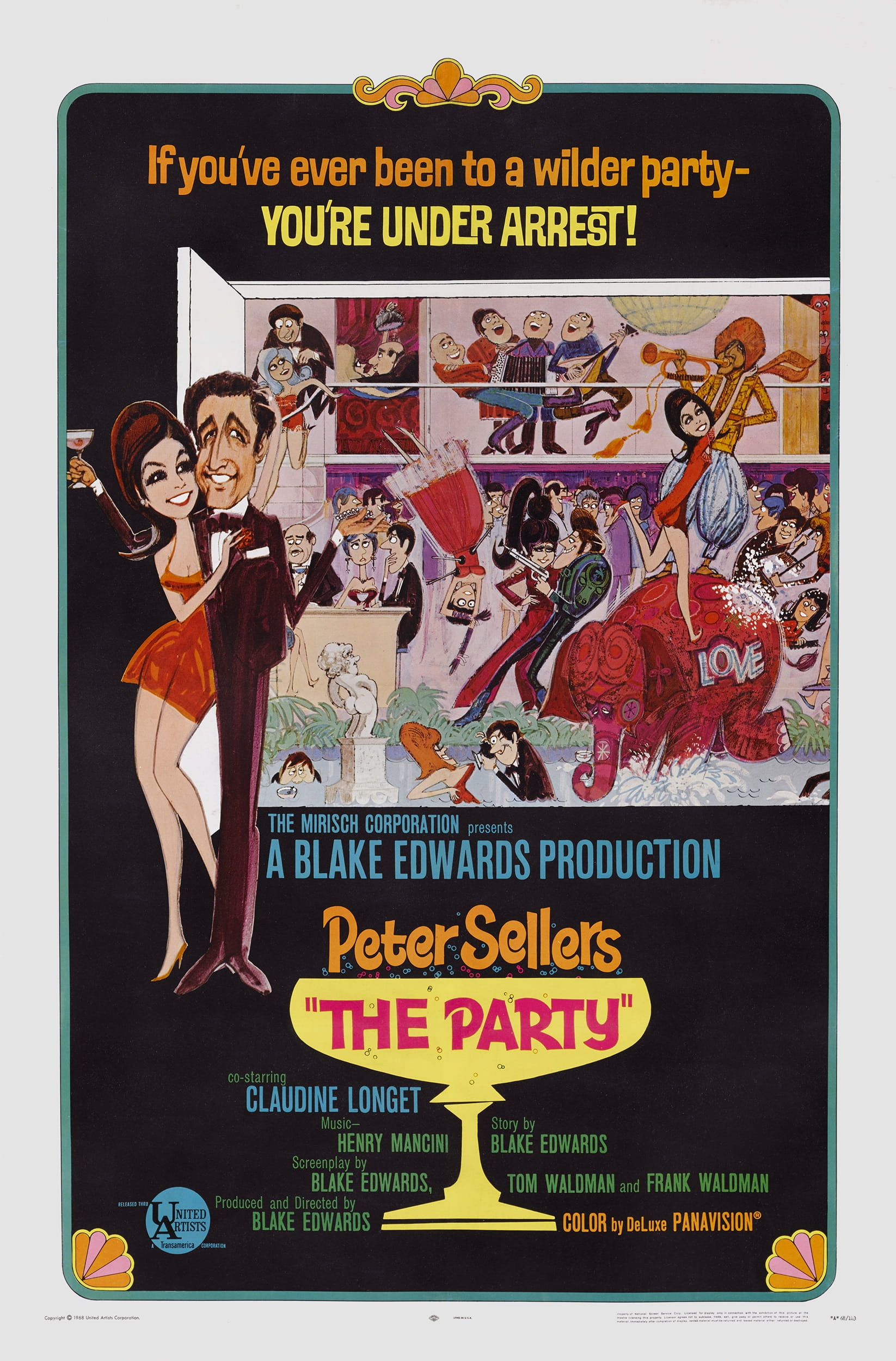 The Party (United Artists, April 4, 1968)
Following the excellent Starship Troopers feedback last week, here’s a selection that might be a little less controversial.
Kidding.
The Party (1968) Who’s in it?Peter Sellers, Claudine Longet, Steve Franken, Denny Miller
What’s it about?Hrundi V. Bakshi (Sellers) is an up and coming Indian actor who dreams of the big time. Unfortunately, being prone to mishaps leads to him blowing up a very expensive film set, and he is fired on the spot. Due to a clerical error though, he ends up on the guest list to a party being thrown by the film’s producer, and he attends in the hope that he can apologize in person. Through no fault of his own, Bakshi stumbles through one surreal incident after another, ultimately leading to the partial destruction of a Hollywood mansion, and a blossoming romance with a young French starlet.
Why do I love it?A perennial family favorite and endlessly quotable; “Birdie num num,” and “I would have been most disappointed if you had not crushed my hand,” are a couple that we use in any given situation.
Of course we should address the painted elephant in the room — Sellers is playing an Indian actor, complete with brown-face and head gestures, so incredibly taboo in this day and age, and there’s nothing I can say to defend it. I will venture one small snippet though with the fact that this film was a huge hit in India, and a favourite of the then PM, Indira Gandhi, who was prone to quote it herself. So there’s that.
Moving on, Sellers’ performance aside (he is, of course, Jacques Tati-inspired perfection), for me the star of this daft slice of celluloid is Steve Franken, who plays Levinson, the increasingly inebriated server. While Levinson is keeping the party guests lubricated, he is also secretly draining any leftovers he happens upon, and is soon three sheets to the wind. Franken’s physical comedy chops are on full display here as he staggers and weaves around the house, baffling guests and infuriating his boss who finally snaps and tries to throttle him in the kitchen, a tableau only revealed to us in a living triptych as the kitchen door swings open and shut during the struggle.
I can’t forget the beautiful score by Henry Mancini either, especially the dreamy song ‘Nothing to Lose’ wistfully sung by Longet at the midway point. A sheer delight.
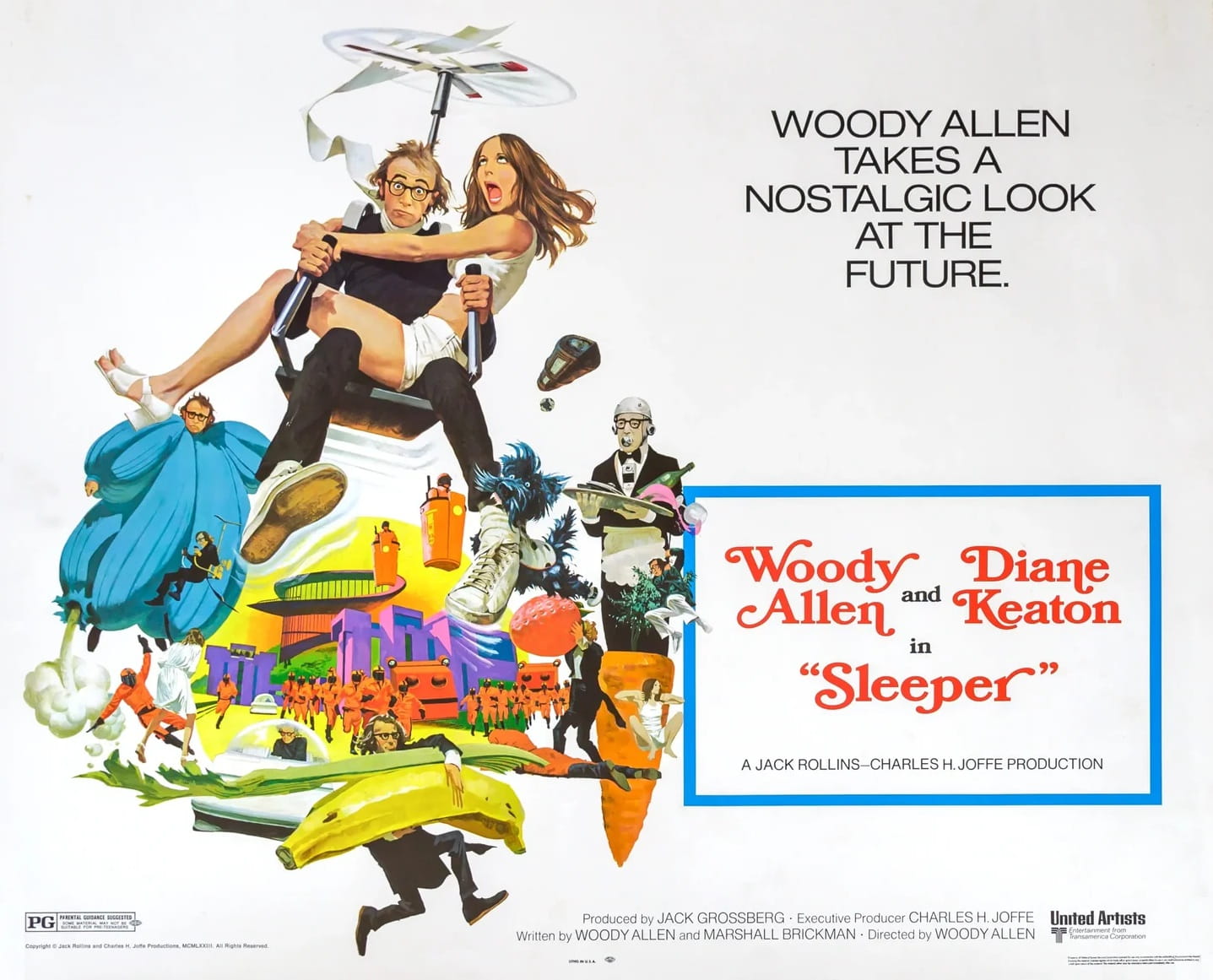 Sleeper (United Artists, December 17, 1973)
Sleeper (1973)
Who’s in it?
Sleeper (United Artists, December 17, 1973)
Sleeper (1973)
Who’s in it?
Woody Allen, Diane Keaton, Jon Beck, Don Keefer
What’s it about?Miles Monroe (Allen), a mild-mannered owner of a health food store, goes into hospital for a routine operation, which goes wrong. He is placed in a cryogenic chamber and forgotten about, only revived 200 years later when rebel scientists need an unidentifiable citizen to infiltrate the tyrannical government in an effort to bring down their ‘Leader.’ Monroe is forced to go on the run after the rebels are captured by the police state, and ends up entwined with socialite slacker, Luna Schlosser (Keaton). Through a series of misadventures they both end up back with the rebels, where Luna falls for the rebel leader, Erno (Beck). After accidentally foiling the government’s efforts to clone the Leader from his only remaining body part, his nose, Monroe and Luna go back on the run again, knowing that staying with the rebellion would only lead to more political power grabbing.
Why do I love it?Speaking of questionable films and filmmakers, if I found it hard to separate the artists from their art then I wouldn’t have read half the books I have, so I have no problem shoving a Woody Allen comedy onto this list.
Sleeper is one of a trio of his early films that I adore (the others being Bananas (1971) and Love and Death (1975)), and it’s the Allen film I return to time and time again. I’ve seen other reviews of Sleeper describe it as Allen’s most Chaplin or Keaton-like, and it’s hard to disagree. The physical comedy, running around, balancing on a ladder, certainly channels Buster Keaton at his best, and he reserves the Charlie Chaplin influence for close-ups to great effect, but it’s not all fighting off sentient puddings or slipping on genetically mutated banana peels. Allen peppers the script with his usual wry observations and self-deprecation and, as was his wont in the early films, usually ties it all back to sex (or lack of it).
It’s the physical comedy for me though; the hapless police and their useless weapons, the flying machine (which made me laugh like a drain when I contemplated him being stuck, rotating in a tree’s branches until the battery ran out), and the ‘Orgasmatron’ plus bonus ‘sex orb’. Diane Keaton showed what a brilliant comedian she was, holding her own in improvised scenes and perfecting the vacant stare, and Allen’s jazz soundtrack is to die for.
Also, did you ever realize that ‘God’ spelled backwards is ‘dog’?
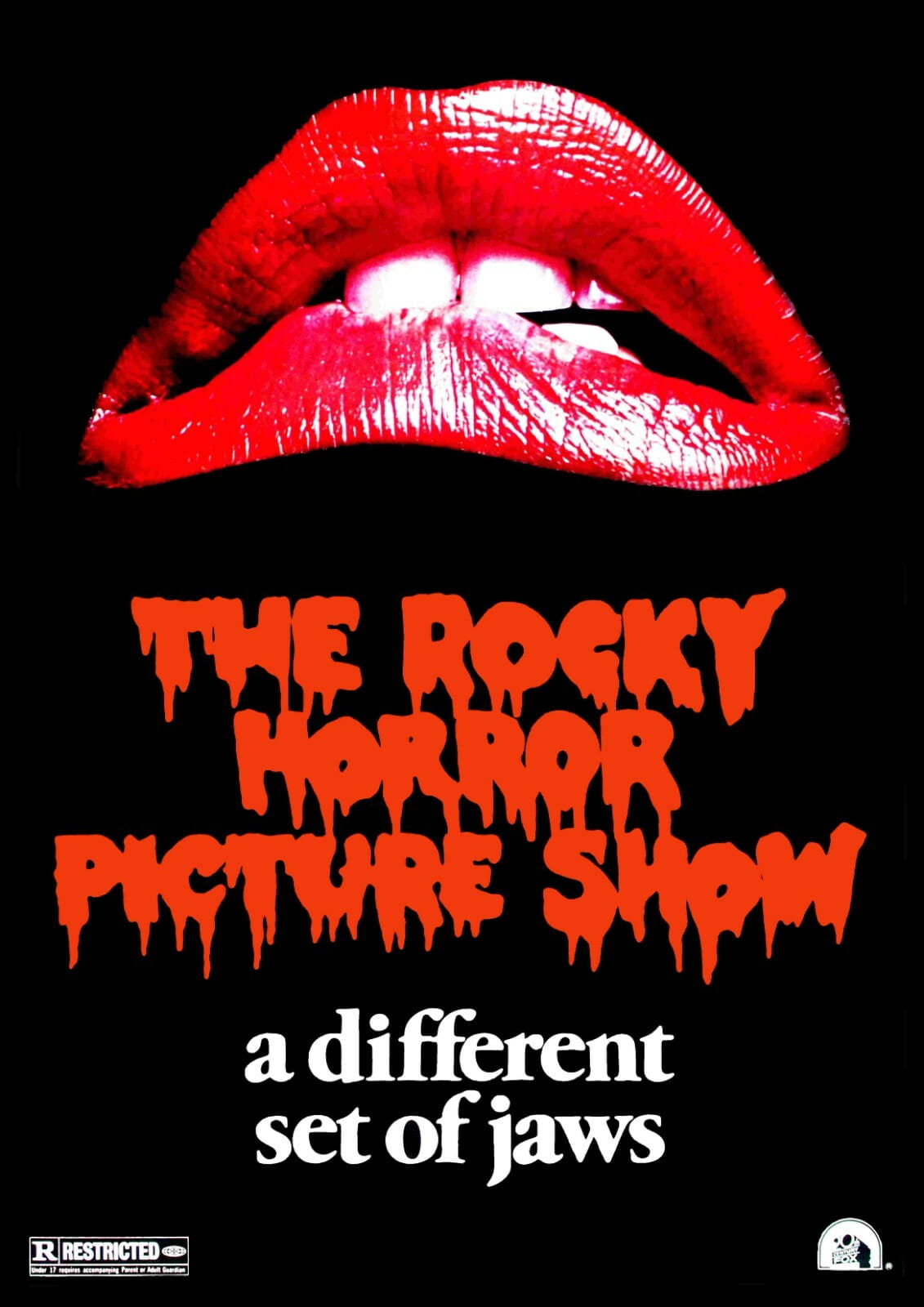 The Rocky Horror Picture Show (20th Century Fox, August 14, 1975)
The Rocky Horror Picture Show (1975)
Who’s in it?
The Rocky Horror Picture Show (20th Century Fox, August 14, 1975)
The Rocky Horror Picture Show (1975)
Who’s in it?
Richard O’Brien, Tim Curry, Susan Sarandon, Barry Bostwick
What’s it about?An innocent young couple, Janet Weiss (Sartandon) and Brad Majors (Bostwick) are on their way to their university professor’s home to celebrate their new engagement when their car suddenly breaks down in a terrible thunderstorm. They run to the closest house in the hopes of finding a phone, but this house is inhabited by an assortment of glorious weirdos who appear to be dedicated to partying and free sex. This throng is led by the fabulous Dr. Frank N. Furter (Curry), a transvestite scientist in the process of building the perfect man. As Brad and Janet try to survive the night, their innocence is shattered by the highly charged energy of the place, and they both undergo sexual awakenings thrust upon them by the aliens who run the place. Hijinks ensue.
Why do I love it?I’m not a fan of musicals, although I make an exception for this one (and Little Shop of Horrors (1986)), purely because everyone seems to be having a lovely time, and the lyrics are hilarious. I saw Rocky Horror in 1983 at a good age, 16, when teens are legally obliged to be discovering who they really are, and it turned out that I was a kid in love with Susan Sarandon who rather enjoyed wearing fancy clothes to the subsequent stage productions I took myself off to. Confusing times!
Still, the main reason I adore this film is, of course, Tim Curry. I had seen him as the Pirate King in The Pirates of Penzance one year earlier and his stage presence, let alone his astonishing voice, was still fresh in my mind. What a whiplash when I saw him not as an overtly rogueish ne’er-do-well, but as a maniacal, fragile, highly sexual ‘sweet transvestite.’ Cue more confusion for teenage me.
Curry is hypnotic, and as much as I enjoy all the preamble and set-up at the start of the film, when I watch his stomping high heel descending in the elevator I know I can finally settle in and let myself go with the flow. I watched it again recently after quite a break, and it truly felt like slipping on a comfortable old pair of fishnets. Ha! Take that, slippers. The songs were as fresh as ever (my personal favourite is the beautifully haunting ‘Over at the Frankenstein Place’), the frantic direction was energetic and subversive, and it still made me feel like I shouldn’t be watching it. Time to show my kids.
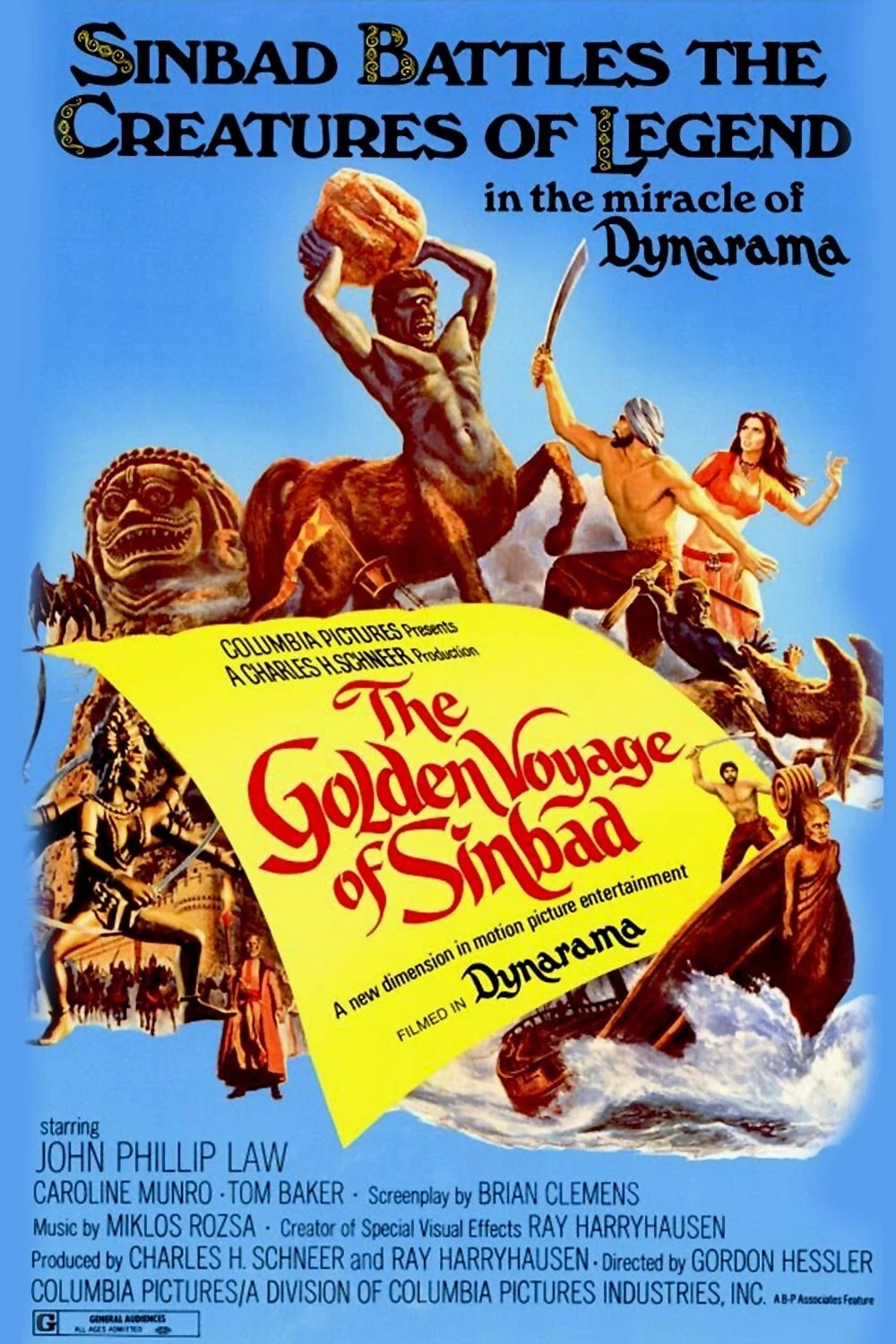 The Golden Voyage of Sinbad (Columbia Pictures, January 25, 1974)
The Golden Voyage of Sinbad (1973)
Who’s in it?
The Golden Voyage of Sinbad (Columbia Pictures, January 25, 1974)
The Golden Voyage of Sinbad (1973)
Who’s in it?
John Phillip Law, Caroline Munro, Tom Baker, Martin Shaw.
What’s it about?When Sinbad (Law) intercepts a homunculus messenger from the evil sorcerer Koura (Baker) it leads him to the Grand Vizir of Marabia, who requests Sinbad’s help in stopping Koura from acquiring the three pieces of a golden artifact that will lead the owner to the Fountain of Destiny and provide them with immortality, invisibility, and riches. A servant girl, Margiana (Munro), joins them on this quest, as she was born with the mark of an eye on her palm, which seems connected to the artifact. So off they sail, encountering several Harryhausen beasties along the way, in an effort to defeat Koura, protect the kingdom of Marabia, and uncover the secret of the eye.
Why do I love it?Two of the films on this list of thirty are true comfort films for me (you’ll meet the other in the final spot) — films that feel like old friends, always there to cheer me up when I’m down, or distract me when I’m sick. Like any sensible child, I adored all of the films that featured Harryhausen’s wizardry, but this one is my absolute favorite, due to arguably his best bit of stop-motion, Kali (yes, I’m putting her over Jason’s skeletons), and then there’s the little rubbery homunculus, the wooden ship figurehead (the sound design here is fantastic, all squeaks and splinters), and a battle royal between a cyclopean centaur and a (sadly underused) griffin.
Golden Voyage has the best cast of any of the films. Law is a fantastic Sinbad, masculine, respectful, wily, and he is ably supported by a crew that is not just there as fodder for monsters. Shaw’s Rachid feels like a true shipmate, you get the sense they have seen a lot together, and he acts as the voice of reason to Sinbad’s whims. Then there’s Tom Baker’s tortured turn as Koura, all wild eyes and gnashing teeth. Baker sells it in his usual extravagant manner, but never takes it too far, and then we have Caroline Munro. Good lord. I recently made a list of all of my comfort films from every genre, and Munro appears in seven out of twenty of them! I’m sure it’s just a coincidence.
Fun fact: that weird, goat-faced oracle that Sinbad and his chums confront in the temple well? That’s an uncredited Robert Shaw.
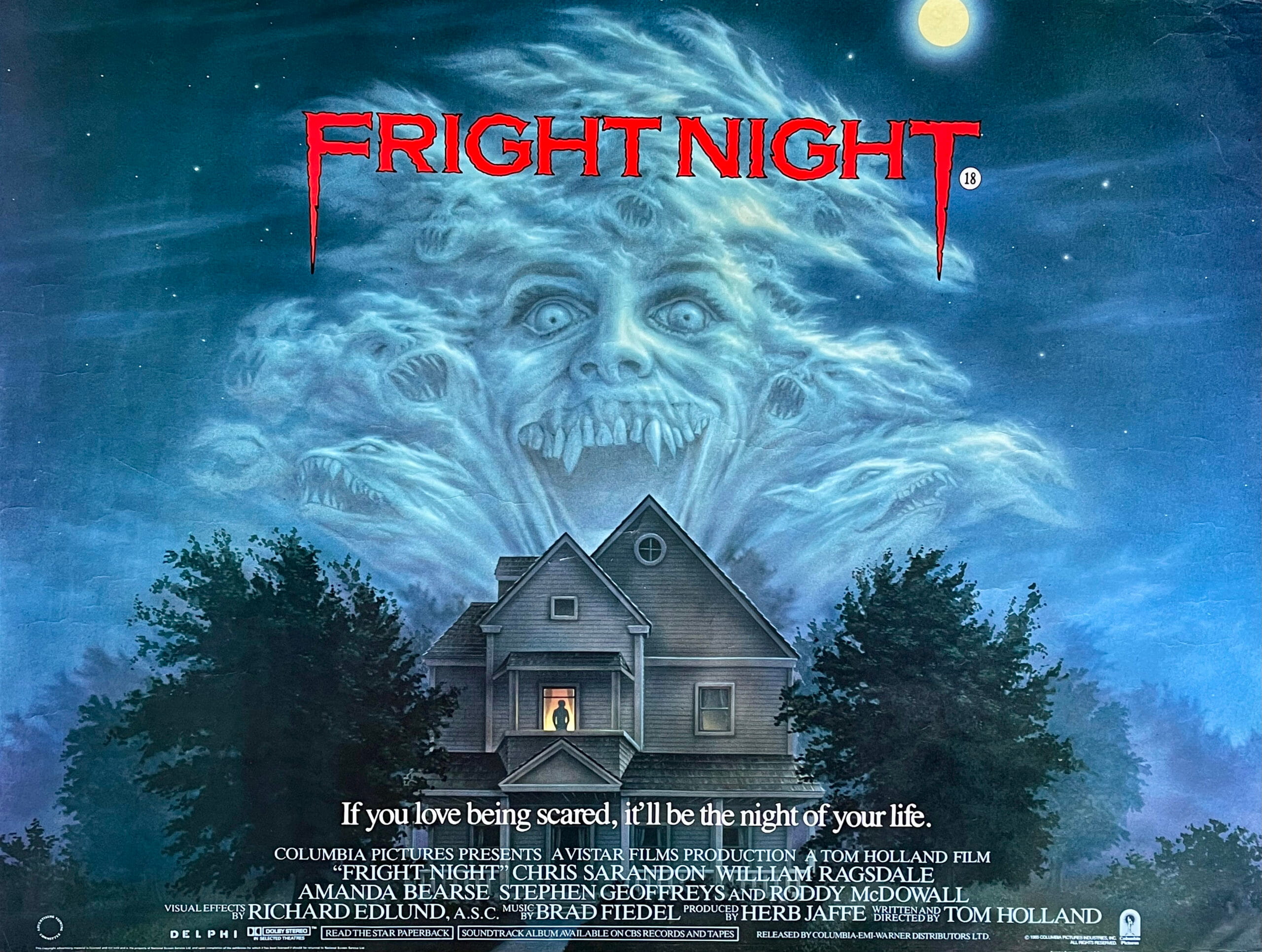 Fright Night (Columbia Pictures, August 2, 1985)
Fright Night (1985)
Who’s in it?
Fright Night (Columbia Pictures, August 2, 1985)
Fright Night (1985)
Who’s in it?
Chris Sarandon, Roddy McDowell, William Ragsdale, Amanda Bearse
What’s it about?Charlie Brewster (Ragsdale) is a horror nut, obsessed with a cheesy TV show that features old horror flicks, introduced by second-rate actor Peter Vincent (McDowell). When he suspects that a vampire (Sarandon) has moved in next door, Charlie eventually recruits Vincent to help him eradicate the monster before it can put the moves on Charlie’s girlfriend, Amy (Bearse). Armed with an encyclopedic knowledge of vampire lore, and some hokey slayer tools, Charlie and Vincent enter the vampire’s lair, ill-prepared and unready to face the monsters within.
Why do I love it?I was at art college when this was released, and had a best friend who was as heavily into horror films as I. We had a mutual love for Hammer and Amicus, hosted regular video parties, and used college resources to practice make up effects. Our first love however was vampire flicks, and every teased image from Fright Night just whetted our appetites even more. Plus, it featured Roddy McDowell, and as huge Planet of the Apes fans, we would watch anything he was in.
The film was playing for one week in the cinema closest to the college, The State Cinema, a 1930’s picture house complete with a wurlitzer organ and scary ticket booth lady. We went to see the film every night that week, steeping ourselves in its gently humorous lore and seductive undertones, to the point that we scared ourselves stupid one night when some leaves rustled in the cemetery we had to walk through to get to the train station. Ah, happy times.
Everything about this film hits the spot; Brad Fiedel’s aggressively boppy score, McDowell’s cowardly custard actor and his redemption arc, Charlie Brewster being a horror freak ‘just like us,’ and the gnarly, blood soaked effects. However, the film belongs to Chris Sarandon. I would argue that there has never been a sexier vampire than his portrayal of Jerry Dandrige. Every word, every move, is precise and effortless (until he gets thoroughly miffed at the end), and he oozes sexual confidence, whether cozying up to his live-in familiar, Billy Cole, or ensnaring Charlie’s girlfriend, Amy, in his nightclub sweater.
The make up and creature effects, headed by Steve Johnson, also make me extremely happy, and this was at a time when we were spoiled for vampire prosthetics (see The Lost Boys (1986), Vamp (1987), Lifeforce (1985) et al). At once hilarious and horrifying, the plethora of creatures on show, vampires, giant bats, an almost cute werewolf, look great and are filmed with appropriate energy by horror legend Tom Holland.
Another one to finally show my kids.
Previous Murky Movie surveys from Neil Baker include:
My Top Thirty Films, Part 1
My Top Thirty Films, Part 2
The Star Warses
Just When You Thought It Was Safe
Tech Tok
The Weyland-Yutaniverse
Foreign Bodies
Mummy Issues
Ch-Ch-Ch-Ch-Changes
Monster Mayhem
It’s All Rather Hit-or-Mythos
You Can’t Handle the Tooth
Tubi Dive
What Possessed You?
See all of Neil Baker’s Black Gate film reviews here. Neil spends his days watching dodgy movies, most of them terrible, in the hope that you might be inspired to watch them too. He is often asked why he doesn’t watch ‘proper’ films, and he honestly doesn’t have a good answer. He is an author, illustrator, teacher, and sculptor of turtle exhibits.
Categories: Fantasy Books
You’ll Love “The Magicians Trilogy” | School Of Hard Knocks (And Spells)
The post You’ll Love “The Magicians Trilogy” | School Of Hard Knocks (And Spells) appeared first on LitStack.
Categories: Fantasy Books
What Stalks the Deep - Book Review
 What Stalks the Deep (Sworn Soldier #3)by T. Kingfisher
What is it about:Alex Easton does not want to visit America.
They particularly do not want to visit an abandoned coal mine in West Virginia with a reputation for being haunted.
But when their old friend Dr. Denton summons them to help find his lost cousin—who went missing in that very mine—well, sometimes a sworn soldier has to do what a sworn soldier has to do...
What did I think of it:I am so in love with this series!
This book was yet another great read. It's funny, witty, suspenseful, and full of creepiness.
I absolutely adore Alex, they're sensible, but at the same time end up in trouble because they're also more courageous then they give themselves credit for.
I had a great time with this book and I wll most probably reread all three books in this series soon, while hoping Kingfisher writes tons more.
Why should you read it:It's a fun and suspenseful Horror read.
Categories: Fantasy Books
Forgotten Authors: Robert Moore Williams
 Robert Moore Williams
Robert Moore Williams was born in Farmington, Missouri on June 19, 1907 and attended the Missouri School of Journalism, from which he graduated in 1931 with a Bachelor of Arts in journalism. He married Margaret Jelley in 1938 and they had one daughter. The couple divorced in 1952.
Williams published his first short story, “Zero as a Limit” in the July 1937 issue of Astounding Science Fiction, at the time still edited by F. Orlin Tremaine. Later in 1937, he published a story in Thrilling Wonder Stories, edited by Mort Weissinger, and his third story, “Flight of the Dawn Star” appeared in the March 1938 issue of Astounding, now edited by John W. Campbell, Jr. By the end of 1938, he added Amazing Stories, edited by Raymond A. Palmer to the list of magazines and editors he sold to.
In addition to science fiction, Williams published in a variety of other genres, occasionally using pseudonyms, including John S. Browning, H.H. Harmon, and Russell Storm. He also used the house name E.K. Jarvis on some stories written for the Ziff-Davis magazines, such as “Hickson’s Strange Adventure.” Although Williams was the most prolific (and possibly only) author to use the Jarvis name in the 40s, Robert Bloch used it most often in the 50s, with seven stories appearing under that byline. Other authors to use it included Paul W. Fairman, Harlan Ellison, Robert Silverberg, and Henry Slesar.
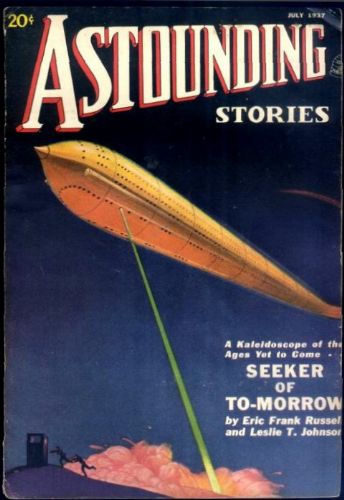 By the end of the 1950s, Williams had sold more than 120 stories to the magazines, and would consider selling short stories throughout most of the decade. He published his first novel, The Chaos Fighters, in 1955, after which he focused primarily on novels, although he had several short stories continue to appear through the end of the decade. Ten of his stories appeared as part of the Ace Doubles series between 1955 and 1964, backed with authors included Leigh Brackett, Eric Frank Russell, John Brunner, Keith Laumer, Terry Carr, and Samuel R. Delany.
While most of the novels Williams published were standalone novels, he did publish novels in two series. The three Jongor novels, which started as novellas published in Fantastic Adventures between 1940 and 1951, were published in book form in 1970 and are a Tarzanesque series focusing on Jongor (born John Gordon) in an Africanized Australia.
His other series, four books about Zanthar, was published as original novels between 1967 and 1969. Just as the Jangor novels were a pastiche of Tarzan, Zanthar is more in line with Burrough’s Barsoom novels, setting human physicist John Zanthar to a foreign and primitive planet courtesy of a cyclotron.
His 1970 novel, Love Is Forever—We are For Tonight has been described by multiple sources as autobiographical and shows a man who has subscribed to Dianetics and Scientology. Other, more science fictional works of the last years of Williams life also have a tendency towards fringe theories. When describing Love Is Forever—We are For Tonight in a Curiosities piece publishe din the January 2007 issue of F&SF, Graham Andrews wrote it “captures his surely unique blend of madness and/or vision in its simon-pure form.”
Gerald W. Page noted that Williams “doesn’t seem to have very often probed deeply into any of his ideas or themes, and this makes some of his work, while perfectly readable on the surface, seem disturbingly incomplete.”
Williams died in Dateland, Arizona on May 12, 1977.
Don D’Ammassa reviewed Williams’ novels on his website, concluding that “Despite his many faults as a writer, Williams is above average for the pulp SF adventure of the 1940s and 1950s. His reputation began to slip during the 1960s as standards for publication rose…”
 Steven H Silver is a twenty-one-time Hugo Award nominee and was the publisher of the Hugo-nominated fanzine Argentus as well as the editor and publisher of ISFiC Press for eight years. He has also edited books for DAW, NESFA Press, and ZNB. His most recent anthology is Alternate Peace and his novel After Hastings was published in 2020. Steven has chaired the first Midwest Construction, Windycon three times, and the SFWA Nebula Conference numerous times. He was programming chair for Chicon 2000 and Vice Chair of Chicon 7.
Categories: Fantasy Books
Book Review: Artifact Space by Miles Cameron
I received a review copy from the publisher. This does not affect the contents of my review and all opinions are my own.
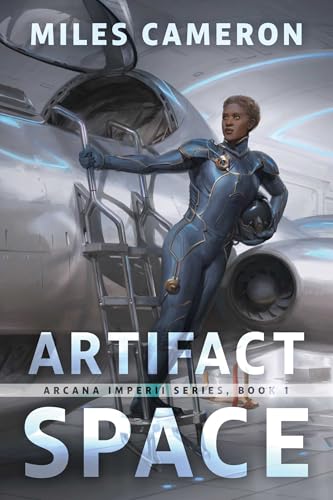 Artifact Space by Miles Cameron
Mogsy’s Rating: 3.5 of 5 stars
Genre: Science Fiction
Series: Book 1 of Arcana Imperii
Publisher: Saga Press (January 27, 2026)
Length: 528 pages
Author Information: Website | Twitter
Artifact Space was a book I felt genuinely excited about checking out. I already have a couple Miles Cameron books under my belt, mostly epic fantasy, but given his range as a writer, a science fiction novel felt like a natural next step. I was curious to see how his style would translate to a space opera setting. That said, military sci-fi being outside of my favorite corner of the genre, I wasn’t too surprised when I ended up struggling a bit.
The story follows a young woman named Marca Nbaro, who, despite growing up in the harsh conditions of an orphanage, has dreamed for years of one day being able to travel to the stars. And at long last, after countless hours of training and preparation, she finally has the chance to join the crew of the Athens, one of the massive Greatships involved in interstellar trade across the galaxy. Unfortunately though, getting aboard isn’t exactly legal. Marca had to spend the last of her resources forging her papers, which means that even if she manages to pull off her long-awaited escape, she’ll be at constant risk of being exposed.
Marca’s efforts pay off, however, when she is allowed onboard and made midshipman. Throwing herself into learning the ropes, she also tries to earn her place among the crew by adjusting to the realities of life on a Greatship run by a ruthless mercantile government. The primary mission of the Athens is the transport of a rare and immensely valuable material called xenoglas, which forms the backbone of human and alien trade. Crew schedules are tightly structured, and any mistakes are judged harshly, which only heightens Marca’s fears of being discovered and cast out. But even as she struggles to prove herself while keeping her head down, the ship becomes involved in an increasingly complicated web of trade politics and risky encounters, pushing Marca well beyond simply trying to get by unnoticed. Apparently, her past isn’t as easy to outrun as she’d hoped.
In a way, Artifact Space almost reads like a slice-of-life book, focusing on everyday moments of Marca’s life aboard the Athens as we follow her through the training routine and developing relationships with the other crew members. That’s not to say the story isn’t plot-driven or devoid of drama and action, because there’s plenty of those. Rather, we just work towards them more gently and slowly. Indeed, a high-stakes conflict does eventually emerge from a series of escalating developments that hint at bigger things in the background.
But while this setup is impressive, I think it’s also what caused the book to drag for me. One quirk I noticed is that although the Athens is a trading vessel, life onboard resembles more like the navy. There’s a lot of complex military-like jargon, heavy emphasis on ranks and hierarchies, as well as the logistics of operations and transport. Cameron clearly wants the reader to view these dynamics as an ecosystem and to understand how they function. The same goes for the political side of the story involving trade alliances and power structures. Of course, none of this is inherently bad, but I confess it didn’t always hold my interest. While I can appreciate this extreme level of detail, at times the minutiae can feel a little overwhelming and more methodical than I personally prefer.
My feelings are also mixed when it comes to Marca. As a protagonist, she’s clearly meant to be likeable, but emotionally, there was a distance. Character work was perhaps on the weaker side, as I often found it difficult to connect with her on a deeper level. For example, her reactions, especially when it came to attraction and romantic elements, didn’t feel fully developed or convincing. The camaraderie between the crew members added some warmth, but many of those relationships stayed fairly surface-level.
That said, the world-building is truly incredible. Just like in his fantasy and historical fiction, Cameron’s attention to detail pays off. The Greatships are a unique concept, giving off cool old-school-meets-futuristic-tech vibes. The setting feels well thought-out and lived in. Storytelling is consistent and shows plainly that it knows where it’s going and what kind of narrative it wants to be, even if it didn’t always line up with my own tastes.
In the end, Artifact Space is a solid start to a new series, but it doesn’t end on a cliffhanger and so also works perfectly well as a standalone. The scope of its wider world reminded me a little of The Expanse, while the more intimate, zoomed-in looks at daily life aboard the Athens even reminded me a little bit of The Wayfarers. Personally though, I do think experience or an appreciation for military sci-fi will help increase enjoyment. I didn’t love this, but I didn’t dislike it either, and I’m curious enough about where things are going that it’s likely I’ll be picking up the sequel.


Categories: Fantasy Books
Dark Muse News: Anna Smith Spark’s A Sword of Bronze and Ashes
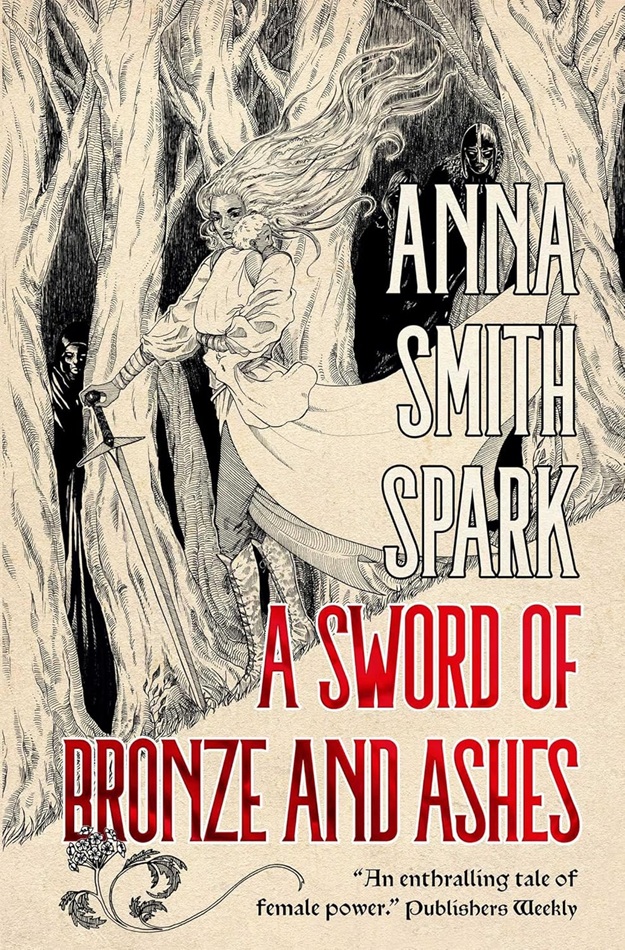 A Sword of Bronze and Ashes, September 12, 2023, FLAME TREE PRESS (Cover illustration by Broci)
Welcome to more Dark Muse News. This post reviews Anna Smith Spark’s A Sword of Bronze and Ashes. It was released in September 2023 (Flame Tree Press, cover illustration by Broci) and is the first book of the series The Making of This World: Ruined. The sequel, A Sword of Gold and Ruin, was recently published in October, 2025.
Anna Smith Spark is known as the Queen of Grimdark, a moniker she acquired with her Empires of Dust series. You can expect the same poetic brutality here. Her style and approach are very unique but are reminiscent of Tanith Lee. Literary wording may keep you distanced as a reader, but the raw emotion expressed throughout is so real that it makes the fantasy feel real, too. We interviewed Anna Smith Spark in 2019 – Disgust and Desire as part of our Beauty in Weird Fiction series, where she revealed all sorts of muses and inspirations. That year, we hosted a Q&A Session at Gen Con; there, she, John O’Neill, and I showed off our footwear (link); Anna’s footwear won hands down!
Anyway, this post reviews the book, offers excerpts, and explains a few new blurbs we posit:
- A Sword of Bronze and Ashes could easily represent Hellblade 3: Family Edition!
- If Lewis Caroll’s Alice lived within Little House on the Prairie, infected by Silent Hill, you would experience A Sword of Bronze and Ashes!
A Sword of Bronze and Ashes combines the fierce beauty of Celtic myth with grimdark battle violence. It’s a lyrical, folk horror high fantasy.
Kanda has a good life until shadows from her past return threatening everything she loves. And Kanda, like any parent, has things in her past she does not want her children to know. Red war is coming: pursued by an ancient evil, Kanda must call upon all her strength to protect her family. But how can she keep her children safe, if they want to stand as warriors beside her when the light fades and darkness rises?
Introducing Ikandera Thygethyn (Kandra)Kandra is the dominant protagonist. She is haunted by memories of her mythological past. At first, it seems she is an unreliable narrator, perhaps a mentally ill one, whom her family, and you as a reader, must trust simply because she is mom. The antagonizing forces do not just affect her, though, and the family embarks on a quest for sirvavil together. This is really fresh stuff. How often have you read a book with these qualities:
- Female protagonist… not a warrior like Jirel of Joiry or Marcel’s Black Widow, but a mother living in a remote homestead
- She is aging… not in her young prime
- Having an identity crisis… not a confident heroine, but one full of doubts and insecurities, fighting memories and dreams
- Accompanied by her family (three young daughters and a passive, farmer husband)… not a sword-wielding buddy or party of four adventurers
As surely as Kandra wrestles with aging and her identity evolving, she must endure watching her children become independent as they all confront supernatural horrors. Kandra is battling with self-talk and arguments with ghosts. She was once a warrior, but now she is an old mother. Check out Kandra’s description of herself in the Excerpts below. Strangely, I was reminded of Kate McKinnon’s performance on Saturday Night Live with her Gifts from Mom skit, where she plays the stereotypical apologetic, insecure mother. This book is far from comedy, but Kandra is definitely dealing with similar emotions.
Kandra, with her husband Dellet, has three daughters: the oldest is Sal, who is empathetic and quieter compared to the middle child, Calian. Calian is spunky and channels similar powers as her mom; her coming of age as a de facto apprentice sparks much parental grief. The youngest, Morna, offers an innocent perspective and vulnerability.
The mystery of what Kandra did/experienced before marrying Dellet is carefully revealed chapter by chapter. It is tough for her and her family to discern fantasy from reality. Some spell casting is traditional, but one particular mechanic really plays with your mind. As Kandra’s horrors and past threaten her family, she protects them by telling stories. Somehow, the act of storytelling literally creates a shieldwall against lingering nightmares. The implication is wildly fantastic: fiction protects people from supernatural horrors that are becoming real!
If Lewis Caroll’s Alice lived within Little House on the Prairie, infected by Silent Hill, you would experience A Sword of Bronze and Ashes!Millieu
I am not a native of England or Wales, but as an outsider, the setting screams Celtic and Welsh vibes. Actually, with the potentially psychotic Ikandera Thygethyn in the lead, with disembodied voices and haunting memories stalking her across the Hall of Roven and the mountainous Mal Amwen, I was reminded of the video game series from Nija Theory, Hellblade: Senua’s Sacrifice and Saga. That game series features Senu, a Pict warrior, on a haunting journey to Vikingesque Helheim to save her lover’s sou known for highlighting mental health through auditory and visual hallucinations, brutal combat, and perception-based puzzles. Rumor has it that a third game is in the works, and there is no reason to think Anna Smith Spark is involved (thought that would be cool); however, A Sword of Bronze and Ashes could easily function as Hell Blade 3: Family Edition. Think of Senua going through the same horrors, facing similar sword battles, but with a family in tow!
A Sword of Bronze and Ashes could easily function as Hellblade 3: Family Edition!Excerpts: Kandra Describes Herself:
“I wet myself when I laugh too hard, Geiamnyn, I have stretch marks from my armpits to my kneecaps, every other month my bleed is so heavy I should strap a cauldron between my legs. You forgot to mention those things. I’m sure my husband could tell you more about me, if you ask him, I sweat in my sleep so the blanket needs washing, I snore, I fart in my sleep, sometimes I piss and fart when I come.” – p103
Fighting with a Family in TowKandra’s sword clashed against the faceless woman’s white blade. The woman too shrieked in joy. White fire crashed around them, the shock of it crashed through Kandra. So long. Too long. A vast shape rising before her, tall as the sky, all she could see. Arms of white fire, wings of white fire, a sword of fire, a crown of gold flames. She saw it with her eyes closed and burning. She tried to raise her sword, her arms were on fire, her sword was melting, glowing, the bronze glowed and dripped. She could hear the children screaming. through pain she lashed out, felt the blade meet and open long-dead bloodless flesh. “Dellet!” she screamed. “Dellet, get away. The children, Dellet!” -p23
Weird Conflict & MeleeKandra came to meet the [a “hodden”, think scarecrow with a horse skull]. The broken sword was out, the sword met the stone hand with a stroke so mighty chips of stone flew up. It towered over her, the length of its wooden arms was twicethe twice the length of her sword blade. She spun back, hacked low at its legs. Her sword caught its left leg and sank into it, sending out a shower of rotten wood dust. It neighed, its teeth clacked. A flint hand came down heavily against the shoulder, pain blossomed, she twisted away drgggin the sword out. She tried not hear her family’s cries as they saw she was bleeding. She staggered, struck again. Harder! Harder! A shower of wood dust that made her choke. Splinters of rotten wood in her mouth. Now Kandra gagged and rethced. The hodden lumbered forward, smashed Kandra sideways. She grasped its arm, the wood crumbling under her hand, driving splinters into her skin… -p52
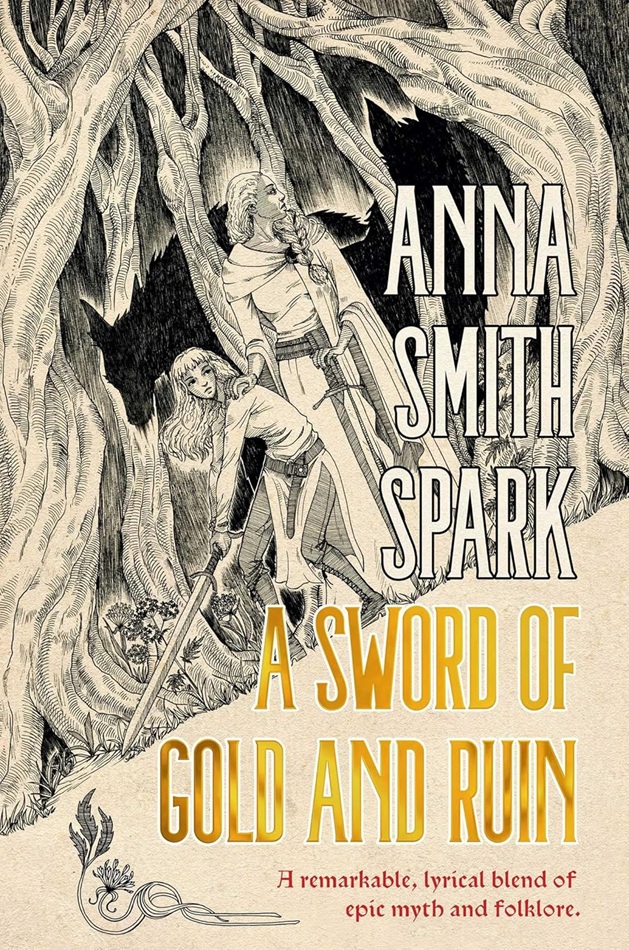
Sequel just arrived October 21, 2025: A Sword of Gold and Ruin Cover BlurbThe sequel to the masterpiece folk horror high fantasy A Sword of Bronze and Ashes, a lyrical blend of epic myth and daily life.
Kanda and her family are on a quest to rebuild the glory that was Roven. Mother and daughters stand together as a light against the darkness. But mother and daughters both have hands that are stained red with blood. They walk a path that is stranger and more beautiful than even Kanda dared imagine, bright with joy, bitter with grief. Ghosts and monsters dog their footsteps – but the greatest monsters lie in their hearts.
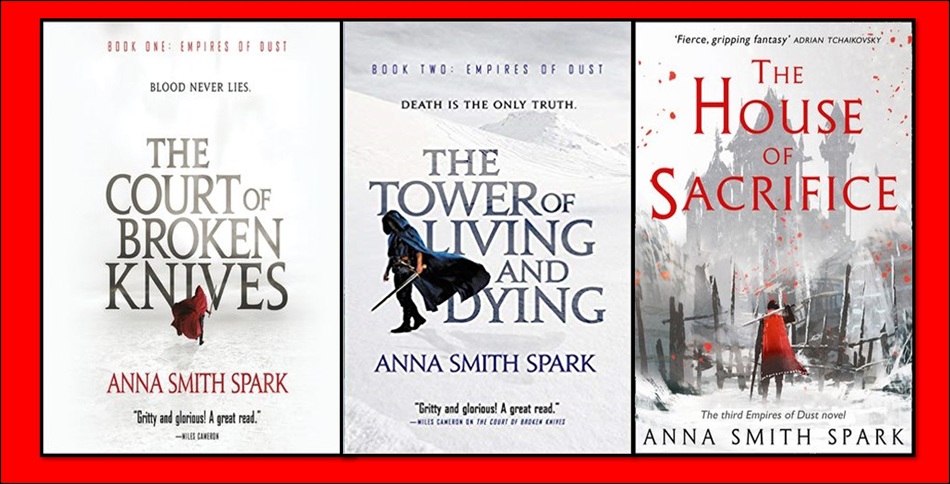
Anna Smith Spark is a critically acclaimed, multi-award short-listedgrimdark epic fantasy novelist. She writes lyrical prose-poetry about war, love, landscapes, and war. Her writing has been described as ‘a masterwork’ by Nightmarish Conjurings, ‘an experience like no other series in fantasy’ by Grimdark Magazine, ‘literary Game of Thrones’ by the Sunday Times, and ‘howls like early Moorcock, converses like the best of Le Guin’ by the Daily Mail. Her favourite authors are Mary Renault, R Scott Bakker and M. John Harrison
S.E. Lindberg is a Managing Editor at Black Gate, regularly reviewing books and interviewing authors on the topic of “Beauty & Art in Weird-Fantasy Fiction.” He has taken lead roles organizing the Gen Con Writers’ Symposium (chairing it in 2023), is the lead moderator of the Goodreads Sword & Sorcery Group, and was an intern for Tales from the Magician’s Skull magazine. As for crafting stories, he has contributed eight entries across Perseid Press’s Heroes in Hell and Heroika series, and has an entry in Weirdbook Annual #3: Zombies. He independently publishes novels under the banner Dyscrasia Fiction; short stories of Dyscrasia Fiction have appeared in Whetstone Amateur S&S Magazine, Swords & Sorcery online magazine, Rogues In the House Podcast’s A Book of Blades Vol I & II, DMR’s Terra Incognita, the 9th issue of Tales From the Magician’s Skull, Savage Realms Magazine, and Michael Stackpole’s S&S Chain Story 2 Project.
Categories: Fantasy Books
Spotlight on “The Optimists” by Brian Platzer
Other LitStack Spots Along with this book in our LitStack Spotlight, our interests have been…
The post Spotlight on “The Optimists” by Brian Platzer appeared first on LitStack.
Categories: Fantasy Books
'The Five: The Untold Lives of the Women Killed by Jack the Ripper' by Hallie Rubenhold

Polly, Annie, Elizabeth, Catherine and Mary-Jane are famous for the same thing, though they never met.
They came from Fleet Street, Knightsbridge, Wolverhampton, Sweden and Wales. They wrote ballads, ran coffee houses, lived on country estates, they breathed ink-dust from printing presses and escaped people-traffickers.
What they had in common was the year of their murders: 1888.
Their murderer was never identified, but the name created for him by the press has become far more famous than any of these five women.
Now, in this devastating narrative of five lives, historian Hallie Rubenhold finally sets the record straight, and gives these women back their stories.
⦾
The Five: The Untold Lives of the Women Killed by Jack the Ripper by Hallie Rubenhold, read on audiobook by Louise Brealey.
“Poor women were expendable …”
I listened to the audiobook of this, via my library's BorrowBox app - even though I've also owned the B-format paperback since about 2020, I could just never bring myself (or my heart) to pick it up and read it of my own volition, but on audiobook I tore through it. And under the talent of Brealey's narration, who could bring out various regional accents to really help things along - it was superb.
This was such a tough listen but I’m really really glad that I finished this book and I found it to be an extraordinary non-fiction work and by far one of the best non-fiction books I’ve read in a long time.
I was completely upended, however to discover that this book has pissed off so many people and specifically “Ripperologists” to the point that Hallie Rubenhold has been horribly abused and harassed because she did to research into the canonical five victims of Jack the Ripper - and put fourth credible evidence that not all of them were prostitutes as the sick lore of this madman murdering spree dictated for so long.
Her book is a gracious and human examination of what it meant to be a woman in the 1880s and the impossible position that they were put in to either be Madonna or whore. She digs into the Victorian mindset of the time that insisted that their murders had to somehow be prescriptive to the wider public and so they were painted as Scarlet women. Their stories absolutely broke my heart and patterns did emerge in all of them — domestic violence, alcoholism (if only to have some alleviation from the drudgery of being a woman at the time) … the way people were kept impoverished and women in particular who had to bear the burden of childbirth and child rearing. Lack of education being the lightning rod overarching issue for so many people of this time. Just an incredible historical examination of everything never said about these women that I found to be so touching and crucial.
As I was reading, I was repeatedly struck by the realisation of how true it is now - just as it was in 1888 - that all it takes is a bad bout of luck, illness or injury for any one of us to experience houselessness and our fate to be completely undone. I thought that about each of these women at so many points in their life as Hallie unpicked them for us ... and my god, did my heart go out to them - across space and time.
The very final chapter in the book is the Author listing all of the items found on four of the victims upon their death; in one of their pockets was one red mitten — and that visual is just touching and heartbreaking, as was the entire book.
5/5
Categories: Fantasy Books
'The Ministry of Time' by Kaliane Bradley

From the BLURB:
A BOY MEETS A GIRL. THE PAST MEETS THE FUTURE. A FINGER MEETS A TRIGGER. THE BEGINNING MEETS THE END. ENGLAND IS FOREVER. ENGLAND MUST FALL.
In the near future, a disaffected civil servant is offered a lucrative job in a mysterious new government ministry gathering 'expats' from across history to test the limits of time-travel.
Her role is to work as a 'bridge': living with, assisting and monitoring the expat known as '1847' - Commander Graham Gore. As far as history is concerned, Commander Gore died on Sir John Franklin's doomed expedition to the Arctic, so he's a little disoriented to find himself alive and surrounded by outlandish concepts such as 'washing machine', 'Spotify' and 'the collapse of the British Empire'. With an appetite for discovery and a seven-a-day cigarette habit, he soon adjusts; and during a long, sultry summer he and his bridge move from awkwardness to genuine friendship, to something more.
But as the true shape of the project that brought them together begins to emerge, Gore and the bridge are forced to confront their past choices and imagined futures. Can love triumph over the structures and histories that have shaped them? And how do you defy history when history is living in your house?
'The Ministry of Time' is the debut novel from British-Cambodian writer and editor based in London, Kaliane Bradley.
So, this may well be my favourite book of 2024. WOW-ee. What an enjoyable read, especially for a low-science fiction girly whose particular proclivity is time-travel tales (those are always my fave 'Doctor Who' episodes, the back-in-time ones). So, some random observations;
⦿ I am very fond of 2005 YA novel 'The White Darkness' by Geraldine McCaughrean, which is about a teenage girl who is genuinely in love with (the long-dead) Captain Lawrence 'Titus' Oates from the doomed Terra Nova Expedition. So when I read the blurb for 'The Ministry of Time' about Britain having harnessed time-travel and successfully bought six travellers from various eras to the modern-day, including Commander Graham Gore from the doomed Franklin expedition - I was all in. *Especially* when the blurb hinted that Gore's present-day "bridge" - the protagonist of the novel who is tasked with helping him acclimatise and who maybe starts to develop feelings - I was *ALL IN*.

⦿ Time-travel has always been my bag. Modern-day women falling for out-of-time men is my particular favourite sub-genre ... I know exactly when this started; 'Playing Beatie Bow' by Ruth Park, and the time-travelling Abigail falling for Judah in the 1800's. This was particularly cemented when I read 'Outlander' by Diana Gabaldon as an 18-year-old; WWII army-nurse Claire passing through the stones to Jamie Fraser in the 18th century. No doubt there's some Marty McFly 'Back to the Future' Michael J. Fox appreciation thrown in there too. But this sub-genre of sci-fi and time-travel is my jamboree. And 'The Ministry of Time' gave it to me in HEAPINGS of timey-wimey goodness. The romance is slow-burn but makes up for it because our protagonist (whose name we don't know, but we get an intimate first-person account from) crushes HARD on Gore and that amps up the burn. But I was also very sucked into the mechanics and politics of the time-travel itself, so it wasn't like I was ever cooling my heels and checking my watch for the low sci-fi to get good ... it was ALL good.
⦿ The politics of time-travel in this book reminded me of the Norwegian sci-fi series 'Beforeigners', about people from different time-periods suddenly randomly appearing in Oslo, becoming refugees of time that the Norwegian government has to deal with. It's also a little bit like the (brilliant) Aussie TV series 'Glitch' set in a small outback town where; 'Seven people from different time-periods return from the dead with no memory and attempt to unveil what brought them to the grave in the first place.' I like this connection in particular because there's a shady organisation linked to the raising of the dead, a big-pharma laboratory called "Noregard" (best in-universe name for a corporation, ever.) It's also a wee bit like the 2001 rom-com starring Hugh Jackman and Meg Ryan, 'Kate & Leopold' about an English Duke from 1876 falling for a modern-day New Yorker when he's unceremoniously dragged into the future. If any/all of those recs are your picnic; this book is for you.

⦿ He filled the room like a horizon ... the writing was sumptuous, and gorgeous at times. Sometimes Bradley had a turn-of-phrase of description that made me go "ohhhhh." When something changes you constitutionally, you say: ‘the earth moved,’ but the earth stays the same. It’s your relationship with the ground that shifts.
⦿ I actually first heard about this book, in a Guardian round-up of British debuts to look out for, and the description of Kaliane Bradley's idea made my spine sizzle and then I Googled her even more and found that she partly wrote the idea for 'The Ministry of Time' during Covid and lockdowns and because she kinda fell in love with the only photograph of Graham Gore. No, really. 'Kaliane Bradley Fell in Love With a Dead Man. The Result Is The Ministry of Time' ... if that's not an *amazing* sales-pitch I don't know what is.

⦿ I just loved this. It's extremely cinematic and I wouldn't be surprised to find it is being developed into a movie or limited-TV series. It both feels appropriately head-nodding to plenty of other fabulous low-sci-fi time-travel that will make aficionados happy, but also sparkly-unique enough to keep adding to the conversation about the space-time continuum. Even if I guessed the small twist that comes, I did so because I know this sub-genre so well and expected certain markers along the way and Bradley did not disappoint. I loved this so much, I was only one-chapter in when I knew it'd give me the best bookish hangover and be hard book to follow-up, probably throwing me into a reading-rut.
5/5
Categories: Fantasy Books
'Love, Death & Other Scenes' by Nova Weetman

From the BLURB:
Nova Weetman’s unforgettable memoir reflects on experiences of love and loss from throughout her life, including: losing her beloved partner, playwright Aidan Fennessy, during the 2020 Covid lockdown; the death of her mother ten years earlier; her daughter turning eighteen and finishing school; and her own physical ageing. Using these events as a lens, Nova considers how various kinds of losses – and the complicated love they represent – change us and can become the catalysts for letting go.
This is a moving, honest account of farewelling a partner of twenty-five years, parenting teenagers through grief, buying property for the first time at the age of fifty, watching Aidan live on through his plays, and learning to appreciate spending hours alone with only the household cat for company. Warm and wise – and often joyful – Love, Death & Other Scenes ultimately focuses on the living we do after losses and what we learn from them.
At one point while reading Nova Weetman's memoir, I said out loud to the empty room; "Geez, you're good Nova."
Such was the power and force of certain sentences, ideas, inflections and offerings throughout. "As writers, we are stealers of other peoples memories, bowerbirds of story," she writes at one point - and then puts that ability to collect on full display throughout as she recounts the life she built with her partner, playwright Aidan Fennessy, who battled and then died from prostate cancer in 2020 during Melbourne's numerous lockdowns and waves of Covid.
I know Nova as a colleague, a fellow middle-grade author and someone I greatly admire, and whose books I truly - hand on heart - believe helped me in tapping into my own voice for this age group. I think it's a little odd that I feel like I know-her, *know* her now after reading 'Love, Death & Other Scenes,' though. And especially because I have a tangential understanding of the loss she and her two children experienced in 2020. My uncle died after his third bout of cancer - having beat the other two, it was pancreatic in the end, third time unlucky - and unlike Nova's partner who had the option but didn't use it; my uncle chose Voluntary Assisted Dying and went out on his own terms, at home, December 2020. We were all there. I'm both surprised and not at all by how much reading Nova's perspective of a death like that during Covid - which I watched my aunt and cousin go through, one of the helpers minding children and looking for ways to ease their pain - I needed to reexamine and feel.
But I'm also surprised at how beautifully romantic this book was too, as Nova writes about how she and Aidan first met - how she fell first, and pursued ... how so much of their relationship felt like it needed balancing, especially in their creative exchange; ‘He introduced me to albums I’d never heard, to singers dead before my time, and the way that songs stain your memories giving them meaning they don’t have in silence.'
In this too, I feel weirdly intimate to the story because Nova writes about Aidan's final play he ever wrote - 'The Heartbreak Choir' - finally being staged, but only after his death. His final work he never got to see fully-realised. It's because I know Nova and am a fan of hers, that I was aware through social media what she was going through - and when tickets became available for 'The Heartbreak Choir' debut performance in Melbourne, I snapped them up for both myself, my mum, and my aunt - also knowing that she in particular may find some comfort in both the story, and its background. And she did - we all did. I saw 'The Heartbreak Choir' in May 2022 and loved it! A play my Aunt still talks about, has triggered her love of theatre to the point that she and my mum will now spontaneously ask me to check out what's on and what's coming up, book something for us all.
'Love, Death & Other Scenes' feels like another chapter to that play, in a way. How apt, that Nova muses towards the end of her memoir; ‘And it is in words that I can find him,' and it's in both her words and his that I feel something being unlocked, and another story I want to share with my family. That I want to press this book into their hands and say; 'It's us, a little bit.' We're not so alone, I think.
5/5
Categories: Fantasy Books
'Unruly: A History of England's Kings and Queens' audiobook read by author, David Mitchell

From the BLURB:
A seriously FUNNY, seriously CLEVER history of our early kings and queens by one of our favourite comedians and cultural commentators.
This will be the most refreshing, entertaining history of England you'll have ever read.
Certainly, the funniest.
Because David Mitchell will explain how it is not all names, dates or ungraspable historical headwinds, but instead show how it's really just a bunch of random stuff that happened with a few lucky bastards ending up on top. Some of these bastards were quite strange, but they were in charge, so we quite literally lived, and often still live, by their rules.
It's a great story. And it's our story. If you want to know who we are in modern Britain, you need to read this book.
♛ ♛ ♛
This just *delighted* me and had me running to find any other audiobooks of David Mitchell's on my Library's BorrowBox app (and yes, I am forever disappointed when somebody says "David Mitchell" and means the bloke who wrote Cloud Atlas. I want 'Peep Show' David Mitchell, 'Upstart Crow' David Mitchell - and this book proves why!)
I listened to this while I walked the dog, and I must have looked like a King George III-level maniac laughing and guffawing as I picked up his poo (with a bag) and walked blithely along, nodding and laugh/crying ... but it was truly just *that* good!
David Mitchell's injections and rants are next-level (at one point he manages to tie in the absurdity of awards for art; like the year that the theme song for 'Shaft' was up against 'The Age of Not Believing' from 'Bedknobs and Broomsticks' for best song at the Oscars, to which he says you may as well compare a fish-finger to a ladder for all the good it does to categorise and quantify two pieces of art like that ... and he's not wrong!)
Mitchell only takes the book up to King James-ish because he says that was the last time that monarchy had true, absolute power before Parliament, Prime Ministers, foreign Governments and such started interfering with what the royals had bamboozled England into thinking was "divine rule," ... I do hope he decides to write a second-book about the waning royals (is it too much to ask that he give a full-throated debate on why a Republic would be better? Throughout the listening of this I could feel his tension to rein in what could have been an 11-hour long rant on the subject!)
As such, this was perhaps the most enjoyable new read I've encountered this year so far. Amazing!
5/5
Categories: Fantasy Books
'Witch of Wild Things' by Raquel Vasquez Gilliland

From the BLURB:
Legend goes that long ago a Flores woman offended the old gods, and their family was cursed as a result. Now, every woman born to the family has a touch of magic.
Sage Flores has been running from her family—and their “gifts”—ever since her younger sister Sky died. Eight years later, Sage reluctantly returns to her hometown. Like slipping into an old, comforting sweater, Sage takes back her job at Cranberry Rose Company and uses her ability to communicate with plants to discover unusual heritage specimens in the surrounding lands.
What should be a simple task is complicated by her partner in botany sleuthing: Tennessee Reyes. He broke her heart in high school, and she never fully recovered. Working together is reminding her of all their past tender, genuine moments—and new feelings for this mature sexy man are starting to take root in her heart.
With rare plants to find, a dead sister who keeps bringing her coffee, and another sister whose anger fills the sky with lightning, Sage doesn’t have time for romance. But being with Tenn is like standing in the middle of a field on the cusp of a summer thunderstorm—supercharged and inevitable.
I am a seasonal reader, and that’s a very hard thing to be in Melbourne at the moment where we’re swinging between heatwaves and downpours. So I find it interesting that in a bit of a reading slump, I randomly decided to reach for a witchy book that includes a character whose mood can change the weather …
This is my first read by Gilliland - and it’s her third book, but first adult romance. Her second YA book - ‘How Moon Fuentez Fell in Love with the Universe’ - won and was shortlisted for a slew of awards, and was already on my radar. But TikTok actually put me onto ‘Witch of Wild Things’ - about a Mexican woman who returns to her hometown where her dead sister haunts her, another curses her, and the boy who made her swoon over AOL until he broke her heart has grown into a hot man with forearm tattoos.
The fact that we come from dirt, and eventually turn to dirt, is spooky and incredible to think about it at the same time. My sister is dirt by now, surely. All of our ancestors are, too. This must make dirt holy, holy enough for the old gods to walk upon it from time to time. Holy enough that Nadia gives it a little cup of espresso to drink every single morning.I’m so glad I started with this book because it *hit the spot* - was lovely and spicy, but also made me weepy and tender-hearted. Our protagonist Sage has a particular story-arc about being the oldest sibling to her two sisters, and defaulting to a parental responsibility role that’s so rarely explored in fiction like this … imagine Luisa Madrigal’s ‘Surface Pressure’ song from ENCANTO, made into a novel.
It’s also very ‘Practical Magic’ by Alice Hoffman (BUT - it’s actually more of the 1998 Sandra Bullock/Nicole Kidman classic movie ‘Practical Magic,’ with its cottagecore-comfy and whimsy, whereas the book is … not? It’s darker. So if you prefer movie ‘Practical Magic’ then *this* is the book for you … not the actual Hoffman book, FYI and lol)
You can *kinda* tell that this book struggled to find a strong plot, however. And Gilliland hints at this in her acknowledgements, where she talks about a severe bout of writer's block from which this story was borne, from the scraps of an abandoned and unworkable idea. It does have a little bit of that feeling, like; she was immersed in this town and this family, the universe, and an actual strong through-line of story had to be somewhat shoehorned in.
So while I loved this - I maybe would have liked a few threads to be more deeply explored and wrapped up, and *maybe* it got slightly too easy by the end … but those are minor quibbles in an otherwise very sparkly and lovely book.
4/5
Categories: Fantasy Books
'Everyone and Everything' by Nadine J. Cohen

From the BLURB:
When Yael Silver’s world comes crashing down, she looks to the past for answers and finds solace in surprising places. An unconventional new friendship, a seaside safe space and an unsettling amount of dairy help her to heal, as she wrestles with her demons – and some truly terrible erotic literature.
Funny and tender, Everyone and Everything is about friendship, grief and the deep, frustrating bond between sisters. It asks what makes us who we are and what leads us onto ledges. Perfect for fans of Meg Mason, Nora Ephron and Victoria Hannan, this is an intimate, wry and wise exploration of one woman’s journey to the brink and back.
---
'Everyone and Everything' is the 2023 debut by Australian author, Nadine J. Cohen - from Pantera Press.
I've just come off an absolute roll with a certain type of new (millennial?) women's fiction. I've been calling it 'Fleabag'-esque. I don't like the term "well-dressed and distressed," for how some of the covers are often stylised - but I'd take "Women's Fiction with Bite." So I was in a bookshop the other day with a legit legend bookseller (Jaci from Hill of Content) who knows I have devoured 'Crushing' by Genevieve Novak, 'A Light in the Dark' by Allee Richards,' and 'Search History' by Amy Taylor ... when we were browsing the shelves and she just gently placed Nadine J. Cohen's debut into my hands and said; "Trust me," and reader - she was right.
This is the story of Yael Silver who joined the 'orphan's club,' far too young, and when the book begins has just made an unsuccessful attempt to end her life because of her latent grief over the deaths of both her parents and Nanna, an f-boy who emotionally wrecked and ghosted her and a general feeling like she's become a burden to her older sister, Liora.
Yael is on a long and slow pathway to recovery that largely begins in earnest when she starts regularly visiting the McIver's Ladies Baths in Coogee - perched on a cliff-face and offering her a scenic place to cry and read bad erotic fiction in peace. Until she meets older woman Shirley and they form an odd and healing friendship.
At one point Liora asks Yael; 'Is that what it's like in your head all the time?' after she shares another random and disturbing thought, to which Yael replies; 'Yup.' And this is essentially the book, too. Chapters are broken down by months spanning a whole year, but they're made up of almost vignette fragments; wisps of memory and tangents (sometimes deeply emotional, recounting her childhood or the lead-up and come-down of her Nanna, mother and father's deaths - other times pop-culture heavy; "Pacey Witter cures all ills.") It's all cogent, I must stress, and brilliantly done for reading like a patchwork of a healing mind, and the memory-squares amounting to so much insight as to who Yael is as a person. She's deeply funny and relatable (from Cher Horowitz praise to 'Gilmore Girls' marathons, she reads like a friend) but also very broken and fragile, and I found myself both smiling and crying in equal measure.
Jewish identity is also tenderly touched on in this book in a way that I really don't feel like I've read much in contemporary Australian fiction. Like how Yael looks back on her Nanna, mother and father's mental states at various times in their lives - how she retrospectively wonders what her grandparents being Holocaust survivors must have done to those lines of generational trauma;
I think about her often fraught relationship with mum, who, like all children of survivors, grew up with irrevocably damaged parents, and six million ghosts.
... and musing on how comfortable Jewish people are with death, compared to gentiles.
I absolutely adored this book. It wasn't easy, but it was beautifully wrought and Yael was a fine companion.
5/5
Categories: Fantasy Books
'Gwen and Art Are Not in Love' by Lex Croucher

Gwen, the quick-witted Princess of England, and Arthur, future lord and general gadabout, have been betrothed since birth. Unfortunately, the only thing they can agree on is that they hate each other.
When Gwen catches Art kissing a boy and Art discovers where Gwen hides her diary (complete with racy entries about Bridget Leclair, the kingdom's only female knight), they become reluctant allies. By pretending to fall for each other, their mutual protection will be assured.
But how long can they keep up the ruse? With Gwen growing closer to Bridget, and Art becoming unaccountably fond of Gabriel, Gwen's infuriatingly serious, bookish brother, the path to true love is looking far from straight …
'Gwen and Art Are Not in Love' by Lex Croucher is; "an outrageously entertaining take on the fake dating trope."
I know, I know - I am forever forgetting about my first bookish social platform love, my blog. I can't promise I'll be any better about updating on here in 2024, but I don't want to let the cobwebs entirely take over so I wanted to at least shout out a *little* something.
This 2023 YA historical queer title is my first Lex Croucher read, but it won't be my last by the British author because I absolutely fell head-over-heels in love with this book!
It exists in a post-King Arthur world, where the legend of Camelot and the Round Table still live on as myth and legend and the latest crop of teenage young royals are dealt the unfortunate blow of being politically and patriotically moulded into the second-coming of that once-great reign. Down to the political marriage alliance between princess Gwen and wealthy Lord, Arthur - who have been betrothed since childhood, and hated each other since then too.
Their feelings towards each other are particularly clouded because both are queer and develop feelings for others throughout the timeline of a tournament that Gwen's father has thrown to highlight the prosperity of new Camelot.
For Arthur, it's Gwen's brother and the next King of England - Gabriel - who perhaps feels the weight of Arthur Pendragon more than anyone. For Gwen, it's the only female knight competing, Bridget LeClair.
I cannot stress enough how much I loved this book; not least for the wide themes it addresses about weight of expectation, what history highlights and hides, and how much of courage takes fear.
'To be truly brave, first you must be afraid—and to be afraid, you must have something you cannot bear to lose.' There's also plenty in here about how cruel families can be, and how your chosen family can come to mean more and see you so much clearer than you see yourself;
‘You know … fathers aren’t always right, just by virtue of being fathers. Or even … just by virtue of being king.’
This was also a deeply, deeply funny book. One of my favourite character's was Arthur's steward, Sidney and the brotherly/jovial relationship they had with one another.
But hands-down, the romances are stand-out. I was swept up in Bridget and Gwen, Arthur and Gabriel and every heart-palpitating glance, kiss, up-against-a-wall make-out session ... all of it! I actually loved them all so much, I'd have been fully onboard had Croucher announced this as an ongoing series following the foursome as they stand to rule over a very new England.
Alas, she's moving on to another queering of a beloved myth next; Not for the Faint of Heart, a Robin Hood re-do! *squeeeeee*!

I can't wait!
5/5
Categories: Fantasy Books
YA Fantasy Audiobook Review: Daughter of the Moon Goddess by Sue Lynn Tan
 Daughter of The Moon Goddess ( The Celestial Kingdom #1)bought on Audible
Synopsis from Goodreads
Growing up on the moon, Xingyin is accustomed to solitude, unaware that she is being hidden from the feared Celestial Emperor who exiled her mother for stealing his elixir of immortality. But when Xingyin’s magic flares and her existence is discovered, she is forced to flee her home, leaving her mother behind.
Alone, powerless, and afraid, she makes her way to the Celestial Kingdom, a land of wonder and secrets. Disguising her identity, she seizes an opportunity to learn alongside the emperor's son, mastering archery and magic, even as passion flames between her and the prince.
To save her mother, Xingyin embarks on a perilous quest, confronting legendary creatures and vicious enemies across the earth and skies. But when treachery looms and forbidden magic threatens the kingdom, she must challenge the ruthless Celestial Emperor for her dream—striking a dangerous bargain in which she is torn between losing all she loves or plunging the realm into chaos.
A captivating debut fantasy inspired by the legend of Chang'e, the Chinese moon goddess, in which a young woman’s quest to free her mother pits her against the most powerful immortal in the realm. Daughter of the Moon Goddess begins an enchanting, romantic duology which weaves ancient Chinese mythology into a sweeping adventure of immortals and magic—where love vies with honor, dreams are fraught with betrayal, and hope emerges triumphant.
8.5/10* * *
This turned out surprisingly good! I started the book rolling my eyes hard at sugary romance between the prince and his companion. Classic xinxia setup!
However, they both proved me wrong with their level of maturity. Basically, both ML and FL got over themselves pretty quickly and went on with their lives like adults.
The secondary romance developed so fast I must have blinked and missed its onset, but it definitely added tension and depth, especially when two men had to work together. * snort* Oh, the antagonism!
I'd say the action sequences were the most interesting and best written and I wished the author elaborated more about Xingyin's missions in the army as I was entertained the most with their descriptions.
Overall, a solid four star read. Will be checking out the next book in the series.
Categories: Fantasy Books
'Falco: The Complete BBC Radio Collection' by Lindsey Davis

From the BLURB:
Full-cast BBC Radio 4 dramatisations of the first five Falco novels by Lindsey Davis, starring Anton Lesser as Marcus Didius Falco.
The Silver Pigs:
One fine day, AD 70, Sosia Camillina quite literally runs into Marcus Didius Falco on the steps of the Forum. It seems Sosia is on the run from a couple of street toughs, and after a quick and dirty rescue, PI Falco wants to know why. Hoping for future favours from Sosia's powerful uncle, Falco embarks on an intricate case of smuggling, murder, and treason that reaches into the palace itself.
Shadows in Bronze:
Rome, AD 71. Against his better judgment, Marcus Didius Falco secretly disposes of a decayed corpse for the Emperor Vespasian, then heads for the beautiful Bay of Naples with his friend Petronius. But this will be no holiday: they have been sent to investigate the murderous members of a failed coup, now sunning themselves in luxurious villas and on fancy yachts in Neapolis, Capreae, and Pompeii.
Venus in Copper:
A small accounting error has left Marcus Didius Falco sharing a cell with a large rat. But the Roman Empire's most hard-done-by investigator is finally bailed out and promptly accepts a commission to help a family of freed slaves fend off a professional bribe....
The Iron Hand of Mars:
Falco is dispatched to one of the most hostile parts of the empire to deliver a new standard, an iron hand, to one of the legions. Germania is cold, wet, dismal and full of dark forests inhabited by bloodthirsty barbarians, but Falco has an even bigger problem to worry about: he has forgotten Helena Justina's birthday, and she is being pursued by the Emperor's son Titus Caesar.
Poseidon’s Gold:
Returning to Rome after his mission to Germania, Falco finds that his mother is being harassed by a centurion named Censorinus, who says he is chasing a debt owed to him by Falco's late brother, Festus. When Falco refuses to cough up the money, he and Censorinus end up fighting...and later, the centurion turns up dead. Under suspicion of murder, Falco must confront his past and uncover his brother's secrets before he can clear his name and solve the mystery.
These funny and fast-moving adaptations are a treat for all Falco fans.
***
Ahhhhh!!
Okay, I started listening to the first X5 'Marcus Didius Falco' books by Lindsey Davis, adapted for BBC radio (Dramatised by Mary Cutler, Directed by Peter Leslie Wild) because my library had them on the BorrowBox app.
I'd been vaguely aware of this series as a great recommendation of a Historical Crime - but given that they were first published in 1989 and there's currently 32-instalments across two series, it just seemed like a huge investment of time, money and resources .... step in local library and BorrowBox, not to mention how entertaining and *wonderful* this condensed BBC Radio Play was!
I think this series is absolutely brilliant; a gumshoe Roman-noir detective series set in AD-70 and featuring a wiry, jaded and sleazy 30-something ex-soldier who is somewhat scarred from his time fighting against the Boudica-uprising.
The first book in the series 'Silver Pigs' has Falco getting entangled with a Senator's family with a missing daughter whom Falco stumbled across and tried to help ... this has him becoming embroiled in a far great conspiracy scandal against the Roman Empire that Falco finds himself being hired to investigate (difficult, since he's also an avowed Republican - given he still has memories of Rome under psychotic Nero).
From the first book he meets the missing girl's cousin, Helena Justina - and she becomes his HEA and one-true-love throughout the rest of the series. I absolutely *love* this aspect, since I can only get invested in ongoing crime-series if there are relationships and romances established from the jump (hello, Karin Slaughter) and I rather love that Helena is far too good for Falco (and he knows it) but she sees and brings out the best in him, and the two spar and sizzle on the page.
Lindsey Davis does a marvellous job of bringing Rome to life and moulding her crime-of-the-week plot-lines around fascinating tidbits of Roman history; from their Legions to their love of art and culture, all within the seedy underbelly of Rome - the literal centre of the universe and first Empire. It has actually made me want to visit Italy for the first time, if only because the history Davis paints is so vivid I feel compelled to reach out and touch what's left of it ...
The BBC Radio Play truly is marvellous, and with a rich acting list;
Falco — Anton Lesser
Helena — Fritha Goodey/Anna Madeley
Petronius — Ben Crowe
Ma — Frances Jeater
Pa — Trevor Peacock
Vespasian— Michael Tudor Barnes
Titus —Jonathan Keeble
I cannot even begin to tell you how awks it is that I found Anton Lesser's voice to be so sexy in this (he who played Qyburn in 'Game of Thrones') and now that I'm getting deeper into Falco fandom, I also appreciate that many of them Fan-Cast Andrew Scott in the role, if it is ever adapted (and that is *spot-on*!)
I do know some fans were disappointed that to condense the books down to 2-4 hour radio-plays, much of Falco's interiority got cut for pacing - and that's apparently where he truly shines, and we see his cleverness and humour - so I am most looking forward to hunting down secondhand copies of ALLLLLLLL these books (R.I.P. my wallet) and getting stuck into a book-reading of the series to properly meet un-edited Falco. I might skim-read the first 5 books, just to make sure the BBC put me in good-standing and foundation for the rest of the series, but overall I'm just so grateful that they offered me a taster into this far-reaching and epic series and now I know for sure that it's right up my alley.
5/5
Categories: Fantasy Books
Chinese Paranormal Fantasy Short Drama Review: Butterflied Lover (2023)
 Butterflied Lover (2023)
22 episodes, watched on Viki
Synopsis from MyDramaList
Inspired by the romance of Liang Shang Bo and Zhu Ying Tai, the story revolves around two lovers who will overcome all obstacles to remain together.
Ling Chang Feng is an honourable general and has been in a passionate marriage with his wife for the past 3 years.
However, a strange disturbance hits their city on their third anniversary, and "madmen" run wild in the town, attacking innocent citizens violently.
Ling Chang Feng leaves his wife behind to protect the people, but when he returns, finds that his wife has been infected by this phenomenon.
He refuses to reveal this, as he knows that anyone who turns mad will be killed. He keeps her by his side in secret while trying to solve the cause of this frightful phenomenon.
8.5/10* * *
It's an exceptionally well made bite size drama, folks (each episode is only 15 mins). You can see they had a very tight budget but they used it so, so well. The plot is fresh, the scenes are carefully crafted and the cinematography is masterful. I watched other two short dramas from the same director, and they were both fantastic (The Killer is Also Romantic, A Familiar Stranger). So, please, don't hesitate to invest your time in this drama.
It starts with Chang Feng and Qian Yue happily married in a fictional Chinese city state. She keeps having a recurring dream about reliving the same day until it actually happens and she gets embroiled in a tragic attack by this world's equivalent of vampires.
After that we are taken into the past, where it shows how Chang Feng met his future wife and how their relationship developed. As she says, her memory starts from him. So she herself is full of secrets and has no memory of her past, a woman who literally had to learn anew everything.
Their relationship develops from him looking after her as this almost childlike creature until she slowly matures and finds her strengths turning into a woman who loves fiercely. Chang Feng himself is a reticent workaholic who keeps away from politics or anything that doesn't require him just to guard his city. Qian Yue slowly changes that, and it's very sweet to see them together.
For once, the second couple's love story here is also touching and very cute. Considering that last time I saw the second male lead, he was playing the main villain in Blood of Youth, and he started as an antihero here as well, I was ready to dislike him, but he went from one dimensional, cold man to a shy, confused and hilariously out of sorts young lover pretty fast, and this melted my resolve to not like him.
Phew, I don't know how I managed not to give you any spoilers! Here is a fan vid to show you the beauty of this drama, folks. I hope after this you will give it a chance. It was great. Humorous, humane and lovely. Two thumbs up from yours truly.
Categories: Fantasy Books
Romantic YA Fantasy Chinese Drama Review: I've Fallen For You (2020)
 I've Fallen For You (2020)
24 episodes, watched on Viki
Synopsis from MyDramaList
A story that follows the quirky female investigator Tian San Qi as she searches for her long lost 'brother' and cracks many cases along the way.
Growing up, Tian San Qi had a strange liking for performing autopsies. She had an older 'brother' who would always be by her side and they spent many good years together. One day, he mysteriously disappears. San Qi as a child promises to find her true love and vows never to marry unless it's him.
In her search, she comes across many potential candidates and forms new friendships. The gang accidentally becomes involved in several cases in the area one of which seems closely related to the disappearance of her 'brother' all those years ago. A shocking conspiracy that is 10 years in the making comes to light.
~~ Adapted from the web novel "Jin Xin Ji" (锦心记) by Han Xue Fei (韩雪霏).
8/10
* * *
Straight away I just wanted to clarify the synopsis: "brother" here is Chinese gege/older brother which can mean both your actual older brother or an older than you male you are familiar with. Same as you would be able to call an older girl -jiejie (older sister) or an older woman who is not your mom - ayi (aunty).
This is a very cute and engaging drama despite its silly light heartedness, and the characters are very young. I can't quite pinpoint what exactly snared me in I've Fallen For You.
It had Esther Yu whom I love since her performance in Love Between Fairy and Devil, and she is a very, very interesting actress. She is able to pull off cutest silliest pouts with great charm in her tinny tiny voice but at the same time give an impression that this is just a mask she adopted and make her moments of brilliant intelligence and sorrowful wise stares absolutely believable.
Liu Yi Chang who plays the male character, Zhao Cuo, is adorable as well. Grumpy, rough around the edges, abrasive, throwing money around and standoffish, he is actually covering his kind and trusting nature with this behaviour like a hedgehog with its needles to protect himself from getting hurt. You really feel his tentative pure nature straight away, and because he also doesn't bother to mince words, most people find him too rude and turn away until San Qi (FL) convinced that he is her long lost childhood sweetheart bulldozes him over.
That poor boy has no chance to withstand against her, and they go through all the phases of good relationship: partnership where they gain mutual respect for each other's abilities (she is great at solving cases, he is a brilliant martial artist), friendship (when they develop an easy camaraderie to each other), and at last, love.
The way Zhao Cuo shows his love for San Qi is especially adorable. There is a scene where she decides to leave him for another guy who she thinks is her real childhood sweetheart, and Cuo after battling his inner demons for awhile accepts it to make her happy and on the day of her departure spends all morning buying her favourite foods for the road and running after the carriage. After she takes the food and drives off he just dissolves into an ugly cry right in the middle of the road. Not a pretty staged "artful tear sliding down my cheek" sort of cry, but proper ugly, suffocating, can't breathe from heartbreak cry. That really touched me.
There were quite a few moments like this, and I surprised myself really enjoying this drama. The soundtrack was a surprise too, it was more a kdrama type, rather than typical Chinese fantasy drama OST.
Overall, despite the strong comedy vibe, this was not only an entertaining but touching and adorable short drama. Recommended!
Categories: Fantasy Books
Pages

Recent comments