
Fantasy Books
NO MAN’S LAND by Richard Morgan
You may know Richard for writing SF (Altered Carbon, Thin Air) or perhaps his A Land Fit For Heroes series involving Ringil the elf (The Steel Remains, etc). In his new book, his first fiction novel for eight years – Thin Air was published in 2016 – he takes up that idea of ‘A Land…
Categories: Fantasy Books
Sea of Charms - Early Book Review
 Sea of Charms (Spellshop #3)by Sarah Beth Durst
What is it about:Marin is a supply runner with her own boat that she sails from island to island, delivering whatever anyone will pay her to deliver: letters, flour, even the occasional enchanted lemur. It’s a lonely life, but it’s hers, and she wouldn’t trade the freedom of the sea for anything. Her only companion is a sea serpent, Perri, whom she saved from a fisherfolk’s net.
One day, she sails to Alyssium and discovers the city is on fire. There’s been a revolution, and the empire has fallen. Marin, with Perri, begins transporting refugees, finding them new homes where they can start over. One such refugee is Dax, a composer who refuses to leave behind his instruments, no matter how much she tries to emphasize the gravity of the situation. Intrigued by his stubbornness, his passion for stories, and his charming smile, Marin discovers perhaps she isn’t saving him ― maybe it’s the other way around.
What did I think of it:I absolutely love The Spellshop and The Enchanted Greenhouse so I was super happy to receive an ARC of Sea of Charms.
The book felt initially slow. I get why it started where it started, but as it overlaps time- and event-wise with The Enchanted Greenhouse it felt like a rehash at times and that's what took the speed out of it for me personally. But luckily after a few chapters the story moved away from the previous book and took on speed.
I especially enjoyed Ree, the sentient plant, and Perri, the sea serpent. I love how Durst manages to give the plants in this series their own personality.I didn't totally get into the relationship between Marin and Dax. Marin seemed unreasonably obsessed with Dax from the start even while telling herself they can never be together, while Dax is a cinnamon roll where someone forgot to add the cinnamon.
I didn't mind much though. The adventures of the four of them were more than fun and enjoyable enough to keep me entertained. I loved seeing even more of the world these books are set in, and to discover more of what happened in the aftermath of the revolution. There's exciting action, lots of humorous situations, and more. There were a few delightful cameos from characters from the other books along the way as well.
All in all a fun and entertaining addition to the series. I will most definitely get my trotters on the hard cover once it releases.
Why should you read it:It's a very enjoyable Cozy Fantasy
Expected publication July 28, 2026
Categories: Fantasy Books
Forgotten Authors: Arthur Leo Zagat
 Arthur Leo Zagat
Last week, I mentioned Arthur Leo Zagat, who was born in New York on February 15, 1896. He collaborated with Nat Schachner on their first eleven short stories, before they both launched solo careers. Like Schachner, Zagat attended City College, where he earned a Bachelor of Arts degree. After college, he served in World War I and studied at Bordeaux University before returning home to earn a law degree from Fordham University. He went on to found the Writers Workshop at New York University. In 1922, he married a woman Ruth Knopf and they had one daughter, Hermine.
Like Schachner, Zagat also practiced law until he decided he could make a living writing full time. In 1941, he was elected to the national executive committee of the Authors League’s pulp writers’ section.
1930 saw the start of his career as an author with the publication of “The Tower of Evil,” which he co-wrote with Nat Schachner. The two men collaborated on eleven stories published in 1931 before both turning to their solo careers as authors. Of the two, Zagat would prove to be the more prolific, although he wrote in a wide range of genres, with his science fiction forming only a small part of his output.
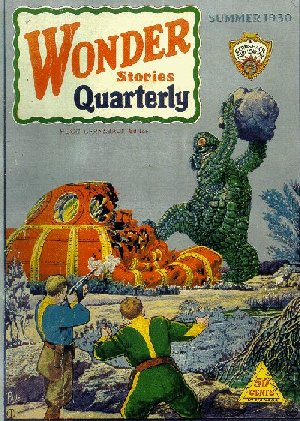 Wonder Stories Quarterly, Summer 1930. Cover by Frank R. Paul
Zagat’s first solo genre story was “The Great Dome of Mystery,” which appeared in the April 1932 issue of Astounding Stories. He branched out to various other pulp magazines, such as Dime Mystery Magazine. He wrote stories about “Doc Turner” that appeared in The Spider, the “Red Finger” series that was published in Operator #5, and under the pseudonym Morgan LaFay for Spicy Mystery Stories, although John Clute has described the LaFay stories as “excruciating.” He also wrote under the pseudonym Grendon Alzee. After 1936, most of his SF genre work appeared in Argosy.
Zagat wrote the six story “Tomorrow” series for Argosy beginning in 1939 with “Tomorrow,” which was set in a near future post-holocaust world. The final two stories in the series, “Sunrise Tomorrow” and “The Long Road to Tomorrow,” were serialized in the magazine.
He also published the novel Seven Out of Time in 1939. Originally serialized in Argosy, it would achieve publication by Fantasy Press in 1949, the same year Zagat died. It tells the story of seven figures from throughout history and brings them to a far future period in which emotions have been lost in order to learn what emotions are and why they are important.
Graham Stone has written that while Zagat helped build many of the tropes of interstellar space travel, such as established shipping lines, his stories had a repetitive feel to them, which may be why he didn’t achieve the reputations of E.E. Smith or Edmond Hamilton. Zagat wrote more than 500 short stories for the pulps, although only about 20 percent of them could be considered within the sf genre.
During World War II, he returned to service, working in the Office of War Information, which served as a form of communications and information between the battlefront and civilian communities through newspapers, radio broadcasts, films, and photographs. Following the war, he remained involved with the military, organizing writers’ workshops for hospitalized veterans.
Zagat suffered a heart attack at his home in the Bronx on April 3, 1949. He is buried Cypress Hills National Cemetery in Brooklyn.
 Steven H Silver is a twenty-one-time Hugo Award nominee and was the publisher of the Hugo-nominated fanzine Argentus as well as the editor and publisher of ISFiC Press for eight years. He has also edited books for DAW, NESFA Press, and ZNB. His most recent anthology is Alternate Peace and his novel After Hastings was published in 2020. Steven has chaired the first Midwest Construction, Windycon three times, and the SFWA Nebula Conference numerous times. He was programming chair for Chicon 2000 and Vice Chair of Chicon 7.
Categories: Fantasy Books
Guns or Butter? Race for the Galaxy by Tom Lehmann

Race For the Galaxy, Revised 2nd Edition, by Tom Lehmann (Rio Grande Games, 2007)
As I mentioned in my review of Terraforming Mars, Race for the Galaxy is one of my long-time favorite games. Its play models the expansion of up to four interstellar civilizations, each from one of five possible starting points: Old Earth, Epsilon Eridani, Alpha Centauri, New Sparta, and Earth’s Lost Colony. Development is represented abstractly, with nothing that represents physical variables, population, or any other real quantity; the idea is to come up with the right combinations of capabilities.
This is a card game, not a board game. There’s no predefined space for play to happen in. Rather, each player creates their own space by the play of their cards into a “tableau.”
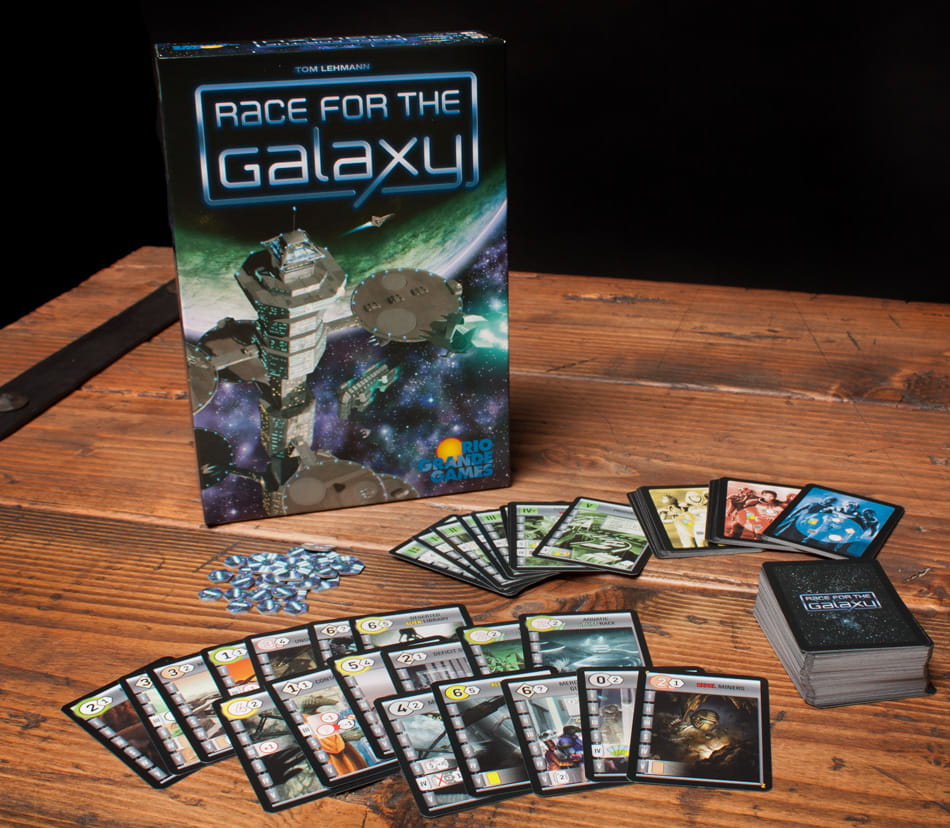
When any player’s tableau gets up to twelve cards, the game ends and players’ scores are determined. Scores are represented by the only other game components: victory point counters. Players can acquire victory points in the course of play, but the decisive scores are determined at the end, based on what’s in each player’s tableau.
The rules are a bit complex, but I was able to summarize them in a few minutes. And the game comes with helpful large cards that have “round summary” on one side and “card summary” on the other, one for each player.
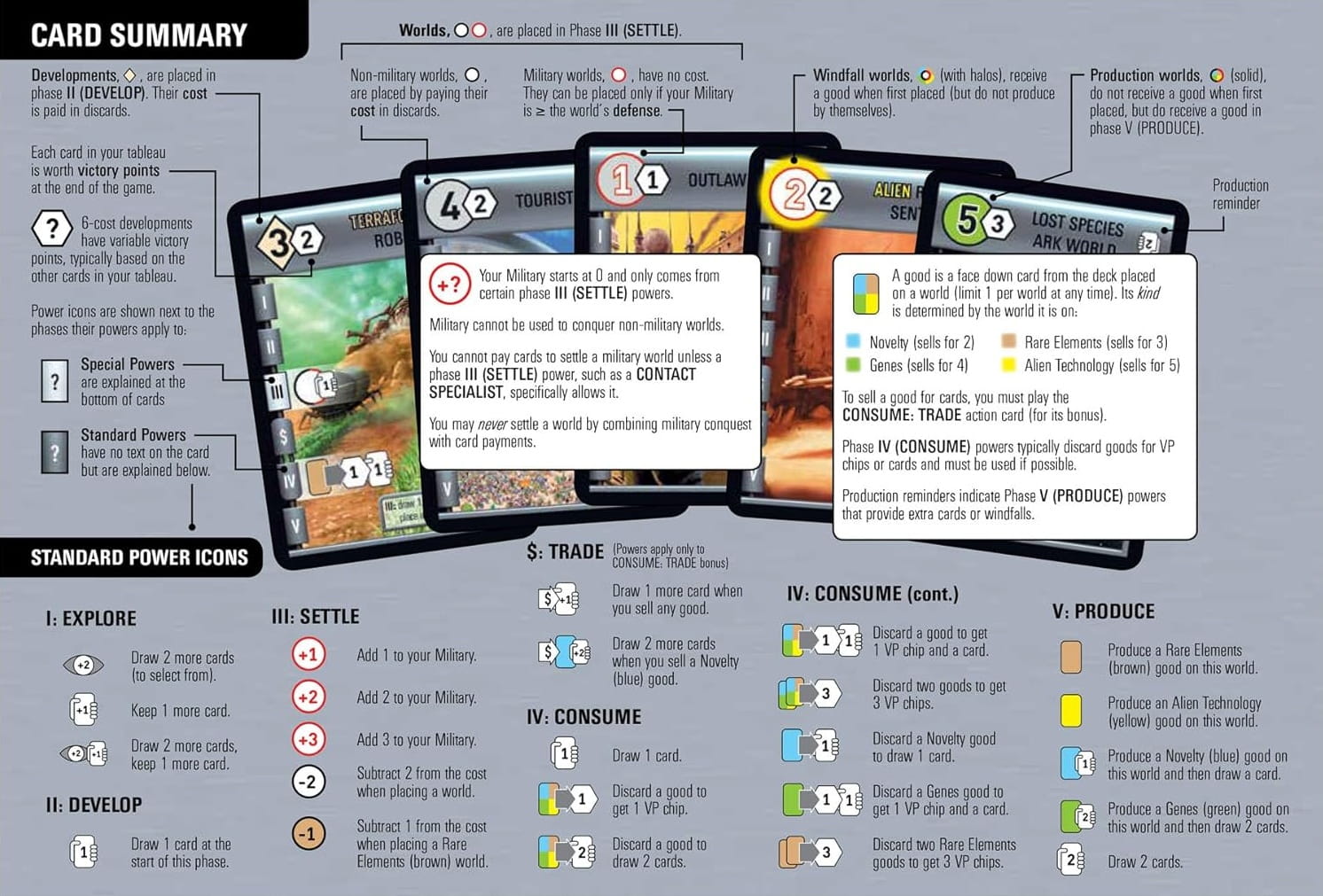 Race for the Galaxy Card Summary
Race for the Galaxy has an ingenious design where cards serve multiple functions. Played face up onto a tableau, they can represent either worlds added to one’s galactic civilization, or technological or social advances achieved by it (“developments”). Discarded face down, they represent a price that must be paid to put a world or a development into play.
Played face down onto a world card, they represent its economic output (one of novelty goods, rare elements, genes, or alien technology), which can later be discarded to gain victory points and/or more cards in the player’s hand.
Since each turn ends with reducing hands to no more than ten cards, players have to economize carefully in putting worlds or developments into play: Cards with lower payoffs may be better discarded to pay for activating cards with higher payoffs.
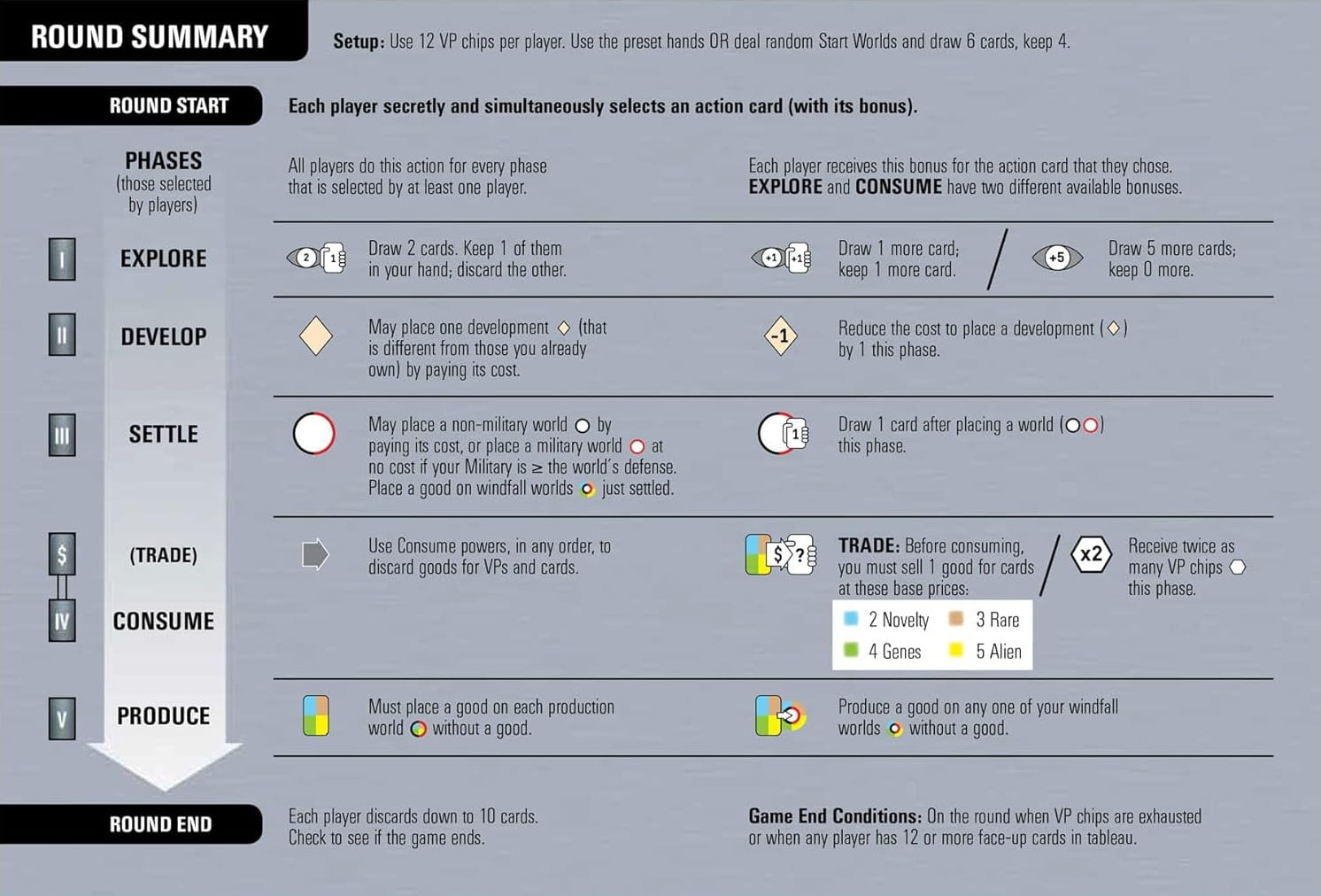 Race for the Galaxy Round Summary
A lot of the play of a hand is thinking about what combinations of cards will give the most useful results, based on the goods worlds can produce and the powers that worlds or developments may provide. For example, a tableau with worlds that produce rare elements invites playing cards that allow trading in rare elements, or that make it cheaper to add a rare element world to a tableau, or that score victory points at the end for having rare element worlds in the tableau — and so a player can develop a kind of theme where those specific cards have high value.
There’s a higher-level strategic choice behind all of this: There are two ways to add worlds to a tableau. The economic route involves spending cards from a hand: “buying” the world, or symbolically, colonizing it. The military route doesn’t require such an expenditure. Instead, the military power ratings for all the worlds in the tableau are added up and compared with the stated military power to conquer a world.
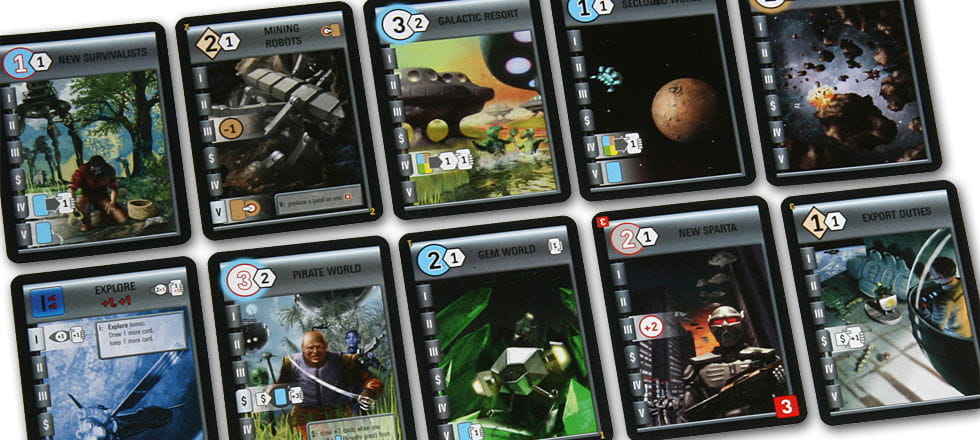
So players choose to act either as builders or as conquerors (the proverbial “guns or butter”). I have to confess both to a philosophical bias toward the economic route, and to finding the combinatorics it’s based on more interesting; when I introduced a friend to the game recently, I intentionally chose to play a military world and follow a military strategy, as an informal handicap — which seems to have worked, as he beat me handily in that first game!
The thing that’s largely missing in Race for the Galaxy is player interaction. There’s not much players can do either to help each other or to hurt each other! (My wife doesn’t much enjoy it as a game because of that design feature; she prefers more social games — for example, the elaborate trading in Settlers of Catan.) Play is, literally, a race: Who can build or conquer faster?
 Race for the Galaxy and two expansions: The Gathering Storm and Rebel vs Imperium
Watching other players has mostly indirect effects. First, there are five actions that can be taken in a turn: Explore (adding new cards to a hand), Develop (playing developments onto a tableau), Settle (playing worlds onto a tableau), Consume (exchanging goods for victory points and/or additional cards), and Produce (having one or more worlds add new goods). But they don’t all happen in a turn! Each player selects one action that will benefit them.
So it’s sometimes possible to say, “Fred’s low on cards, he needs to explore, so I don’t have to select Explore.” Second, if another player is getting close to having a dozen cards in their tableau, that’s a signal to go for quick payoffs in play, and disregard long-term tactics that probably won’t be completed. I’m not sure yet how much of a difference that makes, as I hadn’t paid close attention to it in my previous experience with the game.

The absence of direct rivalry aside, Race for the Galaxy seems to have enough complexities so that it’s not for everybody; it feels as if it’s roughly at the level of, say, Terraforming Mars (though play is much faster — my friend and I got through two rounds in less time than one round of Terraforming Mars took us).
This may be partly a reflection of the inherent challenges of economic/technological development games. But it’s a genre that I like a lot, and Race for the Galaxy strikes me as an excellent example of it.
William H. Stoddard is a professional copy editor specializing in scholarly and scientific publications. As a secondary career, he has written more than two dozen books for Steve Jackson Games, starting in 2000 with GURPS Steampunk. He lives in Lawrence, Kansas with his wife, their cat (a ginger tabby), and a hundred shelf feet of books, including large amounts of science fiction, fantasy, and graphic novels.
Categories: Fantasy Books
Spotlight on “Go Gentle” Maria Semple

Other LitStack Spots – Titles by Maria Semple LitStack has spotted some other titles by…
The post Spotlight on “Go Gentle” Maria Semple appeared first on LitStack.
Categories: Fantasy Books
On McPig's Radar - A Long and Speaking Silence
 A Long and Speaking Silence(The Singing Hills Cycle #7)by Nghi Vo
Every story begins somewhere.
On the banks of the Ya-lé River, the town of Luntien gathers to celebrate the start of the rainy season, but the celebration is marred by the arrival of refugees from the sea. Everyone has a story about the foreigners newly in their midst—lazy, violent, unwanted—while the refugees themselves grieve the loss of the home they loved.
Cleric Chih, very recently still Novice Chih, is also a stranger in Luntien. A moment of carelessness and bad luck leaves them waiting tables as they struggle to establish themself as a real cleric. A cleric’s job is to listen and record, but the stories emerging in Luntien are ugly and violent, as hard to predict as the river itself. With their hoopoe companion Almost Brilliant by their side, Chih must help the refugees while also unraveling a mystery that may have roots in their own faraway home in the abbey of Singing Hills.
In the seventh entry of the award-winning Singing Hills series, we meet Chih and Almost Brilliant just beginning their journey together as Chih assumes their place on the road and in the world.
The novellas of the Singing Hills series are standalone stories linked by the Cleric Chih, and may be read in any order.
Expected publication May 5, 2026
Categories: Fantasy Books
Book Review: Weavingshaw by Heba Al-Wasity
I received a review copy from the publisher. This does not affect the contents of my review and all opinions are my own.
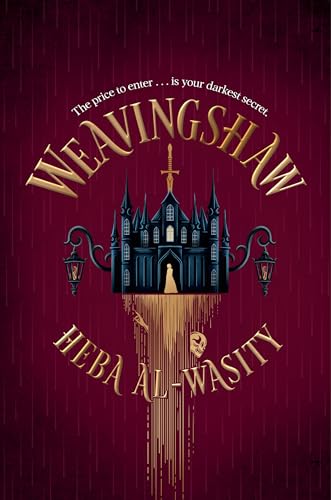
Mogsy’s Rating: 2.5 of 5 stars
Genre: Fantasy, Romance
Series: Book 1 of Weavingshaw
Publisher: Del Rey (February 24, 2026)
Length: 464 pages
Author Information: Website
A lot of other reviewers enjoyed this book, so I’m just going to say this right now: Hi, it’s me, I’m probably the problem! Weavingshaw has a lot of things going for it, at least on a craft level, including a full-on gothic fantasy aesthetic and a tension-laden romance. Unfortunately though, it didn’t fully click for me.
The story follows Leena, a young woman who can see the dead. Ever since her mother died and her father was imprisoned, she and her younger brother Rami have been living as refugees, adrift in a country that treats them as outsiders. For years, they have been trying to survive while she is forced to hide her abilities for fear of being institutionalized or exploited. But when Rami falls gravely ill, Leena has no choice but to seek out help, and the only treatment that can save him is far beyond anything she can realistically afford. Out of options, she turns to the one person everyone warns her to avoid.
Enter Silas, the Saint of Silence, an enigmatic trader in favors and information. The name of his game is leverage, or any knowledge he can use as currency to keep people in his debt. In exchange for the medicine to save her brother’s life, she offers up her secret, the only thing of value that she has. As she’d hoped, it catches the attention of St. Silas, but the bargain comes with strings attached. She’s bound to his service and tasked with finding the ghost of Percival Avon, a figure connected to both the decaying estate of Weavingshaw and St. Silas’s past. From there, Leena and the Saint fall into a tense, uneasy partnership, working together to untangle a mystery buried deep in the past, drawing closer as hidden agendas and outside threats start closing in.
All the classic gothic fantasy and romance ingredients are here, and the setup itself is very much my thing. That said, I found myself appreciating the individual pieces more than the whole. From a world-building standpoint, the lore and supernatural elements are intriguing, but the details are pretty surface level, such as the ghostly mechanics and the stratified society. Ideas are seemingly conjured up whenever the plot needs them, then sidelined again when something else is required. Even though I could sense a larger mythology in play, much of it feels backloaded instead of immersive.
Character-wise, Leena and St. Silas are familiar archetypes, but in a good way. I liked how their motivations were simple, but made sense in the context of their circumstances, i.e. Leena is driven by loyalty to her family vs. Silas being propelled by the secrets in his past and his need to see his long-running plans through. Ironically, the romance was where their relationship felt the weakest. It’s meant to be slow burning, which is fine, but the dynamic also felt overly guarded and stiff as a result. More spark and less posturing would have been better.
Structurally, the pacing can drift with subplots weaving in and out. I confess I put this book down many times because of the meandering, with a storyline that sometimes felt as if it was playing for time in a holding pattern rather than moving towards its destination. However, I always picked it up again, so there is that. The setting really is outstanding, and I enjoyed the fantastically broody vibes. Still, there is a fine line between atmosphere and narrative drag, and I won’t lie, this one frequently came close to crossing it. The open ending was a bit annoying too. As cliffhangers go, it’s far from the worst, but I didn’t love how abruptly it cut off.
In the end, Weavingshaw is a debut with some clear talent behind it, and I completely understand why it’s finding an audience. This just happens to be one where my personal tastes didn’t quite align with the execution. If broody gothic fantasy with haunted settings and a slow-building romance is your thing, there’s a good chance this will work much better for you.


Categories: Fantasy Books
A Swashbuckling Anthology: Swordsmen and Supermen, edited by Donald M. Grant
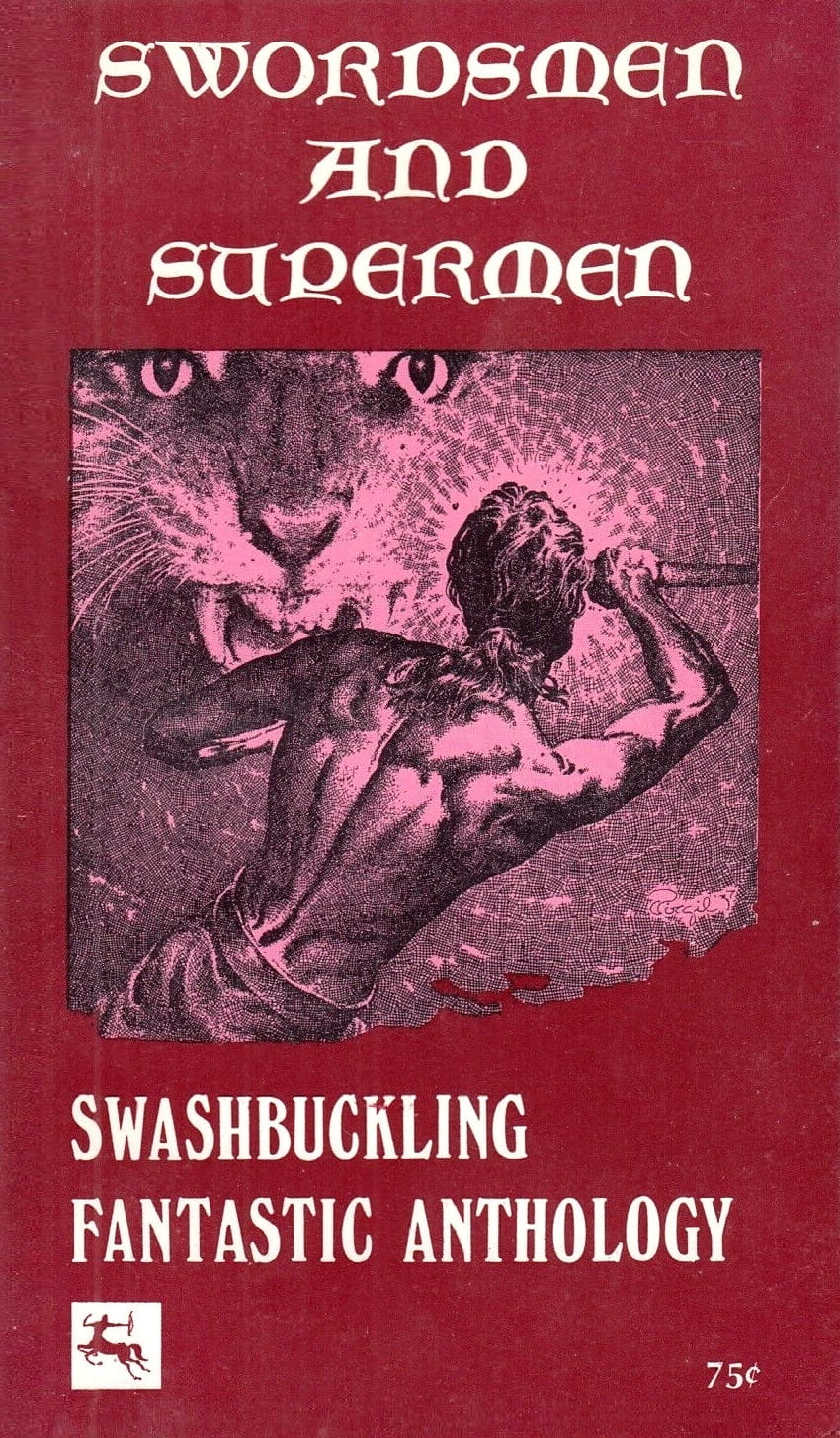
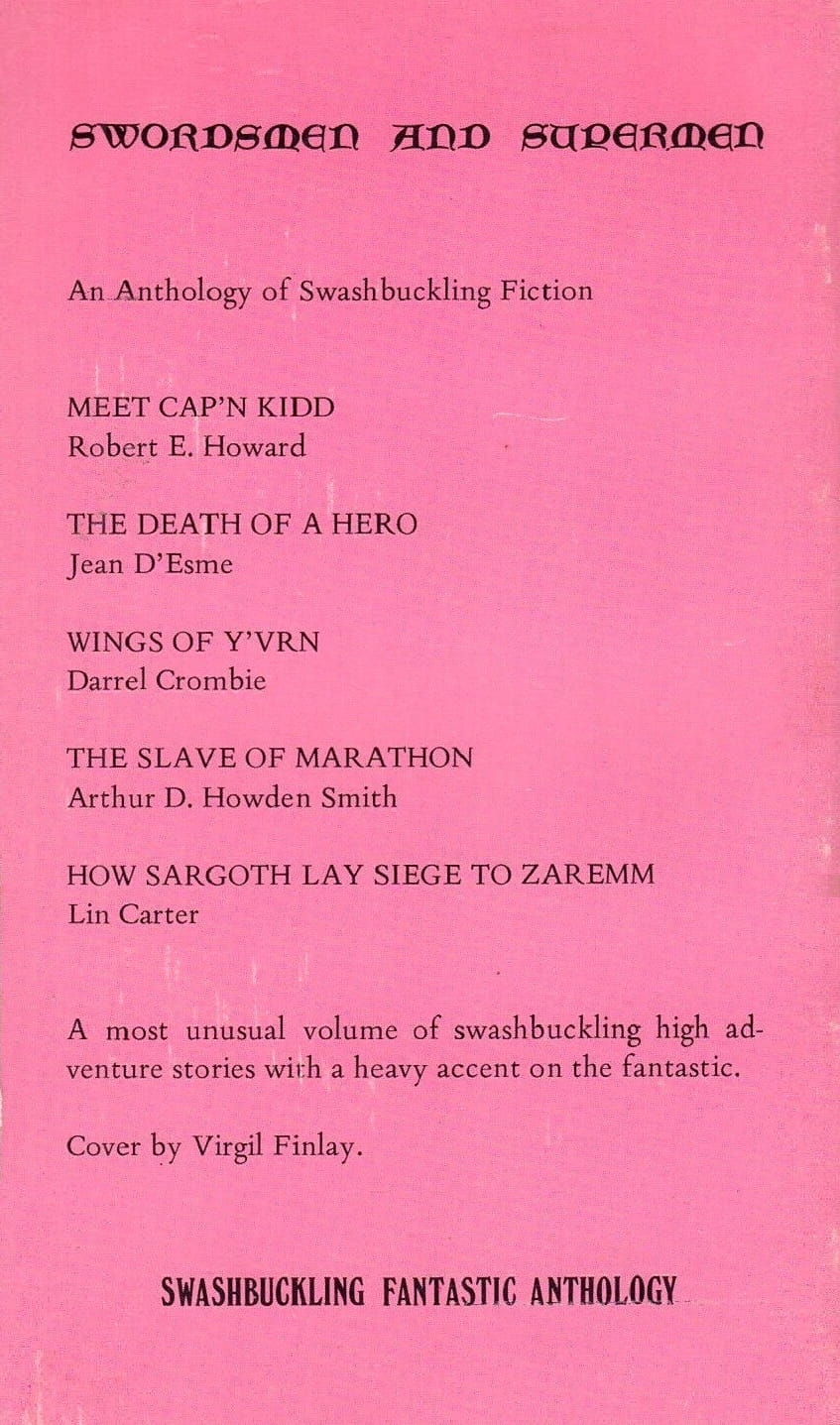
Swordsmen and Supermen (Centaur Press, February 1972). Cover by Virgil Finlay
Swordsmen and Supermen 1972, subtitled “Swashbuckling Fantastic Anthology.” From Centaur Press, edited by Donald M. Grant. Cover from Virgil Finlay. This was linked to Centaur Press’s Time-Lost series of books but I’m not sure it quite fit that or the “swashbuckling” subtitle. It’s a strange mishmash of material, including three old reprints and two new stories (from ’72).
It starts off with a Robert E. Howard story, but it’s one of his humorous westerns featuring Breckinridge Elkins called “Meet Cap’n Kidd.” It’s a funny tale but not really the type of fantasy one associates with Swordsmen.
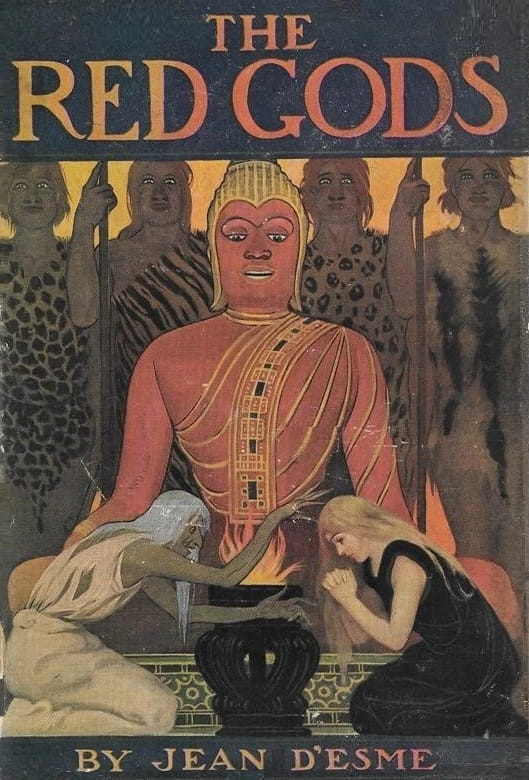 The Red Gods by Jean D’Esme, translated from the French by Moreby Acklom (E. P. Dutton, 1924). Cover artist unknown
Then we have “The Death of a Hero” by Jean D’Esme, which does have some sword and axe battles, but it’s an excerpted piece of a novel called The Red Gods and I’m not sure how well it stood on its own.
Third is “Wings of Y’vrn” by Darrel Crombie, featuring a shapeshifter main character. Donald Grant was apparently very high on Crombie at this time, and the prose is well done. Crombie was a pseudonym for Joseph Fraser Darby, a Canadian who had worked as a journalist. Apparently this is the only known story by Crombie. I liked it pretty well.
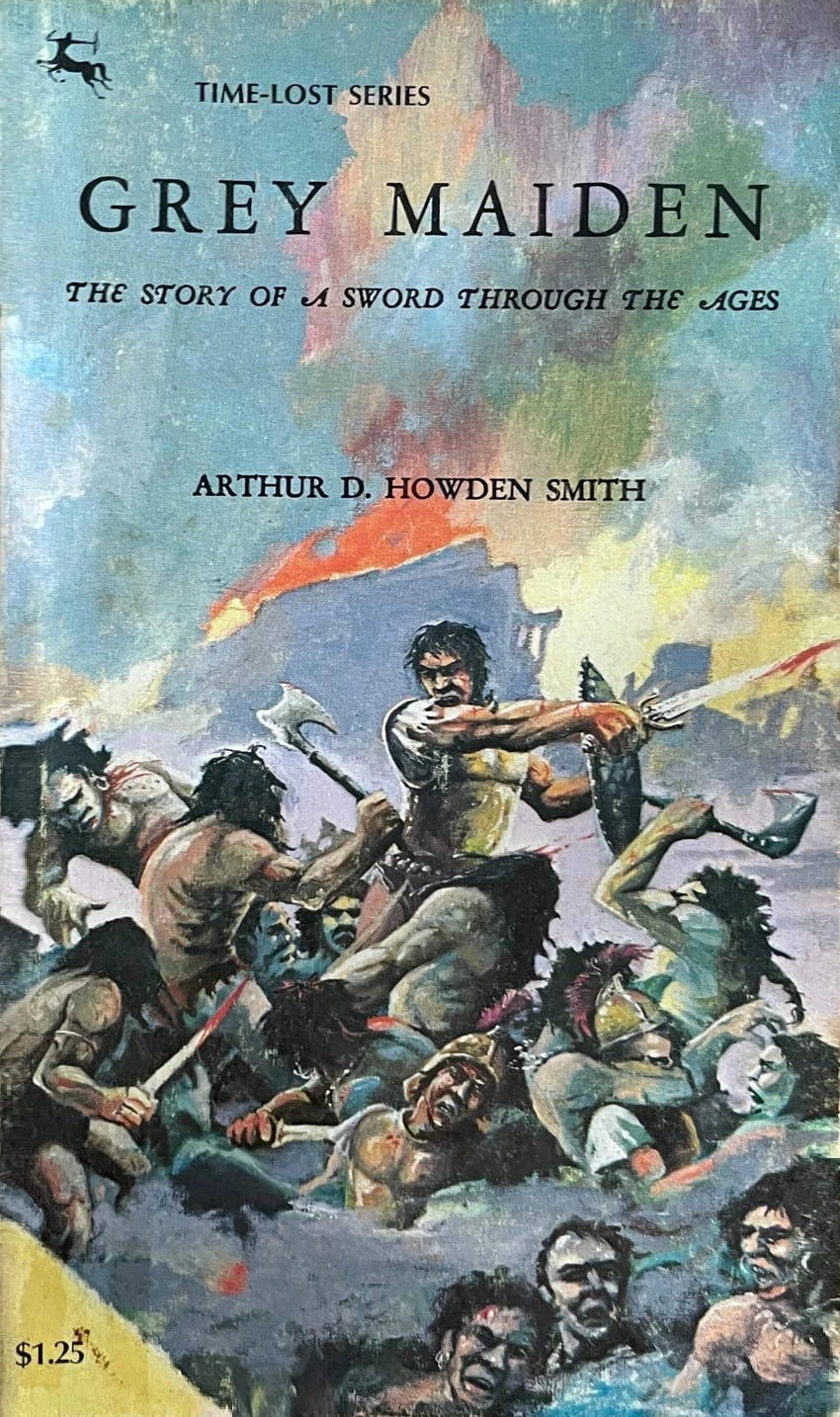
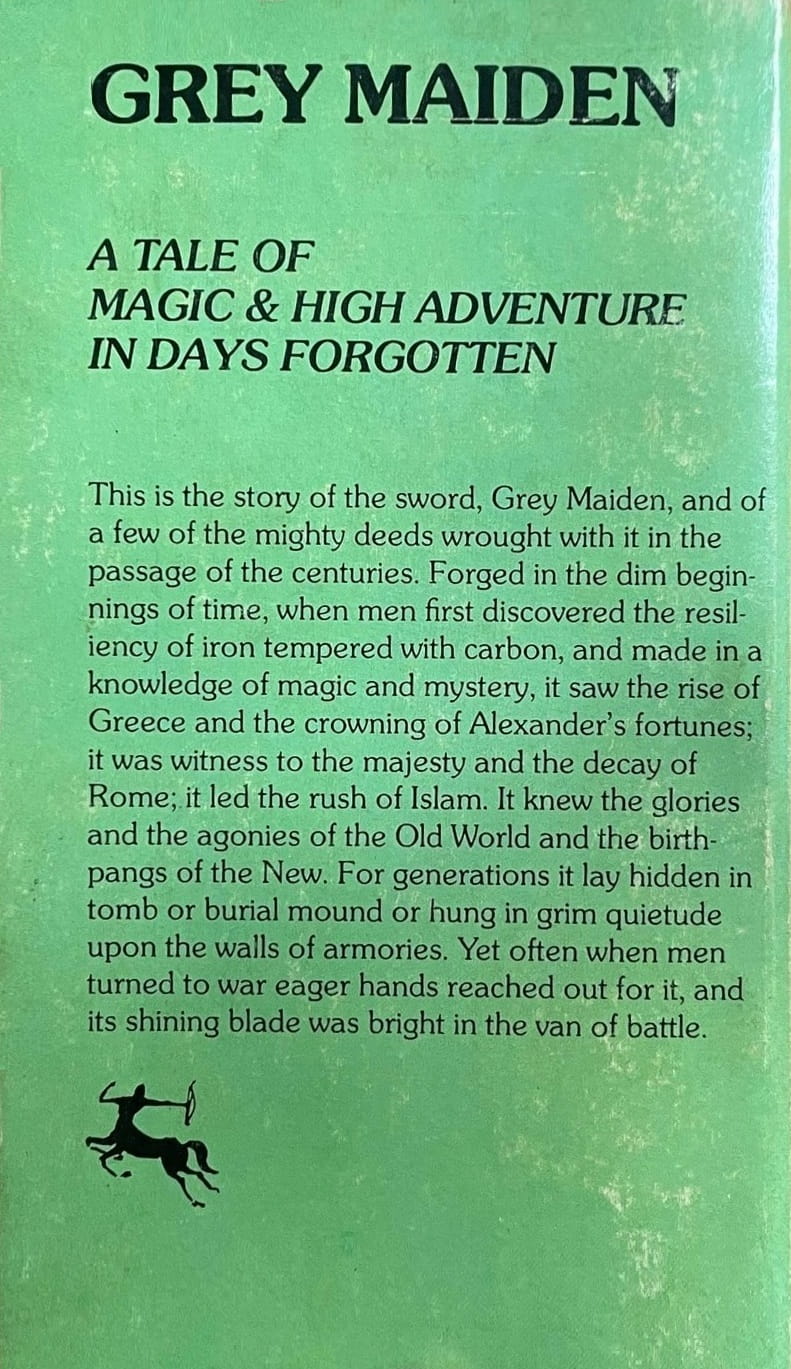
Grey Maiden: The Story of a Sword Through the Ages by Arthur D.
Howden Smith (Centaur Press, October 1974). Cover by David Ireland
“The Slave of Marathon” is next, by well-known writer Arthur D. Howden Smith (1887 – 1945). This is one of Smith’s Gray Maiden stories (Gray Maiden being a sword) and is my favorite story in the book.
Finally, we end with “How Sargoth Lay Siege to Zarwemm” by Lin Carter. This is a very brief piece, only a few pages, by Carter, and while well-written, is not really a story at all but more of a vignette about an unstoppable force meeting an immovable object.
Charles Gramlich administers The Swords & Planet League group on Facebook, where this post first appeared. His last article for us was on Avon Fantasy Reader, edited by Donald A. Wollheim. See all of his recent posts for Black Gate here.
Categories: Fantasy Books
7 Author Shoutouts | Authors We Love To Recommend

Here are 7 Author Shoutouts for this week. Find your favorite author or discover an…
The post 7 Author Shoutouts | Authors We Love To Recommend appeared first on LitStack.
Categories: Fantasy Books
COVER REVEAL: A Murder Most Fungal: A Fungalverse Novel by Adrian M. Gibson

Official Author Website
Buy Mushroom Blues over HERE
Mushroom Blues was Adrian M. Gibson's debut and FBC's SPFBOX Finalist, it was also the joint highest scorer of SPFBO 10. But that's not what we are here to reveal.
Thanks to Adrian, we are super thrilled to reveal the cover for the next Fungalverse story in the Hofmann Report series titled A MURDER MOST FUNGAL (releasing on 16th June 2026)
The brilliant & bloody art is by Katerina Belikova & cover design is done by Adrian himself:

Pre-order A Murder Most Fungal on Amazon
Add A Murder Most Fungal on Goodreads
OFFICIAL BLURB: The knives are out in this fast-paced, standalone Fungalverse novel. Set several months after the events of Mushroom Blues, this side story combines the culinary wonder of Jiro Dreams of Sushi, the kitchen chaos of The Bear, and the explosive tension of Hong Kong crime thrillers.
In the aftermath of the “Fuyu Massacre,” riots and whispers of revolution continue to plague the Hōpponese capital of Neo Kinoko. As a result, the iron grip of a foreign military occupation tightens day by day. Amidst this, Pocho Jiro, a once-renowned makizushi chef, has chosen to cook for Duncan MacArthur—the Coprinian Military Governor in Hōppon—as his personal chef... and indentured servant.
A run-in with dangerous fungal gangsters sets off a chain of events that Pocho cannot escape from. He’s left with two choices: Assassinate MacArthur, or watch his beloved sister die in front of his eyes. Will Pocho take up his knife and prepare MacArthur’s final meal?
You can also view Katerina Belikova's spectacular art of the book in its full glory below:

Categories: Fantasy Books
The Maleficent Faerie - Book Review by Voodoo Bride
 The Maleficent Faerie (For the Love of the Villain #2)by Rebecca F. Kenney
What is it about:A spicy, Fae Sleeping Beauty retelling with a male version of Maleficent, a dying realm, and intriguing twists on the old tale.When Malec, the Void King, attacks Princess Dawn's carriage, her Fae bodyguard Aura switches places with her. Glamoured as a human, Aura must fool Malec into thinking she's the Princess he cursed 25 years ago. Relentless and powerful, but with a vulnerable side he hides from others, Malec begins to crave Aura's respect as much as he craves her body.
What did Voodoo Bride think of it:I've very much enjoyed the other books I've read by Kenney so far, so I treated myself to The Maleficent Faerie to see if I'd enjoy stories not connected to her Wicked Darlings series.
And this book was such an enjoyable read!
I'd call this a re-imagining instead of a retelling as the story differs greatly from the original fairytale (in the most yummy ways). I fell hard for Malec (I do love a tortured hero/villain) so it was easy to lose myself in the romance between Aura and Malec. There were of course story elements connecting this story to its inspiration, but those were used in original ways to create a whole new story with a romance at the heart of it that doesn't need a prince to save Aura.
All in all I had a great time with this very steamy and delicious Fantasy Romance and you bet I got my hands on another book in this series of standalones.
Why should you read it:It's a delightful Fantasy Romance re-imagining of Sleeping Beauty.
Categories: Fantasy Books
Spotlight on “American Fantasy” by Emma Straub

Other LitStack Spots – Titles by Emma Straub LitStack has also spotted some titles by…
The post Spotlight on “American Fantasy” by Emma Straub appeared first on LitStack.
Categories: Fantasy Books
Teaser Tuesdays - Apparently, Sir Cameron Needs to Die
 "Why should he be mad? He's the one who fucked me over," I grumbled, then winced, hoping the construct circling some distance below hadn't caught my words.
(page 68, Apparently, Sir Cameron Needs to Die by Greer Stothers)
---------
Teaser Tuesdays is a weekly bookish meme, previously hosted by MizB of Should Be Reading. Anyone can play along! Just do the following: - Grab your current read - Open to a random page - Share two (2) “teaser” sentences from somewhere on that page BE CAREFUL NOT TO INCLUDE SPOILERS! (make sure that what you share doesn’t give too much away! You don’t want to ruin the book for others!) - Share the title & author, too, so that other TT participants can add the book to their TBR Lists if they like your teasers!
Categories: Fantasy Books
Kingdom of Heaven: A Perfect Film About an Imperfect Knight
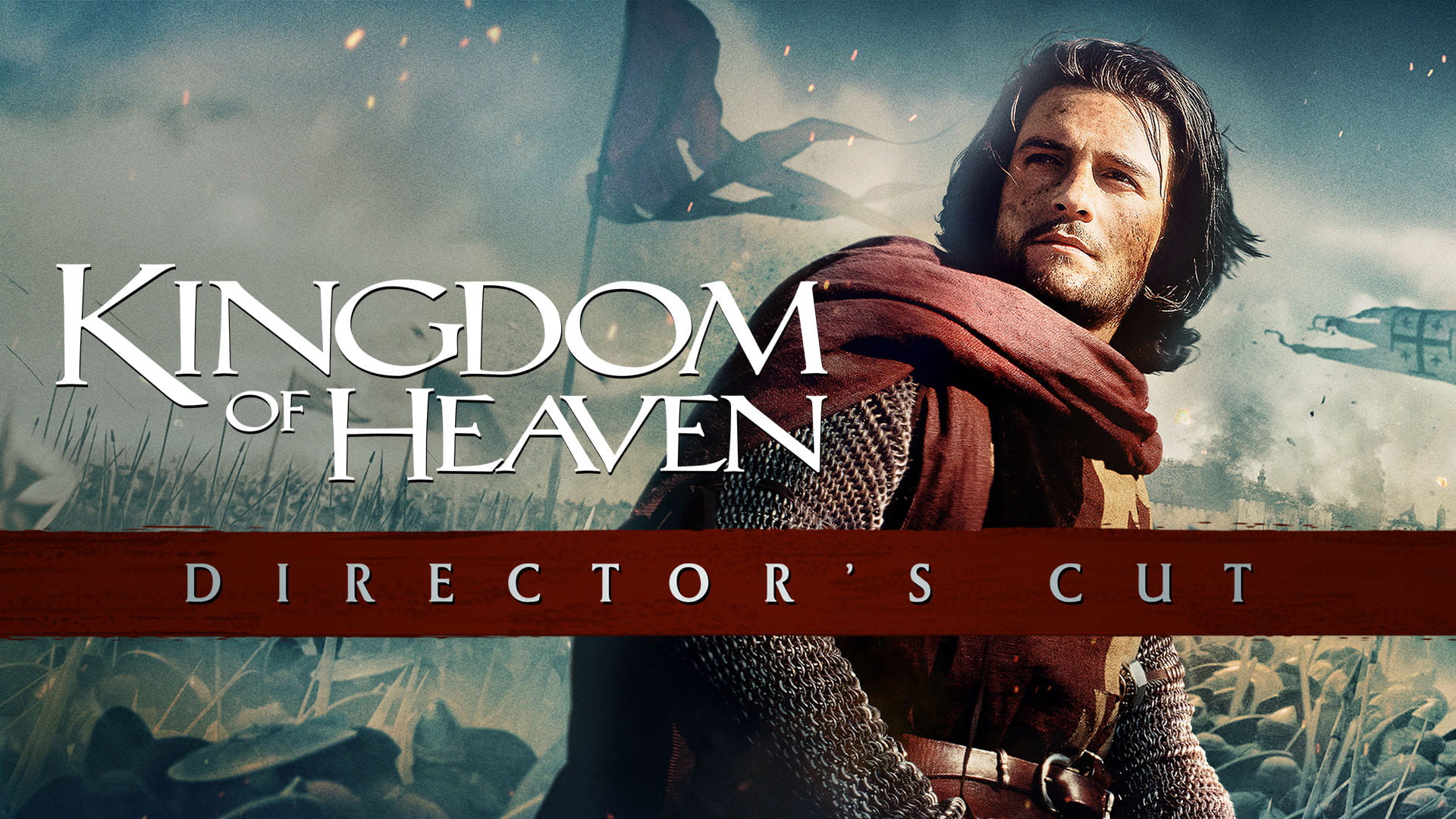 Kingdom of Heaven Director’s Cut (20th Century Fox, December 23, 2005)
Kingdom of Heaven (Director’s Cut) (194 minutes; 2005)
Kingdom of Heaven Director’s Cut (20th Century Fox, December 23, 2005)
Kingdom of Heaven (Director’s Cut) (194 minutes; 2005)
Written by William Monahan. Directed by Ridley Scott.
(There is a shorter theatrical cut, which should be avoided at all costs, like the plague it is.)
What is it?Ridley Scott’s epic saga of the Crusades, as seen through the eyes of a simple French blacksmith who travels to Jerusalem in an attempt to save the soul of his late wife, and ends up as the defender of the city against the massive army of Saladin.

After massive edits mandated by the studio in order to shorten it, the theatrical cut of this film was a bomb. The restored Director’s Cut is, to put it simply, a masterpiece. It is a completely different film from the one the editors hacked to pieces and sent out to theaters, with 45 minutes (!!) of restored footage that completely changes the story and the characters.
For one example of many: in the theatrical cut, Eva Green’s character, the Queen of Jerusalem, comes across as acting irrationally, because we don’t know her motivations. In the Director’s Cut, we gain entirely new and powerful subplots involving her brother, her husband and her son, all of which render her actions quite clear and understandable. The queen becomes half of the beating heart of the story.
How anyone could have thought the movie was improved by omitting even a portion of that material is beyond comprehension.
 Orlando Bloom and Liam Neeson in Kingdom of Heaven
The cast is filled with famous actors. Orlando Bloom stars as the reluctant warrior, Balian. Eva Green is the queen of Jerusalem (with Edward Norton uncredited as her brother, the leper king). Liam Neeson is the Baron of Ibelin and father of Balian. Jeremy Irons is, effectively, the police chief of Jerusalem.
The rest of the stellar cast includes Michael Sheen, David Thewlis, Kevin McKidd, Nikolaj Coster-Waldau, Marton Csokas, Alexander Siddig, Ghassan Massoud, Brendan Gleeson and Iain Glen, among many others. Good heavens.
With the increasing availability of the Director’s Cut, public acclaim for the film has drastically improved. In just the past year alone, the IMDb rating has risen from 5.6 to 7.3, presumably on the strength of viewers’ votes after seeing the Director’s Cut. At this rate, it should deservedly reach a perfect 10 within a couple more years!
(Also of note: Scott’s underrated 2010 Robin Hood movie, starring Russell Crowe, is arguably a direct sequel. Kingdom of Heaven ends with King Richard the Lionheart stopping by Balian’s village on his way to the Crusades, while Robin Hood begins with the king’s journey back home.)
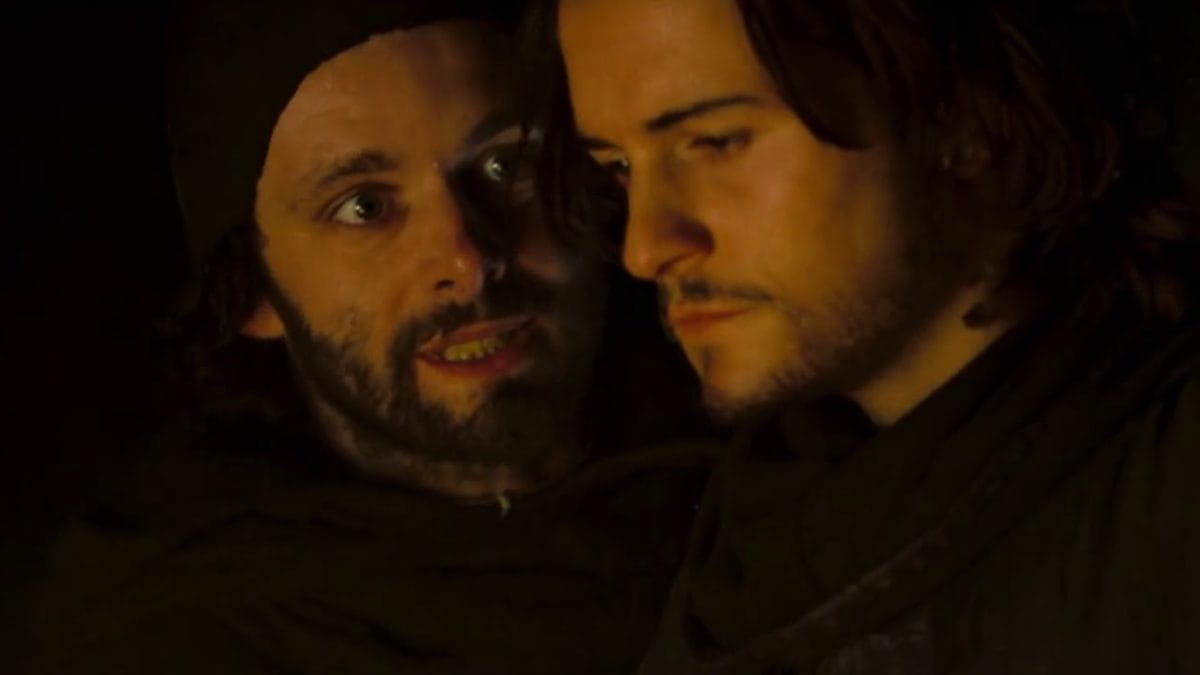 Michael Sheen and Orlando Bloom in Kingdom of Heaven
Quick and Dirty Summary
Michael Sheen and Orlando Bloom in Kingdom of Heaven
Quick and Dirty Summary
During the Crusades, Balian the blacksmith (Bloom) travels from France to Jerusalem to seek forgiveness from God for himself and for his late wife, who committed suicide after the death of their infant child.
Along the way, he kills his half-brother (Sheen) — who needed killing, honestly. He discovers his true father (Neeson), falls in love with a queen (Green), battles corrupt knights (Csokas and Gleeson), and befriends a king (Norton).
He also wrestles with moral questions, impresses a top aide (Siddig) to the great warlord Saladin (Massoud), and absorbs wise counsel from knights such as Hospitaler (Thewlis) and Tiberias (Irons), helping him grow as a man, a knight and a leader. And just in time – because the next thing he knows, this former blacksmith is suddenly in charge of defending Jerusalem from attack by Saladin’s massive army!
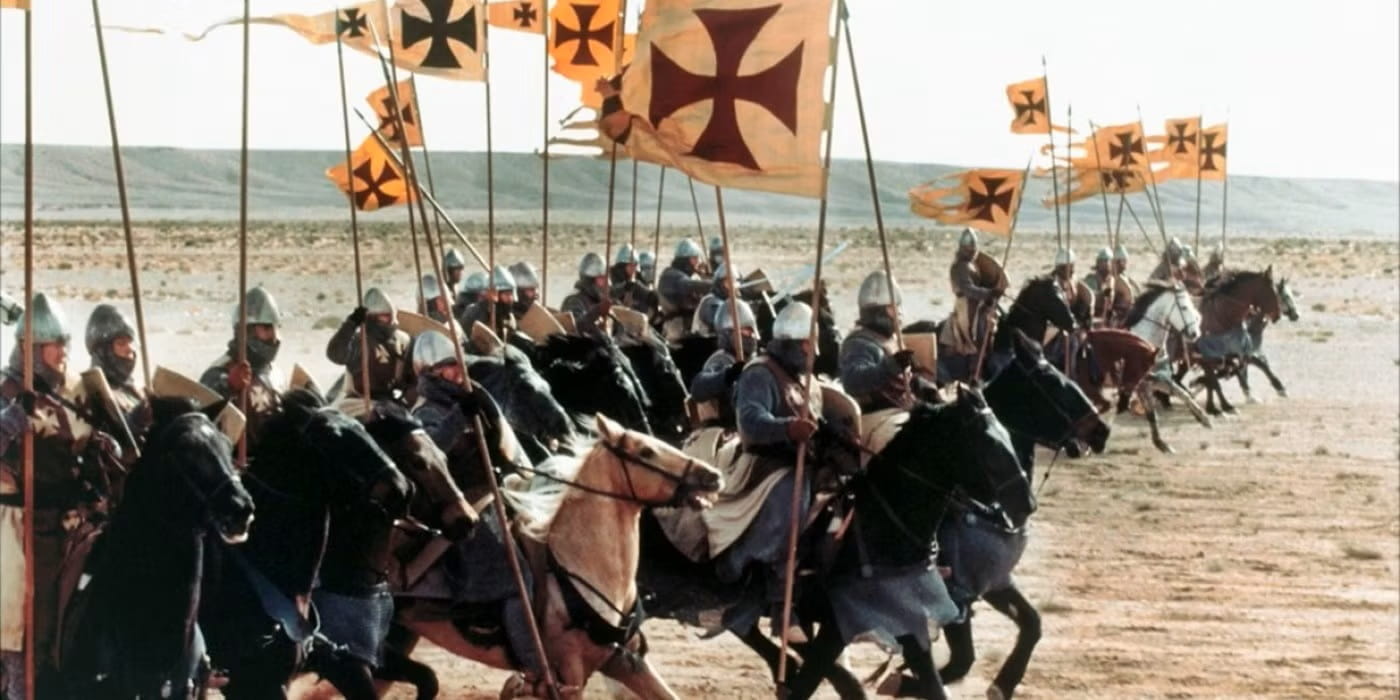
There’s plenty of sword, as in a number of battles involving massive armies, as well as several individual duels (one sword, two swords, a half-molten sword – a lot of swords!). The sorcery elements are more of a religious nature, but unquestionably and increasingly supernatural as the story unfolds.
The Hospitaller Knight – no other name is given for him – is the focus of the most fantastical aspects of the story. At three particular moments he exhibits abilities that elevate him from mere human to divine and perhaps angelic being.
First, during an early battle scene, Hospitaler evades arrows by disappearing from his horse as it runs through the Crusader camp. Ridley Scott doesn’t play fair with us here, however, as we quickly see that the knight has simply shifted to the far side of the horse, hanging on for dear life while making his horse appear riderless. But it serves a tease for what is to come.
 David Thewlis as the Hospitaller Knight
The second scene cranks up the weirdness quite a bit. As Balian sits alone in the desert, brooding over his situation, Hospitaller walks up and addresses him, handing out more deep moral philosophy. Once the knight is done, a literal “burning bush” distracts Balian. When he looks back a moment later, Hospitaler is nowhere to be seen. In true Batman fashion, he has vanished from a vast, wide-open desert. Balian’s horse cries out and rears, as if a ghost – or an angel – had just moved past it, invisible.
Finally, when Balian lies near death following a fight with two of Guy’s Templar knights, Hospitaller appears from out of nowhere. He touches Balian on the forehead, restoring him to life – just in time to try to stop the army of Jerusalem from marching out to its destruction.
Clearly, there’s something going on with that character beyond the realms of mortal man. Some have argued Hospitaler is God himself, or at least an angel, sent to guide Balian. But we are left to puzzle out those specifics for ourselves.
 Eva Green in Kingdom of Heaven
High Point
Eva Green in Kingdom of Heaven
High Point
For all the action and romance and adventure, what still rings true above all else with this film is its powerful message that what king one serves or what religion one adheres to does not ultimately make one a good or bad person. What matters is what we choose to do, and choose not to do – as both the leper king and the priest-knight Hospitaler repeatedly point out to Balian.
One scene crystallizes this entire message. When Balian confides in the Hospitaller Knight that he fears he has lost his religion, the knight responds in a way that shocks the young man – and perhaps the audience, as it comes from a holy man. But it lays out the great message of the film:
I put no stock in religion. By the word religion I have seen the lunacy of fanatics of every denomination be called the will of God. I’ve seen too much religion in the eyes of too many murderers. Holiness is in right action, and courage on behalf of those who cannot defend themselves. And goodness — what God desires — is here (points to head) and here (points to heart). And by what you decide to do every day, you will be a good man. Or not.
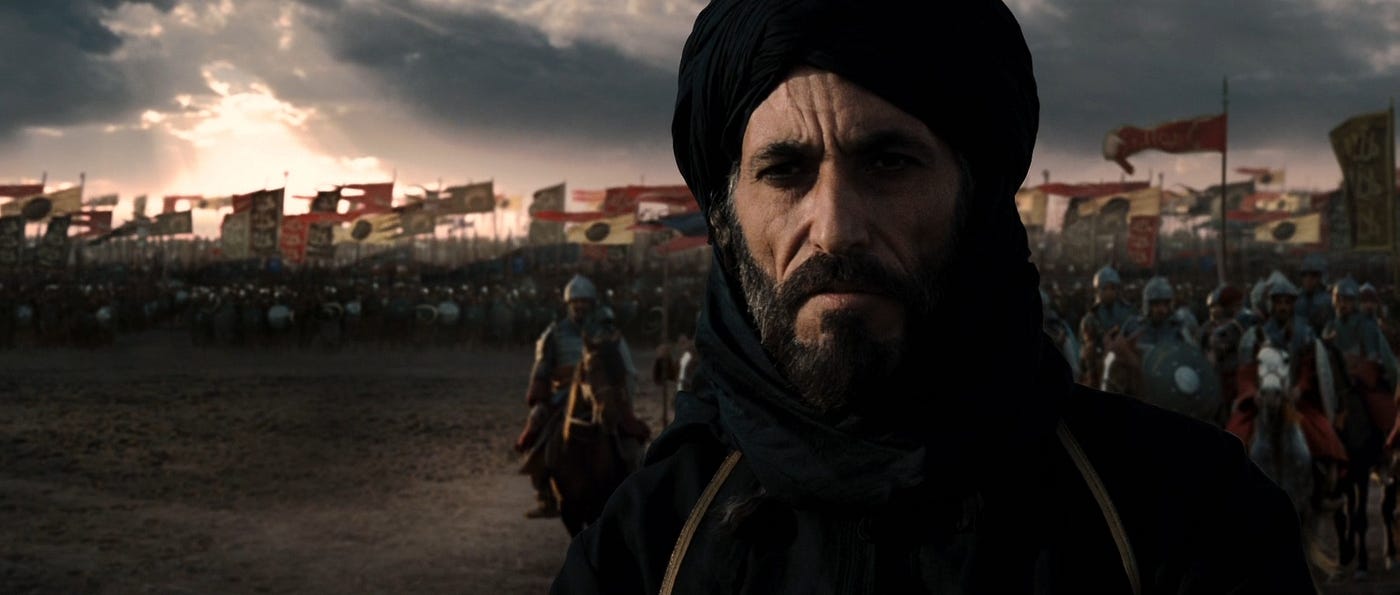 Ghassan Massoud as Saladin
Low Point
Ghassan Massoud as Saladin
Low Point
Balian repeatedly states that his only goal is to be “a good knight.” From this, multiple people respond in shock, with reactions along the lines of, “A perfect knight? Good heavens!” As in, who does he think he is??
But he never says “perfect.” Never once. Just “good.”
It makes me want to pull my hair out.
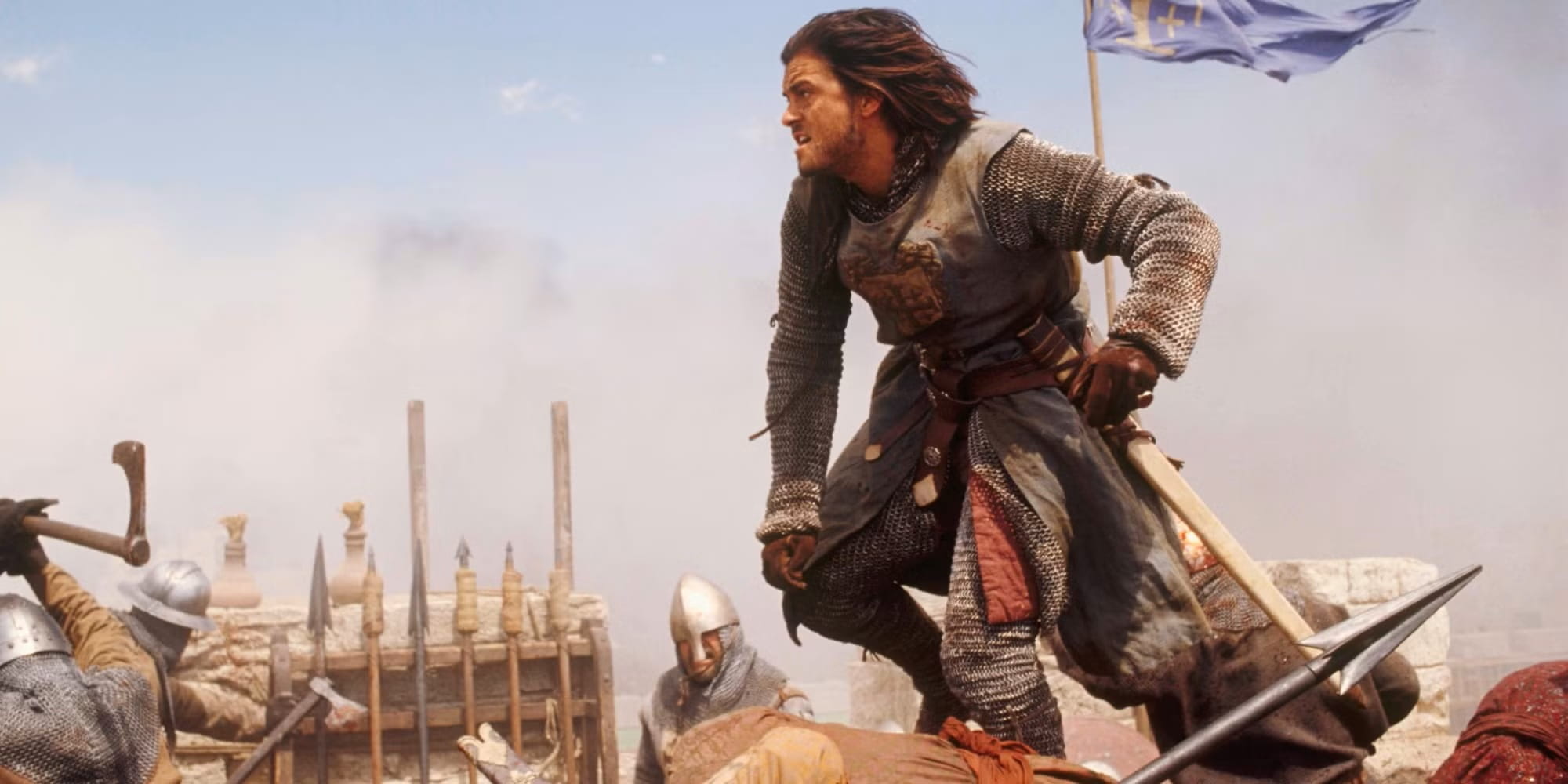
Marton Csokas, who played Celeborn in The Lord of the Rings and who auditioned for the part of Balian in this film, makes for a truly memorable and despicable villain as Guy de Lusignan, head of the Templar Knights. When he’s not sneering on a scale perhaps not seen since Basil Rathbone in the 1938 Robin Hood or scheming against our hero, he’s throwing hissy fits or issuing catastrophically bad orders to his army. In a movie with so many good-guy supporting characters, Csokas shines in his own darkness.
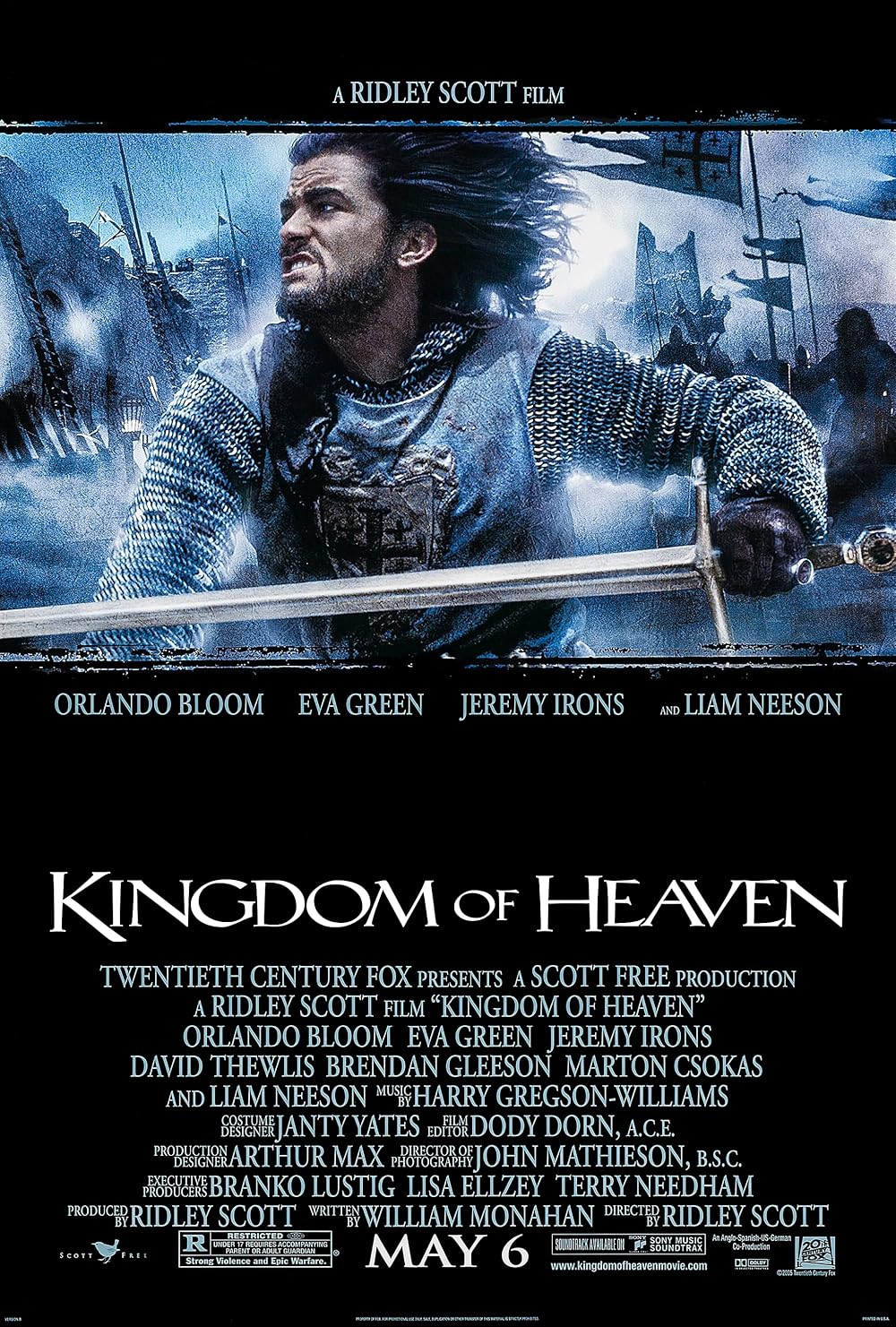 Kingdom of Heaven theatrical poster
Overall Evaluation as a Movie and as Fantasy/SF/Sword & Sorcery
Kingdom of Heaven theatrical poster
Overall Evaluation as a Movie and as Fantasy/SF/Sword & Sorcery
While not as much a Fantasy film as some others, Kingdom of Heaven contains enough Medieval battles, one-on-one sword fights, supernatural forces and general derring-do to place it alongside the best of that genre. Throw in the entire moral and ethical layer, and the film achieves masterpiece status.
Just treat that theatrical cut like the leper it is!
Van Allen Plexico is a member of the Science Fiction and Fantasy Writers of America (SFWA), a Grand Master of Pulp Literature (2025 class) and a multiple-award-winning author of more than two dozen novels and anthologies, ranging from space opera to Kaiju to crime fiction to superheroes to military SF. He notably edited, co-created and co-wrote the Sword and Sorcery anthology GIDEON CAIN: DEMON HUNTER. Find all of his works on Amazon and at Plexico.net.
Categories: Fantasy Books
THE FOX AND THE DEVIL by Kiersten White
Abraham van Helsing is the most famous vampire hunter in literature, and while he vanquished the Count, he may not have been the best father. His daughter Anneke is on the hunt for the creature who killed her father (she happened to be the only person to see this haunting creature), which has helped to…
Categories: Fantasy Books
Big Damn Heroes? Shiny!!! – Firefly Attempting Animated Reboot
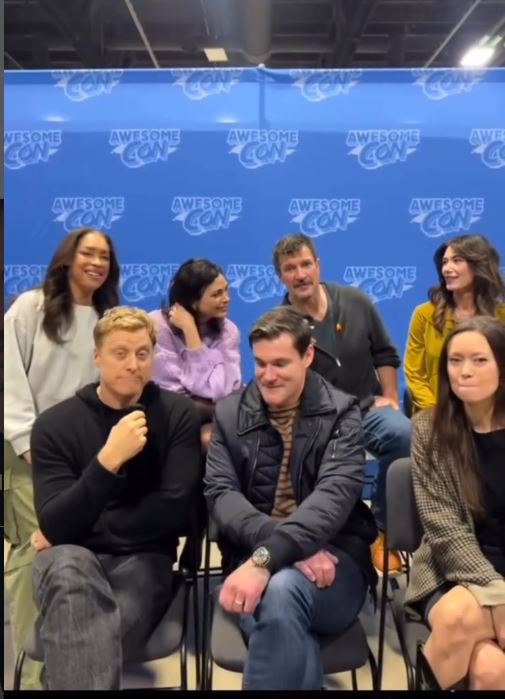 Firefly
For a show that hardly anybody watched (it was reportedly 98th in the Nielsen Ratings for 2002-2003. The TV Guide Ratings page has it at 125th, and Fox’s lowest-ranked show), that one word carries a lot of weight 23 years later.
Fox famously aired the double-length pilot, which set the show up, as episode eleven, and then canceled the show, leaving three episodes unaired. It was also placed in the legendary Friday Night Death slot (where they also buried the far-more deserving The Adventures of Brisco County Jr).
The crew got to reunite and wrap things up two years later in the movie Serenity (which killed off two cast members). There were hopes to do more movies, but even after cutting the budget from $100 million to $39 million, it lost money in the US (98th) and barely broke even worldwide (111th). And the Serenity (which is the ship: Firefly is its class) was grounded for good.
But over the years, Firefly came to be the definitive ‘cult classic,’ and the cast became fan convention staples. You can find all kinds of Firefly info on the web. And both streaming on Hulu, and Prime, the episodes are in order, which I HIGHLY recommend for viewing. Novels, board games, graphic novels — interest remained alive in more Firefly ‘stuff.’
I mentioned that Nathan Fillion and Alan Tudyk started a weekly podcast (Once We Were Spacemen), which is geek heaven. They’ve had several Firefly members on, and other folks from their careers. I love it.
THE BUILDUPOn February 23, a story/vid dropped on their IG page. Nathan Fillion knocks on the door of what looks like Gina Torres’ (Zoe) on-set trailer. She asks “Does this mean it’s time.” He replies, “It’s time.” She looks up wistfully, and Fillion looks confusedly at the skies, as if for Serenity. They both say ‘okay’ a few times and it ends. My response was “Holy crap! What’s happening?”
The Firefly fandom lost its collective mind and speculation was immediate. While a full-blown revival has been a dream for two decades, common thoughts were a gathering at a convention, or a reunion on Fillion’s show The Rookie, or on a podcast.
Two days later, Fillion shows up at Morena Baccarin’s (Inara) house. She is currently starring in the Fire Country spin-off, Sheriff Country. This one is cute, as Fillion is in his The Rookie uniform. And she answers in her sheriff uniform. He flashes that boyish smile and starts to comment they’re both in their uniforms, and she cuts him off with “You son of a bitch.” “He’s startled. “Are we doing this?” “Oh. We’re doing this.” More gravely serious head nodding.
Firefly fans were abuzz after the Gina vid. Now, with two, clearly something was going on. And the stakes has been raised.
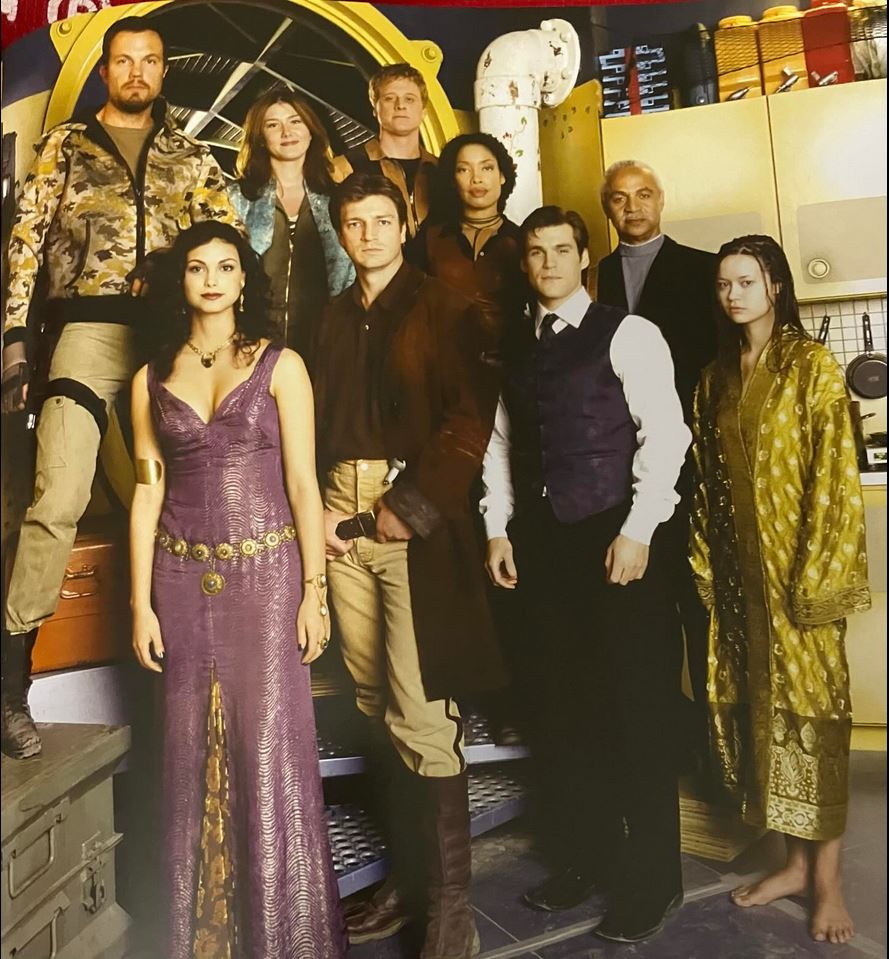 There is a new line of Firefly Funko Pops coming out, and the cynical dismissed this new ‘thing’ as leading to pushing the Funkos. While that’s certainly not beyond the realm of possibility, Fillion had to know that would be an incredibly disappointing payoff after generating so much excitement.
Two days after that (now it’s February 27), Fillion knocks on Sean Maher’s (Simon) door. Maher peaks through, opens the door, says “We don’t want any,” then shuts it and goes back inside. Filion makes a despairing face, knocks again, points at his face with a “It’s Nathan” expression as Maher opens the door. The ‘It’s happening’ thing repeats. Maher gets blown out his doorway by the wind.. The long looks during the head nods, the little extras: these are fun for the cast and fans.
March 2, he’s at Summer Glau’s door. She speaks in very River fashion, and says that she knew the day would come as she stares off into some other place. Deadpan, Fillion says, “Yeah. Still a little creepy when you do that.”
Two days later and he’s knocking on Jewel Staite’s (Kaylee) door. She smiles and says “Shiny,” which makes Nathan smile. More odd head nodding.
March 7, he knocks on Adam Baldwin’s (Jayne) door. Baldwin is wearing Jayne’s orange and yellow hat. Fillion is holding the same hat, and he looks at his and tosses it aside. Both men finish with “Okay then.”
SIDE NOTE – I’m LOVING all this Firefly activity. Fillion and Tudyk have commented that the Joss Whedon who is a pariah now, was not the guy they knew. And that they’d absolutely work with him on a new Firefly. Baldwin appeared on Castle before he got more openly far-right. Clearly, they feel he’s still a part of Firefly. Don’t bother with comments about your dislike of them or their whatever views. I’ll delete them. This is a celebration of Firefly, whatever directional wing they identify with.
On March 12, Fillion shows up at Alan Tudyk’s (Wash) house. He tells him he’s not doing it without him, and Tudyk is so excited he slaps him. They have a very ‘them’ exchange. If you listen to their podcast, they have been real-life friends since Firefly, and they’re fun together.
Since Wash died in Serenity (if that’s a spoiler, I’m not sure why you’re even reading this post), it was uncertain if he would be part of this. Since the two are buddies, I assumed somehow they’ll find a way, even if it’s some kind of continuation series. Maybe he’ll be voices of characters, or a robot, or whatever. But I was happy to see Tudyk get an appearance.
Sadly, Ron Glass (Shepherd Book) died in 2016. So, no visit for Book.
There’s been nary a word about Joss Whedon. It was HIS show. He created, wrote, directed, produced, and even did music for it. Depending on what IT actually is, it’s hard to imagine a new live-action iteration, without him. As I mentioned above, the two have said they would work with him again (and on their podcast a week ago, Felicia Day spoke warmly about Whedon. Not everyone who has worked with him dislikes him). So, we’ll see.
Over 57,000 comments have been left on the various vids, including some from the cast. Nerd culture social media has been posting vids and texts and threads about this. Setting aside whatever IT is, Fillion and Tudyk have handled his brilliantly. From coming up with the idea of generating buzz with each cast member appearing ‘live,’ to feeding out the vids a few days apart for a couple weeks, keeping momentum going: it has worked!
AND NOW, FOR THE PAYOFF…I wrote all this March 14 – the day before announcement at DC’s Awesome Con. I hope it conveyed some of the excitement and buzz that was going on. How from a couple decades of it just being a yearning among fans, into genuine hope somehow, in some shape, Firefly was coming back.
It is!!!!The news was revealed at the reunion panel, and Once We Were Spacemen released a video from Nathan (with bits from the rest of the cast). The plan is to make an animated series.
JOSSFillion has Whedon’s blessing. Presumably this means he won’t be involved.
THE RIGHTS20th CenturyFox/Disney said yes to the project.
SHOW RUNNERTara Butters and Mac Guggenheim are married, and they met through Firefly. Their individual producer credits include Agent Carter, Law & Order: SVU, and Arrow. They’re on board.
SCRIPT“Athenia,” written by Butters and Guggenheim. Ready to go.
ANIMATION HOUSEThey’ve got ShadowMachine on board. They did Robot Chicken.
HOME (WHERE WILL IT AIR?)There’s one not-so-minor road bump left. No one has picked it up. 20th Century Fox or Disney could have made it their own property and greenlit it. They didn’t. I’m a big fan of Almost Paradise, from Dean Devlin (guy behind Leverage, and The Librarians), and he couldn’t find a new network when it was canceled after season two. Youtubers have stated definitively that it will be on Disney, since they own the rights. That’s an assumption. And given Nathan SPECIFICALLY said they’re looking for a home, an erroneous one. Fact check, fanboys.
TIMELINEFillion said that he’s not interested in post-Serenity stories. With Wash and Shepherd dead, I certainly get that. The stories will take place between the end of Firefly, and Serenity. The nine authorized novels took place in that span. I believe some of the graphic novels did, as well. Those were all hit and miss for me, so I’m not invested in them being adapted for the new series. Original stories are fine. Or picking and choosing: I wouldn’t mind some of the novels being used. The Magnificent Nine was a Firefly version of The Magnificent Seven. That’s a winner.
SOOOOO….. I’m excited. I’m reading that Hulu decided to cancel a planned Buffy reboot (never seen that show). But it proves nothing is guaranteed. Fillion is pitching it through his production company. Clearly, it’s got some quality names attached, with lots of inside connections. And a plan is in place. And an animated series certainly seems more doable than a live-action project. Those that are disappointed it’s not a live-action reboot, are living in a fantasy world. Reality precluded that in multiple ways. An animated series, with the original cast, still isn’t a done deal. But I don’t see how we could realistically have expected more. And Fillion and company delivered on all that buildup.
A life-long D&Der, I think Vox Machina is garbage, but it found a geek home on Prime. And there’s always SyFy (yes, it’s still around).
Firefly fans have wanted something since the day it was canceled. This is as solid as could have been reasonably hoped for. Gonna be a massively missed opportunity if it doesn’t happen. But the pieces are in place to get someone to say ‘Yes’ and then air it.
THE COLD HARD REALITY: Firefly had poor ratings. Serenity lost money at the domestic box office, and barely broke even globally. Firefly fans have been loud over the years. But they had better show up and make this a ratings hit, if they don’t want it cancelled quickly.
Fan numbers and dollars didn’t support Firefly, or Serenity. Those are facts, however much Fox screwed up the show, or promoting Serenity. There are no excuses for Browncoats not to make this a smash hit if it happens. A third financial failure and cancellation will establish that there is a core of fandom, but that Firefly isn’t a commercially viable project. Viewers and dollars matter. Not many properties get three chances.
IT’S A NEW IDES OF MARCH!
March 15 was the Ides of March. If this had been a disappointing ‘thing,’ it would have been linked to the Ides forever, like when Brutus and his buddies chopped up the first Caesar salad. Instead, if the animated series happens, it can make The Ides of March a happy day. Well, not for Caesar…
Can’t stop the signal. And the Browncoats are gearing up to support this. Let’s hope it happens.
 Bob Byrne’s ‘A (Black) Gat in the Hand’ made its Black Gate debut in 2018 and has returned every summer since.
His ‘The Public Life of Sherlock Holmes’ column ran every Monday morning at Black Gate from March, 2014 through March, 2017. And he irregularly posts on Rex Stout’s gargantuan detective in ‘Nero Wolfe’s Brownstone.’ He is a member of the Praed Street Irregulars, and founded www.SolarPons.com (the only website dedicated to the ‘Sherlock Holmes of Praed Street’).
He organized Black Gate’s award-nominated ‘Discovering Robert E. Howard’ series, as well as the award-winning ‘Hither Came Conan’ series. Which is now part of THE Definitive guide to Conan. He also organized 2023’s ‘Talking Tolkien.’
He has contributed stories to The MX Book of New Sherlock Holmes Stories — Parts III, IV, V, VI, XXI, and XXXIII.
He has written introductions for Steeger Books, and appeared in several magazines, including Black Mask, Sherlock Holmes Mystery Magazine, The Strand Magazine, and Sherlock Magazine.
You can definitely ‘experience the Bobness’ at Jason Waltz’s ’24? in 42′ podcast.
Categories: Fantasy Books
Avon Fantasy Reader, edited by Donald A. Wollheim
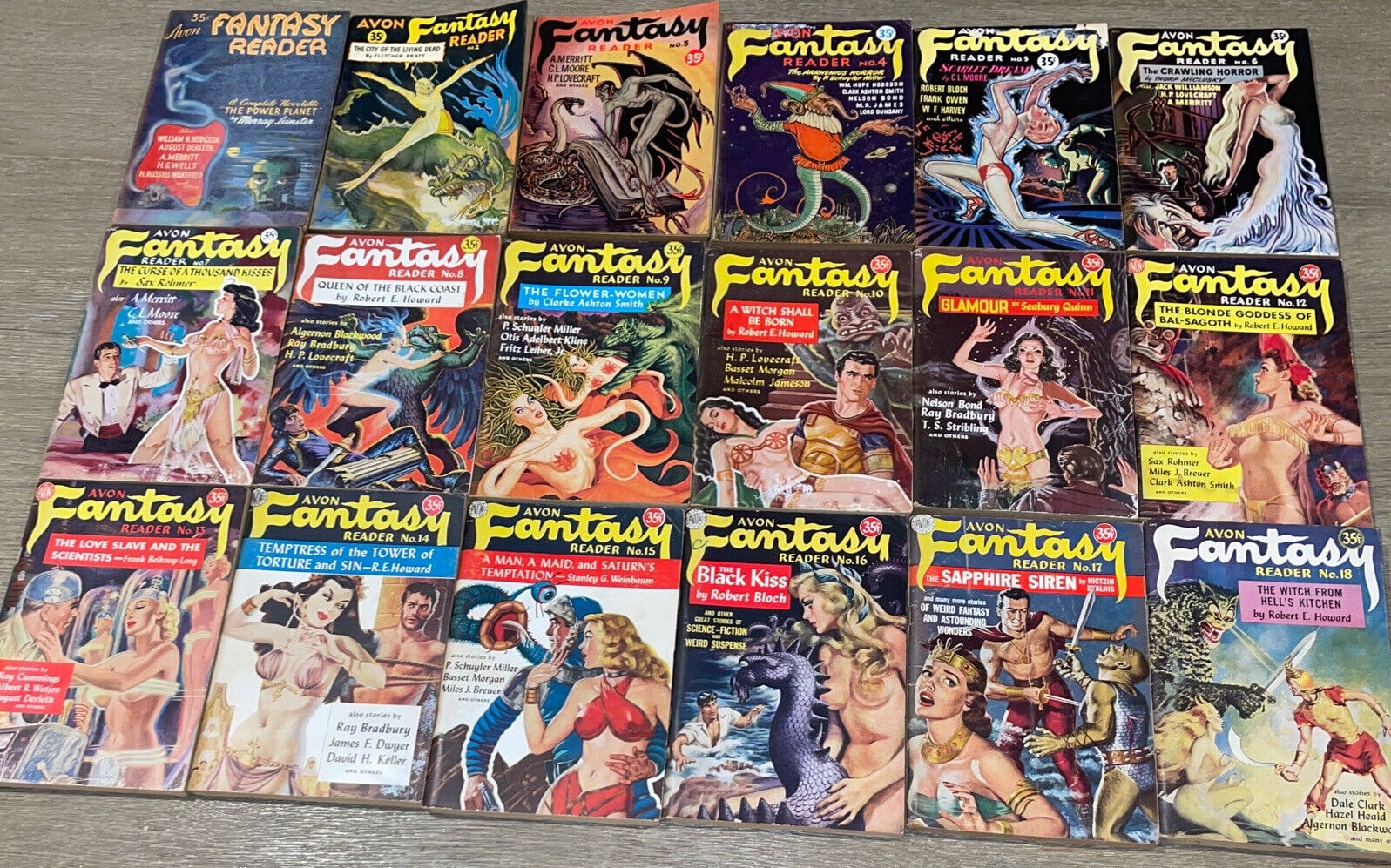
A complete set (18 issues) of Avon Fantasy Reader, edited by Donald A. Wollheim and published 1947-1952
Donald A. Wollheim edited a magazine between the years 1947 to 1952 called Avon Fantasy Reader for Avon Publishers. There were 18 issues, publishing mostly reprints.
Erik Mona reviewed the first issue of Avon Fantasy Reader for Black Gate back in 2023.
I’ve never seen a copy of any of these, but in the late 1960s, George Ernsberger selected some of the best stories from the magazine for two paperback volumes. I believe there were only two. Here are some quick looks at the paperbacks, which I own and have read.
[Click the images for fantastic versions.]
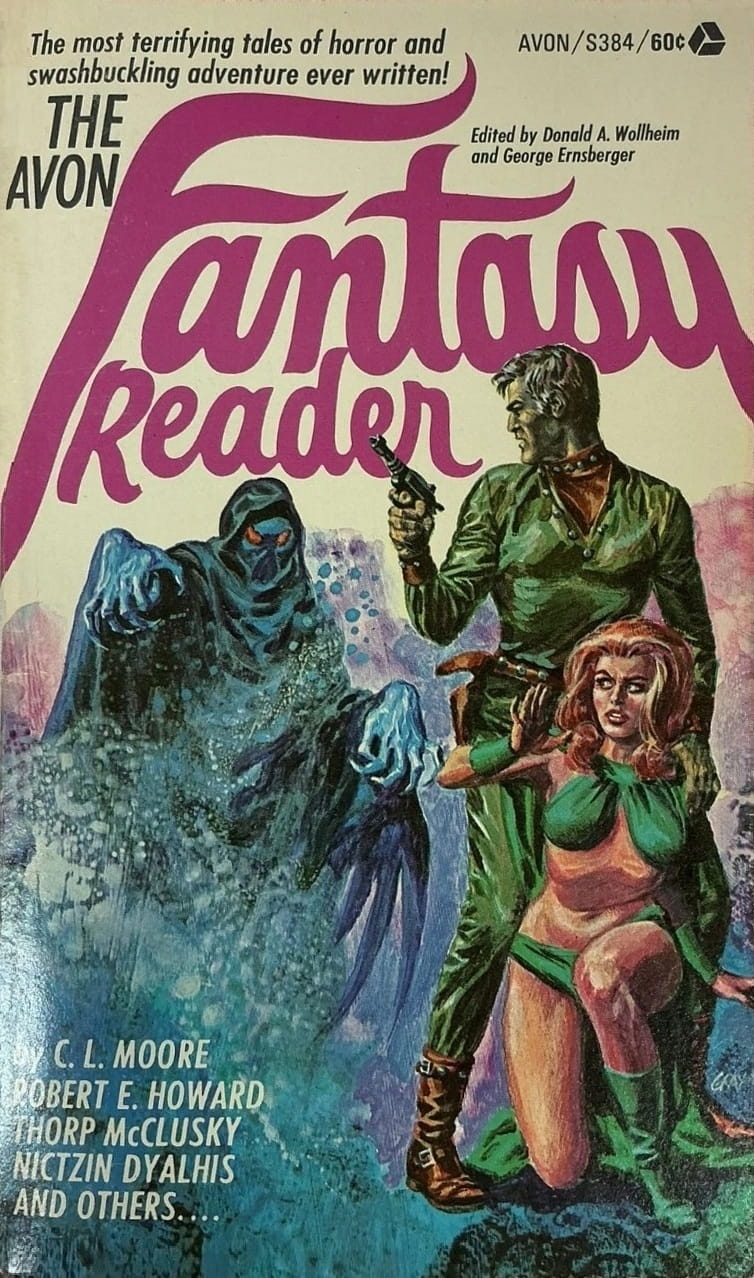
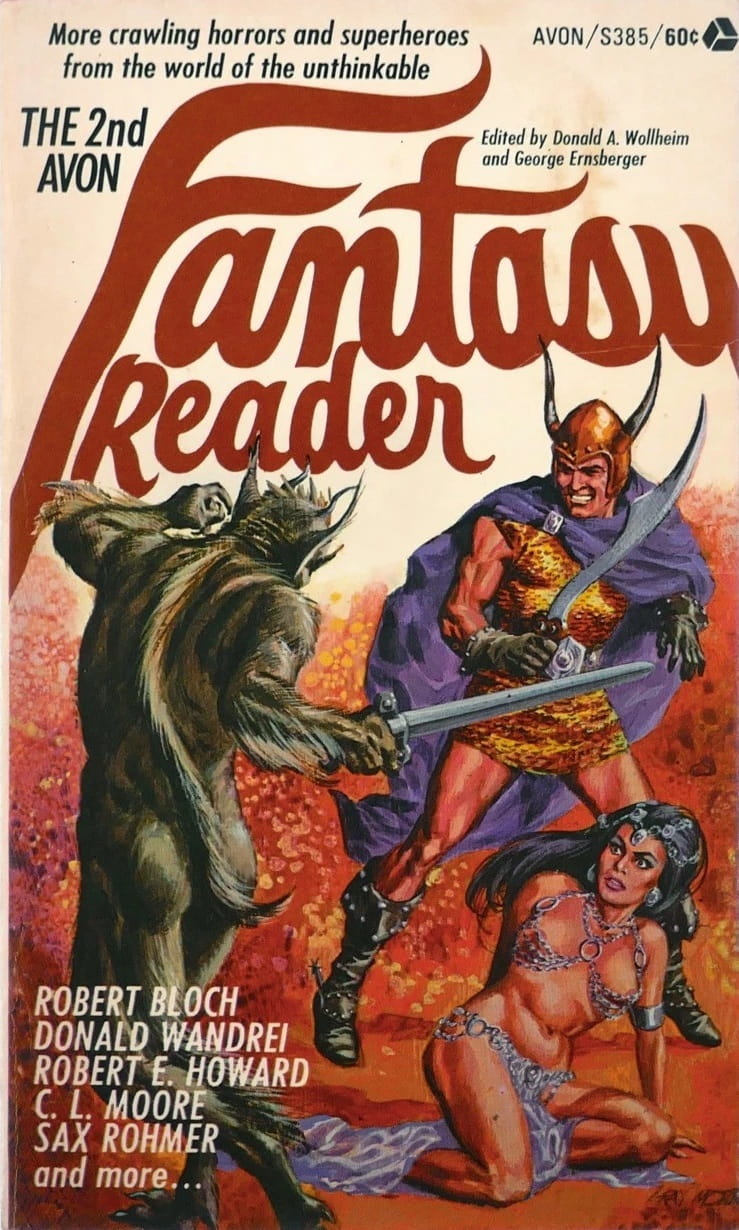
The Avon Fantasy Reader and The 2nd Avon Fantasy Reader, edited by Donald A. Wollheim
and George Ernsberger (Avon Books, January and February 1969). Covers by Gray Morrow
The Avon Fantasy Reader (1969), Avon Books. Contains,
A very short Foreword by Ernsberger
“The Witch from Hell’s Kitchen” by Robert E. Howard, which features a Conanesque hero named Pyrrhas
A Northwest Smith story by C. L. Moore called “Black Thirst”
“A Victim of Higher Space,” by Algernon Blackwood
A fine story by Nictzin Dyalhis called “The Sapphire Siren” (or “The Sapphire Goddess” in Echoes of Valor III)
“The Voice in the Night” by William Hope Hodgson
“The Crawling Horror” by Thorp McClusky
“The Kelpie” by Manly Wade Wellman, which is one of his better stories
The 2nd Avon Fantasy Reader (1969): Contains “The Blonde Goddess of Bal-Sagoth by Howard, and also has stories by C. L. Moore (Northwest Smith again), Zealla Bishop, Clark Ashton Smith, Donald Wandrei, Edward Lucas White, Robert Bloch, Laurence Manning & Fletcher Pratt, and Sax Rohmer.
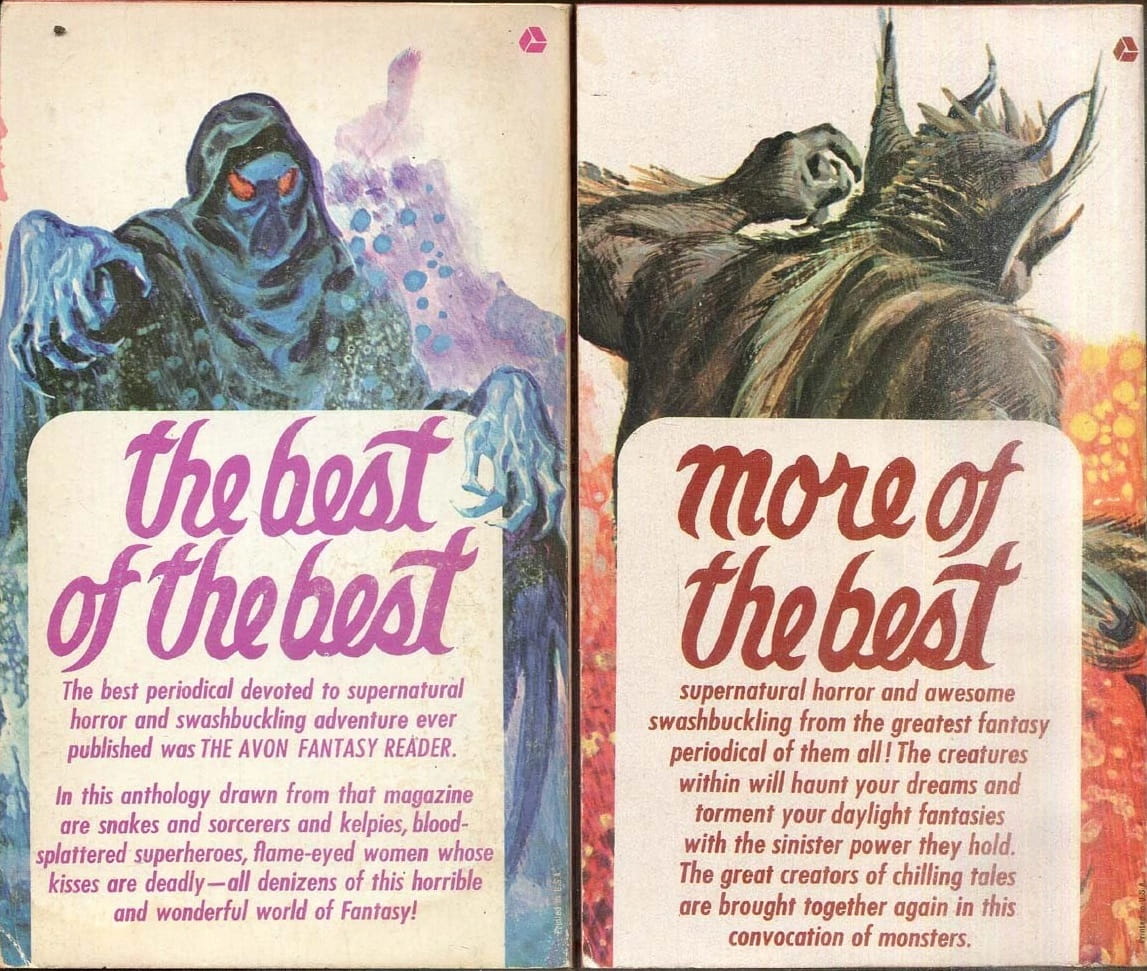 Back covers to The Avon Fantasy Reader and The 2nd Avon Fantasy Reader
“The Black Kiss” by Bloch was excellent, and very Lovecraftian in feel. Several of the stories had that kind of edge to them.
Overall, these two collections are more horror than Sword & Sorcery, although Howard’s two stories fit S&S. The title, “The Witch of Hell’s Kitchen” doesn’t suggest S&S but the tale’s other title perhaps does — “The House of Arabu.” I found both collections generally enjoyable.
I also love these cover illustrations, both of which are by Gray Morrow.
Charles Gramlich administers The Swords & Planet League group on Facebook, where this post first appeared. His last article for us was The Sword & Sorcery of John Jakes. See all of his recent posts for Black Gate here.
Categories: Fantasy Books
The Literary Sorcerer’s Toolkit: Arcane Arts & Cold Steel by David C. Smith
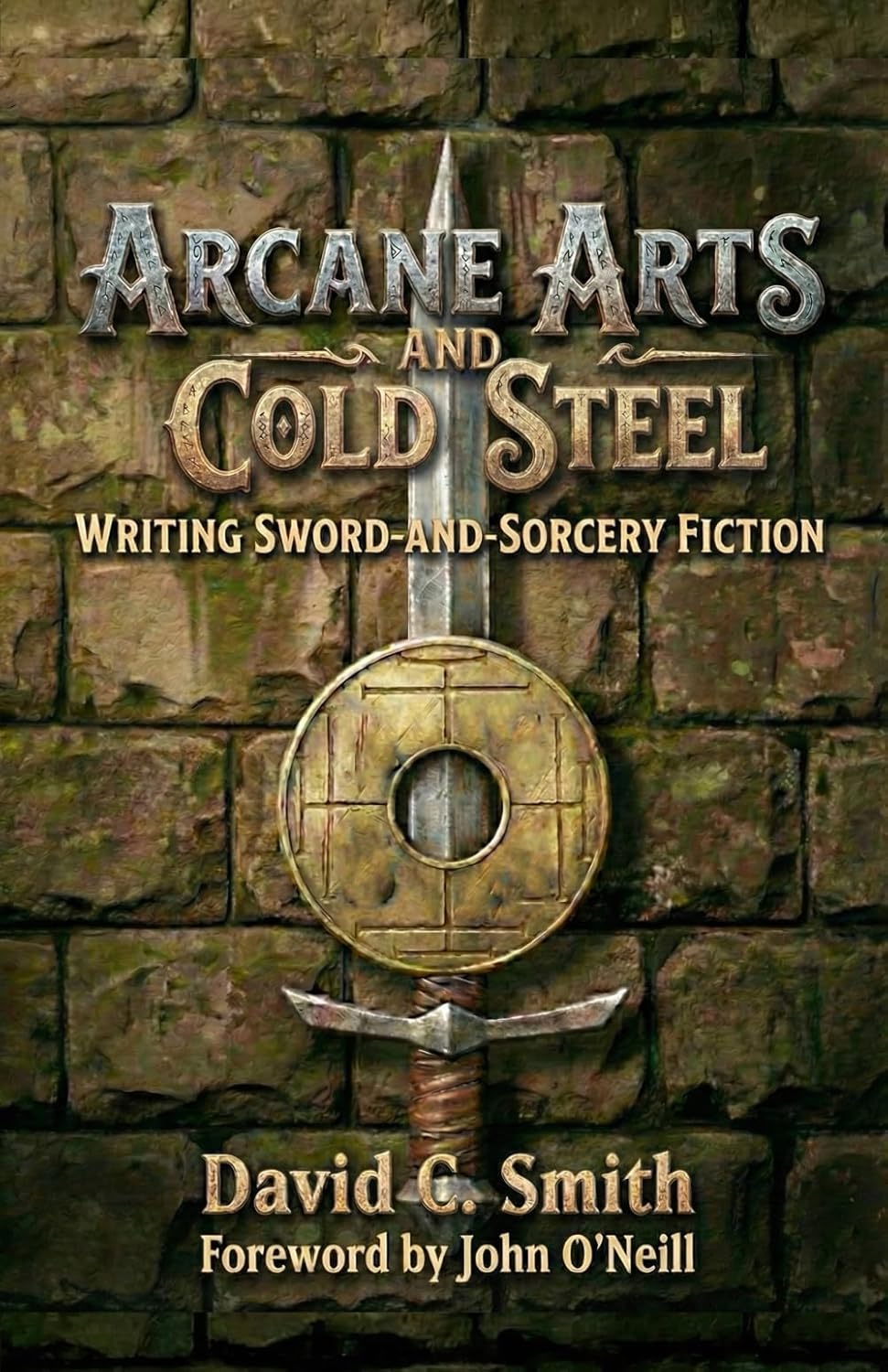
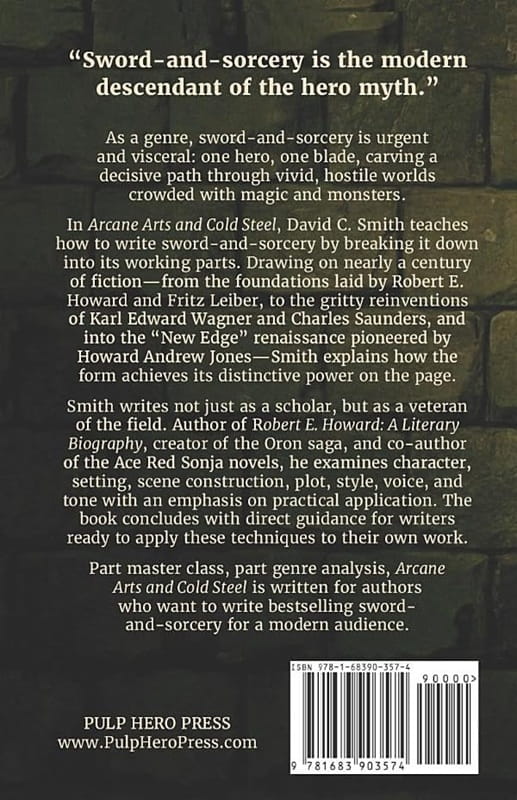
Arcane Arts and Cold Steel (Pulp Hero Press, December 24, 2025)
David C. Smith is a name that speaks to lovers of sword & sorcery, if not with the power of a Karl Edward Wagner, then not far behind, and if you love the genre but don’t know Dave’s name…1) Shame on you; 2) Let me get you up to speed.
A powerful writer of the genre’s last great flowering in the late 70s, Dave’s Tales of Attluma — a sunken lost continent — have spanned five decades, chronicling multiple eras in the lost land’s history — including its destruction — beginning with the epic saga of Oron and most recently, the Unforgiven-esque Sometime Lofty Towers, which I will go on record as calling the best s&s novel since the Elric-fixups, and with more emotional punch.
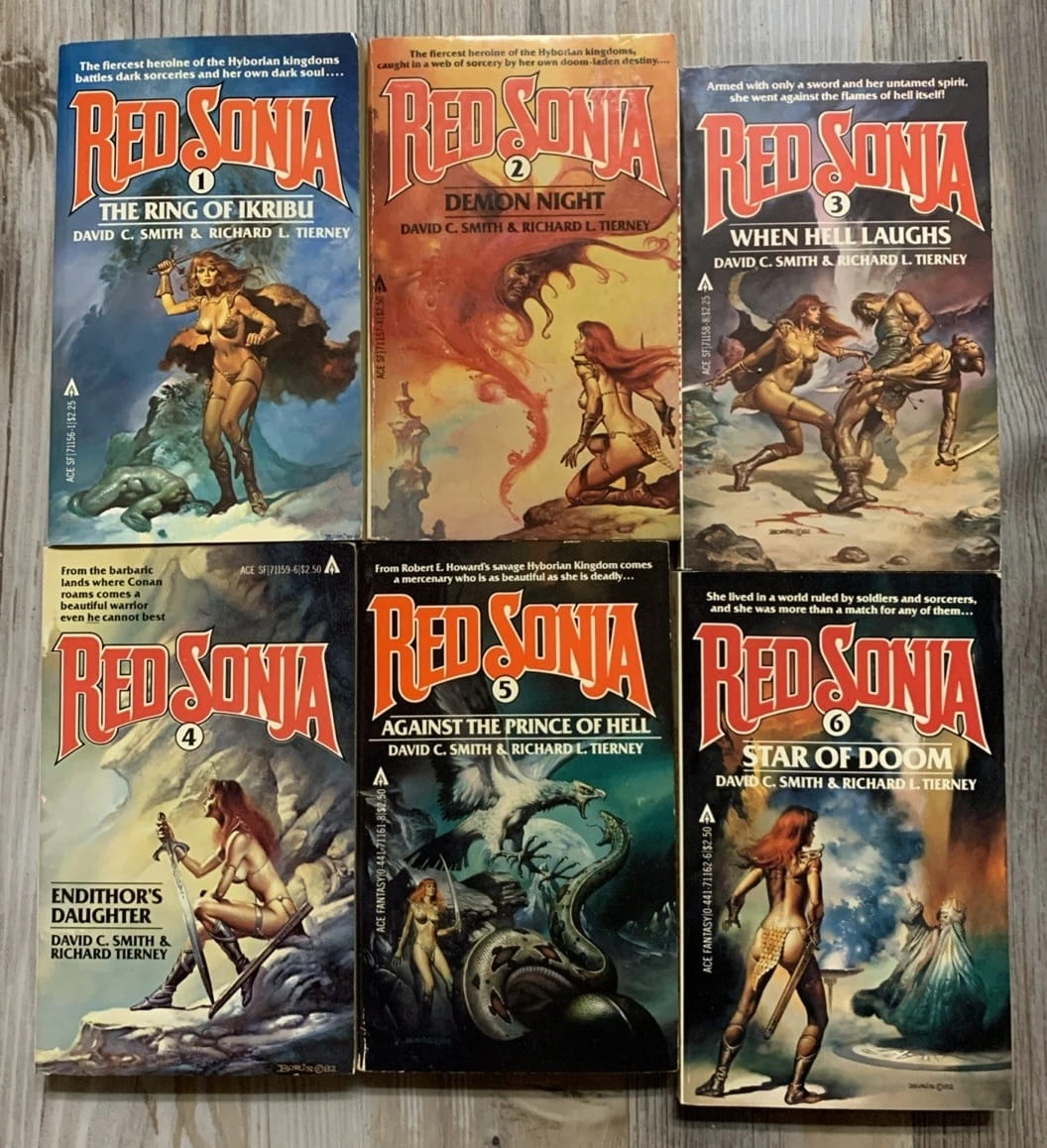 The Red Sonja series by David C. Smith and Richard L. Tierney (Ace Books, December 1981-May 1983). Covers by Boris Vallejo
Dave is also the man who, with another S&S giant, the late Richard L. Tierney, successfully took one of the most vapid characters in S&S — Roy Thomas’s sexing up and dumbing down of Robert E. Howard’s Red Sonya into Marvel’s Red Sonja — and wrote a brilliant, six-volume work-for-hire that are worth the sometimes high prices they command in used bookstores.
Finally, his Literary Biography of Robert E. Howard is one of the most important pieces of Howard scholarship produced in the last twenty years.
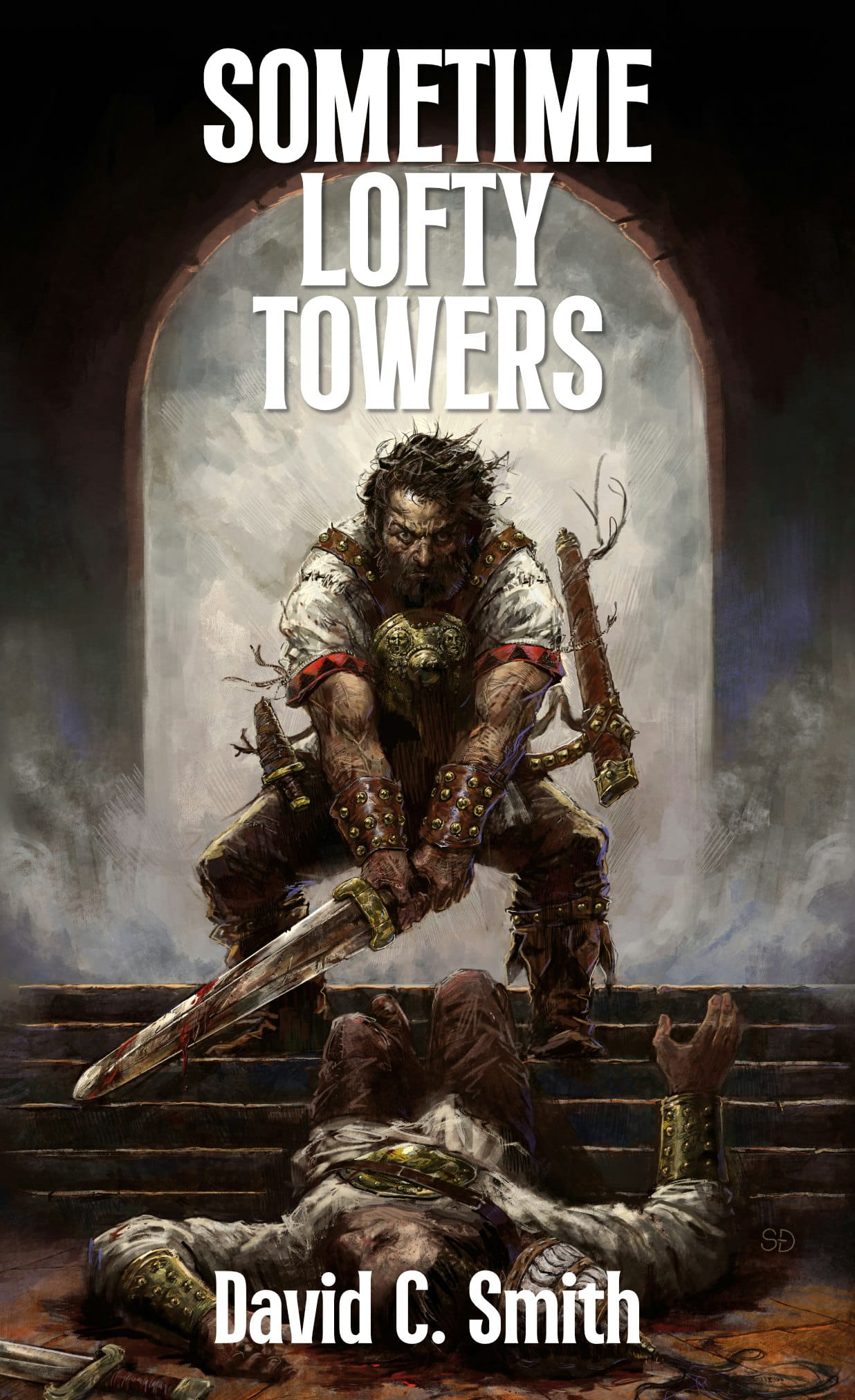
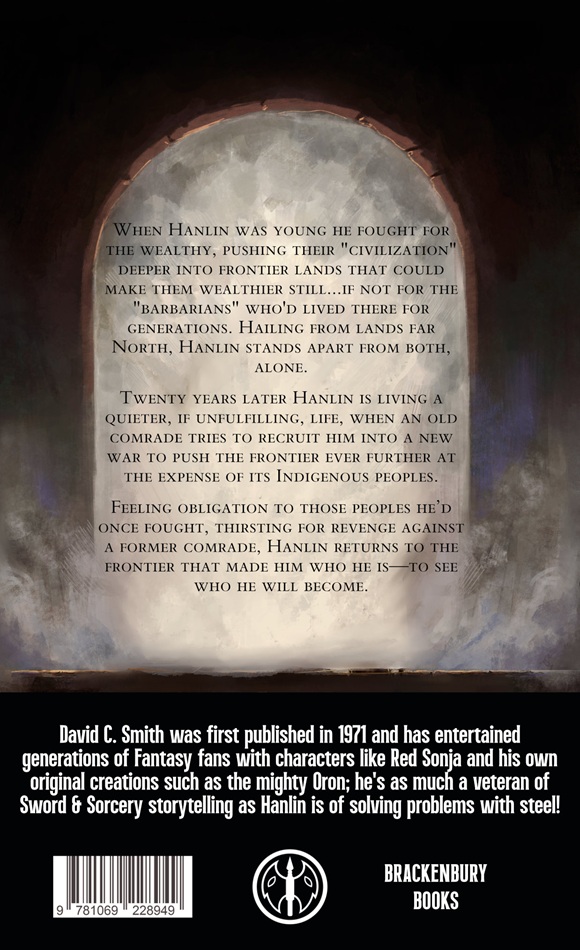
Sometime Lofty Towers by David C. Smith (Brackenbury Books, December 2025). Cover by Saša Đurđević
All of which is saying, Dave knows this genre inside and out. Not just its history, but how to write it.
And that bring us to Arcane Arts and Cold Steel: Writing Sword-and-Sorcery Fiction (with a foreword by BG‘s very own John O’Neill).
Advertised as “Part master class, part genre analysis, Arcane Arts and Cold Steel is written for authors who want to write bestselling sword-and-sorcery for a modern audience.” This is true, but the publisher undersells the book’s power. Yes, the book has a lengthy appendix in which Dave speaks directly to the aspiring writer and reveals his tool kit, and an interview transcript where he speaks to both his career, his long hiatus, and the lay of the S&S writing landscape today. But the core of the book is something much more.
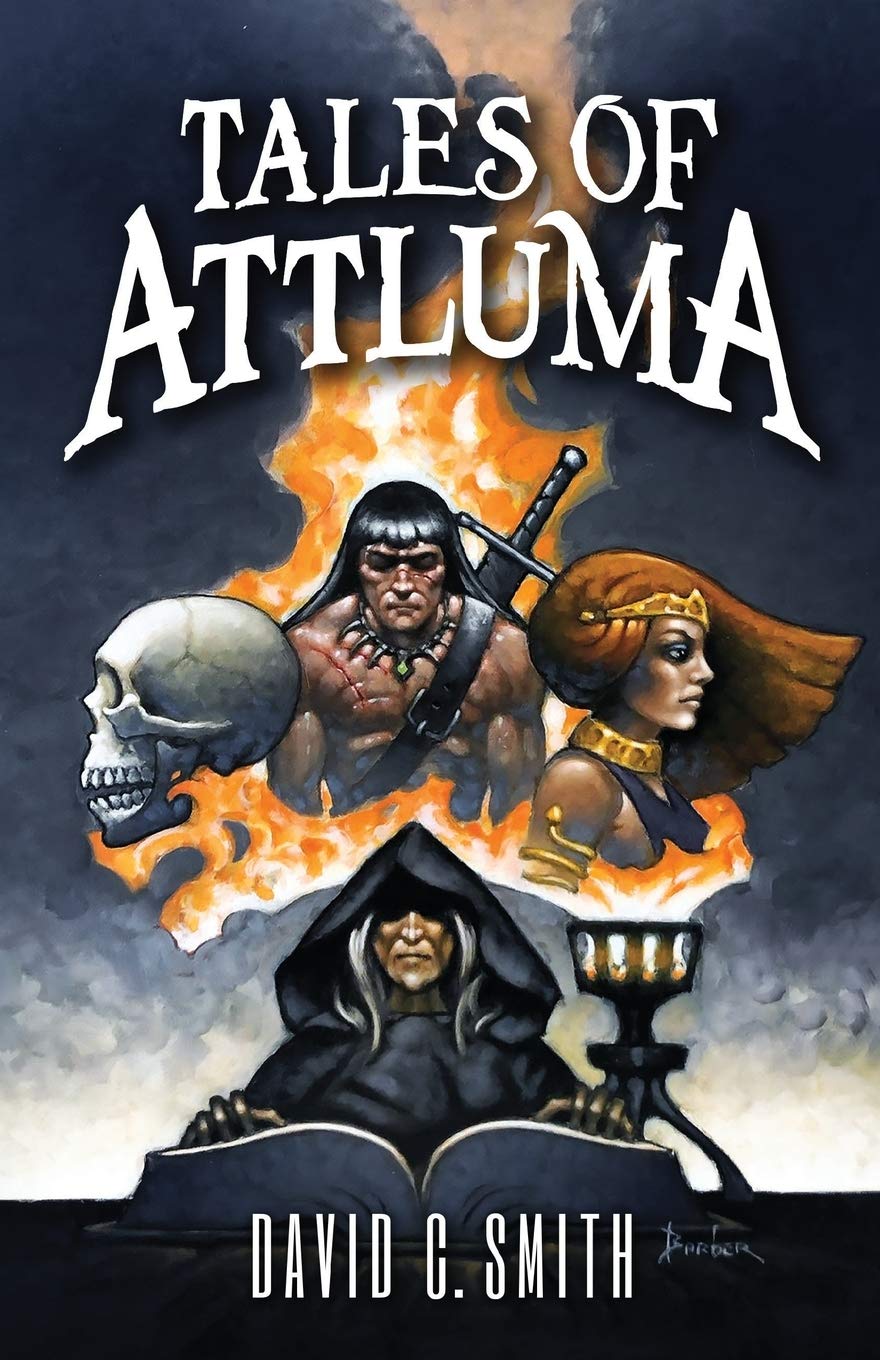
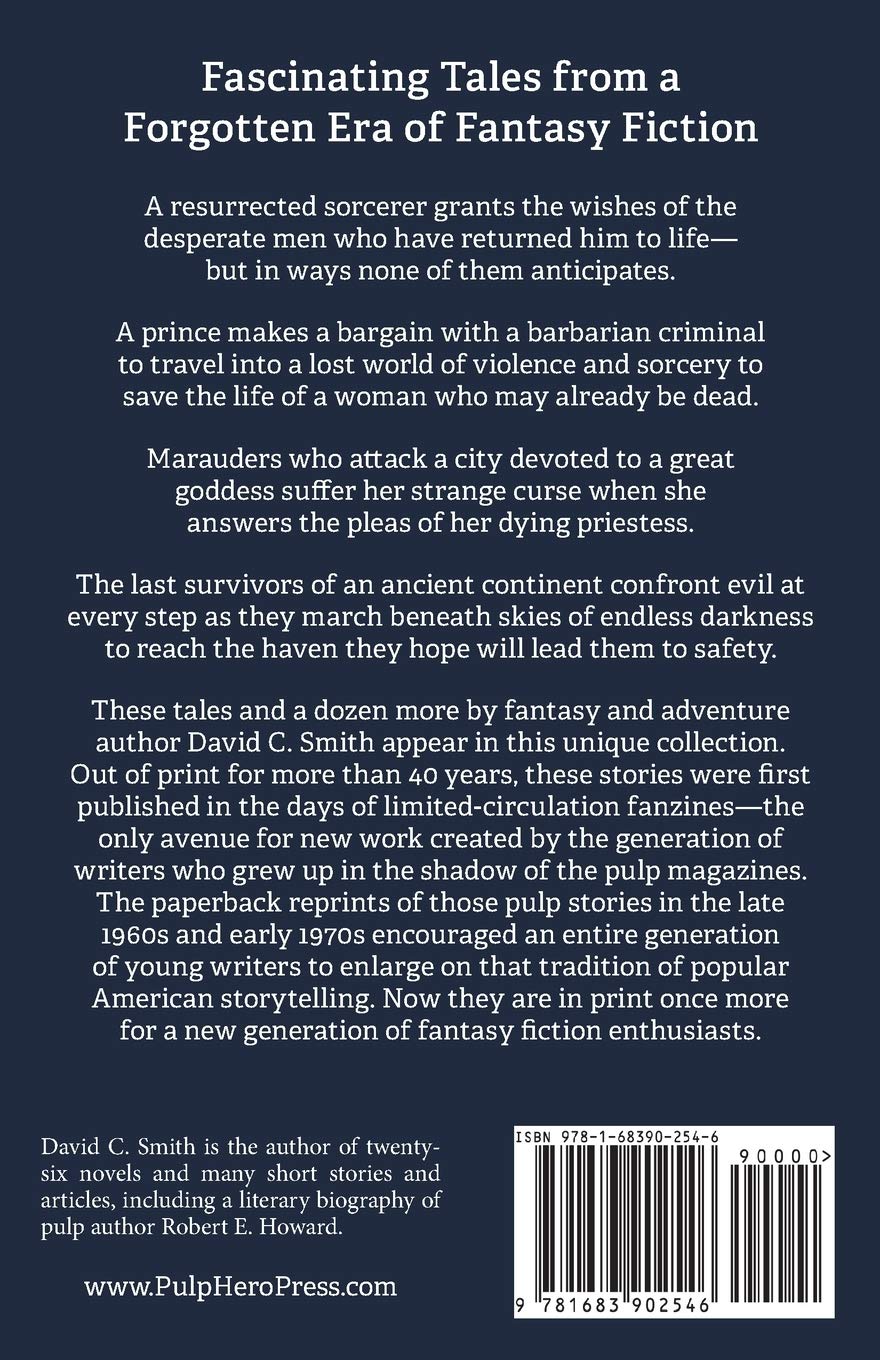
Tales of Attluma by David C. Smith (Pulp Hero Press, December 24, 2025). Cover by Tom Barber
Beginning with a short, concise history of the genre, Dave gets into what IS sword & sorcery fiction, not by trying to create a list of characteristics (Brian Murphy and the late Howard Andrew Jones already did yeoman work here), but by the working nuts & bolts that is usually reserved for snobby lit-crit books.
Smith sees sword & sorcery as the ancestral descendent of myth cycles — Gilgamesh fighting Humbaba, Theseus & the Minotaur, the adventures of the Argonauts — as those tales are immediate and personal, whereas high fantasy is more akin to the great epics.
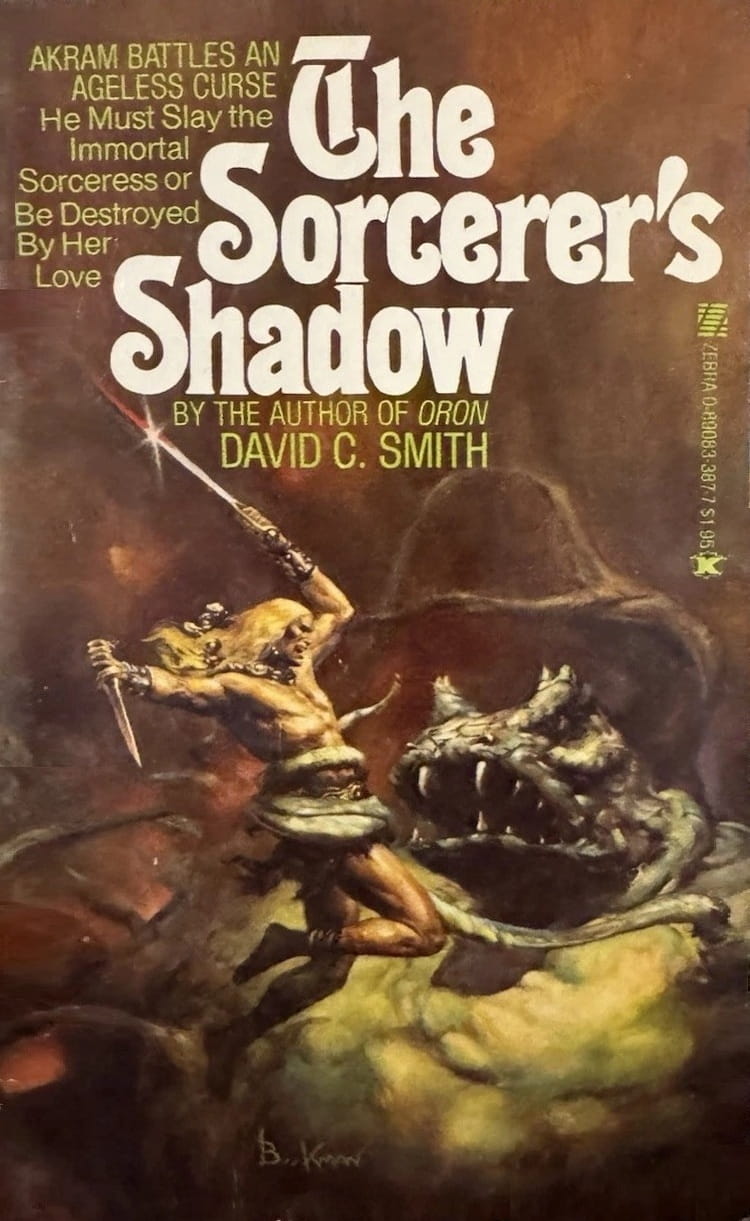
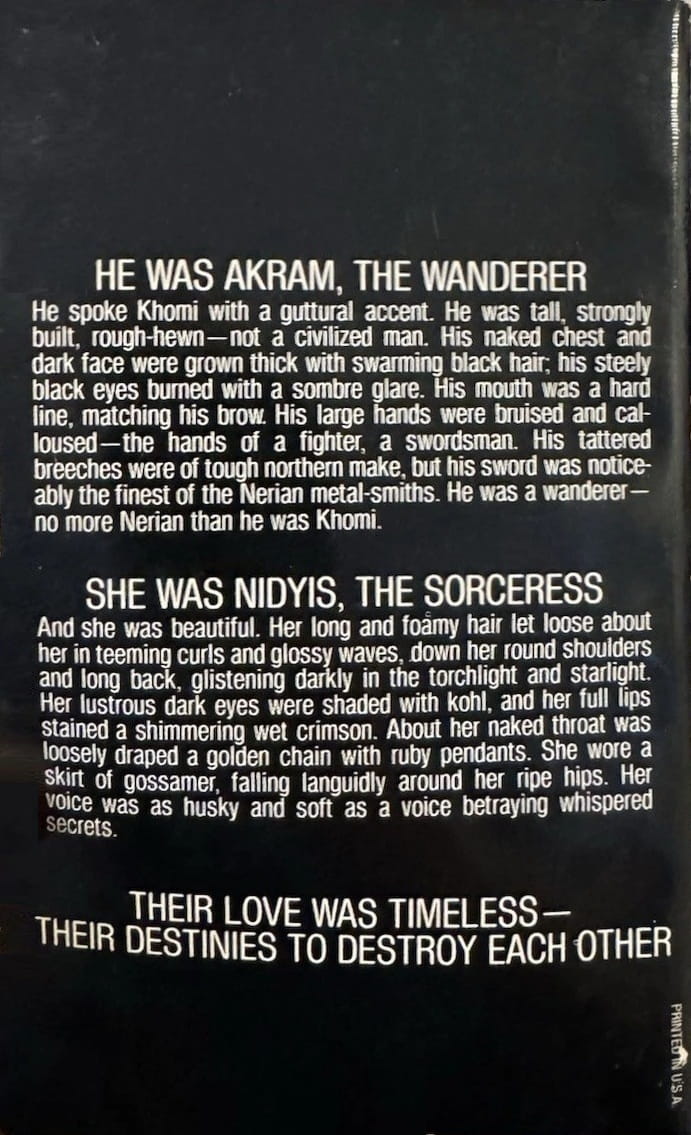
The Sorcerer’s Shadow by David C. Smith (Zebra Books, September 1978). Cover by Doug Beekman
Like Howard Andrew Jones, he sees the immediate predecessor of the genre in the historical adventure fiction of the late 19th century and first years of the 20th century: the work of Haggard and Lamb, the pantheon of pulp writers in Adventure and Argosy, that all coalesced as a young man from west Texas synthesized those experiences, the successful John Carter and Tarzan pennings of Edgar Rice Burroughs, and the weird horror he already wrote and created the characters of Solomon Kane, Kull and Conan, launching a new genre along the way.
Drawing on a century of fiction — from the foundations laid by Robert E. Howard and Fritz Leiber, to the gritty reinventions of Karl Edward Wagner and Charles Saunders, and into the “New Edge” renaissance pioneered by Howard Andrew Jones, Smith looks at story structure: character & setting; plot & scene construction; style, voice, and tone; the use of horror & the supernatural; even the role of the inhuman as character and lens on human issues. Like a lit-crit academic, he digs deep into these topics through extensive examples from real published sources.
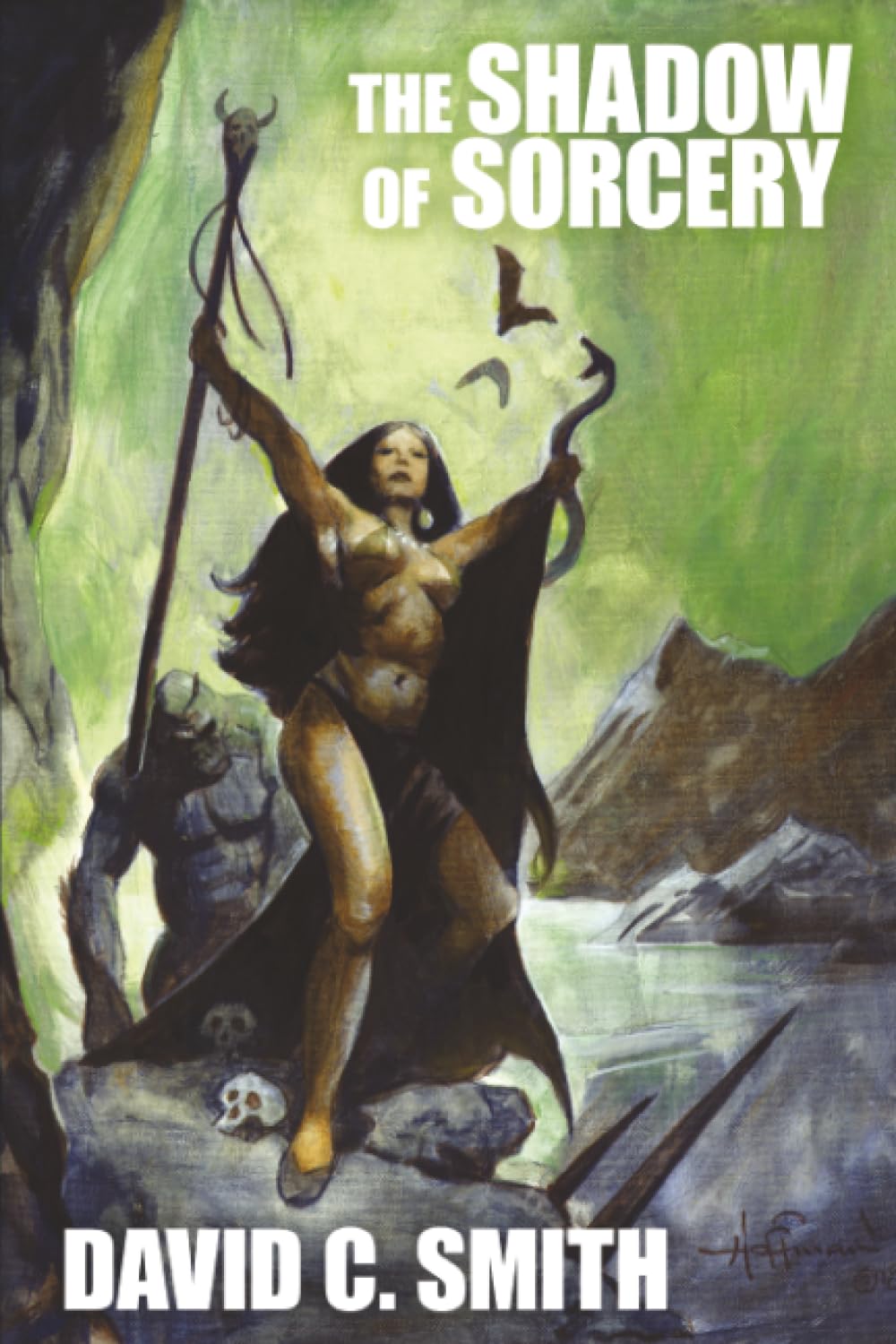
The Shadow of Sorcery by David C. Smith (Wildside Press, March 5, 2026). Cover by Mike Hoffman
And this is the first gold mine. Yes, of course, we see Howard, Leiber, Moorcock and Wagner being cited and examined, but there are as many — or more — examples from the writers of Smith’s generation, such as Adrian Cole, Richard Tierney and Charles Saunders, and even more from active writers today: Jason Ray Carney, Milton Davis, John Fultz, Bryn Hammond, Schuyler Hernstrom, John Hocking, the late Howard Andrew Jones, Dariel Quioge, Jason M. Waltz, Clint Werner and more.
Where the work differs from the usual lit-crit manual is that the author is actually a major figure in the genre he is analyzing and has an actual love of the material he is not afraid to show. This is not some dry, literary analysis of sword & sorcery as literature — this is a paean to the genre, to the power of *genre* fiction and *plot* to do all of the things usually reserved for pure literature.
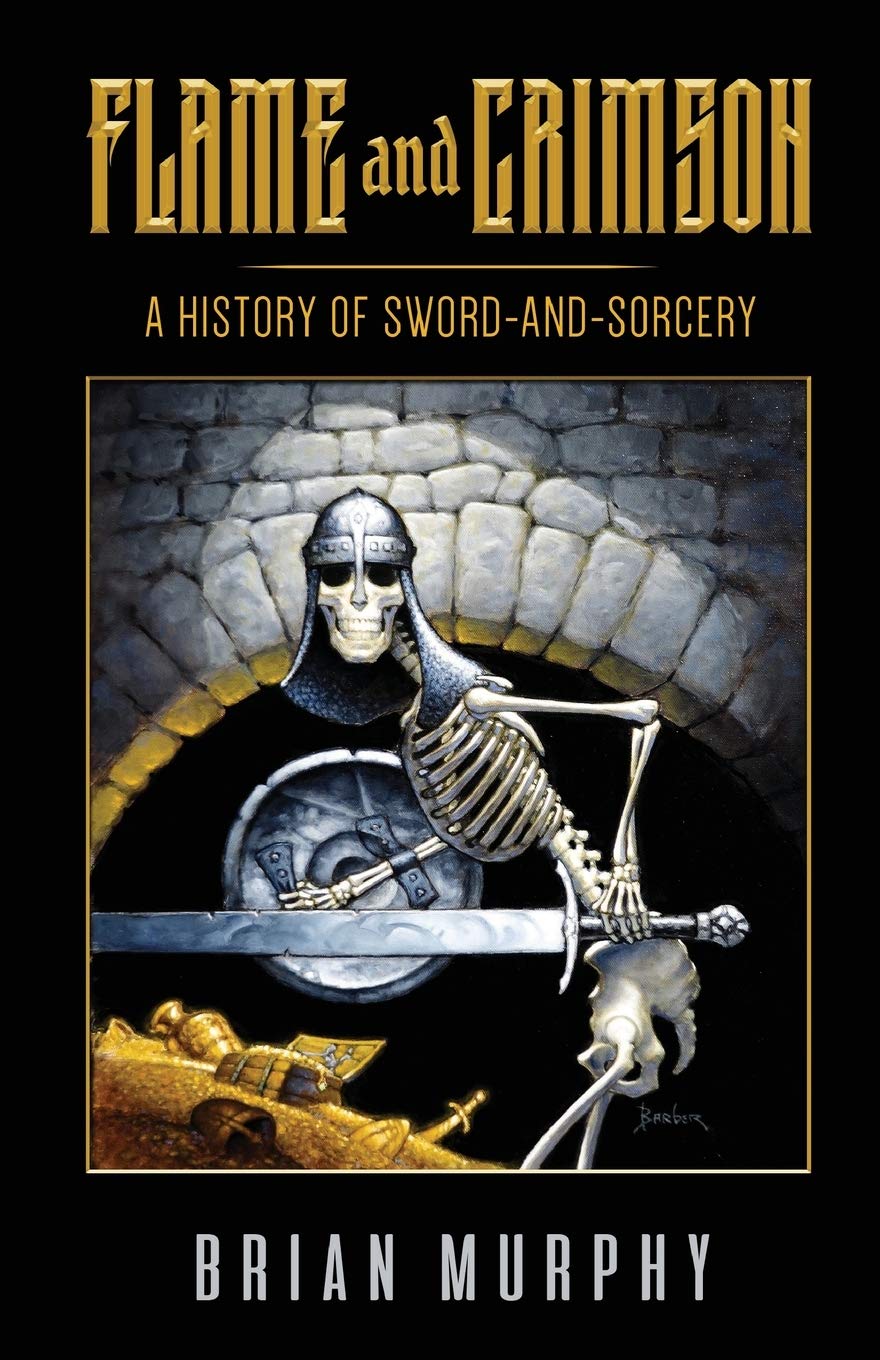
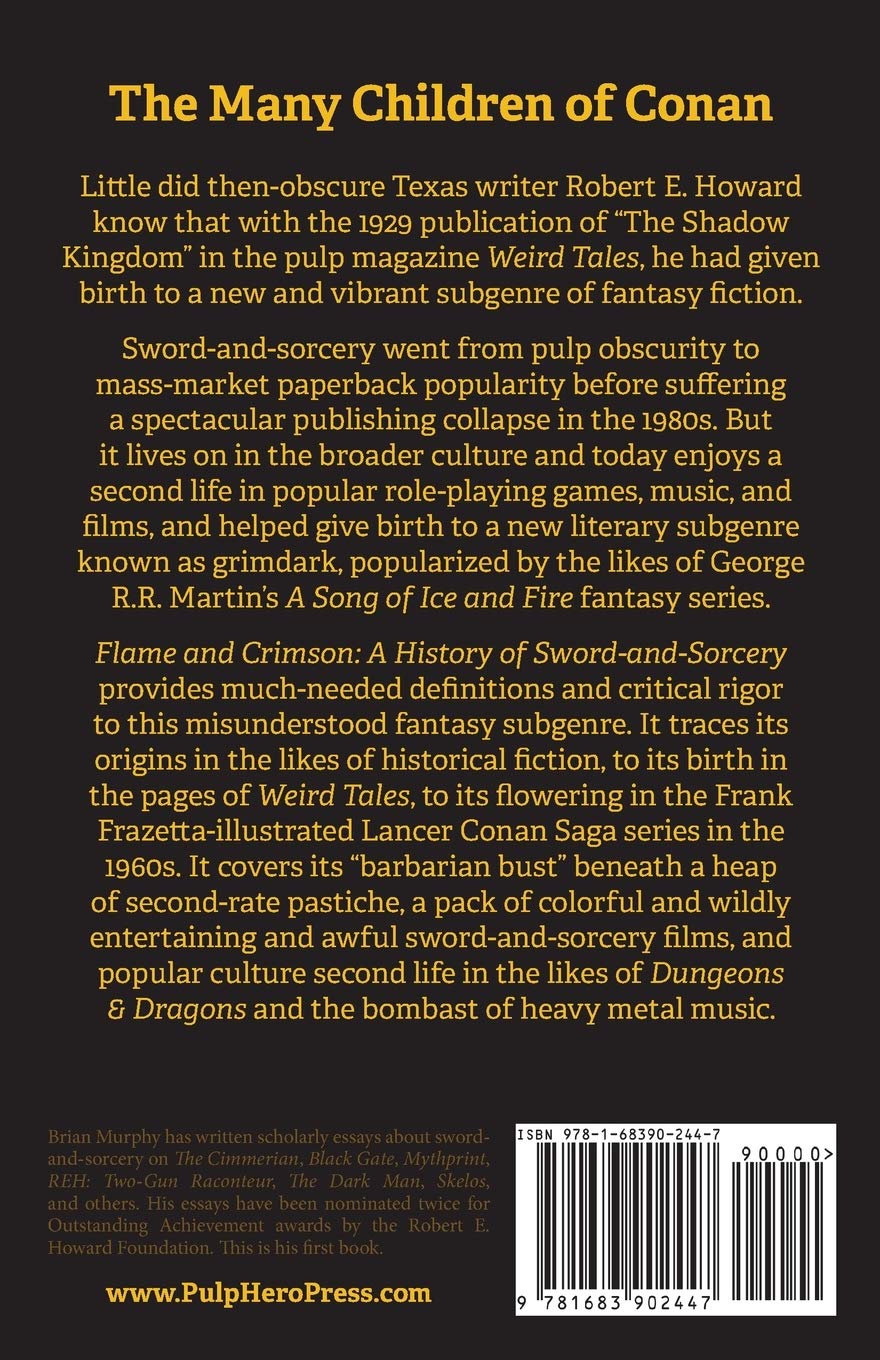
Flame and Crimson: A History of Sword-and-Sorcery by
Brian Murphy (Pulp Hero Press, January 16, 2020). Cover by Tom Barber
Along the way we get snippets of genius from a century of writing, and I guarantee you’ll find stories and writers you never knew about. But you will also see why the oft-maligned “genre” can be powerful literature in its own right, even when its first goal is — gasp — entertainment. You will also find that there is a clear pattern of what makes sword & sorcery a distinct sub-genre, the defiant “attitude” coined by Jason M. Waltz in his massive anthology Neither Beg Nor Yield, making this a perfect companion volume to Brian Murphy’s Flame & Crimson: A history of sword & sorcery.
It’s rare that we get to see a genre analyzed by one of its own luminaries, even rarer they then sit down and tell you how to hone your writing for that field. This is a delightful read that serves on many levels and deserves the praise it is receiving.
Categories: Fantasy Books
Book Review: Nowhere Burning by Catriona Ward
I received a review copy from the publisher. This does not affect the contents of my review and all opinions are my own.
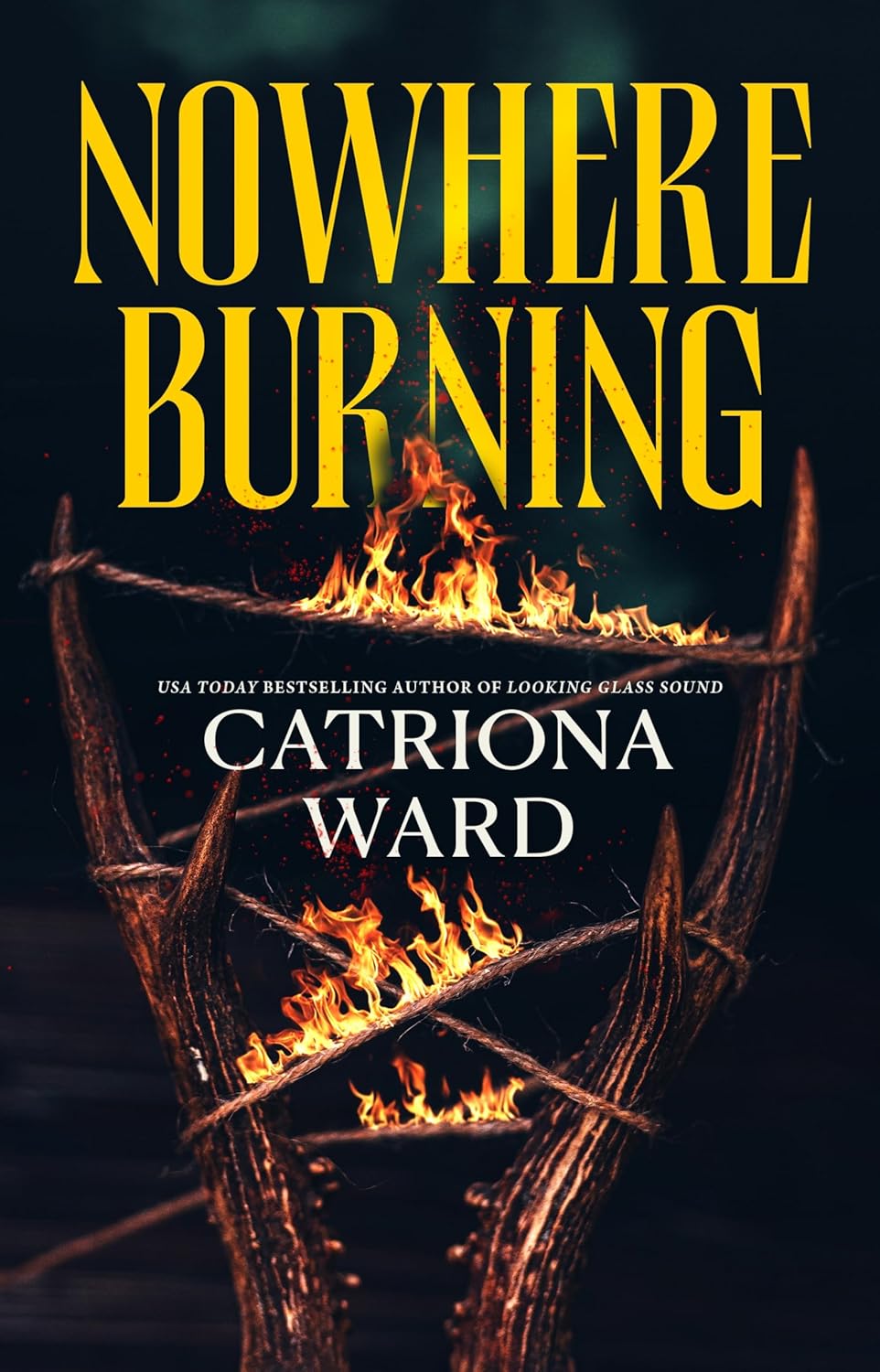 Nowhere Burning by Catriona Ward
Mogsy’s Rating: 3 of 5 stars
Genre: Horror
Series: Stand Alone
Publisher: Nightfire (February 24, 2026)
Length: 304 pages
Author Information: Twitter
Catriona Ward has built a reputation for writing horror that’s strange, unsettling, and often surreally disorienting by design. Nowhere Burning continues following in that same vein, though in this case, it might have gone a bit too far, pushing the story into hazy disjointedness. As a result, I didn’t quite take to this one as much as I’d hoped, finding it occasionally difficult to stay invested in what was happening from one section to the next.
In one major thread, we follow Riley, a teenage girl on the run with her younger brother Oliver. Desperate to escape their abusive foster home, she decides to seek out a place called Nowhere, rumored to be a safe haven hidden deep in the mountains where runaway children can live off the grid. The place, however, comes with its own dark history. The land once belonged to a reclusive actor named Leaf Winham, who built the sprawling ranch retreat years earlier. But what was meant to be a private sanctuary eventually became the center of a horrific scandal before a devastating fire consumed the property. All that’s left now are the burned-out ruins and the bad memories and ugly rumors that have grown around them.
In addition to Riley’s story, a couple others also run alongside in tandem. One follows a pair of filmmakers digging into the ranch’s past for a documentary, interviewing people who were connected to it from before the fire and trying to piece together what really happened. Another thread looks back at Leaf Winham and the early days of the estate, hinting at the secrets that shaped its creepy reputation. As the novel moves between these perspectives, details about Nowhere, its former inhabitants, and the events that led to its ruin gradually come together, showing how past and present collide.
Unfortunately, with so many separate threads and sudden jumps in time, the plot can start to feel a little choppy and hard to follow, and not every storyline gets the space it needs to fully develop. Riley’s is by far the most compelling and arguably the most important; some of the others, however, feel less essential. These came and went like side narratives that only appear in short bursts to give background information before shifting back to Riley’s perspective, which I started looking at as the “main” story. At least her chapters had plenty of emotional themes to anchor them, like her love for Oliver and her determination to secure a safe place for them to live. This was not the case with the “before” and “after” storylines, whose purposes were less defined and didn’t hold my interest as much.
That said, Ward still does a solid job creating a strong sense of place. The isolated mountain setting gives an unsettling edge right from the start, and once we get to the section where Riley finds Nowhere, the behaviors of the young people living there make things feel even more off. And no wonder. Bad things have happened in this place, and the kids here now have had bad things happen to them. The book is heavy with themes of trauma, abuse, and the misery that leads people to make desperate choices when they feel trapped with no way out. It can be difficult read at times.
At the same time, the nebulous tone that defines much of the author’s work can make the reading experience frustrating. The story often hints at deeper, hidden meanings without fully explaining how everything fits together. Granted, it’s clear that some of the vagueness is intentional, since there are secrets buried in the timelines before and after Riley’s storyline that don’t connect until the very end. And yet, the confusion it leads to doesn’t always feel rewarding since the story withholds too much information for too long.
In the end, Nowhere Burning ended up being a bit of a mixed bag. The premise is intriguing, the setting works well, and Riley makes for a strong central character. But the crowded structure and hazy storytelling kept the book from fully coming together for me. I’ve enjoyed Catriona Ward’s previous books (even the more surreal ones!) but this one might end up being my least favorite. Fans of her dreamlike style may still enjoy the ride, but for me this one ultimately landed somewhere in the middle.

Categories: Fantasy Books
Forgotten Authors: Nat Schachner
 Nat Schachner
Nat Schachner was born on January 16, 1895 in New York. He earned a Bachelor of Science in chemistry from City College in 1915. He served in the U.S. Army during World War I in the chemical warfare service from 1917 to 1918 and, when he returned to New York he earned a Doctor of Jurisprudence from New York University in 1919, the same year he married Helen Lichtenstein. The couple would have a daughter. He worked as an attorney until 1933 when he became a freelance writer.
On April 4, 1930, Schachner, along with G. Edward Pendray, David Lasser, and Laurence Manning, founded the American Interplanetary Society, which would be renamed the American Rocket Society four years later. The organization designed and launched liquid fueled rockets and in 1936 the organization was awarded the Prix a’Astronautique by the Société astronomique de France.
1930 also saw the start of his career as an author with the publication of “The Tower of Evil,” which he co-wrote with Arthur Leo Zagat. The two men collaborated on eleven stories published in 1931 before both turning to their solo careers as authors.
Wonder Stories Quarterly, Summer 1930. Cover by Frank R. Paul
Schachner’s first solo story was “Pirates of the Gorm,” which appeared in Astounding Stories in the May 1932 issue. His most famous story appeared in the December 1933 issue, “Ancestral Voices,” a time travel story the was an early example of the grandfather paradox, although in this case, Emmet Pennypacker travels back to the fifth century and kills a Hun who was a distant ancestor of his. Although known for the grandfather paradox, Schachner has stated that the story was a commentary on the destructiveness of the concept of racial purity that was popular in the 1930s.
The same year “Ancestral Voices” was published, Schachner published the three stories which made up “The Revolt of the Scientists,” which was set in the then near-future of 1937, indicating that a technocratic society held the keys to lifting the country out of the throes of the Great Depression.
As the Nazis and Fascism rose to power in the late 1930s, Schachner continued to address their ideas in his fiction, focusing on championing human liberties in his writing, and writing stories in which authoritarianism was ultimately defeated. By 1935, he was writing “World Gone Mad” in which Schachner warns the reader of about the pending global war, although Schachner sets it in 1990, with the U.S. on one side and the Sino-Russian alliance and United Europe on the other side. Despite coming up with interesting ideas and trying to include messages in his fiction, Schachner’s fiction rarely rises about average. Paul A, Carter, writing in The Creation of Tomorrow: Fifty Years of Magazine Science Fiction, described Schachner as “the earliest of pulp science fiction’s anti-Nazi Paul Reveres…”
In 1937, Schachner published Aaron Burr: A Biography, launching a new writing career for himself. He continued to publish science fiction through 1941, with the story “Eight Who Came Back” in the November issue of Fantastic Adventures, but after that he focused on biographies, publishing books on Alexander Hamilton (1946), Thomas Jefferson (1951), and The Founding Fathers (1954). He also published a work on Medieval universities in 1938.
Serving on the editorial committee for the American Jewish Committee, he published The Price of Liberty: A History of the American Jewish Committee in 1948. He would also go on to serve as the Director of Public Relations for the National Council of Jewish Women from 1954 until 1955.
Schachner died in Hastings-on-Hudson on October 2, 1955. He is buried in Mount Hope Cemetery in Hudson-on-Hastings, New York.
Steven H Silver is a twenty-one-time Hugo Award nominee and was the publisher of the Hugo-nominated fanzine Argentus as well as the editor and publisher of ISFiC Press for eight years. He has also edited books for DAW, NESFA Press, and ZNB. His most recent anthology is Alternate Peace and his novel After Hastings was published in 2020. Steven has chaired the first Midwest Construction, Windycon three times, and the SFWA Nebula Conference numerous times. He was programming chair for Chicon 2000 and Vice Chair of Chicon 7.
Categories: Fantasy Books
Pages

Recent comments