
Fantasy Books
THE DEMON KING (Nightfall #3) by Peter V. Brett
The Demon King is the third and final installment of Peter V. Brett’s Nightfall saga, closing the saga of Olive Paper and Darin Bales, as well as the world introduced in The Warded Man, the first Demon Cycle novel. For now, at least. The second installment, The Hidden Queen left readers in a lurch, with…
Categories: Fantasy Books
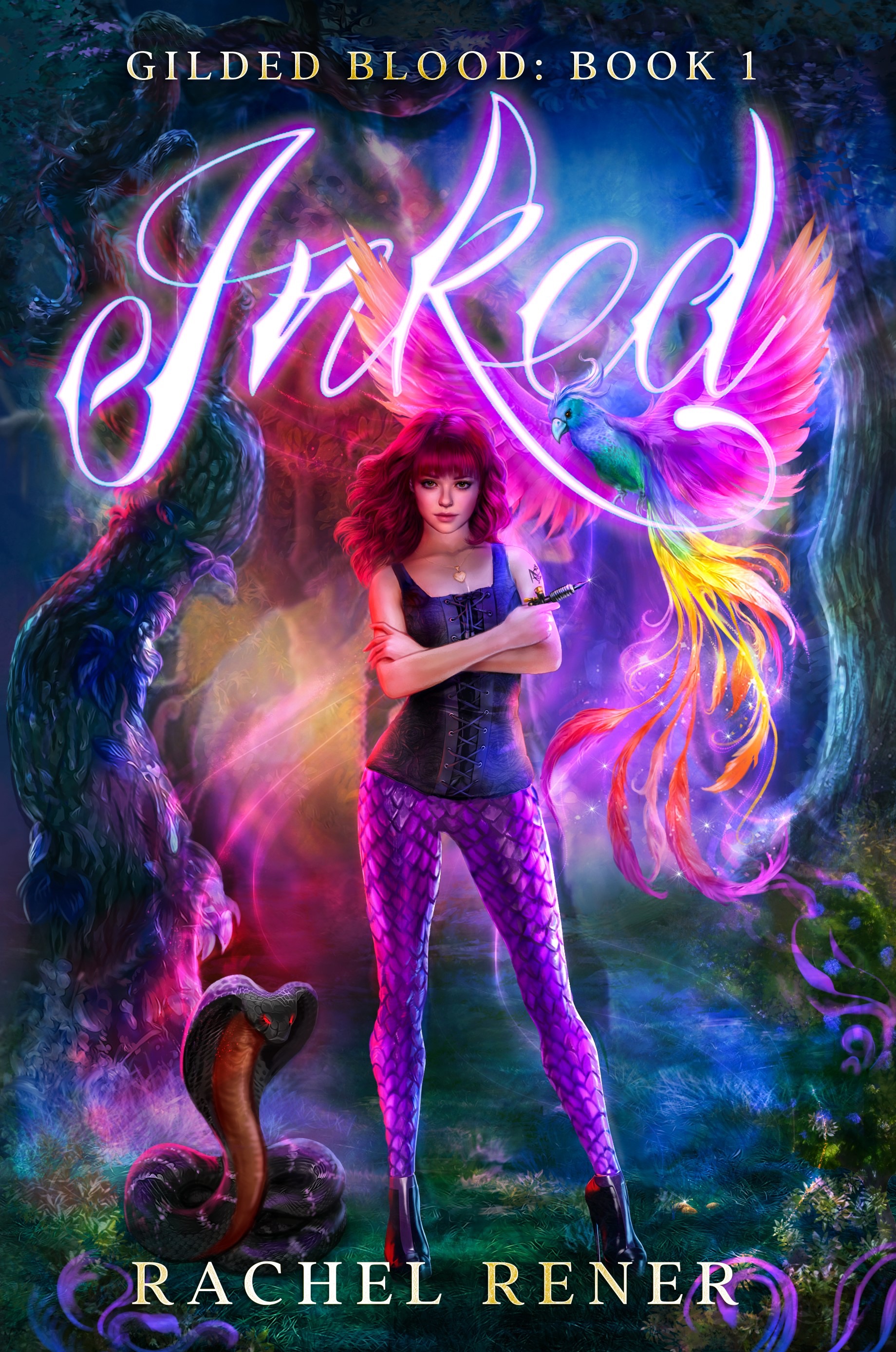
Inked (by Rachel Rener)
Tattoo artist Talia is inking her last customer of the night with a hideous snake on his butt when she runs out of ink. With little option she enters her boss’s office and swipes a little of the ink she is forbidden from using.
And suddenly the snake that was a tattoo, is no longer a tattoo but a very real snake hissing at her.
–––––––––––––––––––––––––––––––––––––––––––––––––––––––––––––––––––––––––
At first I wasn’t really feeling this book. I picked it up in a sale at audible and honestly if it wasn’t on special I probably would not have bought it.
But I’m man enough to admit when I was wrong.
This is a great book. Took a while to suck me in, but suck me in it did and I ended up loving it.
Categories: Fantasy Books
Women in SF&F Month: Isabel J. Kim
It’s a new week of Women in SF&F Month, starting with a new guest post by Isabel J. Kim! Her short fiction has been selected for inclusion in The Best American Science Fiction and Fantasy 2023, 2024, and 2025, and it has been on the Locus Recommended Reading List multiple times. Some of her more recent short stories are “Why Don’t We Just Kill the Kid in the Omelas Hole,” a Nebula, Locus, and BSFA Award winner and Hugo Award […]
The post Women in SF&F Month: Isabel J. Kim first appeared on Fantasy Cafe.
Categories: Fantasy Books
Spotlight on “Glyph” by Ali Smith
LitStack Spots Ali Smith Here are a few other titles Litstack spotted and are adding…
The post Spotlight on “Glyph” by Ali Smith appeared first on LitStack.
Categories: Fantasy Books
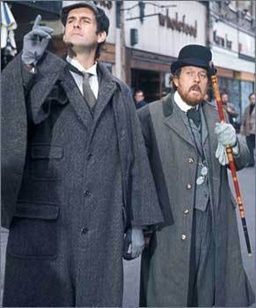
John Cleese Does Sherlock Holmes (and better, the first time)
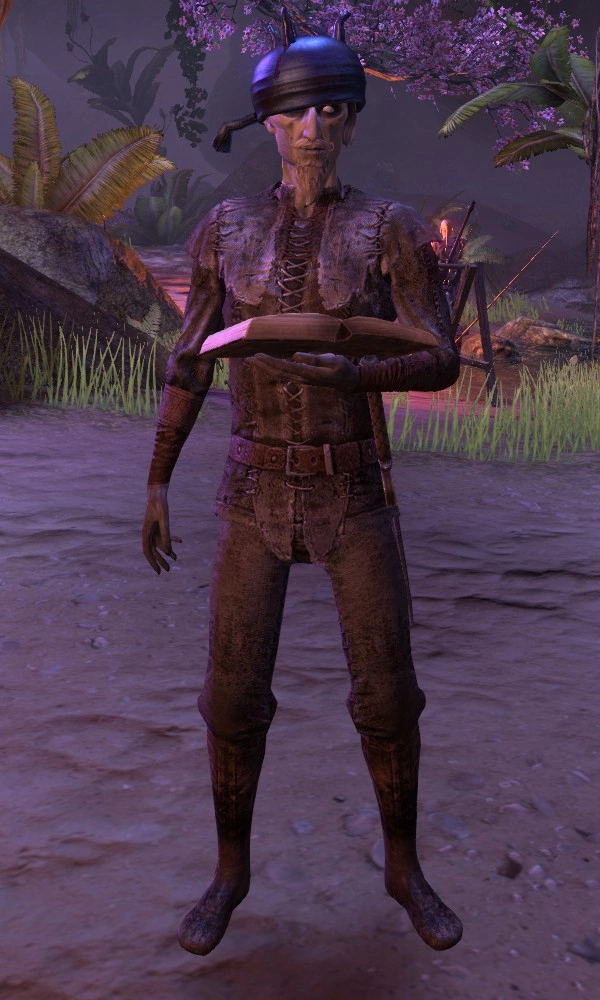
 I reinstalled Elder Scrolls Online, which is a rabbit hole I jump down periodically. I usually do side, and zone, quests. But when I decide to follow some of the main storyline, I am delighted to come across John Cleese’s Sir Cadwell. He is the a rather mad soul shriven who guides the characters in Cleese’s inimitable style. Every scene with Cleese is fun, and he also plays a part in one of the large DLCs.
Here’s a short ‘official’ video on the creation of the character. I think you’ll get the feel of this erratic character. Includes Cleese talking about it.
It’s a blessing he is still with us; active at 86.
Some folks are aware of his The Strange Case of the End of Civilization as We Know It (discussed at the end of this post). I set out to write about that awful Sherlock Holmes parody movie. I wrote this essay instead. And ten years later, I still have no interest in re-watching and writing an essay on Strange Case. It is just too dumb.
However, I do think folks who like Cleese, should give a watch to a better Sherlock Holmes project he did four years before Strange Case. It’s out there on YouTube. And while it’s not brilliant, I found it entertaining Cleese. And I will always watch something John Cleese, which makes me smile. He’s genuinely a feel-good kind of guy. So, read on about Elementary: My Dear Watson.
John Cleese is best known, of course, as the sardonic Q opposite Daniel Craig’s James Bond in Die Another Day. He’s not as well remembered for his role in the British comedy troupe, Monty Python. I’m kidding!
On January 18, 1973, the final episode of Python’s third season aired. It was Cleese’s last episode with the group, which would continue on for one more season. That very same day, Cleese’s next project aired – Comedy Playhouse Presents: Elementary, My Dear Watson. It was produced by Barry Took, who had brought the Python members together.
 I’m going to tackle the Achilles heel (really, it’s more like the entire torso) of this show, the plot: or rather, the lack of one. It’s barely a story. Try to stick with me, and no, I’m not leaving things out: it really goes like this…
SPOILER – THIS IS THE STORY. YOU CAN GO WATCH FIRST, OR KEEP READING.
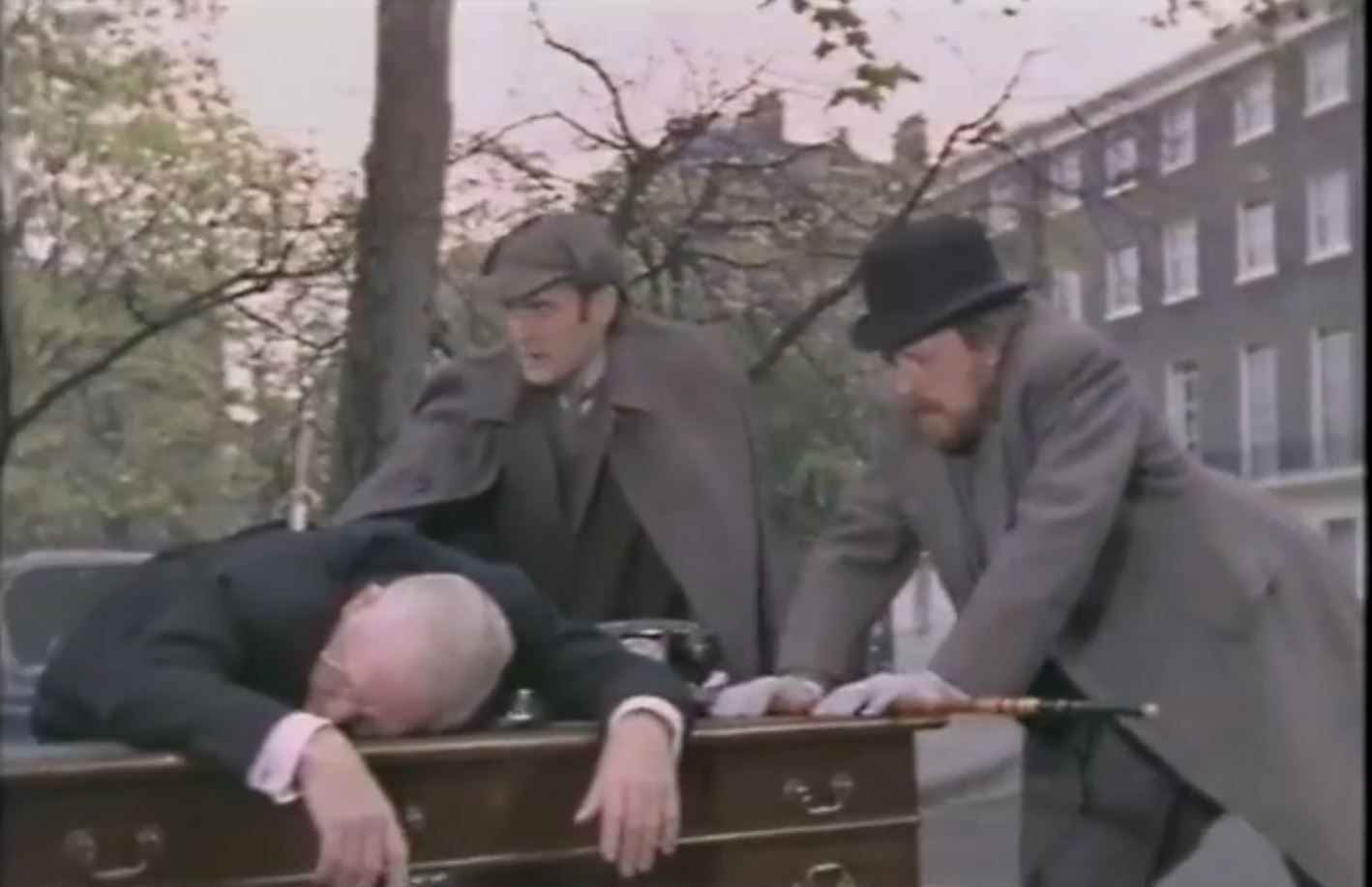
The show opens in a room full of dead lawyers, slumped over their desks, each with a knife in the back. Thus the show’s subtitle, The Strange Case of the Dead Solicitors. A policeman and a secretary exchange what are intended to be witty comments, which immediately brings the lame laugh track to the viewer’s attention.
The scene switches to Baker Street where Cleese (an acceptable looking Holmes) is dining with his Watson, well played by William Rushton. Though there is no audience laughter, I enjoyed Watson’s comment about frequently neglecting his practice to dash off on one of Holmes’ hair-brained schemes, while still living comfortably.
After asking Watson what year it is (he looks at his watch and replies, “1973”), Holmes summons a cab, which pulls up to the curb: it’s a horse-drawn hansom and Holmes makes a reference to Doyle, letting us know that they know they’re in a television show. There’s more of that.
Holmes has been summoned by a Lady Cynthia to a country estate where the old family curse of a deadly rattlesnake has started up again. The snake is killing various animals. What?
But en route, Holmes and Watson are pulled into the case of the dead solicitors. While they are pushing a desk with a dead solicitor from London to Manchester to the studios of the tv game show, Call My Bluff, (the actual cast appears and lampoons their own show) Fu Manchu gets into the act.
I’m not making this up!
Fu Manchu ends up with the desk and body, while Holmes gets confused over the Euston and Paddington train stations and he and Watson end up riding back and forth all over England.
Holmes, annoyed with his deerstalker, throws it out of the train window and it lands on the dead solicitor being pushed along by Fu Manchu and his henchman. They fear Holmes is on to them! Inexplicably, Holmes had sewed the letter with Lady Cynthia’s address into the hat, and now they won’t be able to find her house. So, they go back and look for it. Um…
Animals keep dying at Lady Cynthia’s estate (all in the same room…) and she fears her son will be the next victim. Her frantic calls to the police provide no help. The train mishaps have resulted in Holmes and Watson spending three days en route and finally her son is bitten and dies. Soon, all her animals and son dead, we see her menaced by a rattlesnake as she tells it a story to try and distract it.
 Holmes makes a wild series of deductions with no logic whatsoever, yells “There’s not a moment to lose” and rushes out the door: falling right off the train.
In a full-leg cast, arm in a cast, and head wrapped from the fall, Holmes and Watson confront Frank Potter, a reformed piano tuner who is actually Moriarty in Elizabethan drag. There’s something about piano tuning, which is the offense that put Potter in jail. Piano tuning is a crime? They convince Potter/Moriarty to come with them to help tune a piano. I don’t get it.Of course, you can tuna piano, but you can’t tuna fish (little classic rock joke for you).
We shift to Fu Manchu, loading five crates, labeled as dead solicitors with knives in backs, onto an airplane. Lady Cynthia, on the phone with the police screams. The snake had killed her as well. Everyone there is dead.
Watson is now dressed as Cyrano De Bergerac (I think) so that all three men look ridiculous and if confronted, can pretend they’re escapees from the nearby asylum.
Moriarty gets a phone call on the way and stays behind. He’s being booked for a show at the London Palladium. The less-than-dynamic duo arrives at the airport as Manchu’s plane takes off and Watson observes that they are too late. “I think not, Watson. Reverse the film!”
And yes, the film runs backwards, the evil doctor backs right into a police van, which takes him away, and the case is solved. Uh huh. The Prime Minister goes on television, congratulating the film editors for saving the day, under instructions from Holmes.
At Baker Street, Holmes tells Watson that Frank Potter/Moriarty had nothing to do with the case. He was a red herring to fill in time so that the script wouldn’t be five minutes short. Watson drinks from a glass in each hand, tells Holmes that he never ceases to amaze him and Holmes says, “Elementary, my dear Watson.” And the show ends.
END SPOILER
John Cleese clearly knows sketch comedy. And he was just wrapping up his brilliant run in Monty Python. But a thirty-minute collection of “bits” with a practically non-existent plot doesn’t really make a television show. I’ll let you watch it to find out why Fu Manchu was trying to get five dead solicitors, slumped over their desks with knives in their backs, to China. Hint – they are presents.
 Some things aren’t funny, or just don’t make sense, or both. Why is Jack the Ripper constantly calling Scotland Yard to make a statement? At his house, Moriarty makes a lewd comment and shoos out a blonde wearing only a towel. Watson leers at her as she goes up the stairs and he has to be called in to the other room by Holmes.
However, there is some humor in this show and it’s worth watching. Holmes’ observation of a particular type of mud found on Manchu’s elbow is an amusing dig at Doyle’s penchant for that type of thing. I think that Watson’s comments are among the best lines throughout the show and Rushton is a pretty good parody Watson without being a bumbling fool.
Josephine Tewson, playing Lady Cynthia, appeared in another Holmes parody. She played the nun in the miserable Peter Cook/Dudley Moore Hound of the Baskervilles. THAT was a dog.
It isn’t much of a surprise that the show did not get picked up. I can’t imagine what they would do on a weekly basis when they couldn’t even come up with a plot for a thirty-minute pilot. Two years later, Cleese would star in the short-lived but much funnier Fawlty Towers. Which he is working on a new play about, with his daughter.
Elementary, My Dear Watson, was not Cleese’s only attempt at spoofing Holmes, though it was his best. In 1975, he played Arthur Sherlock Holmes (the detective’s grandson) in The Strange Case of the End of Civilization as We Know It. The only reason I don’t call it the worst Holmes-related film ever, is because I’m not sure whether the aforementioned Cook/Moore Hound deserves the title, or if Strange Case (next week’s topic) does. Or if that should be given to Will Ferrell’s Holmes and Watson (ugh). Maybe Strange Case was funny for its time (Henry Kissinger is gunned down by Arabs at the beginning), but I don’t think I laughed once, the entire movie.
Elementary, My Dear Watson does have enough funny bits to make it worthwhile. And as I said, John Cleese has a way of making you smile, even if if later you think ‘That was odd.” But as a thirty-minute comedy show, it came up short of making me want to see more. But I’ll watch this over Strange Case, any day. And I did smile as I re-watched it for this post. It is fun.
 Bob Byrne’s ‘A (Black) Gat in the Hand’ made its Black Gate debut in 2018 and has returned every summer since.
His ‘The Public Life of Sherlock Holmes’ column ran every Monday morning at Black Gate from March, 2014 through March, 2017. And he irregularly posts on Rex Stout’s gargantuan detective in ‘Nero Wolfe’s Brownstone.’ He is a member of the Praed Street Irregulars, and founded www.SolarPons.com (the only website dedicated to the ‘Sherlock Holmes of Praed Street’).
He organized Black Gate’s award-nominated ‘Discovering Robert E. Howard’ series, as well as the award-winning ‘Hither Came Conan’ series. Which is now part of THE Definitive guide to Conan. He also organized 2023’s ‘Talking Tolkien.’
He has contributed stories to The MX Book of New Sherlock Holmes Stories — Parts III, IV, V, VI, XXI, and XXXIII.
He has written introductions for Steeger Books, and appeared in several magazines, including Black Mask, Sherlock Holmes Mystery Magazine, The Strand Magazine, and Sherlock Magazine.
You can definitely ‘experience the Bobness’ at Jason Waltz’s ’24? in 42′ podcast.
Categories: Fantasy Books
Another Classic Sword & Sorcery Anthology: The Barbarian Swordsmen, edited by Sean Richards (AKA Peter Haining)
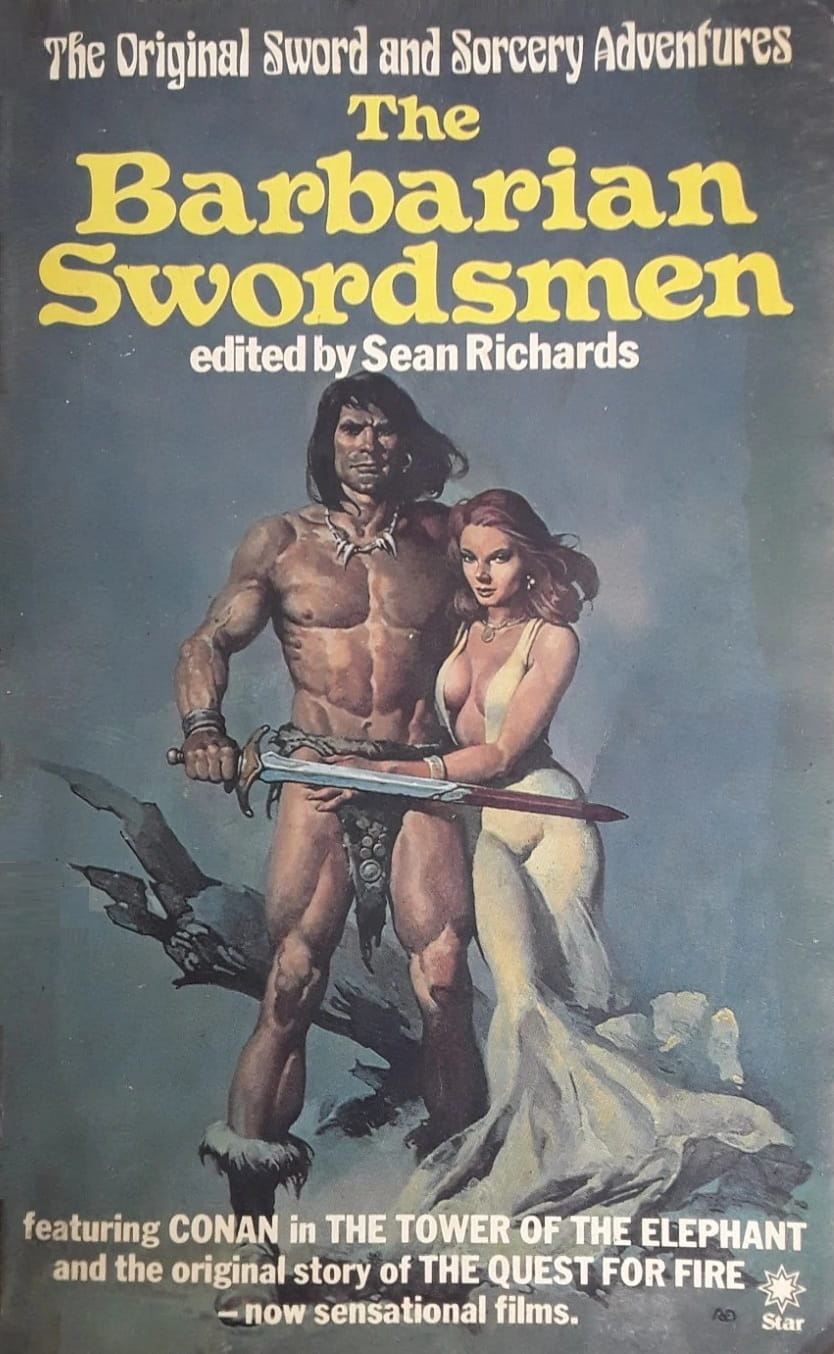
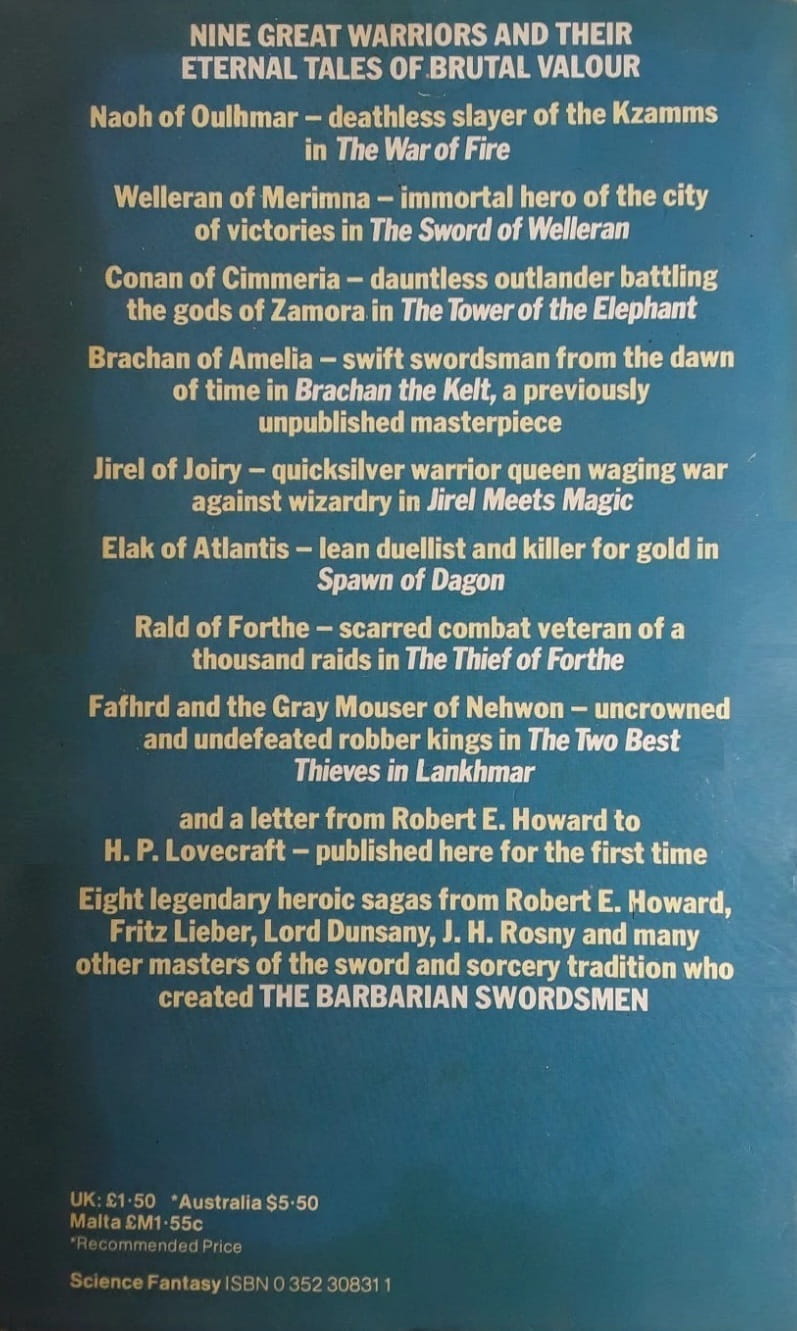
The Barbarian Swordsmen (Star, 1981). Cover by Gino D’Achille
The Barbarian Swordsmen, edited by Sean Richards, Star publishers, a British press, 1981, cool cover by Gino D’Achille. A collection of Sword & Sorcery (S&S) tales that likely wouldn’t exist except for Robert E. Howard.
I couldn’t find out much about Mr. Richards but Toby Hooper revealed to me that Richards has been reported as a pseudonym for Peter Haining and that appears to be true. His intro here doesn’t reveal anything.
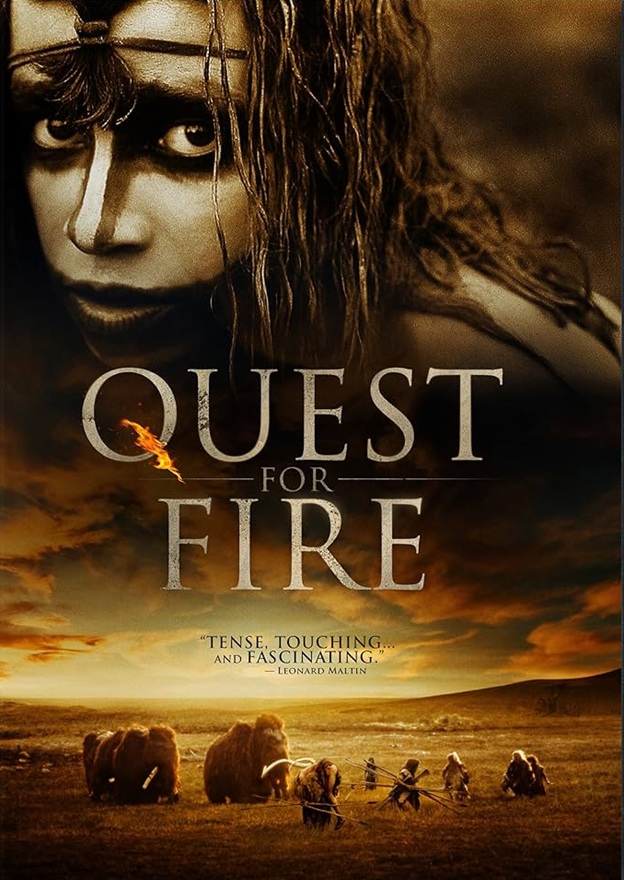 Quest for Fire (20th Century-Fox, December 16, 1981)
The stories are:
“The War of Fire,” by J. H. Rosny. An exciting excerpt from The Quest for Fire, which was also made into a fine movie. J. H. Rosny was a pseudonym, often used by two brothers, Joseph Henri Boex, and Justin Boex. From what I understand, though, Quest for Fire was written solely by Joseph, the elder. The movie does a good job distilling the book but the writing is still enjoyable. We have a primitive cave man named Naoh, what we’d call a Cro-magnon, whose tribe loses its fire. Since they can’t make fire, only maintain it, they have to seek out fire from another tribe, and Naoh and his companions have many adventures doing so, including a battle with Neanderthals. That’s the piece featured in this book.
“The Sword of Welleran,” by Lord Dunsany. Lord Dunsany, an Irishman, is well known to fans of S&S. His fantasy work certainly skated the edge of that genre and he helped develop some of the tropes that later became important. He is said to have influenced Tolkien. His work is rather slowly paced and turgid for modern readers but I find it enjoyable. “The Sword of Welleran” is one of his most approachable tales.
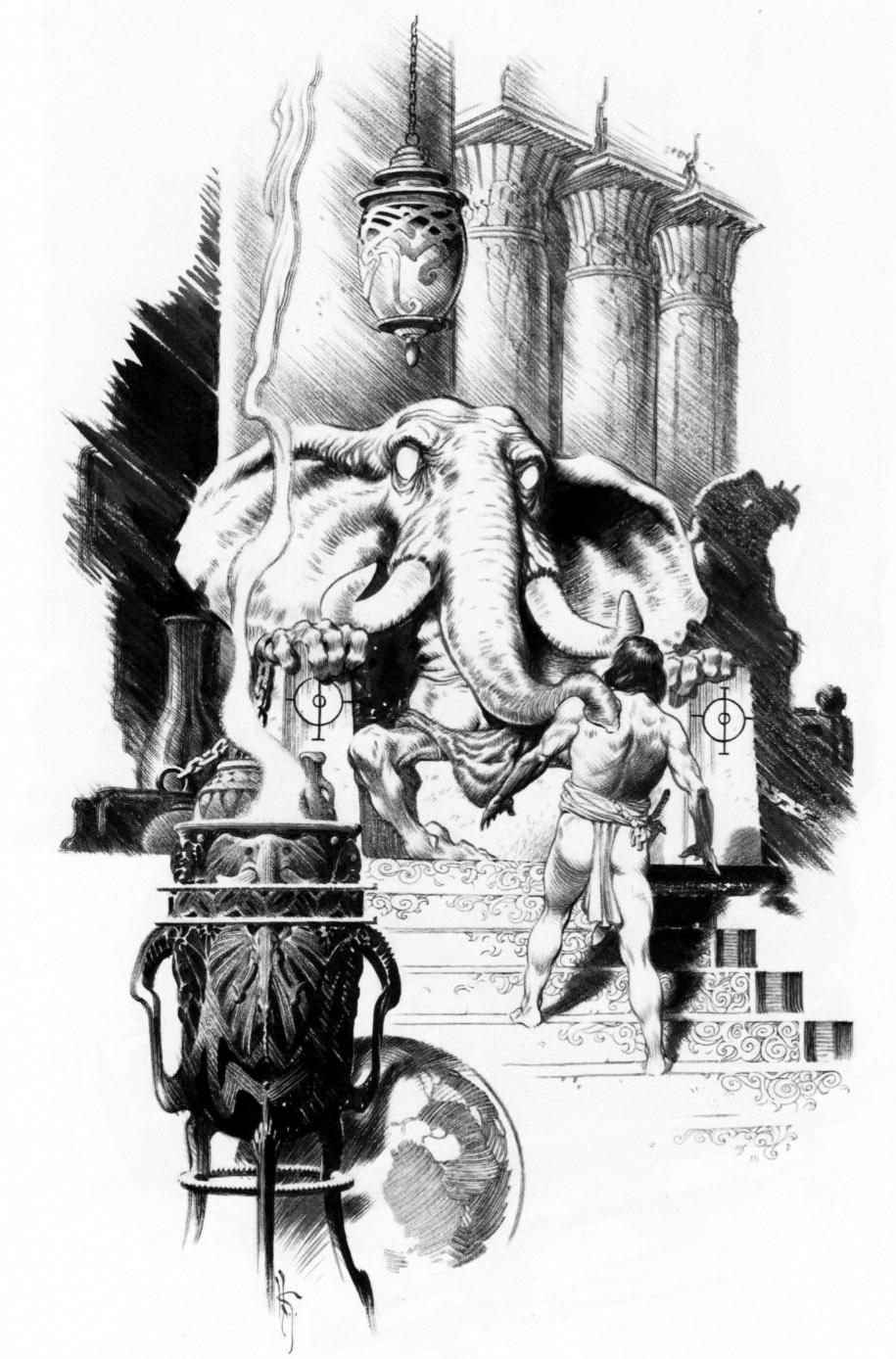 Art for “The Tower of The Elephant” by Mark Schultz
“The Tower of the Elephant,” by Robert E. Howard. I consider this the strangest of the Conan stories. It certainly breaks ranks with most of the other Cimmerian tales in that there’s a strong SF element. I was much taken with it when I first read it, years ago.
“Brachan the Kelt,” by Robert E. Howard. Howard wrote a number of stories involving reincarnation, and several featured the character James Allison, a modern man capable of remembering his past lives. This is a short piece and definitely not fully developed, but it shows the power of Howard’s prose. Allison recalls being a wandering warrior from a time before history was recorded, when the first white-skinned tribes were entering Europe. As Brachan, he must defeat a beast that makes one think of the yeti.
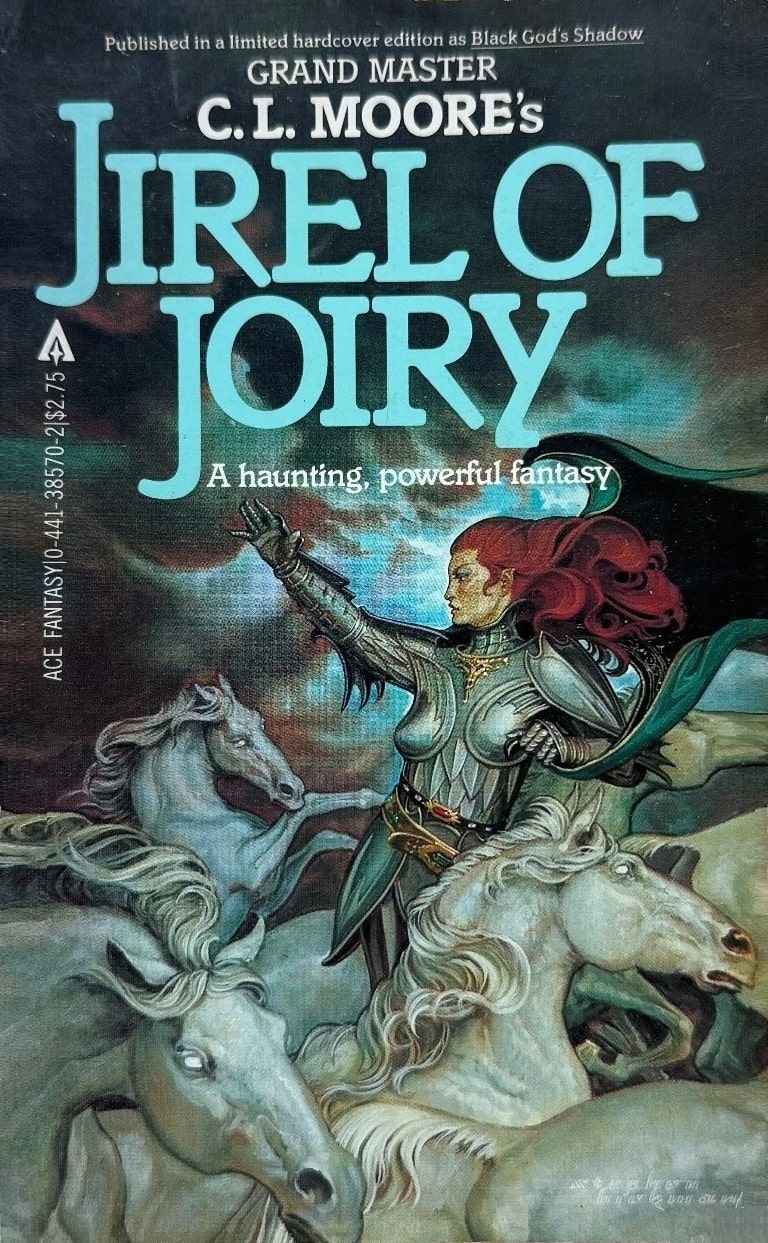 Jirel of Joiry (Ace Books, November 1982). Cover by Stephen Hickman
“Jirel Meets Magic,” by C. L. Moore. Catherine Moore was just a superb writer and her stories of Jirel of Joiry are outstanding S&S tales. Beautifully written and emotionally charged. Jirel is one of the very first fire-tressed female warriors of fantasy fiction. This is not my favorite of the Jirel stories but it’s close. Moore was influenced by Howard, though most of the influence was in subject matter rather than story effects.
“Spawn of Dagon,” by Henry Kuttner. Kuttner married C. L. Moore and after that they mostly wrote as a team. I think Moore was the better writer but Kuttner was more prolific and very professional. Kuttner alone wrote a series of tales about Elak, a prince of Atlantis, and this is one of the best of those. Elak was certainly influenced by Conan but is his own character.
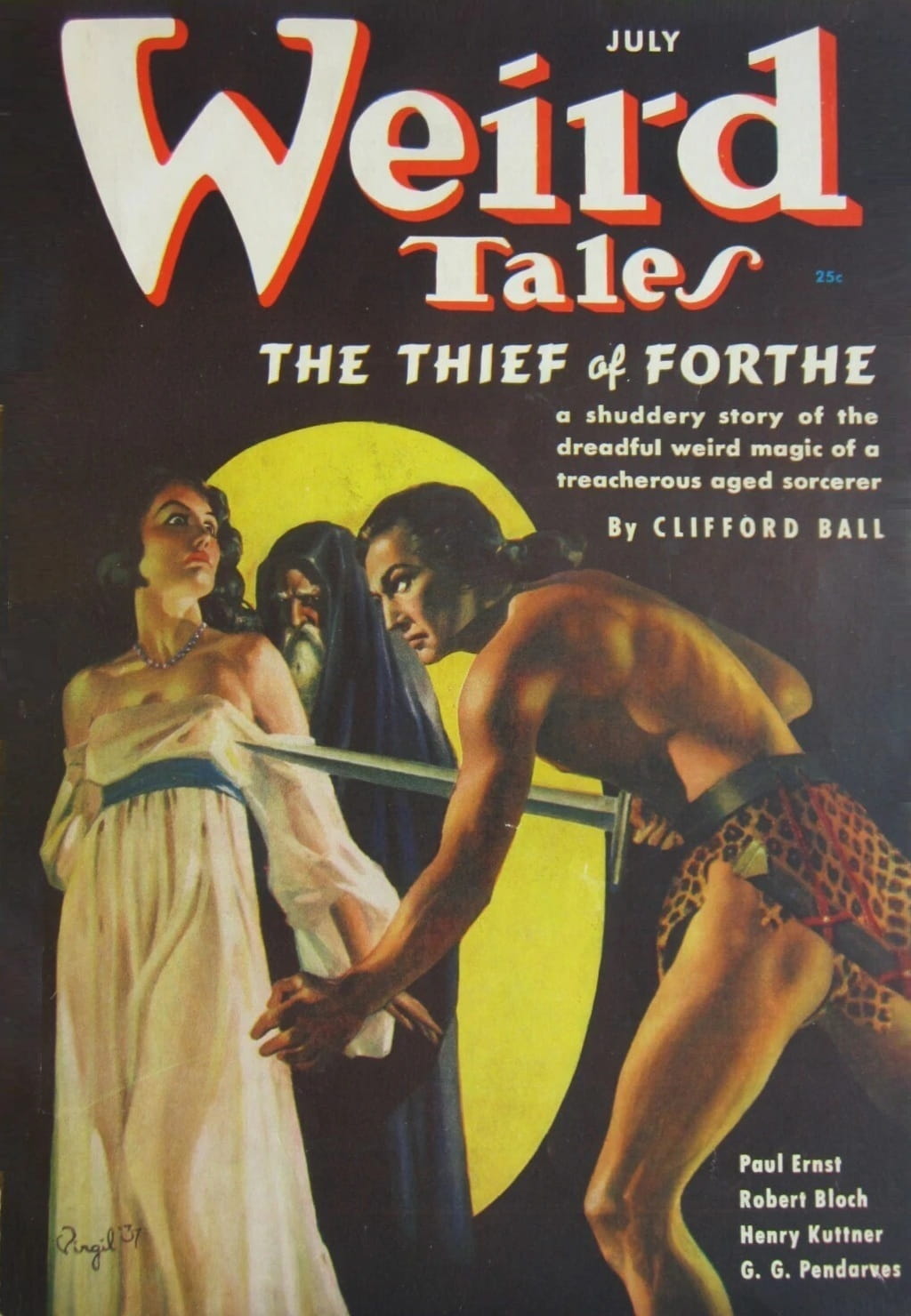 Weird Tales, July 1937, featuring cover story “The Thief of Forthe” by Clifford Ball. Cover by Virgil Finlay
“The Thief of Forthe,” by Clifford Ball. Ball was another writer strongly influenced by REH, which is clearly seen in this tale. It was still well written and enjoyable. Apparently, Ball created an earlier character who was essentially a pastiche Conan, but “Rald,” the “Thief of Forthe” shows some originality. I haven’t read much of Ball’s work but will seek out more.
“The Two Best Thieves in Lankhmar” by Fritz Leiber. Leiber is another writer who was influenced by Howard as to subject matter, but who in no way appears to be an REH clone. His characters and settings are unique and there is a lot more humor in Leiber’s tales than in the Conan stories. Leiber’s characters are Fafhrd, a giant of a man, a barbarian warrior, and the Gray Mouser, a dark and slender thief. They are unlikely friends but friends they are. All these stories are enjoyable.
Appendix is: The Man Who Influenced Robert E. Howard. This is an excerpt from a letter written from Robert Howard to H. P. Lovecraft in which Howard indicates his admiration for the poetry of Alfred Noyes.
Charles Gramlich administers The Swords & Planet League group on Facebook, where this post first appeared. His last article for us was a look at The Mighty Sword & Sorcery Anthologies of Hans Stefan Santesson. See all of his recent posts for Black Gate here.
Categories: Fantasy Books
Women in SF&F Month: Week 4 Schedule & Week in Review
The fifteenth annual Women in SF&F Month continues with three new guest posts coming up this week, starting with a new one tomorrow. Thank you so much to last week’s guests for another wonderful week of essays! The new guest posts will be going up on Monday, Wednesday, and Friday this week, but before announcing the upcoming schedule, here are last week’s essays in case you missed any of them. All guest posts from April 2026 can be found here, […]
The post Women in SF&F Month: Week 4 Schedule & Week in Review first appeared on Fantasy Cafe.
Categories: Fantasy Books
Book Review: Two Truths and A Lie by Mark Stevens
I received a review copy from the publisher. This does not affect the contents of my review and all opinions are my own.
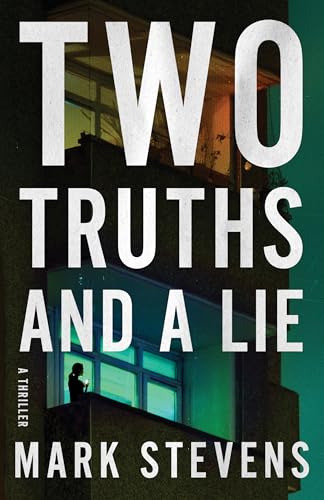 Two Truths and A Lie by Mark Stevens
Mogsy’s Rating: 3.5 of 5 stars
Genre: Thriller, Mystery
Series: Book 2 of Flynn Martin
Publisher: Thomas & Mercer (April 7, 2026)
Length: 459 pages
Author Information: Website
After having such an enjoyable time with Mark Stevens’s No Lie Lasts Forever, I went into the sequel Two Truths and a Lie expecting more of that same sharp cat-and-mouse tension. The good news is, I still received an engaging thriller. That said, this one didn’t quite hit me in the same way as the first book. While it’s still a great follow-up with plenty to like, I just think it was missing some of what made the original feel so tight and suspenseful.
The story picks up with the return of series protagonist Flynn Martin, a Denver journalist who finds herself back in the spotlight following her role in capturing the PDQ Killer, the man who terrorized the city fifteen years ago by murdering three women. At least this time, she’s making headlines for the right reasons, earning back the trust of her employer. But that high doesn’t last long. When a family of four disappears under suspicious circumstances, Flynn seizes the opportunity to prove herself, digging into what at first looks like a tragic but routine missing persons case. However, it quickly becomes clear that there’s far more to the story.
At the same time, Flynn begins receiving unsettling messages, written in a way that immediately brings the PDQ Killer to mind, even though he’s supposedly behind bars and no longer a threat. Or is he? The possibility that she’s being watched again leaves her fearing for her family’s safety, and that personal threat adds a new sense of urgency to the investigation. As Flynn follows the trail, the case begins to branch in multiple directions, pulling in connections to a powerful local church, whispers of corruption, and a web of secrets that may all be connected.
Much like the first book, what continues to work really well here is Stevens’ writing style. The prose is clean and direct, built for speed. It makes for another easy, bingeable read. The newsroom angle remains a strong hook, and I like how the case plays out like a police procedural while approaching it from a different perspective through Flynn’s role. Not being in law enforcement does limit her in some ways, but at the same time, her position as a journalist opens doors and gives her access to sources she might not otherwise reach. The high-octane, punchy pacing highlights the need for instant action as Flynn chases downs leads and puts the pieces of the puzzle together, giving the story a sharp edge.
That said, the structure of this sequel feels noticeably busier. There is simply so much happening all at once, it’s not always clear which thread is the main one, so the end result feels a bit scattered. Compared to the first book, where both the central conflict and the villain were sharply defined, this one comes across as more of a jumble. While it does keep things unpredictable and opens up a wider web of possibilities, this approach also ends up diluting some of the tension, especially when the antagonist and the story’s direction feel less focused.
Flynn herself remains a compelling protagonist, but frequently still manages to get under my skin. More often than not, she ends up being her own worst enemy, and it’s a lesson she’s failed to learn since the first book. And even though I understand it comes with the territory of her job, some of her methods for chasing information also leave a bad taste in my mouth. There are plenty of moments where her decisions feel frustrating, especially when she’s clearly worried about her own safety and her son’s, yet in the very next scene, she’s charging straight into another dangerous situation instead of pulling back. Yes, it creates tension, but it also makes it harder to fully get behind her choices, leaving her character caught somewhere between being admirable and idiotic.
Still, I had a good time with this one. Overall, Two Truths and a Lie is a solid if slightly less focused follow-up that continues Flynn Martin’s story in an engaging and meaningful way. Where the first book felt like a tight psychological showdown, you might find this one to be a broader, more chaotic mystery. Not necessarily a bad trade-off, but it does sometimes feel like it’s juggling a few too many ideas at once. Even so, while it may not reach the heights as No Lie Lasts Forever, it remains a worthwhile sequel that keeps you invested in both the characters and the world.


More on The BiblioSanctum:
Review of No Lie Lasts Forever (Book 1)
Categories: Fantasy Books
Robert E. Howard Days, 2026, and The Emerging Writers Workshop
 The House!
After what seems like strange aeons of dreaming about it, Mark Finn, Jason Waltz, and I (Adrian Simmons) have pulled the trigger on running an in-person Sword & Sorcery writing workshop. Added bonus, we’re holding it in the heart of S&S history, Cross Plains Texas, Robert E. Howard’s home during his days of creating characters like Conan, Soloman Kane, Brikenridge Elkins, El Borak, among others.
Our workshop will take place during the fortieth anniversary of the first Robert E. Howard Days gathering, and not only will help writers level up their skills, but serve as a fundraiser for necessary repairs to the Howard House.
The 2026 Emerging Writers Workshop is a one-day event designed to help provide advice, answers, and encouragement to new and upcoming writers of Howard’s genres — from historical fiction to weird Westerns to sword and sorcery. We won’t be doing poetry this year, but this is the first of what we hope to be a regular component of Howard Days, and perhaps we’ll be able to include verse in later years.
 Robert Howard’s room, and desk, where the magic happened!
This will be an in-person affair, happening Thursday, June 11th, the day before Howard Days officially kicks off. The plan is to have some short lectures, a bit of Q& A about S&S, but lion’s share of the time time will be spent in critiquing submissions by breaking into smaller groups for in-depth discussions.
We realize that there are plenty of writing workshops, but the reality is that S&S and its related sub-genres are often the odd-swordsman/woman-out. Sometimes it is waaaay out.
While the number of S&S and adventure fiction venues has grown massivlely in the last decade, they are in the business of publishing stories, not helping writers get better at their craft. The cold reality is that you already have to be a good writer to get any feedback (and even then, given time constraints…), otherwise you get a form rejection letter. Without that editorial feedback, you’re mostly groping in the dark.
That’s the strongest parts of the Emerging Writers Workshop, you aren’t going to get ‘writers group’ feedback, you’re going to be buffeted by the cold winds of Valhalla from three editors looking at your work with their editor-eyes.
 The Cottonwood Cafe, where our magic will happen!
And who are we to pass judgement upon your writing? Behold!
 Mark — representing with the ‘stash and beard
Mark is an author, an editor, and a pop culture critic. His writing can be found in various books, anthologies, comics, and elsewhere. When he’s not waxing passionate about popular culture or Robert E. Howard, Finn writes stories, publishes RPG zines, and sporadically appears on various podcasts.
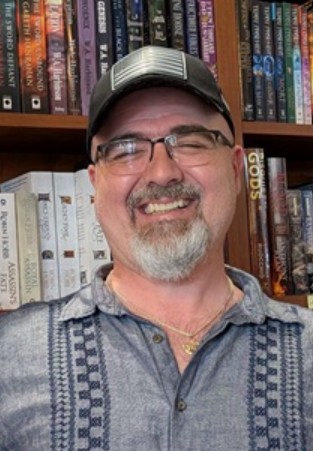 Jason, with the classic goatee
Jason M. Waltz – Long-time reader, writer, publisher, facilitator and promoter of the heroic. THE MAIN ROGUE of Rogue Blades Entertainment (published popular heroic anthologies such as Return of the Sword and Neither Beg Nor Yield) & Rogue Blades Foundation (published award-winning REH titles Hither Came Conan and Robert E. Howard Changed My Life). Host of author interviews @ ’24 in 42.’ Connect via https://linktr.ee/jasonmwaltz
 Adrian, sportin’ the chin scruff
And me? I’m a founding member and primary editor of Heroic Fantasy Quarterly ezine (heroicfantasyquarterly.com), have produced 67 issues and four best of anthologies. I’ve had fiction published at Tales from the Magician’s Skull, Savage Realms, and Swords and Larceny. Some of you here may remember me from my various reviews and musings here at Black Gate.
We’re already about 1/3 of the way to our membership cap (although there has been some talk of an online option, but those dragons have yet to hatch).
The cost is $50, and the deadline to get your work in is Sunday, May 10th.
We discussed the workshop in some detail during a livestream of the Robert E. Howard Foundation. We talk about the workshop starting at the 6:30 mark. Check it out to get a feel for the vibe.
Full details can be found here.
Categories: Fantasy Books
Favorite Shakespeare Quotes – Love Letters, Sonnets, Insults, and Curses

Favorite Shakespeare quotes shared during the month of April are a great way to celebrate…
The post Favorite Shakespeare Quotes – Love Letters, Sonnets, Insults, and Curses appeared first on LitStack.
Categories: Fantasy Books
PARADOX by Douglas and Aletheia Preston
So: what do holy relics, Neanderthals, UFO researchers and secret societies all have in common? They’re all in the latest book by Douglas Preston! Does the name sound familiar? Douglas has been a consistent best-seller writer since the mid-1990’s, perhaps best known for writing nearly 30 crime fiction novels with Lincoln Child, although he has…
Categories: Fantasy Books
Women in SF&F Month: Tesia Tsai
Today’s Women in SF&F Month guest is Tesia Tsai! Her young adult fantasy novel released earlier this week, Deathly Fates, is described as a “a sweeping debut inspired by the Chinese folk practice of necromancy…perfect for fans of Descendant of the Crane, The Bone Shard Daughter, and A Magic Steeped in Poison.” I’m happy she’s here today to share about the women she writes in “The Fate of the Eldest Daughter.” About Deathly Fates: A sweeping debut inspired by the Chinese folk […]
The post Women in SF&F Month: Tesia Tsai first appeared on Fantasy Cafe.
Categories: Fantasy Books
Forgotten Authors: Austin Hall
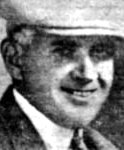 Austin Hall
Austin Hall was born on July 27, 1880.
While working as a cowboy, Hall was asked to write a story. This led to his career as an author, writing westerns, science fiction and fantasy stories, with westerns forming the majority of his published work. A one time, Hall may have worked as a sports editor for a newspaper in San Francisco.
Following the death of Hall’s father, his mother remarried and the family appears to have moved to Ohio, in an interview published by Forrest J Ackerman in 1933, Hall claims to have attended college in Ohio and California, but no details of his academic life can be confirmed. By the time he was thirty, Hall (as well as his mother and step-father) were living back in California and Hall had married Clara Mae Stowe and they had two children, Javen and Bessie.
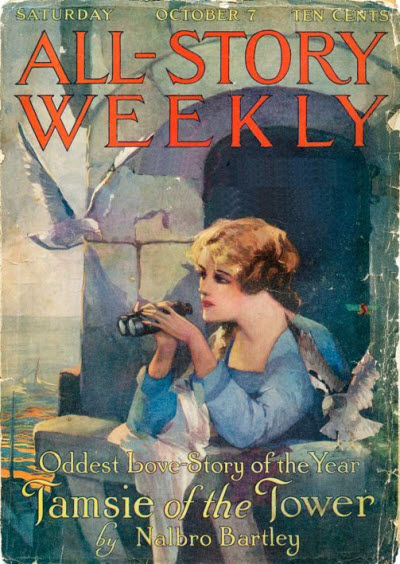 All-Story Weekly, 10/7/1916
His first science fiction story was “Almost Immortal,” which appeared in the October 7, 1916 issue of All-Story Weekly.
His 1919 story “The Man Who Saved the Earth” was reprinted in the first issue of Amazing Stories. Everett Bleiler describes this story as Hall’s second worst, which given Damon Knight’s opinion of Bleiler’s writing says quite a bit.
He collaborated with Homer Eon Flint on the novel The Blind Spot, which Damon Knight described in In Search of Wonder as “an acknowledged classic of fantasy…much praised…several times reprinted, venerated by connoisseurs—all despite the fact that the book has no recognizable vestige of merit. Knight enumerates his problems, not just with the novel, but with Hall’s writing, stating that hall is bereft of, among other things, style, grammar, vocabulary, observation, scientific knowledge, or ability to plot. Knight’s criticism of Hall is almost enough to make someone want to pick up one of his works to see how it could be as bad as Knight describes it.
Bleiler does not believe the story was an actual collaboration. Although Ackerman claims Hall pitched the idea to Flint and the two planned out how to work on it, Bleiler believes that Hall couldn’t come up with the middle of the novel and had Flint take over to get him over the hump.
Eventually, in 1932, eight years after Flint’s death, Hall would published a sequel to The Blind Spot, the serial The Spot of Life, in Argosy. Hall’s other science fiction, “The Rebel Soul” and “Into the Infinite” focus on the life and adventures of George Witherspoon. His The People of the Comet has Alvar, the king of the Sansars, describe his journey to a comet, which had a hollow interior in which they could live.
Although the majority of Hall’s writing appears to have been westerns, they appear to be harder to identify, although he wrote Where the West Begins and stories that appeared in Western Story Magazine.
He died on July 29, 1933 and is buried in Madronia Cemetery in Saratoga, California.
 Steven H Silver is a twenty-one-time Hugo Award nominee and was the publisher of the Hugo-nominated fanzine Argentus as well as the editor and publisher of ISFiC Press for eight years. He has also edited books for DAW, NESFA Press, and ZNB. His most recent anthology is Alternate Peace and his novel After Hastings was published in 2020. Steven has chaired the first Midwest Construction, Windycon three times, and the SFWA Nebula Conference numerous times. He was programming chair for Chicon 2000 and Vice Chair of Chicon 7.
Categories: Fantasy Books
La Belle Dame sans Merci: Tam Lin by Pamela Dean
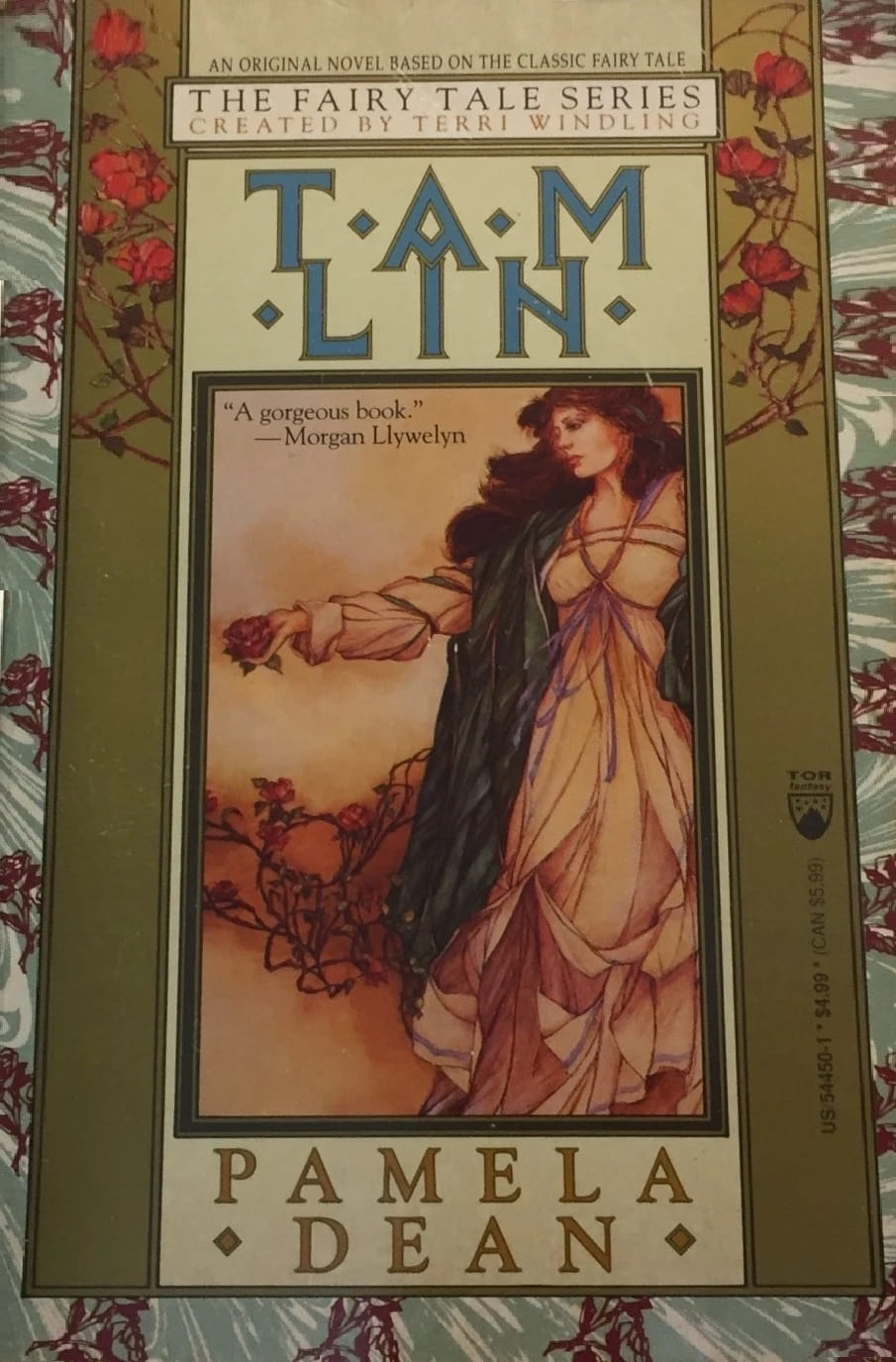
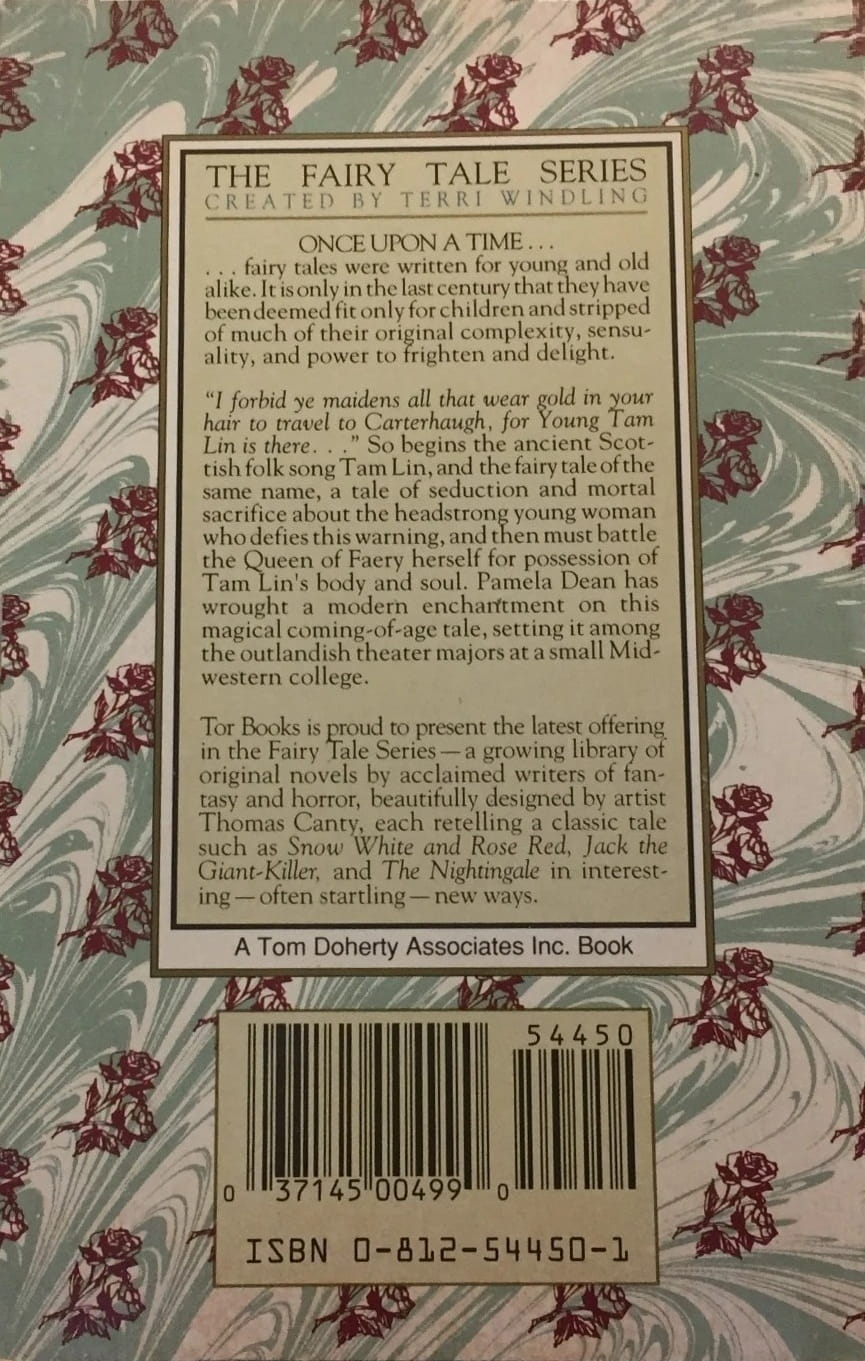
Tam Lin (Tor Books paperback reprint edition, April 1992). Cover by Thomas Canty
There’s been a lot of genre fiction set at schools. Hogwarts is an obvious example, but such settings were around long before Harry Potter; Heinlein’s Space Cadet, The Uncanny X-Men, and Le Guin’s A Wizard of Earthsea were all there first. Tam Lin is another early example, published six years before Harry Potter and the Philosopher’s Stone made scholastic fantasy a best-selling subgenre.
But it has an important difference: Its setting, the fictional Blackstock College, doesn’t teach magic, or superheroic combat, or spaceflight, or anything else fantastic. It’s a fairly typical small liberal arts college (based on the real college where Pamela Dean did her undergraduate work) where the supernatural elements are hidden beneath the surface.
 Carleton College, the real world model for Blackstock College
At the time when it was written, Tor Books was publishing novels that retold fairy tales at greater length, and with a style aimed at adult readers. Dean’s source wasn’t a fairy tale, strictly speaking, but a ballad, “Tam Lin,” though one where the fair folk are a visible presence — like “True Thomas” or Keats’s “La Belle Dame sans Merci.” Its theme is the mortal man who meets a fairy woman and is the worse for it, and that’s the undercurrent of Dean’s novel, and the problem her protagonist, Janet Carter, has to solve.
Much of the story is the non-fantasy details of Janet’s life. Dean lists every course she takes until the first quarter of her senior year — including a dozen in English, seven in Greek, and a variety of general education, from fencing to “physics for poets.”
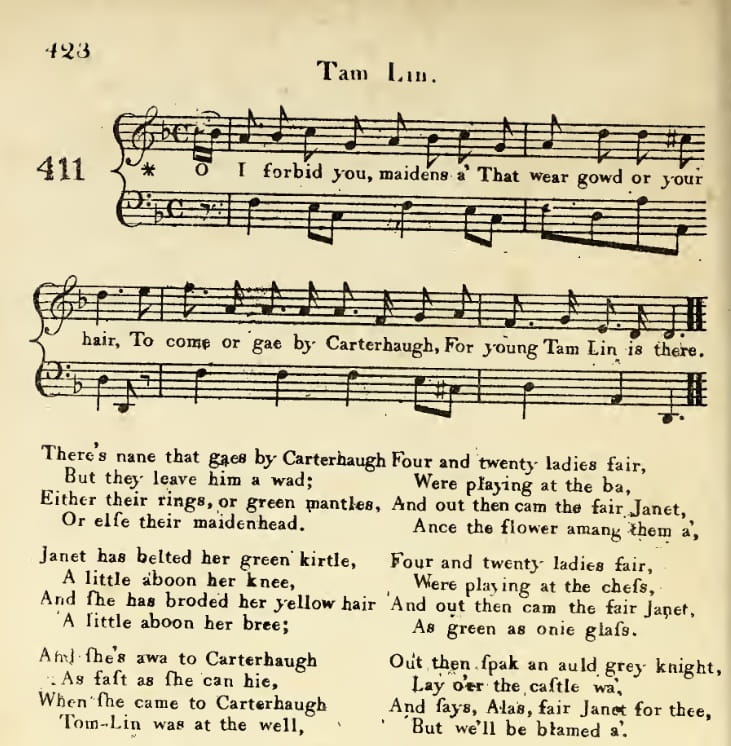 The opening verses of the ballad Tam Lin
We meet Janet’s roommates, Molly and Tina, whom she has difficulty with at first (especially with Tina) but stays with for all four years. We meet the young men they get involved with and learn of their experiences with sex and contraception — and of their breakups. We also meet Janet’s family, including her father, a member of the English faculty at Blackstock.
“I said I liked folk music, and Molly said she went to rock concerts, and Christina said she liked Bach, so they said, oh, look, three people who listen to music, and stuck us in the same room.”
So far as this part of the story goes, Tam Lin is a classic Bildungsroman (coming-of-age novel). But the social and psychological story is interwoven with an increasing awareness of magical aspects. On one hand, the campus has a ghost, a young woman who took an overdose of opiates in 1897 because she was pregnant, and who now throws specific books out of windows, including a Greek textbook. On the other, the classics department is a nexus of strangeness. All three of the women’s lovers are caught up in this, and Janet’s advisor, a classics professor, makes a serious effort to persuade her to major in classics as well.
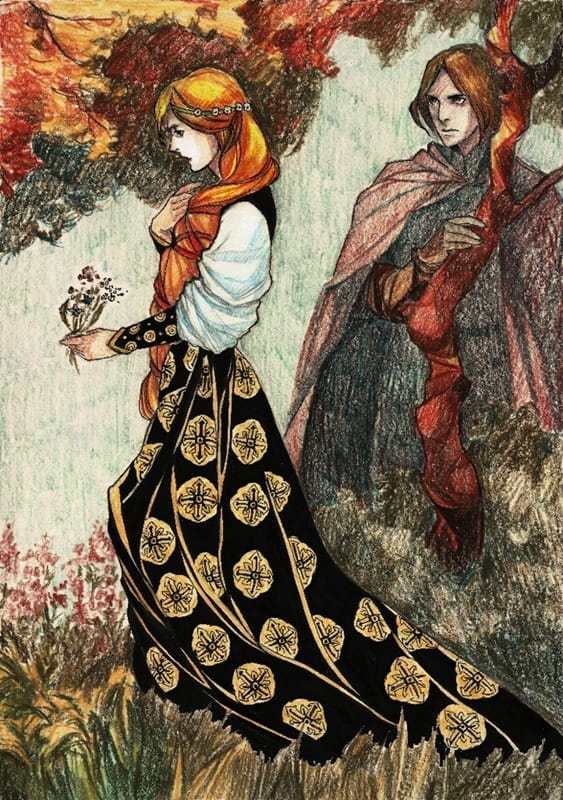
The other nuance of this is that the supernatural threads are interwoven with Janet’s literary tastes and interests, which we learn about in detail. One of the book’s major revelations, for example, comes from Janet reading a complete Shakespeare. An earlier scene has Janet reciting “La Belle Dame sans Merci”:
I saw pale kings and princes too,
Pale warriors, death-pale were they all;
They cried, “La belle dame sans merci
Thee hath in thrall!”
Earlier on, we see a discussion of which translation of Homer is best inspiring one of the young men to quote Keats’s sonnet “On First Looking into Chapman’s Homer.”
Quotations from the English classics are all through the dialogue — which seems plausible, as the fair folk are reputed to have a special affinity for poets and poetry. Janet herself writes a sonnet at one point, though one whose last line has all too plausibly flawed scansion.
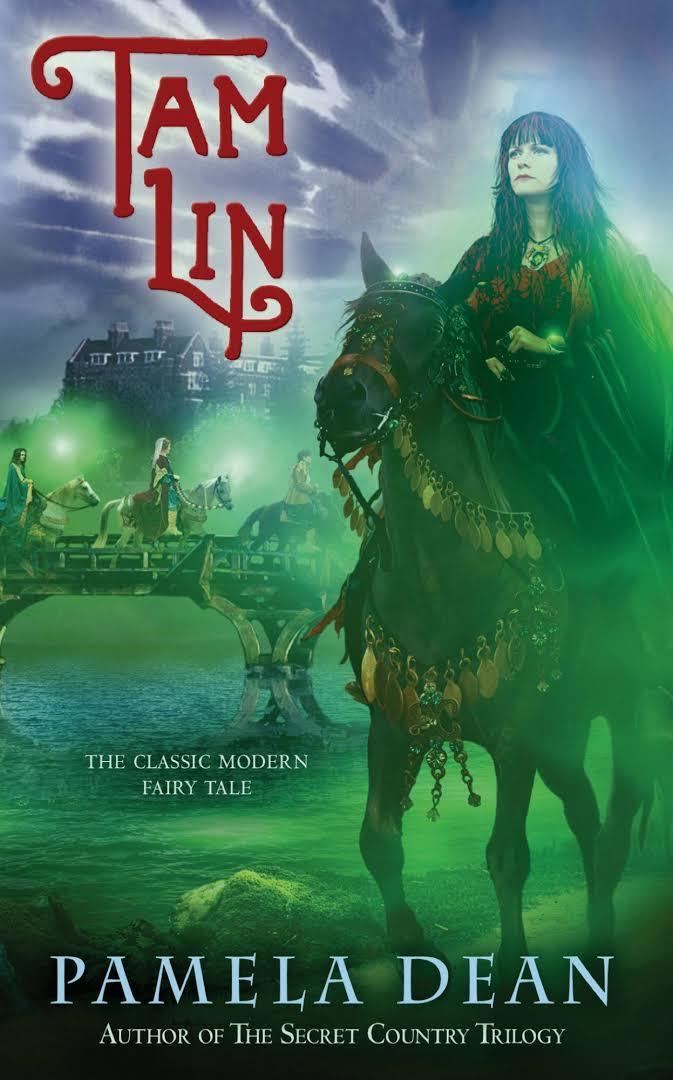 Tam Lin (Firebird, August 2006). Cover by Steve Stone
Women’s sexuality, pregnancy, and contraception are recurring issues, as of course they were in the real world in the 1970s. This fits its source material, where pregnancy is also an issue; but it seems that choosing to modernize that particular story gave Dean a way to comment on those issues, and to make them the crisis that leads to the novel’s climactic conflict.
Tam Lin seems oddly paced. Roughly the first half of the book portrays Janet’s, Molly’s, and Tina’s first term at Blackstock, almost day by day. The second half rushes through three full years, ending on Hallowe’en (naturally). This isn’t quite like some novels I’ve read that seemed to progress evenly until the penultimate chapter, and then rush ahead to tie off the plot; Dean does work things out step by step. But I’m not sure that first term needed to be shown in quite so much detail.
On the other hand, most of the details are, to my possibly peculiar tastes, fascinating. If you like English poetry, and the academic milieu, this novel may entertain you as much as it did me.
William H. Stoddard is a professional copy editor specializing in scholarly and scientific publications. As a secondary career, he has written more than two dozen books for Steve Jackson Games, starting in 2000 with GURPS Steampunk. He lives in Lawrence, Kansas with his wife, their cat (a ginger tabby), and a hundred shelf feet of books, including large amounts of science fiction, fantasy, and graphic novels.
Categories: Fantasy Books
Spotlight on “Seek Immediate Shelter” by Vincent Yu
Other LitStack Spots We’ve spotted more titles we are adding to our TBR stack, including…
The post Spotlight on “Seek Immediate Shelter” by Vincent Yu appeared first on LitStack.
Categories: Fantasy Books
Review: The Republic of Memory by Mahmud El Sayed

Buy The Republic of Memory
FORMAT/INFO: The Republic of Memory will be published by Saga Press on May 5th, 2026. It is 480 pages long and available in paperback, ebook, and audiobook formats.
OVERVIEW/ANALYSIS: Two hundred years ago, the Sarafina set out on a journey to a new planet. While thousands of people sleep in cryogenic pods, generations of living crew members work to keep the ship running smoothly and ensure the safe delivery of the sleepers to their new home. But when a crisis faces the ship, a growing number of people begin to ask a critical question: Do they still want to dedicate every aspect of their lives to serving and protecting people they've never met?
The Republic of Memory is an engrossing tale of a ship in crisis that also digs into some juicy existential questions. What do you do when your ship's values and identity no longer align with the civilization that gave the ship its mission in the first place? Why are the lives of those in cryostasis more honored than the lives of the people who keep the ship running today?
I really enjoyed how the disaster that hits the ship really forces its everyday inhabitants to question things that they've taken for granted and to see the contradictions in their lives. They revere those in cryo as "ancestors," and consider the journey to their new planet as a sacred mission, but the culture of the ship has fundamentally changed since it began its voyage. If the crew were to wake the ancestors today, would they even get along with those who woke up?
To explore all these facets of a culture in upheaval, the story skips around to several different viewpoints over the course of the book, from a mid-level administrator to a teen street artist to the head of a rebel faction. While a few POVs get more of the lion's share of the tale, it's almost hard to point to the "main" characters of this book as there are so many POVs. And yet it is done in a way that is never confusing, as many characters show up in other POV chapters; you are now simply getting a different angle of the same story. It gives a pretty broad look at the different ways people are handling the crisis and grappling with the choices put before them and really enjoyed seeing the different cultures and parts of the ship.
Where I'm a little more mixed is in how well the author engaged with one of the unique aspects of the ship. On this generation ship residential areas are divided not by nation or by job description, but by the language a person speaks. Dividing on those lines is supposed to allow residents more flexibility in migration, as anyone can learn a language but they can't change their religion or heritage. And I did enjoy some of the ways the author plays with language. For instance, when listening to the voice of an ancestor, the current ship inhabitants hear it as "ye olden days" style language, but in flashbacks, the dialogue is perfectly normal.
But language is also supposed to be a huge barrier between the different berths. In fact, there's a whole occupation dedicated to translation, as only Admin people speak English as a primary language, and common folk need a Translator to process paperwork. Aside from some initial encounters with Translators, however, language didn't seem to cause too much friction. I myself grapple if this was the intent, that language evolves to its needs and people will find a common language. But as this is being sold as a linguistic sci-fi, it didn't feel like the author did enough with it.
The Republic of Memory is exactly what I was hoping for: a deep dive into a fully realized culture that has uniquely evolved in support of its mission. I really enjoyed the many different POVs it used, and how well fleshed out this microcosm of civilization felt. I am eagerly awaiting the next installment in this journey and can't wait to see how the crew evolves in the aftermath of this first crisis.
Categories: Fantasy Books
Women in SF&F Month: E. J. Swift
Today’s Women in SF&F Month guest post is by E. J. Swift! Her short fiction includes the BSFA Award finalist “Saga’s Children,” first published in the anthology The Lowest Heaven and later in The Best British Fantasy 2014, and “The Complex,” first published in Interzone and later in The Best British Fantasy 2013. Her two latest novels are The Coral Bones, an Arthur C. Clarke Award and BSFA Award finalist, and When There Are Wolves Again, the 2025 BSFA Award […]
The post Women in SF&F Month: E. J. Swift first appeared on Fantasy Cafe.
Categories: Fantasy Books
7 Author Shoutouts | Authors We Love To Recommend

Here are seven Author Shoutouts for this week. Find your favorite author or discover an…
The post 7 Author Shoutouts | Authors We Love To Recommend appeared first on LitStack.
Categories: Fantasy Books
The Mighty Sword & Sorcery Anthologies of Hans Stefan Santesson
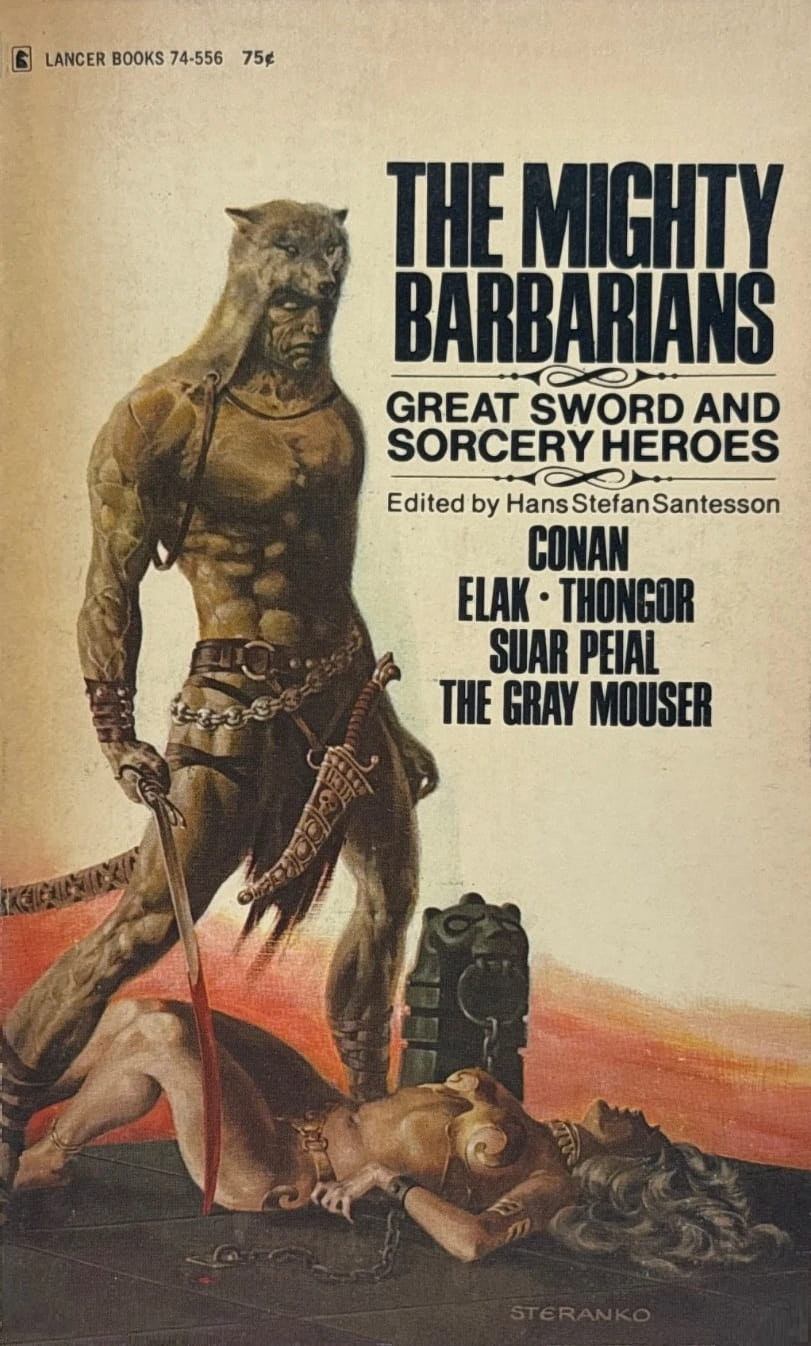
The Mighty Barbarians: Great Sword and Sorcery Heroes, edited by
Hans Stefan Santesson (Lancer Books, 1969). Cover by Jim Steranko
Hans Stefan Santesson (1914 – 1975) was born in France and lived in Sweden with his parents until 1923 when his mother immigrated to the US. She was a commercial artist and he soon became an editor for various mystery publications.
I likely would never have heard of him if not for two books of Sword & Sorcery he edited for Lancer Books. These were The Mighty Barbarians (1969) and The Mighty Swordsmen (1970), both with evocative covers by Jim Steranko.
[Click the images for mighty versions.]
 Hans Stefan Santesson and Samuel Delany in Cleveland, 1966. Photo by Jay Kay Klein
1. The Mighty Barbarians contains an Introduction by Santesson, and then the following stories.
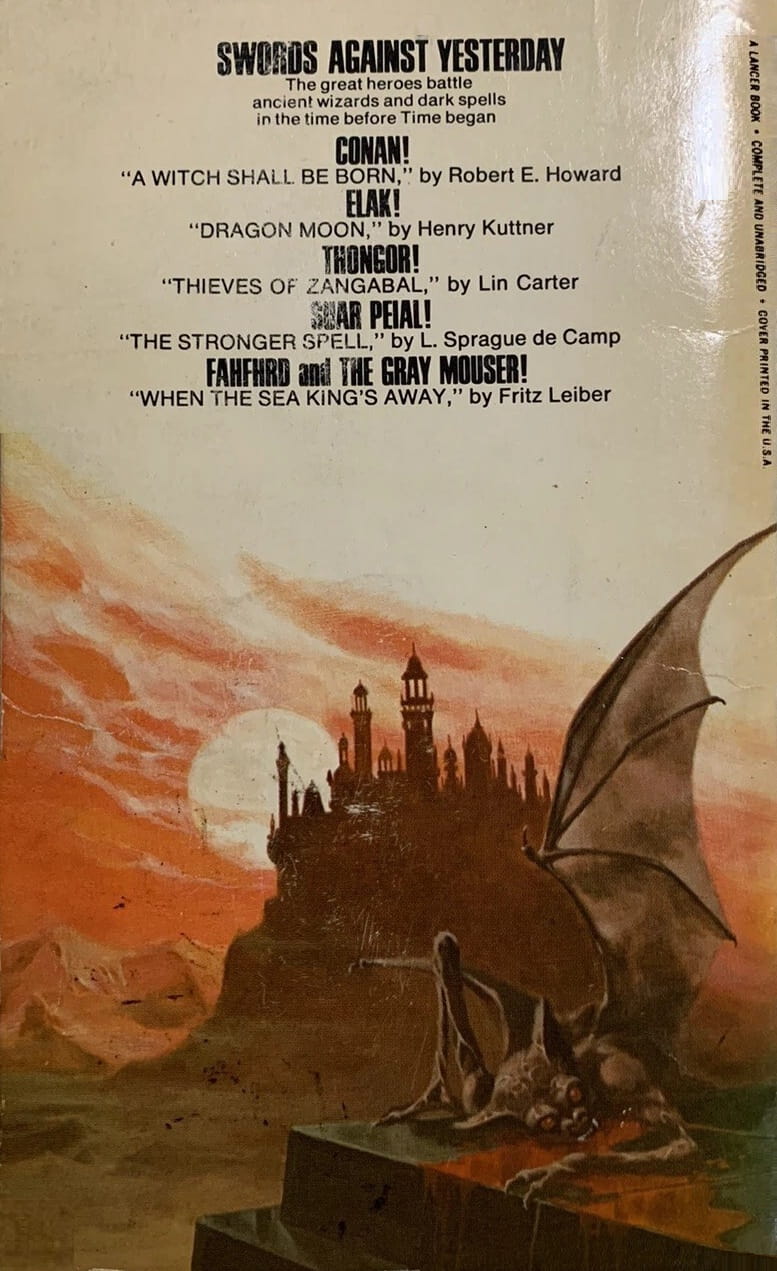
“When the Sea-King’s Away by Fritz Leiber (Fafhrd/Gray Mouser)
“The Stronger Spell” by L. Sprague de Camp
“Dragon Moon by Henry Kuttner (Elak of Atlantis)
“Thieves of Zangabal” by Lin Carter (Thongor)
“A Witch Shall be Born” by Robert E. Howard (Conan)
The intro shows that Santesson was familiar with the history of heroic fantasy. He cites some of Carter’s nonfiction so he may have gotten it from there. All the stories are good and generally full of action.
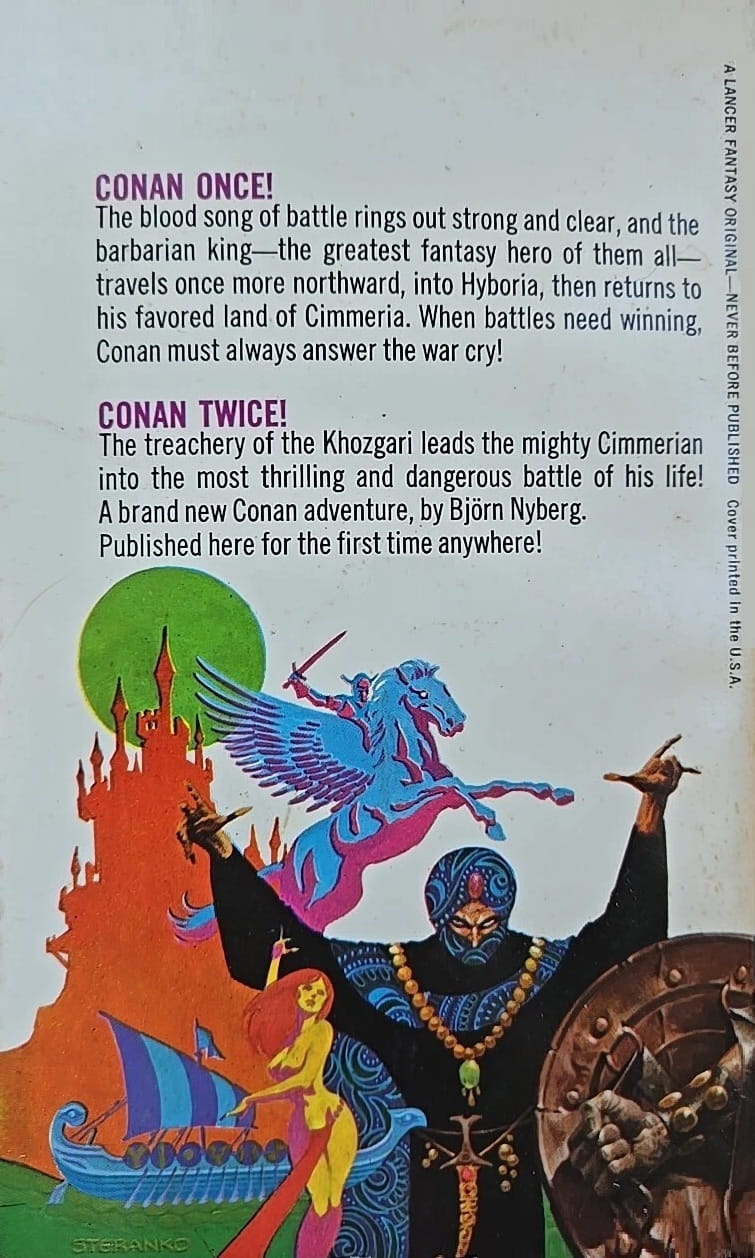
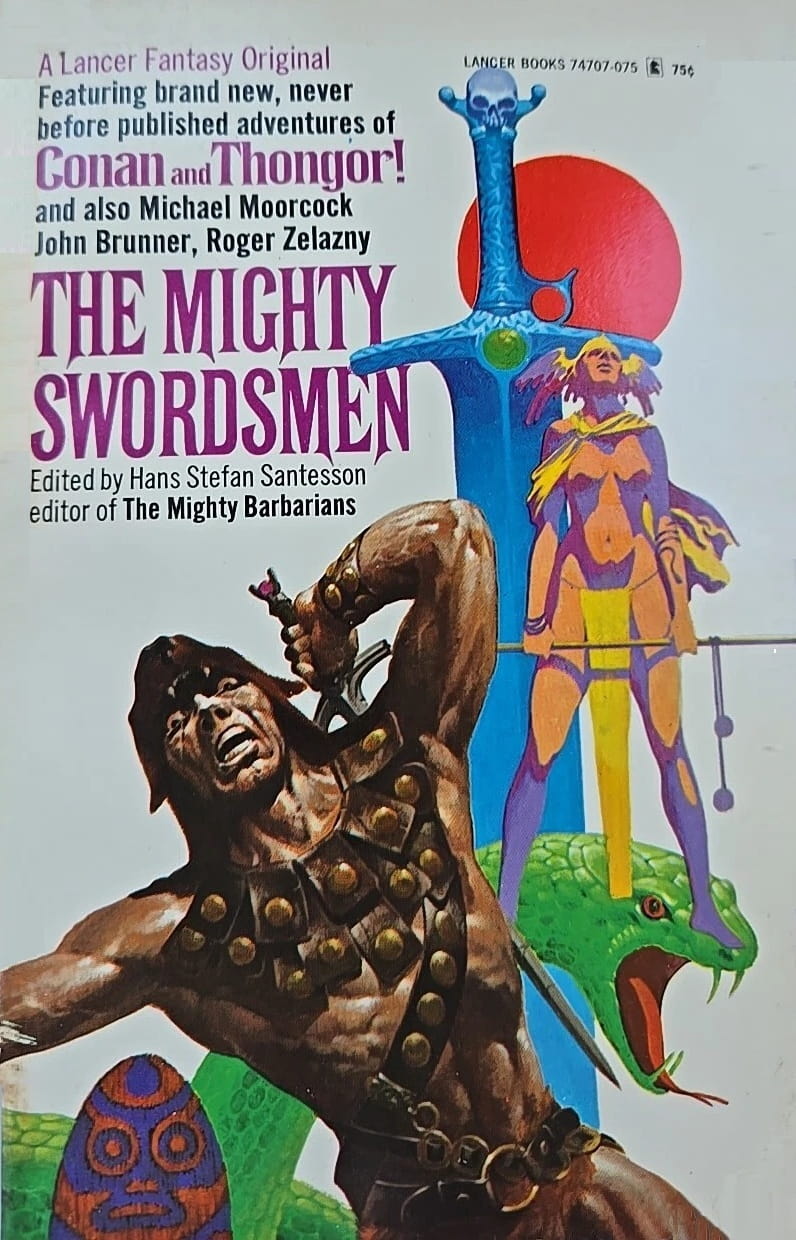
The Mighty Swordsmen, edited by Hans Stefan Santesson (Lancer Books, December 1970). Cover by Jim Steranko
2. The Mighty Swordsmen contains a shorter intro by Santesson and ends with “Beyond the Black River” by REH, one of the best Conan stories. It also contains tales by Moorcock, Brunner, Zelazny and a Conan pastiche by Bjorn Nyberg called “The People of the Summit,” which suffers by comparison with “Beyond the Black River.”
The Moorcock tale is “The Flame Bringers” (Elric). It’s quite good. Zelazny’s story is one of his Dilvish the Damned pieces, “The Bells of Shoredan.” Lin Carter’s “The Keeper of the Emerald Flame” is one of the best of his Thongor stories. Brunner’s story has the best title, “Break the Doors of Hell,” but doesn’t quite seem to fit with the others. It’s one of his Traveler in Black pieces.
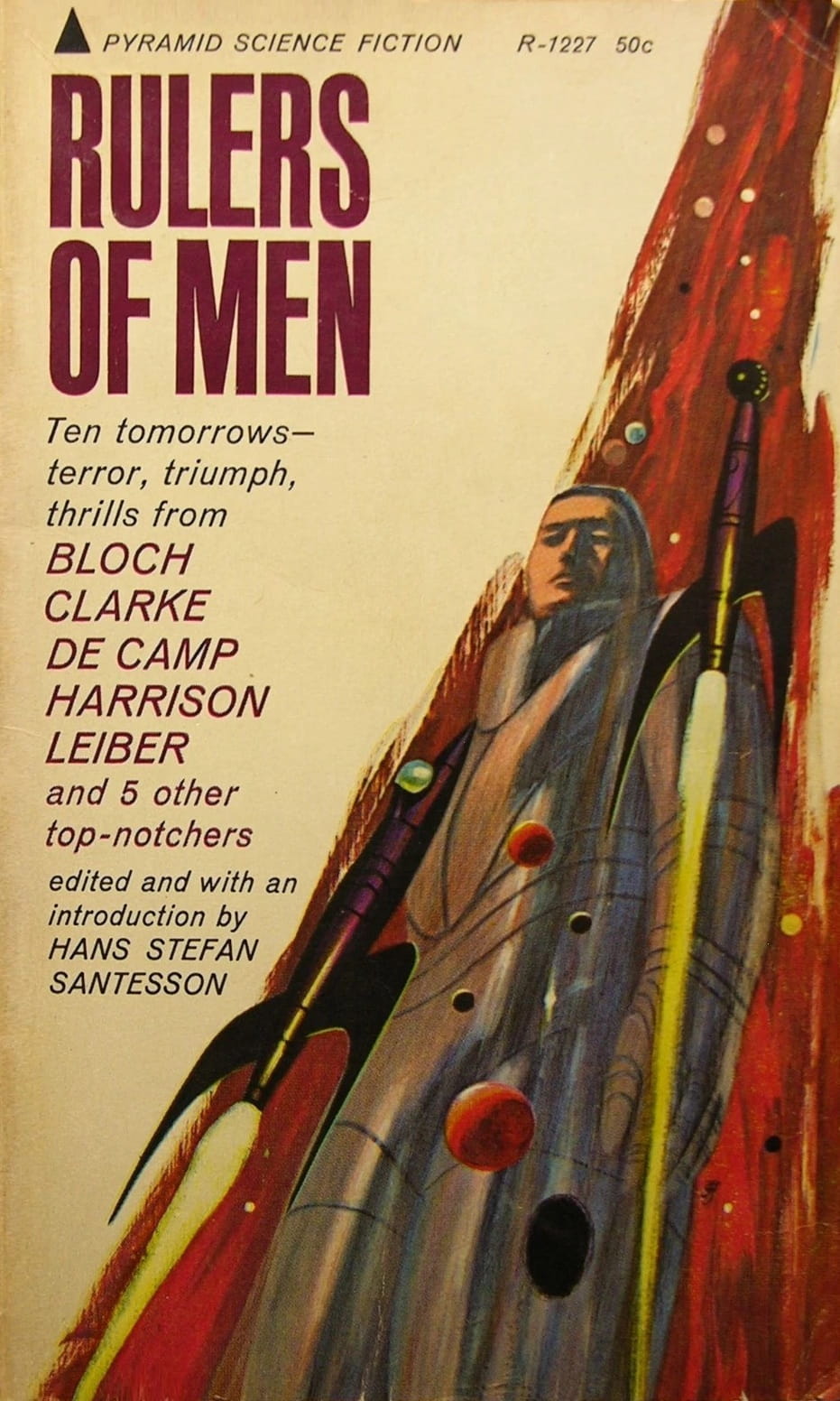
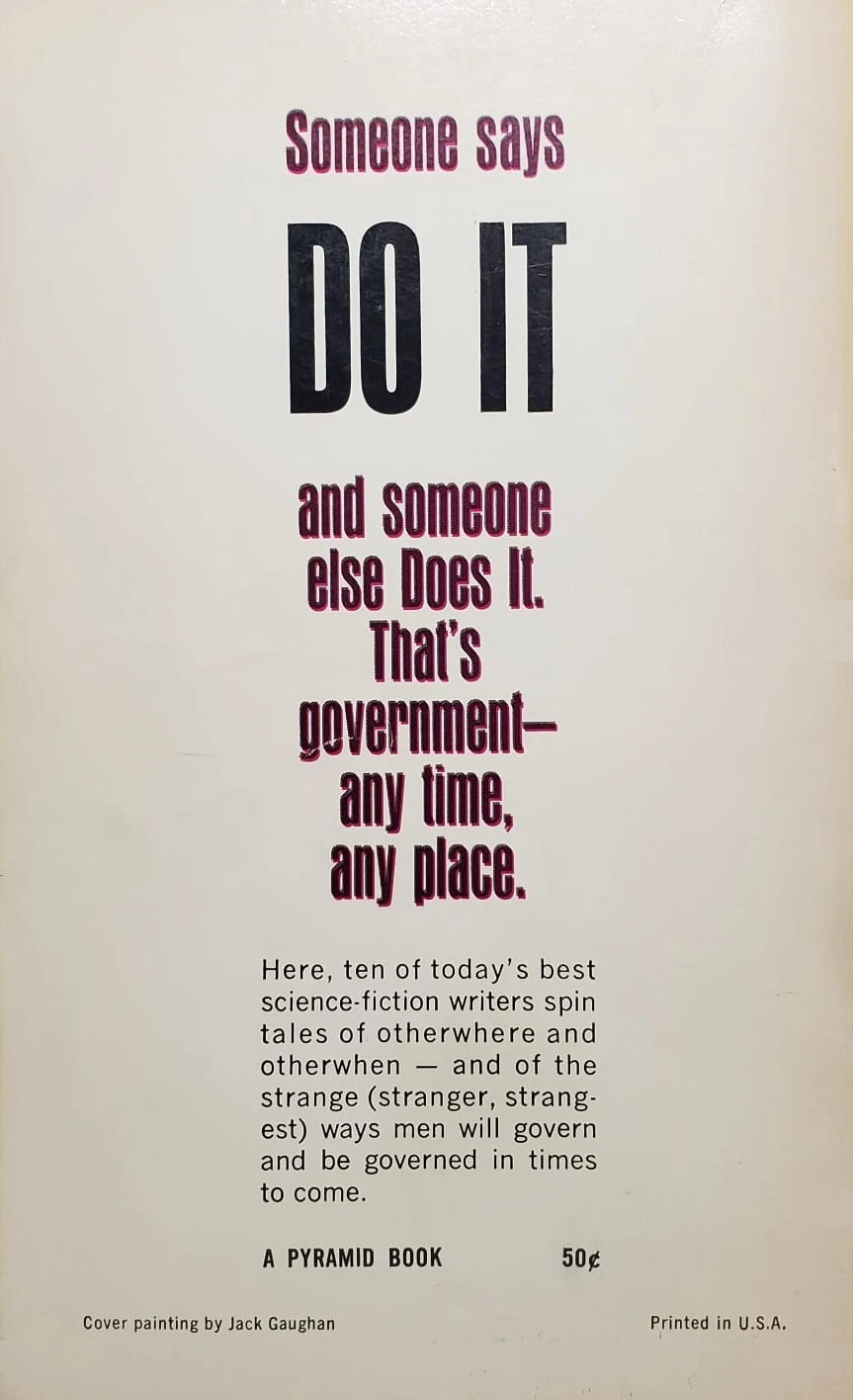
Rulers of Men, edited by Hans Stefan Santesson (Pyramid Books, 1965). Cover by Jack Gaughan
Santesson edited plenty of other works and even wrote a few stories himself under pseudonyms, none of which I’ve heard of. I did discover another edited collection by him that I’m going to try to get. You can see the cover above, by Jack Gaughan. Some star names there.
Charles Gramlich administers The Swords & Planet League group on Facebook, where this post first appeared. His last article for us was a review of the 1970 anthology Dark of the Soul, edited by Don Ward. See all of his recent posts for Black Gate here.
Categories: Fantasy Books
Book review: Flow My Tears, The Policeman Said by Philip K. Dick

ABOUT THE AUTHOR: Over a writing career that spanned three decades, Philip K. Dick (1928-1982) published 36 science fiction novels and 121 short stories in which he explored the essence of what makes man human and the dangers of centralized power. Toward the end of his life, his work turned toward deeply personal, metaphysical questions concerning the nature of God. Eleven novels and short stories have been adapted to film; notably: Blade Runner (based on Do Androids Dream of Electric Sheep?), Total Recall, Minority Report, and A Scanner Darkly. The recipient of critical acclaim and numerous awards throughout his career, Dick was inducted into the Science Fiction Hall of Fame in 2005, and in 2007 the Library of America published a selection of his novels in three volumes. His work has been translated into more than twenty-five languages.
First published February 1, 1974 Page count: 204 pages Formats: all Literary awards: Hugo Award Nominee (1975), Nebula Award Nominee (1974), Locus Award Nominee for Best Novel (1975), John W. Campbell Memorial Award for Best Science Fiction Novel (1975)
There are, broadly speaking, two kinds of bad mornings.
The first is when you wake up late, miss your alarm, and step on something on the way to the bathroom.
The second is when you wake up and discover that you do not legally, socially, or bureaucratically exist, which is considerably worse.
Jason Taverner experiences the second kind. And it’s a strong start. In fact, it’s such a strong start that the rest of the book spends a fair amount of time trying to catch up with it.
In the world Jason wakes up to, authority is everywhere, and it makes a routine of invigilating people. Taverner himself was a celebrity, and he spends most of the book trying to get his life back. Understandable, but it makes him less interested in big questions about identity and reality than in the more practical issue of not being arrested.
Anyway, he’s not awful to read about, but he’s also not that interesting. The book hints that losing everything might change him, but it mostly doesn’t. He stays focused on getting his life, status, comfort, and place at the top back. There are a few chances for him to actually connect with people, but he tends to fumble them or just move past them. That might be the point, but it doesn’t make him more engaging. That said, scenes describing his confusion and panic impressed me. And his attempts at explaining what love is are quite good.
Still, people around him are much more interesting. Buckman, in particular, is a fascinating character who knows a lot about life and certain life altering substances.
The structure is loose. Taverner moves through a series of encounters, each of which feels like it is going somewhere, but often isn’t. Characters appear, say something interesting, and then vanish. The explanation of the mystery didn't shock me since I read most books by Philip K. Dick and also his biography. But I won't spoil it.
So, did I like it? Mostly. There is something here, a sense that people are stuck being themselves, even when the world shifts under their feet. In the end, it’s an interesting book that never quite becomes a great one. It's full of good parts, just loosely assembled. You can see why people remember it. You can also see why they argue about it.
It makes it worth a read, I guess.
Categories: Fantasy Books
Pages

Recent comments