
Fantasy Books
Women in SF&F Month: Veronica G. Henry
Today’s Women in SF&F Month guest is Veronica G. Henry! Her short fiction includes “Lessons in Virtual Reality for Wayward Women” in Many Worlds and “A Terminal Kind of Love” in FIYAH Literary Magazine. She is also the author of the historical fantasy novel Bacchanal, which was a Manly Wade Wellman Award finalist in 2022, and the near-future fantasy books in The Scorched Earth duology, which begins with The Canopy Keepers. Her latest novel is The People’s Library, a science […]
The post Women in SF&F Month: Veronica G. Henry first appeared on Fantasy Cafe.
Categories: Fantasy Books
Forgotten Authors: Neil R. Jones
 Neil R. Jones
Neil R. Jones was born on May 29, 1909 in Fulton, New York, the youngest for four children. He has stated that the first science fiction novel he read, in 1918. Was Will N. Harben’s The Land of the Changing Sun, a lost world novel, which led him to the writings of Edgar Rice Burroughs.
His first published story, “Vengeance of the Ages” was published in his high school yearbook in 1926, with a second story, “The Meteor of Fate” appearing the following year.
“The Death Head Meteor,” was his first professional publication, published in the January 1930 issue of Air Wonder Stories and is believed to contain the first appearance of the word “astronaut.” He had previously sold the story “The Electrical Man,” but it didn’t appear until May of that year in Scientific Detective Monthly, earning him his first cover.
 January 1930 Air Wonder Stories, Cover by Frank R. Paul
One of the stories he had submitted to Gernsback was “The Jameson Satellite,” which kicked off a series of stories about Professor Jameson. When his payment for “The Electrical Man” was less than expected because Gernsback declared he had charged Jones for editorial preparation, Jones decided to submit the revised story to T. Conor Sloane at Amazing Stories. The story introduced the cyborg Zoromes, who featured in subsequent Jones stories about Professor Jameson.
Another innovation Jones introduced was the idea of a planned out, reasonably coherent future history, focusing on the cult of Durna Rangue from the 24th through the 25th centuries and which also tie in to the stories about Professor Jameson, although those are set in the extremely far future. The Jameson story “Time’s Mausoleum,” however, includes time travel to the period of Durna Rangue and refers to events there and was published prior to most of those stories’ publication.
Between 1930 and 1942, Jones published 38 stories and a two part serial, with only about eight stories published after 1942. On May 2, 1942, Jones was drafted into the army as part of the war effort, becoming Corporal Neil R. Jones. He was deployed to North Africa, serving in Morocco and Algeria before participating in the invasion of Sicily. He was also part of the D-Day invasion.
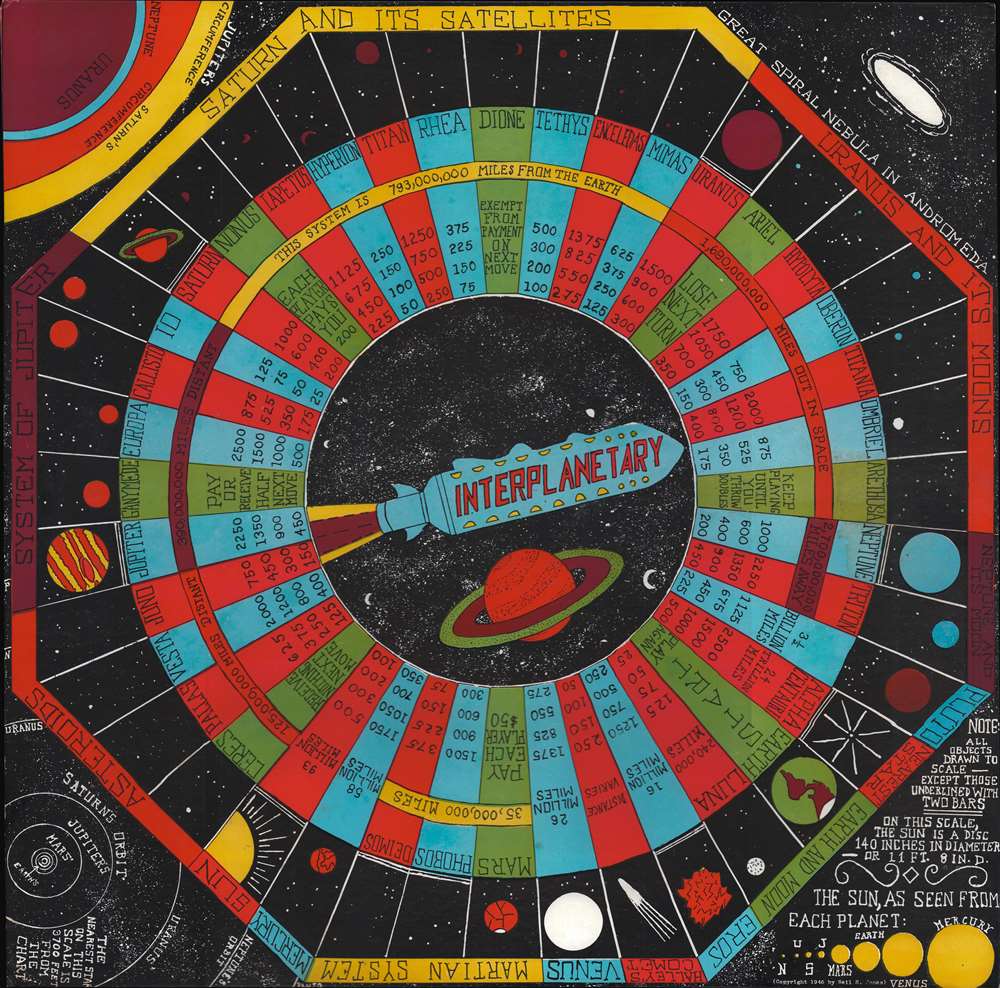 Interplanetary board game
While in England during the war, Jones married Rita Rees on June 19, 1945 in London. The couple returned to the U.S. in the fall of that year and Jones was mustered out of the army in October. Having a wife to support now, he apparently found more traditional jobs working for the New York unemployment office and possibly other book keeping positions. IN 1946, he also invented a board game called Interplanetary during this period, which he may have sold privately. Apparently only four copies are known to exist.
On September 29, 1964, Rita was found by a neighbor with her throat cut. She died in the hospital and an investigation declared it was self-inflicted wound and that she had been suffering health issues. Although some of Jones’s stories were reprinted, he had few new stories published after this point. He retired from the New York unemployment office in 1973. Sometime in the late 1970s, he remarried, to Leona Tice, who survived him.
Jones died on February 15, 1988 and is buried in Mount Adnah Cemetery in Fulton, New York.
 Steven H Silver is a twenty-one-time Hugo Award nominee and was the publisher of the Hugo-nominated fanzine Argentus as well as the editor and publisher of ISFiC Press for eight years. He has also edited books for DAW, NESFA Press, and ZNB. His most recent anthology is Alternate Peace and his novel After Hastings was published in 2020. Steven has chaired the first Midwest Construction, Windycon three times, and the SFWA Nebula Conference numerous times. He was programming chair for Chicon 2000 and Vice Chair of Chicon 7.
Categories: Fantasy Books
Audiobook Review – Sparks and Landmarks (Mitzy Moon Mysteries, BOok 4) by Trixie Silvertale, Narrated by Coleen Marlo (4/5 stars)

Reading Level: Adult
Genre: Paranornal Mystery
Length: 4 hours and 55 minutes
Publisher: Sittin’ on a Goldmine Productions LLC
Release Date: February 28, 2022
ASIN: B09TLF5FJ1
Stand Alone or Series: 4th book in the Mitzy Moon Mysteries series
Source: Bought on Audiobook
Rating: 4/5 stars
“Mitzy Moon’s clairvoyant abilities are growing, but she never predicted arson. After waking to a towering inferno and loading her mentor into an ambulance, she thought things couldn’t get worse. But when the sheriff links her father to the blaze, she’s forced to take the case.
Coming up empty on love and leads pushes Mitzy to unnecessary risks. Now her otherworldly helpers, a nosy Ghost-ma and a fiendish feline, are the only ones who can save her bacon. But with break-ins, Bingo, and big storms stalling out her investigation, she may not be able to keep her dad out of jail.
Can Mitzy dig up the right clues, or will she fall for a sinister plot that puts her six feet under?”
Series Info/Source: This is the 4th book in the Mitzy Moon Mysteries series. I bought this for audiobook.
Thoughts: This was a well written book in the Mitzy Moon Mysteries. I do think that this book is better written than the previous books were. Mitzy is starting to really grow on me as a character and I enjoy many of the side characters as well. The mysteries are well done, and the supernatural elements are subtle but getting more intriguing with each book.
Mitzy wakes up to find the building next to the bookshop on fire and a dead body is found in the blaze. Of course, Mitzy’s father is linked to the incident. Mitzy must work double time and use all of the illegal scrabble facts she learned from her Ghost-ma to solve the mystery and make sure the truth is known.
While this series is a bit too fluffy for me at times, I am growing to enjoy it. I originally picked up the first three book set for audiobook because I was looking for a 4-5 hour audiobook I could read on my monthly road trips for work, which are about 4hrs total (there and back). This whole series has been a easy, quick listen that I don’t have to focus on too hard.
Initially I was not a fan of Mitzy, but she is rapidly maturing and growing as the series continues. She’s learning from her mistakes and really starting to put her newfound fortune to great use. I still enjoy some of the side characters a bit more than Mitzy but I am starting to really like Mitzy as well. We learn a bit more about her background in each book and she starts to show a bit more emotion and vulnerability as well.
There is a well-done mystery here. You have the main mystery with the building that burned down and the body found there, which I enjoyed. However, the side stories around Rory coming to town and Mitzy’s powers growing also both make progress as well. I love a good mystery that has a contained story and progresses a larger story that spans multiple books as well.
The narration for this is well done. There are a couple of small incidents where the narrator seems to confuse voices for a moment or two, but overall, this is easy to listen to and is done well.
My Summary (4/5): Overall I thought this was the most enjoyable book of the series so far. I am really growing the love Mitzy and continue to enjoy all the side characters. I like the shorter mysteries in each book but enjoy that the broader story behind Mitzy’s powers is making progress as well. I look forward to the next book in this series, “Charms and Firearms”.

Categories: Fantasy Books
Dark Muse News: Reviewing Arcane Arts and Cold Steel by David C. Smith
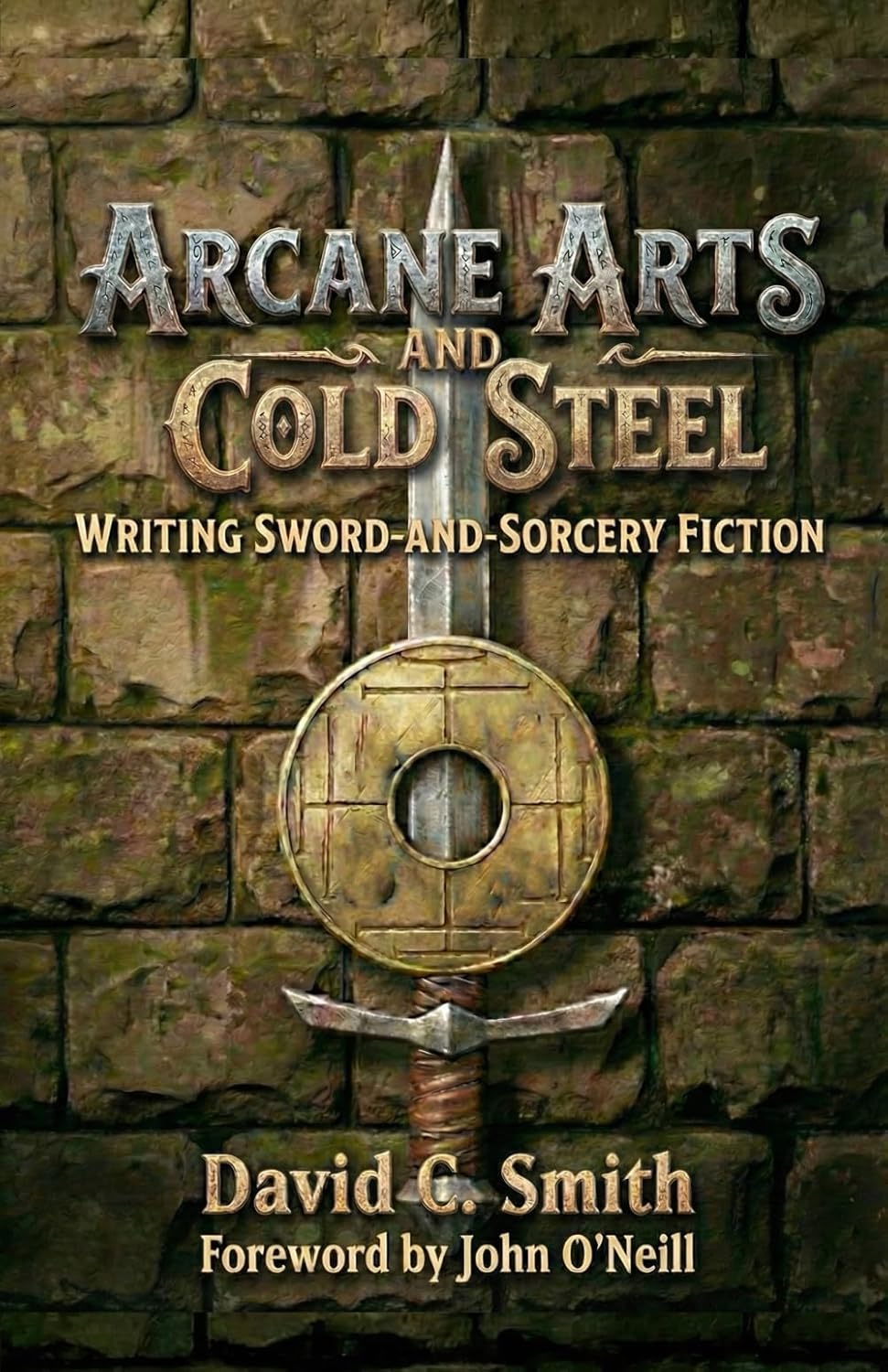
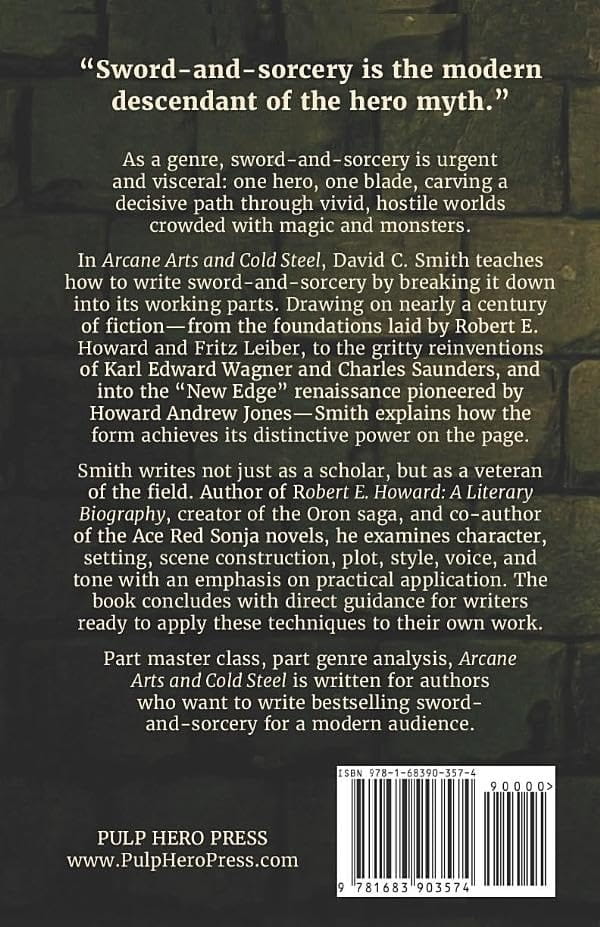
Arcane Arts and Cold Steel (Pulp Hero Press, December 24, 2025)
In 2019, Pulp Hero Press published Brian Murphy’s Flame and Crimson: A History of Sword-and-Sorcery, which was notably covered by David C. Smith (link to review) and John O’Neill (link) on Black Gate. O’Neill highlighted that Brian Murphy was one of the earliest contributors to Black Gate, from way back in 2012! Six years have passed since the publication of Flame and Crimson; whereas the subtitle and focus of that was a history of Sword & Sorcery (S&S), Pulp Hero Press just followed with a sequel focused on writing it, penned by David C. Smith with a foreword by John O’Neill.
This post covers the complementary book Arcane Arts and Cold Steel: Writing Sword-and-Sorcery Fiction (Pulp Hero Press 2025, 298 pages). Greg Mele recently posted a Black Gate article on how this book is The Literary Sorcerer’s Toolkit; read that to learn more about the author.
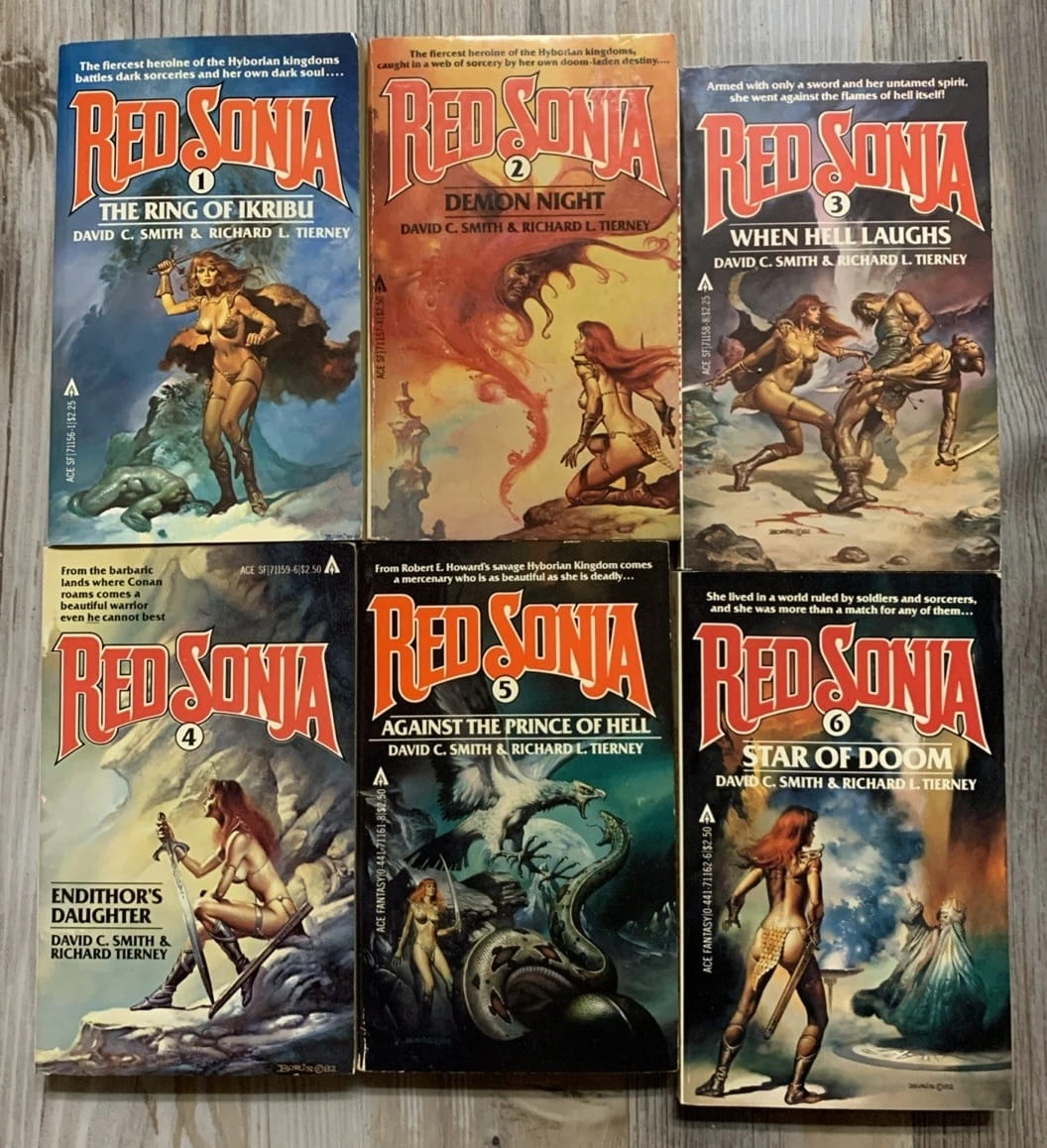 The Red Sonja series by David C. Smith and Richard L. Tierney (Ace Books, December 1981-May 1983). Covers by Boris Vallejo
In short, David C. Smith (Wikipedia page) is a writer of horror, historical, and suspense fiction, and is also a medical editor and essayist. He is best known for his heroic fantasy novels (i.e., Oron and the Attluma books), including his collaborations with Richard L. Tierney featuring Robert E. Howard’s Red Sonja heroine. He has written plenty of nonfiction, too, and won the 2018 Atlantean Award from the Robert E. Howard Foundation for Outstanding Achievement, Book, for Robert E. Howard: A Literary Biography.
Read this to learn the contents of the Arcane Arts and Cold Steel in more detail.
Frankly, it feels like John O’Neill has been moderating a panel on Sword & Sorcery since 2019, Brian Murphy covered the history of S&S, while David C. Smith covered writing perspectives, and Pulp Hero Press captured the transcript in book form.Let us quickly recap some of Flame and Crimson to set up Arcane Arts and Cold Steel content.
What Sword-and-Sorcery is, and What it is NotBrian Murphy opened with a chapter defining “What is Sword-and-Sorcery” before following with eight chapters on the linear history of it. He quoted David C. Smith from the very beginning!
We can give you clues to what it is — and what it is not. It is not high fantasy. High fantasy dresses up life and offers comfort; it is romantic. Our fiction is dark, often very dark, in the same way that unsettling dreams are never far from nightmares, and not at all comforting.
– David C. Smith, “Introduction,” Swords of Steel
- Men (and women) of action
- Dark and dangerous magic
- Personal and/or mercenary motivations
- Horror/Lovecraftian influence
- Short episodic stories
- Inspired by history
- Outsider heroes
At long last, we have a history of the sword-and-sorcery genre, and a very welcome and erudite study it is. Brian Murphy is to be commended for his honest appreciation of our frequently dismissed and often mocked genre. He intelligently surveys the expanse of the sword-and-sorcery field warts and all, low points and high, putting the genre into its proper literary perspective.
To present a linear history of the sword-and-sorcery genre is, in fact, to dissect a Yggdrasil of many branches, which is precisely what Murphy has done here…
He bookends his study with two important chapters, with his initial question “What is Sword-and-Sorcery?” ultimately addressed in the final chapter, “Why Sword-and-Sorcery?” In between, he takes us on a journey beginning with the roots of what is to come
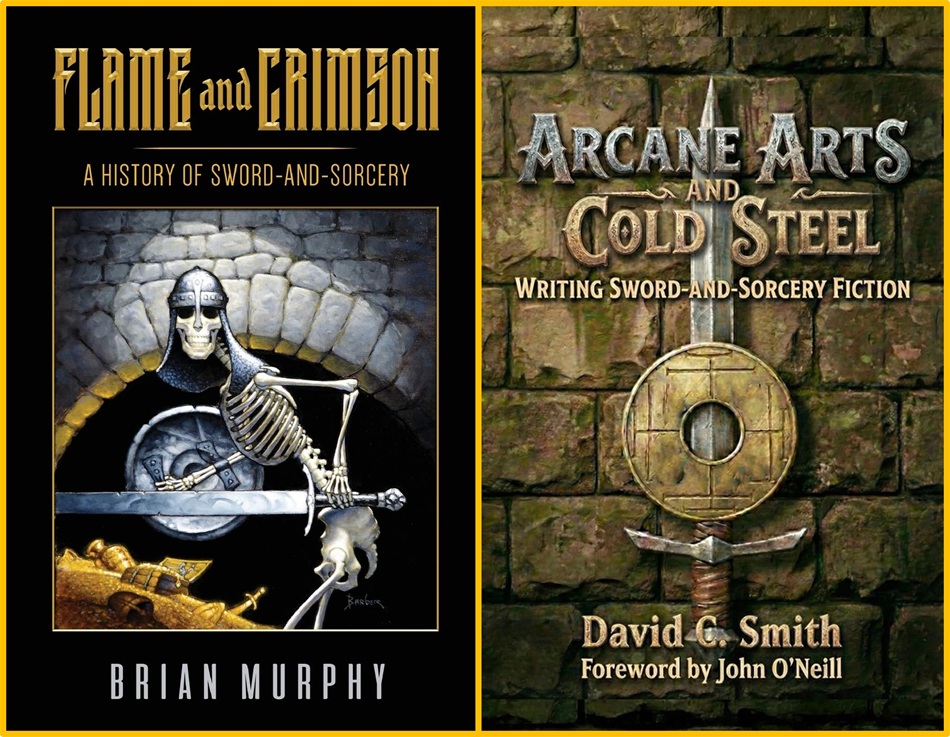 Pulp Hero Press books. Flame and Crimson: A History of Sword-and-Sorcery by Brian Murphy (2019). Arcane Arts and Cold Steel: Writing Sword-and-Sorcery Fiction, David C Smith (2025).
Arcane Arts and Cold Steel
Motivated to Write, and Lie!
Pulp Hero Press books. Flame and Crimson: A History of Sword-and-Sorcery by Brian Murphy (2019). Arcane Arts and Cold Steel: Writing Sword-and-Sorcery Fiction, David C Smith (2025).
Arcane Arts and Cold Steel
Motivated to Write, and Lie!
John O’Neill’s introduction to Arcane Arts and Cold Steel clarifies our loves of lies! He covers humans’ need for storytelling, converging from 17,000-year-old cave paintings summarizing wild hunting expeditions, to 5,000-year-old astronomical myths guiding the evolution of civilizations, to general fiction, and our need for heroic myths. To paraphrase, “there is potential inside us to accomplish things we can hardly dream of” and heroic myths fuel our fire.
O’Neill writes:
What tools do we have to teach [our children] to resist in the face of a terrible, implacable, or unexpected foe? You already know the answer. The answer is myth. Story. Fiction. Lies.
Expect a review of writing approaches, not a step-by-step S&S writing workshopArcana Arts and Cold Steel is about writing, but it is not a stringent workbook for the reader to follow. It is more of a compendium of reviews, collections of excerpts and quotes, and even reviews of other reviews. It is a free-form cookbook that simultaneously showcases over a hundred writers’ and reviewers’ work while categorizing examples for the writer to model. If you do not intend to write, you will walk away with a detailed survey of S&S literature and its fan base, and expand your perspectives of what S&S literature has become (and what it can be). Writers will gain access to countless examples of characters, plots, milieus, practical applications, and styles.
Over three years ago, I had the chance to peruse a draft of Arcana Arts and Cold Steel, and I encouraged David Smith to consider a more direct step-by-step guide. He replied kindly to me via email about that approach: “Who has the right to tell someone how to be their own writer?” Well, he had the credentials for that, but not the ego. Yet he was still driven to compose a book about writing S&S. In the end, the book is a splendid mix of David Smith’s insight blended with so many representations from the broader S&S community that it feels like an encyclopedic love letter to the entire fan base. The Appendix Author Interview relates his development and approach toward the book.
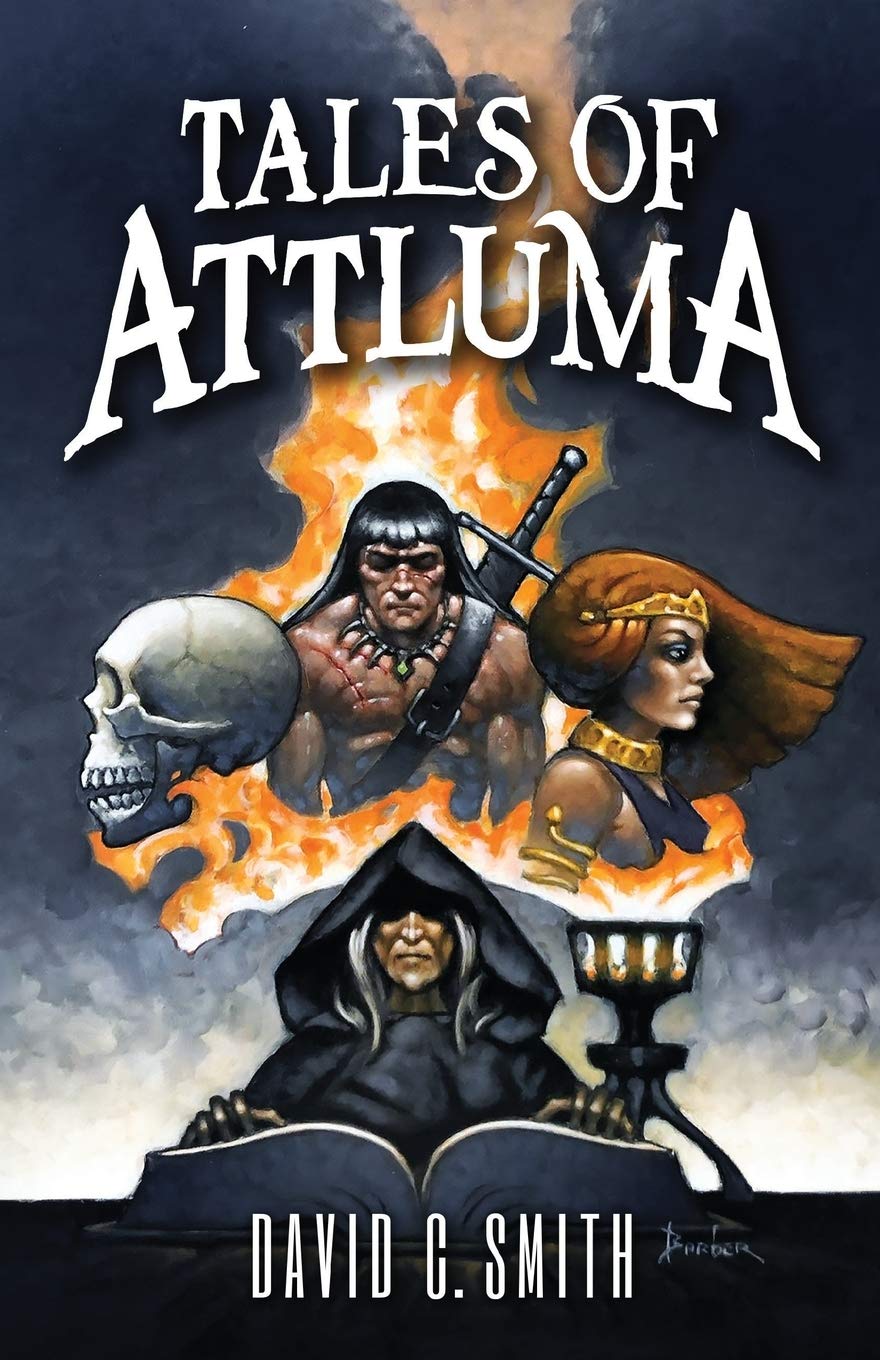
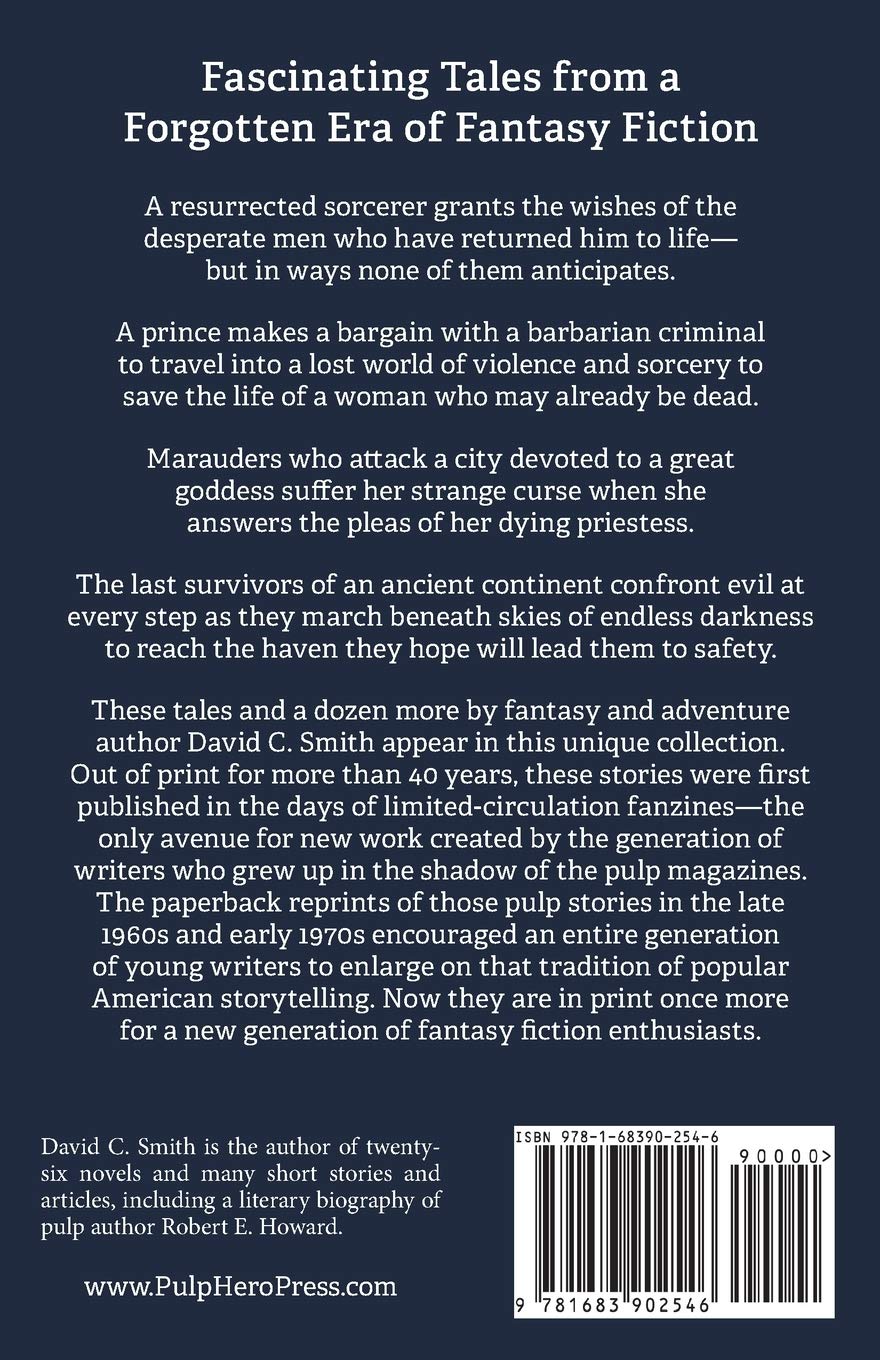
Tales of Attluma by David C. Smith (Pulp Hero Press, December 24, 2025). Cover by Tom Barber
I did. Who am I to tell anyone how to write? You sit down, you start, you learn by doing while referring to writers you like by dissecting how they’ve done what they’ve done. But my friends kept calling it Dave’s “how-to write sword-and-sorcery” book and made the case that offering guidance or ideas to readers would be helpful. Why write a book called “Writing Sword-and-sorcery Fiction” without giving people some ideas about actually writing sword-and-sorcery fiction? They were right. So I added the section doing that to complement the material in the main text.
I’d already come up with the ideas years ago on creating characters. Wrote it for an online writing group. So I had that, and when I reviewed it, I found some good common sense ideas in there. It wasn’t strictly prescriptive. I have a think skin whenever I hear a voice that sounds even vaguely imperative or prescriptive. Don’t tell me what to do! But when I thought of it as giving helpful advice or suggestions, I was fine with it. Started typing and went to town with a lot of ideas. So I hope those pages are worthwhile.
David C. Smith — Page 260-261
Arcane Arts and Cold Steel Contents 1. Sword & Sorcery Fiction: What it is and what it is not (pages 1-72)This is a 70-page, condensed (and less chronological) version of Flame and Crimson‘s history that sets the stage for writing S&S.
2. Story Structure (pages 73-186)- Character and Setting
- Must a protagonist be human?
- Flat and round characters
- Plots and scenes
- Style, voice, and tone
- Theme
In this section, David Smith surveys the rapidly diverging contemporary flavors of Sword & Sorcery. Howard Andrew Jones (HAJ, our beloved champion of S&S and its fan base, who passed in January 2025) coined the term “New Edge” to capture a rebirth of sword and sorcery. In 2008, as Managing Editor at Black Gate, HAJ posted his ‘manifesto’ regarding a resurgence brewing in Sword & Sorcery fiction: Honing A New Edge Part 1 & Part 2 (these originally appeared in the introductory editorials Issue 3 & 4 as “The New Edge”).
This sentiment resonated with many authors and editors, and a decade after its posting, directly inspired the creation of New Edge Sword & Sorcery Magazine (though editor Oliver Brackenbury has a slightly different definition than that of HAJ, read Oliver’s interview at BG for more).
4. Final Words- Appendix I: Writing Sword-and-Sorcery Fiction (p231-252)
- Appendix II: Recommended Reading (p253-256)
- Interview with the Author (p257-264)
As complete as Arcane Arts and Cold Steel is, there is more in David Smith’s head to tap. As an editor and literature guru, he has keen takes on syntax, which he sprinkles throughout the book. I privately hoped for a reprint, or relook, of his “The Writer’s Style: Sound and Syntax in Howard’s Sentences” (published in The Dark Man, February 2013). That essay, like many of The Dark Man (The Journal of Robert E. Howard Studies)‘s articles, delved into Robert E. Howard’s writing. Reading Smith’s Arcane Arts and Cold Steel motivated me to reread Smith’s article which dissects the Father of S&S’s syntax:
- Natural Order of Sentences and Plain Style
- Alliterative Devices, Conventional Phrases, archaic Flourishes, and Diction (poetic
- Color
- Use of Present Tense (mixed with past)
— David C. Smith
S.E. Lindberg is a Managing Editor at Black Gate, regularly reviewing books and interviewing authors on the topic of “Beauty & Art in Weird-Fantasy Fiction.” He has taken lead roles organizing the Gen Con Writers’ Symposium (chairing it in 2023), is the lead moderator of the Goodreads Sword & Sorcery Group, and was an intern for Tales from the Magician’s Skull magazine. As for crafting stories, he has contributed eight entries across Perseid Press’s Heroes in Hell and Heroika series, and has an entry in Weirdbook Annual #3: Zombies. He independently publishes novels under the banner Dyscrasia Fiction; short stories of Dyscrasia Fiction have appeared in Whetstone Amateur S&S Magazine, Swords & Sorcery online magazine, Rogues In the House Podcast’s A Book of Blades Vol I & II, DMR’s Terra Incognita, the 9th issue of Tales From the Magician’s Skull, Savage Realms Magazine, and Michael Stackpole’s S&S Chain Story 2 Project.
Categories: Fantasy Books
Spotlight on “Homebound” by Portia Elan
LitStack Spots We’ve spotted a few other titles we want to add to our TBR…
The post Spotlight on “Homebound” by Portia Elan appeared first on LitStack.
Categories: Fantasy Books
The Wonder Engine - Book Review
 The Wonder Engine (Clocktaur War #2)by T. Kingfisher
What is it about:Pull three people out of prison--a disgraced paladin, a convicted forger, and a heartless assassin. Give them weapons, carnivorous tattoos, and each other. Point them at the enemy.
What could possibly go wrong?
In the sequel to CLOCKWORK BOYS, Slate, Brenner, Caliban and Learned Edmund have arrived in Anuket City, the source of the mysterious Clockwork Boys. But the secrets they're keeping could well destroy them, before the city even gets the chance...
What did I think of it:This was an entertaining read and a mostly cool conclusion to this duology.
I absolutely loved Grimehug, the gnole who joined Slate and her team in The Clockwork Boys. He and the other gnoles are my favorite of the creatures in the Clocktaur world.I also really liked Learned Edmund and Brenner.The story was fun and exciting as well. I was eager to find out how our band of misfits would deal with their predicaments and how they would complete their mission.
But the Romance...
I loved Slate, but Caliban...I know which Knight Commander inspired Caliban, and I can say that Caliban is just as annoying as I find that particular Knight Commander, so well done, I say.And mostly the romance is cute and sweet, and I might even have been satisfied with it, but near the end of the book something happens that for me would have meant the end of the relationship or should have had at least a different aftermath then it got. Now the Romance to me ended with a lopsided relationship that I don't think will last.
All that said: the overall story was still tons of fun, so this book will be added to my growing T. Kingfisher collection.
Why should you read it:It's a really fun and entertaining Fantasy read.
Categories: Fantasy Books
Review: The Fake Divination Offense by Sara Raasch

Buy The Fake Divination Offense
FORMAT/INFO: The Fake Divination Offense will release on May 19th, 2026 from Bramble Romance. It is 336 pages and available in paperback, ebook, and audiobook formats.
OVERVIEW/ANALYSIS: It's time for a new chapter in Orok's life. He's starting the rawball season on a new team, and ready to make a clean break with the Church of Uzroth (patron god of aggression). But when Orok protects cheerleader Alexo at a bar, the Church of Uzorth approaches Orok and Alexo with a proposal: be part of a fake relationship for the season to give the Church a needed PR boost, and they'll sponsor Alexo off the bench and onto the main cheerleading squad. Orok's already attracted to Alexo and he can see how much the sponsorship would mean to the man, so he agrees to the deal. But while genuine sparks fly between Orok and Alexo, Alexo has dangerous secrets in his past - ones that threaten much more than a simple sponsorship.
The Fake Divination Offense is an adventure-filled fantasy sports romance that's about all kinds of love: self-love, platonic love, and yes, romantic love. Main character Orok is a half-giant, raised in a church that believes its followers should resolve all conflict through physical violence and posturing, and should always be the alpha in the room. (Quick Note: Although Orok struggles with his church in this book, this is a queernorm world, and none of his struggles have the slightest thing to do with homophobia.) While Orok doesn't follow his church's tenets, he also wrestles with his own belief that relying on his friends just drags them down. He shouldn't bother them with his problems, he should be strong enough to deal with them on his own. Learning to accept his friends' help is just one journey this quiet giant goes on.
What's nice about this romance is that although it's a fake-dating story, from the jump Orok makes it clear to Alexo that he's interested in a real relationship. There's no dancing around what's pretend and what's real; the two have frank conversations about their feelings and what their boundaries are. That doesn't mean there aren't secrets or that their relationship is perfect. But as someone who hates when miscommunication is used, it was nice to not have to deal with "is any of this real?" type story-lines.
Speaking of not-perfect, Orok is a possessive person by nature. While he is constantly checking in on Alexo and his wants and boundaries, Orok is also the kind of person who sees the person he loves and thinks "this person is MINE, I will protect them at all costs." Naturally, Alexo has been written as the kind of love interest who is fine with this dynamic, but if possessiveness isn't your cup of tea, you might bounce a little on this. But as Alex is in a certain amount of danger throughout the story from nefarious individuals, it's a dynamic that does make sense, as Orok will do whatever it takes to keep his love safe, whether it's sucking up to people he doesn't like or physically defending Alexo from a villain.
I did also enjoy the fantasy sports aspect of the storyline. Orok plays a fantasy sport called rawball (the name is a play on a D&D term) that vaguely resembles football if magic was allowed. The rules of the sport aren't important; what IS important is Orok's journey to integrating with his new team. After a bad experience with his previous team, Orok is constantly looking for his teammates to undercut him, ignore him, or outright attack him. Learning to let go of past social traumas and to open up to his teammates is part of Orok's own growth, and a story I really enjoyed watching.
The Fake Divination Offense is another lovely story of love, healing, and acceptance from Sara Raasch. I've really enjoyed this romance duology and look forward to checking out more of her work in the future!
Categories: Fantasy Books
Swords & Sorcery and The Fantastic Swordsmen, edited by L. Sprague de Camp
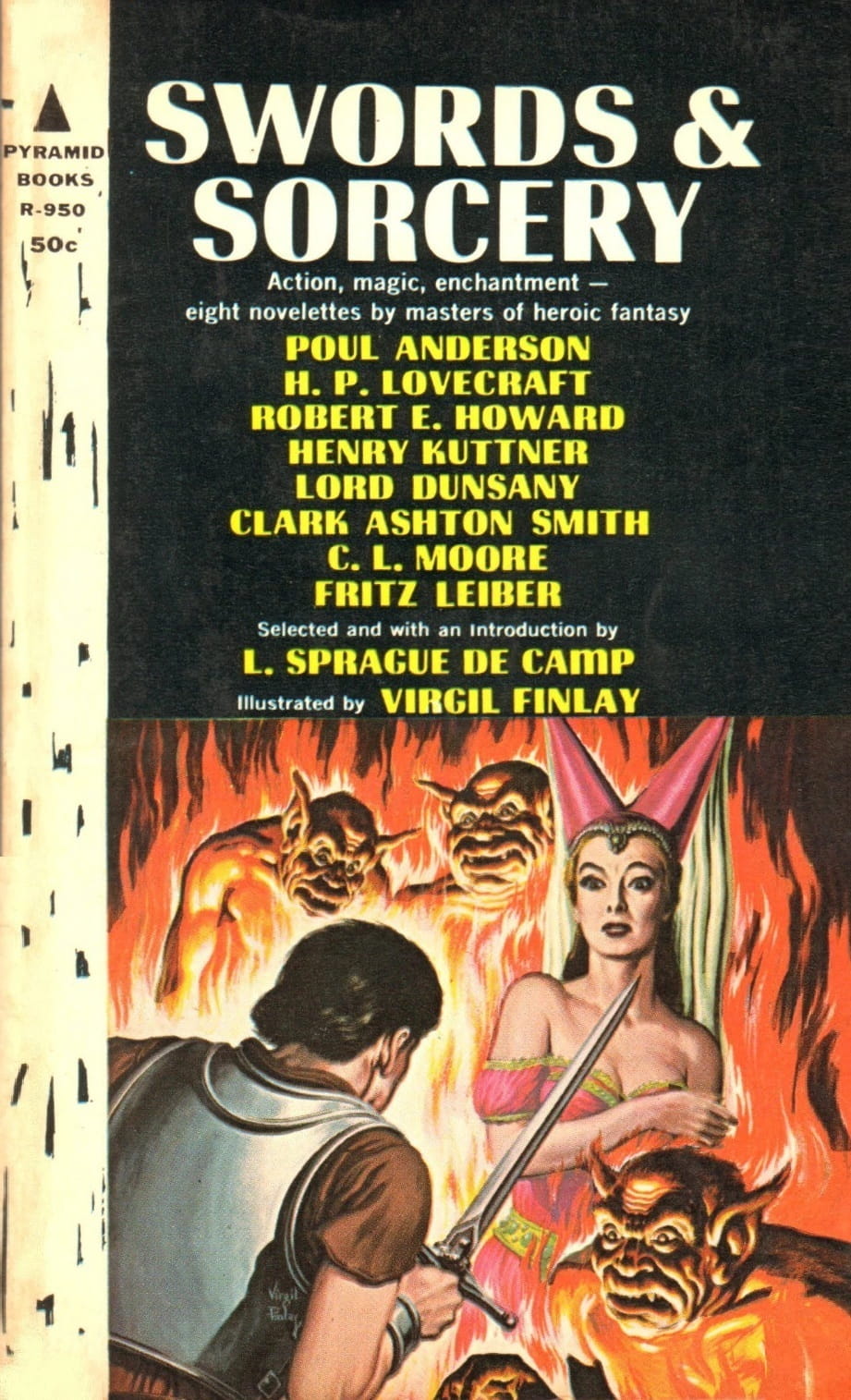
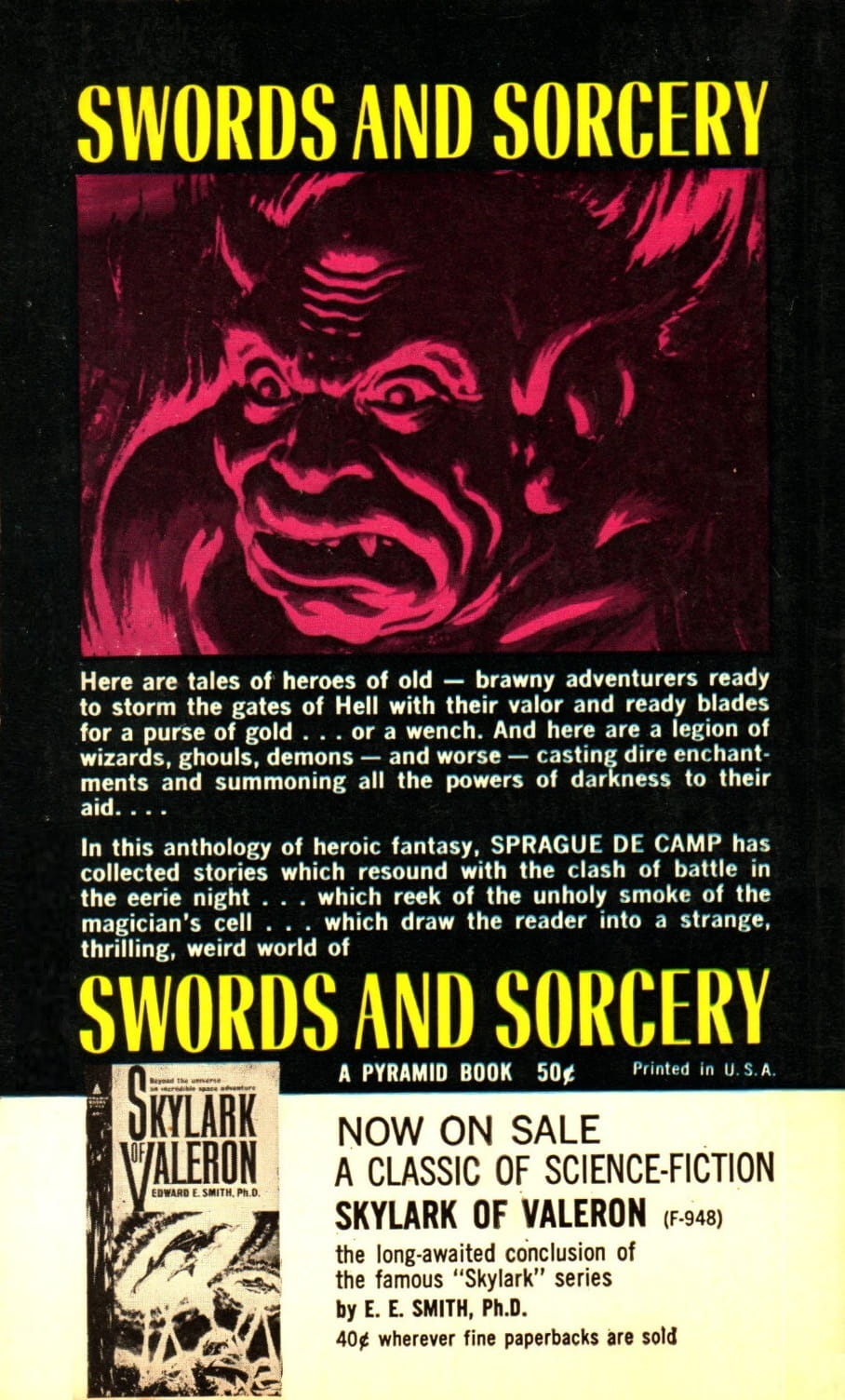
Swords and Sorcery: Stories of Heroic Fantasy, edited by L. Sprague de Camp
(Pyramid Books, December 1963). Cover by Virgil Finlay
Here are two more Sword & Sorcery anthologies edited by L. Sprague de Camp. Both are from Pyramid Books. Swords & Sorcery is 1963, with interior illustrations by Virgil Finlay. ISFDB indicates the cover is by Finlay as well, although it looks to me very much in the cover style of the second book, The Fantastic Swordsmen (1967), where the cover is attributed to Jack Gaughan. Some of the experts who visit this page probably know the truth.
1. Swords & Sorcery is a nice collection. It contains “Shadows in the Moonlight” (Conan) by Robert E. Howard, and stories by Poul Anderson (the excellent “Valor of Cappen Varra”), Fritz Leiber (Fafhrd, Gray Mouser), Kuttner (Prince Raynor), Lord Dunsany, C. L. Moore (Jirel), Clark Ashton Smith, and Lovecraft (“The Doom that Came to Sarnath”). The introduction on “Heroic Fantasy” by de Camp tends to piss some people off that I know, although I’m not one of those particularly. It suggests that S&S is purely escapist reading. I think it does make for a good escape from life’s mundanities but there’s more to it than just that.
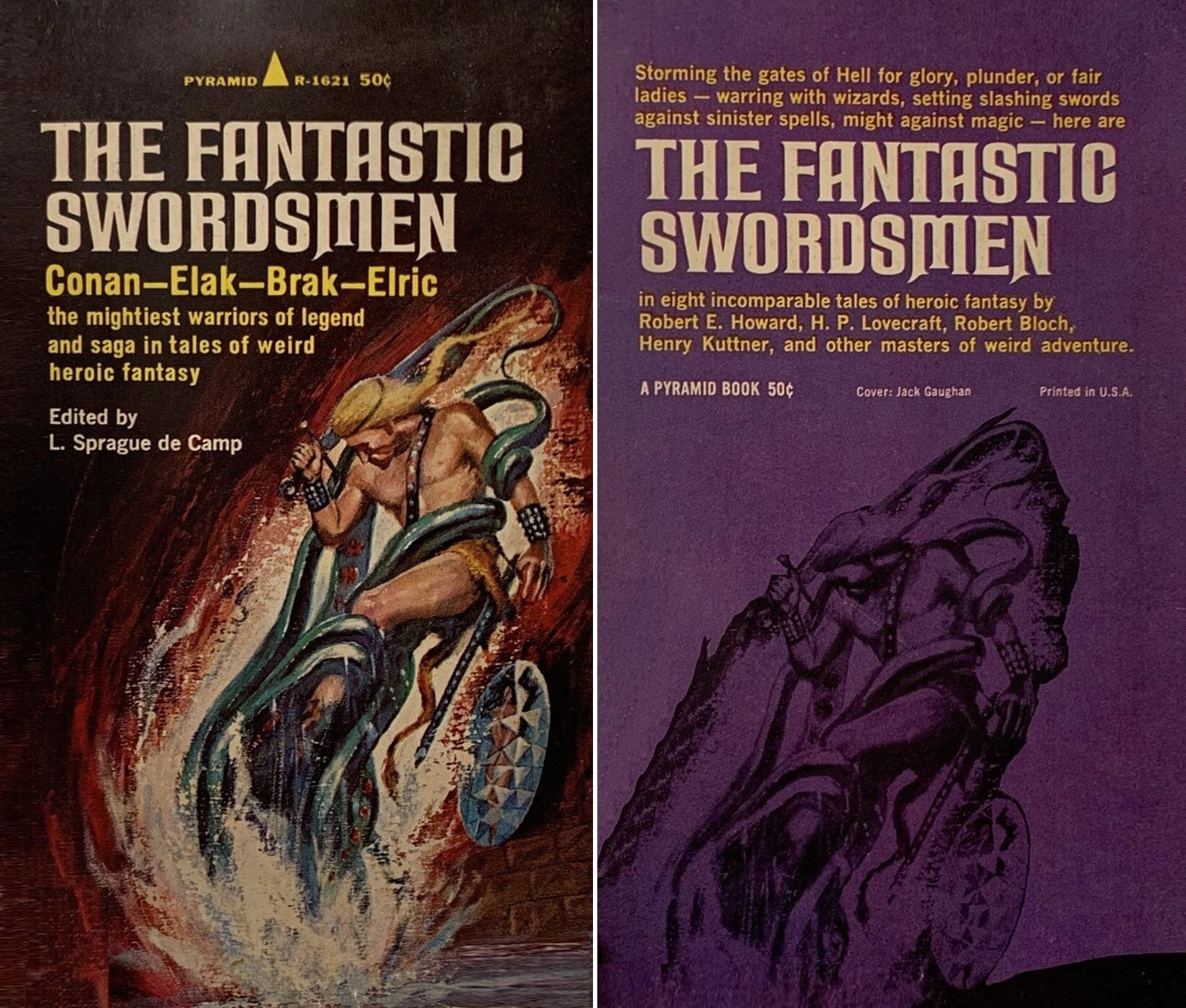 The Fantastic Swordsmen , edited by L. Sprague de Camp (Pyramid Books, May 1967). Cover by Jack Gaughan
2. The Fantastic Swordsmen is also a pretty good collection, with stories about Conan, Elak, Brak, and Elric, along with a few new items. The cover shows us Brak. The Conan story is one that de Camp finished from a Howard outline and isn’t terribly strong. There’s also a very early story by Robert Bloch, which, while well written, shows his lack of storytelling experience at the time.
Fantastic Swordsmen also contains:
“Tellers of Tales” an intro by L. Sprague de Camp
“Black Lotus” by Robert Bloch
“The Fortress Unvanquishable, Save for Sacnoth” by Lord Dunsany
“Drums of Tombalku” by REH and L. Sprague de Camp
“The Girl in the Gem” by John Jakes (Brak)
“Dragon Moon ” by Henry Kuttner (Elak of Atlantis)
“The Other Gods” by H.P. Lovecraft
“The Singing Citadel” by Michael Moorcock (Elric & Moonglum)
“The Tower” by Luigi De Pascalis, who also wrote an Afterword
Charles Gramlich administers The Swords & Planet League group on Facebook, where this post first appeared. His last article for us was a review of The Imaro Saga by Charles Saunders. See all of his recent posts for Black Gate here.
Categories: Fantasy Books
Women in SF&F Month: Shay Kauwe
Today’s Women in SF&F Month guest is Shay Kauwe! The Killing Spell, her upcoming novel that follows a young Hawaiian woman in a future with language magic, will be released on April 14 in the US and April 23 in the UK. Her book has received starred reviews from Booklist and Publishers Weekly, which called it a “smart and satisfying urban fantasy debut [that] combines gripping mystery, tantalizing romance, and sharp cultural critique.” I’m delighted she’s here today to discuss […]
The post Women in SF&F Month: Shay Kauwe first appeared on Fantasy Cafe.
Categories: Fantasy Books
7 Author Shoutouts | Authors We Love To Recommend

Here are seven Author Shoutouts for this week. Find your favorite author or discover an…
The post 7 Author Shoutouts | Authors We Love To Recommend appeared first on LitStack.
Categories: Fantasy Books
Teasing on a Wednesday - Do You Ship It?
 He interjects, 'And this is my mate, Jake. He was meant to come dressed as you, actually, but had a wing malfunction.'
(page 184, Do You Ship It? by Beth Reekles)
---------
Teaser Tuesdays is a weekly bookish meme, previously hosted by MizB of Should Be Reading. Anyone can play along! Just do the following: - Grab your current read - Open to a random page - Share two (2) “teaser” sentences from somewhere on that page BE CAREFUL NOT TO INCLUDE SPOILERS! (make sure that what you share doesn’t give too much away! You don’t want to ruin the book for others!) - Share the title & author, too, so that other TT participants can add the book to their TBR Lists if they like your teasers!
Categories: Fantasy Books
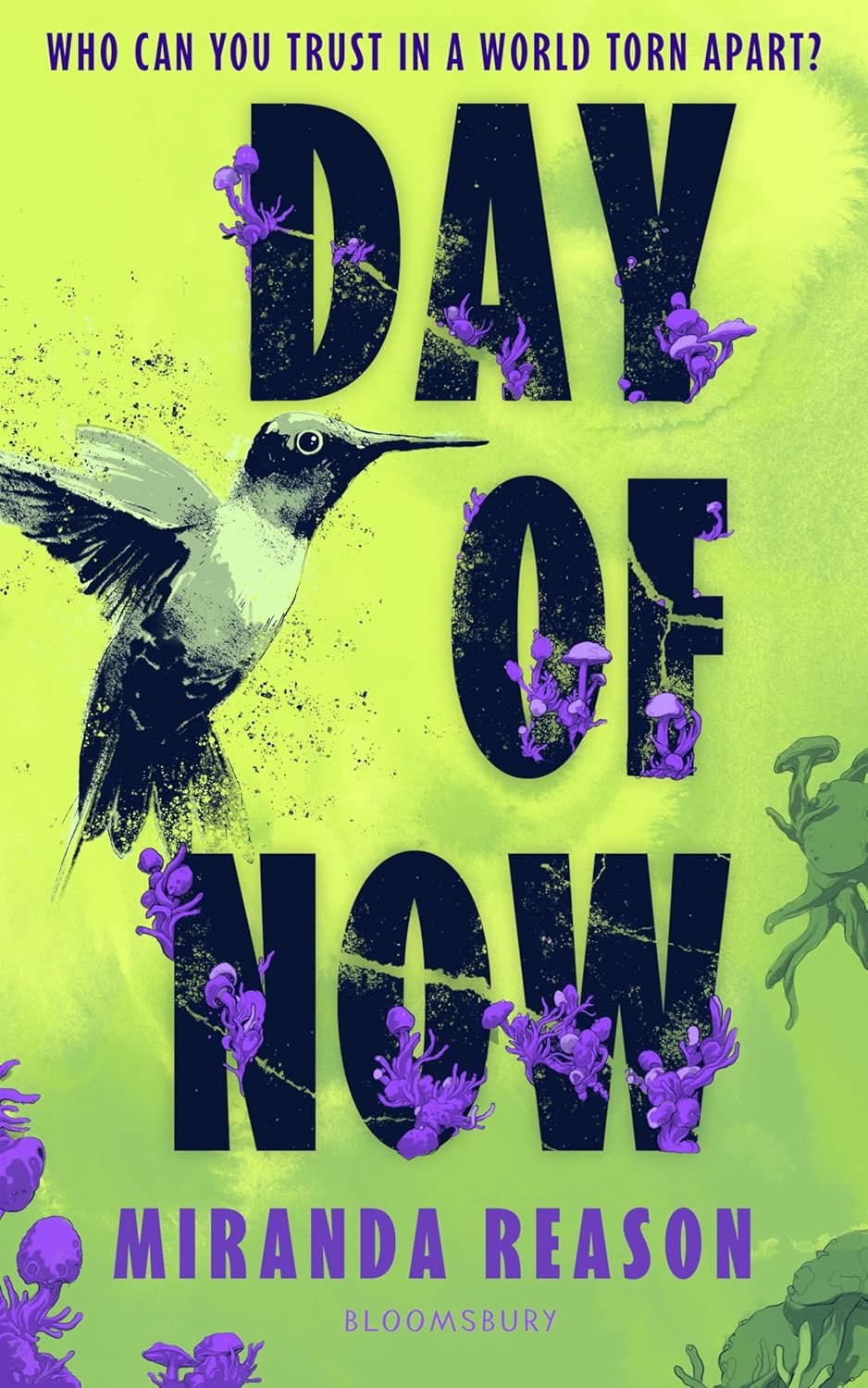
Day of Now (by Miranda Reason)
Young Adult / Dystopian
A virus has turned the planet into a dystopian wasteland. After their father is bitten Dayna and Pax venture out after hearing the promise of a vaccine. What they find are religious fanatics, deviants and a group who have decided they are in charge and will crush anyone who stands against them.
––––––––––––––––––––––––––––––––––––––––––––––––––––––––––––––––––––––––––
Day of Now reminded me of so many books. I can see reflections of the John Wyndham classic, The Day of the Triffids, a book I last read in the late 1970s by Robert C. O’Brien, Z is for Zachariah and more recently a book by A.M. Geever, Love in an Undead Age. It’s all of those books and it’s none of them. I really hope young people read this one because I think it has the potential to be something they will remember reading in 50 years just like I remember reading Z is for Zachariah when I was young.
Categories: Fantasy Books
Review – Dating After the End of the World by Jeneva Rose (2/5 stars)

Reading Level: Adult
Genre: Post-Apocalyptic
Length: 300 pages
Publisher: Montlake
Release Date: October 1, 2025
ASIN: B0DW4HPCMF
Stand Alone or Series: Sttand Alone
Source: Kindle First Reads
Rating: 2/5 stars
“Casey Pearson grew up with a doomsday-prepping father. At eighteen, tired of living an unconventional life, she left home, vowing never to return.
More than a decade later, a mysterious viral outbreak changes everything, including the people it infects, turning them into zombielike creatures. It’s the end of the world, and no one saw it coming—well, except for Casey’s father. With no place left to run and danger lurking around every corner, Casey is forced to return home.
Upon arrival, she’s surprised to find that her dad has hunkered down with a group of survivors, including her archnemesis, Blake Morrison, the high school bully who made Casey’s teenage years a living hell.
While struggling to live on the compound, face outside threats, and survive alongside her handsome enemy, Casey will learn that although the world has ended, hers is just beginning.”
Series Info/Source: This is a stand alone book. I got this on ebook from Kindle First Reads.
Thoughts: This was an easy and quick read, and I appreciated how Rose tried to combine a zombie apocalypse story with an enemies to lovers comedy romance. The characters were immature, and the action scenes poorly written. The ending was just unhinged…and not in a good way.
After the death of her mother, Casey’s father changed into a huge doomsday prepper. Casey, unlike her classmates, spent every hour of her free time digging trenches and prepping for an apocalypse. Her classmates, especially Blake Morrison, teased her relentlessly. Fast forward to present day where Casey is doing her residency as a medical doctor. She hasn’t talked to her dad in years and is engaged to a perfectly nice fellow doctor. Then the world ends, and Casey is left running for her life to seek shelter at the very compound she helped build, only to find her worst enemy (Blake) is also taking shelter there.
This is a cute story with some gruesome zombie apocalypse elements. I enjoyed the premise of their being different types of results of this viral infection (biters, nomes, and nothing). I also enjoyed Casey’s background being raised as a prepper; it left her much more aware and able to survive, and explained her ability to “make it” in this world. After the beginning of the book, there isn’t a ton of plot here.
There were a number of things I thought were just okay or flat out didn’t like. Casey acts very immature for her age and makes some bad decisions that are very out of character and seem to be there only to move the plot forward (especially at the end of the book). When she and Blake are reunited, Blake acts like a colossal asshole, which is odd for someone who wants to apologize and get to know Casey better. It seems borderline abusive, and I didn’t really enjoy their relationship. The characters in here have very little depth and are all stereotypes of characters you have already read about. The dialogue is immature, more like middle-schoolers arguing, than snappy or witty.
The way weapons were used throughout was silly and inaccurate. Casey using throwing stars to “one-shot” everything is a fantasy that doesn’t even happen in fantasies. This bothered me throughout the story, throwing stars just don’t do that much damage. The action scenes in general needed work and were poorly written and hard to follow.
The end of this book made absolutely no sense to me. I am not sure if it is setting up for a sequel or trying to make the point that this is a treacherous world now. It felt clunky and awkward. I thought I had missed a chapter or something and went back to make sure I hadn’t accidentally missed a part, but no….it was just a really awkward ending.
My Summary (2/5): Overall this was a quick, mildly entertaining read with an intriguing premise around zombies that quickly gets dropped and wanders into a somewhat absurd rom-com tale instead. I thought the characters were immature and didn’t like the chemistry between Blake and Casey. The action scenes are poorly written with a lot of inaccuracies (even trying to look past my disbelief that you can kill someone with a ninja star to the head from a long distance). The ending was the worst part, not making sense and stopping completely in the middle of a scene. This needed better editing. It was a quick read, so I didn’t waste a ton of time on it, but I don’t plan on picking up any more Jeneva Rose books in the future.
I guess if you aren’t fan of zombie/fantasy literature and are looking for a gory rom-com that dips a toe into the zombie/fantasy world you might enjoy this. Anyone who has read a lot of zombie stories or is big into fantasy will be frustrated by all the inaccuracies and poor portrayals here. I actually didn’t like the romance that much either, but some people might be into “that big strong man being verbally abusive when he really wants to apologize” vibe…I am not one of those people.

Categories: Fantasy Books
DNF Round-Up
I know I haven’t been posting or commenting on blogs these past couple weeks, but it was spring break for the schools over here and my family and I have been away traveling. I thought I was going to have some downtown to read and get a few reviews up while I was gone, but yes, that plan turned out to be just a tad over ambitious. We flew out west to visit family, and between stops in San Diego, Las Vegas, and then a full tour of the Utah national parks, there really wasn’t much time to sit still, let alone write anything coherent.
Anyway, I just got back and I’m still recovering, so honestly this might be the perfect time for another DNF update while I take the next couple days to gather my wits and catch up. Recently, I ended up abandoning several books, and honestly, nothing against them, but they just weren’d holding my attention, and I have very little patience for that when I’m traveling. My reading mood tends to get extra picky when I’m on the go.
As always, just because I DNF a book doesn’t mean it’s terrible. Most of the time, it just means it’s not the right fit at the right moment. And that’s why I do these posts, because even if something didn’t work for me, it might be exactly what someone else is looking for.
I received review copies from the publisher(s). This does not affect the contents of my reviews and all opinions are my own.
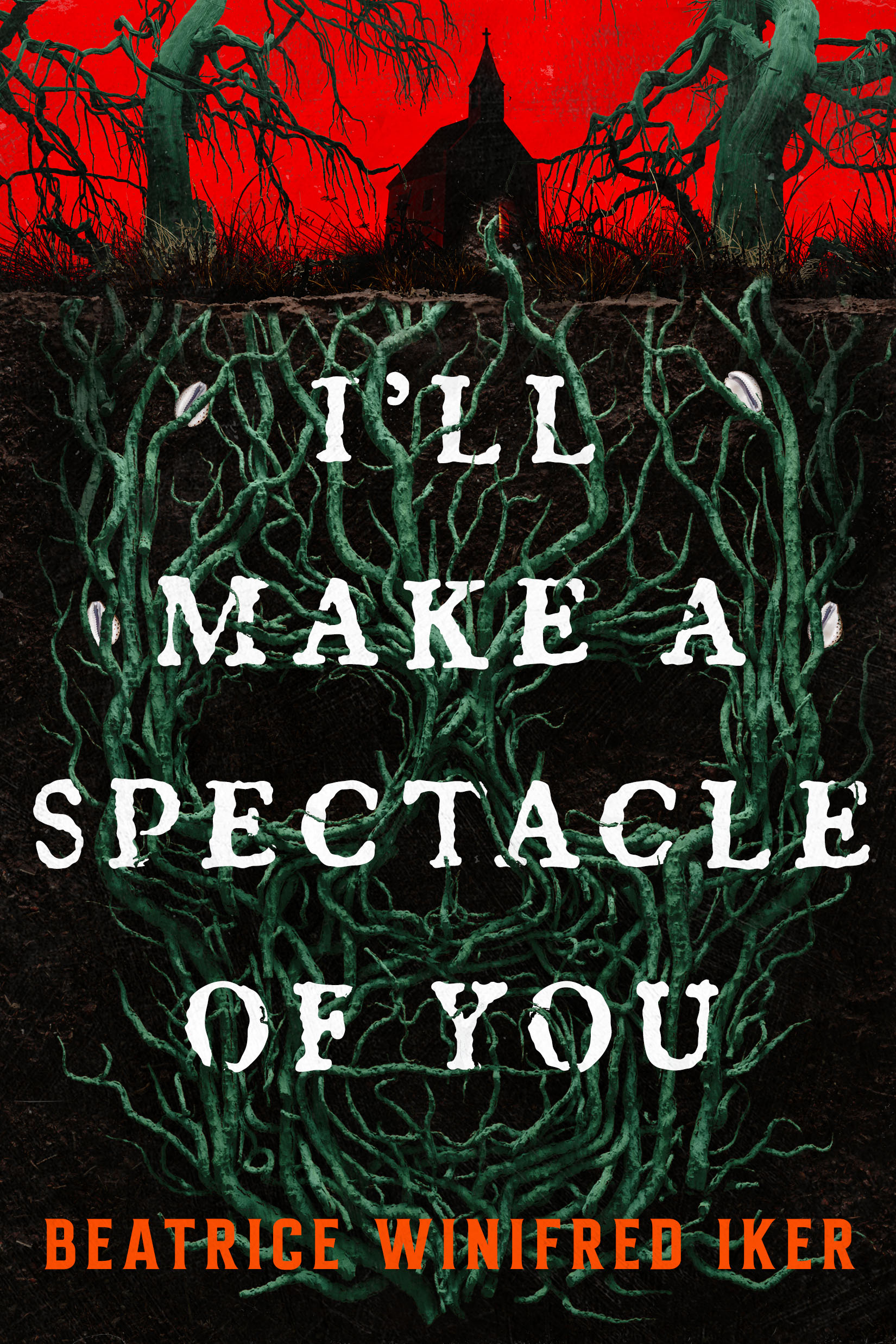 I’ll Make A Spectacle of You by Beatrice Winifred Iker
Mogsy’s Rating: DNF
Genre: Horror
Series: Stand Alone
Publisher: Run For It (November 18, 2025)
Length: 388 pages
This one ended up being a DNF for me quite early on. The premise of a Southern gothic horror set at an old university, complete with secret societies and a legend about a beast lurking in the nearby woods drew me in initially. However, the execution didn’t quite click. From the start, the pacing felt very slow, and I struggled to stay engaged. The writing style also didn’t help. Despite the beauty of the prose, it came across more clunky and awkward than I liked. It made it hard to connect with any of the characters or care about what was happening. I had to restart this one multiple times just in case it was me being in a distractable mood, but ultimately it started to feel like a chore to keep trying. That said, I can see the appeal for readers who enjoy slower, more atmospheric horror with heavy folklore and historical influences.
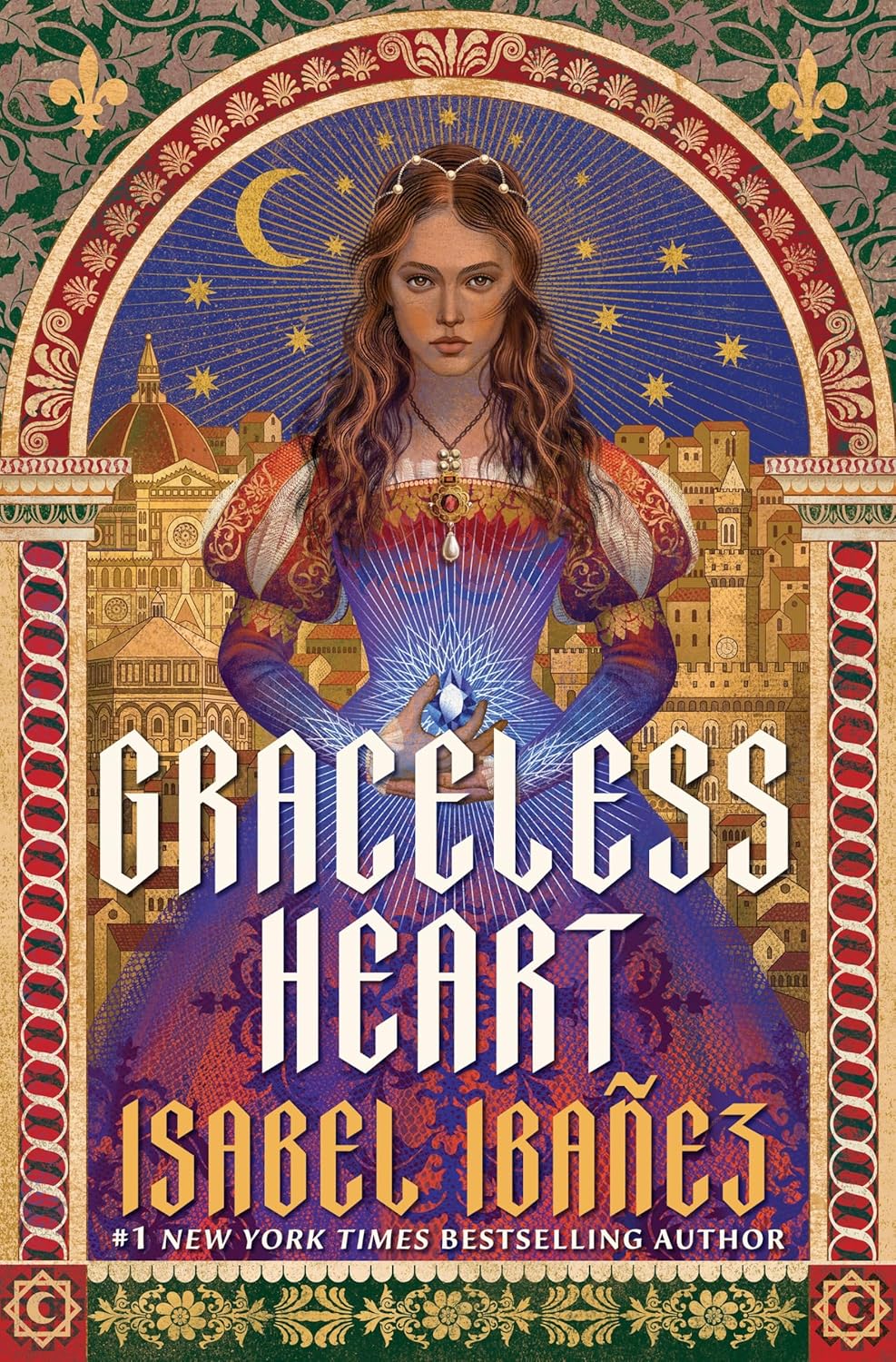 Graceless Heart by Isabel Ibañez
Genre: Fantasy, Romance
Series: Book 1 of The Spellbound History Quartet
Publisher: Saturday Books (January 13, 2026)
Length: 488 pages
I technically “finished” this book which is why you see a rating, but because I also ended up skimming through huge chunks (eventually just giving up and skipping to the end so I could find out what happened), I feel it appropriate enough to include my thoughts here. Graceless Heart is another book whose premise sounds rich on paper, featuring a heroine who is a sculptor who uses forbidden magic, but not much about its story or central romance worked for me at all. The plot was linear and the tropes were predictable, which is why I felt so comfortable skimming without feeling I was missing much. The world-building was also sparse, though there were flashes of intersting ideas, especially with the magic tied to artistry and the main character’s skills. Plus, I was invested enough to see how it all ended, so there’s something to be said for that, though in the end, none of it was explored deeply enough to really matter.
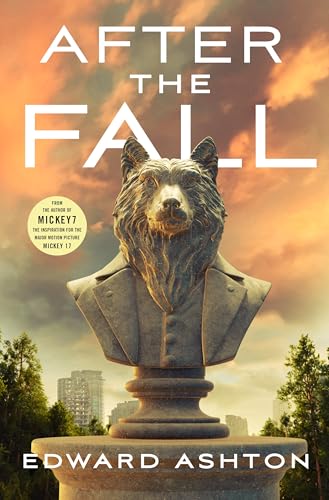 After the Fall by Edward Ashton
Mogsy’s Rating: DNF
Genre: Science Fiction
Series: Stand Alone
Publisher: St. Martin’s Press (February 24, 2026)
Length: 288 pages
This one actually hurt a bit to abandon. I’ve genuinely had a great time with Edward Ashton’s previous books, and going into After the Fall, I wanted to like the whole “humans as pets to alien overlords” concept. Unfortunately, it did not come together for me in the way I’d hoped. Instead of the usual sharp, witty voice I associate withe author, the story felt strangely flat and lifeless. Gone was the humor or personality that normally carries his writing. Again, I had several false starts, but in the end, I just had to accept that the hook was never going to come. This one just felt bland more than anything else, though I think readers who might connect with a more subdued approach should still give it a try.
Categories: Fantasy Books
Conan the Barbarian: Lamentations of a 35-Foot Snake
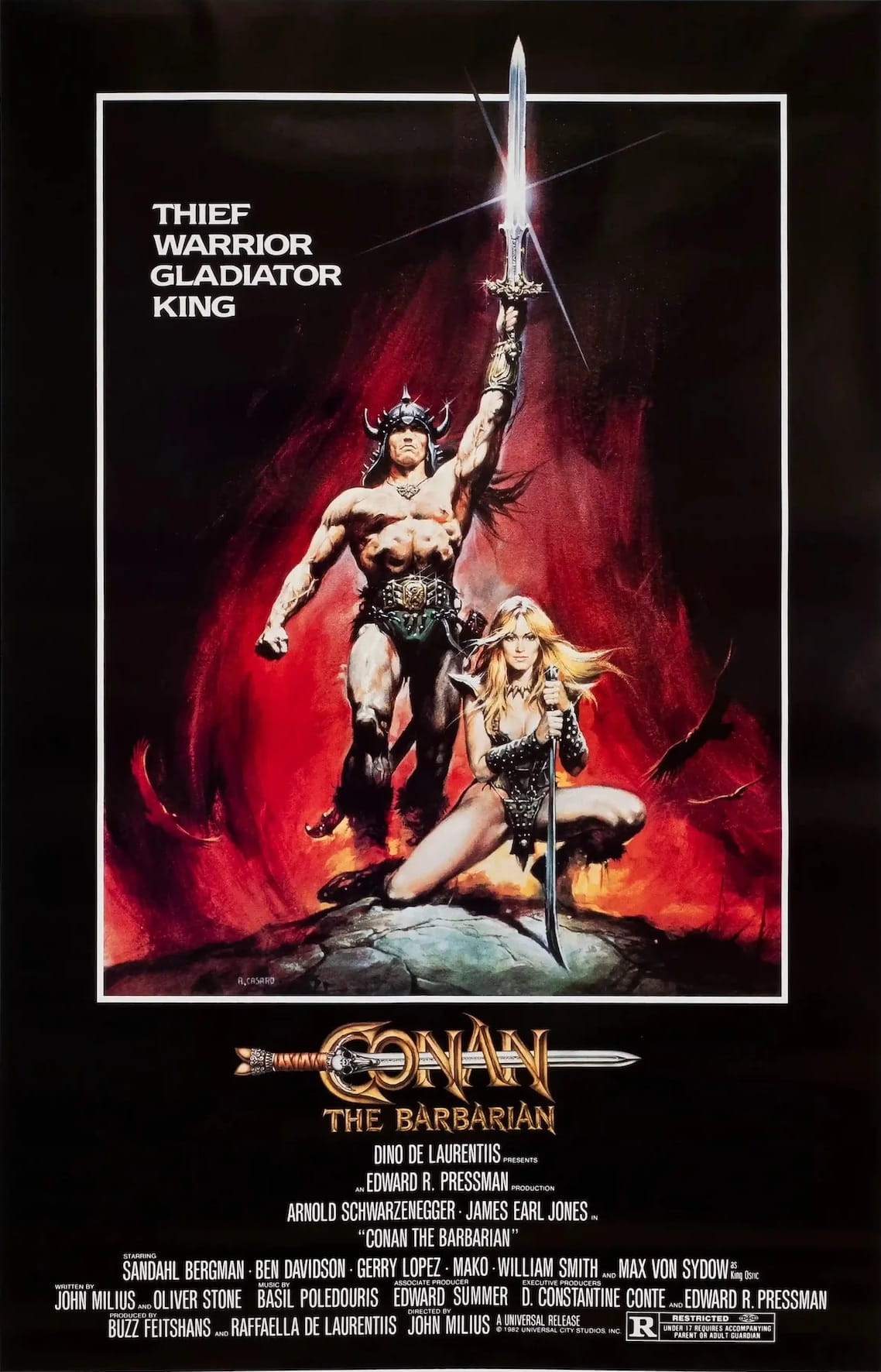 Conan the Barbarian (Universal Pictures, May 14, 1982)
Conan the Barbarian (129 minutes; 1982)
Conan the Barbarian (Universal Pictures, May 14, 1982)
Conan the Barbarian (129 minutes; 1982)
Written by John Milius and Oliver Stone. Directed by John Milius.
Based on the Conan stories by Robert E. Howard.
The first film adaptation of Robert E Howard’s greatest creation: the Cimmerian warrior who was a thief, soldier, pirate, mercenary and king. We get at least a glimpse of most of those here, even if in a somewhat distorted form.
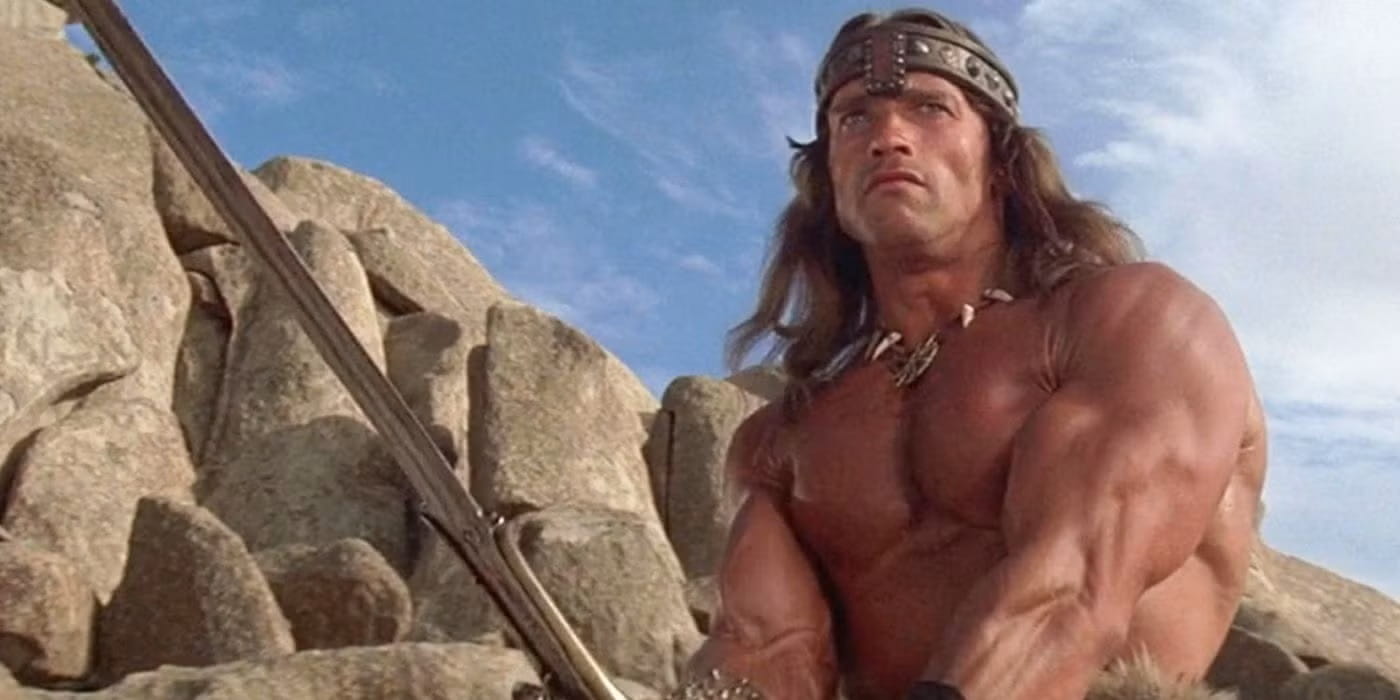 Arnold Schwarzenegger as Conan
Noteworthy
Arnold Schwarzenegger as Conan
Noteworthy
The original script for the movie was written by Oliver Stone (Platoon; JFK) under the influence of a whole lot of drugs. It would’ve run at least four hours, and featured Conan in a sort of Thundarr the Barbarian post-apocalyptic future hellscape, battling an army of 10,000 mutants.
The production company struggled to find a suitable director, at one point considering Stone and also looking at Ridley Scott. Scott, coming off the filming of the first Alien movie, turned them down. (There’s an alternate timeline where we got Alien vs Conan. And I would’ve been there for it.)
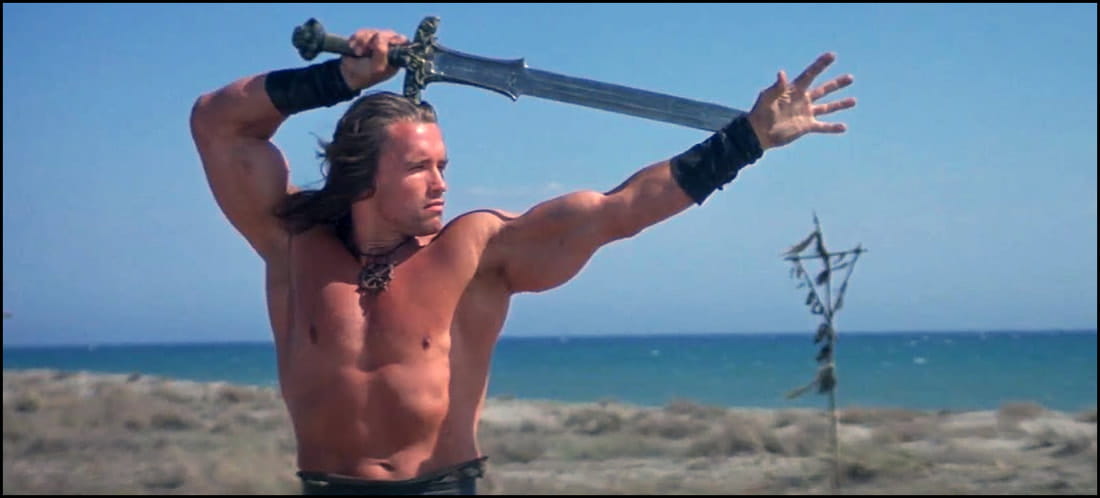
Finally John Milius, who had written the screenplays for Clint Eastwood’s Dirty Harry (1971) and Magnum Force (1973), agreed to direct the film — if he could rewrite Stone’s screenplay. No one objected to that idea. Milius was already contracted to do his next film for Dino De Laurentiis, so he convinced the producer to make Conan that movie.
Milius combined elements from various Conan stories by Robert E. Howard for his rewrite of the script, as well as borrowing the villain (Thulsa Doom) from the stories of another Howard creation, Kull the Conqueror.
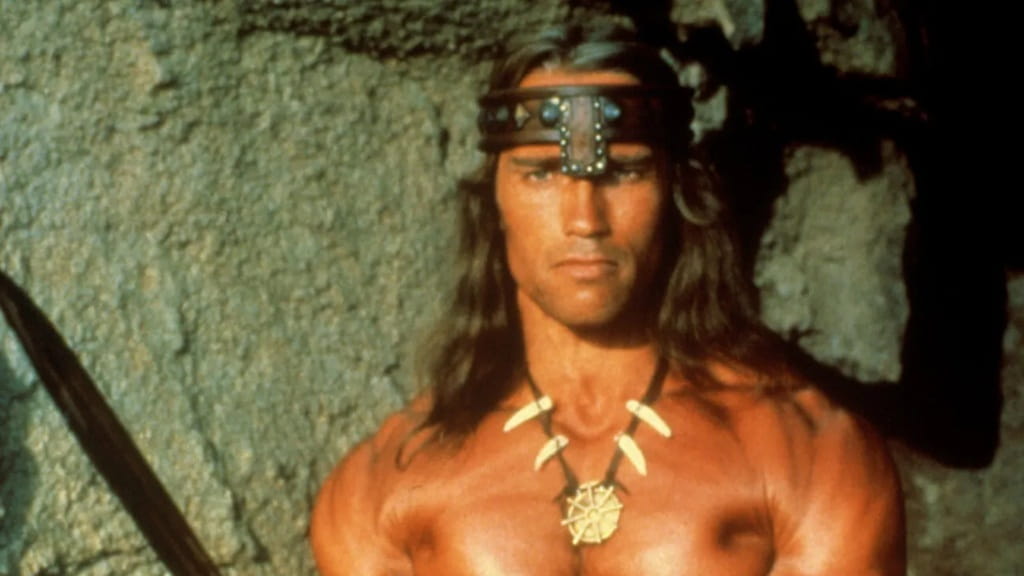
After the producers saw Arnold Schwarzenegger’s bodybuilding film, Pumping Iron, they agreed he was the clear choice for the title role. They did, however, require him to slim down from a massive, muscular 240 to a more lithe 210 pounds, through a regimen of rope climbing, horseback riding and swimming.
This was the breakout role for Schwarzenegger, who would go on to dominate action cinema for years. Other actors who were considered include Charles Bronson, Lou Ferrigno and Sylvester Stallone. Ferrigno and Stallone are predictable, but a Charles Bronson Conan would certainly have been… something. I’m not sure what, though. He might have made a better Subotai.
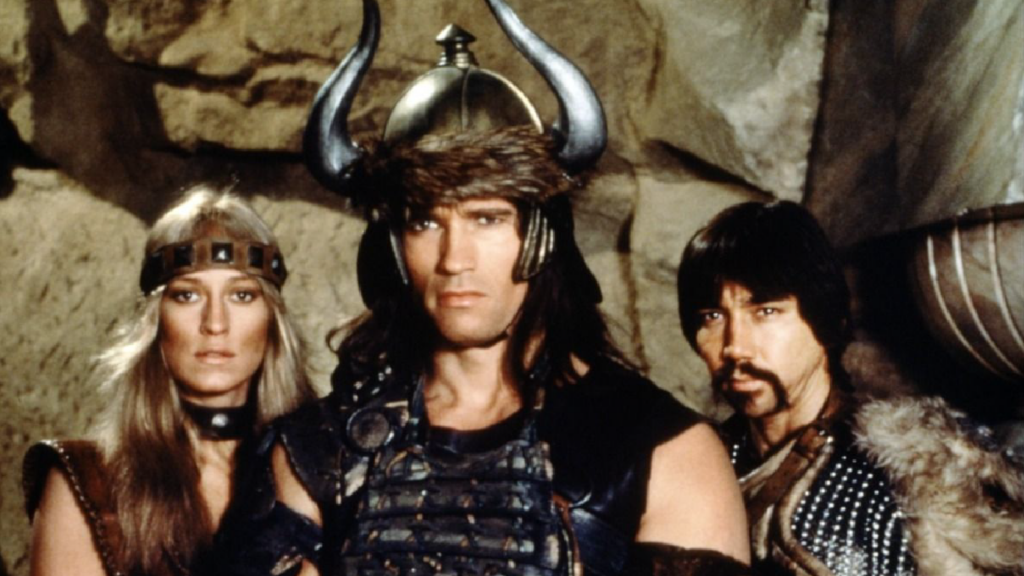 Sandahl Bergman as Valeria, Arnold Schwarzenegger as Conan, and Gerry Lopez as Subotai
Interestingly, Conan’s two allies in the film were also played by relative newcomers. While Schwarzenegger’s background was bodybuilding, Gerry Lopez (Subotai) was a champion surfer, and Sandahl Bergman (Valeria) was a dancer who had appeared in Bob Fosse’s All That Jazz. All three performed their own stunts, but none of them pleased Milius with their initial acting performances. Schwarzenegger was subjected to intensive speech training in a (failed) attempt to reduce his heavy Austrian accent, while Lopez’s lines ultimately were overdubbed by another actor. When James Earl Jones joined the cast, he began helping coach Arnold on his line delivery.
Four carbon steel copies each were forged of Conan’s father’s sword and the Atlantean sword he finds in a tomb, at a cost of $10,000 each. These were used for closeup filming. Lighter versions used in combat scenes were made from aluminum and fiberglass. Some were able to retract their blades to simulate a killing blow, and others could spray blood from their tips.
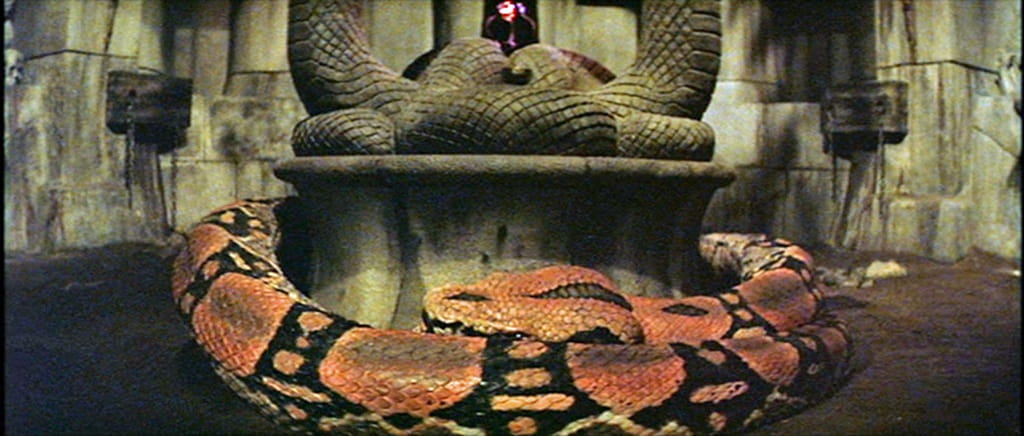 Conan the Barbarian: The giant snake
The giant snake Conan kills was over 35 feet long and cost $20,000 to create. It was so large it would not fit onto the set, so only part of it is ever shown on screen. Its skeleton was made from the same material used to build aircraft frames.
Some action scenes were filmed using a remote-controlled camera crane system originally created by Nick Allder during the filming of Dragonslayer.
The movie was shot in five months in various locations in Spain. It took over a year to edit. During that time, editor C. Timothy O’Meara removed several particularly violent scenes to which the studio objected. He then had to piece the movie back together without them, and keep the story comprehensible in the process.
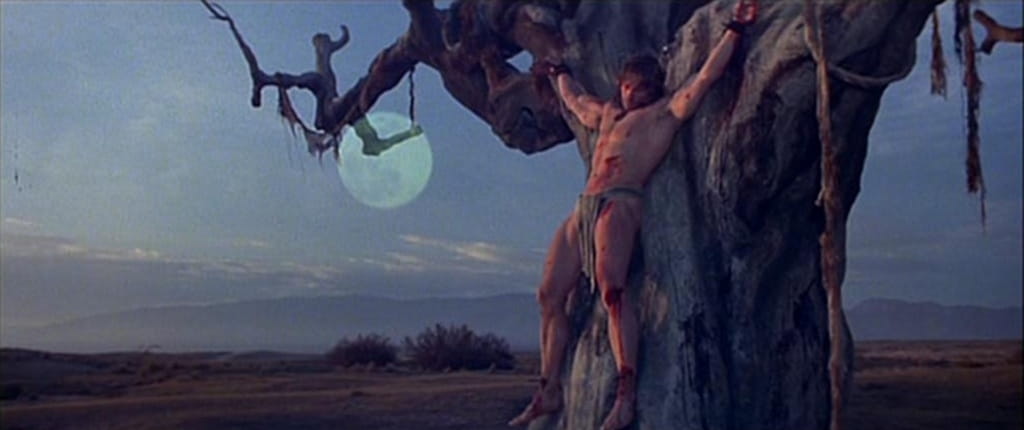 Conan on the Tree of Woe
The musical score for the film, composed by Basil Poledouris, is spectacular and memorable. It was the first film to list Musync, a newly developed music and tempo editing software package, in the credits. Musync allowed Poledouris to compose much of the music before filming had even wrapped, and then alter it to fit the various scenes after they were completed. It was the last film released by a major studio with a mono soundtrack, because producers balked at the extra tens of thousands of dollars required for a stereo score, and because they felt at the time not enough theaters were equipped to handle that anyway.
The film earned around $75 million (on a $20 million budget) in its initial theatrical release. This was considered successful enough that a sequel, Conan the Destroyer, was released two years later. (We’ll cover it soon.)
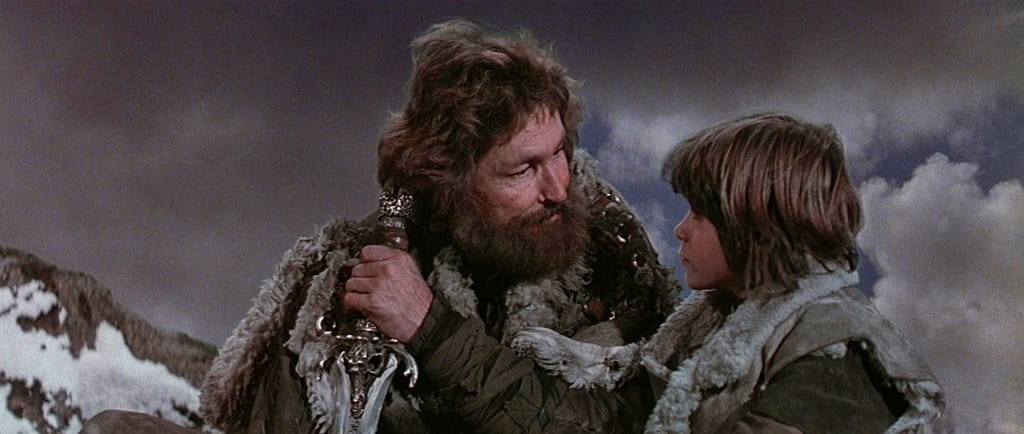 Young Conan and his father
Quick and Dirty Summary
Young Conan and his father
Quick and Dirty Summary
A young barbarian vows revenge on the snake cult leader who killed his parents and destroyed his village. He grows up to be a powerful warrior with a heavy Austrian accent, and teams up with a pair of thieves moonlighting from their surfing and dancing jobs. Eventually he gets the chance to exact his vengeance, slaying the snake cult leader and destroying his temple – but at a price.
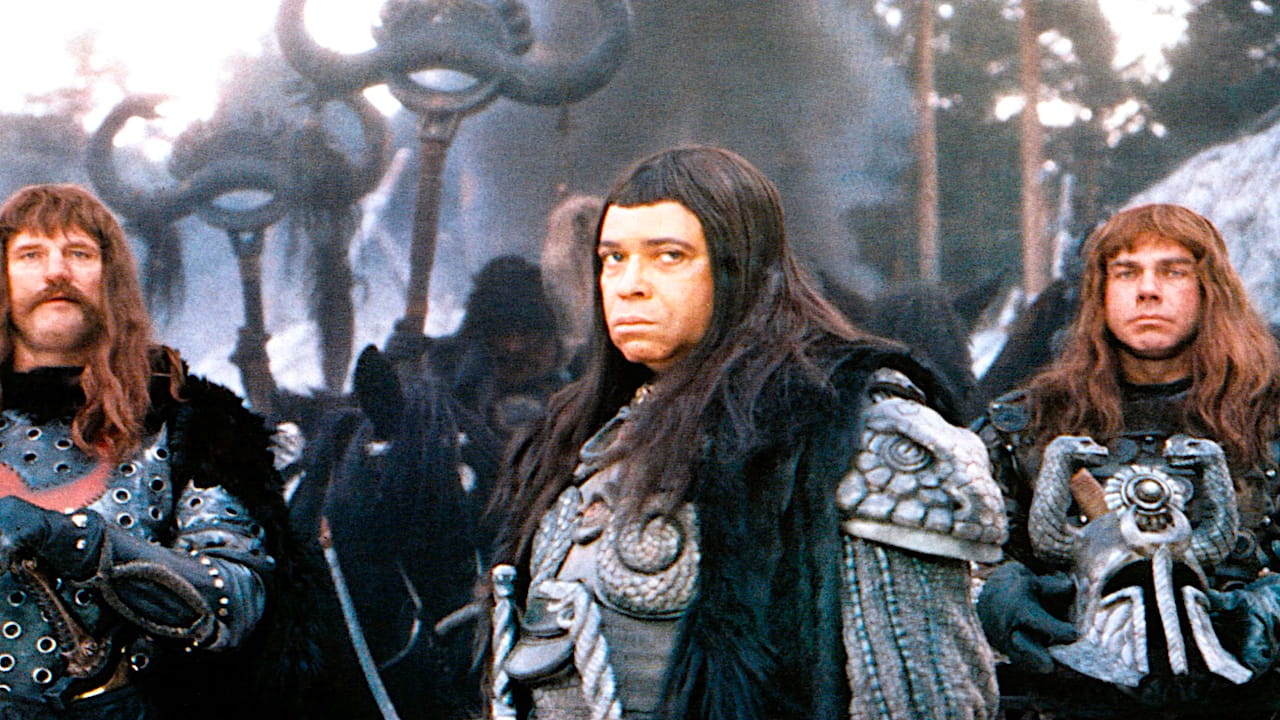 James Earl Jones as Thulsa Doom
Fantasy/SF/Sword & Sorcery Elements
James Earl Jones as Thulsa Doom
Fantasy/SF/Sword & Sorcery Elements
Robert E. Howard literally wrote the book on muscles and steel triumphing over sorcerers, monsters and evil gods. And Conan is the prototypical Sword & Sorcery hero. He greatly dislikes sorcery, but he seems to fare pretty well against it.
This film overflows with Sword & Sorcery elements. The battle with the giant snake is memorable, as is Conan’s showdown with Thulsa Doom’s henchmen. Doom’s slow transformation into a giant snake himself – a remarkable achievement of practical special effects in the days before CGI – comes out of nowhere and shakes things up again.
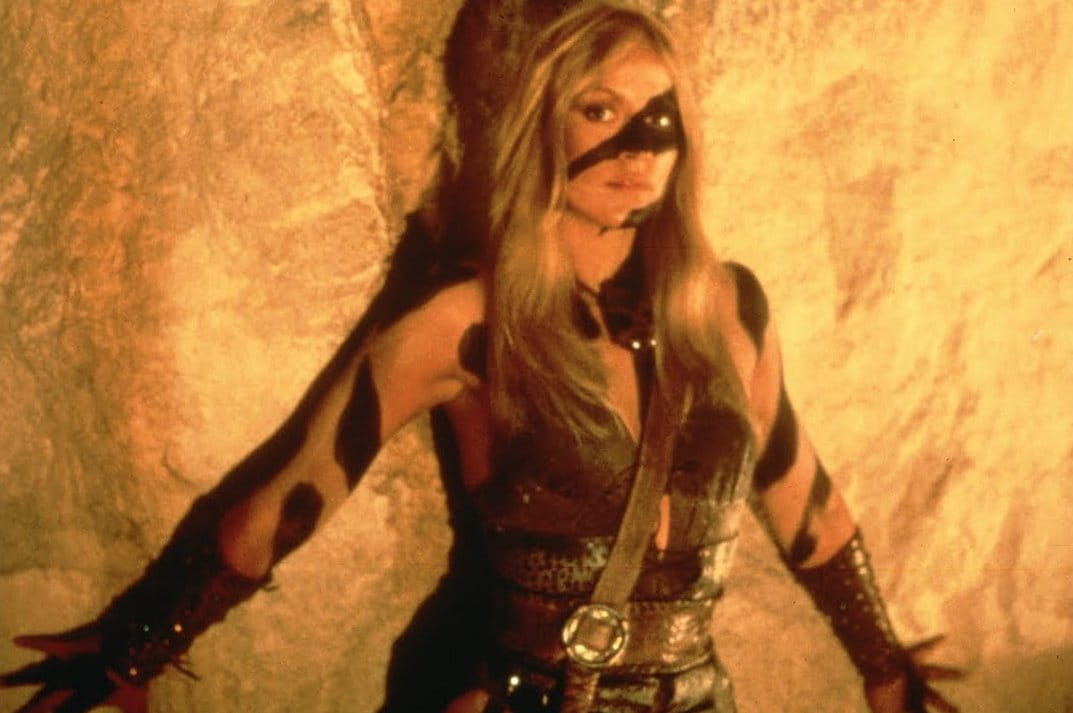 Sandahl Bergman in Conan the Barbarian
High Point
Sandahl Bergman in Conan the Barbarian
High Point
Once Conan becomes “grown-man warrior Conan,” the plot remains fun but it becomes fairly predictable. Full-on Conan isn’t going to lose to anybody in his debut film. At that point, the only questions are, “How will he kill them all?” and “Will any of his allies die along the way?”
I would argue the most interesting portion of the movie is actually the first third, as we watch a young Conan transition from scene to scene in slavery, as a gladiator, and a survivor, all the while learning about the world around him and looking for the cultists who wiped out his village.
And of course there’s the classic moment where he reminds us all what is best in life: “To crush your enemies, see them driven before you, and hear the lamentations of the women!”
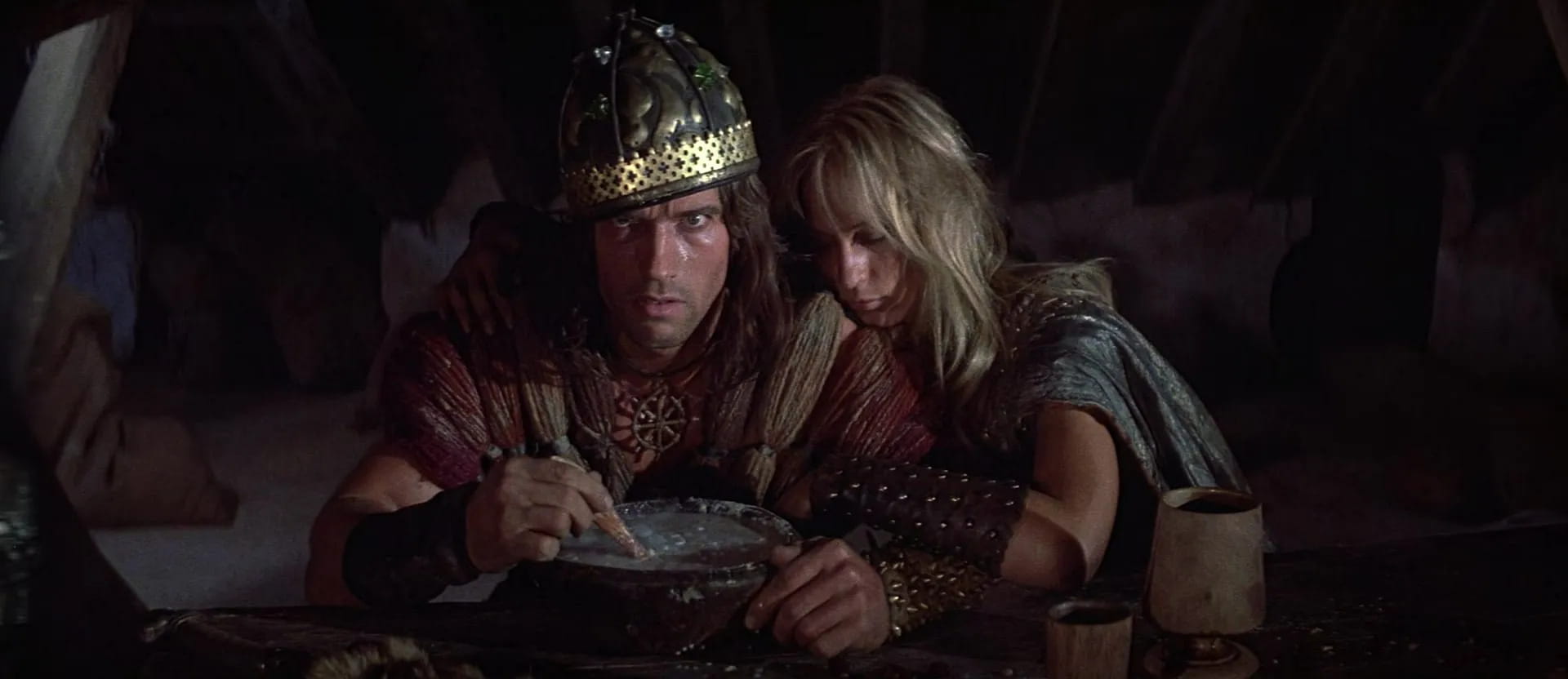 Conan and Valeria
Low Point
Conan and Valeria
Low Point
There’s no question that Schwarzenegger’s performance here, at the very start of his career, is iconic and enjoyable. But it’s a situation similar to “movie James Bond vs book James Bond.” In both cases, the movie version of the character is significantly altered from the literary version. Arnold’s Conan is dumbed down. He’s mostly muscle and brute force. At one point, he punches a camel. His reactions are often comical, and some are played for comedy. Howard’s Conan was always capable of winning a fight with his muscles and his sword, but he was also a serious, clever and canny guy, endowed with native smarts and charisma.
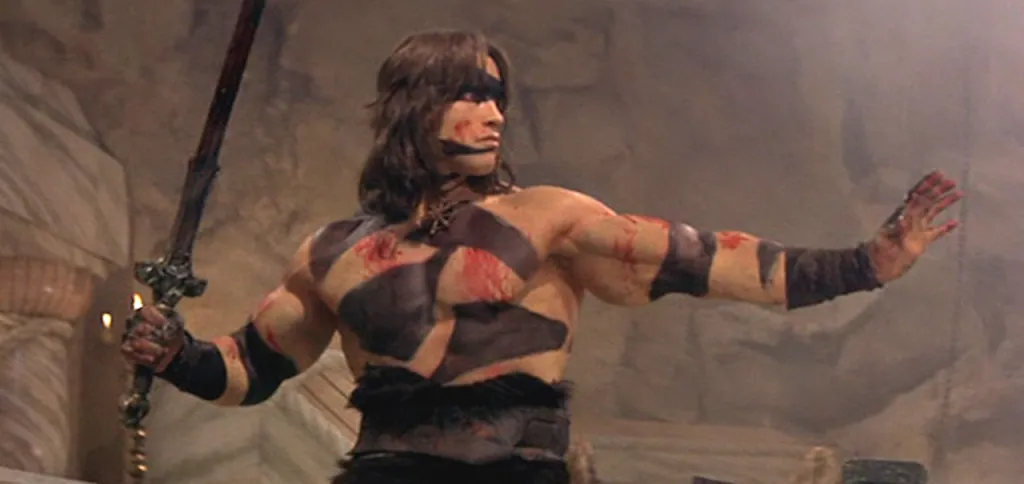
All of the above said, it would be a crime not to give the nod here to Schwarzenegger. This movie would not be half of what it is without his unforgettable presence looming over nearly every frame. He may not exactly be Howard’s Conan, but he’s mesmerizing, entertaining, and entirely awesome.
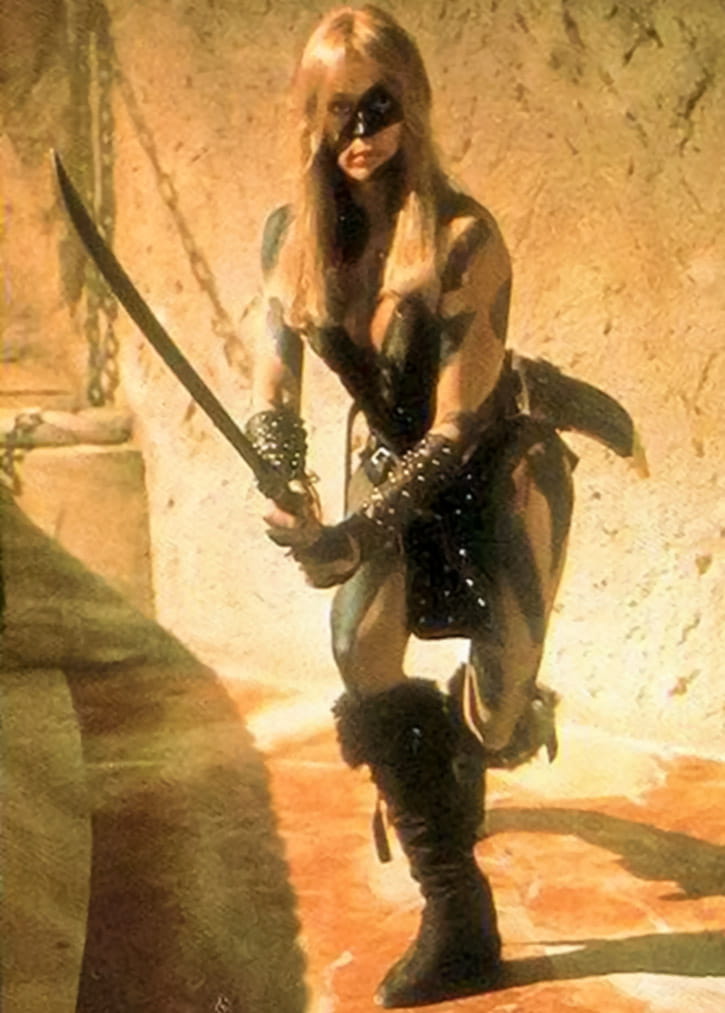 Valeria in action
Overall Evaluation as a Movie and as Fantasy/SF/Sword & Sorcery
Valeria in action
Overall Evaluation as a Movie and as Fantasy/SF/Sword & Sorcery
Conan the Barbarian is an excellent action/adventure movie in general, but it is on the “Mt. Rushmore” of Sword & Sorcery films. It has to be. It brought the greatest hero of the genre to the big screen for the first time. It gave him a worthy opponent and high stakes. It combined drama, action, character and violence, with a touch of humor along the way.
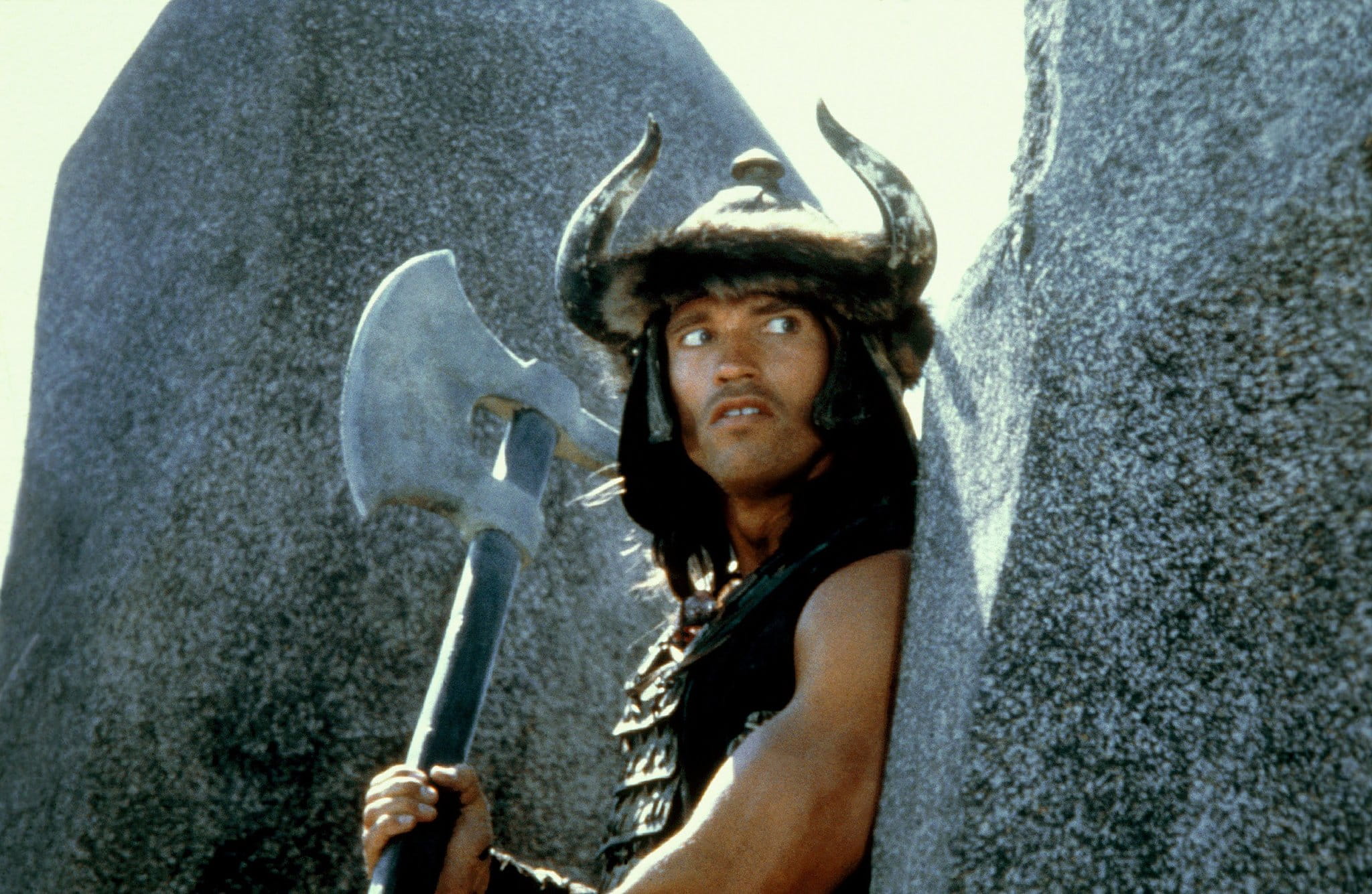
To paraphrase Conan’s prayer to his Cimmerian god: Valor pleases Crom, so perhaps he will grant me one request: That those of you who have not watched this movie will give it a shot.
And if you do not love it, then to hell with you!
Van Allen Plexico is a member of the Science Fiction and Fantasy Writers of America (SFWA), a Grand Master of Pulp Literature (2025 class) and a multiple-award-winning author of more than two dozen novels and anthologies, ranging from space opera to Kaiju to crime fiction to superheroes to military SF. He notably edited, co-created and co-wrote the Sword and Sorcery anthology GIDEON CAIN: DEMON HUNTER. Find all of his works on Amazon and at Plexico.net.
Categories: Fantasy Books
So What If I’m A Puta and Putafeminista | 2 Books Explore Brazilian Sex Workers

The post So What If I’m A Puta and Putafeminista | 2 Books Explore Brazilian Sex Workers appeared first on LitStack.
Categories: Fantasy Books
Apparently, Sir Cameron Needs to Die - Book Review
 Apparently, Sir Cameron Needs to Dieby Greer Stothers
What is it about:All his life, Sir Cameron has stayed as far away from danger as possible. He is, quite frankly, too handsome to die a violent and pointless death in battle. But when the Church hands down a prophecy to his fellow knights predicting that the only way to defeat their nemesis, the mad sorcerer Merulo, is to kill Cameron, he finds himself in a situation too sticky for even his considerable wiles. Short of ideas, Cameron throws himself on the mercy of the one person who now actually wants him to survive: the mad sorcerer.
Merulo isn’t thrilled to be babysitting a spoilt, attention-seeking knight, but fate has tied them together. And transmogrifying Cameron into a vulture is at least a great source of entertainment. Cameron, meanwhile, is on a voyage of self-discovery. It turns out he’s really, really into surly sorcerers who lock him up and tell him what to do. Who knew?
As a legion of knights surround their stronghold, the sorcerer’s poisonous ambitions draw ever closer to fruition. Cameron is quite invested in not dying, but he finds he’s also invested in Merulo. And sometimes, supporting the sorcerer you care about means taking an interest in their hobbies. Even if that hobby is trying to kill God.
Even if it might get you killed, too.
What did I think of it:This was a nice enough read.
I especially liked the first half of the boo. It was fun and funny, and Sir Cameron's antics were fresh. Also: He's a vulture for parts of the story!At one point though, I thought things were going on too long and then there were revelations where it came to the world this story is set and the book lost me to be honest. I was far enough in to finish it, but it was a bit of a drag.
All in all a fun concept, with an overall execution that was just not for me.
Why should you read it:It's a fun Fantasy Romance.
Categories: Fantasy Books
Book review: The Red Winter by Cameron Sullivan

Book links: Amazon, Goodreads
ABOUT THE AUTHOR: Cameron Sullivan was born in Perth, Western Australia. He grew up with the dark fantasy and horror icons of the ’80s and went on to study classics and creative writing at the University of Western Australia.
After several years working and studying in Italy and the UK, he returned to Australia and settled in Melbourne. He will easily lose a weekend to a good book, a new recipe or games of any kind.
Publisher: Tor Books (February 24, 2026) Page count: 544 (Hardback) Formats: all
Sebastian Grave is a centuries-old occult practitioner, who makes a living off the dead. He shares his body with a demon, Sarmodel, who is extremely effective, provided you don’t forget what it is.
The story opens with a dead girl, a curse, and a misunderstanding involving a witch’s bone. It works because it’s fun, well-written but also shows that in this world the supernatural is not mysterious so much as procedural. Things happen for reasons and Sebastian’s job is to find them.
Soon, things get complicated. A young nobleman, Jacques d’Ocerne, arrives with a summons tied to an old, unfinished contract concerning a Beast of Gévaudan. Against his better judgement, Sebastian agrees to return there.
And so a journey starts, and it's not a cheerful one. It involves mud, infection, poor financial planning, and mayhem. From there we follow a few timelines, learn about demons, church politics, and follow a thread of doomed romance. The shifting timelines are handled well enough that you don’t feel lost, and there’s a steady drip of reveals that keeps things moving.
I enjoyed the business of the supernatural most. The scenes involving it are grim, and often carry a dry edge of humor that lands well with me. I also loved Sarmodel’s presence. I mean, he is Sebastian’s inner voice that has opinions about how edible his clients are. The conversations between them are some of the strongest parts of the book.
Jacques, on the other hand, functions as an obstacle with legs. His secrecy, pride, and general refusal to communicate make sense once explained, but the explanation arrives late. Until then, much of the interaction follows a familiar pattern where Sebastian asks a reasonable question, Jacques refuses to answer it, and both suffer for it. Repeatedly.
There’s also Livia - Sebastian's secretary (well, not really but I won’t spoil everything for you) and a succubus. She feeds on desire and leaves very little behind when she is done. Her chapters and scenes are some of the most entertaining in the story. She says what she wants, goes after it, and resents every rule that stops her halfway. On the page, she’s lively. In the audiobook, she’s something else entirely. Imogen Church narration is brilliant, rich, theatrical and over the top in the best way.
Structurally, the book is uneven. After an excellent opening, the middle section sags. Things happen, but they don’t always feel like they’re building toward something larger. The central threat (the Beast, the old contract) waits too long while the story circles smaller conflicts and Sebastien's history.
That said, the atmosphere is consistently good, the writing remains entertaining and both POV characters have strong and memorable voices. So yes, The Red Winter is carried by its characters.
Categories: Fantasy Books
Women in SF&F Month: Samantha Mills
Women in SF&F Month continues today with a guest post by Samantha Mills, plus a chance to win a copy of her upcoming book (whether you live in the US or not)! She is the author of the science fantasy novel The Wings Upon Her Back, a Compton Crook Award winner and World Fantasy Award finalist—as well as one of my own favorite books published in 2024 for its uniqueness and exploration of a variety of subjects, particularly its protagonist’s […]
The post Women in SF&F Month: Samantha Mills first appeared on Fantasy Cafe.
Categories: Fantasy Books
Spotlight on “The Fifth Year” by Marlen Haushofer

LitStack Spots Here are a few other titles we’ve spotted and are adding to the…
The post Spotlight on “The Fifth Year” by Marlen Haushofer appeared first on LitStack.
Categories: Fantasy Books
Pages

Recent comments