
https://www.blackgate.com/

Another Classic Sword & Sorcery Anthology: The Barbarian Swordsmen, edited by Sean Richards (AKA Peter Haining)
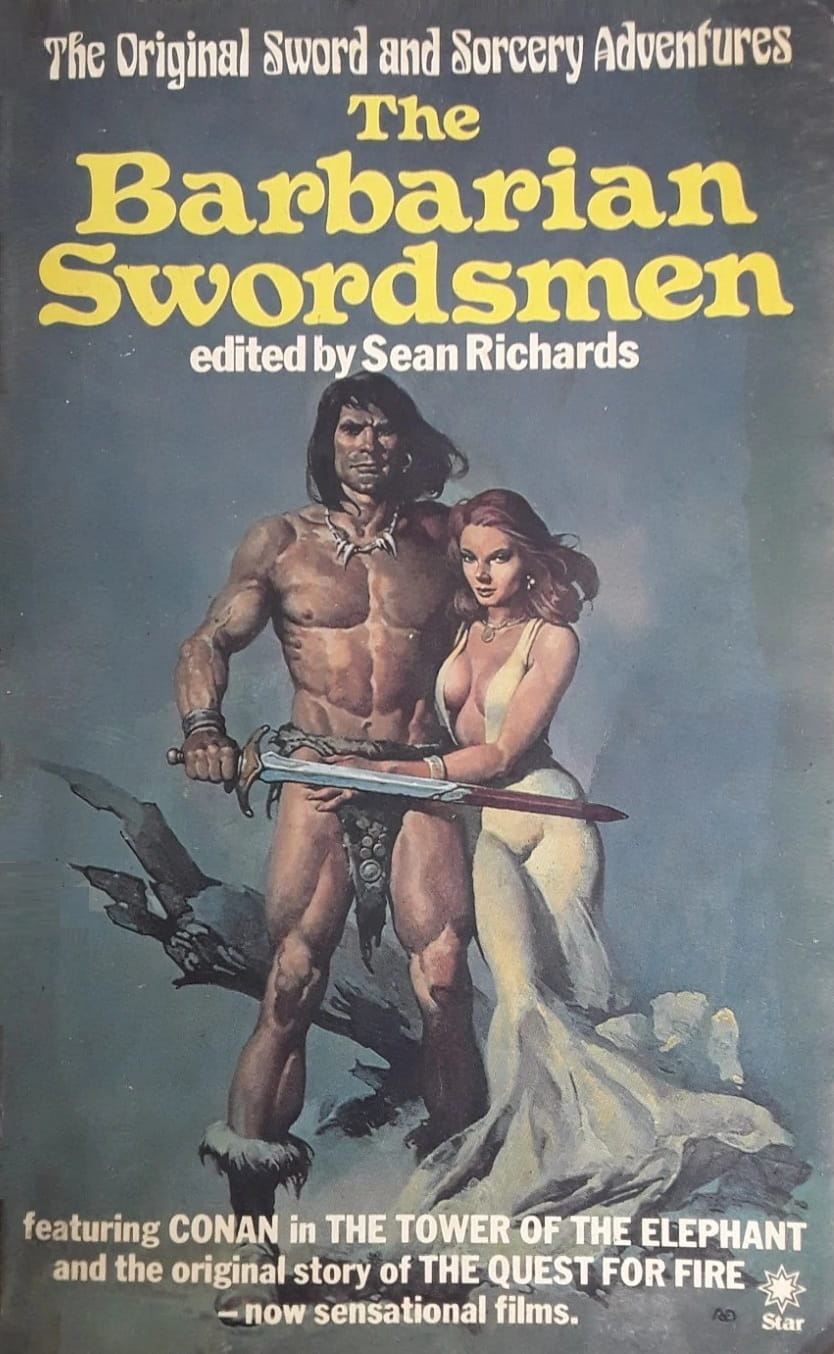
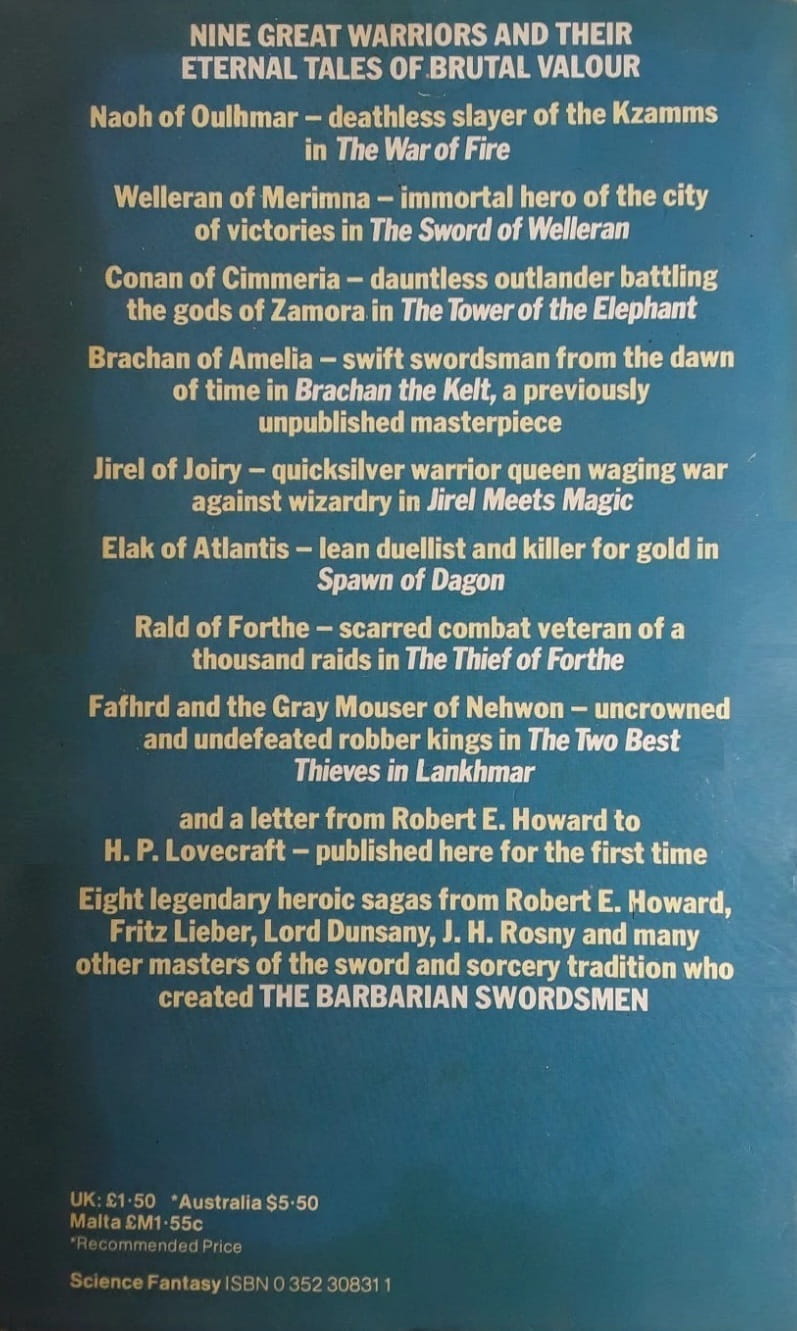
The Barbarian Swordsmen (Star, 1981). Cover by Gino D’Achille
The Barbarian Swordsmen, edited by Sean Richards, Star publishers, a British press, 1981, cool cover by Gino D’Achille. A collection of Sword & Sorcery (S&S) tales that likely wouldn’t exist except for Robert E. Howard.
I couldn’t find out much about Mr. Richards but Toby Hooper revealed to me that Richards has been reported as a pseudonym for Peter Haining and that appears to be true. His intro here doesn’t reveal anything.
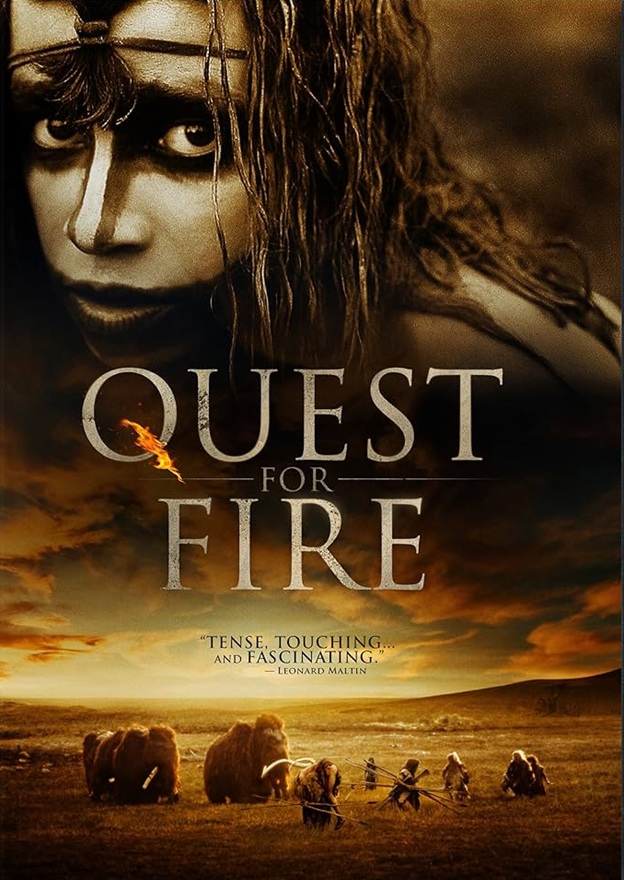 Quest for Fire (20th Century-Fox, December 16, 1981)
The stories are:
“The War of Fire,” by J. H. Rosny. An exciting excerpt from The Quest for Fire, which was also made into a fine movie. J. H. Rosny was a pseudonym, often used by two brothers, Joseph Henri Boex, and Justin Boex. From what I understand, though, Quest for Fire was written solely by Joseph, the elder. The movie does a good job distilling the book but the writing is still enjoyable. We have a primitive cave man named Naoh, what we’d call a Cro-magnon, whose tribe loses its fire. Since they can’t make fire, only maintain it, they have to seek out fire from another tribe, and Naoh and his companions have many adventures doing so, including a battle with Neanderthals. That’s the piece featured in this book.
“The Sword of Welleran,” by Lord Dunsany. Lord Dunsany, an Irishman, is well known to fans of S&S. His fantasy work certainly skated the edge of that genre and he helped develop some of the tropes that later became important. He is said to have influenced Tolkien. His work is rather slowly paced and turgid for modern readers but I find it enjoyable. “The Sword of Welleran” is one of his most approachable tales.
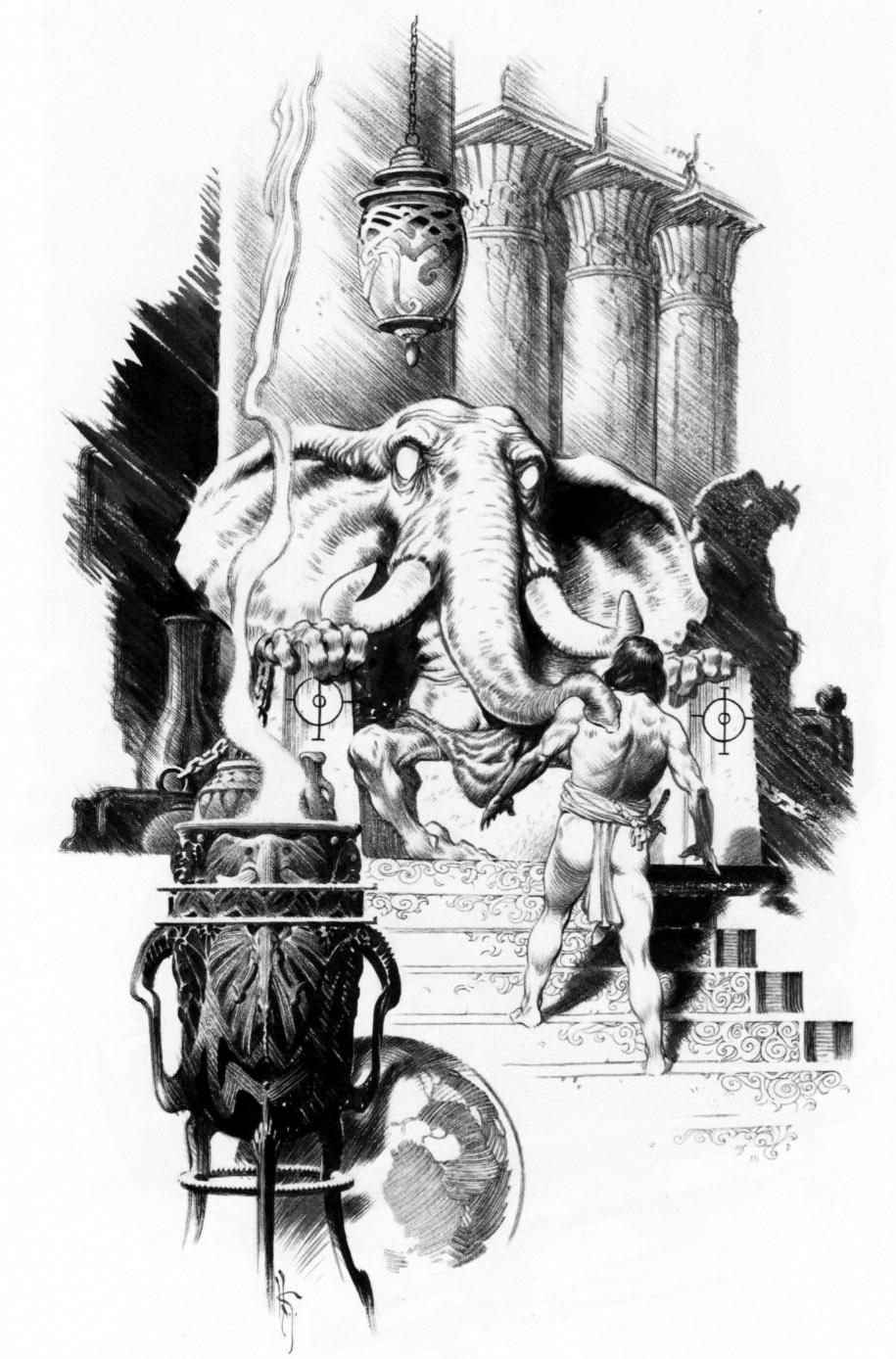 Art for “The Tower of The Elephant” by Mark Schultz
“The Tower of the Elephant,” by Robert E. Howard. I consider this the strangest of the Conan stories. It certainly breaks ranks with most of the other Cimmerian tales in that there’s a strong SF element. I was much taken with it when I first read it, years ago.
“Brachan the Kelt,” by Robert E. Howard. Howard wrote a number of stories involving reincarnation, and several featured the character James Allison, a modern man capable of remembering his past lives. This is a short piece and definitely not fully developed, but it shows the power of Howard’s prose. Allison recalls being a wandering warrior from a time before history was recorded, when the first white-skinned tribes were entering Europe. As Brachan, he must defeat a beast that makes one think of the yeti.
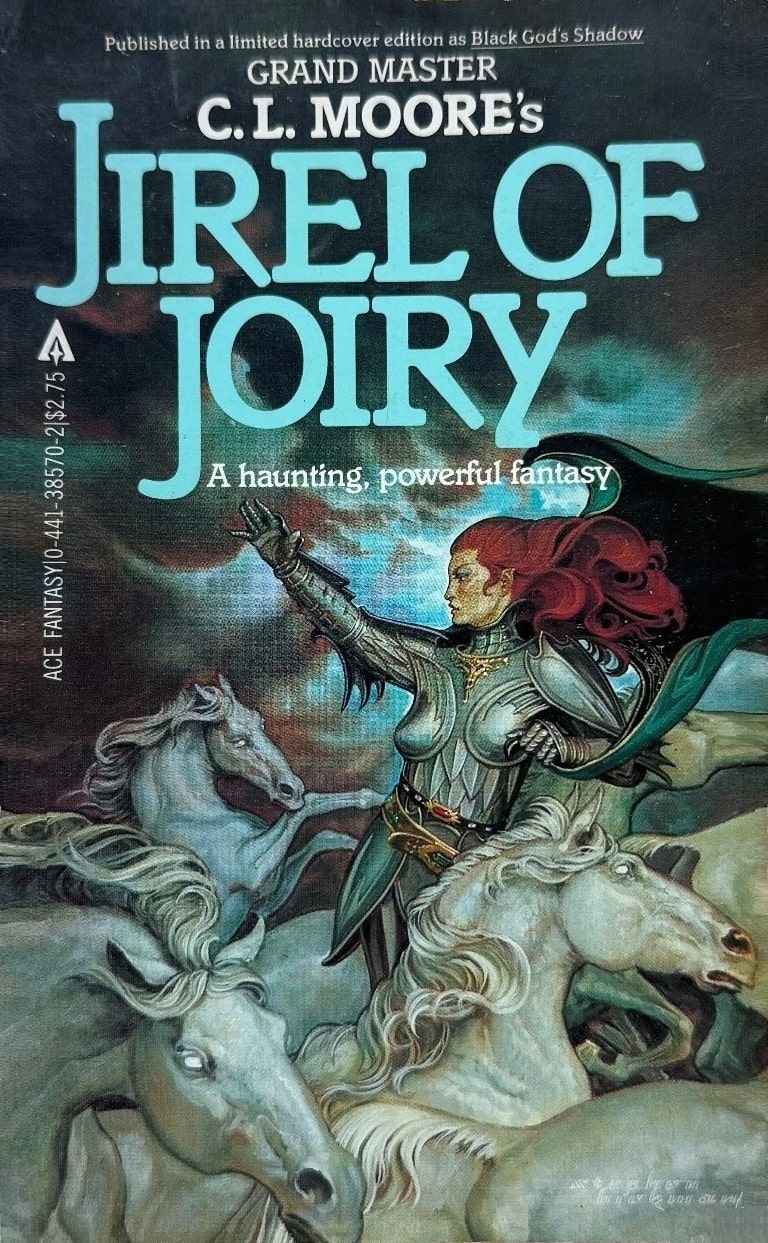 Jirel of Joiry (Ace Books, November 1982). Cover by Stephen Hickman
“Jirel Meets Magic,” by C. L. Moore. Catherine Moore was just a superb writer and her stories of Jirel of Joiry are outstanding S&S tales. Beautifully written and emotionally charged. Jirel is one of the very first fire-tressed female warriors of fantasy fiction. This is not my favorite of the Jirel stories but it’s close. Moore was influenced by Howard, though most of the influence was in subject matter rather than story effects.
“Spawn of Dagon,” by Henry Kuttner. Kuttner married C. L. Moore and after that they mostly wrote as a team. I think Moore was the better writer but Kuttner was more prolific and very professional. Kuttner alone wrote a series of tales about Elak, a prince of Atlantis, and this is one of the best of those. Elak was certainly influenced by Conan but is his own character.
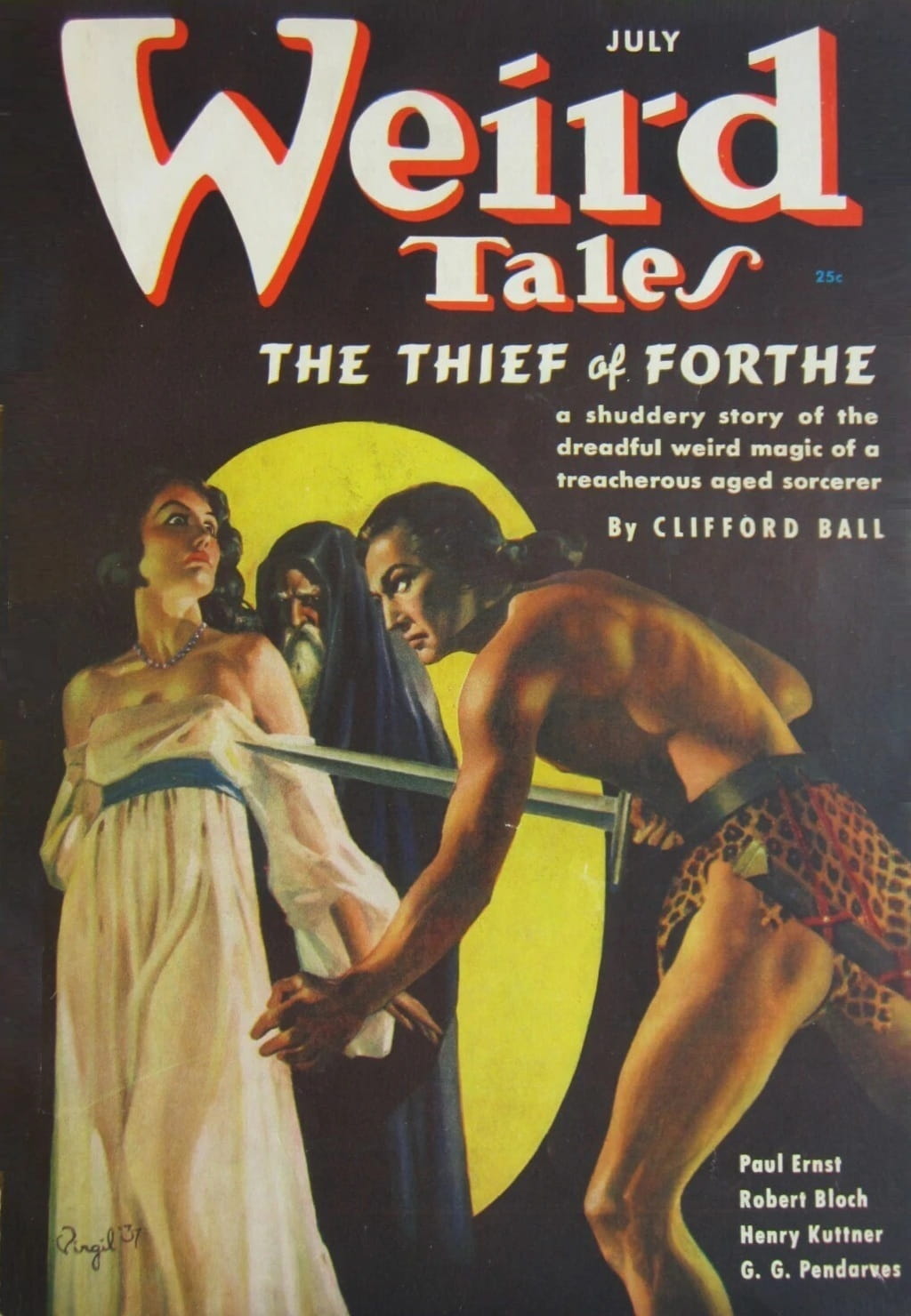 Weird Tales, July 1937, featuring cover story “The Thief of Forthe” by Clifford Ball. Cover by Virgil Finlay
“The Thief of Forthe,” by Clifford Ball. Ball was another writer strongly influenced by REH, which is clearly seen in this tale. It was still well written and enjoyable. Apparently, Ball created an earlier character who was essentially a pastiche Conan, but “Rald,” the “Thief of Forthe” shows some originality. I haven’t read much of Ball’s work but will seek out more.
“The Two Best Thieves in Lankhmar” by Fritz Leiber. Leiber is another writer who was influenced by Howard as to subject matter, but who in no way appears to be an REH clone. His characters and settings are unique and there is a lot more humor in Leiber’s tales than in the Conan stories. Leiber’s characters are Fafhrd, a giant of a man, a barbarian warrior, and the Gray Mouser, a dark and slender thief. They are unlikely friends but friends they are. All these stories are enjoyable.
Appendix is: The Man Who Influenced Robert E. Howard. This is an excerpt from a letter written from Robert Howard to H. P. Lovecraft in which Howard indicates his admiration for the poetry of Alfred Noyes.
Charles Gramlich administers The Swords & Planet League group on Facebook, where this post first appeared. His last article for us was a look at The Mighty Sword & Sorcery Anthologies of Hans Stefan Santesson. See all of his recent posts for Black Gate here.
Categories: Fantasy Books
Robert E. Howard Days, 2026, and The Emerging Writers Workshop
 The House!
After what seems like strange aeons of dreaming about it, Mark Finn, Jason Waltz, and I (Adrian Simmons) have pulled the trigger on running an in-person Sword & Sorcery writing workshop. Added bonus, we’re holding it in the heart of S&S history, Cross Plains Texas, Robert E. Howard’s home during his days of creating characters like Conan, Soloman Kane, Brikenridge Elkins, El Borak, among others.
Our workshop will take place during the fortieth anniversary of the first Robert E. Howard Days gathering, and not only will help writers level up their skills, but serve as a fundraiser for necessary repairs to the Howard House.
The 2026 Emerging Writers Workshop is a one-day event designed to help provide advice, answers, and encouragement to new and upcoming writers of Howard’s genres — from historical fiction to weird Westerns to sword and sorcery. We won’t be doing poetry this year, but this is the first of what we hope to be a regular component of Howard Days, and perhaps we’ll be able to include verse in later years.
 Robert Howard’s room, and desk, where the magic happened!
This will be an in-person affair, happening Thursday, June 11th, the day before Howard Days officially kicks off. The plan is to have some short lectures, a bit of Q& A about S&S, but lion’s share of the time time will be spent in critiquing submissions by breaking into smaller groups for in-depth discussions.
We realize that there are plenty of writing workshops, but the reality is that S&S and its related sub-genres are often the odd-swordsman/woman-out. Sometimes it is waaaay out.
While the number of S&S and adventure fiction venues has grown massivlely in the last decade, they are in the business of publishing stories, not helping writers get better at their craft. The cold reality is that you already have to be a good writer to get any feedback (and even then, given time constraints…), otherwise you get a form rejection letter. Without that editorial feedback, you’re mostly groping in the dark.
That’s the strongest parts of the Emerging Writers Workshop, you aren’t going to get ‘writers group’ feedback, you’re going to be buffeted by the cold winds of Valhalla from three editors looking at your work with their editor-eyes.
 The Cottonwood Cafe, where our magic will happen!
And who are we to pass judgement upon your writing? Behold!
 Mark — representing with the ‘stash and beard
Mark is an author, an editor, and a pop culture critic. His writing can be found in various books, anthologies, comics, and elsewhere. When he’s not waxing passionate about popular culture or Robert E. Howard, Finn writes stories, publishes RPG zines, and sporadically appears on various podcasts.
 Jason, with the classic goatee
Jason M. Waltz – Long-time reader, writer, publisher, facilitator and promoter of the heroic. THE MAIN ROGUE of Rogue Blades Entertainment (published popular heroic anthologies such as Return of the Sword and Neither Beg Nor Yield) & Rogue Blades Foundation (published award-winning REH titles Hither Came Conan and Robert E. Howard Changed My Life). Host of author interviews @ ’24 in 42.’ Connect via https://linktr.ee/jasonmwaltz
 Adrian, sportin’ the chin scruff
And me? I’m a founding member and primary editor of Heroic Fantasy Quarterly ezine (heroicfantasyquarterly.com), have produced 67 issues and four best of anthologies. I’ve had fiction published at Tales from the Magician’s Skull, Savage Realms, and Swords and Larceny. Some of you here may remember me from my various reviews and musings here at Black Gate.
We’re already about 1/3 of the way to our membership cap (although there has been some talk of an online option, but those dragons have yet to hatch).
The cost is $50, and the deadline to get your work in is Sunday, May 10th.
We discussed the workshop in some detail during a livestream of the Robert E. Howard Foundation. We talk about the workshop starting at the 6:30 mark. Check it out to get a feel for the vibe.
Full details can be found here.
Categories: Fantasy Books
Forgotten Authors: Austin Hall
 Austin Hall
Austin Hall was born on July 27, 1880.
While working as a cowboy, Hall was asked to write a story. This led to his career as an author, writing westerns, science fiction and fantasy stories, with westerns forming the majority of his published work. A one time, Hall may have worked as a sports editor for a newspaper in San Francisco.
Following the death of Hall’s father, his mother remarried and the family appears to have moved to Ohio, in an interview published by Forrest J Ackerman in 1933, Hall claims to have attended college in Ohio and California, but no details of his academic life can be confirmed. By the time he was thirty, Hall (as well as his mother and step-father) were living back in California and Hall had married Clara Mae Stowe and they had two children, Javen and Bessie.
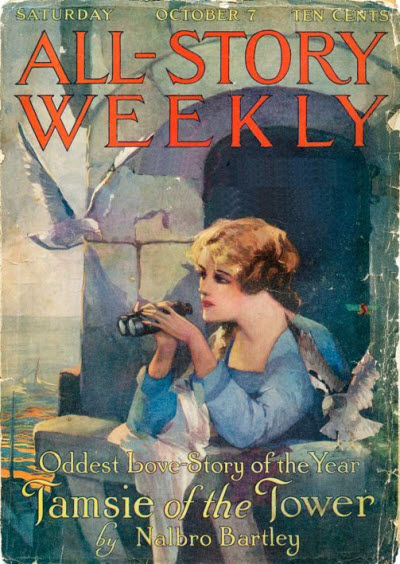 All-Story Weekly, 10/7/1916
His first science fiction story was “Almost Immortal,” which appeared in the October 7, 1916 issue of All-Story Weekly.
His 1919 story “The Man Who Saved the Earth” was reprinted in the first issue of Amazing Stories. Everett Bleiler describes this story as Hall’s second worst, which given Damon Knight’s opinion of Bleiler’s writing says quite a bit.
He collaborated with Homer Eon Flint on the novel The Blind Spot, which Damon Knight described in In Search of Wonder as “an acknowledged classic of fantasy…much praised…several times reprinted, venerated by connoisseurs—all despite the fact that the book has no recognizable vestige of merit. Knight enumerates his problems, not just with the novel, but with Hall’s writing, stating that hall is bereft of, among other things, style, grammar, vocabulary, observation, scientific knowledge, or ability to plot. Knight’s criticism of Hall is almost enough to make someone want to pick up one of his works to see how it could be as bad as Knight describes it.
Bleiler does not believe the story was an actual collaboration. Although Ackerman claims Hall pitched the idea to Flint and the two planned out how to work on it, Bleiler believes that Hall couldn’t come up with the middle of the novel and had Flint take over to get him over the hump.
Eventually, in 1932, eight years after Flint’s death, Hall would published a sequel to The Blind Spot, the serial The Spot of Life, in Argosy. Hall’s other science fiction, “The Rebel Soul” and “Into the Infinite” focus on the life and adventures of George Witherspoon. His The People of the Comet has Alvar, the king of the Sansars, describe his journey to a comet, which had a hollow interior in which they could live.
Although the majority of Hall’s writing appears to have been westerns, they appear to be harder to identify, although he wrote Where the West Begins and stories that appeared in Western Story Magazine.
He died on July 29, 1933 and is buried in Madronia Cemetery in Saratoga, California.
 Steven H Silver is a twenty-one-time Hugo Award nominee and was the publisher of the Hugo-nominated fanzine Argentus as well as the editor and publisher of ISFiC Press for eight years. He has also edited books for DAW, NESFA Press, and ZNB. His most recent anthology is Alternate Peace and his novel After Hastings was published in 2020. Steven has chaired the first Midwest Construction, Windycon three times, and the SFWA Nebula Conference numerous times. He was programming chair for Chicon 2000 and Vice Chair of Chicon 7.
Categories: Fantasy Books
La Belle Dame sans Merci: Tam Lin by Pamela Dean
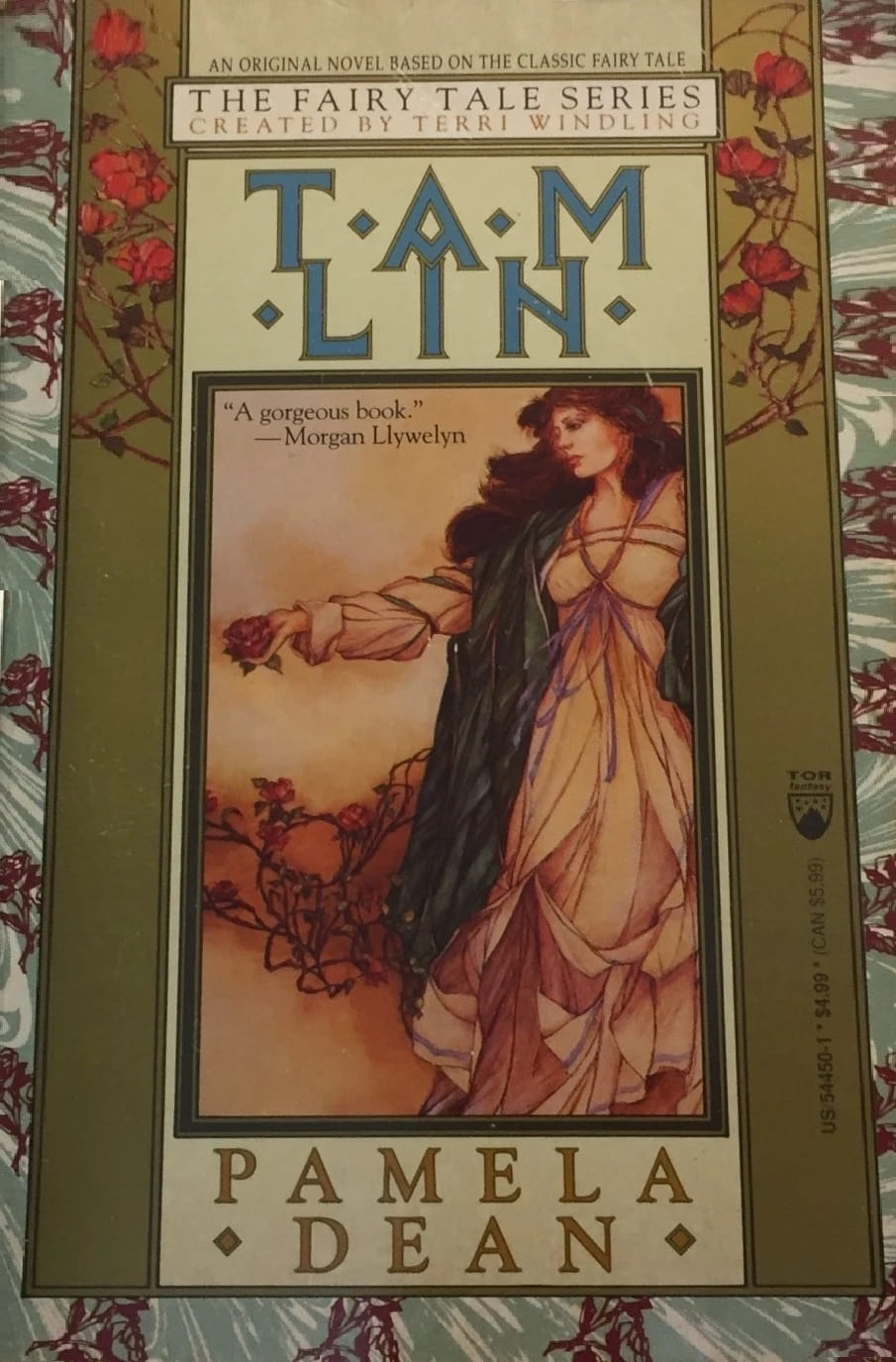
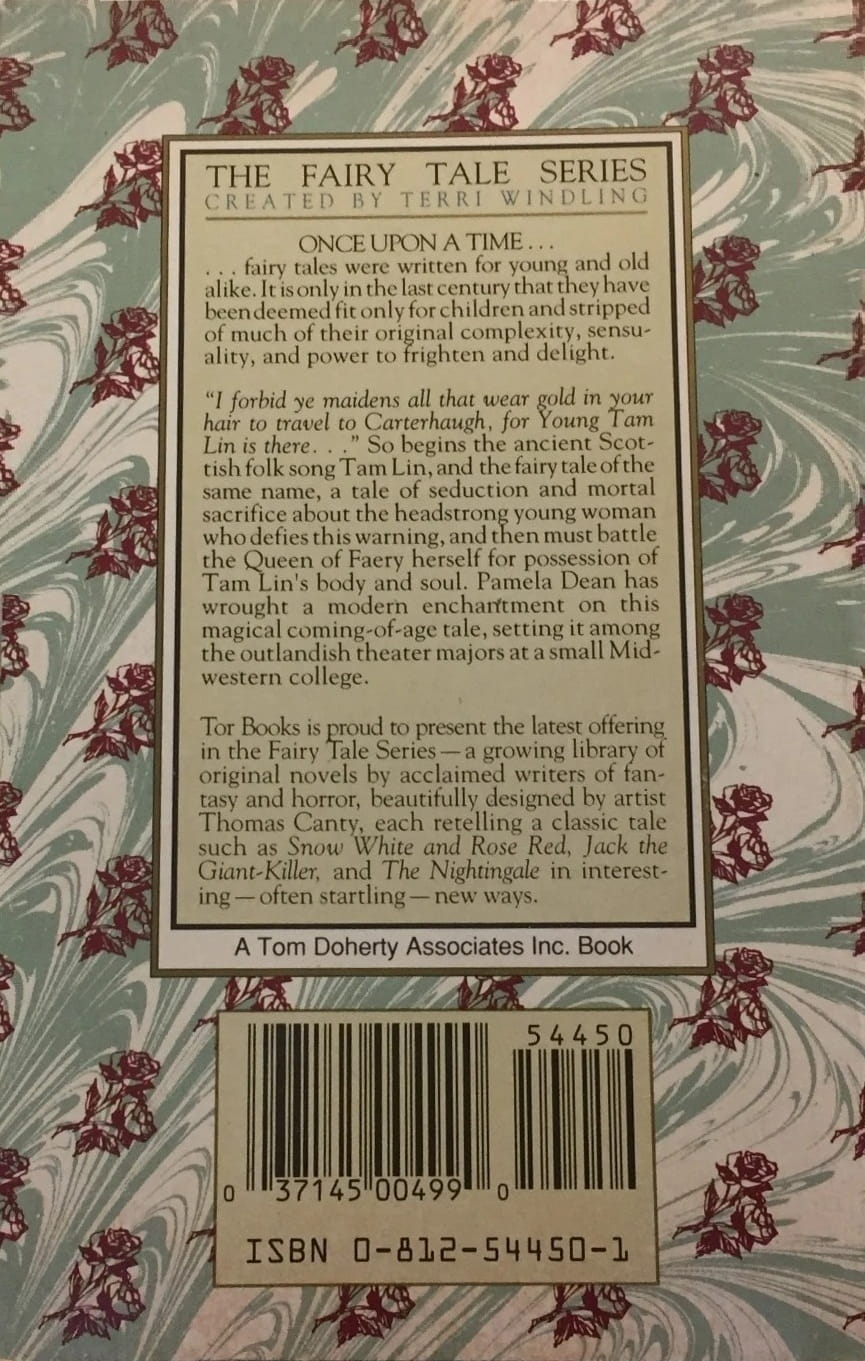
Tam Lin (Tor Books paperback reprint edition, April 1992). Cover by Thomas Canty
There’s been a lot of genre fiction set at schools. Hogwarts is an obvious example, but such settings were around long before Harry Potter; Heinlein’s Space Cadet, The Uncanny X-Men, and Le Guin’s A Wizard of Earthsea were all there first. Tam Lin is another early example, published six years before Harry Potter and the Philosopher’s Stone made scholastic fantasy a best-selling subgenre.
But it has an important difference: Its setting, the fictional Blackstock College, doesn’t teach magic, or superheroic combat, or spaceflight, or anything else fantastic. It’s a fairly typical small liberal arts college (based on the real college where Pamela Dean did her undergraduate work) where the supernatural elements are hidden beneath the surface.
 Carleton College, the real world model for Blackstock College
At the time when it was written, Tor Books was publishing novels that retold fairy tales at greater length, and with a style aimed at adult readers. Dean’s source wasn’t a fairy tale, strictly speaking, but a ballad, “Tam Lin,” though one where the fair folk are a visible presence — like “True Thomas” or Keats’s “La Belle Dame sans Merci.” Its theme is the mortal man who meets a fairy woman and is the worse for it, and that’s the undercurrent of Dean’s novel, and the problem her protagonist, Janet Carter, has to solve.
Much of the story is the non-fantasy details of Janet’s life. Dean lists every course she takes until the first quarter of her senior year — including a dozen in English, seven in Greek, and a variety of general education, from fencing to “physics for poets.”
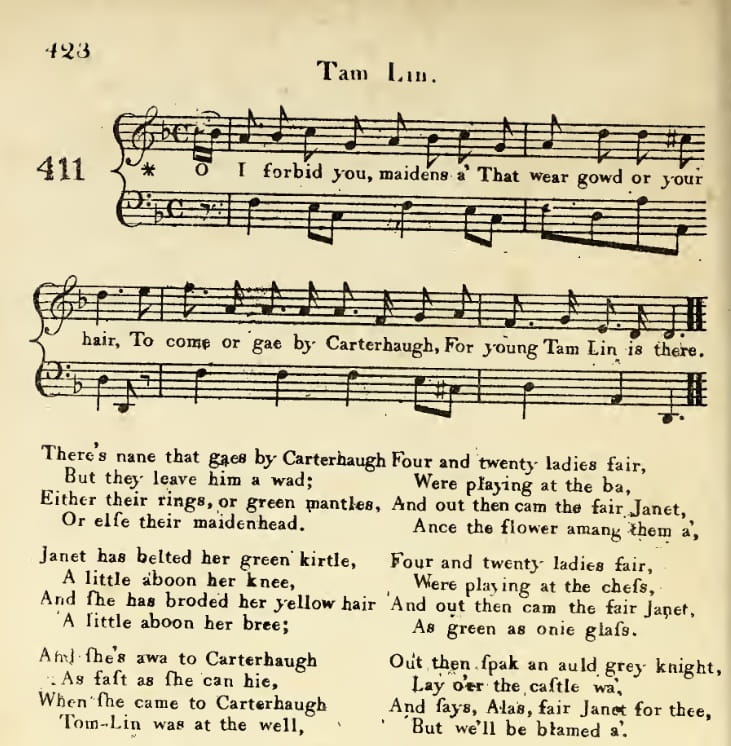 The opening verses of the ballad Tam Lin
We meet Janet’s roommates, Molly and Tina, whom she has difficulty with at first (especially with Tina) but stays with for all four years. We meet the young men they get involved with and learn of their experiences with sex and contraception — and of their breakups. We also meet Janet’s family, including her father, a member of the English faculty at Blackstock.
“I said I liked folk music, and Molly said she went to rock concerts, and Christina said she liked Bach, so they said, oh, look, three people who listen to music, and stuck us in the same room.”
So far as this part of the story goes, Tam Lin is a classic Bildungsroman (coming-of-age novel). But the social and psychological story is interwoven with an increasing awareness of magical aspects. On one hand, the campus has a ghost, a young woman who took an overdose of opiates in 1897 because she was pregnant, and who now throws specific books out of windows, including a Greek textbook. On the other, the classics department is a nexus of strangeness. All three of the women’s lovers are caught up in this, and Janet’s advisor, a classics professor, makes a serious effort to persuade her to major in classics as well.
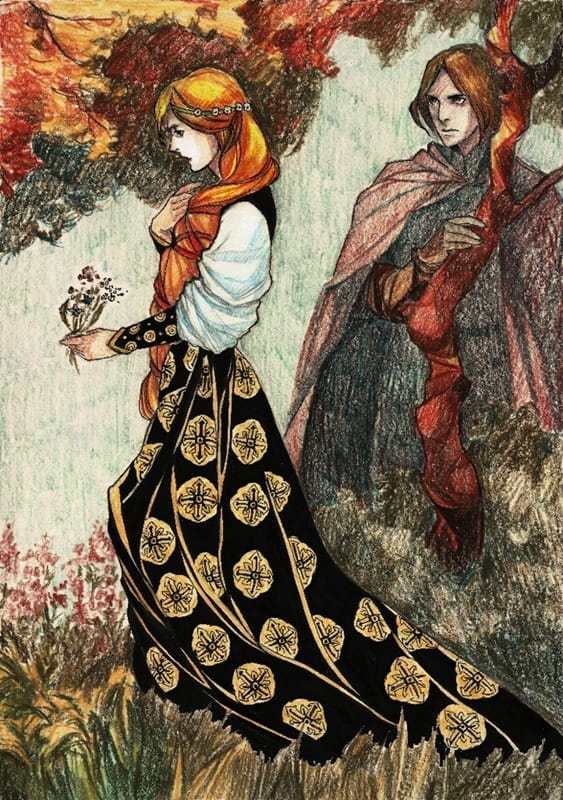
The other nuance of this is that the supernatural threads are interwoven with Janet’s literary tastes and interests, which we learn about in detail. One of the book’s major revelations, for example, comes from Janet reading a complete Shakespeare. An earlier scene has Janet reciting “La Belle Dame sans Merci”:
I saw pale kings and princes too,
Pale warriors, death-pale were they all;
They cried, “La belle dame sans merci
Thee hath in thrall!”
Earlier on, we see a discussion of which translation of Homer is best inspiring one of the young men to quote Keats’s sonnet “On First Looking into Chapman’s Homer.”
Quotations from the English classics are all through the dialogue — which seems plausible, as the fair folk are reputed to have a special affinity for poets and poetry. Janet herself writes a sonnet at one point, though one whose last line has all too plausibly flawed scansion.
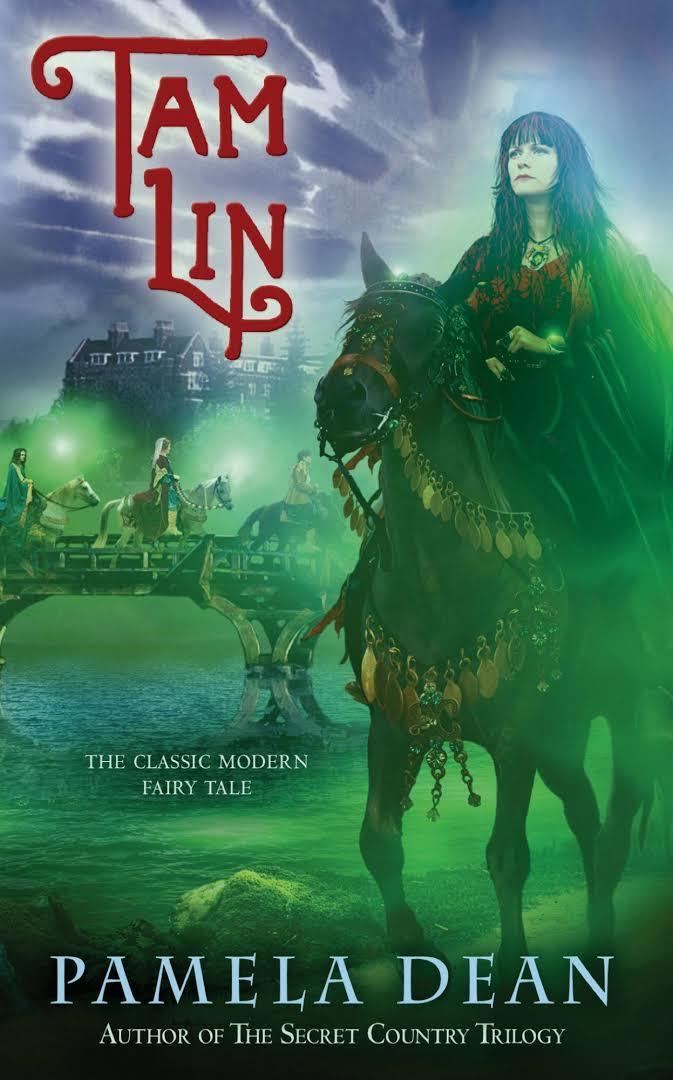 Tam Lin (Firebird, August 2006). Cover by Steve Stone
Women’s sexuality, pregnancy, and contraception are recurring issues, as of course they were in the real world in the 1970s. This fits its source material, where pregnancy is also an issue; but it seems that choosing to modernize that particular story gave Dean a way to comment on those issues, and to make them the crisis that leads to the novel’s climactic conflict.
Tam Lin seems oddly paced. Roughly the first half of the book portrays Janet’s, Molly’s, and Tina’s first term at Blackstock, almost day by day. The second half rushes through three full years, ending on Hallowe’en (naturally). This isn’t quite like some novels I’ve read that seemed to progress evenly until the penultimate chapter, and then rush ahead to tie off the plot; Dean does work things out step by step. But I’m not sure that first term needed to be shown in quite so much detail.
On the other hand, most of the details are, to my possibly peculiar tastes, fascinating. If you like English poetry, and the academic milieu, this novel may entertain you as much as it did me.
William H. Stoddard is a professional copy editor specializing in scholarly and scientific publications. As a secondary career, he has written more than two dozen books for Steve Jackson Games, starting in 2000 with GURPS Steampunk. He lives in Lawrence, Kansas with his wife, their cat (a ginger tabby), and a hundred shelf feet of books, including large amounts of science fiction, fantasy, and graphic novels.
Categories: Fantasy Books
The Mighty Sword & Sorcery Anthologies of Hans Stefan Santesson
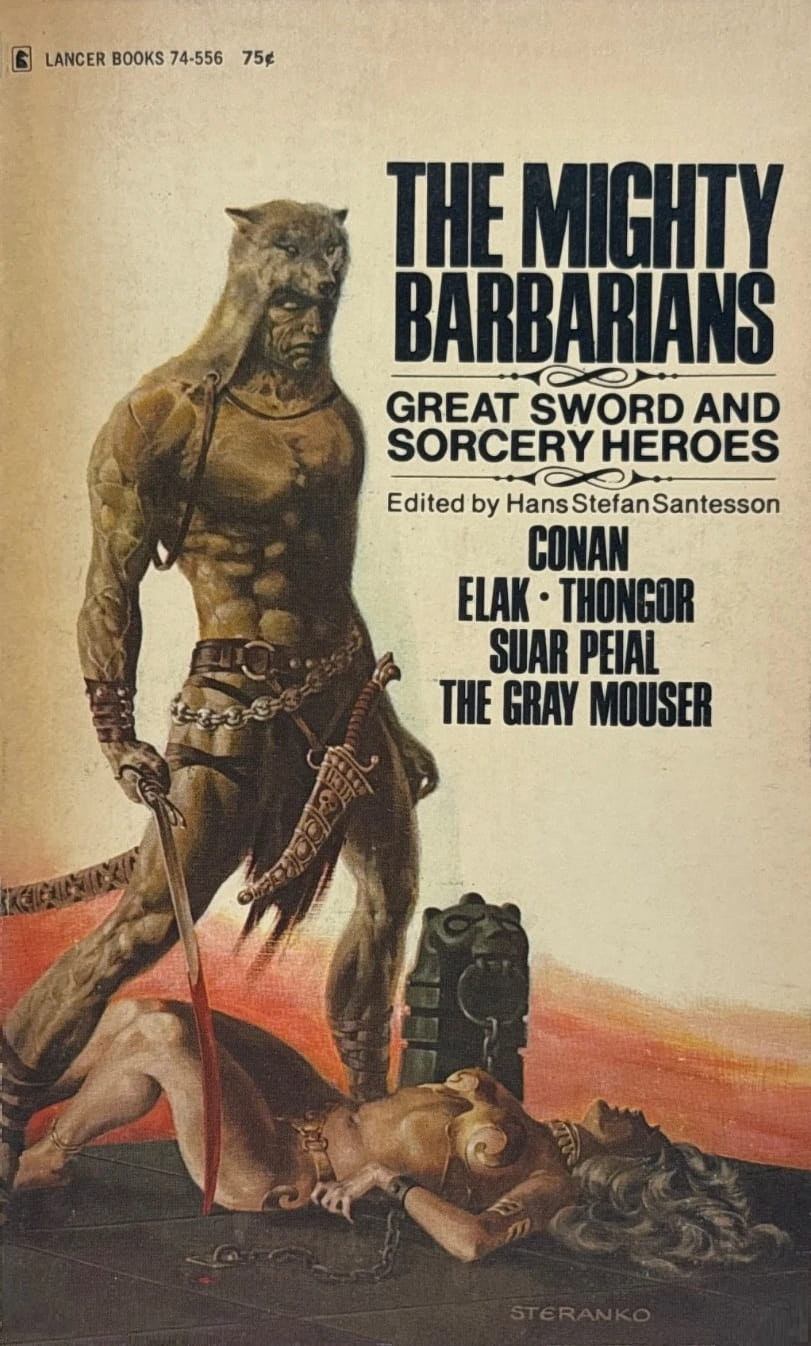
The Mighty Barbarians: Great Sword and Sorcery Heroes, edited by
Hans Stefan Santesson (Lancer Books, 1969). Cover by Jim Steranko
Hans Stefan Santesson (1914 – 1975) was born in France and lived in Sweden with his parents until 1923 when his mother immigrated to the US. She was a commercial artist and he soon became an editor for various mystery publications.
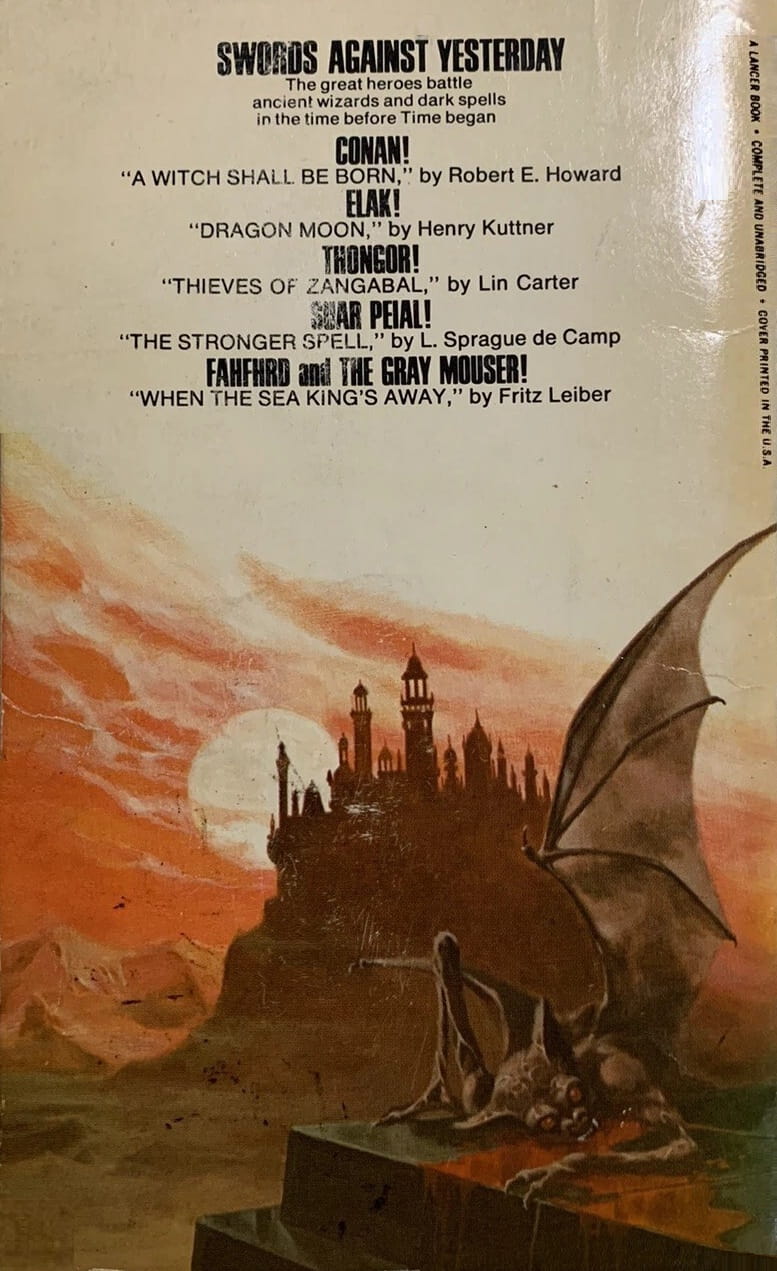
I likely would never have heard of him if not for two books of Sword & Sorcery he edited for Lancer Books. These were The Mighty Barbarians (1969) and The Mighty Swordsmen (1970), both with evocative covers by Jim Steranko.
[Click the images for mighty versions.]
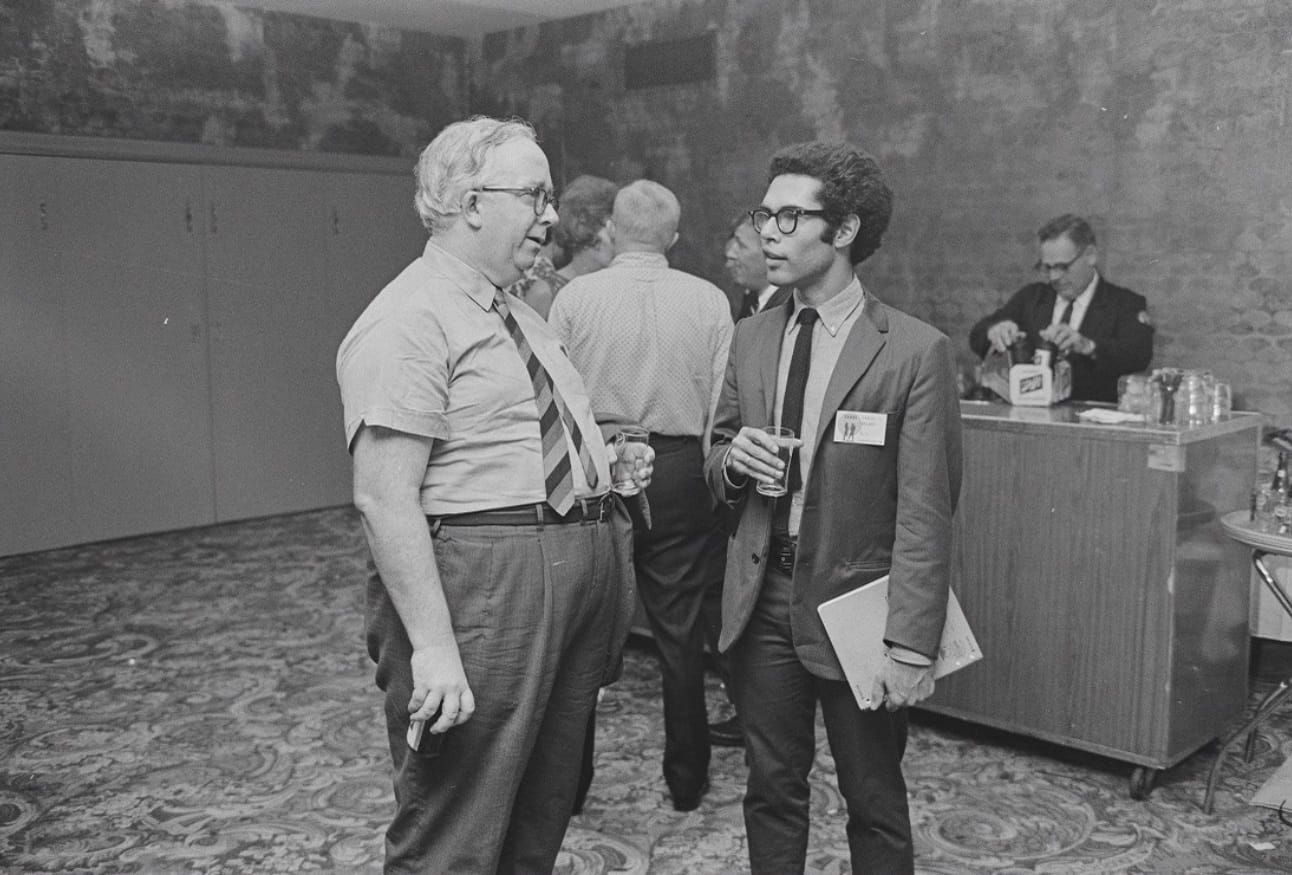 Hans Stefan Santesson and Samuel Delany in Cleveland, 1966. Photo by Jay Kay Klein
1. The Mighty Barbarians contains an Introduction by Santesson, and then the following stories.
“When the Sea-King’s Away by Fritz Leiber (Fafhrd/Gray Mouser)
“The Stronger Spell” by L. Sprague de Camp
“Dragon Moon by Henry Kuttner (Elak of Atlantis)
“Thieves of Zangabal” by Lin Carter (Thongor)
“A Witch Shall be Born” by Robert E. Howard (Conan)
The intro shows that Santesson was familiar with the history of heroic fantasy. He cites some of Carter’s nonfiction so he may have gotten it from there. All the stories are good and generally full of action.
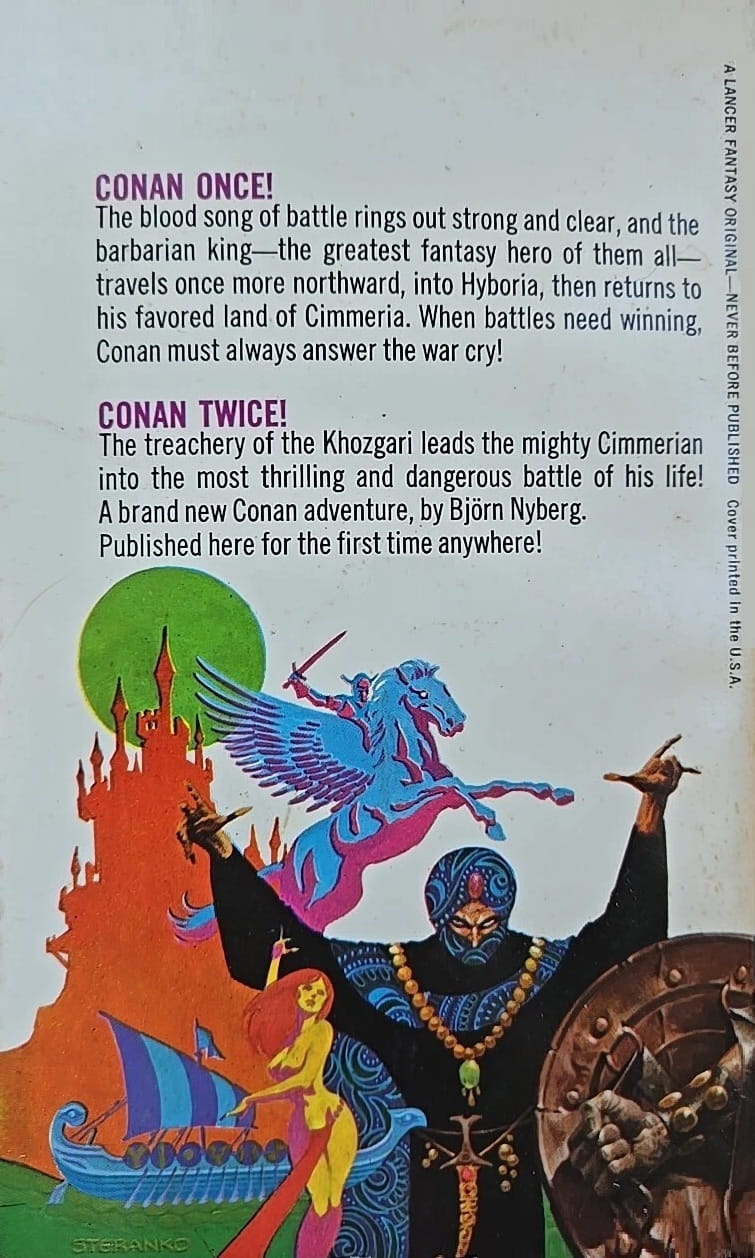
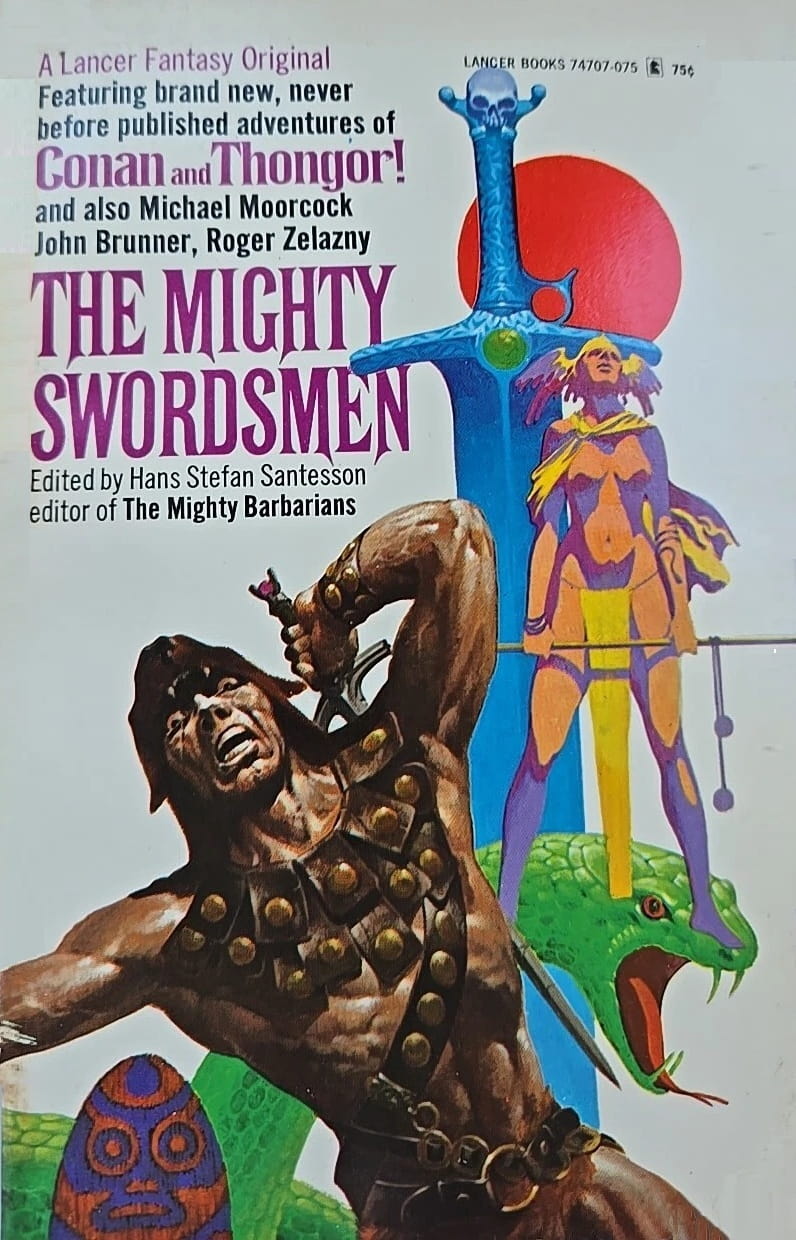
The Mighty Swordsmen, edited by Hans Stefan Santesson (Lancer Books, December 1970). Cover by Jim Steranko
2. The Mighty Swordsmen contains a shorter intro by Santesson and ends with “Beyond the Black River” by REH, one of the best Conan stories. It also contains tales by Moorcock, Brunner, Zelazny and a Conan pastiche by Bjorn Nyberg called “The People of the Summit,” which suffers by comparison with “Beyond the Black River.”
The Moorcock tale is “The Flame Bringers” (Elric). It’s quite good. Zelazny’s story is one of his Dilvish the Damned pieces, “The Bells of Shoredan.” Lin Carter’s “The Keeper of the Emerald Flame” is one of the best of his Thongor stories. Brunner’s story has the best title, “Break the Doors of Hell,” but doesn’t quite seem to fit with the others. It’s one of his Traveler in Black pieces.
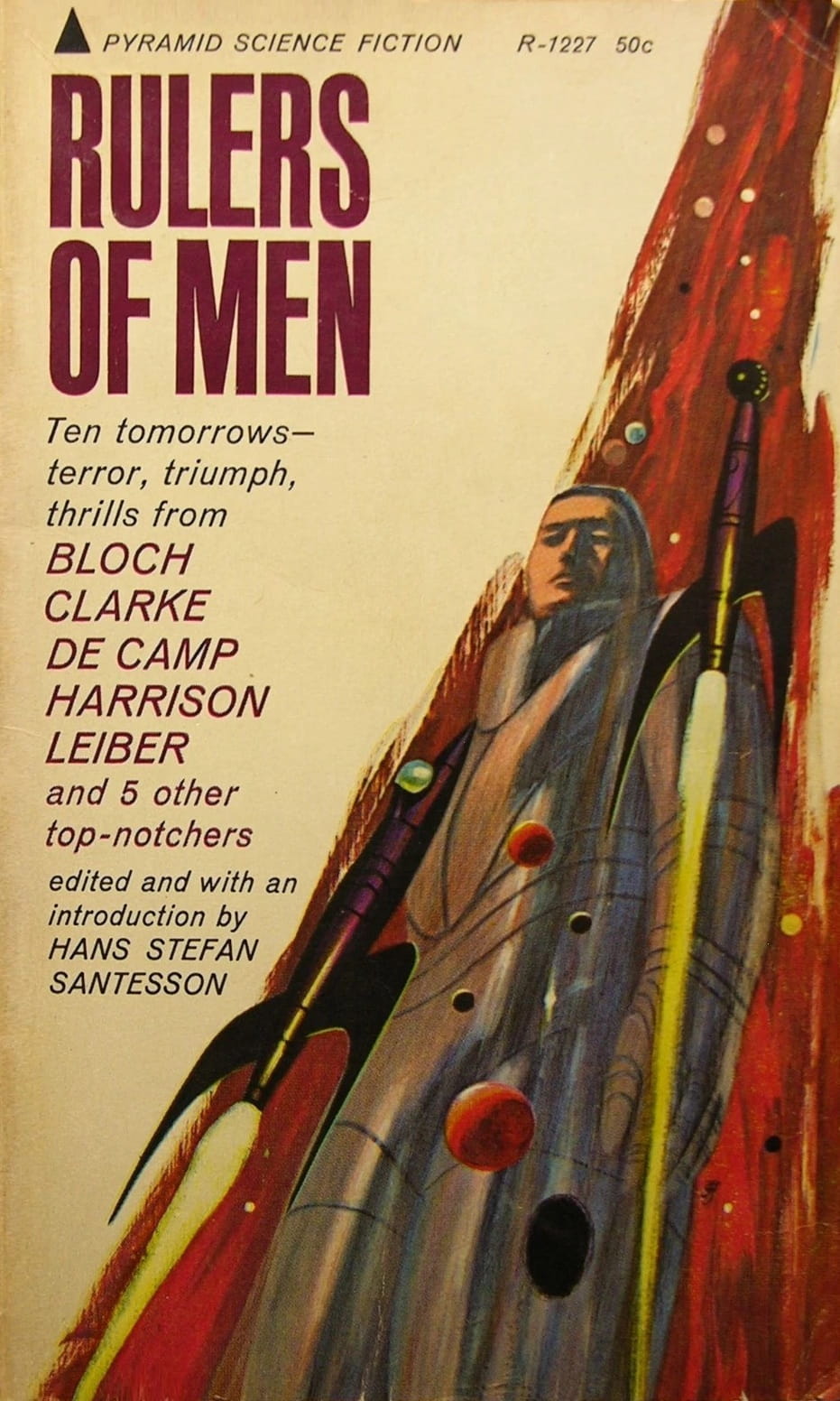
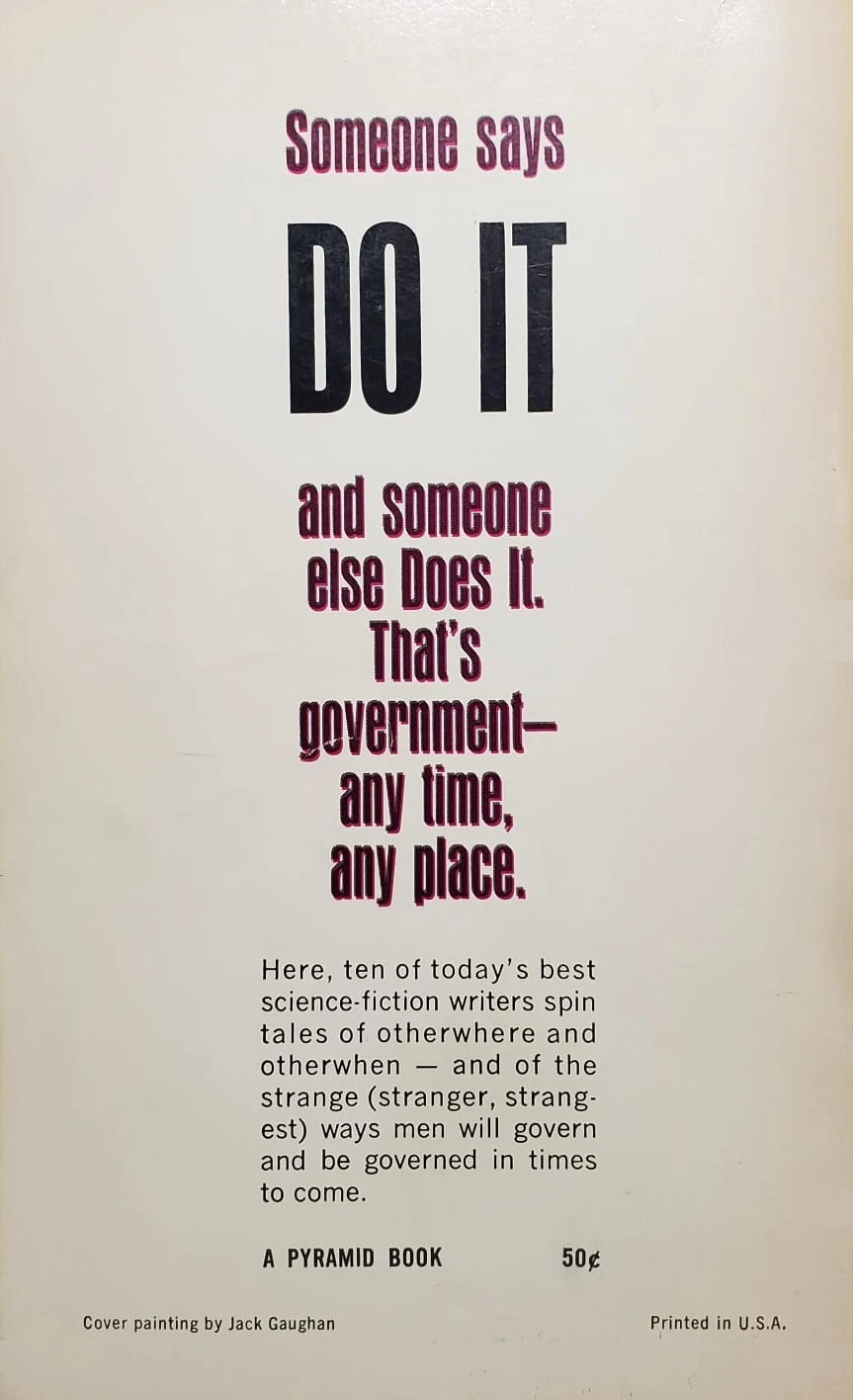
Rulers of Men, edited by Hans Stefan Santesson (Pyramid Books, 1965). Cover by Jack Gaughan
Santesson edited plenty of other works and even wrote a few stories himself under pseudonyms, none of which I’ve heard of. I did discover another edited collection by him that I’m going to try to get. You can see the cover above, by Jack Gaughan. Some star names there.
Charles Gramlich administers The Swords & Planet League group on Facebook, where this post first appeared. His last article for us was a review of the 1970 anthology Dark of the Soul, edited by Don Ward. See all of his recent posts for Black Gate here.
Categories: Fantasy Books
Is This Still a Thought?

Goodafterevenmorn, Readers!
I had an interaction online that took me aback a little bit, and I really need to talk about it. I realise that I’m largely preaching to the choir here, but I am feeling a little like I need a sympathetic ear, so apologies. But I must give some context, so here we go:
As part of my effort to make of my writing a viable source of income, I have joined a number of new social media sites that are, by and large, similar to but a much better experience than Facebook. I’m not going to tell you which one of these this happened in, largely because I’m not sure that some greater drama might result. I doubt anyone here is foolish enough to start a dogpile, but I’d much rather err on the side of caution.
On one of these sites, I posted a brief review of a book I had recently read — The Shadow of the Gods by John Gwynne. For those who have not yet read this, it is the first book in a trilogy, and it is heavily based on dark age Scandinavian life and myth (what we’d consider ‘Viking’ in its most populist understanding). It is dark, and gritty, and really interesting. It really enjoyed this read (it didn’t make me cry, though, so I knocked off a few points in the review). Here is what I wrote about the book:
Meant to note that I’d finished reading this last weekend. A gripping read that’s very clearly been well-researched. I really enjoyed it.
And then, rather oddly (to me), I received this reply:
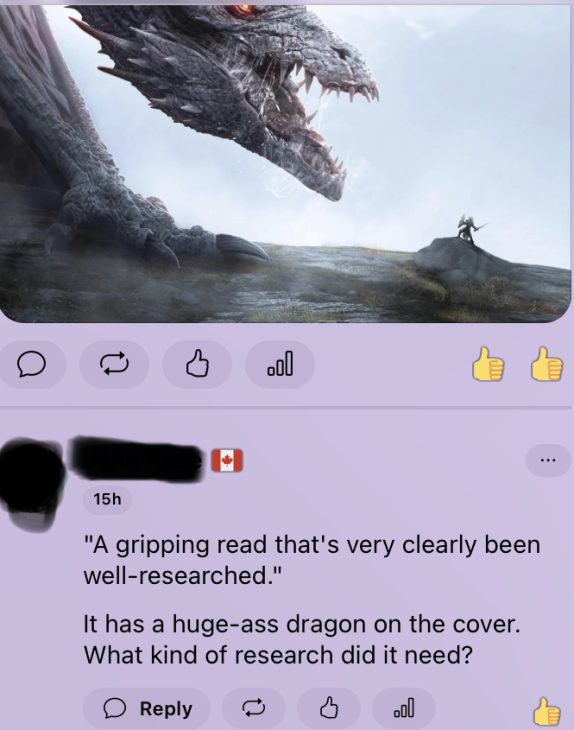
Now, I’ll be the first to admit, it got my hackles up right away. I write genre; mostly fantasy. And I’m usually in amongst people who also write the same, or adjacent, so I forget what opinions are outside of these circles. This slammed it in my face, and I wasn’t prepared. So my reply might have been equally as blunt, and perhaps a little tart as well. Perhaps I struck a nerve, as I received a reply to it, but it had been deleted before I could read what it actually said.
Probably for the best. I have a short fuse sometimes, and find myself in fights more often than I’d like, no matter how futile my brain knows it is. Besides the point. The point is, I had forgotten how some people outside of the genre view fantasy as a genre; primarily that because it is couched in distant allegory and magical worlds, and is a product of wild (also see: brilliant) imaginations, it clearly must not have much actual thought or “real work” (read here: research) behind it.
That is wildly offensive to me.
There are some things that even fantasy worlds and fantastical stories require in order for the reader to engage their suspension of disbelief, things must make sense. Things that are familiar must work more or less the same in the real world (unless its important to the world or plot that they don’t). If someone is fighting near a lava pool, there must be heat. If they are fighting with a spear, a strike with the shaft of the weapon will bludgeon, not cut. These kinds of things.
Are many things made up? Absolutely! Magic? That doesn’t exist in the real world, not at least like it does in fantasy stories (technology is a magic of a sort). Shape changers? Giant flying reptiles (this one did once exist, though. Have you seen arambourgiania, hatzegoteryx or quetzalcoatlus? Holy giant pterosaurs, Batman!)? Talking weapons? Talking animals? Talking plants? These things don’t exist in real life. Fun and completely made-up. But in order for them to work, the rest of the world must be believable. And often times, that requires a whole lot of research.
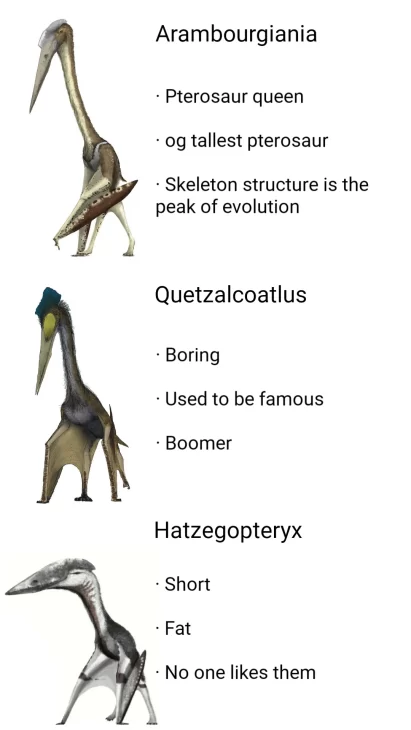 Found this image on reddit.com. It gave me a good giggle.
I will take The Shadow of the Gods as an example here. Set in a world that is analogous to Scandinavia of the (wrongly called) Dark Ages, but one in which myth and magic is real and exists, and the gods are not all that familiar in name or manner as the “Viking” pantheon we’re familiar with. It’s much more primal, with gods taking on bestial forms that are perhaps more familiar to folks who have studied various shamanic traditions.
That in an of itself requires a fair amount of research. As someone who has done that research, the execution of the world mythos was really well done. The tales have enough of a familiar ring to them that they do feel like a real life tradition made “real,” as it were. The hallmarks of many ancient myths are there – the all-being/first being was killed by his own progeny, and from his parts the world was made. We see it or its aspects in many traditions; particular those of Europe. In Viking myth, we see this in Odin and his siblings slaying Ymir, and making the world from the corpse.
It happened very similarly in this iteration, though the names Odin, Ymir and other names we might recognise are not used. This is a little out of my area of expertise (having studied much earlier up until the rise of the Roman Empire), but even those of us with a little passing knowledge would recognise the story, and those of us without would at least recognise the bones of it… pun unintended.
But there’s more to it than just the mythology of the world feeling familiar and plausible as an origin story in the world (that turns out to be probably very true). There’s so much in this book that benefitted from the author doing his research. A short list:
- Life in a world of snow and volcanoes, where night can last several weeks in mid-winter and day several weeks in high summer.
- Life on a raiding vessel; including division of labour, storage of armour and weapons, and beaching, disembarking and the actual act of raiding.
- Art and architecture in a world of frost and fire.
- Life in a settlement.
- Navigation
- Social structures and hierarchies in Late Iron Age/Early Middle Ages northern Europe.
- Fighting styles required of round shields and spears as primary weapons.
- Strategy in which shield and spear are the primary weapons in engagements.
- Anatomy (a femoral artery was cut in one scene that I recall, which anyone who knows anything about anatomy knows that’s as much a death sentence as if it was a carotid (particular in the time period represented)).
All of this and more was obvious in John Gwynne’s writing. It was very clear to me that a great deal of background research and knowledge was poured into this book.
 Image by Gordon Johnson from Pixabay. Also how I imagine the author looked while researching.
And the most oblique suggestion that it wasn’t still really grated on my nerves.
Again, I know I’m preaching to the choir, so this rant is going to change nothing, but still. I am getting quite fed up with people pretending that simply because a piece for writing is fantastical means that there was no research or work done behind the scenes to make it come to life. A good story well told will always have a lot behind it, whether or not magic is part of the tale. And I, for one, really appreciate it when you can tell it’s there. I’m just being a grump, I supposed, but I received that comment nearly two weeks ago, and it’s still bothering me.
So… thanks for listening to my rant. I needed to get that off my chest without starting a genre war. I feel better now.
Anyway, if you haven’t yet, do read The Shadow of the Gods, do. It’s a really great read.
And very well researched.
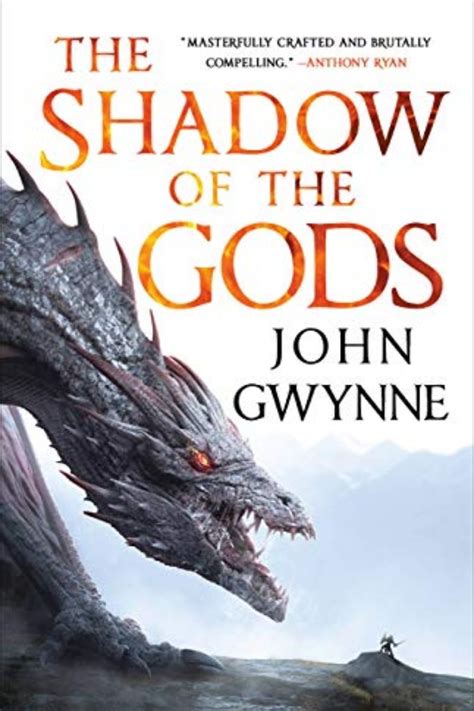
Ciao for now!
When S.M. Carrière isn’t brutally killing your favorite characters, she spends her time teaching martial arts, live streaming video games, and sometimes painting. In other words, she spends her time teaching others to kill, streaming her digital kills, and sometimes relaxing. Her most recent titles include Daughters of Britain, Skylark and Human. The Timbercreek Incident is free to read on Wattpad.
Categories: Fantasy Books
Let’s Go to the Movies: 1996
1996 was 30 years ago. And it was quite the year for movies. Big-screen extravaganzas dominated the box office, and some movies outside the Top 10 still more than resonate today.
On July 3, Independence Day dropped. Man, that was a huge hit. EVERYBODY I knew saw, or was talking, about it. And smooth crooner Harry Connick Jr. became a lot more popular. With a US gross of $306,156,000 ($644,338,000 in today’s dollars) on a budget of $75 million, it was a smash hit.
Big-screen action continued the trend of domination, with Twister ($241,721,000) second, and The Rock ($134,069,000) fourth.
And at number three saw the birth of a mega-franchise that seven hit follow-ups and which only wrapped up last year: Mission Impossible. That first movie was an homage to the original series, and I really liked it. Then John Woo turned it into special effects cotton candy and I never watched another installment.
Eddie Murphy was at the end of his run as a box office super draw, and came it at number five with The Nutty Professor. The rest of the top ten was Ransom (Mel Gibson), The Bird Cage (Robin Williams), A Time To Kill (Matthew McConaughey), 101 Dalmations (a bunch of dogs), and The First Wives Club (Goldie Hawn).
Some Other Notable films
Eraser (11)
Arnold Schwarzenegger was five years removed from Terminator 2: Judgement Day. And two years from the disaster that was Junior. Ugh. But in addition to the sci-fi noir Eraser, he also made one of my favorite Christmas movies, Jingle all the Way (number 25).
Star Trek: First Contact (14)
 I loved the original cast reboot of Star Trek. And then Generations transitioned to a new era. First Contact ensured there would be more Star Trek films, and it had James Cromwell. BTW – if you’ve not seen 1997’s LA Confidential, it’s a superb hardboiled noir flick, and if you have read James Ellroy’s novel, Cromwell was a terrific choice as Dudley Smith.
Jerry Maguire (18)
The box office rankings are by the calendar year receipts. It released on December 13, and its total gross would have ranked it fourth for the year. This was the Romcom of 1996.
Twelve Monkeys (22)
I never got into this movie with Bruce Willis and Madeline Stowe, but it became a sci-fi cult classic. I should give this another try.
Tin Cup (26)
Post-apocalyptic movies – Waterworld (1995) and The Postman (91st this year) – did not exactly build on the success of The Bodyguard. But in between those two movies, Costner made a charming golf Romcom with Rene Russo and Don Johnson.
Grumpier Old Men (31)
The two-year take would put his up at number 17 (which was Broken Arrow). In the last 7 years of Walter Matthau’s life, he made Grumpy Old Men, Grumpier Old Men, Out to Sea, and The Odd Couple II, with Jack Lemmon. And I am darn glad those two old friends rekindled their on screen magic, which began in 1966 with The Fortune Cookie. And if you like this duo, I highly recommend My Fellow Americans. James Garner slips into a Walter Matthau role opposite Lemmon. My favorite of this whole bunch.
Toy Story (32)
Released the prior year, it’s total gross would have made it the number three movie of 1996. This was Pixar’s first feature film, and it changed movies. Pixar, and the animated types of movies it influenced other studios to make, are still part of the industry today.
Happy Gilmore (38)
I’m not an Adam Sandler fan. Stuff like Little Nicky, and The Waterboy, falls in what I call ‘dumb funny’ and I think it’s just dumb, not funny. To each their own. However, I LOVE Happy Gilmore. It’s simply funny. And frankly, hilarious. Great comedy. I put Talladega Nights in this category.
The Ghost and the Darkness (39)
I’m a big William Goldman fan. He wrote The Princess Bride (novel and screenplay), and two memoirs about working in Hollywood are among the best memoirs you’ll ever read. His chapter on this movie, which was not the hit expected, is interesting. The guy was an elite screenwriter, if you check his IMDB.com.
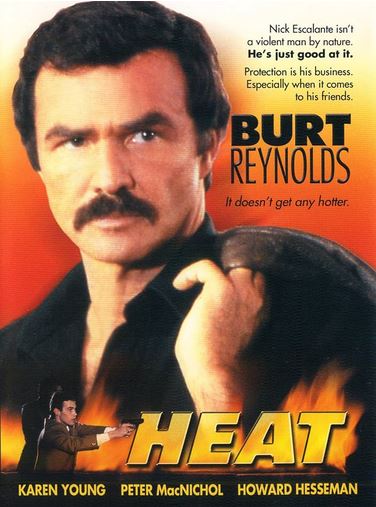 No. Not THAT one!
Heat (42)
Michael Mann had hit it big with The Last of the Mohicans – not the case with his adaptation of F. Paul Wilson’s The Keep. Heat is a ‘really good but not quite great’ movie for me. Like Bogie’s Dead Reckoning. But man, this is a taut heist film, with a great cast. Another one I’m due to watch again.
Striptease (48)
I am almost done re-reading/re-listening to the first ten Carl Hiassen novels (they drop off for me around number nine, so this won’t be a complete re-read). But I do love his books. They are laugh-out-loud dark crime comedies. I remember seeing this movie and thinking it wasn’t bad. But the book was much better. I suspect that would still hold true. Still, I think I’ll check it out again. TV’s R.J. Decker (based on Double Whammy) is losing it’s Hiassen roots, but still worth watching so far.
Leaving Las Vegas (53)
Sabrina (61) Excellent remake of a Bogart/Hepburn film
That Thing You Do! (67) A total gem!!!!!!!
From Dusk til Dawn (68)
Escape From LA (70) A far cry from the original.
Scream (74) A late release that would have been #11 for the year
Fargo (75) Coen Brothers wizardry, but not box office magic
Last Man Standing (97) Based on Hammett’s Red Harvest (which influenced Yojimbo)
The Phantom (100) Bruce Campbell lost out to Billy Zane for the lead
GoldenEye (108) Late release that was a 1997 hit
My Fellow Americans (120) See Grumpier Old Men, above
Mulholland Falls (124) Was a good year toe be a hardboiled/noir fan
2 Days in the Valley (125) More noir
Two if by Sea (128) See Grumpier Old Men…
Seven (129) 1997 hit
Heavens Prisoners (161) Hollywood is 0 for 2 on James Lee Burke. Do better!)
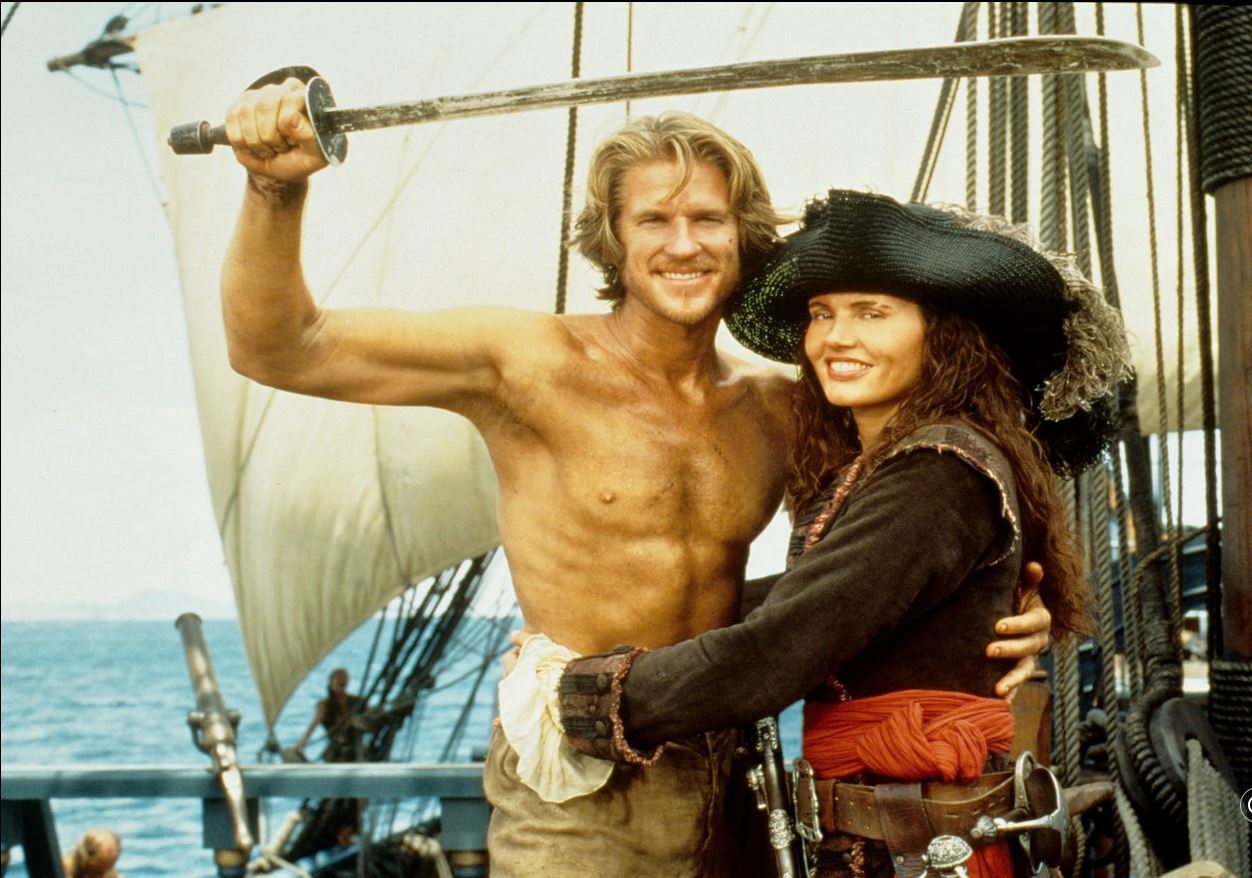 Swingers (164) $4 million box office, but a cult classic
Ace Ventura: When Nature Calls (166) Big hit in 1997
Cutthroat Island (170) Not quite Pirates of the Carribean
Barb Wire (180) Pamela Anderson remakes Casablanca/The Maltese Falcon. Soooo bad
Tastes certainly vary, but there was a lot to go see in 1996. As a hardboiled guy, Heat, Mulholland Falls, Last Man Standing, and 2 Days in the Valley, were all worthwhile. I liked Heavens Prisoners okay, as a Dave Robicheaux fan.
Scifi, comedy, action, offbeat – a good year for movies.And up top, Independence Day is still a great watch. That was from Dean Devlin, who had written Stargate, and would give us Leverage, and The Librarians. Mission Impossible continued to make bank for decades.
Share your thoughts on the list. Or others I left off. I skimped on the horror stuff.
So…what year shall we look at next?
Some previous entries on things to watch:Firefly – The Animated Reboot
What I’ve Been Watching – February 2026 (The Night Manager, SS-GB, Best Medicine)
What I’ve Been Watching – October 2026 (Return to Paradise, Lynley, Expend4bles, and more)
What I’ve Been Watching – August 2025 (Ballard, Resident Alien, Twisted Metal, and more)
What I’ve Been Watching – May 2025 (County Line, The Bondsman, Bosch: Legacy)
What I’ve Been Watching – October 2024 (What We Do in the Shadows, The Bay, Murder in a Small Town)
What I’m Watching – November 2023 (Brooklyn Nine-Nine, The Caine Mutiny Court Martial, A Haunting in Venice)
What I’m Watching – April 2023 (Florida Man, Picard – season three, The Mandalorian)
The Pale Blue Eye, and The Glass Onion: Knives Out
Tony Hillerman’s Dark Winds
The Rings of Power (Series I wrote on this show – all links at this one post)
What I’m Watching – December 2022 (Frontier, Leverage: Redemption)
What I’m Watching – November 2022 (Tulsa King, Andor, Fire Country, and more)
What I’m Watching – September 2022 (Galavant, Firefly, She-Hulk, and more)
What I’m Watching- April 2022 (Outer Range, Halo, Why Didn’t They Ask Evans, and more)
When USA Network was Kicking Major Butt (Monk, Psych, Burn Notice)
You Should be Streaming These Shows (Corba Kai, The Expanse, Bosch, and more)
What I’m BritBoxing – December 2021 (Death in Paradise, Shakespeare & Hathaway, The Blake Mysteries, and more)
To Boldly Go – Star Treking – (Various Star Trek incarnations)
What I’ve Been Watching – August 2021 (Monk, The Tomorrow War, In Plain Sight, and more)
What I’m Watching – June 2021 (Get Shorty, Con Man, Thunder in Paradise, and more)
Tucker and Dale vs. Evil
What I’ve Been Watching – June 2021 (Relic Hunter, Burn Notice, Space Force, and more)
Appaloosa
Psych of the Dead
The Mandalorian
What I’m Watching: 2020 – Part Two (My Name is Bruce, Sword of Sherwood Forest, Isle of Fury, and more)
What I’m Watching 2020: Part One (The Adventures of Brisco County Jr, Poirot, Burn Notice, and more)
Philip Marlowe: Private Eye
Leverage
Nero Wolfe – The Lost Pilot
David Suchet’s ‘Poirot’
Sherlock Holmes (over two dozen TV shows and movies)
 Bob Byrne’s ‘A (Black) Gat in the Hand’ made its Black Gate debut in 2018 and has returned every summer since.
His ‘The Public Life of Sherlock Holmes’ column ran every Monday morning at Black Gate from March, 2014 through March, 2017. And he irregularly posts on Rex Stout’s gargantuan detective in ‘Nero Wolfe’s Brownstone.’ He is a member of the Praed Street Irregulars, and founded www.SolarPons.com (the only website dedicated to the ‘Sherlock Holmes of Praed Street’).
He organized Black Gate’s award-nominated ‘Discovering Robert E. Howard’ series, as well as the award-winning ‘Hither Came Conan’ series. Which is now part of THE Definitive guide to Conan. He also organized 2023’s ‘Talking Tolkien.’
He has contributed stories to The MX Book of New Sherlock Holmes Stories — Parts III, IV, V, VI, XXI, and XXXIII.
He has written introductions for Steeger Books, and appeared in several magazines, including Black Mask, Sherlock Holmes Mystery Magazine, The Strand Magazine, and Sherlock Magazine.
You can definitely ‘experience the Bobness’ at Jason Waltz’s ’24? in 42′ podcast.
Categories: Fantasy Books
Horror and Gothic, Magic and Witchcraft: The Dark of the Soul, edited by Don Ward

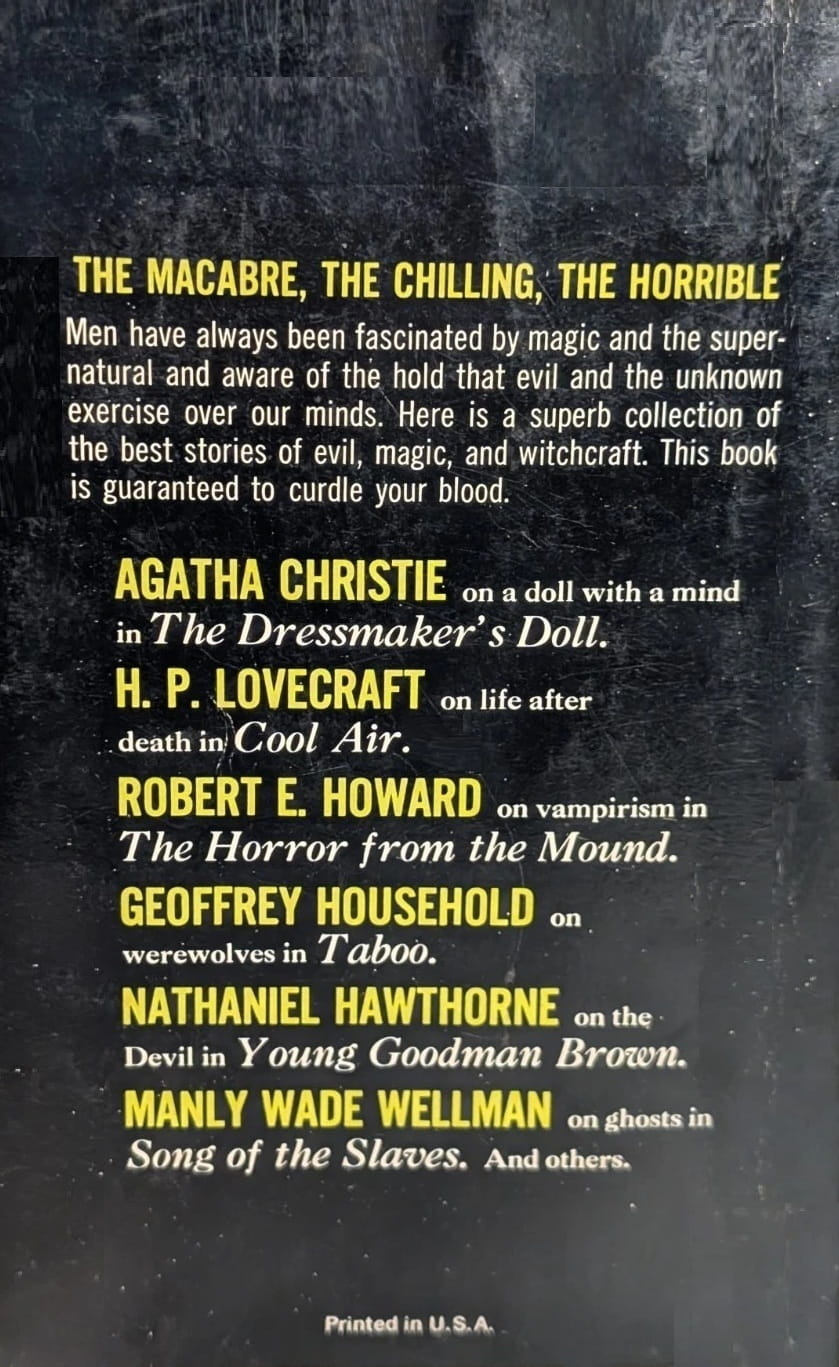
The Dark of the Soul (Tower Books, 1970)
Here’s another anthology I picked up because it had a Robert E. Howard story in it.
The Dark of the Soul, edited by Don Ward, A Tower book, 1970. Cover artist unknown. It contains a short story by Robert E. Howard called “The Horror from the Mound.” It’s a good story, although not one of Howard’s best.
This collection is more horror and gothic, magic and witchcraft, and not Sword & Sorcery (S&S). The stories are atmospheric but maybe slow for modern audiences. Here are my thoughts.
1. Introduction by Don Ward. Gives some context to the stories but probably wasn’t needed.
2. “The Horror from the Mound” by Robert E. Howard has the highest level of action in the collection, and is genuinely creepy.
3. “The Muted Horn” by Dorothy Salisbury Davis doesn’t have any action and is not my cup of tea.
4. “Mrs Amworth” by E. F. Benson was also slow, with a long setup that could mostly have been cut.
5. “Song of the Slaves” by Manly Wade Wellman is a long way from this author’s best work.
6. “The Ash Tree” by M. R. James is a creepy piece. James didn’t beat around the bush getting to the heart of the tale and this is one of the better pieces in the book.
7. “Cool Air” by H. P. Lovecraft. I’m a big Lovecraft fan but this isn’t among his best stories.
8. “Taboo” by Geoffrey Household was a solid tale but maybe with too much unnecessary material.
9. “Young Goodman Brown” by Nathaniel Hawthorne is a memorable tale from an author you don’t generally see in such collections.
10. “Smee” by A. M. Burrage is a good ghost story, though fairly slow.
11. “The Dressmaker’s Doll” by Agatha Christie was a surprise. I knew her from her mysteries but this was creepy and with a strong ending.
Charles Gramlich administers The Swords & Planet League group on Facebook, where this post first appeared. His last article for us was a review of two Sword & Sorcery anthologies from L. Sprague de Camp. See all of his recent posts for Black Gate here.
Categories: Fantasy Books
What’s For Dinner? The Library at Hellebore by Cassandra Khaw
 Art by Vladimir Logos
I’ve lost count of novels that involve some sort of magical college featuring adolescent misfits plucked from humdrum daily existence thrust into contests between good and evil, not to mention raging hormones.
Blame Harry Potter, though Rowling was building on the trope, not inventing it (c.f., in particular, A Wizard of Earthsea). She just got wildly successful with it. So why shouldn’t others also build on that success?
Granted there is nothing new under the sun; no one is irked that Maggie O’Farrell did yet another riff on a Shakespeare play with Hamnet. Even so, not to knock the whole dark academia thing, I can understand how some might sneer at yet another mystical schoolyard fantasy.
Sure, some are tapping into a built-in audience without trying to rise much above the hackneyed (c.f., example, Starfleet Academy, despite the presence of Paul Giamatti and Holly Hunter, though you could probably say the same about most of the Star Trek spinoffs, The Next Generation and Strange New Worlds notwithstanding). Most others expand the form (c.f., the aforementioned Hamnet).
Which brings us to The Library of Hellebore by Cassandra Khaw. A sort of middle finger to the whole Harry Potter universe.
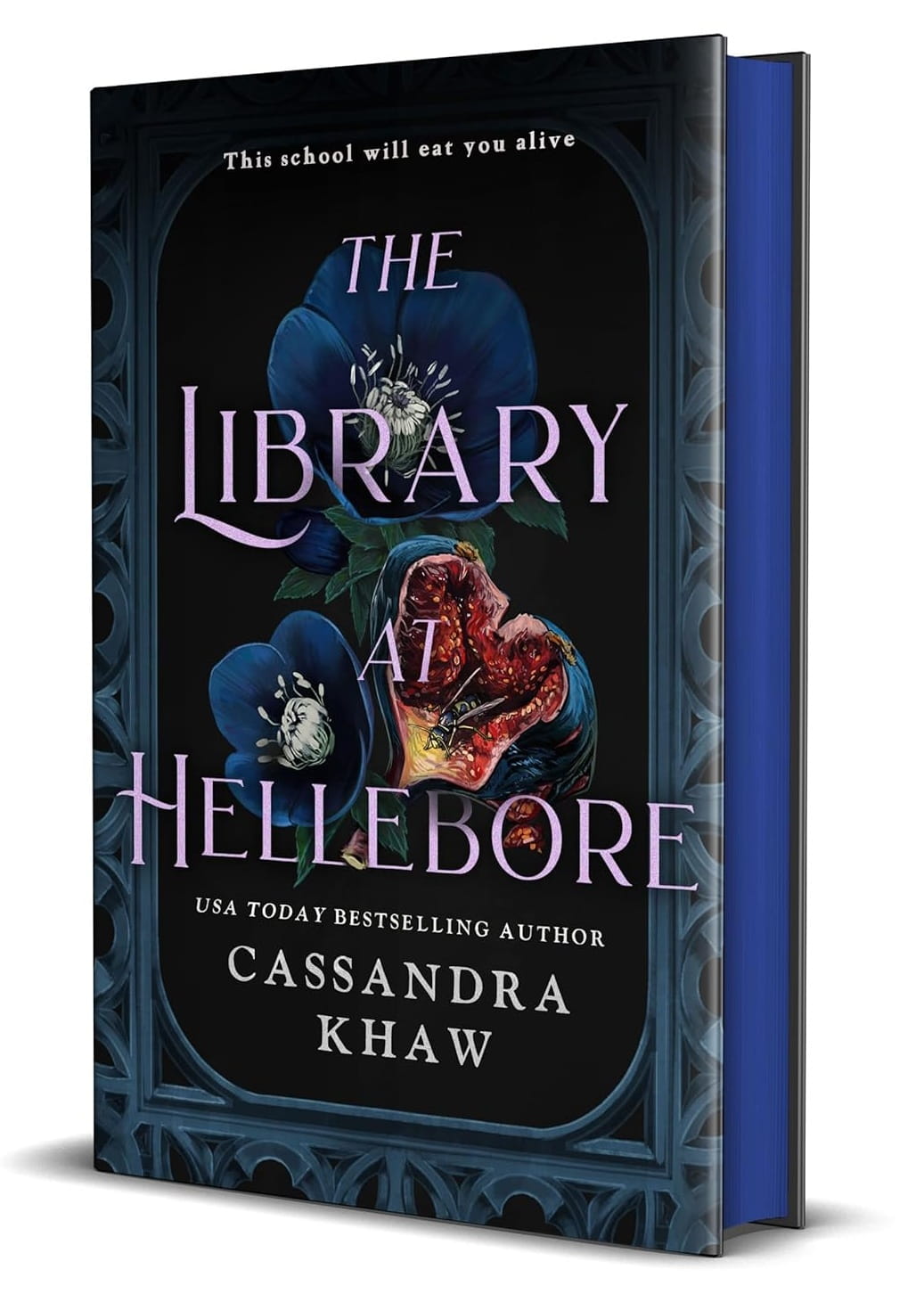 The Library at Hellebore, by Cassandra Khaw (Tor Nightfire, July 22, 2025)
Here’s how it starts.
When I woke up, my roommate, Johanna, was dead… the walls were soaked in effluvium. Every piece of linen on our beds was at least moderately pink with gore. The floor was a soup of viscera, intestines like ribbons unstrung over the scuffed wood.
So despite all the familiar elements — The Hellebore Technical Institute for the Gifted, students with magical abilities, the titular library — we’re not in Kansas anymore. Hammering home the point that this is not a Harry Potter clone is when the headmaster says,
That we might be sorted into houses, a prospect so repellant the crowd spontaneously lost all fear of her and began groaning objections.
“I am just kidding,” she simpered among the thunderous murmurs. “Although the way you’re all complaining, I might have to make it happen.”
Though she retained her mask throughout, what mystique she possessed was lost in the wake of that awful joke.
While Hellebore might seem to connote humdrum existence in the netherworld (and maybe at some level Khaw intends to convey that), a hellebore is actually a poisonous plant, sometimes used in antiquity to treat psychosis. Indeed, our narrator, Alessa Li, hasn’t escaped a humdrum Muggle existence by being chosen to enroll in the institute; rather, she’s been kidnapped to prevent her powers from harming normal society.

Further distancing the novel from run-of-the-mill dark academia is that the Institute’s faculty aims to eat the student body. Now that’s dark.
Which brings us to the titular library, where Alissa and some of her surviving classmates — though hardly friendly allies — escape from professorial ravenous cravings. But there are no safe spaces even at this bastion of learning and knowledge as the monstrous librarian has her own carnivorous cravings.
The only lesson here is that of kill or be killed. Not in a Hunger Games kind of way. More like in an eat or be eaten Darwinian kind of way. Literally.
The horror genre is transgressive, meant to provoke revulsion in reminding us of bodily disgust, of psychological dislocation, of humanity’s animalistic nature. The horror of the Library of Hellebore is that “things like decency are nothing but human inventions. The cosmos bends nowhere except toward annihilation.”
David Soyka is one of the founding bloggers at Black Gate. He’s written over 200 articles for us since 2008. See them all here.
Categories: Fantasy Books
Forgotten Authors: Neil R. Jones
 Neil R. Jones
Neil R. Jones was born on May 29, 1909 in Fulton, New York, the youngest for four children. He has stated that the first science fiction novel he read, in 1918. Was Will N. Harben’s The Land of the Changing Sun, a lost world novel, which led him to the writings of Edgar Rice Burroughs.
His first published story, “Vengeance of the Ages” was published in his high school yearbook in 1926, with a second story, “The Meteor of Fate” appearing the following year.
“The Death Head Meteor,” was his first professional publication, published in the January 1930 issue of Air Wonder Stories and is believed to contain the first appearance of the word “astronaut.” He had previously sold the story “The Electrical Man,” but it didn’t appear until May of that year in Scientific Detective Monthly, earning him his first cover.
 January 1930 Air Wonder Stories, Cover by Frank R. Paul
One of the stories he had submitted to Gernsback was “The Jameson Satellite,” which kicked off a series of stories about Professor Jameson. When his payment for “The Electrical Man” was less than expected because Gernsback declared he had charged Jones for editorial preparation, Jones decided to submit the revised story to T. Conor Sloane at Amazing Stories. The story introduced the cyborg Zoromes, who featured in subsequent Jones stories about Professor Jameson.
Another innovation Jones introduced was the idea of a planned out, reasonably coherent future history, focusing on the cult of Durna Rangue from the 24th through the 25th centuries and which also tie in to the stories about Professor Jameson, although those are set in the extremely far future. The Jameson story “Time’s Mausoleum,” however, includes time travel to the period of Durna Rangue and refers to events there and was published prior to most of those stories’ publication.
Between 1930 and 1942, Jones published 38 stories and a two part serial, with only about eight stories published after 1942. On May 2, 1942, Jones was drafted into the army as part of the war effort, becoming Corporal Neil R. Jones. He was deployed to North Africa, serving in Morocco and Algeria before participating in the invasion of Sicily. He was also part of the D-Day invasion.
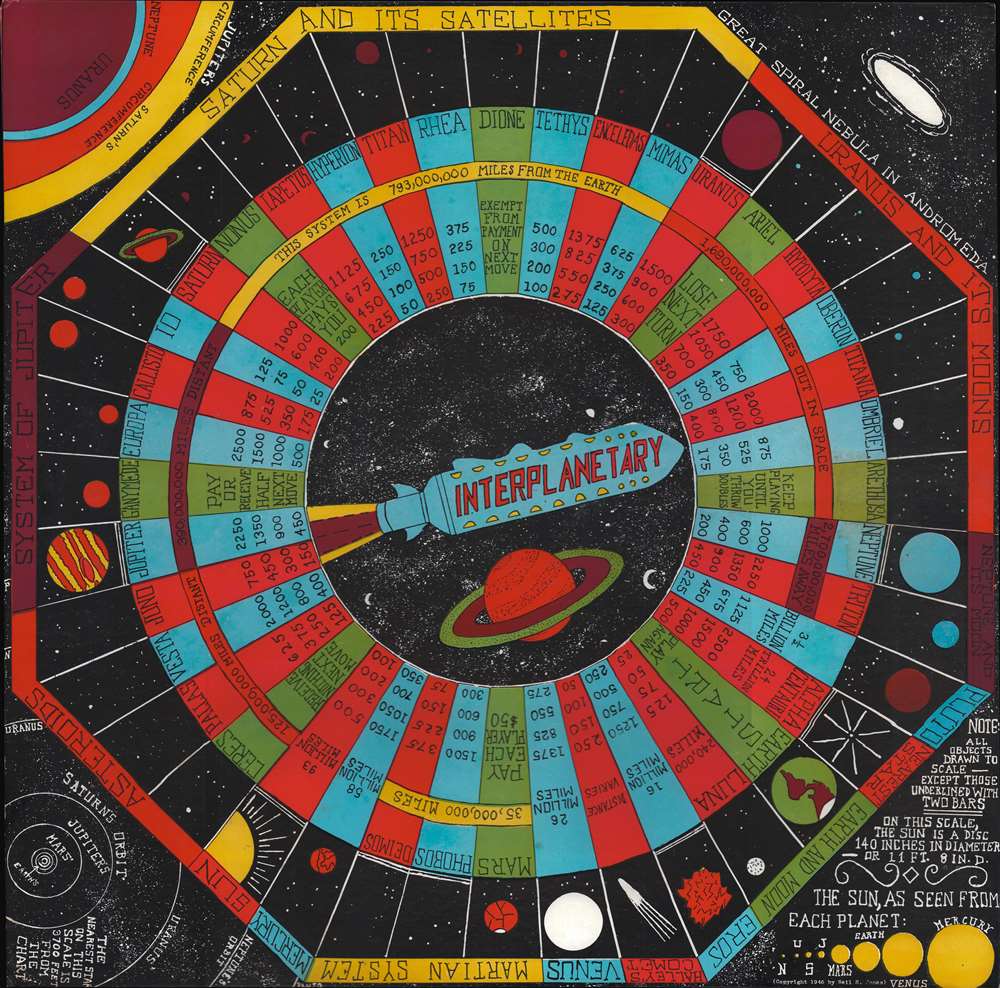 Interplanetary board game
While in England during the war, Jones married Rita Rees on June 19, 1945 in London. The couple returned to the U.S. in the fall of that year and Jones was mustered out of the army in October. Having a wife to support now, he apparently found more traditional jobs working for the New York unemployment office and possibly other book keeping positions. IN 1946, he also invented a board game called Interplanetary during this period, which he may have sold privately. Apparently only four copies are known to exist.
On September 29, 1964, Rita was found by a neighbor with her throat cut. She died in the hospital and an investigation declared it was self-inflicted wound and that she had been suffering health issues. Although some of Jones’s stories were reprinted, he had few new stories published after this point. He retired from the New York unemployment office in 1973. Sometime in the late 1970s, he remarried, to Leona Tice, who survived him.
Jones died on February 15, 1988 and is buried in Mount Adnah Cemetery in Fulton, New York.
Steven H Silver is a twenty-one-time Hugo Award nominee and was the publisher of the Hugo-nominated fanzine Argentus as well as the editor and publisher of ISFiC Press for eight years. He has also edited books for DAW, NESFA Press, and ZNB. His most recent anthology is Alternate Peace and his novel After Hastings was published in 2020. Steven has chaired the first Midwest Construction, Windycon three times, and the SFWA Nebula Conference numerous times. He was programming chair for Chicon 2000 and Vice Chair of Chicon 7.
Categories: Fantasy Books
Dark Muse News: Reviewing Arcane Arts and Cold Steel by David C. Smith
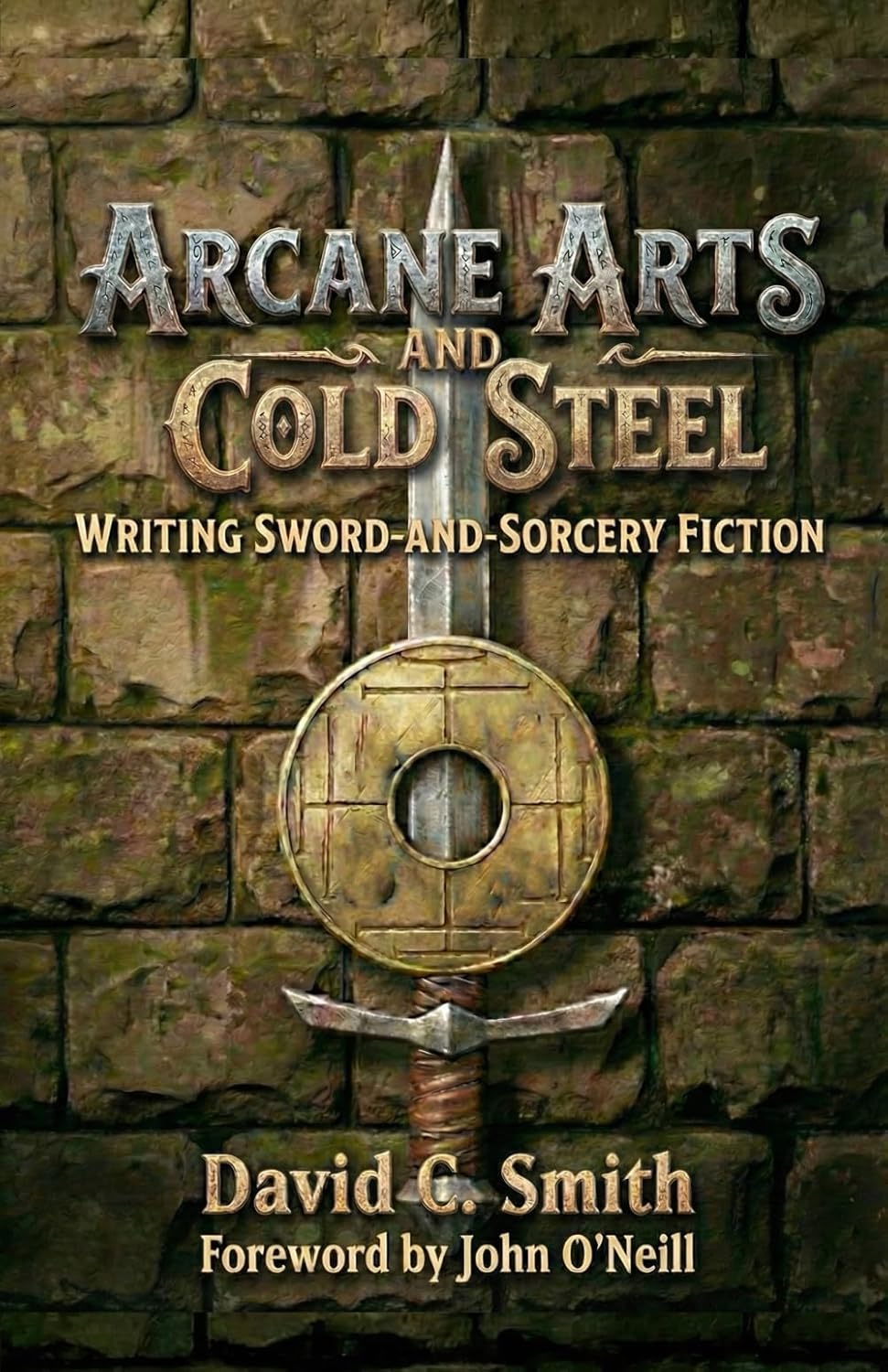
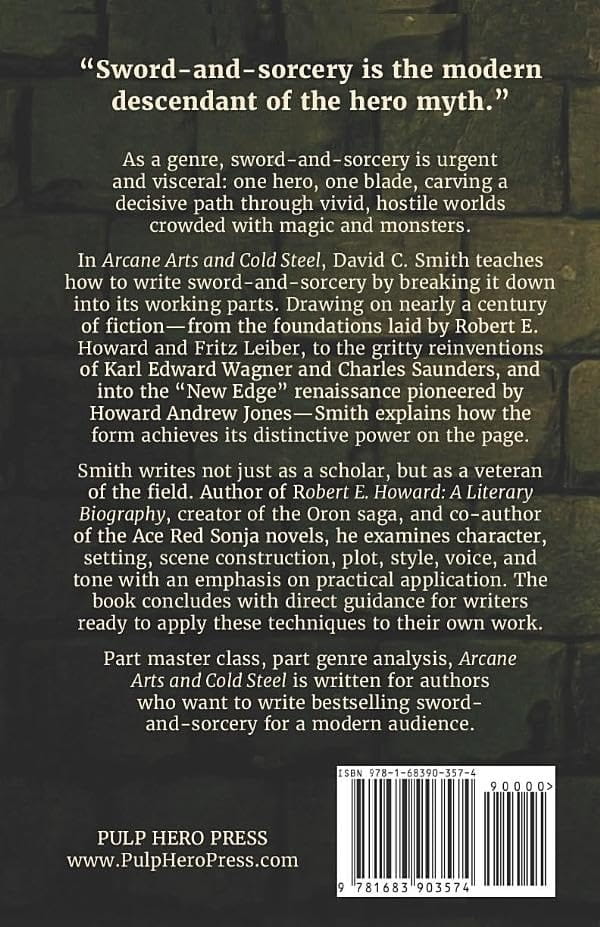
Arcane Arts and Cold Steel (Pulp Hero Press, December 24, 2025)
In 2019, Pulp Hero Press published Brian Murphy’s Flame and Crimson: A History of Sword-and-Sorcery, which was notably covered by David C. Smith (link to review) and John O’Neill (link) on Black Gate. O’Neill highlighted that Brian Murphy was one of the earliest contributors to Black Gate, from way back in 2012! Six years have passed since the publication of Flame and Crimson; whereas the subtitle and focus of that was a history of Sword & Sorcery (S&S), Pulp Hero Press just followed with a sequel focused on writing it, penned by David C. Smith with a foreword by John O’Neill.
This post covers the complementary book Arcane Arts and Cold Steel: Writing Sword-and-Sorcery Fiction (Pulp Hero Press 2025, 298 pages). Greg Mele recently posted a Black Gate article on how this book is The Literary Sorcerer’s Toolkit; read that to learn more about the author.
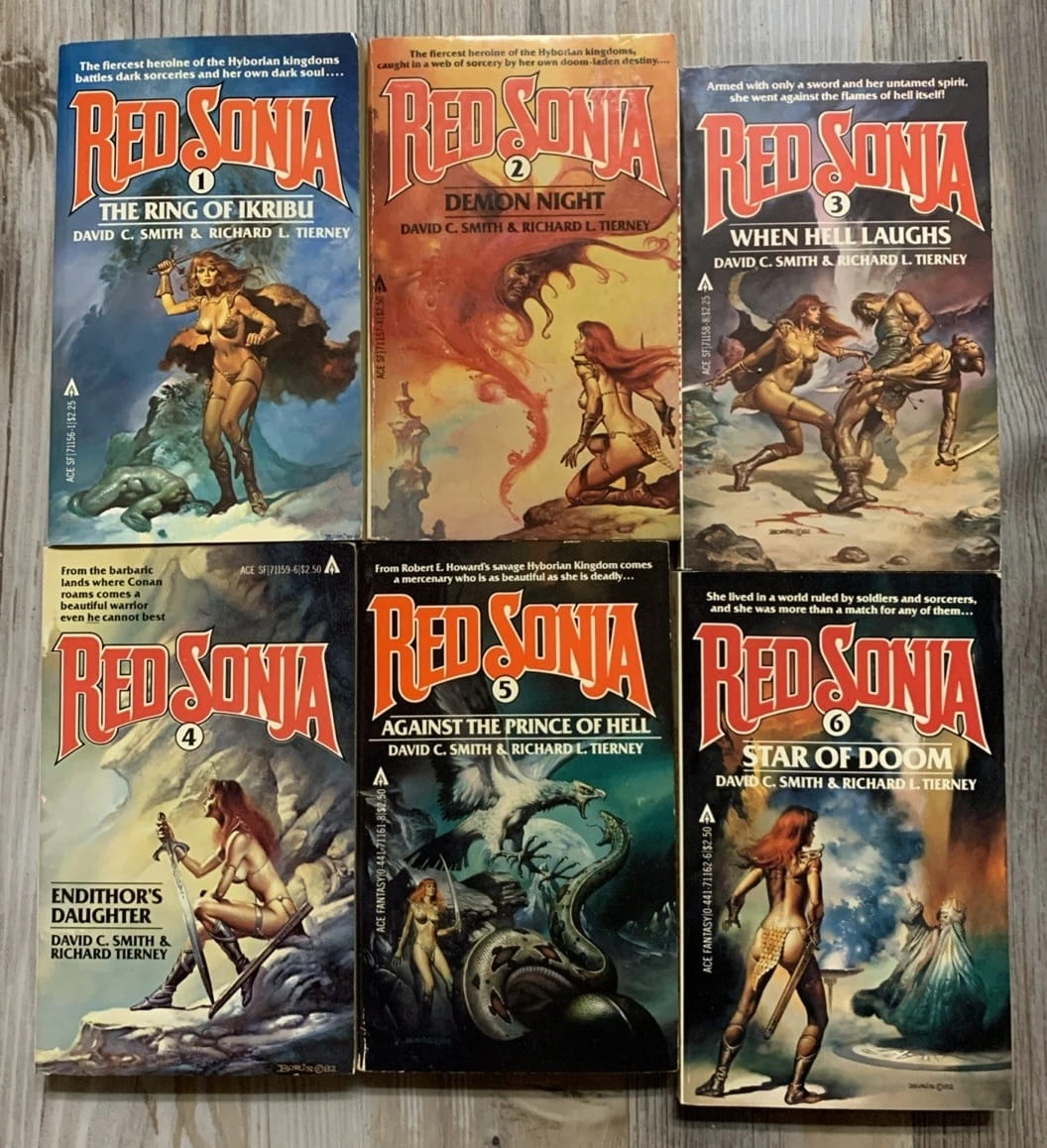 The Red Sonja series by David C. Smith and Richard L. Tierney (Ace Books, December 1981-May 1983). Covers by Boris Vallejo
In short, David C. Smith (Wikipedia page) is a writer of horror, historical, and suspense fiction, and is also a medical editor and essayist. He is best known for his heroic fantasy novels (i.e., Oron and the Attluma books), including his collaborations with Richard L. Tierney featuring Robert E. Howard’s Red Sonja heroine. He has written plenty of nonfiction, too, and won the 2018 Atlantean Award from the Robert E. Howard Foundation for Outstanding Achievement, Book, for Robert E. Howard: A Literary Biography.
Read this to learn the contents of the Arcane Arts and Cold Steel in more detail.
Frankly, it feels like John O’Neill has been moderating a panel on Sword & Sorcery since 2019, Brian Murphy covered the history of S&S, while David C. Smith covered writing perspectives, and Pulp Hero Press captured the transcript in book form.Let us quickly recap some of Flame and Crimson to set up Arcane Arts and Cold Steel content.
What Sword-and-Sorcery is, and What it is NotBrian Murphy opened with a chapter defining “What is Sword-and-Sorcery” before following with eight chapters on the linear history of it. He quoted David C. Smith from the very beginning!
We can give you clues to what it is — and what it is not. It is not high fantasy. High fantasy dresses up life and offers comfort; it is romantic. Our fiction is dark, often very dark, in the same way that unsettling dreams are never far from nightmares, and not at all comforting.
– David C. Smith, “Introduction,” Swords of Steel
- Men (and women) of action
- Dark and dangerous magic
- Personal and/or mercenary motivations
- Horror/Lovecraftian influence
- Short episodic stories
- Inspired by history
- Outsider heroes
At long last, we have a history of the sword-and-sorcery genre, and a very welcome and erudite study it is. Brian Murphy is to be commended for his honest appreciation of our frequently dismissed and often mocked genre. He intelligently surveys the expanse of the sword-and-sorcery field warts and all, low points and high, putting the genre into its proper literary perspective.
To present a linear history of the sword-and-sorcery genre is, in fact, to dissect a Yggdrasil of many branches, which is precisely what Murphy has done here…
He bookends his study with two important chapters, with his initial question “What is Sword-and-Sorcery?” ultimately addressed in the final chapter, “Why Sword-and-Sorcery?” In between, he takes us on a journey beginning with the roots of what is to come
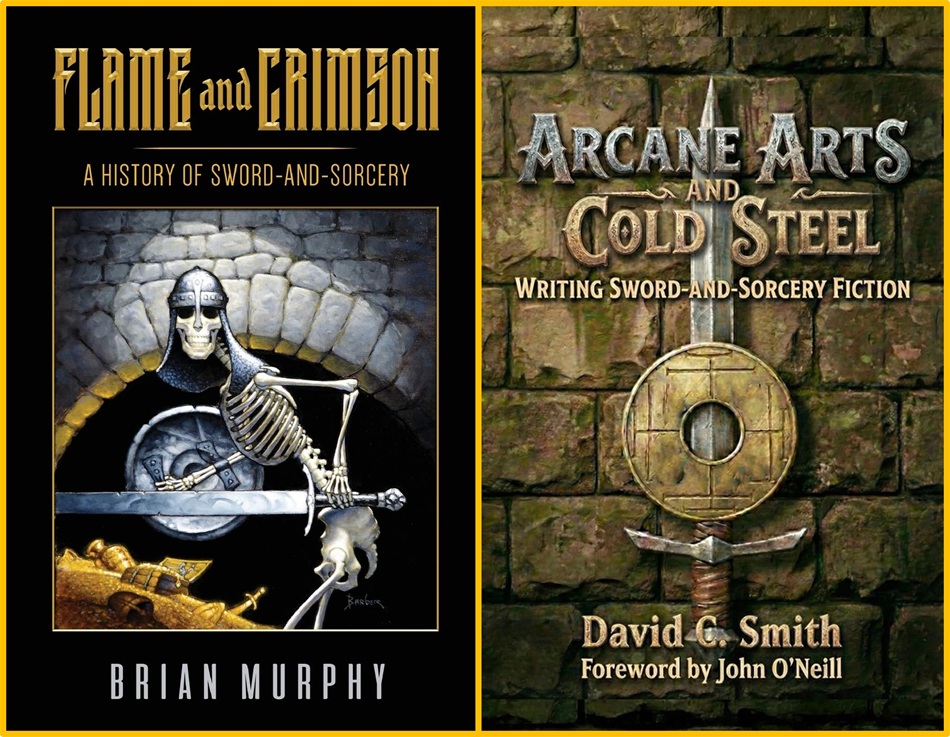 Pulp Hero Press books. Flame and Crimson: A History of Sword-and-Sorcery by Brian Murphy (2019). Arcane Arts and Cold Steel: Writing Sword-and-Sorcery Fiction, David C Smith (2025).
Arcane Arts and Cold Steel
Motivated to Write, and Lie!
Pulp Hero Press books. Flame and Crimson: A History of Sword-and-Sorcery by Brian Murphy (2019). Arcane Arts and Cold Steel: Writing Sword-and-Sorcery Fiction, David C Smith (2025).
Arcane Arts and Cold Steel
Motivated to Write, and Lie!
John O’Neill’s introduction to Arcane Arts and Cold Steel clarifies our loves of lies! He covers humans’ need for storytelling, converging from 17,000-year-old cave paintings summarizing wild hunting expeditions, to 5,000-year-old astronomical myths guiding the evolution of civilizations, to general fiction, and our need for heroic myths. To paraphrase, “there is potential inside us to accomplish things we can hardly dream of” and heroic myths fuel our fire.
O’Neill writes:
What tools do we have to teach [our children] to resist in the face of a terrible, implacable, or unexpected foe? You already know the answer. The answer is myth. Story. Fiction. Lies.
Expect a review of writing approaches, not a step-by-step S&S writing workshopArcana Arts and Cold Steel is about writing, but it is not a stringent workbook for the reader to follow. It is more of a compendium of reviews, collections of excerpts and quotes, and even reviews of other reviews. It is a free-form cookbook that simultaneously showcases over a hundred writers’ and reviewers’ work while categorizing examples for the writer to model. If you do not intend to write, you will walk away with a detailed survey of S&S literature and its fan base, and expand your perspectives of what S&S literature has become (and what it can be). Writers will gain access to countless examples of characters, plots, milieus, practical applications, and styles.
Over three years ago, I had the chance to peruse a draft of Arcana Arts and Cold Steel, and I encouraged David Smith to consider a more direct step-by-step guide. He replied kindly to me via email about that approach: “Who has the right to tell someone how to be their own writer?” Well, he had the credentials for that, but not the ego. Yet he was still driven to compose a book about writing S&S. In the end, the book is a splendid mix of David Smith’s insight blended with so many representations from the broader S&S community that it feels like an encyclopedic love letter to the entire fan base. The Appendix Author Interview relates his development and approach toward the book.
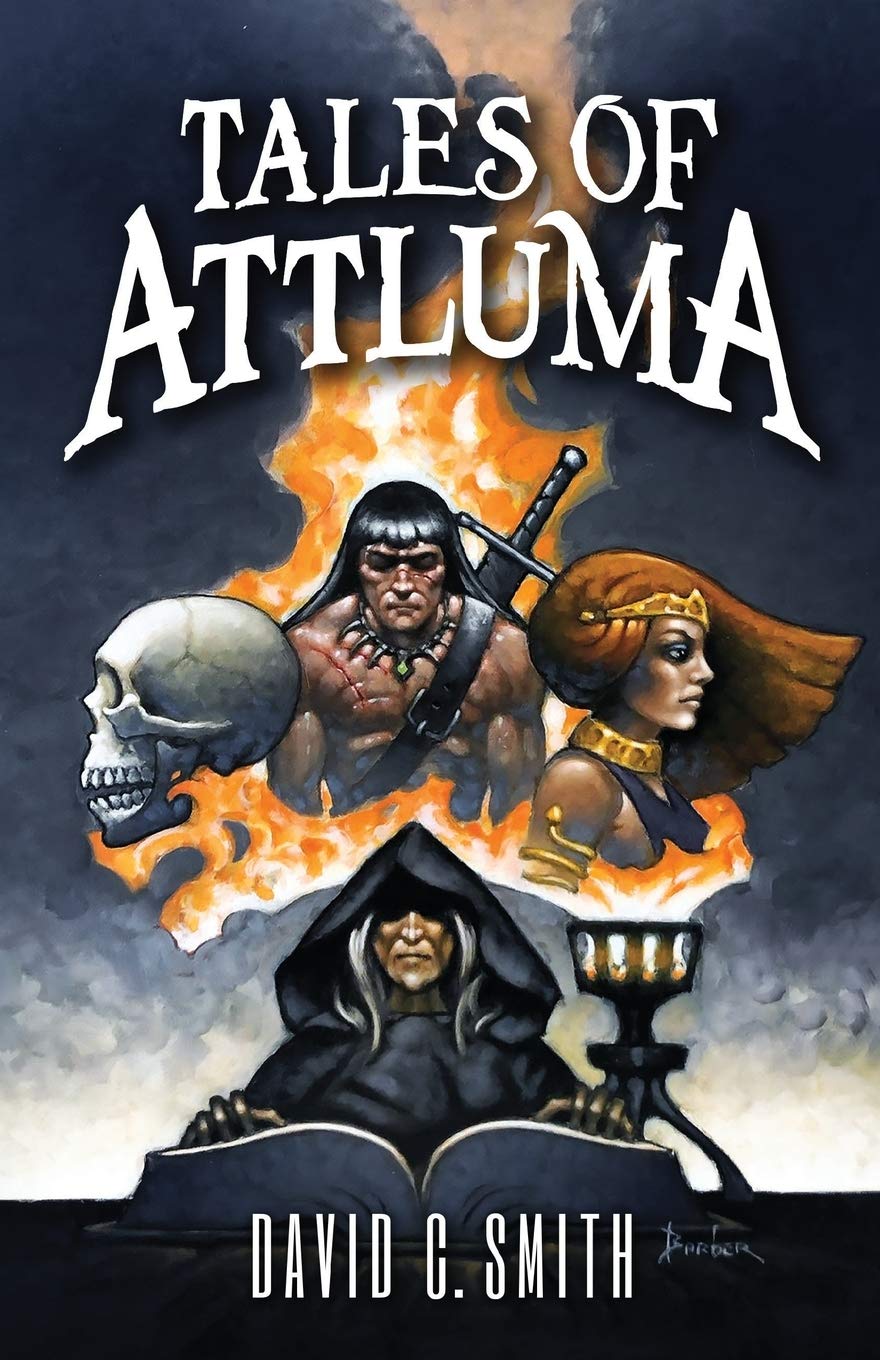
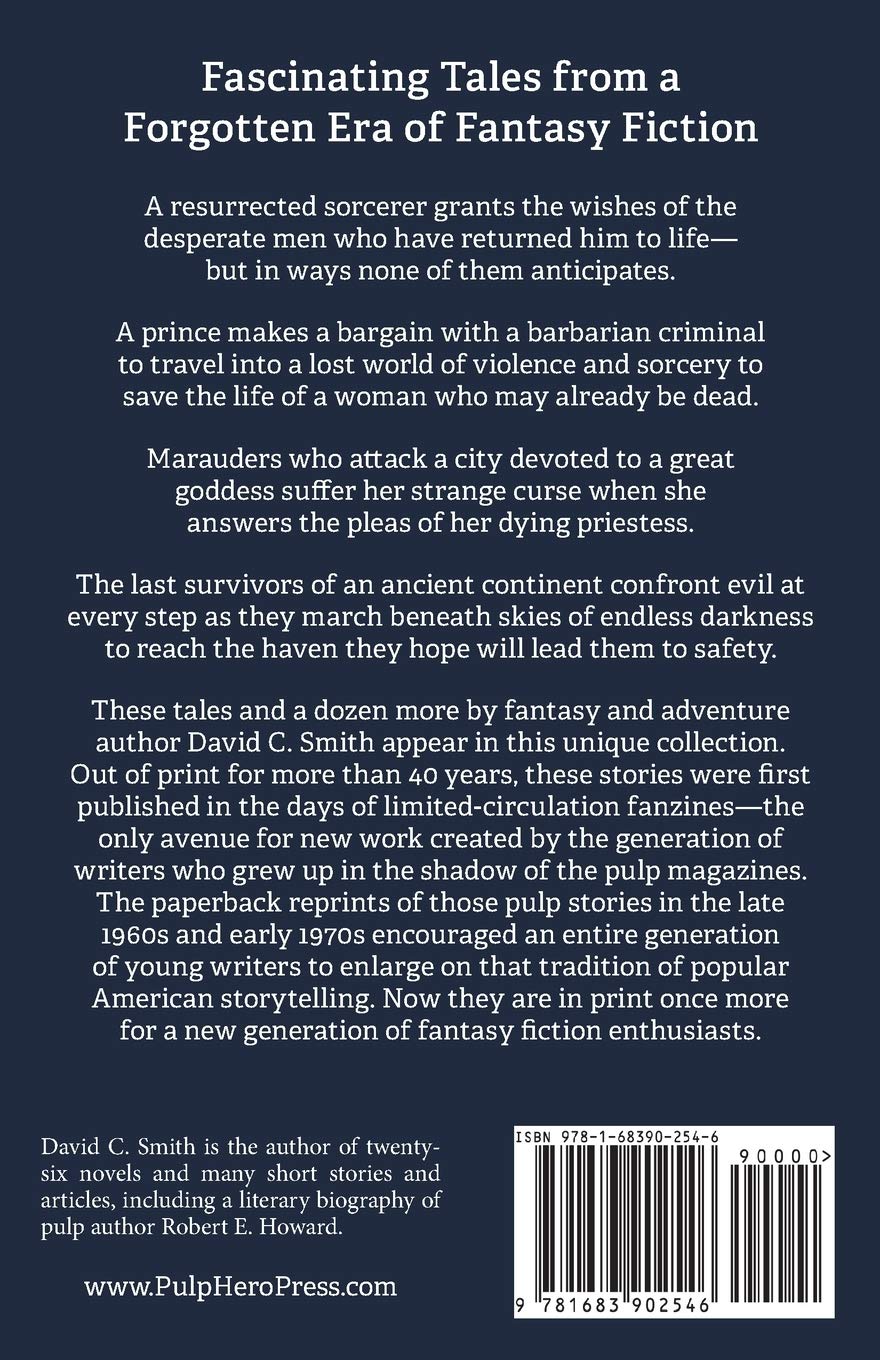
Tales of Attluma by David C. Smith (Pulp Hero Press, December 24, 2025). Cover by Tom Barber
I did. Who am I to tell anyone how to write? You sit down, you start, you learn by doing while referring to writers you like by dissecting how they’ve done what they’ve done. But my friends kept calling it Dave’s “how-to write sword-and-sorcery” book and made the case that offering guidance or ideas to readers would be helpful. Why write a book called “Writing Sword-and-sorcery Fiction” without giving people some ideas about actually writing sword-and-sorcery fiction? They were right. So I added the section doing that to complement the material in the main text.
I’d already come up with the ideas years ago on creating characters. Wrote it for an online writing group. So I had that, and when I reviewed it, I found some good common sense ideas in there. It wasn’t strictly prescriptive. I have a think skin whenever I hear a voice that sounds even vaguely imperative or prescriptive. Don’t tell me what to do! But when I thought of it as giving helpful advice or suggestions, I was fine with it. Started typing and went to town with a lot of ideas. So I hope those pages are worthwhile.
David C. Smith — Page 260-261
Arcane Arts and Cold Steel Contents 1. Sword & Sorcery Fiction: What it is and what it is not (pages 1-72)This is a 70-page, condensed (and less chronological) version of Flame and Crimson‘s history that sets the stage for writing S&S.
2. Story Structure (pages 73-186)- Character and Setting
- Must a protagonist be human?
- Flat and round characters
- Plots and scenes
- Style, voice, and tone
- Theme
In this section, David Smith surveys the rapidly diverging contemporary flavors of Sword & Sorcery. Howard Andrew Jones (HAJ, our beloved champion of S&S and its fan base, who passed in January 2025) coined the term “New Edge” to capture a rebirth of sword and sorcery. In 2008, as Managing Editor at Black Gate, HAJ posted his ‘manifesto’ regarding a resurgence brewing in Sword & Sorcery fiction: Honing A New Edge Part 1 & Part 2 (these originally appeared in the introductory editorials Issue 3 & 4 as “The New Edge”).
This sentiment resonated with many authors and editors, and a decade after its posting, directly inspired the creation of New Edge Sword & Sorcery Magazine (though editor Oliver Brackenbury has a slightly different definition than that of HAJ, read Oliver’s interview at BG for more).
4. Final Words- Appendix I: Writing Sword-and-Sorcery Fiction (p231-252)
- Appendix II: Recommended Reading (p253-256)
- Interview with the Author (p257-264)
As complete as Arcane Arts and Cold Steel is, there is more in David Smith’s head to tap. As an editor and literature guru, he has keen takes on syntax, which he sprinkles throughout the book. I privately hoped for a reprint, or relook, of his “The Writer’s Style: Sound and Syntax in Howard’s Sentences” (published in The Dark Man, February 2013). That essay, like many of The Dark Man (The Journal of Robert E. Howard Studies)‘s articles, delved into Robert E. Howard’s writing. Reading Smith’s Arcane Arts and Cold Steel motivated me to reread Smith’s article which dissects the Father of S&S’s syntax:
- Natural Order of Sentences and Plain Style
- Alliterative Devices, Conventional Phrases, archaic Flourishes, and Diction (poetic
- Color
- Use of Present Tense (mixed with past)
— David C. Smith
S.E. Lindberg is a Managing Editor at Black Gate, regularly reviewing books and interviewing authors on the topic of “Beauty & Art in Weird-Fantasy Fiction.” He has taken lead roles organizing the Gen Con Writers’ Symposium (chairing it in 2023), is the lead moderator of the Goodreads Sword & Sorcery Group, and was an intern for Tales from the Magician’s Skull magazine. As for crafting stories, he has contributed eight entries across Perseid Press’s Heroes in Hell and Heroika series, and has an entry in Weirdbook Annual #3: Zombies. He independently publishes novels under the banner Dyscrasia Fiction; short stories of Dyscrasia Fiction have appeared in Whetstone Amateur S&S Magazine, Swords & Sorcery online magazine, Rogues In the House Podcast’s A Book of Blades Vol I & II, DMR’s Terra Incognita, the 9th issue of Tales From the Magician’s Skull, Savage Realms Magazine, and Michael Stackpole’s S&S Chain Story 2 Project.
Categories: Fantasy Books
Swords & Sorcery and The Fantastic Swordsmen, edited by L. Sprague de Camp
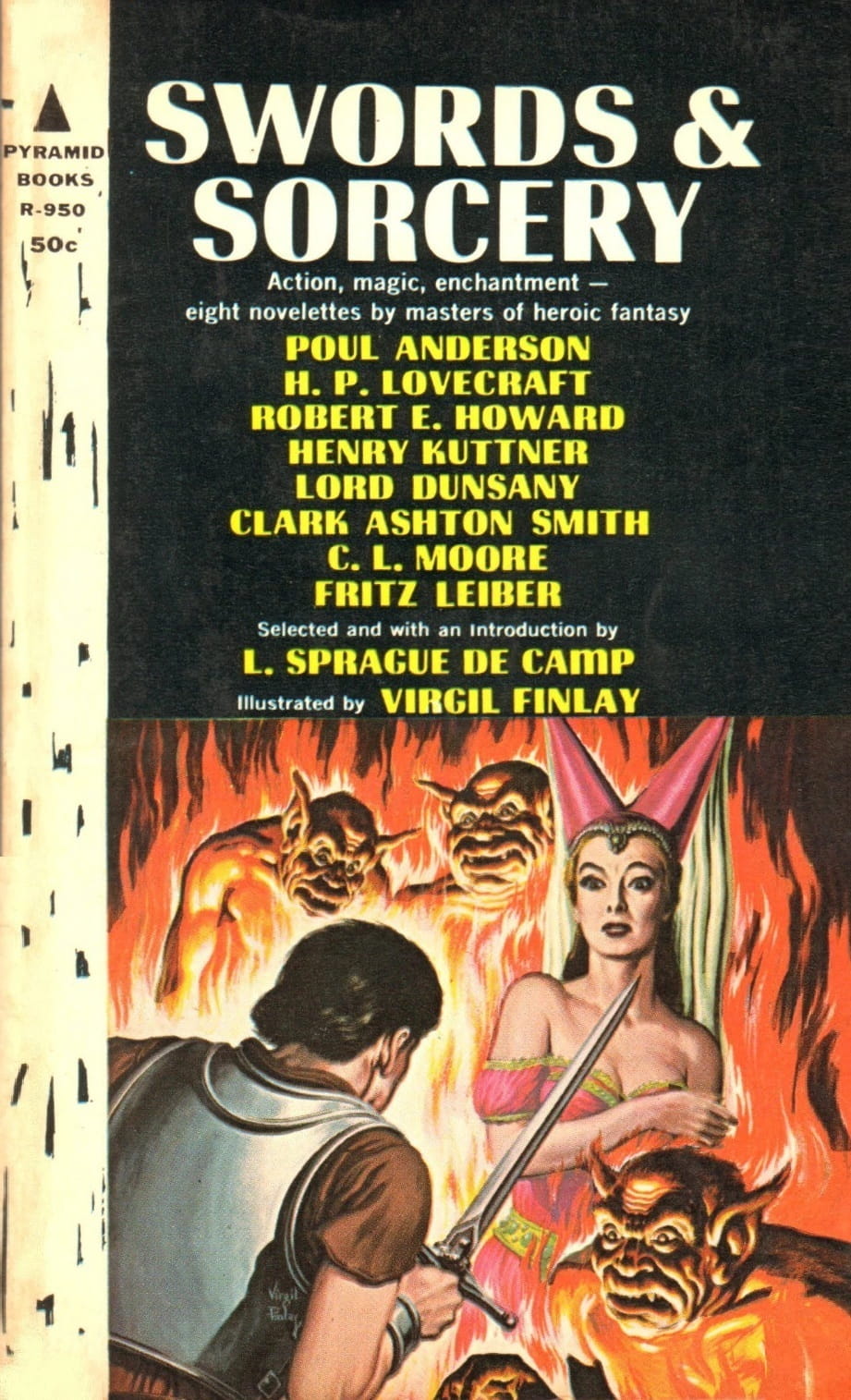
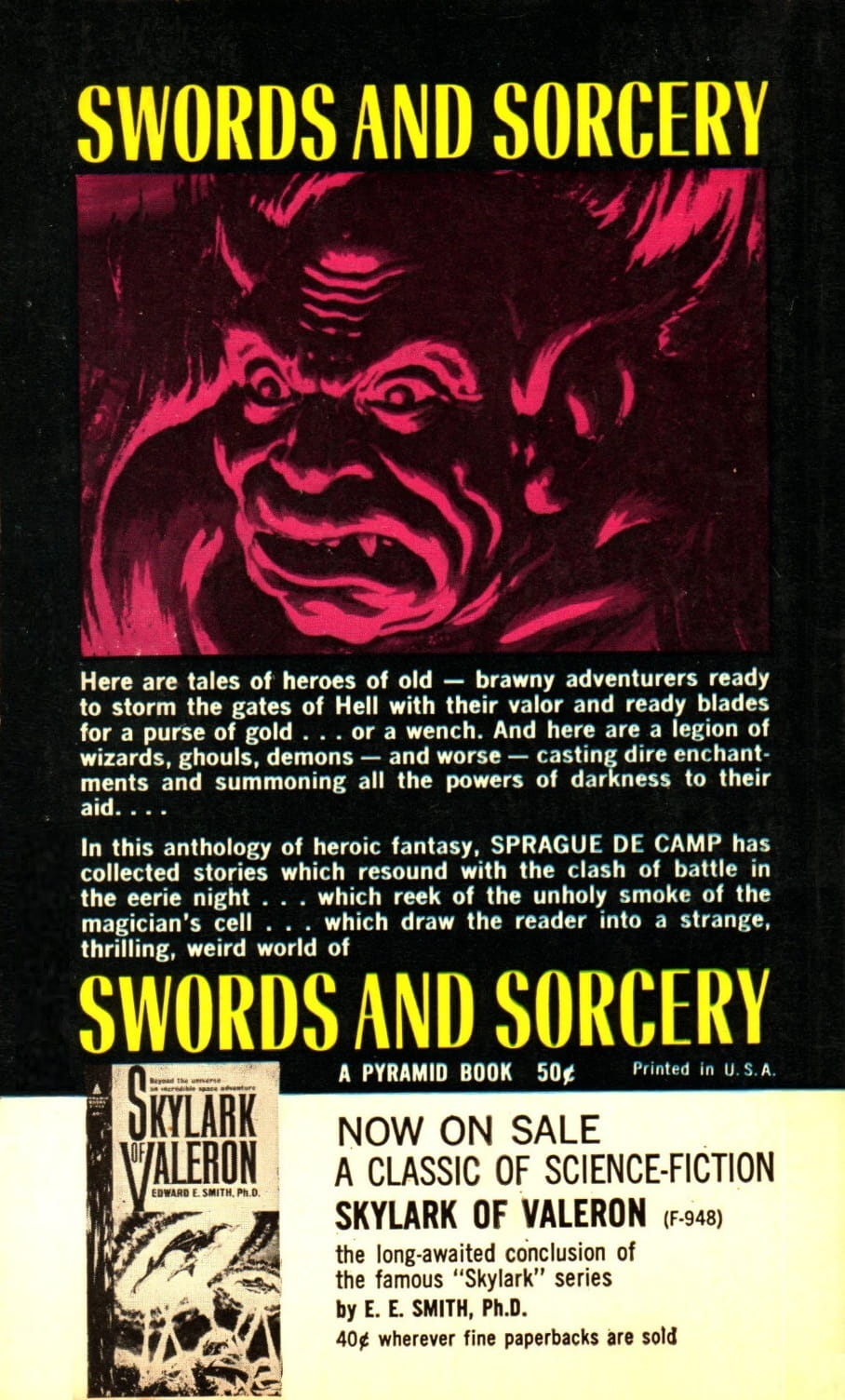
Swords and Sorcery: Stories of Heroic Fantasy, edited by L. Sprague de Camp
(Pyramid Books, December 1963). Cover by Virgil Finlay
Here are two more Sword & Sorcery anthologies edited by L. Sprague de Camp. Both are from Pyramid Books. Swords & Sorcery is 1963, with interior illustrations by Virgil Finlay. ISFDB indicates the cover is by Finlay as well, although it looks to me very much in the cover style of the second book, The Fantastic Swordsmen (1967), where the cover is attributed to Jack Gaughan. Some of the experts who visit this page probably know the truth.
1. Swords & Sorcery is a nice collection. It contains “Shadows in the Moonlight” (Conan) by Robert E. Howard, and stories by Poul Anderson (the excellent “Valor of Cappen Varra”), Fritz Leiber (Fafhrd, Gray Mouser), Kuttner (Prince Raynor), Lord Dunsany, C. L. Moore (Jirel), Clark Ashton Smith, and Lovecraft (“The Doom that Came to Sarnath”). The introduction on “Heroic Fantasy” by de Camp tends to piss some people off that I know, although I’m not one of those particularly. It suggests that S&S is purely escapist reading. I think it does make for a good escape from life’s mundanities but there’s more to it than just that.
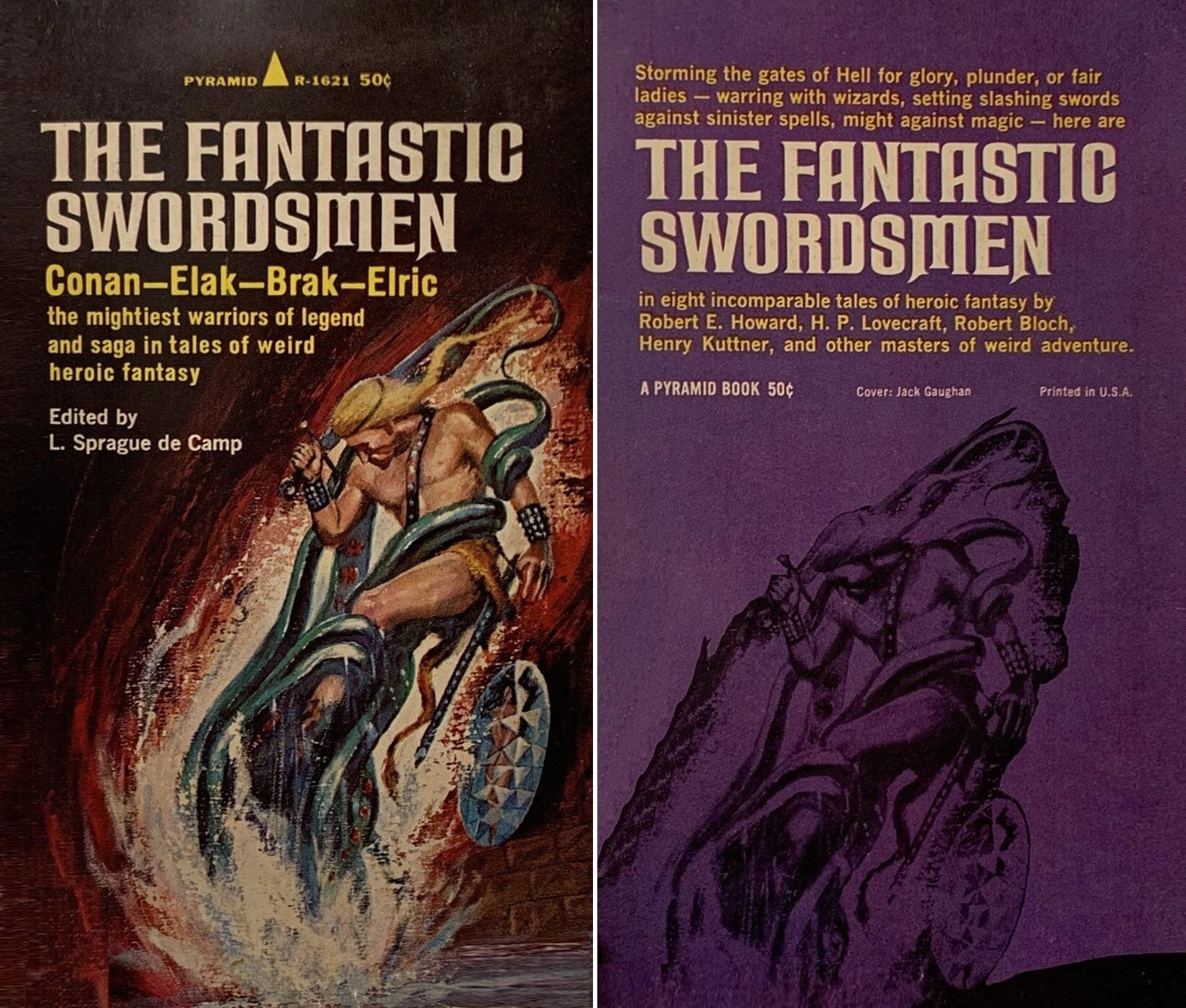 The Fantastic Swordsmen , edited by L. Sprague de Camp (Pyramid Books, May 1967). Cover by Jack Gaughan
2. The Fantastic Swordsmen is also a pretty good collection, with stories about Conan, Elak, Brak, and Elric, along with a few new items. The cover shows us Brak. The Conan story is one that de Camp finished from a Howard outline and isn’t terribly strong. There’s also a very early story by Robert Bloch, which, while well written, shows his lack of storytelling experience at the time.
Fantastic Swordsmen also contains:
“Tellers of Tales” an intro by L. Sprague de Camp
“Black Lotus” by Robert Bloch
“The Fortress Unvanquishable, Save for Sacnoth” by Lord Dunsany
“Drums of Tombalku” by REH and L. Sprague de Camp
“The Girl in the Gem” by John Jakes (Brak)
“Dragon Moon ” by Henry Kuttner (Elak of Atlantis)
“The Other Gods” by H.P. Lovecraft
“The Singing Citadel” by Michael Moorcock (Elric & Moonglum)
“The Tower” by Luigi De Pascalis, who also wrote an Afterword
Charles Gramlich administers The Swords & Planet League group on Facebook, where this post first appeared. His last article for us was a review of The Imaro Saga by Charles Saunders. See all of his recent posts for Black Gate here.
Categories: Fantasy Books
Conan the Barbarian: Lamentations of a 35-Foot Snake
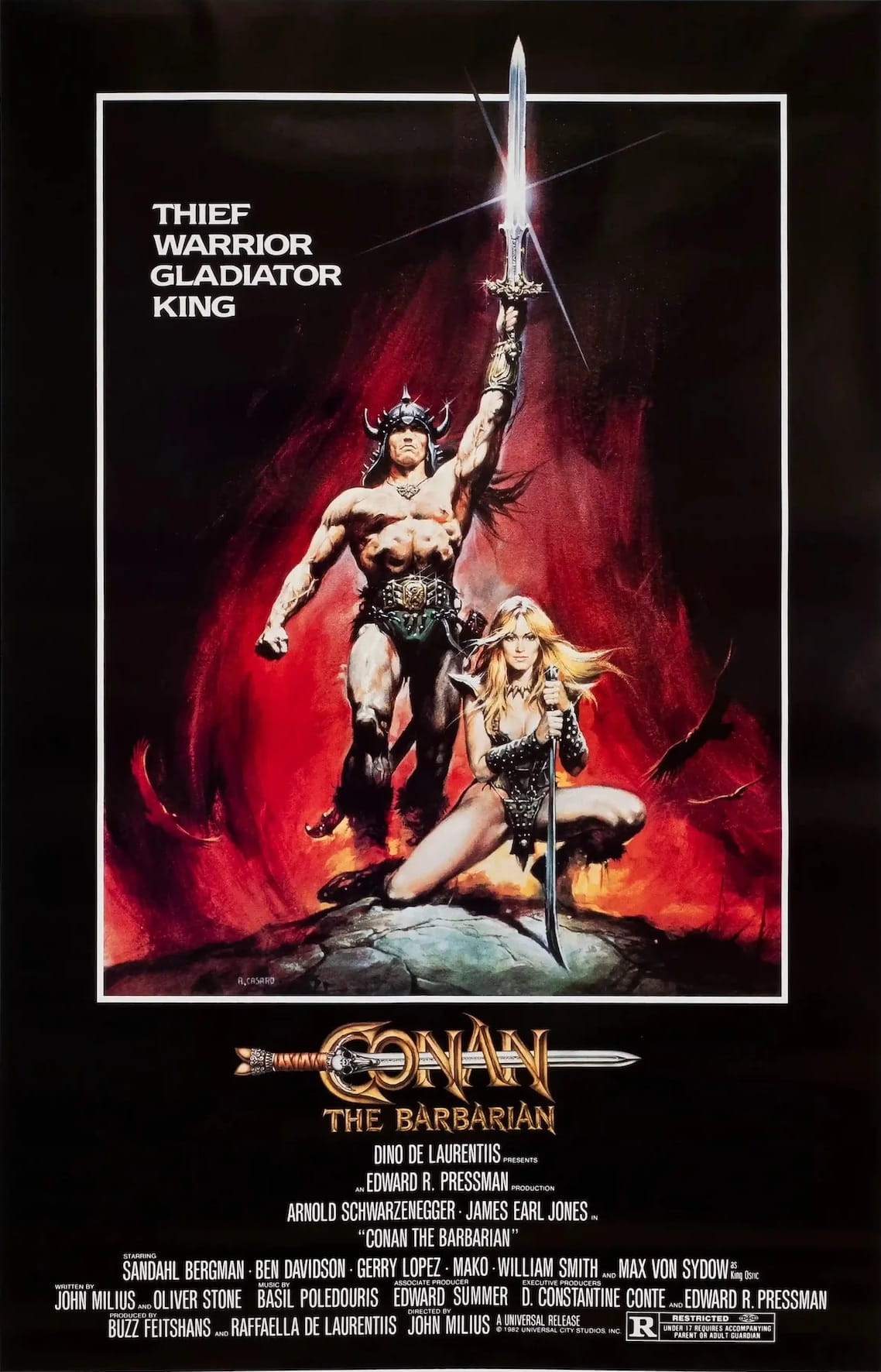 Conan the Barbarian (Universal Pictures, May 14, 1982)
Conan the Barbarian (129 minutes; 1982)
Conan the Barbarian (Universal Pictures, May 14, 1982)
Conan the Barbarian (129 minutes; 1982)
Written by John Milius and Oliver Stone. Directed by John Milius.
Based on the Conan stories by Robert E. Howard.
The first film adaptation of Robert E Howard’s greatest creation: the Cimmerian warrior who was a thief, soldier, pirate, mercenary and king. We get at least a glimpse of most of those here, even if in a somewhat distorted form.
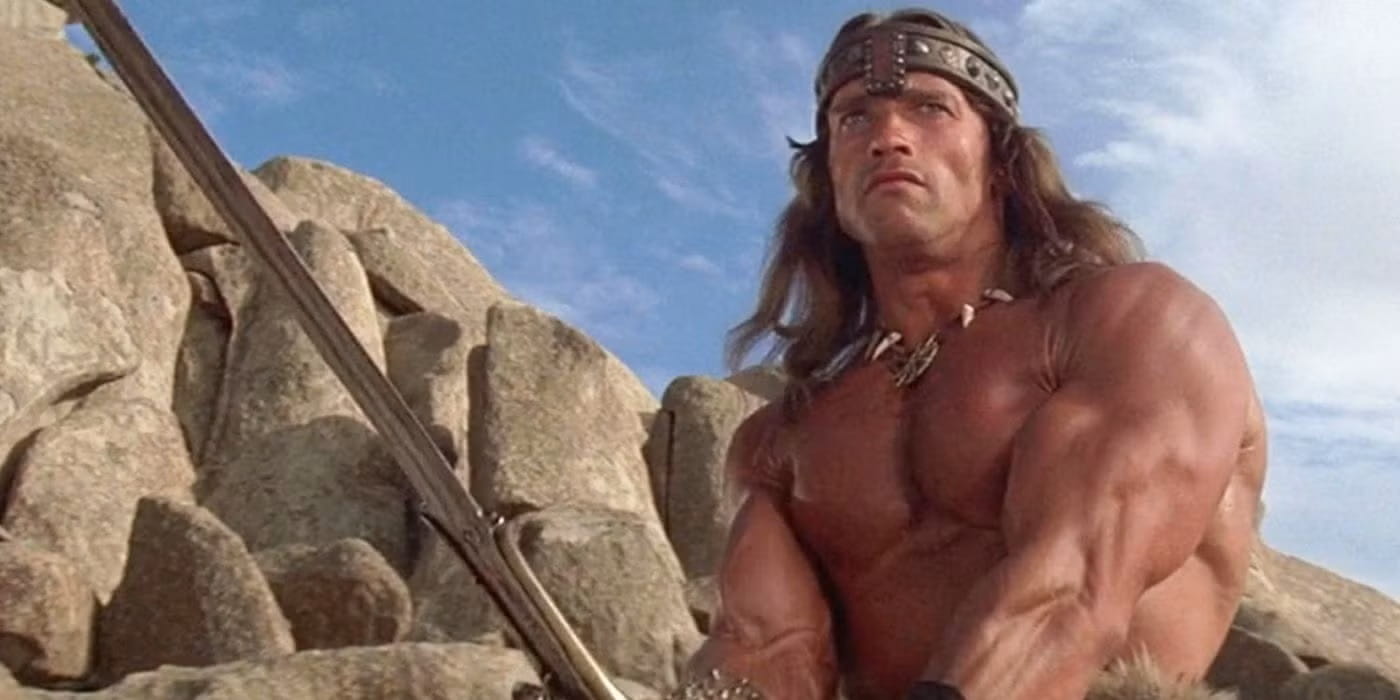 Arnold Schwarzenegger as Conan
Noteworthy
Arnold Schwarzenegger as Conan
Noteworthy
The original script for the movie was written by Oliver Stone (Platoon; JFK) under the influence of a whole lot of drugs. It would’ve run at least four hours, and featured Conan in a sort of Thundarr the Barbarian post-apocalyptic future hellscape, battling an army of 10,000 mutants.
The production company struggled to find a suitable director, at one point considering Stone and also looking at Ridley Scott. Scott, coming off the filming of the first Alien movie, turned them down. (There’s an alternate timeline where we got Alien vs Conan. And I would’ve been there for it.)
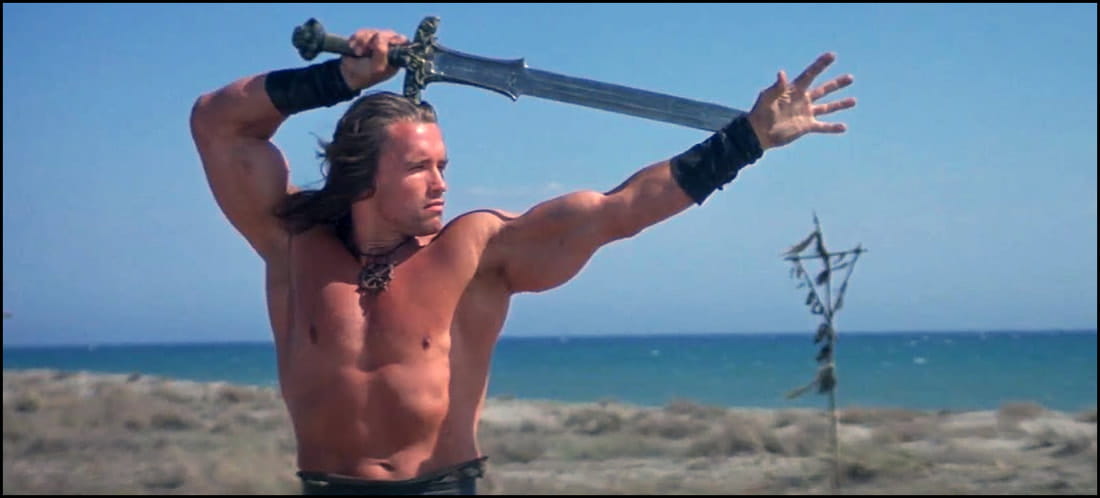
Finally John Milius, who had written the screenplays for Clint Eastwood’s Dirty Harry (1971) and Magnum Force (1973), agreed to direct the film — if he could rewrite Stone’s screenplay. No one objected to that idea. Milius was already contracted to do his next film for Dino De Laurentiis, so he convinced the producer to make Conan that movie.
Milius combined elements from various Conan stories by Robert E. Howard for his rewrite of the script, as well as borrowing the villain (Thulsa Doom) from the stories of another Howard creation, Kull the Conqueror.
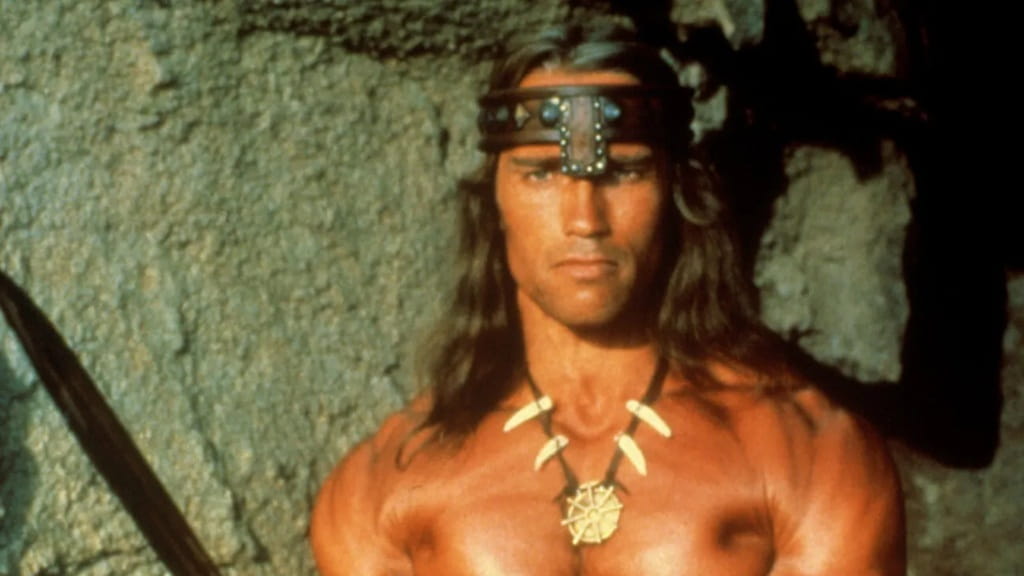
After the producers saw Arnold Schwarzenegger’s bodybuilding film, Pumping Iron, they agreed he was the clear choice for the title role. They did, however, require him to slim down from a massive, muscular 240 to a more lithe 210 pounds, through a regimen of rope climbing, horseback riding and swimming.
This was the breakout role for Schwarzenegger, who would go on to dominate action cinema for years. Other actors who were considered include Charles Bronson, Lou Ferrigno and Sylvester Stallone. Ferrigno and Stallone are predictable, but a Charles Bronson Conan would certainly have been… something. I’m not sure what, though. He might have made a better Subotai.
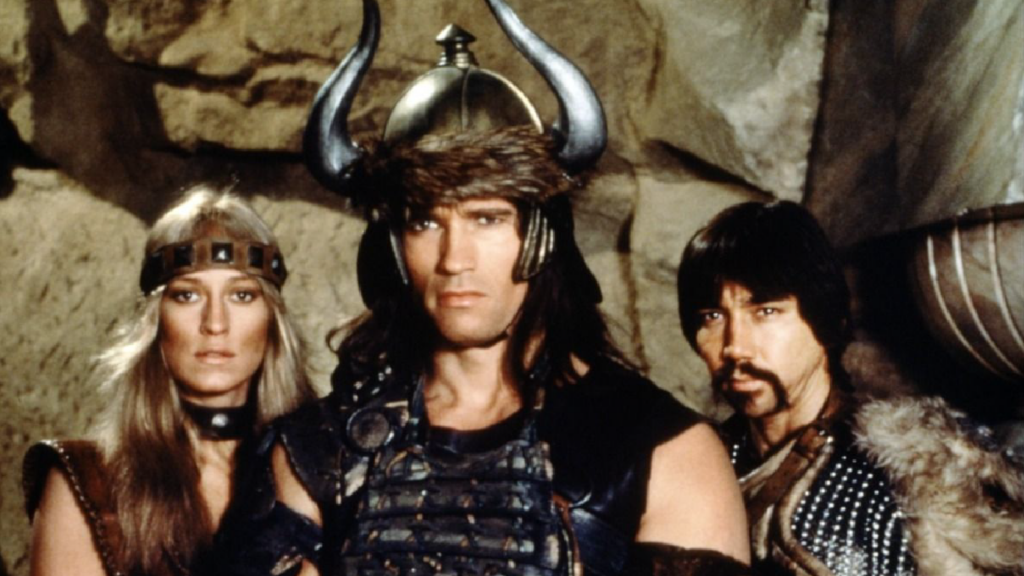 Sandahl Bergman as Valeria, Arnold Schwarzenegger as Conan, and Gerry Lopez as Subotai
Interestingly, Conan’s two allies in the film were also played by relative newcomers. While Schwarzenegger’s background was bodybuilding, Gerry Lopez (Subotai) was a champion surfer, and Sandahl Bergman (Valeria) was a dancer who had appeared in Bob Fosse’s All That Jazz. All three performed their own stunts, but none of them pleased Milius with their initial acting performances. Schwarzenegger was subjected to intensive speech training in a (failed) attempt to reduce his heavy Austrian accent, while Lopez’s lines ultimately were overdubbed by another actor. When James Earl Jones joined the cast, he began helping coach Arnold on his line delivery.
Four carbon steel copies each were forged of Conan’s father’s sword and the Atlantean sword he finds in a tomb, at a cost of $10,000 each. These were used for closeup filming. Lighter versions used in combat scenes were made from aluminum and fiberglass. Some were able to retract their blades to simulate a killing blow, and others could spray blood from their tips.
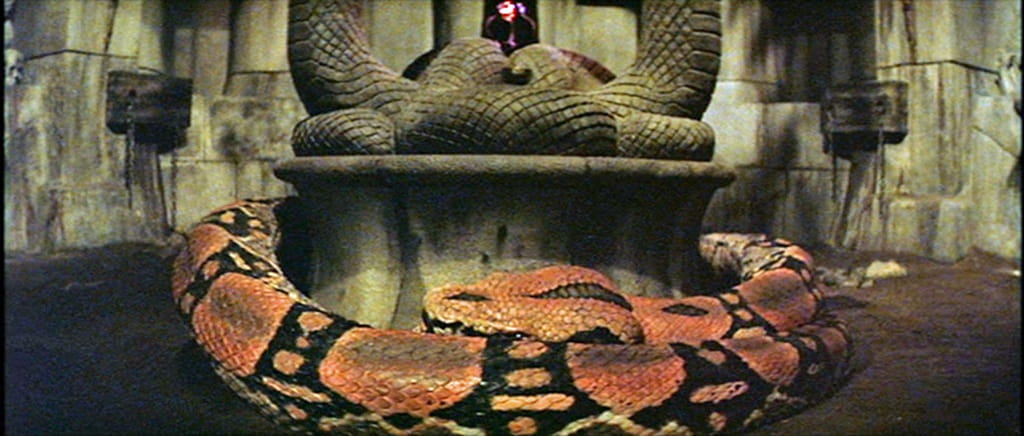 Conan the Barbarian: The giant snake
The giant snake Conan kills was over 35 feet long and cost $20,000 to create. It was so large it would not fit onto the set, so only part of it is ever shown on screen. Its skeleton was made from the same material used to build aircraft frames.
Some action scenes were filmed using a remote-controlled camera crane system originally created by Nick Allder during the filming of Dragonslayer.
The movie was shot in five months in various locations in Spain. It took over a year to edit. During that time, editor C. Timothy O’Meara removed several particularly violent scenes to which the studio objected. He then had to piece the movie back together without them, and keep the story comprehensible in the process.
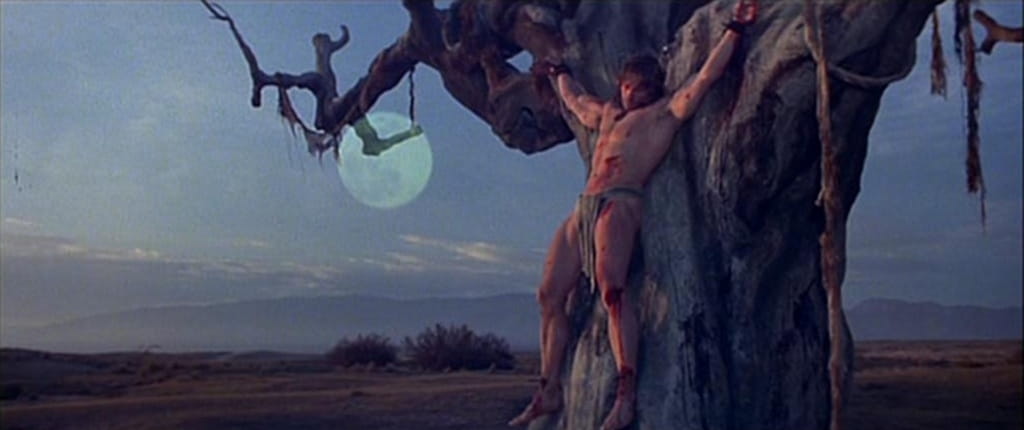 Conan on the Tree of Woe
The musical score for the film, composed by Basil Poledouris, is spectacular and memorable. It was the first film to list Musync, a newly developed music and tempo editing software package, in the credits. Musync allowed Poledouris to compose much of the music before filming had even wrapped, and then alter it to fit the various scenes after they were completed. It was the last film released by a major studio with a mono soundtrack, because producers balked at the extra tens of thousands of dollars required for a stereo score, and because they felt at the time not enough theaters were equipped to handle that anyway.
The film earned around $75 million (on a $20 million budget) in its initial theatrical release. This was considered successful enough that a sequel, Conan the Destroyer, was released two years later. (We’ll cover it soon.)
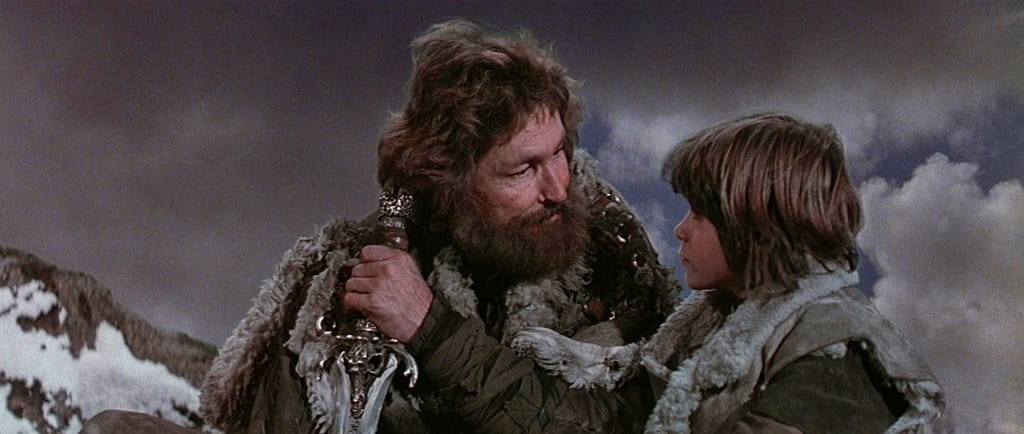 Young Conan and his father
Quick and Dirty Summary
Young Conan and his father
Quick and Dirty Summary
A young barbarian vows revenge on the snake cult leader who killed his parents and destroyed his village. He grows up to be a powerful warrior with a heavy Austrian accent, and teams up with a pair of thieves moonlighting from their surfing and dancing jobs. Eventually he gets the chance to exact his vengeance, slaying the snake cult leader and destroying his temple – but at a price.
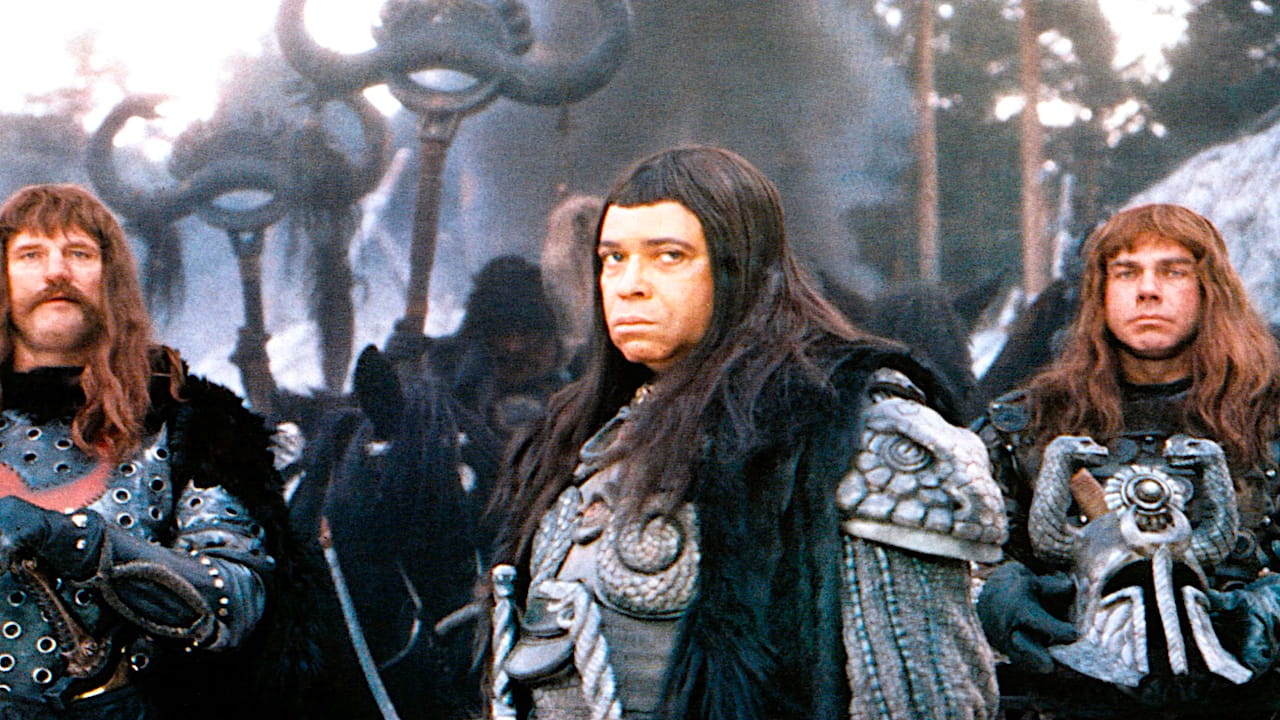 James Earl Jones as Thulsa Doom
Fantasy/SF/Sword & Sorcery Elements
James Earl Jones as Thulsa Doom
Fantasy/SF/Sword & Sorcery Elements
Robert E. Howard literally wrote the book on muscles and steel triumphing over sorcerers, monsters and evil gods. And Conan is the prototypical Sword & Sorcery hero. He greatly dislikes sorcery, but he seems to fare pretty well against it.
This film overflows with Sword & Sorcery elements. The battle with the giant snake is memorable, as is Conan’s showdown with Thulsa Doom’s henchmen. Doom’s slow transformation into a giant snake himself – a remarkable achievement of practical special effects in the days before CGI – comes out of nowhere and shakes things up again.
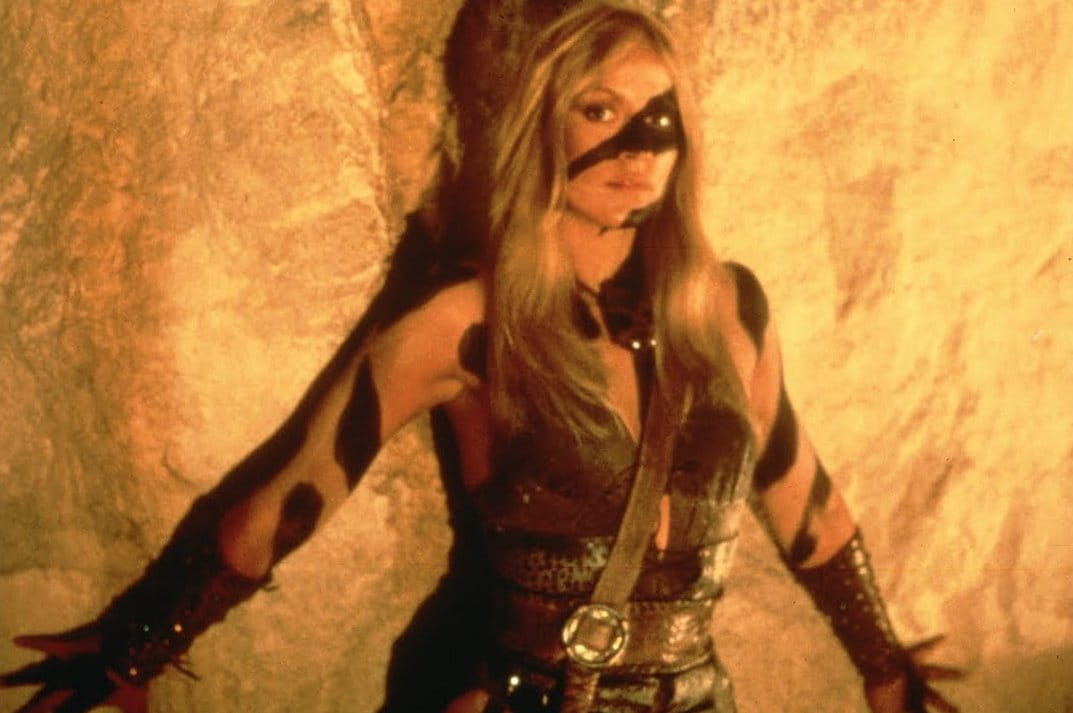 Sandahl Bergman in Conan the Barbarian
High Point
Sandahl Bergman in Conan the Barbarian
High Point
Once Conan becomes “grown-man warrior Conan,” the plot remains fun but it becomes fairly predictable. Full-on Conan isn’t going to lose to anybody in his debut film. At that point, the only questions are, “How will he kill them all?” and “Will any of his allies die along the way?”
I would argue the most interesting portion of the movie is actually the first third, as we watch a young Conan transition from scene to scene in slavery, as a gladiator, and a survivor, all the while learning about the world around him and looking for the cultists who wiped out his village.
And of course there’s the classic moment where he reminds us all what is best in life: “To crush your enemies, see them driven before you, and hear the lamentations of the women!”
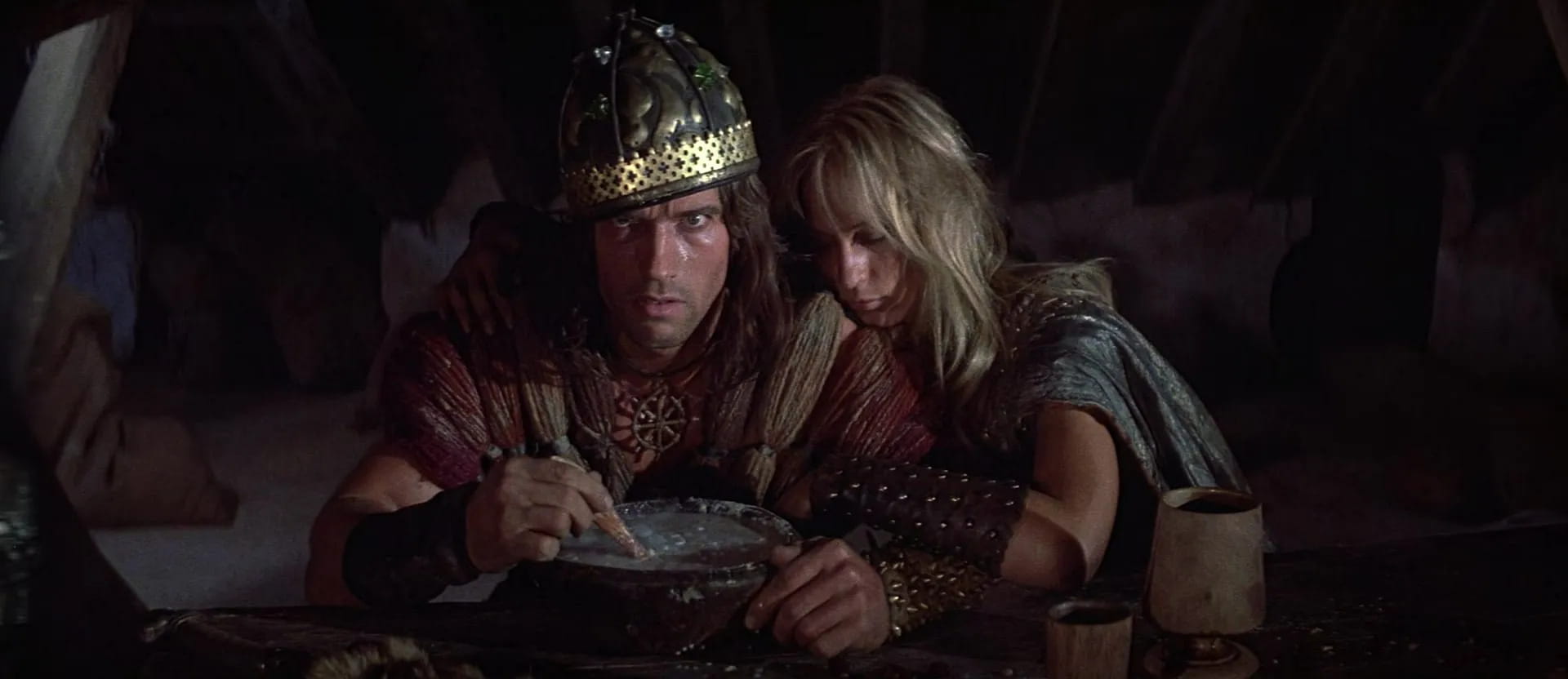 Conan and Valeria
Low Point
Conan and Valeria
Low Point
There’s no question that Schwarzenegger’s performance here, at the very start of his career, is iconic and enjoyable. But it’s a situation similar to “movie James Bond vs book James Bond.” In both cases, the movie version of the character is significantly altered from the literary version. Arnold’s Conan is dumbed down. He’s mostly muscle and brute force. At one point, he punches a camel. His reactions are often comical, and some are played for comedy. Howard’s Conan was always capable of winning a fight with his muscles and his sword, but he was also a serious, clever and canny guy, endowed with native smarts and charisma.
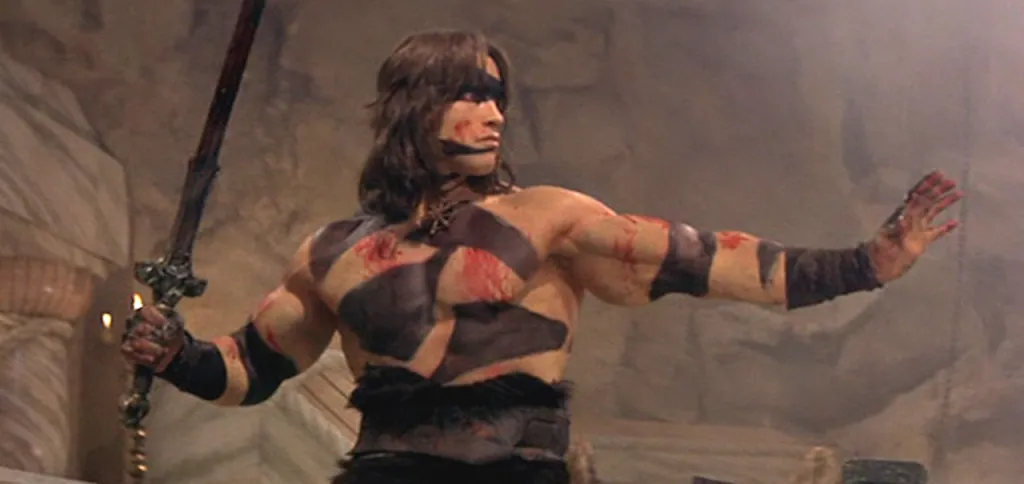
All of the above said, it would be a crime not to give the nod here to Schwarzenegger. This movie would not be half of what it is without his unforgettable presence looming over nearly every frame. He may not exactly be Howard’s Conan, but he’s mesmerizing, entertaining, and entirely awesome.
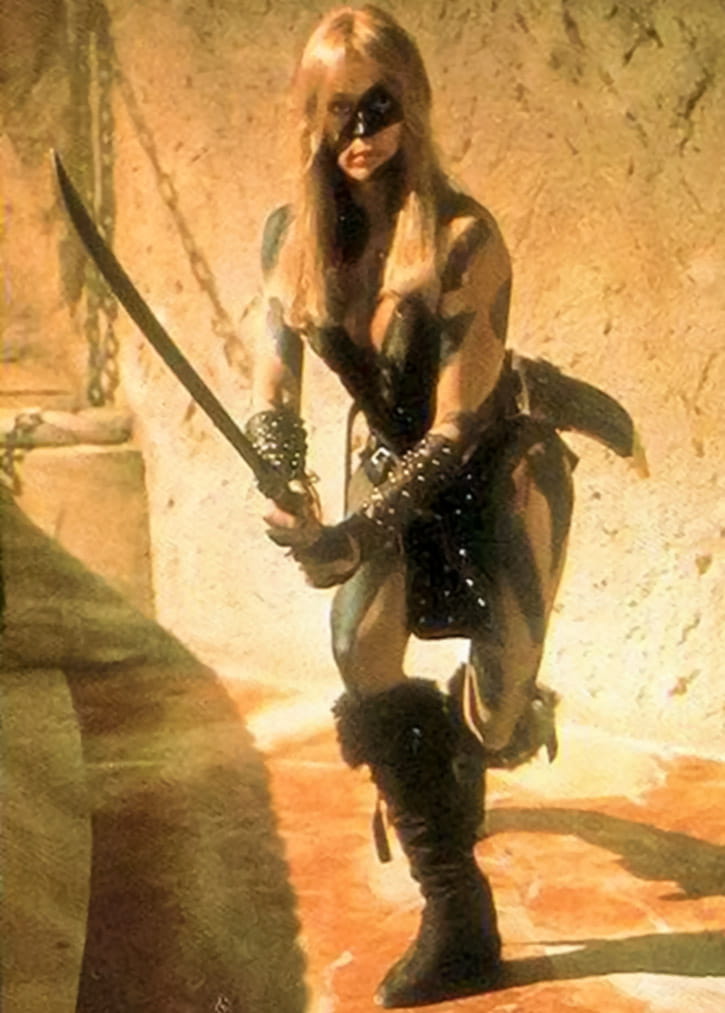 Valeria in action
Overall Evaluation as a Movie and as Fantasy/SF/Sword & Sorcery
Valeria in action
Overall Evaluation as a Movie and as Fantasy/SF/Sword & Sorcery
Conan the Barbarian is an excellent action/adventure movie in general, but it is on the “Mt. Rushmore” of Sword & Sorcery films. It has to be. It brought the greatest hero of the genre to the big screen for the first time. It gave him a worthy opponent and high stakes. It combined drama, action, character and violence, with a touch of humor along the way.
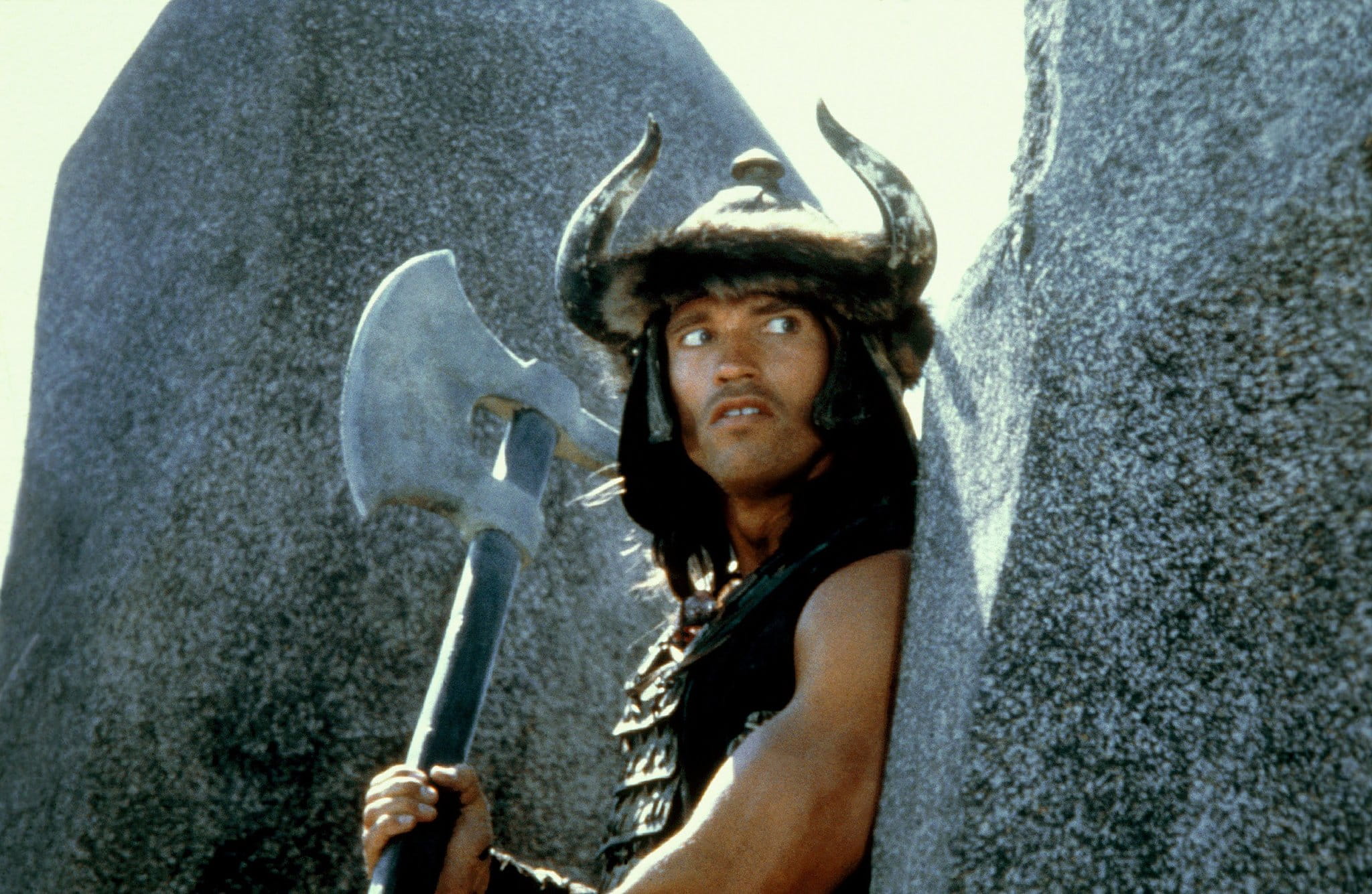
To paraphrase Conan’s prayer to his Cimmerian god: Valor pleases Crom, so perhaps he will grant me one request: That those of you who have not watched this movie will give it a shot.
And if you do not love it, then to hell with you!
Van Allen Plexico is a member of the Science Fiction and Fantasy Writers of America (SFWA), a Grand Master of Pulp Literature (2025 class) and a multiple-award-winning author of more than two dozen novels and anthologies, ranging from space opera to Kaiju to crime fiction to superheroes to military SF. He notably edited, co-created and co-wrote the Sword and Sorcery anthology GIDEON CAIN: DEMON HUNTER. Find all of his works on Amazon and at Plexico.net.
Categories: Fantasy Books
Twin Peaks Meets Arthur Conan Doyle
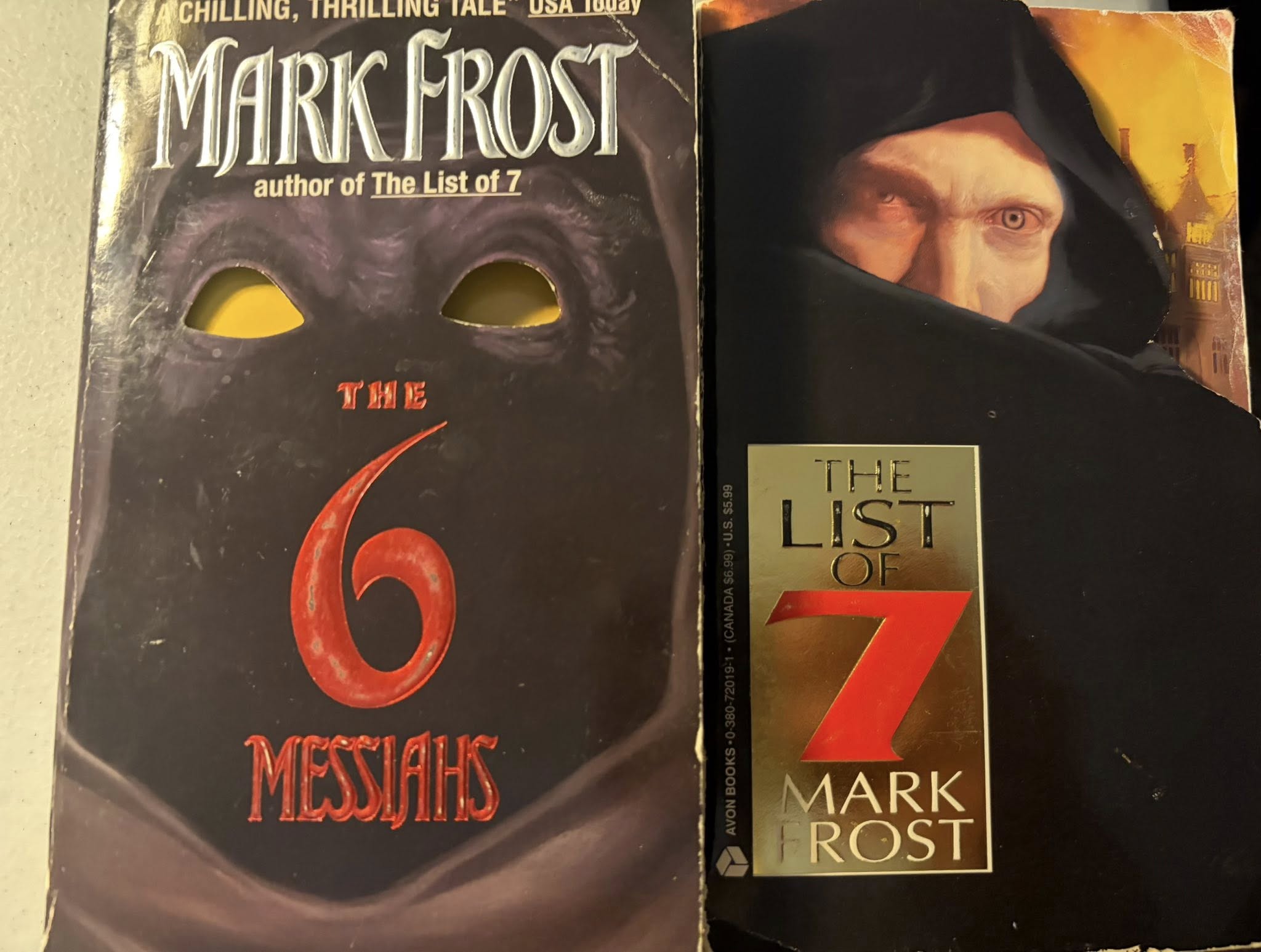
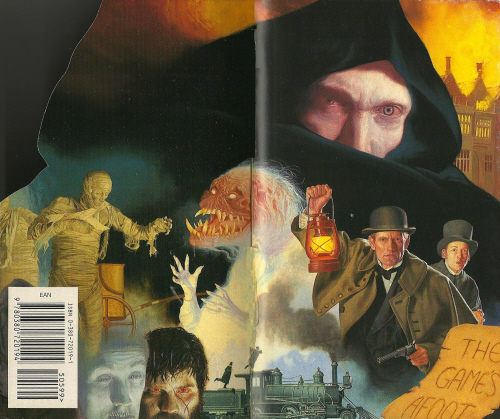 Mark Frost co-created, co-wrote, and co-produced, Twin Peaks. That includes the 2017 reboot (which I abandoned early on. I’m a huge fan of the original series, but the restart did nothing for me.
He also wrote the two Fantastic Four films with Jessica Alba (which I said here, are better than people give it credit), as well as 42 episodes of Hill Street Blues, which was an extremely influential cop show in the eighties.
Frost wrote the dark James Spader movie, Storyville after Twin Peaks ended. And he also wrote a novel, which came out in 1993.
The List of 7 came about because Frost is a Sherlock Holmes fan. Not only is the novel’s protagonist none other than Arthur Conan Doyle and bits of his life are scattered throughout, but there are Holmes-isms aplenty. Thus, the book is a type of pastiche, though darker than any straight Holmes tale I’ve read.
A struggling young doctor who hasn’t yet created Holmes, Doyle receives a mysterious summons to what turns out to be a séance. Really creepy stuff happens, people die, a mysterious rescuer appears, and Doyle spends the rest of the book on the run from a dark conspiracy. Turns out that his completely fictional novel submission, The Dark Brotherhood, exactly mirrors a real group. And as you can guess by the name, it’s a really evil secret organization. Man, don’t you hate it when that happens!
 Doyle’s rescuer, Jack Sparks, clearly has a lot of Sherlock Holmes in him, with some James Bond thrown in. And the main villain certainly brings to mind a ruthless Moriarty. Doyle is a pretty good version of, well, himself.
This is a pulp style horror yarn: More Clark Ashton Smith than Arthur Conan Doyle. It’s lathered in supernatural like a cheap medium in fake ectoplasm. Four hundred pages long, it rollicks along at a breakneck pace: another pulp characteristic. I think that Frost is an over-writer. He uses lots and lots of words. I don’t particularly mind his style, but it certainly feels a bit wordy. This book could be leaner. It works, but it’s noticeable.
I’m not much of a horror fan, but I am a great fan of Robert R. McCammon (I wrote about his nearly flawless ‘coming of age’ novel, Boy’s Life, here). The antagonist brought to mind the villain from his novel, Baal. And that ain’t nice. There is some unpleasant stuff in this book: there’s just no way around it. This secret group is evil.
Now, along with Doyle, we meet Bram Stoker, Prince Edward Albert, and a slightly renamed Sir William Gull (the latter two figuring prominently in the Royal Conspiracy theories about Jack the Ripper).
But you can’t finish a chapter without running into something Sherlockian, which is fun. Sparks has a place on Montague Street, he uses cocaine, he’s brilliant, he has a brilliant brother: you get the idea. The story also nicely dovetails into Doyle’s actual life.
After the main problem has been resolved, there are still a couple of nice little surprises left. If you don’t mind a supernatural edge to your Holmes-like story, this is a pretty good read. Frost really does keep things moving forward at a brisk pace.
I recommend The List of 7 as as a Pulp-style, supernatural thriller with a Sherlock Holmes/Arthur Conan Doyle overlay. That definitely works for me.
THE SEQUELTwo years later, Frost followed up with a sequel, The 6 Messiahs.
Doyle is now an international success, though constantly pestered to bring Holmes back from his supposed death at the Reichenbach Falls. Jack Sparks and Eileen Temple, from the first book, had vanished from his life.
Doyle, accompanied by his (real-life) younger brother, Innes, is off to America for a speaking tour. Shenanigans on shipboard (I like that turn of phrase) draw Doyle into a plan to steal great religious texts as part of an evil plot. Really, Doyle can’t turn around without coming up against some great evil trying to take over the world. It’s like Miss Marple or bakers on Hallmark, finding a dead body every time they leave the house!
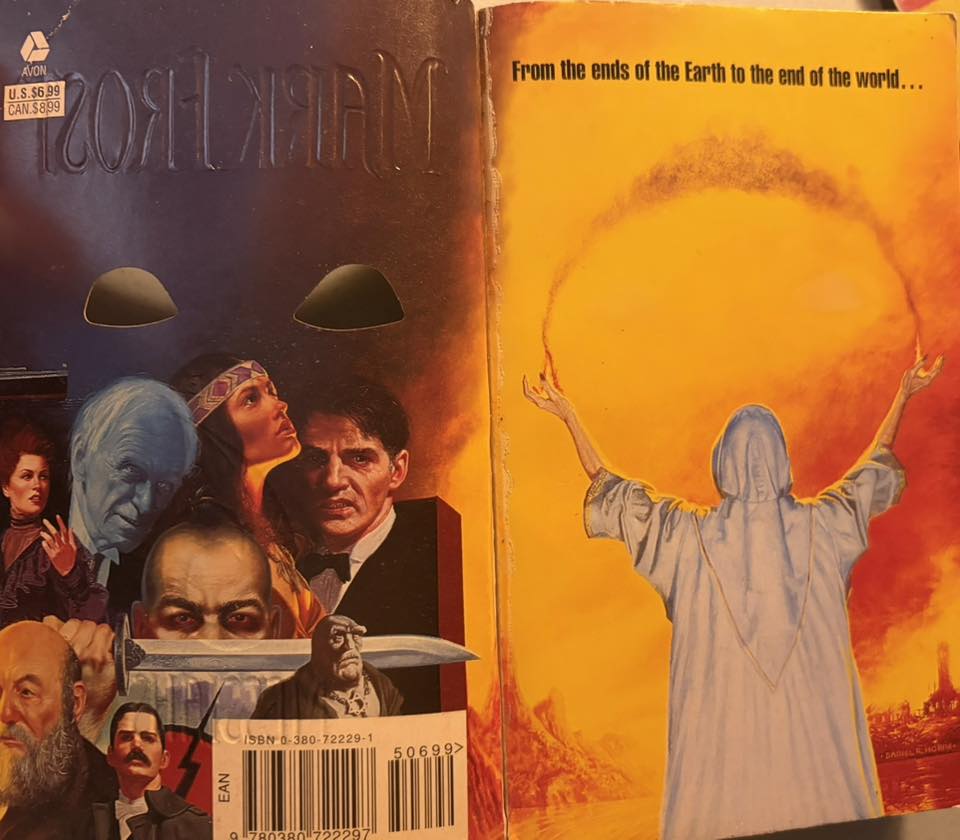 Turns out five folks have had dreams of a great black tower rising out of the desert and events bring heroes and villains together for an epic showdown. “Five,” you say? Yep, you’ll have to guess who the sixth messiah is.
Unlike List, Messiahs is very much an American/Old West adventure. And there’s a Mormon feel to the religious commune. It doesn’t feel as action-packed as its predecessor. This one moves forward at a more leisurely pace. I think it’s in part because there’s much less a sense of imminent danger for Doyle this time around.
Anyone who enjoyed List should certainly read Messiahs, though I think it is markedly the lesser of the two. Nothing wrong with it, just not as good a book.
Mark Frost will forever be known (with David Lynch) for Twin Peaks. But he’s also got a foot in the Holmes door with these two dark, Pulpy novels about Arthur Conan Doyle. I’d certainly like to see it become a trilogy, but after thirty years of silence about it, I don’t think so.
Check out The List of 7. You won’t be disappointed.
Bob Byrne’s ‘A (Black) Gat in the Hand’ made its Black Gate debut in 2018 and has returned every summer since.
His ‘The Public Life of Sherlock Holmes’ column ran every Monday morning at Black Gate from March, 2014 through March, 2017. And he irregularly posts on Rex Stout’s gargantuan detective in ‘Nero Wolfe’s Brownstone.’ He is a member of the Praed Street Irregulars, and founded www.SolarPons.com (the only website dedicated to the ‘Sherlock Holmes of Praed Street’).
He organized Black Gate’s award-nominated ‘Discovering Robert E. Howard’ series, as well as the award-winning ‘Hither Came Conan’ series. Which is now part of THE Definitive guide to Conan. He also organized 2023’s ‘Talking Tolkien.’
He has contributed stories to The MX Book of New Sherlock Holmes Stories — Parts III, IV, V, VI, XXI, and XXXIII.
He has written introductions for Steeger Books, and appeared in several magazines, including Black Mask, Sherlock Holmes Mystery Magazine, The Strand Magazine, and Sherlock Magazine.
You can definitely ‘experience the Bobness’ at Jason Waltz’s ’24? in 42′ podcast.
Categories: Fantasy Books
Military Cyborgs, Alien Plants, and Desert Heists: January-February 2026 Print Science Fiction Magazines
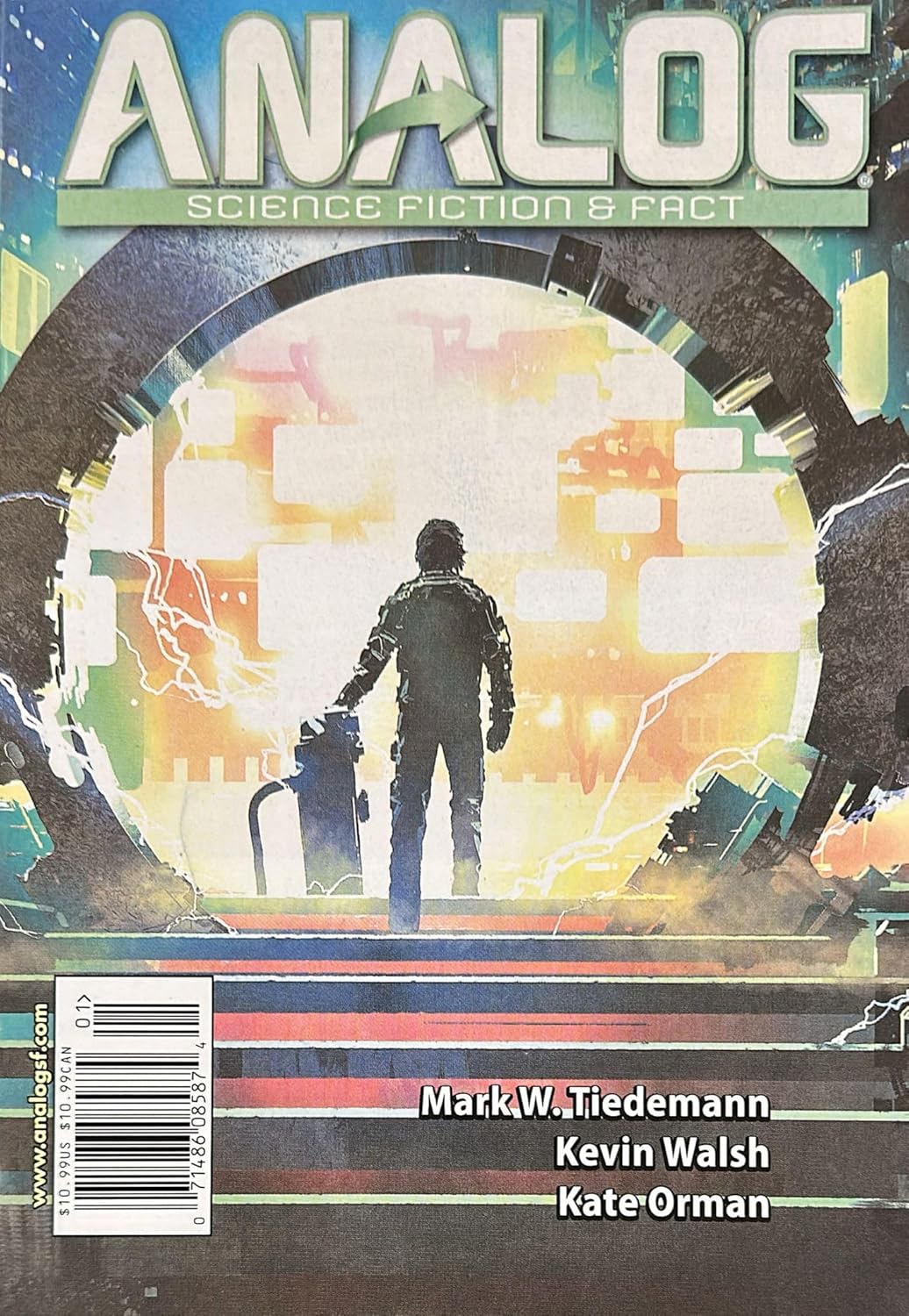

The January-February issues of Analog Science Fiction & Fact and
Asimov’s Science Fiction. Cover art by Tithi Luadthong and Dominic Harman
We’ve settled into a new reality with Analog and Asimov’s SF. Both magazines are consistently running more than two months late, but both are at least on a predictable schedule, arriving regularly in two-month intervals. Readers more observant than I have pointed out that the publisher, Must Read Magazines, has removed the cover date and Next Issue date from the covers entirely, which was probably a good idea.
They do provide semi-regular updates online, and on March 31st Emily Alta Hockaday, Managing Editor at Dell Magazines, posted this in the Analog Science Fiction and Fact Magazine Fan Club on Facebook in response to a question on postal delivery.
We’re in the process of switching printers — both because of print quality and the delays we’ve experienced with them. Once we have the contract with the new printer figured out, I’ll have warehouse dates to share for both March/April and May/June.
Hopefully that change will help them gradually get back on schedule. In other news, Sheila Williams continues to recover from the brain aneurysm she suffered two months ago. She remains hospitalized, but her family posts occasional updates, including the delightful photo of Sheila below.
 The unstoppable Sheila Williams, in a photo posted by her daughter Irene (with the caption “Felt cute might delete later”). That stare!
Until Sheila returns, Emily Hockaday continues to act as interim editor of Asimov’s.
As usual, the latest issues have plenty to offer science fiction fans, including new stories by Alexander Jablokov, William Preston, Adam-Troy Castro, Susan Palwick, Sean Monaghan (twice!), Jack Skillingstead, Will Ludwigsen, Lavie Tidhar, James Sallis, Mark W. Tierdermann, Geoffrey Hart, Matt McHugh, Jo Miles, Rich Larson, and many more.
Victoria Silverwolf at Tangent Online enjoyed the latest Analog.
“Sin Eaters” by Mark W. Tiedemann is the lead novelette. A police officer rescues alien children from a man who kidnapped and tortured them. The adult aliens refuse to press charges. The officer tries to figure out the motives of the man and the aliens, while dealing with his own emotional trauma. This is a powerful story that deals with issues of guilt, atonement, and psychological healing in a thoughtful and mature fashion. It also provides an example of true, profound friendship, rarely seen in fiction.
In the novelette “The Origami Man” by Doug Franklin, a fishing boat discovers what seems to be a drowned man in the middle of the ocean. The being turns out to be alive, and something other than human. It goes on to interact with the man who found it in a special way. At first, the mood is that of a horror story, with the entity compared to a zombie or a shape-shifting alien. The conclusion changes the tone drastically, in a way that some may find a bit too sentimental. The story is most notable for a vivid portrait of its Alaskan setting.
“You Who Sought the Stars’ Distant Light” by Stewart C. Baker is narrated by what was once the mind of a human being, now the consciousness of a starship. It defends itself against an intruder, only to discover its former relationship with the person invading it. The revelation of the narrator’s previous life, now forgotten, offers emotional appeal.
“Unsung” by Derrick Boden features a man who has been genetically engineered and prosthetically enhanced to become a military cyborg, destined to be a hero in a war taking place across the solar system. He participates in many battles, becoming less human each time, until he learns the truth about his origin and purpose. This is a dark, cynical story, with multiple deceptions involved in the plot.
The title character in “And She is Content” by Frank Ward is an artificial intelligence running a starship while the crew and passengers are in hibernation. Once a century during the long voyage the people wake up and enjoy the pleasures of a city created for them. The AI panics when the journey is complete, now that she has no purpose and will lose the company of the ship’s commander. This is a romantic science fiction story, reminiscent of Anne McCaffrey’s 1961 story “The Ship Who Sang” and its sequels. The once-a-century city is compared to the one featured in the 1947 musical Brigadoon. The AI and the Commander are referred to as the famous medieval lovers Heloise and Abelard. These allusions create a wistful, nostalgic mood that will appeal to softhearted readers.
“Linka’s Out” by Rich Larson takes place on a mining planet. The protagonist travels to the planet’s prison to meet the title character when she is released. The reunion leads to a shocking conclusion. This is a gloomy and hopeless tale, set on a harsh world dominated by an autocratic corporation. A hint to the story’s mood appears very early in the text, when the reader learns that the bodies of dead workers are recycled into raw material. The discovery that the main character makes at the prison is particularly gruesome.
All the characters in “Iron Star Swing” by Kate Orman are beings made up of subatomic particles, although they appear to each other as people or even as inanimate objects. They live on the surface of the sun, which is now a black dwarf in the immensely far future. They feed on neutrinos that reach the sun from stars that become novae. The plot involves a wounded warrior in a war that has lasted trillions of years and a young being who sometimes takes the form of a boy and sometimes of a firetruck. As can be seen, this story is most notable for its bizarre setting and characters.
Read Victoria’s complete review here.
The new Asimov’s is reviewed by Mina at Tangent Online. Here’s an excerpt.
“The Greenway” by Susan Palwick is an odd story, but it grows on you. The narrator is alone with her two children when the caravan comes bringing the “greenway” with it. We learn that all people eventually begin to sprout plants (a new meaning for “gone to seed”), which slowly kills them. But the sprouting bodies bring a new fertility that is spread every spring by the caravan. The bitter-sweet ending stays with you.
“Ecobomb” by Alexander Jablokov is an invasion story that doesn’t take itself too seriously. The aliens are truly alien, sending “ecobombs” to change the ecosystems on the planet they are invading. But the humans on the Earth adapt to the changes and start working with the new flora and fauna to create hybrids. They create biocomputers and, through cooperation, they not only survive but are ready when the alien invaders arrive. The story grows on you like an unpleasant fungus.
“The Man with the Ruined Hand” by Sean Monaghan starts with a heist in the middle of a desert of a distant planet. Cliff is sent to catch the thief but finds himself in the middle of a double cross. It feels like the author wanted to create a Philip Marlowe vibe, but Raymond Chandler did it better.
In “Replacement Theory” by Jack Skillingstead, Tyler suddenly starts seeing everyone around him as monsters, including his girlfriend Emma. Does he have a brain defect or is he surrounded by aliens? Then he meets someone else with the same problem. But who can he trust?
“The Imaginative Youngster’s Handbook to UFOs” by Will Ludwigsen is one of those short stories I really like — a wonderful surprise. What starts off reading like a book for intelligent and imaginative youngsters slowly gains an emotional depth that is truly heart-rending. We begin to care very much about one particular child, who experiences abuse and bullying in their daily life, yet who manages to keep wonder alive inside themselves despite their loneliness. There is gentle humour and questioning of things adults hold to be self-evident but, mostly, there is compassion and a desire not to be a person who hurts others just because you have been hurt yourself. What’s particularly well done is the mix of a child’s logic with adult understanding. I would read this more than twice!
“As Long As We’re Still Here, We Might As Well Dance” by Adam-Troy Castro continues our descent into grimness. We watch the last moments of two people who did not flee when the Nihilators arrived to destroy and “repurpose” their city, including anyone left alive in it. We see love and defiance, and an unwillingness to die. The real tragedy is that both protagonists stayed because each in their own way believed they deserved to be damned.
“The Lady in Camo” by John Richard Trtek is a detective story with references to Blade Runner, Chandler, and Sherlock Holmes. Jack Twice is hired to find a missing person. It’s a world filled with clones, soft deaths and partial resurrections. I wanted to like this story but just couldn’t fully engage with it. The last few lines are good, making you wish the rest of the story had lived up to them.
Read Mina’s complete review here.
Here’s all the details on the latest SF print mags.
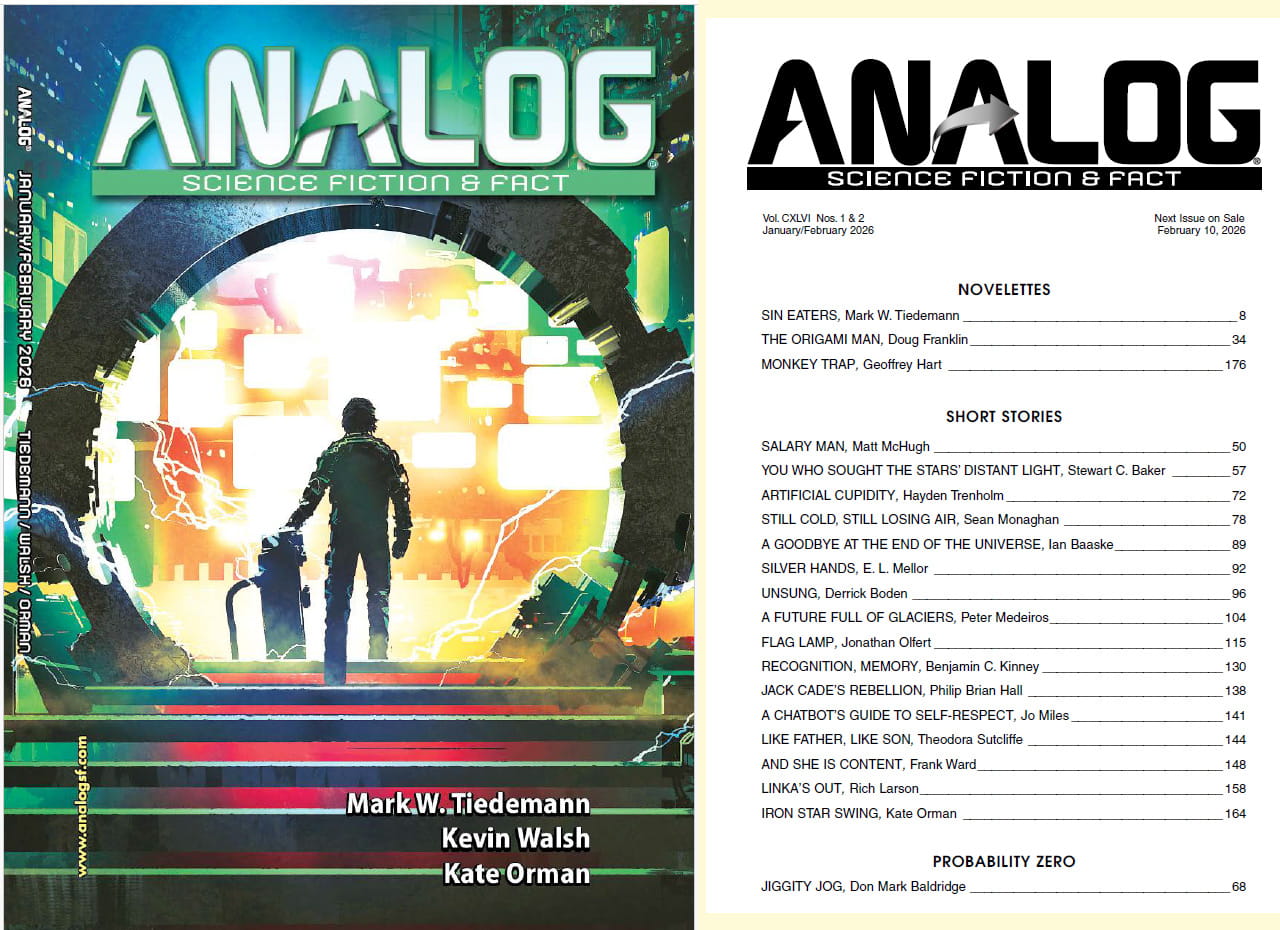 Analog Science Fiction & Fact Magazine January/February 2026 contents
Analog Science Fiction & Science Fact
Analog Science Fiction & Fact Magazine January/February 2026 contents
Analog Science Fiction & Science Fact
Editor Trevor Quachri gives us a tantalizing summary of the current issue online, as usual.
This issue’s opening salvo of 2026 stories continues right on into a furious fusillade of fiction next issue, including:
“Sin Eaters,” by Mark W. Tiedemann: how do you investigate — let alone prosecute — a crime when the societal standards violated are so alien that we can hardly recognize them?; A slick interstellar heist (…or is it?) in “The Starworthy Slip,” by AC Koch; a particle-scaled solar fable in “Iron Star Swing” by Kate Orman; a sweet burgeoning romance that mingles with a perspective on a deep geological timescale to reveal something else entirely, in Peter Medeiros’ “A Future Full of Glaciers”; a salvage crew that thinks they’ve found signs of intelligent life only to realize that the life may have anticipated them more keenly then they’d like, in Geoffrey Hart’s “Monkey Trap”; a look at the realities of building permanent settlements on the Moon, in “Homes Away From Home,” our Fact Article for the issue, by Michael W. Carroll; and more, from Doug Franklin, Howard V. Hendrix, Theodora Suttcliffe, Sean Monaghan, Matt McHugh, and others, plus, of course, all our regular columns, including an additional Guest Alternate View from Richard A. Lovett on AI and conspiracy theories (sadly, ever more relevant by the day); as well as our annual Index and Analytical Laboratory ballot.
Here’s the full TOC.
Novelettes
“Sin Eaters” by Mark W. Tierdermann
“The Origami Man” by Doug Franklin
“Monkey Trap” by Geoffrey Hart
Short Stories
“Salary Man” by Matt McHugh
“You Who Sought the Star’s Distant Light” by Stewart C. Baker
“Artificial Cupidity” by Hayden Trenholm
“Still Cold, Still Losing Air” by Sean Monaghan
“A Goodbye at the End of the Universe” by Ian Baaske
“Silver Hands” by E.L. Mellor
“Unsung” by Derrick Boden
“A Future Full of Glaciers” by Peter Medeiros
“Flag Lamp” by Jonathan Olfert
“Recognition Memory” by Benjamin C. Kinney
“Jack Cade’s Rebellion” by Philip Brian Hall
“A Chatbot’s Guide to Self-Respect” by Jo Miles
“Like Father, Like Son” by Theodora Sutcliffe
“And She is Content” by Frank Ward
“Linka’s Out” by Rich Larson
“Iron Star Swing” by Kate Orman
Probability Zero
“Jiggity Jog” by Dan Mark Baldridge
Science Fact
Nor Any Drop to Drink by Kevin Walsh
Special Features
The War, Astounding, and Campbell by Edward M. Wysocki, Jr.
Me-N-You-Genics by Howard V. Hendrix
Poetry
Escape Pod by S.L. Johnson
The Bones They Left by Stanley Poole
Reader’s Departments
Editorial: The State of the Union by Trevor Quachri
In Times to Come
The Alternate View by John G. Cramer
In Memoriam: J.T. Sharrah by Emily Hockaday
In Memoriam: Bruce Boston by Emily Hockaday
Guest Alternate View by Richard A. Lovett
Unknowns, edited by Alec Nevala-Lee: Time Lapse by Todd McClary
The Reference Library by Sean CW Korsgaard
Brass Tacks
2025 Index
Analytical Laboratory Ballot
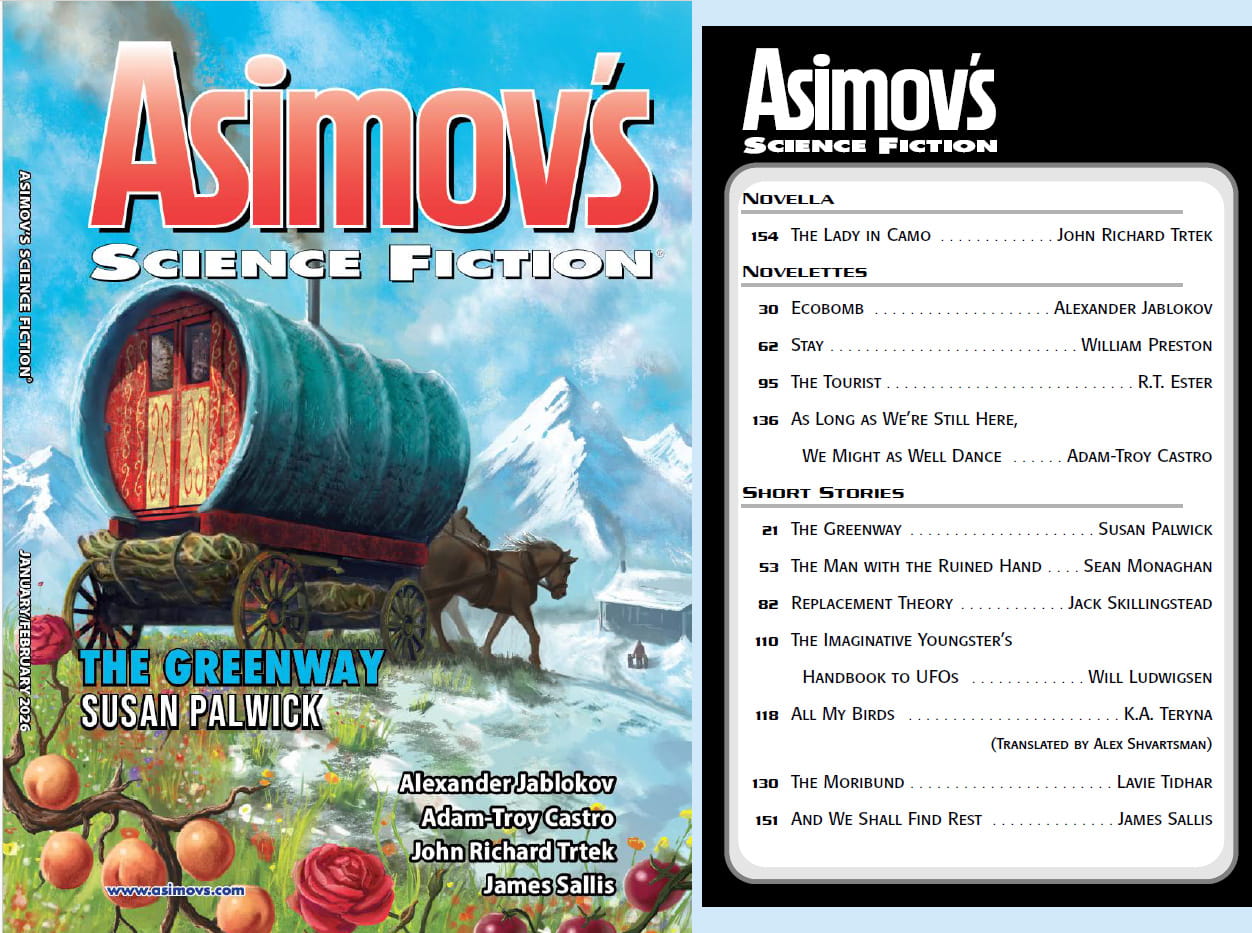 Asimov’s Science Fiction Magazine January/February 2026 contents
Asimov’s Science Fiction
Asimov’s Science Fiction Magazine January/February 2026 contents
Asimov’s Science Fiction
Sheila Williams provides a brief summary of the latest issue of Asimov’s at the website.
We have a lively bunch of stories in our January/February 2026 issue! John Richard Trtek’s novella teems with intrigue, deceit, danger, and the mystery of “The Lady in Camo,” while Alexander Jablokov’s novelette, “Ecobomb,” is a tense yet often amusing tale about the unanticipated consequences of an alien invasion!
William Preston tells a moving story about a dying man, his sister, his robot double, and his best friend in “Stay”; James Sallis’s characters calmly face alien visitors and the death of half of humanity in “And We Will Find Rest”; in his first sale to Asimov’s, R.T. Ester tells a complicated tale about “The Tourist”; also new to Asimov’s, well-known author Adam-Troy Castro’s characters enjoy a final day of freedom in “As long as We’re Still Here, We Might as Well Dance”; some young men experience serious breakdowns in Jack Skillingstead’s “Replacement Theory”; a woman faces an unusual condition in K.A. Teryna’s lovely story about “All My Birds” (this tale was translated from Russian by Alex Shvartsman); another woman faces mysterious strangers and an illness along “The Greenway” in Susan Palwick’s new story; Sean Monaghan reveals why you shouldn’t trust “The Man with the Ruined Hand”; a woman copes with an extreme fetish in “The Moribund” by Lavie Tidhar; and Will Ludwigsen charms us with “The Imaginative Youngster’s Handbook to UFOs.”
Robert Silverberg’s Reflections considers: “The Multiplicity of Mermaids”; James Patrick Kelly’s On the Net looks at AI audio and says, “Welcome to Just Okay”; Kelly Jennings’s On Books reviews works by Mary Soon Lee, Ray Nayler, Chuck Tingle, Charlie Jane Anders, and others; Kelly Lagor’s Thought Experiment shines a light on “Bradbury and Truffaut’s Empathy in Fahrenheit 451”; plus we’ll have an array of poetry, our yearly Index, and our 40th Annual Readers’ Award ballot!
You’ll find our January/February 2026 issue on sale at newsstands on December 8, 2025. Or subscribe to Asimov’s—in paper format or our own downloadable varieties — by visiting us online at www.asimovs.com. We’re also available individually or by subscription via Amazon.com’s Kindle Unlimited, BarnesandNoble.com’s Nook, and Magzter.com/magazines!
Here’s the complete Table of Contents.
Novella
“The Lady in Camo” by John Richard Trtek
Novelettes
“Ecobomb” by Alexander Jablokov
“Stay” by William Preston
“The Tourist” by R.T. Ester
“As Long as We’re Still Here, We Might as Well Dance” by Adam-Troy Castro
Short Stories
“The Greenway” by Susan Palwick
“The Man with the Ruined Hand” by Sean Monaghan
“Replacement Theory” by Jack Skillingstead
“The Imaginative Youngster’s Handbook to UFOs” by Will Ludwigsen
“All My Birds” by K.A. Teryna (Translated by Alex Shvartsman)
“The Moribund” by Lavie Tidhar
“And We Shall Find Rest” by James Sallis
Poetry
Monster by Megan Branning
The Freetown Bar and Bookstore by M.C. Childs
Thirty-Six Views of the Milky Way by Connor Yeck
Closing Time by Brian U. Garrison
Humans Make Anything Their Pets by Dawn Vogel
Departments
Editorial: WorldCon Extraganza by Sheila Williams
Reflections: The Multiplicity of Mermaids by Robert Silverberg
On the Net: Welcome to Just Okay by James Patrick Kelly
Thought Experiment: Bradbury and Truffaut’s Empathy in Fahrenheit 451 by Kelly Lagor
2025 Index
Asimov’s Readers’ Awards Ballot
On Books by Kelly Jennings
Next Issue
Analog, Asimov’s Science Fiction and The Magazine of Fantasy & Science Fiction are available wherever magazines are sold, and at various online outlets. Buy single issues and subscriptions at the links below.
Asimov’s Science Fiction (208 pages, $9.99 per issue, one year sub $57.75 in the US) — edited by Sheila Williams
Analog Science Fiction and Fact (208 pages, $10.99 per issue, one year sub $57.75 in the US) — edited by Trevor Quachri
The Magazine of Fantasy & Science Fiction (208 pages, $12.99 per issue, one year sub $46.95 in the US) — edited by Sheree Renée Thomas
The January-February issues of Asimov’s and Analog are officially on sale until mid-February, but since that was almost two months ago and the magazines are still on sale, I suspect they’ll be on shelves a little longer than that. No word on when to expect the next F&SF, but let’s say 2027 to be on the safe side.
See our coverage of the November-December 2025 issues here, and all our recent magazine coverage here.
Categories: Fantasy Books
Sumptuous visuals and brilliant writing in an Indie RPG? Clair Obscur: Expedition 33 Has it All
 Clair Obscur Expedition 33, developed Sandfall Interactive and published by Kepler Interactive April 24, 2025
So… if you are an enthusiast of single player RPGs and have not spent any time thoroughly engrossed in this modern masterpiece, you’re either buried under a pile of rubble or not allowing yourself enough time for brilliant escapism.
In either case, you’re missing out on what was unequivocally the 2025 GOTY.
I’ll work up a proper review at some point but am simply too busy playing this stunning piece of interactive art with all of my spare time to do so now.
 Fighting the giant head in Clair Obscur: Expedition 33
My very short take, aside from the above, is that this is essentially the game that Square Enix has been wishing they could have produced over the last two decades. I truly do not remember the last time I played a game that checked every box I have on my list of desired qualities after a lifetime of video games.
Fresh, engaging mechanics, sumptuous visuals, deeply developed world-building, top shelf voice acting, brilliant writing with staggering emotional depth, and the most phenomenal score since Final Fantasy VII.
All from a tiny French studio with barely more than 30 team members, most of whom are Ubisoft refugees.
Buy it, play it, support Sandfall Interactive. But even if they never produce another game again, their debut masterwork will prove to be an enduring legacy in the field for decades to come.
Joshua Dinges’s last game review for Black Gate was Return of the Obra Dinn.
Categories: Fantasy Books
Forgotten Authors: P. Schuyler Miller
 P. Schuyler Miller
Peter Schuyler Miller was born on February 21, 1912 in Troy, New York. He earned a Master of Science from Union College and worked as a technical writer for General Electric and the Fisher Scientific Company.
Miller had a lifelong interest in archaeology and was a member of the New York State Archaeological Association.
His first published short story “The Red Plague,” appeared in the July 1930 issue of Wonder Stories. Based on the cover of the magazine’s January issue, it was the first winner of a contest Wonder Stories ran, earning Miller publication and $150. Sam Moskowitz described the story as “more of a well-written plot synopsis for a novel than a short story.”
Miller participated in multiple collaborations. In the early 1930s, he wrote two stories with Walter Dennis and Paul McDemott: “The Red Spot of Jupiter” and “The Duel on the Asteroid.” These two stories were the only fiction Dennis and Dermott published, but Dennis was the co-editor, with Raymond A. Palmer, of The Comet, often cited as the first fanzine.
 Wonder Stories, July 1930, Cover by Frank R. Paul
In 1934, he took part in the collaborative novel Cosmos, for which he wrote “Chapter 14: The Fate of the Neptunians.” In 1950, he collaborated with L. Sprague de Camp on the 1950 novel Genus Homo, which took advantage of Miller’s interest in archaeology. In late 1933, he began publishing the 11 part serial “Alice in Blunderland” under the pseudonym “Nihil.”
Willy Ley attacked Miller’s 1931 story “Tetrahedra in Space” for its scientific inaccuracies and Miller responded that the physical chemistry described in the story was accurate. Everett F. Bleiler had a low opinion of Miller’s stories in general, suggesting that his 1936 story “The Chrysalis,” published in Astounding was his only story worth reading.
After 1951, Miller became best known for writing reviews for Astounding’s “The Reference Library” until his death om 1974. He had very little fiction output once he began reviewing books. His reviews tended to look for the good in the stories and novels he was reviewing, often including mini essays of this historical and literary context of the works under review. In 1963, he won a Special Hugo Award for his book reviews.
Miller died in Parkersburg, West Virginia on October 13, 1974 while on an archaological tour of the Fort Ancient culture and was buried in the Elmwood Cemetery in Schaghticoke, New York.
His papers formed the bases of the P. Schuyler Miller Memorial Library at the Carnegie Museum in Pittsburgh, Pennsylvania.
Steven H Silver is a twenty-one-time Hugo Award nominee and was the publisher of the Hugo-nominated fanzine Argentus as well as the editor and publisher of ISFiC Press for eight years. He has also edited books for DAW, NESFA Press, and ZNB. His most recent anthology is Alternate Peace and his novel After Hastings was published in 2020. Steven has chaired the first Midwest Construction, Windycon three times, and the SFWA Nebula Conference numerous times. He was programming chair for Chicon 2000 and Vice Chair of Chicon 7.
Categories: Fantasy Books
A Curious Amalgam: Joan and Peter by H.G. Wells
 Joan and Peter by H.G. Wells (Macmillian, first American edition, 1918)
Science fiction fans naturally know H.G. Wells best for his scientific romances. But after 1905, he wrote relatively little in that genre. Instead, he turned his efforts variously to the Fabian Society, Britain’s indigenous socialist movement; to surveys of human knowledge for general audiences, in the style later followed by Isaac Asimov (I read my grandmother’s copy of The Outline of History, and I still have the four volumes of The Science of Life); and to realistic novels, starting with Love and Mr. Lewisham in 1900.
Joan and Peter is a curious amalgam of these interests — a realistic novel about changing class relations and cultural attitudes in England, much of whose storyline focuses on the problems of the English educational system as experienced by its title characters. This gives Wells a chance to explain things to his readers, though he’s often fairly good at enlivening the presentation beyond big lumps of exposition.
[Click the images to embiggen.]
 The books of HG Wells
When I say “realistic” here, I mean it in a mostly literary sense: fiction that avoids scientific speculation, marvelous inventions, supernatural powers, and other exotica. Joan and Peter’s characters are human beings living in a human world. However, some of its narrative turns seem to show the influence of older romantic themes.
The foundation for this story is a pair of English families with different origins and qualities. On one hand, the Stublands: Solidly middle class, in the older sense that meant “six hundred a year” and no need to work, thanks to ancestors who made a success in textiles. Ancestrally Quaker, they drifted over time among various non-established churches, and by the start of the novel, they’re spiritual without being religious, and many of them are artistic. On the other hand, the Sydenhams: County people, generally conservative, and prolific enough to have little money for their younger generation.
Dolly Sydenham, a vicar’s daughter, has a deep attachment to her cousin Oswald — but loses track of it temporarily in the excitement of meeting Arthur Stubland (“whom everyone called Stubbo,” Wells says, but in fact the nickname is used only half a dozen times, all in the first chapter). Arthur and Dolly marry and have a son, Peter. A couple of years later Dolly’s brother, an alcoholic reactionary journalist, dies and leaves her to care for his bastard daughter Joan.
And that gives us our core cast. This kind of family tableau seems exactly the sort of thing English novelists favored as a setup, though Wells may have been a little hasty with his: I tried to draw family trees and couldn’t make either the Stublands or the Sydenhams entirely consistent on the basis of Wells’s statements.
 1918 Macmillan Company advertisment for Joan and Peter by HG Wells
From this foundation, Joan and Peter develops in three main parts.
In the first part, Peter is born, in a house designed by Arthur (one of only two), and Oswald comes from Africa to visit and, learning that Peter is not to be christened unless he asks to be, offers to be his godfather “pour rire,” and pledge that he shall be taught French, German, mathematics, chemistry, and biology and that he shall renounce the Devil and all his works. After he departs, Arthur and Dolly have a bicycling accident and consider who would become Peter’s guardian if they were both killed; after a little while Arthur thinks of Oswald.
A few years later, Oswald comes for another visit, after Joan has become part of the household. By this time, Arthur has been unfaithful to Dolly, “on principle,” Wells says, and goes on to hint at the affair to Dolly (a century later he would have said “polyamory”), who reacts very unhappily and indeed is tempted to return Oswald’s previously unconfessed love for her, perhaps even to go to Africa with him. Finally Dolly and Arthur are dramatically reconciled, and go on a trip to Italy, while Arthur’s sisters Phoebe and Phyllis move in to look after the children. During the trip they both drown in the waters off Capri.
By this point, it’s clear that Oswald is Wells’s real hero, and he has the right attributes for one: Enlisted young in the Navy, he receives the Victoria Cross at twenty for courage in battle — a battle that blinds one eye and scars half his face. No longer able to serve in the Navy, he eventually ends up in Nyasaland as a British agent, with the idea of serving humanity and the British Empire, suppressing slavery and despotic local rulers, but also with the idea that civilization is essentially an educational enterprise.
 Joan and Peter inside flap (Cassell, 1918)
All of this actually makes Wells sounds more Kiplingesque than he’s often thought of as being. On his second visit to England, Peter gives him the nickname “Nobby,” after his favorite toy, a Dutch doll half of whose face was smashed off while Peter was playing with him and then painted black; the two of them fuse into a central figure in Peter’s private mythology. It’s as that myth that he appears in the second part.
All of that part’s complications derive from Arthur’s will, as he revised it before the trip to Italy — without telling Dolly! He appoints his two sisters as joint guardians with Oswald, and then, not wanting Oswald outvoted all the time, he adds Oswald’s aunt by marriage, Lady Charlotte, a wealthy and conservative widow, “one of those large, ignorant, ruthless, low-church, wealthy, and well-born ladies who did so much to make England what it was in the days before the Great War.”
This leads to a long series of conflicts over Joan and Peter’s upbringing, their schooling, and their religious instruction, carried out partly through solicitors, and eventually by Lady Charlotte’s agents taking Joan and Peter from their school to dispose of them more suitably (as Lady Charlotte sees it), when Peter has reached the age of ten.
At this point, Oswald comes back to England, for two reasons: first, he’s been warned that if he stays in Africa, blackwater fever will kill him; second, witnesses have been found to Arthur and Dolly’s deaths, and while the courts normally assume that the woman will drown first, being “the weaker vessel,” their testimony shows that Dolly went on swimming long after Arthur sank — so her will prevails, and Oswald is the only guardian after all.
 Joan and Peter paperback edition
The third part then jumps forward a decade, to when Peter and Joan are nearing majority, though with flashbacks to Oswald’s arrangements for their schooling. They get caught up in the Great War, and also in sexual passions — and Joan learns that Peter isn’t her brother, or even her half brother, but her first cousin, whom she can think of marrying, while Oswald puzzles over what a mess his wards are making of the whole matter.
On one hand, for American readers, these attachments of cousins may seem peculiar and even creepy: Oswald and Dolly are first cousins, and so are Peter and Joan, and there’s even a scene of unspoken romantic attraction between Oswald and Joan, who’s his first cousin once removed and thirty-two years younger. Wells treats it as a matter of course, though, and American writers once did so: Louisa May Alcott’s Rose Campbell (in Eight Cousins and Rose in Bloom) never even considers a suitor who’s not one of her male first cousins.
On another, having been raised together, and even thought each other to be half-siblings since infancy, Joan and Peter may not be a plausible romantic couple, and making them so may owe more to romantic poets like Shelley than to actual observation. The Westermarck effect had been recognized about when Wells began writing fiction. I also noticed several scenes of same-sex attraction; it’s visible that Wells makes male–male attraction much more disturbing than female–female.
But all of this is something of a side issue to Wells’s real plot, which is didactic. Key scenes involve his characters encountering the peculiarities of a sample of schools of various English types.
 Joan and Peter: The Story of an Education (Cassell, 1918)
The School of St. George and the Venerable Bede, which Joan and Peter both attend from early childhood, has what we might now call a New Age flavor: children wear robes called djibbahs, and the curriculum is rather freeform and experimental, with artistic activities such as performing A Midsummer Night’s Dream. Wells makes a point of reading being taught by the “look–say” method and arithmetic by a process that emphasizes understanding rather than memorization, much like New Math or current approaches to mathematics — unfortunately the young woman who teaches arithmetic is a little confused about some of it. (These were things I thought came in after World War II, and maybe they did — in the United States.)
High Cross School is a much more traditional school, with a headmaster who was good at sports and never really mastered the classical languages he mainly teaches. After being harassed by other boys and caned by the headmaster (for not answering to the headmaster’s newly invented nickname for him) Peter runs away and finds his way home (and one of the boys sent out to search for him expresses extravagant, sentimental grief when it appears that he drowned). Peter calls on the name of “Nobby” during the caning and fantasizes about him while running away. Joan, in the meantime, isn’t sent to school at all; as a bastard she’s thought best suited to domestic service — and then she catches measles.
After this, Oswald undertakes a long search for better schools, of which we hear most about the ones for boys. Peter ends up at Caxton, a fairly progressive school for boys, and Joan at Highmorton, a school for girls run by suffragettes. And during this phase Wells gives us a passage where the headmaster of a preparatory school that readies Peter for Caxton bemoans the limits placed on him by parents’ demands for the standard sort of education.

Joan and Peter The Story of an Education (Aevum Editions Publishing, December 30, 2023)
Behind all this is a clash of philosophies of education, presented in a conversation during Peter’s infancy: Arthur and Dr. Fremisson, the family doctor, are all for a natural childhood, in the spirit of Rousseau or William Morris, but Oswald thinks that human planning can improve nature considerably. This leads to a debate over whether plowed fields are artificial or natural:
“I’d like to know just what does belong to the natural life of man and what is artificial,” said Oswald. “If a ploughed field belongs then a plough belongs. And if a plough belongs a foundry belongs — and a coal mine. And you wouldn’t plough in bare feet — not in those Weald Clays down there? You want good stout boots for those. And you’d let your ploughman read at least a calendar? Boots and books come in, you see.”
“You’re a perfect lawyer, Mr. Sydenham,” said the doctor, and pretended the discussion had become fanciful…
The whole thing was remarkably like a Heinlein character’s rant about technophobes! Wells really was an ancestor to classic science fiction.
In a charmingly comedic scene, Arthur tries to get the children to build cooperatively with toy bricks, following Kropotkin’s theories, only to be frustrated by each one wanting to do the whole job: “Dadda not put any more bricks. No. Peter finish it.” The housemaid, Mary — a socially enlightened household has to have at least one servant, who actually spends more time with the children than either parent — finds it simpler to draw a line across the floor and give each child half the bricks, letting them play side by side. (Mary quietly vanishes from the story sometime after Oswald’s return.)
 Joan and Peter trade paperback edition (Read Books, 2008)
A final chapter has Oswald setting out to give Joan and Peter a valediction, an apology for his own life and what he’s made of it, and a philosophy of education. But he doesn’t get to deliver much of what he’s lain awake rehearsing; no sooner does he ask his rhetorical introductory question, “What is education up to?” than Peter jumps in and offers his own answers. In the end Oswald, sitting in the dark in his study, reflects on his own life, and his feelings for Dolly and Joan, and then gets up to light his reading lamp and go to work.
I suppose literarily this is more plausible, and livelier, than Socrates giving a long speech while his young admirers say, “Yes, Socrates!” but I ended up feeling that it was a little too inconclusive. (And Plato would have explicitly linked erotic attraction to education in a way that Wells hints at but doesn’t quite make clear.) The whole project is a kind of amphibious entity, half a novel and half a tract, and both halves are interesting, but they don’t quite mix.
It had not thitherto occurred to Oswald that his ward had the most beautiful neck and shoulders in the world, or that Joan was as like what Dolly once had been as a wild beast is like a cherished tame one.
William H. Stoddard is a professional copy editor specializing in scholarly and scientific publications. As a secondary career, he has written more than two dozen books for Steve Jackson Games, starting in 2000 with GURPS Steampunk. He lives in Lawrence, Kansas with his wife, their cat (a ginger tabby), and a hundred shelf feet of books, including large amounts of science fiction, fantasy, and graphic novels.
Categories: Fantasy Books
The Imaro Saga by Charles Saunders
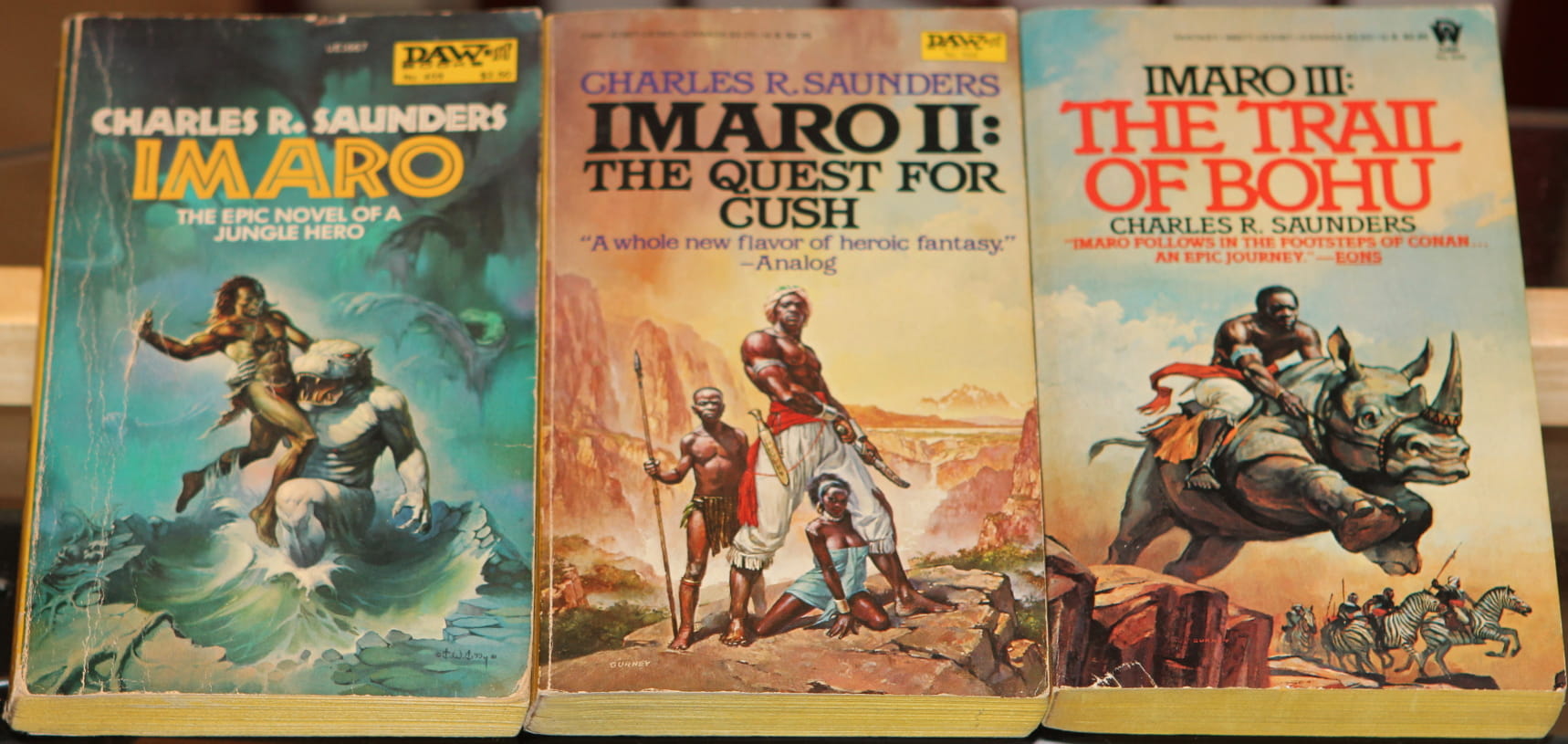 The Imaro trilogy by Charles Saunders, all from DAW Books: Imaro (November 1981), The Quest for Cush (February 1984) and The Trail of Bohu (October 1985). Covers: Ken Kelly and James Gurney
Charles Saunders (1946 – 2020) was one of two men who established a sub-genre of Sword & Sorcery that has come to be called Sword & Soul. The other was Samuel Delany (1942 – ). Saunders was born in the USA but moved to Canada as a conscientious objector after being drafted for Vietnam. He became a journalist and wrote a lot of nonfiction, much of it dealing with the lives of Blacks in Canada.
Around 1974, Saunders created a fictionalized Africa called Nyumbani and began writing S&S stories set there about a hero named Imaro. These were published in a small magazine but the first one was reprinted by Lin Carter in his 1975 edition of Year’s Best Fantasy. By 1981, some of these stories had been connected into novel form and were published as Imaro, by DAW books (Ken Kelly cover). Two more books followed, The Quest for Cush (1984) and The Trail of Bohu (1985), both with excellent and more appropriate-to-the-character covers by James Gurney.
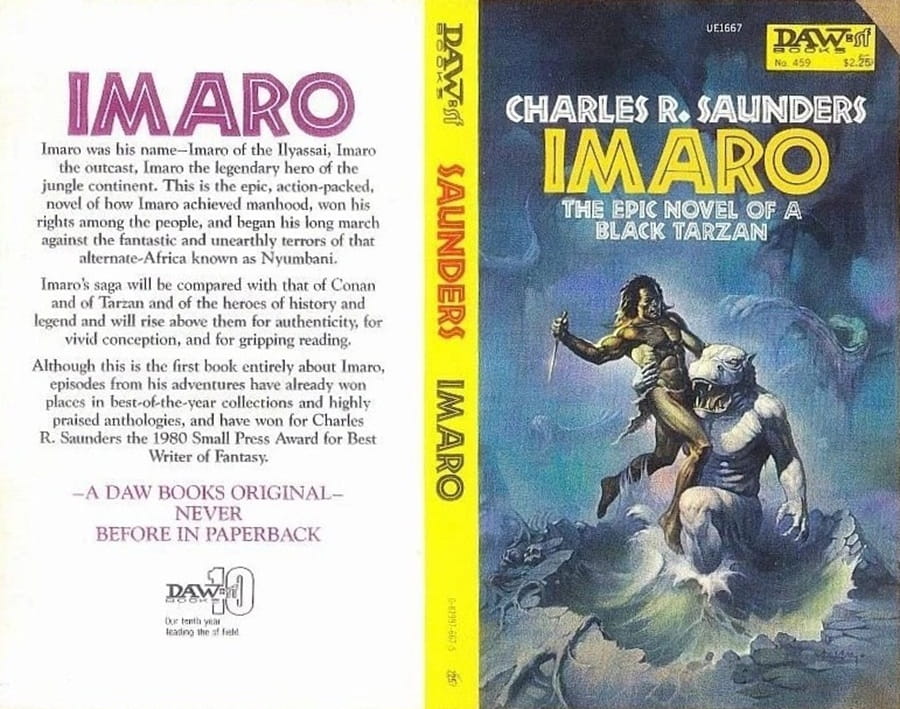 DAW’s original cover for Imaro, with tag line The Epic Novel of a Black Tarzan, withdrawn and reprinted after a complaint from the estate of Edgar Rice Burroughs
DAW didn’t know how to market a black S&S hero like Imaro and initially the character was compared to Tarzan, probably because of the African connection. Imaro, however, is much more Conan than Tarzan, although he is a unique character and no “clonan.” DAW realized their error and made the better connection, quoting on the back of Imaro:
Imaro’s saga will be compared with that of Conan and other heroes of history and legend…
(An aside about this quote: Conan is implied to be a hero of ‘history and legend.’ That’s a little odd.)
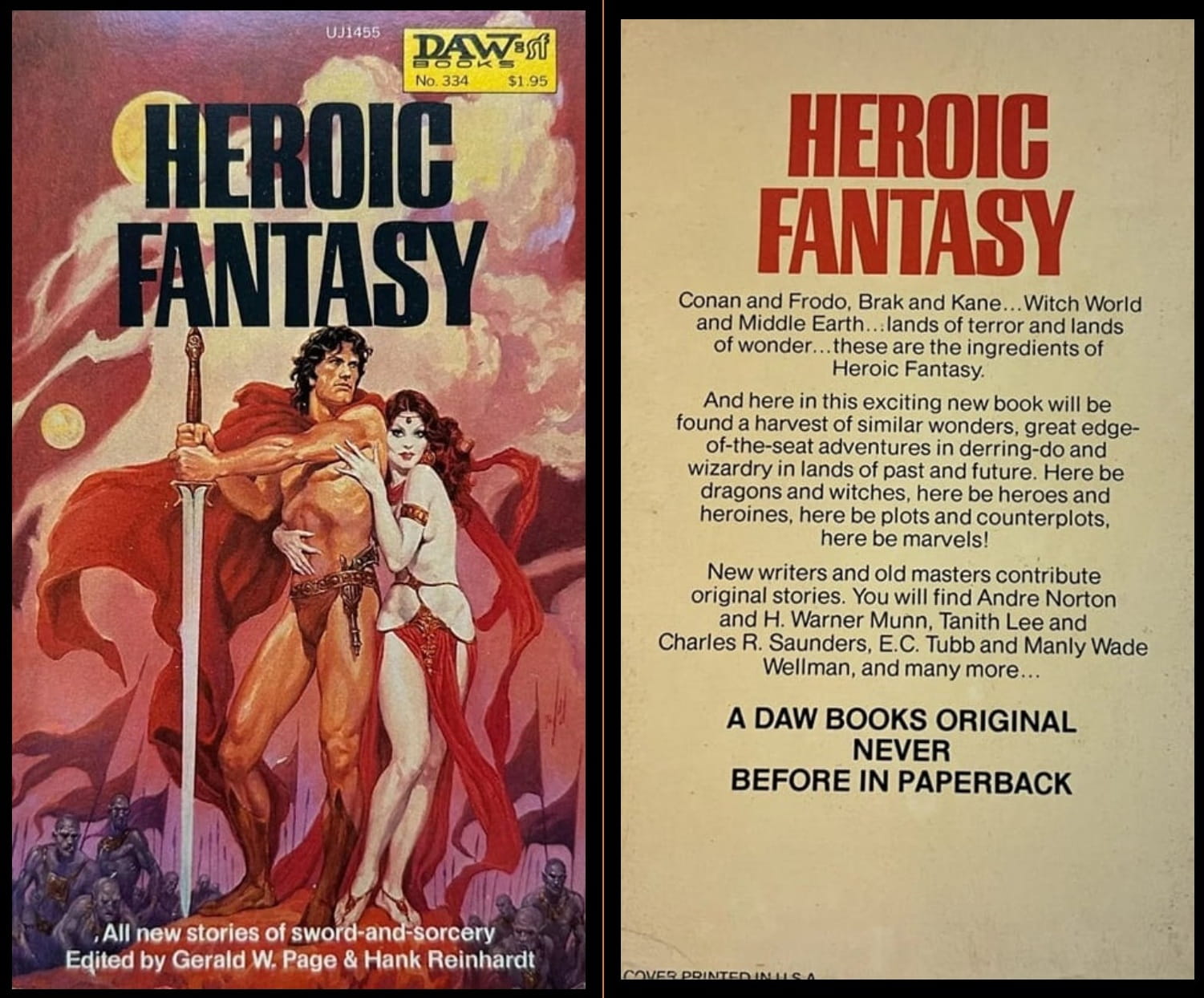 Heroic Fantasy edited by Gerald W. Page & Hank Reinhardt (DAW Books, April 1979). Cover by Jad
Imaro III: The Trail of Bohu has a cover quote:
Imaro follows in the footsteps of Conan
I first discovered Imaro in an anthology I’ve mentioned before called Heroic Fantasy. This led me to the first Imaro novel, although it took a while to find #2 and #3. They make a nice, solid body of work.
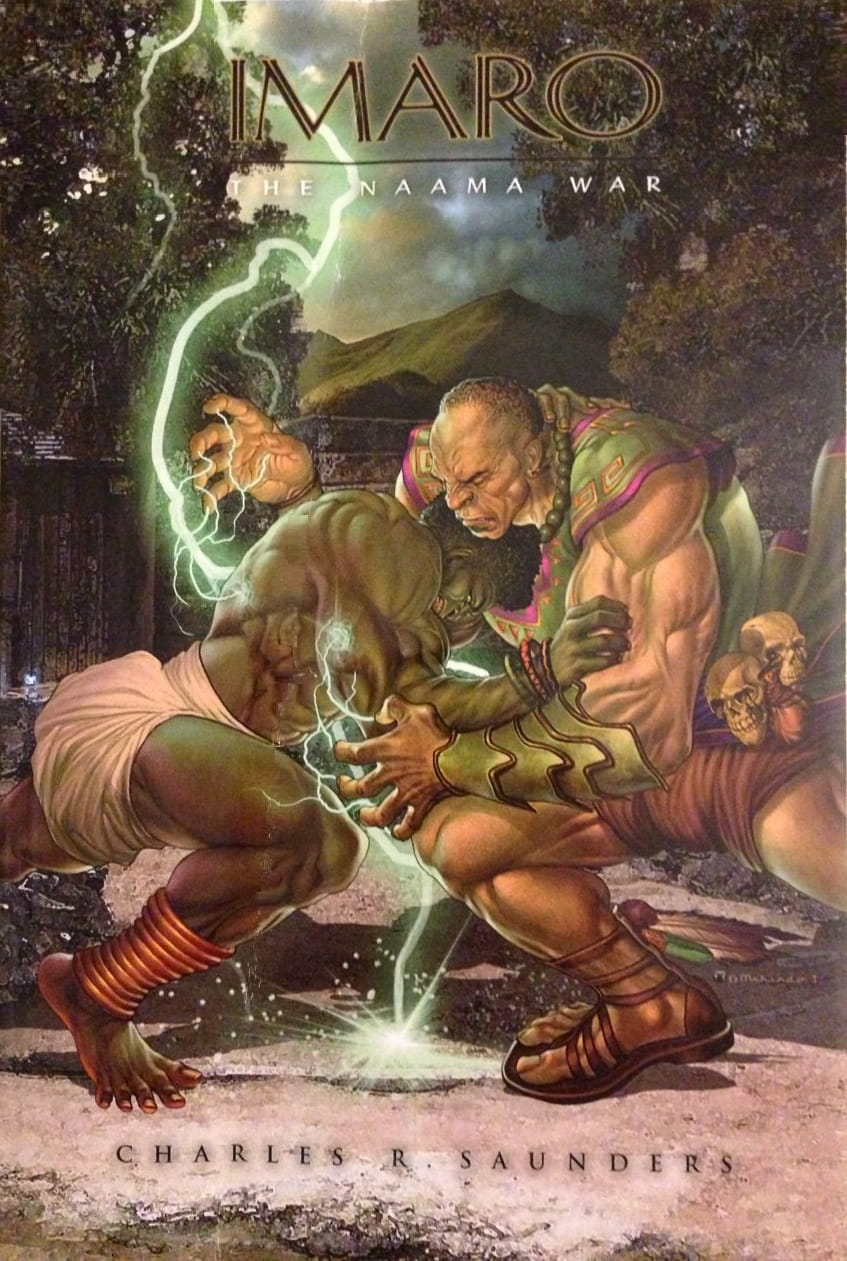 Imaro: The Naama War (Sword and Soul Media, December 29, 2009). Cover by Mshindo Kuumba
In 2009, Saunders self-published a fourth Imaro novel called The Naama War, through Lulu. Unfortunately, I didn’t immediately pull the trigger to buy it and now it’s unavailable. I’ve shown the cover pic by Mshindo Kuumba above.
There’s also a short story collection called Nyumbani Tales set in Imaro’s world (below), but the copies I’ve seen are used ones for nearly 150 bucks.
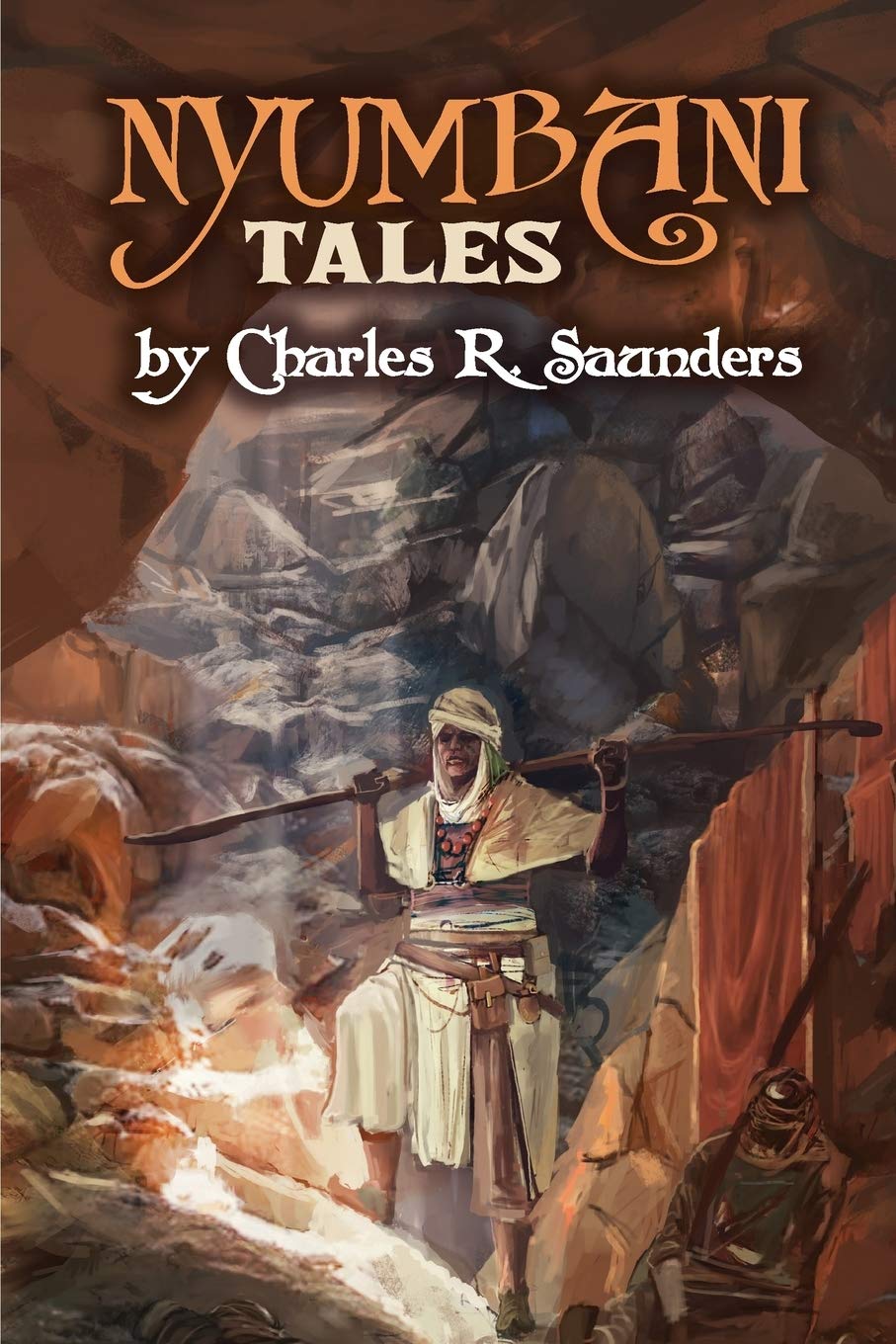
Nyumbani Tales (MVmedia, May 19, 2017). Cover by Edison Moody
Updated versions of the first two Imaro novels (re-edited by Saunders) were published in the early 2000s, although I don’t have them (see below). Saunders also wrote stories about a woman warrior named Dossouye. I read one of these, which was quite good, but the collection is currently unavailable.
I remember hearing of Saunder’s death several months after it occurred and being shocked. His writing, fine as it was, had not brought him any comfortable financial situation.
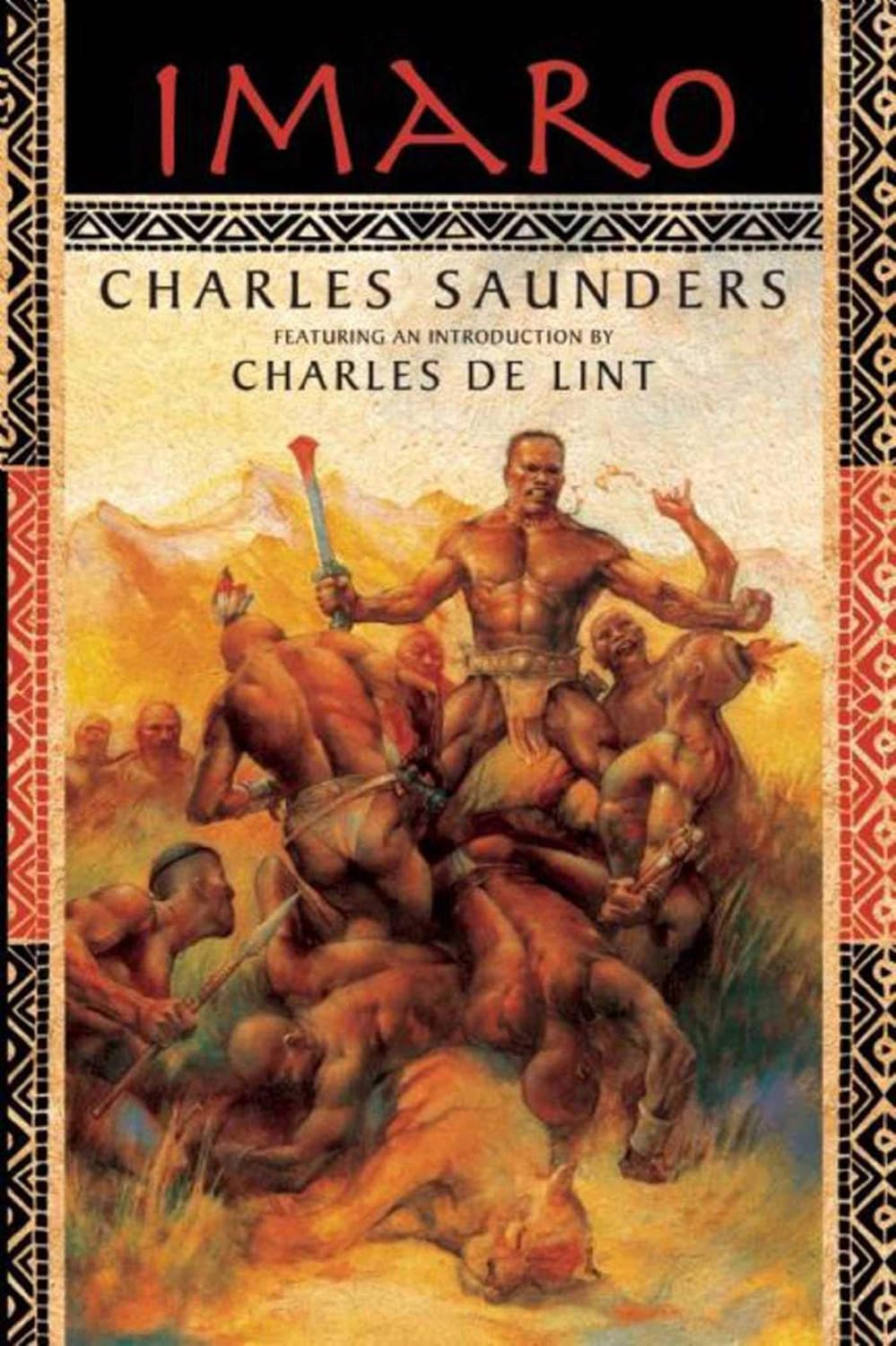
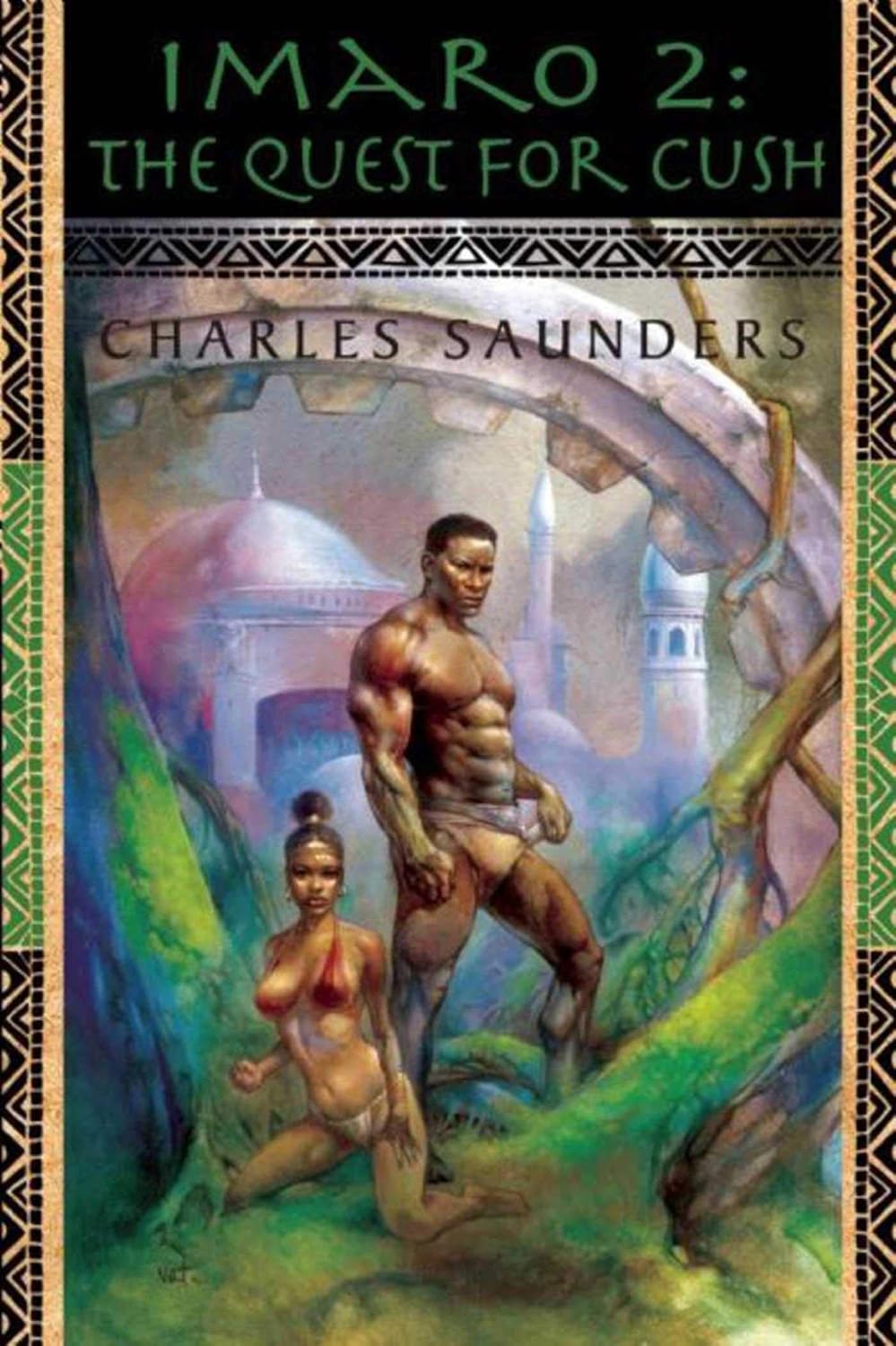
Reprint editions of Imaro and Imaro 2: The Quest for Cush from
Night Shade Books (February 15, 2006, and January 2007). Covers by Vince Evans
He died in a small apartment with no phone or internet connection, and apparently with no one close enough to him to check on his whereabouts. We can at least hope he’ll be better remembered after his death than he seemingly was before.
Charles Gramlich administers The Swords & Planet League group on Facebook, where this post first appeared. His last article for us was a review of two S&S anthologies, both titled Warlocks and Warriors, edited by Donald M. Grant. See all of his recent posts for Black Gate here.
Categories: Fantasy Books
Proven Wrong… Joyfully
 Image by kalhh from Pixabay
Good afterevenmorn, Readers!
Everyone has a preference, right? Preferences show up all the time; in food, in friends, in partners, in art, films, and books. I, for example, like my food relatively spicy. My father will take it so damned hot any normal person will hallucinate pink elephants for hours. Not my preference. Sharing an Indian meal with him is sometimes a challenge. I prefer whiskey to most other alcoholic beverages, though I’ll happily have a rum and coke on occasion. I am a huge fan of surrealism in art, and find expressionism a little dull (controversial take alert). And when it comes to my books, I do not like first person perspective narratives, or LitRPGs, and I’m very particular about my humour.
Well, there are two books/series now that have absolutely slapped me in the face and called me a liar. And I’m here to admit I have (joyfully) been proven so very wrong.
 Image by Ylanite Koppens from Pixabay
First, I have to mention that I had struggled with reading for years and years and years. In fact, reading for pleasure became in credibly difficult during and after my university years. I just could not find it in me to pick up a book and start reading. There are some books that pulled me out of the slump momentarily (thank you Malazan Book of the Fallen), but on the whole, I’ve not been able to read.
I have no idea what the block was about. I did try to overcome it last year, attempting to force myself to read just before bed. While I did read more books last year (I think the number was four) than I had in previous years, it was still an absolute slog. This made me incredibly sad, as I had, prior to university, devoured books by the dozens in a year. I loved reading. Or I did. So why couldn’t I read?
Something this year shifted. For some reason, I have been much better about reading. As I don’t really have much spare time, I’ve kept my reading time for the times I’m on public transit, which is usually just Tuesdays, Thursdays and Saturdays (when I head to and from martial arts training). This appears to have worked a bloody miracle. I set my reading goal for twelve books in the year. I figured one book a month was more than doable with my schedule.
I have, as of this weekend just done, finished my tenth book. I don’t know why I’m suddenly devouring books again, but I’m not sad about it… because I have read some stellar books of late. My wallet, however…
The first book that took me by surprise in my new reading feast was this one:
I had heard from a few ‘BookTok’ creators that this was a good read (though BookTok appears to have ben swallowed whole by Romantasy at present, some folks are recommending different books). The first book in the Farseer Triology, The Assassin’s Apprentice by Robin Hobb is written in one of my least favourite perspectives – first person. I was not thrilled, to be honest, when I read the first page. Until I hit the second. And then I was all in on this story. I cried three times before chapter five. This was an absolute five star read for me. And it took me by surprise. I was not expecting something written in the first person to be as affecting as it was.
I chalked it up to a fluke. One exception to the rule due to an exceptional writer.
And then, and then, and THEN I read this:
I admit, I was influenced. A number of people in my circles had mentioned how good this book was. It did not seem like my thing. I am not a fan of LitRPGs, and worse, it was first person. So, not something I would enjoy. Still, folks were taking about how good this book was, so I resolved to give it a chance.
I. Loved. It.
This book is funny, and earnest, and somehow able to maintain some incredible tension. The situation was absolutely ridiculous, yet I managed to be filled with compassion for some of the ‘mobs,’ charmed by characters who could be incredibly annoying if mishandled, and absolutely holding my breath in some of the scenes.
This was my second five star read that I absolutely did not expect. Twice now I’ve been made a liar, and this book made me a liar twice over. A first person LitRPG that I loved? Impossible!
This is, of course, because both Hobb and Dinniman are exception writers, who have both created complicated, fascinating and charming characters, with styles very appropriate to the stories they are telling. While I did not cry during Dungeon Crawler Carl (usually a prerequisite for a five star rating from me), I was so thoroughly entertained, I could not help but rate it highly. For the record, I did tear up a bit in the afterword, which was something I did not know I needed.
You will not break me. Those who’ve read it will understand, I think.

My experience with both first person perspectives as a young reader had coloured my opinion, as these things tend to. It didn’t help that more recent books written in that perspective that got wildly popular were… not very well written in my estimation. If I hear the words ‘Inner Goddess’ one more time, I will absolutely lose what’s left of my sanity. LitRPGs similarly proved disappointing reads before now, and I’ve found them boring or so silly that I cannot get into the story.
Given the poor experiences in the past, it cannot be a surprise that I was hesitant to read these books, and sceptical of their popularity as well (and I have found a lot of books that became wildly popular not really to my tastes besides). Turns out, they’re exceptional, and I am now a liar, liar, pants on fire. I do like first person perspective books, and at least one LitRPG. I should have kept a more open mind.
There’s no really point to this post, except to say that maybe we should all be giving more books a chance, and maybe take some time to test our preferences every once in a while. We might end up very pleasantly surprised… and a little poorer because now I need these books and the entirety of their associated series on my shelf. They bring me joy.
It could be drugs. At least it’s not drugs. Besides, I’ve started walking to work again now that my flu has passed and my lungs are supporting movement again, so there will be less time on public transit. That should slow my reading and spare my wallet a bit…
In any case, I hope you’ll all accept this mea culpa. First person perspectives and LitRPGs are not inherently bad reads. Turns out, like every other genre and perspective, there are good books and bad ones, and a fair number of middling ones. I’m sorry for instinctively turning my nose at them.
Have you read these books? What did you think of them? What kinds of books are your preference? I love talking books. Sound off below!
When S.M. Carrière isn’t brutally killing your favorite characters, she spends her time teaching martial arts, live streaming video games, and sometimes painting. In other words, she spends her time teaching others to kill, streaming her digital kills, and sometimes relaxing. Her most recent titles include Daughters of Britain, Skylark and Human. The Timbercreek Incident is free to read on Wattpad.
Categories: Fantasy Books
Recent comments