
https://www.blackgate.com/

The Problem of the Invincible Warrior: Frank Frazetta’s Death Dealer by James Silke
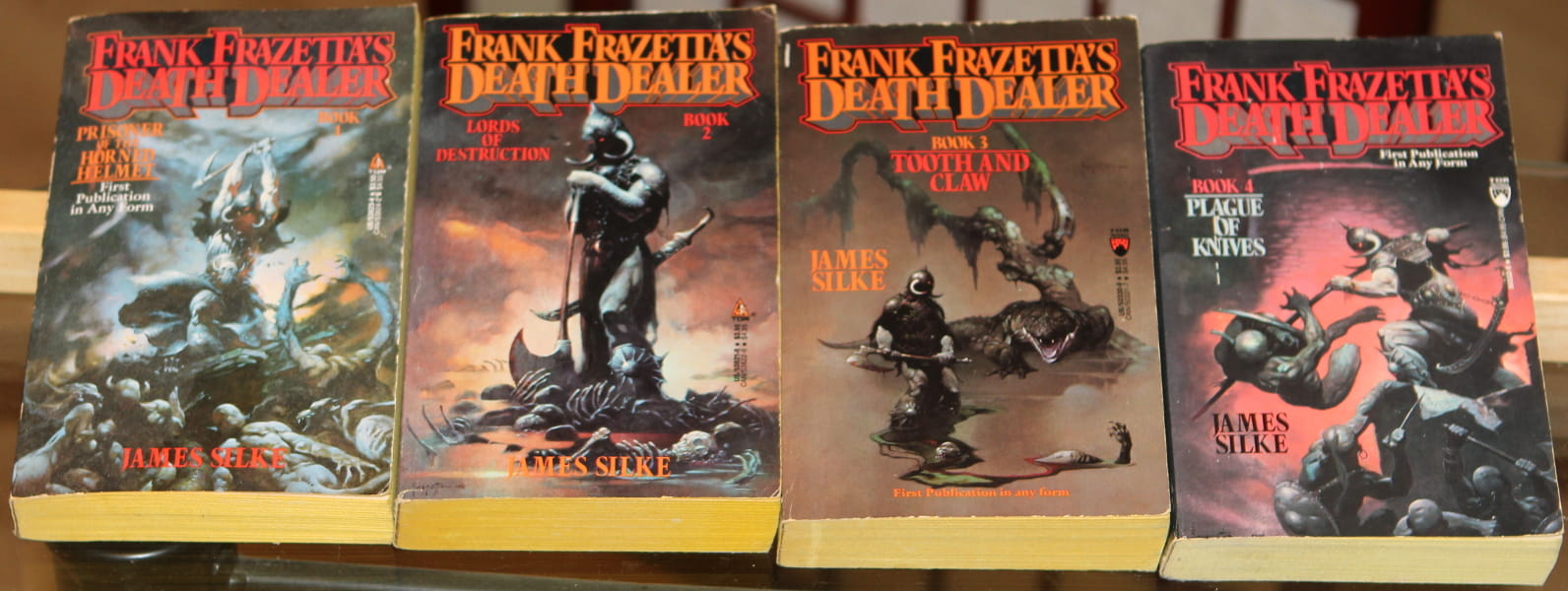 Frank Frazetta’s Death Dealer, Volumes 1-4, by James Silke (Tor Books, 1988-1990). Covers by Frank Frazetta
James Silke (1931 – ) is something of a renaissance man in the arts. He’s a visual artist and prose writer, a set and costume designer, photographer, and comic book guy. Most people who I meet recognize him as a comic artist/writer, although I’ve never read any of his graphic stuff.
I’ve seen a few of the movies he’s worked on, including King Solomon’s Mines and The Barbarians. My only experience with Silke’s writing is the four Sword & Sorcery books in the Frank Frazetta Death Dealer series.
These are:
1 Prisoner of the Horned Helmet (February 1988)
2 Lords of Destruction (January 1989)
3 Tooth and Claw (November 1989)
4 Plague of Knives (June 1990)
There’s also a book called Rise of the Death Dealer, with a Frazetta Cover (shown below), but I’ve never seen a physical copy, and from what I understand it’s not a 5th book in the series. According to Fantastic Fiction, it’s an omnibus volume that collects the first two books. Fantastic Fiction has been pretty accurate in my experience.
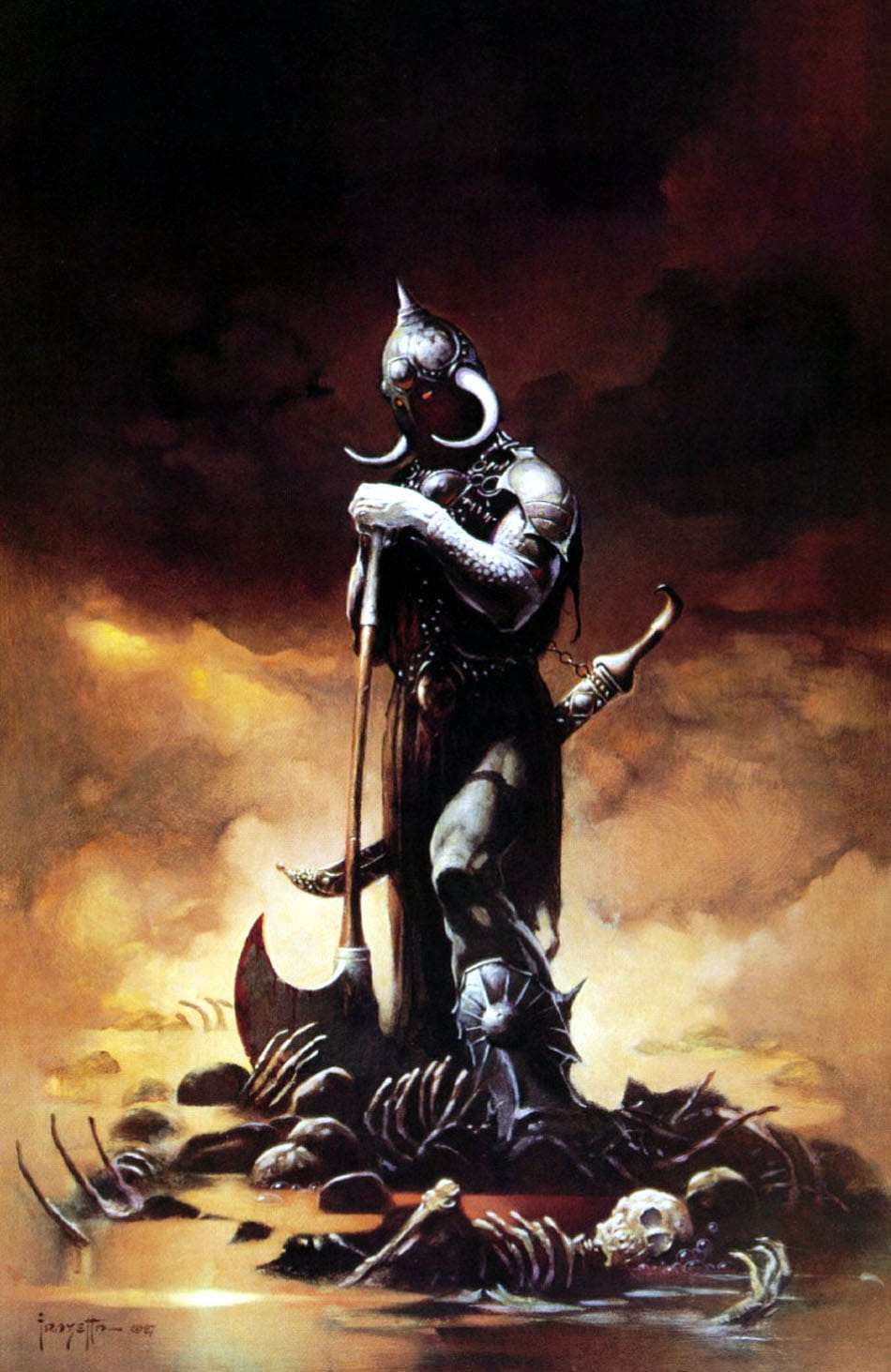 Frank Frazetta’s Rise of the Death Dealer, omnibus edition (Tor Books, March 2005). Cover by Frank Frazetta
As far as I understand, Frazetta provided the Death Dealer character and the covers and Silke wrote stories about the warrior, including an origin story in Prisoner of the Horned Helmet. I don’t know whether Frazetta offered any story ideas but the prose is Silke.
The series features a character named Gath of Baal, a young but powerful warrior at the beginning of the series, who acquires a horned helmet imbued with great sorcery. He doesn’t realize that once he puts it on he’ll become its prisoner and will become the Death Dealer.
I enjoyed the series quite a lot. There are some strong visuals and some bloody, gory fights. The prose is serviceable but not outstanding. There are some very modern phrasings that occasionally threw me out of the story. I was hoping for more Robert E. Howard style poetic prose but didn’t get it.
The pacing is not as fast as it could have been either, mainly because the books are too long. Cutting fifty pages out of each of these volumes would have really helped. At some point I’ll also talk about the “problem” of the invincible warrior and how it diminishes tension in a tale.
Charles Gramlich administers The Swords & Planet League group on Facebook, where this post first appeared. His last article for us was Erich von Däniken’s Chariots of the Gods? and the Pseudoscience Bestsellers of the 1970s. See all of his recent posts for Black Gate here.
Categories: Fantasy Books
Forgotten Authors: Raymond F. Jones
 Raymond F. Jones was born in Salt Lake City on November 15, 1915. He studied engineer and English at the University of Utah before working as a radio engineer. He later suggested that getting an English degree is one of the worst things a writer could do. He had a reasonable amount of success as an author, with his novel This Island Earth being the work he is best known for. It was adapted into a film in 1955, starring Jeff Morrow and featuring Russell Johnson, who would go on to portray the Professor on Gilligan’s Island, and Richard Deacon, who played Mel Cooley on The Dick van Dyke Show.
According to Jones, he was introduced to science fiction in 1927 when he read H.G. Wells’ War of the Worlds. He decided he never wanted to read it again because he was afraid it couldn’t live up to the “thrill of that first contact with the realm of imagined science.”
After graduating college, he served on a mission in Galveston, Texas and worked installing telephone exchange equipment for Western Electric in Texas, but after marrying Elaine Kimball on June 27, 1940, he took a job with the Weather Bureau to cut down on travel. During World War II, he used his radio engineering degree at Bendix Radio in Baltimore before settling in Arizona after the war.
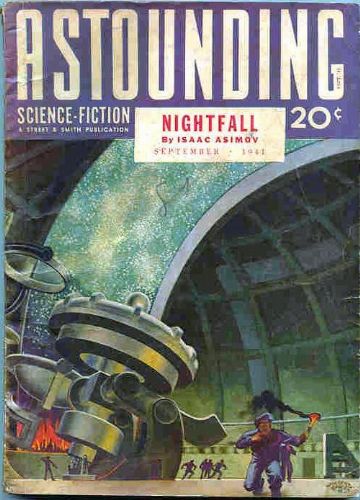
Jones’ first short story, “Test of the Gods,” was published in the September 1941 issue of Astounding, in which it was overshadowed by the cover story, Isaac Asimov’s “Nightfall.” This is a pattern that would be repeated, leading Gerald W. Page to note that while Jones was a “writer of surprising versatility. But the price of this seems to be that too often he came on the scene with a perfectly good story that was still second best to the similar works of someone else.”
Jones wrote 15 novels in addition to This Island Earth, beginning in 1951 with the novel Renaissance (which was reprinted as Man of Two Worlds).
In addition to This Island Earth, two other stories by Jones were adapted by Hollywood. “The Children’s Room,” originally published in 1947, was an episode of the anthology series Tales of Tomorrow in 1952, and 1950’s “Divided We Fall” was adapted for the anthology series Out of This World in 1962.
 His 1950 story “Tools of the Trade” is believed to be the first description of 3D printing.
Jones not only wrote science fiction, he also wrote non-fiction, with four juvenile science books ranging from The World of Weather to Animals of Long Ago. He also wrote the study Ice Formation on Aircraft.
Jones was a Hugo finalist in 1967 for his short story “Rat Race,” which lost to Larry Niven’s “Neutron Star.” In 1996, his story “Correspondence Course,” was remembered by enough people to earn him a Retro-Hugo nomination, where he lost to Hal Clement’s “Common Sense.”
Elaine died on July 23, 1970 and on May 2, 1973, Jones married Lillian Wats. Jones and Elaine had five children and eighteen grandchildren. When he married Lillian, he gained five step-children.
Jones died in Sandy, Utah on January 24, 1994 after suffering from pancreatic cancer. For no reason other than the same first name, I tend to think of Jones along with author Raymond Z. Gallun (1911-1994). Coincidentally, both of their obituaries appeared in the same issue of Locus, with Jones coming in second to Gallun’s.
I reviewed Jones’ short story “Death Eternal” in 2018 as part of my Birthday Reviews series on Blackgate.
 Steven H Silver is a twenty-one-time Hugo Award nominee and was the publisher of the Hugo-nominated fanzine Argentus as well as the editor and publisher of ISFiC Press for eight years. He has also edited books for DAW, NESFA Press, and ZNB. His most recent anthology is Alternate Peace and his novel After Hastings was published in 2020. Steven has chaired the first Midwest Construction, Windycon three times, and the SFWA Nebula Conference numerous times. He was programming chair for Chicon 2000 and Vice Chair of Chicon 7.
Categories: Fantasy Books
A Game of Classic Science Fiction: Terraforming Mars by Jacob Fryxelius
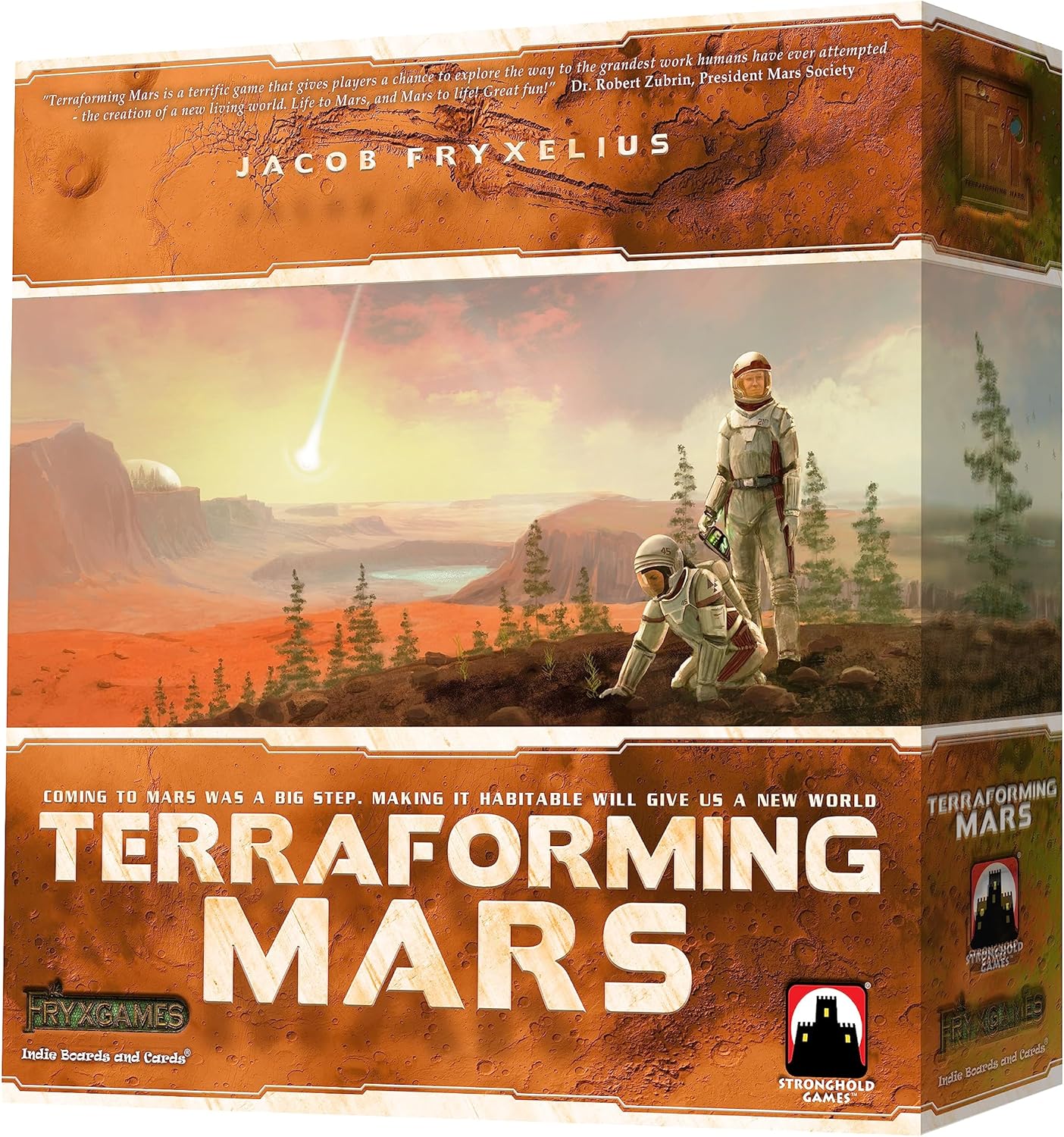 Terraforming Mars by Jacob Fryxelius (FryxGames/Stronghold Games, 2016)
About a year ago, I added Terraforming Mars to my collection of board games, fascinated by the premise. At the very end of the year, a local friend proposed to get together and try playing it. On 2 January, three of us sat down to a first game, using the beginner option of everyone playing a standard corporation and keeping all ten of their initial cards without having to pay for them. Four and a half hours later, we started counting up scores.
Terraforming Mars is a game about economic investment and its returns, like Race for the Galaxy, one of my long-time favorites. The premise is fairly hard science fiction: Several corporations have been granted charters by Earth’s world government to begin — as the title says — terraforming the planet Mars: raising its temperature and oxygen and giving it bodies of water. When these reach specific designated values, the game ends and score is taken. There are no violations of fundamental laws of physics such as faster-than-light travel; the departure, so far as there is one is not qualitative but quantitative, in the rapid progress of terraforming, though in some compensation, play is divided into “generations,” which implies a time scale on the order of centuries.
[Click the images to terraform them.]
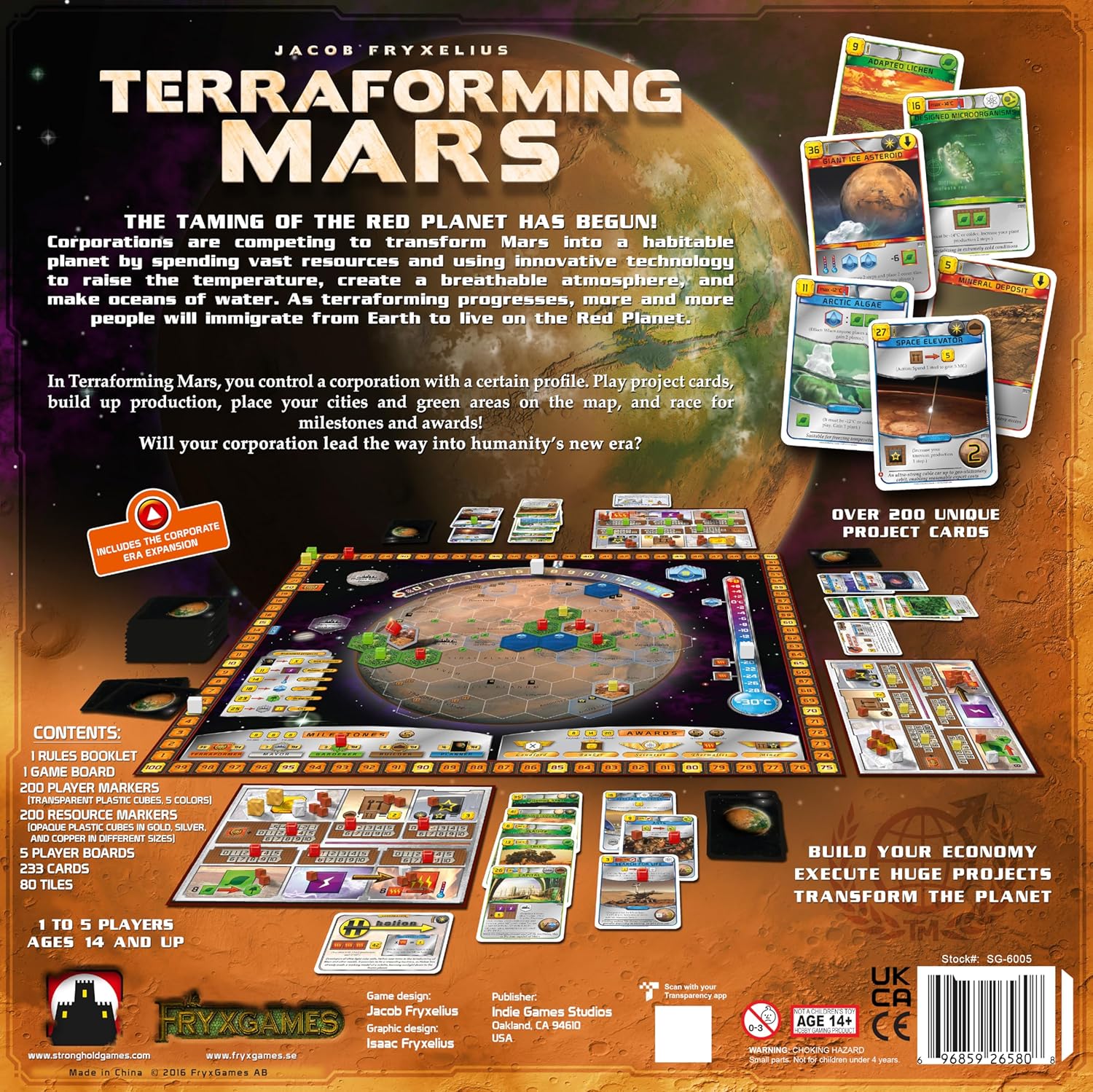 Back cover of Terraforming Mars
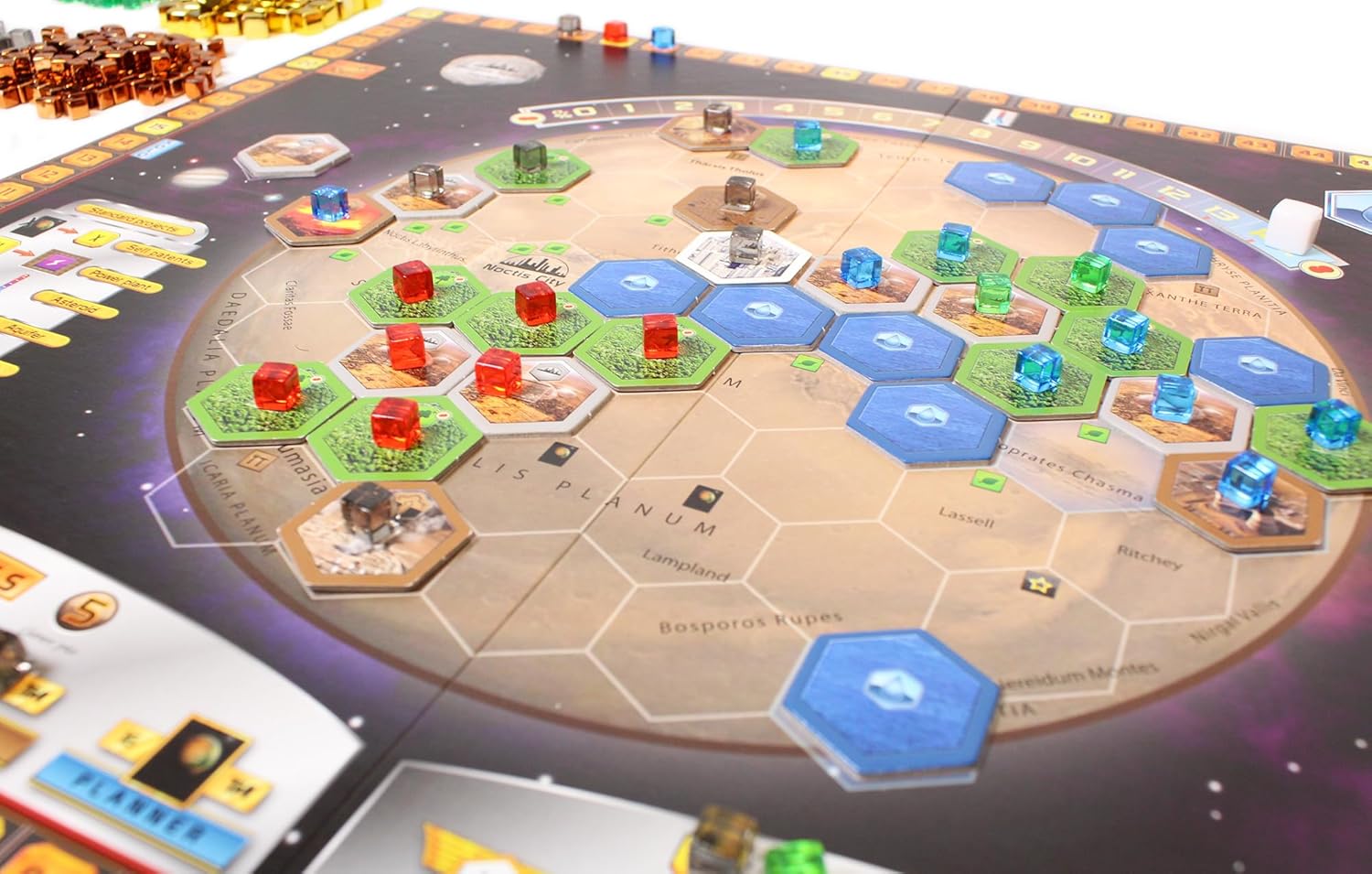
The rule book for the game is 16 pages, but that includes introductory material, illustrations, and several game variants, including a solitaire version. The actual rules are in easily readable type and can be read through in a few minutes. Most of the complexities are strategic and are expressed in the text and graphics of game cards. Along with these cards, each player has a personal game board that keeps track of resources, and players share a larger board that’s a map of one hemisphere of Mars, where tiles can be placed to represent cities, oceans, vegetation, and other special achievements.
The map is also used to keep track of various scores and accomplishments. Reading the map is a little complicated, like watching the screen for character status in a computer game; on this first session we took a while to figure out some of its sections. But I think it can become familiar quickly.
In a way comparable to Race for the Galaxy, each generation in Terraforming Mars is divided into phases. A generation begins with each corporation receiving four cards from a deck, which represent newly acquired capabilities if the player wants to pay for them (“‘Take what you like,’ said God; ‘take it, and pay for it.'”) After that, players perform various actions, many but not all enabled by the cards, and some of which add tiles to the large board. Spatial arrangement of tiles is important and is partly restricted by the game rules.
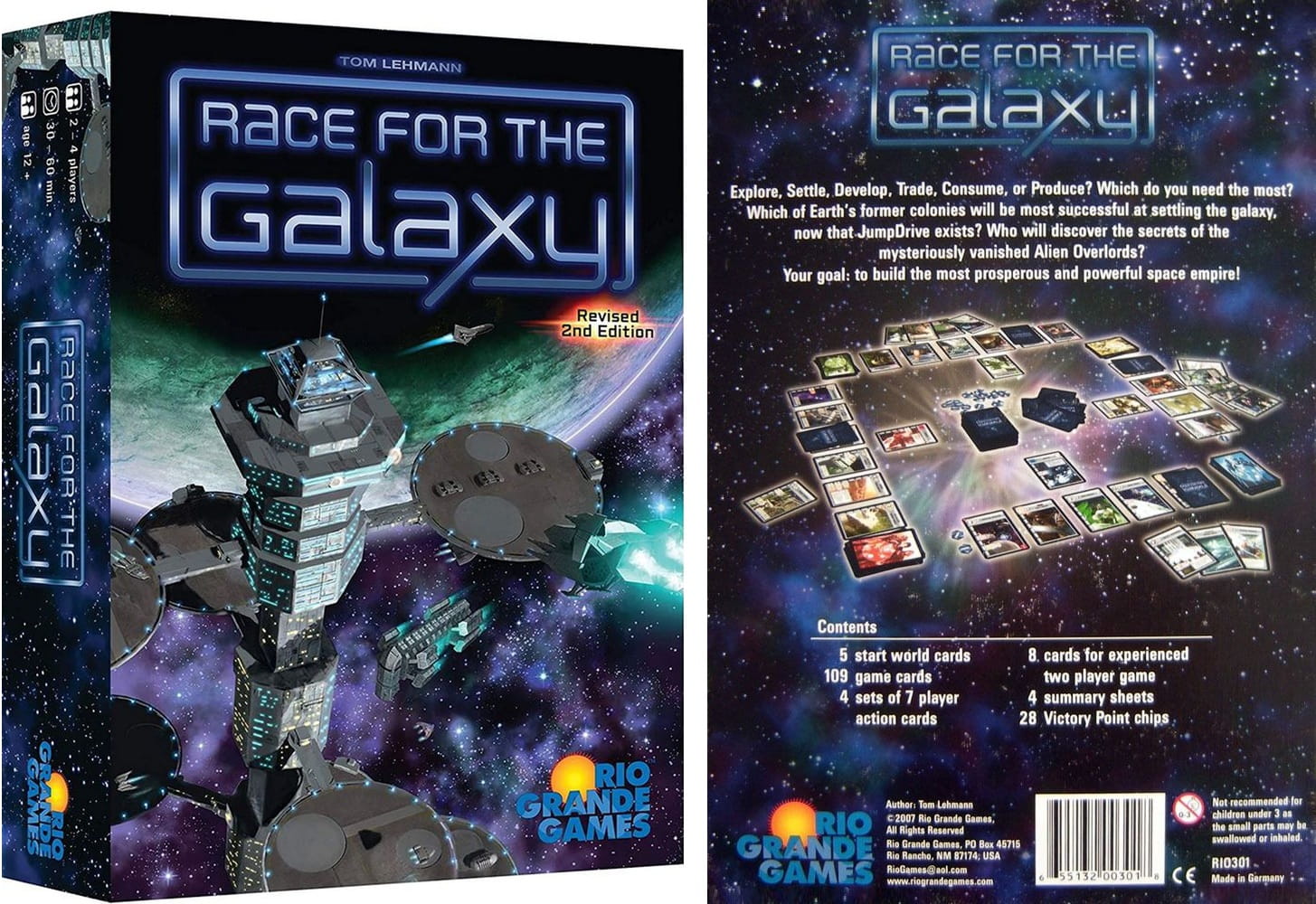
Race For the Galaxy by Tom Lehmann (Rio Grande Games, 2007)
Some cards are used up by one action; some are kept and displayed in front of the player, and some of these can be used for a new action in each generation. All of this costs credits, and sometimes other resources! At the end of the generation, players engage in “production,” which provides more credits (based partly on their terraforming scores) and sometimes other resources that can be used to advance terraforming, directly or indirectly.
One thing that’s largely omitted from the game is violent conflict; most of the time, the various corporations are competing in an enterprise that theoretically benefits all of them (moving them toward a fully terraformed planet). There are a few moves that advance one player while imposing costs on another. An economist would call these “externalities”; a historian might call them “acts of war.” But as with, for example, Settlers of Catan (another European game), players have the option either of cutthroat competition or of deciding that that makes playing the game less fun, and avoiding it.
One of the three of us found the game rules a bit too complicated and hard to follow, so this may not be a game for everybody. It’s certainly not a casual game! But the other two of us enjoyed it a lot. In The Psychology of Everyday Things (published 1988), Donald O. Norman set out principles for ease of use, and pointed out that well designed games are deliberately a little difficult to “use” successfully (that is, to win); otherwise they become boring when the player solves them. I don’t see Terraforming Mars as likely to become boring.
Many games have an implied story. Sometimes this is very abstract, as with chess (a game about feudal warfare) or bridge (a game about capitalistic competition and cooperation); sometimes a kind of story emerges from the play of the game. (And sometimes, as with Dungeons and Dragons, telling bits of story is an actual move in the game.) Terraforming Mars has a fairly strong story aspect: It tells about how humanity moves out into the solar system and makes other planets humanly livable, in the style of classic science fiction writers (a clever joke in the rule book is to give examples of play with three players named Kim, Stanley, and Robinson!), of recent video series such as For All Mankind, or of the proposals of billionaires.
If you like that premise, or are willing to accept it, you’ll find Terraforming Mars a well thought out representation of a lot of its scientific details. I expect that as we play more games, and move on to using more than the standard starting corporations, we’ll find interesting bits of added flavor in the profiles of other corporations. And I may try playing the solo version when I have a few hours free; it seems likely to be entertaining.
William H. Stoddard is a professional copy editor specializing in scholarly and scientific publications. As a secondary career, he has written more than two dozen books for Steve Jackson Games, starting in 2000 with GURPS Steampunk. He lives in Lawrence, Kansas with his wife, their cat (a ginger tabby), and a hundred shelf feet of books, including large amounts of science fiction, fantasy, and graphic novels. His last piece for Black Gate was a review of Whose Body? by Dorothy Sayers
Categories: Fantasy Books
Recent comments