
https://www.blackgate.com/

Forgotten Authors: Nictzin Dyalhis
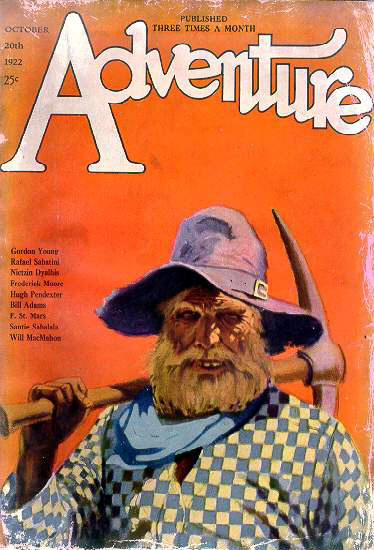 Adventure, October 10, 1922
Some science fiction authors like to cloak their histories in mystery, not content to keep the fiction in their writing. Lester Del Rey claimed he was born Ramon Felipe Alvarez-del Rey and that his family was killed in a car crash, although his sister confirms his birth name was Leonard Knapp and the accident only killed his first wife. Nothing F. Gwynplaine MacIntyre said about himself should be trusted. Nictzin Dyalhis is another author who appeared to create his own history.
According to his draft registration card, he was born on June 4, 1873 in Massachusetts, although he also claimed to have been born in 1880 and 1879 and variously in England in Pima, Arizona. His draft registration is also the first time the name Nictzin Dyalhis appears. It also notes that he lost an eye in his childhood.
In 1912, he married Harriet Lord, who was committed to the Warren State Hospital in the late 1920s and died there in 1959. Her death certificate shows two interesting things. First, it claims her husband’s name was Fred, which could be Dyalhis’ birth name. Second, it lists her as a widow, indicating she was never divorced. Despite this, Dyalhis remarried by 1930, to Mary Sheddy, although in the 1930 census her name is given as Netulyani Dyalhis (and later claims that her birth name was Netulyani Del Torres). Nictzin and Mary had a daughter, Mary, in 1932.
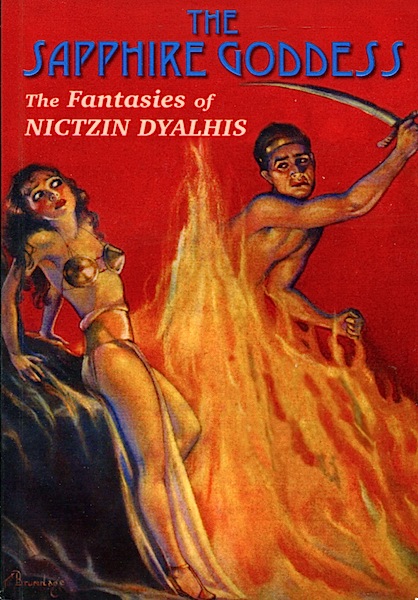 The Sapphire Goddess: The Fantasies of Nictzin Dyalhis, Cover by Margaret Brundage
Just as there is a question about Dyalhis’ first name, there is also speculation that Dyalhis is a playful spelling of the name Dallas, although in Literary Swordsmen and Sorcerers, L. Sprague de Camp explains that his father was a Welshman whose last name was Dyahlis, who had a fascination with the Aztec, from whom the name Nictzin was taken.
It appears that Dyalhis tried his hand at various jobs, which isn’t surprising given that his literary output is limited to a baker’s dozen stories. When he visited Arizona in 1913 with Harriet, he appears to have been involved in mining or panning for gold. In 1920, he listed himself as working as a chemist. While living in Waynesboro, Pennsylvania in 1930, he listed his occupation as a machinist at a tool manufacturing plant. He also claims to have spent time in Asia, where he was introduced to the occult, which is often seen in his writing.
His first published story was “Who Keep the Desert Law,” published in the October 20, 1922 issue of Adventure. In April of 1925, his story “When the Green Star Waned” was published in Weird Tales, where the majority of his stories would appear. “When the Green Star Waned” has the distinction of being the first known reference to a ray gun as a “blastor.” His stories fit in well with the Weird Tales vibe and have the feel of authors like Clark Ashton Smith and August Derleth, offering heroes dealing with supernatural and occult forces which seem to be manifestations of the natural order of things.
Dyalhis died in Salisbury, Maryland on May 8, 1942. His first wife died in 1959 and his second wife in 1977.
 Steven H Silver is a twenty-one-time Hugo Award nominee and was the publisher of the Hugo-nominated fanzine Argentus as well as the editor and publisher of ISFiC Press for eight years. He has also edited books for DAW, NESFA Press, and ZNB. His most recent anthology is Alternate Peace and his novel After Hastings was published in 2020. Steven has chaired the first Midwest Construction, Windycon three times, and the SFWA Nebula Conference numerous times. He was programming chair for Chicon 2000 and Vice Chair of Chicon 7.
Categories: Fantasy Books
Murder and Courtship: Strong Poison by Dorothy Sayers
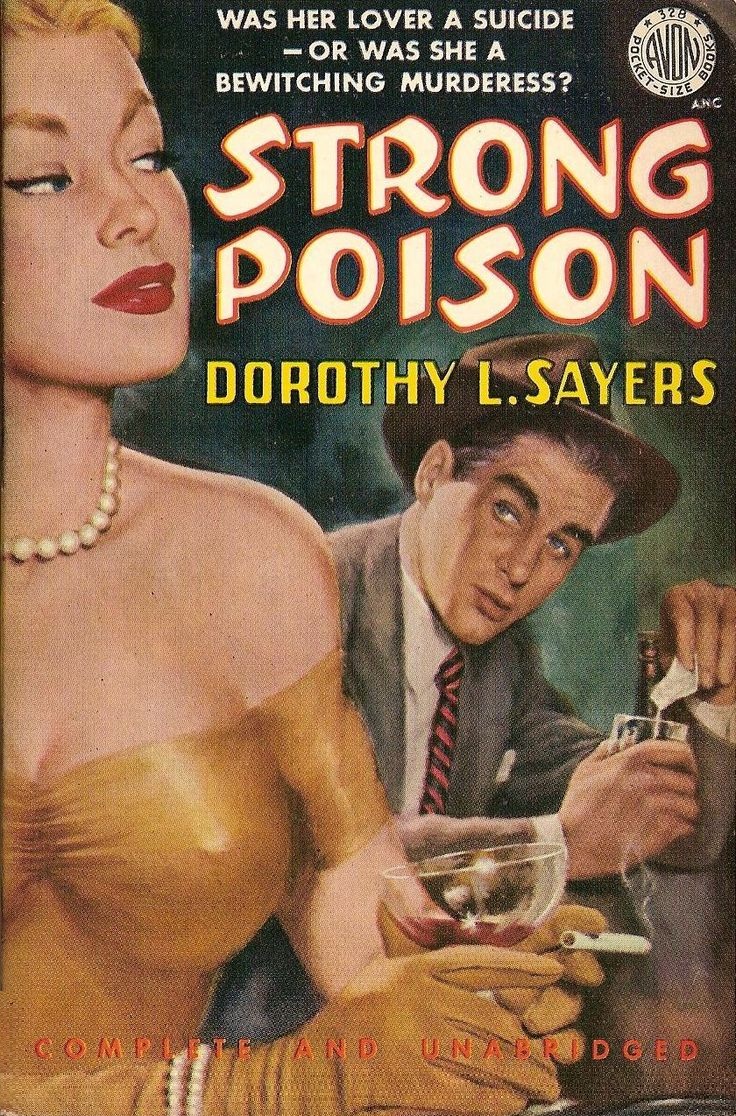 Strong Poison, by Dorothy Sayers (Avon Books #328, 1951)
In Strong Poison, Sayers gives Peter Wimsey a love interest, and makes this central to the story. Traditional mystery writers had avoided this kind of plot (Irene Adler, for example, was clearly not romantically involved with Sherlock Holmes, however profound an impression she made on him).
Not all of her readers welcomed the innovation. In particular, Harriet Vane, a successful author of detective stories, was sometimes looked at as what fan fiction readers now call a “self-insertion” by Sayers — a view that gains plausibility from Vane’s involvement in a love affair, given what we know now about Sayers’s life story.
We first meet Vane in a courtroom, where she is being tried for the murder of her former lover, Philip Boyes, a less successful but more artistically pretentious novelist (what little is said of his books suggests Aldous Huxley’s early novels, before Brave New World made him immortal).
[Click the images for stronger versions.]
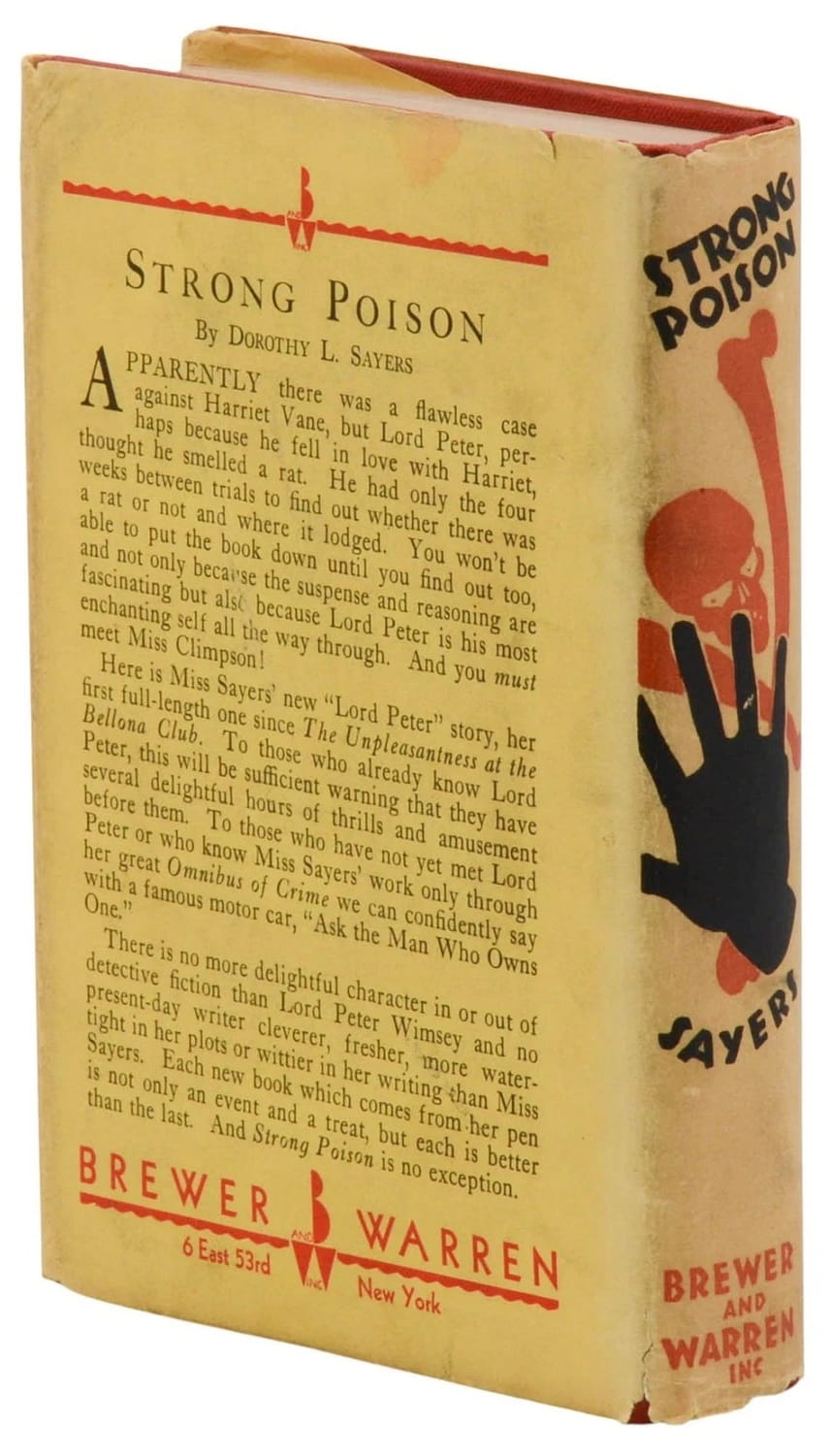
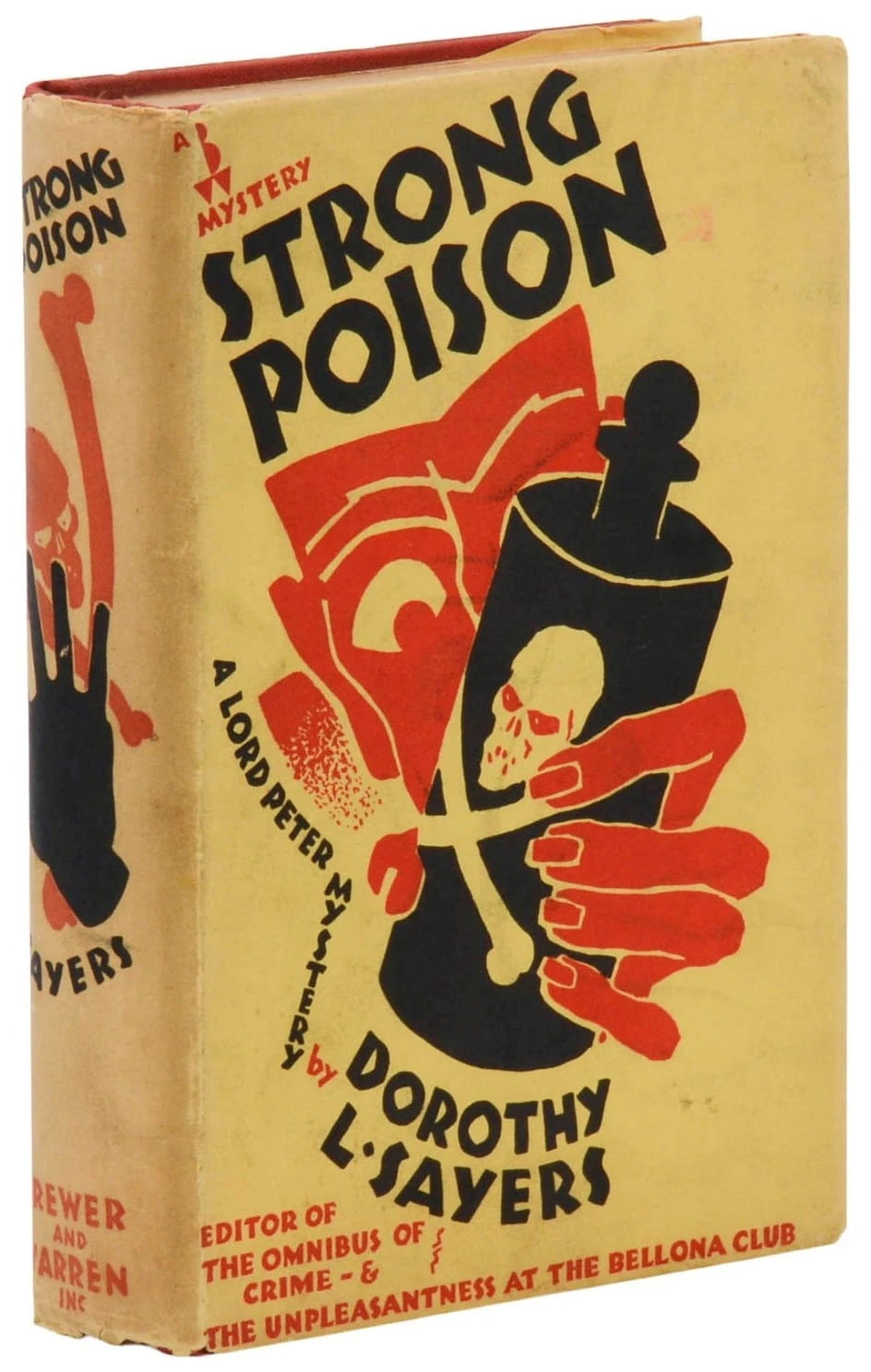
Strong Poison (Brewer and Warren, 1930)
Boyes died of arsenic poisoning, and Vane had bought arsenic twice in the time leading up to his death, and had seen him the night he died, so the circumstantial evidence looks damning.
Sayers has the judge sum up the testimony for the jury and advise them as to what points they need to decide, a handy device for exposition. The jury is out for a long time, from just after lunch till well into the evening, and finally ends up hung, nine to three.
One of the three is Wimsey’s ally Miss Climpson (introduced in Unnatural Death), who holds out against a lot of pressure from the foreman and most of the other jurors, saying that the prisoner’s demeanor is part of the evidence and Vane’s demeanor isn’t that of a murderer.
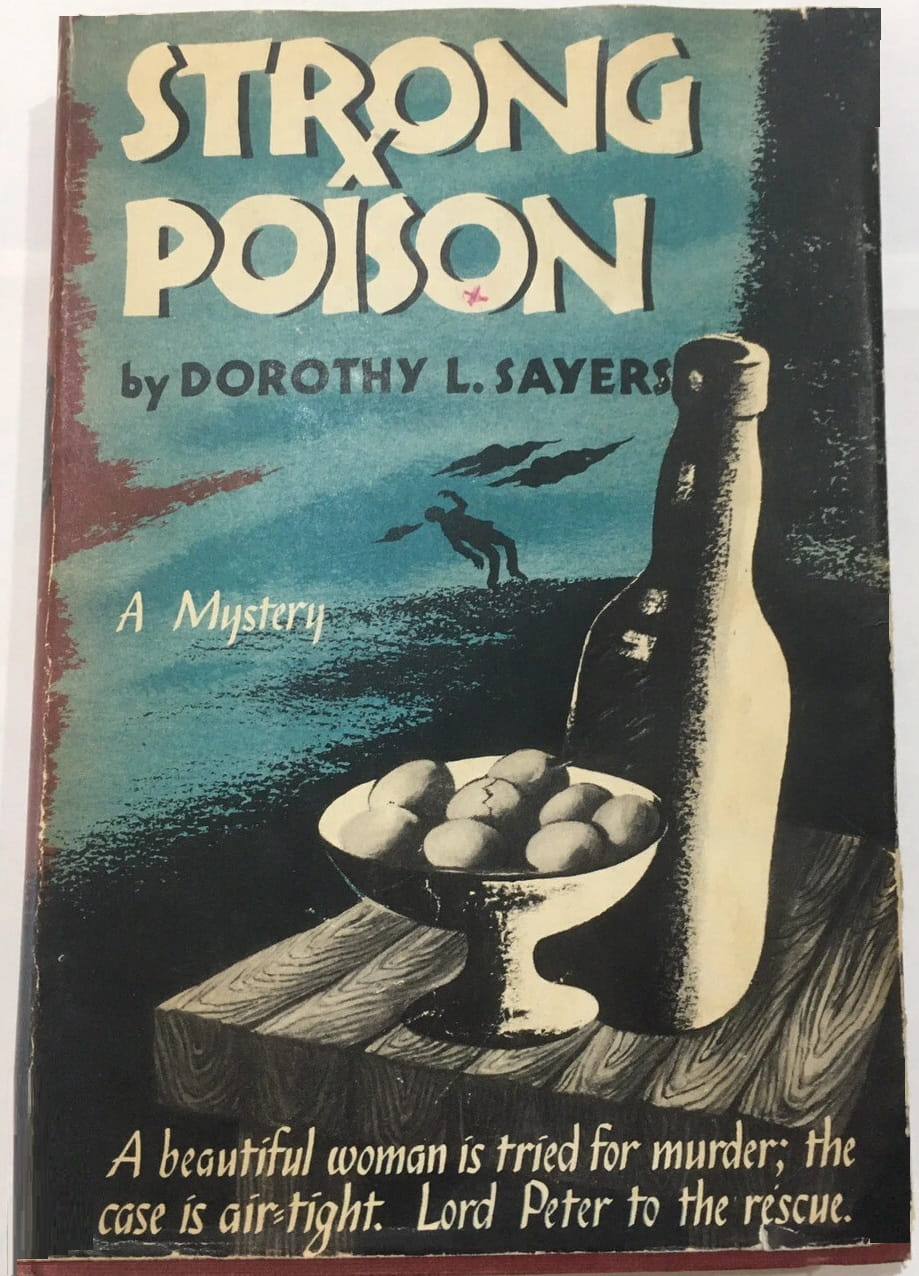
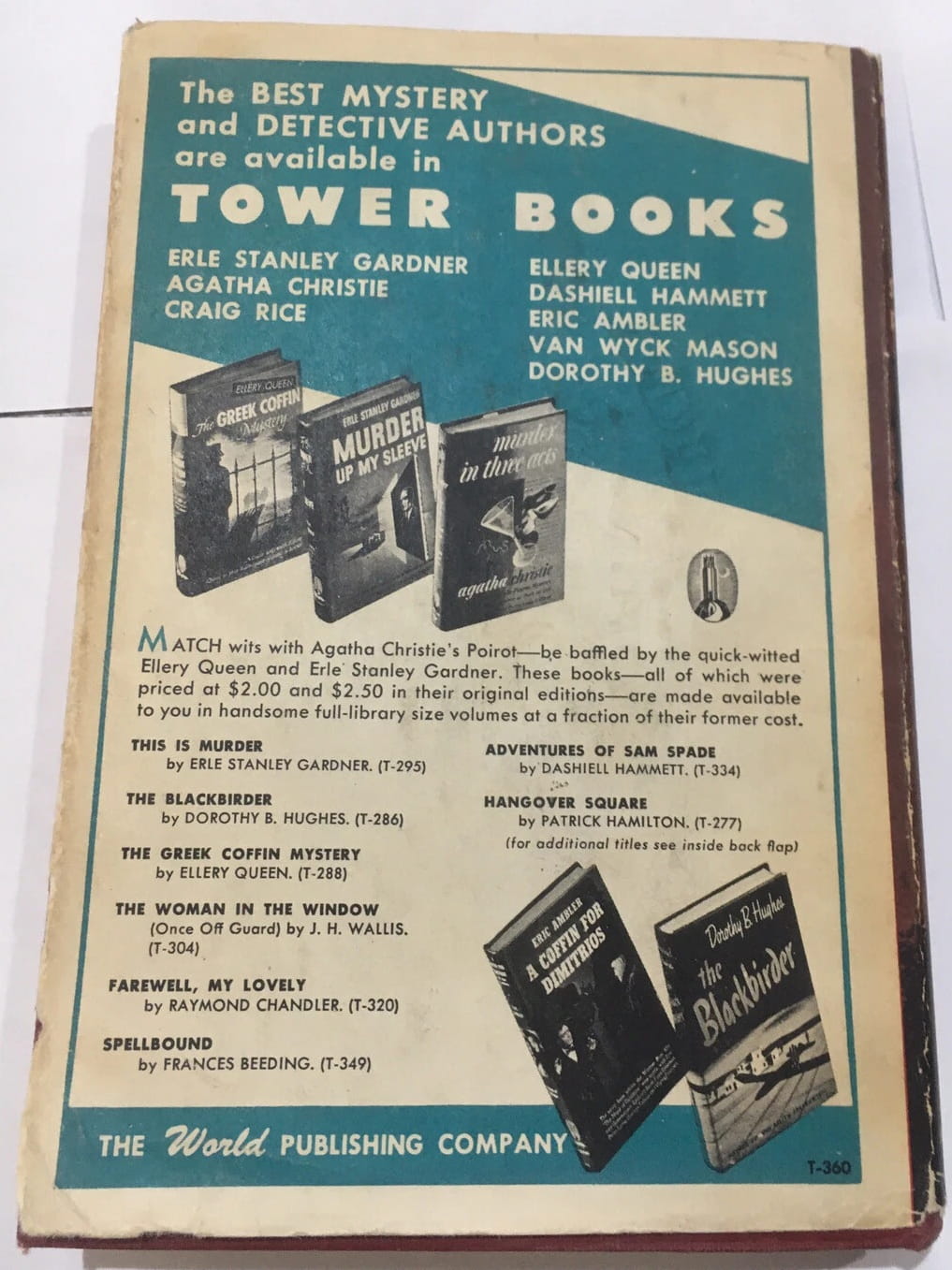
Strong Poison (Tower, 1945)
Wimsey himself, who apparently has been in the audience throughout the trial, seems to have reached the same conclusion; he’s convinced enough of Vane’s innocence to criticize her solicitor for treating this as a job of casting doubt on her guilt. But at the same time, he has decided to marry Vane, having fallen in love with her. He says as much to her when he first interviews her in prison, and is taken aback when she says, “Oh, are you another of them? That makes forty-seven.”
Wimsey’s closest friend, Charles Parker, makes an appearance, in two roles. On one hand, he’s initially convinced that Vane is guilty, though he provides Wimsey with help in looking for evidence to the contrary.
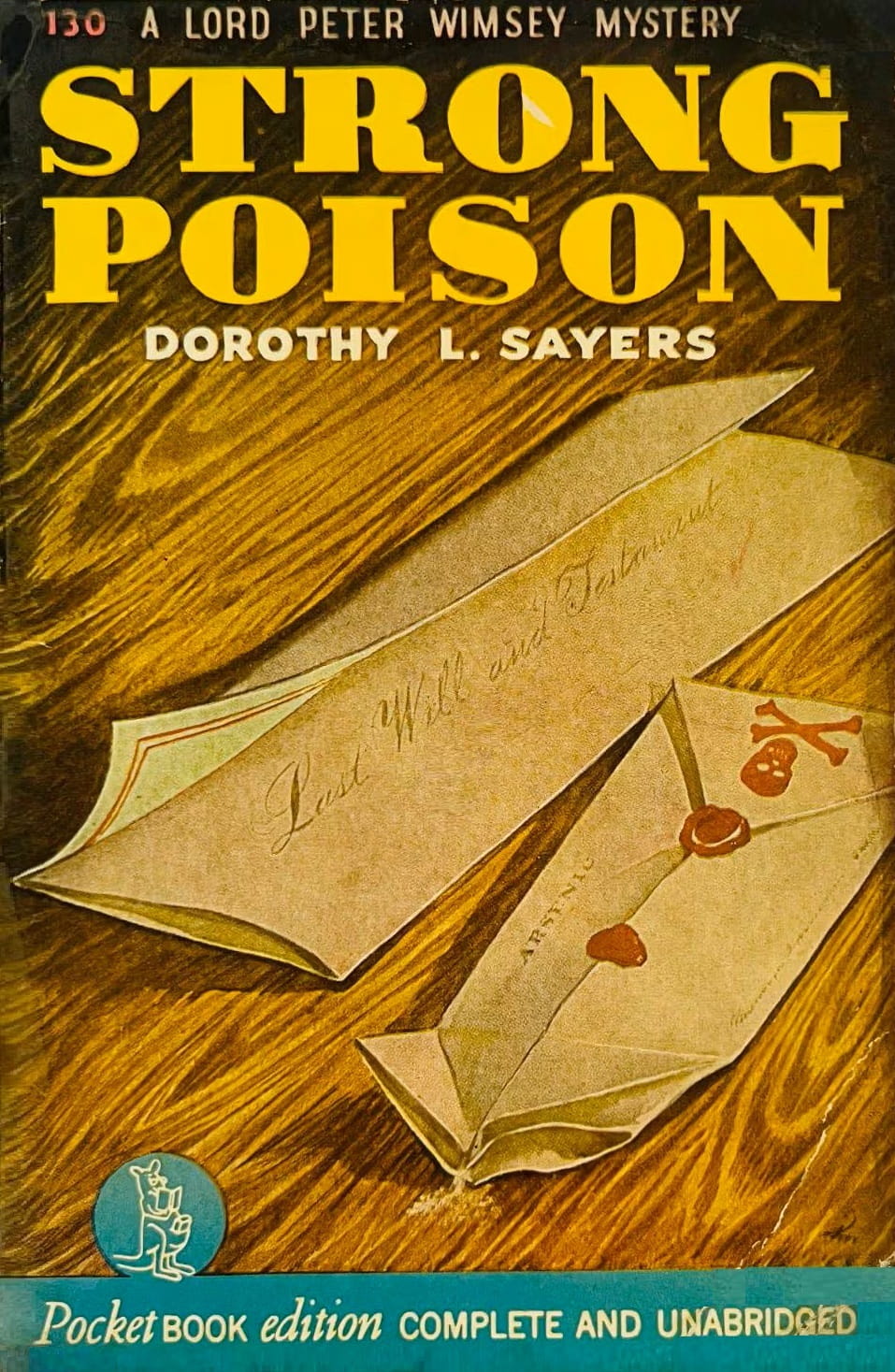
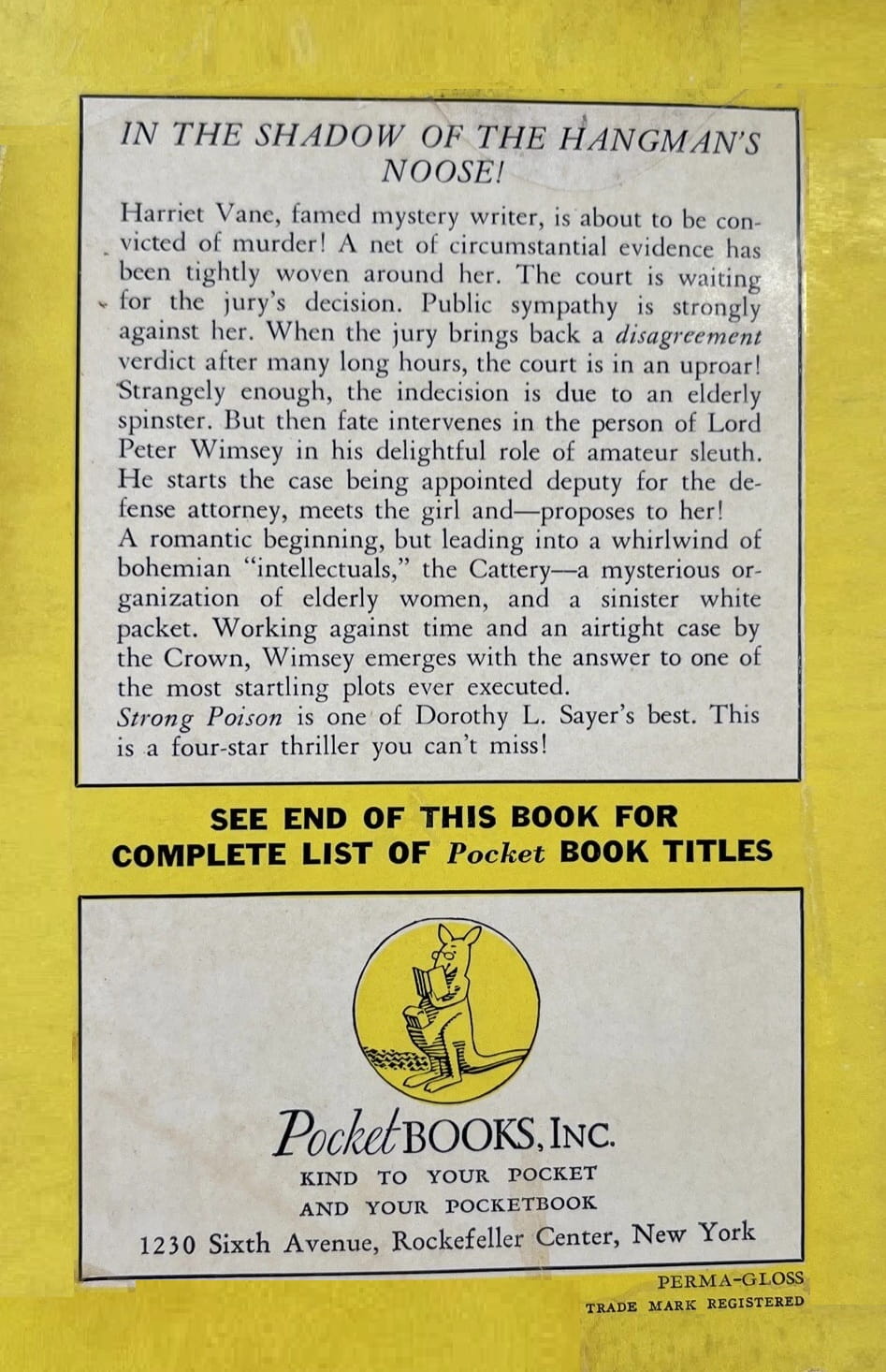
Strong Poison (Pocket Books, 1945)
On the other, he and Wimsey’s sister Mary have fallen in love with each other, and the issues of social class this raises parallel those between Wimsey and Vane neatly; their older brother, the Duke of Denver, is horrified at both prospects.
The use of arsenic makes this another mystery that turns on medical knowledge — or, in this case, on medical folklore. Once again, Sayers focuses less on who than on how.
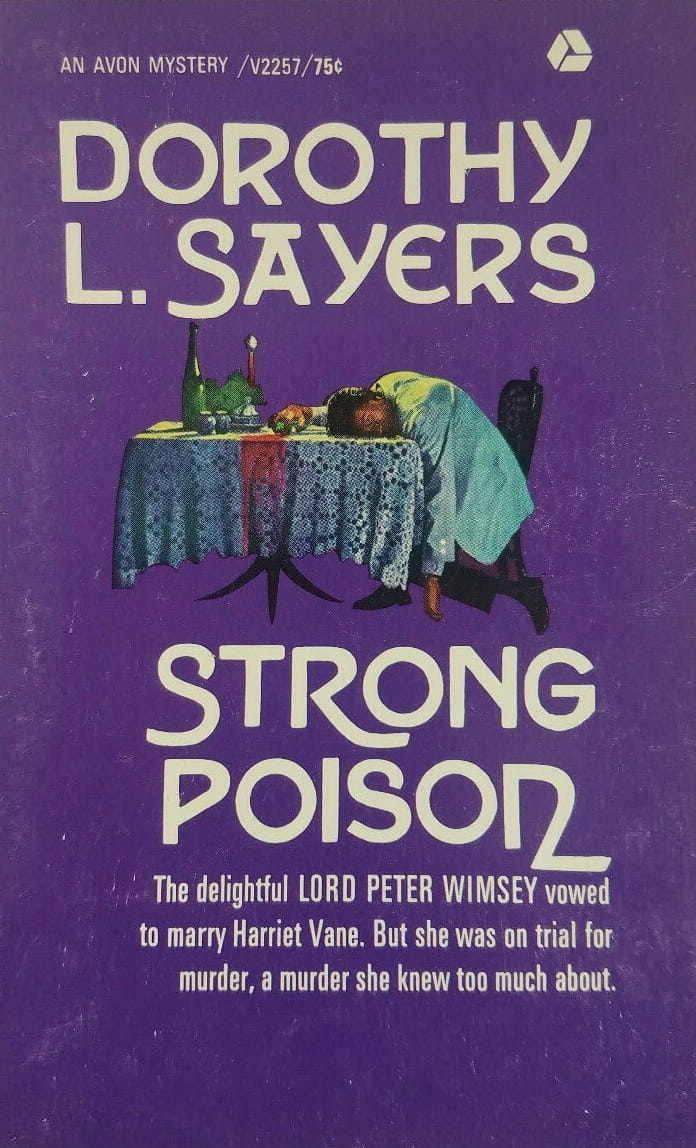
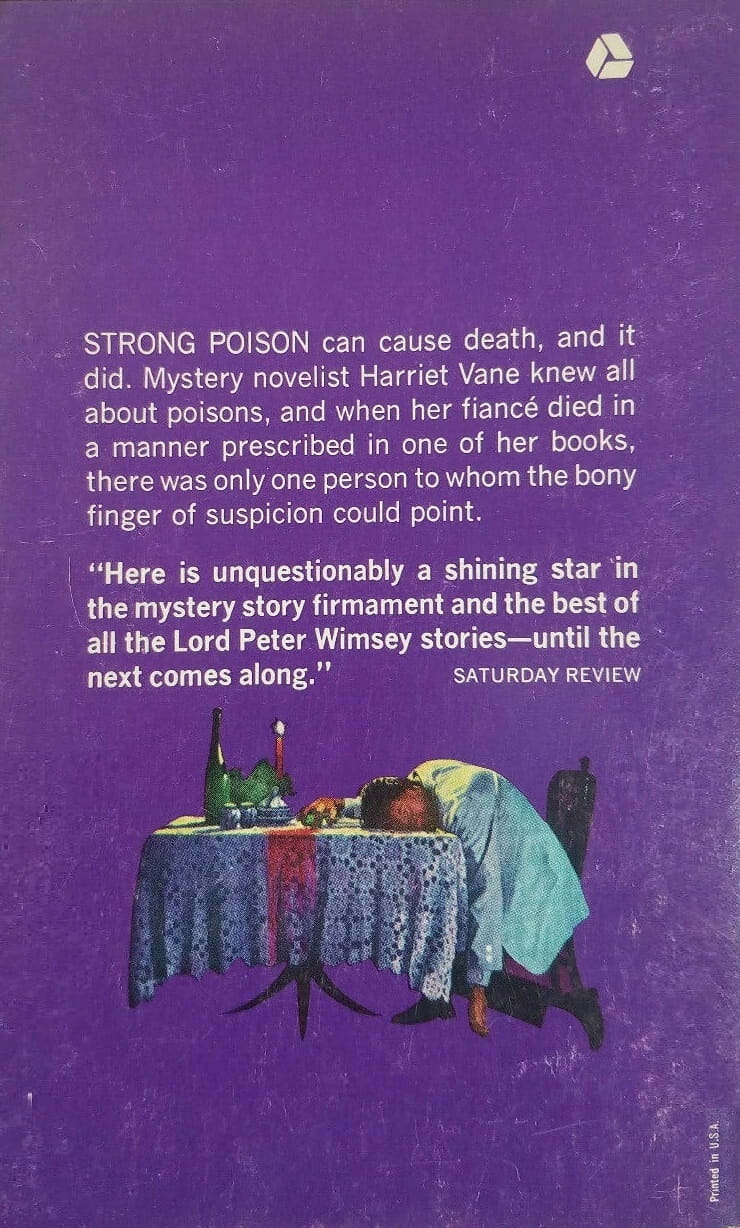
Strong Poison (Avon Books, 1969)
When Wimsey has his manservant Bunter put away some books he’s been consulting, one of which is A Shropshire Lad, I recognized, and so (to his credit) did Bunter, that this was a reference to the poem “Epilogue” (or “Terence, This Is Stupid Stuff”), which ends with the legend of Mithridates:
There was a king reigned in the East.
There, when kings will sit to feast,
They get their fill before they think
With poisoned meat and poisoned drink . . .
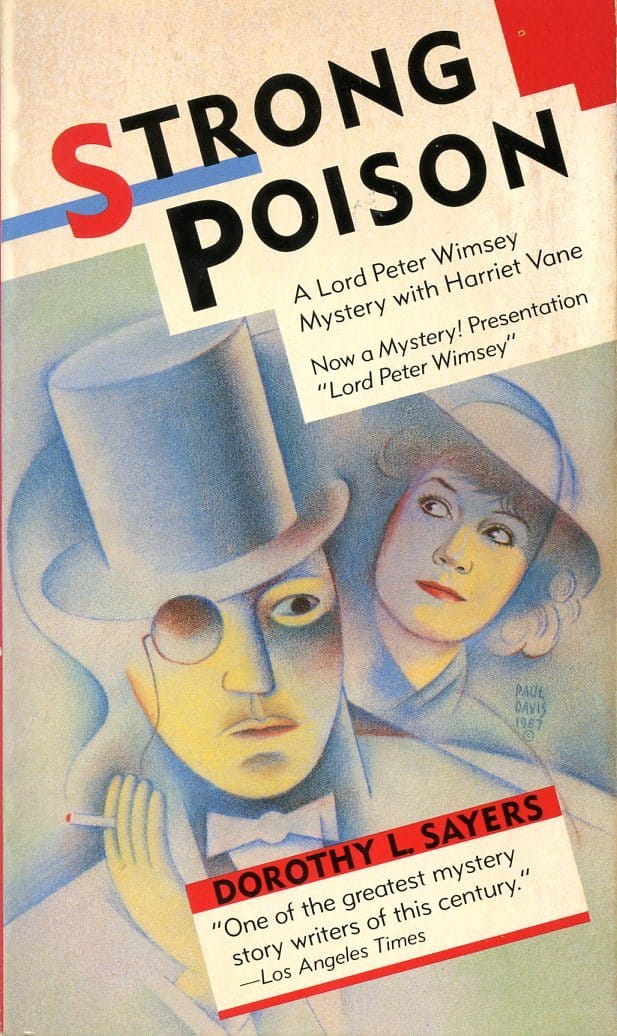
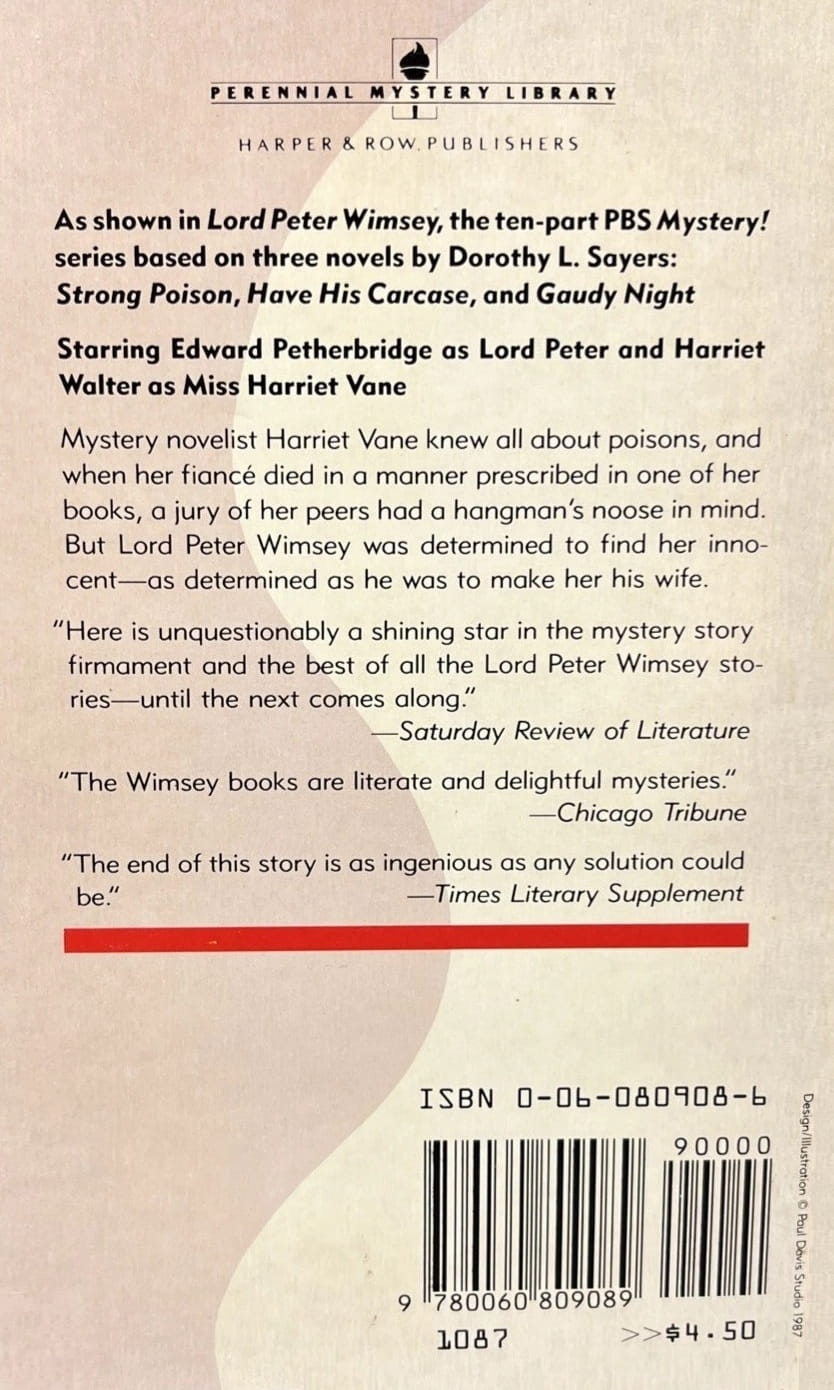
Strong Poison (Harper & Row paperback edition)
In fact, this is a book filled with quotations and allusions; and the exchange of both between Wimsey and Vane is one of the first signs that they might actually belong together. The poem neatly hints at the method (which is one that is no longer thought to be workable) and at how Wimsey proves his case.
Beyond how, there’s also why: the motive for the crime. And here, as in Unnatural Death (and An Unpleasantness at the Bellona Club, which came in between), family history and financial assets come into the story.
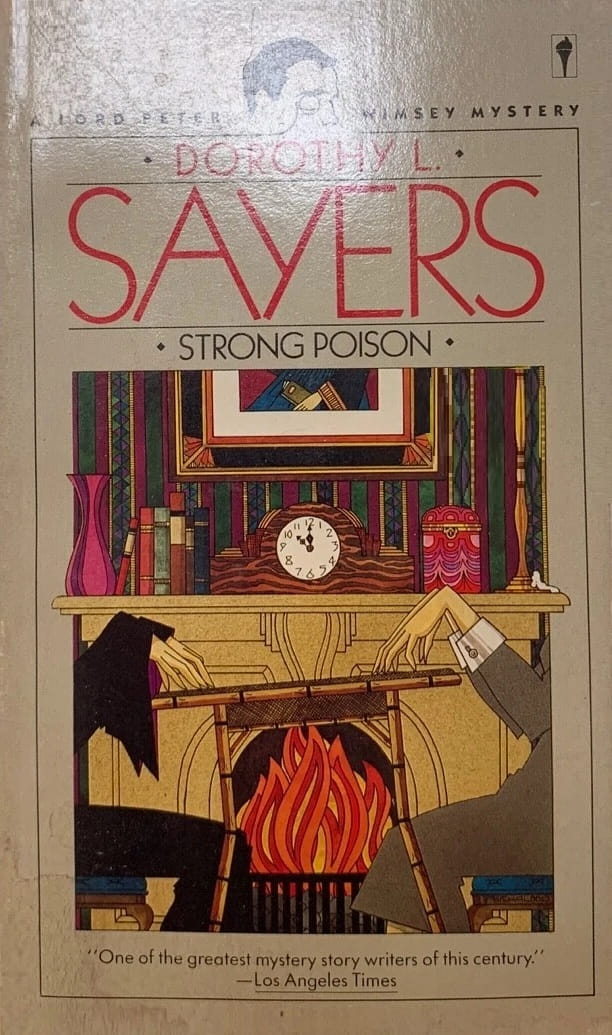
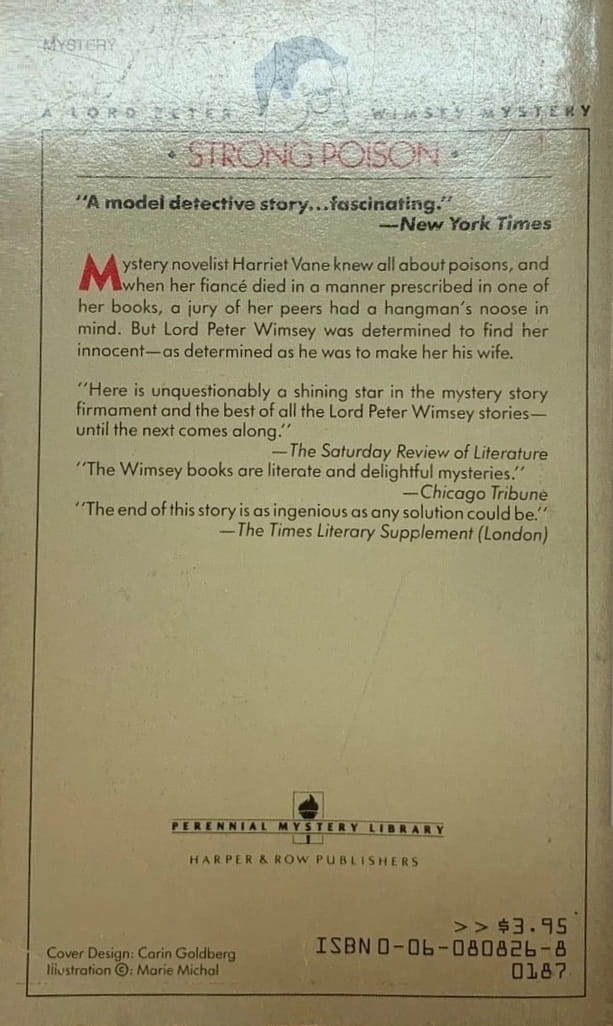
Strong Poison (HarperCollins, 1987)
Both Boyes and his cousin Norman Urquhardt, a solicitor, with whom he dined on the night of his death, have family connections to Rosanna Wrayburn (née Hubbard), a famous actress of the 1860s who led a scandalous life, under the stage name of Cremorna Garden, and invested the many gifts it brought her, making her wealthy in her old age. Sayers seems to like stories about women who rebelled against Victorian expectations in various ways!
Wimsey gets together with Miss Climpson early in the investigation and discusses possible motives with her; and later he calls on both her and another woman in his agency, Miss Murchison, to investigate various aspects of the case. In Miss Climpson’s case that involves her playing the role of a spirit medium for Mrs. Wrayburn’s credulous nurse (a great bit of comic relief!); Miss Murchison gets lessons in lockpicking from a former burglar, Bill Rumm, who reformed and got religion after an earlier encounter with Wimsey.
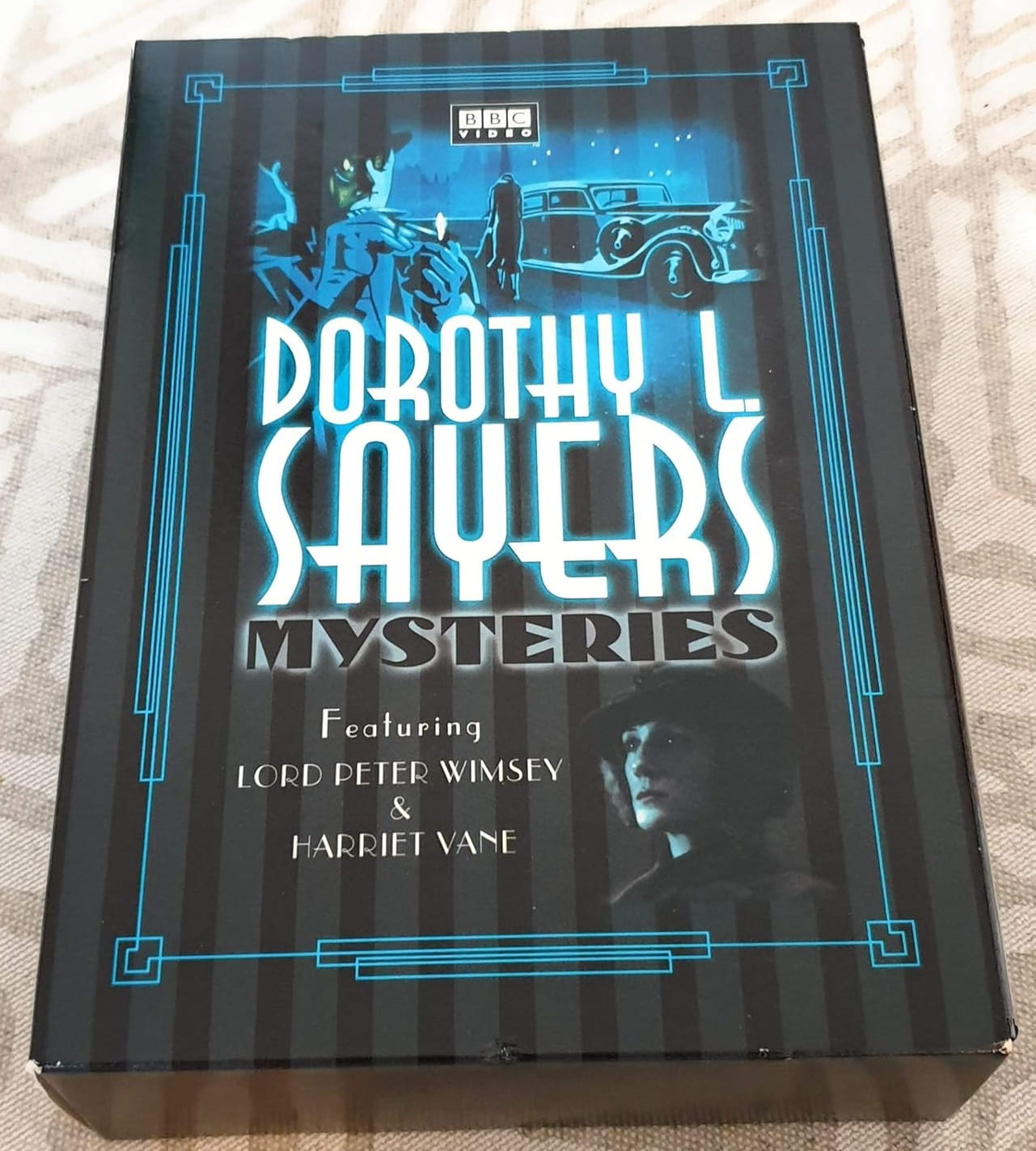
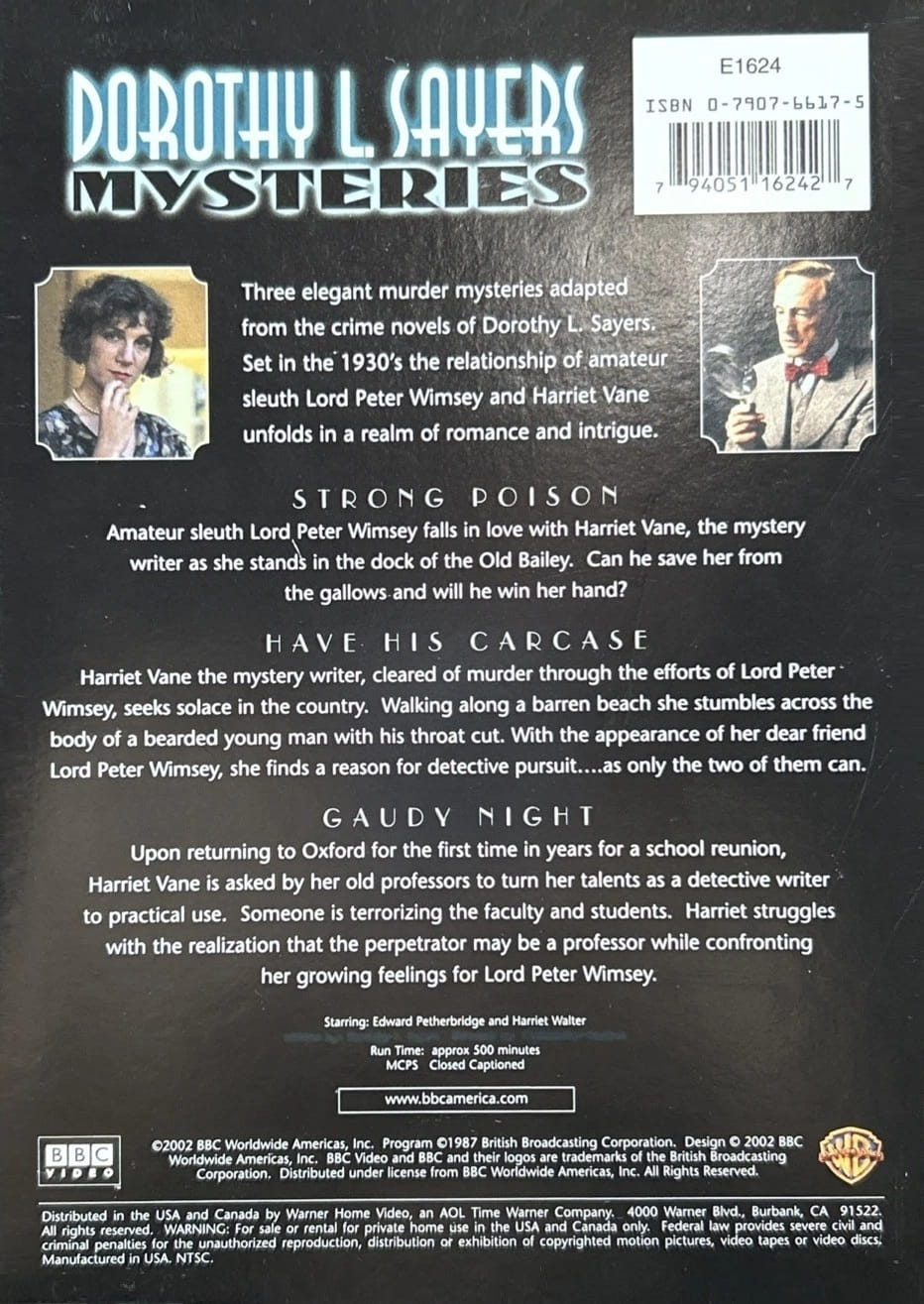
Dorothy L. Sayers Mysteries adaptations featuring Lord Peter Wimsey and Harriet Vane:
Strong Poison, Have His Carcase, and Gaudy Night (BBC Video, 2002)
Knowing why gives Wimsey confirmation of who. There are also connections with the Megatherium Trust (named for the giant ground sloth!), on which Wimsey gets helpful advice from his friend Freddy Arbuthnot — who has just become engaged to Rachel Levy, the daughter of the murder victim in Whose Body?, another matrimonial crossing of established social boundaries.
We also see Wimsey consulting with Marjorie Phelps, an artist who makes porcelain figures, for a better understanding of Vane’s cultural milieu. In particular, she introduces him to Vane’s friends Sylvia Marriott and Eiluned Price, who give him more background on Vane’s relationship with Boyes.
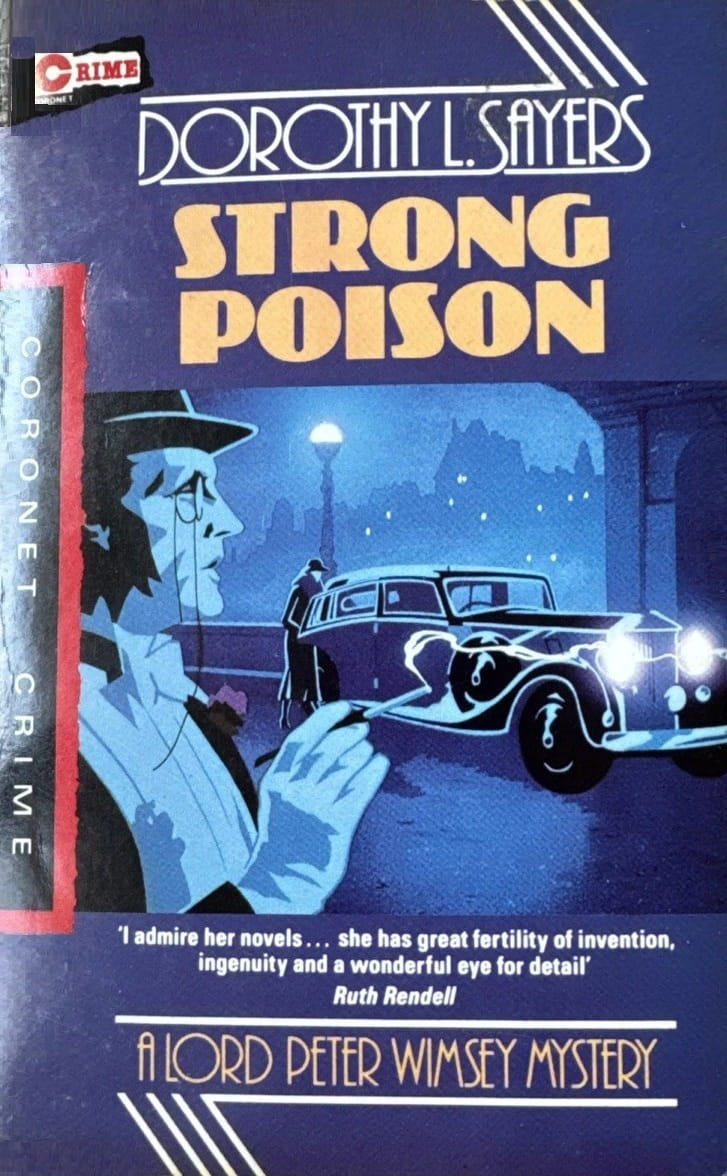
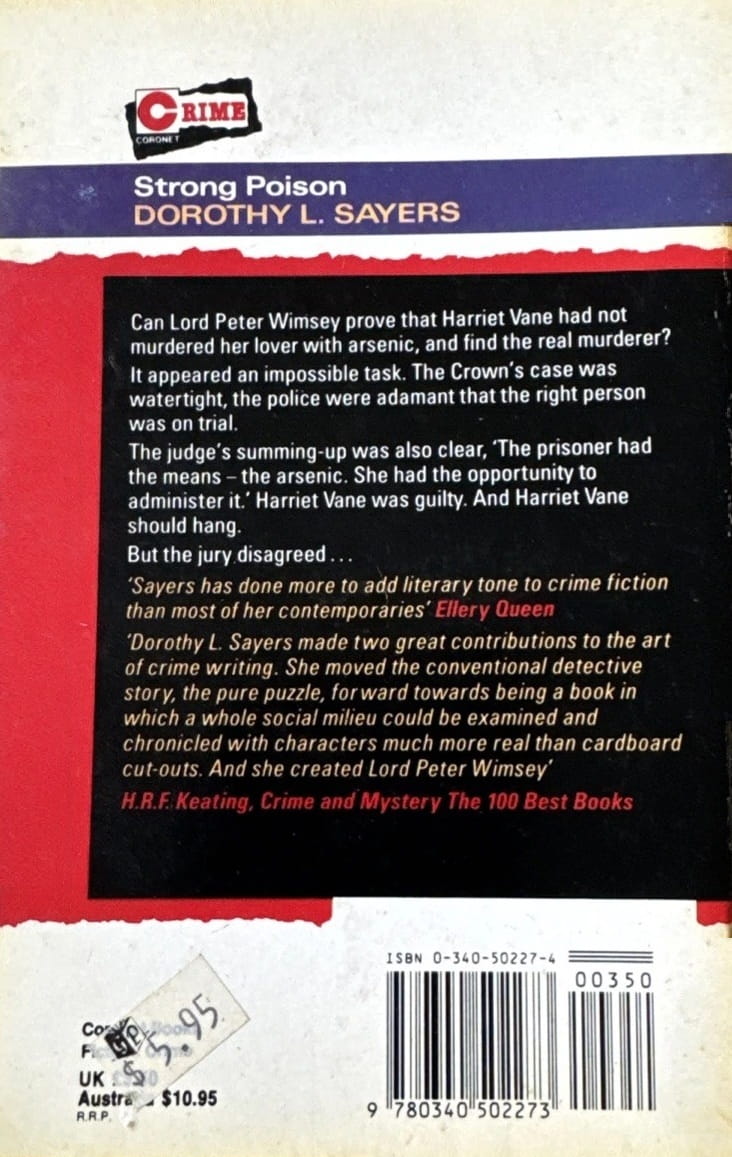
Strong Poison (Hodder & Stoughton/Coronet Crime trade paperback, 1993)
Price is characterized as generally disliking men, which might or might not be a hint about her sexuality, but at the end of the novel she tells Vane that Wimsey is too decent to be importunate in his courtship, so it seems he managed to make a good impression on her.
The chapter where Wimsey talks with the three women doesn’t seem to advance his investigation much; its function seems to be more one of characterization — notably Phelps’s silent unhappiness at the end, which hints at something unspoken between her and Wimsey.
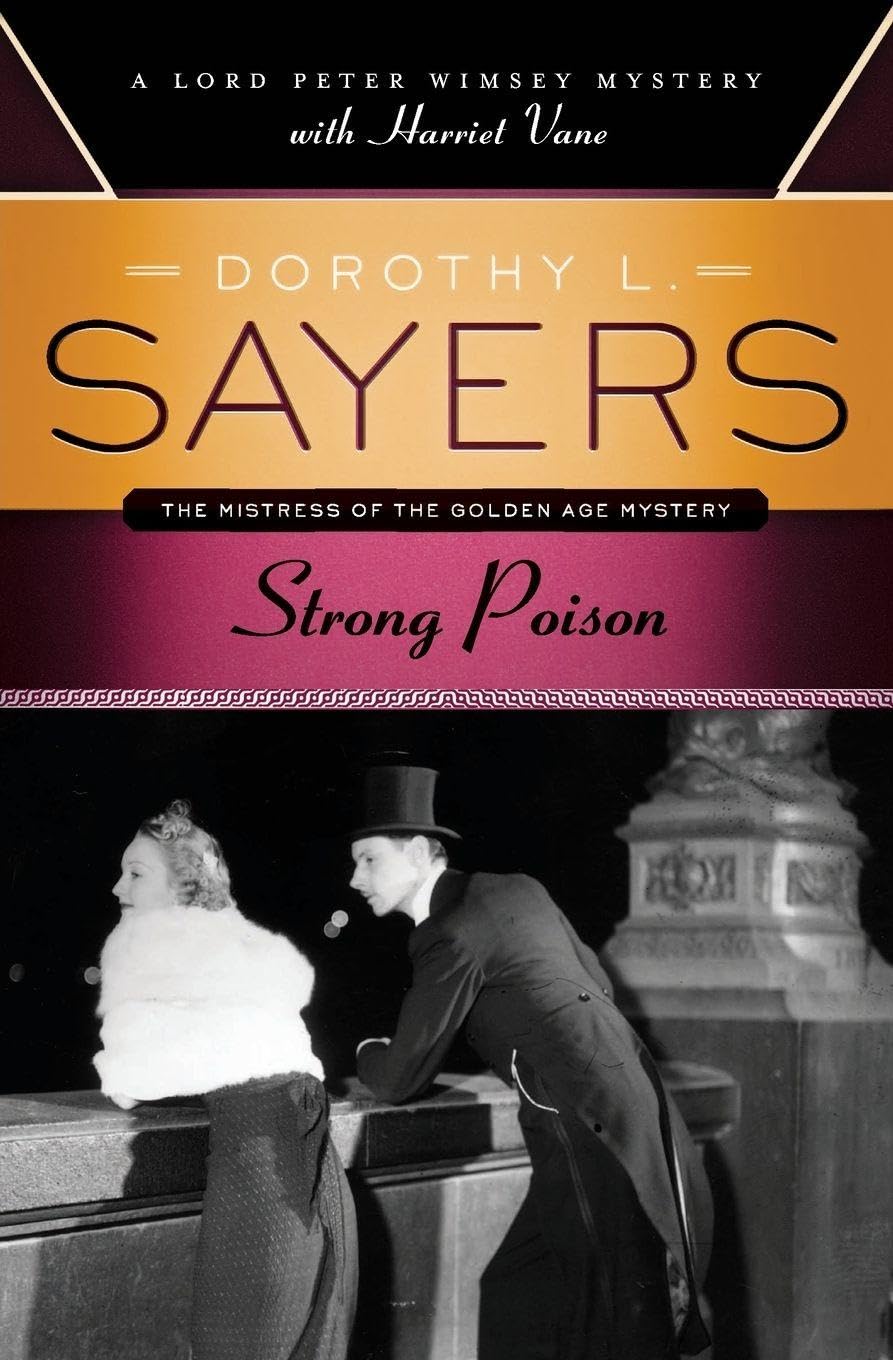
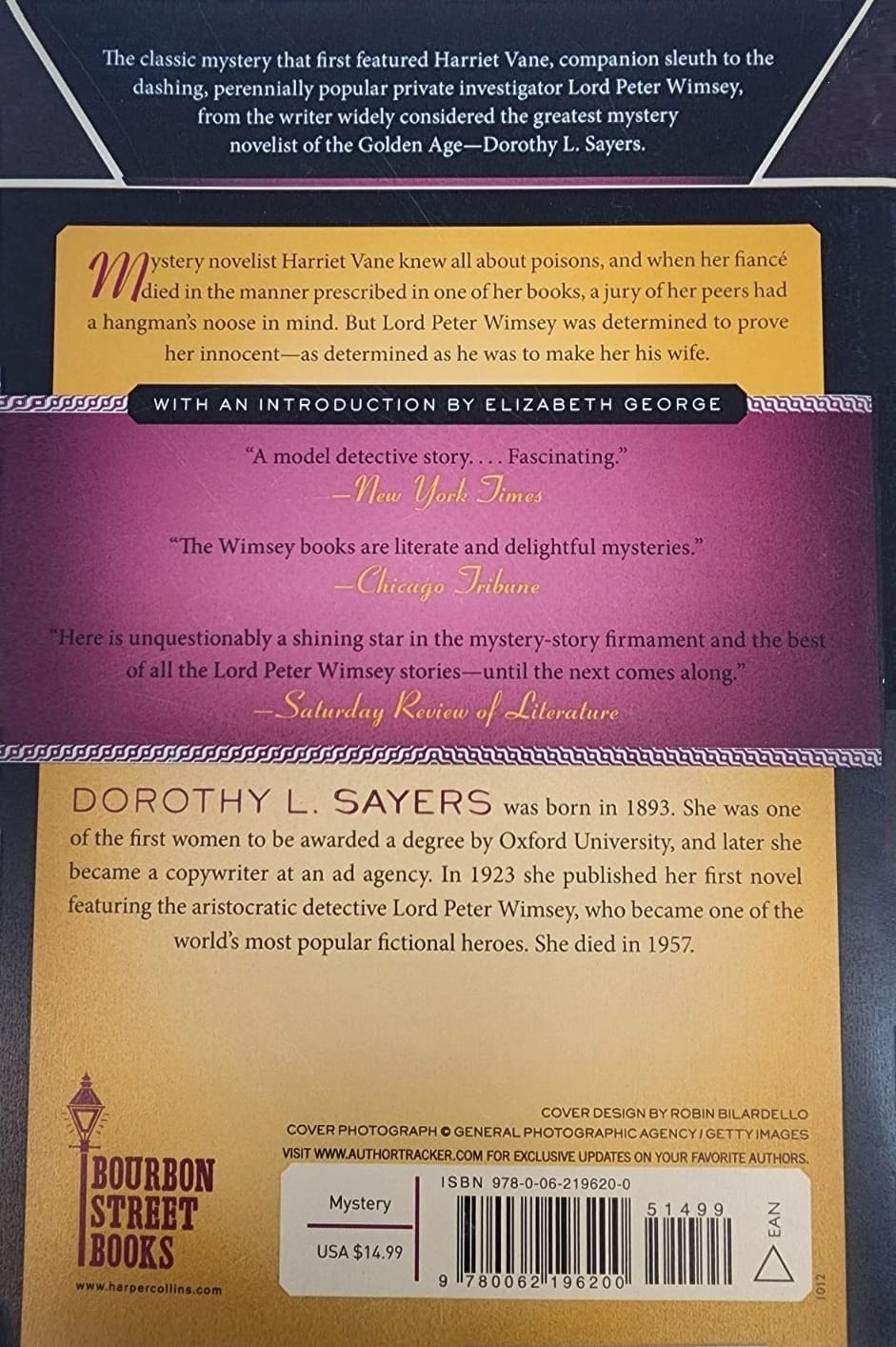
Strong Poison (Harper Paperbacks, 2012)
On one hand, I can’t regret the introduction of Harriet Vane into the series; she will play a significant role in some of the later novels, and even in this one her characterization is interesting.
On the other, while it’s in character for Wimsey to decide she’s innocent and take up investigating her case, it seems implausible for him to fall in love with her after having merely seen her in the witness box in a courtroom. I feel as if Sayers didn’t feel able to show the beginning of the attraction convincingly and fell back on making it a fait accompli.
And Wimsey’s declaration of his feelings during his first interview with Vane is awkward in a way that’s hard to believe of a man of such suavity. The events of Strong Poison are central to the series, but they make me wonder if the story Sayers was telling had gotten out of her control. So I can understand why some of her readers may have thought this particular storyline was ill-advised.
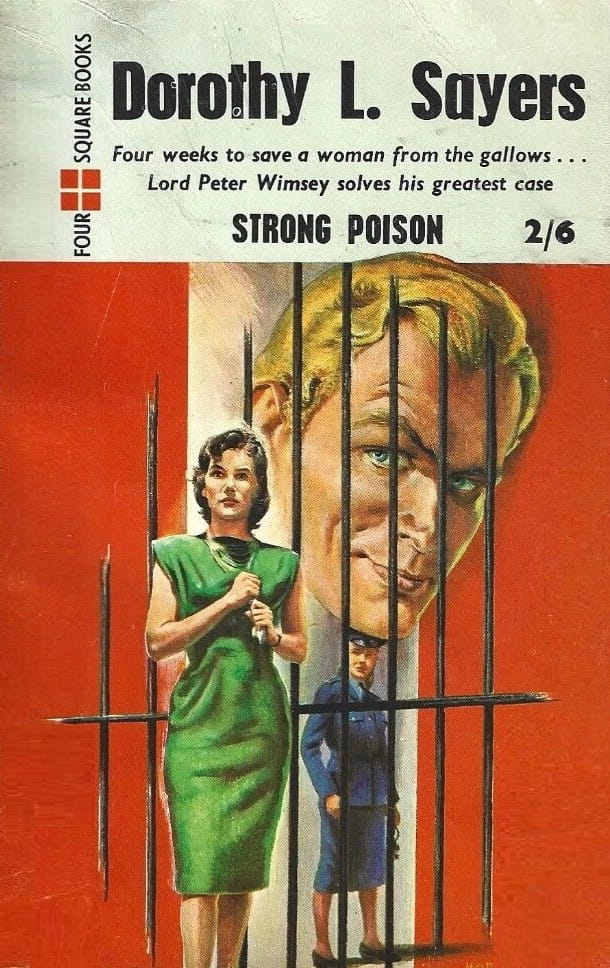 Strong Poison by Dorothy L Sayers (Four Square UK edition, 1960)
On the other hand, Sayers’s fusion of a murder mystery with a novel about courtship and social class certainly breaks the series out of any previously established formula, which is part of what makes it interesting.
“Forgive my asking, but — you were very fond of Philip Boyes?”
“I must have been, mustn’t I — under the circumstances?”
“Not necessarily,” said Wimsey, boldly, “you might have been sorry for him — or bewitched by him — or even badgered to death by him.”
“All those things.”
William H. Stoddard is a professional copy editor specializing in scholarly and scientific publications. As a secondary career, he has written more than two dozen books for Steve Jackson Games, starting in 2000 with GURPS Steampunk. He lives in Lawrence, Kansas with his wife, their cat (a ginger tabby), and a hundred shelf feet of books, including large amounts of science fiction, fantasy, and graphic novels.
Categories: Fantasy Books
A Vintage Horror Collection: Young Blood, edited by Mike Baker
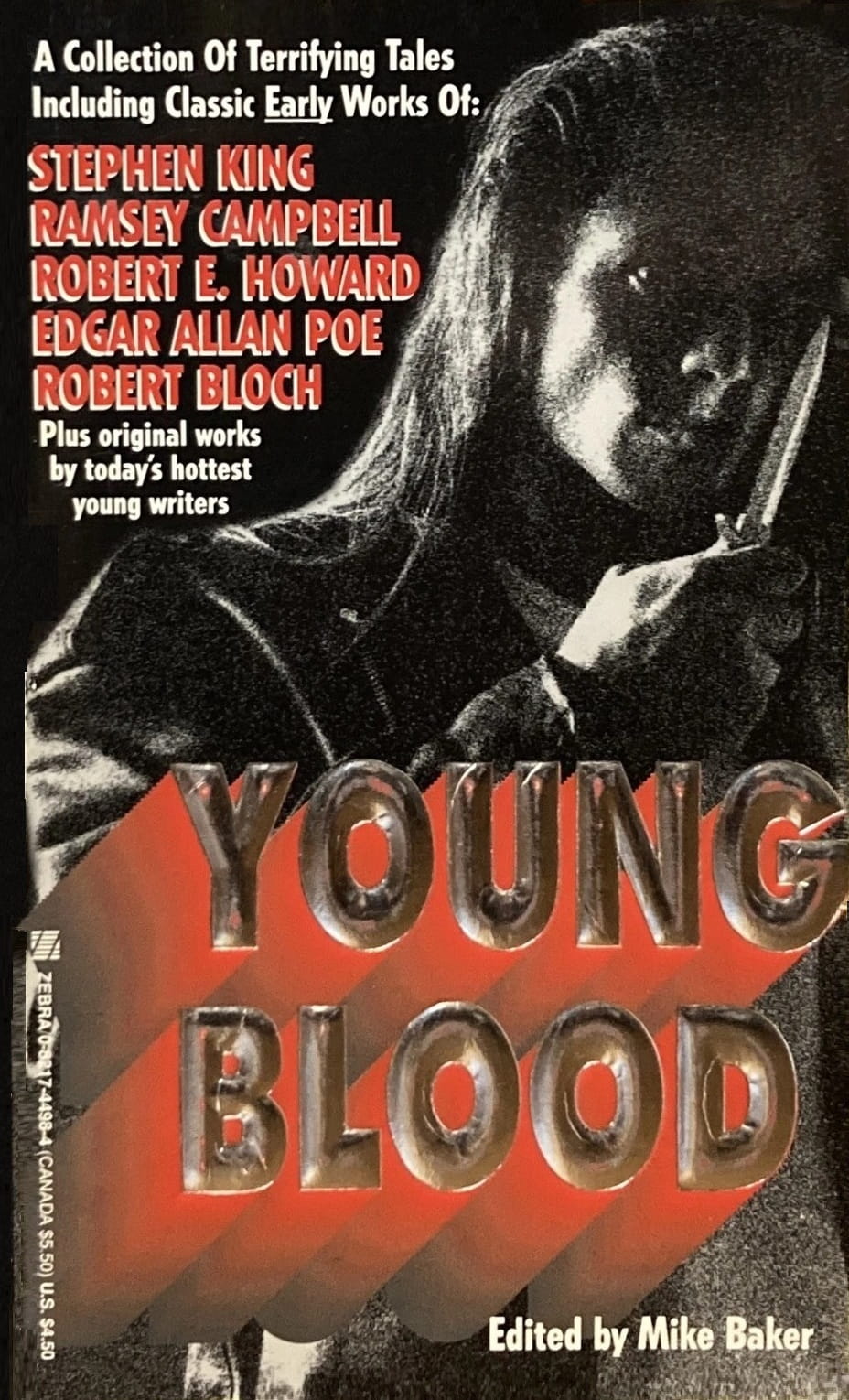
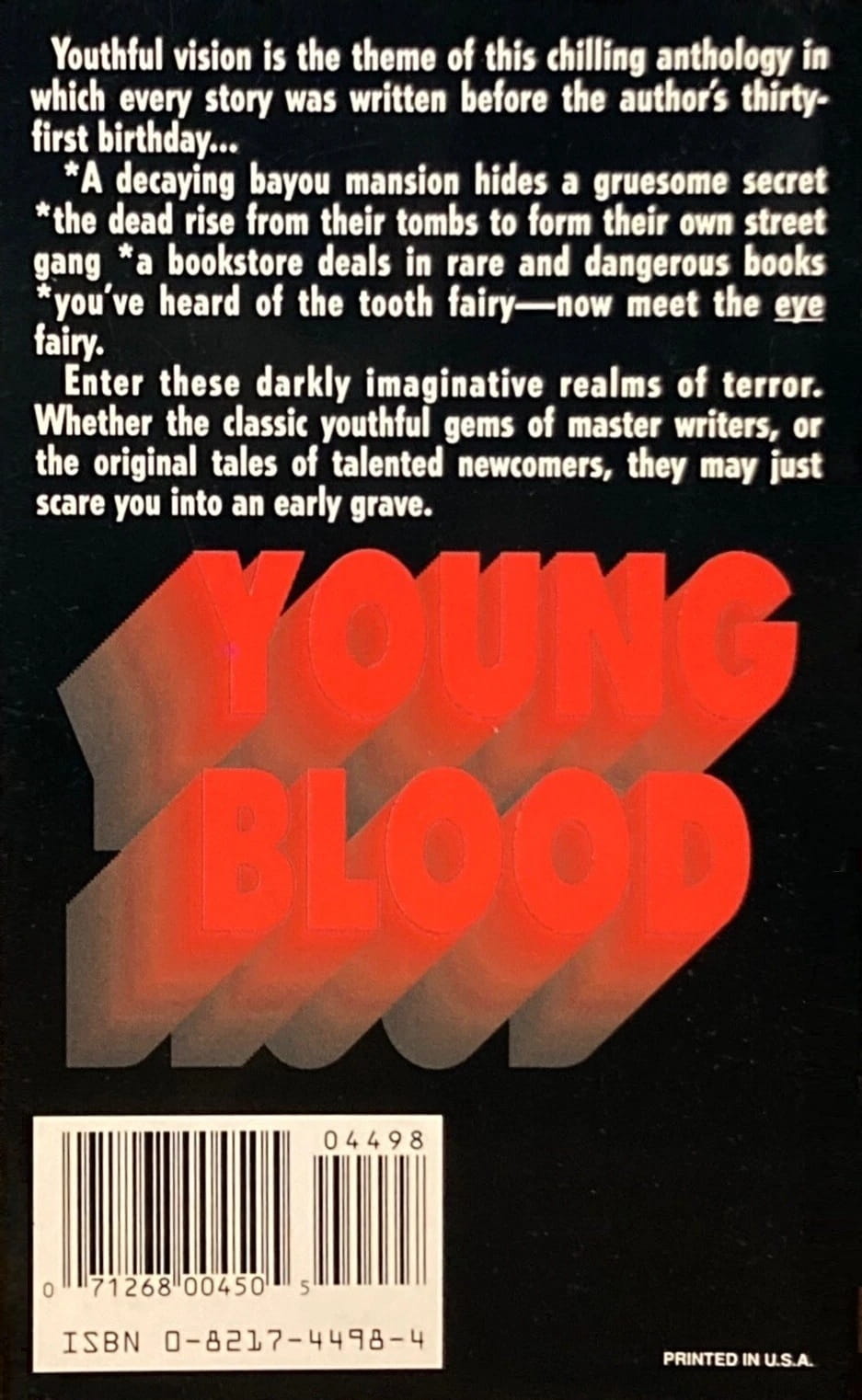
Young Blood (Zebra Books, March 1994). Cover uncredited
Young Blood, from Zebra 1994, Edited by Mike Baker. Cover looks like a photo: Artist unknown.
Here’s another book I picked up originally because it had a Robert E. Howard story in it. This one’s different, though. It isn’t a collection of Sword & Sorcery tales, but of horror stories. The Howard story is “Pigeons From Hell,” which is somewhat universally recognized as the best of his supernatural tales. In Danse Macabre, his nonfiction book on horror, Stephen King called it “one of the finest horror stories of our century.” I agree.
[Click the images for bloody versions.]
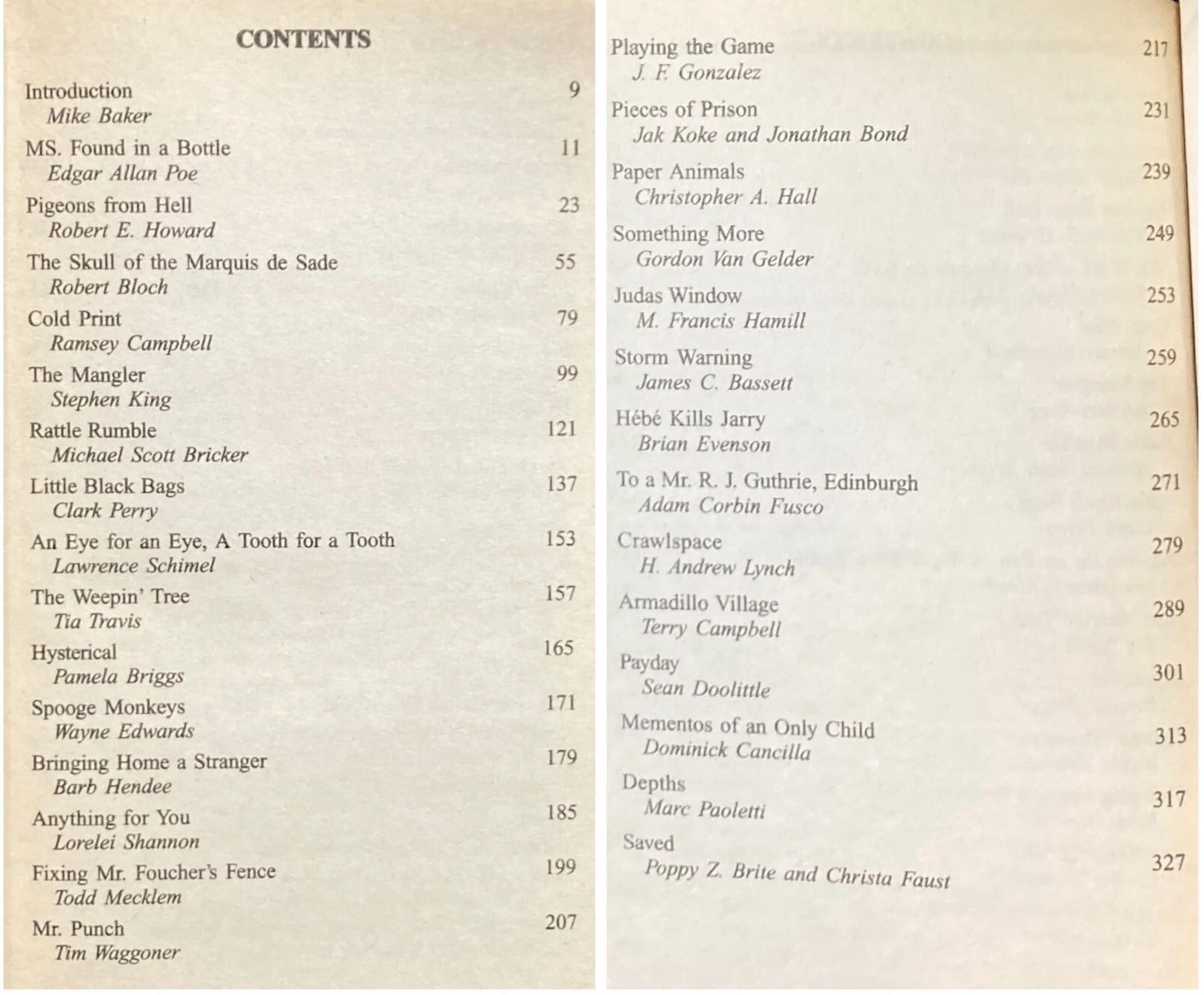 Young Blood contents
The collection also has stories by King, Ramsey Campbell, Robert Block, Poe, Michael Scott Bricker, Clark Perry, Lawrence Schimel, Tia Travis, Wayne Edwards, Pamela Briggs, Barb Hendee, Lorelei Shannon, Todd Mecklem, Marc Paoletti, Dominick Cancilla, Sean Doolittle, Terry Campbell, H. Andrew Lynch, Brian Evenson, James C. Basett, M. Francis Hamill, Gordon Gelder, Cristopher Hall, J. F. Gonzalez, Jak Koke & Jonathan Bond, Adam Fusco, Tim Waggoner, and Poppy Z. Brite & Christa Faust.
I knew a lot of these names, though not all, and I’ve had pleasant dealings with such folks as Hendee, Mecklem, Bond and Waggoner. I also knew Poppy Brite at this time, although he is now known as William Joseph Martin (1967 -).
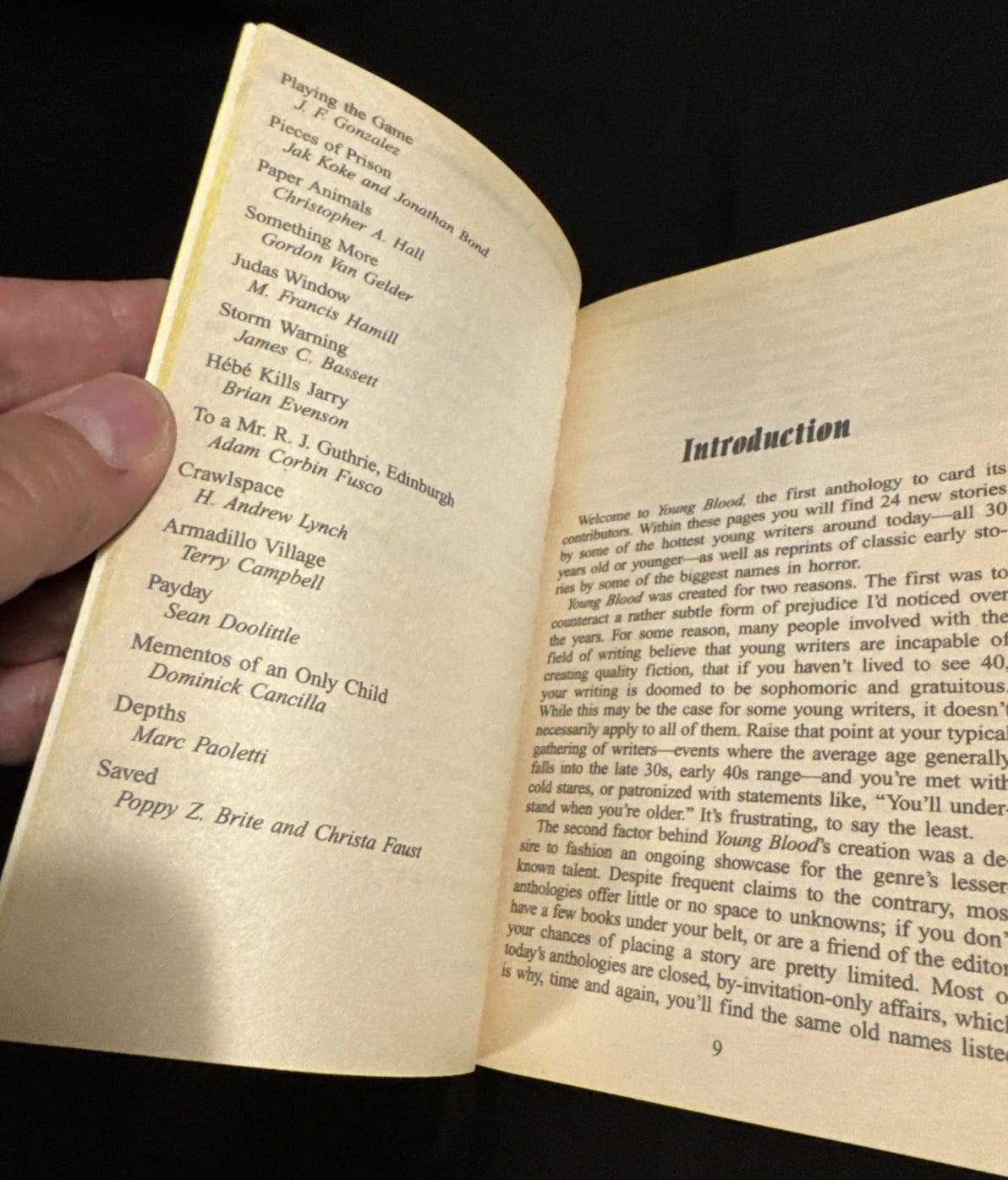 Young Blood introduction by Mike Baker
Brite’s collaboration, “Saved,” is by far the most graphic story in the book. I enjoyed it but was glad I hadn’t eaten recently.
My favorite story in the book, (other than Howard of course) was by Schimel. It was called “An Eye for an Eye, A Tooth for a Tooth.” It was absolutely hilarious. And one great idea.
Charles Gramlich administers The Swords & Planet League group on Facebook, where this post first appeared. His last article for us was a look at The Cornerstones of High Fantasy. See all of his recent posts for Black Gate here.
Categories: Fantasy Books
Late to the Game – My First Ever D&D Campaign
Good afterevenmorn, Readers!
So… I’m a nerd. I know, surprising, right? What might actually be surprising, though, is that I’ve never actually played a game of Dungeons & Dragons. I mean, I’ve had a couple of home-brewed one-shots many years ago, but I’m never actually played a proper campaign, with a regular crew. That changed this year. I started with a friend, who was part of another group, who then created a splinter group for a different game. I am part of that splinter group, starting a new campaign at ground zero.
Can I just say, I am loving it. It’s a very excellent way to explore character and motivation, as well as world-building and story-telling. If you struggle with any of these, consider starting a D&D campaign. Let’s explore what’s going on in my game, because I’m too enamoured with it currently not to share.
First, because I’m relatively new to the whole thing, I started out basic. The character I chose is closest to myself in both appearance and temperament, which is to say I am playing a human fighter. She’s wildly idealistic, believing her strength and talents should be used to protect those who cannot protect themselves. She is the embodiment of my favourite quote from The Lord of the Rings, as articulated by my favourite captain of Gondor, Faramir.
I do not love the bright sword for its sharpness, nor the arrow for its swiftness, nor the warrior for his glory. I love only that which they defend.
Which, incidentally, I intend to have tattooed to my person one of these days.
Unlike the devastating stories of early childhood trauma that seems to be the norm for player characters, Tabynthia’s childhood was happy. She grew up in a tiny village, who, like Sparta raises fighters. Unlike Sparta, however, this society is kind and open, and are directly responsible for instilling her belief that it is her duty in this life to defend the defenseless and protect the innocent.
Everyone, regardless of race or ability has a place in this village, provided they adhere to the tenants of life there (on of Taby’s best friends is a half-orc, whose father orcish father fell in love with one of the fighters when she was out in the world, and followed her, eventually joining the village, earning a living as a smith). Only those who are able are raised as warriors, and sent out into the world to make their mark and earn coin and when their adventuring is done, assuming they live, they return home to help raise and train the next generation of defenders.
The manner in which they make their coin matters, and upon their death, they must face the judgement of their ancestors, making a full accounting of their deeds in life. Only the worthy are permitted to join the ancestors in their eternal festivities. Everyone else is sent back to right their wrongs, or to try again and become worthy. Taby was loved by bother her parents, both of whom are still alive. Her mother trained her in the fighting arts, and her grandmother, a great hero of her time, coached her in ethics growing up. Her father simply proudly doted. She is out in the world now as a young adult, attempting to make the world better for her being there.
That’s my character. I mean in game.
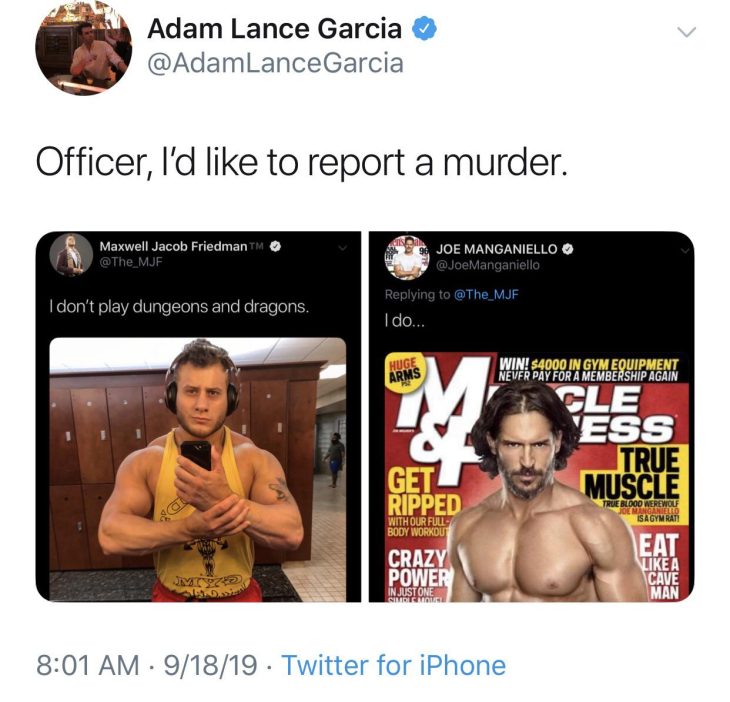 D&D, for everyone! Except the first guy. Not him.
This is a very fun dynamic in game to play. It makes for some really interesting choices for the character; a narrative choice. Does Taby permit the horrors of the world make of her a cold, hardened warrior, or does she make the very deliberate choice to lean even harder into the kindness and belief in goodness that stands at the core of her upbringing? Will she maintain the belief in herself instilled in her by a family that loved and supported her, or will she fall into the trap of having her self of self erode away, leaving her in despair regarding her own abilities? Save the fortune or misfortune of the roll of the dice, everything about a character is a deliberate choice on the part of the player.
It’s a great way to examine character choices in narrative, for those of us who are writers. It’s also an interesting way to examine our choice in the real world. I know for a fact that I’ve often turned to thoughts of my character when I’ve been personally struggling. What would Tabynthia do? She’s become a source of inspiration for me… which is weird, since I made her up. But it’s true.
This is also the first time I’ve played in a world that isn’t of my own creation. This is a very new experience for me. I have never written fan fiction, and I haven’t partnered with another author to create a story together. So this is something that I approached with considerable trepidation. It can be really tough creating in a world that has constraints you did not yourself create, and so might have trouble keeping your character or actions within the bounds of those constraints.
This is a good thing, I think; an excellent exercise for writer. I have read a few writers who break their own world rules without any valid justification (“because the narrative demands it” is not sufficient). I’ve also read a lot of characters that are able to magically do something that doesn’t make sense for their characters to be able to do. Practice not being able to do these things, as is offered by D&D, can help here I think.
Incidentally, though I’ve not dabbled in it, fan fiction can also help with this, as it is someone else’s world and, if done correctly, rules. It can also break the world, but let’s not talk about that too much.
I have to say, the DM running my particular game is quite forgiving when it comes to permitting me to create the whole damned culture which gave us Tabynthia. This small collection of villages in northern Faerûn doesn’t exist explicitly in the books I was given to help me get a handle on the game. But I was allowed to have Tabynthia come from there all the same. He’s also extremely patient in talking me through what my character can do, so I can make informed choices in any interaction. So, depending on your DM, you may have a lot more leeway to exercise your imagination while still being mostly true to the game. Though I still grimace at his evil little chuckles.
 How it feels any time the dice favour me. Image by Lixxe from Pixabay
This game also helps put you right in the shoes of your protagonist (and every player is the protagonist in their version of the story), so for anyone who struggles to see an alternate perspective, or having a character act differently from themselves in their fiction, this is a great way to exercise that particular muscle.
In order to do that, though, you must be willing to emphasize the role-playing aspect of this game. I have been letting my buried once-theatre kid have a ball with this character. It might take a bit for someone not used to inhabiting a role in this way to be able to do it, and perhaps a little longer to be comfortable doing it in a group setting, but it is well worth it; not just because it’s really fun, but also because it’s really good for seeing through another’s eyes. In writing and in life, this can only be a good thing.
Dungeons & Dragons is not just a great way to gather and play, but it can be a really serious exercise in good writing, in writing practice, and, like most fiction, dissecting the real world in which we live, and the actions of those in it in a more hands-on way than reading often permits (unless you’re like me, in which case you get so into a book you’re practically living it).
If you haven’t tried your hand at it yet, this is your sign to give it a go. Finding a good crew with a good DM can often be a challenge (hoy boy, have I heard some horror stories), but it’s well worth it if they can be found.
When S.M. Carrière isn’t brutally killing your favorite characters, she spends her time teaching martial arts, live streaming video games, and sometimes painting. In other words, she spends her time teaching others to kill, streaming her digital kills, and sometimes relaxing. Her most recent titles include Daughters of Britain, Skylark and Human. The Timbercreek Incident is free to read on Wattpad.
Categories: Fantasy Books
When is a Sidewalk Fully Dressed? – The Hudsucker Proxy
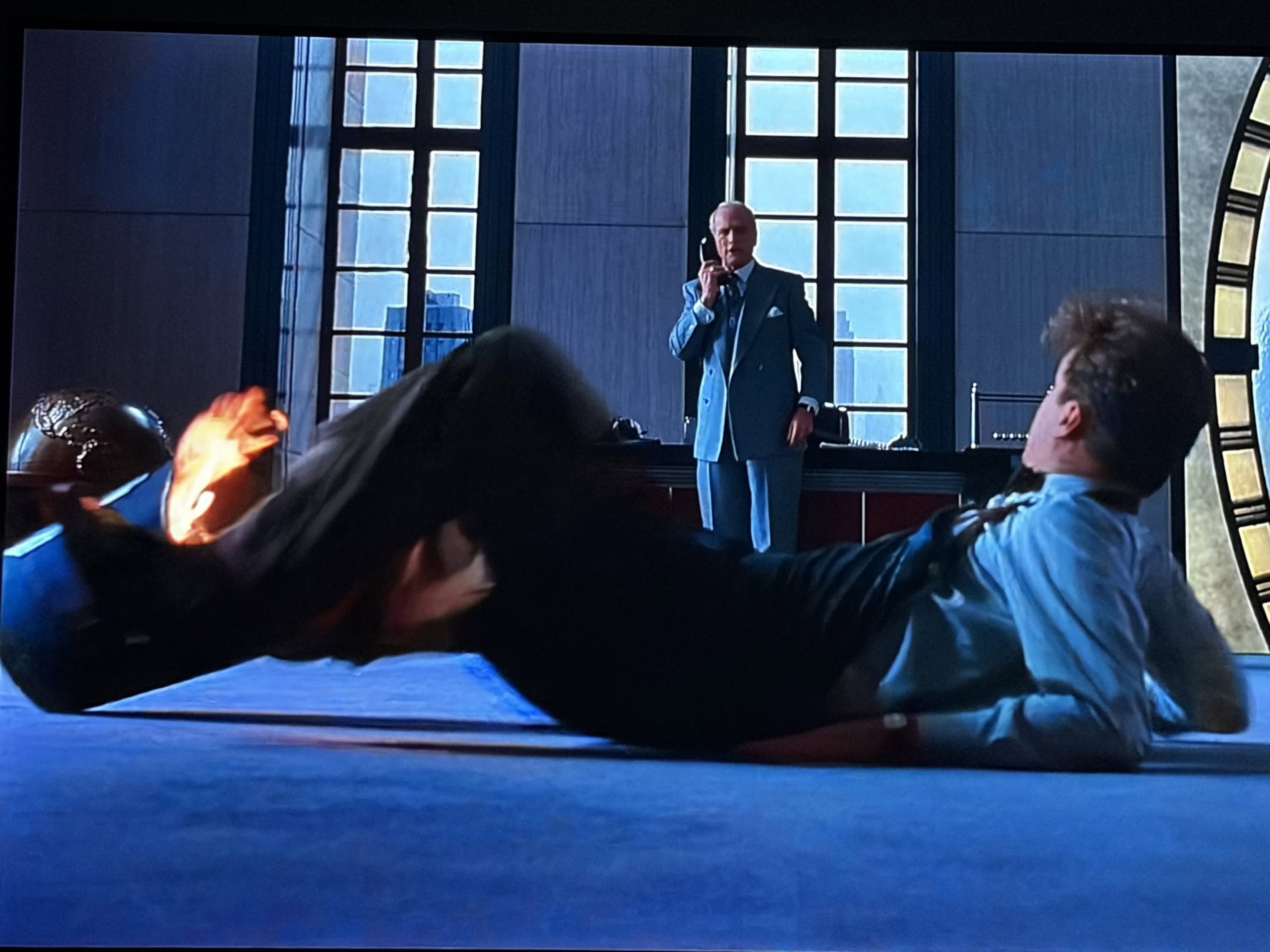 The Coen Brothers are among the finest filmmakers of my lifetime. Joel and younger brother Ethan started with Blood Simple in 1984, writing, directing, and producing together for the next few decades. And they produced some of the era’s best films. Dark comedies like Raising Arizona, Barton Fink, Fargo, and Intolerable Cruelty. The Big Lebowski is a prolific meme generator. And O Brother, Where Art Thou is a masterful ‘modern’ retelling of The Odyssey.
They raised the Noir stakes from Blood Simple, making The Man Who Wasn’t There (a black-and-white film in 2001? That’s bold). And the chilling No Country for Old Men.
Miller’s Crossing – heavily influenced by Dashiell Hammett’s The Glass Key – is one of my Top Five Hardboiled films of all time,
Joel worked as an assistant film editor (back in the days when they literally cut and spliced together reels of film) for 1981’s Evil Dead. That was the first movie which Sam Raimi and Bruce Campbell made (that’s a post subject some day). A friendship formed between Joel and Sam, and the ‘two camps’ would intertwine.
The Coens made a ‘fake trailer’ for Blood Simple, and Campbell – who is not in the movie – played the murder victim. The Coens’ next film was Crimewave (written with, and directed by, Raimi), and they wrote the lead for Campbell. He wasn’t remotely a star yet, and the studio wanted ‘a name’ and vetoed the choice. The brothers and Raimi created an entirely new part – Renaldo ‘The Heel’ – to get Bruce in the movie.
 And to tie all this together, Bruce and Sam played parts in my vote for the most underrated Coen Brothers film, The Hudsucker Proxy. It’s simply brilliant. You could call it a screwball comedy, with satire, and oddly, some fantasy mixed in.
It BOMBED at the box office, finishing 174 (domestic) for the year. And #176 was Red Rock West, which is one of the best Noirs you’ve never seen. There’s no accounting for taste.
Beyond the story basics, this is gonna be a spoiler-free essay. You should explore the movie yourself.
Between Bull Durham, and The Hudsucker Proxy, Tim Robbins had become well-respected in 1992 for The Player (box office #67), and Bob Roberts (#129). These were insightful satires. The Player elevates by being a terrific movie in which it’s hard to find someone to root for. That is not easy to pull off. (I know, by default it’s gotta be Gretta Sacchi. But I found her tiresome).
In 1994, Robbins played bumpkin Norvell Barnes, hitting the big city in 1958, fresh out of the Muncie School of Business. He gets a job in the mail room of Hudsucker Industries, just as a change is occurring on the top floor. And at ground level as well.
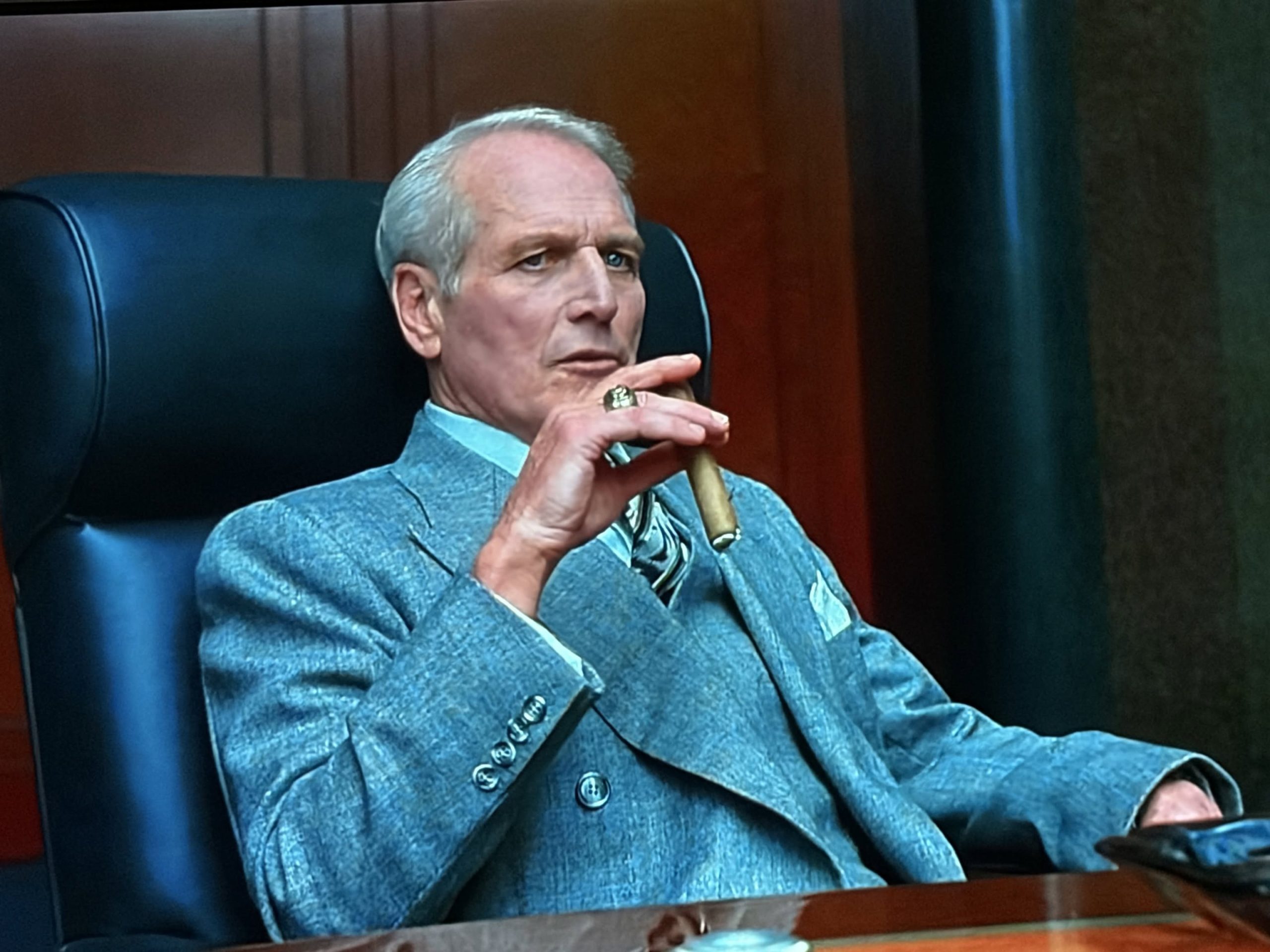
Paul Newman is the crusty, cigar-smoking, sleazy, right-hand man, and he’s an absolute delight. One of my favorite performances of his. He has a scheme that involves elevating Barnes to President of the company, and he supports his bizarre product idea.
With the working name Extruded Plastic Dingus, there’s a montage of the different design, development, promotion, and production phases of this new item ‘You know, for kids.’
There’s a lot of hoopla for a simple product. The satire is highlighted by the Advertising secretary reading War & Peace, and then Anna Kerinina, while the ad men toss out slogan after slogan.
It’s all done in a visual fifties corporate style, and it’s fun to watch. The Coens were clever and intentionally thoughtful. The burst of color they use for the Dingus after these bland scenes is more evidence of their skill and ability to make enduring films.
Then, it’s THE montage, with the dingus, and the kids. Sam Raimi directed this, and he has a cameo alongside John Cameron, another of The Evil Dead crew. I think that Raimi is one of the truly excellent filmmakers of this era (like the Coens), and this is a masterful montage.
Watch the facial expressions, the way the scene moves forward visually with the music (there’s no dialogue). The plot explodes in this montage, without using any words. Don’t scroll on your phone – really watch this. Even the price stickers going back up is clever. This movie is full of ‘smart funny’ elements; you pick up on more things, the more you watch it.
Such as, keep an eye on the changes in Robbin’s character as it goes along. It’s shown visually, bit by bit. It presages one of the episodes in The Ballad of Buster Scruggs. The Coen Brothers are really good at telling a story.
There’s a lot of movie left, and I’ll leave the rest of the story to your viewing. A fantastical element becomes a key part, and it’s always struck me as a bit jarring, but it sticks together.
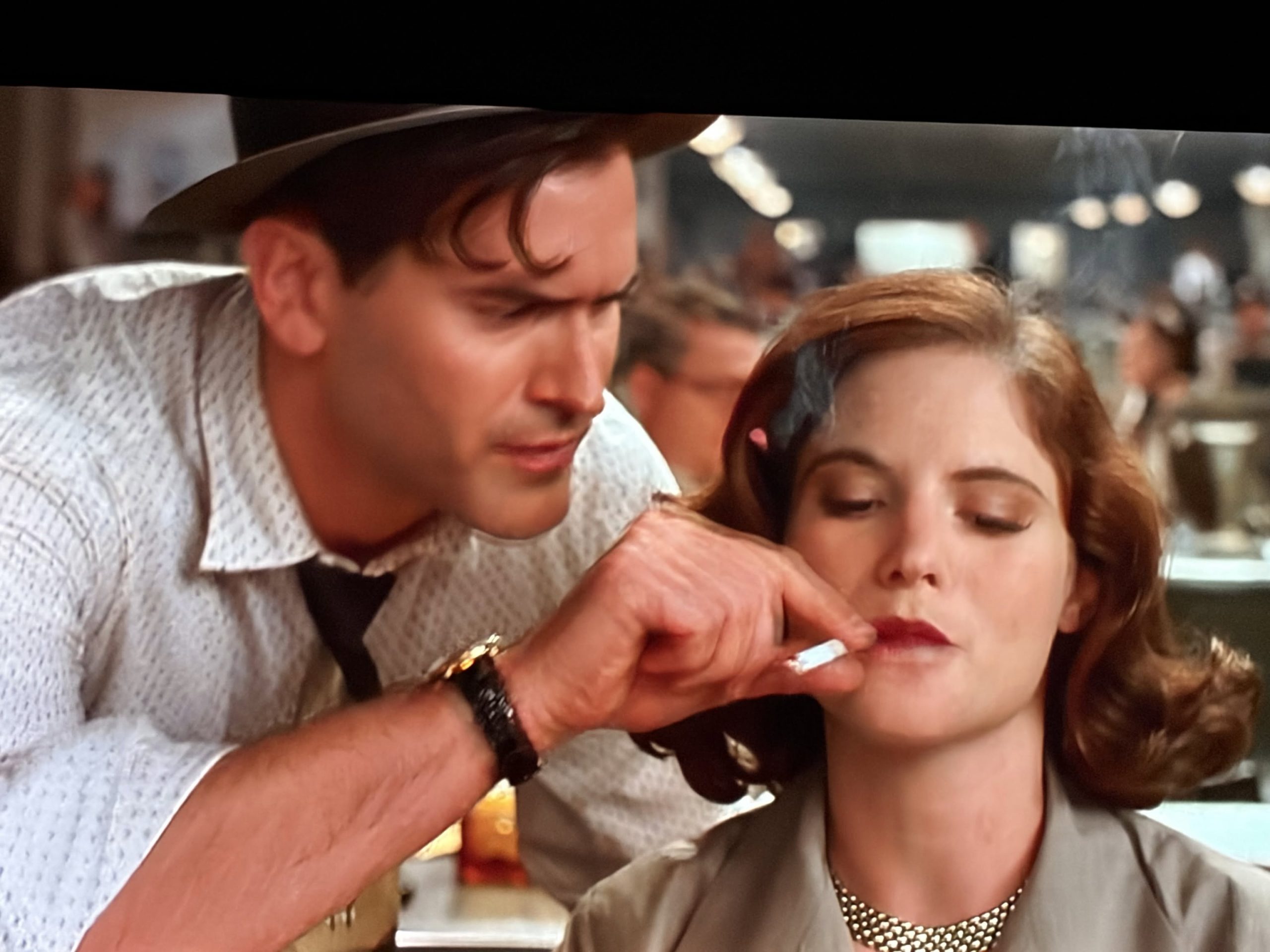
Jennifer Jason Leigh is Amy Archer (who never fails to mention she’s won a Pulitzer Prize), a fast-talking newspaper reporter. John Mahoney (Frasier) is her editor, and Bruce Campbell is a fellow reporter. The Coens put together a terrific cast – folks even in single scenes. It’s got Charles Durning and Bill Cobbs, and look for Peter Gallagher, Steve Buscemi, Anna Nicole Smith, John Goodman (maybe listen for him), and Richard Schiff.
And if you are a fan of The Wire, you are gonna love EVERY scene Jim True-Frost is in. He’s delightful. Seriously.
 While box office revenues are certainly a valid way to assess a movie’s success or failure, it’s certainly not the sole determinant of a movie’s worth. On a $25 million budget, Hudsucker only brought in $2.8 million, and it had no international release. It barely made back one-tenth of its budget.
The Coens’ next two movies would be Fargo, and The Big Lebowski. The boys continued to be popular but not commercially successful (Fargo, #75, Lebowski #98). Even O Brother, Where Art Thou, which was a financial hit, still was only the #58 movie of 2001.
But movie fans can rattle off movie after movie, when asked what they like by the Coens. The box office isn’t the measure of the Coen Brothers’ quality. They made smart, or funny, or dark, or satirical, or thoughtful – usually a mix of at least two of those qualities – movies. I have a friend who thought Intolerable Cruelty was just okay. I think it’s hilarious. And we both think the Coens remade True Grit as well as anyone could have. You just need to watch a few of their movies to appreciate them.
I drifted away from their stuff starting with Burn After Reading, and The Ballad of Buster Scruggs is the last thing I saw (and Hail Caesar! fell flat for me). But a half dozen-ish of them are among the best movies I’ve seen. The Coens were THAT good. If you only saw The Hudsucker Proxy, and Miller’s Crossing, your life would have been blessed. Though O Brother, Where Art Thou is great in so many ways – especially for this Greek mythology geek.
The Hudsucker Proxy isn’t the same kind of cult classic which Firefly, or even The Big Lebowski, is. But people who know, love this one. And many of us rank it higher than the better-known Coens movies. Regardless, this is a treat to watch, and it doesn’t grow stale with additional viewings.
You can watch The Hudsucker Proxy for free, on Tubi. This world is a dumpster fire. We all have things we watch, or listen to, to help us deal with it. To step away from all the crap. If you wanna sit down and watch something funny and thoughtful, this is the movie for you.
Some previous entries on things to watch:Let’s Go to the Movies: 1996
Firefly – The Animated Reboot
What I’ve Been Watching – February 2026 (The Night Manager, SS-GB, Best Medicine)
What I’ve Been Watching – October 2026 (Return to Paradise, Lynley, Expend4bles, and more)
What I’ve Been Watching – August 2025 (Ballard, Resident Alien, Twisted Metal, and more)
What I’ve Been Watching – May 2025 (County Line, The Bondsman, Bosch: Legacy)
What I’ve Been Watching – October 2024 (What We Do in the Shadows, The Bay, Murder in a Small Town)
What I’m Watching – November 2023 (Brooklyn Nine-Nine, The Caine Mutiny Court Martial, A Haunting in Venice)
What I’m Watching – April 2023 (Florida Man, Picard – season three, The Mandalorian)
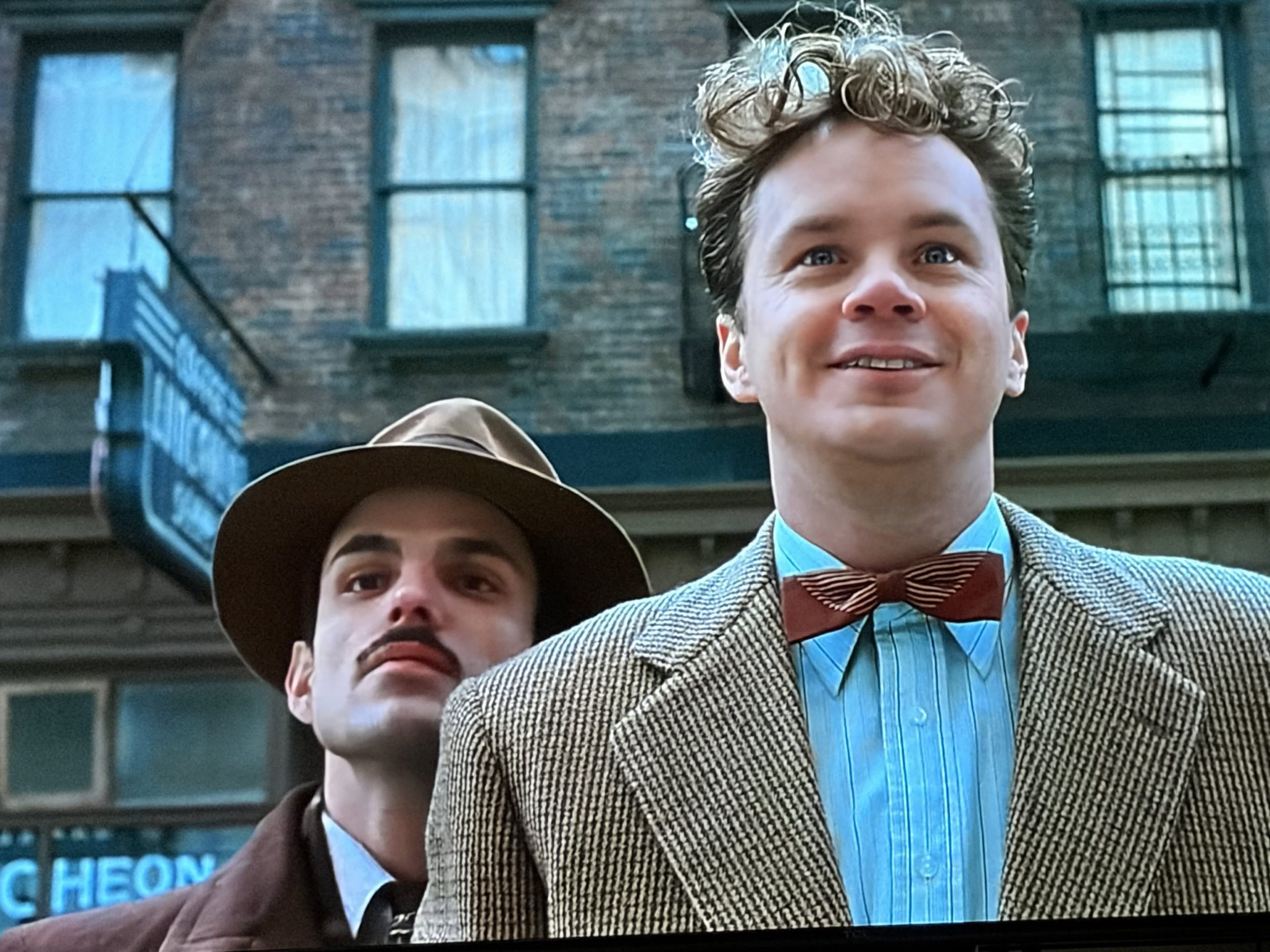 The Pale Blue Eye, and The Glass Onion: Knives Out
Tony Hillerman’s Dark Winds
The Rings of Power (Series I wrote on this show – all links at this one post)
What I’m Watching – December 2022 (Frontier, Leverage: Redemption)
What I’m Watching – November 2022 (Tulsa King, Andor, Fire Country, and more)
What I’m Watching – September 2022 (Galavant, Firefly, She-Hulk, and more)
What I’m Watching- April 2022 (Outer Range, Halo, Why Didn’t They Ask Evans, and more)
When USA Network was Kicking Major Butt (Monk, Psych, Burn Notice)
You Should be Streaming These Shows (Corba Kai, The Expanse, Bosch, and more)
What I’m BritBoxing – December 2021 (Death in Paradise, Shakespeare & Hathaway, The Blake Mysteries, and more)
To Boldly Go – Star Treking – (Various Star Trek incarnations)
What I’ve Been Watching – August 2021 (Monk, The Tomorrow War, In Plain Sight, and more)
What I’m Watching – June 2021 (Get Shorty, Con Man, Thunder in Paradise, and more)
Tucker and Dale vs. Evil
What I’ve Been Watching – June 2021 (Relic Hunter, Burn Notice, Space Force, and more)
Appaloosa
Psych of the Dead
The Mandalorian
What I’m Watching: 2020 – Part Two (My Name is Bruce, Sword of Sherwood Forest, Isle of Fury, and more)
What I’m Watching 2020: Part One (The Adventures of Brisco County Jr, Poirot, Burn Notice, and more)
Philip Marlowe: Private Eye
Leverage
Nero Wolfe – The Lost Pilot
David Suchet’s ‘Poirot’
Sherlock Holmes (over two dozen TV shows and movies)
 Bob Byrne’s ‘A (Black) Gat in the Hand’ made its Black Gate debut in 2018 and has returned every summer since.
His ‘The Public Life of Sherlock Holmes’ column ran every Monday morning at Black Gate from March, 2014 through March, 2017. And he irregularly posts on Rex Stout’s gargantuan detective in ‘Nero Wolfe’s Brownstone.’ He is a member of the Praed Street Irregulars, and founded www.SolarPons.com (the only website dedicated to the ‘Sherlock Holmes of Praed Street’).
He organized Black Gate’s award-nominated ‘Discovering Robert E. Howard’ series, as well as the award-winning ‘Hither Came Conan’ series. Which is now part of THE Definitive guide to Conan. He also organized 2023’s ‘Talking Tolkien.’
He has contributed stories to The MX Book of New Sherlock Holmes Stories — Parts III, IV, V, VI, XXI, and XXXIII.
He has written introductions for Steeger Books, and appeared in several magazines, including Black Mask, Sherlock Holmes Mystery Magazine, The Strand Magazine, and Sherlock Magazine.
You can definitely ‘experience the Bobness’ at Jason Waltz’s ’24? in 42′ podcast.
Categories: Fantasy Books
The Cornerstones of High Fantasy: E. R. Eddison, J.R.R. Tolkien, Stephen R. Donaldson, J. K. Rowling, and George R. R. Martin
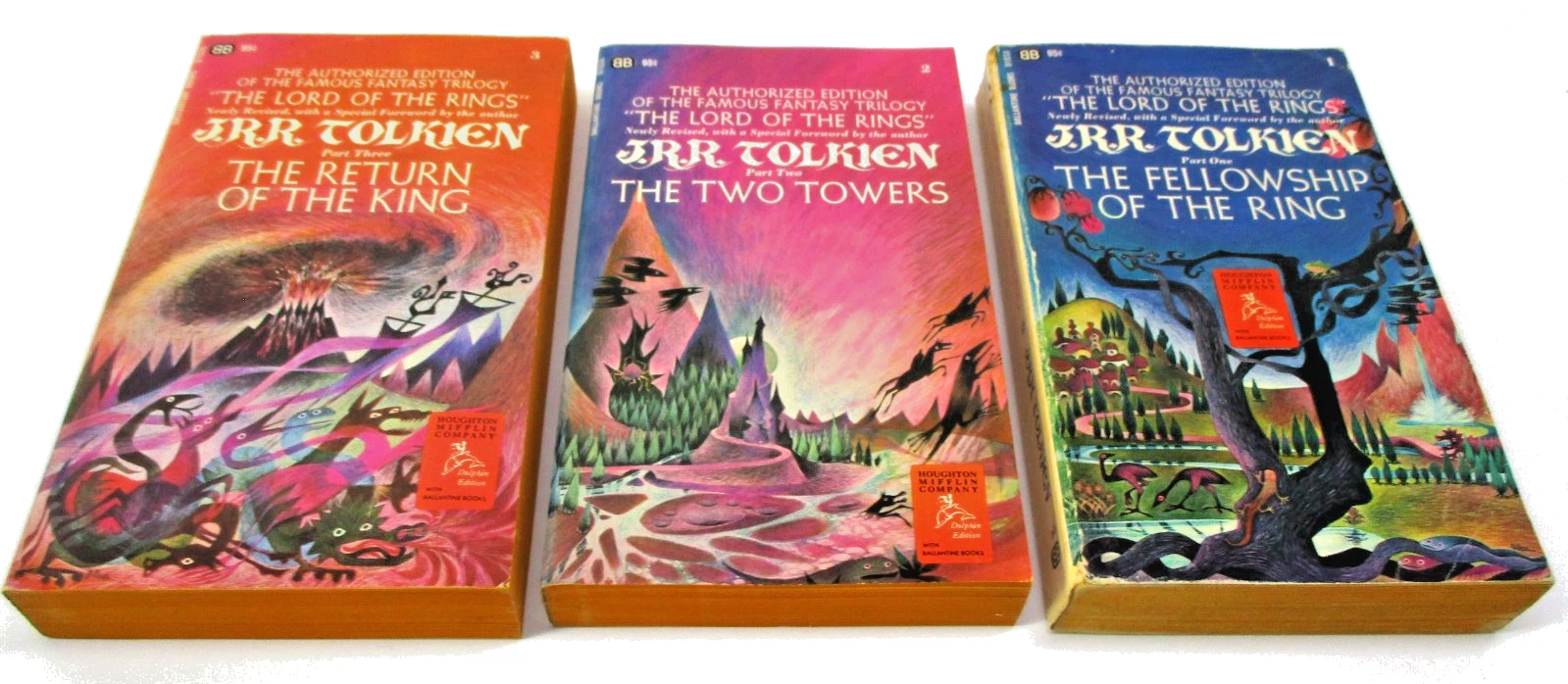 The Lord of the Rings by J.R.R. Tolkien (Ballantine paperback editions, October & November 1965). Covers by Barbara Remington
I’ve defined Heroic Fantasy (HF) as a type of fiction in which a heroic (bigger than life) figures use a combination of physical strength and edged weapons (Swords, Axes, Spears) to face bigger than life foes. The hero may be either male or female, but the focus is primarily on personal conflict between the hero and various villains.
I divide Heroic Fantasy into four categories: Sword and Sorcery, Sword and Planet, High Fantasy, and Heroic Historical. I’ve previously discussed S&S, S&P, and Heroic Historical (HH). Today let’s check out High Fantasy.
[Click the images for heroic versions.]
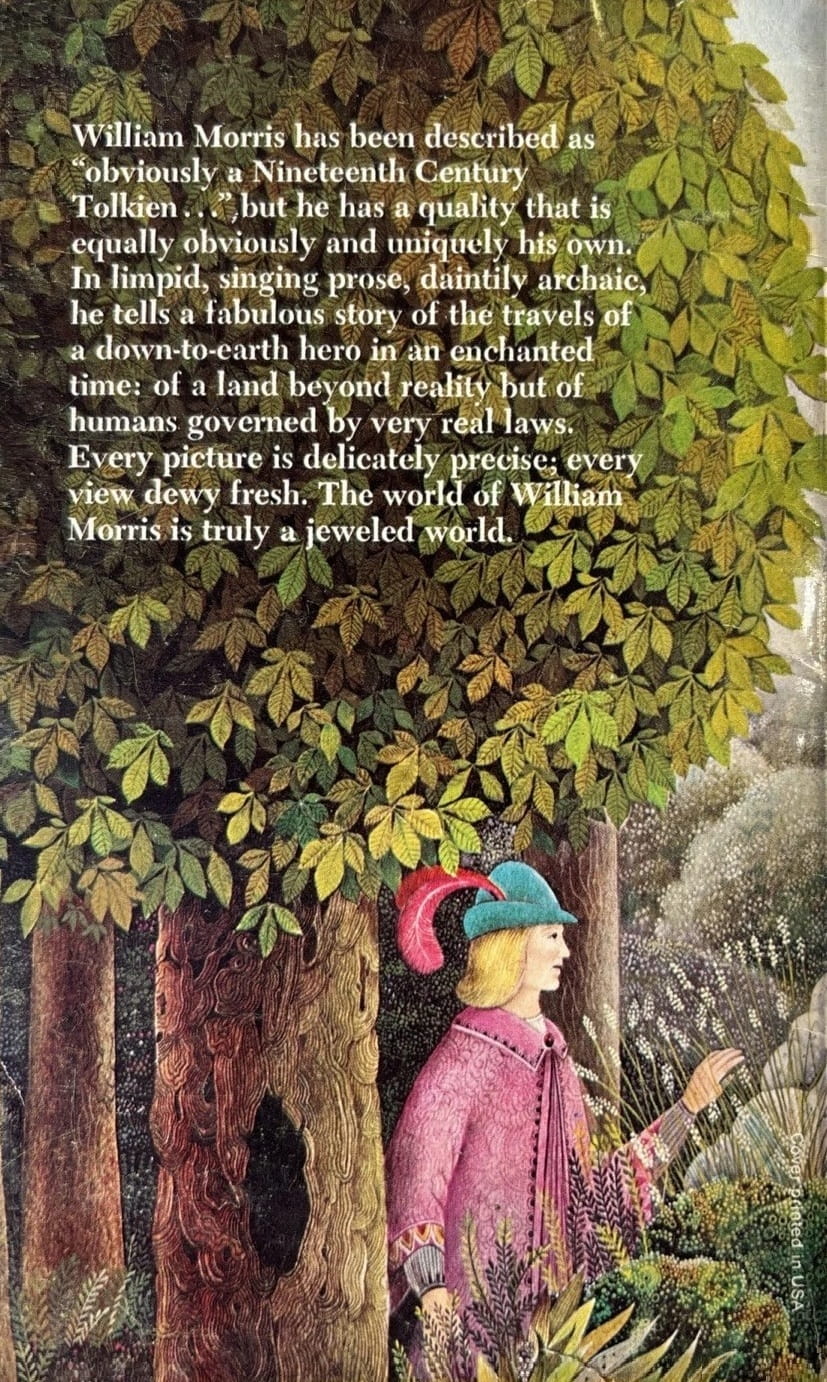
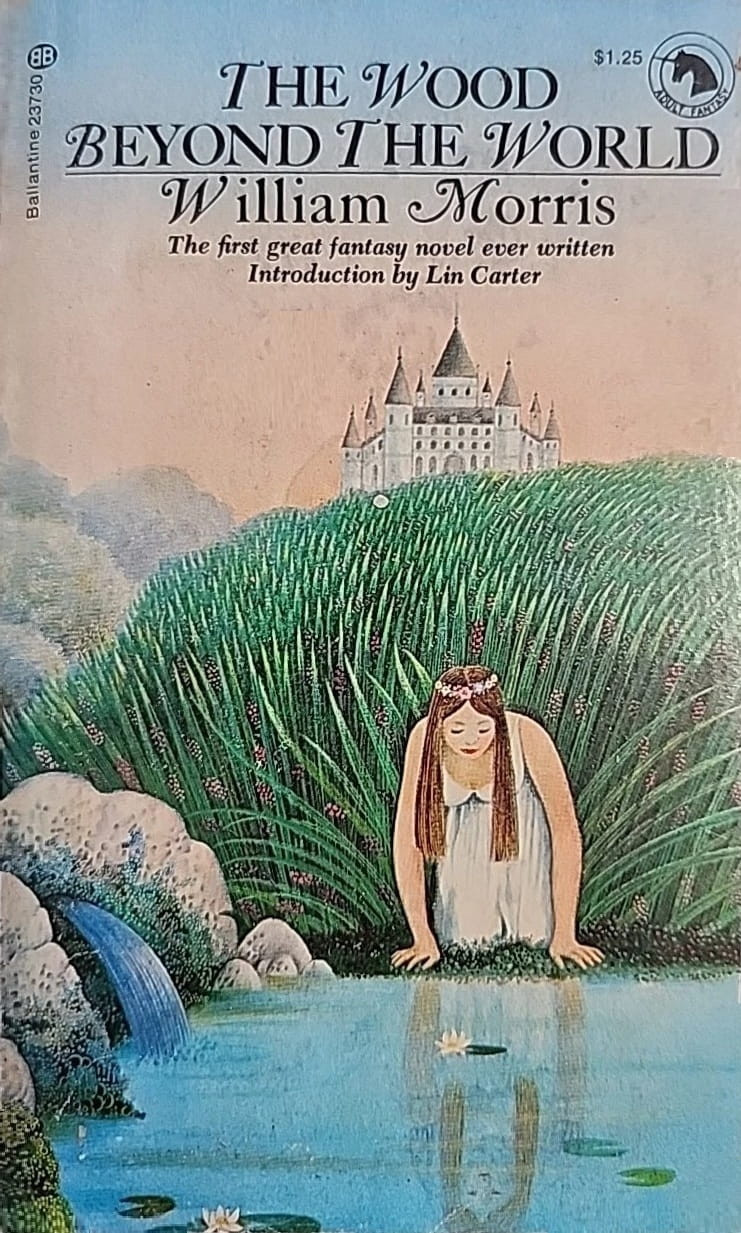
The Wood Beyond the World by William Morris (Ballantine Adult Fantasy #3, July 1969) Cover by Gervasio Gallardo
The emphasis in High Fantasy is on a Mythic adventure, either a quest or a large scale (often world spanning) conflict between the powers of Light and Dark. The hero is usually not bigger than life. In fact, he, or she, is often rather small and weak physically, though there is usually a tight knit band of followers or friends who help them.
The heroes are generally chosen for their role by some greater power and usually do not know how strong they really are at the beginning of the story. They grow into the role as the work progresses.
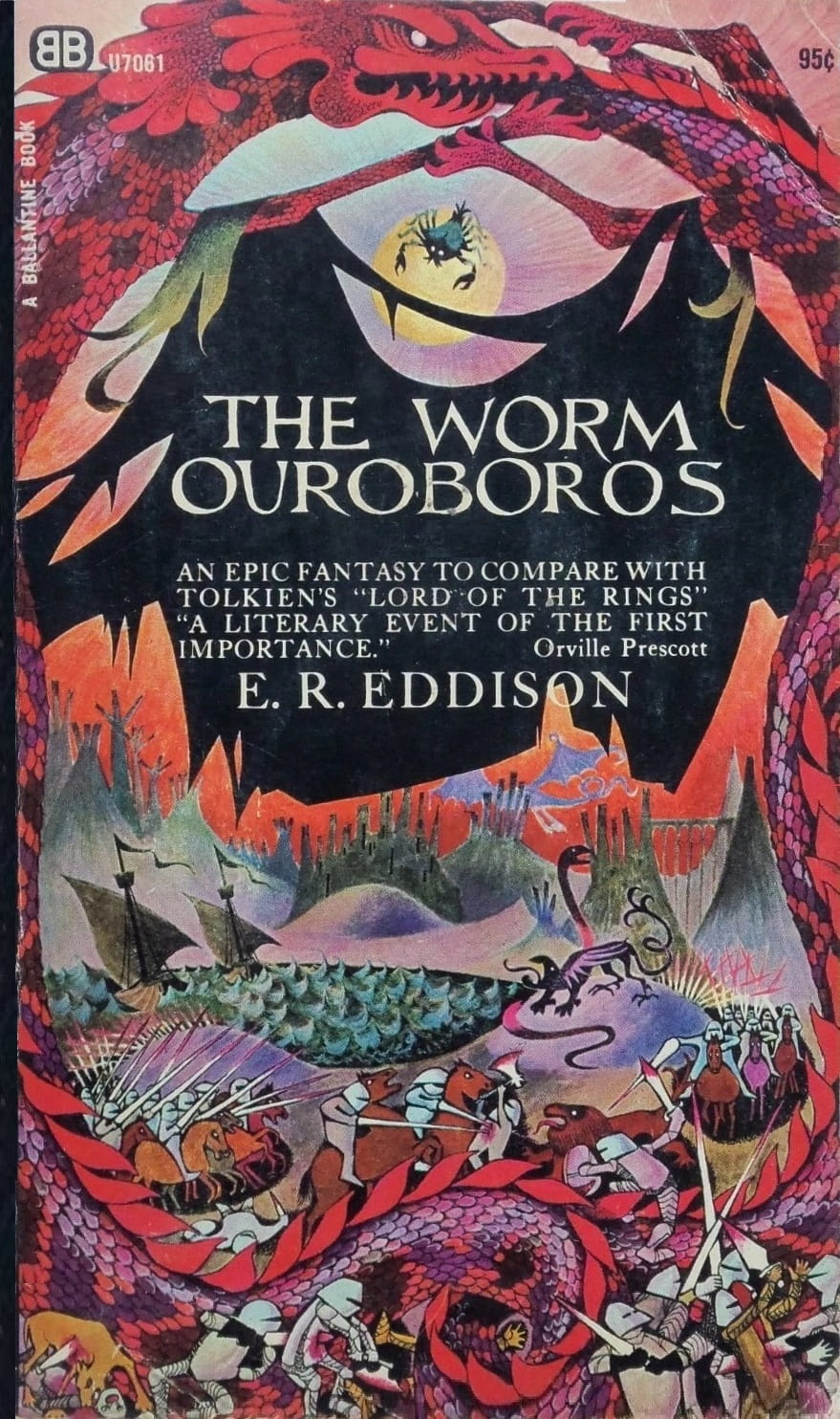
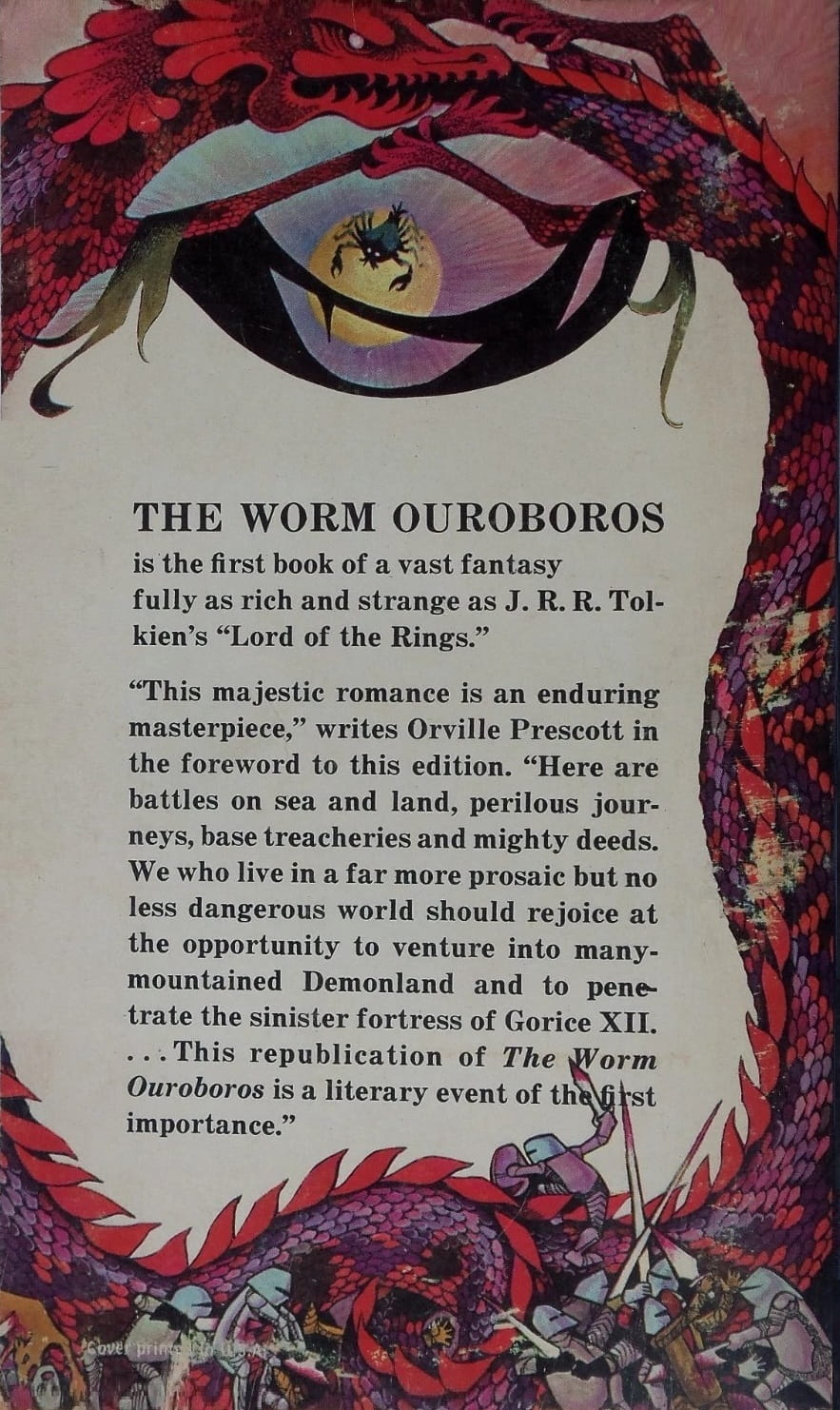
The Worm Ouroboros by E.R. Eddison (Ballantine Books, April 1967). Cover by Barbara Remington
Supernatural forces are integral to High Fantasy, and there are almost always magical items such as rings, or swords, or enchanted armor that can help or hinder the heroes in their quests. There is much less emphasis on individual physical combat than in S&S, S&P, or HH. The High Fantasy setting is a mythic world, usually an ancient Earth that is populated by elves, dwarves, dragons, goblins, or recognizable variants of these. Dragons seem particularly indispensable.
J. R. R. Tolkien (1892 – 1973) established the primary tropes of High Fantasy and his Lord of the Rings trilogy is still the best example, although William Morris’s (1834 – 1896) The Wood Beyond the World (1894), E. R. Eddison’s (1882 – 1945) The Worm Ouroboros (1922) and Lord Dunsany’s (1878 – 1957) The King of Elfland’s Daughter (1924) preceded Tolkien’s The Hobbit (1937) and The Lord of the Rings trilogy (1954-1955).
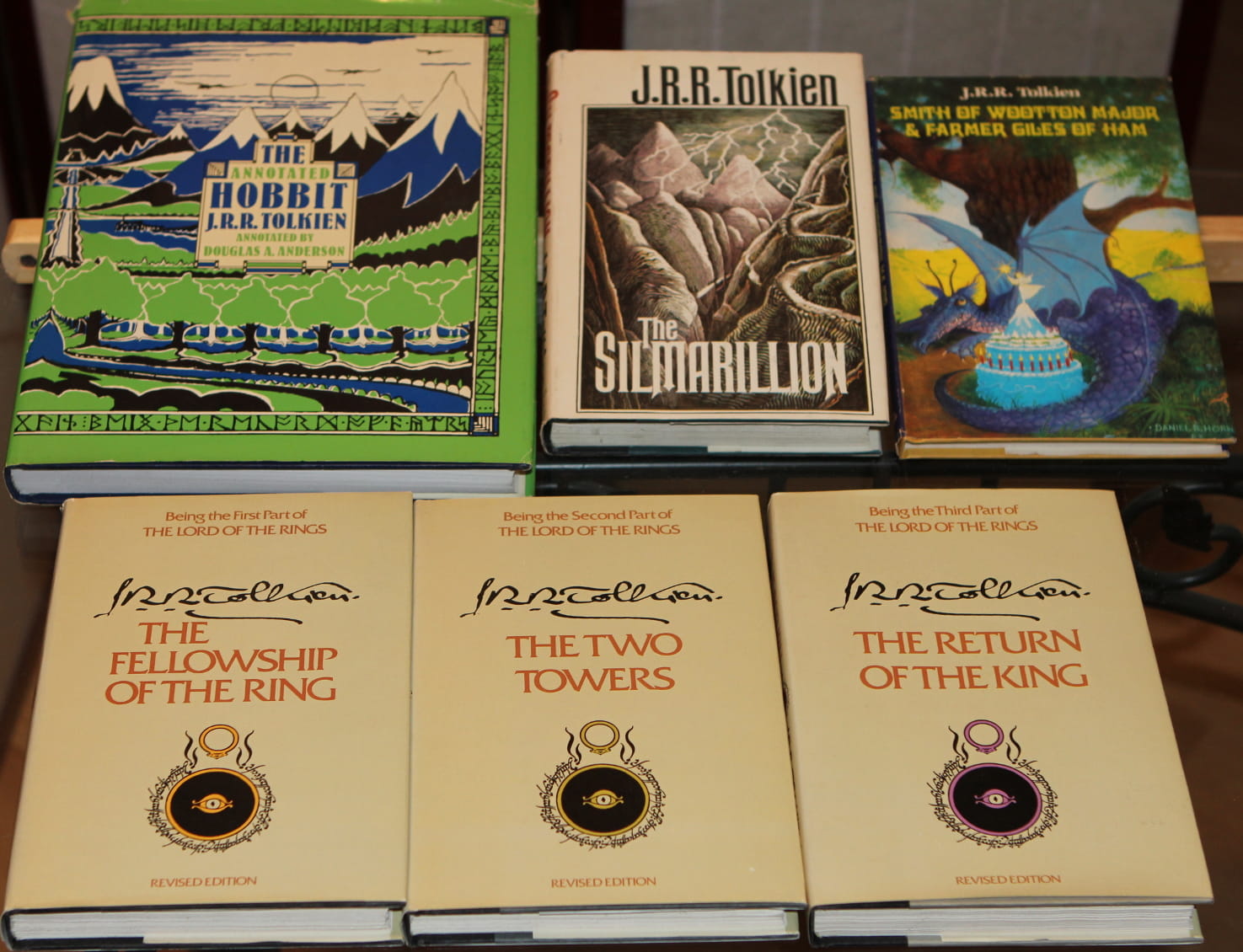 The fantasies of J.R.R. Tolkien: The Annotated Hobbit (Houghton Mifflin, October 1988), The Silmarillion (Houghton Mifflin, September 1977), Smith of Wootton Major and Farmer Giles of Ham (Science Fiction Book Club, May 1984), and The Lord of the Rings revised editions (Houghton Mifflin). Covers, top row: J. R. R. Tolkien, J. R. R. Tolkien, Daniel Horne)
The sheer scale and detail of Tolkien’s Middle Earth has established him as the grandfather of the High Fantasy genre, and pretty much everything that came after owes him a debt. I don’t personally read a lot of High Fantasy and seldom write anything linked to the genre, but I have read some very good stuff in the field, including most of Tolkien’s work.
One difference between High Fantasy and the other three HF genres is the level of good versus evil that exists in them. In High Fantasy, we generally need to speak of EVIL in all caps because it is often a soul-destroying force that wants to bring darkness to the whole world. In S&S and S&P, the evil is not so all powerful, although it may be very nasty. In HH, the evil is human, as is the case in the real world.
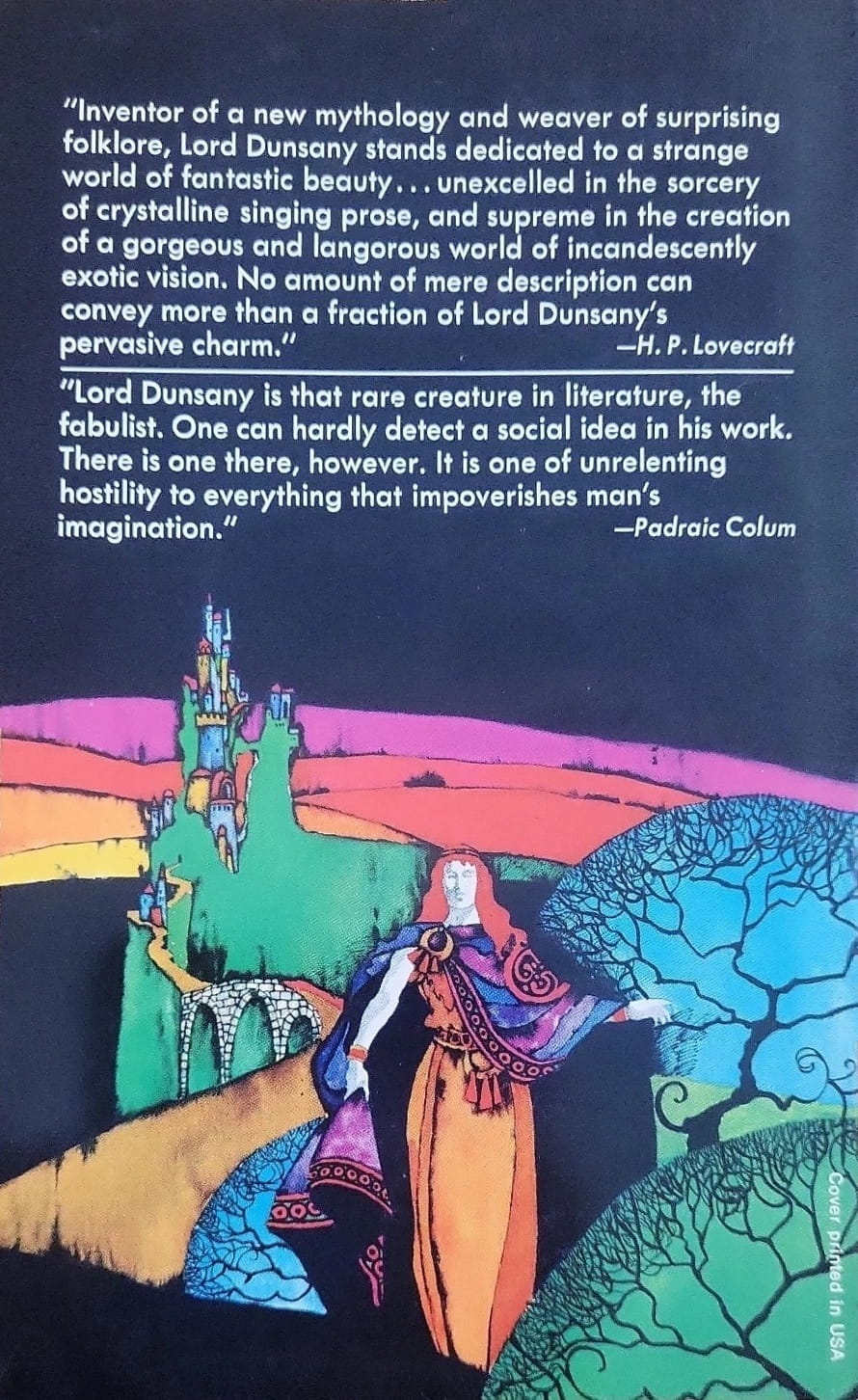
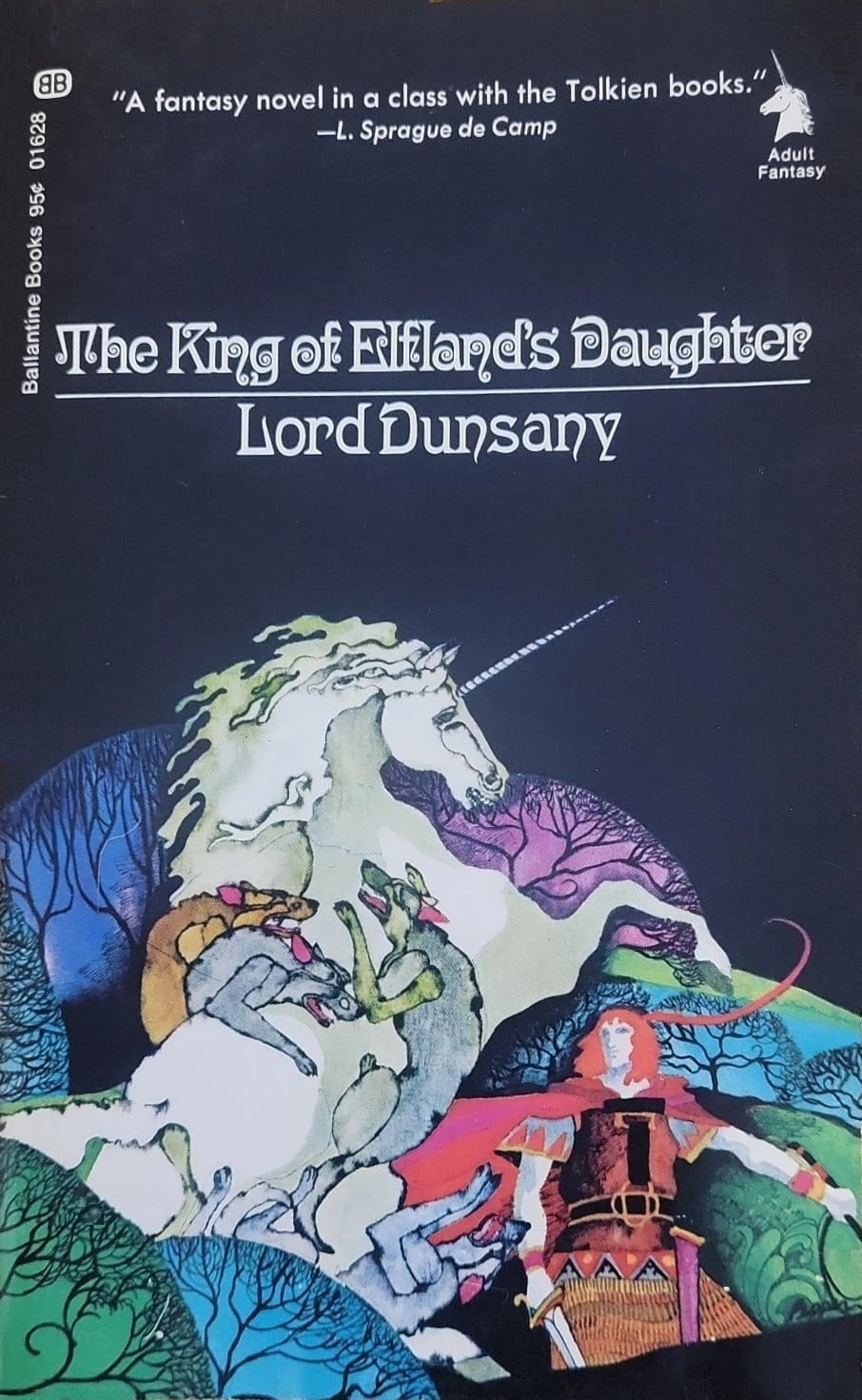
The King of Elfland’s Daughter by Lord Dunsany (Ballantine Adult Fantasy #2, June 1969). Cover by Robert Pepper
There are two more differences between the subgenres I’ll mention. First, S&S works best in short stories, S&P and HH in novellas or short novels, but High Fantasy needs a grand scope and lends itself to large novels and multi-book series.
Second, High Fantasy lends itself to humor better than the other types. Perhaps because of its length and its ensemble cast of characters, it provides a setting where more humor naturally occurs.
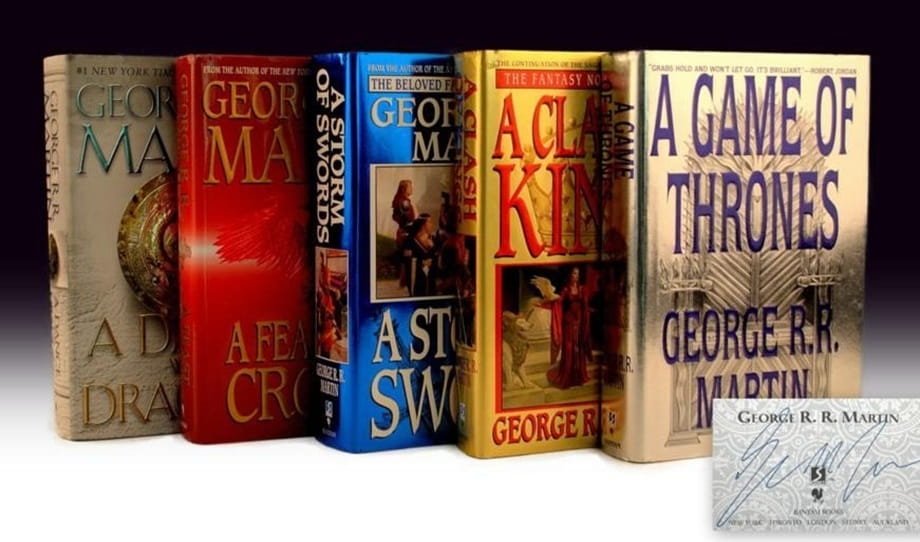 A Song of Ice and Fire by George R.R. Martin, filmed as the HBO series Game of Thrones
So, who writes High Fantasy since Tolkien?
There’s been a bunch of it. It currently seems the most popular form of Heroic Fantasy published today and has been for a long time. George R. R. Martin’s Game of Thrones is a prominent example, as is Robert Jordan’s The Wheel of Time.
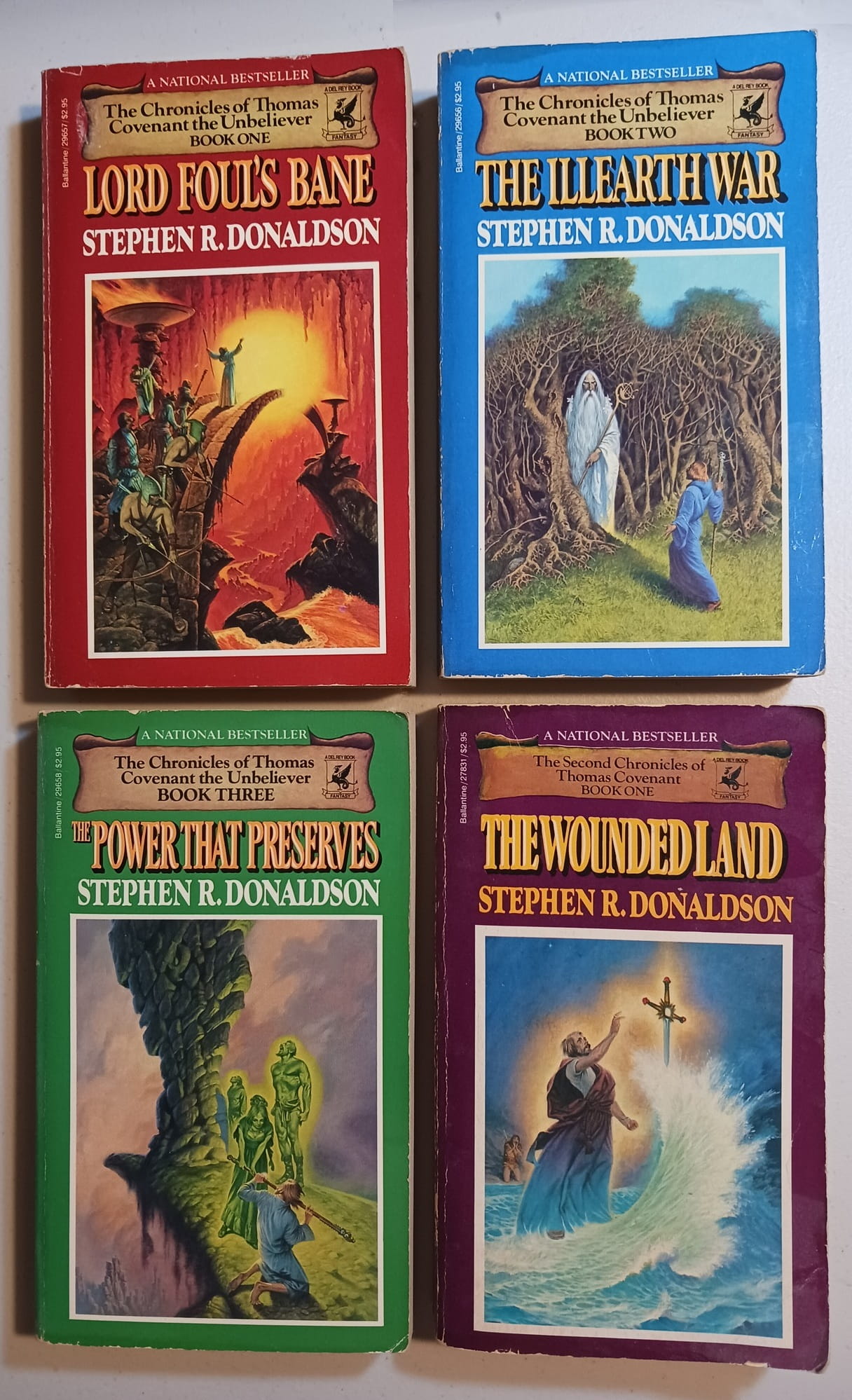 The first four novels of The Chronicles of Thomas Covenant by Stephen R. Donaldson: Lord Foul’s Bane, The Illearth War, The Power That Preserves, and The Wounded Land (Del Rey paperback editions, August and September 1978, March 1979, and May 1981). Covers by Darrell K. Sweet
I haven’t read either of those but I saw the TV series based on them and enjoyed them. I haven’t read them because both are multi-volume works with each volume making a good doorstopper. I’m 65 and there’s a lot of books I want to read before I go; I don’t plan to spend a year or two of precious reading time on these kinds of series.
What have I read in the genre? I read Tolkien’s The Hobbit and The Lord of the Rings trilogy in my teens and early twenties, and greatly enjoyed them, although I didn’t have any urge to write such a series. A little later, I read Stephen R. Donaldson’s Chronicles of Thomas Covenant series of six books, and I read Dennis L. McKiernan “retelling” of Tolkien’s trilogy in his own trilogy, The Iron Tower.
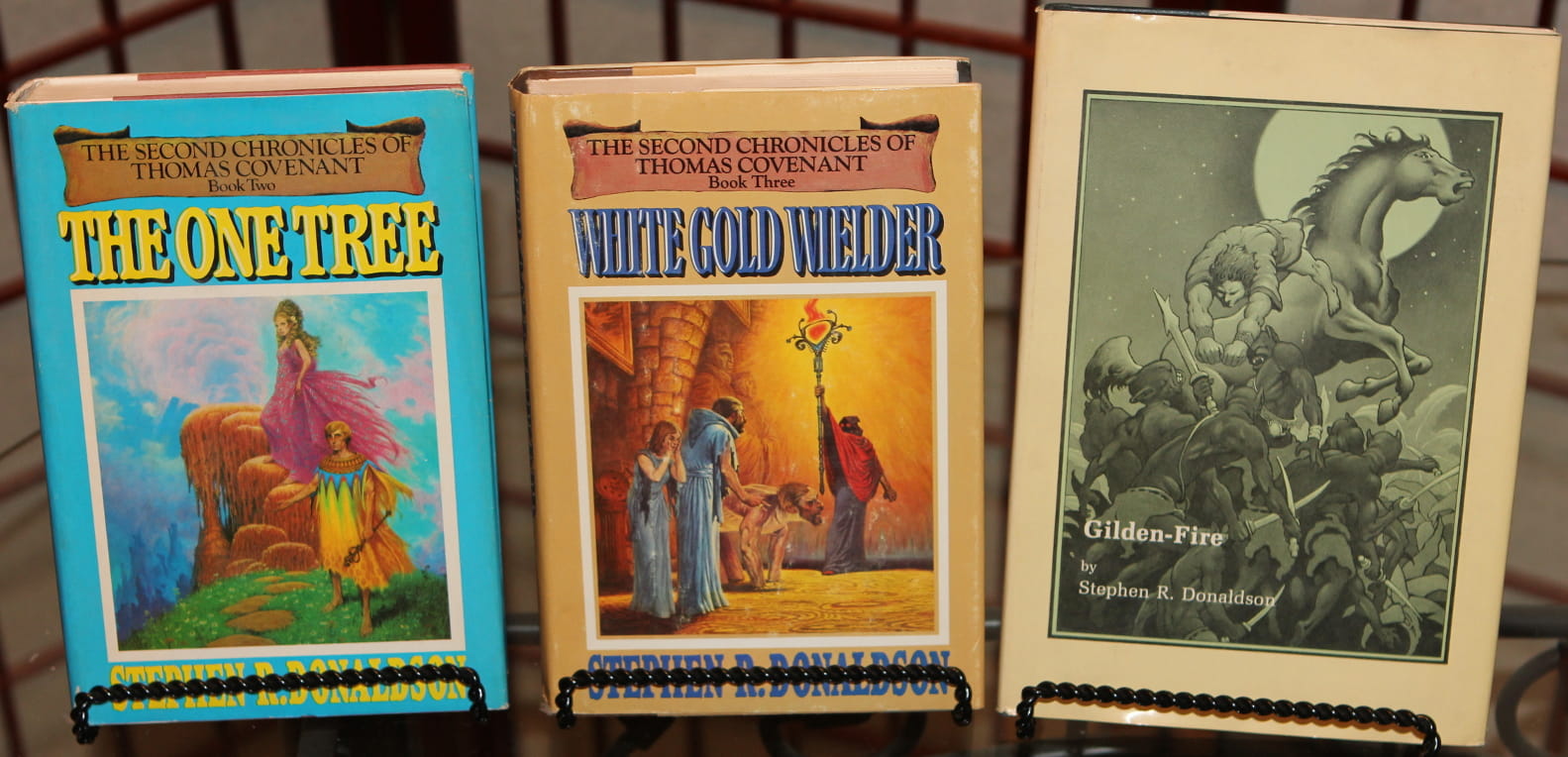 The final volumes in The Second Chronicles of Thomas Covenant: The One Tree and White Gold Wielder (Del Rey, April 1982 and April 1983), and the novella Gilden-Fire (Underwood-Miller, November 1981). Covers by Darrell K. Sweet and Stephen E. Fabian
McKiernan’s work was a little too close for my tastes, and I hated the protagonist in Donaldson’s series. Thomas Covenant was a complete asshole, though I loved the world and many of the supporting characters. I read a couple in Bret Funk’s Path of Glory series. In my fifties I read the entire Harry Potter series by J. K. Rowling, which I would categorize as High Fantasy, although it pushes the boundaries with few edged weapons and a lot more modern setting.
Why has High Fantasy been so popular? I think there are various reasons.
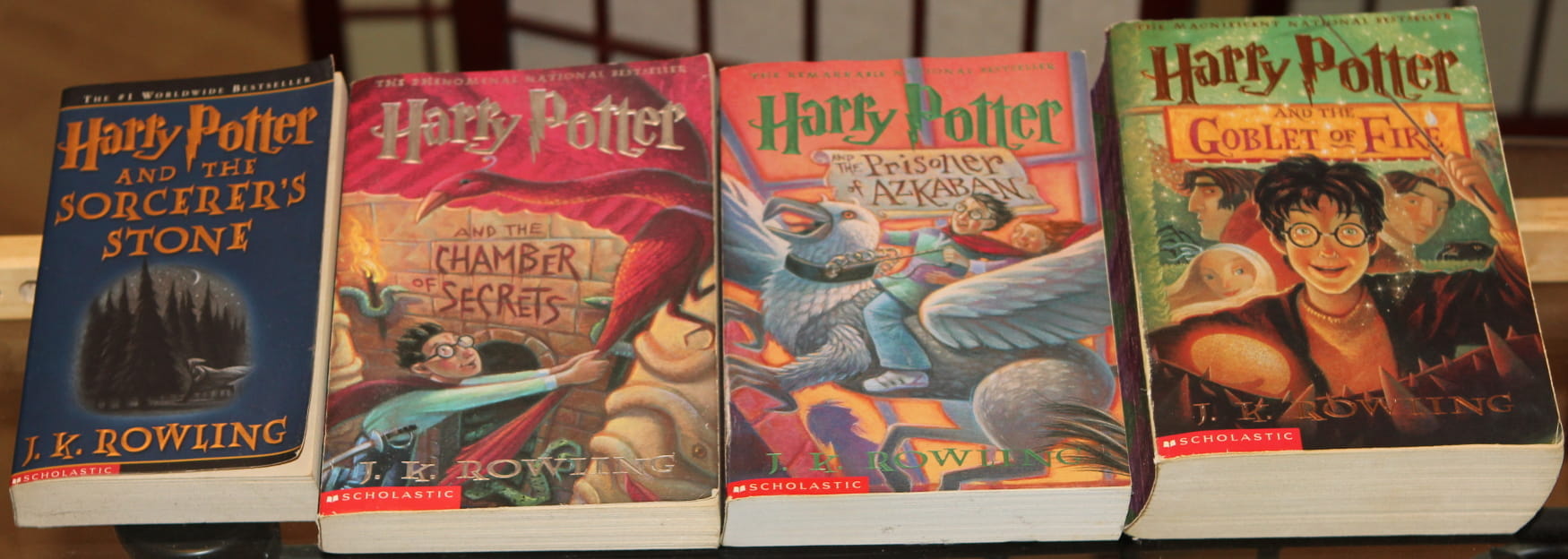 The first four novels in the Harry Potter series by J.K. Rowling: Harry Potter and the Sorcerer’s Stone, Harry Potter and the Chamber of Secrets, Harry Potter and the Prisoner of Azkaban, and Harry Potter and the Goblet of Fire (Scholastic paperback reprints, November 2011, 2000, September 2001, September 2002). Covers: Mary GrandPré
First, the “growth” of the hero across the books is an attractive quality to many readers, who like to see a character gain strength and competence, perhaps because it offers hope that they, too, can grow. This is the classic “Hero’s Journey,” which can happen in the other genres of HF but often doesn’t, or at least not to the same extent.
Second, although there are plenty of exceptions, High Fantasy also seems to appeal more to the average woman reader than the other types and — quite simply — women buy more books than men, a big plus for publishers. This is illustrated, in part, by the number of women writers in the genre. Patricia McKillip, Anne McCaffrey, Mercedes Lackey, Joy Chant, Margaret Weis, and J. K. Rowling are just some of the many women writers who have enriched the genre.
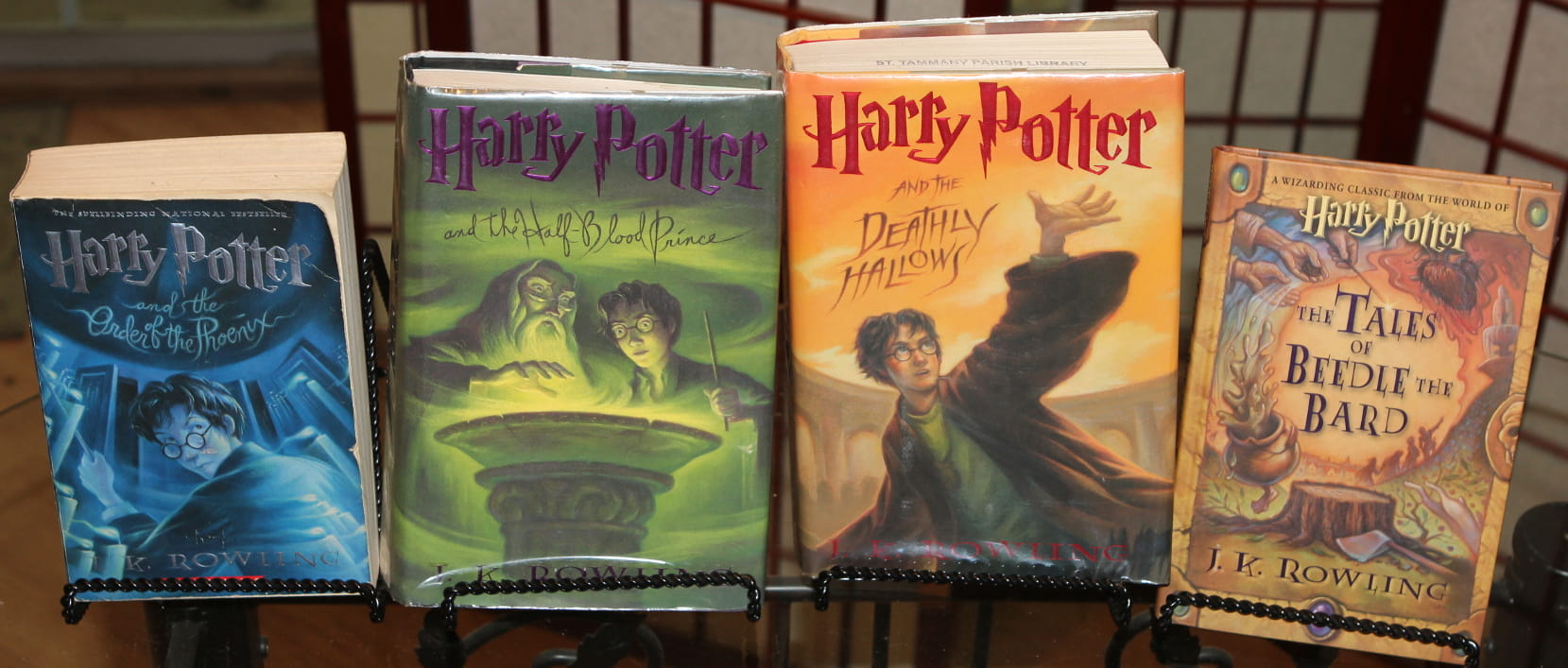 The concluding volumes of the Harry Potter series by J.K. Rowling: Harry Potter and the Order of the Phoenix (Scholastic paperback reprint, August 2004), Harry Potter and the Half-Blood Prince, and Harry Potter and the Deathly Hallows (Arthur A. Levine Books, July 16, 2005 and July 21, 2007), and The Tales of Beedle the Bard (Paw Prints, April 9, 2009). Covers by Mary GrandPré
Because of the ensemble cast of characters in high fantasy, the lesser focus on hack and slay, and the setting details, there would also seem to be more potential good roles for women in these books.
Charles Gramlich administers The Swords & Planet League group on Facebook, where this post first appeared. His last article for us was a look at the Sword & Sorcery of S. E. Lindberg. See all of his recent posts for Black Gate here.
Categories: Fantasy Books
The Enduring Legacy of Jack Kirby: Kamandi, Fantastic Four, Conan, and Much More
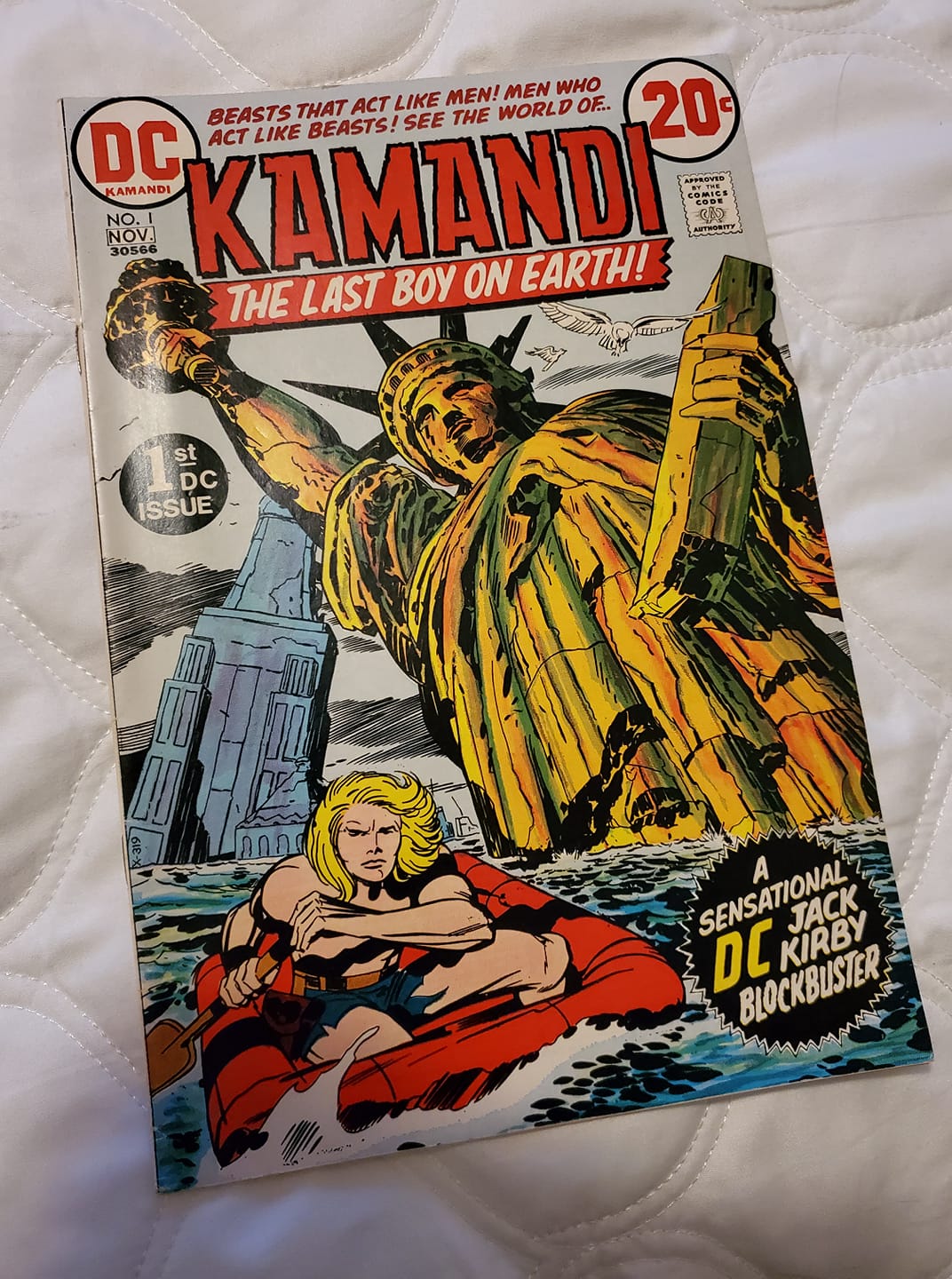
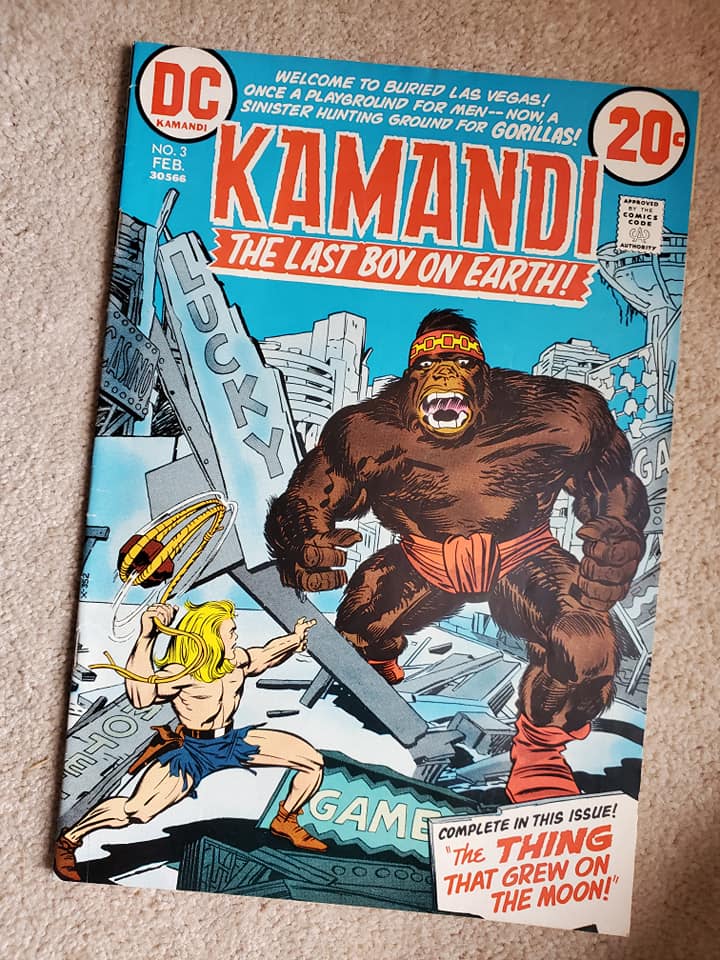
Kamandi, The Last Boy on Earth by Jack Kirby (DC Comics,
October 1972 and February 1973). Covers by Jack Kirby
Kamandi, The Last Boy on Earth, written and illustrated by Jack “King” Kirby (1917-1994), has long been an inspiration to my creative works. The tone, the setting, the characters and creatures — pure brilliance. Highly recommended.
Kamandi #16 is a fascinating issue. An ape doctor who encounters Kamandi knows of Cortexin, the chemical which stimulated evolution and intelligence in animals and turned them into parahumans. The Last Boy on Earth discovers more about the post-cataclysmic Earth, in which men have devolved to beasts, and beasts have evolved to higher intelligence.
[Click the images for Kirby-sized versions.]
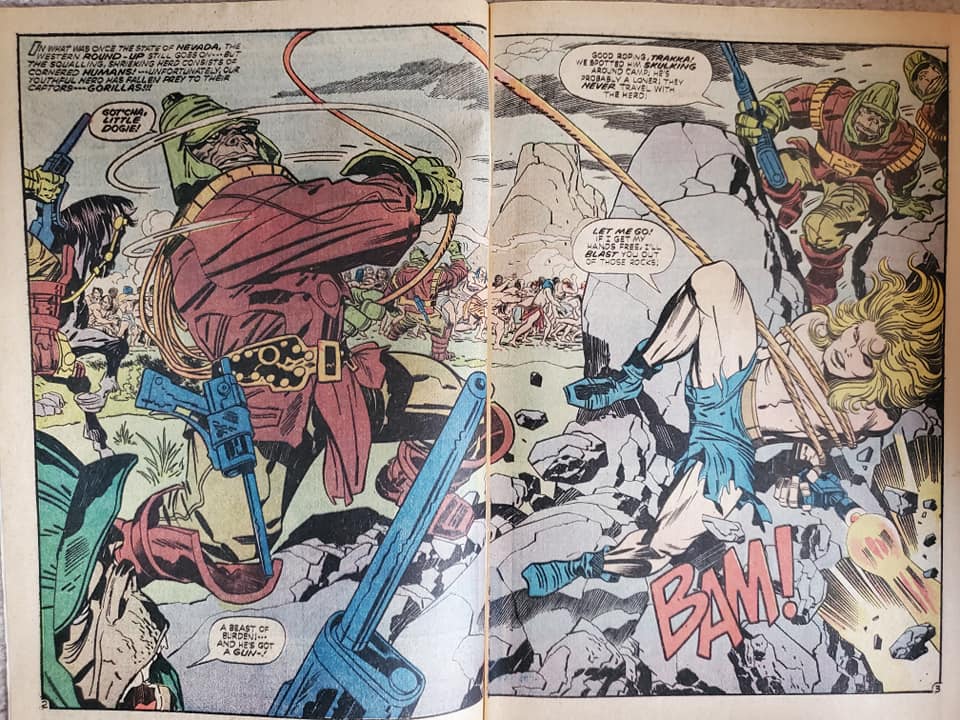 Interior art from Kamandi The Last Boy on Earth #3, by Jack Kirby (DC Comics, February 1973)
Jack Kirby was such a visionary and innovator, and Kamandi is such a treasure. Every time I flip through a random issue, I’m filled with joy.
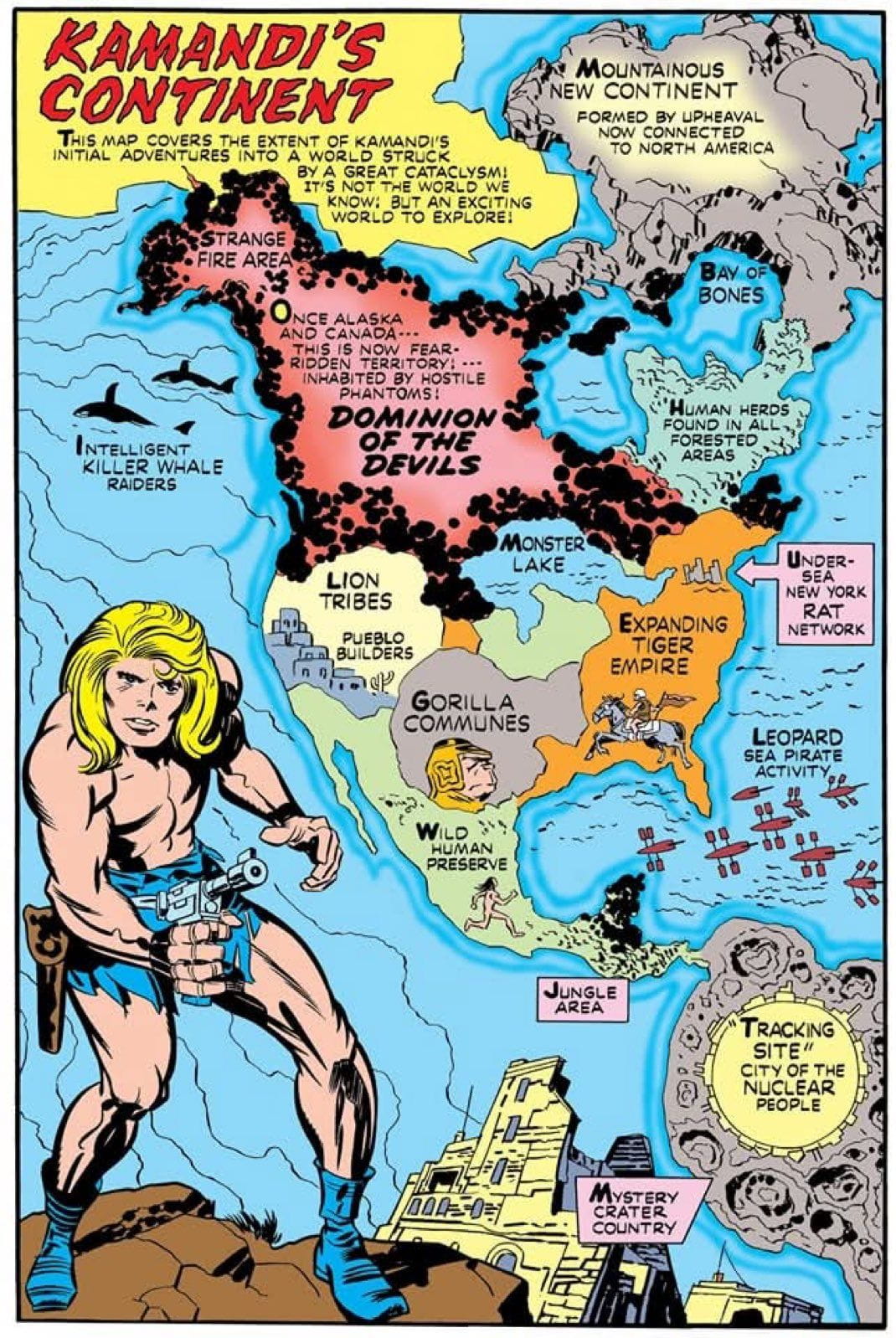
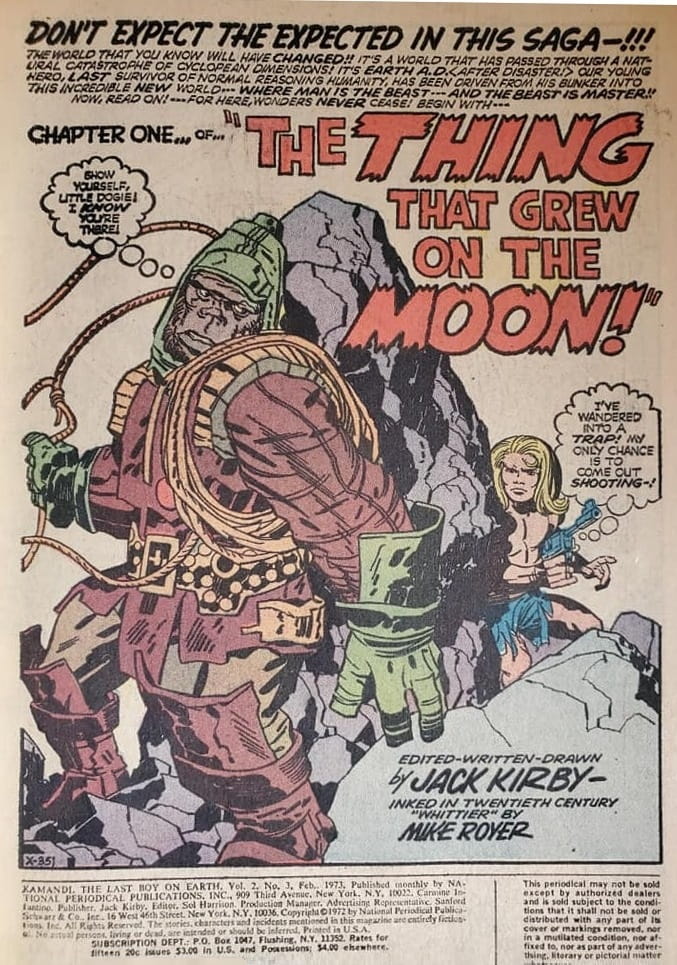
Kamandi art by Jack Kirby. Left: a look at Kamandi’s world. Right: splash page for issue #3, February 1973
Below is a panel from Fantastic Four #34, from 1965, written by Stan Lee and illustrated by Kirby. Kirby as usual peered into his crystal ball and came up with a billionaire just as evil and corrupt as any Marvel costume baddie, smacking of today’s headlines.
Gregory Gideon tried to use his money to destroy the FF, but his son got in the middle and almost died, Daddy repented and the story had a happy ending. The lust for money at any cost is the Root of all Evil.
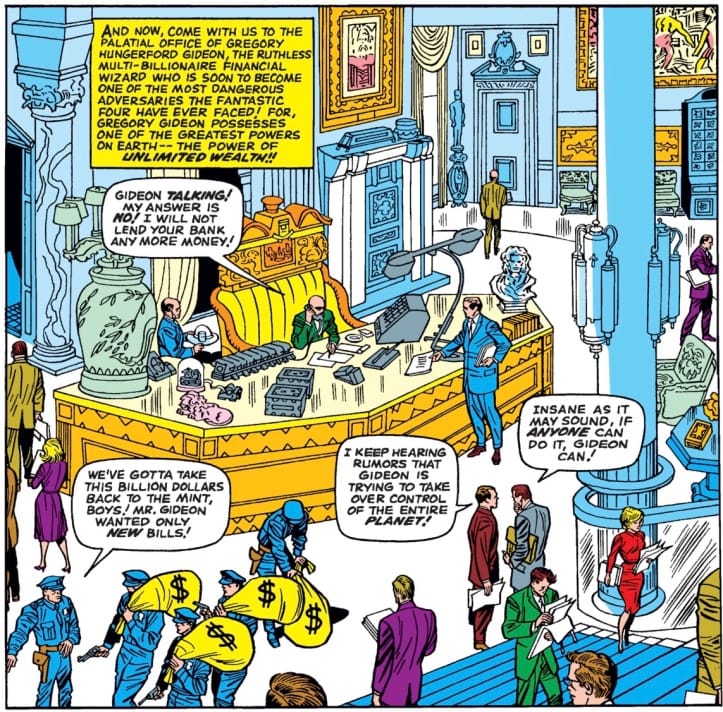 Art from Fantastic Four #34 by Jack Kirby (Marvel Comics, cover date January 1965)
There is an incredible array of fascinating characters created by Stan Lee and Jack Kirby, not the least of which is Medusa, a member of the Inhumans. Pictured below is a rendition of Medusa by Jack for Marvel’s line of black light posters.
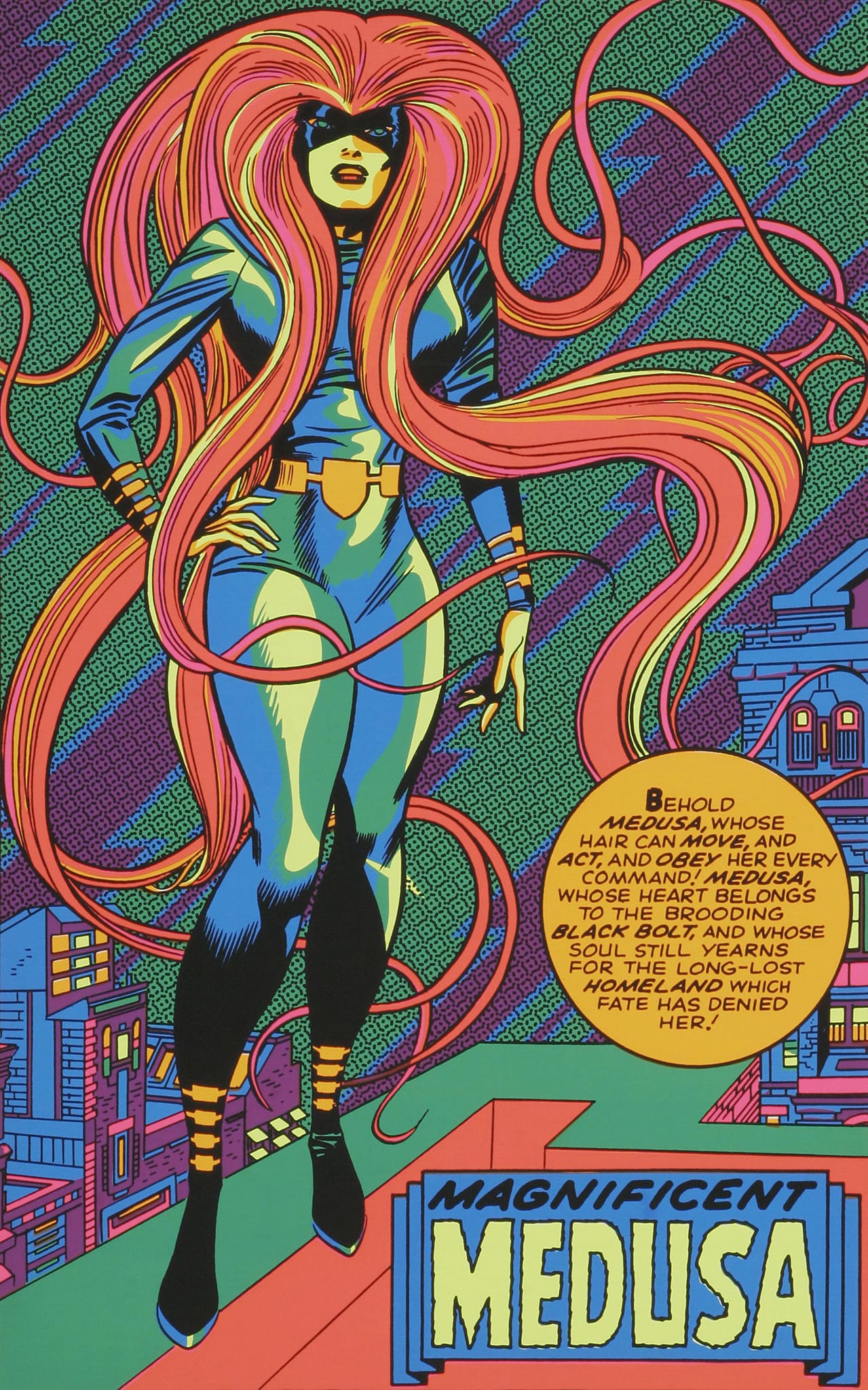 Magnificent Medusa by Jack Kirby
Medusa, inspired in part by the creature of same name from Greek Mythology, has prehensile hair that can lift thousands of pounds, can extend to great lengths, and strangle an enemy with ease. The wife of Black Bolt, she is a stunning beauty whom Jack illustrated magnificently. Her first appearance was in Fantastic Four #36, but I best remember her from the Kree-Skrull War, which took place in the pages of The Avengers.
Anyone else a fan of this lesser known character, or any of the other Inhumans for that matter?
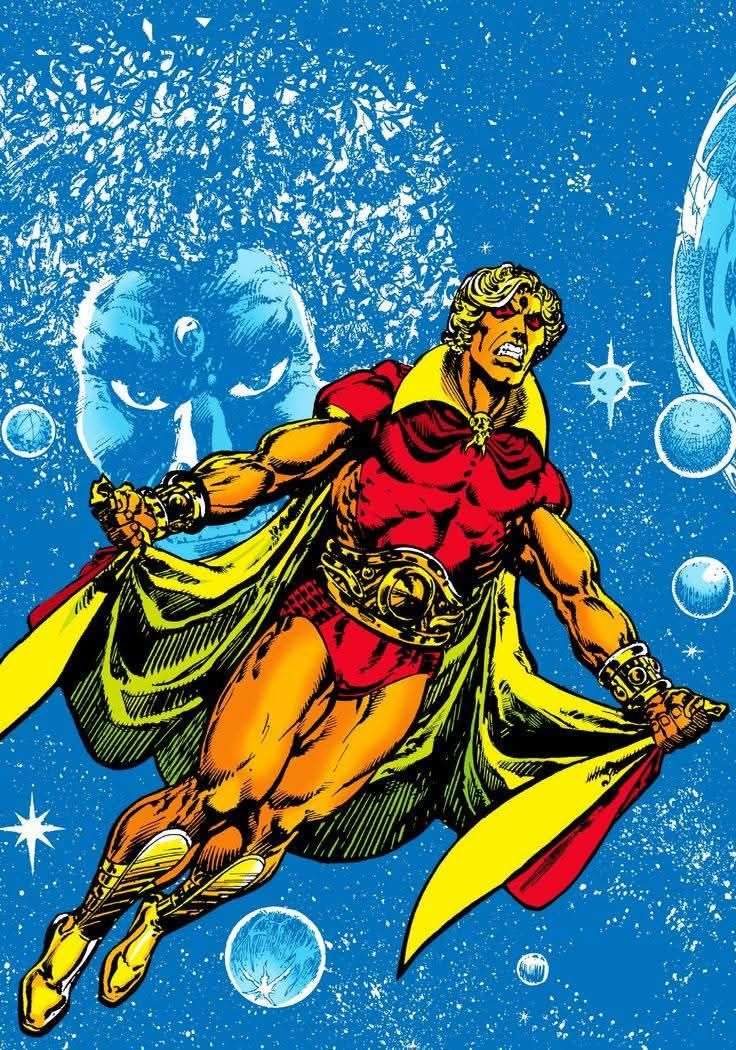 Warlock by Jim Starlin
Fans of the Marvel Cinematic Universe would do well to look into the character Adam Warlock, created by Stan Lee and Jack Kirby. His original name was “Him,” a being created by a group called Enclave to be the next step in human evolution (Fantastic Four #66-67). It was an interesting storyline, but not very significant as compared to other characters and stories being developed at that time.
It was years later, when Roy Thomas and Jim Starlin really brought the character to life as Warlock, renamed and rebirthed by the High Evolutionary. The Marvel Comics Database explains it well.
The High Evolutionary gave Warlock purpose, direction, and the vampiric Soul Gem. Soon afterward, Warlock journeyed to the planet called Counter-Earth, one of the High Evolutionary’s experiments, that had recently been contaminated. Counter-Earth had been an attempt to create a Utopian society, and it had been so till the evil Man-Beast, a renegade creation of the High Evolutionary, had corrupted it; the Man-Beast was to become Warlock’s greatest enemy.
Warlock’s later involvement versus Thanos — and that one’s obsession with the accumulation of power — gave rise to the original mini-series, The Infinity Gauntlet. While it was nice that the MCU afforded Warlock a bit role in the films, satisfying (to some degree) fans like me, it is still worth pointing out that major aspects of that spectacular MCU run were derived from content that Adam Warlock was the star of in the comic books.
Any other Adam Warlock fans in the house?
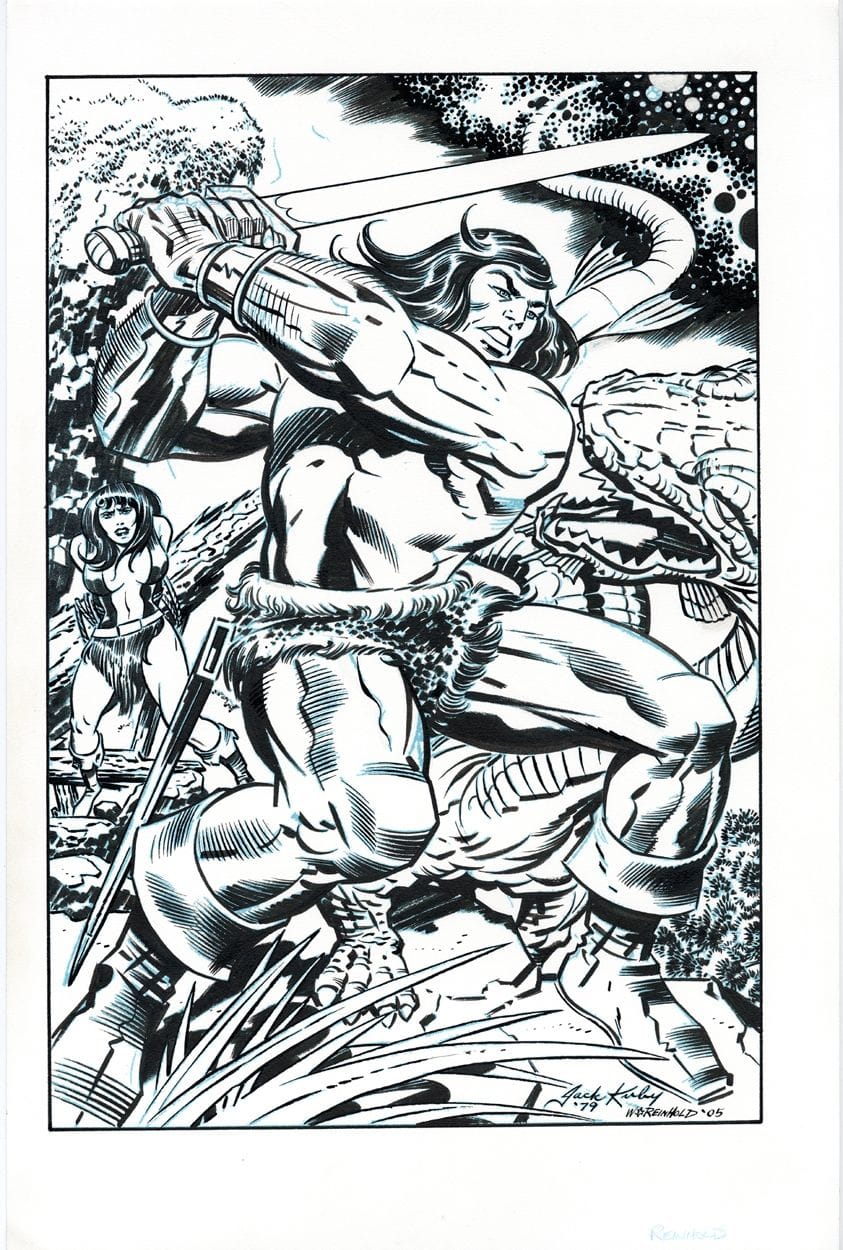 Conan the Barbarian by Jack Kirby
I’ll close with a few sketches of other Marvel characters, starting with Conan the Barbarian, by Jack Kirby. Jack was not known for many Conan illustrations, but by Crom, this one is incredible.
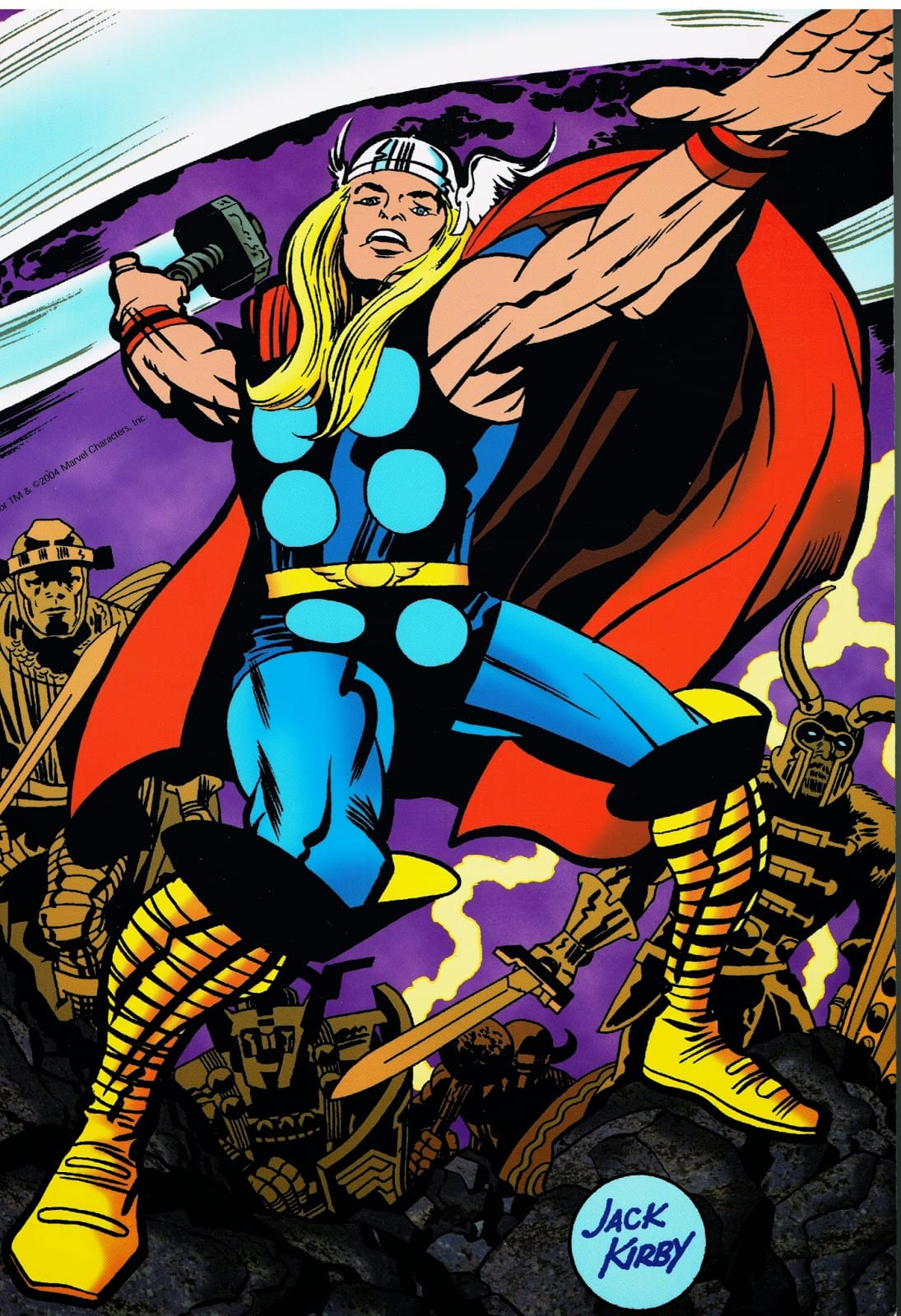 Thor by Jack Kirby
Although Walt Simonson wrote my favorite Thor story arc, no one, IMO, drew the thunder god better than Kirby. If you have a favorite Thor picture, feel free to mention it in the comments! Make sure to cite the artist.
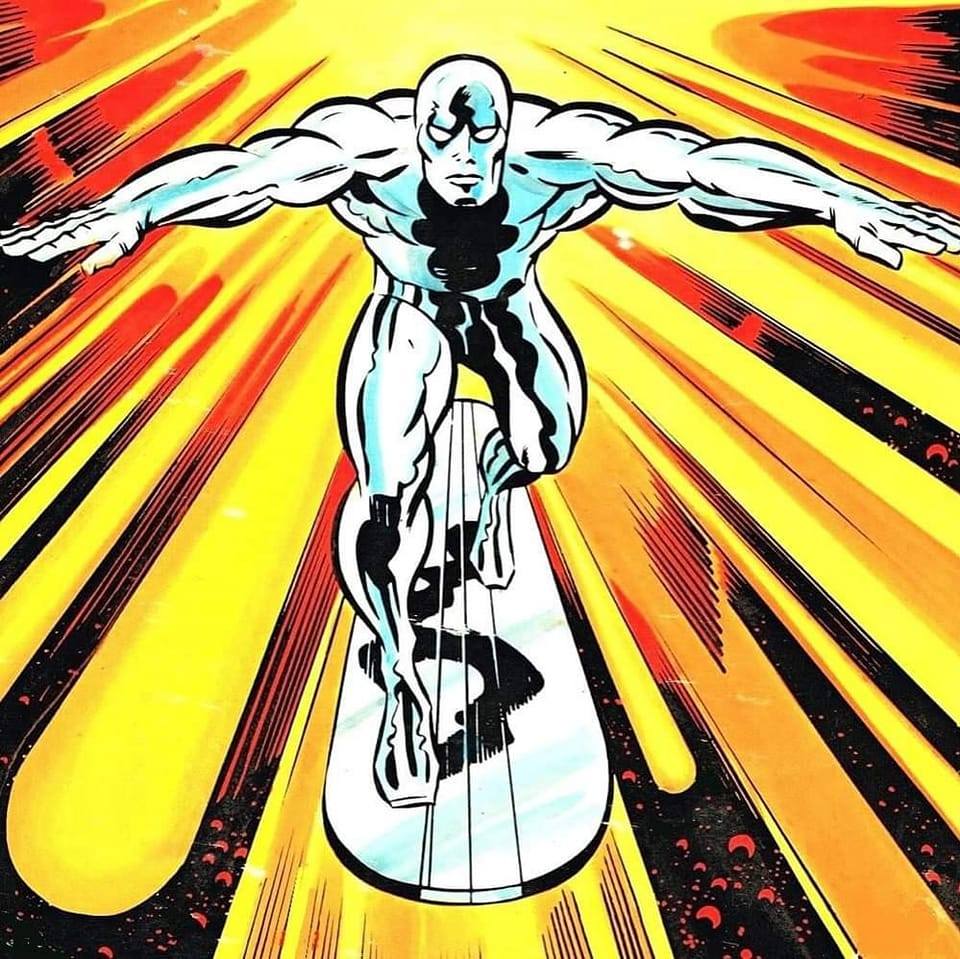 The Silver Surfer by Jack Kirby
Finally, here’s a rendering of the Silver Surfer by Jack.
Jeffrey P. Talanian’s last article for Black Gate was a look at the Fifty Years of Gary Gygax’s Greyhawk. Jeffrey is the creator and publisher of the Hyperborea sword-and-sorcery and weird science-fantasy RPG from North Wind Adventures. He was the co-author, with E. Gary Gygax, of the Castle Zagyg releases, including several Yggsburgh city supplements, Castle Zagyg: The East Mark Gazetteer, and Castle Zagyg: The Upper Works. Read Gabe Gybing’s interview with Jeffrey here, and follow his latest projects on Facebook and at www.hyperborea.tv.
Categories: Fantasy Books
Forgotten Authors: G. Peyton Wertenbaker
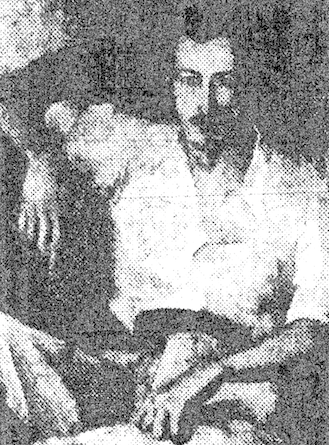 G. Peyton Wertenbaker
Green Peyton Wertenbaker was born on December 23, 1907 in New Castle, Delaware. He attended the University of Virginia. After graduation, he worked as a technical writer and eventually a journalist in addition to writing fiction. During World War II, Wertenbaker services in the U.S. Navy and was later associated with the USAF School of Aerospace Medicine.
Wertenbaker married Barkley Barbee and they had one son, George.
His first story, published in Science and Invention when he was 16 in 1923, was “The Man from the Atom.” Gernsback reprinted the story three years later in the first issue of Amazing Stories. The next month, he would become the first person to publish an original story in Amazing (as well as the first repeat author), when Gernsback published his obviously titled sequel “The Man from the Atom (sequel).” Wertenbaker would go three issues for three the next month with the appearance of “The Coming of the Ice.”
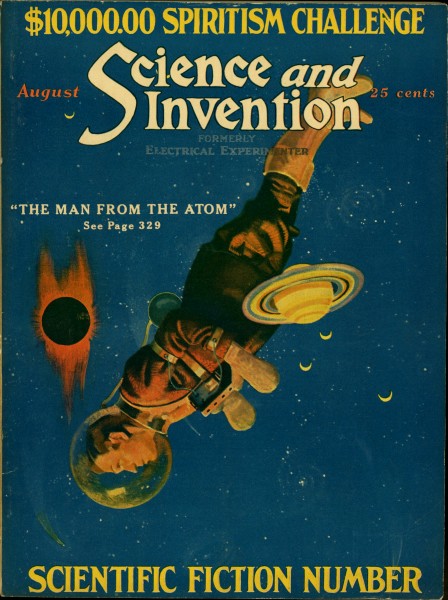 Science and Invention, 8/1923, Cover by Howard V. Brown
Along with Wertenbaker’s “The Man from the Atom,” the first issue of Amazing included a reprint story by Austin Hall. In January 1924, Weird Tales ran a letter from Wertenbaker which stated “In the September issue of Weird Tales, begins a romance by Austin Hall, entitled ‘The People of the Comet.’…You may imagine my surprise when I discovered that the idea that plays the most important part in it is one which I myself developed somewhat differently in a story about a month earlier. If you will consult Science and Invention…you will see my own tale ‘The Man from the Atom.’ Mr. Hall may possibly be interested in comparing it with his romance.” Wertenbaker’s letter indicates that he saw himself a fan of horror fiction, even if most of his own fiction was more science fiction.
Although Wertenbaker had a long and successful career as a writer, his science fiction formed only a small part of his work over a short period of time, with a mere eight years passing between the original publication of “The Man from the Atom” when he was 16 until “Elaine’s Tomb” when he was 24.
Wertenbaker also published under his first two names. His first novel, Black Cabin, was published in 1933 as by Green Peyton. Under that name he also wrote 5,000 Miles Toward Tokyo, San Antonio: City in the Sun, For God and Texas, and American’s Heartland: The Southwest and was considered an authority of the American Southwest.
Eventually, Wertenbaker moved to London, where he served as the UK correspondent for Fortune Magazine and also wrote for Time. In 1958, he wrote the scripts for the series Doctors in Space and joined NASA as a speechwriter, eventually taking on the role of NASA Chief Historian of the Aerospace Medical Division. In final book was the non-fiction Fifty Years of Aerospace Medicine.
Wertenbaker died on July 26, 1968 in San Antonio, Texas and was cremated.
Steven H Silver is a twenty-one-time Hugo Award nominee and was the publisher of the Hugo-nominated fanzine Argentus as well as the editor and publisher of ISFiC Press for eight years. He has also edited books for DAW, NESFA Press, and ZNB. His most recent anthology is Alternate Peace and his novel After Hastings was published in 2020. Steven has chaired the first Midwest Construction, Windycon three times, and the SFWA Nebula Conference numerous times. He was programming chair for Chicon 2000 and Vice Chair of Chicon 7.
Categories: Fantasy Books
Dark Muse News: There’s something about Return to Silent Hill – It’s Mary!
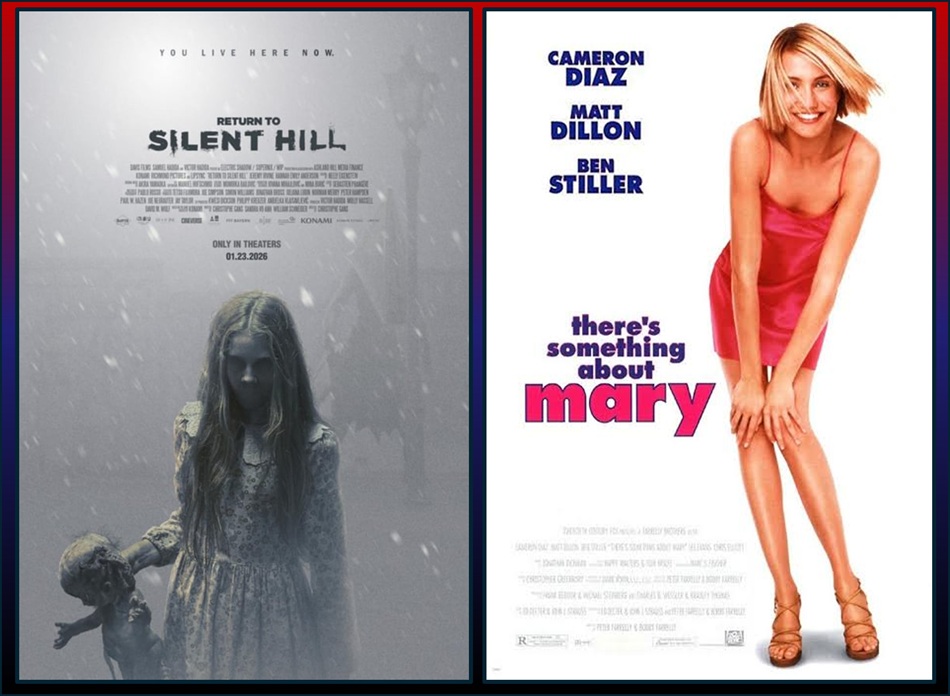
The movie Return to Silent Hill (2026) is an adaptation of the psychological horror Silent Hill 2 (SH2) video game that was rebooted by Konami under Bloober Team in 2024. This ‘return’ film is directed by Christophe Gans, who championed the original 2006 film (which loosely adapted the first video game released in 1999). With the resounding success of the Bloober SH2 video game reboot, fans of the horror series had hope that the movie would pack a 1-2 punch, but it has been received poorly. Why?
Not helping the United States release was an ill-timed blizzard that stretched across the country (Wikipedia even has an entry about the storm). I suspect if that were a fog-storm (do those exist?), then ticket sales would have skyrocketed. At this point, almost every blogger and reviewer who has seen the movie has been pissed since it did not seem to represent the core elements of the game; I was in a similar camp until I dissected the film for this article. Here’s the Deal.
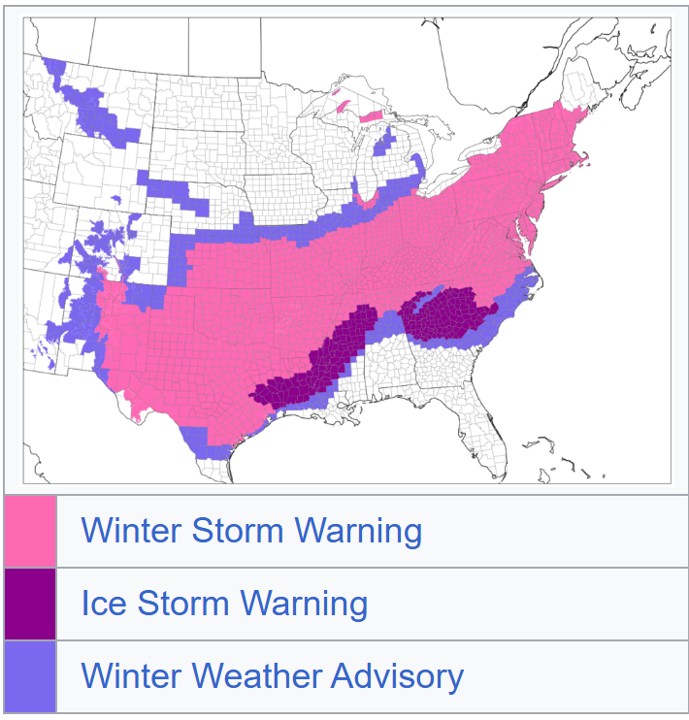 All warnings and advisories issued in the US due to the January 23–27 winter storm (Source: Wikipedia)
James Sunderland appears to be the focus since the movie opens with him driving a car to a lookout featuring Silent Hill, as would be expected from the video games (both original and release) and the Trailer. The truth is, the movie is really not about him. Also, you’ll meet a ton of characters, and they will mirror characters in the game… except in the movie, they aren’t really different people.
So:
- If you do not know the lore, you’ll take the characters at face value when introduced (different names imply different people), and you’ll get confused later
- Fans knowing the lore will watch assuming the same… and get confused… and pissed
To deliver this sucker punch approach, Gans’ production delivery had to be perfect. And it was off. I had to meticulously screen capture, crop, and dissect the movie to change my mind about the work. Why reveal spoilers here? Most of the internet already has, including Gans in his interview (links below), and, for me, the movie would have been more enjoyable knowing what I know now. What at first appears to be a big mess is actually a coherent offering.
Anyway, in short, as teased by the header image, there is something about Mary.
Read on! Maybe you will enjoy the film more!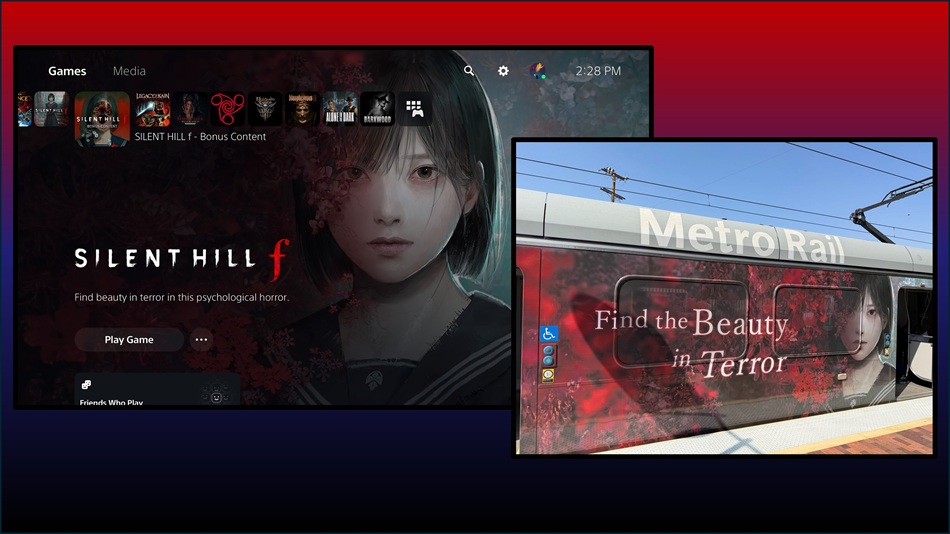
Being Dark Muse News, we are focused on beautiful, horrific art. With the resurgence of Silent Hill games, Silent Hill f released late 2025, just months before the Return to Silent Hill movie. This game is set in 1960s Japan, focusing on a teenage girl named Hinako Shimizu, and it doesn’t share creators with the film.
Anyway, it’s a great game that I hope to cover soon; we mention it here because its tagline is “Find the Beauty in Terror” which can be found on the buses in Japan and on the home screen of the PS5 console. Its use of red spider lilies (higanbana) instead of creepy, red paint used in prior SH offerings brought with it the beautiful horror it promised. Could the movie, released months after “f” have the same artistic, beautiful take on terror?
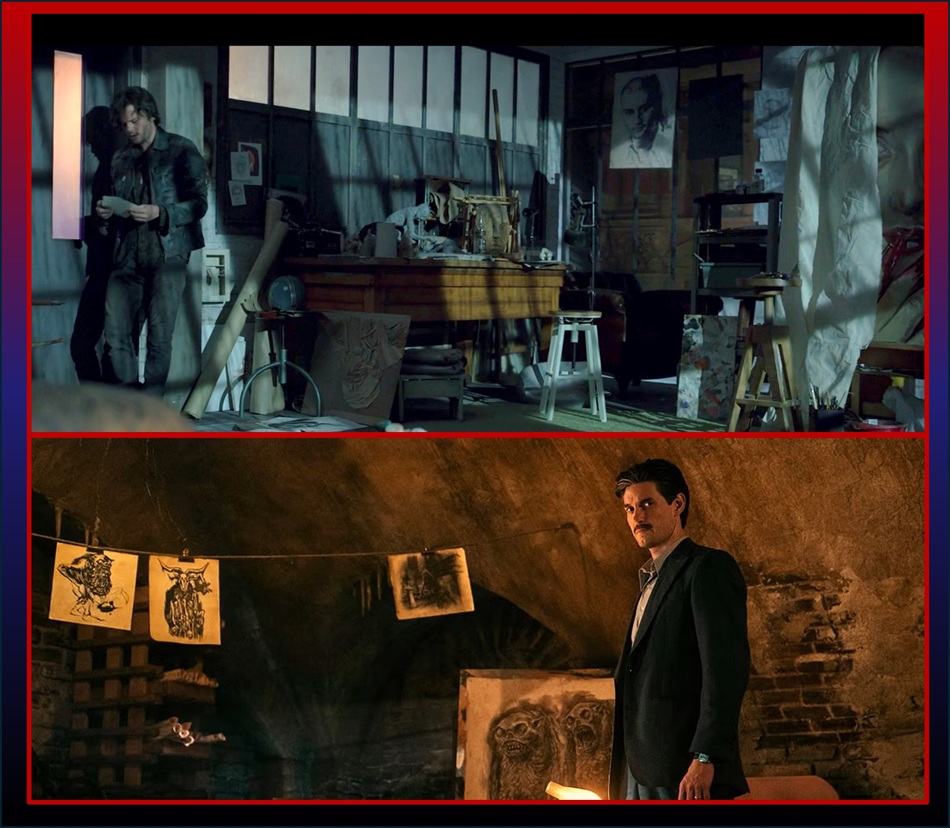 TOP: James Sunderland opens a letter from Mary in his art studio (Return to Silent Hill Movie) BOTTOM: Thurber, and artist in Pickman’s Model – Netflix adaptation (Guillermo del Toro’s Cabinet of Curiosities Season 1, Ep 5)
James is a Painter! But he isn’t Lovecraft’s Pickman / Thurber
TOP: James Sunderland opens a letter from Mary in his art studio (Return to Silent Hill Movie) BOTTOM: Thurber, and artist in Pickman’s Model – Netflix adaptation (Guillermo del Toro’s Cabinet of Curiosities Season 1, Ep 5)
James is a Painter! But he isn’t Lovecraft’s Pickman / Thurber
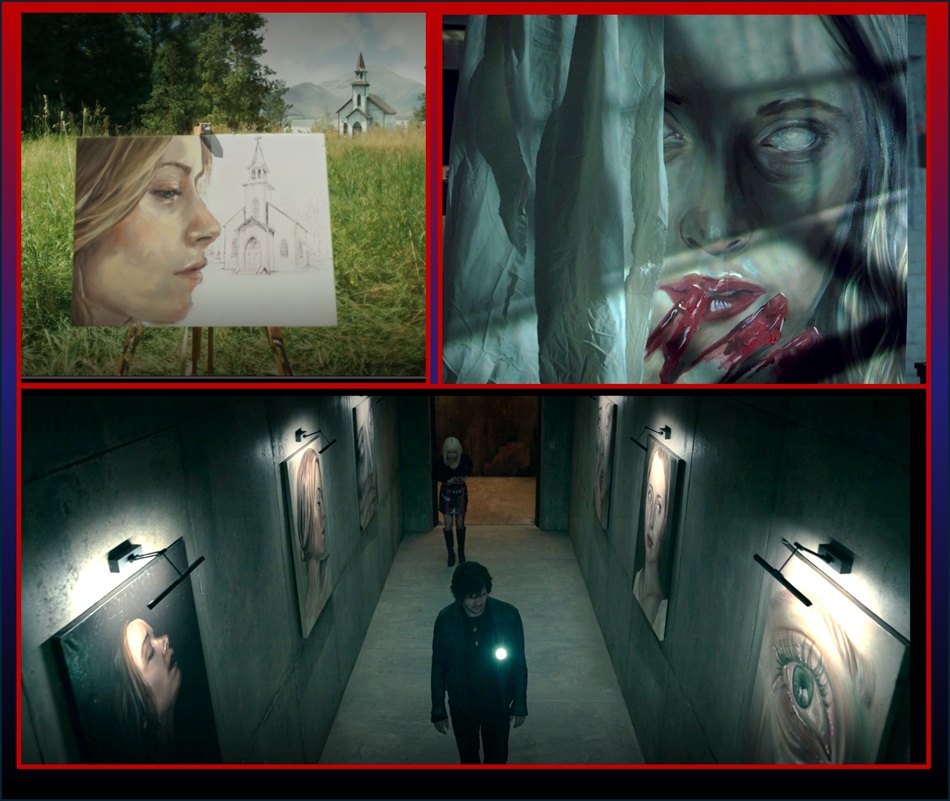
Ok, so we are revved up, expecting blends of art and horror from the SH franchise. In the game, the protagonist is James Sunderland, who was an “average Joe” everyman. In the movie, he is portrayed as a painter! As soon as I learned this from the trail and internet hype, I was excited, since I had hopes of the character being more deep, something like the artist(s) in H. P. Lovecraft’s 1927 “Pickman’s Model” (wherein Richard Upton Pickman painted monstrosities that were more real than his audience knew; the story is fantastic and occasionally adapted to film, such as Guillermo del Toro’s Cabinet of Curiosities Season 1, Ep 5, 2022).
In Return to Silent Hill, James is only shown painting in one instance. As far as screen time goes, the painter aspect is not fleshed out much (this post highlights the most relevant, painting snapshots).
It’s a lost opportunity. Artsy elements were set up, but they are swamped out by CGI antics, with more time dedicated to atmospheric ambiance (which was overdone). James’ ability to paint feels thrown in as a bonus, rather than a critical design element. Why did we not see him portray Mary in action, watch him capture her emotions? Watch him make the gallery shown later in the movie (for about a minute when he races through it with Maria).
He could have stopped to analyze those paintings, inquire about his muse, and what was in them. Instead, he just races by them. I purchased and skimmed the Novelization by John Passarella, hoping to unearth some arcana, but it provides even less depth on the paintings than the movie.
.
So why would James’ character not be fleshed out more? Well, he was not the main draw, apparently. In a sense, Return to Silent Hill (2026) has more in common with There’s Something About Mary (1998), a romantic comedy in which Ben Stiller plays a man who pines for his old crush Mary Jensen (played by Cameron Diaz). Both movies are romances where a blond woman named Mary is sought out. RtSH was really more about Mary than James. Note that, according to Reddit and fan lore, a SH2 documentary had the character designers identifying Cameron Diaz as an inspiration for Maria’s character.
 LEFT: Cameron Diaz; RIGHT Maria from Silent Hill 2 (original game)
The evidence that movie is not really about James, but is about Mary? Well, Christopher Gans told the public via interviews with Fandomwire (link) and Temple of Geek (link to where Gans explains that Angela is Mary too). This explains why actress Hannah Emily Anderson plays four ‘distinct’ roles in the 2026 film Return to Silent Hill: Mary Crane, Maria, Angela, and monstrous/moth Mary.
Evie Templeton played the character Laura, who, by chance, apparently also did the voice and motion capture for the same character in Bloober’s SH2. The explicit evidence of a universal Mary existing is Laura’s reveal at the Lakeview Hotel, when she reminded James that the tombstone for Mary has this inscription: “Mary Angela Laura Crane.” In the video game, Laura is a girl whom Mary met in the hospital, and Angela is a depressed survivor of sexual abuse. The film conversely posits that Angela, Mary, and Laura are all the same! For me, I would have enjoyed the movie more if I had known this ‘sucker punch’ spoiler.
For first-time watchers, the film appears to be a mess until the grand reveal of the tombstone naming. There are tons of characters that seem to require more screen time and stories fleshed out. They all play roles similar to what they had in the games, but are left fragmented. Once we know that many of the characters in the movie are literally Mary in different forms, then we can enjoy it a lot more.
Return to Silent Hill is really about her. Let go of a few red herrings and cameos (i.e., Eddie) and focus on the implications.
Embracing There’s something about MaryThe consequence of having Laura, Angela, Mary, and Mary’s monstrous version of herself all being the same entity is profound. It implies that the Abstract Daddy is Mary’s father, who abused her sexually (more so than the cultish poisoning). It implies her connection to the town is so powerful that her soul/identity manifests throughout everything. It means she was trying to communicate with James through several versions of herself.
In the film, Abstract Daddy was Mary’s father. Mary’s father and his cult (The Order) abused her, drugged and manipulated her. James catches Mary when she wants to leave the cult at the overlook at the beginning, and he brings her back. He is responsible for her not leaving the cult!
Character Differences: Game vs Movie Character SH2 Video Game(s) Return to Silent Hill movie James Sunderland Focal Character of Story, knew his wife was terminally ill A foil character for Mary …. it’s all about Mary. James did not know Mary was sick Silent Hill A resort/retreat town that James and Mary Mary’s birthplace, a trap she is trying to escape Mary _____ Mary Shepherd-Sunderland, WIFE of James, victim of terminal disease, and later to James Mary Crane, a GIRLFRIEND of James, a victim to her father’s abuse and the cult of Silent Hill Laura A girl whom Mary befriended in Brookhaven Hospital A younger Mary Angela A woman abused by her father Another version of Mary Maria An alternative version of Mary, a sluttier version of his wife A doppelganger Mary, a sluttier version of his girlfriend, is not real Pyramid Head A monstrous manifestation of James ’ sexual frustrations An angry/champion version of James, fighting on his behalf against the monstrous version of Mary (the version of her that the cult encouraged her to becomeIncarnations of Mary

The movie introduces Pyramid Head as an entity chasing him/Laura, but then it becomes clear that it is not after James. It is after the monsters and unreal things haunting James. Pyramid Head doesn’t rape maniquins as he does in the video games; here he struggles with the monster version of Mary. James’s only painting (done when he had a beard, so before the timeline of the film) is a self-portrait that assumes the Pyramid Head mask. Many times in the film, both James and Pyramid Head mirror each other’s gestures.
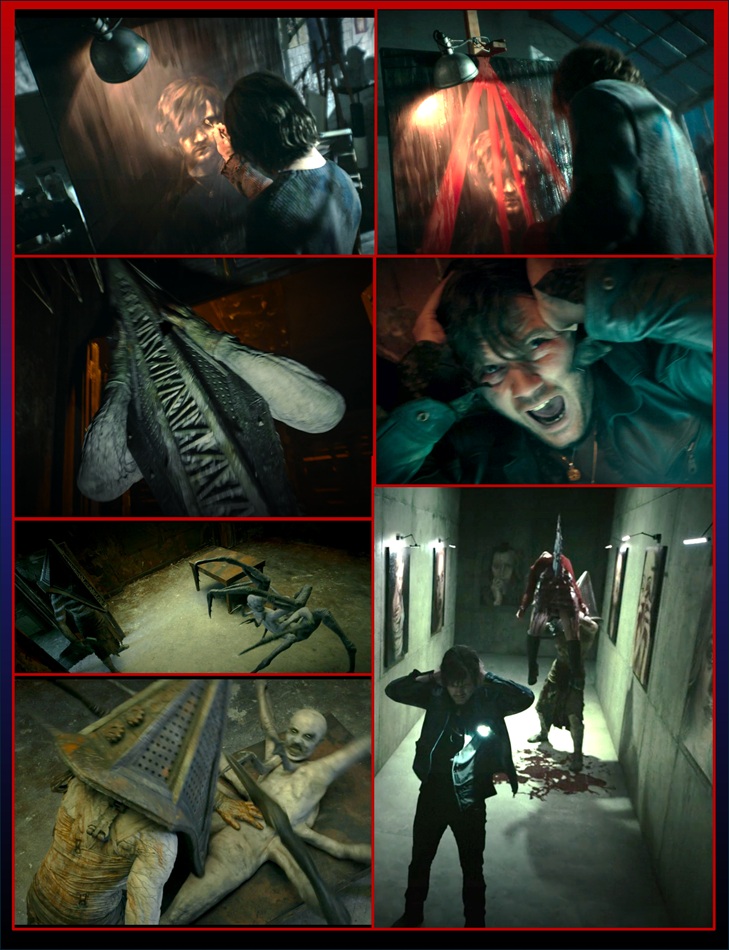
For my first viewing, the movie was too different than the game and too confusing for me to catch the artistic nuances. Analyzing it for this post made me more sympathetic to Mary (and happier to rewatch the film). Below are a few additions I would have enjoyed, and if there is a god in Silent Hill, perhaps some of them exist in a Director’s Cut.
- Have Mary be focused in the beginning scene (not James in the car); have her climb out of the valley to the overlook, maybe even dropping a sacred doll or relic of the cult to demonstrate her escape
- Have James place a rose on a tombstone when he meets Angela (instead of carrying sandbags with her)
- Have James actively paint Mary, show them interacting, and him exercising his craft. Show him learning about her as he paints. Show her hiding her odd past with the cult, turning into a monster. Maybe he sees the emerging monster in her, and paints it.
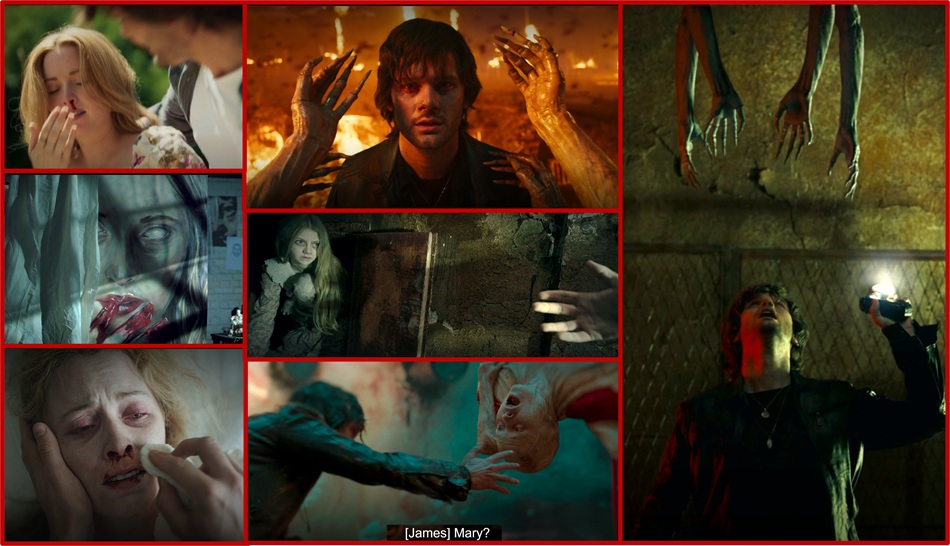
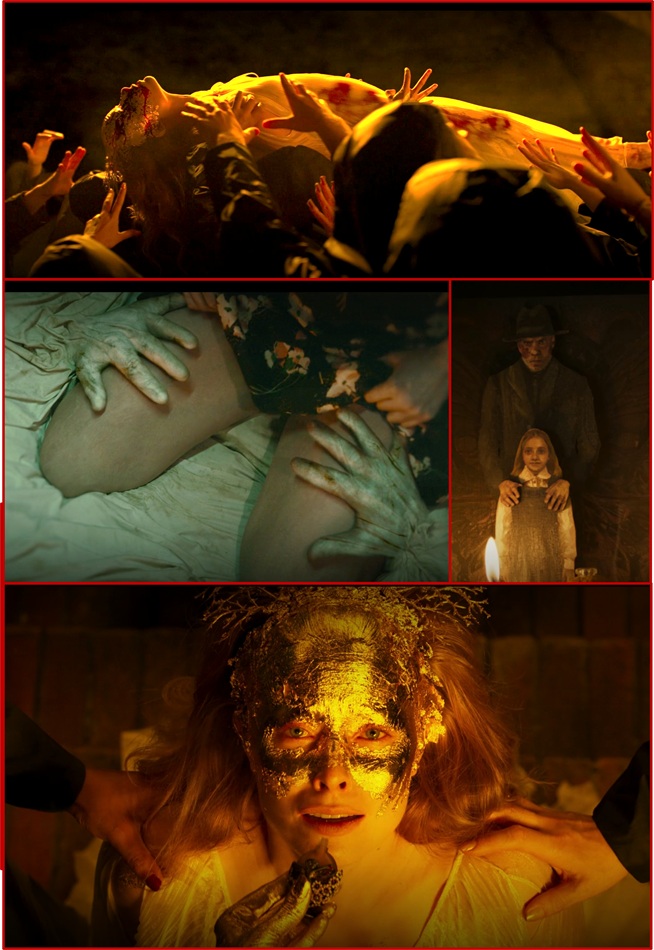
S.E. Lindberg is a Managing Editor at Black Gate, regularly reviewing books and interviewing authors on the topic of “Beauty & Art in Weird-Fantasy Fiction.” He has taken lead roles organizing the Gen Con Writers’ Symposium (chairing it in 2023), is the lead moderator of the Goodreads Sword & Sorcery Group, and was an intern for Tales from the Magician’s Skull magazine. As for crafting stories, he has contributed eight entries across Perseid Press’s Heroes in Hell and Heroika series, and has an entry in Weirdbook Annual #3: Zombies. He independently publishes novels under the banner Dyscrasia Fiction; short stories of Dyscrasia Fiction have appeared in Whetstone Amateur S&S Magazine, Swords & Sorcery online magazine, Rogues In the House Podcast’s A Book of Blades Vol I & II, DMR’s Terra Incognita, the 9th issue of Tales From the Magician’s Skull, Savage Realms Magazine, and Michael Stackpole’s S&S Chain Story 2 Project.
Categories: Fantasy Books
S. E. Lindberg is One of the most unique voices in Modern Sword & Sorcery
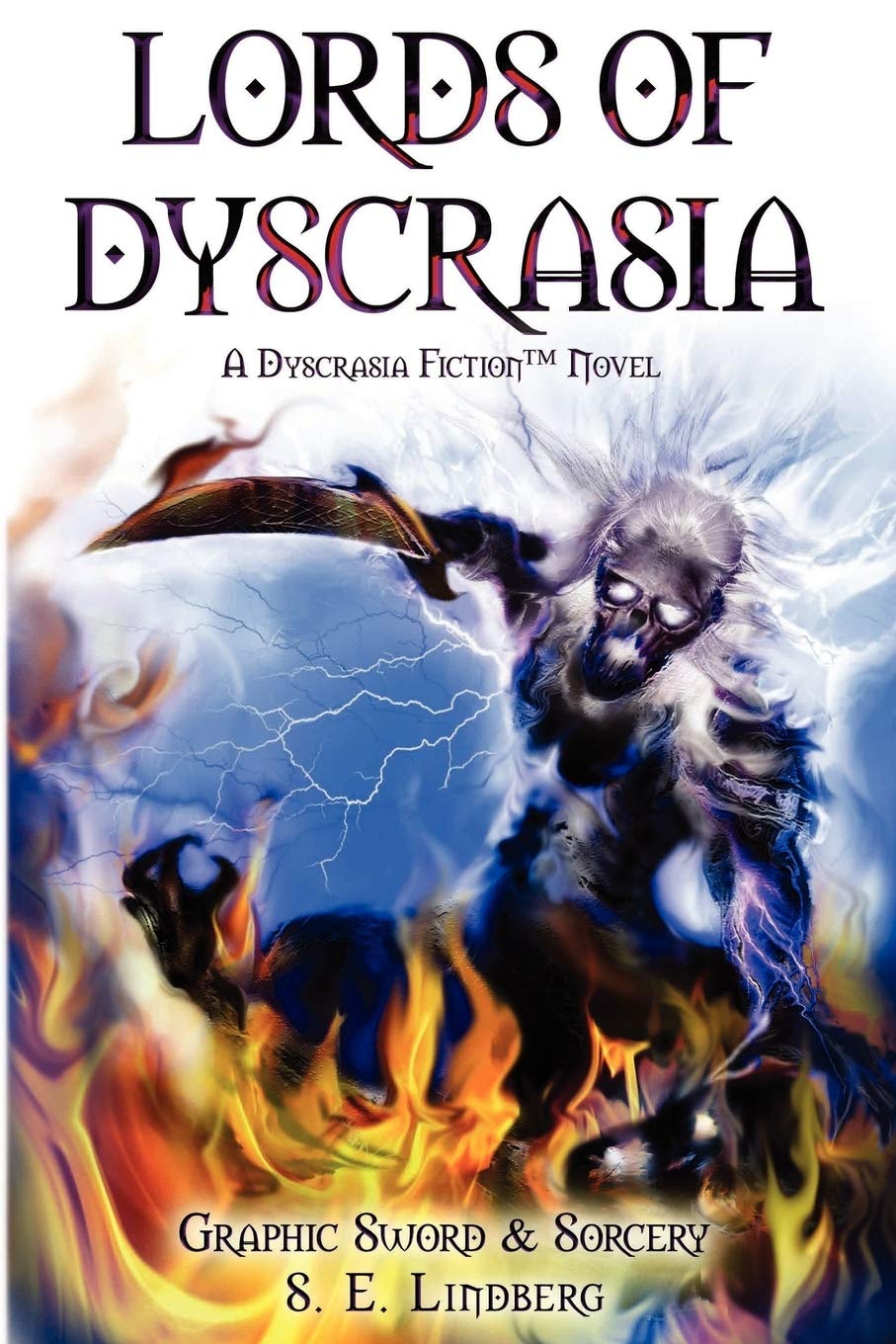
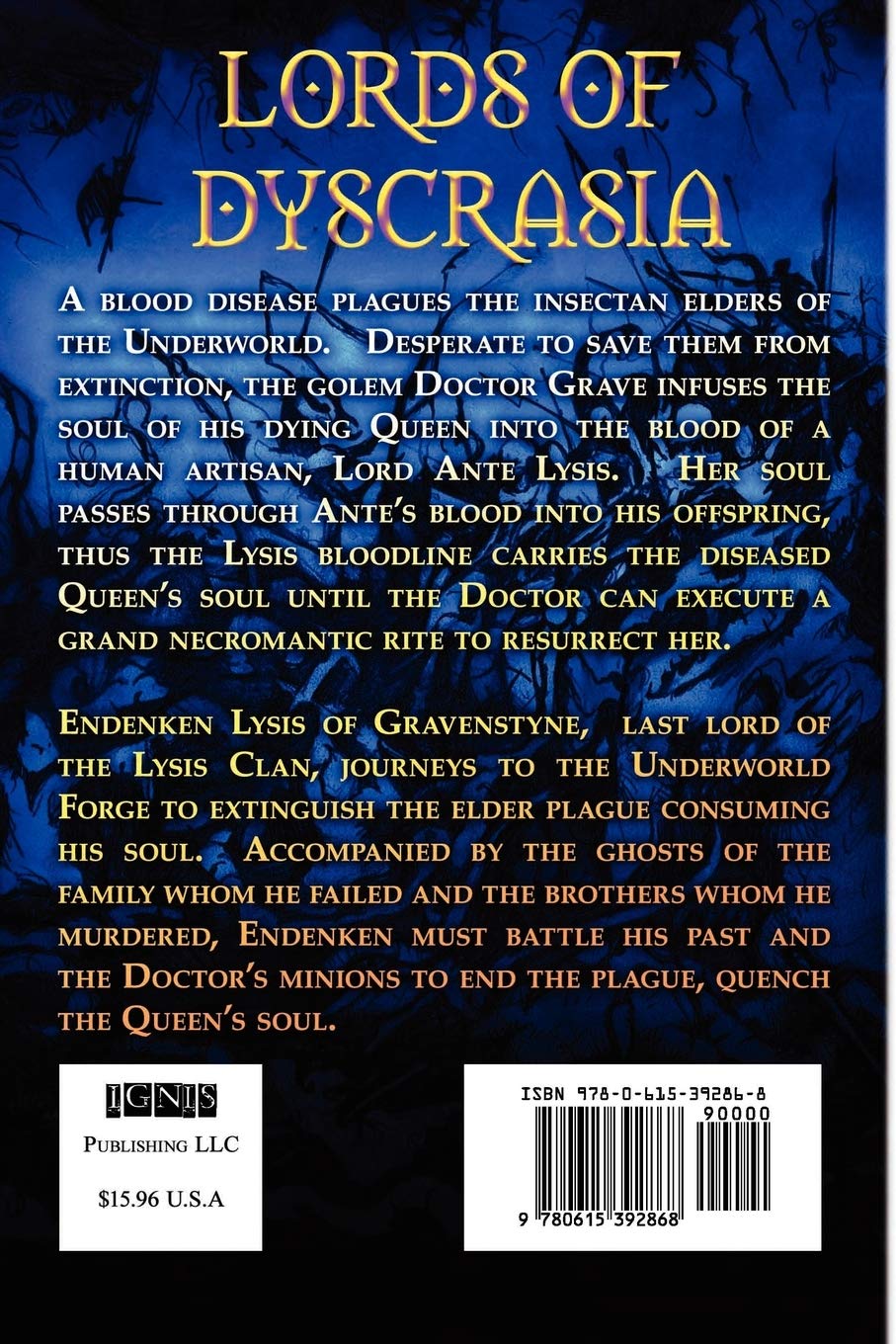
Lords of Dyscrasia by S. E. Lindberg (IGNIS Publishing, July 7, 2011). Cover by S. E. Lindberg
One of the most unique voices working in Sword & Sorcery today is S. E. Lindberg. I met Seth a few years back and we’ve corresponded frequently as well as running into each other here at Black Gate, where he is the Managing Editor, and at Goodreads. Lindberg has put together a unique setting for what he calls Dyscrasia Fiction.
Dyscrasia means “a bad mixture of liquids,” which is related to the Greek concept of the four “humors” of Blood, Phlegm, Black Bile, and Yellow Bile. In Dyscrasia fiction, these humors are sources of magical power and often soul and body corrupting influences.
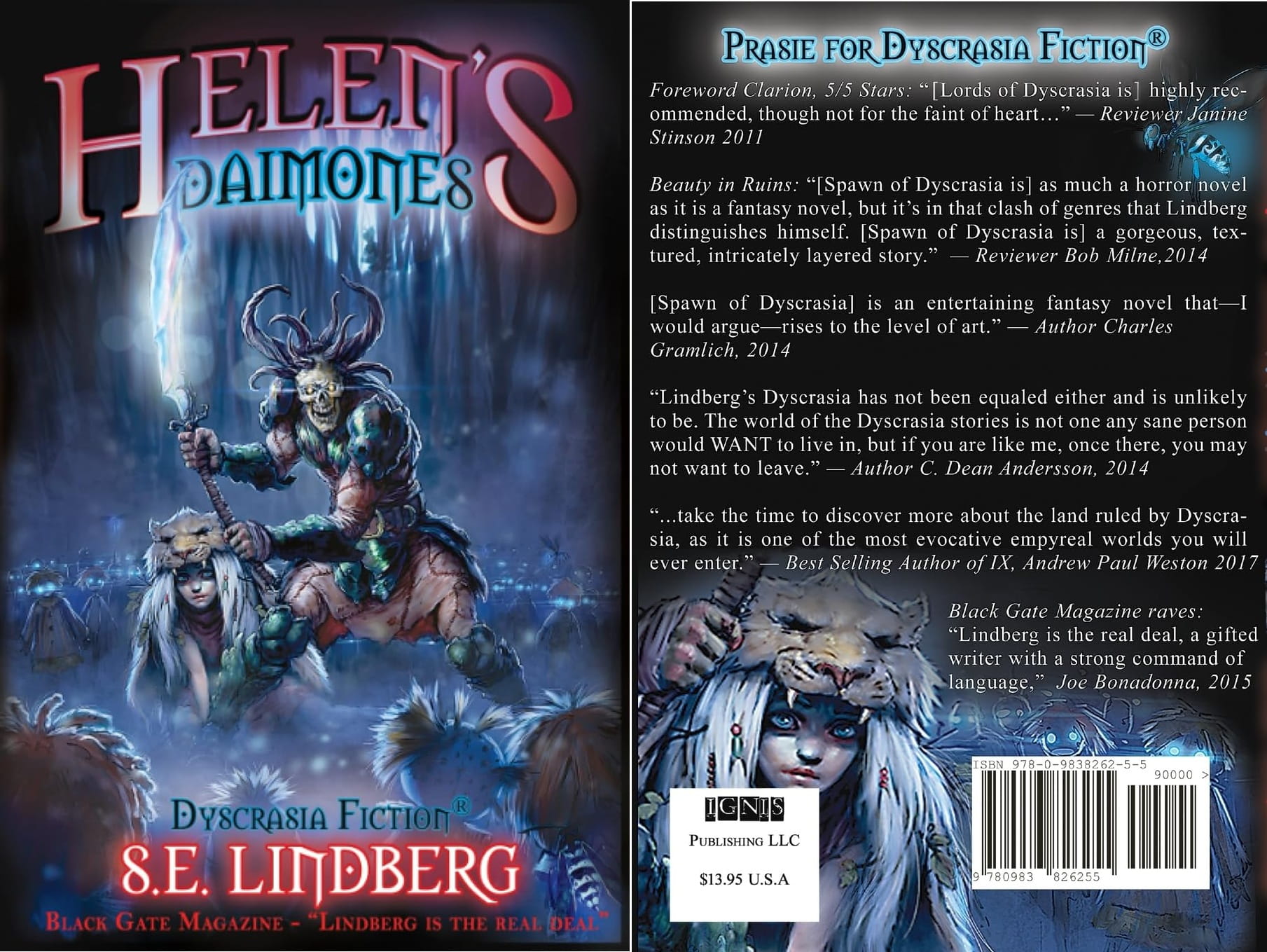 Helen’s Daimones by S. E. Lindberg (IGNIS Publishing, September 22, 2017). Cover by Daniel Landerman
The three novels available now are
Lords of Dyscrasia (2011)
Spawn of Dyscrasia (2014)
Helen’s Daimones (2017)
Although Helen’s Daimones was the most recently published, Lindberg suggests new readers start with it since it sets the tone for the other books.
Wherever you start, though, you’ll find a combination of beautiful language and powerful imagination. These works are hallucinogenic, dream-like, full of wraiths and apparitions — and sometimes horrors. Ideas and images pile one on top of another with an intensity that is far from common in fantasy literature.
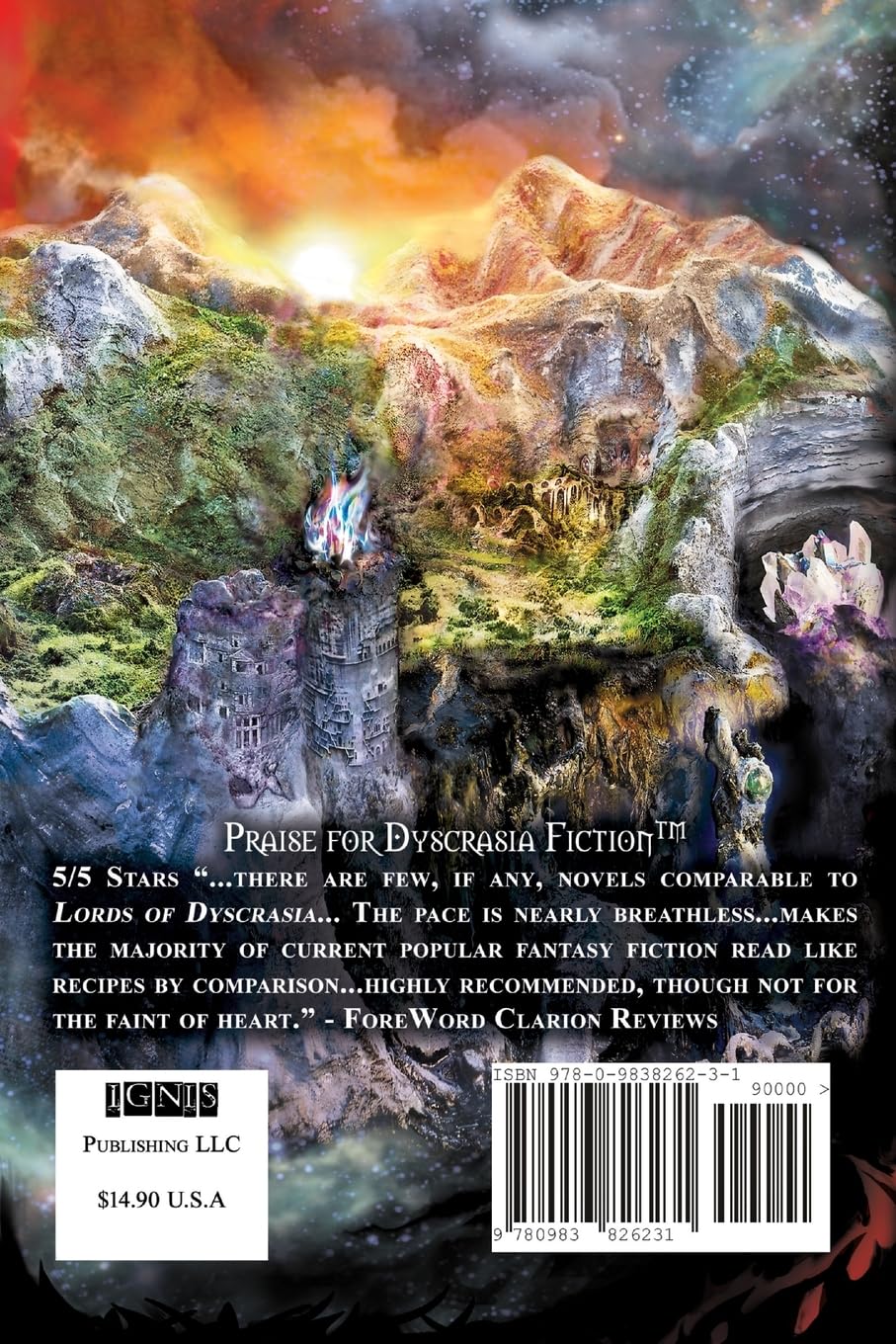
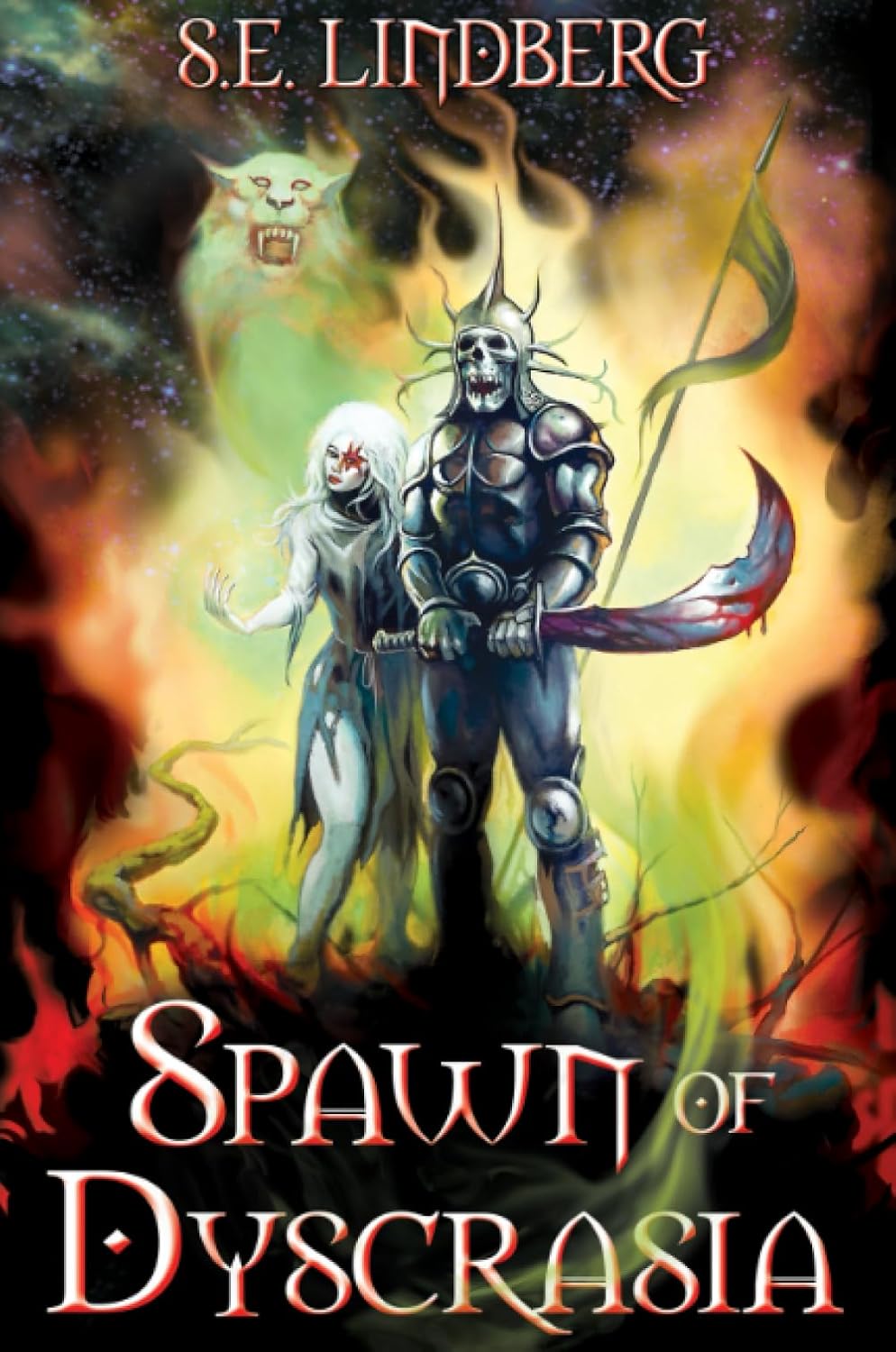
Spawn of Dyscrasia (IGNIS Publishing, July 17, 2015). Cover by Ken Kelly
I admire the author’s ability to maintain that intensity throughout his works; his world-building never stumbles, and the result is a unique fantasy vision that rises to the level of art.
A word about the covers for these books. The first was created by Lindberg himself, who also has other artistic skills in addition to writing. Spawn of Dyscrasia has an amazing cover by Ken Kelly, and Helen’s Daimones has a great cover by Daniel Landerman.
There are also a number of short stories tied to the Dyscrasia setting. For more information, check out Seth’s webpage or his Facebook page, or have a look at Joe Bonadonna’s 2015 review of Lords of Dyscrasia, here at Black Gate.
Charles Gramlich administers The Swords & Planet League group on Facebook, where this post first appeared. His last article for us was a review of The Barbarian Swordsmen, edited by Peter Haining. See all of his recent posts for Black Gate here.
Categories: Fantasy Books
Excalibur: The Holy Grail of King Arthur Movies
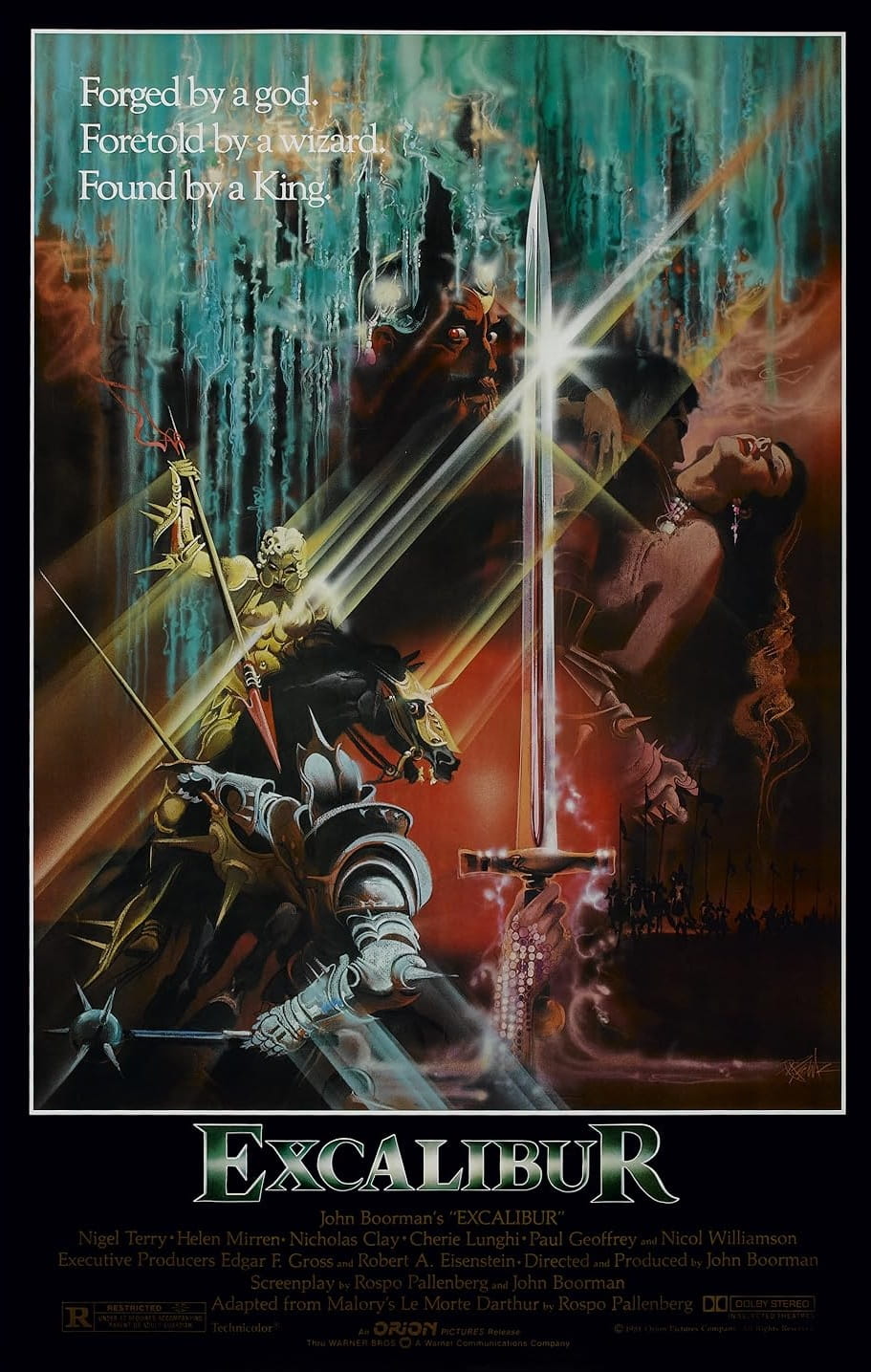 Excalibur (Warner Bros, April 10, 1981)
Excalibur (141 minutes; 1981)
Excalibur (Warner Bros, April 10, 1981)
Excalibur (141 minutes; 1981)
Written by Rospo Pallenberg and John Boorman. Directed by John Boorman.
Loosely based on Le Morte d’Arthur by Thomas Malory.
What is it?A classic telling of the story of King Arthur, the Knights of the Round Table, the quest for the Holy Grail, and the magical sword Excalibur.
Many filmed adaptations of that story have followed. This one, however, with its heightened sense of wonder and layers of magic woven throughout, probably remains the best-loved, most visually stunning, and most talked-about of them all.
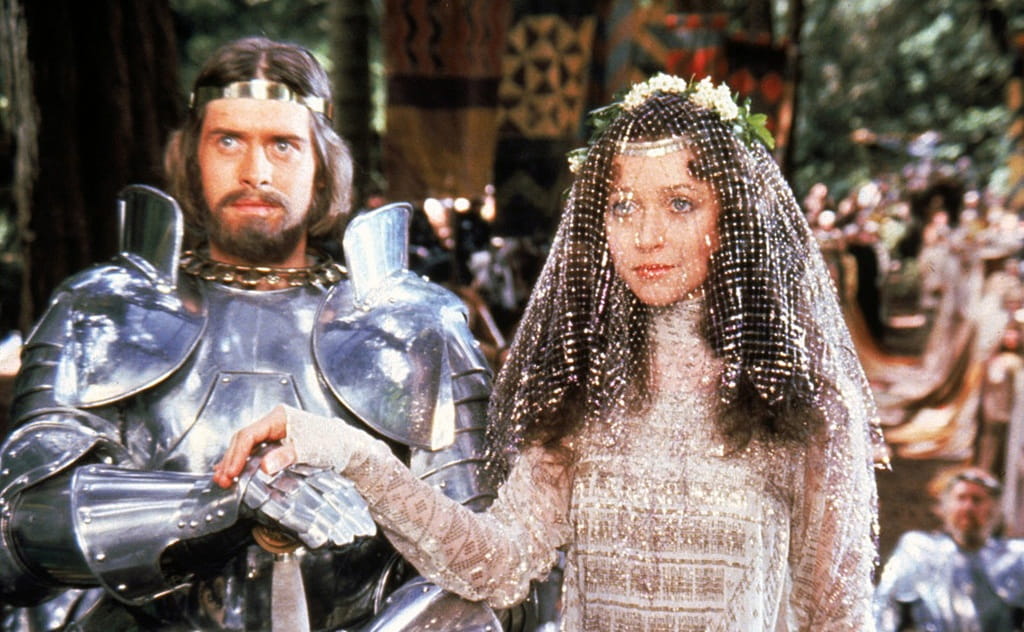 Arthur and Guenevere in Excalibur
Noteworthy
Arthur and Guenevere in Excalibur
Noteworthy
The story goes that Boorman, legendary director of films as lofty as Hope and Glory (1987) and as derided as Zardoz (1974), brought the idea of a film about King Arthur to United Artists in 1969. The studio rejected his original script, which ran three hours, on the grounds of its enormous expected cost to produce. They suggested he make an adaptation of The Lord of the Rings instead. Because that would’ve been shorter and cost less money–?!
Boorman briefly went along with the Rings idea, at least long enough that costume and set designs for Middle-Earth were drafted. Some of these would later be recycled for use on Excalibur.
It took him the entire decade of the Seventies to do it, but eventually he raised enough funds and support to begin work on the movie he’d wanted to make all along.
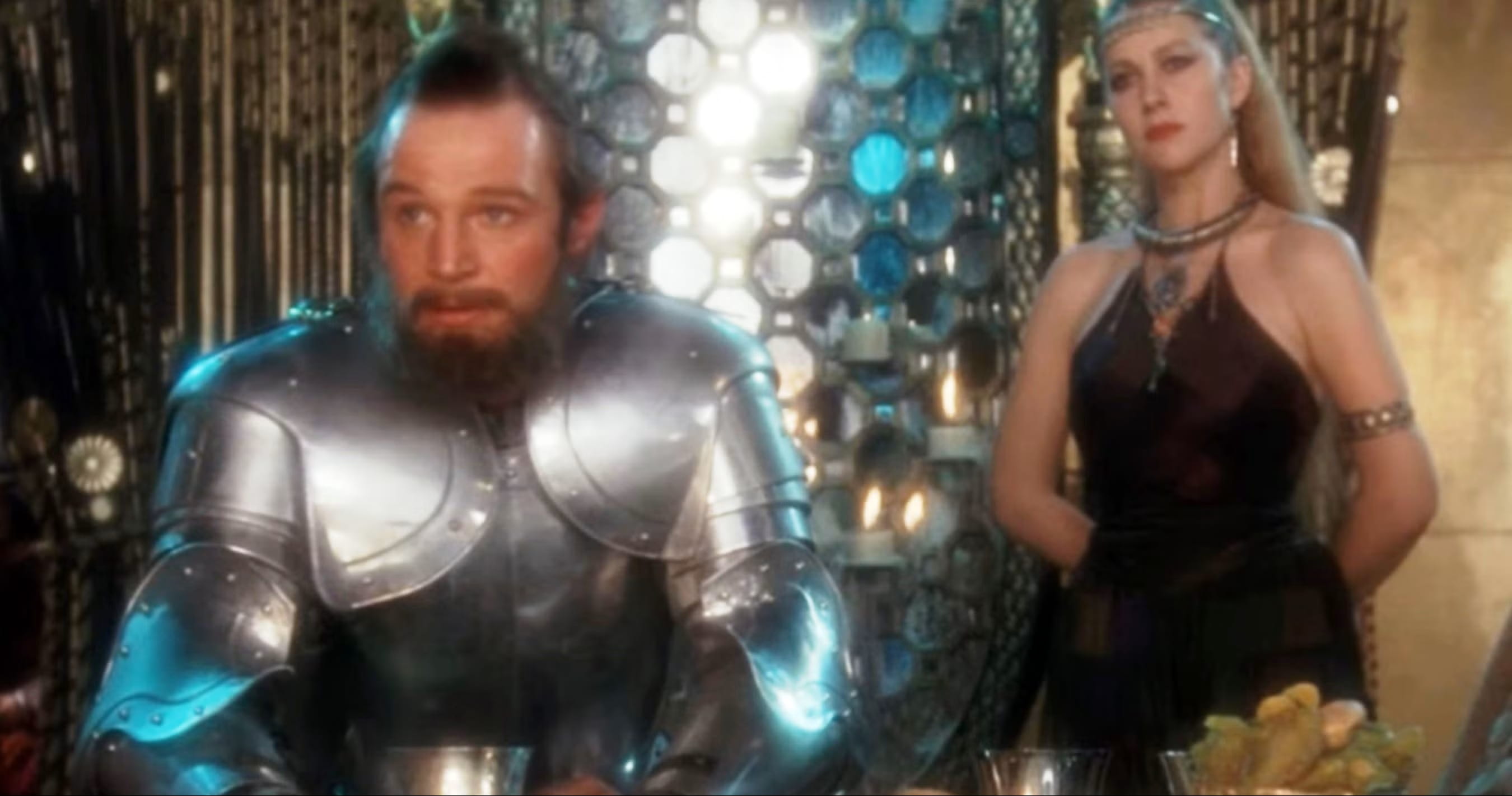 Liam Neeson and Helen Mirren in Excalibur
Boorman couldn’t afford the top actors of the day, so instead he did a remarkable job of finding the top actors of tomorrow, and fitting them into his budget. We therefore get the likes of Liam Neeson, Gabriel Byrne, Ciaran Hinds and Patrick Stewart, all in minor supporting roles. The film’s actual leads include Nigel Terry as Arthur (from teen to aged), Helen Mirren as Morgana, Nicholas Clay as Lancelot, Cherie Lunghi as Guenevere, Paul Geoffrey as Perceval and Nicol Williamson as Merlin.
On a budget of $11 million ($41 million in 2026), Excalibur brought in $35 million ($131 million today) at the North American box office. And of course it went on to become a staple on cable TV.
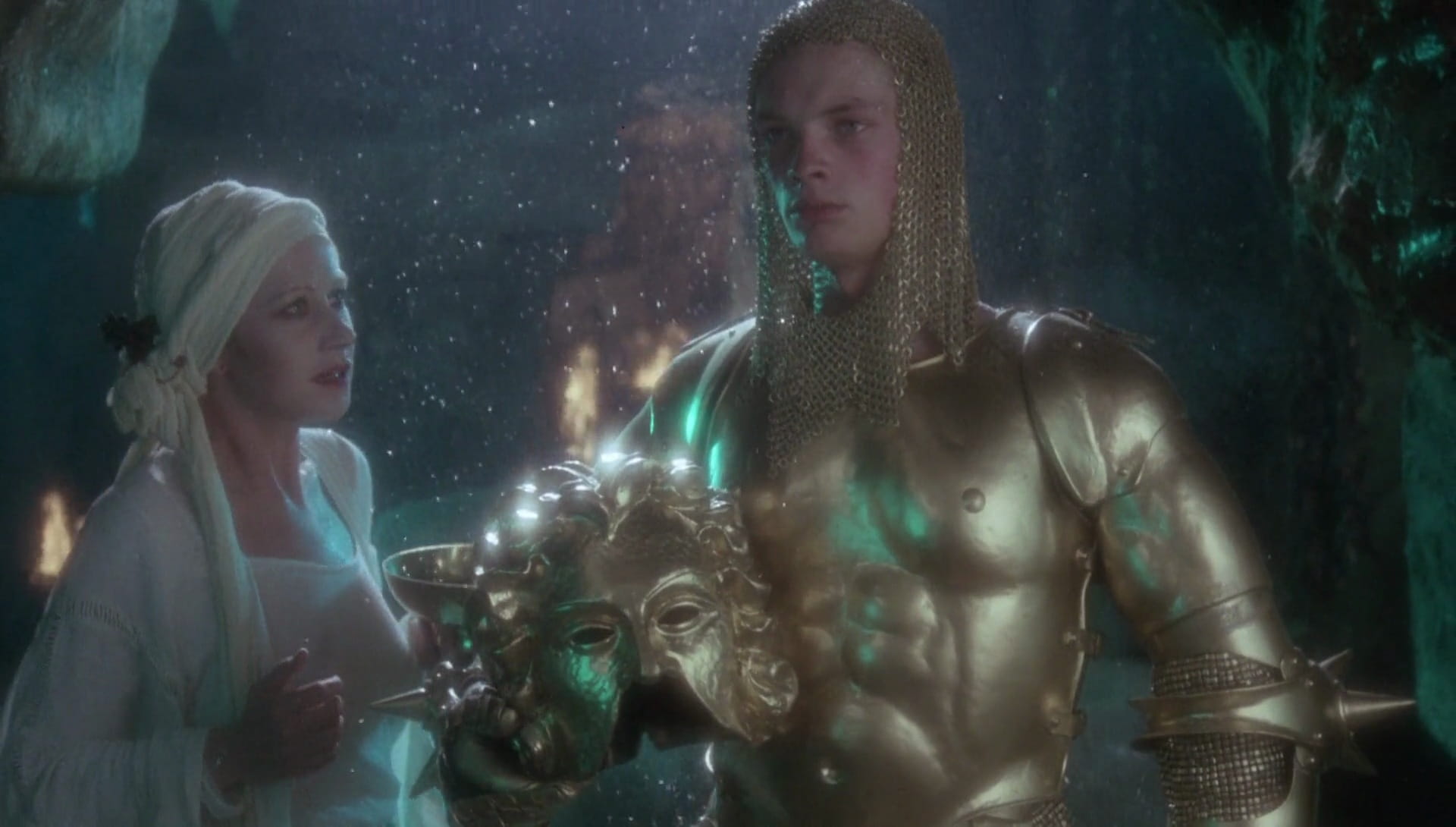 Morgana and Mordred
At Cannes in 1981, it won for “Best Artistic Contribution.” It received an Oscar nomination for “Best Cinematography” and a BAFTA nomination for “Best Costume Design.”
Appropriately enough, Boorman was himself knighted by Queen Elizabeth in 2022.
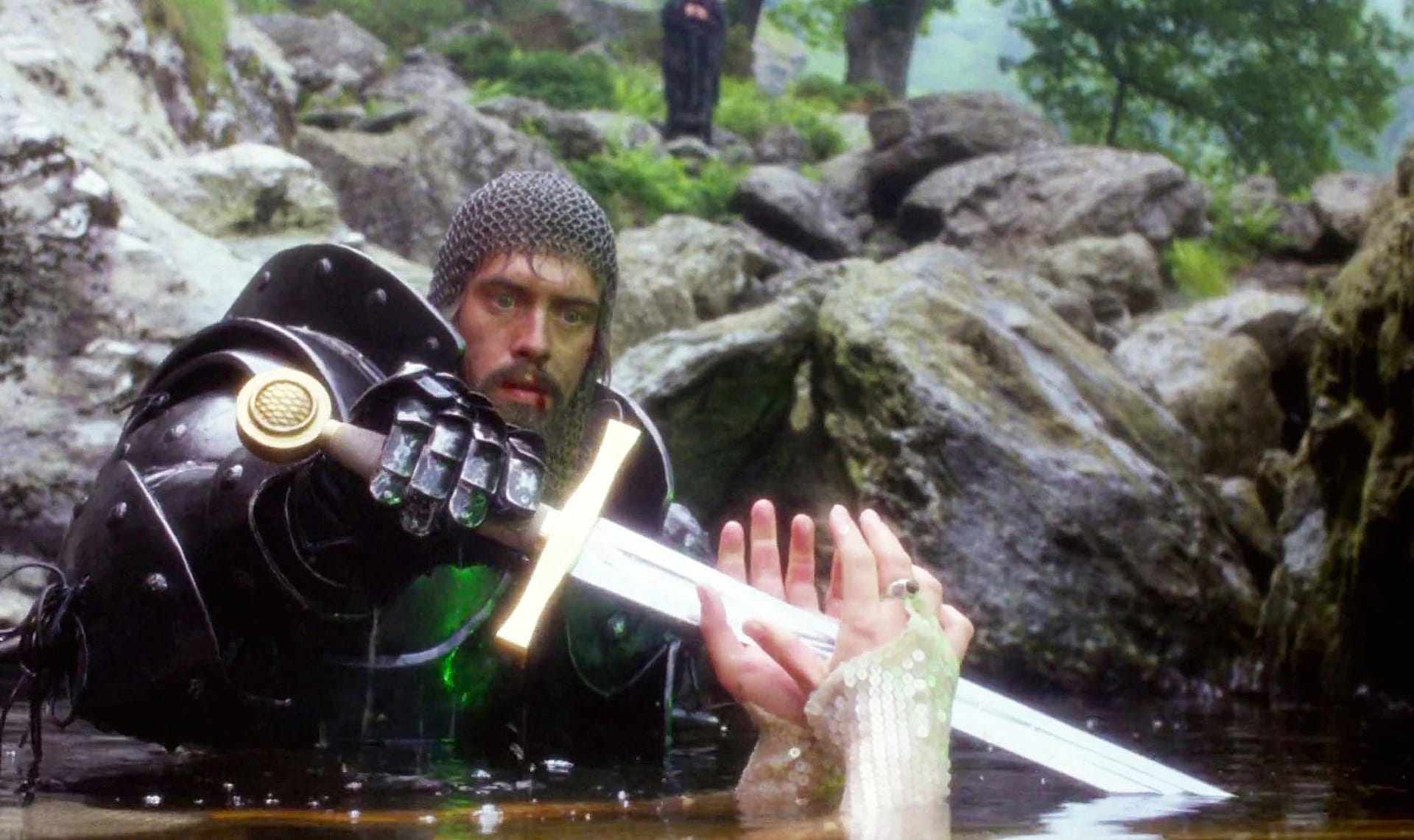 Uthur receives the sword
Quick and Dirty Summary
Uthur receives the sword
Quick and Dirty Summary
The wizard Merlin receives the magical sword Excalibur from the mystical force known as the Lady of the Lake and gives it to Arthur’s future father, Uther Pendragon. Uther uses it to conquer and unify the kingdom. Through Merlin’s magic, Uther seduces a rival’s queen and she gives birth to Arthur. Merlin takes young Arthur away to be raised by another nobleman. Uther implants Excalibur into a stone, and only the future king can draw it out. (Though, like folks lining up to try to lift Thor’s hammer, everyone takes a shot at it.)
A young Arthur draws the sword from the stone, becomes king, unifies the kingdom and creates the Round Table for his knights.
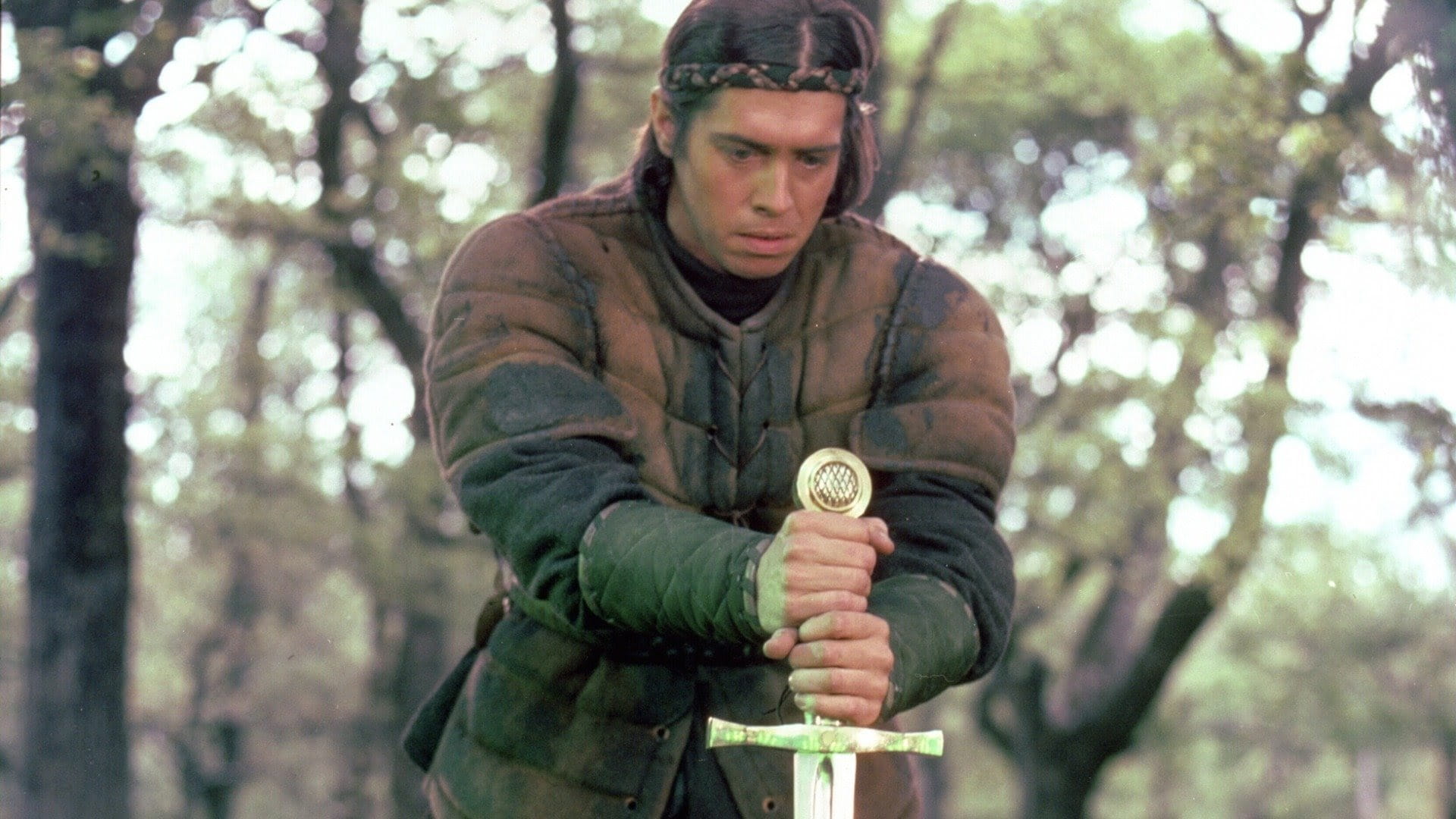 Arthur draws the sword
Conflict arises from various quarters. There’s a quest for the Holy Grail, more great battles and more sorcery.
Eventually most of the main characters square off against one another, in clashes of swords and magic. Merlin overcomes the sorceress Morgana’s spells, Arthur’s son Mordred kills his mother (it’s complicated), and then he and his father slay one another in battle. Before he dies, Arthur orders the sword Excalibur returned to the Lady of the Lake, where it will await the next time England finds itself in need of its power.
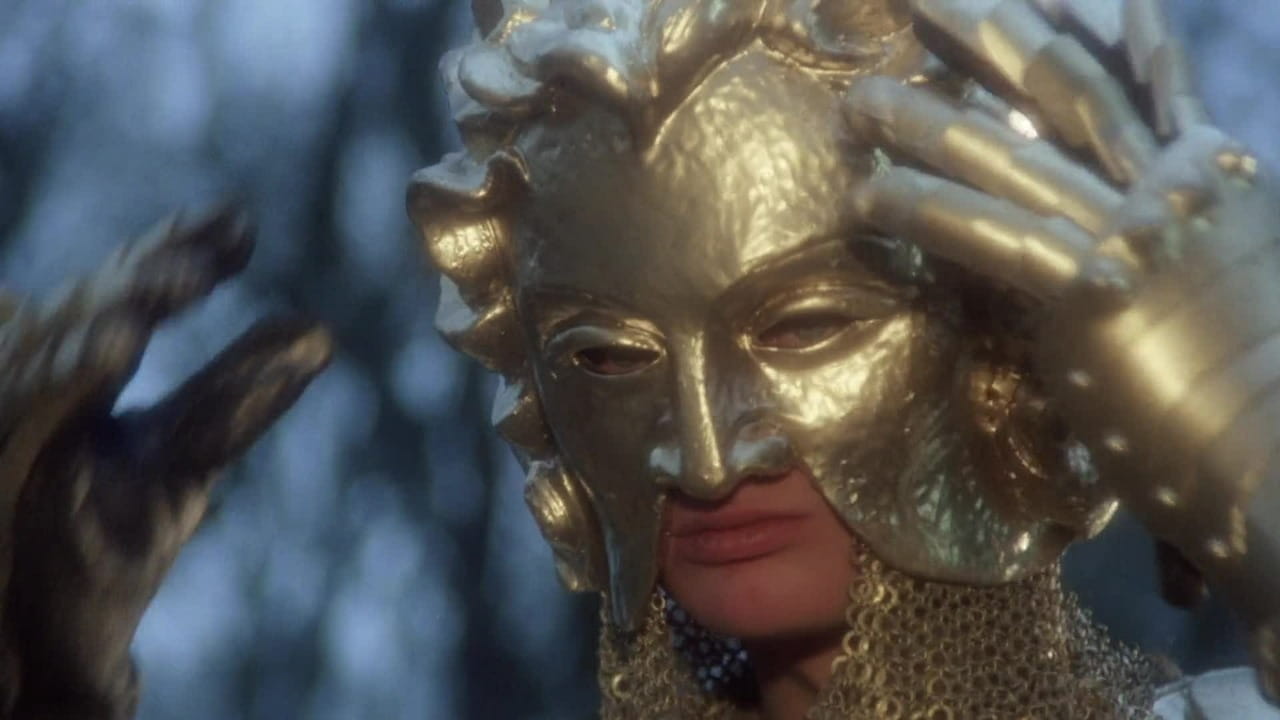 Mordred dons the armor
In addition to being an awesome saga of knights and wizards and battles, the story reflects a deeper idea about the relationship between the people, the land and the king. Here, King Arthur, the sword Excalibur, and the land of England are all tied together in mystical fashion, such that harm to one harms the others, and jealousy and bad actions by the king result in misery and unhappiness for the people and the land. Only by redeeming himself can Arthur restore the land and people to health and prosperity.
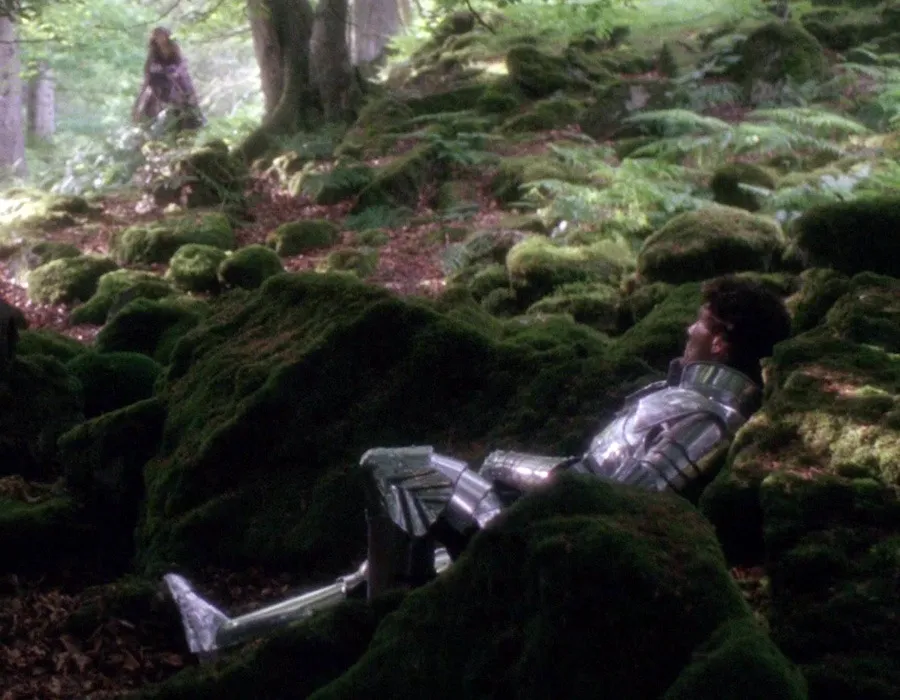 Guenevere comes to Lancelot
Fantasy/SF/Sword & Sorcery Elements
Guenevere comes to Lancelot
Fantasy/SF/Sword & Sorcery Elements
The most obvious examples are Merlin and Morgana and their use of magical powers. The fact that everyone else takes completely for granted the fact that magic is real and is being used around them constantly, including on the battlefield, only reinforces the sense that this is a different England from the one we know. Sorcery is rather commonplace and expected in and around Camelot.
Excalibur itself is a magical weapon. Other supernatural elements include Mordred’s golden armor that cannot be harmed by any weapon forged by Man; the Lady of the Lake distributing magical swords from her watery confines; and the fact that the land suffers when Arthur is low and prospers when he is redeemed.
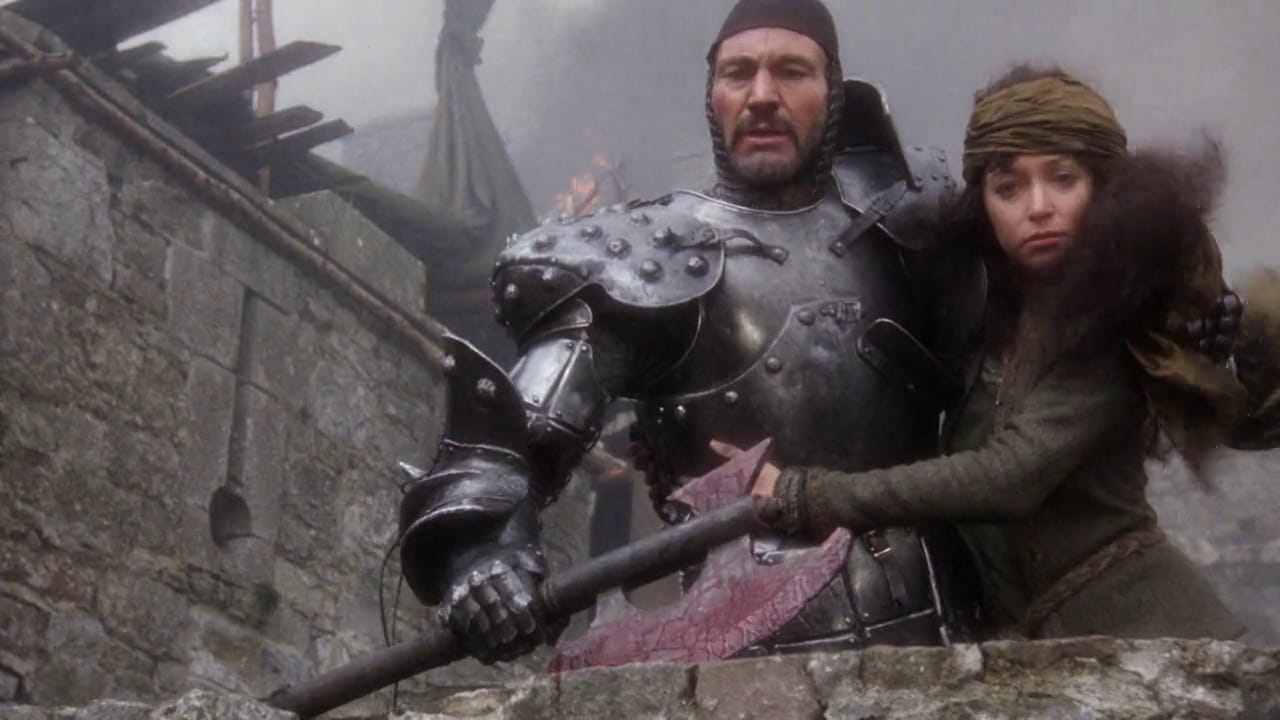 Patrick Stewart and Cherie Lunghi in Excalibur
High Point
Patrick Stewart and Cherie Lunghi in Excalibur
High Point
There are many to choose from, but my favorite has always been the moment when a young Arthur is part of an army besieging a castle commanded by a rival nobleman. Arthur, at this point still in the simple garb of a squire, confronts one of the enemy’s vassal knights. Arthur demands the knight swear fealty to him, but the knight scoffs that he couldn’t even if he desired to, because Arthur is but a squire.
This represents no real hurdle for Arthur. He simply hands Excalibur to the knight and commands his enemy to knight him, there on the battlefield. Arthur has thus rendered himself unarmed and defenseless, and has given over the great sword of kings to his enemy.
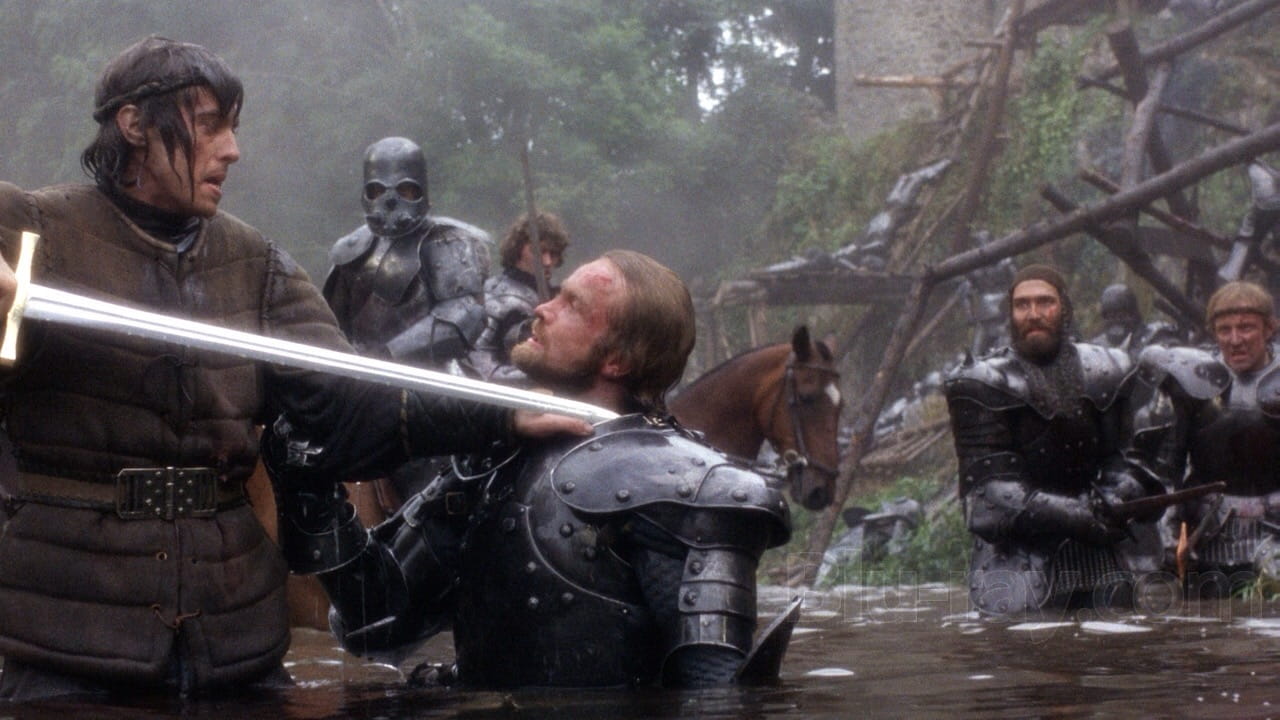 Arthur asks to be knighted
The battle comes to a very abrupt halt as knights and soldiers all around look on in astonishment. Everyone clearly expects the knight to strike foolish Arthur down with Excalibur and claim the sword as his own. The knight even appears resolved to follow that course of action.
He raises Excalibur to deliver the killing stroke. But then, whether from the compulsion of some magical force or out of simple respect for Arthur’s bravery, he finds he cannot do so. Instead he brings the sword down on Arthur’s shoulders and speaks the words, knighting him. Arthur, for his part, takes this all in stride, reclaims Excalibur from the bewildered knight, and declares victory.
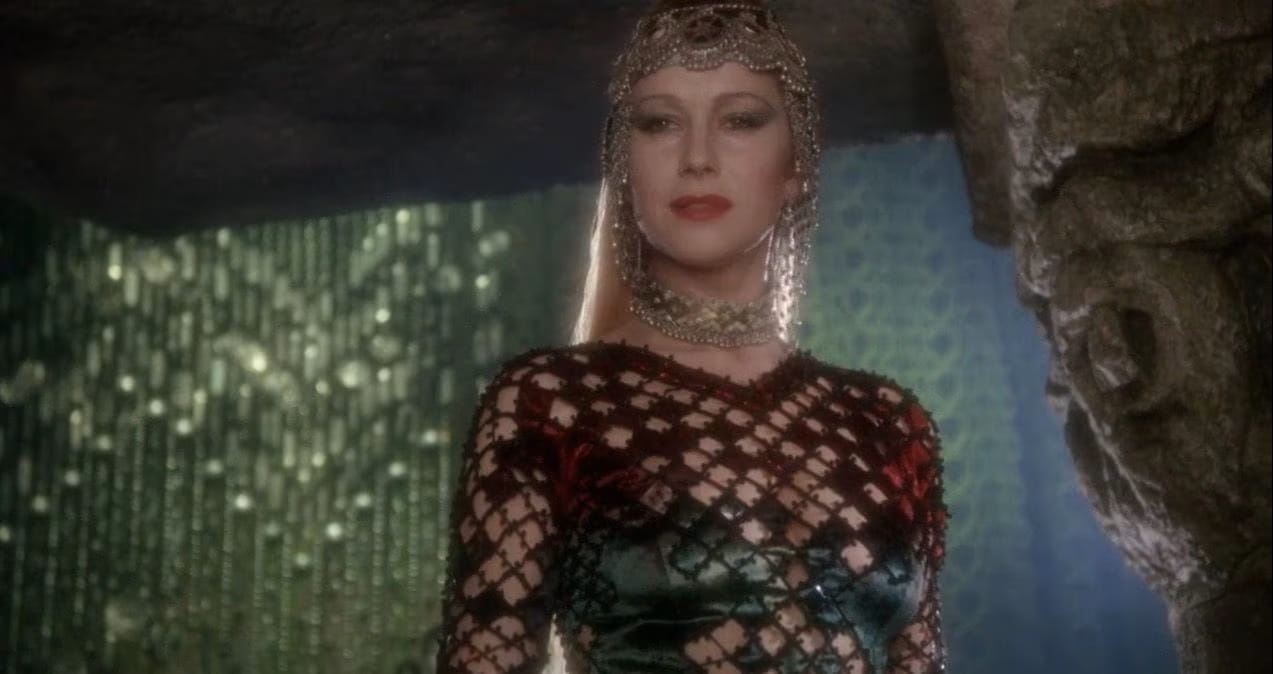 Helen Mirren as Morgana
Low Point
Helen Mirren as Morgana
Low Point
If there is a low point, perhaps it is in how Gabriel Byrne’s Uther reacts upon first laying eyes upon Igrayne, the queen whom he will later trick into sleeping with him. Uther loses his fool mind, declares that he will move heaven and earth to have one night with the lass, and demands that Merlin use his spells to make it happen.
This question arises: Why does Merlin not only go along with this foul act but actually enable what is without question rape? If Merlin knew that Igrayne bearing Uther’s child was vital to the future of the realm, it seems there are many other ways that such a thing could’ve been arranged, none of which need include outright deception and violation in this manner. Indeed, Merlin behaves as if it is all quite unexpected and he wants nothing to do with it, yet he actually facilitates it.
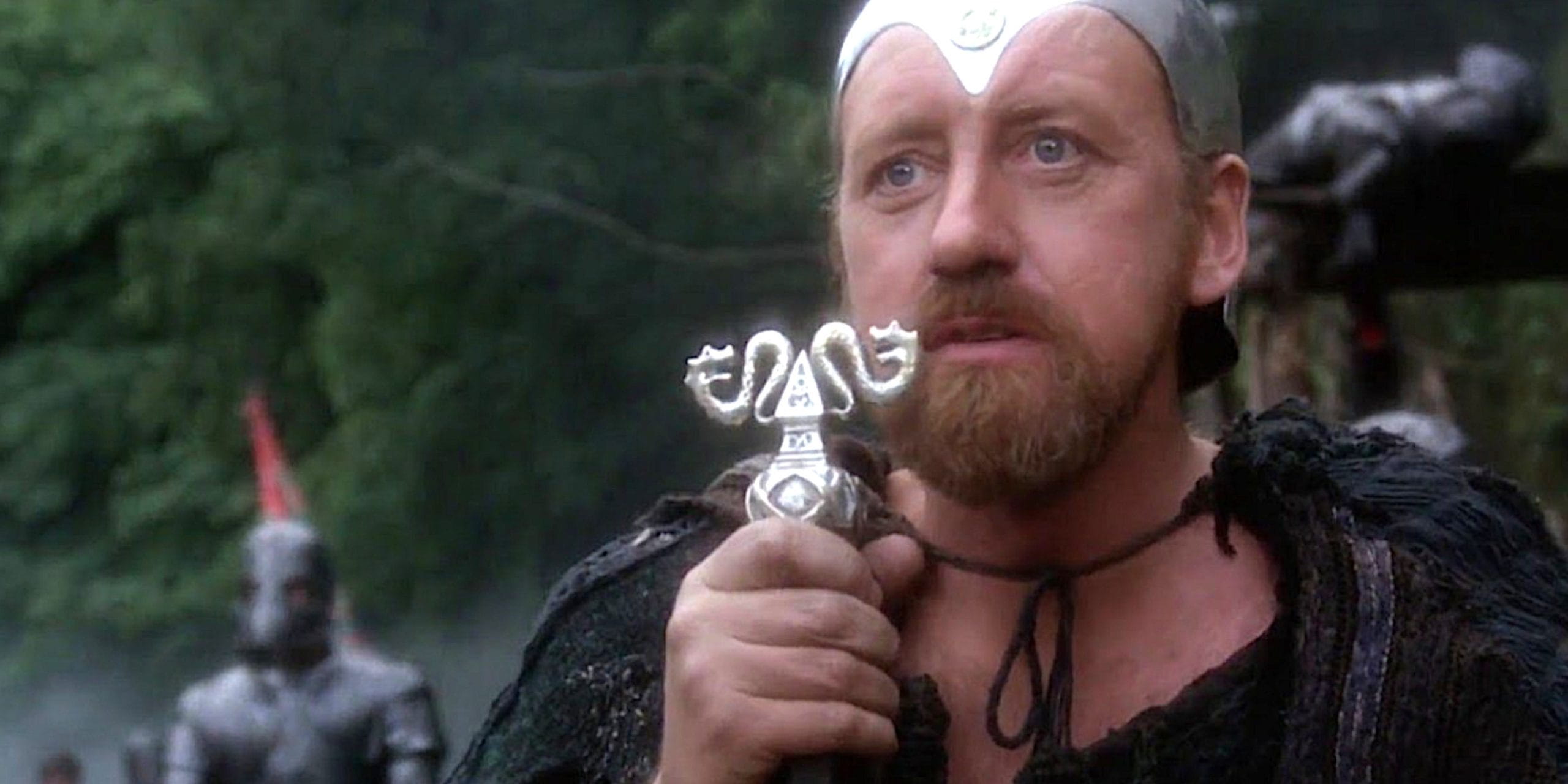 Nicol Williamson as Merlin in Excalibur
Standout Performance
Nicol Williamson as Merlin in Excalibur
Standout Performance
In a movie that includes the likes of Neeson, Stewart and Mirren, can there be any question that Nicol Williamson absolutely dominates the screen any time he appears? What he achieves here places Merlin on par with such legendary and movie-stealing supporting performances as Val Kilmer’s “Doc Holliday” in Tombstone and Alan Rickman’s “Hans Gruber” in Die Hard.
Williamson is by turns menacing, silly, vulnerable, outraged, commanding, and hilarious. He spends most of the movie warning Arthur about the dangers of various women, then falls into the trap of one himself.
That relationship – Merlin and Morgana, played by Helen Mirren – was fiery off-screen as well as on. Boorman intentionally cast Mirren in the role because he knew she and Williamson couldn’t stand one another. He anticipated fireworks as a result, and he got them.
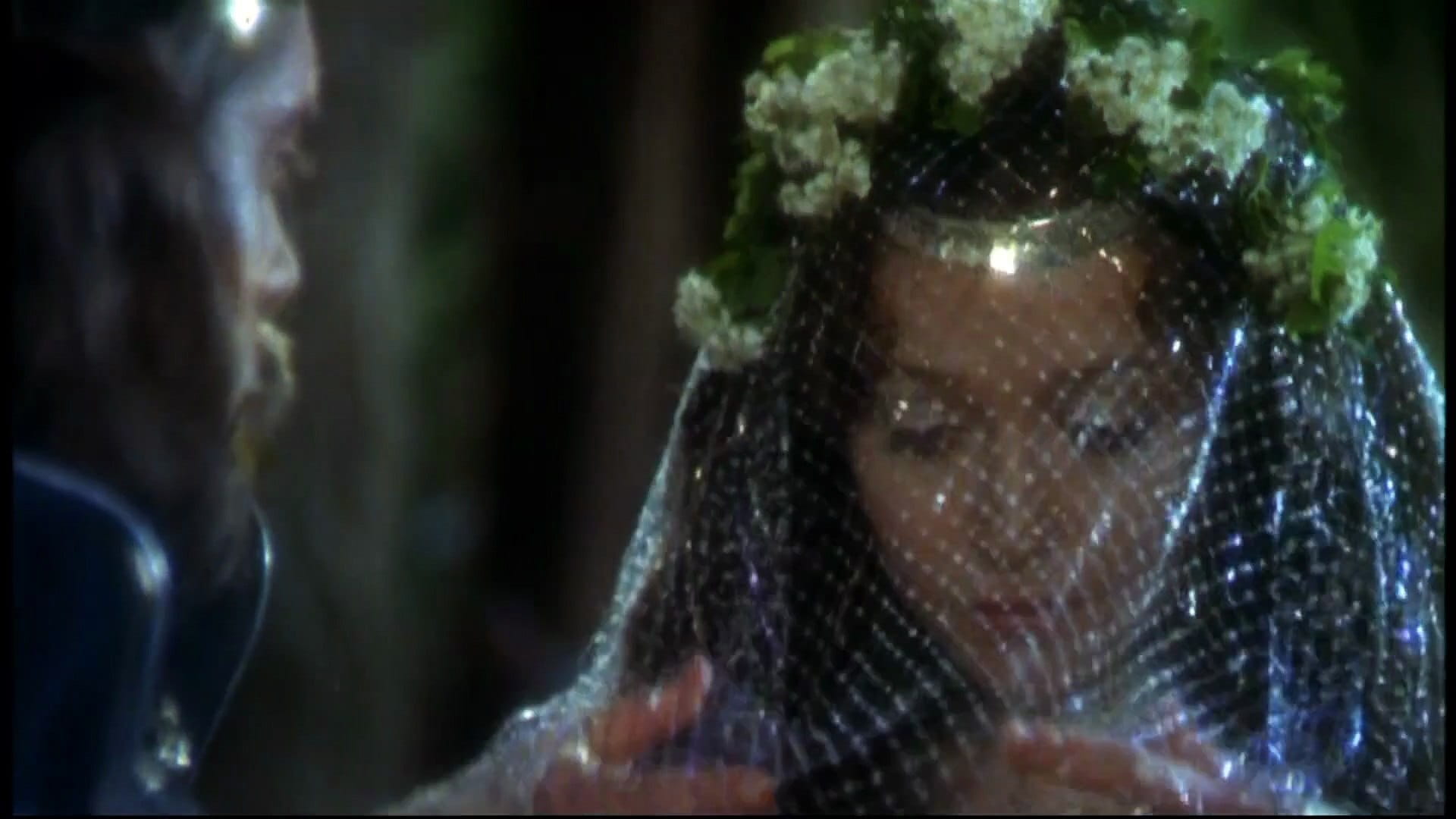 Arthur and Guenevere
Overall Evaluation as a Movie and as Fantasy/SF/Sword & Sorcery
Arthur and Guenevere
Overall Evaluation as a Movie and as Fantasy/SF/Sword & Sorcery
Excalibur exists in a strange in-between realm. On the one hand, it very much looks like a product of the early Eighties; in places, almost like a glorified stage play. On the other, the performances by a cadre of legendary actors still jump off the screen, and the cinematography and visuals (with no CGI!) remain radiant and lush to this day.
It’s a timeless tale, well-told by Boorman and company. Watching it again in 2026, the armor still gleams, Excalibur’s magic yet flashes, and the Williamson-Mirren sparks continue to fly.
All told, it’s for the best Boorman chose the sword over the ring.
Van Allen Plexico is a member of the Science Fiction and Fantasy Writers of America (SFWA), a Grand Master of Pulp Literature (2025 class) and a multiple-award-winning author of more than two dozen novels and anthologies, ranging from space opera to Kaiju to crime fiction to superheroes to military SF. He notably edited, co-created and co-wrote the Sword and Sorcery anthology GIDEON CAIN: DEMON HUNTER. Find all of his works on Amazon and at Plexico.net.
Categories: Fantasy Books
John Cleese Does Sherlock Holmes (and better, the first time)
 I reinstalled Elder Scrolls Online, which is a rabbit hole I jump down periodically. I usually do side, and zone, quests. But when I decide to follow some of the main storyline, I am delighted to come across John Cleese’s Sir Cadwell. He is the a rather mad soul shriven who guides the characters in Cleese’s inimitable style. Every scene with Cleese is fun, and he also plays a part in one of the large DLCs.
Here’s a short ‘official’ video on the creation of the character. I think you’ll get the feel of this erratic character. Includes Cleese talking about it.
It’s a blessing he is still with us; active at 86.
Some folks are aware of his The Strange Case of the End of Civilization as We Know It (discussed at the end of this post). I set out to write about that awful Sherlock Holmes parody movie. I wrote this essay instead. And ten years later, I still have no interest in re-watching and writing an essay on Strange Case. It is just too dumb.
However, I do think folks who like Cleese, should give a watch to a better Sherlock Holmes project he did four years before Strange Case. It’s out there on YouTube. And while it’s not brilliant, I found it entertaining Cleese. And I will always watch something John Cleese, which makes me smile. He’s genuinely a feel-good kind of guy. So, read on about Elementary: My Dear Watson.
John Cleese is best known, of course, as the sardonic Q opposite Daniel Craig’s James Bond in Die Another Day. He’s not as well remembered for his role in the British comedy troupe, Monty Python. I’m kidding!
On January 18, 1973, the final episode of Python’s third season aired. It was Cleese’s last episode with the group, which would continue on for one more season. That very same day, Cleese’s next project aired – Comedy Playhouse Presents: Elementary, My Dear Watson. It was produced by Barry Took, who had brought the Python members together.
 I’m going to tackle the Achilles heel (really, it’s more like the entire torso) of this show, the plot: or rather, the lack of one. It’s barely a story. Try to stick with me, and no, I’m not leaving things out: it really goes like this…
SPOILER – THIS IS THE STORY. YOU CAN GO WATCH FIRST, OR KEEP READING.
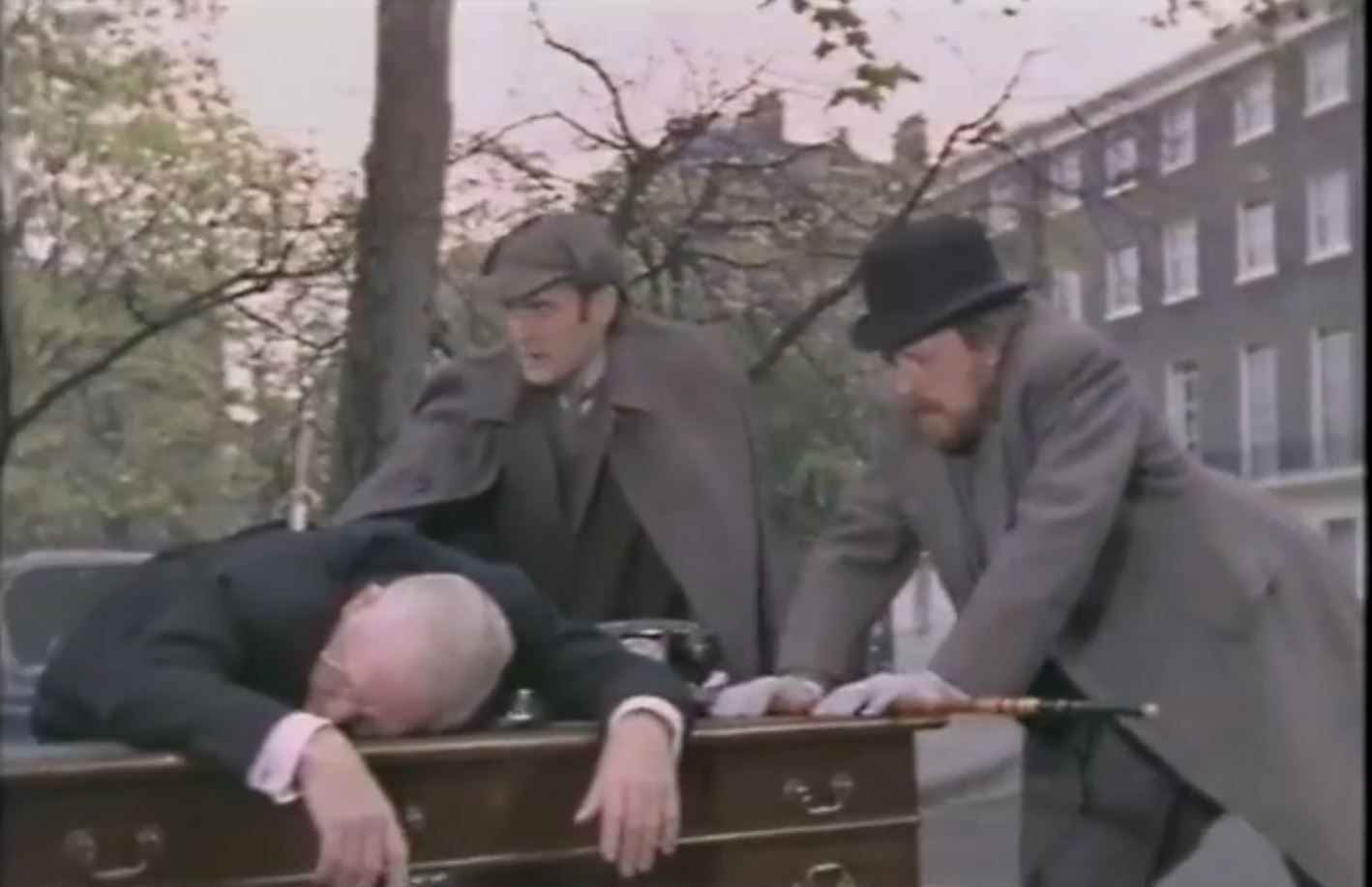
The show opens in a room full of dead lawyers, slumped over their desks, each with a knife in the back. Thus the show’s subtitle, The Strange Case of the Dead Solicitors. A policeman and a secretary exchange what are intended to be witty comments, which immediately brings the lame laugh track to the viewer’s attention.
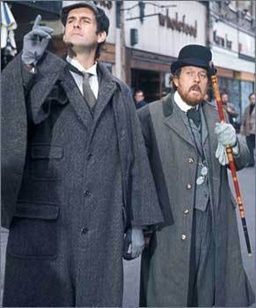
The scene switches to Baker Street where Cleese (an acceptable looking Holmes) is dining with his Watson, well played by William Rushton. Though there is no audience laughter, I enjoyed Watson’s comment about frequently neglecting his practice to dash off on one of Holmes’ hair-brained schemes, while still living comfortably.
After asking Watson what year it is (he looks at his watch and replies, “1973”), Holmes summons a cab, which pulls up to the curb: it’s a horse-drawn hansom and Holmes makes a reference to Doyle, letting us know that they know they’re in a television show. There’s more of that.
Holmes has been summoned by a Lady Cynthia to a country estate where the old family curse of a deadly rattlesnake has started up again. The snake is killing various animals. What?
But en route, Holmes and Watson are pulled into the case of the dead solicitors. While they are pushing a desk with a dead solicitor from London to Manchester to the studios of the tv game show, Call My Bluff, (the actual cast appears and lampoons their own show) Fu Manchu gets into the act.
I’m not making this up!
Fu Manchu ends up with the desk and body, while Holmes gets confused over the Euston and Paddington train stations and he and Watson end up riding back and forth all over England.
Holmes, annoyed with his deerstalker, throws it out of the train window and it lands on the dead solicitor being pushed along by Fu Manchu and his henchman. They fear Holmes is on to them! Inexplicably, Holmes had sewed the letter with Lady Cynthia’s address into the hat, and now they won’t be able to find her house. So, they go back and look for it. Um…
Animals keep dying at Lady Cynthia’s estate (all in the same room…) and she fears her son will be the next victim. Her frantic calls to the police provide no help. The train mishaps have resulted in Holmes and Watson spending three days en route and finally her son is bitten and dies. Soon, all her animals and son dead, we see her menaced by a rattlesnake as she tells it a story to try and distract it.
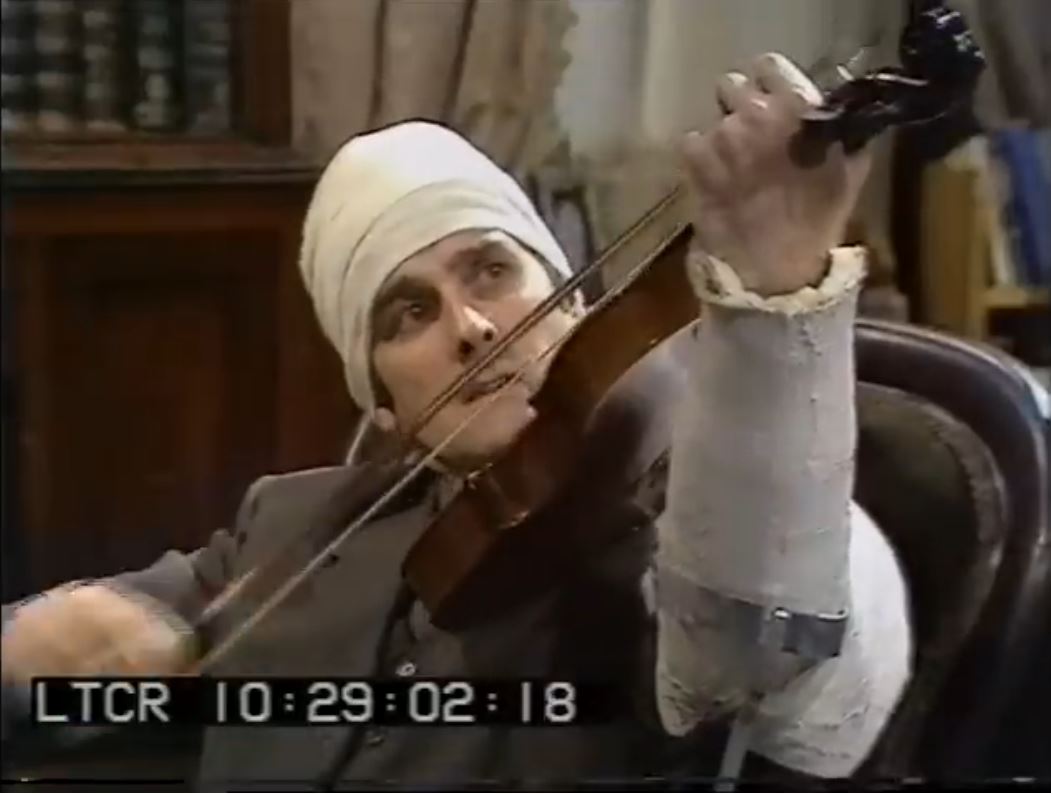 Holmes makes a wild series of deductions with no logic whatsoever, yells “There’s not a moment to lose” and rushes out the door: falling right off the train.
In a full-leg cast, arm in a cast, and head wrapped from the fall, Holmes and Watson confront Frank Potter, a reformed piano tuner who is actually Moriarty in Elizabethan drag. There’s something about piano tuning, which is the offense that put Potter in jail. Piano tuning is a crime? They convince Potter/Moriarty to come with them to help tune a piano. I don’t get it.Of course, you can tuna piano, but you can’t tuna fish (little classic rock joke for you).
We shift to Fu Manchu, loading five crates, labeled as dead solicitors with knives in backs, onto an airplane. Lady Cynthia, on the phone with the police screams. The snake had killed her as well. Everyone there is dead.
Watson is now dressed as Cyrano De Bergerac (I think) so that all three men look ridiculous and if confronted, can pretend they’re escapees from the nearby asylum.
Moriarty gets a phone call on the way and stays behind. He’s being booked for a show at the London Palladium. The less-than-dynamic duo arrives at the airport as Manchu’s plane takes off and Watson observes that they are too late. “I think not, Watson. Reverse the film!”
And yes, the film runs backwards, the evil doctor backs right into a police van, which takes him away, and the case is solved. Uh huh. The Prime Minister goes on television, congratulating the film editors for saving the day, under instructions from Holmes.
At Baker Street, Holmes tells Watson that Frank Potter/Moriarty had nothing to do with the case. He was a red herring to fill in time so that the script wouldn’t be five minutes short. Watson drinks from a glass in each hand, tells Holmes that he never ceases to amaze him and Holmes says, “Elementary, my dear Watson.” And the show ends.
END SPOILER
John Cleese clearly knows sketch comedy. And he was just wrapping up his brilliant run in Monty Python. But a thirty-minute collection of “bits” with a practically non-existent plot doesn’t really make a television show. I’ll let you watch it to find out why Fu Manchu was trying to get five dead solicitors, slumped over their desks with knives in their backs, to China. Hint – they are presents.
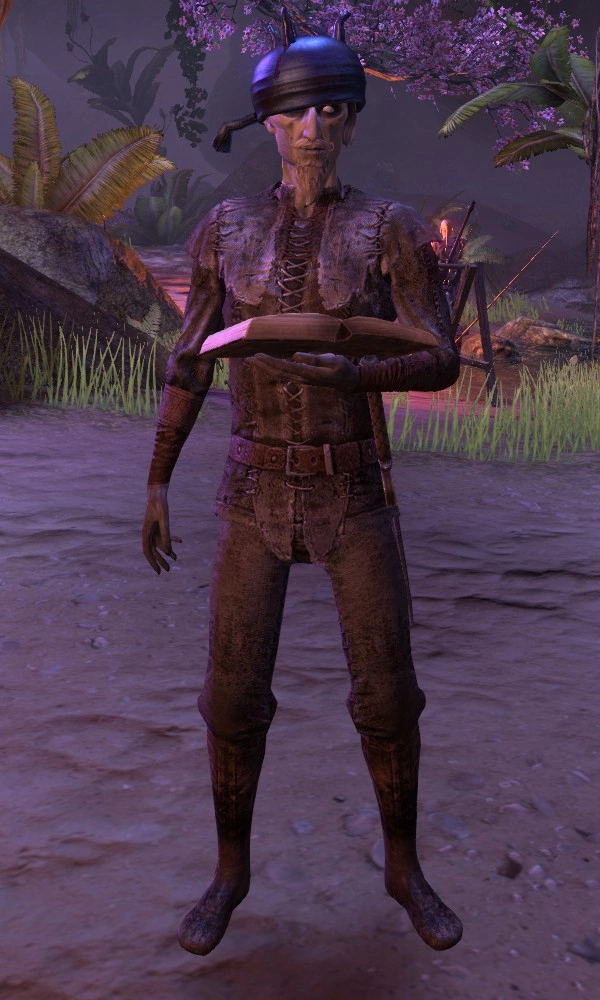 Some things aren’t funny, or just don’t make sense, or both. Why is Jack the Ripper constantly calling Scotland Yard to make a statement? At his house, Moriarty makes a lewd comment and shoos out a blonde wearing only a towel. Watson leers at her as she goes up the stairs and he has to be called in to the other room by Holmes.
However, there is some humor in this show and it’s worth watching. Holmes’ observation of a particular type of mud found on Manchu’s elbow is an amusing dig at Doyle’s penchant for that type of thing. I think that Watson’s comments are among the best lines throughout the show and Rushton is a pretty good parody Watson without being a bumbling fool.
Josephine Tewson, playing Lady Cynthia, appeared in another Holmes parody. She played the nun in the miserable Peter Cook/Dudley Moore Hound of the Baskervilles. THAT was a dog.
It isn’t much of a surprise that the show did not get picked up. I can’t imagine what they would do on a weekly basis when they couldn’t even come up with a plot for a thirty-minute pilot. Two years later, Cleese would star in the short-lived but much funnier Fawlty Towers. Which he is working on a new play about, with his daughter.
Elementary, My Dear Watson, was not Cleese’s only attempt at spoofing Holmes, though it was his best. In 1975, he played Arthur Sherlock Holmes (the detective’s grandson) in The Strange Case of the End of Civilization as We Know It. The only reason I don’t call it the worst Holmes-related film ever, is because I’m not sure whether the aforementioned Cook/Moore Hound deserves the title, or if Strange Case (next week’s topic) does. Or if that should be given to Will Ferrell’s Holmes and Watson (ugh). Maybe Strange Case was funny for its time (Henry Kissinger is gunned down by Arabs at the beginning), but I don’t think I laughed once, the entire movie.
Elementary, My Dear Watson does have enough funny bits to make it worthwhile. And as I said, John Cleese has a way of making you smile, even if if later you think ‘That was odd.” But as a thirty-minute comedy show, it came up short of making me want to see more. But I’ll watch this over Strange Case, any day. And I did smile as I re-watched it for this post. It is fun.
Bob Byrne’s ‘A (Black) Gat in the Hand’ made its Black Gate debut in 2018 and has returned every summer since.
His ‘The Public Life of Sherlock Holmes’ column ran every Monday morning at Black Gate from March, 2014 through March, 2017. And he irregularly posts on Rex Stout’s gargantuan detective in ‘Nero Wolfe’s Brownstone.’ He is a member of the Praed Street Irregulars, and founded www.SolarPons.com (the only website dedicated to the ‘Sherlock Holmes of Praed Street’).
He organized Black Gate’s award-nominated ‘Discovering Robert E. Howard’ series, as well as the award-winning ‘Hither Came Conan’ series. Which is now part of THE Definitive guide to Conan. He also organized 2023’s ‘Talking Tolkien.’
He has contributed stories to The MX Book of New Sherlock Holmes Stories — Parts III, IV, V, VI, XXI, and XXXIII.
He has written introductions for Steeger Books, and appeared in several magazines, including Black Mask, Sherlock Holmes Mystery Magazine, The Strand Magazine, and Sherlock Magazine.
You can definitely ‘experience the Bobness’ at Jason Waltz’s ’24? in 42′ podcast.
Categories: Fantasy Books
Another Classic Sword & Sorcery Anthology: The Barbarian Swordsmen, edited by Sean Richards (AKA Peter Haining)
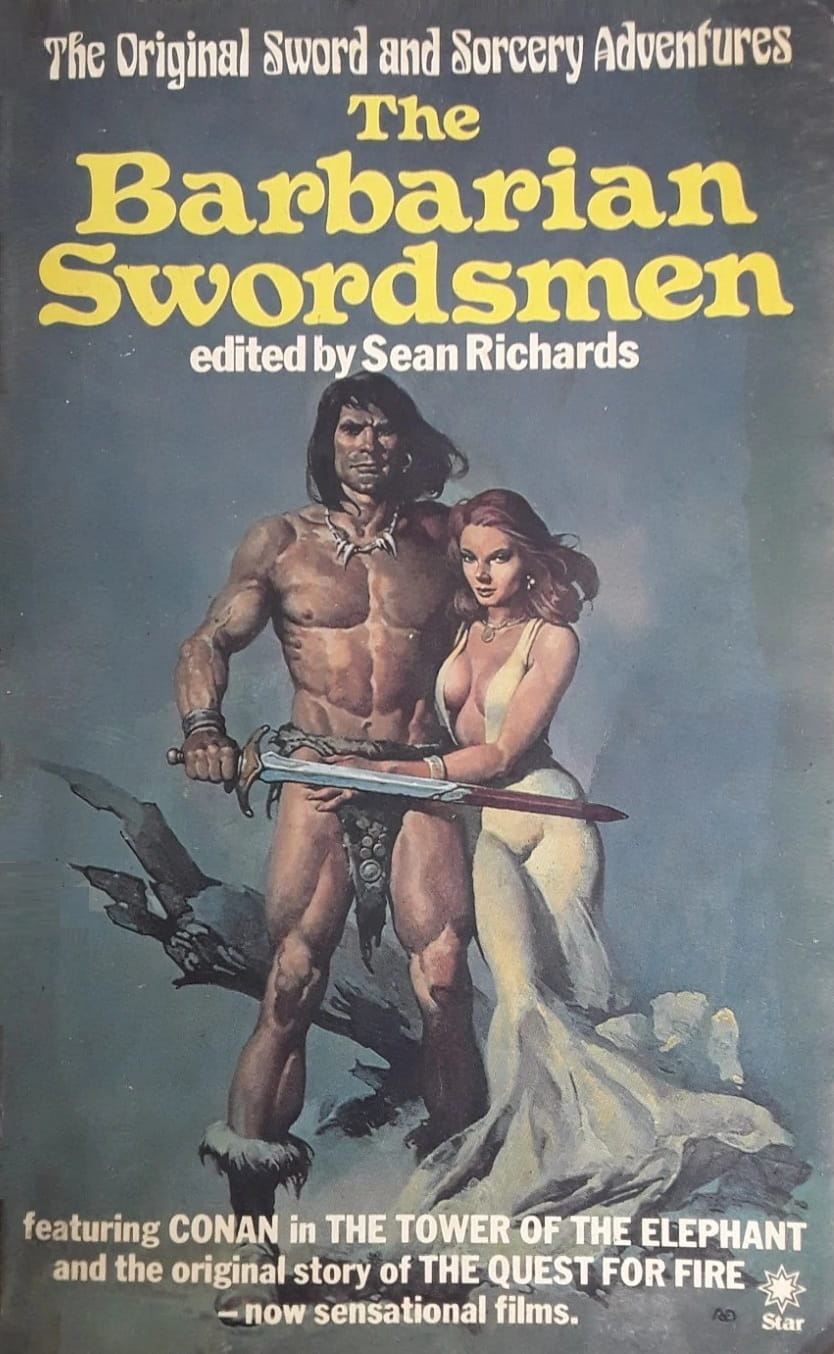
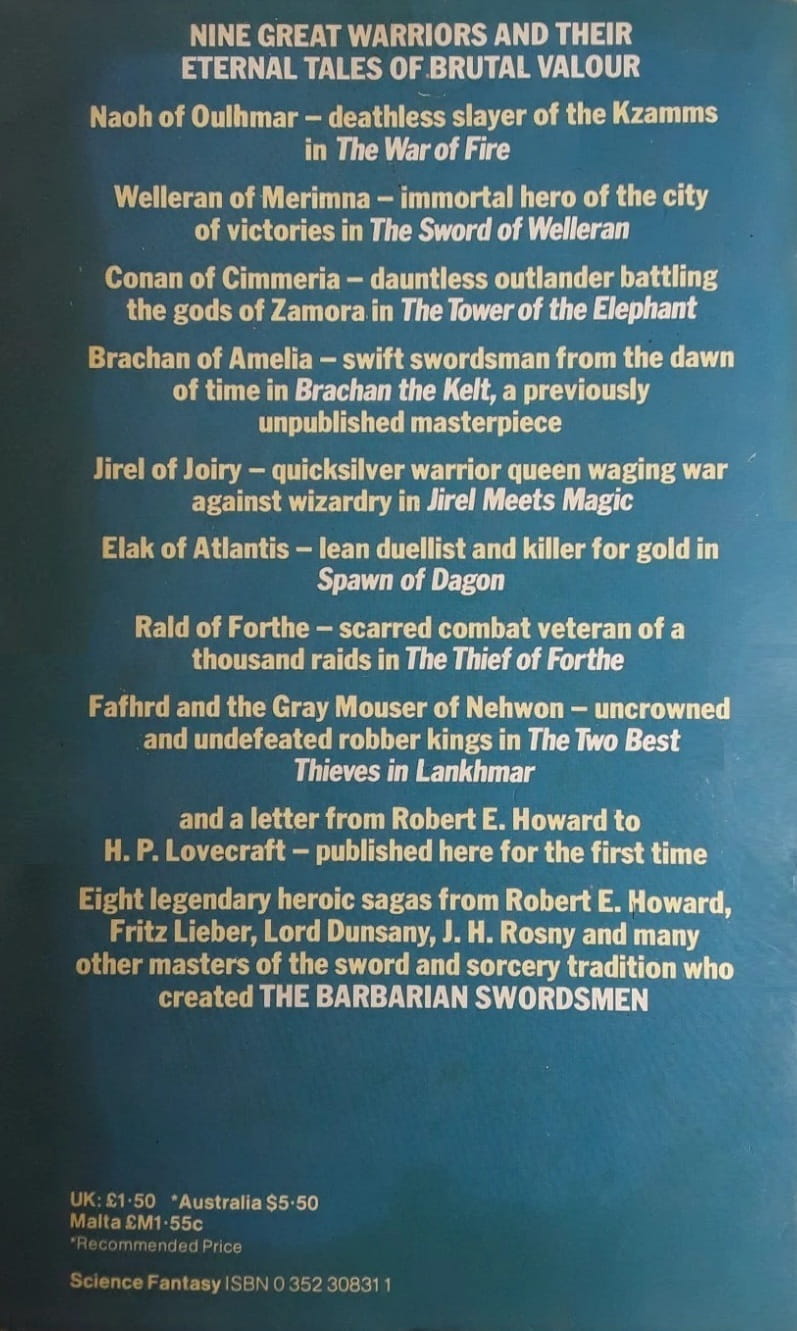
The Barbarian Swordsmen (Star, 1981). Cover by Gino D’Achille
The Barbarian Swordsmen, edited by Sean Richards, Star publishers, a British press, 1981, cool cover by Gino D’Achille. A collection of Sword & Sorcery (S&S) tales that likely wouldn’t exist except for Robert E. Howard.
I couldn’t find out much about Mr. Richards but Toby Hooper revealed to me that Richards has been reported as a pseudonym for Peter Haining and that appears to be true. His intro here doesn’t reveal anything.
 Quest for Fire (20th Century-Fox, December 16, 1981)
The stories are:
“The War of Fire,” by J. H. Rosny. An exciting excerpt from The Quest for Fire, which was also made into a fine movie. J. H. Rosny was a pseudonym, often used by two brothers, Joseph Henri Boex, and Justin Boex. From what I understand, though, Quest for Fire was written solely by Joseph, the elder. The movie does a good job distilling the book but the writing is still enjoyable. We have a primitive cave man named Naoh, what we’d call a Cro-magnon, whose tribe loses its fire. Since they can’t make fire, only maintain it, they have to seek out fire from another tribe, and Naoh and his companions have many adventures doing so, including a battle with Neanderthals. That’s the piece featured in this book.
“The Sword of Welleran,” by Lord Dunsany. Lord Dunsany, an Irishman, is well known to fans of S&S. His fantasy work certainly skated the edge of that genre and he helped develop some of the tropes that later became important. He is said to have influenced Tolkien. His work is rather slowly paced and turgid for modern readers but I find it enjoyable. “The Sword of Welleran” is one of his most approachable tales.
 Art for “The Tower of The Elephant” by Mark Schultz
“The Tower of the Elephant,” by Robert E. Howard. I consider this the strangest of the Conan stories. It certainly breaks ranks with most of the other Cimmerian tales in that there’s a strong SF element. I was much taken with it when I first read it, years ago.
“Brachan the Kelt,” by Robert E. Howard. Howard wrote a number of stories involving reincarnation, and several featured the character James Allison, a modern man capable of remembering his past lives. This is a short piece and definitely not fully developed, but it shows the power of Howard’s prose. Allison recalls being a wandering warrior from a time before history was recorded, when the first white-skinned tribes were entering Europe. As Brachan, he must defeat a beast that makes one think of the yeti.
 Jirel of Joiry (Ace Books, November 1982). Cover by Stephen Hickman
“Jirel Meets Magic,” by C. L. Moore. Catherine Moore was just a superb writer and her stories of Jirel of Joiry are outstanding S&S tales. Beautifully written and emotionally charged. Jirel is one of the very first fire-tressed female warriors of fantasy fiction. This is not my favorite of the Jirel stories but it’s close. Moore was influenced by Howard, though most of the influence was in subject matter rather than story effects.
“Spawn of Dagon,” by Henry Kuttner. Kuttner married C. L. Moore and after that they mostly wrote as a team. I think Moore was the better writer but Kuttner was more prolific and very professional. Kuttner alone wrote a series of tales about Elak, a prince of Atlantis, and this is one of the best of those. Elak was certainly influenced by Conan but is his own character.
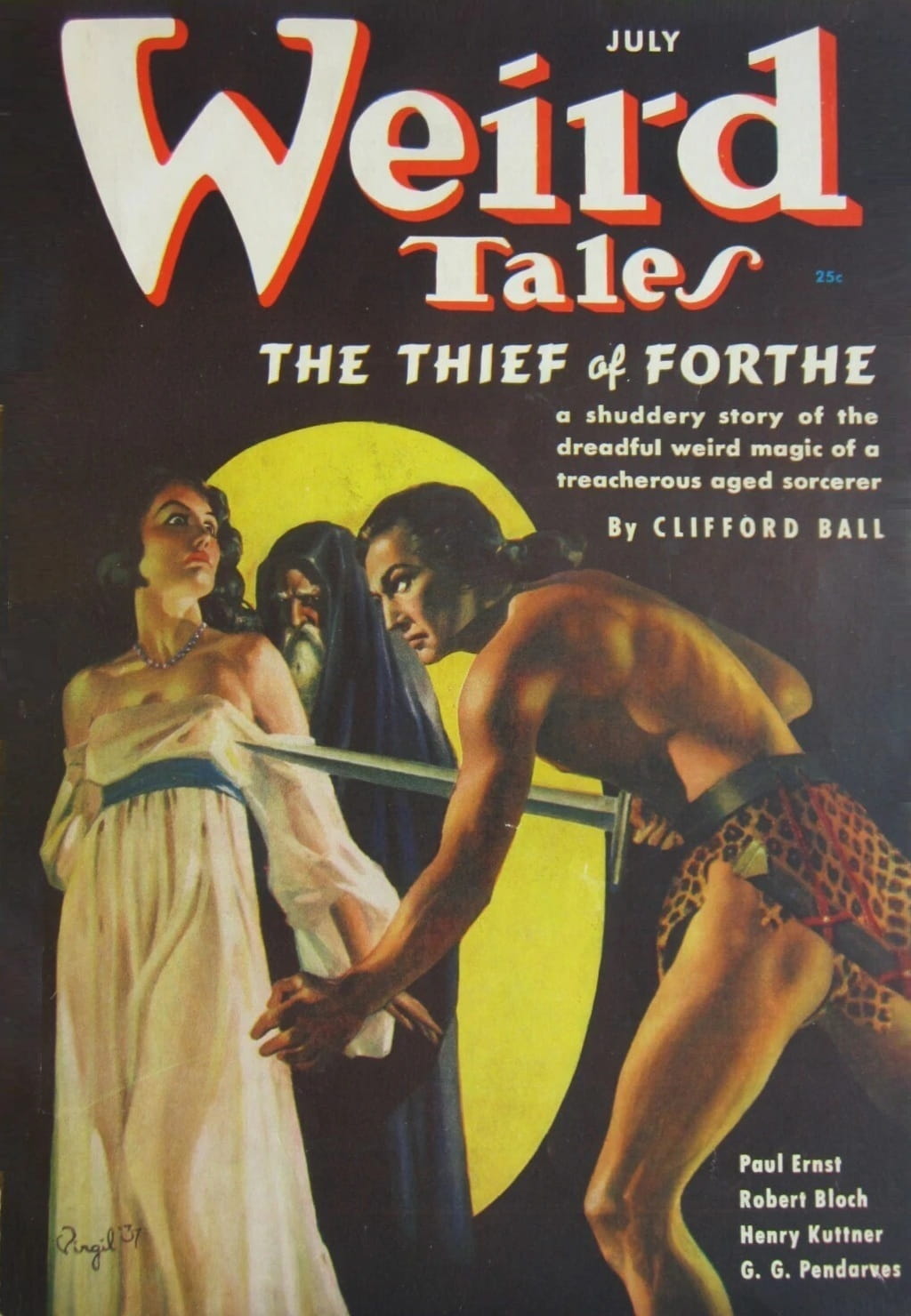 Weird Tales, July 1937, featuring cover story “The Thief of Forthe” by Clifford Ball. Cover by Virgil Finlay
“The Thief of Forthe,” by Clifford Ball. Ball was another writer strongly influenced by REH, which is clearly seen in this tale. It was still well written and enjoyable. Apparently, Ball created an earlier character who was essentially a pastiche Conan, but “Rald,” the “Thief of Forthe” shows some originality. I haven’t read much of Ball’s work but will seek out more.
“The Two Best Thieves in Lankhmar” by Fritz Leiber. Leiber is another writer who was influenced by Howard as to subject matter, but who in no way appears to be an REH clone. His characters and settings are unique and there is a lot more humor in Leiber’s tales than in the Conan stories. Leiber’s characters are Fafhrd, a giant of a man, a barbarian warrior, and the Gray Mouser, a dark and slender thief. They are unlikely friends but friends they are. All these stories are enjoyable.
Appendix is: The Man Who Influenced Robert E. Howard. This is an excerpt from a letter written from Robert Howard to H. P. Lovecraft in which Howard indicates his admiration for the poetry of Alfred Noyes.
Charles Gramlich administers The Swords & Planet League group on Facebook, where this post first appeared. His last article for us was a look at The Mighty Sword & Sorcery Anthologies of Hans Stefan Santesson. See all of his recent posts for Black Gate here.
Categories: Fantasy Books
Robert E. Howard Days, 2026, and The Emerging Writers Workshop
 The House!
After what seems like strange aeons of dreaming about it, Mark Finn, Jason Waltz, and I (Adrian Simmons) have pulled the trigger on running an in-person Sword & Sorcery writing workshop. Added bonus, we’re holding it in the heart of S&S history, Cross Plains Texas, Robert E. Howard’s home during his days of creating characters like Conan, Soloman Kane, Brikenridge Elkins, El Borak, among others.
Our workshop will take place during the fortieth anniversary of the first Robert E. Howard Days gathering, and not only will help writers level up their skills, but serve as a fundraiser for necessary repairs to the Howard House.
The 2026 Emerging Writers Workshop is a one-day event designed to help provide advice, answers, and encouragement to new and upcoming writers of Howard’s genres — from historical fiction to weird Westerns to sword and sorcery. We won’t be doing poetry this year, but this is the first of what we hope to be a regular component of Howard Days, and perhaps we’ll be able to include verse in later years.
 Robert Howard’s room, and desk, where the magic happened!
This will be an in-person affair, happening Thursday, June 11th, the day before Howard Days officially kicks off. The plan is to have some short lectures, a bit of Q& A about S&S, but lion’s share of the time time will be spent in critiquing submissions by breaking into smaller groups for in-depth discussions.
We realize that there are plenty of writing workshops, but the reality is that S&S and its related sub-genres are often the odd-swordsman/woman-out. Sometimes it is waaaay out.
While the number of S&S and adventure fiction venues has grown massivlely in the last decade, they are in the business of publishing stories, not helping writers get better at their craft. The cold reality is that you already have to be a good writer to get any feedback (and even then, given time constraints…), otherwise you get a form rejection letter. Without that editorial feedback, you’re mostly groping in the dark.
That’s the strongest parts of the Emerging Writers Workshop, you aren’t going to get ‘writers group’ feedback, you’re going to be buffeted by the cold winds of Valhalla from three editors looking at your work with their editor-eyes.
 The Cottonwood Cafe, where our magic will happen!
And who are we to pass judgement upon your writing? Behold!
 Mark — representing with the ‘stash and beard
Mark is an author, an editor, and a pop culture critic. His writing can be found in various books, anthologies, comics, and elsewhere. When he’s not waxing passionate about popular culture or Robert E. Howard, Finn writes stories, publishes RPG zines, and sporadically appears on various podcasts.
 Jason, with the classic goatee
Jason M. Waltz – Long-time reader, writer, publisher, facilitator and promoter of the heroic. THE MAIN ROGUE of Rogue Blades Entertainment (published popular heroic anthologies such as Return of the Sword and Neither Beg Nor Yield) & Rogue Blades Foundation (published award-winning REH titles Hither Came Conan and Robert E. Howard Changed My Life). Host of author interviews @ ’24 in 42.’ Connect via https://linktr.ee/jasonmwaltz
 Adrian, sportin’ the chin scruff
And me? I’m a founding member and primary editor of Heroic Fantasy Quarterly ezine (heroicfantasyquarterly.com), have produced 67 issues and four best of anthologies. I’ve had fiction published at Tales from the Magician’s Skull, Savage Realms, and Swords and Larceny. Some of you here may remember me from my various reviews and musings here at Black Gate.
We’re already about 1/3 of the way to our membership cap (although there has been some talk of an online option, but those dragons have yet to hatch).
The cost is $50, and the deadline to get your work in is Sunday, May 10th.
We discussed the workshop in some detail during a livestream of the Robert E. Howard Foundation. We talk about the workshop starting at the 6:30 mark. Check it out to get a feel for the vibe.
Full details can be found here.
Categories: Fantasy Books
Forgotten Authors: Austin Hall
 Austin Hall
Austin Hall was born on July 27, 1880.
While working as a cowboy, Hall was asked to write a story. This led to his career as an author, writing westerns, science fiction and fantasy stories, with westerns forming the majority of his published work. A one time, Hall may have worked as a sports editor for a newspaper in San Francisco.
Following the death of Hall’s father, his mother remarried and the family appears to have moved to Ohio, in an interview published by Forrest J Ackerman in 1933, Hall claims to have attended college in Ohio and California, but no details of his academic life can be confirmed. By the time he was thirty, Hall (as well as his mother and step-father) were living back in California and Hall had married Clara Mae Stowe and they had two children, Javen and Bessie.
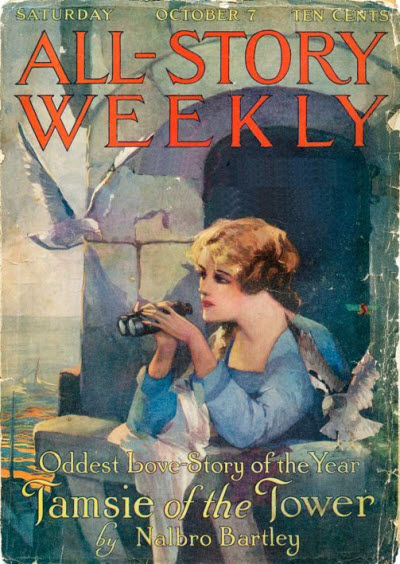 All-Story Weekly, 10/7/1916
His first science fiction story was “Almost Immortal,” which appeared in the October 7, 1916 issue of All-Story Weekly.
His 1919 story “The Man Who Saved the Earth” was reprinted in the first issue of Amazing Stories. Everett Bleiler describes this story as Hall’s second worst, which given Damon Knight’s opinion of Bleiler’s writing says quite a bit.
He collaborated with Homer Eon Flint on the novel The Blind Spot, which Damon Knight described in In Search of Wonder as “an acknowledged classic of fantasy…much praised…several times reprinted, venerated by connoisseurs—all despite the fact that the book has no recognizable vestige of merit. Knight enumerates his problems, not just with the novel, but with Hall’s writing, stating that hall is bereft of, among other things, style, grammar, vocabulary, observation, scientific knowledge, or ability to plot. Knight’s criticism of Hall is almost enough to make someone want to pick up one of his works to see how it could be as bad as Knight describes it.
Bleiler does not believe the story was an actual collaboration. Although Ackerman claims Hall pitched the idea to Flint and the two planned out how to work on it, Bleiler believes that Hall couldn’t come up with the middle of the novel and had Flint take over to get him over the hump.
Eventually, in 1932, eight years after Flint’s death, Hall would published a sequel to The Blind Spot, the serial The Spot of Life, in Argosy. Hall’s other science fiction, “The Rebel Soul” and “Into the Infinite” focus on the life and adventures of George Witherspoon. His The People of the Comet has Alvar, the king of the Sansars, describe his journey to a comet, which had a hollow interior in which they could live.
Although the majority of Hall’s writing appears to have been westerns, they appear to be harder to identify, although he wrote Where the West Begins and stories that appeared in Western Story Magazine.
He died on July 29, 1933 and is buried in Madronia Cemetery in Saratoga, California.
Steven H Silver is a twenty-one-time Hugo Award nominee and was the publisher of the Hugo-nominated fanzine Argentus as well as the editor and publisher of ISFiC Press for eight years. He has also edited books for DAW, NESFA Press, and ZNB. His most recent anthology is Alternate Peace and his novel After Hastings was published in 2020. Steven has chaired the first Midwest Construction, Windycon three times, and the SFWA Nebula Conference numerous times. He was programming chair for Chicon 2000 and Vice Chair of Chicon 7.
Categories: Fantasy Books
La Belle Dame sans Merci: Tam Lin by Pamela Dean
Tam Lin (Tor Books paperback reprint edition, April 1992). Cover by Thomas Canty
There’s been a lot of genre fiction set at schools. Hogwarts is an obvious example, but such settings were around long before Harry Potter; Heinlein’s Space Cadet, The Uncanny X-Men, and Le Guin’s A Wizard of Earthsea were all there first. Tam Lin is another early example, published six years before Harry Potter and the Philosopher’s Stone made scholastic fantasy a best-selling subgenre.
But it has an important difference: Its setting, the fictional Blackstock College, doesn’t teach magic, or superheroic combat, or spaceflight, or anything else fantastic. It’s a fairly typical small liberal arts college (based on the real college where Pamela Dean did her undergraduate work) where the supernatural elements are hidden beneath the surface.
 Carleton College, the real world model for Blackstock College
At the time when it was written, Tor Books was publishing novels that retold fairy tales at greater length, and with a style aimed at adult readers. Dean’s source wasn’t a fairy tale, strictly speaking, but a ballad, “Tam Lin,” though one where the fair folk are a visible presence — like “True Thomas” or Keats’s “La Belle Dame sans Merci.” Its theme is the mortal man who meets a fairy woman and is the worse for it, and that’s the undercurrent of Dean’s novel, and the problem her protagonist, Janet Carter, has to solve.
Much of the story is the non-fantasy details of Janet’s life. Dean lists every course she takes until the first quarter of her senior year — including a dozen in English, seven in Greek, and a variety of general education, from fencing to “physics for poets.”
 The opening verses of the ballad Tam Lin
We meet Janet’s roommates, Molly and Tina, whom she has difficulty with at first (especially with Tina) but stays with for all four years. We meet the young men they get involved with and learn of their experiences with sex and contraception — and of their breakups. We also meet Janet’s family, including her father, a member of the English faculty at Blackstock.
“I said I liked folk music, and Molly said she went to rock concerts, and Christina said she liked Bach, so they said, oh, look, three people who listen to music, and stuck us in the same room.”
So far as this part of the story goes, Tam Lin is a classic Bildungsroman (coming-of-age novel). But the social and psychological story is interwoven with an increasing awareness of magical aspects. On one hand, the campus has a ghost, a young woman who took an overdose of opiates in 1897 because she was pregnant, and who now throws specific books out of windows, including a Greek textbook. On the other, the classics department is a nexus of strangeness. All three of the women’s lovers are caught up in this, and Janet’s advisor, a classics professor, makes a serious effort to persuade her to major in classics as well.
The other nuance of this is that the supernatural threads are interwoven with Janet’s literary tastes and interests, which we learn about in detail. One of the book’s major revelations, for example, comes from Janet reading a complete Shakespeare. An earlier scene has Janet reciting “La Belle Dame sans Merci”:
I saw pale kings and princes too,
Pale warriors, death-pale were they all;
They cried, “La belle dame sans merci
Thee hath in thrall!”
Earlier on, we see a discussion of which translation of Homer is best inspiring one of the young men to quote Keats’s sonnet “On First Looking into Chapman’s Homer.”
Quotations from the English classics are all through the dialogue — which seems plausible, as the fair folk are reputed to have a special affinity for poets and poetry. Janet herself writes a sonnet at one point, though one whose last line has all too plausibly flawed scansion.
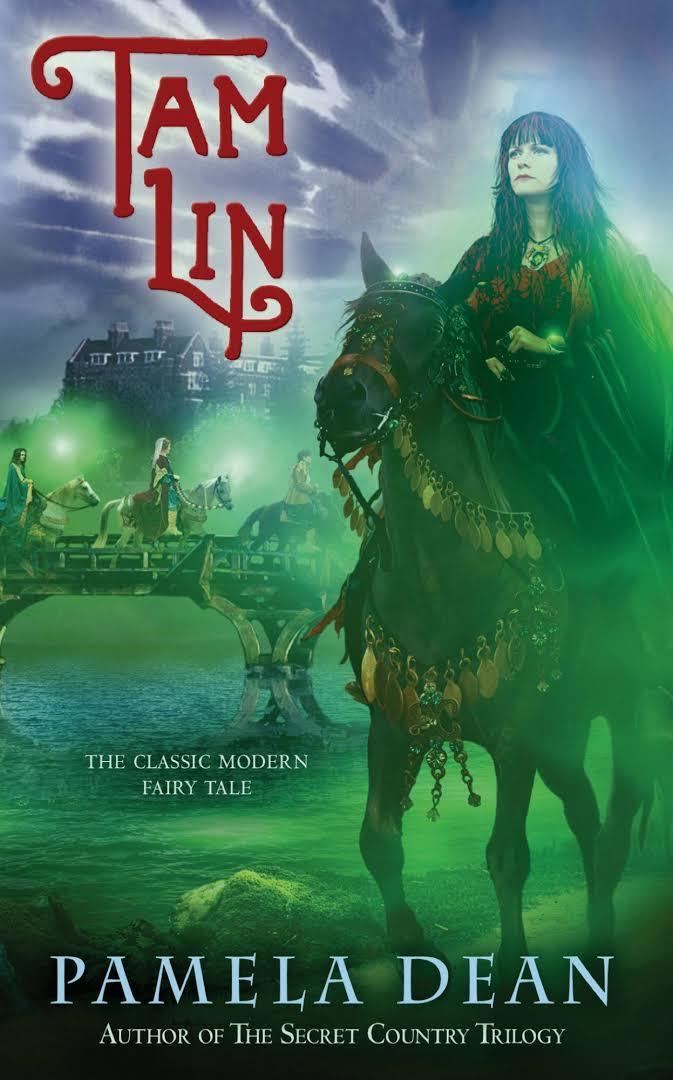 Tam Lin (Firebird, August 2006). Cover by Steve Stone
Women’s sexuality, pregnancy, and contraception are recurring issues, as of course they were in the real world in the 1970s. This fits its source material, where pregnancy is also an issue; but it seems that choosing to modernize that particular story gave Dean a way to comment on those issues, and to make them the crisis that leads to the novel’s climactic conflict.
Tam Lin seems oddly paced. Roughly the first half of the book portrays Janet’s, Molly’s, and Tina’s first term at Blackstock, almost day by day. The second half rushes through three full years, ending on Hallowe’en (naturally). This isn’t quite like some novels I’ve read that seemed to progress evenly until the penultimate chapter, and then rush ahead to tie off the plot; Dean does work things out step by step. But I’m not sure that first term needed to be shown in quite so much detail.
On the other hand, most of the details are, to my possibly peculiar tastes, fascinating. If you like English poetry, and the academic milieu, this novel may entertain you as much as it did me.
William H. Stoddard is a professional copy editor specializing in scholarly and scientific publications. As a secondary career, he has written more than two dozen books for Steve Jackson Games, starting in 2000 with GURPS Steampunk. He lives in Lawrence, Kansas with his wife, their cat (a ginger tabby), and a hundred shelf feet of books, including large amounts of science fiction, fantasy, and graphic novels.
Categories: Fantasy Books
The Mighty Sword & Sorcery Anthologies of Hans Stefan Santesson
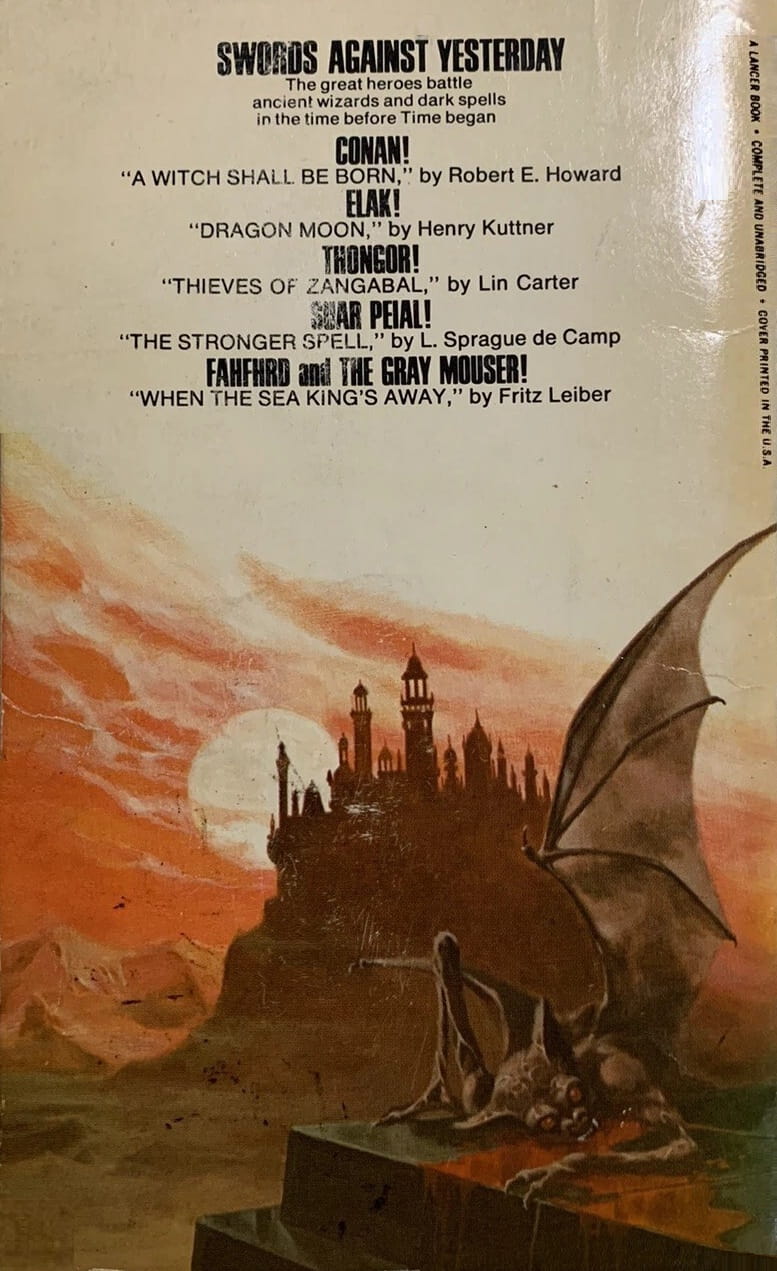
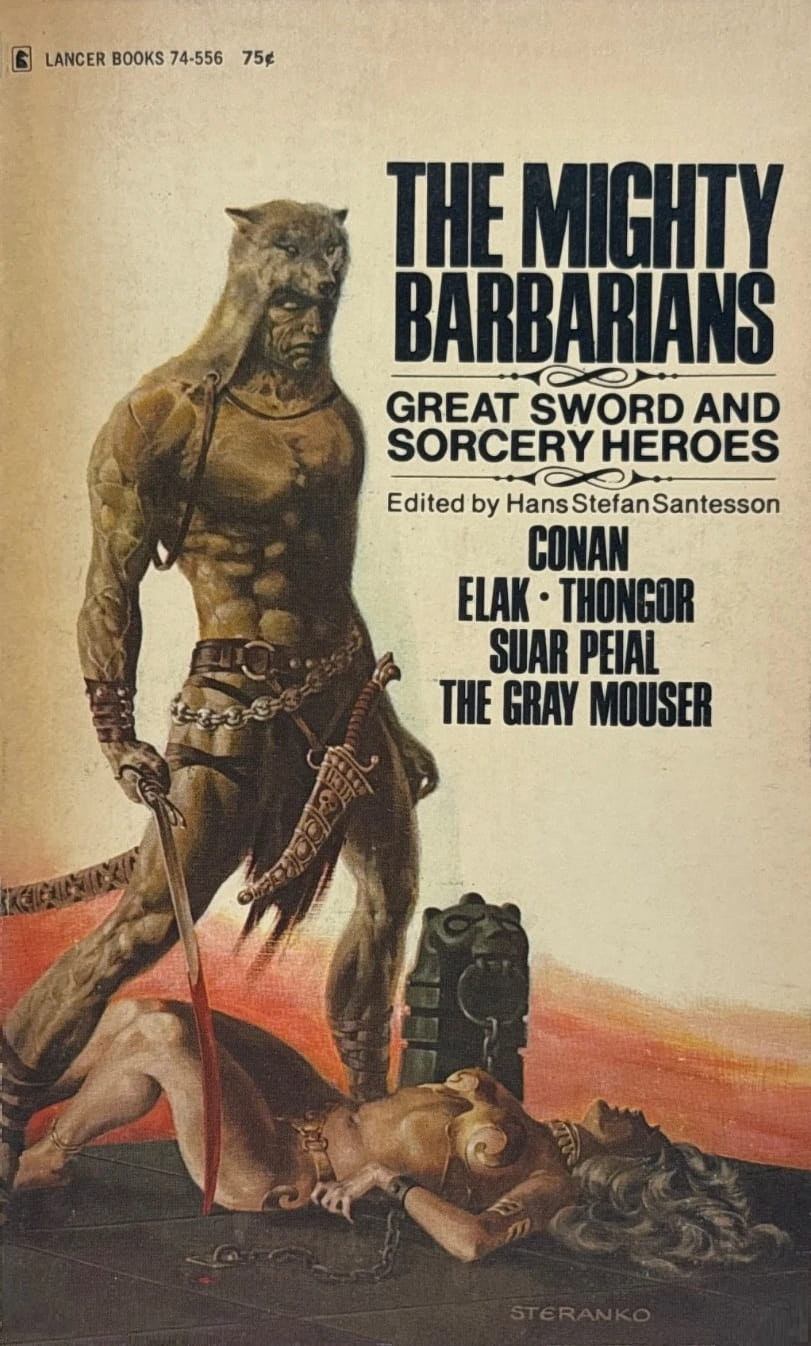
The Mighty Barbarians: Great Sword and Sorcery Heroes, edited by
Hans Stefan Santesson (Lancer Books, 1969). Cover by Jim Steranko
Hans Stefan Santesson (1914 – 1975) was born in France and lived in Sweden with his parents until 1923 when his mother immigrated to the US. She was a commercial artist and he soon became an editor for various mystery publications.
I likely would never have heard of him if not for two books of Sword & Sorcery he edited for Lancer Books. These were The Mighty Barbarians (1969) and The Mighty Swordsmen (1970), both with evocative covers by Jim Steranko.
[Click the images for mighty versions.]
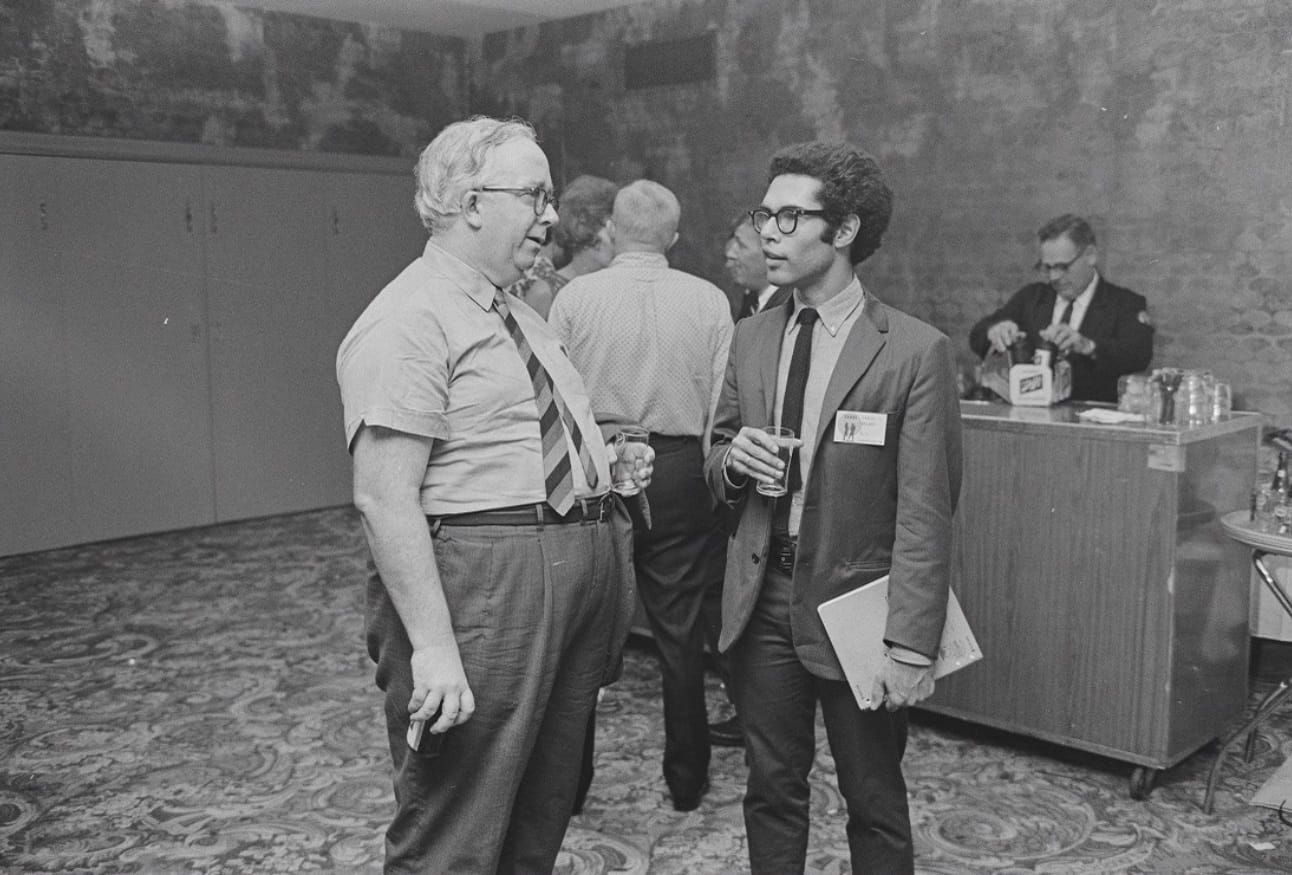 Hans Stefan Santesson and Samuel Delany in Cleveland, 1966. Photo by Jay Kay Klein
1. The Mighty Barbarians contains an Introduction by Santesson, and then the following stories.
“When the Sea-King’s Away by Fritz Leiber (Fafhrd/Gray Mouser)
“The Stronger Spell” by L. Sprague de Camp
“Dragon Moon by Henry Kuttner (Elak of Atlantis)
“Thieves of Zangabal” by Lin Carter (Thongor)
“A Witch Shall be Born” by Robert E. Howard (Conan)
The intro shows that Santesson was familiar with the history of heroic fantasy. He cites some of Carter’s nonfiction so he may have gotten it from there. All the stories are good and generally full of action.
The Mighty Swordsmen, edited by Hans Stefan Santesson (Lancer Books, December 1970). Cover by Jim Steranko
2. The Mighty Swordsmen contains a shorter intro by Santesson and ends with “Beyond the Black River” by REH, one of the best Conan stories. It also contains tales by Moorcock, Brunner, Zelazny and a Conan pastiche by Bjorn Nyberg called “The People of the Summit,” which suffers by comparison with “Beyond the Black River.”
The Moorcock tale is “The Flame Bringers” (Elric). It’s quite good. Zelazny’s story is one of his Dilvish the Damned pieces, “The Bells of Shoredan.” Lin Carter’s “The Keeper of the Emerald Flame” is one of the best of his Thongor stories. Brunner’s story has the best title, “Break the Doors of Hell,” but doesn’t quite seem to fit with the others. It’s one of his Traveler in Black pieces.
Rulers of Men, edited by Hans Stefan Santesson (Pyramid Books, 1965). Cover by Jack Gaughan
Santesson edited plenty of other works and even wrote a few stories himself under pseudonyms, none of which I’ve heard of. I did discover another edited collection by him that I’m going to try to get. You can see the cover above, by Jack Gaughan. Some star names there.
Charles Gramlich administers The Swords & Planet League group on Facebook, where this post first appeared. His last article for us was a review of the 1970 anthology Dark of the Soul, edited by Don Ward. See all of his recent posts for Black Gate here.
Categories: Fantasy Books
Is This Still a Thought?

Goodafterevenmorn, Readers!
I had an interaction online that took me aback a little bit, and I really need to talk about it. I realise that I’m largely preaching to the choir here, but I am feeling a little like I need a sympathetic ear, so apologies. But I must give some context, so here we go:
As part of my effort to make of my writing a viable source of income, I have joined a number of new social media sites that are, by and large, similar to but a much better experience than Facebook. I’m not going to tell you which one of these this happened in, largely because I’m not sure that some greater drama might result. I doubt anyone here is foolish enough to start a dogpile, but I’d much rather err on the side of caution.
On one of these sites, I posted a brief review of a book I had recently read — The Shadow of the Gods by John Gwynne. For those who have not yet read this, it is the first book in a trilogy, and it is heavily based on dark age Scandinavian life and myth (what we’d consider ‘Viking’ in its most populist understanding). It is dark, and gritty, and really interesting. It really enjoyed this read (it didn’t make me cry, though, so I knocked off a few points in the review). Here is what I wrote about the book:
Meant to note that I’d finished reading this last weekend. A gripping read that’s very clearly been well-researched. I really enjoyed it.
And then, rather oddly (to me), I received this reply:
Now, I’ll be the first to admit, it got my hackles up right away. I write genre; mostly fantasy. And I’m usually in amongst people who also write the same, or adjacent, so I forget what opinions are outside of these circles. This slammed it in my face, and I wasn’t prepared. So my reply might have been equally as blunt, and perhaps a little tart as well. Perhaps I struck a nerve, as I received a reply to it, but it had been deleted before I could read what it actually said.
Probably for the best. I have a short fuse sometimes, and find myself in fights more often than I’d like, no matter how futile my brain knows it is. Besides the point. The point is, I had forgotten how some people outside of the genre view fantasy as a genre; primarily that because it is couched in distant allegory and magical worlds, and is a product of wild (also see: brilliant) imaginations, it clearly must not have much actual thought or “real work” (read here: research) behind it.
That is wildly offensive to me.
There are some things that even fantasy worlds and fantastical stories require in order for the reader to engage their suspension of disbelief, things must make sense. Things that are familiar must work more or less the same in the real world (unless its important to the world or plot that they don’t). If someone is fighting near a lava pool, there must be heat. If they are fighting with a spear, a strike with the shaft of the weapon will bludgeon, not cut. These kinds of things.
Are many things made up? Absolutely! Magic? That doesn’t exist in the real world, not at least like it does in fantasy stories (technology is a magic of a sort). Shape changers? Giant flying reptiles (this one did once exist, though. Have you seen arambourgiania, hatzegoteryx or quetzalcoatlus? Holy giant pterosaurs, Batman!)? Talking weapons? Talking animals? Talking plants? These things don’t exist in real life. Fun and completely made-up. But in order for them to work, the rest of the world must be believable. And often times, that requires a whole lot of research.
 Found this image on reddit.com. It gave me a good giggle.
I will take The Shadow of the Gods as an example here. Set in a world that is analogous to Scandinavia of the (wrongly called) Dark Ages, but one in which myth and magic is real and exists, and the gods are not all that familiar in name or manner as the “Viking” pantheon we’re familiar with. It’s much more primal, with gods taking on bestial forms that are perhaps more familiar to folks who have studied various shamanic traditions.
That in an of itself requires a fair amount of research. As someone who has done that research, the execution of the world mythos was really well done. The tales have enough of a familiar ring to them that they do feel like a real life tradition made “real,” as it were. The hallmarks of many ancient myths are there – the all-being/first being was killed by his own progeny, and from his parts the world was made. We see it or its aspects in many traditions; particular those of Europe. In Viking myth, we see this in Odin and his siblings slaying Ymir, and making the world from the corpse.
It happened very similarly in this iteration, though the names Odin, Ymir and other names we might recognise are not used. This is a little out of my area of expertise (having studied much earlier up until the rise of the Roman Empire), but even those of us with a little passing knowledge would recognise the story, and those of us without would at least recognise the bones of it… pun unintended.
But there’s more to it than just the mythology of the world feeling familiar and plausible as an origin story in the world (that turns out to be probably very true). There’s so much in this book that benefitted from the author doing his research. A short list:
- Life in a world of snow and volcanoes, where night can last several weeks in mid-winter and day several weeks in high summer.
- Life on a raiding vessel; including division of labour, storage of armour and weapons, and beaching, disembarking and the actual act of raiding.
- Art and architecture in a world of frost and fire.
- Life in a settlement.
- Navigation
- Social structures and hierarchies in Late Iron Age/Early Middle Ages northern Europe.
- Fighting styles required of round shields and spears as primary weapons.
- Strategy in which shield and spear are the primary weapons in engagements.
- Anatomy (a femoral artery was cut in one scene that I recall, which anyone who knows anything about anatomy knows that’s as much a death sentence as if it was a carotid (particular in the time period represented)).
All of this and more was obvious in John Gwynne’s writing. It was very clear to me that a great deal of background research and knowledge was poured into this book.
 Image by Gordon Johnson from Pixabay. Also how I imagine the author looked while researching.
And the most oblique suggestion that it wasn’t still really grated on my nerves.
Again, I know I’m preaching to the choir, so this rant is going to change nothing, but still. I am getting quite fed up with people pretending that simply because a piece for writing is fantastical means that there was no research or work done behind the scenes to make it come to life. A good story well told will always have a lot behind it, whether or not magic is part of the tale. And I, for one, really appreciate it when you can tell it’s there. I’m just being a grump, I supposed, but I received that comment nearly two weeks ago, and it’s still bothering me.
So… thanks for listening to my rant. I needed to get that off my chest without starting a genre war. I feel better now.
Anyway, if you haven’t yet, do read The Shadow of the Gods, do. It’s a really great read.
And very well researched.
Ciao for now!
When S.M. Carrière isn’t brutally killing your favorite characters, she spends her time teaching martial arts, live streaming video games, and sometimes painting. In other words, she spends her time teaching others to kill, streaming her digital kills, and sometimes relaxing. Her most recent titles include Daughters of Britain, Skylark and Human. The Timbercreek Incident is free to read on Wattpad.
Categories: Fantasy Books
Let’s Go to the Movies: 1996
1996 was 30 years ago. And it was quite the year for movies. Big-screen extravaganzas dominated the box office, and some movies outside the Top 10 still more than resonate today.
On July 3, Independence Day dropped. Man, that was a huge hit. EVERYBODY I knew saw, or was talking, about it. And smooth crooner Harry Connick Jr. became a lot more popular. With a US gross of $306,156,000 ($644,338,000 in today’s dollars) on a budget of $75 million, it was a smash hit.
Big-screen action continued the trend of domination, with Twister ($241,721,000) second, and The Rock ($134,069,000) fourth.
And at number three saw the birth of a mega-franchise that seven hit follow-ups and which only wrapped up last year: Mission Impossible. That first movie was an homage to the original series, and I really liked it. Then John Woo turned it into special effects cotton candy and I never watched another installment.
Eddie Murphy was at the end of his run as a box office super draw, and came it at number five with The Nutty Professor. The rest of the top ten was Ransom (Mel Gibson), The Bird Cage (Robin Williams), A Time To Kill (Matthew McConaughey), 101 Dalmations (a bunch of dogs), and The First Wives Club (Goldie Hawn).
Some Other Notable films
Eraser (11)
Arnold Schwarzenegger was five years removed from Terminator 2: Judgement Day. And two years from the disaster that was Junior. Ugh. But in addition to the sci-fi noir Eraser, he also made one of my favorite Christmas movies, Jingle all the Way (number 25).
Star Trek: First Contact (14)
 I loved the original cast reboot of Star Trek. And then Generations transitioned to a new era. First Contact ensured there would be more Star Trek films, and it had James Cromwell. BTW – if you’ve not seen 1997’s LA Confidential, it’s a superb hardboiled noir flick, and if you have read James Ellroy’s novel, Cromwell was a terrific choice as Dudley Smith.
Jerry Maguire (18)
The box office rankings are by the calendar year receipts. It released on December 13, and its total gross would have ranked it fourth for the year. This was the Romcom of 1996.
Twelve Monkeys (22)
I never got into this movie with Bruce Willis and Madeline Stowe, but it became a sci-fi cult classic. I should give this another try.
Tin Cup (26)
Post-apocalyptic movies – Waterworld (1995) and The Postman (91st this year) – did not exactly build on the success of The Bodyguard. But in between those two movies, Costner made a charming golf Romcom with Rene Russo and Don Johnson.
Grumpier Old Men (31)
The two-year take would put his up at number 17 (which was Broken Arrow). In the last 7 years of Walter Matthau’s life, he made Grumpy Old Men, Grumpier Old Men, Out to Sea, and The Odd Couple II, with Jack Lemmon. And I am darn glad those two old friends rekindled their on screen magic, which began in 1966 with The Fortune Cookie. And if you like this duo, I highly recommend My Fellow Americans. James Garner slips into a Walter Matthau role opposite Lemmon. My favorite of this whole bunch.
Toy Story (32)
Released the prior year, it’s total gross would have made it the number three movie of 1996. This was Pixar’s first feature film, and it changed movies. Pixar, and the animated types of movies it influenced other studios to make, are still part of the industry today.
Happy Gilmore (38)
I’m not an Adam Sandler fan. Stuff like Little Nicky, and The Waterboy, falls in what I call ‘dumb funny’ and I think it’s just dumb, not funny. To each their own. However, I LOVE Happy Gilmore. It’s simply funny. And frankly, hilarious. Great comedy. I put Talladega Nights in this category.
The Ghost and the Darkness (39)
I’m a big William Goldman fan. He wrote The Princess Bride (novel and screenplay), and two memoirs about working in Hollywood are among the best memoirs you’ll ever read. His chapter on this movie, which was not the hit expected, is interesting. The guy was an elite screenwriter, if you check his IMDB.com.
 No. Not THAT one!
Heat (42)
Michael Mann had hit it big with The Last of the Mohicans – not the case with his adaptation of F. Paul Wilson’s The Keep. Heat is a ‘really good but not quite great’ movie for me. Like Bogie’s Dead Reckoning. But man, this is a taut heist film, with a great cast. Another one I’m due to watch again.
Striptease (48)
I am almost done re-reading/re-listening to the first ten Carl Hiassen novels (they drop off for me around number nine, so this won’t be a complete re-read). But I do love his books. They are laugh-out-loud dark crime comedies. I remember seeing this movie and thinking it wasn’t bad. But the book was much better. I suspect that would still hold true. Still, I think I’ll check it out again. TV’s R.J. Decker (based on Double Whammy) is losing it’s Hiassen roots, but still worth watching so far.
Leaving Las Vegas (53)
Sabrina (61) Excellent remake of a Bogart/Hepburn film
That Thing You Do! (67) A total gem!!!!!!!
From Dusk til Dawn (68)
Escape From LA (70) A far cry from the original.
Scream (74) A late release that would have been #11 for the year
Fargo (75) Coen Brothers wizardry, but not box office magic
Last Man Standing (97) Based on Hammett’s Red Harvest (which influenced Yojimbo)
The Phantom (100) Bruce Campbell lost out to Billy Zane for the lead
GoldenEye (108) Late release that was a 1997 hit
My Fellow Americans (120) See Grumpier Old Men, above
Mulholland Falls (124) Was a good year toe be a hardboiled/noir fan
2 Days in the Valley (125) More noir
Two if by Sea (128) See Grumpier Old Men…
Seven (129) 1997 hit
Heavens Prisoners (161) Hollywood is 0 for 2 on James Lee Burke. Do better!)
 Swingers (164) $4 million box office, but a cult classic
Ace Ventura: When Nature Calls (166) Big hit in 1997
Cutthroat Island (170) Not quite Pirates of the Carribean
Barb Wire (180) Pamela Anderson remakes Casablanca/The Maltese Falcon. Soooo bad
Tastes certainly vary, but there was a lot to go see in 1996. As a hardboiled guy, Heat, Mulholland Falls, Last Man Standing, and 2 Days in the Valley, were all worthwhile. I liked Heavens Prisoners okay, as a Dave Robicheaux fan.
Scifi, comedy, action, offbeat – a good year for movies.And up top, Independence Day is still a great watch. That was from Dean Devlin, who had written Stargate, and would give us Leverage, and The Librarians. Mission Impossible continued to make bank for decades.
Share your thoughts on the list. Or others I left off. I skimped on the horror stuff.
So…what year shall we look at next?
Some previous entries on things to watch:Firefly – The Animated Reboot
What I’ve Been Watching – February 2026 (The Night Manager, SS-GB, Best Medicine)
What I’ve Been Watching – October 2026 (Return to Paradise, Lynley, Expend4bles, and more)
What I’ve Been Watching – August 2025 (Ballard, Resident Alien, Twisted Metal, and more)
What I’ve Been Watching – May 2025 (County Line, The Bondsman, Bosch: Legacy)
What I’ve Been Watching – October 2024 (What We Do in the Shadows, The Bay, Murder in a Small Town)
What I’m Watching – November 2023 (Brooklyn Nine-Nine, The Caine Mutiny Court Martial, A Haunting in Venice)
What I’m Watching – April 2023 (Florida Man, Picard – season three, The Mandalorian)
The Pale Blue Eye, and The Glass Onion: Knives Out
Tony Hillerman’s Dark Winds
The Rings of Power (Series I wrote on this show – all links at this one post)
What I’m Watching – December 2022 (Frontier, Leverage: Redemption)
What I’m Watching – November 2022 (Tulsa King, Andor, Fire Country, and more)
What I’m Watching – September 2022 (Galavant, Firefly, She-Hulk, and more)
What I’m Watching- April 2022 (Outer Range, Halo, Why Didn’t They Ask Evans, and more)
When USA Network was Kicking Major Butt (Monk, Psych, Burn Notice)
You Should be Streaming These Shows (Corba Kai, The Expanse, Bosch, and more)
What I’m BritBoxing – December 2021 (Death in Paradise, Shakespeare & Hathaway, The Blake Mysteries, and more)
To Boldly Go – Star Treking – (Various Star Trek incarnations)
What I’ve Been Watching – August 2021 (Monk, The Tomorrow War, In Plain Sight, and more)
What I’m Watching – June 2021 (Get Shorty, Con Man, Thunder in Paradise, and more)
Tucker and Dale vs. Evil
What I’ve Been Watching – June 2021 (Relic Hunter, Burn Notice, Space Force, and more)
Appaloosa
Psych of the Dead
The Mandalorian
What I’m Watching: 2020 – Part Two (My Name is Bruce, Sword of Sherwood Forest, Isle of Fury, and more)
What I’m Watching 2020: Part One (The Adventures of Brisco County Jr, Poirot, Burn Notice, and more)
Philip Marlowe: Private Eye
Leverage
Nero Wolfe – The Lost Pilot
David Suchet’s ‘Poirot’
Sherlock Holmes (over two dozen TV shows and movies)
Bob Byrne’s ‘A (Black) Gat in the Hand’ made its Black Gate debut in 2018 and has returned every summer since.
His ‘The Public Life of Sherlock Holmes’ column ran every Monday morning at Black Gate from March, 2014 through March, 2017. And he irregularly posts on Rex Stout’s gargantuan detective in ‘Nero Wolfe’s Brownstone.’ He is a member of the Praed Street Irregulars, and founded www.SolarPons.com (the only website dedicated to the ‘Sherlock Holmes of Praed Street’).
He organized Black Gate’s award-nominated ‘Discovering Robert E. Howard’ series, as well as the award-winning ‘Hither Came Conan’ series. Which is now part of THE Definitive guide to Conan. He also organized 2023’s ‘Talking Tolkien.’
He has contributed stories to The MX Book of New Sherlock Holmes Stories — Parts III, IV, V, VI, XXI, and XXXIII.
He has written introductions for Steeger Books, and appeared in several magazines, including Black Mask, Sherlock Holmes Mystery Magazine, The Strand Magazine, and Sherlock Magazine.
You can definitely ‘experience the Bobness’ at Jason Waltz’s ’24? in 42′ podcast.
Categories: Fantasy Books
Horror and Gothic, Magic and Witchcraft: The Dark of the Soul, edited by Don Ward
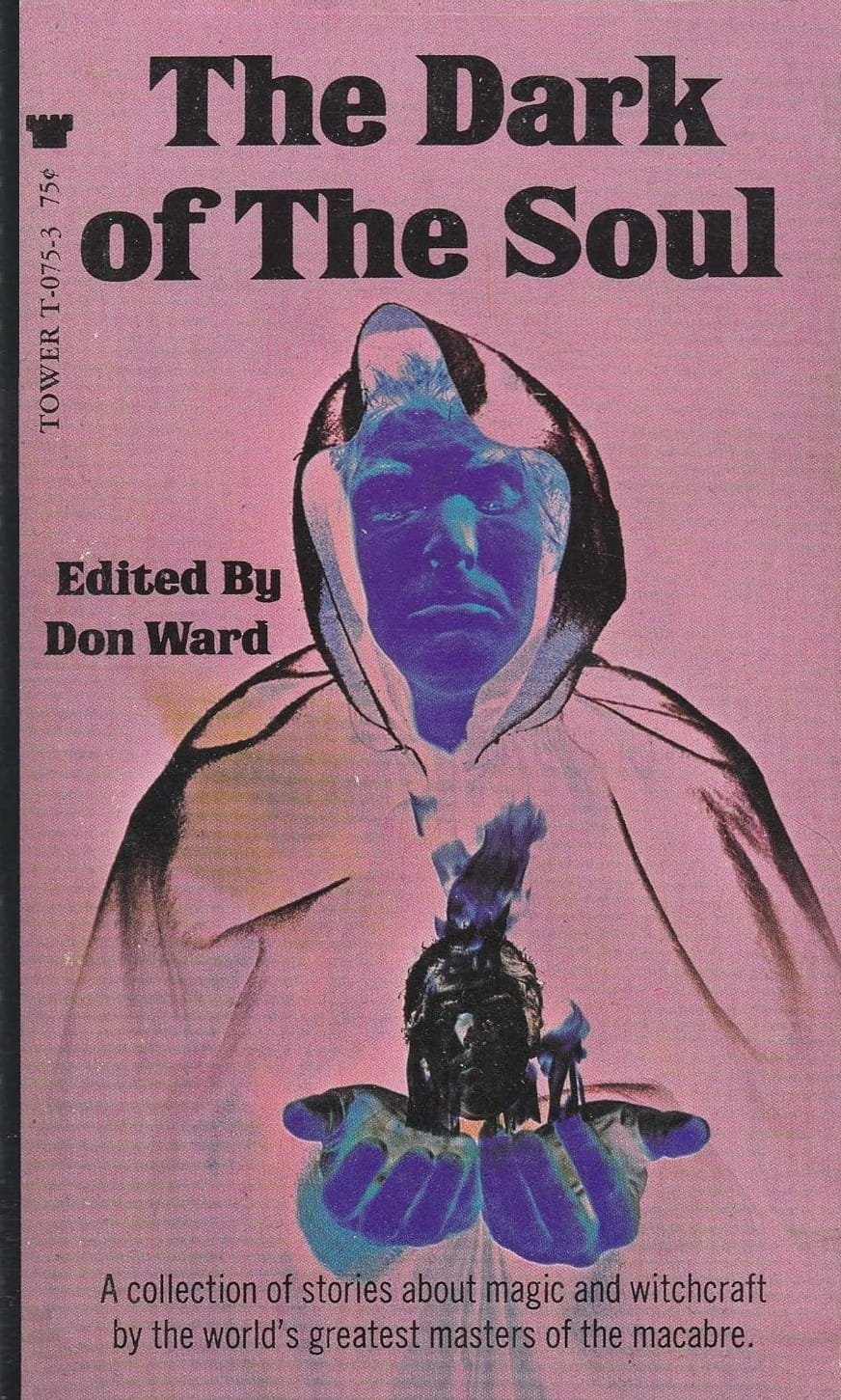
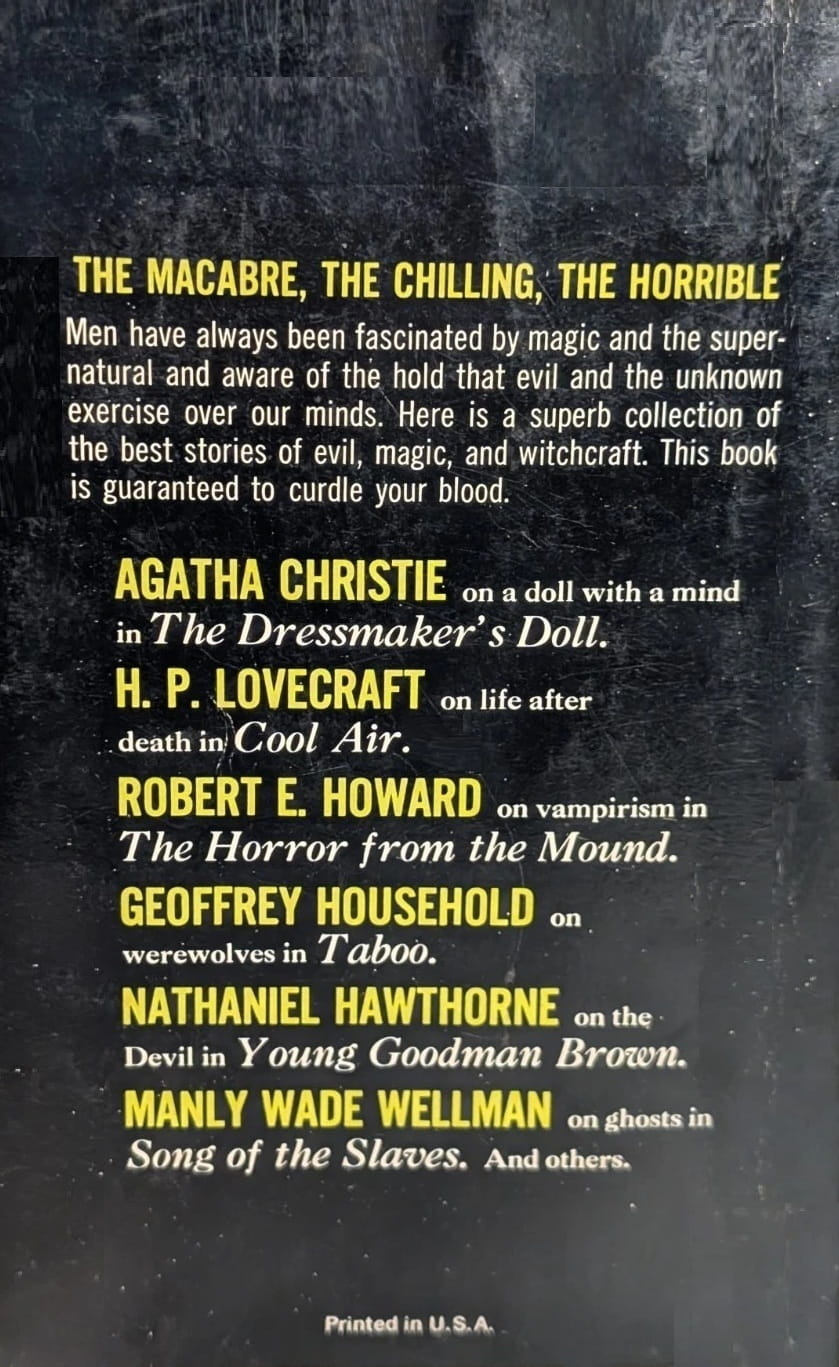
The Dark of the Soul (Tower Books, 1970)
Here’s another anthology I picked up because it had a Robert E. Howard story in it.
The Dark of the Soul, edited by Don Ward, A Tower book, 1970. Cover artist unknown. It contains a short story by Robert E. Howard called “The Horror from the Mound.” It’s a good story, although not one of Howard’s best.
This collection is more horror and gothic, magic and witchcraft, and not Sword & Sorcery (S&S). The stories are atmospheric but maybe slow for modern audiences. Here are my thoughts.
1. Introduction by Don Ward. Gives some context to the stories but probably wasn’t needed.
2. “The Horror from the Mound” by Robert E. Howard has the highest level of action in the collection, and is genuinely creepy.
3. “The Muted Horn” by Dorothy Salisbury Davis doesn’t have any action and is not my cup of tea.
4. “Mrs Amworth” by E. F. Benson was also slow, with a long setup that could mostly have been cut.
5. “Song of the Slaves” by Manly Wade Wellman is a long way from this author’s best work.
6. “The Ash Tree” by M. R. James is a creepy piece. James didn’t beat around the bush getting to the heart of the tale and this is one of the better pieces in the book.
7. “Cool Air” by H. P. Lovecraft. I’m a big Lovecraft fan but this isn’t among his best stories.
8. “Taboo” by Geoffrey Household was a solid tale but maybe with too much unnecessary material.
9. “Young Goodman Brown” by Nathaniel Hawthorne is a memorable tale from an author you don’t generally see in such collections.
10. “Smee” by A. M. Burrage is a good ghost story, though fairly slow.
11. “The Dressmaker’s Doll” by Agatha Christie was a surprise. I knew her from her mysteries but this was creepy and with a strong ending.
Charles Gramlich administers The Swords & Planet League group on Facebook, where this post first appeared. His last article for us was a review of two Sword & Sorcery anthologies from L. Sprague de Camp. See all of his recent posts for Black Gate here.
Categories: Fantasy Books
Recent comments