
Fantasy Books
Dark Muse News: The Fish in Jonah’s Puddle (To Say Nothing of the Demon) by Byron Leavitt
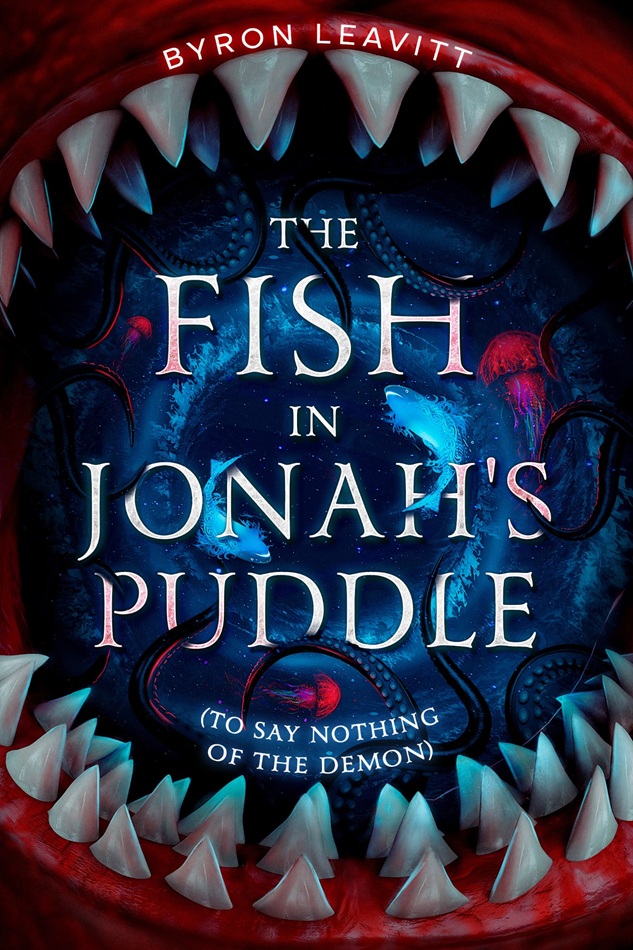
The Fish in Jonah’s Puddle (To Say Nothing of the Demon) by Byron Leavitt
(Brain Waves Press, 2026.) Cover created by Miblart with interior illustration by the author.
The Fish in Jonah’s Puddle (To Say Nothing of the Demon) is a young-adult, portal fantasy written by Byron Leavitt. It’s a contemporary, cosmic-horror take on the sub-genre that was a gateway for many of us. Recall the books like A Wrinkle in Time by Madeleine L’Engle (1962), The Phantom Tollbooth by Norton Juster (1961), The Lion, the Witch and the Wardrobe by C.S. Lewis (1950), The Wizard of Oz by L. Frank Baum (1900), and Alice’s Adventures in Wonderland by Lewis Carroll (1865)?
All of the above have adult followings as much as their young adult readerships. Which portal fantasies grabbed you and helped you become addicted to fantasy?
These share fun tropes, usually involving a band of children being quickly transported to a magical realm that reflects their child-like perspectives. Readers get talking animals and landscapes made from toys (and manifestations of Rhyme and Reason). Oftentimes, the children are out to rescue family members. There is usually an evil, sorcerous entity hell-bent on destroying the children (IT, Wicked Witches, Queen of Hearts, etc.). Of course, the party of kids makes friends with goofy-alien things like scarecrows, empty-hearted tin puppets, Mad Hatters, and strange entities that guide them (three cheers for Mrs. Whatsit, Mrs. Who, and Mrs. Which).
The beauty of portal fantasies with child protagonists is that those journeys resonate with adults too, who, after decades of trying to make sense of the world, miss their younger, naive, adventurous take on life. When I heard Byron Leavitt, best known as a horror writer for Diemension Games’ Deep Madness and Dawn of Madness (including the Deep Madness: Shattered Seas spin-off novel reviewed on Black Gate), released a young adult adventure, I had to check it out. We interviewed Byron Leavitt in 2021 (Interview link), and it is wild to revisit the Q&A five years later and see foreshadowings of this book.
This post shares details of Jonah’s journey, art from the author, and excerpts. But wait, there is more! We used this opportunity to reconnect with Byron Leavitt and get answers to crazy questions about salmon, and discover lost connections of Black Gate with Jonah’s inception.
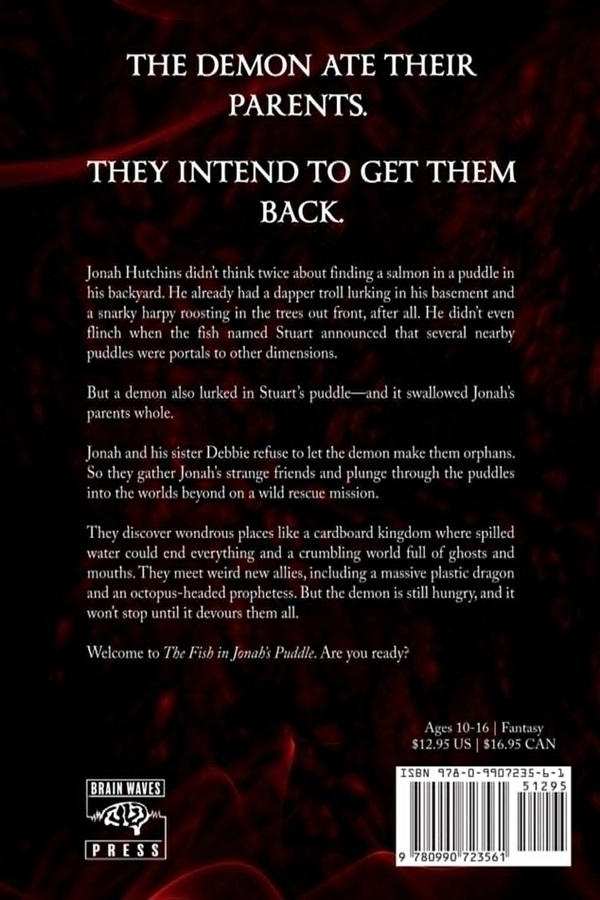
The Fish in Jonah’s Puddle Back Cover BlurbThe demon ate their parents. They intend to get them back.
Jonah Hutchins didn’t think twice about finding a salmon in a puddle in his backyard. He already had a dapper troll lurking in his basement and a snarky harpy roosting in the trees out front, after all. He didn’t even flinch when the fish named Stuart announced that several nearby puddles were portals to other dimensions.
But a demon also lurked in Stuart’s puddle — and it swallowed Jonah’s parents whole.
Jonah and his sister Debbie refuse to let the demon make them orphans. So they gather Jonah’s strange friends and plunge through the puddles into the worlds beyond on a wild rescue mission.
They discover wondrous places like a cardboard kingdom where spilled water could end everything and a crumbling world full of ghosts and mouths. They meet weird new allies, including a massive plastic dragon and an octopus-headed prophetess. But the demon is still hungry, and it won’t stop until it devours them all.
This book combines the awestruck adventure of Impossible Creatures with the dark, hungry dread of Coraline. It is a celebration of the imagination’s power and a whirlwind ride you won’t soon forget.
Welcome to The Fish in Jonah’s Puddle. Are you ready?
Wardrobes, Phone Booths, Rabbit Holes, and Tornadoes, clear room for demonic Puddles! The Weird Fellowship & Key AlliesLet’s get acquainted with the children’s party.
- Jonah Hutchins: a boy with wild creativity, and as the title suggests, our key protagonist.
- Debbie Hutchins: Jonah’s younger sister, who initially thinks her brother is “weird”.
- Stuart: A highly mannered, angelic talking-salmon who appeared in a puddle within Jonah’s backyard after a trans-dimensional storm.
- Humphrey: A monstrous, but gentle, troll who can travel through shadows.
- Calisto: A harpy with powerful wings and a beautiful face framed by long black hair and jagged teeth. She can be grumpy and is a fierce fighter.
- Ms. Finch (Loretta): A six-foot-tall prophetess with an octopus head who lives in a cozy, grandmotherly dimension. She provides critical counsel, opens the “ways” between worlds.
- Sir Reginald: A brave tin soldier with a melted left foot who initially tries to stop the party in Toy Land but joins them after realizing their honorable intentions.
- Pete: A massive, plastic red dragon that Jonah befriends and names in Toy Land.
- Dave (Lord Davros von München-Bellyweather the Fourth): A survivor living inside the demon who is part crab, squid, and man.
The Fish in Jonah’s Puddle features about ten drawings by the author. The cool thing is that Black Gate previewed some of these in 2021 with our interview with Byron Leavitt. Here’s the quick link to our discussion about his non-writing muses: OTHER DARK ARTS, YOUR DRAWINGS. Revealed there are images of Dave and Ms Finch. Those illustrations are shown in this article, with Humphry and Calistro now joining them.
Locations- Jonah’s House and Backyard: The story begins here after a cosmic “trans-dimensional storm” leaves the yard littered with “deep puddles” that serve as portals to other realities.
- Ms. Finch’s House: Her abode can be reached through a puddle; it is a cozy, grandmotherly residence featuring a sitting room with floral prints and warm cherry wood furniture.
- Toy Land: Accessed via Ms. Finch’s front door, this world is constructed entirely of playthings; the ground is cardboard, the trees are plastic, and the sky has the texture of coarse paper.
- The Royal Castle: Situated within Toy Land, this is a massive hodge-podge fortress built from Lego bricks, Lincoln Logs, and sharpened #2 pencils. It houses a puppet theater that serves as the throne room for the realm’s rulers.
- The Dark City (Inside the Demon): This is the dark dimension within the demon’s soul. It is a bleak, “dead city” characterized by crumbling black skyscrapers, ankle-high grimy water, and a sky filled with ghostly green wisps and lightning.
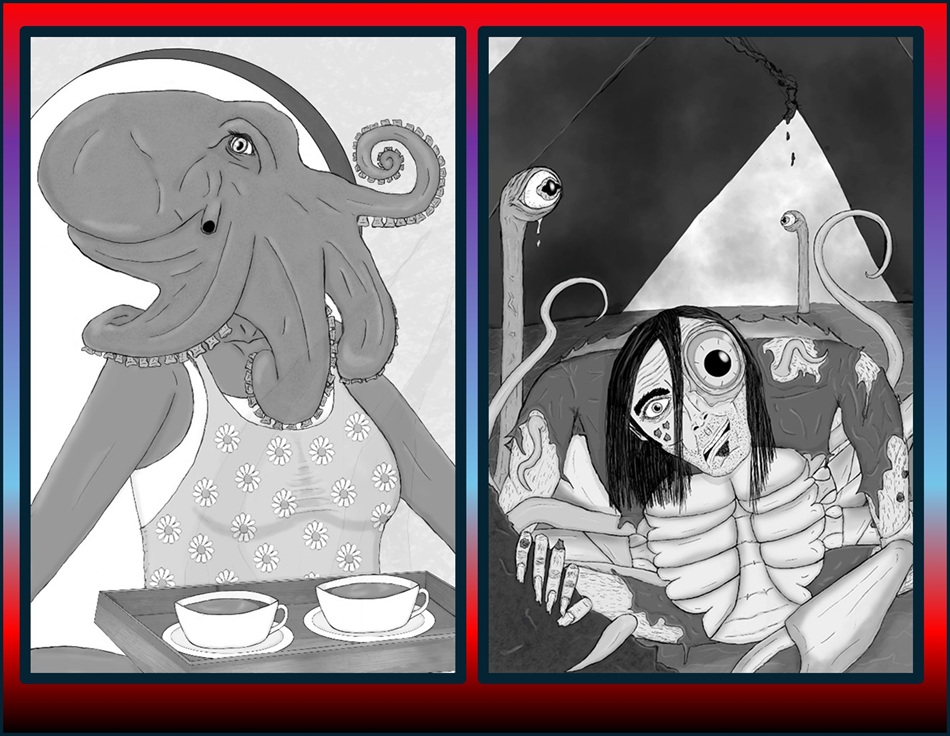 Ms. Finch and David, illustration by Byron Leavitt
Weird, wild, and darkly funny, The Fish in Jonah’s Puddle (To Say Nothing of the Demon) is a portal fantasy where imagination is dangerously good!
Excerpts
Creativity Actually Creates!
“I wonder if your mind can sometimes access them. Which would make the division between your world and others thinner near you.” “Huh,” Jonah said. “Care to elaborate?” “What were you thinking about when Humphrey appeared?” “I…” Jonah’s gaze darted around, and he winced. “It was a long time ago, and I was young, okay? But… I was pretending that I was a knight who had just discovered a massive troll. And then we teamed up and conquered an evil king.”
…
“Oh, man,” Debbie said. “Does that work for anyone? If so, I would bring my Flufferblooms to play with me. That would be incredible!”
…
“Flufferblooms?” Calisto asked. “What are those?” “They’re the flower people I draw.” Calisto guffawed. “And you call them… Flufferblooms?”
Consuming Wonder Bread
Ms. Finch and David, illustration by Byron Leavitt
Weird, wild, and darkly funny, The Fish in Jonah’s Puddle (To Say Nothing of the Demon) is a portal fantasy where imagination is dangerously good!
Excerpts
Creativity Actually Creates!
“I wonder if your mind can sometimes access them. Which would make the division between your world and others thinner near you.” “Huh,” Jonah said. “Care to elaborate?” “What were you thinking about when Humphrey appeared?” “I…” Jonah’s gaze darted around, and he winced. “It was a long time ago, and I was young, okay? But… I was pretending that I was a knight who had just discovered a massive troll. And then we teamed up and conquered an evil king.”
…
“Oh, man,” Debbie said. “Does that work for anyone? If so, I would bring my Flufferblooms to play with me. That would be incredible!”
…
“Flufferblooms?” Calisto asked. “What are those?” “They’re the flower people I draw.” Calisto guffawed. “And you call them… Flufferblooms?”
Consuming Wonder Bread
[Debbie] picked up Jonah’s slice of wonder and shoved it into his mouth. Jonah’s senses erupted. It wasn’t that new colors appeared. Instead, those already present became so vivid they almost burst with brilliance. The world seemed so alive— so vibrant. Sounds and melodies filled the air, shimmering with details Jonah had never noticed before. The taste, too, was an explosion of flavors that danced across his tongue like a parade of sweet, sour, salty, and tangy. These sensations were unlike anything he had experienced before.
The MawThe meaty flooring soon formed an uneven shelf that stretched as far as Jonah could see in either direction. Then, it curved upward before him into a gooey, living wall. Jonah’s gaze traveled up the surface and finally landed on the mouth that pierced it. The Maw was big enough to devour buildings. Its needle teeth were more like swords, and it had so many. Maybe a dozen tentacles slithered out like tongues from inside it, wriggling as they quested across the shelf below. The mouth ate greedily. However, it didn’t consume meat, bone, or any physical matter. Instead, it devoured light and chewed on souls.
Any Biblical Undertones Are SubtleThe biblical account of Jonah (Old Testament) describes that character as being swallowed by a “great fish” (often thought to be called a whale nowadays). He survived for three days and three nights in its belly before being vomited onto dry land. His journey and survival are linked to obeying “the Lord’s” will. In The Fish in Jonah’s Puddle, there is a boy Jonah who is guided by a fish (a salmon named Stuart) who enables transportation to strange realms. Near clueless agnostics (i.e., me) detect some possible connections. However, Byron Leavitt steers clear of overt religious allegories (i.e., I recall feeling hoodwinked as a youth when I learned about Aslan being more than a lion in C.S. Lewis’s Narnia). Anyway, it is wild to note that creative horror writers (like Stephen King or Anne Rice) are often religious.
This tracks with Byron Leavitt’s style. He admits his reverence for a higher power and is inspired in many ways, but his spiritual muses are masked so well that most readers would never know. His stories feel pleasantly agnostic. From our 2021 interview, we cornered him on how he reconciled his weird art with perspectives on God; check out his answers to these prompts there: (1) DO YOU THINK GOD ENJOYS HORROR? (2) RELIGION IN WEIRD ART.
Interview Reconnect – Exclusive Arcana RevealedWe just had to connect with Byron Leavitt to ask a few questions. I’m very grateful that he was available and willing, since he revealed fascinating bits about the history of Jonah, Black Gate, and Jellyfish stomachs.
I’m curious if you eat salmon or have ever had a pet fish?Actually, we eat salmon a lot, though our kids protested a bit after I first read the book to them. Ha! My kids have had pet fish. I’m not sure if I ever had one, but I had many pet crayfish—including one who had babies and then ate them. Her sole surviving offspring was an albino named Little Squirt who became translucent whenever he molted. He was a great crayfish. I’ve also had several pet jellyfish, one of which was named Peanut Butter the jelly. The other jellies died, but Peanut Butter lived on. Then, before her death, she gifted me with dozens (maybe more) of asexually produced baby jellyfish, which have clung to the sides of their aquarium in polyp form ever since. I was told jellyfish never have babies in home aquariums, particularly when there’s only one. But at one point in her life, Peanut Butter had five stomachs instead of the usual four, so she was never completely normal.
Also, any Easter eggs or cross-over secrets infused from your previous work in Jonah’s tale? Perhaps some of the same muses you had for so many years inspired Jonah and other characters. Any tidbits or treats for your Deep/Dawn-Madness fans?I don’t think there are any connections with Deep or Dawn in this book. (I’ve saved those for a forthcoming novel called Under the Iridescent Sea.) However, that’s at least partially because this book predates them. The idea for this book came to me when I was a teenager. I then turned it into a novelette, which, interestingly enough, I submitted to Black Gate way back in the day when it was still a print magazine. In the end it was just a little too long and a little too different from the other stuff Black Gate was publishing to make it fit. So having the book reviewed in Black Gate is kind of a full-circle moment. The story sat for years after that. But I always wanted to turn it into a book. Jonah’s dad had mentioned there were no trolls in the basement or harpies in the trees, so I knew there had to be.
Finally, I launched a small Kickstarter for it and turned it into a very short novel. However, once it was finished, the book sat again. I had just been hired full-time at Diemension, so I didn’t have time for it. Eventually, I realized I either needed to put it out there or go back and fix a glaring error in the book: Jonah’s lack of a sister. I finally decided to do one more big rewrite. The book grew 50% longer, hopefully added more emotional heft, and got a final battle that I think is much more climactic and fulfilling than the original one. So, anyway, that’s a little peek into the 25-year epic that was this book’s journey from conception to print. It is physical proof that, if you have a trunk novel, there’s still hope it will see the light of day.
Expect More JonahThis novel is nicely self-contained, but Byron Leavitt has more to share as he indicates in the Afterword of his book:
I hope you enjoyed The Fish in Jonah’s Puddle (To Say Nothing of the Demon). Assuming you did, you may be interested in reading another adventure featuring Jonah and his strange group of friends. Well, I’ve got you covered— and I’m going to give it to you for free. … You can also go to byronleavitt.com/more-jonah/ … Then, I’ll send you a free short story set in Jonah’s worlds. I’ll also email you once in a while to keep in touch and let you know what’s going on with me and future stories, but you can unsubscribe at any time. What are you waiting for? Get your free story right now! About Byron LeavittByron Leavitt is a creator of weird fiction who lives to cultivate wonder. He wrote all the story content for the hit board games Deep Madness and Twisted Fables by Diemension Games, plus either wrote or co- wrote all eight books for the story- driven game Dawn of Madness, which one reviewer called “the best narrative I’ve ever read.” Byron also wrote the books Deep Madness: Shattered Seas and The Art of Deep Madness, as well as the true story Of Hope and Cancer, about his battle with stage- four Hodgkin’s lymphoma. He’s currently working on many more projects, including the long- gestating epic dark fantasy novel Alayaka and the science fiction novel Under the Iridescent Sea. Byron lives in a centennial Swiss- style house in Tacoma, Washington, with his wife, Sarah, his daughters Aurora and Eden, many jellyfish babies, his butler, Egad, several gremlins, and the Gargoyle Baby. When he’s not writing stories, publishing books, or making games, Byron also serves as a copywriter and editor. You can learn more about him on his website at byronleavitt.com and on his Substack newsletter at byronleavitt.substack.com.
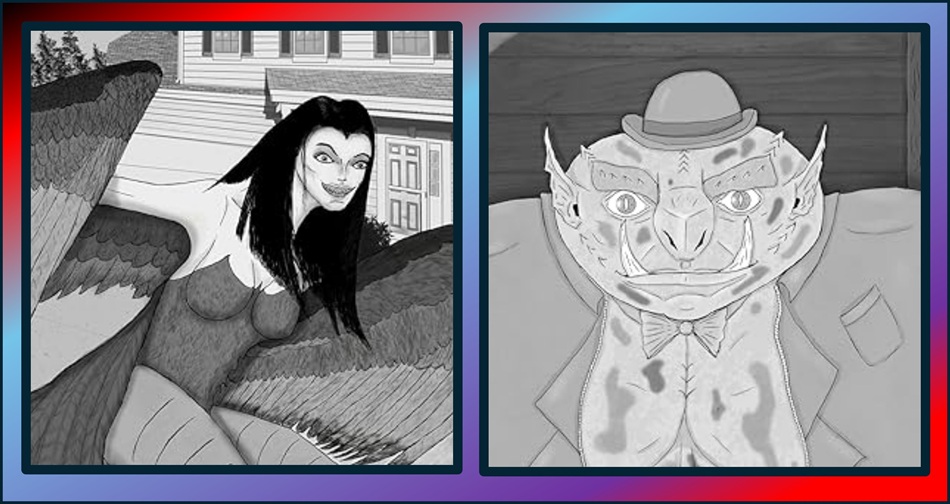 Calisto and Humphrey; Art by Byron Leavitt
Listen to the talking Salmon! Follow Jonah into the Puddle!
Calisto and Humphrey; Art by Byron Leavitt
Listen to the talking Salmon! Follow Jonah into the Puddle!
S.E. Lindberg is a Managing Editor at Blackgate.com, regularly reviewing books, interviewing authors on ‘Beauty & Art in Weird-Fantasy Fiction’, and running Dark Muse News. He has taken lead roles organizing the Gen Con Writers’ Symposium (2020-2023) and the Goodreads Sword & Sorcery Group; he even interned for Tales from the Magician’s Skull magazine and is an Assistant Editor for Battleborn magazine. As for crafting stories, he has contributed eight entries across Perseid Press’s Heroes in Hell and Heroika series, and has an entry in Weirdbook Annual #3: Zombies. He independently publishes novels under the banner Dyscrasia Fiction®; short stories of these have appeared in Whetstone and Swords & Sorcery online magazine, Rogues In the House Podcast’s A Book of Blades (Vol. I and Vol. II), DMR’s Terra Incognita, Tales From the Magician’s Skull (Issue #9), Savage Realms Magazine (July 2025), and Michael Stackpole’s S&S Chain Story 2 Project.
Categories: Fantasy Books
Spotlight on “Femmephilia” by Sophie Lewis

LitStack Spots Here are other titles we are definitely adding to our TBR stack, including…
The post Spotlight on “Femmephilia” by Sophie Lewis appeared first on LitStack.
Categories: Fantasy Books
Book Review: The Franchise by Thomas Elrod
I received a review copy from the publisher. This does not affect the contents of my review and all opinions are my own.
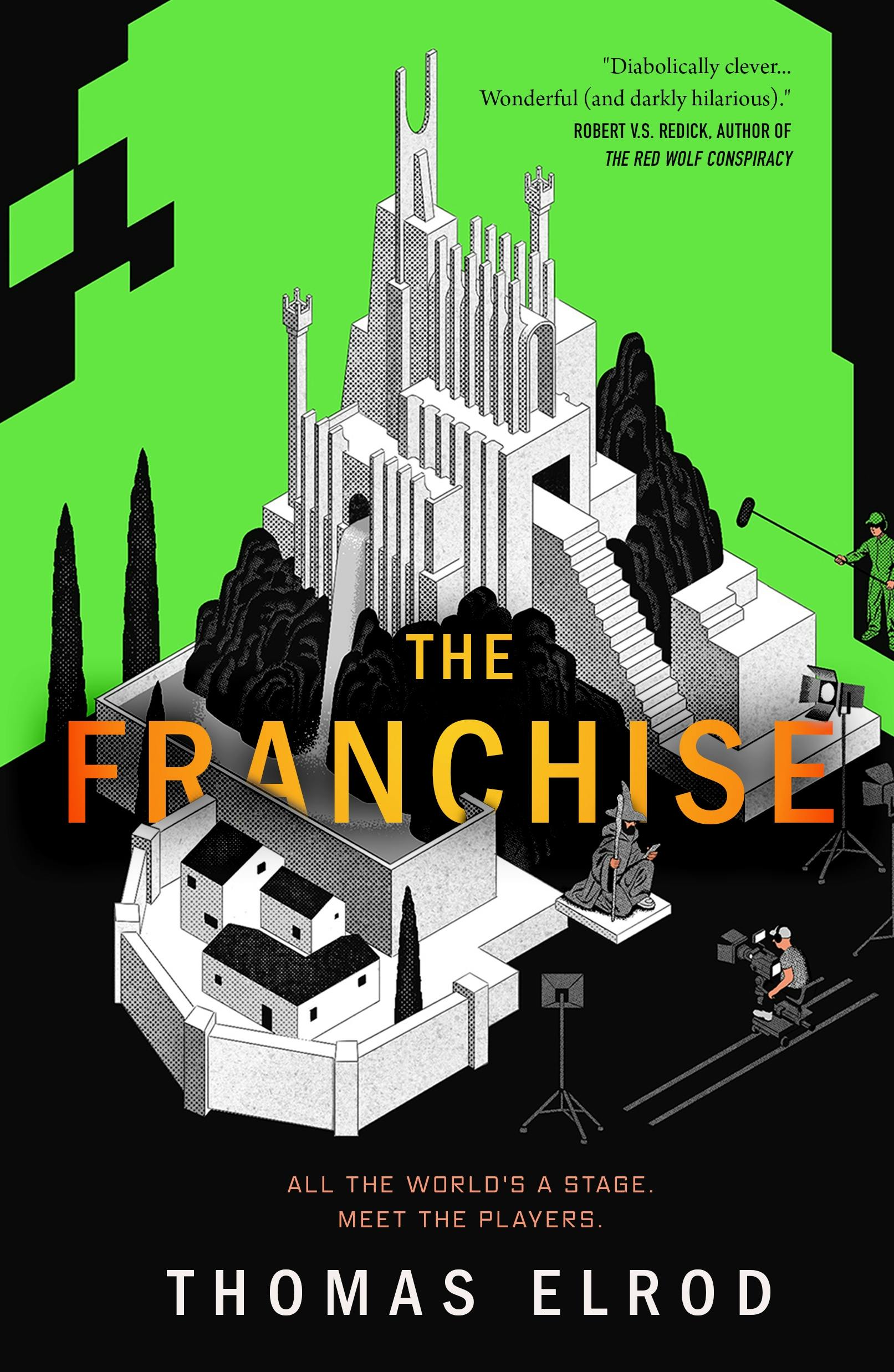
Mogsy’s Rating: 3 of 5 stars
Genre: Science Fiction, Fantasy
Series: Stand Alone
Publisher: Tor Books (May 12, 2026)
Length: 368 pages
Author Information: Website
At first, The Franchise seemed exactly like the kind of speculative fiction I’d go for. While Thomas Elrod’s debut joins an increasingly popular vein of cautionary sci-fi tales about the dangers of technology, what really makes it stand out is the way it portrays reality entertainment to almost grotesque extremes.
The story begins with the meteoric rise of a beloved fantasy series created by an author who spent his lifetime fiercely protecting his work from studio executives eager to cash in on adaptations, merchandising, and every other possible spin-off opportunity. However, after his death, the rights fell into the hands of an heir far more interested in profit than artistic integrity, and before long, the franchise saw itself ballooning into a massive multimedia machine. Movies and toys were only the beginning. Using cutting-edge technology, corporations eventually figured out how to create a fully immersive fantasy world populated by real participants who have had their memories altered and identities rewritten. Some volunteered willingly, at least at first. Others became involved under far murkier circumstances.
The result is something that goes far beyond your typical theme park experience. The people inside this manufactured reality truly believe in the new roles they are given, whether they are queens, knights, wizards, or peasants living in this medieval fantasy kingdom. Meanwhile, outside the illusion are the producers, scriptwriters, hired actors, and handlers working behind the scenes to turn this entire enterprise into marketable entertainment. An entire ecosystem is required to manipulate events in order to maintain interest and increase profits, all the while trying to stop the entire operation from collapsing under its own weight. As you can see, the comparisons to The Truman Show, Westworld, and even Game of Thrones are apt.
And really, that’s where the novel shines most: the concept itself. Elrod clearly has a lot to say about fandom, capitalism, exploitation, as well as the toxic aspects of our entertainment culture in general. The book utilizes satire in a lot of it commentary, presenting a near future where spectacle and profit matter more than basic humanity. As the story progresses, the lengths corporations are willing to go for ratings and audience engagement become increasingly absurd, but intentionally so. There’s a darkly funny thread turning through much of the book, and much of it actually works surprisingly well.
That said, a concept, even a fantastic one, can only carry you so far. Eventually, the story started losing me. As the focus shifted more heavily towards individual narratives, leaving behind the more intriguing mechanics of the plot, The Franchise gradually became less engaging instead of more. Structurally, it was also laid out in a way that was inconducive to maintaining momentum. Eventually, all the time jumps and rotating perspectives took their toll, breaking up the flow and making things feel increasingly disjointed.
Ironically, I also found myself far more invested in the happenings outside the fantasy world than within it once the situation became clear to readers. After the curtain is pulled back, revealing the inner workings of the system, the actual fantasy story line loses a lot of its appeal. Instead, more important questions are brought to the forefront relating to the ethics, psychological consequences, and horrifying implications of a society willing to normalize all this for entertainment. Exploring those speculative elements is where the novel feels strongest and most at home, and this is what I mean when I say that the concept is consistently stronger than the story built around it.
That said, I really enjoyed The Franchise, even though I found myself less invested by the end than I was at the beginning. At the end of the day, though, this is one of those novels I admire more for its ambitions than for the actual reading experience. The ideas are genuinely great, the scope is impressive, and there are stretches that absolutely work, like the intrigue in the early chapters and some of the later thematic explorations. I just don’t think the novel ever fully balances all its moving pieces into a cohesive whole. Still, for a debut, there’s a lot to like here, and I’d definitely be curious to check out Thomas Elrod’s future work.


Categories: Fantasy Books
7 Author Shoutouts | Authors We Love To Recommend

Here are 7 Author Shoutouts for this week. Find your favorite author or discover an…
The post 7 Author Shoutouts | Authors We Love To Recommend appeared first on LitStack.
Categories: Fantasy Books
Lin Carter’s Year’s Best Fantasy Stories
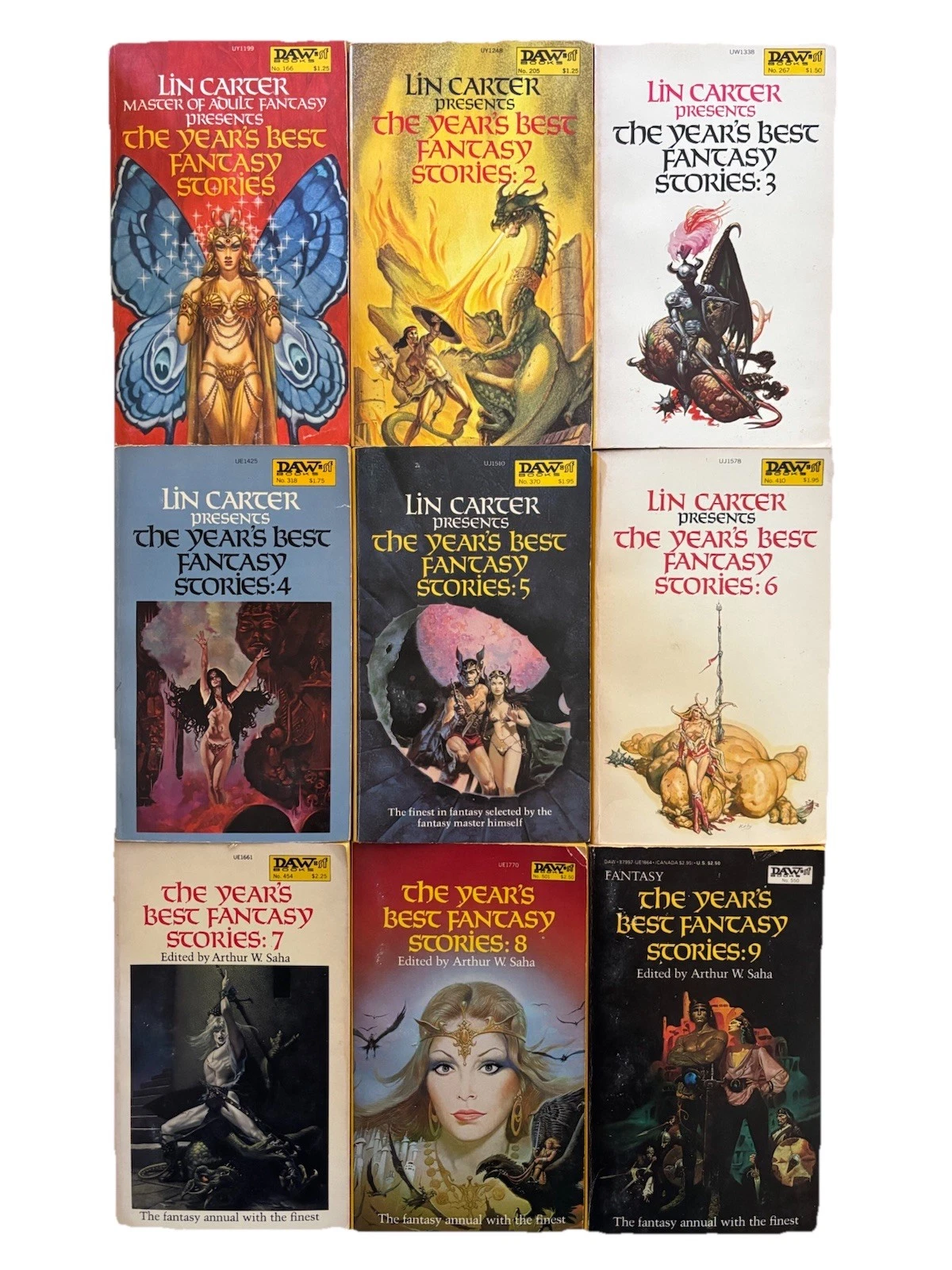 The Year’s Best Fantasy Stories, volumes 1-9, edited by Lin Carter and Arthur Saha (DAW Books, 1975-1983)
While people disagree on the quality of Lin Carter’s writing, most people agree he was a fine editor and tireless supporter of the fantasy field. Volumes edited by Carter brought quite a few new authors to my attention, as well as feeding me a steady diet of works by writers I already loved.
From 1975 to 1988, DAW books presented a yearly anthology called The Year’s Best Fantasy Stories. Lin Carter edited the first six and I own and have read all but #3, which I ordered recently but was sent the wrong book.
Arthur W. Saha took over as editor after that. I only have one of his volumes. I don’t know why the editorial switch, but Carter may have been suffering from ill health around that time. He died in 1988. I first read the three with Robert E. Howard content, but later read a couple of others. Here are my thoughts.
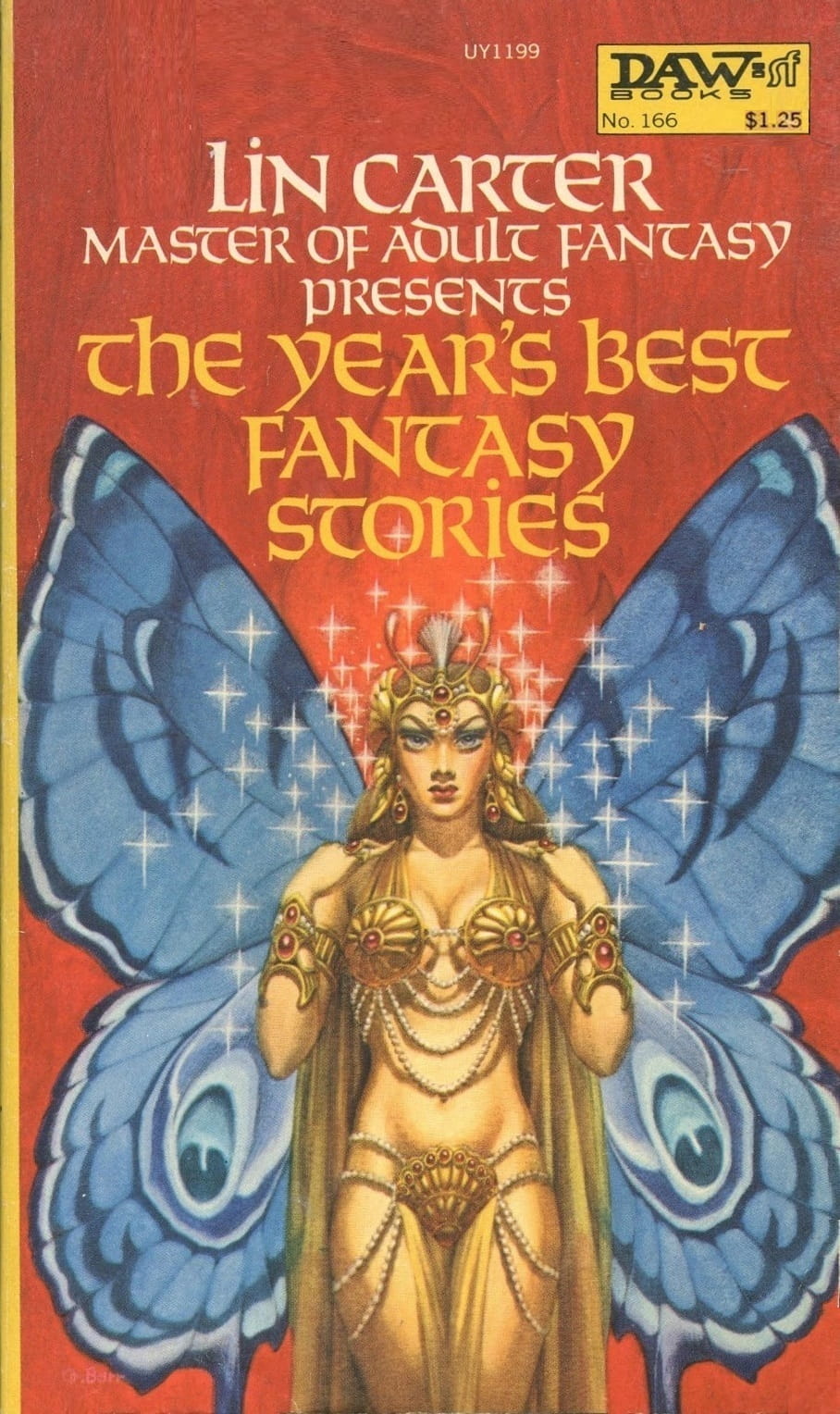
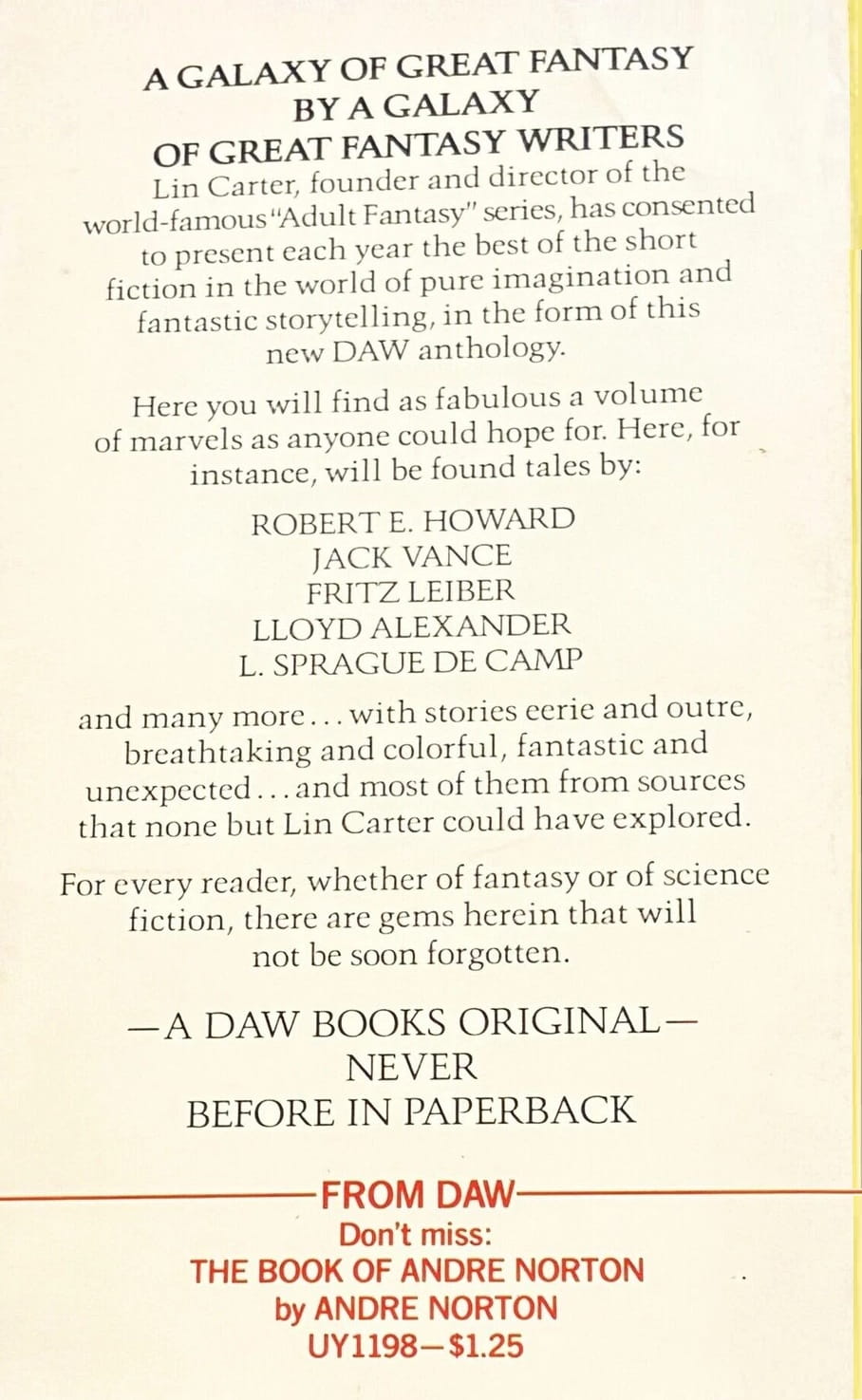
The Year’s Best Fantasy Stories 1, edited by Lin Carter (DAW, October 1975). Cover by George Barr
Contains “The Temple of Abomination” by Robert E. Howard, a Cormac Mac Art story, and pieces by Marion Zimmer Bradley, Lloyd Alexander, Clark Ashton Smith (fragment completed by Carter), Fritz Leiber (Fafhrd/Gray Mouser), Lin Carter (Thongor), Hannes Bok, L. Sprague de Camp, Pat McIntosh, Charles R. Saunders (Imaro, & apparently the first story Saunders ever wrote), and Jack Vance (Dying Earth).
Most of these are decent stories. The Saunders tale shows a lot of power and promise but also feels like a very early effort. The de Camp tale is told in his often used tongue-in-cheek style, which I have to admit doesn’t do much for me.
It’s generally considered a faux pax these days to include your own story in such an anthology, particularly in something called “Best,” but Carter often did and the publisher didn’t seem to have a problem. He was probably a decent sales draw.
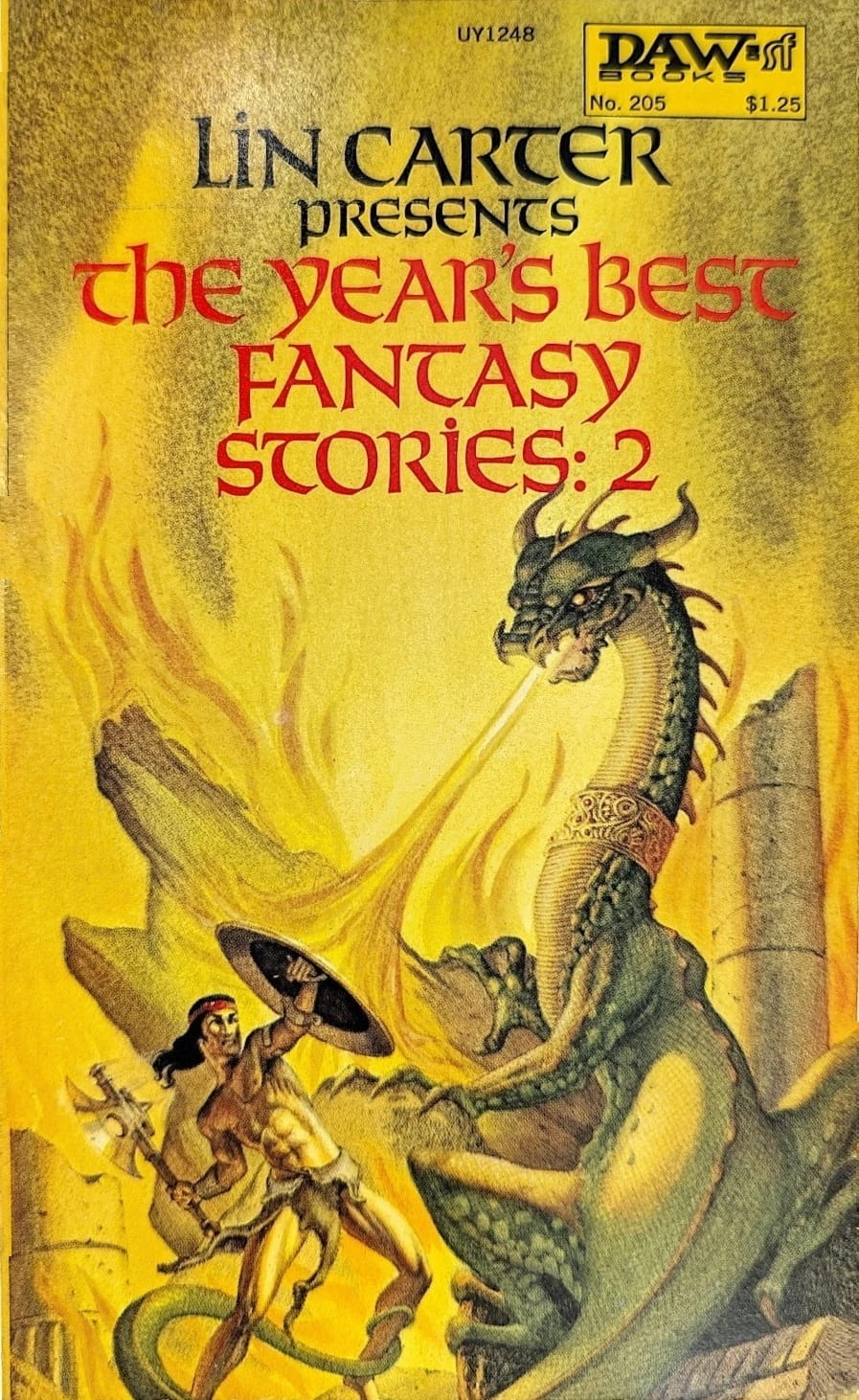
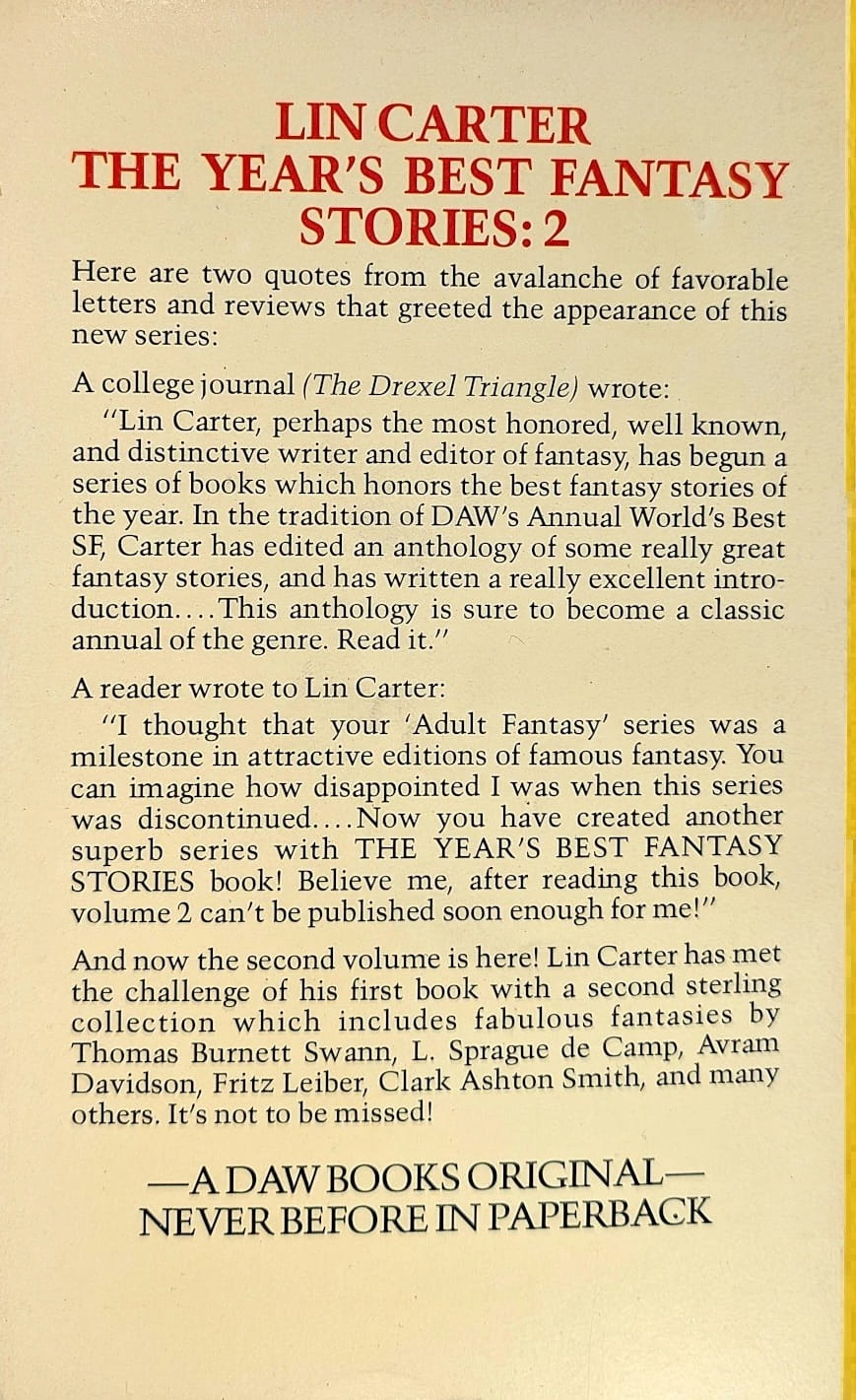
The Year’s Best Fantasy Stories 2, edited by Lin Carter (DAW, August 1976). Cover by George Barr
Contains:
The Year in Fantasy, by Carter
“The Demoness” by Tanith Lee, beautifully written and probably my favorite story in the collection
“The Night of the Unicorn” by Thomas Burnett Swann, very short and something of a magical realism story; it was quite good
“Cry Wolf by Pat McIntosh, a werewolf tale
“Under the Thumbs of the God”s by Fritz Leiber, a good Fafhrd/Gray Mouser tale
“The Guardian of the Vault,” by Paul Spencer, a very good story with a twist ending
“The Lamp from Atlantis,” by L. Sprague de Camp, which was interesting but far longer than needed
“Xiurhn,” by Gary Myers, a Lovecraftian tale
“The City in the Jewel” by Lin Carter, a long and quite good Thongor story
“In ‘Ygiroth” by Walter C. DeBill, Jr., a decent piece
“The Scroll of Morloc” by Clark Ashton Smith & Lin Carter, which wasn’t terribly well done
“Payment in Kind” by Caradoc A. Cador, which was well written and intriguing but with an ending I didn’t get
“Milord Sir Smiht, the English Wizard” by Avram Davidson, which was glacially slow and left me scanning it
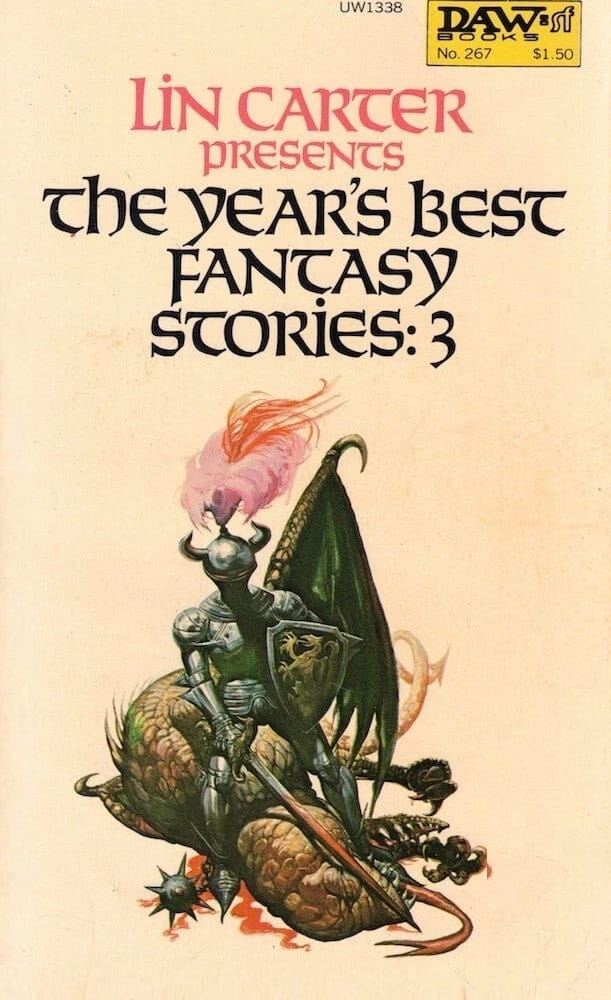
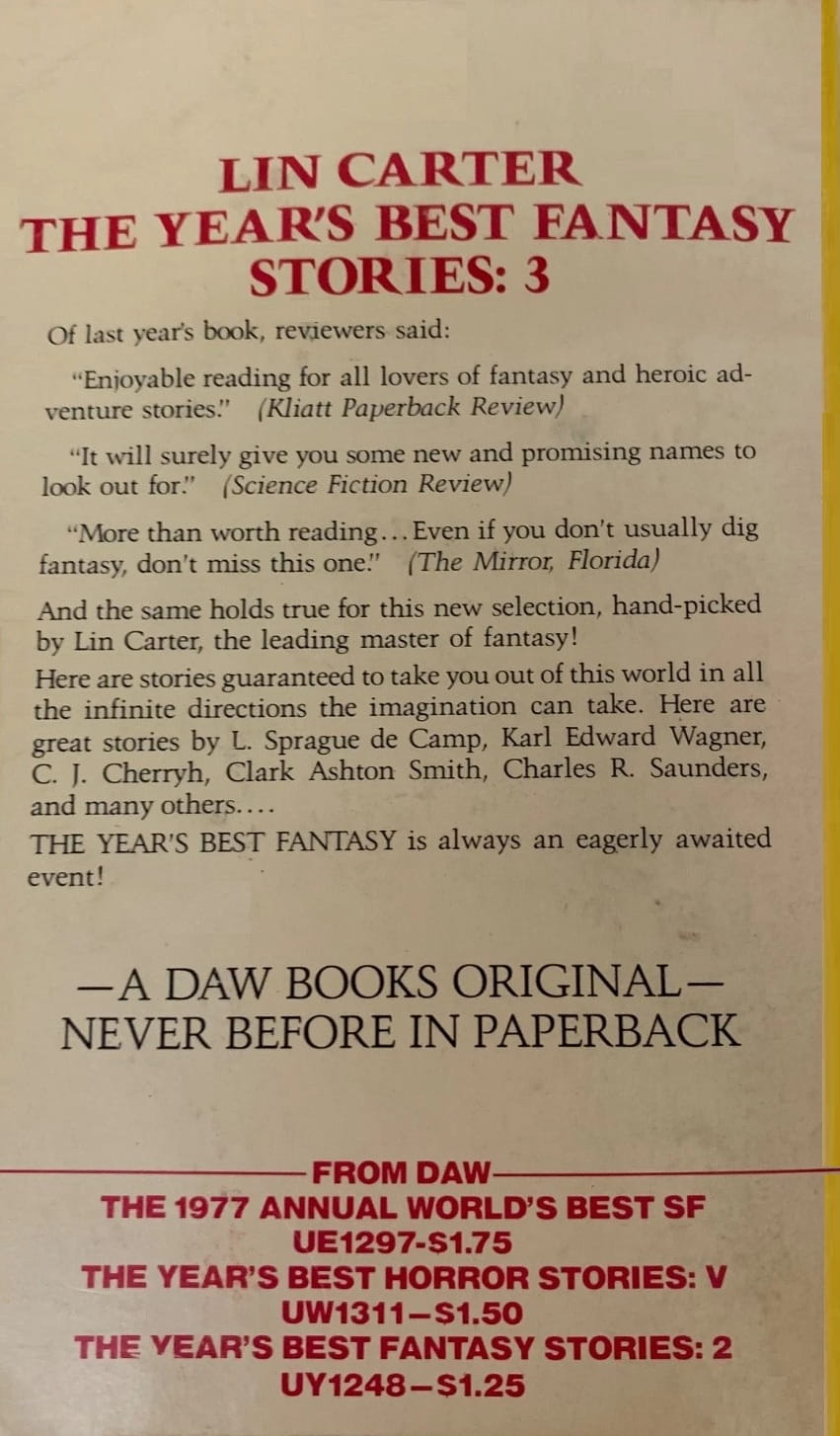
The Year’s Best Fantasy Stories 3, edited by Lin Carter (DAW, November 1977). Cover by Josh Kirby
I haven’t read this but thought I’d include the TOC for those who are interested. Contains:
The Year in Fantasy essay by Carter
“Eudoric’s Unicorn” by de Camp
“Shadow of a Demon” by Gardner F. Fox (Niall of the Far Travels)
“Ring of Black Stone,” by Pat McIntosh
“The Lonely Songs of Laren Dorr” by George R. R. Martin
“Two Suns Setting” by Karl Edward Wagner (Kane story)
“The Stairs in the Crypt” by Clark Ashton Smith and Lin Carter
“The Goblin Blade by Raul Garcia Capella
“The Dark King,” by C. J. Cherryh
“Black Moonligh” by Lin Carter
“The Snout in the Alcove” by Gary Myers
“The Pool of the Moon” by Charles Saunders
and the usual essay by Carter on the year’s best fantasy books.
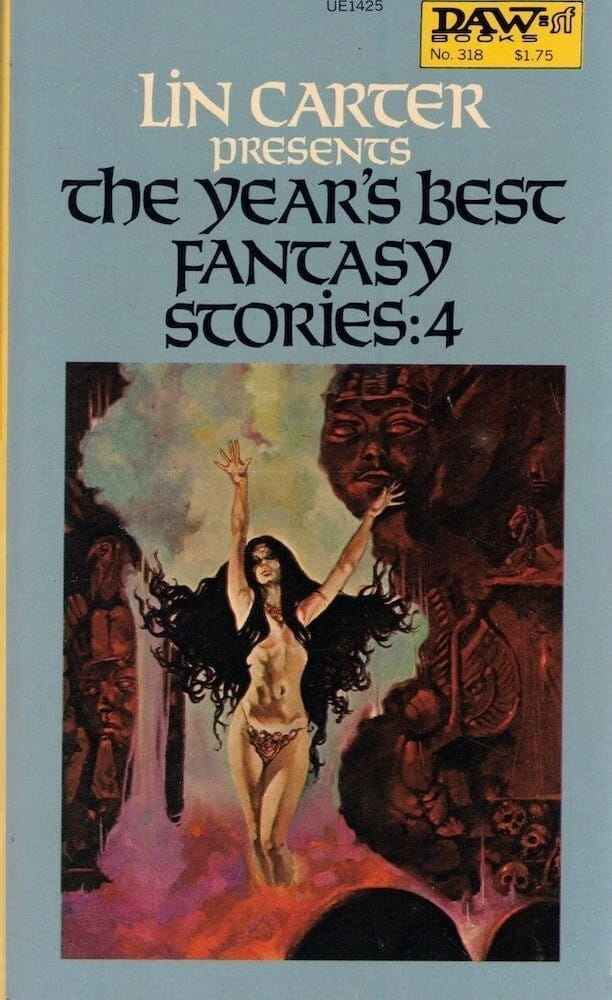
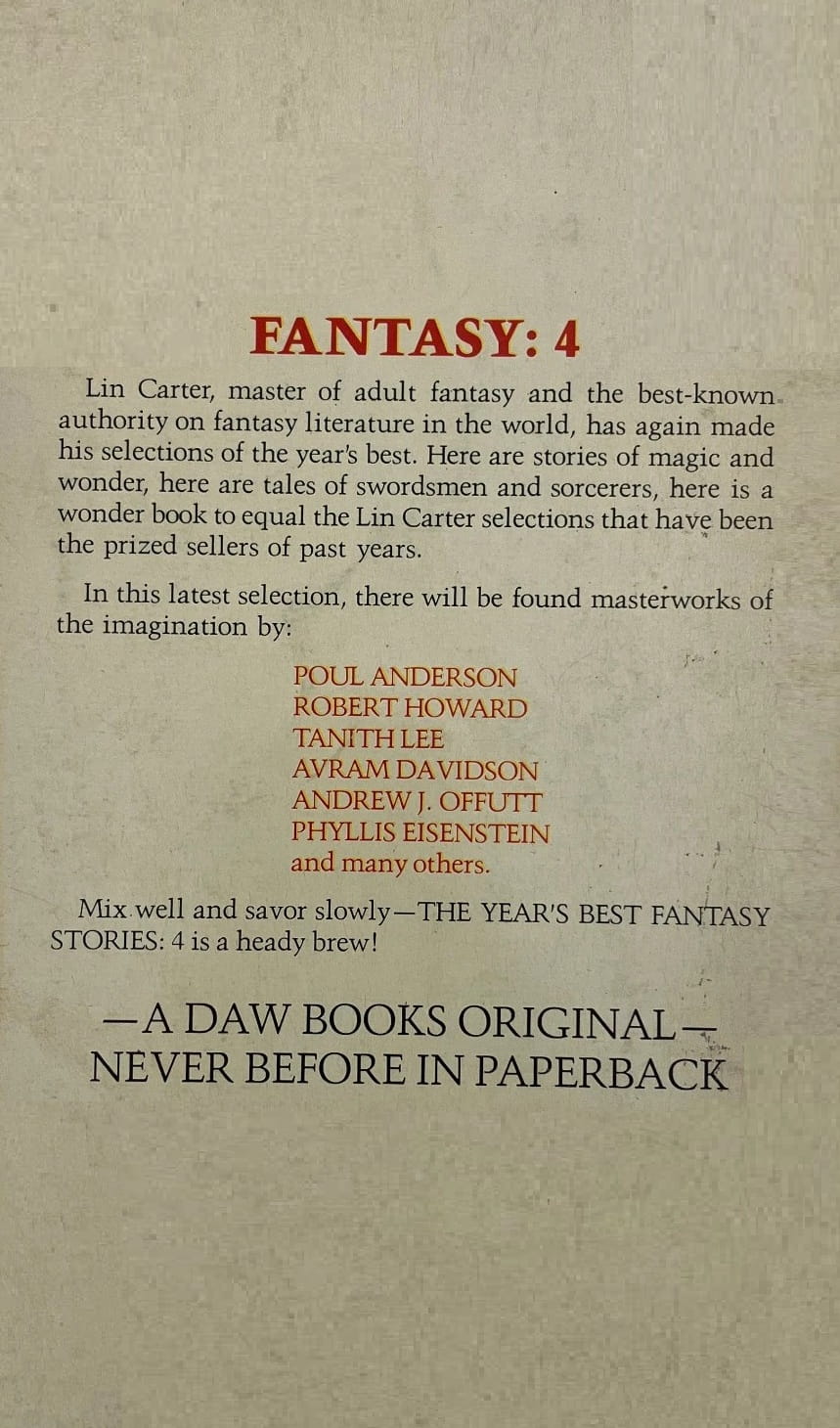
The Year’s Best Fantasy Stories 4, edited by Lin Carter (DAW, December 1978). Cover by Esteban Maroto
Contains “Nekht Semerkeht” by Robert E. Howard, which was a partial story completed very well by Andrew Offutt. It also has stories by Poul Anderson, Grail Undwin, Clark Ashton Smith, Lin Carter, Avram Davidson, Phyllis Eisenstein, Tanith Lee, Ramsey Campbell, Pat McIntosh, and Philip Coakley.
Other than “Nekht Semerkeht,” the two best tales were Campbell’s (which appeared in Swords Against Darkness), and Anderson’s story, “The Tale of Hauk.” Avram Davidson’s story was “Hark! Was that the Squeal of an Angry Thoat?,” which was a play on Edgar Rice Burrough’s work. I found it pretty goofy. Smith’s story was “Lok the Depressor,” good but not outstanding.
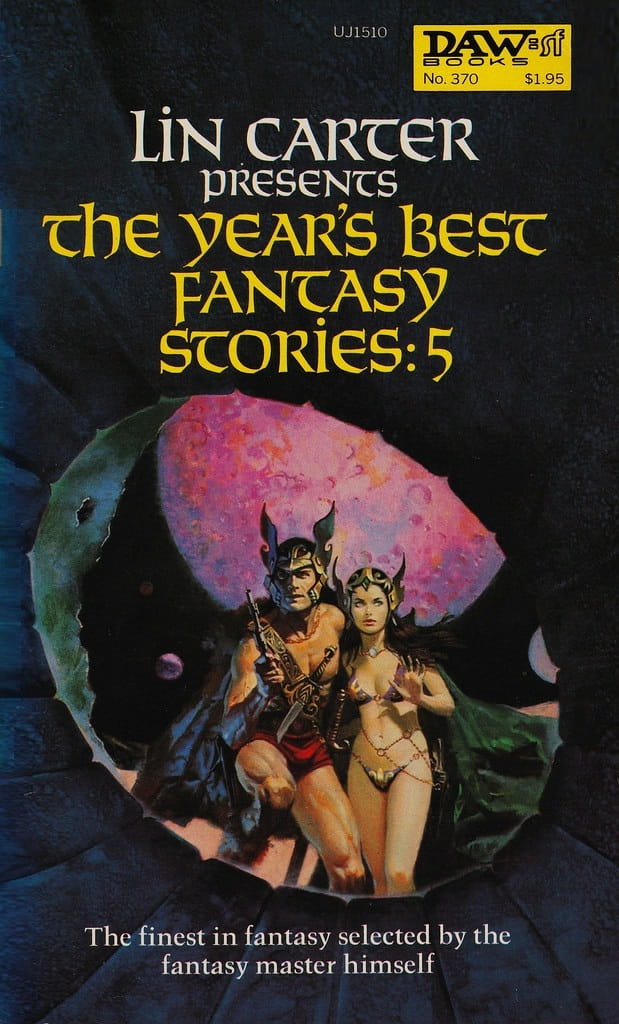
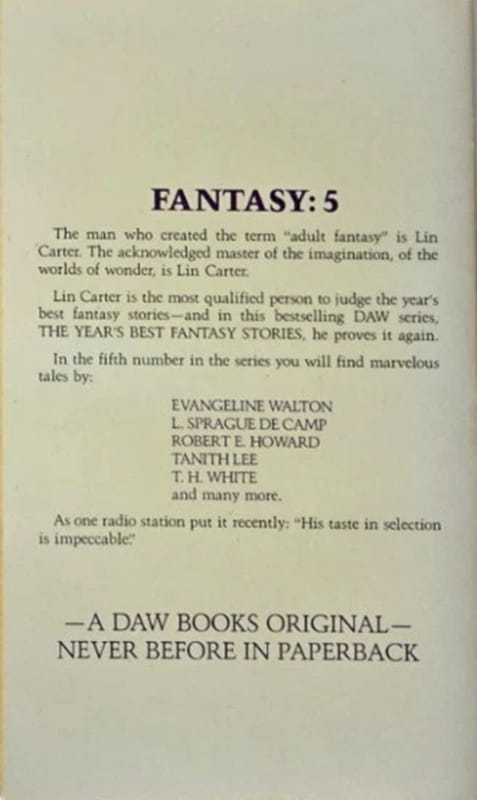
The Year’s Best Fantasy Stories 5, edited by Lin Carter (DAW, January 1980). Cover by Penalva
It contains “Lord of the Dead” by Howard, which is primarily a crime story with fantastic elements. It also contains a Conan pastiche by de Camp and Carter, and stories by T. H. White, Tanith Lee, Pat McIntosh, Craig Shaw Gardner, Adrian Cole, Janet Fox, David Malory, Grail Undwin, Marvin Kaye, and Evangeline Walton.
“Astral Stray” by Adrian Cole was the best thing here outside of Howard. I’ve always liked Cole’s work a lot.
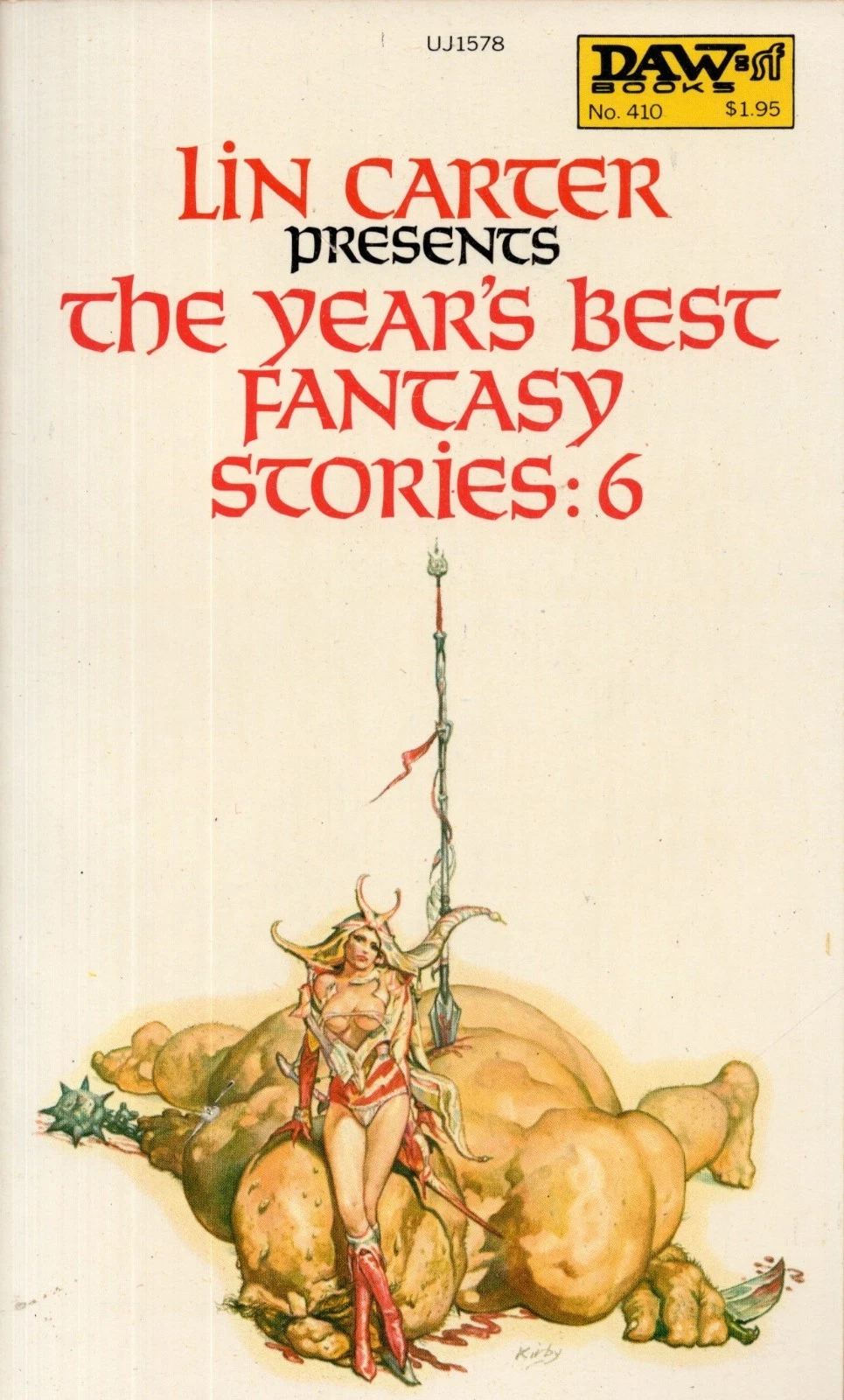
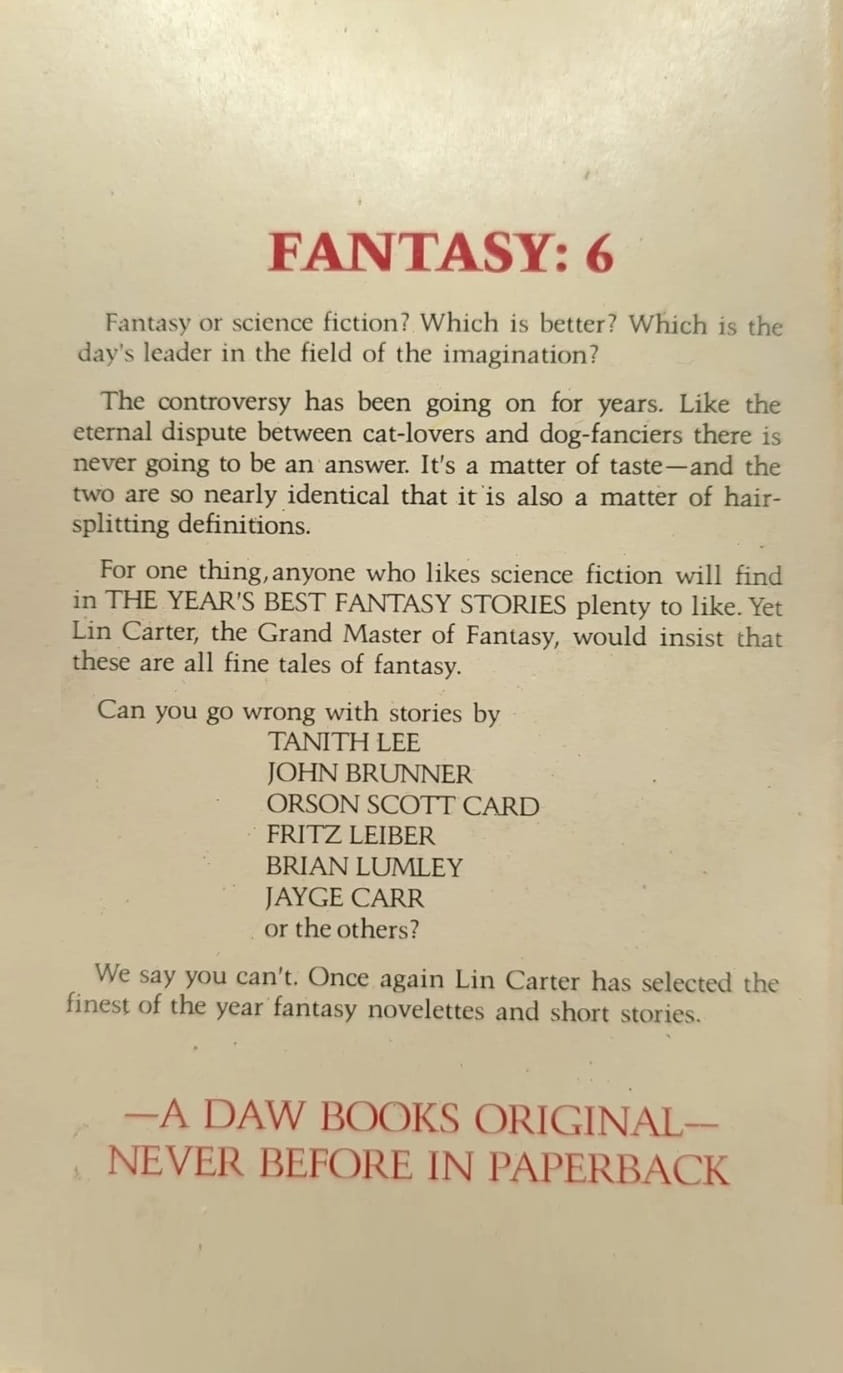
The Year’s Best Fantasy Stories 6, edited by Lin Carter (DAW, November 1980). Cover by Josh Kirby
This is a pretty good collection, even if it doesn’t contain a Robert E. Howard tale. We have:
The Year in Fantasy by Carter
“Garden of Blood” by Roger Zelazny (Dilvish)
“The Character Assassin” by Paul H. Cook
“The Things That Are Gods” by John Brunner
“Zurvan’s Saint” by Grail Undwin
“Perfidious Amber” by Tanith Lee
“The Mer She” by Fritz Leiber (Fafhrd/Gray Mouser)
“Demon of the Snows” by Carter (Thongor)
“The Pavilion Where All Times Meet” by Jayge Carr
“Cryptically Yours” by Brian Lumley
“Red as Blood” by Tanith Lee
“Sandmagic” by Orson Scott Card
The Year’s Best Fantasy Books by Carter
“Sandmagic” is worth the price by itself.
Now for a surprise about The Year’s Best Fantasy series. You may notice that Grail Undwin appeared in a bunch of these Carter edited collections, although I remember nothing about the stories. Well, this fact actually calls into question Carter’s suitability as an editor for this kind of “Best of” collection, because — it appears — Grail Undwin was a secret pseudonym of Carter.
I first heard this from G. W. Thomas but it certainly has the ring and scent of truth. If it is, Carter managed not only to get one of his stories under his own name into each of these anthologies, but he got a secret one in as well (and no doubt got paid for it).
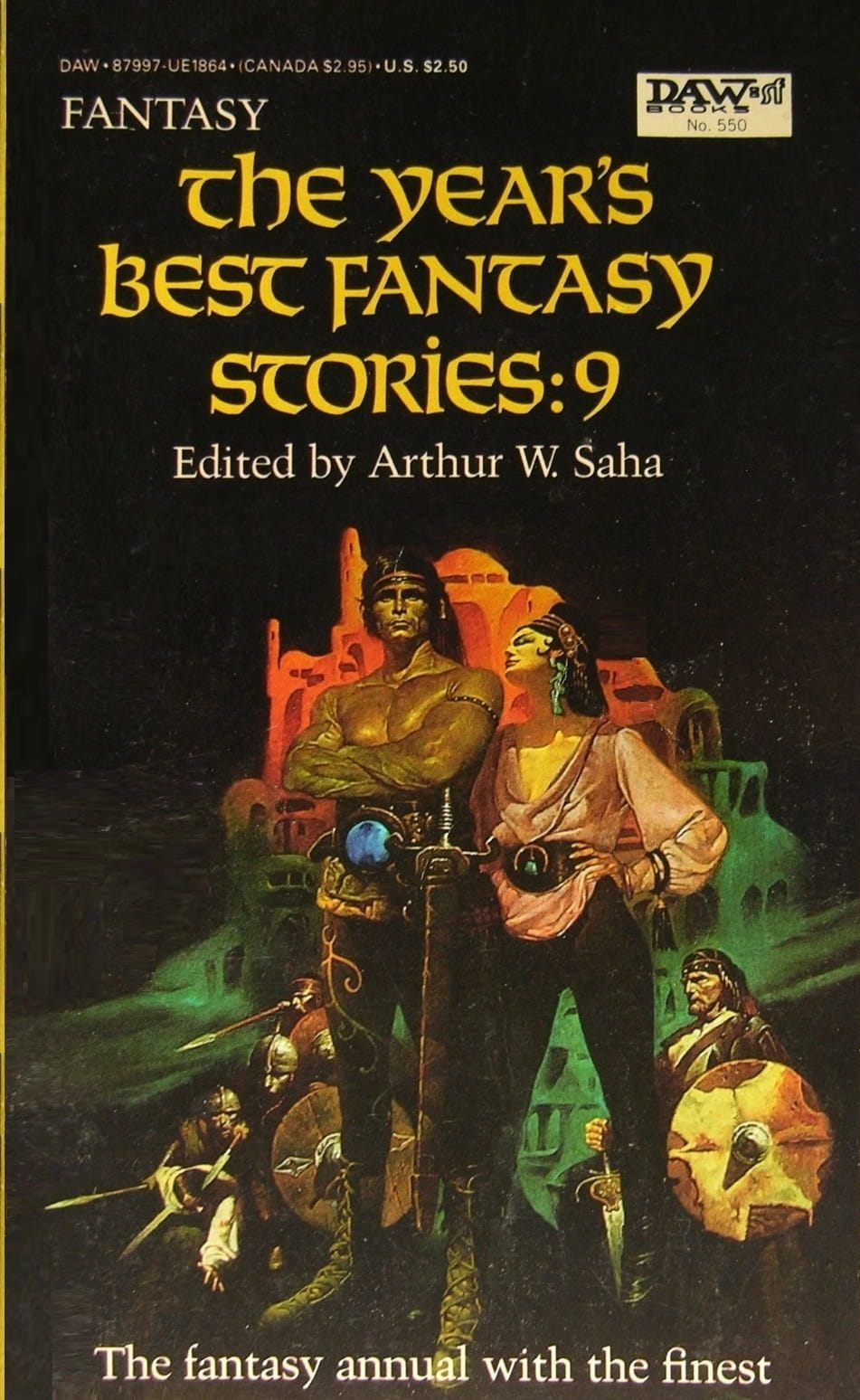
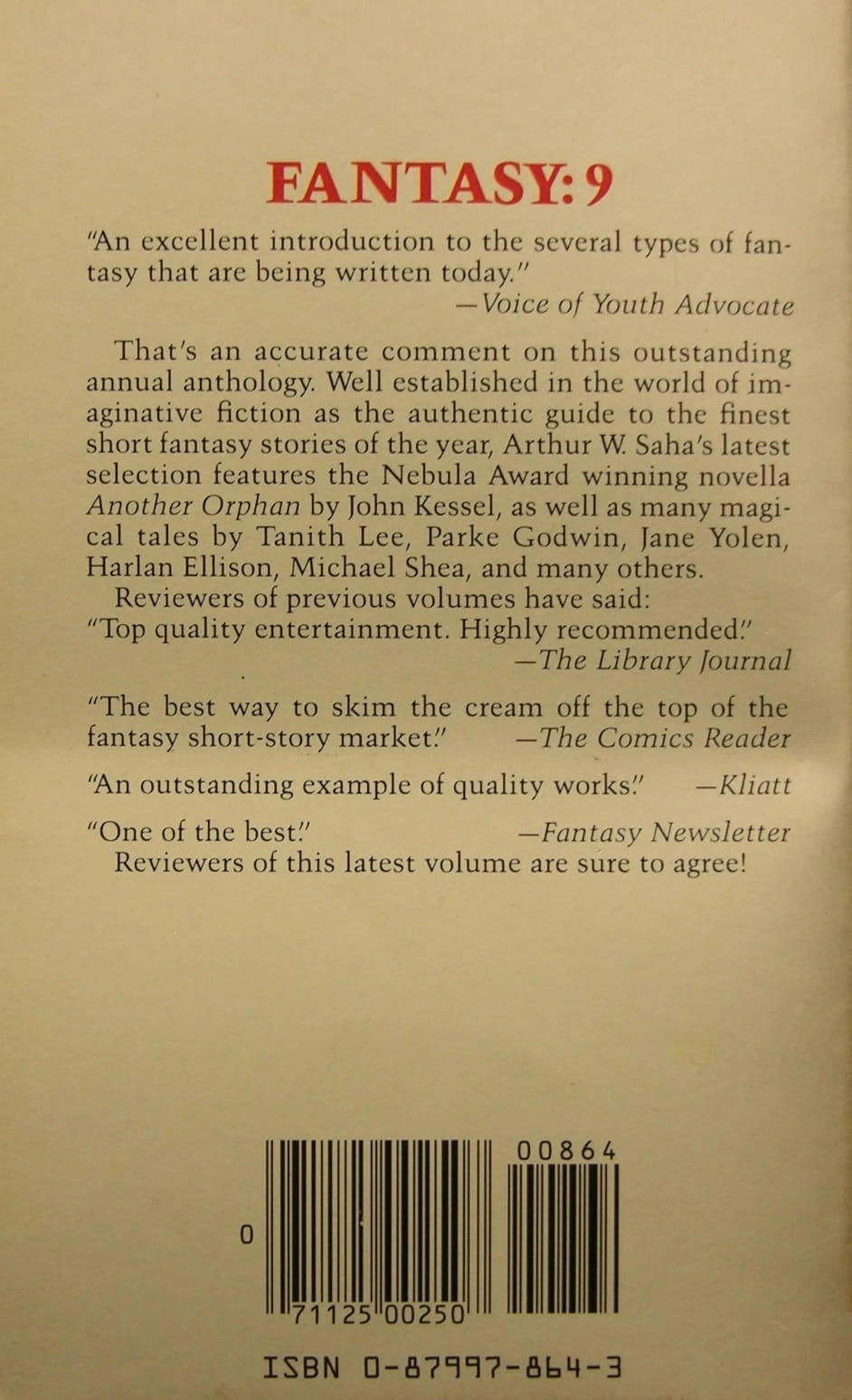
The The Year’s Best Fantasy Stories 9, edited by Arthur W. Saha (DAW, October 1983). Cover by Sanjulian
Edited by Art Saha. Cover by Sanjulian.
Contains stories by John Kessel. R. A. Lafferty, Michael Shea, Harlan Ellison, Richard Christian Matheson, Parke Godwin, Jor Jennings, Jane Yolen, Suzette Haden Elgin, and Tanith Lee.
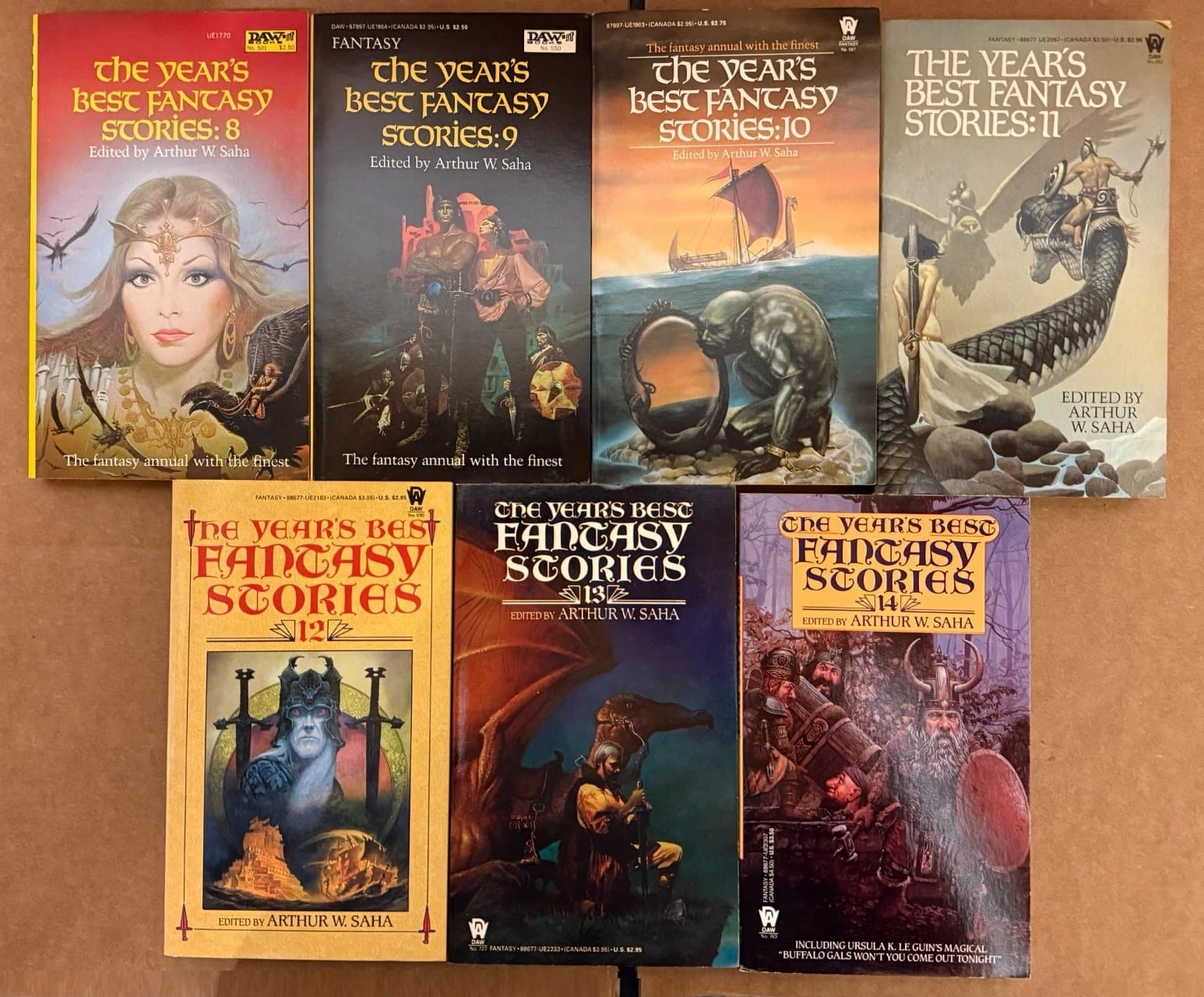 The Year’s Best Fantasy Stories, volumes 8-14, edited by Arthur Saha (DAW Books, 1982-1988)
Saha took a much wider view of fantasy than Lin Carter and some people probably liked that. I didn’t. I wanted adventure and this presented very little of that, and most of the stories were set in much more modern milieus and tended toward the humorous.
In retrospect, I’m sure these were perfectly good stories but they just weren’t what I was looking for and were a drastic change from the stuff Carter had chosen. I haven’t picked up any more of the Saha edited volumes.
Charles Gramlich administers The Swords & Planet League group on Facebook, where this post first appeared. His last article for us was a a review of Superman/Tarzan: Sons of the Jungle by Chuck Dixon and Carlos Meglia. See all of his recent posts for Black Gate here.
Categories: Fantasy Books
Review – A Parade of Horribles (Dungeon Crawler Carl, Book 8) by Matt Dinniman (4.5/5 stars)

Reading Level: Adult
Genre: Science Fiction/Fantasy
Length: 766 pages
Publisher: Dandy House
Release Date: May 12, 2026
ASIN: B0GJJDXG4L
Stand Alone or Series: 8th book in the Dungeon Crawler Carl series
Source: eGalley from NetGalley for Review
Rating: 4.5/5 stars
“As chaos and mass panic spread outside the dungeon in the wake of Faction Wars, Carl and Donut find themselves on the tenth floor, where they’re forced to compete in a surprisingly normal set of tasks. Well, normal for the dungeon.
Races. Get from point A to point B, and don’t come in last. After each race, they pick an upgrade for their vehicle and the track gets more challenging. It all seems a little too normal, a little too simple.
Ignore those strange glitches that are occurring with increasing frequency. Don’t listen to those whispers about what’s happening on the mysterious eleventh floor, something the system AI calls A Parade of Horribles. Nobody, not even the showrunners, knows what that means. Just that the AI has ominously dubbed it “a coming-out party for the ages.”
Everything is fine, Crawler. I repeat, everything is fine.
Carl hates that it’s business as usual. The rules of this floor have taken away his agency. That just will not do.
So Carl is planning a party of his own. It’s a plan so dangerous, so insane, he can’t even consult his friends lest the AI put a stop to it. Because if it goes wrong, it’s not just the end of Carl and Donut. No. The stakes are higher than they’ve ever been.”
Series Info/Source: This is the 8th book in the Dungeon Crawler Carl series. I got this on ebook through NetGalley for review.
Thoughts: I was incredibly excited to get a review copy of this. This is fast-paced, action packed, and full of all the wonderful characters from throughout the series. However, I can’t help feeling like the story is a bit forced and contrived at points.
Carl and Donut are on the tenth floor. A strangely “normal” floor where they go through multiple heats of races. As more and more crawlers are eliminated Carl, Donut, and team desperately look for a way to help both NPCs and crawlers escape the dungeon completely. The AI has gone a bit wonky, and the Gods are free…so, things aren’t exactly going as planned. If they can make it through the races of the tenth floor they will have to face the mysterious eleventh floor, A Parade of Horribles.
I have a couple of small quibbles right from the start. First, the intro from Samantha’s point of view was confusing to say the least. Second, this series is starting to feel strangely repetitive despite the creative craziness. The formula is always the same…something crazy horrible happens, but our heroes figure out a way to survive! Then the situation gets even more crazy horrible…and yet they survive again!
I still enjoyed the characters and the ludicrous situations they are put into. A lot of the things that happen are unpredictable, weird, or just flat out gross. I also really liked that we get to learn more about the Primals and the AI. There are many previous plot points that really come to a climax in this book as well.
The chapters here are action packed and fairly short, which really pulls you through the story. It still took me over a week to read this massive book, but I did finish it, which is saying a lot. I have been struggling to stay focused on some of the books I have picked up, and I genuinely looked forward to sitting down and reading this one.
I have listened to the majority of this series on audiobook, and I definitely prefer that. I think the only books I have read in print form are the first book and then this one. While I do feel like I remember things better when I read them, I also am more prone to skimming things in print form. The audiobooks just bring a whole additional level of fun to the story because they are done so well. I already picked up a copy of the audiobook so I can listen to this as well.
My Summary (4.5/5): Overall I enjoyed this. I love the characters and the concept here; the story is fast-paced and action-packed. The story line is getting harder to follow and more convoluted, though. I am also starting to feel a tad bit irritated by how formulaic some of this is. Yes, there are surprises and crazy things that are constantly happening, but the core of the story is the same: something horrible happens, Carl comes up with a crazy plan to save the day, something more horrible happens, Carl comes up with a new, more dangerous plan to save the day…somehow these plans always work out in the end. Will I keep reading the series? Of course, I am this far in, and I am a huge fan of many of the characters in here.

Categories: Fantasy Books
Thundarr the Barbarian: Demon Dogs and Lords of Light
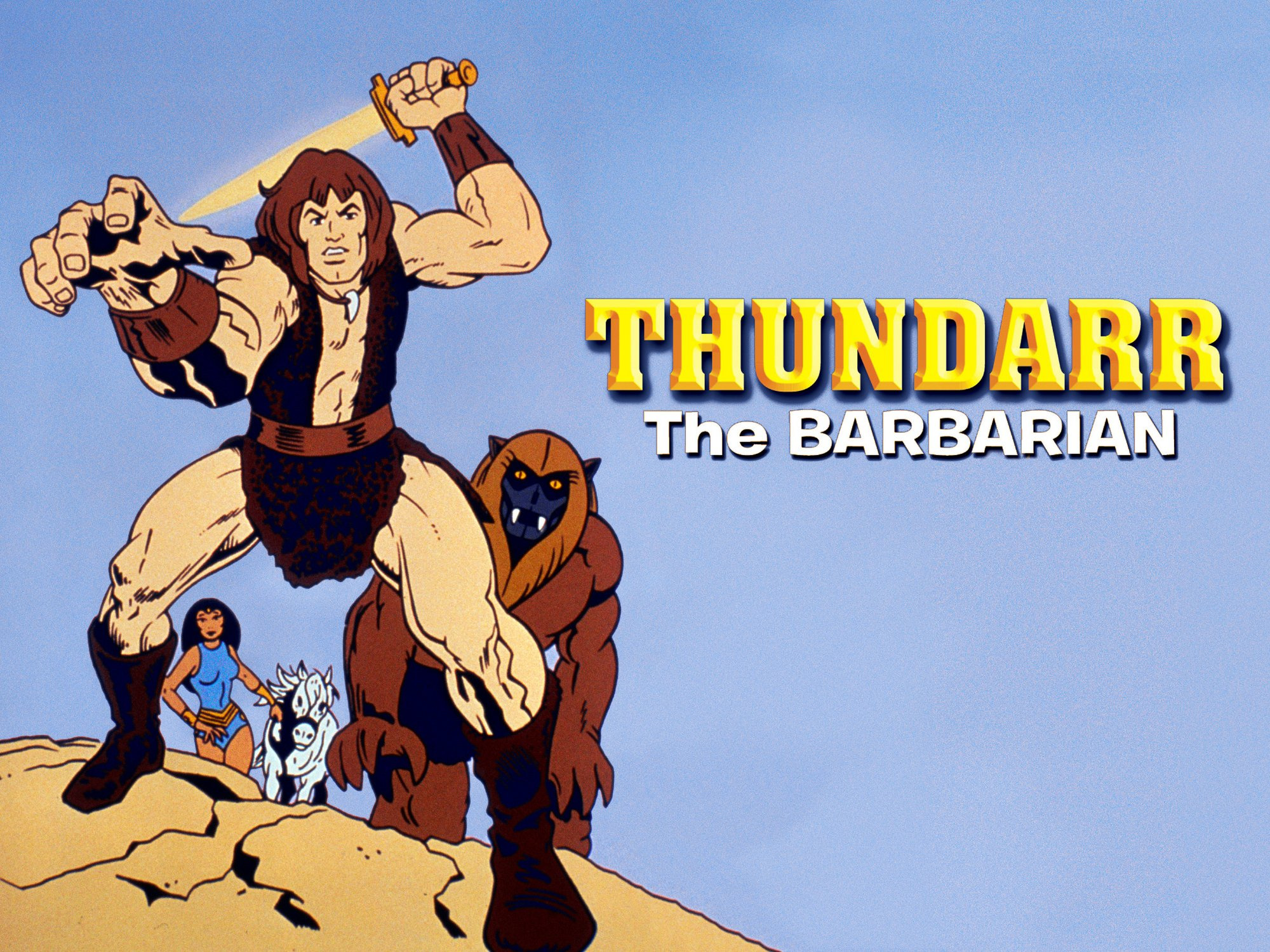 Thundarr the Barbarian (Ruby-Spears Productions/ABC, October 4, 1980 – October 31, 1981)
Thundarr the Barbarian (21 episodes; 1980-81)
Thundarr the Barbarian (Ruby-Spears Productions/ABC, October 4, 1980 – October 31, 1981)
Thundarr the Barbarian (21 episodes; 1980-81)
Created by Steve Gerber (Howard the Duck; The Defenders).
The look of the main characters was designed by Alex Toth. After he was unavailable to continue working on the series, Jack “King” Kirby was brought in, at the recommendation of Gerber and Mark Evanier (who would later write a biography of Kirby). Kirby designed the look of most of the villains and supporting characters.
What is it?What is it?? Lords of Light, it’s awesome, is what it is!
It’s an animated series that aired on ABC on Saturday mornings between 1980 and 1981. It aired in reruns on NBC in 1983.
Created in part by the legendary Jack Kirby and Alex Toth, it brought a Conan-style barbarian warrior to a distant, post-apocalyptic future, teamed him with a sorceress and a monstrous ally, and pitted the trio against all sorts of menaces that combined super-science and sorcery.
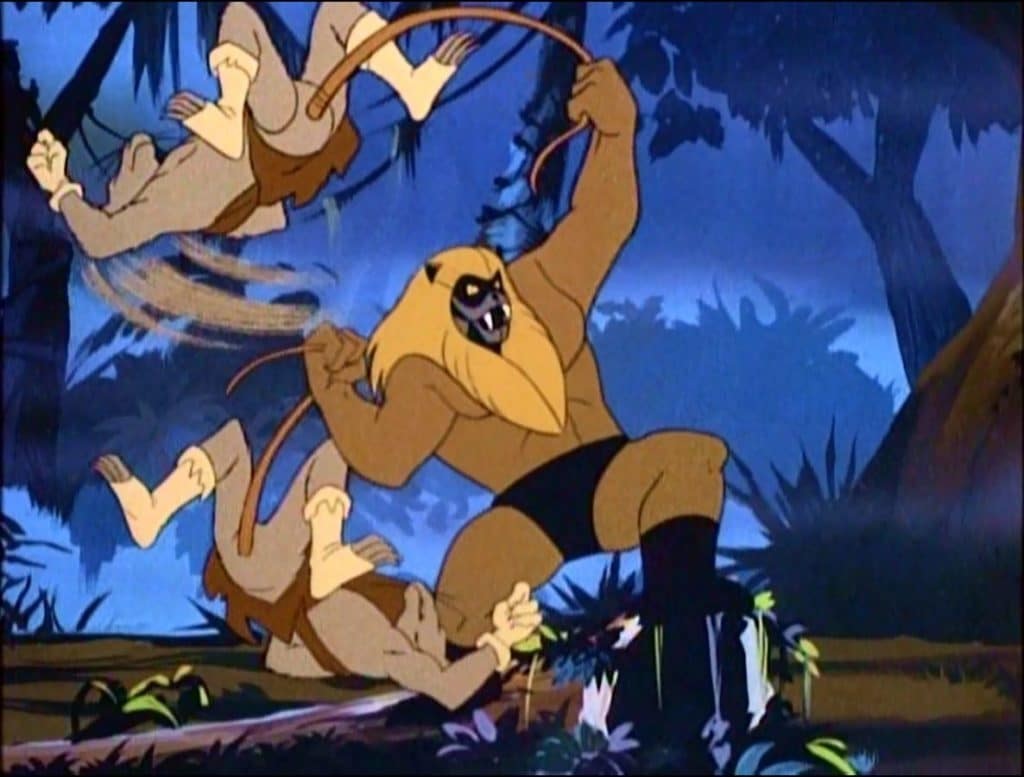 Thundarr’s companion Ookla
Noteworthy
Thundarr’s companion Ookla
Noteworthy
The show is worth it just for the character designs by Toth and Kirby. Warriors, wizards, mutants and monsters all clash amid the crumbling remains of our own civilization.
The network insisted Gerber include a monstrous Wookie-like ally for Thundarr. Gerber reluctantly agreed, but needed a name for the character. When he and writer Martin Pasko went to dinner in the Westwood area of Los Angeles, Pasko looked up at the front gates of the UCLA campus and suggested the name “Ookla.”
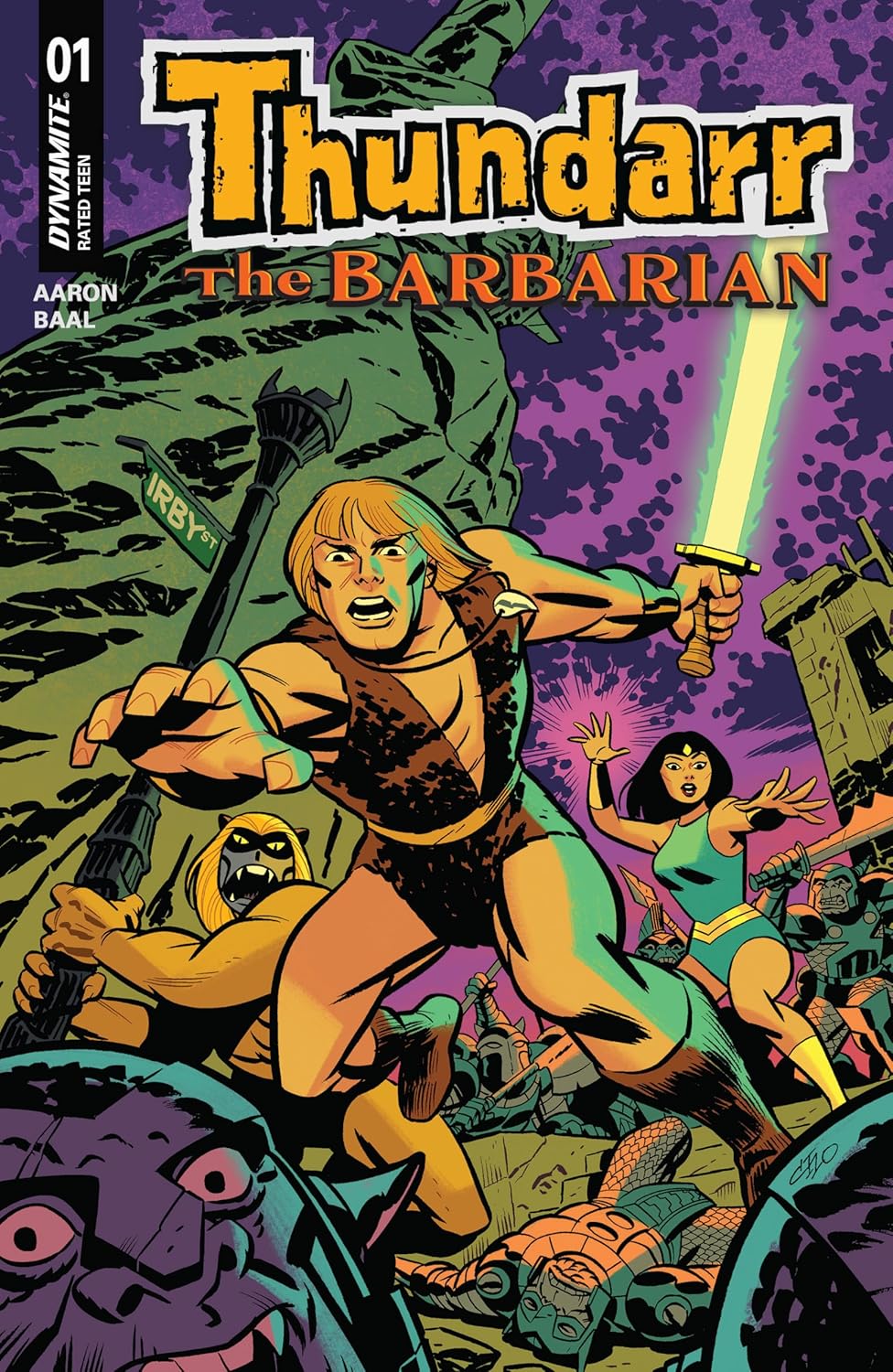 Thundarr The Barbarian issue 1, by Jason Aaron and Kewber Baal (Dynamite Entertainment, February 4, 2026)
As of 2026, there’s a new Thundarr comic book being published by Dynamite Entertainment, featuring various artists and written by Jason Aaron (Avengers; Conan).
Cartoon Network aired the show in the 1990s. The complete series was released on DVD and Blu-ray home video as recently as 2021.
 The world of Thundarr the Barbarian
Quick and Dirty Summary
The world of Thundarr the Barbarian
Quick and Dirty Summary
The opening credits of each episode present us with an origin story for Thundarr’s world, but not so much for the character himself.
The world is our own, two thousand years in the future, after a “runaway planet” (likely a comet) tears our moon in half and brings down Earth’s civilization. We are left with a world of super-science, sorcery, and savagery.
Thundarr breaks free of the slave pens and somehow acquires the “fabulous Sunsword,” enabling him to go toe-to-toe with the mightiest monsters and evil beings. Teamed up with his allies, Ookla the Mok (a furry, savage beast, in the Chewbacca mold) and Princess Ariel (a sorceress who never reveals much of anything about her past), they travel across the wrecked remains of Earth, battling evil at every turn!
 Thundarr the Barbarian
Fantasy/SF/Sword and Sorcery Elements
Thundarr the Barbarian
Fantasy/SF/Sword and Sorcery Elements
Because the show is set in the far future, after a massive, worldwide catastrophe, it is able to blend elements of science fiction (flying vehicles, lasers, and so on) with more traditional elements of fantasy and magic. The result is a particularly appealing type of Sword & Sorcery, in which the familiar tropes of the genre stand side-by-side with the ruins of contemporary settings and futuristic characters and weapons, in a sort of goulash of everything that’s cool.
There’s a proud tradition in Sword & Sorcery of that one really extra-cool weapon in a story, from the famous sword Excalibur (as in Excalibur and other films) to the Glaive (Krull) to the awesome, three-bladed rocket-sword we discussed previously (The Sword and the Sorcerer). Thundarr has just such a weapon: “the fabulous Sunsword.” We never learn exactly where he acquired it, but it’s a hilt that generates an energy blade, and is remarkably similar to the lightsaber of Star Wars. It also magnetically attaches to his wristband for easy transport when he’s not using it to hack giant rat-men to pieces.
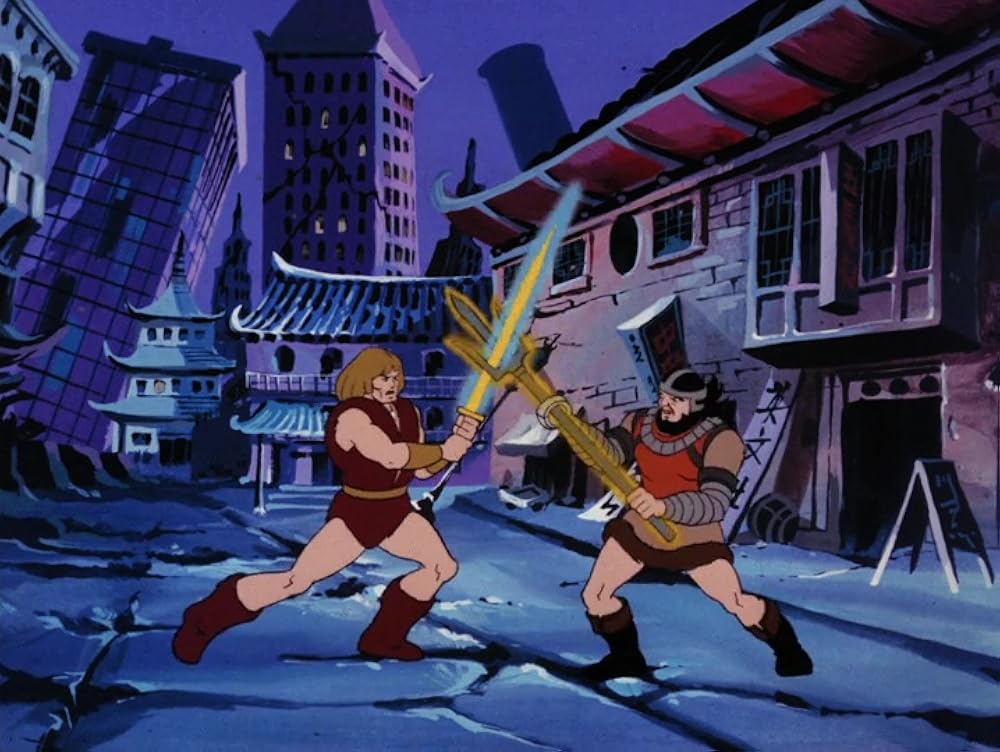 Thundarr’s fabulous Sunsword
Thundarr’s two companions are familiar Sword & Sorcery archetypes. Princess Ariel is able to cast all sorts of offensive and defensive spells, and Ookla is a mighty warrior who needs no weapons to wreak havoc on his enemies (or on helicopters, when he gets frustrated trying to fly one). All three heroes ride horses, though Ookla’s is alien in appearance and is called an “equort.”
Thundarr and company confront a wide variety of foes familiar to all sword and sorcery fans. There are mutated humanoid rats and lizards, giant monsters, werewolves, and a number of colorful wizards and sorcerers. There’s even an alien monster in the mold of The Thing! (Think Kurt Russell, not Ben Grimm.)
The intermingling of these fantasy elements with the technology of post-apocalyptic science fiction makes for an irresistible combination.
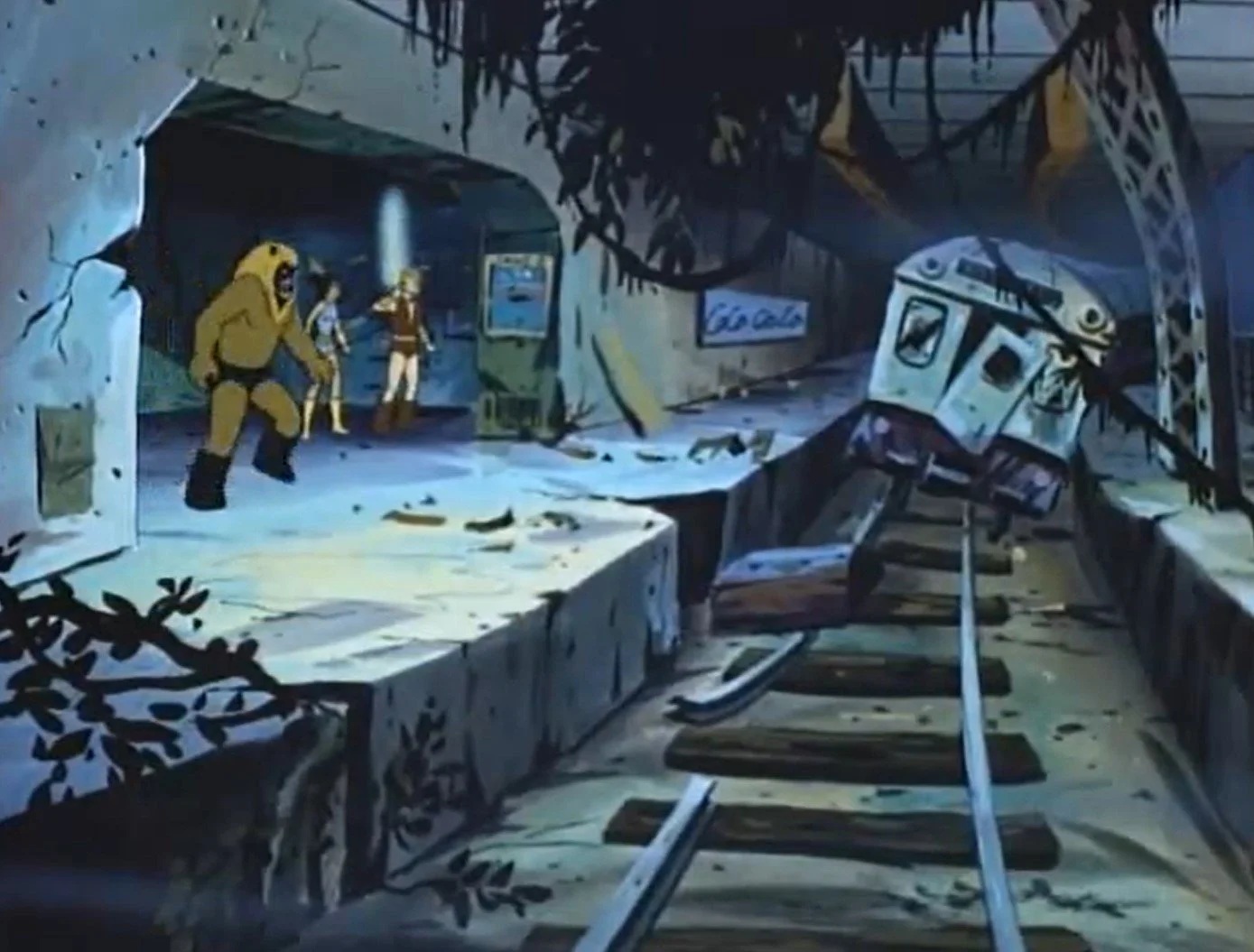 Thundarr the Barbarian, Episode 1: “Secret of the Black Pearl”
High Point
Thundarr the Barbarian, Episode 1: “Secret of the Black Pearl”
High Point
For me, the high point of the series is the premiere episode, “Secret of the Black Pearl,” in which Thundarr’s team clashes with the villain called Gemini.
One thing that perhaps held this show back a bit was its lack of an iconic recurring villain. Gemini had the potential to be that, and he did make a second appearance later in the series.
 The two faces of Gemini
He is such a perfect Jack Kirby villain, and a perfect Thundarr foe. He wears a sort of combination space-suit and Medieval armor that would let him fit in at a New Gods or Eternals family reunion. Beneath his space helmet, his face is exposed. Normally, it’s a benign face; perhaps even jolly.
But when he’s angered, his entire head swivels around 180 degrees and a different visage is revealed: One with burning red eyes that fire energy beams! Gemini embodies the “super-science meets sorcery” idea arguably better than anyone else on the show. And nobody conveys such scorn for his opponent as Gemini, when he addresses Thundarr as, “BARBAAAARIAN!!”
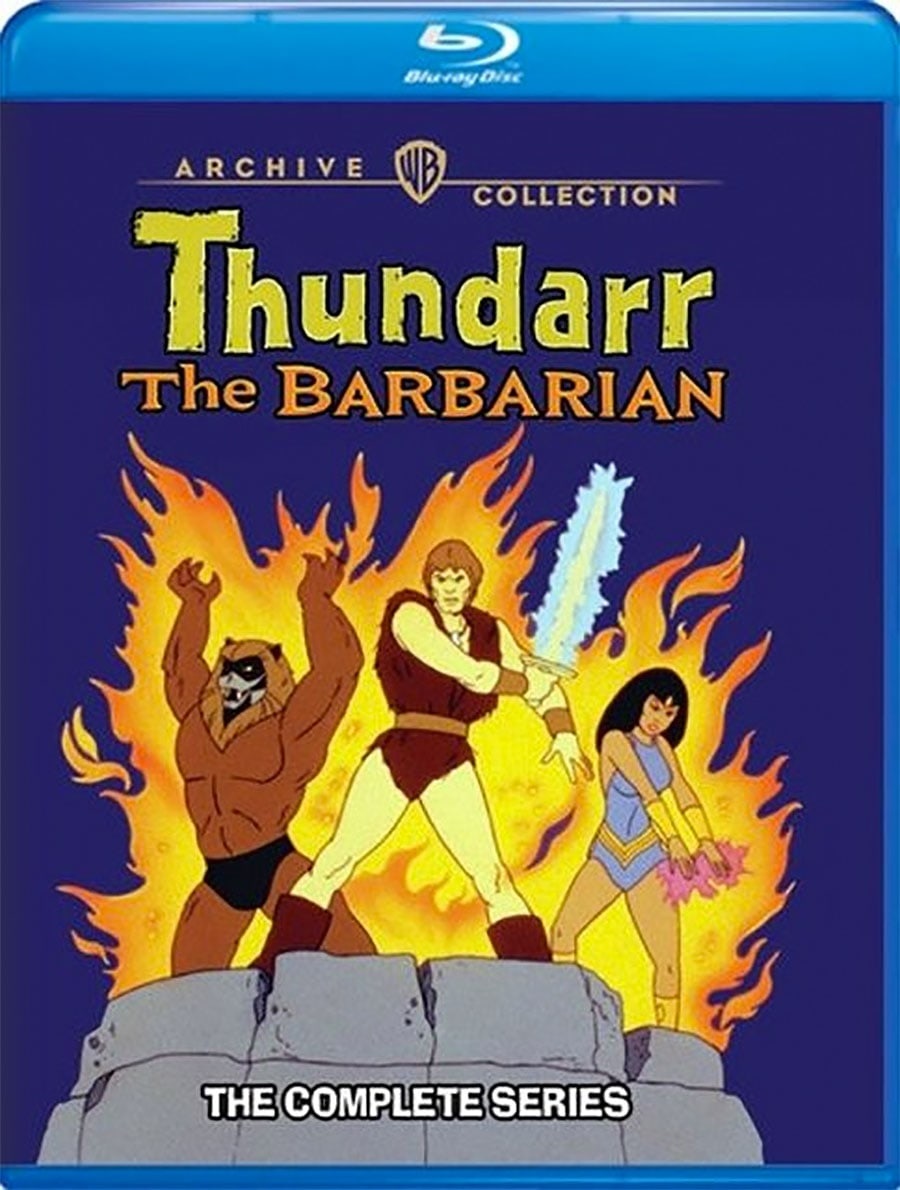 Thundarr the Barbarian: The Complete Series (Warner Archives, April 6, 2021)
Low Point
Thundarr the Barbarian: The Complete Series (Warner Archives, April 6, 2021)
Low Point
All of the episodes are written primarily for a younger audience. So, while the series is of very good quality compared to most of the shows that aired on Saturday mornings during that era, they still lack a bit in terms of stories. The potential is tremendous, but the show mostly fails to live up to the very heights it was clearly capable of reaching.
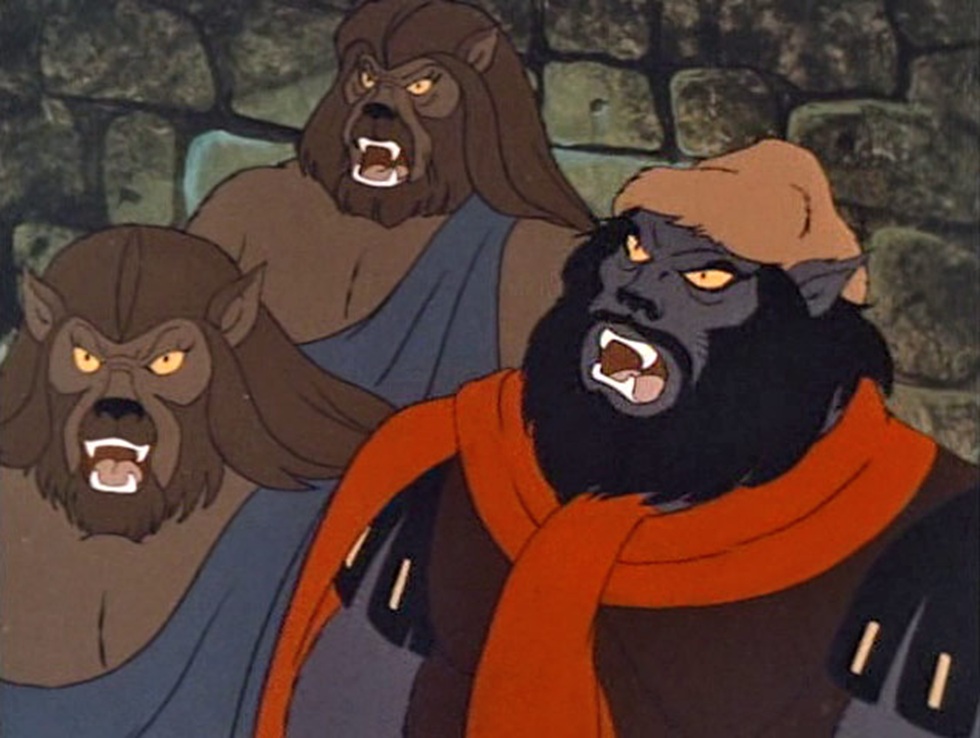 The fashionable villains of Thundarr the Barbarian
Standout Performance
The fashionable villains of Thundarr the Barbarian
Standout Performance
Robert Ridgely, a “that guy” actor who appeared in nearly everything over the years, provided the voice of Thundarr, unleashing famous catchphrases such as “Demon Dogs!” “Lords of Light!” and of course, “Ariel–Ookla–RIDE!!”
With his supremely heroic voice, Ridgley also played the title character in the fantastic 1979 animated New Adventures of Flash Gordon series.
Nellie Bellflower voiced Princess Ariel, as well as a number of other female characters.
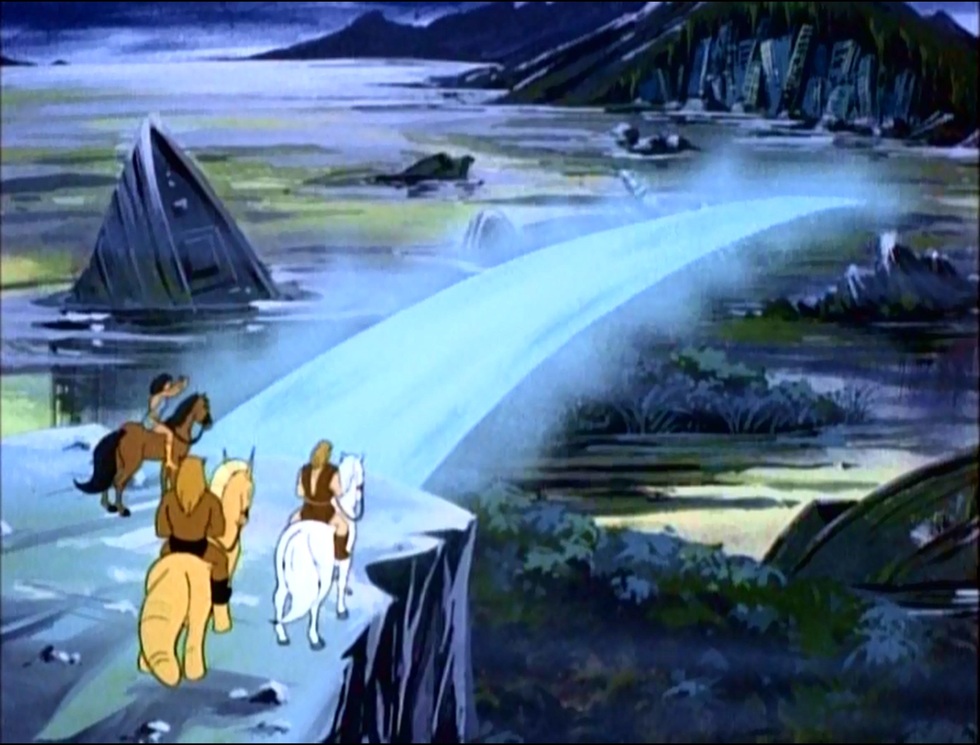 The road goes ever on
Overall Evaluation as a Movie and as Fantasy/SF/Sword & Sorcery
The road goes ever on
Overall Evaluation as a Movie and as Fantasy/SF/Sword & Sorcery
It’s not a movie, but Thundarr the Barbarian is as Sword & Sorcery as you can get. The genre comes in a number of sub-forms, and I’d call this one the “post-apocalyptic fantasy world” variety, where you’re as likely to encounter a giant, sorcery-animated Statue of Liberty as a werewolf or a rat-man.
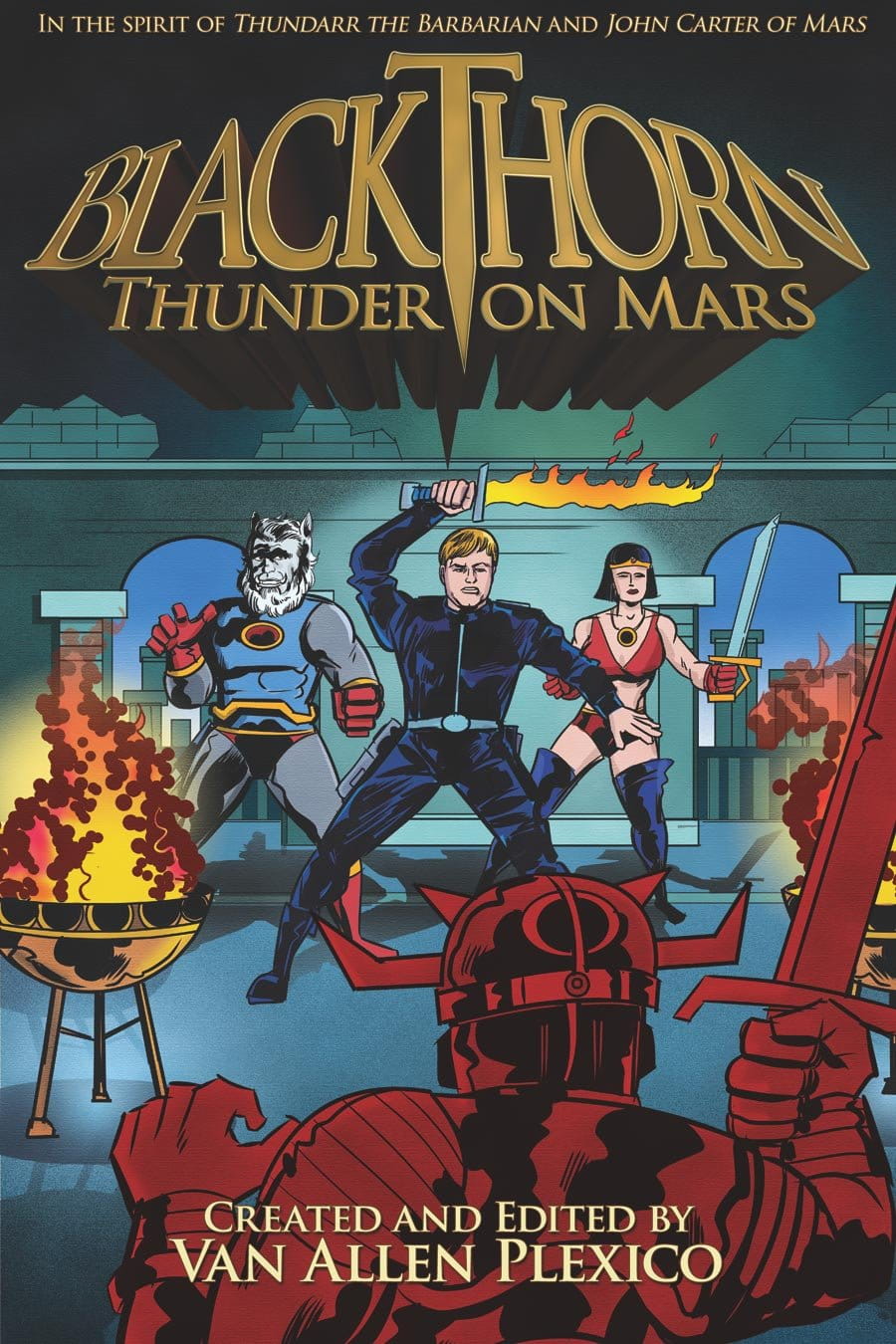 Blackthorn Thunder on Mars, edited by Van Allen Plexico (White Rocket Books, November 26, 2011)
For a Saturday morning cartoon, the writing is surprisingly intelligent and clever. It’s unfortunate they never gave us more backstory to the characters, but that was a common thing among TV shows and cartoons of that era: Minimal information to get us up to speed, and then off we go.
Unfortunately, we never did encounter those danged Demon Dogs!
Van Allen Plexico once edited an anthology of tales set in a Thundarr-style post-apocalyptic future of super-science and sorcery, called Blackthorn: Thunder on Mars. He is a member of the Science Fiction and Fantasy Writers of America (SFWA), a Grand Master of Pulp Literature (2025 class) and a multiple-award-winning author of more than two dozen novels and anthologies, ranging from space opera to Kaiju to crime fiction to superheroes to military SF. Find his works on Amazon and at www dot Plexico dot net.
Categories: Fantasy Books
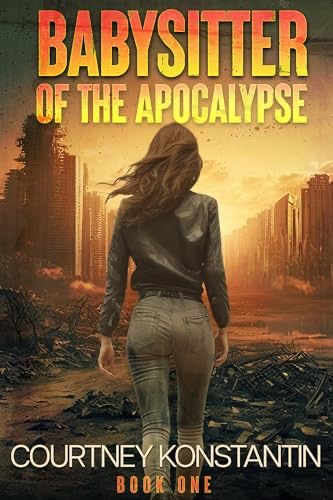
Babysitter of the Apocalypse (by Courtney Konstantin)
Zompoc
When the world ended Vicki was quite happy drinking herself into oblivion. Until her neighbor hammered on her door and asked her to look after her two young girls, Gabby aged 5 and Tina aged 2 while she went out looking for her sister. Her neighbor never returned and now Vicki a borderline alcoholic has found herself looking after two young children the oldest of whom is quite happy pointing out her flaws.
As they navigate the fallen world they make friends and lose friends, they encounter bandits and live with the ever present threat of zombies as they search for a safe place to be.
––––––––––––––––––––––––––––––––––––––––––––––––––––––––––––––––––––––––
If you enjoy Post-Apocalypse / Zompoc there aren’t too many better than this series. I read her previous <i>Sundown</i> series, well I read the first two books and the novella and didn’t like it nearly as much. Babysitter of the Apocalypse is right up there with Sarah Lyons Fleming. Great and it joins my list of “must read” books when the next instalment comes out.
Categories: Fantasy Books
Book review: Colleen the Wanderer by Raymond St. Elmo

ABOUT THE AUTHOR:
Publisher: St. Elmo (July 14, 2024) Length: 385 pages Formats: ebook
Raymond St. Elmo’s Colleen the Wanderer is the second book set in the same world as Barnaby the Wanderer. It’s a tighter story with fewer pages, fewer characters, and a much more personal focus. For me, that shift worked well. We spend most of the time following Colleen as she moves through a strange world full of saints, monsters, and the occasional odd conversation.
I liked it. That’s not exactly a surprise. I generally like St. Elmo’s writing, and this book delivers many of the things that make his work distinctive.
Colleen herself is a good lead. She’s practical to a fault. She doesn’t want adventure, destiny, or glory. She wants people to leave her alone so she can make pots. Alas, the world has other plans. Saints interfere, monsters appear, dreams intrude, and somehow she ends up wandering whether she wants to or not.
The wandering really is the point. The plot exists, but it’s loose and often takes a back seat to encounters along the road. Colleen meets a steady parade of odd creatures, hermits, and supernatural oddities ("miscreates," as the book calls them) Some are funny, some unsettling, some just strange.
The tone sits somewhere between classic fantasy adventure and something more whimsical. St. Elmo has said he was aiming for a style similar to Andre Norton’s Witch World books, but he admits he can’t quite write without humor creeping in. That’s obvious here. The world may be full of saints and fate and mysterious forces, but the dialogue often undercuts any attempt at solemnity. Characters talk like people who are aware that the situation is absurd. It keeps the book lively.
As always with St. Elmo, the prose is one of the main draws. It’s sharp, playful, and occasionally very funny without trying too hard. The dialogue in particular works well.
That said, the structure is a little uneven.
The opening takes a while to settle in. The first stretch is slightly confusing and slow, partly because the world operates on its own strange logic and the book doesn’t rush to explain it. Things improve once Colleen properly hits the road and the story finds its rhythm.
The ending goes the other way. After spending so much time wandering and meeting odd characters, the conclusion arrives fairly quickly. It ties the threads together, but it felt a bit abrupt. I wouldn’t have minded another chapter or two.
Still, the experience of reading the book is enjoyable. The story has a dreamlike quality where events make just enough sense to keep you moving forward. You don’t always know where things are going, but you trust the author to get you somewhere interesting.
If you’ve read Barnaby the Wanderer, you’ll notice a few familiar faces showing up briefly. They’re more like cameos than major roles, though, and the book mostly stands on its own. The focus stays firmly on Colleen.
In the end, Colleen the Wanderer is imaginative, occasionally funny, and full of peculiar creatures and conversations. The pacing wobbles a bit at the beginning and end, but the middle stretch - the actual wandering - is consistently engaging.
Categories: Fantasy Books
Book review: Nothing Tastes As Good by Luke Dumas

Book links: Amazon, Goodreads
ABOUT THE AUTHOR: Luke Dumas is the USA Today bestselling author of Nothing Tastes as Good, The Paleontologist, and A History of Fear.
He is the winner of a 2024 ITW Thriller Award for Best Paperback Original, was nominated for the Silver Falchion Award for Best Supernatural, and his work has been optioned for film and TV.
He received his master’s degree in creative writing from the University of Edinburgh, and has worked in nonprofit philanthropy for more than a decade with organizations including San Diego Zoo Wildlife Alliance and the American Red Cross.
Luke was born and raised in San Diego, California, where he lives with his husband and dogs and works for a biomedical research institute.
Publisher: Atria Books (March 31, 2026) Page count: 352 Formats: audiobook, ebook, paperback Genre: Horror (ish)
I ended up liking Nothing Tastes as Good quite a bit. It’s easy to fly through it. I listened to the audiobook and kept telling myself "just one more chapter" most of the time.
This leans much more toward thriller than straight horror for me, even with the body horror and cannibalism stuff lurking in the background. The story follows Emmett and how badly the world treats him because of his weight. That part felt believable. The book does a really good job showing how exhausting it is to constantly feel judged, dismissed, or turned into a "before" picture by society.
Emmett worked well as a protagonist too. He’s funny, insecure, and desperate to finally feel comfortable in his own life and body. When he joins the clinical trial for the weight loss drug Obexity, you immediately know this cannot possibly end well. And yet I completely understood why he kept going even after things started getting very weird and very bloody.
The horror elements are there, but they’re sparse. This is more about paranoia, obsession, body image, social media, and the realization that people suddenly treat you better once you look different. Actually, some of the most uncomfortable moments weren’t the gore. It was seeing how differently people reacted to Emmett after he lost weight.
I also liked the mixed format with blog posts, interviews, and reports scattered throughout the story. It kept things moving and made the audiobook especially fun to listen to.
The final act gets pretty over-the-top, and I can't say I was a fan. The villains and their motivations turned paper-thin and shallow and the rushed ending disappointed. I'm ok with Emmett's fate, but not of the road that led to it.
Anyway, it's a good book, and very engaging most of the time. Luke Dumas clearly had a lot to say about diet culture and self-worth, but never forgot to make it entertaining too. Maybe not especially scary, but definitely engaging, gross in places, and very hard to stop listening to.
Categories: Fantasy Books
MAKE ME BETTER by Sarah Gailey
Anybody who has read Sarah Gailey knows she crafts unflinching narratives. Make Me Better is the third novel I’ve read by Gailey and it is something to experience. Set in Kindred Cove, a location separated by the world at large, Gailey introduces readers to Celia. Who is Celia? She’s a woman looking to become better,…
Categories: Fantasy Books
Spotlight on “Bridging the Rivers of Difference” Catherine Meeks
LitStack Spots Here are a few other titles that we’re definitely adding to our TBR…
The post Spotlight on “Bridging the Rivers of Difference” Catherine Meeks appeared first on LitStack.
Categories: Fantasy Books
A (Black) Gat in the Hand: All My Steeger Books Intros
 It’s mid-May, and I’ve been in something of a hardboiled mood lately. So with Summer looming, here’s a Black (Gat) in the Hand. More Pulp is coming, like a gumshoe with a gasper and a rod.
I am fortunate to be part of a star-studded roster of writers who provide intros to Pulp reprints from Steeger Books. More and more classic, and forgotten, Pulp is continually being brought back to print – and electronically as well. I just finished my tenth intro, and that will roll out with number eleven, later this year.
Below you can find links to all nine of the intros that have been printed so far. Plus a bonus one that didn’t quite make it. If you like what I had to say, you might be interested in checking out the books themselves. You’ll likely recognize at least a couple of the names below. But I cannot praise the Max Latin stories by Norbert Davis, enough. I have the audiobook, and that’s my bedtime listening multiple times a week, all year long. Love those stories.
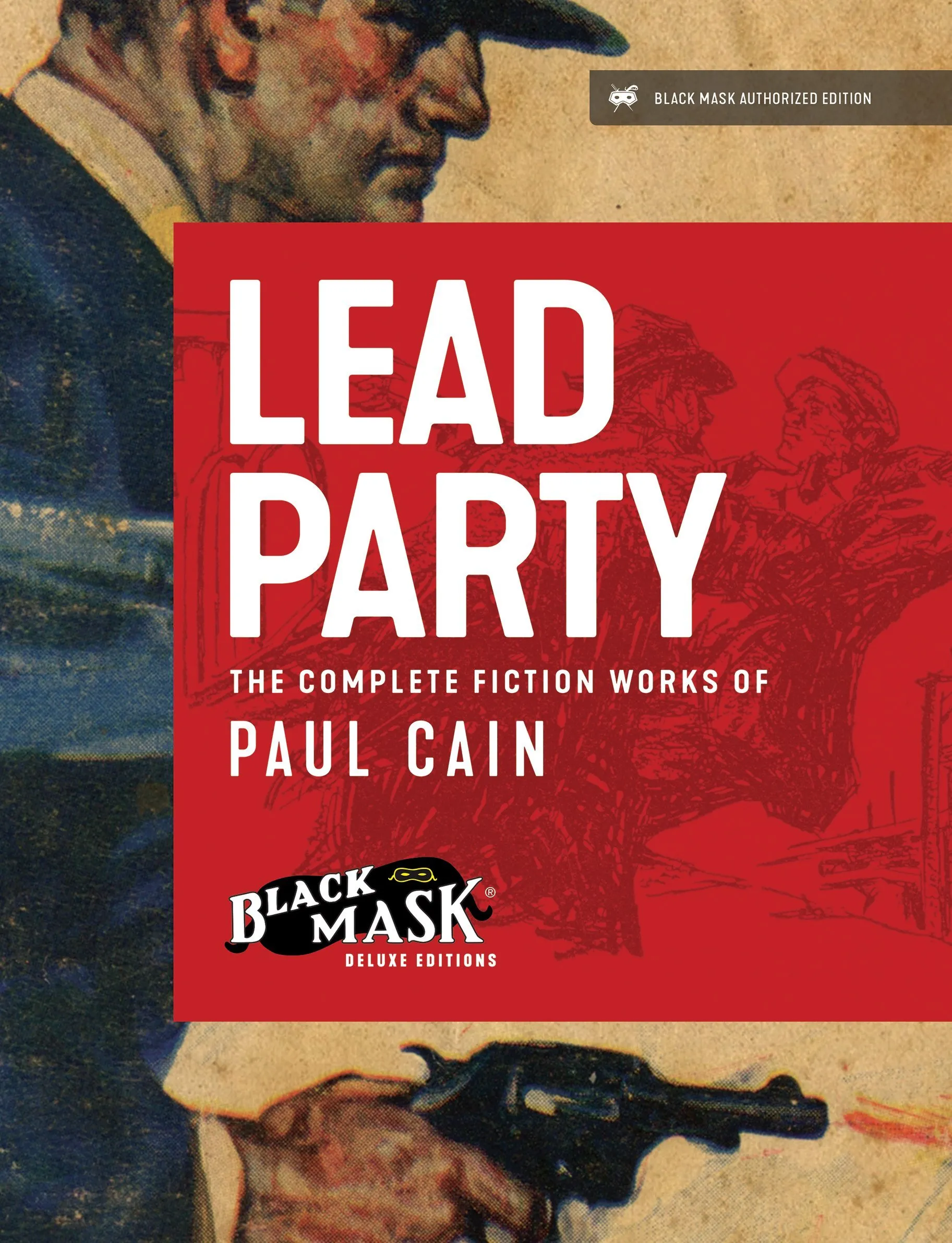
FAST ONE (Paul Cain)Lead Party has all of Paul Cain’s short stories, as well as his lone novel, Fast One. Mine is one of five essays in this deluxe hardback. And I got to write about Fast One!
Raymond Chandler referred to it as “some kind of high point in the hardboiled manner.” I think this is a nearly flawless book, and it rivals The Maltese Falcon as my favorite Hardboiled novel. If you haven’t read it, you’re missing out on one of the best works in the genre.
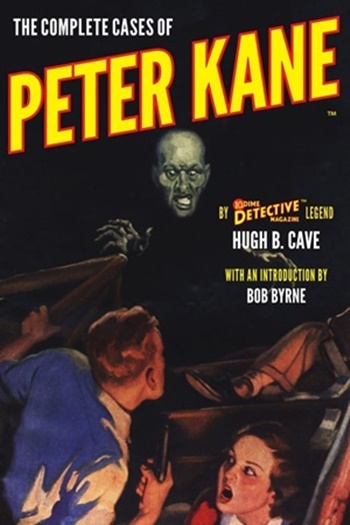
PETER KANE (Hugh B. Cave)My first intro for Steeger covered the six Peter Kane stories. Kane worked for Boston’s Beacon Agency. He was big, and the closest he got to sober was dry drunk. Other ‘hard-drinking’ Pis are pikers compared to him.
Cave was a master of Weird Menace, but only one of the stories ventured down that path. Maybe a little odd here or there, but Cave knew how to write ‘straight’ hardboiled, and I think Kane was hist best example.
MAX LATIN (Norbert Davis)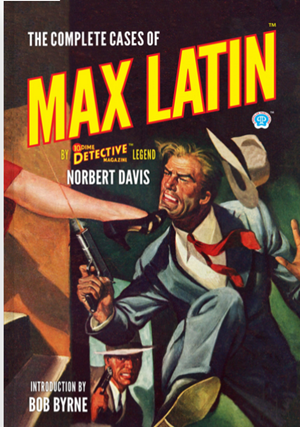 I’ve said many times, if there was a Norbert B. Davis fan club, I’d probably be the President of it. And his Dime Detective stories about a shady PI who operates out of a restaurant booth, are in my Top Five mystery series’. John D. MacDonald’s last paid work was a cranky intro to these stories. I was thrilled to write a new one – ‘replacing’ my favorite writer from any genre.
These stories have humor, but fall short of screwball comedy. And the cast of characters make these very re-readable. HIGHLY recommended.
BEN SHALEY (Norbert Davis)This is the first collection of Black Mask stories from Davis – including his Ben Shaley tales. These are mostly ‘straight’ stories, with only glimpses of the humor that Davis was known for.
There were only two Shaley stories, which is a shame. Davis definitely could have had an ongoing series in Black Mask with him. Raymond Chandler said that “Red Goose” impressed him more than any other tale he read when he decided to become a hardboiled writer.
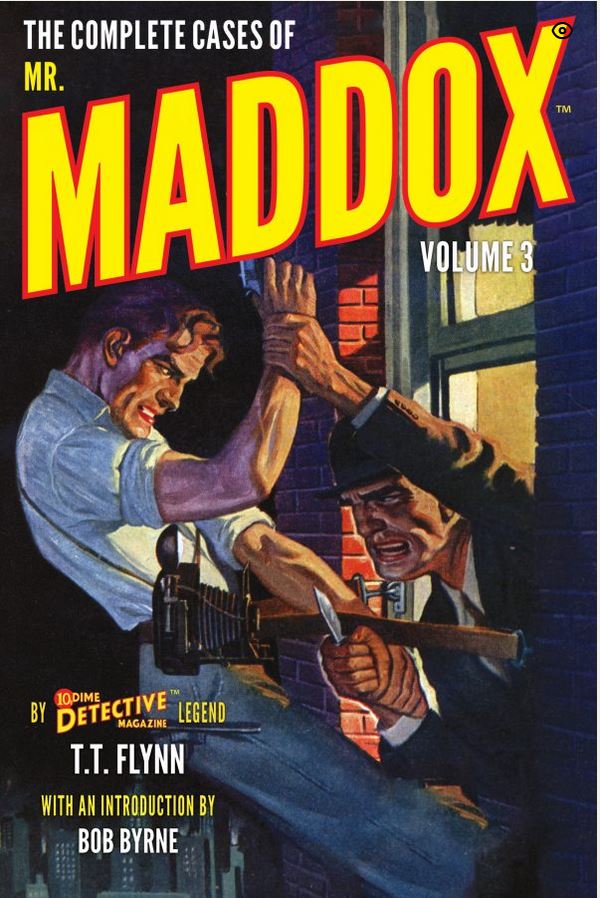
I jumped in late for this series. Mr. Maddox is a bookie, making the rounds of the thoroughbred racing circuit each year. He regularly runs across a murder, and bad guys push him into going up against them. He essentially functions like your typical private eye. It’s neat to get an inside look at the horse-racing world of the forties.
These are long stories – legitimately novella length. They are not quick reads like most of the short stories I do intros for. But by using a horse track bookie, they stand out from the more common PI/cop/reporter tales.
CONTINENTAL OP – VOL 1 (Dashiell Hammett) CONTINENTAL OP – VOL 2 (Dashiell Hammett) CONTINENTAL OP – VOL 3 (Dashiell Hammett)Steeger is reprinting every Continental Op story from Hammett. The short, fat, honorable – and unnamed – private eye for the Continental Detective Agency, showcases the best of Hammett. And Red Harvest (which will be covered in Volume 4) is right up there alongside Fast One for hardboiled action.
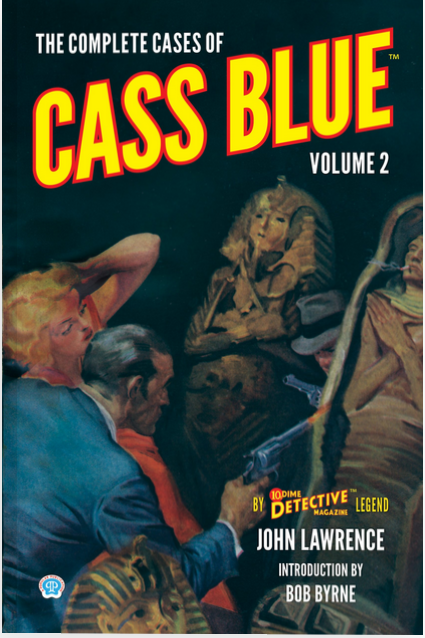
CASS BLUE – VOL 2 (John Lawrence)In between his Dime Detective series’ Sam Beckett, and the Marquis of Broadway, the prolific thirties Pulpster wrote about tough guy Cass Blue. Though there was something of an Agatha Christie ‘country manor’ vibe to several of the stories. It was a bit of a change up for Dime Detective readers.
MIKE & TRIXIE (T.T. Flynn)So, I missed the deadline for the first Mike & Trixie book from Steeger (there have been three so far). I ended up with a homeless intro, so I posted it here at Black Gate. Click on over. You can be one of the very few people on the planet to have read it.
Though that applies to quite a few things I’ve written.
It’s gonna be another Summer of Pulp, and I’m hoping to have a Frederick Nebel surprise in the Fall. Next up, maybe I’ll dig a little deeper into Rex Sackler. I wrote a post after having only read one story. I like him even more after finishing off Volume 1 from Steeger.
We’re a hundred-ish years into Pulp, and I still enjoy reading it. So do a lot of folks I know. Look at the links below, and check out an essay or two written by myself, and some friends. The Pulp world lies at your feet.
Prior Posts in A (Black) Gat in the Hand – 2025 (12)
 Will Murray on Dash(iell Hammet) and (Lester) Dent
Shelfie – Dashiell Hammett
Windy City Pulp & Paper Fest – 2025
Will Murray on Who was N.V. Romero?
Conan – The Phoenix in the Sword in Weird Tales
More of Robert E. Howard’s Kirby O’Donnell
More Weird Menace from Robert E. Howard – Conrad and Kirowan
Hardboiled Gaming- LA Noire
Western Noir: Hell on Wheels
T.T. Flynn’s Mr Maddox
Dashiell Hammettt’s The Scorched Face (my intro)
Will Murray on Raymond Chandler’s Other Lost Stories?
Prior Posts in A (Black) Gat in the Hand – 2024 Series (11)
Will Murray on Other Lost Raymond Chandler Stories?
Will Murray on Dashiell Hammett’s Elusive Glass Key
Ya Gotta Ask – Reprise
Rex Stout’s “The Mother of Invention”
Dime Detective, August, 1941
John D. MacDonald’s “Ring Around the Readhead”
Harboiled Manila – Raoul Whitfield’s Jo Gar
7 Upcoming A (Black) Gat in the Hand Attractions
Paul Cain’s Fast One (my intro)
Dashiell Hammett – The Girl with the Silver Eyes (my intro)
Richard Demming’s Manville Moon
More Thrilling Adventures from REH
Prior Posts in A (Black) Gat in the Hand – 2023 Series (15)
Back Down those Mean Streets in 2023
Will Murray on Hammett Didn’t Write “The Diamond Wager”
Dashiell Hammett – ZigZags of Treachery (my intro)
Ten Pulp Things I Think I Think
Evan Lewis on Cleve Adams
T,T, Flynn’s Mike & Trixie (The ‘Lost Intro’)
John Bullard on REH’s Rough and Ready Clowns of the West – Part I (Breckenridge Elkins)
John Bullard on REH’s Rough and Ready Clowns of the West – Part II
William Patrick Murray on Supernatural Westerns, and Crossing Genres
 Erle Stanley Gardner’s ‘Getting Away With Murder (And ‘A Black (Gat)’ turns 100!)
James Reasoner on Robert E. Howard’s Trail Towns of the old West
Frank Schildiner on Solomon Kane
Paul Bishop on The Fists of Robert E. Howard
John Lawrence’s Cass Blue
Dave Hardy on REH’s El Borak
Prior posts in A (Black) Gat in the Hand – 2022 Series (16)
Asimov – Sci Fi Meets the Police Procedural
The Adventures of Christopher London
Weird Menace from Robert E. Howard
Spicy Adventures from Robert E. Howard
Thrilling Adventures from Robert E. Howard
Norbert Davis’ “The Gin Monkey”
Tracer Bullet
Shovel’s Painful Predicament
Back Porch Pulp #1
Wally Conger on ‘The Hollywood Troubleshooter Saga’
Arsenic and Old Lace
David Dodge
Glen Cook’s Garrett, PI
John Leslie’s Key West Private Eye
Back Porch Pulp #2
Norbert Davis’ Max Latin
Prior posts in A (Black) Gat in the Hand – 2021 Series (7 )
The Forgotten Black Masker – Norbert Davis
Appaloosa
A (Black) Gat in the Hand is Back!
Black Mask – March, 1932
Three Gun Terry Mack & Carroll John Daly
Bounty Hunters & Bail Bondsmen
Norbert Davis in Black Mask – Volume 1
Prior posts in A (Black) Gat in the Hand – 2020 Series (21)
 Hardboiled May on TCM
Some Hardboiled streaming options
Johnny O’Clock (Dick Powell)
Hardboiled June on TCM
Bullets or Ballots (Humphrey Bogart)
Phililp Marlowe – Private Eye (Powers Boothe)
Cool and Lam
All Through the Night (Bogart)
Dick Powell as Yours Truly, Johnny Dollar
Hardboiled July on TCM
YTJD – The Emily Braddock Matter (John Lund)
Richard Diamond – The Betty Moran Case (Dick Powell)
Bold Venture (Bogart & Bacall)
Hardboiled August on TCM
Norbert Davis – ‘Have one on the House’
with Steven H Silver: C.M. Kornbluth’s Pulp
Norbert Davis – ‘Don’t You Cry for Me’
Talking About Philip Marlowe
Steven H Silver Asks you to Name This Movie
Cajun Hardboiled – Dave Robicheaux
More Cool & Lam from Hard Case Crime
A (Black) Gat in the Hand – 2019 Series (15)
Back Deck Pulp Returns
A (Black) Gat in the Hand Returns
Will Murray on Doc Savage
Hugh B. Cave’s Peter Kane
Paul Bishop on Lance Spearman
A Man Called Spade
Hard Boiled Holmes
Duane Spurlock on T.T. Flynn
Andrew Salmon on Montreal Noir
Frank Schildiner on The Bad Guys of Pulp
Steve Scott on John D. MacDonald’s ‘Park Falkner’
William Patrick Murray on The Spider
John D. MacDonald & Mickey Spillane
Norbert Davis goes West(ern)
 Bill Crider on The Brass Cupcake
A (Black) Gat in the Hand – 2018 Series (32)
George Harmon Coxe
Raoul Whitfield
Some Hard Boiled Anthologies
Frederick Nebel’s Donahue
Thomas Walsh
Black Mask – January, 1935
Norbert Davis’ Ben Shaley
D.L. Champion’s Rex Sackler
Dime Detective – August, 1939
Back Deck Pulp #1
W.T. Ballard’s Bill Lennox
Erle Stanley Gardner’s The Phantom Crook (Ed Jenkins)
Day Keene
Black Mask – October, 1933
Back Deck Pulp #2
Black Mask – Spring, 2017
Erle Stanley Gardner’s ‘The Shrieking Skeleton’
Frank Schildiner’s ‘Max Allen Collins & The Hard Boiled Hero’
A (Black) Gat in the Hand: William Campbell Gault
A (Black) Gat in the Hand: More Cool & Lam From Hard Case Crime
MORE Cool & Lam!!!!
Thomas Parker’s ‘They Shoot Horses, Don’t They?’
Joe Bonadonna’s ‘Hardboiled Film Noir’ (Part One)
Joe Bonadonna’s ‘Hardboiled Film Noir’ (Part Two)
William Patrick Maynard’s ‘The Yellow Peril’
Andrew P Salmon’s ‘Frederick C. Davis’
Rory Gallagher’s ‘Continental Op’
Back Deck Pulp #3
Back Deck Pulp #4
Back Deck Pulp #5
Joe ‘Cap’ Shaw on Writing
Back Deck Pulp #6
The Black Mask Dinner
 Bob Byrne’s ‘A (Black) Gat in the Hand’ made its Black Gate debut in 2018 and has returned every Summer since.
His ‘The Public Life of Sherlock Holmes’ column ran every Monday morning at Black Gate from March, 2014 through March, 2017. And he irregularly posts on Rex Stout’s gargantuan detective in ‘Nero Wolfe’s Brownstone.’ He is a member of the Praed Street Irregulars, and founded www.SolarPons.com (the only website dedicated to the ‘Sherlock Holmes of Praed Street’).
He organized Black Gate’s award-nominated ‘Discovering Robert E. Howard’ series, as well as the award-winning ‘Hither Came Conan’ series. Which is now part of THE Definitive guide to Conan. He also organized 2023’s ‘Talking Tolkien.’
He has contributed stories to The MX Book of New Sherlock Holmes Stories — Parts III, IV, V, VI, XXI, and XXXIII.
He has written introductions for Steeger Books, and appeared in several magazines, including Black Mask, Sherlock Holmes Mystery Magazine, The Strand Magazine, and Sherlock Magazine.
You can definitely ‘experience the Bobness’ at Jason Waltz’s ’24? in 42′ podcast.
Categories: Fantasy Books
Early Review – Letters from the Last Apothecary (Tressport Magic, Book 1) by Bita Behzadi (4/5 stars)

Reading Level: Adult
Genre: Historical Fantasy
Length: 368 pages
Publisher: Hay House LLC
Release Date: June 9, 2026
ASIN: B0FQG3SPC1
Stand Alone or Series: 1st book in the Tressport Magic series
Source: eGalley from NetGalley
Rating: 4/5 stars
“Struggling against a tide of anti-magic sentiment amidst the city’s rapid industrialization, the shop is slated to close in six short months unless Josie can save it. Luckily, she’s no stranger to impossible odd—she’s applying to study magic at the local university, something women are typically excluded from—even as the shop’s prickly apothecarist, Aufidius Reid, seems determined to dislike her.
Reid finds her unbearably insistent. She finds him infuriatingly uptight—nothing like the sensitive scholar Josie has been exchanging anonymous letters with as they study together for entrance to a graduate magic program. A scholar who just so happens to be Reid himself, unbeknownst to either of them.
Letter by letter, they fall in love. But at work, Josie and Reid clash constantly about the direction of the business. As pressure rises, they discover the threat to the shop is more dangerous than they could have ever imagined, and working together to save it might be their only chance at true purpose, and at each other.”
Series Info/Source: This is the 1st book in the Tressport Magic series. I got this on ebook for review through NetGalley.
Thoughts: This is the first book in the Tressport Magic series. I really love how much detail and thought the author puts into developing the magic system here. However, this is incredibly slow for the first 50% of the book, to the point where I almost set it aside. Luckily, the pace really picks up mid-book, and I ended up being very happy I stuck with the story and finished it.
The story switches POV between Josie and Reid. Our main heroine, Josie, practices the more structured form of magic (which is frowned on for women) and is determined to go to the magical university to advance her studies. However, she needs a job over the summer while she waits to find out if she’s been admitted. She ends up with a job at an apothecary to make ends meet. Reid is also trying to get into the same magical university but is stuck helping to run a nearly bankrupt apothecary shop while he waits for his admission response. Josie is a disruption to Reid’s summer that he was neither prepared for nor wanted.
This is set in a sort of generic Victorian city, but a city where magic is real. There are a couple types of magic, a more intuitive magic and a more structured magic.
Between each chapter, there are letters between Josie and a man that she met via correspondence. These alternate with intervals between chapters in which we read letters between Reid and a woman he met via correspondence. This was a unique way to format the book and enables us to get to know Josie’s and Reid’s internal thoughts much more quickly. Unfortunately, this is part of why the book was so slow. Some of these letters feel very drawn out, and it slows the story down. As you might guess, this gives the story a similar feel to Rebecca Ross’s “Letters of Enchantment” series. This book would have felt a lot more unique if I hadn’t already read “Letters of Enchantment,” which uses a similar mechanic of secret letters.
After the first half, I ended up enjoying this book and finished it very quickly. It took me four days to read the first 50% and one day to finish the rest. There are a lot of themes here I like; a woman pursuing research studies in the face of adversity, a tight family, and a sort of enemies to lovers relationship that grows from daily work and understanding. I liked the magic in here and found this to be an interesting world as well.
My Summary (4/5): Overall the first half of this book was painfully slow, but the second half made up for that. I enjoyed the magic system and world-building here. I also liked the idea of getting to know our characters’ inner thoughts through letters, but the way this was done was so similar to Ross’s “Letter of Enchantment” series that it felt copied. Reid and Josie were fun characters to read about and I look forward to spending more time with both them and this intriguing magical world in the next book in this series. I would recommend this to readers who enjoy a sort of magical alternate history Victorian setting, like a scholarly theme to their stories, and enjoy a good enemies to lovers sort of romance.

Categories: Fantasy Books
Roger Zelazny, Master Craftsman of Fantasy
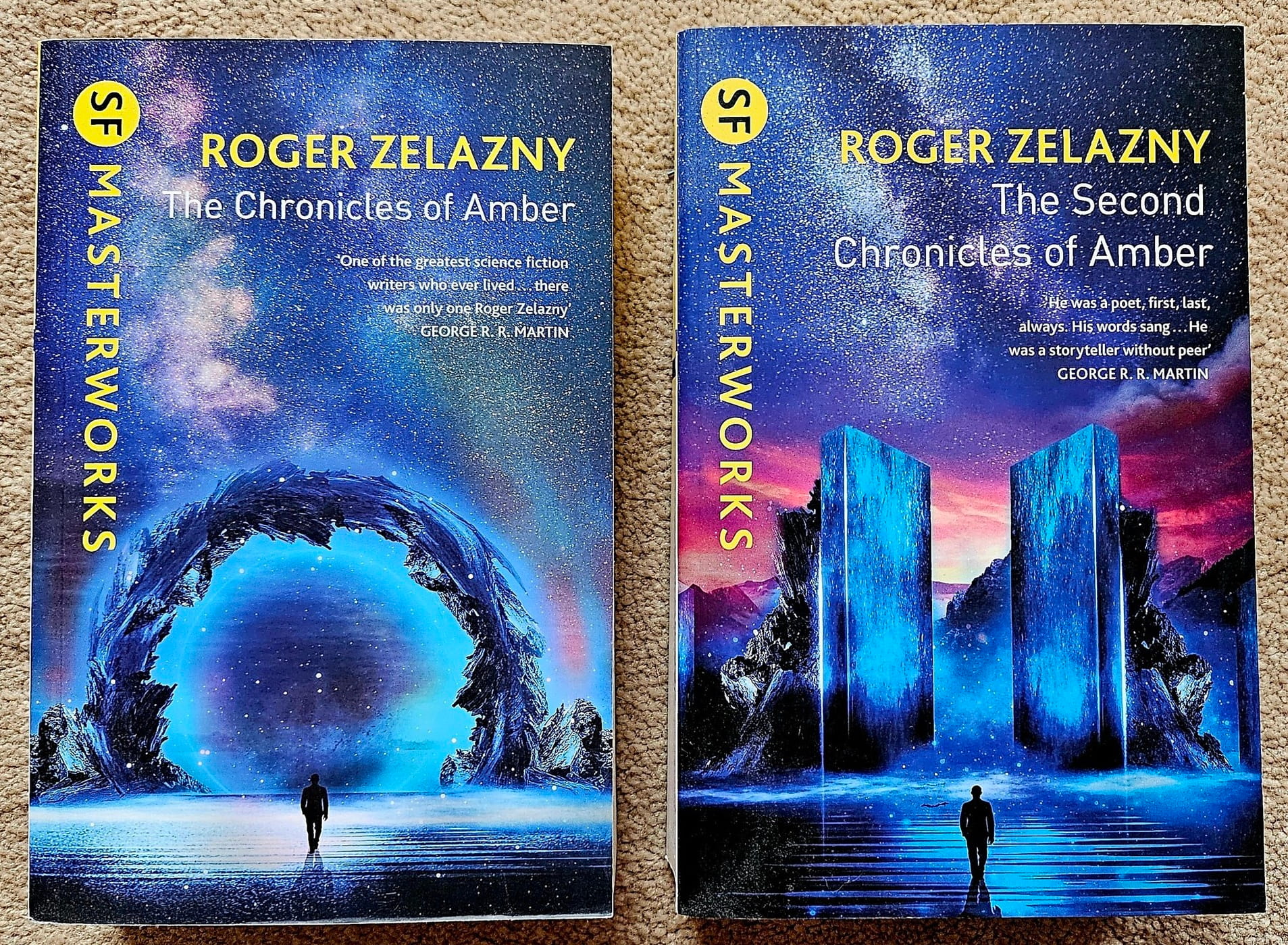 The Chronicles of Amber and The Second Chronicles of Amber by Roger Zelazny (Gollancz SF Masterworks editions, April 14 and August 18, 2022). Covers uncredited
There are few authors whose works bring me greater joy than Roger Zelazny.
Zelazny was a master of craft and style who could present in a terse style that seamlessly evolves into evocative prose without any awkwardness or jarring transitions. His strengths as a writer were myriad: incredible storytelling, plot development, vivid descriptions, character development, and boundless imagination in the creation of strange worlds — sometimes a shade different from our own; other times wholly alien.
In The Chronicles of Amber, Zelazny exhibits all his strengths as a writer. It’s almost frustrating to read him, because he seems to perform his craft so effortlessly.
[Click the images for master craft versions.]
 Roger Zelazny
Roger Zelazny’s The Chronicles of Amber is an absolute classic that I am about to revisit. I recently reread his novel Jack of Shadows, which is another fantastic work. But the Amber stories were perhaps his finest achievement.
Zelazny’s style of prose is something I really appreciate. It fluctuates from economical and concise, to poetic, to stream-of-consciousness — and it never jars the reader. It’s so smooth. I admire his work quite a bit.
I am a part of the evil which exists to oppose other evils. I destroy Melkins when I find them, and on that Great Day of which prophets speak but in which they do not truly believe, on that day when the world is completely cleansed of evil, then I, too, will go down into darkness, swallowing curses. Perhaps even sooner than that, I now judge. But whatever… Until that time, I shall not wash my hands nor let them hang useless.
—Roger Zelazny, The Chronicles of Amber, Book 2: The Guns of Avalon
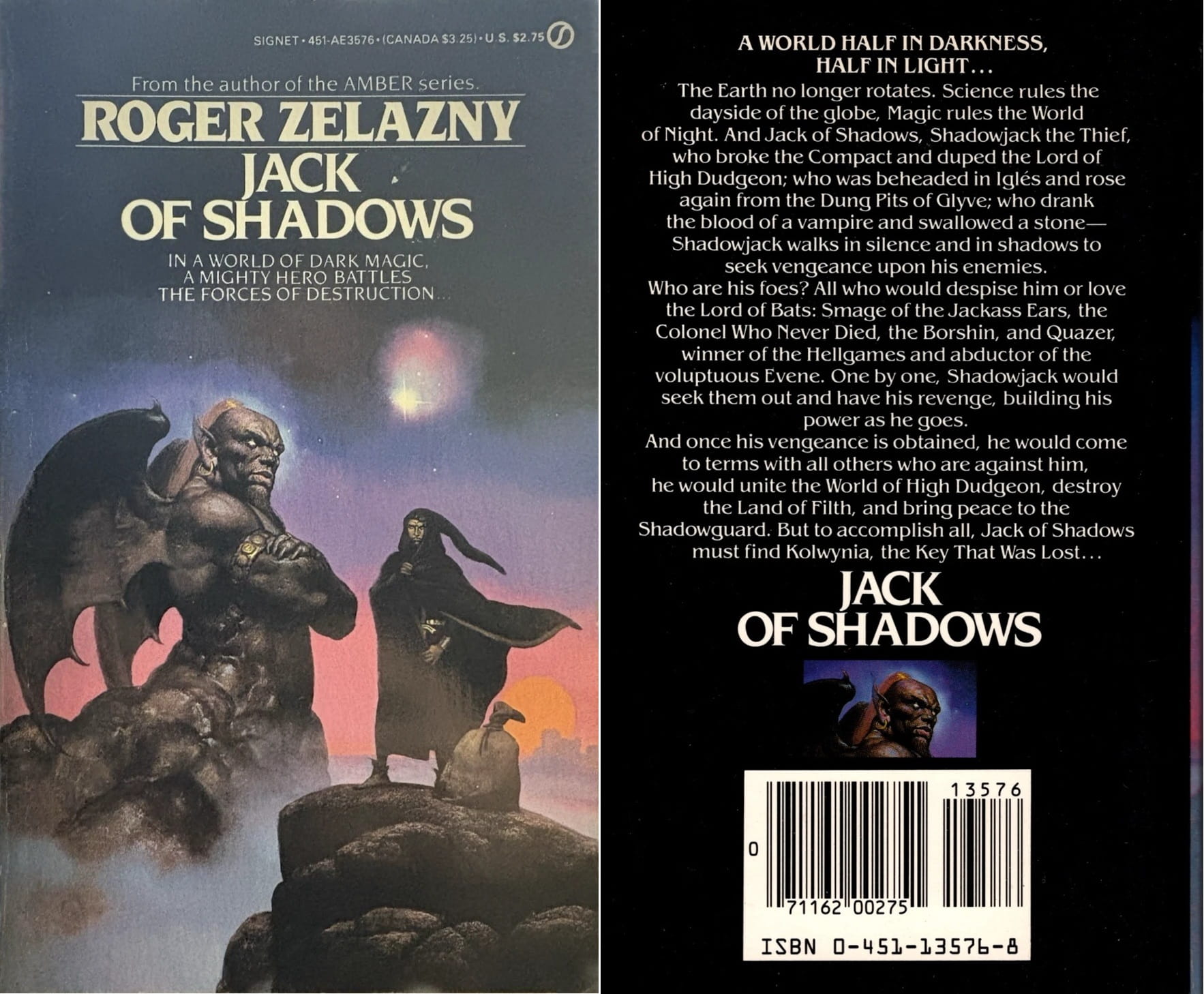 Jack of Shadows (Signet, May 1985). Cover by Vicente Segrelles
There’s much more to Zelazny than the world of Amber, of course.
Jack of Shadows is a novel that I can read again and again. It’s a perfect fusion of science fiction and fantasy, conceived by a true master of genre fiction. It could make a great film in the right hands.
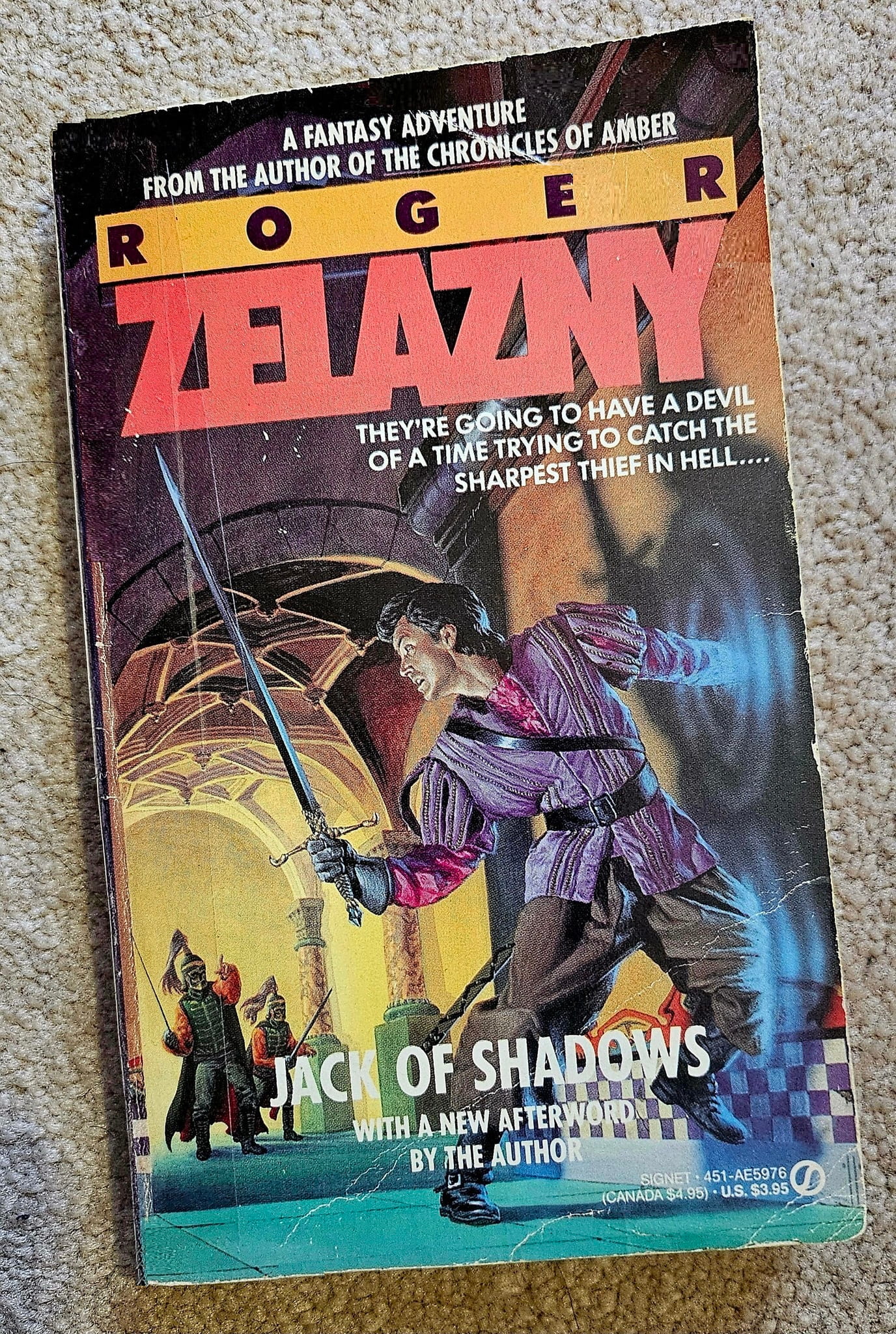
Jack of Shadows (Signet, May 1989). Cover by Richard Hescox
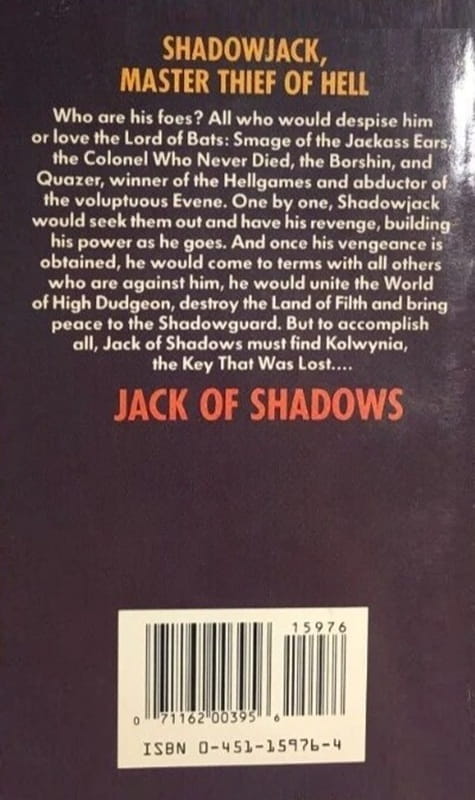
Shadowjack, Master Thief of Hell!
Who are his foes? All who would despise him or love the Lord of Smage of the Jackass Ears, the Colonel Who Never Died, the Borshin, and Quazer, winner of the Hellgames and abductor of the voluptuous Evene. One by one, Shadowjack would seek them out and have his revenge, building his power as he goes. And once his vengeance is obtained, he would come to terms with all others who are against him, he would unite the World of High Dudgeon, destroy the Land of Filth, and bring peace to the Shadowguard. But to accomplish all, Jack of Shadows must find Kolwynia, the Key That Was Lost…
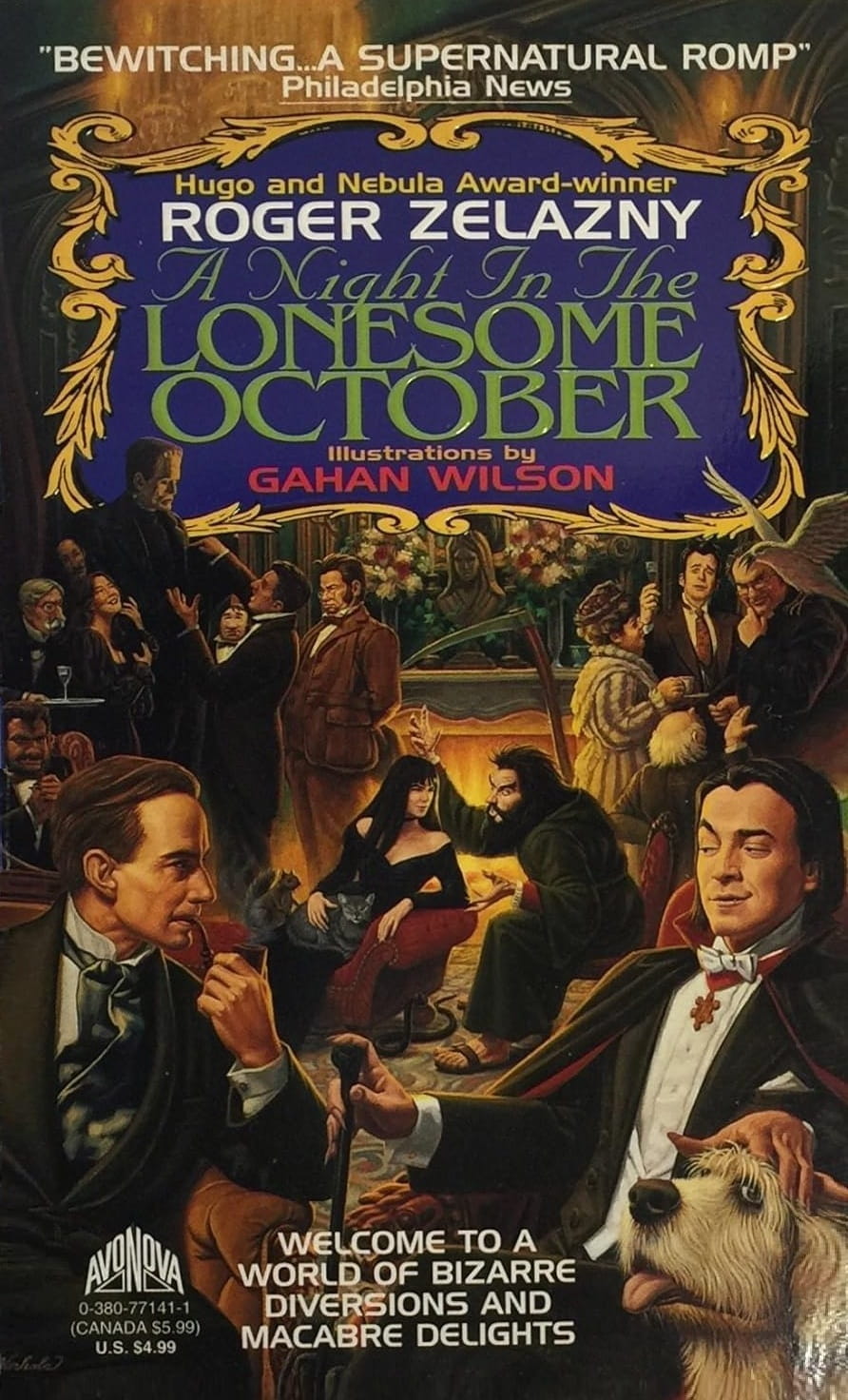
A Night in Lonesome October (AvoNova paperback reprint, September 1994). Cover by James Warhola
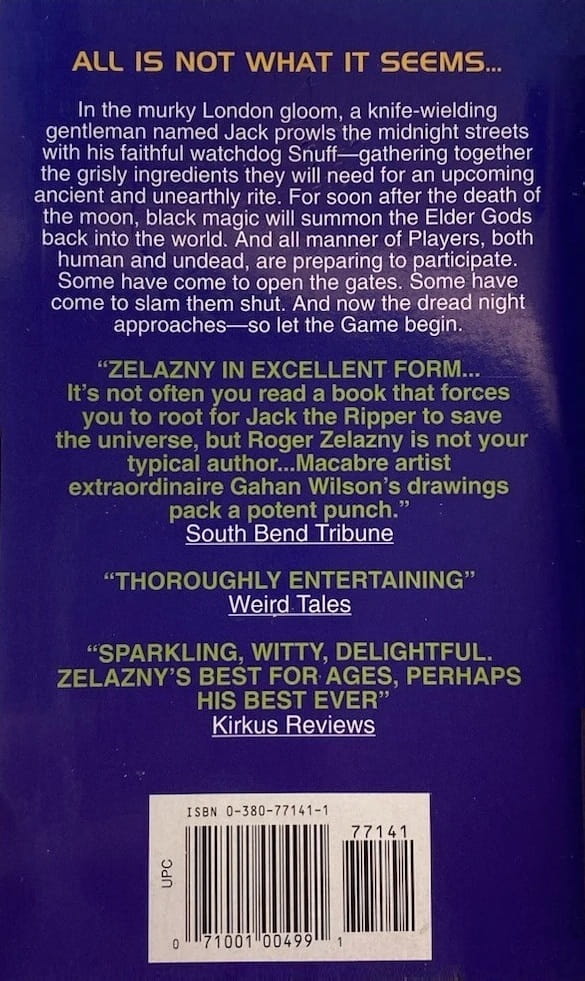
A Night in Lonesome October is an absolute masterpiece. His final “solo” novel, this story is told from the first-person viewpoint of Jack’s watchdog, Snuff. Without giving away too many spoilers, Jack is loosely based on the infamous Jack the Ripper, and Snuff functions not quite like a pet, but a familiar spirit, one of several familiars (a bat, a cat, an owl, a rat, etc.) in the story, each with their own agendas, each with an eccentric master of great notoriety.
Zelazny’s prose often slows me down, as I pause to reread passages that are so well-wrought. Allow me to set this scene: Snuff is trying to remove a dead (murdered) body that was deposited on Jack’s property. He’s doing it not because Jack is the killer, but because he’s concerned about how it will look. Night after night he drags the body closer to a local river…
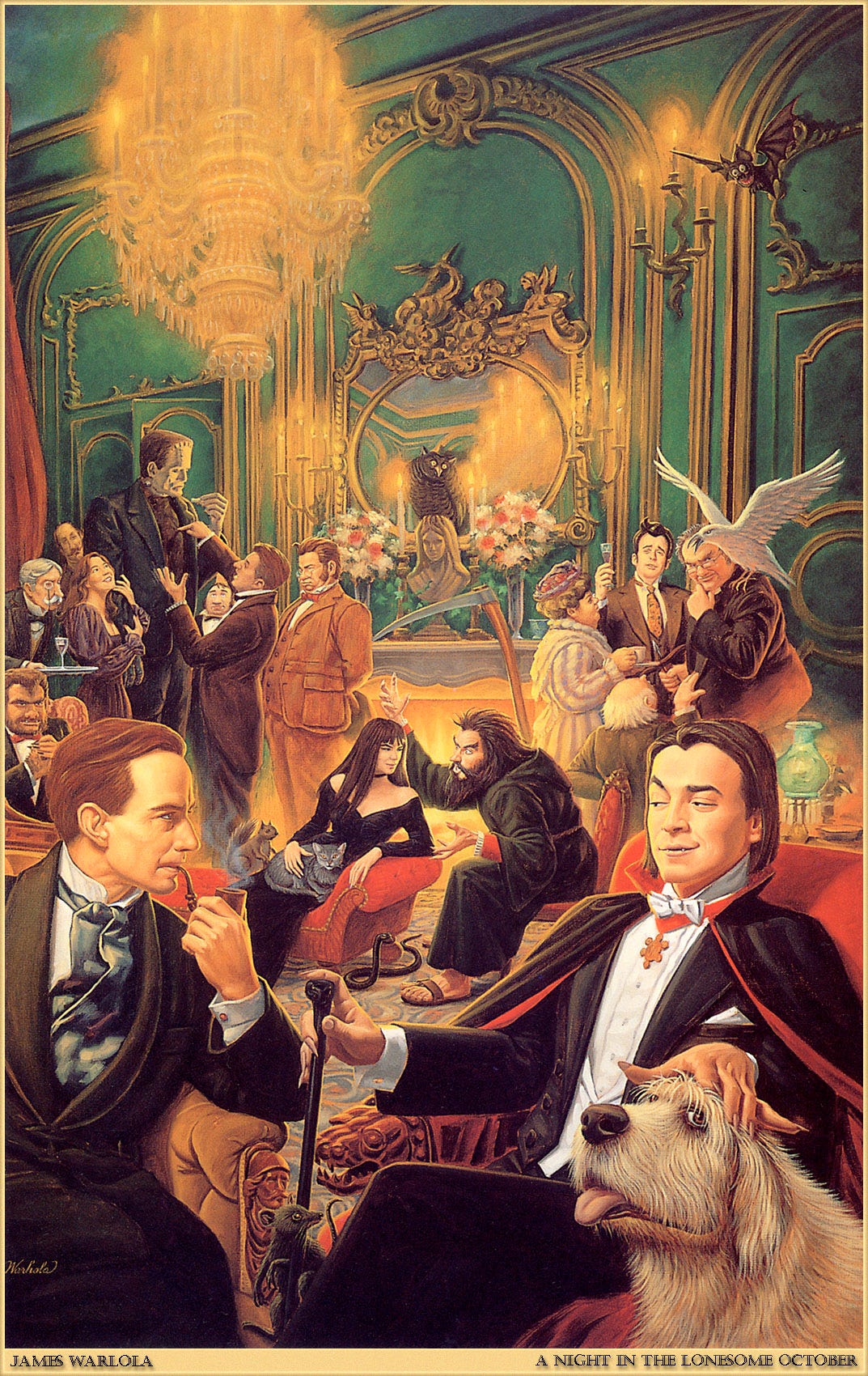 James Warhola’s cover for A Night in Lonesome October
First time out yesterday I got him farther through the muck, but he was still in it when I left him. I was tired. Jack was sequestered with his objects. The police were about, searching the area. The vicar was out, too, offering exhortations to the searchers. Night came on, and later I made my way back to the muck, chasing off a few vermin and beginning the long haul once again.
I’d worked on and off for over an hour, allowing myself several panting breaks, when I realized I was no longer alone. He was bigger than me even, and he moved with a silence I envied, some piece of the night cut loose and drifting against lesser blacknesses.
He seemed to know the moment I became aware of him, and he moved toward me with a long, effortless stride, one of the largest dogs I’d ever seen outside of Ireland.
Correction. As he came on I realized he wasn’t really a dog. It was a great gray wolf that was bearing down on me. I quickly reviewed my knowledge of the submissive postures these guys are into as I backed away from the corpse.
Quoting for emphasis:
He was bigger than me even, and he moved with a silence I envied, some piece of the night cut loose and drifting against lesser blacknesses.
That was a line I read again and again. True genius.
Jeffrey P. Talanian’s last article for Black Gate was a look at the The Enduring Legacy of Jack Kirby. Jeffrey is the creator and publisher of the Hyperborea sword-and-sorcery and weird science-fantasy RPG from North Wind Adventures. He was the co-author, with E. Gary Gygax, of the Castle Zagyg releases, including several Yggsburgh city supplements, Castle Zagyg: The East Mark Gazetteer, and Castle Zagyg: The Upper Works. Read Gabe Gybing’s interview with Jeffrey here, and follow his latest projects on Facebook and at www.hyperborea.tv.
Categories: Fantasy Books
Novella Review: Dead Weight by Hildur Knútsdóttir
I received a review copy from the publisher. This does not affect the contents of my review and all opinions are my own.
 Dead Weight by Hildur Knútsdóttir
Mogsy’s Rating: 3 of 5 stars
Genre: Horror
Series: Stand Alone
Publisher: Nightfire (May 26, 2026)
Length: 160 pages
Author Information: Website
After enjoying The Night Guest, I was pretty curious to see what Hildur Knútsdóttir would do next, especially since her style seems tailor-made for weird little psychological horror novellas. Unfortunately, Dead Weight ended up being a bit of a letdown. First off, I don’t think it was marketed correctly. While it’s pubbed by a horror imprint, I agree with a lot of other reviewers who felt this didn’t feel like horror. For me, it was barely even a thriller. Maybe a low-key suspense story would be more accurate? And yet, the tension hardly builds. Instead, the book mostly drifted along in a kind of muted haze before arriving at a strangely underwhelming ending.
The story follows Unnur, a lonely and emotionally detached woman living a quiet, isolated life in Reykjavík, when a black cat suddenly begins showing up in her apartment uninvited. Trying to do the responsible thing, she tracks down the cat’s owner, a young woman named Ásta, who arrives looking visibly flustered and more than a little unsettled when she comes to collect her pet. It quickly becomes clear that Ásta is dealing with serious problems of her own, though Unnur initially wants no part in getting involved. Still, the cat, Io, keeps returning to her apartment, almost as if it has chosen Unnur for itself. Before long, the situation becomes even harder to ignore when Io unexpectedly gives birth to a kitten in Unnur’s bed.
Distraught over moving the mother and newborn, Ásta convinces Unnur to let Io stay temporarily so that the kitten can be raised in a safe and stable environment. Ásta admits that her own home doesn’t have that kind of security right now, though she promises to stop by regularly to help care for the cats. Reluctantly, Unnur agrees, and what begins as an awkward arrangement slowly develops into an uneasy friendship between the two women. As they spend more time together, the story begins exploring their personal lives, their loneliness, their unhealthy relationships, and the things they’ve quietly convinced themselves to tolerate. Beneath the surface, a growing unhappiness hangs over both women, tied up in the emotional weight of the choices they keep making.
To be fair, the setup itself isn’t bad at all. I did find myself drawn to the atmosphere and to Unnur’s character at first. While Knútsdóttir’s writing style is admittedly a little rigid and aloof, I can’t help but wonder if some of the original prose’s texture and nuance might have been lost in translation. Regardless, it works surprisingly well for a story built around people navigating emotional scars or dealing with hardship. There’s a quiet strangeness to the novella that kept me reading, especially in the opening chapters, where just enough intrigue is established to hold your attention and carry you forward.
But the further I got, the more I found myself wanting from the story, which became a problem when the book never really delivered what I hoped it would. Despite delving quite intimately into both Unnur and Ásta’s lives, Dead Weight never quite develops the momentum or depth required to make their relationship feel fully realized, which made the ensuring crux of the novella feel less significant than it should have. I didn’t feel much urgency or escalation, even when darker elements started unfolding. Everything felt oddly distant and rote. Quite honestly, the cats ended up being the most compelling part of the whole book. Between Io and her kitten, there were genuinely more cute moments than tense ones (which isn’t necessarily a bad thing, I guess).
The biggest issue for me, though, was the lack of payoff. The novella spends its entire runtime hinting at something more, but when it finally arrives, it barely feels like a climax at all. To be fair, I might just be used to reading more intense horror and thriller, thus making this feel way more subtle and tame. Even so, I had expected more impact to justify all the buildup. I don’t think the short length was the issue either, because the ending itself feels abrupt in a way that doesn’t make the book feel complete. It just kind of stops, and I was left wondering, beyond the obvious metaphor of ridding yourself of life’s burdensome liabilities, what was the point?
Still, I can’t say I disliked Dead Weight. A bite-sized novella, it’s an easy enough read and it worked perfectly well as a palate cleanser for me between heavier books. Although it was mildly frustrating because I wanted more, it still works as a decent diversion for an afternoon.
Categories: Fantasy Books
You Can Tell Me (by Melinda Leigh)
Romantic Suspense
Olivia Cruz lives with the demons of her kidnapping three years earlier Save Your Breath (Morgan Dane Book 6). In an effort to exorcise those demons and get on with her life she agrees to talk with her friend, true crime podcaster Zoe March. But when she shows up for the meeting, Zoe is nowhere to be found. She has vanished off the face of the earth.
Police are called but it quickly becomes obvious that Olivia and her boyfriend Lincoln are the only ones who really care about Zoe.
–––––––––––––––––––––––––––––––––––––––––––––––––––––––––––––––––––––––––––
The Olivia Cruz series has been a long time coming. Melinda Leigh has focused on Bree Taggert for the last few years but now that series is winding down and there is some clean air to explore Olivia’s story. This story is great, it offers the familiar characters we know and love while introducing a few new characters who no doubt will come forward in the next few books. It is solid romantic suspense done well.

Categories: Fantasy Books
Superman/Tarzan: Sons of the Jungle by Chuck Dixon and Carlos Meglia
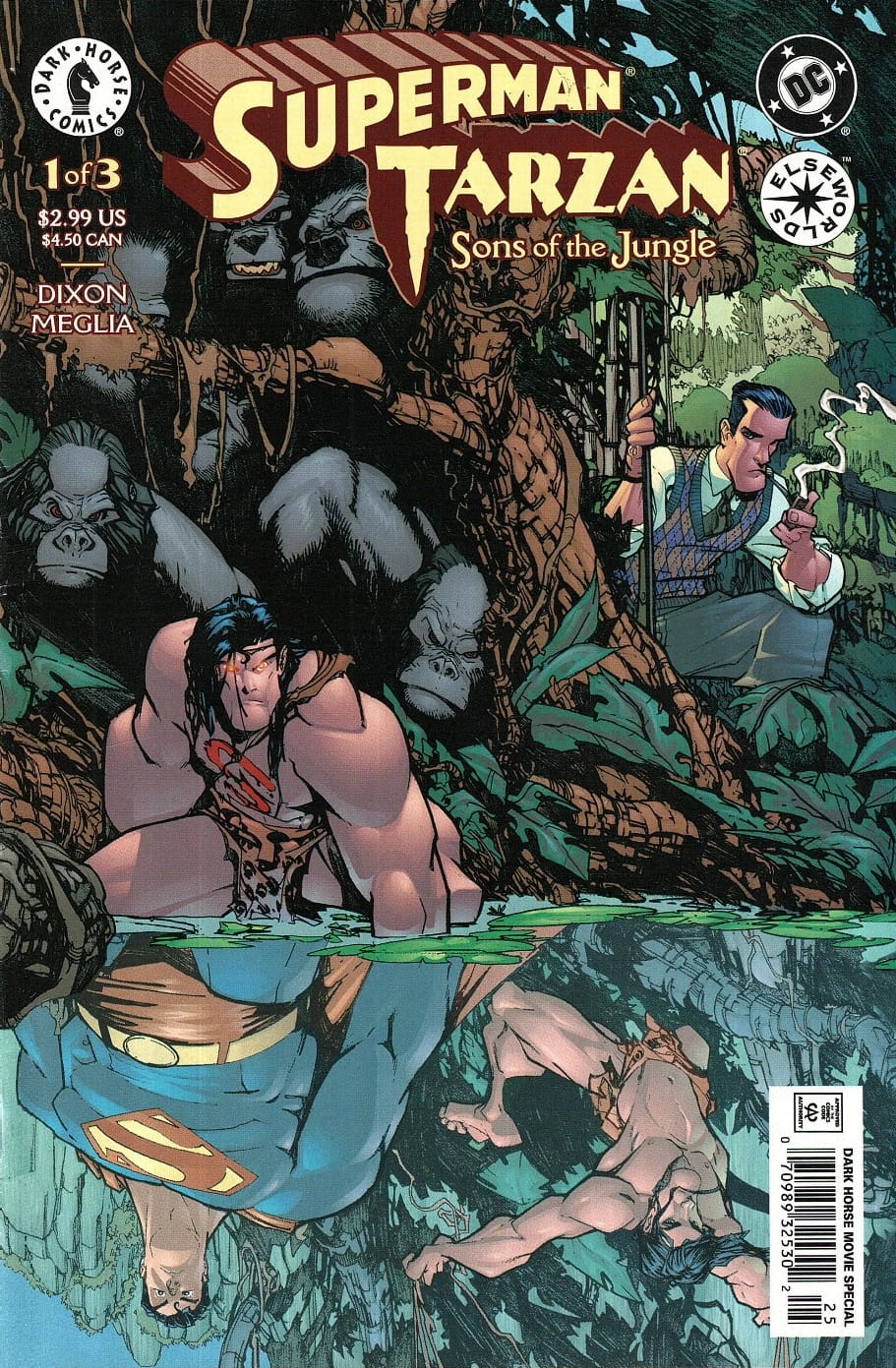 Superman/Tarzan: Sons of the Jungle, issue 1 (Dark Horse, October 2001). Cover by Humberto Ramos
From Dark Horse Comics and DC comes Superman Tarzan: Sons of the Jungle, written by Chuck Dixon with interior art by Carlos Meglia. Cover art on the original issue covers was by Humberto Ramos.
This is a 3-issue comic arc that riffs off the original Tarzan story by Edgar Rice Burroughs. The mutiny aboard The Fuwalda takes place as usual, which is the start of Edgar Rice Burrough’s 1912/1914 serial/novel Tarzan of the Apes.
[Click the images for Superman-sized versions.]
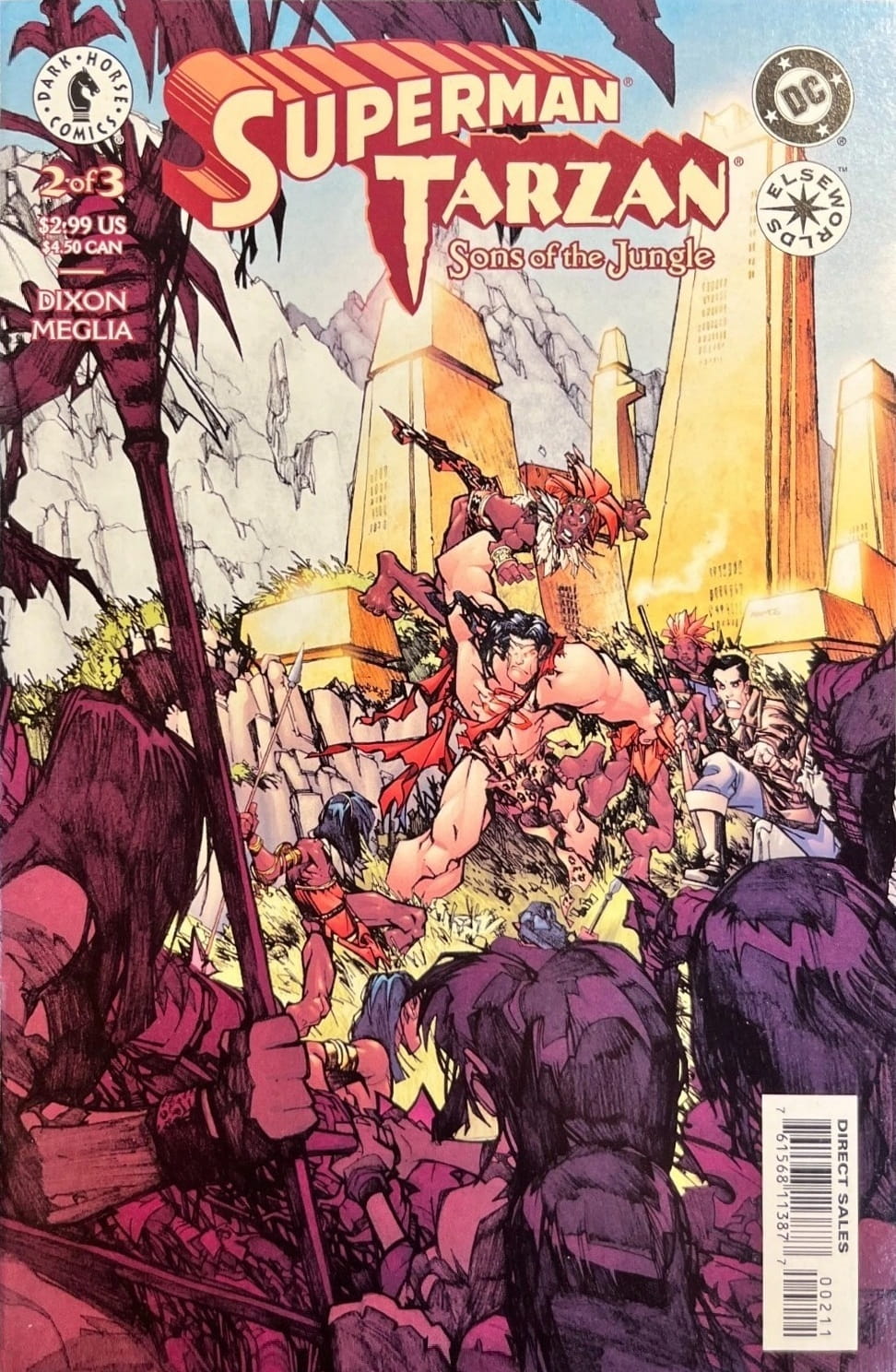 Superman/Tarzan: Sons of the Jungle, issue 2 (Dark Horse, November 2001). Cover by Humberto Ramos
John Clayton and his pregnant wife, Alice, are about to be marooned on the coast of Africa when a flaming meteor sweeps over and crashes right where the crew was set to land. The crew takes that as a bad omen and instead returns to Cape Town to drop off the Claytons. Thus, the infant who would have become Tarzan is raised by his living parents in civilized Britain instead of by Kala and the Apes in the jungle.
Before that twist is completed, though, we find that the meteor which crashed was actually the ship carrying the infant Kal-El from Krypton to Earth. Kala ends up adopting “Superman” instead of Tarzan and he is named Argo-zan (fire-skin). That must have been quite an experience for the apes, though we don’t get to see any of Argo-zan’s earliest years.
 Superman/Tarzan: Sons of the Jungle, issue 3 (Dark Horse, May 2002). Cover by Humberto Ramos
By the way, this appears to be the earliest incarnation of Kal-El where he is not so superpowered and can’t fly, but he is still far stronger than any human and cannot be physically injured.
Some spoilers ahead: The last 2 issues of the comic suggest that “fate” cannot be escaped because circumstances conspire to bring the man who would have been Tarzan and Jane Porter back to Africa, and they are accompanied by none other than Lois Lane.
La of Opar is set up as the bad guy and she’s discovered some Kryptonite that she hopes to use to control Argo-Zan. You gotta figure how that works out, and at the end, fate brings everyone back to the places where they should have been in the first place.
Superman/Tarzan: Sons of the Jungle collected edition (Dark Horse, September 30, 2002)
Here are my thoughts: It’s a cool idea and generally well done. Chuck Dixon does a smooth job with the story itself and the art facilitates the story.
My criticisms are twofold. 1. There’s a lot more story here than could adequately be told in 3 comic book issues. It’s a rich tale and because of word and length limits we only get parts of it.
I understand why but I’d still have liked more story, such as Argo-zan’s childhood and his interactions with the African wildlife, and John Clayton’s early growth as well. We see that John is “unsatisfied” with his civilized life and knows something is missing, but there were many scenes I’d have enjoyed getting a look at. (I’ll just tell them to myself in my head.)
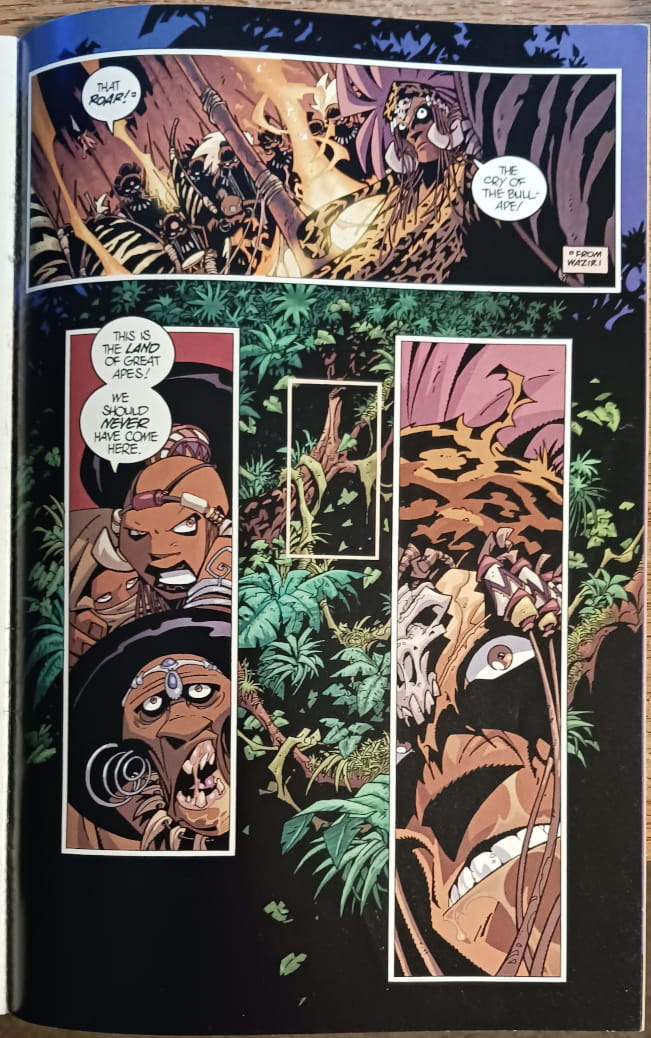
Interior art for Superman/Tarzan: Sons of the Jungle by Carlos Meglia
My second criticism concerns the art. Let it be known that I have no artistic abilities myself and both Meglia and Ramos are immensely more talented than I am. I admire their skills, but I didn’t personally like many of the human images presented here, although I liked a lot of the jungle backgrounds.
The characters, though, are hugely exaggerated, particularly their faces. Superman looks like he has acromegaly on the covers, and some of the interiors are close to caricatures. (See the interior illustrations I include here.)
This may have been done on purpose as a style choice, but I mostly didn’t love that choice. I did like the pool reflection on issue #1’s cover. Your appreciation may differ and that’s perfectly fine.
Charles Gramlich administers The Swords & Planet League group on Facebook, where this post first appeared. His last article for us was a a review of The Iron Tower Trilogy by Dennis L. McKiernan. See all of his recent posts for Black Gate here.
Categories: Fantasy Books
Desperate Characters Find Ways To Survive “Project Hail Mary” by Andy Weir

Other Titles by Andy Weir Here are a few other books by Andy Weir that…
The post Desperate Characters Find Ways To Survive “Project Hail Mary” by Andy Weir appeared first on LitStack.
Categories: Fantasy Books
Stacking the Shelves – Review Book for the Last 5 Months – 5/16/26
Welcome to Stacking the Shelves, hosted by Reading Reality.


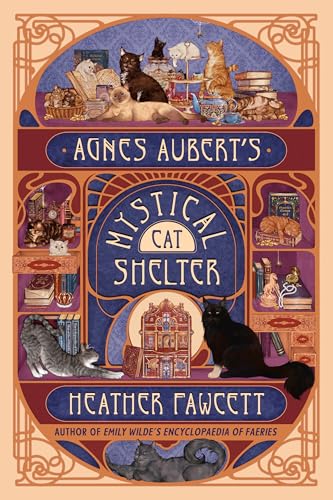


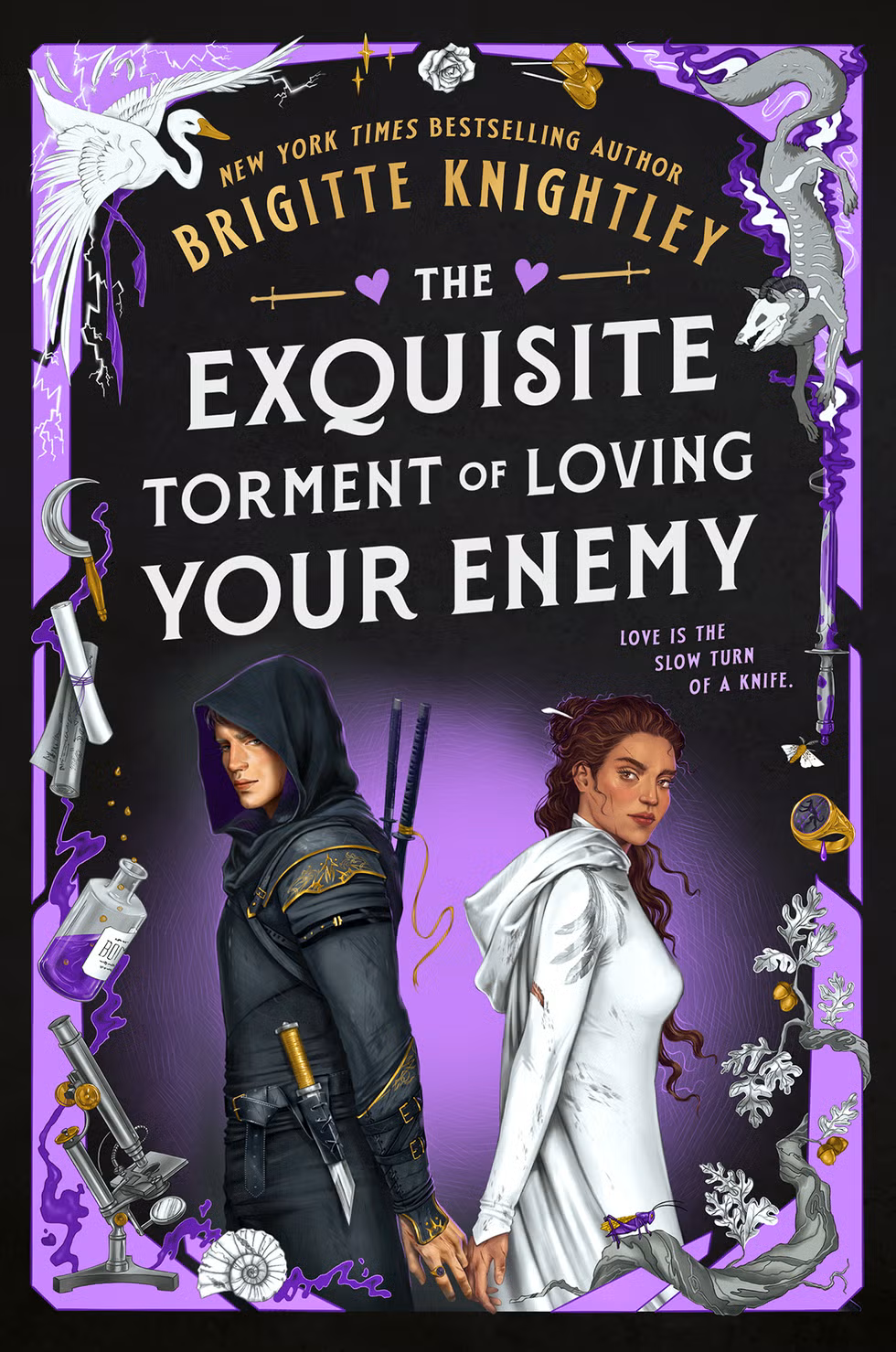


Categories: Fantasy Books
Pages

Recent comments