
Fantasy Books
Sumptuous visuals and brilliant writing in an Indie RPG? Clair Obscur: Expedition 33 Has it All
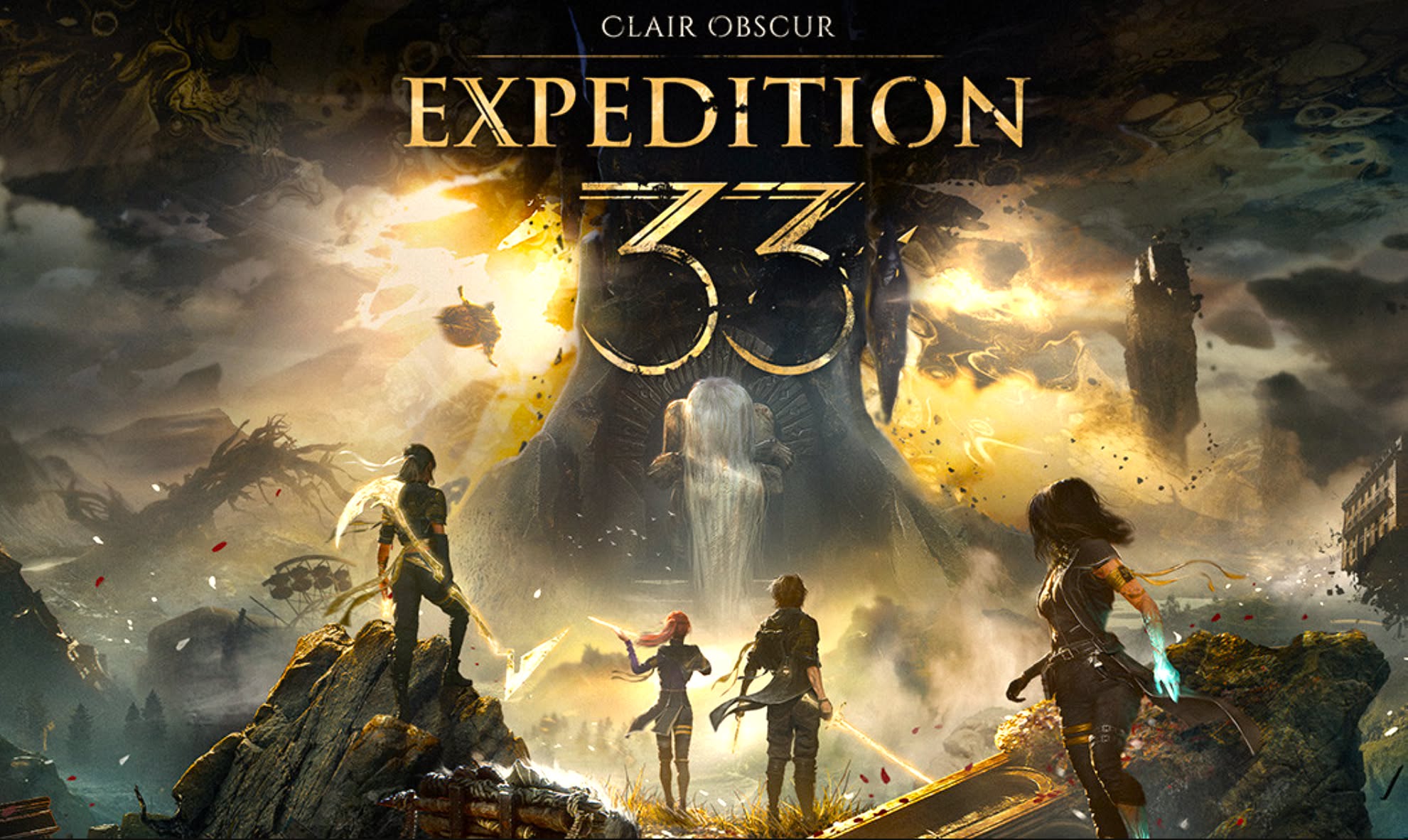 Clair Obscur Expedition 33, developed Sandfall Interactive and published by Kepler Interactive April 24, 2025
So… if you are an enthusiast of single player RPGs and have not spent any time thoroughly engrossed in this modern masterpiece, you’re either buried under a pile of rubble or not allowing yourself enough time for brilliant escapism.
In either case, you’re missing out on what was unequivocally the 2025 GOTY.
I’ll work up a proper review at some point but am simply too busy playing this stunning piece of interactive art with all of my spare time to do so now.
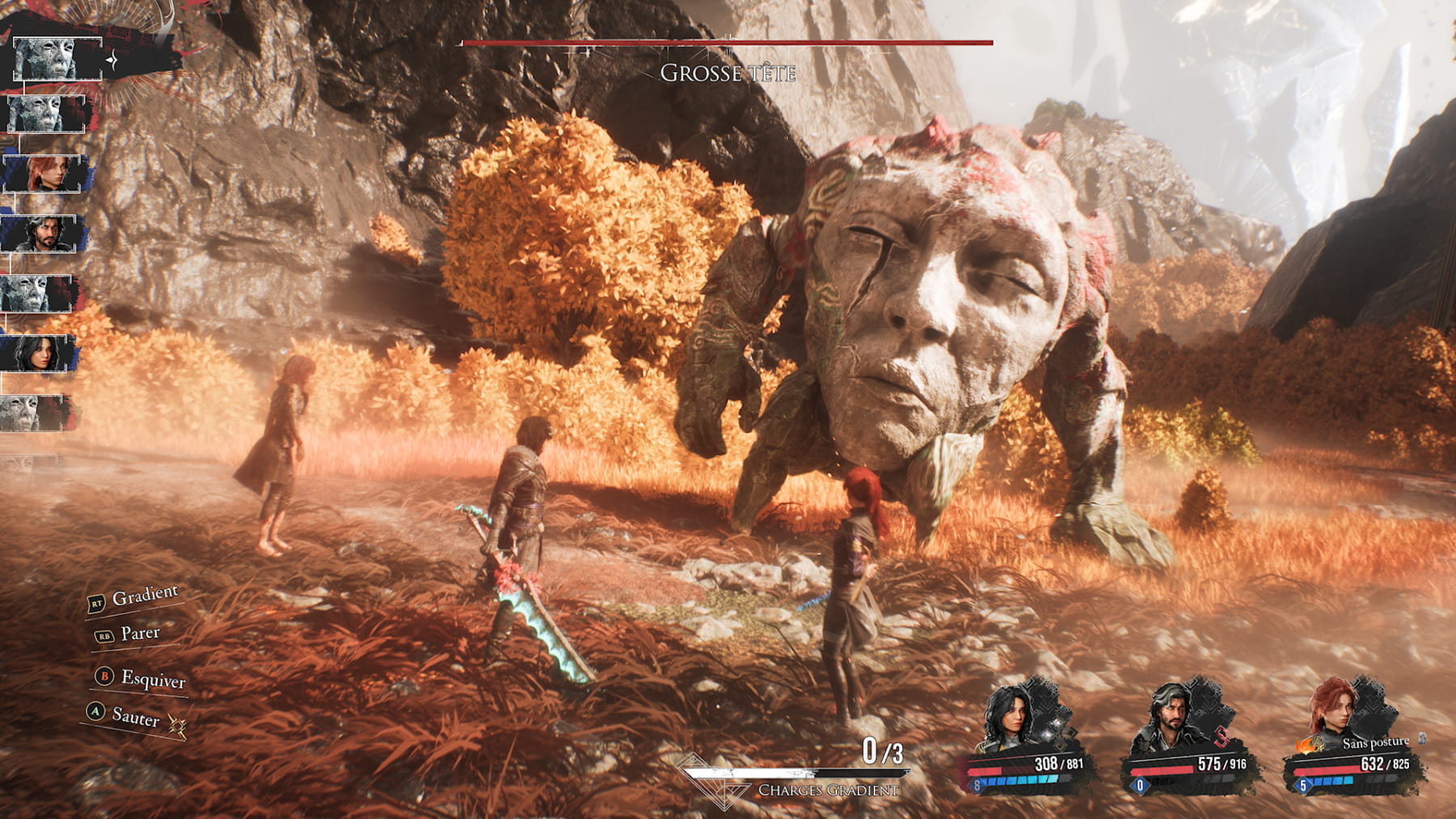 Fighting the giant head in Clair Obscur: Expedition 33
My very short take, aside from the above, is that this is essentially the game that Square Enix has been wishing they could have produced over the last two decades. I truly do not remember the last time I played a game that checked every box I have on my list of desired qualities after a lifetime of video games.
Fresh, engaging mechanics, sumptuous visuals, deeply developed world-building, top shelf voice acting, brilliant writing with staggering emotional depth, and the most phenomenal score since Final Fantasy VII.
All from a tiny French studio with barely more than 30 team members, most of whom are Ubisoft refugees.
Buy it, play it, support Sandfall Interactive. But even if they never produce another game again, their debut masterwork will prove to be an enduring legacy in the field for decades to come.
Joshua Dinges’s last game review for Black Gate was Return of the Obra Dinn.
Categories: Fantasy Books
6 Nautical Novels Drowning In Suspense
Nautical Novels – All Aboard for Danger on the High Seas! Search on Bookshop.org One-Way,…
The post 6 Nautical Novels Drowning In Suspense appeared first on LitStack.
Categories: Fantasy Books
STARTER VILLAIN by John Scalzi
I’ve often said that writing humour (sorry, American readers: ‘humor’) is HARD. The difficulty is, as I understand it, that writing humour means that it doesn’t come across in the same way as a spoken one-liner. Perhaps more problematical is that a person’s sense of humour is not the same as another’s. What can seem…
Categories: Fantasy Books
Women in SF&F Month: Elaine Ho
Today’s Women in SF&F Month guest is artist and author Elaine Ho! Her illustrations, which can be found on her website and Instagram, include “Bones to the Wind” from the eponymous book cover jacket, “Harmony” from the Gen Con 2024 program cover, “Wall of Roses” from Uncanny Magazine Issue 46, and scenes from her debut novel. Her dark political fantasy book released late last year, Cry, Voidbringer, explores “how identity is reshaped under empire” and the question “Why do post-colonial […]
The post Women in SF&F Month: Elaine Ho first appeared on Fantasy Cafe.
Categories: Fantasy Books
Forgotten Authors: P. Schuyler Miller
 P. Schuyler Miller
Peter Schuyler Miller was born on February 21, 1912 in Troy, New York. He earned a Master of Science from Union College and worked as a technical writer for General Electric and the Fisher Scientific Company.
Miller had a lifelong interest in archaeology and was a member of the New York State Archaeological Association.
His first published short story “The Red Plague,” appeared in the July 1930 issue of Wonder Stories. Based on the cover of the magazine’s January issue, it was the first winner of a contest Wonder Stories ran, earning Miller publication and $150. Sam Moskowitz described the story as “more of a well-written plot synopsis for a novel than a short story.”
Miller participated in multiple collaborations. In the early 1930s, he wrote two stories with Walter Dennis and Paul McDemott: “The Red Spot of Jupiter” and “The Duel on the Asteroid.” These two stories were the only fiction Dennis and Dermott published, but Dennis was the co-editor, with Raymond A. Palmer, of The Comet, often cited as the first fanzine.
 Wonder Stories, July 1930, Cover by Frank R. Paul
In 1934, he took part in the collaborative novel Cosmos, for which he wrote “Chapter 14: The Fate of the Neptunians.” In 1950, he collaborated with L. Sprague de Camp on the 1950 novel Genus Homo, which took advantage of Miller’s interest in archaeology. In late 1933, he began publishing the 11 part serial “Alice in Blunderland” under the pseudonym “Nihil.”
Willy Ley attacked Miller’s 1931 story “Tetrahedra in Space” for its scientific inaccuracies and Miller responded that the physical chemistry described in the story was accurate. Everett F. Bleiler had a low opinion of Miller’s stories in general, suggesting that his 1936 story “The Chrysalis,” published in Astounding was his only story worth reading.
After 1951, Miller became best known for writing reviews for Astounding’s “The Reference Library” until his death om 1974. He had very little fiction output once he began reviewing books. His reviews tended to look for the good in the stories and novels he was reviewing, often including mini essays of this historical and literary context of the works under review. In 1963, he won a Special Hugo Award for his book reviews.
Miller died in Parkersburg, West Virginia on October 13, 1974 while on an archaological tour of the Fort Ancient culture and was buried in the Elmwood Cemetery in Schaghticoke, New York.
His papers formed the bases of the P. Schuyler Miller Memorial Library at the Carnegie Museum in Pittsburgh, Pennsylvania.
 Steven H Silver is a twenty-one-time Hugo Award nominee and was the publisher of the Hugo-nominated fanzine Argentus as well as the editor and publisher of ISFiC Press for eight years. He has also edited books for DAW, NESFA Press, and ZNB. His most recent anthology is Alternate Peace and his novel After Hastings was published in 2020. Steven has chaired the first Midwest Construction, Windycon three times, and the SFWA Nebula Conference numerous times. He was programming chair for Chicon 2000 and Vice Chair of Chicon 7.
Categories: Fantasy Books
Early Review – Platform Decay (The Murderbot Diaries, Book 8) by Martha Wells (4/5 stars)

Reading Level: Adult
Genre: Science Fiction
Length: 256 pages
Publisher: Tor Books
Release Date: May 5, 2026
ASIN: B0FMSC5S4W
Stand Alone or Series: 8th book in The Murderbot Diaries
Source: eGalley from NetGalley for Review
Rating: 4/5 stars
“Having someone else support your bad decision feels kind of good.
After volunteering to run a rescue mission, Murderbot realizes that it will have to spend significant time with a bunch of humans it doesn’t know.
Including human children. Ugh.
This may well call for… eye contact!
(Emotion check: Oh, for f—)”
Series Info/Source: This is 8th book The Murderbot Diaries. I got an eGalley of this from NetGalley to review.
Thoughts: The last book in the Murderbot Diaries was published in Nov of 2023, so it’s been quite awhile since we’ve seen a new Murderbot book. As a result the beginning of this book, which jumps straight into action, is incredibly confusing. As the story continues, we do get clarification about what is going on, but I was nearly 30% of the way in before I figured out why Murderbot was doing what it was doing and why it was where it was.
The beginning of this book has Murderbot and Three infiltrating a massive rotating space station shaped like a torus, things go sideways when Barish-Estranza troops show up. I was quite sure why Murderbot and Three were infiltrating this space station until much further into the story. You are plopped straight into the action, which was a bit confusing.
Once I got about 40% of the way in, I was fully engaged in the story, understood what Murderbot was doing, and didn’t want to put the story down. However, that first third was pretty clunky and confusing. If you are going to take years between publishing books in a series, you have to give at least a few sentences of recap at the beginning. Not all readers go back and re-read the whole series before the next book or even have access to the previous books in the series.
I enjoyed Murderbot’s normal sardonic comments and also enjoyed the new “emotion check” functions. I didn’t feel like Murderbot grew much as a character in this book. This story felt very much like filler to me and was a bit disappointing. I didn’t feel like it progressed Preservation’s story much or really progressed any larger storyline at all. It was a very compact and separate story from the rest of the series. Additionally, the way the book wrapped up was incredibly abrupt. I was left feeling like, uh, okay I guess the book’s done then.
I would love to feel like that is a broader story arc here that is making progress, but at this point, I think we are just reading about instances in Murderbot’s existence. Which is fine, I guess. I just really loved where some of the previous books were going, and this feels so much like filler to me.
My Summary (4/5): Overall I enjoyed revisiting Murderbot and this world. I was disappointed at how confusing the first part of the book was and at how abruptly the story ended. The second half was action-packed, and the book was very hard to put down for that portion. All of this left me a bit confused about how to rate this book. The first part 3 stars, the middle to end portion 5 stars, then the end 3 stars…so I settled on 4 stars. I will definitely continue to read this series but feel like this book wasn’t as good as come of the previous books.

Categories: Fantasy Books
A Curious Amalgam: Joan and Peter by H.G. Wells
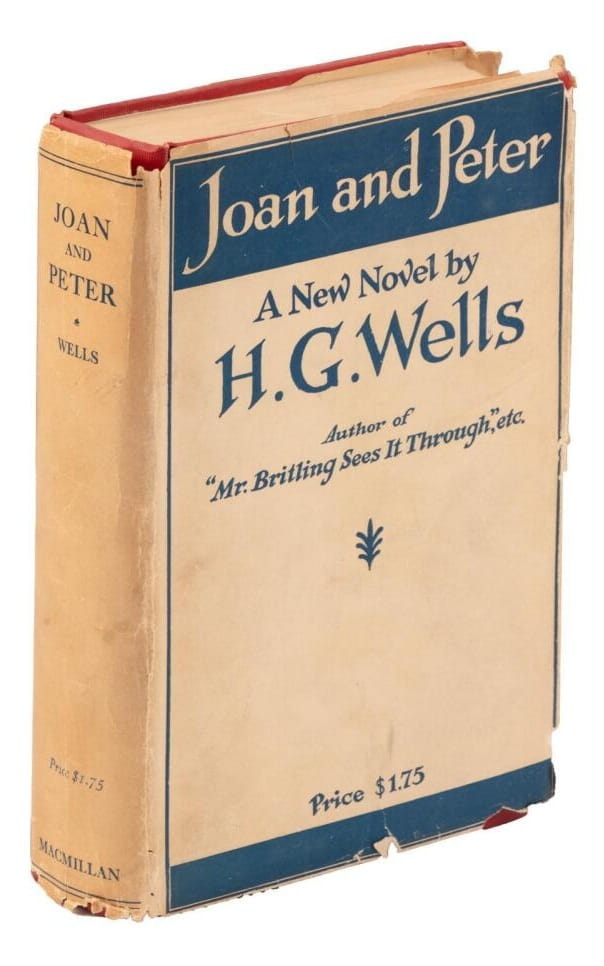 Joan and Peter by H.G. Wells (Macmillian, first American edition, 1918)
Science fiction fans naturally know H.G. Wells best for his scientific romances. But after 1905, he wrote relatively little in that genre. Instead, he turned his efforts variously to the Fabian Society, Britain’s indigenous socialist movement; to surveys of human knowledge for general audiences, in the style later followed by Isaac Asimov (I read my grandmother’s copy of The Outline of History, and I still have the four volumes of The Science of Life); and to realistic novels, starting with Love and Mr. Lewisham in 1900.
Joan and Peter is a curious amalgam of these interests — a realistic novel about changing class relations and cultural attitudes in England, much of whose storyline focuses on the problems of the English educational system as experienced by its title characters. This gives Wells a chance to explain things to his readers, though he’s often fairly good at enlivening the presentation beyond big lumps of exposition.
[Click the images to embiggen.]
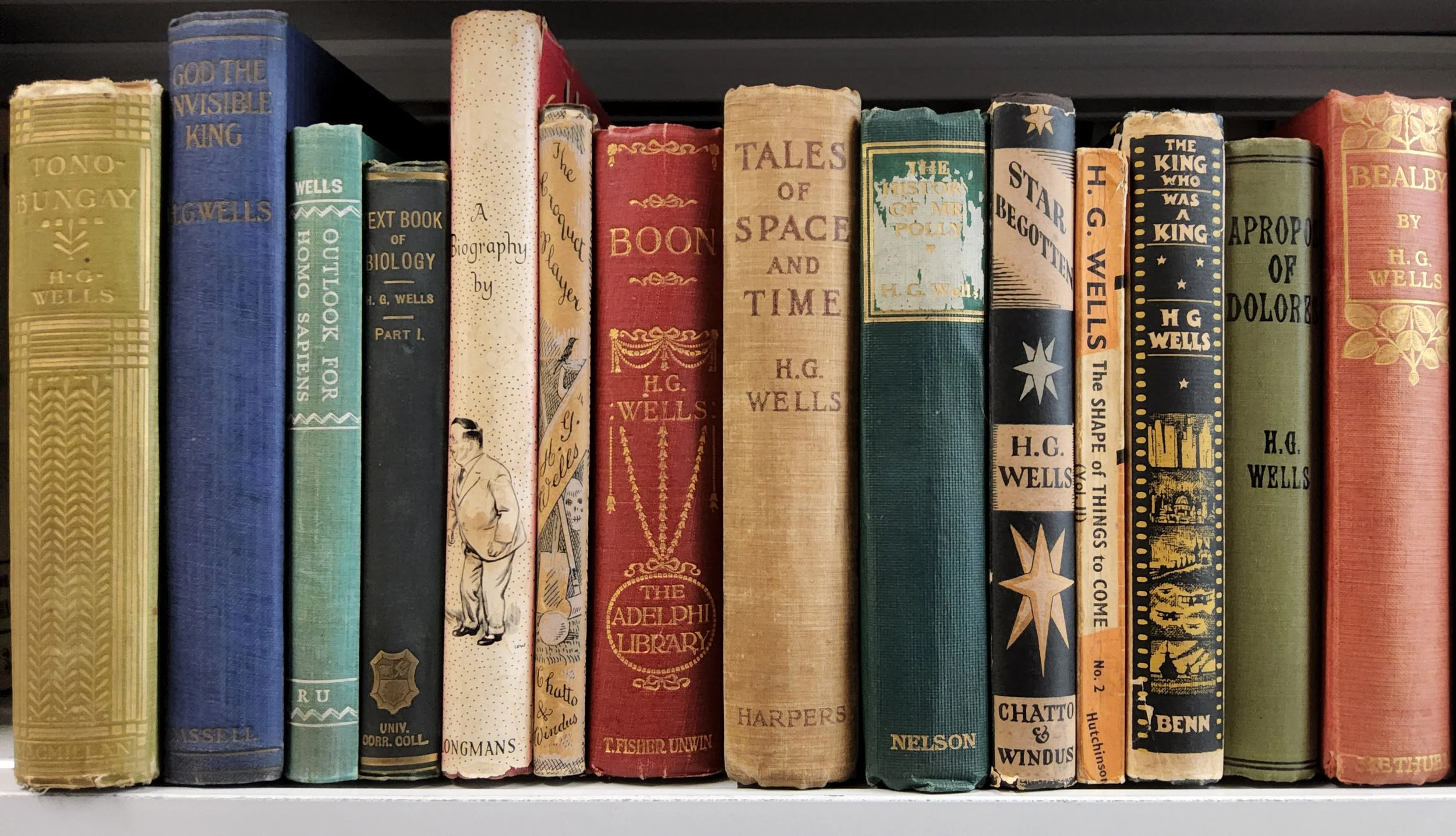 The books of HG Wells
When I say “realistic” here, I mean it in a mostly literary sense: fiction that avoids scientific speculation, marvelous inventions, supernatural powers, and other exotica. Joan and Peter’s characters are human beings living in a human world. However, some of its narrative turns seem to show the influence of older romantic themes.
The foundation for this story is a pair of English families with different origins and qualities. On one hand, the Stublands: Solidly middle class, in the older sense that meant “six hundred a year” and no need to work, thanks to ancestors who made a success in textiles. Ancestrally Quaker, they drifted over time among various non-established churches, and by the start of the novel, they’re spiritual without being religious, and many of them are artistic. On the other hand, the Sydenhams: County people, generally conservative, and prolific enough to have little money for their younger generation.
Dolly Sydenham, a vicar’s daughter, has a deep attachment to her cousin Oswald — but loses track of it temporarily in the excitement of meeting Arthur Stubland (“whom everyone called Stubbo,” Wells says, but in fact the nickname is used only half a dozen times, all in the first chapter). Arthur and Dolly marry and have a son, Peter. A couple of years later Dolly’s brother, an alcoholic reactionary journalist, dies and leaves her to care for his bastard daughter Joan.
And that gives us our core cast. This kind of family tableau seems exactly the sort of thing English novelists favored as a setup, though Wells may have been a little hasty with his: I tried to draw family trees and couldn’t make either the Stublands or the Sydenhams entirely consistent on the basis of Wells’s statements.
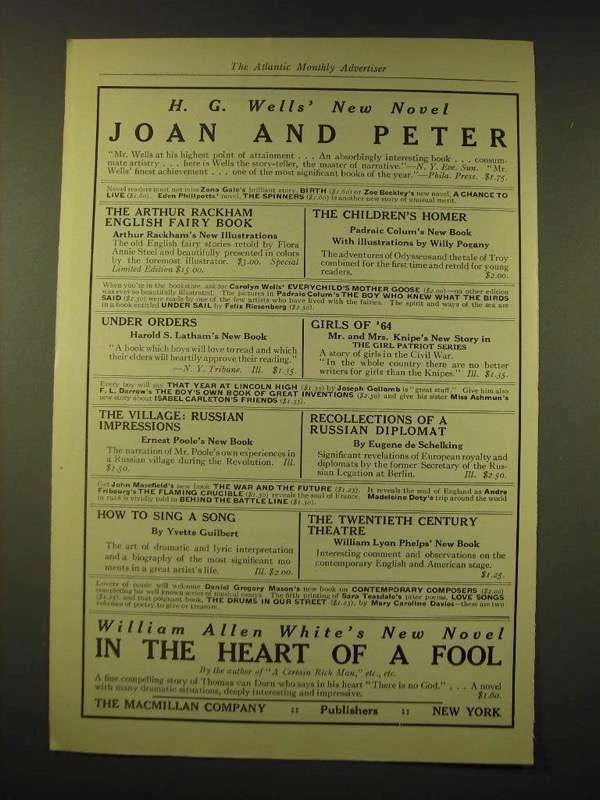 1918 Macmillan Company advertisment for Joan and Peter by HG Wells
From this foundation, Joan and Peter develops in three main parts.
In the first part, Peter is born, in a house designed by Arthur (one of only two), and Oswald comes from Africa to visit and, learning that Peter is not to be christened unless he asks to be, offers to be his godfather “pour rire,” and pledge that he shall be taught French, German, mathematics, chemistry, and biology and that he shall renounce the Devil and all his works. After he departs, Arthur and Dolly have a bicycling accident and consider who would become Peter’s guardian if they were both killed; after a little while Arthur thinks of Oswald.
A few years later, Oswald comes for another visit, after Joan has become part of the household. By this time, Arthur has been unfaithful to Dolly, “on principle,” Wells says, and goes on to hint at the affair to Dolly (a century later he would have said “polyamory”), who reacts very unhappily and indeed is tempted to return Oswald’s previously unconfessed love for her, perhaps even to go to Africa with him. Finally Dolly and Arthur are dramatically reconciled, and go on a trip to Italy, while Arthur’s sisters Phoebe and Phyllis move in to look after the children. During the trip they both drown in the waters off Capri.
By this point, it’s clear that Oswald is Wells’s real hero, and he has the right attributes for one: Enlisted young in the Navy, he receives the Victoria Cross at twenty for courage in battle — a battle that blinds one eye and scars half his face. No longer able to serve in the Navy, he eventually ends up in Nyasaland as a British agent, with the idea of serving humanity and the British Empire, suppressing slavery and despotic local rulers, but also with the idea that civilization is essentially an educational enterprise.
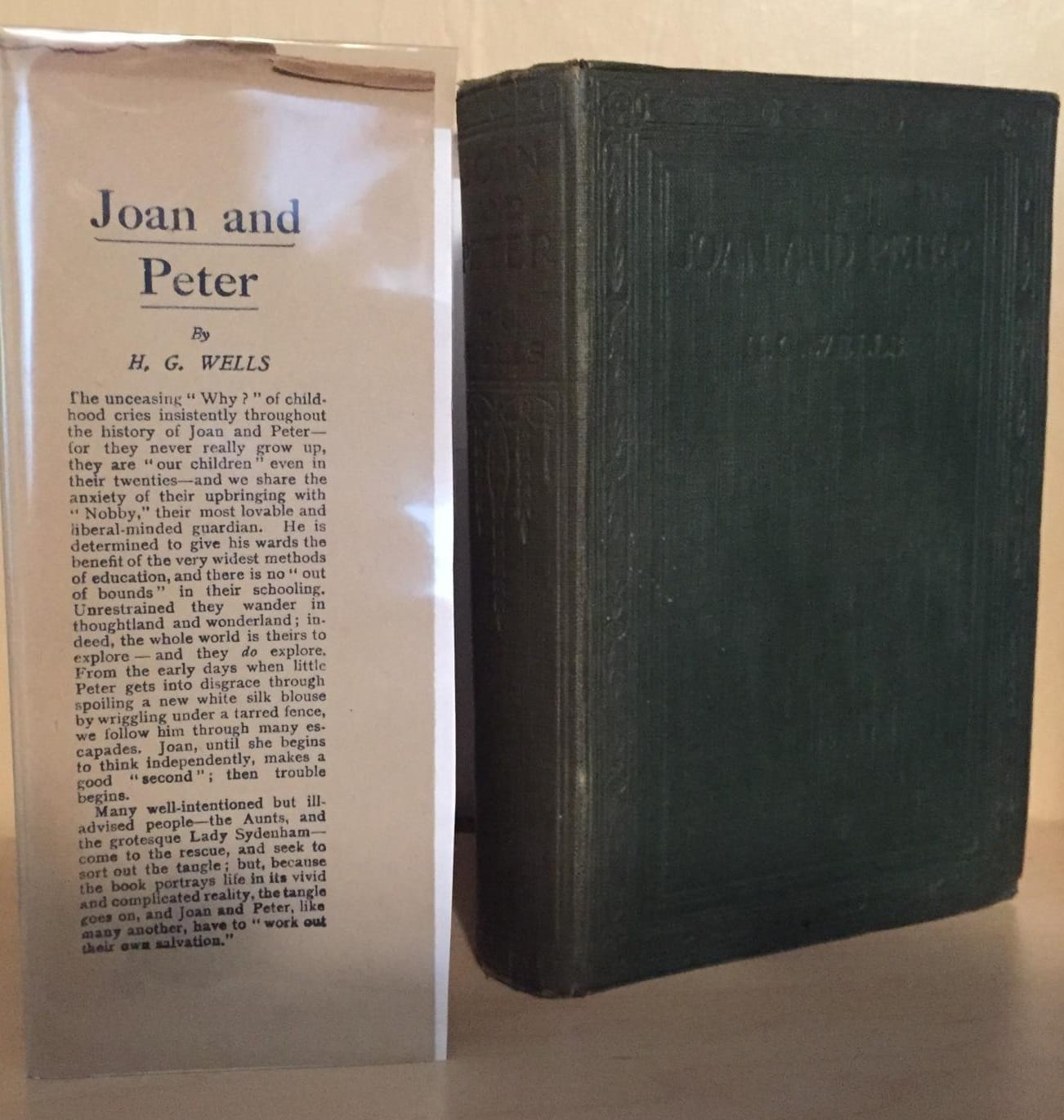 Joan and Peter inside flap (Cassell, 1918)
All of this actually makes Wells sounds more Kiplingesque than he’s often thought of as being. On his second visit to England, Peter gives him the nickname “Nobby,” after his favorite toy, a Dutch doll half of whose face was smashed off while Peter was playing with him and then painted black; the two of them fuse into a central figure in Peter’s private mythology. It’s as that myth that he appears in the second part.
All of that part’s complications derive from Arthur’s will, as he revised it before the trip to Italy — without telling Dolly! He appoints his two sisters as joint guardians with Oswald, and then, not wanting Oswald outvoted all the time, he adds Oswald’s aunt by marriage, Lady Charlotte, a wealthy and conservative widow, “one of those large, ignorant, ruthless, low-church, wealthy, and well-born ladies who did so much to make England what it was in the days before the Great War.”
This leads to a long series of conflicts over Joan and Peter’s upbringing, their schooling, and their religious instruction, carried out partly through solicitors, and eventually by Lady Charlotte’s agents taking Joan and Peter from their school to dispose of them more suitably (as Lady Charlotte sees it), when Peter has reached the age of ten.
At this point, Oswald comes back to England, for two reasons: first, he’s been warned that if he stays in Africa, blackwater fever will kill him; second, witnesses have been found to Arthur and Dolly’s deaths, and while the courts normally assume that the woman will drown first, being “the weaker vessel,” their testimony shows that Dolly went on swimming long after Arthur sank — so her will prevails, and Oswald is the only guardian after all.
 Joan and Peter paperback edition
The third part then jumps forward a decade, to when Peter and Joan are nearing majority, though with flashbacks to Oswald’s arrangements for their schooling. They get caught up in the Great War, and also in sexual passions — and Joan learns that Peter isn’t her brother, or even her half brother, but her first cousin, whom she can think of marrying, while Oswald puzzles over what a mess his wards are making of the whole matter.
On one hand, for American readers, these attachments of cousins may seem peculiar and even creepy: Oswald and Dolly are first cousins, and so are Peter and Joan, and there’s even a scene of unspoken romantic attraction between Oswald and Joan, who’s his first cousin once removed and thirty-two years younger. Wells treats it as a matter of course, though, and American writers once did so: Louisa May Alcott’s Rose Campbell (in Eight Cousins and Rose in Bloom) never even considers a suitor who’s not one of her male first cousins.
On another, having been raised together, and even thought each other to be half-siblings since infancy, Joan and Peter may not be a plausible romantic couple, and making them so may owe more to romantic poets like Shelley than to actual observation. The Westermarck effect had been recognized about when Wells began writing fiction. I also noticed several scenes of same-sex attraction; it’s visible that Wells makes male–male attraction much more disturbing than female–female.
But all of this is something of a side issue to Wells’s real plot, which is didactic. Key scenes involve his characters encountering the peculiarities of a sample of schools of various English types.
 Joan and Peter: The Story of an Education (Cassell, 1918)
The School of St. George and the Venerable Bede, which Joan and Peter both attend from early childhood, has what we might now call a New Age flavor: children wear robes called djibbahs, and the curriculum is rather freeform and experimental, with artistic activities such as performing A Midsummer Night’s Dream. Wells makes a point of reading being taught by the “look–say” method and arithmetic by a process that emphasizes understanding rather than memorization, much like New Math or current approaches to mathematics — unfortunately the young woman who teaches arithmetic is a little confused about some of it. (These were things I thought came in after World War II, and maybe they did — in the United States.)
High Cross School is a much more traditional school, with a headmaster who was good at sports and never really mastered the classical languages he mainly teaches. After being harassed by other boys and caned by the headmaster (for not answering to the headmaster’s newly invented nickname for him) Peter runs away and finds his way home (and one of the boys sent out to search for him expresses extravagant, sentimental grief when it appears that he drowned). Peter calls on the name of “Nobby” during the caning and fantasizes about him while running away. Joan, in the meantime, isn’t sent to school at all; as a bastard she’s thought best suited to domestic service — and then she catches measles.
After this, Oswald undertakes a long search for better schools, of which we hear most about the ones for boys. Peter ends up at Caxton, a fairly progressive school for boys, and Joan at Highmorton, a school for girls run by suffragettes. And during this phase Wells gives us a passage where the headmaster of a preparatory school that readies Peter for Caxton bemoans the limits placed on him by parents’ demands for the standard sort of education.

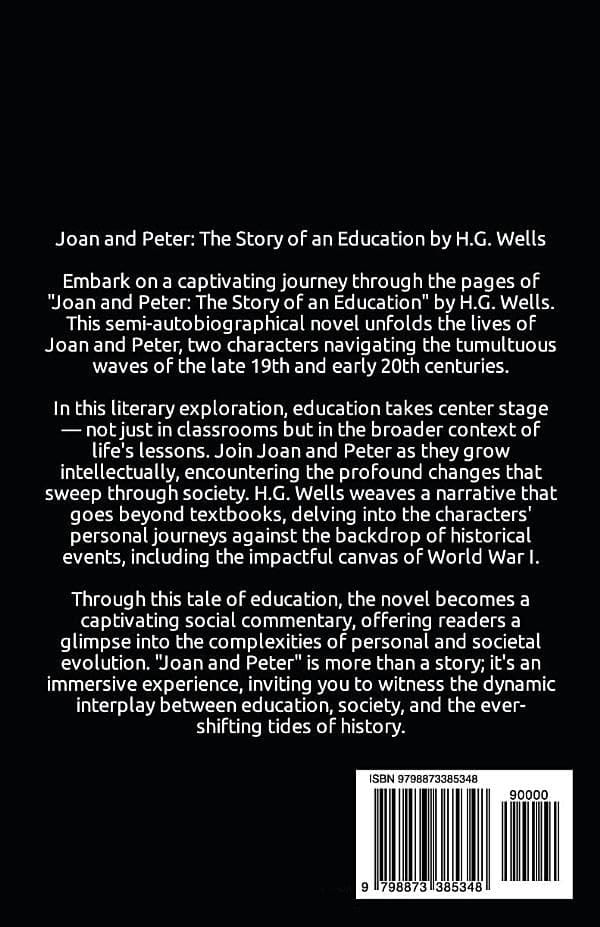
Joan and Peter The Story of an Education (Aevum Editions Publishing, December 30, 2023)
Behind all this is a clash of philosophies of education, presented in a conversation during Peter’s infancy: Arthur and Dr. Fremisson, the family doctor, are all for a natural childhood, in the spirit of Rousseau or William Morris, but Oswald thinks that human planning can improve nature considerably. This leads to a debate over whether plowed fields are artificial or natural:
“I’d like to know just what does belong to the natural life of man and what is artificial,” said Oswald. “If a ploughed field belongs then a plough belongs. And if a plough belongs a foundry belongs — and a coal mine. And you wouldn’t plough in bare feet — not in those Weald Clays down there? You want good stout boots for those. And you’d let your ploughman read at least a calendar? Boots and books come in, you see.”
“You’re a perfect lawyer, Mr. Sydenham,” said the doctor, and pretended the discussion had become fanciful…
The whole thing was remarkably like a Heinlein character’s rant about technophobes! Wells really was an ancestor to classic science fiction.
In a charmingly comedic scene, Arthur tries to get the children to build cooperatively with toy bricks, following Kropotkin’s theories, only to be frustrated by each one wanting to do the whole job: “Dadda not put any more bricks. No. Peter finish it.” The housemaid, Mary — a socially enlightened household has to have at least one servant, who actually spends more time with the children than either parent — finds it simpler to draw a line across the floor and give each child half the bricks, letting them play side by side. (Mary quietly vanishes from the story sometime after Oswald’s return.)
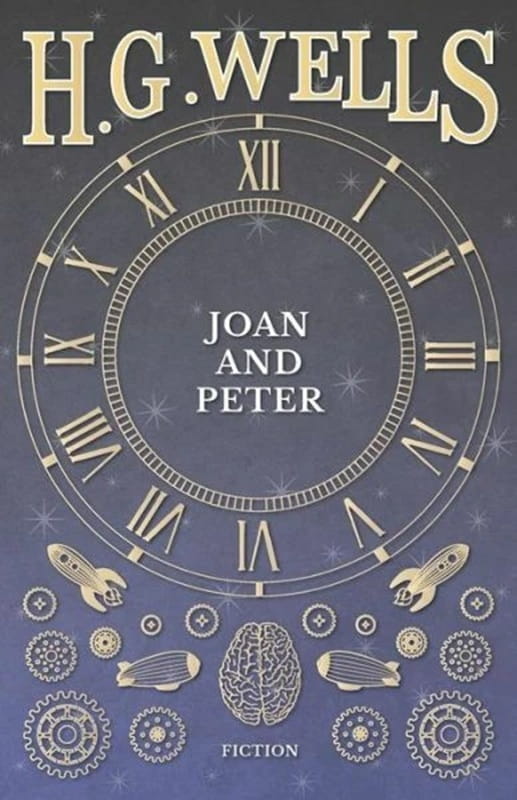 Joan and Peter trade paperback edition (Read Books, 2008)
A final chapter has Oswald setting out to give Joan and Peter a valediction, an apology for his own life and what he’s made of it, and a philosophy of education. But he doesn’t get to deliver much of what he’s lain awake rehearsing; no sooner does he ask his rhetorical introductory question, “What is education up to?” than Peter jumps in and offers his own answers. In the end Oswald, sitting in the dark in his study, reflects on his own life, and his feelings for Dolly and Joan, and then gets up to light his reading lamp and go to work.
I suppose literarily this is more plausible, and livelier, than Socrates giving a long speech while his young admirers say, “Yes, Socrates!” but I ended up feeling that it was a little too inconclusive. (And Plato would have explicitly linked erotic attraction to education in a way that Wells hints at but doesn’t quite make clear.) The whole project is a kind of amphibious entity, half a novel and half a tract, and both halves are interesting, but they don’t quite mix.
It had not thitherto occurred to Oswald that his ward had the most beautiful neck and shoulders in the world, or that Joan was as like what Dolly once had been as a wild beast is like a cherished tame one.
William H. Stoddard is a professional copy editor specializing in scholarly and scientific publications. As a secondary career, he has written more than two dozen books for Steve Jackson Games, starting in 2000 with GURPS Steampunk. He lives in Lawrence, Kansas with his wife, their cat (a ginger tabby), and a hundred shelf feet of books, including large amounts of science fiction, fantasy, and graphic novels.
Categories: Fantasy Books
Spotlight on “Small Boat” by Vincent Delecroix

LitStack Spots Here are other books we’ve spotted and we’re adding to our TBR list,…
The post Spotlight on “Small Boat” by Vincent Delecroix appeared first on LitStack.
Categories: Fantasy Books
The Imaro Saga by Charles Saunders
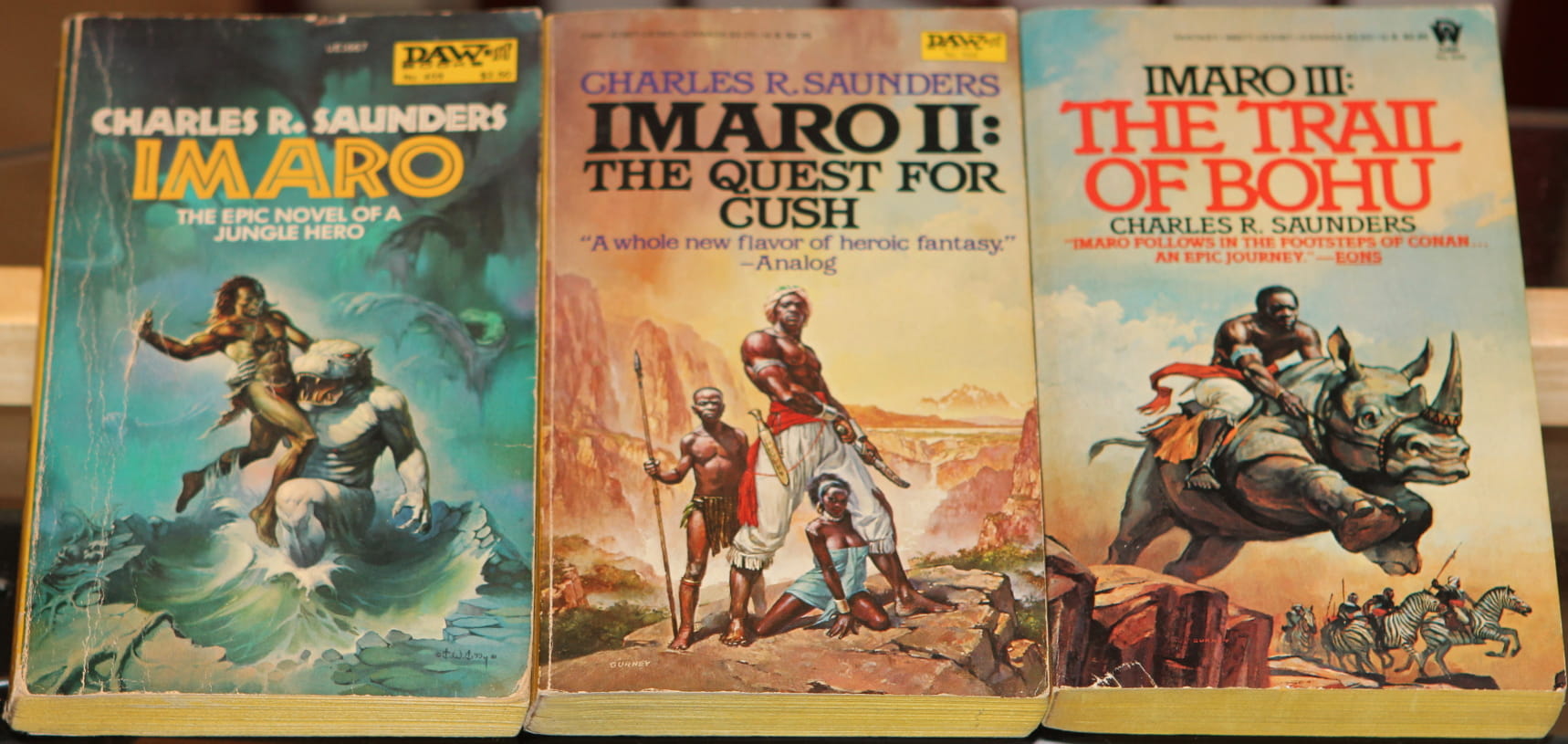 The Imaro trilogy by Charles Saunders, all from DAW Books: Imaro (November 1981), The Quest for Cush (February 1984) and The Trail of Bohu (October 1985). Covers: Ken Kelly and James Gurney
Charles Saunders (1946 – 2020) was one of two men who established a sub-genre of Sword & Sorcery that has come to be called Sword & Soul. The other was Samuel Delany (1942 – ). Saunders was born in the USA but moved to Canada as a conscientious objector after being drafted for Vietnam. He became a journalist and wrote a lot of nonfiction, much of it dealing with the lives of Blacks in Canada.
Around 1974, Saunders created a fictionalized Africa called Nyumbani and began writing S&S stories set there about a hero named Imaro. These were published in a small magazine but the first one was reprinted by Lin Carter in his 1975 edition of Year’s Best Fantasy. By 1981, some of these stories had been connected into novel form and were published as Imaro, by DAW books (Ken Kelly cover). Two more books followed, The Quest for Cush (1984) and The Trail of Bohu (1985), both with excellent and more appropriate-to-the-character covers by James Gurney.
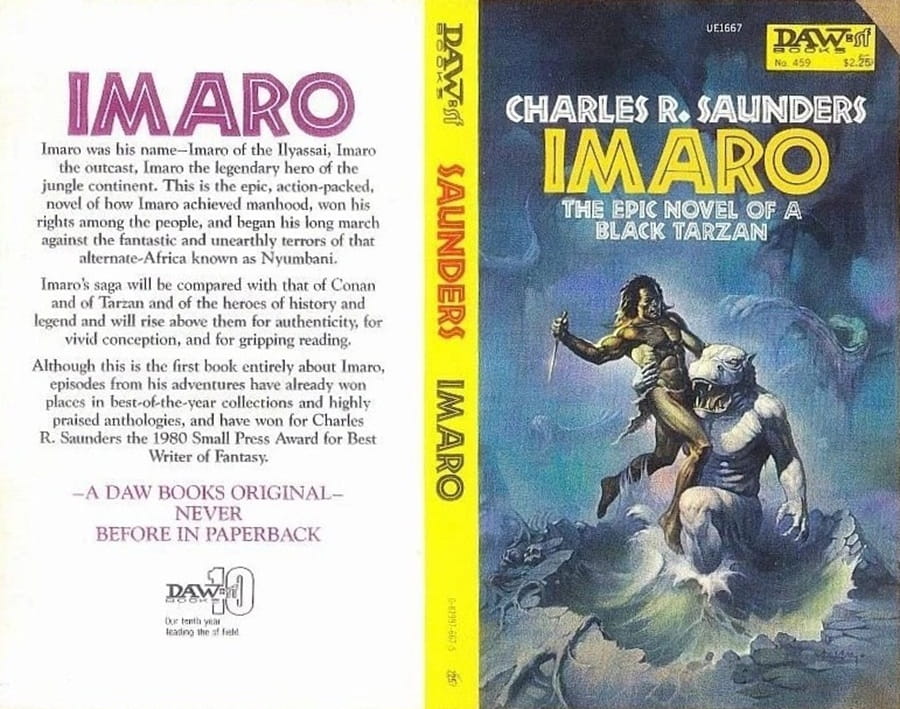 DAW’s original cover for Imaro, with tag line The Epic Novel of a Black Tarzan, withdrawn and reprinted after a complaint from the estate of Edgar Rice Burroughs
DAW didn’t know how to market a black S&S hero like Imaro and initially the character was compared to Tarzan, probably because of the African connection. Imaro, however, is much more Conan than Tarzan, although he is a unique character and no “clonan.” DAW realized their error and made the better connection, quoting on the back of Imaro:
Imaro’s saga will be compared with that of Conan and other heroes of history and legend…
(An aside about this quote: Conan is implied to be a hero of ‘history and legend.’ That’s a little odd.)
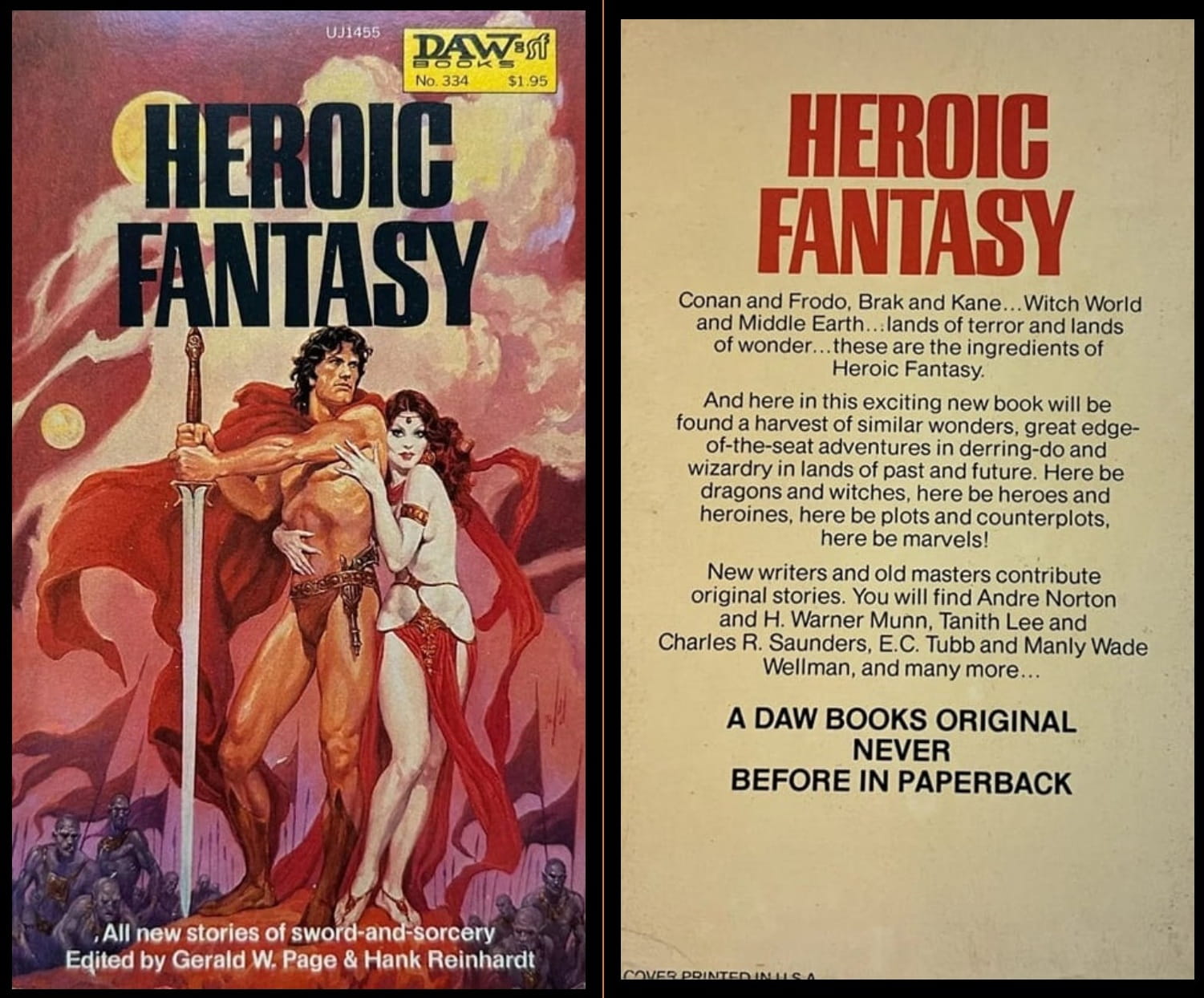 Heroic Fantasy edited by Gerald W. Page & Hank Reinhardt (DAW Books, April 1979). Cover by Jad
Imaro III: The Trail of Bohu has a cover quote:
Imaro follows in the footsteps of Conan
I first discovered Imaro in an anthology I’ve mentioned before called Heroic Fantasy. This led me to the first Imaro novel, although it took a while to find #2 and #3. They make a nice, solid body of work.
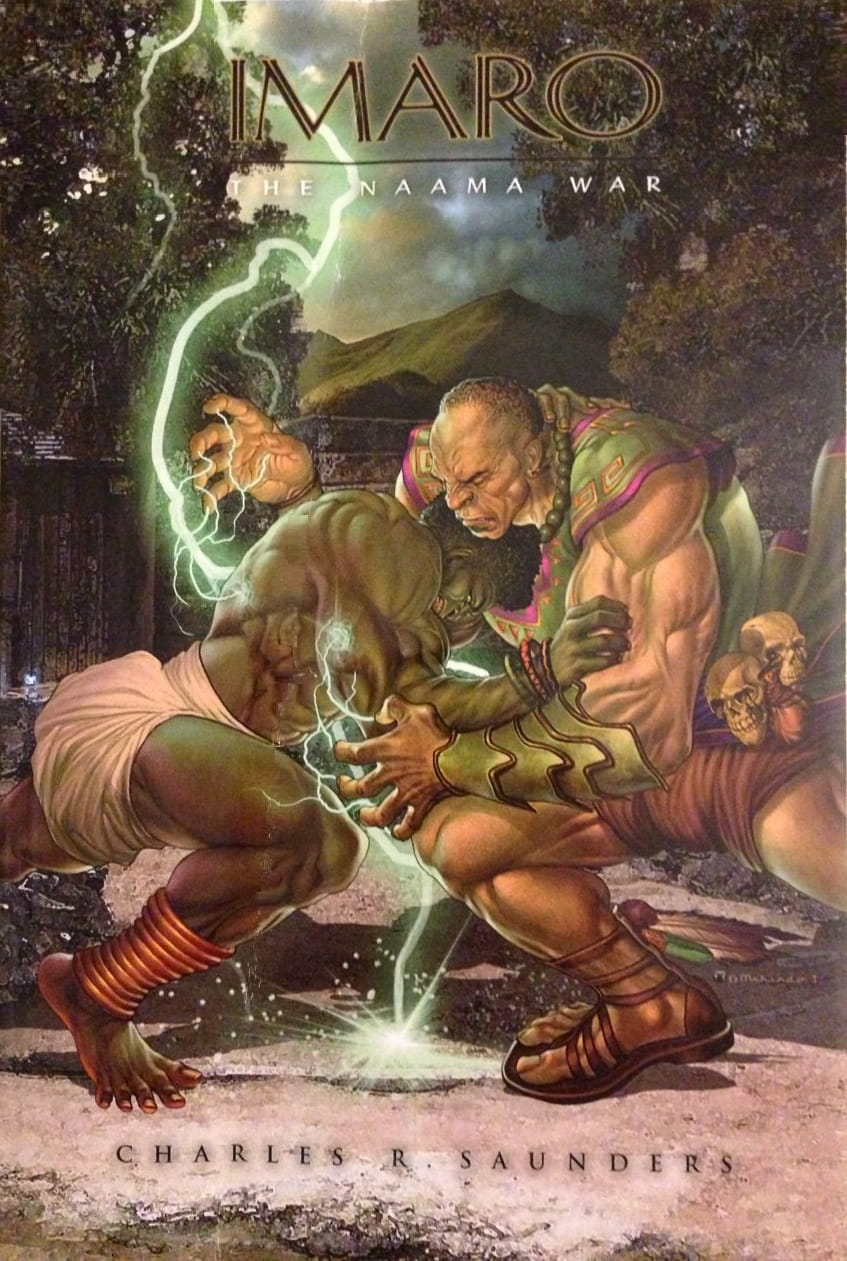 Imaro: The Naama War (Sword and Soul Media, December 29, 2009). Cover by Mshindo Kuumba
In 2009, Saunders self-published a fourth Imaro novel called The Naama War, through Lulu. Unfortunately, I didn’t immediately pull the trigger to buy it and now it’s unavailable. I’ve shown the cover pic by Mshindo Kuumba above.
There’s also a short story collection called Nyumbani Tales set in Imaro’s world (below), but the copies I’ve seen are used ones for nearly 150 bucks.
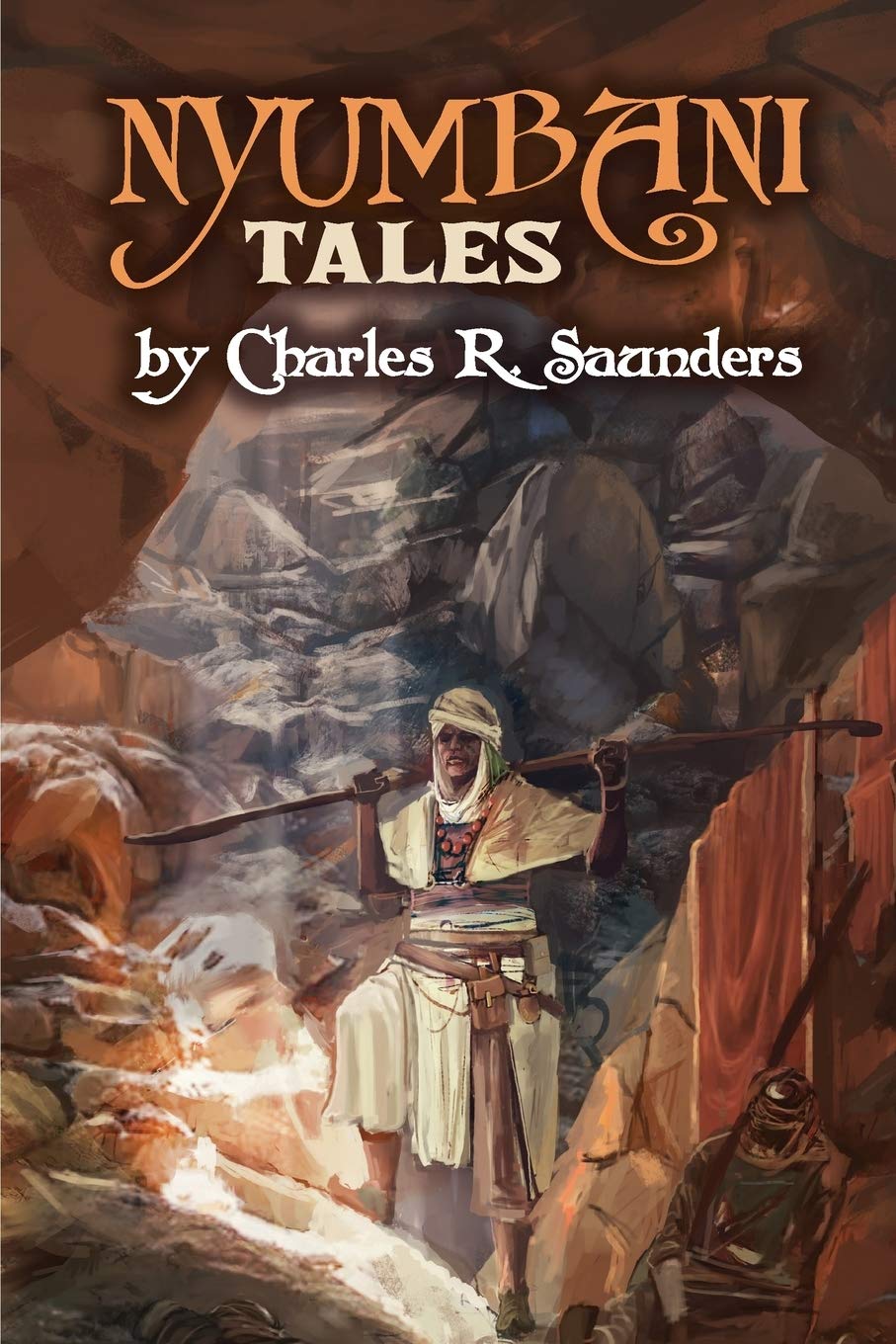
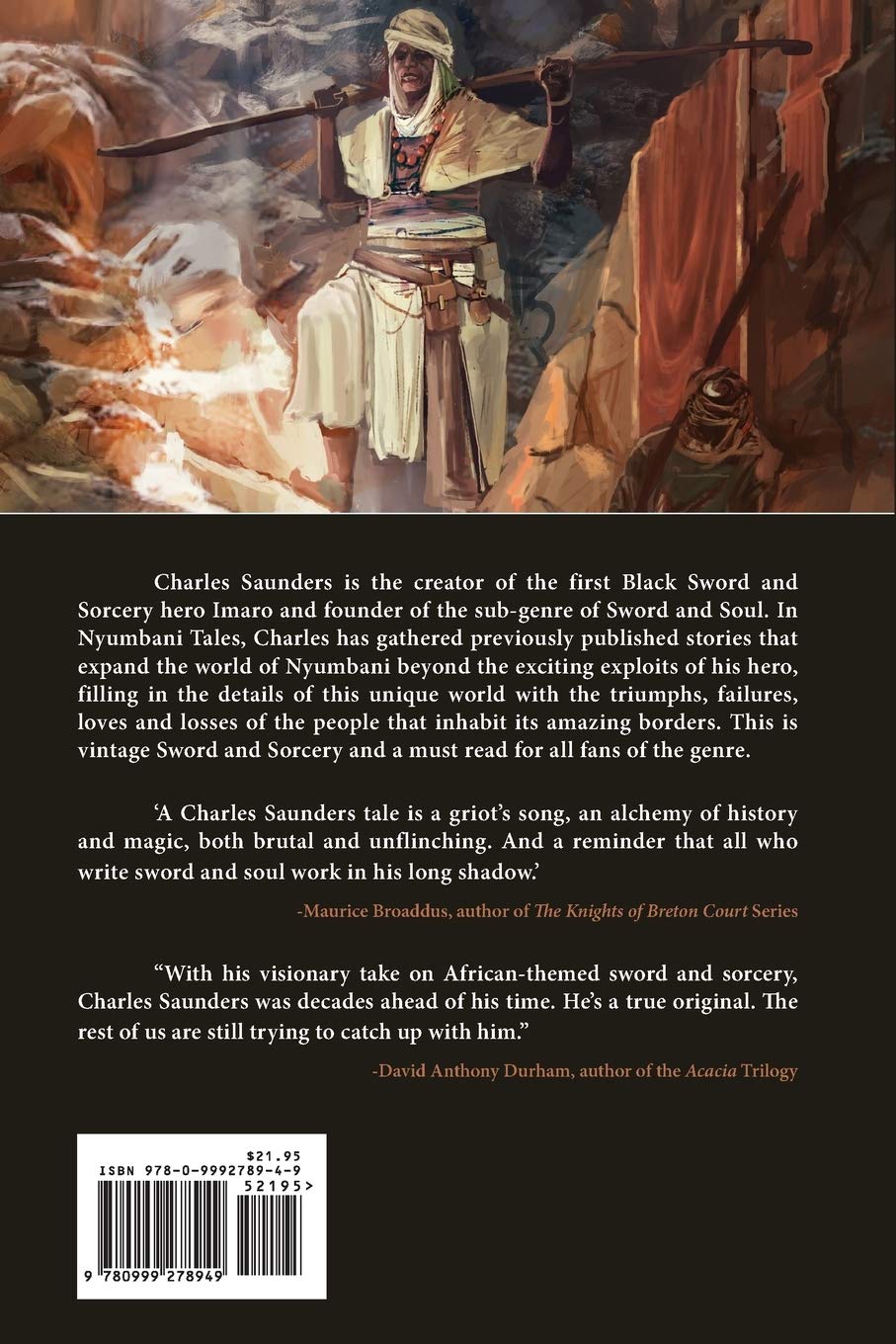
Nyumbani Tales (MVmedia, May 19, 2017). Cover by Edison Moody
Updated versions of the first two Imaro novels (re-edited by Saunders) were published in the early 2000s, although I don’t have them (see below). Saunders also wrote stories about a woman warrior named Dossouye. I read one of these, which was quite good, but the collection is currently unavailable.
I remember hearing of Saunder’s death several months after it occurred and being shocked. His writing, fine as it was, had not brought him any comfortable financial situation.
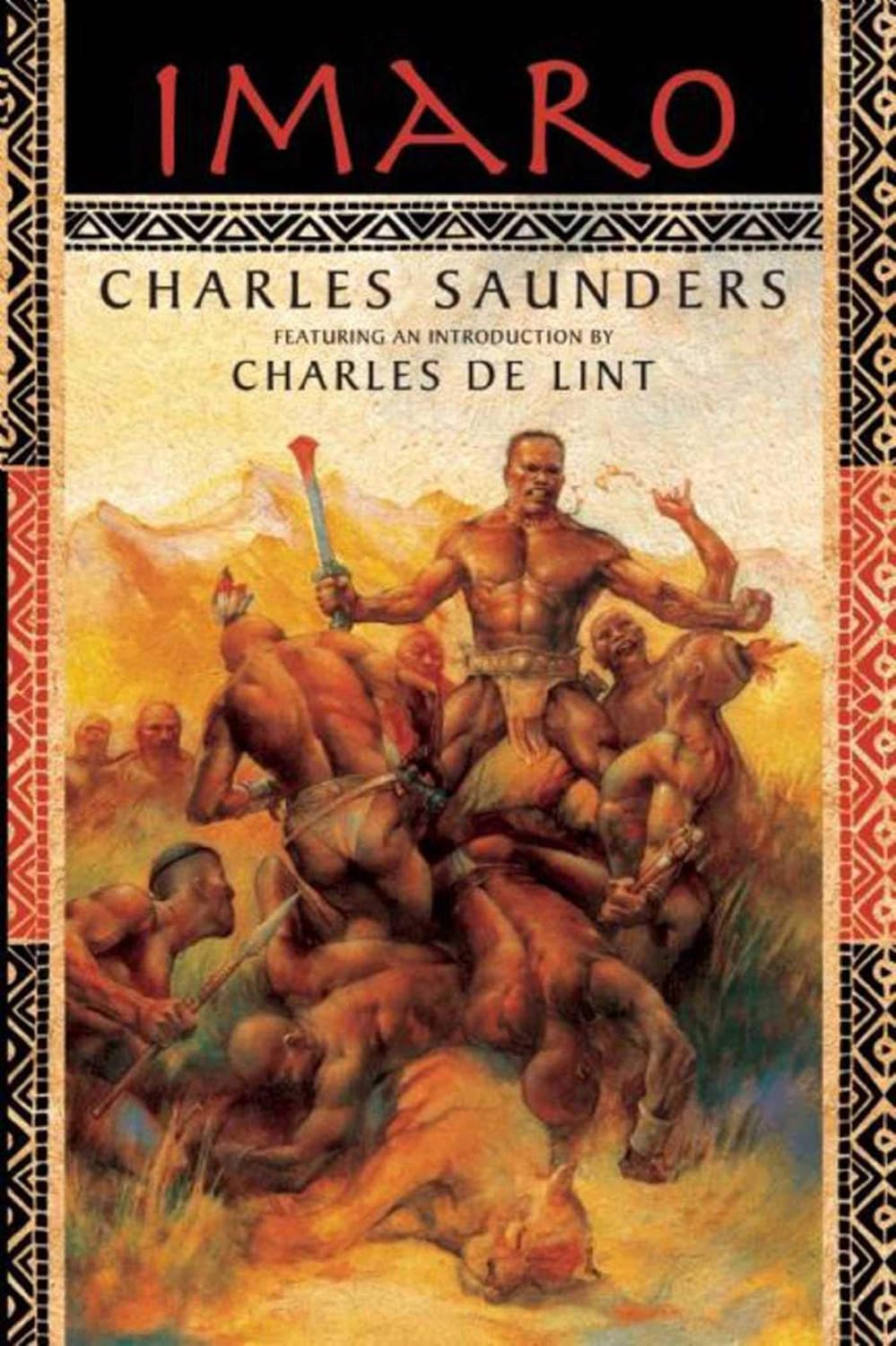
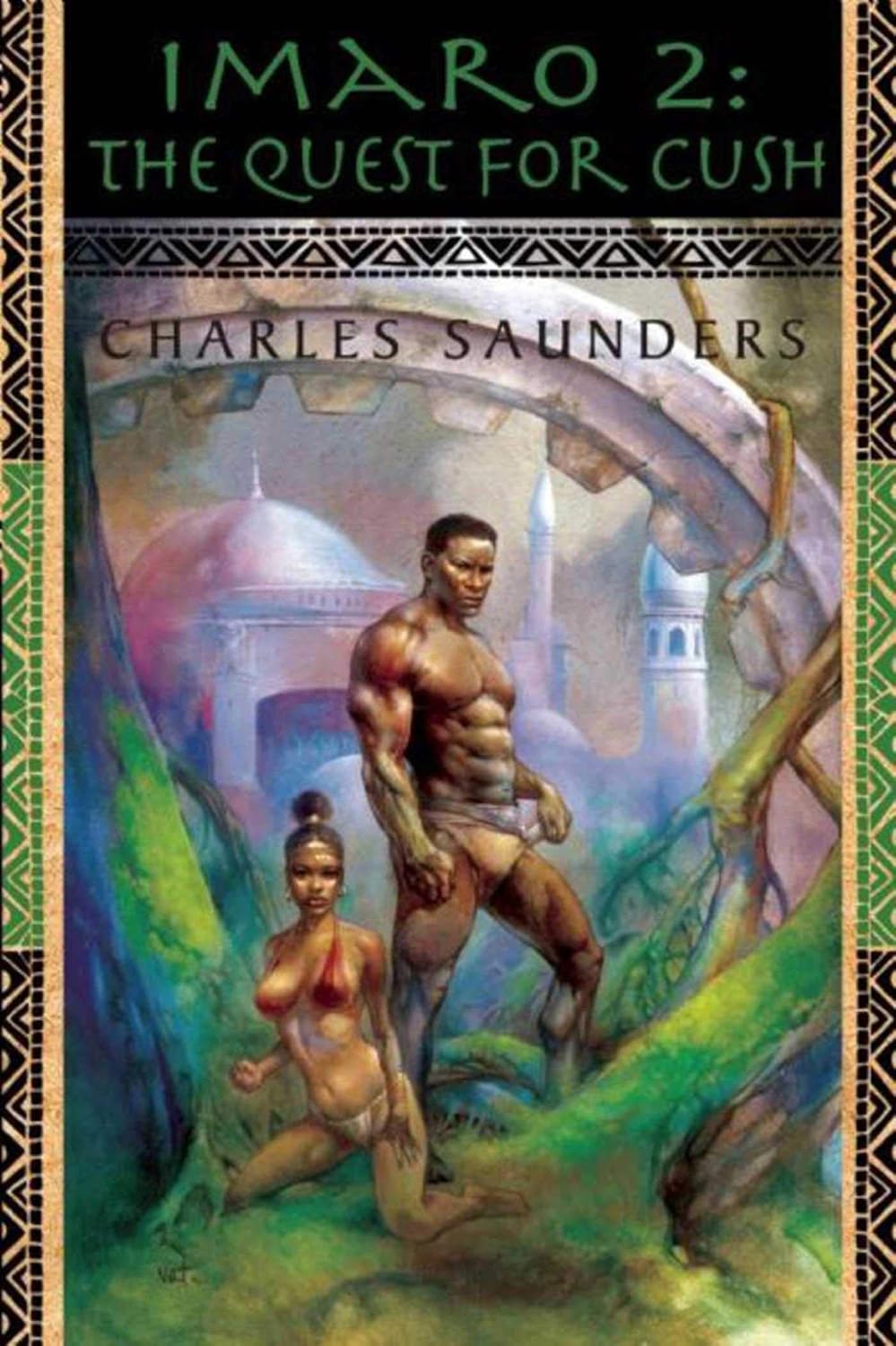
Reprint editions of Imaro and Imaro 2: The Quest for Cush from
Night Shade Books (February 15, 2006, and January 2007). Covers by Vince Evans
He died in a small apartment with no phone or internet connection, and apparently with no one close enough to him to check on his whereabouts. We can at least hope he’ll be better remembered after his death than he seemingly was before.
Charles Gramlich administers The Swords & Planet League group on Facebook, where this post first appeared. His last article for us was a review of two S&S anthologies, both titled Warlocks and Warriors, edited by Donald M. Grant. See all of his recent posts for Black Gate here.
Categories: Fantasy Books
Women in SF&F Month: Lorraine Wilson
Women in SF&F Month 2026 officially starts today with a guest post by Lorraine Wilson! Her short fiction includes “Bathymetry” (winner of the British Fantasy Award) and “Mhairi Aird” (published in the British Fantasy Award–nominated anthology Nova Scotia: New Speculative Fiction from Scotland, Volume 2). Her first novel, This Is Our Undoing, won the SCKA for Best Debut and was a finalist for the Kavya Prize as well as the British Fantasy Awards for Best Novel and Best Newcomer. Her […]
The post Women in SF&F Month: Lorraine Wilson first appeared on Fantasy Cafe.
Categories: Fantasy Books
7 Author Shoutouts | Authors We Love To Recommend

Here are 7 Author Shoutouts for this week. Find your favorite author or discover an…
The post 7 Author Shoutouts | Authors We Love To Recommend appeared first on LitStack.
Categories: Fantasy Books
Monthly Review – March 2025

I started the following series:
- None
I finished the following series:
- Redemptor (Raybearer, Book 2) by Jordan Ifueko (5/5 stars)
My Favorite Books of the Month Were:
- Agnes Aubert’s Mystical Cat Shelter by Heather Fawcett (5/5 stars)
- Redemptor (Raybearer, Book 2) by Jordan Ifueko (5/5 stars)
- Dreams Lie Beneath by Rebecca Ross (5/5 stars)
The full list of books that I read this month are shown below:
1. The Glowing Life of Leeann Wu by Mindy Hung (3/5 stars)
2. Agnes Aubert’s Mystical Cat Shelter by Heather Fawcett (5/5 stars)
3. So Far Away by Kat Mellon (4/5 stars)
4. Silver and Lead (October Daye, Book 19) by Seanan McGuire (3.5/5 stars)
5. Hollow Gods (Monstress, Vol 10) by Marjorie Liu, Sana Takeda (4/5 stars)
6. Redemptor (Raybearer, Book 2) by Jordan Ifueko (5/5 stars)
7. Wings and Broken Things (Mitzy Moon, Book 3) by Trixie Silvertale, Narrator Coleen Marlo (4/5 stars)
8. Keeper & Kindred (Meow: Magical Emporium of Wares, Book 2) by Toni Binns (4/5 stars)
9. Dreams Lie Beneath by Rebecca Ross (5/5 stars)
10. The Faraway Inn by Sarah Beth Durst (4/5 stars)
Categories: Fantasy Books
Proven Wrong… Joyfully
 Image by kalhh from Pixabay
Good afterevenmorn, Readers!
Everyone has a preference, right? Preferences show up all the time; in food, in friends, in partners, in art, films, and books. I, for example, like my food relatively spicy. My father will take it so damned hot any normal person will hallucinate pink elephants for hours. Not my preference. Sharing an Indian meal with him is sometimes a challenge. I prefer whiskey to most other alcoholic beverages, though I’ll happily have a rum and coke on occasion. I am a huge fan of surrealism in art, and find expressionism a little dull (controversial take alert). And when it comes to my books, I do not like first person perspective narratives, or LitRPGs, and I’m very particular about my humour.
Well, there are two books/series now that have absolutely slapped me in the face and called me a liar. And I’m here to admit I have (joyfully) been proven so very wrong.
 Image by Ylanite Koppens from Pixabay
First, I have to mention that I had struggled with reading for years and years and years. In fact, reading for pleasure became in credibly difficult during and after my university years. I just could not find it in me to pick up a book and start reading. There are some books that pulled me out of the slump momentarily (thank you Malazan Book of the Fallen), but on the whole, I’ve not been able to read.
I have no idea what the block was about. I did try to overcome it last year, attempting to force myself to read just before bed. While I did read more books last year (I think the number was four) than I had in previous years, it was still an absolute slog. This made me incredibly sad, as I had, prior to university, devoured books by the dozens in a year. I loved reading. Or I did. So why couldn’t I read?
Something this year shifted. For some reason, I have been much better about reading. As I don’t really have much spare time, I’ve kept my reading time for the times I’m on public transit, which is usually just Tuesdays, Thursdays and Saturdays (when I head to and from martial arts training). This appears to have worked a bloody miracle. I set my reading goal for twelve books in the year. I figured one book a month was more than doable with my schedule.
I have, as of this weekend just done, finished my tenth book. I don’t know why I’m suddenly devouring books again, but I’m not sad about it… because I have read some stellar books of late. My wallet, however…
The first book that took me by surprise in my new reading feast was this one:
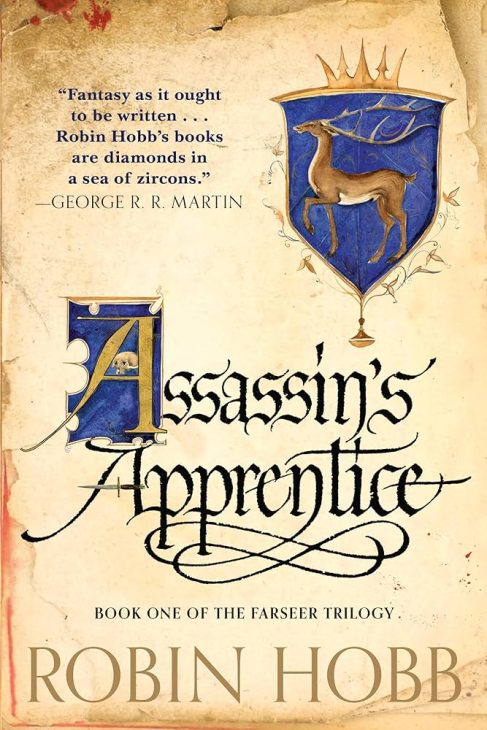
I had heard from a few ‘BookTok’ creators that this was a good read (though BookTok appears to have ben swallowed whole by Romantasy at present, some folks are recommending different books). The first book in the Farseer Triology, The Assassin’s Apprentice by Robin Hobb is written in one of my least favourite perspectives – first person. I was not thrilled, to be honest, when I read the first page. Until I hit the second. And then I was all in on this story. I cried three times before chapter five. This was an absolute five star read for me. And it took me by surprise. I was not expecting something written in the first person to be as affecting as it was.
I chalked it up to a fluke. One exception to the rule due to an exceptional writer.
And then, and then, and THEN I read this:
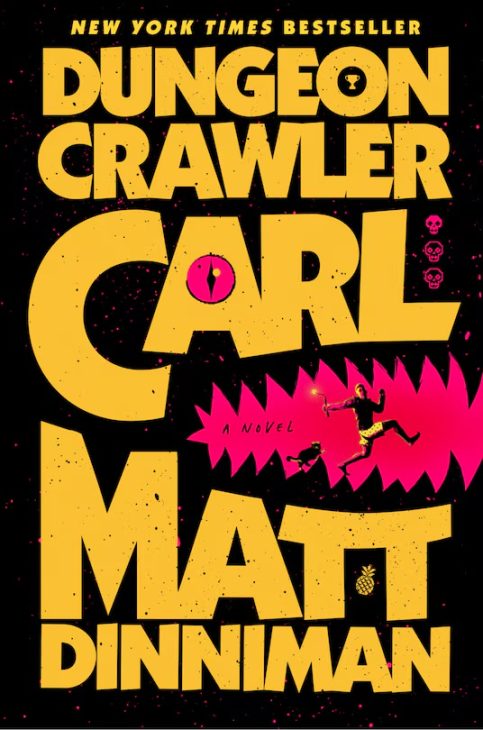
I admit, I was influenced. A number of people in my circles had mentioned how good this book was. It did not seem like my thing. I am not a fan of LitRPGs, and worse, it was first person. So, not something I would enjoy. Still, folks were taking about how good this book was, so I resolved to give it a chance.
I. Loved. It.
This book is funny, and earnest, and somehow able to maintain some incredible tension. The situation was absolutely ridiculous, yet I managed to be filled with compassion for some of the ‘mobs,’ charmed by characters who could be incredibly annoying if mishandled, and absolutely holding my breath in some of the scenes.
This was my second five star read that I absolutely did not expect. Twice now I’ve been made a liar, and this book made me a liar twice over. A first person LitRPG that I loved? Impossible!
This is, of course, because both Hobb and Dinniman are exception writers, who have both created complicated, fascinating and charming characters, with styles very appropriate to the stories they are telling. While I did not cry during Dungeon Crawler Carl (usually a prerequisite for a five star rating from me), I was so thoroughly entertained, I could not help but rate it highly. For the record, I did tear up a bit in the afterword, which was something I did not know I needed.
You will not break me. Those who’ve read it will understand, I think.

My experience with both first person perspectives as a young reader had coloured my opinion, as these things tend to. It didn’t help that more recent books written in that perspective that got wildly popular were… not very well written in my estimation. If I hear the words ‘Inner Goddess’ one more time, I will absolutely lose what’s left of my sanity. LitRPGs similarly proved disappointing reads before now, and I’ve found them boring or so silly that I cannot get into the story.
Given the poor experiences in the past, it cannot be a surprise that I was hesitant to read these books, and sceptical of their popularity as well (and I have found a lot of books that became wildly popular not really to my tastes besides). Turns out, they’re exceptional, and I am now a liar, liar, pants on fire. I do like first person perspective books, and at least one LitRPG. I should have kept a more open mind.
There’s no really point to this post, except to say that maybe we should all be giving more books a chance, and maybe take some time to test our preferences every once in a while. We might end up very pleasantly surprised… and a little poorer because now I need these books and the entirety of their associated series on my shelf. They bring me joy.
It could be drugs. At least it’s not drugs. Besides, I’ve started walking to work again now that my flu has passed and my lungs are supporting movement again, so there will be less time on public transit. That should slow my reading and spare my wallet a bit…
In any case, I hope you’ll all accept this mea culpa. First person perspectives and LitRPGs are not inherently bad reads. Turns out, like every other genre and perspective, there are good books and bad ones, and a fair number of middling ones. I’m sorry for instinctively turning my nose at them.
Have you read these books? What did you think of them? What kinds of books are your preference? I love talking books. Sound off below!
When S.M. Carrière isn’t brutally killing your favorite characters, she spends her time teaching martial arts, live streaming video games, and sometimes painting. In other words, she spends her time teaching others to kill, streaming her digital kills, and sometimes relaxing. Her most recent titles include Daughters of Britain, Skylark and Human. The Timbercreek Incident is free to read on Wattpad.
Categories: Fantasy Books
GREEN & DEADLY THINGS by Jenn Lyons
Jenn Lyons has published a slew of well-received epic fantasy novels over the last few years (she launched a 5-book series in 2019 with The Ruin of Kings [click the title for a link to my review] that concluded in 2022), an epic standalone and now Green & Deadly Things, a dark-fantasy standalone about dead…
Categories: Fantasy Books
Introducing Women in SF&F Month 2026
This April will be the fifteenth annual Women in SF&F Month here at Fantasy Cafe, starting on the 1st! For the last several years, this month has been dedicated to highlighting some of the many women doing wonderful work in fantasy and science fiction, and the site will be featuring guest posts by some of these writers throughout April. There will be new posts appearing on Mondays, Wednesdays, and Fridays throughout the month, and there will also be a book […]
The post Introducing Women in SF&F Month 2026 first appeared on Fantasy Cafe.
Categories: Fantasy Books
Monday Musings: Checking In After A Quiet Stretch
It’s been a while since I last posted on this blog, and while I don’t think I have much to say, I thought I should at least say something. So….
Hi. How’re’ya doin’?
Good, good…
How am I?
That’s…complicated. Generally, I’m okay. Life flows along. I had a birthday not so long ago. Never mind which one. But I saw friends and family. I heard from lots of people. And despite the inexorable march of time, I felt pretty good about the whole thing. Especially considering the alternative….
A few days later, though, I was feeling down, and I couldn’t explain it. As I say, I’d just had a nice birthday, and things seemed to be going along pretty well. Yet, I was just so very sad. Why? I finally said something to Nancy, and she reacted with something akin to, “Well, yeah, of course.” And then she reminded me that we were, almost to the day, five years removed from the day Alex called to tell us of her cancer diagnosis.
Suddenly, it made sense. As my therapist used to say, the body remembers. Even if the mind doesn’t actively, the body responds on a primal level to things like seasonal changes — the weather, the angle of sun, the awakening of trees and wildlife. My body remembered the trauma of that conversation, and more, it associated it with this time of year. And once I understood, I felt better. I was still sad, of course, but at least I understood why, and that I could handle.
So, yeah, ups and downs.
Speaking of seasonal changes… Spring insinuates itself daily into the landscape and weather. Spring in Tennessee was a frenzied affair. Temperatures rose quickly, everything seemed to bloom at once, and it wasn’t uncommon to go from winter to spring to days that felt like mid-summer in the span of a single month. Spring here in the Northeast is a far more gradual process, as if the land itself is savoring its rebirth. Fits and starts. Warm days give way to cold ones, which in turn are followed by warmer ones. The end of last week was downright cold. It snowed here yesterday. But earlier in the week, it reached 70. It’s supposed to do the same early this week. And then we could have more snow on Thursday or Friday. Nuts, right? Our crocuses are up. Tulips and daffodils are emerging, but not yet showing blooms. Tree buds are beginning to swell. A few more bird species are flocking to our feeders. The general trend is clear and heartening after a long winter.
With spring, of course, comes baseball, which is still my sport of choice. I love soccer (excuse me: football), but my connection to baseball goes back to some of the earliest memories of my childhood. Playing ball on our little dead end street with the neighborhood kids, playing stickball on my school playground, collecting baseball cards, poring over boxscores in the newspaper literally every day of the season, watching games on TV with my dad, listening to games on my radio on weeknights when I should have been trying to sleep.
I don’t watch as much as I used to. When I was ten, I didn’t have to justify wasting a couple of hours watching a televised game. These days, there always seems to be something else I ought to be doing. But MLB.com airs radio broadcasts of Major League games from all over the country, and because I’m a subscriber, they’re basically free. So, I intend to listen this summer. There is something magical about baseball on the radio, announced by someone who knows what they’re doing. Maybe it’s the slower pace of the sport that makes it work. Maybe it’s just my love of the game. Whatever. I’m looking forward to it.
What? Work? Yeah, I’m doing some work. I am editing stories for the upcoming anthology, Disruptive Intent, which I am co-editing with Sarah J. Sover for Falstaff Books. There have been a few hiccups along the way, but that is to be expected when working on a project with so many moving parts. I can’t wait to see the final product. We have a terrific set of stories from our roster of wonderful writers, and working with Sarah has been a joy.
When not working on those edits, I have been writing my new book. I am not setting any land speed records with my output, but that’s okay. I’m not in any rush. I’m making progress, and I continue to love the concept and the main character.
I did my taxes this past week (which is also part of “work,” since I’m self-employed). That’s really all I care to say on that subject….
Finally, this past weekend, I took part in downtown Albany’s small but passionate No-King’s Rally. The city hosted a couple of rallies, and the region hosted more than a dozen. The one I attended began in the shadow of New York’s statehouse and then marched through the streets surrounding the Capitol Plaza. We chanted and held signs and all that good stuff, and we joined the millions worldwide who called for an end to the war-of-choice in Iran, the extra-legal brutality of ICE, the weaponization of the Justice Department, the assault on voting rights, and the systemic protection of Jeffrey Epstein’s allies and enablers in the White House and elsewhere. It felt good to do something positive with my simmering anger at this Administration, and to be surrounded by so many like-minded people.
And that’s me right now.
I hope you are well, that the onset of spring brings you joy, and that you have a wonderful week.
Categories: Fantasy Books
Spotlight on “The Chambermaid’s Key” by Genevieve Graham

Titles by Genevieve Graham Here are a few other LitStack Spots of titles to add…
The post Spotlight on “The Chambermaid’s Key” by Genevieve Graham appeared first on LitStack.
Categories: Fantasy Books
8 Things I Think I Think: March 2026
1– BATTLEFRONT II IS PRETTY COOL
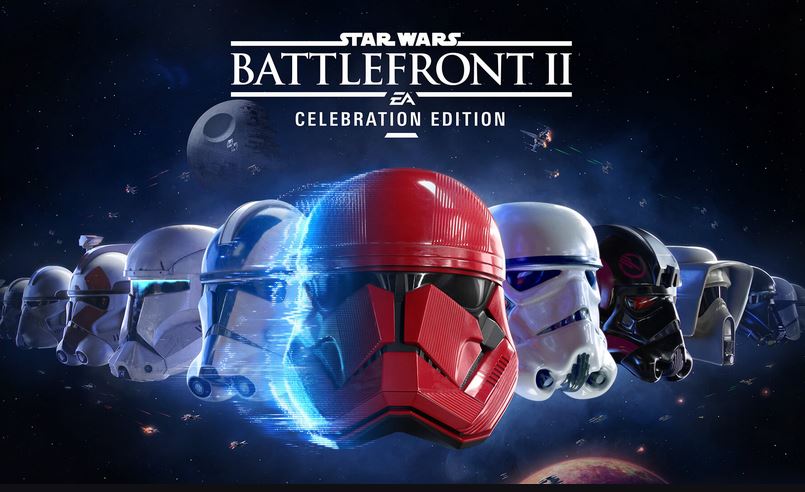 I’ve posted before that Fortnite is my kind of shooter. Fast-paced, high action games like Marvel Rivals, and Call of Duty, aren’t fun for me. And I pretty much just die. Fast and often. I’d rather go play a Solo RPG or something. I had been stuck since finishing Grim Dawn (which I wrote about here). I tried a couple games, including getting into Red Dead Redemption II (which I like, it just hasn’t grabbed me like LA Noire did). I false-started a half dozen games.
My son likes Star Wars: Battlefront II, which I briefly tried. Died repeatedly. Quit. But I decided to give it another go. It’s got a single player campaign mode, with multiple missions, as well as a few other solo options. But it was developed as a Multiplayer shooter, reminiscent of Team Fortress 2.
There was a huge controversy upon release in 2017, regarding micro transactions, and Electronic Arts stopped new content and support, in 2020. But the game has had a couple of resurgences and hit an all-time high in concurrent players last Summer. The game is what it is, and there’s a lot of content for the frequent $3.99 sale price.
I played the entire Solo campaign, in which you are primarily Iden Versio, leader of an Empire elite special forces unit. You have a wakening of the conscience and go to work for the Rebel Alliance. It’s often challenging, but fun. There are also individual Solo scenarios for the Light and Dark sides, where you can play a wide array of SW heroes and villains.
And I’ve played myself up to level 13 in Multiplayer. These are usually large-scale battles of a couple different types, along with options for smaller (down to 4v4) options. I die a lot, but you just re-spawn and continue. I’ve only encountered one blatant cheater so far.
I just wanna say, visually, this game is TREMENDOUS. It’s now 9 years old, and I love how it looks. The cut scenes are like mini-movies. Game play looks great. In space, on ships, on planets: this is a beautiful Star Wars game. I had the Dos-based X-Wing, in the early 90s. Battlefront II is a treat just to watch.
I wish there was more to the Solo campaign (it includes a short sequel), but that was never the heart of the game. The Multiplayer works well enough for me that I’m playing it regularly. It’s not as fun as Fortnite (or maybe, Fortnite is far less frustrating), but the Star Wars immersion is so deep I’m loading it up and blasting away. Check it out on sale and see if it’s your kind of Star Wars thing. The solo campaign was worth $4 alone.
2 – CARL HIASSEN IS A SMILE IN THESE MESSED-UP TIMES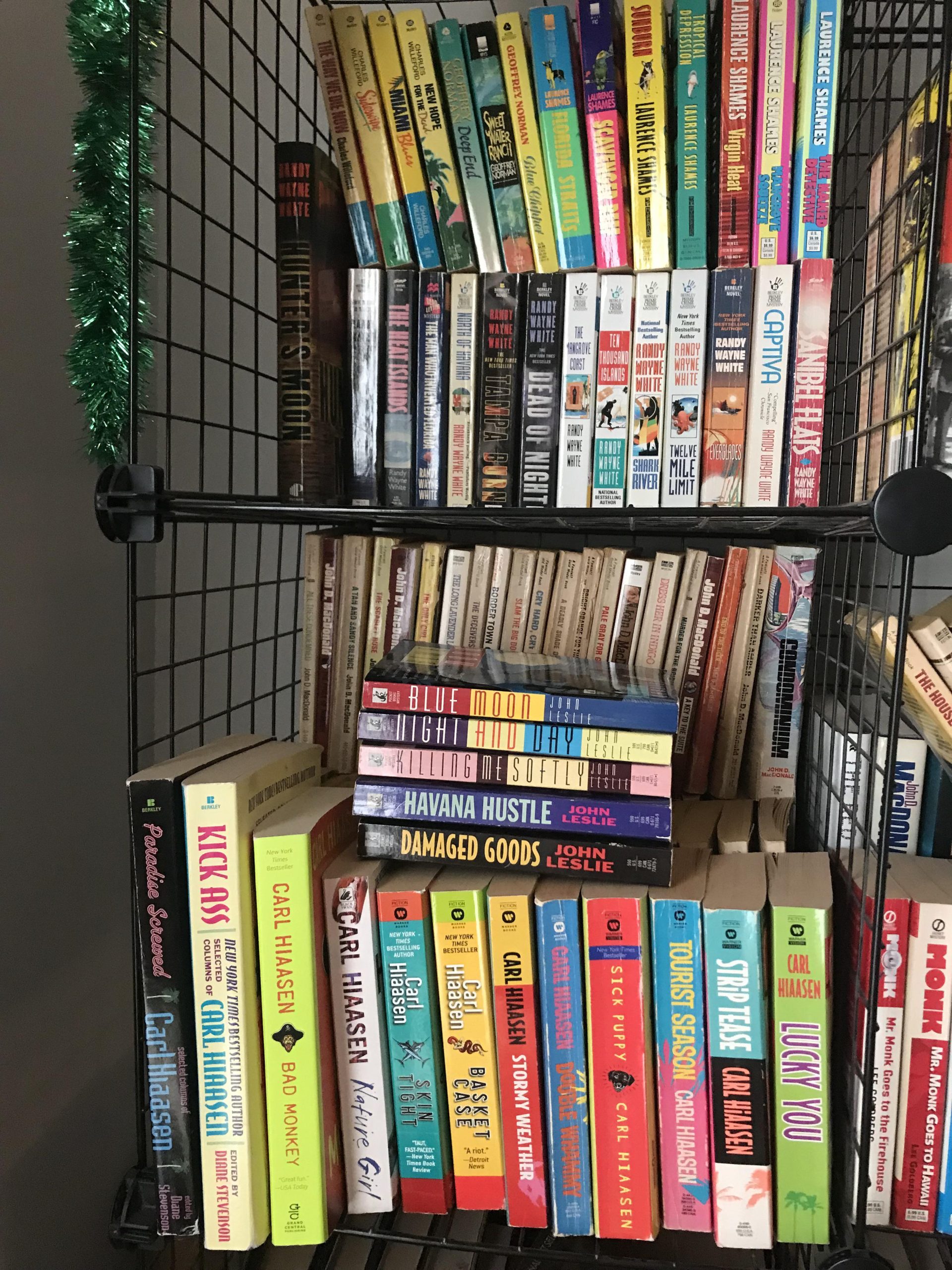 I was a Carl Hiassen fan after he broke big back in the 80s. The Miami newspaper columnist wrote funny crime novels that captured what has become the Florida craziness. Strip Tease was a big-screen movie with Demi Moore. Recently, Apple+ made a Vince Vaughan show from Bad Monkey.
There’s a new Florida PI show, RJ Decker, on Tuesday nights. The character, if not the plots, is from Hiassens’ second novel, Double Whammy. I like the show, though after the first two episodes, they’ve significantly dropped the humor level, and it’s in danger of becoming just another cop show. Hope they get back on track.
There’s a character named Skink, in the book. He’s the former governor of Florida who simply walked away from the corruption and the office and lives in the swamps, eating fresh roadkill. He’s in several Hiassen books, though the show left him out.
Since I really liked the Decker pilot; and since the world is a dumpster fire that keeps getting hotter, I decided to revisit Hiassen.
Hiassen satirizes the absurdity of Florida life – which is also to say, people in general. Hiassen can be laugh-out-loud funny. In a different way from Douglas Adams, and Terry Pratchett. He exacerbates situations, but you don’t dismiss them. Because people are too ‘people-ish.’ They can be that dumb, or shallow, or evil.
What really appeals to me right now is that bad guys get their come-uppance. Often in fitting and hilarious ways. Not always SFW, either. You’ll never forget what a bottlenose dolphin does to a steroided-up security guard in Native Tongue. Bad things happen to ‘good’ folks during the books, but the villains pay their price in the end. And I need that these days.
Hiassen was a newspaper writer for years, and he had co-authored three thrillers, before he started writing funny Florida crime novels. I have re-read/re-listened to six of his first eight novels, and they are still really good, decades later. And they’re still fun. He’s an insightful writer, and a good one.
I started to be less enthralled around book ten, back when. We’ll see how many more I tackle. I know I haven’t read his two most recent adult books (he also writes young fiction) – maybe I should.
I unreservedly recommend Douglas Adams and Terry Pratchett. I think Red Dwarf fits in there, too, if a bit less, for me. I really think you should give Hiassen a try. I’d start with Tourist Season, or Double Whammy. But you don’t need to read them in order. Not even the Skink books (recommended for those, though). Or try Strip Tease if you remember the movie.
The laughs, and the bad guys paying for their crimes, is what I need right now. Hiassen delivers.
3 – JAMES LEE BURKE IS A MASTER OF HARDBOILEDI caught up on some Clive Cussler (well, his continuators) in January and February. Now, I last read a James Lee Burke novel. Back in 2020. Swan Peak is book number 17 in his Cajun hardboiled series about Dave Robicheaux. It was from 2008, so I was a bit behind. Well, that series will be up to 25, later this year.
Before jumping down the Carl Hiassen rabbit hold, I read the next book in the series: 2010’s The Glass Rainbow. And I re-listened to the first, The Neon Rain. Two things about James Lee Burke have held true for almost forty years.
One is that he’s a superb writer. Probably my vote for the best modern hardboiled writer. I know Elmore Leonard has his supporters, and Donald Westlake was terrific. There are several excellent ones. I’m just saying that I’m a Burke guy.
The second thing, is that his books are dark. Disturbingly dark. Very bad things happen to people. Worse than ‘just’ death. Death is a release. Robicheaux – and often his buddy, Clete Purcel – go to great lengths to punish bad guys. But a Burke novel is the polar opposite of a Hiassen one, as far as crime books go. Having said that, The Glass Rainbow is classic Robicheaux. As of 2010, Burke was still a superior writer. I have the next book in the series. But I’d had enough dark for a while. I’ve liked almost every novel I’ve read, including some non-Robicheaux. But I have to be mentally ‘in a place’ for Burke. This isn’t like reading Cussler, or Higgins, or even John D. MacDonald. But The Glass Rainbow was a good read, and I will go on to Creole Belle.
And if you can find the unabridged audiobooks by Will Patton (seems mostly just abridged are out there now), get those. I really didn’t care for the guy reading them now.
4 – NATHAN FILLION IS THE KIND OF GUY WE NEED Fillion turned 55 last week. He started out on a soap opera, briefly flew on Firefly, was Captain Hammer (corporate tool), became a mainstream star on Castle, and is currently heading up The Rookie. He’s both a ‘star’ and a nerd. And he revels in it all. He recently started a podcast with real-life buddy Alan Tudyk – Once We Were Spacemen. Which I wrote about here.
I wrote about the Firefly buzz a couple weeks ago (zero comments? C’mon, Byrne fans!). Hopefully the animated series project will find a home. I’m almost done with this re-watch of Firefly, with Serenity to follow. I watched Dr. Horrible’s Sing-Along-Blog again last week, and it’s still delightful.
If you see other people talk about Fillion (ie, Katie Sackhoff on her own podcast), there is nary a discouraging word. It’s like EVERYBODY knows him from his wide-ranging career. And to a person, they say he’s genuinely nice. He treats people like they matter. Not just powerful people. Fans, crew, people he runs into: everyone has nice things to say about him.
His coworkers (not named Stana Katic) praise how he makes everyone comfortable as part of the team. Jewel Staite says she calls him for professional advice. You hear story after story praising him.
Our culture loves to cancel people we deem ‘not nice.’ Legacies are tarnished or destroyed – not always justifiably. Fillion is the guy people want to be around. And that’s cool to see.
I am a fan of Firefly, Dr Horrible, Castle, Con Man (which I talked about here), and I liked him on Desperate Housewives. When you listen to Once We Were Spacemen, you hear all these great stories from his life. And about him and Tudyk buddying around in real life. Bruce Campbell and Nathan Fillion are two actors I like rooting for and watching.
Go to Youtube and pick a couple Spacemen episodes. They’ve had guests from their careers on, including most of the Firefly bunch. I recommend the Felicia Day one a few weeks ago. That was really fun. But honestly, they all are.
And watch a couple interviews he does. You’ll see how people feel about him. It’s cool.
5 – I CANCELED ALMOST ALL MY STREAMING SUBSSo, There are too Many Subscriptions was my fifth item on the February Five Things. I talked about how I was fed up with how many subscriptions I seemed to need to watch and listen to stuff. So much for ‘cutting the cable.’ So, I had canceled Paramount+ and Peacock. And Audible, and Kindle Unlimited. And I switched home Wifi, cutting that bill in half.
Well, I continued on, pulling the plug on Hulu LiveTV (meaning no Disney or ESPN), and Spotify. Along with a credit card I didn’t need, I knocked off $225 a month for stuff I could live without.
I did buy a digital antenna, which picks up my local area stations. And I kept Prime – partly because my son buys more stuff on it than I do. I am using Roku’s Life TV, Pluto, and Plex; all of which are free. I’ve dug out shows like Emergency!, and Simon and Simon. With Prime I can watch Castle, and Poirot. Plus whatever movies they haven’t started charging for. Yet.
I basically gave up on hockey and soccer, and mostly baseball. Won’t be much football, either. But I’ve watched a lifetime of sports. I can leave them behind to avoid paying multiple platforms to see them. I’ll check online for standings and news.
I haven’t bought a DVR system (and my TV requires a USB port to use an SSD drive, which is already tied up), so no recording anything. I actually sit down at 8 PM on Tuesday night and watch Best Medicine, running to pee during the commercials. And then RJ Decker at 10. Just like the cavemen watched TV!
In Ohio, the Public Utilities Commission is corrupt as FIFA, and my electric bill has more than doubled, with another rate increase approved last week. So, that’s eating up these savings. But the whole ‘cut the cable and save money with streaming’ was fools gold. I ended up paying more for even more channels I never watched. I finally said “No thanks.”
6 – JAMES TOLKAN COULD BE ONE SERIOUS DUDEActor James Tolkan died last week. He might be best known as the guy who told Maverick (Tom Cruise) “Your ego is writing checks your body can’t cash” in Top Gun. He had mastered that ‘no-nonsense’ role way back in War Games. And he delivered more of the same as Vice-Principal Strickland in Back to the Future. He had no use for slackers!
I’ve written about A&E’s terrific A Nero Wolfe Mystery (back when A&E wasn’t a garbage network). Tolkan was a key part of that ensemble cast, appearing in 14 of the 20 stories which were adapted. He was his typical self as FBI Special Agent in Charge Richard Wragg. But he got to branch out, like he did as Avery Ballou. He oddly had a Sherlock Holmes deerstalker on as a dog handler in Die Like a Dog. Speaking of Sherlock Holmes, he had a minor role in They Might Be Giants.
And he was an utterly despicable old man in an episode of Leverage. Talk about rooting against the bad guy in that one! Tolkan had a long career of performing well on screen.
7 – I’M READY FOR THE MANDALORIAN & GROGU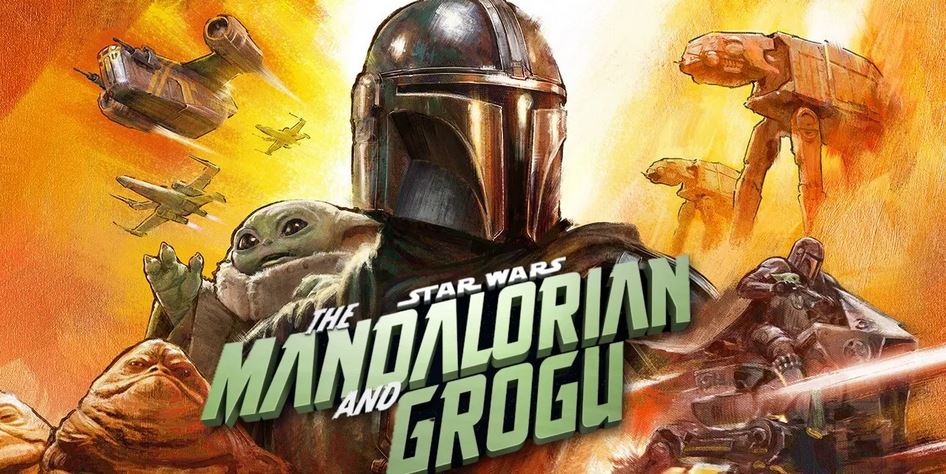 I’ve shared my feelings about Andor (loved Rogue One, but I’d rather re-read Splinter of the Mind’s Eye, and I haven’t encountered so much pretentiousness since the last time I had an Amazon return at Whole Foods).
I am SOOOOO looking forward to The Mandalorian movie hitting theaters in May. I shall be in attendance. This fun, action flick is exactly the Star Wars I need. Live-action Zeb is cool (loved Rebels), and every part of the trailer worked for me. I’m not a theater guy anymore, but Star Wars will always bring me to a big screen.
And if you ask, I DNFed Skeleton Crew. Couldn’t have been less interested. I don’t begrudge people liking something. Good for them. But I’m not drinking anybody’s Flavor Aid. I’ll just wait for something I like.
I expect The Mandalorian and Grogu to fully meet my Star Wars expectations. My first post about that great show.
8 -YOU SHOULD WATCH DR. HORRIBLE’S SING-ALONG BLOG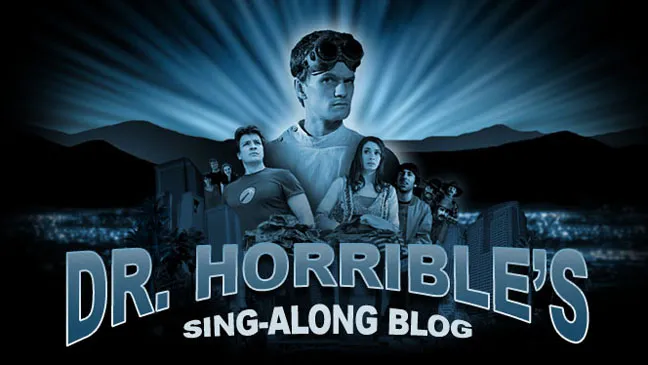 I absolutely will be doing a post dedicated to this gem of a web series, which grew out of the 2007-2008 Writers Guild of America strike. It’s not streaming anywhere, which is silly. But I pull it up on youtube and cast it to my 50” TV. The soundtrack is out there, including on Spotify.
It is 45 minutes of pure fun. Neil Patrick Harris is fantastic. Watching him is a treat. And the guy can sing. Nathan Fillion delights as Captain Hammer (corporate tool). He can sing, as well. Felicia Day shines as the girl between them. And she actually went to school on a violin scholarship. She knows music.
I was hooked in the very opening scene (ha haaa ha ha ha haaaaaa). Harris’ monologue is great. And things just keep getting better as Penny, and then Captain Hammer, enter the story. Simply put, this is my favorite musical. I can watch it on back-to-back days and it’s still fresh and fun. The music is great. And while Fillion and Day are so good, Neil Patrick Harris understatedly dominates every scene he’s in. You see the shift in his character at the 25 minute mark, on his face. He’s an outstanding actor. Love his singing voice, too.
I praise Con Man in my nerd circles. It’s a sci-fi homage any fan (especially of Firefly) should enjoy. Dr. Horrible is less than an hour out of your day, and it’s worth every second of it.
Prior Things I Think I Think
Five Things I Think I Think (February 2026)
Five Things I Think I Think (January 2026)
Four Things I Think I Think (May 2025)
 Six Things I Think I Think (March 2025)
Ten Things I Think I Think (January 2025)
Ten Things I Think I Think (December 2024)
Nine Things I Think I Think (October 2024)
Five More Things I Think: Marvel Edition (September 2024)
Ten Things I Think I Think: Marvel Edition ( September 2024)
Five Things I Think I Think (January 2024)
Seven Things I Think I Think (December 2023)
Talking Tolkien: TenThings I Think I Think (August 2023)
A (Black) Gat in the Hand: Ten Things I Think I think (August 2023)
5 More Things I Think (March 2023)
10 Things I Think I Think (March 2023)
 Bob Byrne’s ‘A (Black) Gat in the Hand’ made its Black Gate debut in 2018 and has returned every summer since.
His ‘The Public Life of Sherlock Holmes’ column ran every Monday morning at Black Gate from March, 2014 through March, 2017. And he irregularly posts on Rex Stout’s gargantuan detective in ‘Nero Wolfe’s Brownstone.’ He is a member of the Praed Street Irregulars, and founded www.SolarPons.com (the only website dedicated to the ‘Sherlock Holmes of Praed Street’).
He organized Black Gate’s award-nominated ‘Discovering Robert E. Howard’ series, as well as the award-winning ‘Hither Came Conan’ series. Which is now part of THE Definitive guide to Conan. He also organized 2023’s ‘Talking Tolkien.’
He has contributed stories to The MX Book of New Sherlock Holmes Stories — Parts III, IV, V, VI, XXI, and XXXIII.
He has written introductions for Steeger Books, and appeared in several magazines, including Black Mask, Sherlock Holmes Mystery Magazine, The Strand Magazine, and Sherlock Magazine.
You can definitely ‘experience the Bobness’ at Jason Waltz’s ’24? in 42′ podcast.
Categories: Fantasy Books
Review: Platform Decay by Martha Wells

Buy Platform Decay
FORMAT/INFO: Platform Decay will be published on May 5th, 2026 by Tor Books. It is 256 pages long and available in ebook, audiobook, and hardcover.
OVERVIEW/ANALYSIS: The mission: secretly extract friendly humans from enemy territory. The location: a planet-sized space port controlled by multiple corporate sectors, with a mix of tourists, workers, and security making life difficult. The target: multiple humans, including...children. Ugh. Murderbot may be up to the task, but that doesn't mean it has to like it. Looks like watching Sanctuary Moon will have to wait...
Platform Decay is that wonderful blend of action and character that reminds me why I love Murderbot. The plot itself is pitch perfect. It's a classic extraction mission: Murderbot must sneak into a planet-sized space port, find its protectees, and escort them to safety. That means we get some stealth and espionage, as well as full-tilt firefights as Murderbot goes about its job. The story might be considered bland were it not for both the constant shifting of environments as Murderbot goes from zone to zone across the station and the trademark deadpan exasperation it has for almost anything humans do.
I would have thoroughly enjoyed my time with this novella if that was all there was, but there are some great character beats scattered throughout that are the cherry on top. Murderbot, you see, is trying some new approaches to processing its feelings after the events of book seven, System Collapse. The result is some small quiet scenes that nevertheless show some growth for Murderbot as it continues its journey to get a handle on this while emotions thing.
At the end of the day, all you really need to know is that Murderbot is back and is operating at peak form. If you're a fan of the series, you'll be well rewarded and if you haven't started yet...why are you reading this review, go start the series!
Categories: Fantasy Books
Early Review – The Faraway Inn by Sarah Beth Durst (4/5 stars)

Reading Level: Young Adult
Genre: Contemporary Fantasy
Length: 384 pages
Publisher: Delacorte Press
Release Date: March 31, 2026
ASIN: B0FH1G5QT9
Stand Alone or Series: Stand Alone
Source: eGalley from NetGalley for Review
Rating: 4/5 stars
“When sixteen-year-old Calisa arrives at her great-aunt’s B&B in rural Vermont for the summer, she’s shocked to find a rundown inn rather than the cozy bed-and-breakfast she was expecting. Grumpy and eccentric, Auntie Zee is determined to keep anyone from messing with her beloved inn . . . even though she clearly needs the help.
To convince her great-aunt to keep her around, Calisa sets to work fixing up the inn, enlisting extra help from the groundskeeper’s (handsome) son. But the longer she stays, the surer she is that there’s something strange about the B&B—and its guests. Something almost . . . otherworldly.
The inn is keeping a magical secret—but to protect the place she’s come to love, Calisa must unravel the truth before it’s too late.”
Series Info/Source: This is a stand alone book. I got an eGalley of this from NetGalley to review.
Thoughts: I ended up really enjoying this but thought the beginning came off as much more juvenile sounding than a lot of Durst’s other books (maybe because it is more aimed at young adult readers). I am a huge fan of Durst and have read most of her books. This definitely comes off as more middle grade/young adult than her other adult fantasy books. I enjoyed the premise and found this easy to read.
Calisa’s boyfriend cheated on her, and she needs to get away for the summer to decompress from the drama. Her moms suggest spending the summer at her Aunt Zee’s inn helping out. When Calisa arrives she find that Aunt Zee does not want her there. Not only that, but the inn is really run down and a bit…odd. Aunt Zee gives Calisa three days to visit and then wants Calisa to leave. Calisa is desperate to convince her Aunt that she needs to stay the summer. Then Calisa starts noticing odd things about the inn…
Calisa grew on me as a character, although initially I thought she seemed a bit immature and naive about things. As the story continued, you start to see more of her depth. All of the characters in this book lack some depth and seem a bit stereotypical. I was surprised by that because I am normally sucked in by Durst’s characters (although lately I have been reading her adult novels). Maybe that is because this is a stand alone, but I wanted to know more about how the characters thought and felt. Especially Aunt Zee, she kind of remains a mystery, and I would have loved to learn her background.
I loved the inn and the magic there but again felt like I didn’t get to learn enough about it. How did this inn get to be, how does the travel work? I kept feeling like this would have been a better duology or trilogy that would have allowed more page space to add a bit more depth to this cool inn and the characters that dwelt there. Maybe we’ll get a companion book from when Aunt Zee was younger or for one what happens after this book.
I also thought the reveal about what Aunt Zee was felt abrupt, and then we never really learned more about her type of magic. I wanted to learn more about this and have it expanded on. I also thought the intriguing visitors to the inn were kind of glanced over. They seemed like interesting characters sketches that weren’t fully realized.
This is a cute YA contemporary cozy fantasy read. I enjoyed it and read it quickly. My main complaint is everything about it felt a bit too simple; the characters, the world, the story, and even the dialogue. It’s still a really good read, I just feel like it could have been an amazing story if it wasn’t forced into this one short volume.
My Summary (4/5): Overall I liked this story and thought it was a fun, simple, cozy, contemporary fantasy read. My main complaint is everything felt a bit too simple and under-explained. How did Aunt Zee get to where she was? How did the Inn get there? Calisa felt pretty immature and naive for an older teen as well, although she did gain a bit more depth and grow on me as the story progressed. While this wasn’t my favorite Durst book, it was a fun one. I would love to see some companion novels written about this world.
Categories: Fantasy Books
Pages

Recent comments