Error message

  • Notice: Trying to access array offset on value of type int in element_children() (line 6592 of /home1/montes/public_html/books/includes/common.inc).
  • Notice: Trying to access array offset on value of type int in element_children() (line 6592 of /home1/montes/public_html/books/includes/common.inc).
  • Notice: Trying to access array offset on value of type int in element_children() (line 6592 of /home1/montes/public_html/books/includes/common.inc).
  • Notice: Trying to access array offset on value of type int in element_children() (line 6592 of /home1/montes/public_html/books/includes/common.inc).
  • Notice: Trying to access array offset on value of type int in element_children() (line 6592 of /home1/montes/public_html/books/includes/common.inc).
  • Notice: Trying to access array offset on value of type int in element_children() (line 6592 of /home1/montes/public_html/books/includes/common.inc).
  • Notice: Trying to access array offset on value of type int in element_children() (line 6592 of /home1/montes/public_html/books/includes/common.inc).
  • Notice: Trying to access array offset on value of type int in element_children() (line 6592 of /home1/montes/public_html/books/includes/common.inc).
  • Notice: Trying to access array offset on value of type int in element_children() (line 6592 of /home1/montes/public_html/books/includes/common.inc).
  • Notice: Trying to access array offset on value of type int in element_children() (line 6592 of /home1/montes/public_html/books/includes/common.inc).
  • Notice: Trying to access array offset on value of type int in element_children() (line 6592 of /home1/montes/public_html/books/includes/common.inc).
  • Deprecated function: implode(): Passing glue string after array is deprecated. Swap the parameters in drupal_get_feeds() (line 394 of /home1/montes/public_html/books/includes/common.inc).
  • Deprecated function: The each() function is deprecated. This message will be suppressed on further calls in menu_set_active_trail() (line 2405 of /home1/montes/public_html/books/includes/menu.inc).

Feed aggregator

Hey Cassie, it’s been a while, I’m 33 next week. It been a fun 15 years reading your books. Recently I read Castellane, also beautifully written. Shadowhunter world remains my favorite though, and I’m a Blackstairs girl. I’m still gathering up the...

Cassandra Clare - Mon, 03/23/2026 - 21:07

Bred in the Bone is sad, but not because anything terrible happens to Julian or Emma. It is more sad in the philosophical sense of reminding us that nothing is permanent, that as Stephen King once titled a story, "All that you love will be carried away." Mortality, human nature, love, you know. The little stuff.

So it's not so much sad as haunting, I would say. And Emma and Julian are fine; we see them in book one. Still happy, still together. :-)

Categories: Authors

Free Fiction Monday: Crunchers, Inc.

Kristine Kathryn Rusch - Mon, 03/23/2026 - 20:00

Edith works for Number Crunchers Incorporated. Her job? Determine the monetary worth of each human being.  But her corporation faces a nemesis—the EISHies. The ridiculously sentimental organization sabotages Crunchers, Inc. and other places just like it.

Edith must discover how the EISHies infiltrated her business—and then figure out what to do about it, without succumbing to the EISHies’ subversive message: Everyone Is Someone’s Hero.

“Crunchers, Inc.” is available on this site for one week only. You can get the story as a standalone ebook on all retail sites. Enjoy!


Crunchers, Inc. Kristine Kathryn Rusch


The scream from the middle office was loud and long.

“Damn,” said Edith. “We’ve just lost another one.”

Sure enough, Reginald Waterston burst out of the office, slamming the door against the wall—the windowed one, with the expensive glass that formed its own shutters.

He stopped at Edith’s desk—they all stopped at her desk, for reasons she never quite fathomed—and said, “My grandfather gave me a horse!”

Edith resisted the urge to roll her eyes. She folded her hands on top of the file that she hadn’t been studying, and leaned forward. The computer built into her desktop beeped, letting her know that on its screen, it already had Reginald’s personnel file, his suggested severance pay, and his recommendation letter.

“A real horse?” she said, pretending interest in Reginald Waterson’s revelation.

“A plastic horse. From 1942. It had no chips in the paint at all.” Reginald Waterston was forty-two himself, balding, with a tummy that needed a bit of tuck. His suit fit loosely—something Edith would have told him to change if she had been his company advisor—and he needed to trim his fingernails.

Employees five cubicles over slid their chairs toward the aisle. People were leaning around the ancient gray formations, so that all she could see were eyes.

Rows and rows of eyes.

It was different every time, with every single Actuarial Engineer. And everyone except Edith thought these outbursts were interesting.

Edith resisted the urge to sigh. She needed Reginald to get the point, and if she followed his inane line of reasoning, she would be listening to the poor man all day.

“This horse is important because—?”

“It’s the only thing I ever got from him.” Reginald had to mean the grandfather, not the horse.

Edith nodded.

“I was five, maybe littler. He told me to take care of it.”

“Which I’m sure you did.” The computer beeped again. Edith wished she could take that insistent tone with people. Maybe that was why they all came to her in the end. Because she was unfailingly polite.

“I did!” Reginald said with something like surprise. “And because of that horse, I went to a Wild West vacation in Arizona when I was twenty-five. I met my wife, we had my daughter, and I wouldn’t be standing here.”

“Resigning,” Edith said.

That stopped him. “Quitting,” he said after a moment. As if he were actually reflecting.

None of them had ever reflected before.

“How will you pay for your home? Your wife’s – .” she paused, looked down, saw nothing on the wife except that she had some outstanding student loans, and took a wild stab at it. “—continuing education? Your daughter’s first four-year college? Hmmm?”

“We have savings,” he said, sounding less and less certain of himself.

“And what happens when those savings run out?” she asked.

He stared at her for a long moment. Then those blood-shot eyes of his went slightly wild and he yelled, “I can’t stay here! My grandfather gave me a horse!”

“I know,” Edith said, hitting the image of the check on her desk-screen, then hitting print so that Reginald could have a hardcopy recommendation letter in addition to the e-mail version. “Believe me, I know.”

***

Reginald left fifteen minutes later, stopping to tell anyone who made eye contact with him about his grandfather, the plastic horse, and the small gestures that could turn into major events.

Damn EISH, anyway. They’d found a way to get to him.

They always found a way in.

Edith summoned Conrad Meisner, telling him to meet her in five minutes in what had been Reginald’s office. She felt unfairly burdened.

Any senior management official who got confronted with a terminating employee had to handle all problems caused by that employee.

Which meant that Edith had more than her share of terminal offenses. She’d actually dug through the hiring records to see if anyone had instructed quitters to come to Edith, but so far she had found nothing.

She would have to look again.

Then she heaved a sigh and got up, heading toward Reginald’s office. She had put on weight again, so moving wasn’t as easy as it had been. She had eight months before she was eligible for her third reduction surgery, so she’d either have to lay off the Cheetos before bed or take a six-week cure.

The last time she took the six-week cure, she went down to her official, government-recommended weight for two extra months, then gained every pound back plus the friend that pound had probably been shacking up with. She could do the old-fashioned starvation/exercise thing, but she wasn’t an exercise kinda girl even though she knew in fifteen years, she’d have to be at regulation weight or it would count against her. She already had two black marks—mid-level management position and no children—and she really couldn’t afford another.

She pressed her palm against the doorknob to get in. The office had reset itself when Reginald took his walking papers. The door unlocked then eased open, as if it were afraid to reveal the office’s interior.

The interior window had stayed shuttered, and so had the exterior window. The office itself was dark. As she crossed the threshold, light rose slowly—the brochures had said it calmed, but mostly it replicated the moment of irritation when she learned that she couldn’t make the lights come up any faster.

She had no idea how many times she had walked into this room, felt that same irritation, wished she could alter the moment when she ordered the lights. Originally, this had been her office. She hadn’t been demoted, just moved, because the Brass thought that perhaps a private office (with tons of extra security) would help Actuarial Engineers stay at the job longer.

So far, it hadn’t worked. Reginald had been the fifth AE to leave in the past sixteen months.

She stood with her hands on her too-ample hips. He hadn’t even personalized the space. The wall across from him had two dozen screens, all of them scrolling information in real time. His work desk had five more, slowed down to show the problem accounts, and the vid unit—digitized at optimal level for Reginald’s personal myopia—wasn’t even turned on.

The chair remained at the height the last AE had left it at, the spaces on the desk for photographs had dust, and the air-perfume was still set on Chanel, which was the preference of at least two AEs ago. Reginald didn’t strike her as a Chanel-type guy. Maybe, with all this talk of horses, he’d been a Bud and illegal smokes sort, but he hadn’t even set the air to imitate that.

Almost as if he’d known he wouldn’t last.

She shook off the paranoia and looked at the accounts while she waited for Conrad. Conrad always ran ten minutes late, except when he was fifteen minutes early. It was almost as if he couldn’t decide who he was.

She knew who he was. He was a relatively young man with too much responsibility. Conrad was in charge of all of the security on the seventeenth floor—a daunting task, considering the amount of information that flowed through this place.

Public records, bank records, arrest records, personal complaints, grades, salaries, family size, and any other information that someone—anyone, not just the subject—chose to share. People could (and often did) send false information on someone they hated; if the sender got caught, the information went into the sender’s file—one of those horrible black marks that Edith feared.

She constantly checked her records and saw only the two legitimate marks—the middle-management position (and no sign of ambition for a higher place in society) and the childlessness, which could be a plus if her ambition grew. Only she didn’t know how to grow ambition. She’d already come a long way. Her mother had been a homemaker in the days when homemakers were shunned as retro-women, and her father, an Iraqi war veteran, never really got over his period of service—moving from job to job to job, each with less pay and less responsibility.

That she managed to rise this high—and stay here—was a bloody miracle if she said so herself, and she did, although not as often as she could have (fearing that someone would report her for repetitious behavior or vainglory or some other minor sin that could besmirch her record if too many people reported disliking her).

“Edie?”

She jumped, even though she recognized the voice as belonging to Conrad. He was one of the few people in the world who called her Edie.

She turned, hand against her beating heart, glad for the cover of her fear. He always made her heart beat faster. He was six feet tall, broad shouldered, and strong featured. He had a classic 20th century handsomeness—the kind you saw on war recruitment posters in World War II (her area of expertise in college, all those years ago)—and his voice, a rumbling baritone, seemed to match it.

A few of the women said he was too perfect, suspecting him of abusing enhancements to improve his physical appearance (even in this day and age, women were supposed to do anything they could to improve their physical appearance, but men should abstain for fear of focusing too much on good looks over character). Edith believed he was one of the few humans on the planet born with his incredible good looks. No matter how much she stared at him (and she stared at him too much), she couldn’t see evidence of any surgical procedure, nano- or otherwise.

“You seem jumpy.” He came all the way into the office, and closed the door. Something in his movement jarred the wall system and both glass-shutters opened, as if preventing some kind of physical (albeit unplanned) rendezvous.

“I hate this,” she said. “EISH got to him.”

EISH was short for the Everyone Is Someone’s Hero Society, with the last “s” dropped because EISHS was too hard to say. If Edith had been running the Society, she would have given it another acronym altogether because EISH sounded too much like “ish” for her tastes.

“I don’t know how EISH got in,” Conrad said. “I’ve added more secure equipment to this room than any other place in the building. We even have guards posted outside—real, living, breathing guards—just so that no strangers get inside the elevators coming up to the seventeenth floor.”

Edith shrugged. “He screamed, then came out at top speed to tell me about his grandfather and a plastic pony, and how that made him the man he is today.”

Conrad sighed. “Sounds like EISH.”

He leaned against the desk and crossed his arms. He stared at the information still scrolling on the wall across from him, but he clearly wasn’t seeing it.

Edith sank into the chair. It felt comfortable, familiar, as if she had come home. Here she didn’t feel quite as heavy; here she didn’t feel quite as useless or out of date.

She sprang up.

“Check the chair,” she said.

“They did chairs two years ago. They’re not going to—”

“Check the chair.”

He sighed a second time—what other response could they all have to EISH but sigh?—and crouched. While he worked, Edith paced.

Technically, EISH wasn’t her responsibility. The Brass was supposed to monitor EISH and all other like-minded groups. There were divisions that handled anti-EISH spin; divisions that persecuted EISH members to the full extent of the law; and, it was rumored, divisions that sent EISH members into the database earlier than they deserved to go.

But technically, Actuarial Engineers were supposed to prevent database tampering. Even though it was against the company’s best interest, Actuarial Engineers were supposed to double-check suspicious information—especially information provided about a hated person or a person who belonged to a hated organization (like EISH). This protected the corporation from class action lawsuits, too much government oversight, and the occasional overzealous politician/prosecutor/investigative reporter.

After all, EISH had a point that most people sympathized with: Every life had value. Sometimes the value was as small as giving a plastic horse to a child you’d never see again. Sometimes the value was being the person everyone ran to in a crisis (Edith would have to see if that somehow made it into her file—a white mark to counteract the black). Sometimes the value was in living the perfect American life—2.5 children, a dog, a house and too much credit, and perfect attendance at the marginally useful job.

This sentimental view, which even she had some sympathy with, appealed to everyone whose life hadn’t exactly gone the way he’d planned. The person who woke up at forty, realizing that he wasn’t going to get the chance to buy enhancements that would make him a star quarterback (those were age-limited to the under thirty crowd, no matter what your innate talent level) or that he wasn’t going to be a wunderkind in any subject because wunderkinds all died before they turned forty, usually of some self-inflicted something or other.

EISHies, as she called them, gave succor to the hopeless, hope to the fearful, and pap to everyone else. They simply didn’t understand the way the world had to work.

“Yup,” Conrad said. “They got the chair. I’m going to have to boost the scans again. They put a low energy chip into this thing. It must’ve been working on him for weeks before he finally blew.”

Blew. That was a term. Actuarial Engineers went through a battery of personal tests, showing that they lacked the kind of sentimental bent that made EISH appeal to most people. AEs were as close as people got to being robots themselves, or so personnel had told Edith after the fifth AE blew his cool and left.

People who got hired by Crunchers, Inc., which was a branch of Number Crunchers, Inc., a branch of Statistical and Numerical Services, Inc., a branch of—well, she couldn’t remember, not that she had to. She’d only gone to the third level when she’d been applying here.

Suffice to say that the job of Crunchers, Inc. and companies like this was to assist decision-makers in those hardest of hard decisions.

The ones that involved life and death.

Rather than applying a standard of morality that varied from person to person or township to township, Crunchers and companies like it made certain that decisions occurred on a level playing field.

Each American life (someday, the bigwigs hoped, each life) would be reduced to a series of positives and negatives. The intrinsic value of the human being—not just his political clout and financial worth (although those factored in; no one could ignore the way that money talked, even now), but his value to society, how much has he contributed in a variety of measures—as a teacher, as a valued member of his own community, as a giver of advice. Is he a good parent? Have his children grown to become equally valued members of the society or are they in prison/unemployed/living on some sort of benefits? Has he had a positive influence on the people around him?

Each action could cause a reaction—good and bad. The programs worked out a level of disgruntledness proportionate to fame or good fortune or (in cases like Conrad’s) simple good looks (figuring that jealousy created bad human behavior). There were also the health factors—was this person keeping good enough care of himself so that he wouldn’t become a burden on society—too much alcohol, too much food, too little exercise (unless these things were matched by weight loss surgeries and overnight nano-exercises, things that only a fortunate few [like Edith] could afford).

In other words, the programs kept a functional and relatively simple database—most people fell into easily predictable categories.

It was the folks who led non-traditional lives who were the problems, and they fell under the auspices of the relatively robotic AE, who gave the information a somewhat human glance and decided what category the person belonged in.

Somehow, organizations like EISH had discovered the AEs and even worse, found their names. Now AEs were targets, and all of them seemed to be breaking under the pressure.

“Got it.” Conrad held up a chip the size of a fruit fly. “I’ll analyze it, but I’m sure it’s an EISH component.”

“Scan the room for more of them. And find out how it got on the chair.”

He gave her a lazy grin that warmed her more than it should have. “Yes, ma’am. And what’ll you do?”

“Besides fill out report after report on poor, broken Reginald?” She sighed, making this one gusty and long, so that Conrad knew he wasn’t alone in his disgust. “Find a replacement, of course.

***

The replacement, Edith decided, had to be someone with no trace of sentimentality. No hidden plastic horses, no loving spouse, nothing that could pry through the shield of that person’s loyalty to numbers, statistics and the purity of formula.

She no longer allowed personnel to make the final decision. She added a few interviews of her own.

It took a week before the seventeenth floor got its new AE. That put seventeen behind all the other floors in the building, a serious problem. Life and death decisions were being made all over the country, and the files that had been routed to seventeen couldn’t be accessed.

That meant doctors, who needed to know which patients deserved life-saving treatments couldn’t find out; insurance companies couldn’t figure out who deserved the high-end coverage; extended living facilities and comfortable retirement centers couldn’t evaluate applications—at least, not for the thirty thousand or so files normally processed each week on floor seventeen.

If this went on too long, seventeen would get docked (and black-marked). More than a month, and everyone on seventeen would be fired for lack of productivity—and then try to find a new job.

Edith shuddered. Job loss wasn’t a black mark on the permanent files, but job loss resulting in demotion was, and if she got fired along with everyone else on seventeen because they couldn’t find an AE, then she would never find a mid-level management position again. She’d be an “average” worker, and more than black marks, one thing you didn’t want in your permanent record was the word “average.”

So she went above and beyond. She stayed late, reviewing applicants’ life histories, breaking an unwritten rule and investigating their permanent files in search of sentimentality. (Technically personnel was supposed to look through permanent files for mundane things, like genetic predisposition to various diseases, criminal records, criminal charges, and personal complaints. To look for something more specific, like family history or a tendency toward weeping at sad movies, was against some Federal law that personnel could cite chapter and verse [and did whenever Edith asked them to do it] but Edith didn’t care. She wanted the best AE possible, and that meant taking extraordinary measures.)

She also had Conrad beef up security to the room—again. She looked in the budget to see if there was money to secure the AE’s place of residence as well. EISH had become quite sophisticated; its anti-formula programs slowly bombarded the AE’s subconscious with sentimental stories of the ways that the smallest of encounters could trigger life-changing events.

Even EISH didn’t argue that everyone should be saved. The serial killer, the repeat child molester—their bad deeds outweighed any potential for good. Despite the word “everyone” in EISH’s title, they were really arguing for the ordinary person, the average person, the person who, when they died, wouldn’t have enough accompaniments to fill a fifteen-second obituary spot on the Mourning Network.

Edith always thought (privately) that the founders of EISH were trying to protect themselves and their family. She always argued (publicly) that if EISH wanted the entire well-behaved world to get extended life treatments or the best medical care, then EISH shouldn’t concentrate on changing the formulas that companies like Crunchers used.

EISH should get more and more people to live on the high end of the Crunchers’ scale. EISH should encourage them to give more to charity or donate genetic material or house foster children. If more people wanted the benefits of an exemplary life, they should live one.

Even though it was hard. Edith was falling short, but at least she tried. She didn’t go through day-to-day sleepwalking. She actually thought about each action, and its equal or opposite reaction.

She knew she was taking risks interviewing the AE candidates herself, but she figured the benefits outweighed any chance she took.

And finally, within seven days, she found the perfect candidate.

***

He was tall and thin and homely. He wore black wool suits, white shirts, and work boots, all of which looked like they’d come from a second-hand store. He lived alone. His parents had died when he was young, and he’d been shuttled from foster home to foster home, never staying long enough to make attachments. He had been an excellent student who graduated with degrees in economics, applied mathematics, and computer analysis, but he didn’t read for pleasure nor did he see movies, play games, or socialize.

He never had a pet. He never, so far as Edith could tell, had a friend. He never supported a cause or took a stand. He ate every meal placed in front of him without complaint. He wasn’t even a vegetarian, as so many of these systems guys were.

Edith could find nothing—in his résumé, in his history with the company (in a lesser department; straight accounting), in his own personal life files—that showed a trace of sentimentality. There wasn’t even a place where sentimentality could breed—nothing, so far as she could see, that would give those relentless little chips that EISH was so fond of placing (somehow!) in this company a way to make him see the facts and figures he was crunching as human beings.

His name was Bartleby Plante, and he could start immediately. In fact, accounting was happy to transfer him to the seventeenth floor.

Edith ran through the training and Plante had no questions at all, rare for someone in this job, most of whom would ask for certain kinds of clarification, like “What does living alone really mean? Is she alone if she has a dog?” or “Does it matter how long ago his last act of kindness really was?”

Plante simply nodded, took notes, and then set to work.

By the end of the business day, he’d gone through five hundred files, more than any other AE had done on a single day. Edith had to stay late to check his work, and she found no fault with it.

If anything, he was a bit too strict—if someone huddled on the cusp of “deserves Excellent Treatment” and “has earned Good Treatment,” Plante always gave them the Good Treatment recommendation.

Of course, Edith recommended that to new AEs, with the caveat that good treatment costs all businesses that contract with Crunchers, Inc. less than excellent treatment, and one should save money where one could.

Still, all other AEs, faced with a subject one-quarter of a percentage away from Excellent Treatment, upgraded that subject. It seemed like the most humane thing to do.

But, she reminded herself that first night, she hadn’t hired Plante to be humane. She’d hired him to make judgments that fell outside the normal parameters, and if he was slightly harsher than most, it simply meant she wouldn’t lose him to EISH infiltration quite as quickly as some.

After a few days of checking, she felt satisfied that Plante could do the job. Sure, she had to tweak his process a little. If a subject was one-sixteenth of a percentage into Excellent Treatment country, Plante would downgrade them, and Edith had to remind him that once they earned Excellent Treatment, no matter how narrowly, they deserved to stay there.

Until, of course, their behavior moved them down a category—but she didn’t say that to Plante. He would not get a chance to review a file twice. Reviews moved up the floors—next year, new information would move everyone processed on seventeen to eighteen, and so on, as a sort of double-check. Of course, once a file had an eyeball review which was, at heart, Plante’s job, then the file tended to remain in whatever category it had been assigned—usually all the way to the bitter end.

Edith liked the system. She believed in the system. It was so much better than having individual doctors, for example, deciding which patients got the most expensive treatments based on personal likes and dislikes or on desire to perform that particular new experimental procedure or on ability to pay.

Edith believed in all that, she truly did. She felt sorry for the people who didn’t qualify for everything they wanted—few did!—but in the end, it was their own damn fault.

She found comfort in that.

She was certain she did.

***

Plante irritated her.

She couldn’t confess that to anyone. She had stressed that she needed the perfect EISH-proof employee, and she had found that in Plante.

But…

He ate tuna fish sandwiches for lunch, and the smell stayed in the office until closing. He picked his teeth while he waited for the on-floor barista to make his coffee. He didn’t seem to dry clean his suits regularly, and his boots had a faint barnyard odor.

Finally, Edith had to go to his office after he left and set the air-perfume on Scrub followed by Lilac, not caring that it was a gender-associated scent. She needed the strongest smell she could find to cover his odors, not to mention the strongest smell she could stand.

She sent a memo to personnel so that someone would discuss his hygiene with him, and hoped it would do some good. She didn’t want to disturb him more than she already did.

He scuttled away from her when he saw her; wouldn’t make eye-contact; and spilled his mocha-cream double-tall the first time she said hello to him during the mid-afternoon mandatory coffee break.

She tried to shrug it off—after all, a lot of people had trouble with her: she was the highest-ranking manager on seventeen—but she couldn’t entirely shake the feeling she’d made a mistake.

So she watched him. Watched him interact with the other employees (he didn’t); watched him arrive first thing in the morning (his breakfast came with him: McDonald’s biscuit with cheese); watched him lock up at night (always the same movement—a press of the palm to the doorknob, then a double-check with the other hand, just to make sure the door was locked).

He said hello to no one—not even the barista on the two mandatory coffee breaks—acknowledged no one, and shied away from any personal contact at all. If someone brushed against him in the elevator, he moved as if he’d been hit. If someone grinned at him, he ducked his head and looked away.

None of this was in his file, of course. He wasn’t listed as anti-social, just shy. So nothing pathological had come from this—and, she supposed, it was all expected, given his upbringing. He’d never learned any of the major social skills.

But he should know them, shouldn’t he? So that he could make evaluations? So that he could decide that a woman who smiled at babies sometimes saved them in a crisis—but said crisis hadn’t happened yet, so it couldn’t be counted on her record. But the smiling should be.

Or a man who gave money to the legion of homeless (those who hadn’t behaved well enough to let the system help them or who opted out of the system entirely) wasn’t that bad after all. He was just trying to provide what he could for people who couldn’t help themselves. There was no guarantee that those deadbeats would use the money to buy alcohol or drugs—and wasn’t it on the plus side for the man that he didn’t quiz the recipients on how they’d use his money? He trusted them to make the best decision for themselves.

Edith’s head was swirling with this and all the other factors that Plante had to consider for his job. She wanted to ask him if he realized he initially got a high rating because of his difficult childhood. For the first ten years of an adult’s life, a difficult childhood gave him a pass—an excuse to miss on certain things like marriage in your twenties or learning personal hygiene.

After ten years, though,—and Plante was right on that cusp—difficult childhoods faded in importance. The cultural assumption (again a correct one as far as Edith was concerned) was that adults should learn and grow, and yes, a difficult childhood handicapped people but they should learn the things they missed in childhood in their twenties, making them much better citizens in their thirties.

She found herself idly searching his file, looking for his exact birth date, the day he would turn thirty and become, in society’s eyes, accountable for his own weirdness.

And that was when she realized she was stepping over a line. She wasn’t quite sure what the line was, except that she knew it had to do with obsession, and eventually, she would get caught.

Another black mark on a file that couldn’t afford any more.

So, she contacted Conrad, met him in a coffee bar off-premise after hours, and waited the requisite fifteen minutes because he was, as usual, late.

He arrived, wearing the same twill pants he’d worn that day in the office with a different shirt (a brown that accented his coloring) and his hair slicked back.

He looked nice.

She wondered if that was for her, then decided it wasn’t. Men like Conrad were never interested in women like Edith. They had nothing in common except their jobs, and she wasn’t pretty enough, smart enough or interesting enough to keep him satisfied for very long.

The other women in the bar watched him walk across the room. The bar was small, with ferns against dark wood paneling—some kind of faux 20th century look—and the entire place smelled of coffee mixed with vanilla, a smell that always made Edith hungry.

“Out of the office,” he said as he sat down. He was smiling, which he didn’t do at work either. “Clandestine meetings, secret talks. Are we suddenly spies?”

She smiled, but waited to answer him until the waitress took his order—a plain black go-for-the-throat charger with extra caffeine, a man’s drink. A macho man’s drink.

“I may have made a mistake with Plante,” she said.

Conrad looked sympathetic.

“May I tell you my worries?” she asked.

“Is this on- or off-the-record?” he asked.

She shrugged. “Which is safer?” she asked, knowing that either could backfire.

“Just tell me,” he said, and he, the head of the seventeenth floor’s security, would make the decision for her.

Somehow she found that comforting. She found him comforting.

So she told him her observations and her fears about Plante. Conrad listened (they ended up having dinner), and then asked, “Isn’t that what you wanted?”

She blinked at him, not quite sure what he meant.

“A person who couldn’t be persuaded by anything EISH threw at him, a person without sentiment, a person who saw the world in numbers and codes and absolutes. Isn’t that why you got involved, so that you’d get the exact right man?” Conrad pushed his plate aside—he’d had a sandwich made from some kind of thinly sliced beef so rare it didn’t look like it’d been cooked—and folded his hands on the table.

“I didn’t expect him to be so cold,” she said, and realized how lame that sounded. She had picked at her salad, which she had ordered to impress Conrad with her restraint, not because she really wanted it.

“How could he be anything but?” Conrad asked. “You wanted no sentiment.”

“Sentiment’s a bad thing in this job,” she said.

“Is it?” his voice was soft. “Maybe compassion’s a better word then.”

She frowned.

“I mean, there’s compassion built into the system, right? Isn’t that why people with difficult childhoods get a pass early on?”

“The pass doesn’t cost much,” she said. “Younger people don’t have as many illnesses. They often don’t have insurance, and they’re not usually involved in life-and-death decisions. If they’re in an emergency room, it’s usually because of their own stupidity, which by every form, counts against them.”

Conrad’s lips turned up, but he wasn’t smiling. “So there’s compassion when it doesn’t cost anything.”

She nodded.

“And isn’t that what you’re complaining about?”

She frowned again.

“The eighteenths of a percentage point—he’s waiting for a perfect score to move people up and down the scale, but really, how much difference is there for people who are on the cusp, people who deserve more privileges in this society or nearly do?”

She shrugged. “Some.”

“Then I don’t see what the problem is,” Conrad said.

The smell of vinegar was beginning to turn her stomach. She pushed her salad away. She was beginning to regret this. She had thought Conrad was sympathetic, but he was like all the others.

He didn’t understand the fineness of her position, the way it sometimes became personal. If Plante were reviewing her file, he wouldn’t look at her previous weight losses. He wouldn’t look at the fact she was the first manager in her entire family, the first non-blue collar worker, the first person to make something of herself by her familial standards.

She was too old for him to look at familial standards. Her previous weight losses were too far in the past. She’d relied on surgery and tricks recently, and that wouldn’t wash.

She hadn’t had children, didn’t give enough money to charities, worked in the Crunching industry which—because crunchers didn’t want to be accused of bias—actually counted against her (but because crunchers did the work, was often bypassed as a “non-consideration.”) Plante wouldn’t make that a non-consideration. He’d examine each of the past five years for black marks and recommendations, for her good work and her bad. He’d see that no one would really miss her if she disappeared, and he’d mark that into her file, and no one would review it, not for quite a while, and if she suddenly found herself with some kind of strange cancer or something, she wouldn’t get the preferential treatment she would have received in her thirties, when she was still up and coming, when she was a potential wife, a potential parent, a potential CEO, someone who would eventually become a major contributing member of society, who, even if she didn’t have family, would sit on boards of various charities, and give a healthy percentage of her eight-figure income to various needy folk, and would serve as a role model to children of blue collar workers everywhere.

She’d stalled, grown content, felt no urge to move on, and her files would reflect that. The statistics said she wasn’t going to improve any longer, and Plante would know that, instead of looking at her and realize that just by getting involved in his hiring, she was showing ambition again.

She was striving. She just wasn’t doing a very good job at it.

“Edie?” Conrad asked. “You okay?”

She made herself take a deep breath. She nodded, regretting this conversation, regretting speaking to anyone on or off the record.

“I’m fine,” she said. “Thanks for coming, Conrad. I appreciate your time.”

Then she patted him on the hand, grabbed the bill and swiped it through the pay register on the side of the table, then pressed her right index finger on the marker, so that she paid out of the correct account.

He was trying to say something as she walked away, but she didn’t stop. She couldn’t stop.

She felt like a fool—and she wasn’t exactly sure why.

***

She became sure when she arrived at work two days later to find her boss, Conrad, and three members of upper management huddled around her desk.

Conrad looked at her guiltily, but the others had a coldness in their eyes. She recognized that coldness; she’d felt it too whenever she’d had to confront a misbehaving employee.

“What’s wrong?” she asked.

Conrad held up a chip. It was barely the size of a grain of sand. She had to squint to see it.

“EISH,” he said. “They couldn’t reach Plante—in any way—so they got you.”

She felt a flare of anger that she immediately suppressed. Anger would guarantee that she would lose this fight—and fight it was, sudden and terrifying.

“I told you I wasn’t being sentimental,” she said, sounding a bit clipped. She made herself breathe.

The others looked at her as if she were a subspecies of bug. Conrad bit his lower lip, an attractive look for him.

“I’ll walk you through the termination procedure,” he said gently. “It’s the least I can do, since I had to report that conversation.”

She had known he would. No matter what she’d said, on the record or off, she had known he would report her. She would have reported anyone who said those things—if she didn’t believe in the person. If she hadn’t trusted them.

Apparently, Conrad hadn’t trusted her.

“You had to know I’d do that,” he said into her silence. “You gave me the choice.”

She glared at the other three, who looked away from her, as if she were tainted somehow, as if, even by being close to her, they would ruin their own careers.

They had decided. Anything she did now would simply make matters worse. A black mark—being fired!—would become a stain if she fought too hard. She might never find another job if she protested. Someone would write her up as “irrational,” “emotional,” or “uncooperative.”

“All right,” she said to Conrad. “Walk me through.”

***

She knew the procedure better than he did. She had to help him when he got stuck, remind him that she needed her final check or the contents of her personal drawer.

He didn’t say much as he did the work, although he did have trouble meeting her gaze.

Finally, it was done. She grabbed her pitiful box of personal belongings and headed for the door—away from the prying eyes, the people who peered from the sides of their cubicles, the private glee that some of them would feel at losing a manager no matter what the cause.

Plante didn’t even look to see what the disturbance was. He didn’t seem to care—and why would he? That was the problem, after all.

Conrad caught up to her, took the box from her, and pushed the door open with his foot.

“You don’t have to do that,” she said.

“Yes, I do,” he said.

According to company regulations, he had to make sure she left, had to certify that she had walked out the front door, taking nothing from the company except her check and doing no vandalism as she went.

She resented that. She rarely accompanied any employee out—only the ones who were certifiable or who seemed unduly angry. The rest, she monitored through the company’s surveillance system, letting it verify when they had left.

Conrad stood silently beside her as the elevator took them down all seventeen floors—a trip that seemed to take most of her life. Then he followed her as she marched to the front door, feeling the gaze of two dozen people in reception following her as she left for the very last time.

Outside, it was sunny and warm, the air smelling faintly of hamburgers being grilled at the diner next door, the diner she had never gone into for fear it (and the preferences it implied) would show up on her record.

Maybe she’d go in there. Maybe she’d eat every greasy salty sugary thing on the menu. Then she’d go home and lay on her couch and order the worst movies ever made, play the most violent interactive internet games she could find, and maybe even indulge in some illegal porn downloads.

Who cared, after all? She had more black marks than she could fight. Her record had gone from not bad to worrisome in the space of an afternoon.

“I’m sorry,” Conrad started.

“Save it,” she said, reaching for her box.

“I mean it,” he said. “I had to keep my job. You know that, right?”

And he said it with some kind of weird emphasis, as if she should have an in-depth understanding of what he was talking about.

“Yeah,” she said. “We all feel that way in the real world.”

He winced. He moved the box away from her, and stepped toward the curb.

“They’re going to fire Plante,” he said.

She hadn’t known that. She wasn’t sure she cared.

“He’s compromised. You hired him by going outside procedure.”

She blinked. “He’s the perfect man for the job.”

“Yes,” Conrad said. “But this way…”

His voice trailed off. He leaned toward her, giving her the box, but as she slid her fingers through the cardboard handholds, he clung.

“EISH couldn’t get to him,” Conrad was whispering now. “We knew this was the only way.”

“We?” Edith asked.

He nodded. “I had to stay. Do you know how hard it is to keep a guy like me on the seventeenth floor?”

He let go of the box. Her head was spinning. What was he saying?

“Conrad, are you—?”

He put a finger on her lips. “You’ll be all right,” he said. “I’ll make sure of it.”

And then he walked away from her, disappearing back into the Crunchers’ building, the place she had spent most of her adult life. A place she had believed in.

Or maybe it had just been a place she feared. And maybe, by working there, she had tried to control those fears.

She had taken it to an extreme with Plante. Whom Conrad had gotten fired. The only man doing a superb job, and Conrad had found a way to get rid of him.

By getting rid of Edith too.

She hefted the box, glanced at the diner, and thought about it. Eating her way through her problems wasn’t the answer. She’d have to do what she recommended to so many others—career counseling, a personal reassessment, a quiet contemplation of what she really wanted from life.

Maybe she hadn’t contributed much because she’d been stuck in her fear instead of living her life.

Maybe.

Or maybe she had just been going through the motions, like everybody else. Marking time until someone made a decision for her.

Like EISH had.

Like Conrad had.

At her request. She had been trapped with Plante, a creature of her own making; Conrad had freed her.

If she understood him right, he was getting rid of all the Plantes, making sure that certain things didn’t go any farther.

She stared at that diner door, silver on the outside and spotless because of city regulations, but a faint grease line coated the interior. The man at the counter was as round as she was. The woman behind it had gray hair and wrinkles all over her face.

Imagine living a life like that—without worrying about each movement, each decision. Without thinking about black marks and ratings. Taking the consequences when the time came—but not before.

Just going through life, the way people did before computers and information-gathering and streamlined decision-making regulations.

Imagine having a piece of pie because she wanted a piece of pie—not because she was allowed one on her current program or because she could afford one given the amount of exercise she’d done.

She glanced at the Crunchers’ building, and then at the diner. She’d never before seen the irony in them being side by side. She studied them, thought about them, shifted her box from one hip to the other.

And then she walked away, heading—

She didn’t know where. She didn’t care. Somewhere new.

Somewhere undefined.

Somewhere very different from here.


Crunchers, Inc.

Copyright © by Kristine Kathryn Rusch

Published by WMG Publishing

Cover and layout copyright ©  by WMG Publishing

Cover design by WMG Publishing

Cover art copyright © Karol Brandys/Dreamstime

This book is licensed for your personal enjoyment only. All rights reserved. This is a work of fiction. All characters and events portrayed in this book are fictional, and any resemblance to real people or incidents is purely coincidental. This book, or parts thereof, may not be reproduced in any form without permission.

Any use of this publication to train generative artificial intelligence (“AI”) technologies is expressly prohibited. The author and publisher reserve all rights to license uses of this work for generative AI training and development of machine learning language models.

Categories: Authors

will there be a lot of kissing in TLKoF?

Cassandra Clare - Mon, 03/23/2026 - 19:41

Yes.

Categories: Authors

You mentioned a while ago that we have clues about Kit’s powers, but today I can’t connect anything to them. Like, making the fairies disappear and increasing Magnus’s power – is that related? Any clues? Spoilers?

Cassandra Clare - Mon, 03/23/2026 - 17:40

Yes, those things are related, but they may not be as they seem. Helpful? Possibly? :-)

My inbox is open briefly at the moment and I'll open it back up Friday around noon EST.

Categories: Authors

Admin Stuff

ILONA ANDREWS - Mon, 03/23/2026 - 15:53

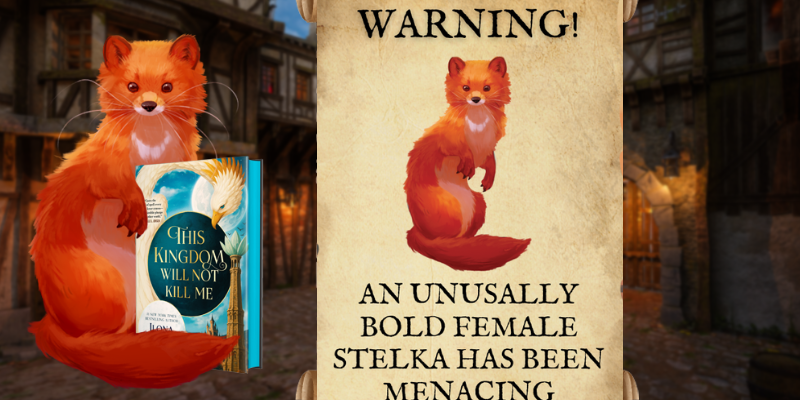
We are getting closer to the release of This Kingdom and we are still very snowed in with the deadlines.

Quick news and admin things:

We are in the internet blackout for the next 2 weeks, while we work on the book and tour. Mod R will be taking the wheel.

Our store is closing tonight and will reopen in mid-April with new Maggie merch.

If you want art prints of the work from Candice, Helena, Leesha, and Luisa, we will post those for you as they become available.

We will be doing a Zoom event for those of you who cannot come to see us in person, but it will likely be mid-to-late April, as we are finishing Book 2, and we will be fried after the tour. Please save your questions. Mod R will put up a spoiler and question thread and we will do a long Zoom event and try to answer most of them.

We will have a website dedicated to Maggie and it will go live shortly after the release. Mod R will give you the details.

Quick answers:

Is This Kingdom a romantasy?

Why does this keep coming up?

Genres evolve organically. They exist to help readers to find a book that matches their reading preferences. It’s a shorthand for saying, if you like books with X, here are some titles that might be fun. For some reason, people get very heated about it. I had a whole post on it, but there is no time to devote to it.

There is no hard and fast definition of Romantasy. Again, people will argue to death over it, but at the core it is a subgenre of fantasy romance typically featuring a coming of age protagonist, set in a world of high fantasy, and focused heavily on romance. It’s a very fun genre, aimed at a mostly female audience, and it offers great escapism.

Now I have to define all this, argh.

Fantasy – genre that has magic, a fantastic element or force, which is impossible to explain by current science.

Romance – genre that focuses on a love story with a happy ending. The relationship is the plot and the book cannot exist without it.

Fantasy Romance – romance with fantasy elements. Romance is the story.

Romantic fantasy – fantasy with romance elements. Romance is there but is not the story.

High Fantasy – fantasy that takes place in a different world, some place other than Earth.

Low Fantasy – fantasy that takes place on Earth changed by magic.

So, to sum up: romantasy = young protagonist, a different world with magic, relationship is the story. There are other criteria people mention: first person, lighter worldbuilding, fae love interest, etc, but those are mostly details. You have to have the first three elements for the romantasy definition.

What about an older protagonist?

Romantasy, as it exists right now, tends to do the same thing as NA genre tried to do: it sets its narrative in the time of firsts. For contemporary romance, it is the first time living on your own, first job, first serious relationship. Romantasy deals in first love and finding your place in the world. Older protagonists already have some life experience, and their stories tend to fall under a more general genre of Fantasy Romance.

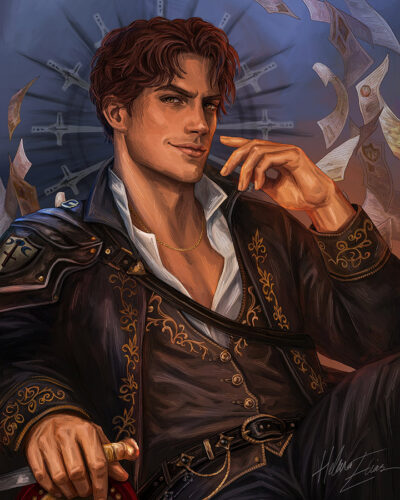
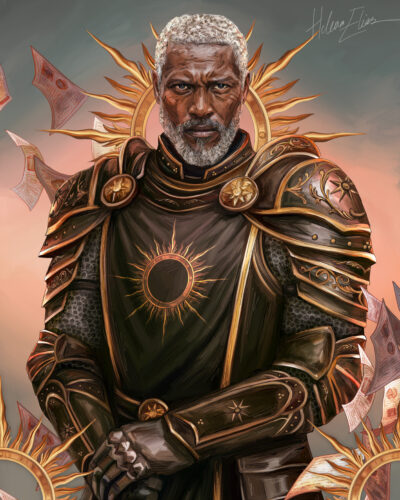
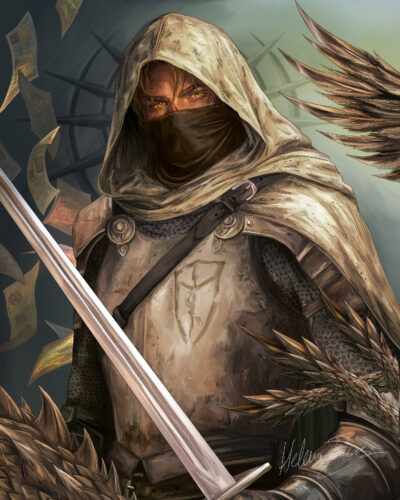
This Kingdom is not a romantasy. It is a portal fantasy, a high fantasy (we never see Earth,) an epic fantasy, and a fantasy with strong romantic elements. It focuses heavily on politics, intrigue, action, and yes, it has a strong romantic element. There are several love interests. They are very hot, as the art demonstrates, and they are compelling.

This Kingdom will absolutely appeal to the romantasy audience, as the early reviews show. People kicked their feet and described the slow burn as “delicious.” By the definition of the subgenre, this series is not a romance. It is closest to Game of Thrones, except not as dark, and without incest.

How dark is it?

The first three chapters of the book are probably the darkest, so if you made it through the preview, you are good to go. We don’t write super dark or bleak or hopeless. Our bread and butter is action mixed with humor, high stakes, and sparks of romance.

That doesn’t mean there won’t be dark moments. You can’t have high stakes without them. We will be killing people. We will be killing one particular person repeatedly. You must have darkness for light to exist. In storytelling that means that there must be low points for the high points to shine brighter.

If you want the technical know-how of the entire commercial fiction, here is the super secret of how it works – we scare and upset you, and then fix things, and you feel happy.

How much worldbuilding is there?

A lot. The worldbuilding is extensive, it is worth it to learn it, and it does pay off. If you are coming from a lighter worldbuilding, there is quite a bit, but it will make rereads more enjoyable. A lot of people read the early copies multiple times. We will have the website, with cast of characters, etc.

HEA?

Oy, Steve, oy. Yes, the series will have an HEA.

When is the second one?

Aaaaaaa! Ahem. The second one is being written right now. We are coming up on the final part and anticipate the final length of 175,000-180,000 words. We are at 155k right now. 150k. We have to edit this scene and it’s in cuts right now, so I am going to resurrect and rework it, and then we will be back to 155k.

Dear BDH, stay fluffy and chalant! We love all of you, we will see you on tour, and we will treat you to fun extras after the book comes out.

Okay, now I have a question for you: places to eat along our tour stops. The ideal restaurant will be close to the hotel and will be open late. We have three places:

  • Near Washington Avenue, Minneapolis
  • Near Joseph-Beth Bookstore in Lexington
  • Near Dulaney Valley Road, Towson, MD

Any suggestions are very appreciated.

The post Admin Stuff first appeared on ILONA ANDREWS.

Categories: Authors

Spotlight on “The Witch” by Marie NDiaye

http://litstack.com/ - Mon, 03/23/2026 - 14:00
The Witch by Marie Ndiaye book cover

Titles by Marie NDiaye Here are other titles by Marie NDiaye spotted by LitStack, including…

The post Spotlight on “The Witch” by Marie NDiaye appeared first on LitStack.

Categories: Fantasy Books

Monday Meows

Kelly McCullough - Mon, 03/23/2026 - 13:00

Jeeves, you must go to the Dagobah system…

Hokay, I’m in, what’s a Baglebah?

Not the hero we were looking for.

I keep trying to change the channel, but it never works.

Gonna wash that cat right outta my hair, gonna wash that cat…

Categories: Authors

Eddie and the Cruisers: The Novel You’ve Missed Out on All These Years

https://www.blackgate.com/ - Mon, 03/23/2026 - 11:00

I LOVE the movie, Eddie and the Cruisers. I’ve seen the flick, about a short-lived Jersey bar band, at least a dozen times. And it’s got a terrific soundtrack by John Cafferty and the Beaver Brown band. I like Cafferty more than I do the much more famous Bruce Springsteen, who he kinda sounds like. To each their own.

Eddie and the Cruisers was the #110 box office film of 1983. With a budget of $5 million, its domestic gross was $4.7. It was Embassy Pictures’ first ever try at distribution, and they pulled it from theaters after only three weeks. Needless to say (though I’m saying it anyways…) there was no international release. Pretty damn poor choice by producer Martin Davidson, who admitted he selected them – knowing they had zero experience – because they offered the most money.

Then it ran on HBO in 1984 and became a cult classic. I was part of that happening. On the Dark Side had charted at #64 when the movie came out. The HBO success prompted a re-release and it hit #7 on the Billboard 100 – and #1 on the mainstream charts. For a movie that nobody saw in the theaters, for the next three+ decades, EVERYBODY knew Eddie and the Cruisers. It was only in the past ten-ish years that I have started running across folks who have never heard of it. Truly a cult classic.

It’s adapted from P.F. Kluge’s novel of the same name. Kluge also wrote Dog Day Afternoon, which became a smash hit movie in 1975 (it made about 25 times its budget at the box office). A few weeks ago, I finally decided to read the book. I finished it in two days – and I worked on both days.

This was my first Kluge. There’s a lot more to this book than there is in the movie. Keep in mind I love that flick, so I’m not disparaging it. But they massively changed the tone of the novel. There’s a very different vibe. And I get why: it wouldn’t become a hit movie, ‘as written.’ Unless I specify otherwise, I’m talking about the novel from here on in.

The book is told from Frank ‘Wordman’ Ridgeway’s point of view: Tom Berenger’s character in the movie. He and the other characters are far more developed, which is essential to the story.

First off: this is much darker than the film. There’s murder. There’s a world-weary cynicism to Frank which reminds me a little of Raymond Chandler’s Philip Marlowe. As in the movie, time shifts between the present and the past. And that’s thematically at the center of Frank’s narration. That summer on the Jersey shore, was a moment. There was a road of fame and accomplishment and…a life, ahead, for each of them. But a flaming car crash (no bridge involved in the book) detoured all of the Cruisers to back roads and other paths. Not shiny (a little Firefly for you, as I’m immersed in that ongoing story), Hallmark ones, either.

Frank walked away from music and became a high school literature teacher. Words and music. Eddie was the music, and to borrow from Don McLean, Eddie’s car wreck was the day the music died. Frank had only his words, now. Silent, bereft of their place. You can guess how receptive high schoolers were to his words, day after day. Year after year.

But as you move through the book, chapter-by-chapter, Kluge – somewhat subtly – shows that they are living lives with an echo of what could have been. Not of quiet desperation (well, Sal maybe). Beyond the ‘words and music’ scene which is repeated in the movie (and it’s brief, on screen and on the page), the book leads us in Frank’s wake as he moves through the shadows that part of his life, which he had left completely behind, are casting on him now. The echoes become louder, rising to a violent crescendo.

The differences from the movie are big enough that I don’t want to drop a bunch of spoilers. I already mentioned there’s a murder. And instead of Seasons in Hell and the lost master tape, it’s a search for secret recording sessions that only Wendell was at with Eddie. There’s an actual funeral for Eddie; his body doesn’t go missing after the accident.

As Frank digs deeper into the mystery of what happened at the mysterious Lakehurst sessions, he traces the paths which each Cruiser (it’s ‘Eddie and the Farway Cruisers in the book) went down after the band broke up after the funeral. All of their lives changed completely. Wendell didn’t take a fatal overdose while the band is still together. I think his fate is actually harder in the book. As Eddie (unrelatedly) says in the sequel movie, he got away by dying.

And it’s Frank reflecting on his own life, while he reconnects with the band members, which gives this book its depth, its weight. It’s gravitas. It’s not a wistful ‘what might have been.’ It’s more about the lesser lives that resulted for each of them, because Eddie was the heart of the body that was Eddie and the Cruisers. And when he died, that life as Cruisers died.

A little of it comes through in the movie. Fragments of the scene with Sal after his oldies band show, when he talks about how mad he gets at Eddie. There’s another layer to that. And Sal wanted to continue the band, with a look-alike. He’s done with all of them when they say ‘No’ and he’s forced to go down the ‘Holiday Inn Lounge’ oldies approach instead. That makes Frank visiting him again a dubious move, and as I keep saying, there’s more to it.

Or the walk with Kenny where he talks about Wendell’s drug overdose. Kenny is a womanizing party goer in the book. He becomes a married minister. When Frank visits him, and is told “It wasn’t all good stuff,” that’s just a few seconds on screen. But it furthers the mystery in the book. And again, there’s a lot involved with that.

These are just tidbits in the movie, but they’re part of the theme that weaves throughout the novel and holds it together. Kluge really was a good writer.

If you’re looking for happy stories, you’re in the wrong book. Frank doesn’t ‘find’ himself. Eddie doesn’t live happily ever after. People die (though not Wendell). The vibe is more like Hemingway than it is the movie.

Martin Davidson optioned the book, wrote, and directed the original movie. He wanted nothing to do with the proposed sequel. The second movie has zilch to do with Kluge and the original novel, other than Eddie Wilson was a Jersey rocker. Eddie and the Cruisers is a gourmet meal. The sequel is greasy fast food. Even the soundtrack is just okay, and I’m a big John Cafferty fan. I only watched Eddie and the Cruisers II: Eddie Lives, once. Even writing this essay, I have no inclination to revisit it.

You know I’m a Pulp guy. I bristle when I see critics of the time dismiss it as garbage: not ‘literature,’ said with nose stuck up in the air. You’ve run across that dismissive attitude for some genre things you like. Fantasy fans had to put up with it before it became mainstream. I see it today with pretentious twits who like to say “Andor is Star Wars for intelligent people,” like being slow-paced and dull makes it better than the action-packed Mandalorian. I’d rather re-read Splinter of the Mind’s Eye, than watch an episode of Andor. That’s fine if you like it – but I have no use for people who think it’s on some higher plane than the rest of Star Wars. They’re the same type who looked down on Hammett, Louis L’Amour, and comic books.

So, acknowledging that I dislike those distinctions which use ‘a classification to look down on another one,’ the novel is more literature, than ‘just’ fiction. The fact that it brings to mind The Great Gatsby (which is mentioned more than once) and Hemingway, is indicative of that. It doesn’t make it superior to the movie. But it absolutely adds depth that got dropped in the film. It’s a fuller experience of the characters.

If you remember the “I like the caesura” scene, it shouldn’t be a huge surprise that things are a bit high-browed, at least thematically. Frank is the book. Sal is the movie.

This is really a mystery novel, as the Lakehurst sessions become the central plot point. Many elements were transferred to the movie, but the tone is different. Be warned: it turns pretty dark at the end. And the movie tacked on the happy ending, which I like. But reading Eddie and the Cruisers is a different experience from watching it.

The fact that I tore through this read in two days tells you that I liked it. A lot. I prefer the movie because I’ve been a fan for decades, and it’s not as depressing. And I listen to the soundtrack on its own.

But Kluge is a good writer. The book moves along, and I was pulled into the story the longer it went on. Knowing what happens in the movie, I was curious where the Lakehurst sessions element was going. We definitely find out.

The premise that maybe Eddie’s not really dead comes along fairly late in the book. As I read this, I saw the actors from the film. But many of the scenes were different. So I saw them, but I wasn’t just replaying parts of the movie in my mind as I went on. The film changes what you’re reading a fair amount. And Ellen Barkin is actually an obnoxious young guy Rolling Stone reporter in the book. Kruge drops in a lot of the Garden State; not just where they lived and played. I imagine that Jersey-ites familiar with places from the sixties and seventies saw a lot they recognized. Lifestyle, and locations.

For me, Eddie’s “Monument to nothing” speech at the junkyard castle is one of the great scenes of the movie, and it presages what is coming. It’s based on a real place called the Palace of Depression, which was bulldozed in 1983. Those lines embody Eddie’s emotions and musical aspirations, and they fit the movie perfectly.

His speech is different in the book. His working title for his secret project is Palace of Depression – like the guy who fused a bunch of stuff together to try and make something useful. Even though it all came to nothing. But Eddie changes the title to Leaves of Grass. Walt Whitman’s poetry. And that has a strand throughout the novel.

It wouldn’t have fit the movie at all. But because Kluge is a good writer, it helps tie together the novel. So, two different meanings from the same thing, but both work. And for me, typifies that I love the movie and also really like the book, on their own merits.

Maybe I’ll do a movie-centric post and dig into it from that side. Go watch it. Read the book. Absolutely listen to the music. Follow-up with Eddie and the Cruisers II, if you’re so inclined. Though I believe you’re okay leaving out the sequel and just doing an Eddie Wilson trilogy (book, movie I, soundtrack).

As for the possibility of a third film, Pare is 67. Make of that what you will. He said a few years ago, the rights are in a very murky state, apparently owned by someone in France. Sounds like somebody would have to do some work to sort them out, then acquire them. After II, I hope they don’t even try a III.

But you know what?

Eddie lives!

Bob Byrne’s ‘A (Black) Gat in the Hand’ made its Black Gate debut in 2018 and has returned every summer since.

His ‘The Public Life of Sherlock Holmes’ column ran every Monday morning at Black Gate from March, 2014 through March, 2017. And he irregularly posts on Rex Stout’s gargantuan detective in ‘Nero Wolfe’s Brownstone.’ He is a member of the Praed Street Irregulars, and founded www.SolarPons.com (the only website dedicated to the ‘Sherlock Holmes of Praed Street’).

He organized Black Gate’s award-nominated ‘Discovering Robert E. Howard’ series, as well as the award-winning ‘Hither Came Conan’ series. Which is now part of THE Definitive guide to Conan. He also organized 2023’s ‘Talking Tolkien.’

He has contributed stories to The MX Book of New Sherlock Holmes Stories — Parts III, IV, V, VI, XXI, and XXXIII.

He has written introductions for Steeger Books, and appeared in several magazines, including Black Mask, Sherlock Holmes Mystery Magazine, The Strand Magazine, and Sherlock Magazine.

You can definitely ‘experience the Bobness’ at Jason Waltz’s ’24? in 42′ podcast.


Categories: Fantasy Books

Review: The Fox and the Devil by Kiersten White

http://fantasybookcritic.blogspot.com - Mon, 03/23/2026 - 08:00


 Buy The Fox and the Devil

FORMAT/INFO: The Fox and the Devil was published on March 10th, 2026. It is 368 pages long and available in hardcover, ebook, and audiobook formats.

OVERVIEW/ANALYSIS: Five years ago, Anneke's father Dr. Van Helsing was murdered by a mysterious woman. Anneke has been on the hunt ever since, using her skills as a detective to consult on unusual cases across Europe. And after five years, Anneke finally has a lead on her father's killer. Along with a crew of other unusual detectives, Anneke will need to figure out the method to the killer's madness so they can stop her once and for all. But when the killer makes the unusual move of leaving behind a letter for Anneke, the two find themselves drawn into a relationship that is far more than cat and mouse.

The Fox and the Devil is an engrossing supernatural murder mystery across Europe. I really liked watching the early 20th century methods of detective work, and watching our crew start to put together a profile of the killer. I like watching smart people do their thing, and in this, The Fox and the Devil succeeds. The growing shift towards treating the case as supernatural also happens well. Our characters are coming from a point of view of vampires and other such creatures are purely myth; but after a few incidents, they take the evidence that they have and realize that their killer may be something other than human.

Unfortunately, The Fox and the Devil also tries to be a dark love story and in that aspect, it fails. We are told from nearly page one that Anneke has an intense obsession with the killer that goes beyond a desire for revenge. It's very hard for me to get into relationships where I'm just told "these two people have a history and chemistry, go with it." As a result, the dark romance between Anneke and the killer Diavola just didn't land for me. I like watching the build up of a relationship, and short of that, I want to actually see some tension and chemistry. I didn't get that in this story.

On the whole, The Fox and the Devil works well as a supernatural tale, as a group of detectives slowly piece together that their killer is something inhuman. I enjoyed the globetrotting adventure and the mystery tale itself, even if I didn't love the central relationship.

Categories: Fantasy Books

Audiobook Review – Wings and Broken Things (Mitzy Moon, Book 3) by Trixie Silvertale, Narrator Coleen Marlo (4/5 stars)

http://hiddeninpages.com/ - Mon, 03/23/2026 - 07:55

Reading Level: Adult
Genre: Paranormal Mystery
Length: 4 hours and 57 minutes
Publisher: Sittin’ On A Goldmine Productions LLC
Release Date: October 18, 2023
ASIN: B0CL5F5CK9
Stand Alone or Series: 3rd book in the Mitzy Moon series
Source: Audiobook from Audible.com
Rating: 4/5 stars

“Mitzy Moon is eager to test her expanding abilities. She’d love to look into the hit-and-run that struck down her favorite veterinarian while everyone was at the Yuletide Extravaganza. But before she can suss out a single tip, the advances of a charming green-eyed stranger offer a dangerous distraction…

Desperate to put her investigation back on track, she goes undercover at the high school and lands on the wrong side of the law by lunch. And her “get out of jail free” card comes with the help of her meddling Grams, an interfering feline, and her alchemically inclined attorney.

But when a curse puts her powers on the fritz, she may not be able to save everyone…

Can Mitzy juggle dating and sleuthing, or will a hex knock off more than her halo?”

Series Info/Source: This is the 3rd book in the Mitzy Moon series. I listened to this on an audiobook from Audble.com.

Thoughts: This is the third book in the Mitzy Moon series, and I think it was the best one in the series so far. That being said this is pretty typical paranormal mystery and Mitzy can still come off as very immature, although she is starting to grow a bit as a character.

While everyone in town is at the Yuletide Extravaganza, the town veterinarian is severely injured in what appears to be a hit and run. Mitzy is on the case, even though it involves going undercover at the local high school. When a charming new man comes to town, everyone is warning Mitzy against spending time with him, but Mitzy think he seems genuine enough. Can Mitzy balance dating, sleuthing, and maybe even start doing some good with her newfound fortune?

This was again a pretty straight-forward story with a decent mystery. I still don’t love Mitzy as a character but I do enjoy the cat she’s inherited and some of the other quirky folks in the story. To be fair, Mitzy is starting to grow on me a bit. She is starting to mature some and consider what she can do with this money she has inherited to help out the town. We also start to learn a bit more about Mitzy’s odd powers in this book as well.

In the end, this is a cute, light-hearted paranormal mystery. At points, it is a bit simple and immature for me, but it is also a good diversion while I am driving. I go into the office for work once a month, and it is about a 3hr drive in, these are perfect to finish on a trip there and back. I don’t have a lot of other opportunities to listen to audiobooks right now, so it is nice to have a series with some shorter books in it like this.

I don’t really have a lot to say about this series. If you are looking for a light-hearted paranormal mystery read with a younger, less mature heroine, this might work for you. The audiobooks are well narrated and easy to listen to. They are pretty easy and breezy, so if you miss a bit of the story while driving it’s not a huge deal.

My Summary (4/5): Overall I liked this and thought it was better than the previous two books in the series. While the heroine, Mitzy, isn’t my favorite she is starting to grow on me and I do enjoy the quirky town and side characters in the story. I mainly picked this up as a three book pack because these are shorter audiobooks that I can listen to on my monthly trip down to the office. I went ahead and picked up the next three in the series because I was able to get a good deal on them from audible and it’s nice to have a light-hearted, shorter audiobook that is fun and easy to listen to. Would I recommend this series? It’s definitely not the best humorous paranormal mystery series out there, but it’s not bad if you are looking for something with shorter installments.

Categories: Fantasy Books

Fan-made AI trailer for the Matthew Corbett series

Robert McCammon - Mon, 03/23/2026 - 04:07

YouTube user Golgotharath has posted an AI trailer for the Matthew Corbett books. The trailer includes scenes from throughout the series.

Categories: Authors

Portrait of an Artist: A Chat With Nghi Vo

https://www.blackgate.com/ - Sun, 03/22/2026 - 21:30


Siren Queen (Tor.com, May 2022). Cover design by Julianna Lee

Nghi Vo isn’t your typical award-winning writer of speculative fiction. Don’t take my word for it. Flip threw her oeuvre and select a story around at random: your bound to wind up reading something that will leave you spellbound. That’s exactly what happened to me when I first read Siren Queen over a year ago and most recently with the short story “Stitched To Skin Like Family Is” (which can be read for free on Uncanny Magazine‘s website).

Her rise has been steady, some might even say as subtle as the plots and characters that have attracted readers to Vo over the years. I had the privilege of interviewing the author about her career, craft, and so much more.

First things first, where did your journey as a writer start?

My journey as a writer basically started when I was a kid and my teacher showed me my very first dictionary. It was like one of those old, enormous blocks of paper and she told me that every word in English was in there and everyone that came out used words from that dictionary. I was tiny and thought, “that’s all a book is, I just need to get the words in the right order and that is all the material I need.”

It’s not entirely right but it’s kind of right. It was the discovery that words are very modular and the joy of writing was the fact that there was no buy in, no equipment. Its literally just pen, paper, and the words that you have.

It was a very cheap craft to get into! That was part of it. I wish I could give you something more romantic but that’s where it started.

You have writing credits that go back to 2005. I believe you have short stories that came out back then. What was the process like going from a writer trying to get short stories published to an author with their first book deal?

It was less of a journey and sort of like stumbling through the world and falling flat on my face a few times. I actually don’t have any training in writing. When I was in school, I was in school for for media studies and political science. I briefly flirted with law school then realized I would have to spend my whole life surrounded by lawyers and maybe I didn’t want to do that. I didn’t have the endurance for that!

I got out of college and was working tech support. The thing about tech support is there’s a lot of free time and I went back to the fact that you don’t need money to write a story. You know I had my ancient laptop and I saw a call for submissions and I’m like, “I can do this, I have time, I can write 2,000, 3,000, 4,000 words. So, I started writing and submitting, honestly because it was fun, because I thought it was interesting.

If you look at my bibliography, you’ll notice at the time it wasn’t consistent at all. It wasn’t like I was trying to do a certain number of stories a year. I was just trying to write between keeping my job, making sure my family’s taken care of, hanging out with my friends, all the stuff you’re doing in the early aughts.

Then I saw a call for submissions from Angry Robot Publishers. This would have been about 2016 or so. It was a contest for a novel and it was unagented. So I wrote Siren Queen, they passed on it but sent me this lovely rejection which said, “Usually we’d give you critique here but you mostly know what you’re doing.” I’m like, “that’s not true,” but I started doing the agent rounds, sending it off to agents to see where it would go.

While I was submitting to agents Tor.com, who is my current publisher who I owe a lot to, they put out a submissions call for unagented novellas. I said, “I don’t have an agent, I can probably write 20,000 words.” And so in about six weeks I wrote The Empress of Salt and Fortune, I sent it to them, and then I didn’t think about it very much. I was trying to pay a lot of rent at that time, made a lot of bad housing decisions (laughs). Made some bad romantics decisions (more laughter) too.

The first five books in The Singing Hills Cycle, all published by Tor.com: The Empress of Salt and Fortune (2020), When the Tiger Came Down the Mountain (2020), Into the Riverlands (2022), Mammoths at the Gates (2023), and The Brides of High Hill (2024)

Then what happened was within the same week I got two offers of interest from agents and then I got this email from Rouxi Chen who is my editor at Tor.com and it was this long letter. I was like wow, this is the nicest rejections letter I’ve ever gotten! She was saying how passionate she was about it, how much she likes it, and then that she wants to acquire it!

It was a lot of falling on my face, I was doing a lot of writing. I was in tech support, I did freelance writing for a while. It was writing but not fiction. I was more or less writing what people paid me to write, things like cockroach care guides and articles about why you can’t ride bears. That was a real thing I wrote!

It was really funny because when I look back on it, I was really quite bad at all of this. My agent and I have been together for about seven years now. She finally told me a few years on, “did you know that your submission letter was deeply mediocre!” That’s the word she used and she still signed me, so there’s hope for all of us.

I’m flabbergasted because Siren Queen is the first story of yours I read. The thing I really love about it is how, though it’s set in a modern setting, it feels ethereal and magical. It feels enchanting. It’s one of those books where, when I got to the end, I just wanted more!

Thank you so much for telling me that. If you like I can tell you why that book was written.

Please!

What happened was suddenly I realized that the whole system of studios from the time period giving their stars new names and new pasts sounded like fairies kidnapping people, like changelings. I kind of got on this thing when my friend was trying to convince me to have dinner. She’s telling me “Nghi, what do you want to eat” and I keep saying, “there’s so many more parallels! You don’t understand!”

My friends have always been patient when I suddenly have an idea. I have a lot of good ideas and that was just the one that happened to be a novel. I’ve always loved Golden Age Hollywood. Have you heard of The Animaniacs?

Yes.

Have you heard of Slappy Squirrel?

Yes.

That was one of the places Siren Queen comes from!

Wow! Well, if you look at bookshelves right now, a lot of people, myself included, would say we are in a Golden Age. I feel part of that is because, if you go back 20 years ago, the kind of people getting signed and the types of books that came out weren’t anywhere near as diverse. Now the field is so much bigger, so much richer. How does it feel to be able to write and sell stories featuring leads from wherever you want them to be and still get recognized? How does it feel to appeal to readers without needing to navigate the kind of mazes writers back in the day had to?

It feels a lot of different ways. It feels wonderful to have my stories be things that are wanted. It feels wonderful to reach out to people who are in situations a great deal like I was when I grew up. At the same time there is this sort of ocean of grief underneath it because we’ve had a century of modern publishing in the US and you think about how many voices we lost who had amazing stories we will never get to hear. Sometimes that’s very heavy and feels like this responsibility that we have to live up to the people who came before us. It is both true and not true.

We’re working in a business and we’re trying to make a living. But at the same time, we are making art and art has a great deal of responsibility to those that came before us or, one thing I spend a lot of time thinking about, those that should have come before us but weren’t allowed to. For me as a writer its stories all the way down. As I do this job I keep running into readers who have stories, readers who are going to be writers and storytellers, and all I can think is how bright the future is because we’re talking about it, we can see these stories form. At the same time while there is this weight of grief there’s also this sense of hope that we are going into a future where we have more stories than we have ever had before.


The Chosen and The Beautiful (Tor.com, June 1, 2021). Cover by Greg Ruth

How has the reaction to your success been like? Have you ever had anyone come across as feeling threatened by your work?

Well, my first published novel was The Chosen and The Beautiful which is a sort of take on The Great Gatsby featuring a Jordan Baker who is Asian American, queer, and made of magic. One of the first things anyone told me about it is they called it a joyless cash grab! My first reaction was “No this is an extremely joyful cash grab!” And it is, I’m in this to make money. This is how I pay my rent.

This is the thing. I was asked recently if I felt threatened by AI as an artist. I’m like, look, the minute I start writing I’m throwing myself against every writer that came before. Because I start typing, because I put pen to paper, because I have the nerve to sell my stuff, I have always been putting myself against competition. So, I don’t see why it’s any different.

In terms of being intimidated, they should be! How about that?

Well said! Now, I wanted to ask a bit about your background. Has it had any impact on your work and if so how?

Vietnamese is one of the many things I am. I have given up on the idea of having any sort of unified selfhood when it comes to identity. I am Asian-American, I am Vietnamese-Chinese, I am queer… it’s a long list of things. It is something that as an adult I’ve had to corral and accept. While there is the hope of some sort of unified picture, I don’t know if that is a thing that is possible. It is important to me to offer both respect and acknowledgement of the various things that I am and to enjoy the privilege that I do have of being open about it.

The Saint (Paramount Pictures, April 4, 1997)

Way back in the 60s or 70s, there was a spy series called The Saint, there was a Val Kilmer movie about it, it was a huge series. I didn’t realize for a longtime that the author was half Asian. It was not in any of the biographies or anything like that. The idea that I have the intense privilege of being openly who I am, that it is my picture on the books, that there is no question about what pseudonym I have to use… every part of me that I can show I will because so many people before me haven’t been able to do so.

It’s a little dicey sometimes. This is my favorite Margaret Cho quote. Someone once asked her something like, “Aren’t you worried your Asian parents are ashamed of what you’re doing?” Her response was, “Man, I kind of assumed every parent would be ashamed of what I’m doing.” It’s a fine line to walk.

Let’s go back to your books. One thing I love about your bibliography is it is full of short stories, novellas, novels, novelettes, entire series… when you initially get an idea how do you decide if its going to be a short story or something longer?

These days I ask my agent (laughs). Historically what I do is ask myself how much time do I want to spend with an idea, how much work is going to go into expressing it? Sometimes it’s a matter of how much is covered in the story to do it justice. Sometimes it’s a matter of ‘wow, that’s a really cool idea that will only last 2,000 words before someone starts asking questions that I cannot answer.’

There’s a certain reality to how much ground you can cover in a short story compared to a novel. This isn’t to say you can’t cover thousands of years in a short story or have novels that take place in a novel. But it depends on what I want to do with it, what I think is fun. Like Siren Queen which was a huge amount of fun to write. I know you said it’s short but I write short because I get bored quickly. But it was good to spend more time with Luli (main character of Siren Queen). There was “Stitched to Skin like Family Is” is which is about a woman that sort of magically communicates with clothes and that one has historical serial killers in it.

Uncanny Magazine, March-April 2024, containing “Stitched to Skin like Family Is” That was published by Uncanny Magazine!

Yeh.

It won a Hugo right?

It won something (laughs). I don’t know.

My next question is about craft. What would you say were the big milestones going from a short story writer sending out those manuscripts to getting your first deal. Were there any moments where you realized ‘I can do this’?

Every day is a new surprise, it really is. The big milestones never show up or hit the way you think it will. The Empress of Salt and Fortune came out during the pandemic. The shutdowns happened and my book came out. I didn’t know what was happening and no one else knew either. No parties, no getting to see my book in the store for some time. But the first fan letter was very cool. (The milestones) just keep coming. One of my books is going to be published in Vietnamese sometime in the next couple of years and that gave me so many moments because that means so many of my relatives can read my book if they want to. That’s if they want to, they don’t have to, it’s okay.

I think this job… and I’ve had quit a few jobs, there’s so much weirdness and so much joy in it that the milestones definitely sneak up on you. They aren’t things that you can really work for. I also realized I published like 10 books in the last five years and my brain might not work well anymore! Sometimes I’m like, this is a thing happening to me again! I may not be the right person to ask.

For me, it seems like the milestones sneak up on me. They’re special and I’ll know immediately that they’re special, but I can’t always predict them

I will say this: some of it was the fact that they don’t really stop me from putting what I want in my acknowledgements. So recently, when I was typing up my acknowledgements, I was telling them about the fact that my agent stopped me from putting a half-man half-stove hybrid in one of the books that is coming out soon. She stopped me from that and I got to talk about that and it was weirdly special.

It was in The Scarlet Ball, which will be out later this year, and the best story I can tell about it is I was writing it very fast, there’s this character that is a duke, and he’s like half-human half-stove. I was trying to make a point about overconsumption and the predatory nature of nobility and the industrialization of England. I thought I was being smart and then one day my agent calls me and says, “Nghi, why the fuck is the duke a stove!” She made me stop and upon further reflection that was the right call to make.

You started sending out manuscripts while in tech support. Any advice to anyone trying to balance working a regular job with their dream of getting their writing published?

That is a very hard question and in some ways it’s a deeply unfair question. Not that its unfair to ask but in the answers I can give. I am sitting where I am because I am profoundly lucky. I had a tech support job that essentially allowed me to make money while making money. I was healthy, most of my school was subsidized through scholarships, I’m mentally healthy, I didn’t have kids to support, I’ve been very lucky with the relationships that I’ve had largely. A lot of it is luck. What I can tell people who are trying to do something similar is if you see an advantage, seize it. If you have a connection, use that connection. If you have someone willing to put you up while you work on your novel, take advantage of that.

I like my job a great deal. It is not always easy, it is not always fair. It is very, very important to remember that it is a job. You can love this job and this job will not love you back. I’m saying this as someone who is surrounded by professionals who care deeply about stories, who I’m genuinely willing to say care about me as a person, but if you go into this job trying to give it everything you are you are going to lose. And when you lose it can be very dark and dramatic. You are the most important person in this equation and that is the thing you can never forget as someone trying to be a working artist.


The Empress of Salt and Fortune (Tor.com, March 24, 2020). Cover by Alyssa Winans

Powerfully said! Reminds me of a lot of great authors who despite being super talented, never enjoyed the success they deserved. Charles R. Saunders is a good example. He died penniless, uncelebrated, and while the industry has since recognized his work that doesn’t really do much for him now.

It can be brutally unfair. There’s nothing more important than yourself as an artist and yourself as a person. You must take care of yourself. That’s what I’ve been trying to say for a while, because I’ve been talking to other people about this. We are not a life support system for stories; our stories are a life support system for us. That’s the way it has to go.

My next question kind of ties into self-care. Do you ever deal with writer’s block or anything like it?

This isn’t to brag but I will say that when I was freelance writing I was like the McDonalds of freelancing! I was doing tiny descriptions of vacuum cleaner parts, I was turning over about 6,000 words a day. That is what it took to get my bills paid. I do know what its like to stare at a page and not know what comes next. But you start putting things on the page anyway.

Here’s the thing I’ve learned about writer’s block: what you think of as writer’s block is a lot of the time that is burnout. A lot of the time that’s people pushing themselves too hard or there’s that little voice in there head that says there’s a time limit on how its going to go. That freezes them up, your not going to go anywhere, and that sucks.

When it comes to writer’s block, I know I keep coming back to it but this is how I pay my rent. I can’t afford it! But I will say this, if you don’t know what comes next a lot of the times the problem isn’t what you’re writing that minute. Go back and try just temporarily removing the last 500 words you wrote. Start from there again. That is one thing that has been helping me when I feel like I don’t know what comes next and gets you things like men that are half-man, half-stove.

Be careful thinking that it is a creative issue when it is just the fact that you have nothing in the tank.

The Scarlet Ball by Nghi Vo, forthcoming from Tor Books on October 6, 2026 You have novel coming out in May, right? Can you tell us a bit about that book and any other projects we can look forward to?

Yeh so we have actually announced that in May we have coming out A Long and Speaking Silence which is the seventh book in The Singing Hills Cycle series. It is hard to say ‘well this one is very important’ when they’re all important stories to me, I wrote them. But I love this one. This is Cleric Chee, our storytelling cleric, with their friend Almost Brilliant the talking bird. This is them at the earliest point in their journey when they are learning to be a storytelling cleric and are quite bad at it. It’s a story about food, veneration, parties, good stuff and bad stuff….I think its hilarious but not everyone is going to agree with me.

And this October we’re going into The Scarlet Ball, which is the story that no longer has a half-man half-stove, once again I was forced to take that out! But it’s the story of a half-French half-Vietnamese courtesan who comes to the united states on the run who gets a deal from a very rich white woman that is one of the New York 400 in 1890. This woman is missing a grand daughter. If my main character Judith is willing to put on a white girls face and go dance with demons, she can go and marry a storm. I’m looking forward to that one, it was not an easy book to write and I can’t wait for people to see it. Its gory, messed up, I like to think it is kind of sexy and just tons of fun.

A Long and Speaking Silence, volume 7 in The Singing Hills Cycle, forthcoming from Tor.com on May 5, 2026 It sounds a ton of fun but I want to go back to the A Long and Speaking Silence you mentioned. That is the seventh book in its series. Most series don’t last that long. What sustained it? What is it you love most about that setting.

I’m going to tell you how The Singing Hill Cycle Series came about. When I wrote The Empress of Salt and Fortune, I had no idea it was going to be a series. My editor at the time, Rouxi, she comes to me when we are going to pub and she says, can this be a series? Here’s the thing, as a freelancer, you don’t say yes to a project when you’re 100% sure you can do it. You say yes at 90%, at 80%. If you are kind of hungry and have rent that needs to get paid you say yes at 60%. So what I said was yes,  this can be a series!

Literally I’m on the phone with her and saying, “Yes it can be a series, each book will be standalone, and they’ll all be stories about stories”. It kind of snuck up on me because this is something I did because I wanted to be a novelist… I wanted this job. I was kind of coming up with it on the fly. Part of it is I didn’t expect to love it as much as I did. I didn’t think that I was going to fall in love with these characters or the world. I got lucky when I made the main character Chih who is kind, who mostly wants to hear and tell stories and I love them. That’s my favorite thing about them, how the love came and how unexpected it was.

Love segues nicely into my last question. Our readers at Black Gate magazine love speculative fiction as I’m sure you do. But I’ve got to ask: why do you choose to write speculative works as opposed to any other genre?

The answer is: if I can have a dragon, a mechanical horse, talking birds, entire worlds, demons who love cities, girls who wear other girls’ faces why the hell wouldn’t I? This is the most fun you can have while writing so why wouldn’t I?

Categories: Fantasy Books

Comment on Book #5 and Long-Term Plans by Edmund Wong

Benedict Jacka - Sun, 03/22/2026 - 03:32

Hi Benedict!
I was so looking for another epic 12 book series. But since you have worked out how the story will tie it all together, I am grateful for it. I will looking forward to it been put together in the next few books coming out before the Olympic Games 2032 in Brisbane, Australia

Categories: Authors

Probing Questions

https://www.blackgate.com/ - Sat, 03/21/2026 - 20:55
The McPherson Tape (Axiom Films, 1989)

Hold onto your butts — a new watch-a-thon starts today!

Who likes alien abduction flicks? I’ll soon fix that.

The McPherson Tape — 1989 – Tubi

The youngest of a trio of brothers has acquired a new video camera, and makes his directorial debut at a birthday party for his young niece in a remote Montana farmhouse. As the family jovially bickers and gets ready for cake, the lights suddenly go out, and the three men head out to the woodshed to check out the fuse box. Outside they witness a red light in the sky and, following its trajectory, stumble upon what looks like a landed spacecraft complete with little aliens mooching around. They rush back to the farm, arm themselves, and settle in for an evening of glimpsed faces at windows, strange noises, and family breakdowns.

Coming in at a brief 66 minutes, and made for little more than $6K, this is director Dean Alioto’s first run at a story that he would return to a decade later with a new name and bigger budget (Alien Abduction: Incident in Lake County, which I’ll be watching later).

Allegedly, this film was considered a classic ‘hoax’ film, although I very much doubt anyone was really taken in by the children in alien costumes and the mostly improvised dialogue of the family members. However, as a found footage flick, it ticks all the boxes; lack of focus when really needed, underlit, all the detailed clarity of a bowl of squid ink ravioli in a coal mine.

It’s all rather shouty and tedious, but I have to admire it for getting made for next to nothing, and inspiring a slew of dodgy knock-offs, most of which I’ll be reviewing.

4/10

Alien Invasion (Creatures of the Dark, August 16, 2019) Alien Invasion (AKA After the Lethargy) — 2019 – Prime

Intrepid journalist Sara Hamilton has a slight obsession with an incident that happened in Tetis County somewhere in the Rockies. Much like Roswell, a ship allegedly crashed and a bunch of little fellas were found strewn around the wreckage. However, one went missing. Through lengthy bouts of exposition sandwiched between bursts of grimy characters running from pixels, we learn that a remote military barracks was being used for experiments, primarily by the nefarious Dr. Marshall and his wife, in an attempt to create alien hybrids. Hamilton goes to the site to investigate, and assorted ghastliness ensues.

This is a Spanish production and first film for Marc Carreté, who I suspect did not have a lot of Euros to play with. Though grateful for the title change, this is hardly an invasion, more of an X-Files episode where running and screaming take the place of bickering and sleuthing.

Andrea Guasch does a good job as Sara, put through the wringer to ever increasing degrees, although there are a couple of actors who play it a little more over-the-top than required. The film is billed as a horror comedy, but aside from one character who spends most of the film hilariously mumbling like Gabby Johnson from Blazing Saddles, there’s very to laugh at, especially since the central premise is women being kidnapped, raped, and forced to give birth to hybrid abominations. A real rib-tickler.

Not great, but not terrible either.

4/10

Hangar 10 (Newscope Films, October 22, 2014) Hangar 10 — 2014 – YouTube

Never let it be said that I ignore the follower(s) of these projects, for here is a suggestion from fellow Canuck and purveyor of weird shit, Mark, who thought I should check this one out as it almost meets the criteria. Good enough for me.

Three UK metal detector nerds, Gus, Sally, and Jake, head out to Suffolk to look for treasure, although Jake is only tagging along because he a) fancies Sally, and b) is interested in the Rendlesham Incident, a decades-old UFO event in the same area.

After a good deal of traipsing around in a very orderly forest, punctuated by occasional spurts of bickering, things finally kick off when the trio witness some spooky lights in the clouds, and everything goes to pot deep inside a military installation. Extraterrestrial shenanigans ensue.

This is a found footage film, so it already had an uphill battle when it came to keeping me engaged, and although it is a lot better than many of the other genre films I’ve hate-watched, it still suffers from underexposed/unfocused scenes, and ‘spontaneous’ dialogue. Hangar 10 managed to bring me back under its folds though with some beautifully realized effects shots, and some interesting scenes in the spooky base, which were unfortunately relegated to the last 25 mins or so.

Worth a look if you like this sort of thing, but left me craving a film that might have used a tripod.

6/10

The Recall (Minds Eye Entertainment, June 2, 2017) The Recall — 2017 – Prime

No, not a film about something going wrong on a Volkswagen, rather this is a jolly romp that threads its way through several genres before settling on a good old fashioned ‘kick the alien butt’ flick.

A group of five friends head to a luxury cabin in the woods for a spot of rumpy pumpy and other youthful distractions. During the trip there, they are aware of strange atmospheric disturbances (not that they pay any attention), and one of them, Brenden (Breaking Bad‘s R.J. Mitte), upsets a local hunter at a gas station (played by Wesley Snipes, having the time of his life). They finally reach the cabin, then find another ghastly shack in the forest with photos of the hunter in his former life as an astronaut. So far, so Wrong Turn.

Then the story turns into a home invasion as presumably the hunter is attacking them, but it turns out to be malevolent aliens hellbent on abducting and possessing the chums.

Once all the threads are tied together, we can settle down for a bit of bish bash bosh as the surviving teens fight back against their aggressors, and the film concludes with big ideas and some X-Men shenanigans.

As bonkers as this all sounds, I had a fun time with this one, helped by a decent cast and solid effects. Sure, it’s all over the place, but at least its not boring, and that’s all I can ask for these days.

Check it out!

7/10

Scary Movie 4 (Dimension Films, April 14, 2006) Scary Movie 4 — 2006 – Tubi

A bit of a swerve for the next film in my wildly ignored project, but work deadlines have been kicking my butt and preventing movie watching, and it does at least have a War of the Worlds section, so I’m sticking with it.

The Scary Movie franchise has not aged well, not that I ever really liked it to begin with, but the dated pop-culture references and tired direction really makes this one a slog. I really don’t understand why this is so bad. David Zucker, one third of ZAZ who brought us one of the top three comedies of all time (Airplane!), and the sublime daftness of Police Squad! is the solo director on this, although the ‘A’ in ZAZ, Jim Abrahams, co-wrote it.

Yes, I get the notion that these films are meant to lampoon whatever was popular in the few years preceding it (in this case, War of the Worlds, The Village, The Grudge, Saw, and Tom Cruise couch jumping), and that’s not the issue. It’s the approach to the set-ups and landings that kill it. In Airplane!, I’m trying to think of a moment when someone breaks the fourth wall, perhaps there was one moment when someone looks to camera (please illuminate me in the comments), but otherwise it is played straight as an arrow.

In Scary Movie 4, characters look to camera all the time, as if to tell us, “Hey, isn’t this funny and weird?”, and then the gag is repeated to the point where even a dead horse would resurrect itself and walk off.

It is possible that I chortled twice — I definitely recall making a noise- – but I can’t remember what at. If these films are your bag, all power to you, I don’t want to poo-poo your enjoyment, but I’d be happy to never watch one of these again.

2/10

Previous Murky Movie surveys from Neil Baker include:

My Top Thirty Films
The Star Warses
Just When You Thought It Was Safe
Tech Tok
The Weyland-Yutaniverse
Foreign Bodies
Mummy Issues
Ch-Ch-Ch-Ch-Changes
Monster Mayhem
It’s All Rather Hit-or-Mythos
You Can’t Handle the Tooth
Tubi Dive
What Possessed You?

See all of Neil Baker’s Black Gate film reviews here. Neil spends his days watching dodgy movies, most of them terrible, in the hope that you might be inspired to watch them too. He is often asked why he doesn’t watch ‘proper’ films, and he honestly doesn’t have a good answer. He is an author, illustrator, teacher, and sculptor of turtle exhibits.

Categories: Fantasy Books

Deceptive Appearances in “Deadly Gold Rush” | All That Glitters is Not Gold

http://litstack.com/ - Sat, 03/21/2026 - 14:00
Deadly Gold Rush by Landis Wade

Deadly Gold Rush is murder, mayhem, and the Carolina gold rush. LitStack is excited to…

The post Deceptive Appearances in “Deadly Gold Rush” | All That Glitters is Not Gold appeared first on LitStack.

Categories: Fantasy Books

Audiobook Review: Wolf Worm by T. Kingfisher

http://Bibliosanctum - Sat, 03/21/2026 - 06:11

I received a review copy from the publisher. This does not affect the contents of my review and all opinions are my own.

Wolf Worm by T. Kingfisher

Mogsy’s Rating (Overall): 4.5 of 5 stars

Genre: Horror

Series: Stand Alone

Publisher: Macmillan Audio (March 24, 2026)

Length: 9 hrs and 14 mins

Author Information: Website

Narrator: Mary Robinette Kowal

T. Kingfisher is at it again, and this is exactly what I’m talking about! I am all in on the creepy setting, the brave and quietly capable heroine, and a horror premise that makes me squirm in grossed out discomfort. The author just has this unmatched talent for taking esoteric subjects or slightly odd interests and spinning them into highly engaging stories that keep me up at night, and listening to this one in audio was even more immersive.

Set at the tail end of the 19th century, the story follows Sonia Wilson, a struggling artist whose career prospects have dried up after a string of personal and professional setbacks. After the death of her father, she decides to leave her dead-end teaching job to return to her first love: scientific illustration. However, the only job she’s able to land is with a surly, reclusive entomologist named Dr. Halder, who needs a new illustrator to finish a book based on his research after his previous artist departed under unknown circumstances. This is how Sonia finds herself at his sprawling rural estate deep in the North Carolinian woods, where the only other residents besides the doctor are his housekeeper, groundskeeper, and a young maid.

It doesn’t take long for Sonia to sense that something isn’t quite right about her new situation. The discovery of an old sketchbook in her quarters reveals that Dr. Halder’s former artist was none other than his own wife, who vanished mysteriously about a year earlier. No one will speak openly about what happened, and the same reticence surrounds the local rumors of “blood thieves” who were said to have terrorized the townsfolk at the time. Sonia tries to keep her head down and focus on her work, even as Halder’s assignments force her to illustrate increasingly unsettling specimens tied to his research. But the deeper she throws herself in the work, the harder it becomes to ignore the strange happenings around her. Is her imagination running wild after too many hours reading up on the grotesque details of parasitic insects and their invasive life cycles? Or is there something truly unnatural stirring in the forest?

What really sold me about Wolf Worm was Sonia. A scientific illustrator protagonist hit a very specific soft spot for me, as I was genuinely interested in pursuing that field myself once upon a time, back before the digital age kind of ruined my plans. Kingfisher captures the tactile, observational nature of the work so well, and also portrays Sonia as a true artist: the way she sketches out the faces of the people she meets for the first time in her head, or the way she matches the names of watercolor paints to the hues she sees in the environment around her. Fans of the author will also recognize Sonia as a classic Kingfisher lead. She’s practical, a little anxious, but also stubbornly competent. Her wry personality allows her to take things in stride, helpful when her job frequently brings her up close and personal with all kinds of creepy crawlies.

Speaking of which, the tone of the novel falls in horror-mystery territory, though the setting does a lot of heavy lifting with its isolation, and then of course, there are the insects! Flesh eating parasites, maggots, you name it. Lots of messy, wriggly, burrowing things! Intimate, horrifying details of how insects live, eat, and reproduce. It’s all here, described in an uncomfortable level of detail, and reading this in spring right when it’s warming up and real-world insects are starting to emerge, it felt even more effective. So, if you have a bug phobia, you have been warned.

Finally, there’s a supernatural thread woven through the mystery that I absolutely loved. I won’t spoil it, but Kingfisher plays with a very familiar gothic creature myth and it filters through a strangely scientific, biological lens. It’s one of those clever reveals that makes you stop and think, ooooh I like that. It’s familiar territory but tackled from a highly unexpected and unconventional angle, and I think it works well with the story’s themes of bodies, hosts, and hunger.

All told, this is easily one of the best books by T. Kingfisher, and now one of my personal favorites. Much praise also goes to Mary Robinette Kowal’s whose narration in the audiobook brought Sonia’s curious and lively personality to life, and made the people and environment feel real around her. Wolf Worm is a smart, character-first horror novel that will make you squirm, and readers who wouldn’t mind a bit of weird science with their Southern Gothic tales will get a cool bonus. In other words, It’s exactly my kind of book.

Categories: Fantasy Books

NO MAN’S LAND by Richard Morgan

ssfworld - Sat, 03/21/2026 - 00:00
You may know Richard for writing SF (Altered Carbon, Thin Air) or perhaps his A Land Fit For Heroes series involving Ringil the elf (The Steel Remains, etc). In his new book, his first fiction novel for eight years – Thin Air was published in 2016 – he takes up that idea of ‘A Land…
Categories: Fantasy Books

Who’s been your favorite one off character in TLKoF so far? (As in barley appears in more then a few scenes)

Cassandra Clare - Fri, 03/20/2026 - 21:50

Oh, that's always fun. There's a redcap named Bonecrusher who is always in a bad mood, but it's probably Ash's friends Callen and Cuan, who are twins and while not unhinged, they are not entirely hinged either.

Categories: Authors

Comment on Book #5 and Long-Term Plans by Bill

Benedict Jacka - Fri, 03/20/2026 - 18:38

Thank you for the update and I think that I “sort of” understand although not completely as your post had to, by necessity, avoid spoilers! I pretty pleased that you now have the whole series mapped out, at least in your head and will (probably?) be better prepared for the rest of the series and hence keep to the annual timeline!

Thanks again & good luck when you start writing again, I assuming there was nothing nasty in the Book#4 edits to be worried about…?

Categories: Authors

Comment on Book #5 and Long-Term Plans by Jaidev Singh dhariwal

Benedict Jacka - Fri, 03/20/2026 - 14:20

Thank you so much for ur work boss u are the best. Silly question, can i be in ur book as character

Categories: Authors

Pages

Recent comments

Subscribe to books.cajael.com aggregator