
Feed aggregator
This Kingdom Gives Away Vellum Overlays
We have beautiful overlays from Helena Elias, and today is you chance to win a set. We made you this video explaining what the overlays are, so you have a chance to listen to me in my Sell Products Online era.
If you are reading this in your inbox and can’t see the video, here is a direct link to the post.
If you are already a newsletter subscriber, no need to do anything. Your email address is already entered.
If you haven’t subscribed, you have two options: Publishing News, which comes out only a few times a year with important news like new releases and giveaways, and Blog Updates, which delivers all of our blog posts to your inbox. We will not sell or share your information; your email address stays with us and is used only for our newsletters.
As stated, these are prototypes, and the portraits of Sol and Ramond turned out to be a little too dark when printed, so they will be lightened for the final printing. Please note that I said 3 times in the video that these are semi-transparent. That’s because experience tells me that someone will order these and be terribly upset because they are not art prints.
If you would prefer to order Helena’s prints, they are available at her store.
Winner will be chosen next Friday, May 08, 2026. We will ship internationally; however, there is no guarantee that the prints will arrive to you. In the event the prints are lost in transit, we will not replace them and will bear no responsibility for compensating you.
The post This Kingdom Gives Away Vellum Overlays first appeared on ILONA ANDREWS.
Categories: Authors
One Year Until Overworld
As you've no doubt already heard, we have about a year left before the release of my new book, Overworld, in April 2027.
But, of course, you knew that. You saw my elementally appropriate Pokémon shirts.
Not only have I been writing this book for a while already, but we're in the middle of the editing process now. Since this is my first project with Tor, or any traditional publisher, I've gotten to learn a new editing process. A much cooler one.
Most people don't know this, but Tor edits by printing off the manuscript and having each author hike it up to the top of an active volcano. If you recite the chant correctly while tossing it into lava page by page, Tor alchemists can reconstitute the ash into a version of the book with no errors.
If you do mess up the chant, sometimes you'll end up with the wrong "their." Or an extra "ring like a bell."
My usual editing process involves sailing out into the deep sea and using a printed copy of my manuscript as bait to hook a fish, then grilling and eating that fish so I can taste the typos. But I'll try it their way this time.
So, does that mean you'll have to wait another year for my next book? No!
Not unless something goes horribly wrong, anyway. Like the volcano rejecting my gift.
The Commander is still slated for release this year. In fact, as many of you have already noted by looking slightly to the right, I finished a draft of it a few weeks ago.
But then it was back to editing Overworld! And now it will be back to writing another draft of The Commander. Then editing The Commander. Then writing The Sword. Then maybe editing The Commander one more time, depending on what the volcano says. Then releasing The Commander. Then editing The Sword.
And so on and so forth. They call that The Circle of (My) Life.
-Will
But, of course, you knew that. You saw my elementally appropriate Pokémon shirts.
Not only have I been writing this book for a while already, but we're in the middle of the editing process now. Since this is my first project with Tor, or any traditional publisher, I've gotten to learn a new editing process. A much cooler one.
Most people don't know this, but Tor edits by printing off the manuscript and having each author hike it up to the top of an active volcano. If you recite the chant correctly while tossing it into lava page by page, Tor alchemists can reconstitute the ash into a version of the book with no errors.
If you do mess up the chant, sometimes you'll end up with the wrong "their." Or an extra "ring like a bell."
My usual editing process involves sailing out into the deep sea and using a printed copy of my manuscript as bait to hook a fish, then grilling and eating that fish so I can taste the typos. But I'll try it their way this time.
So, does that mean you'll have to wait another year for my next book? No!
Not unless something goes horribly wrong, anyway. Like the volcano rejecting my gift.
The Commander is still slated for release this year. In fact, as many of you have already noted by looking slightly to the right, I finished a draft of it a few weeks ago.
But then it was back to editing Overworld! And now it will be back to writing another draft of The Commander. Then editing The Commander. Then writing The Sword. Then maybe editing The Commander one more time, depending on what the volcano says. Then releasing The Commander. Then editing The Sword.
And so on and so forth. They call that The Circle of (My) Life.
-Will
Categories: Authors
Spotlight on “Waiting on a Friend” by Natalie Adler

Other LitStack Spots We’ve spotted a few other titles to add to our TBR stack,…
The post Spotlight on “Waiting on a Friend” by Natalie Adler appeared first on LitStack.
Categories: Fantasy Books
Cast in Blood is (already) live
Tuesday, the latest of the CAST novels was released into the wilds in print, audio and ebook. People who have preordered the book should have seen it pop up on their ebook reading platforms. This is the nineteenth CAST novel, the twenty-third Elantra novel. I’ve been writing these books since the early 2000s, and many of you have been reading them since then. Many of you may have already read the book that was released last Tuesday >.<. I can’t believe that my world has become so over-focused on family that I completely missed what would otherwise be the most important event on Tuesday just past–which would be pub day for Cast in Blood. It’s proof that life–bad and good–continues … Continue reading →
Categories: Authors
Murder and Courtship: Strong Poison by Dorothy Sayers
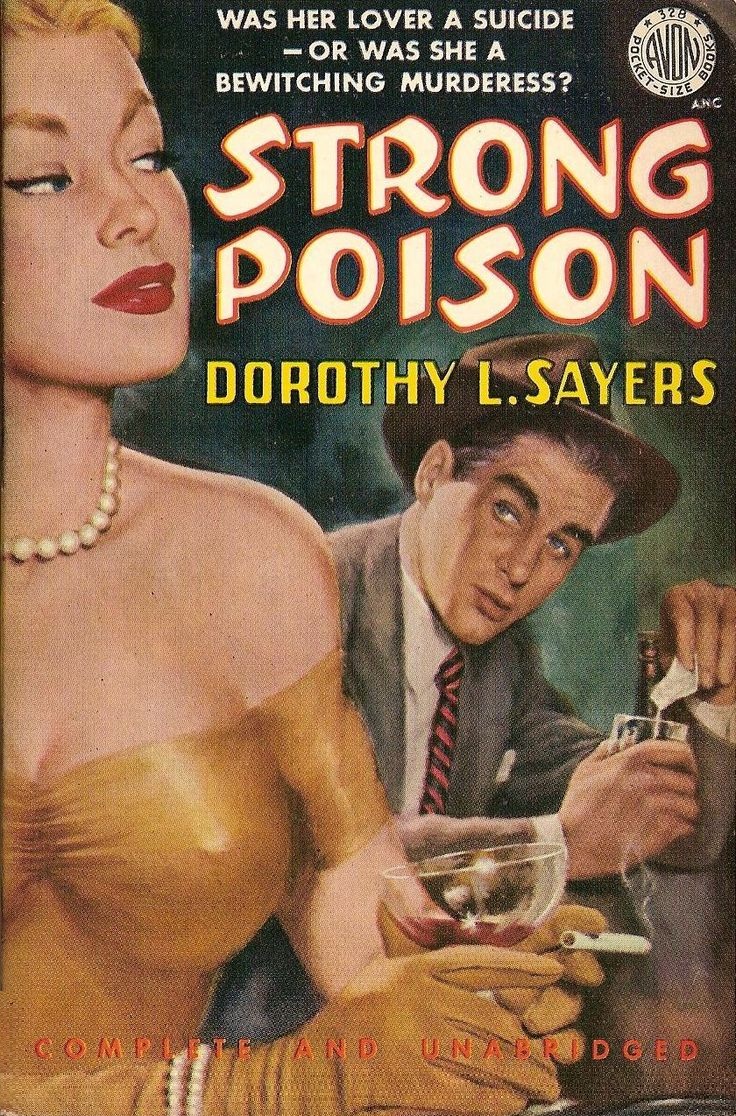 Strong Poison, by Dorothy Sayers (Avon Books #328, 1951)
In Strong Poison, Sayers gives Peter Wimsey a love interest, and makes this central to the story. Traditional mystery writers had avoided this kind of plot (Irene Adler, for example, was clearly not romantically involved with Sherlock Holmes, however profound an impression she made on him).
Not all of her readers welcomed the innovation. In particular, Harriet Vane, a successful author of detective stories, was sometimes looked at as what fan fiction readers now call a “self-insertion” by Sayers — a view that gains plausibility from Vane’s involvement in a love affair, given what we know now about Sayers’s life story.
We first meet Vane in a courtroom, where she is being tried for the murder of her former lover, Philip Boyes, a less successful but more artistically pretentious novelist (what little is said of his books suggests Aldous Huxley’s early novels, before Brave New World made him immortal).
[Click the images for stronger versions.]
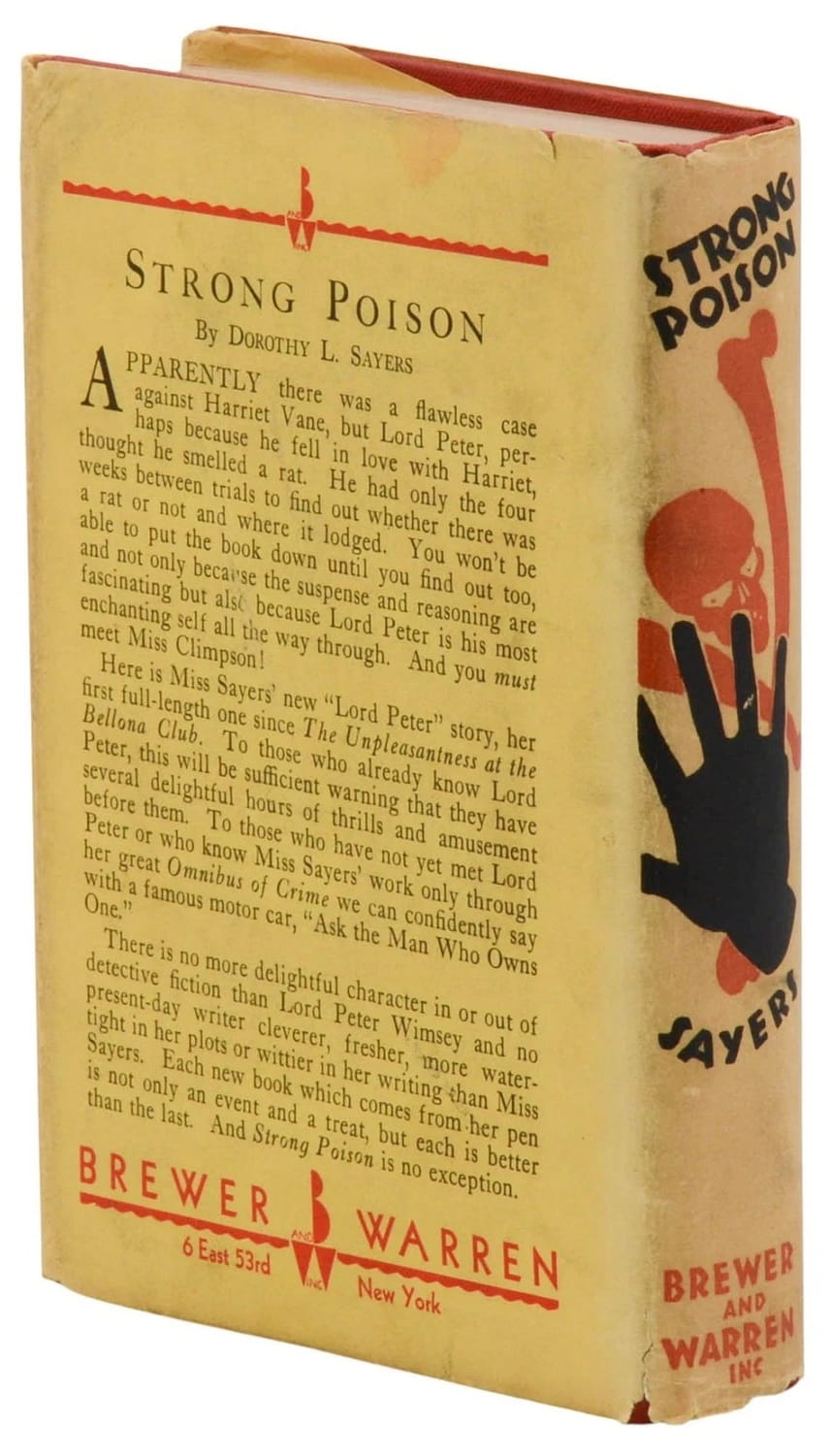
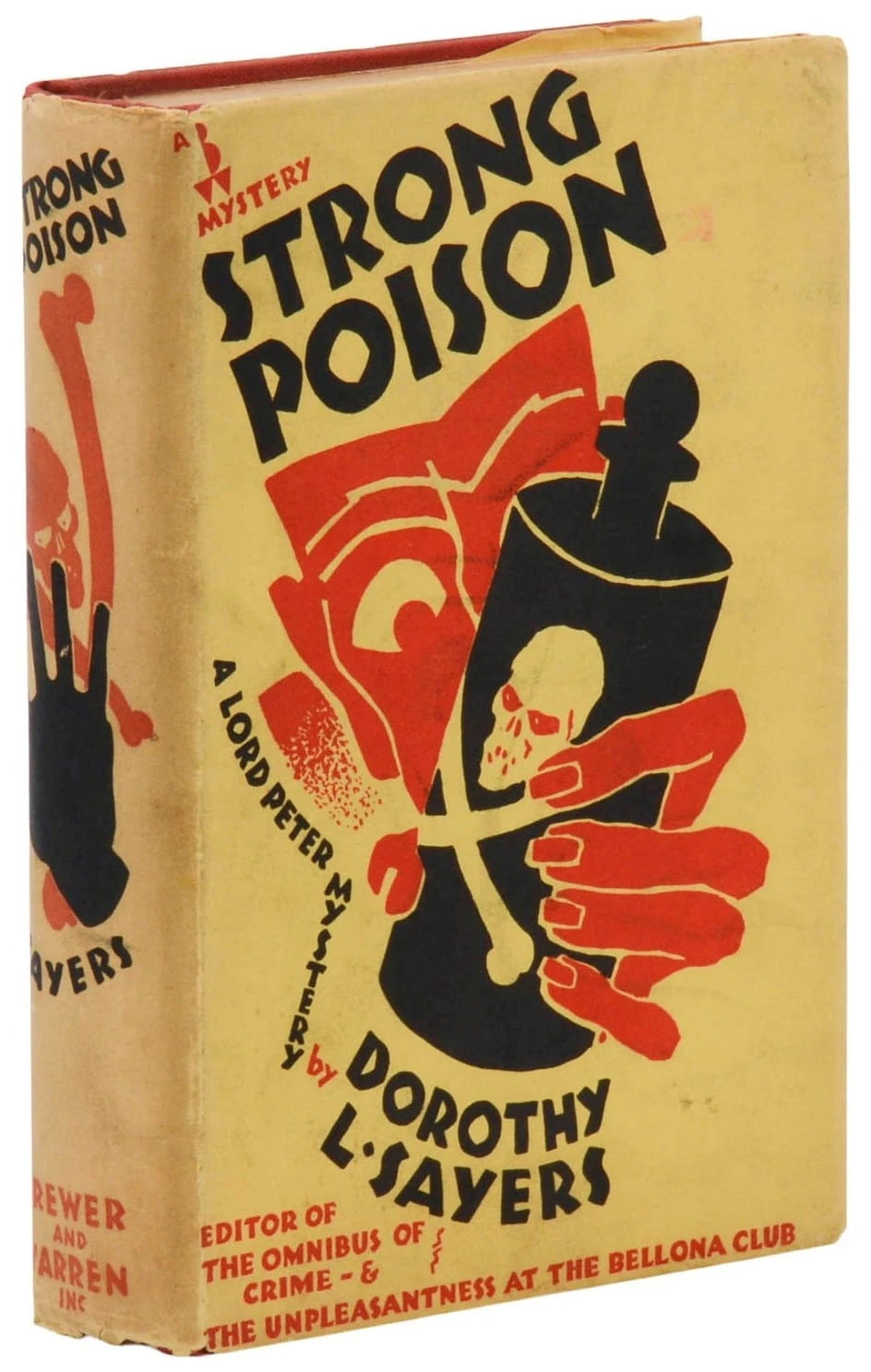
Strong Poison (Brewer and Warren, 1930)
Boyes died of arsenic poisoning, and Vane had bought arsenic twice in the time leading up to his death, and had seen him the night he died, so the circumstantial evidence looks damning.
Sayers has the judge sum up the testimony for the jury and advise them as to what points they need to decide, a handy device for exposition. The jury is out for a long time, from just after lunch till well into the evening, and finally ends up hung, nine to three.
One of the three is Wimsey’s ally Miss Climpson (introduced in Unnatural Death), who holds out against a lot of pressure from the foreman and most of the other jurors, saying that the prisoner’s demeanor is part of the evidence and Vane’s demeanor isn’t that of a murderer.
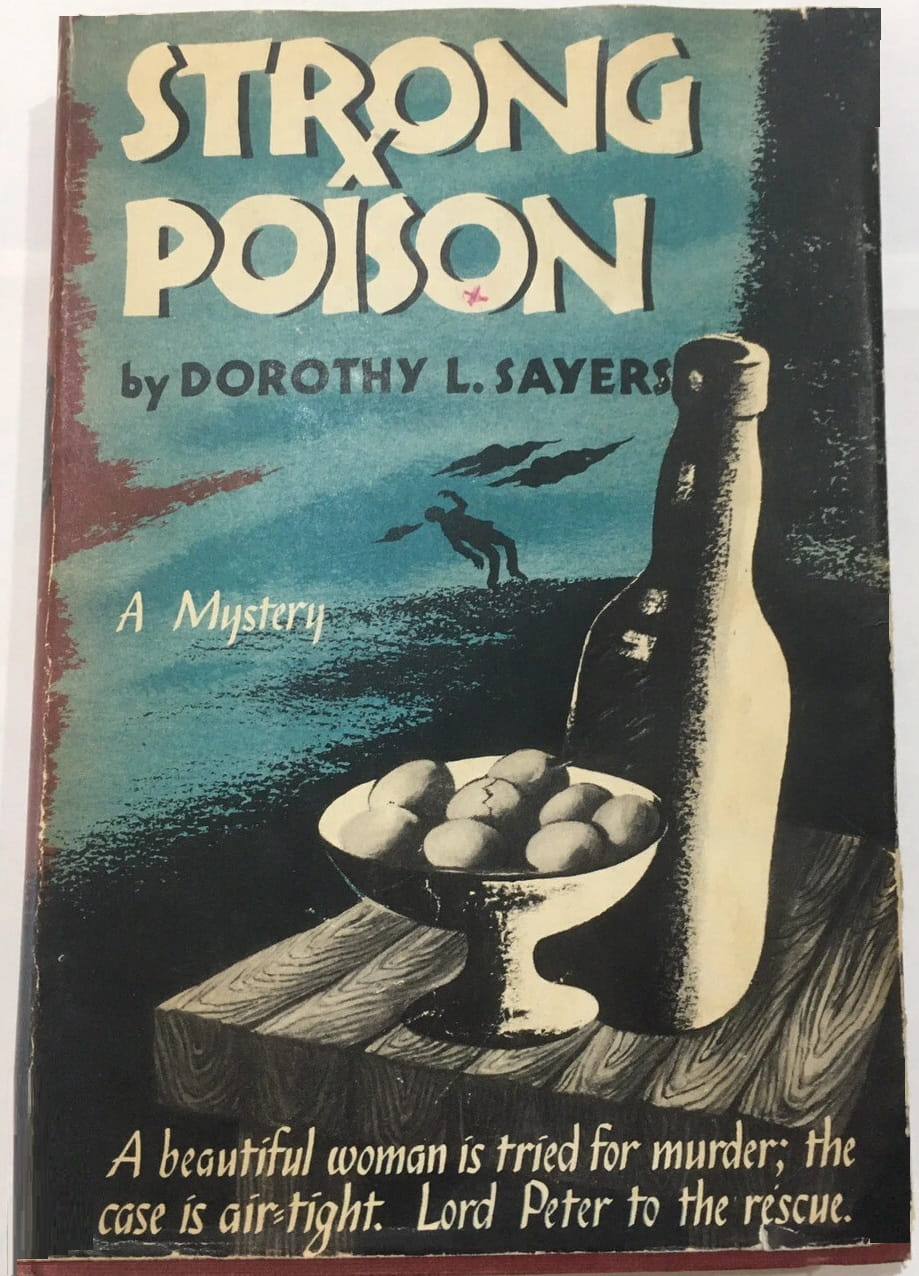
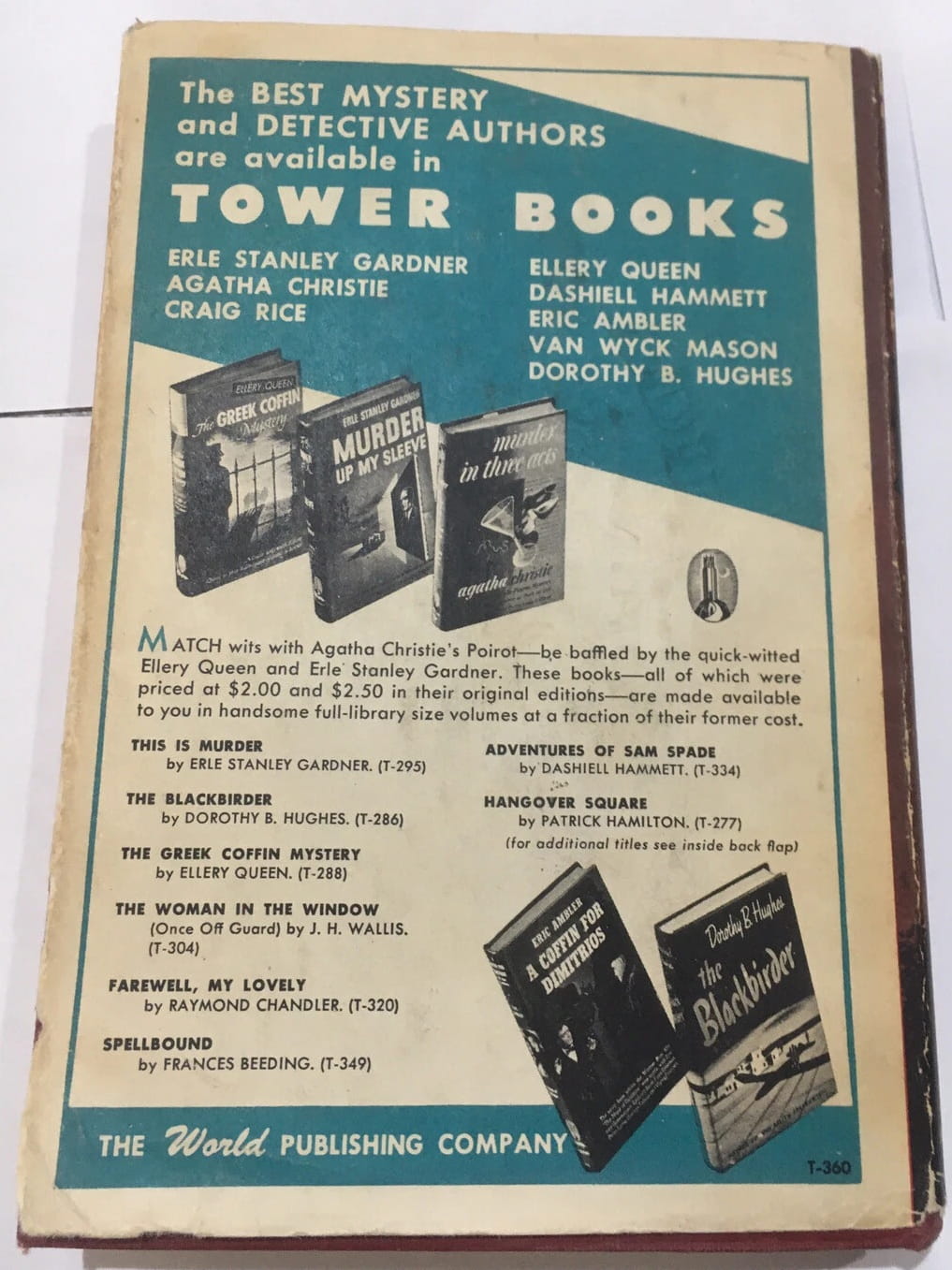
Strong Poison (Tower, 1945)
Wimsey himself, who apparently has been in the audience throughout the trial, seems to have reached the same conclusion; he’s convinced enough of Vane’s innocence to criticize her solicitor for treating this as a job of casting doubt on her guilt. But at the same time, he has decided to marry Vane, having fallen in love with her. He says as much to her when he first interviews her in prison, and is taken aback when she says, “Oh, are you another of them? That makes forty-seven.”
Wimsey’s closest friend, Charles Parker, makes an appearance, in two roles. On one hand, he’s initially convinced that Vane is guilty, though he provides Wimsey with help in looking for evidence to the contrary.
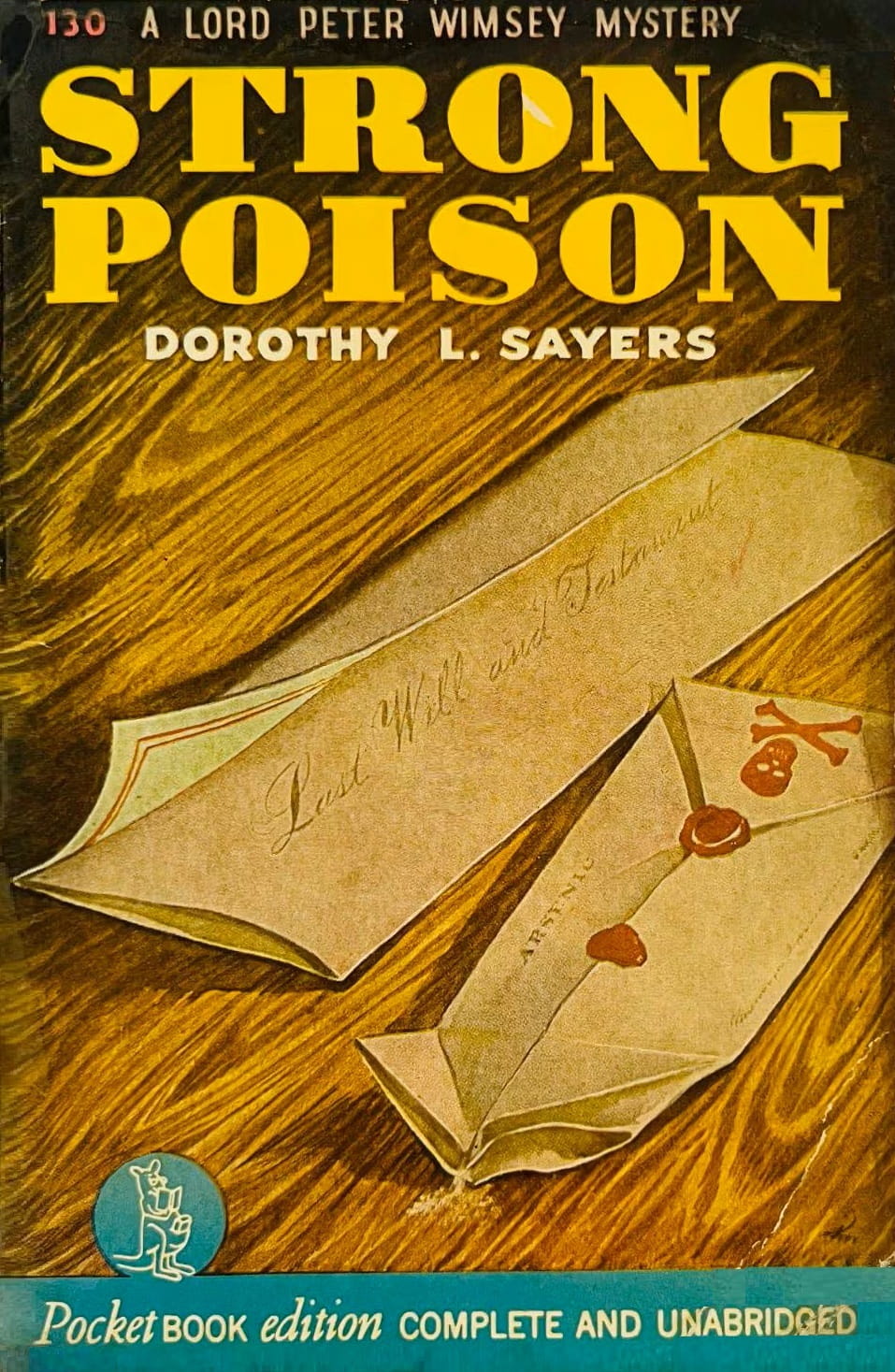
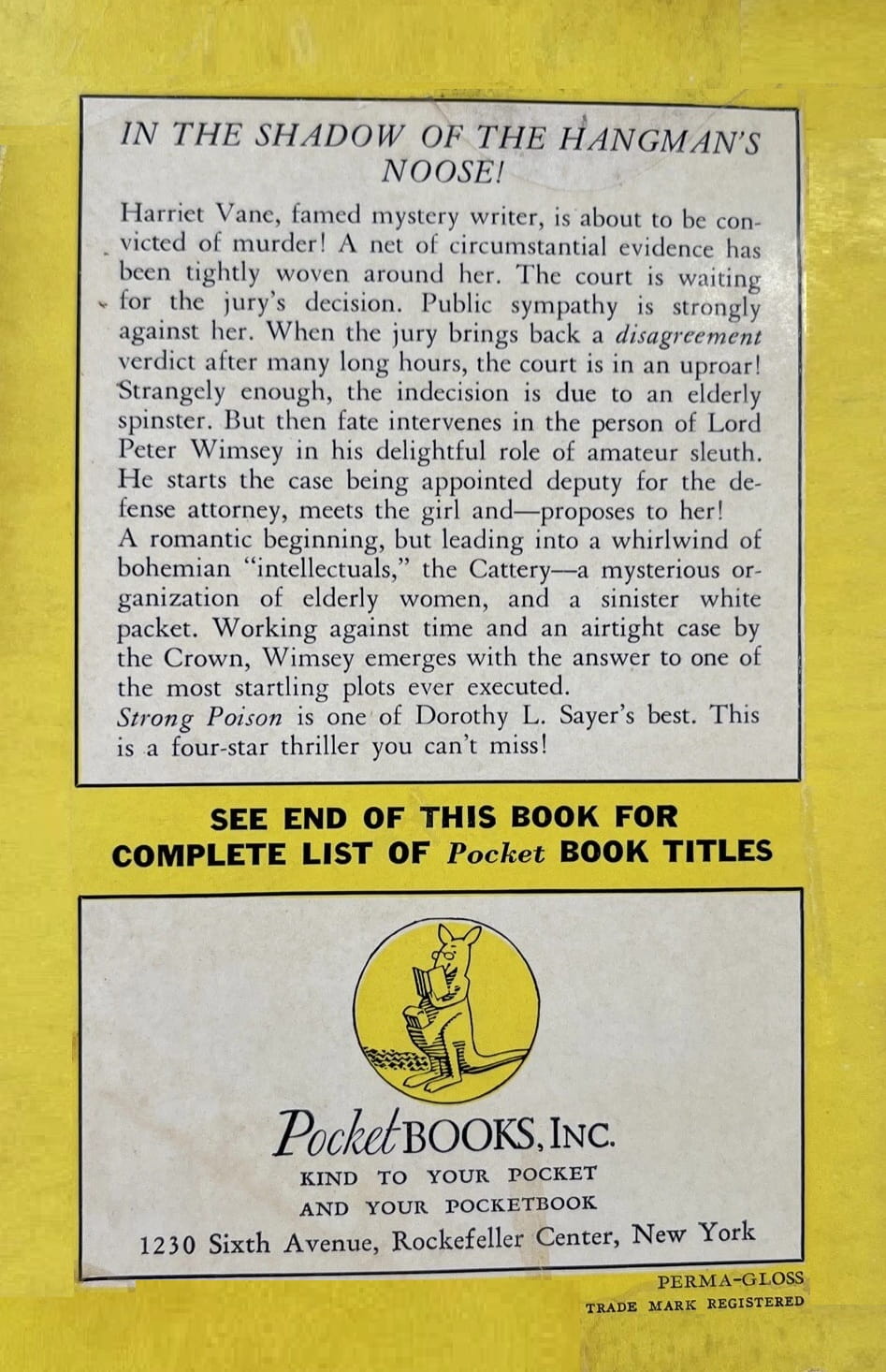
Strong Poison (Pocket Books, 1945)
On the other, he and Wimsey’s sister Mary have fallen in love with each other, and the issues of social class this raises parallel those between Wimsey and Vane neatly; their older brother, the Duke of Denver, is horrified at both prospects.
The use of arsenic makes this another mystery that turns on medical knowledge — or, in this case, on medical folklore. Once again, Sayers focuses less on who than on how.
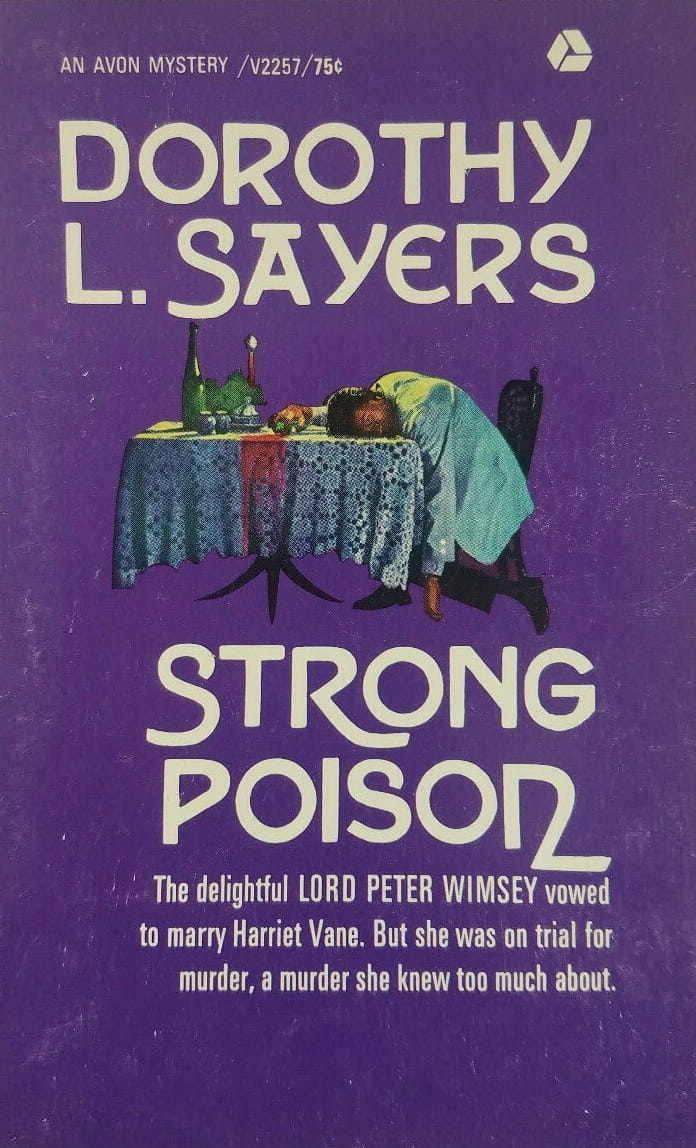
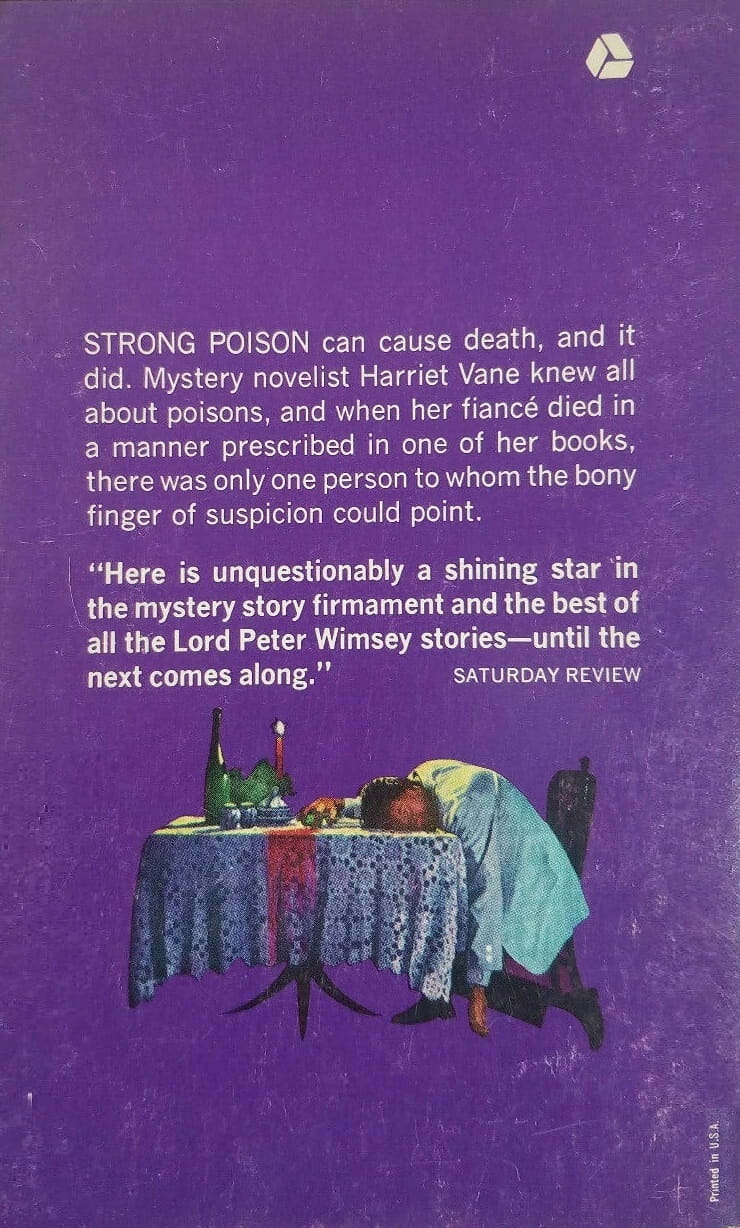
Strong Poison (Avon Books, 1969)
When Wimsey has his manservant Bunter put away some books he’s been consulting, one of which is A Shropshire Lad, I recognized, and so (to his credit) did Bunter, that this was a reference to the poem “Epilogue” (or “Terence, This Is Stupid Stuff”), which ends with the legend of Mithridates:
There was a king reigned in the East.
There, when kings will sit to feast,
They get their fill before they think
With poisoned meat and poisoned drink . . .
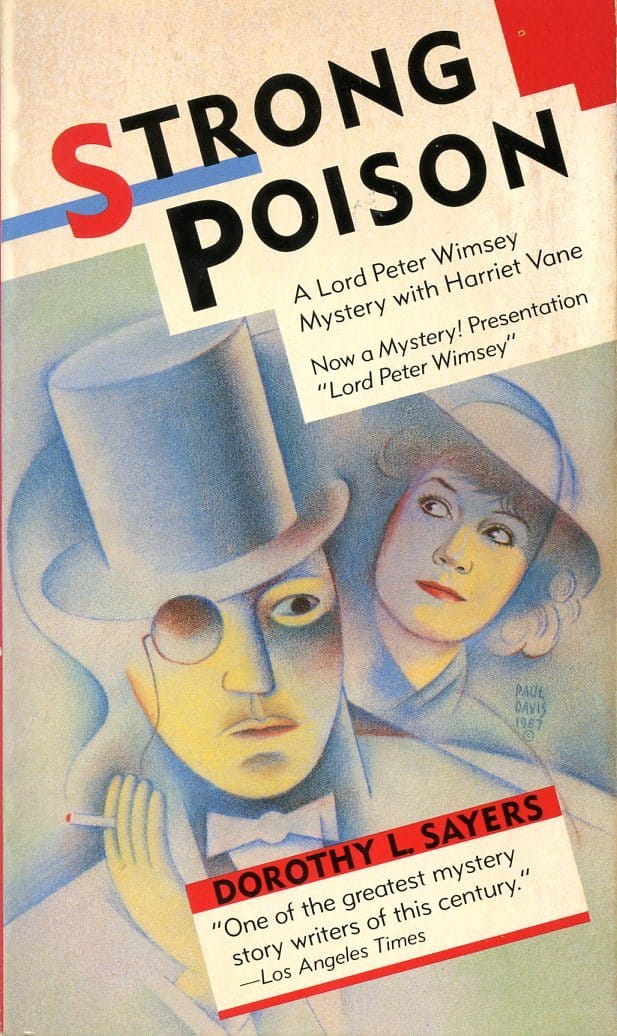
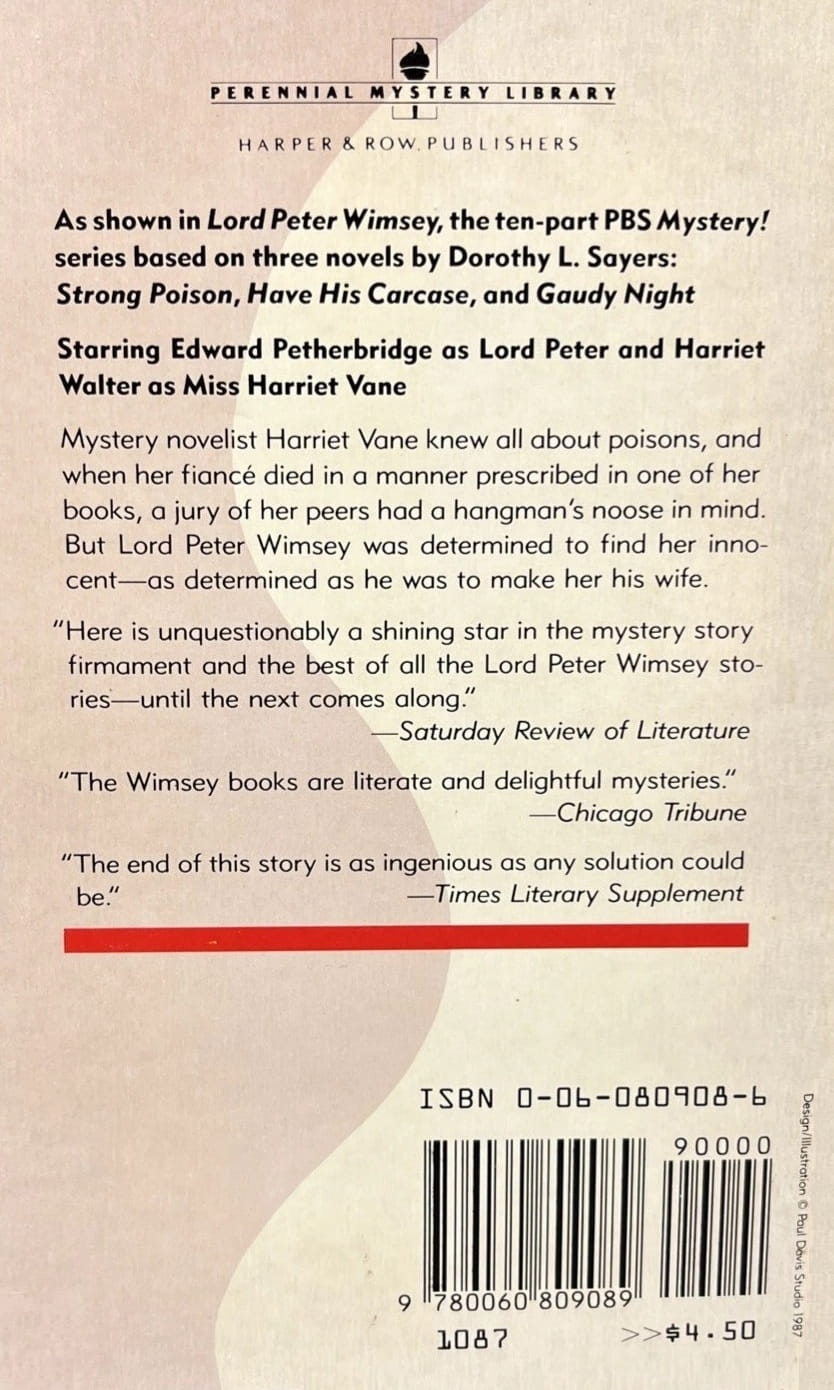
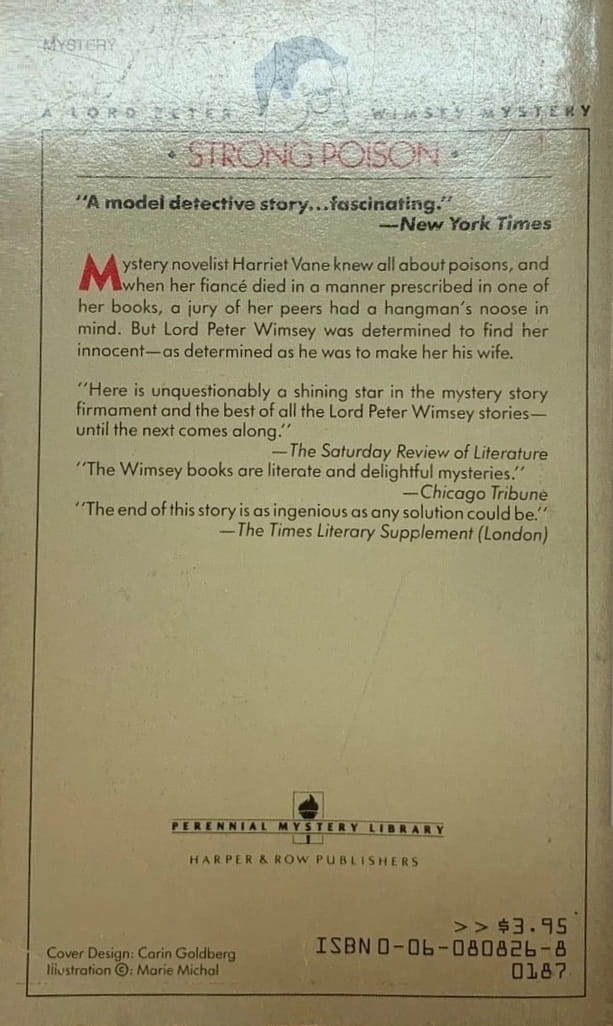
Strong Poison (Harper & Row paperback edition)
In fact, this is a book filled with quotations and allusions; and the exchange of both between Wimsey and Vane is one of the first signs that they might actually belong together. The poem neatly hints at the method (which is one that is no longer thought to be workable) and at how Wimsey proves his case.
Beyond how, there’s also why: the motive for the crime. And here, as in Unnatural Death (and An Unpleasantness at the Bellona Club, which came in between), family history and financial assets come into the story.
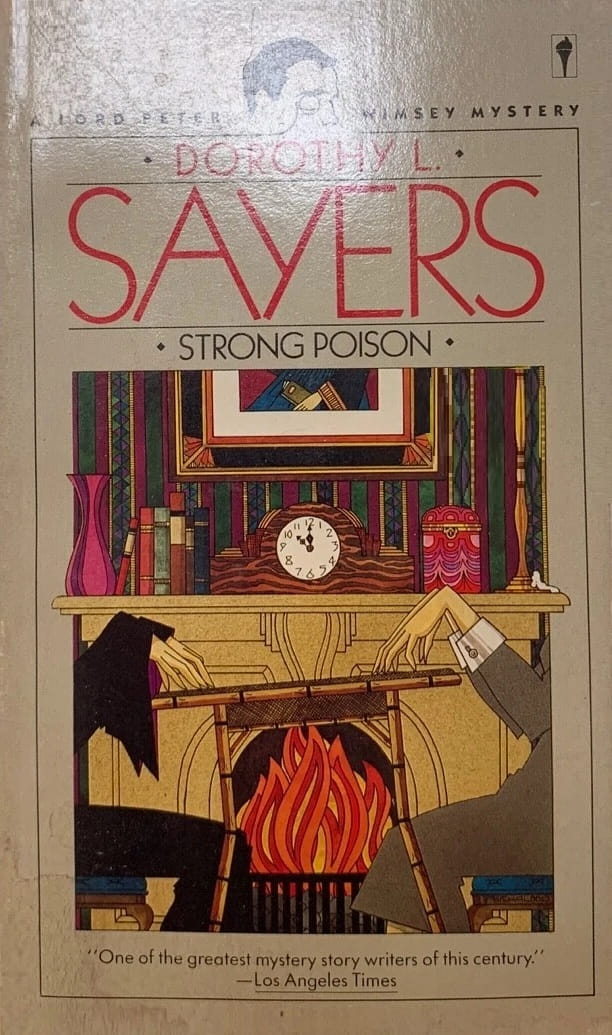
Strong Poison (HarperCollins, 1987)
Both Boyes and his cousin Norman Urquhardt, a solicitor, with whom he dined on the night of his death, have family connections to Rosanna Wrayburn (née Hubbard), a famous actress of the 1860s who led a scandalous life, under the stage name of Cremorna Garden, and invested the many gifts it brought her, making her wealthy in her old age. Sayers seems to like stories about women who rebelled against Victorian expectations in various ways!
Wimsey gets together with Miss Climpson early in the investigation and discusses possible motives with her; and later he calls on both her and another woman in his agency, Miss Murchison, to investigate various aspects of the case. In Miss Climpson’s case that involves her playing the role of a spirit medium for Mrs. Wrayburn’s credulous nurse (a great bit of comic relief!); Miss Murchison gets lessons in lockpicking from a former burglar, Bill Rumm, who reformed and got religion after an earlier encounter with Wimsey.
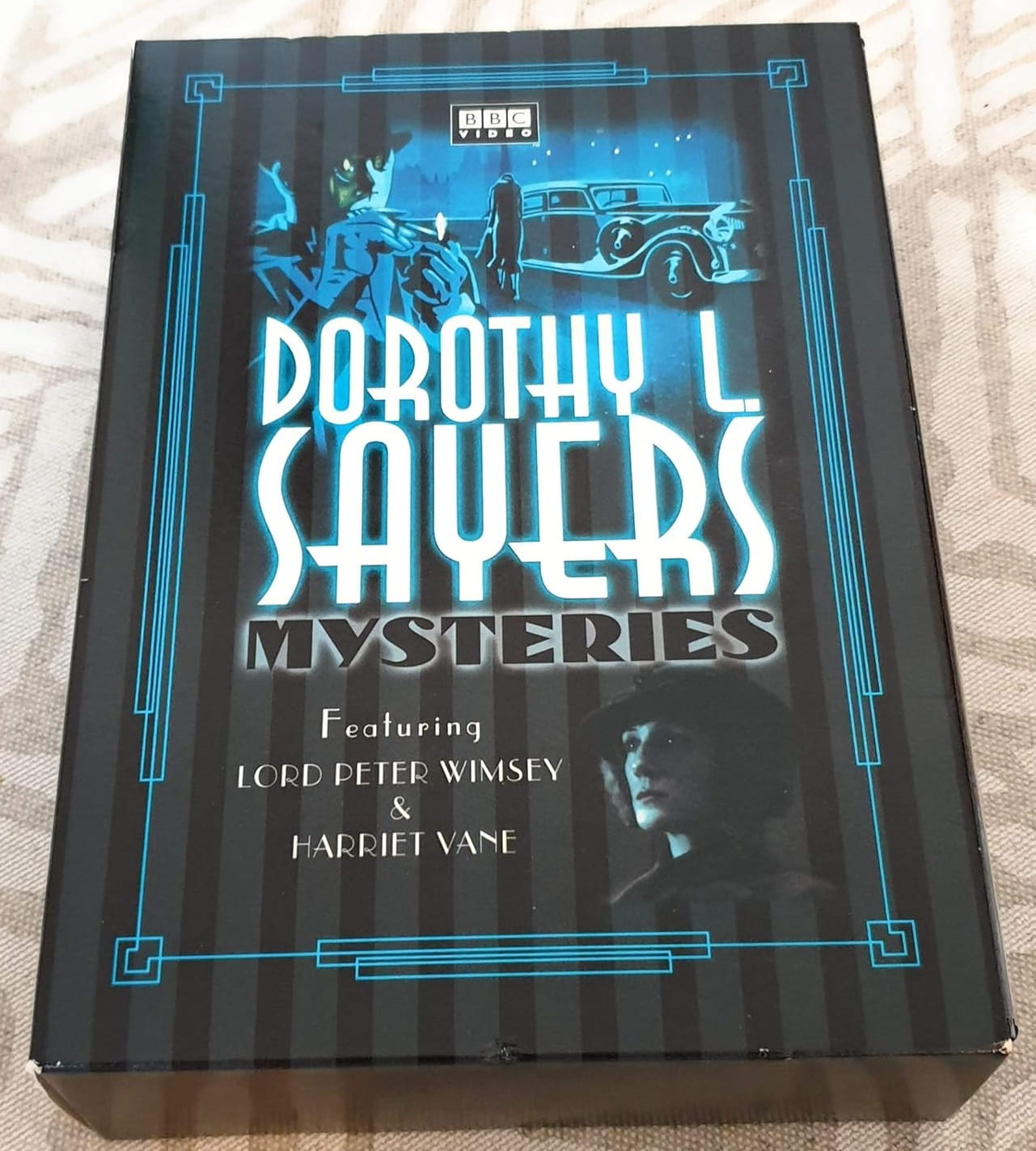
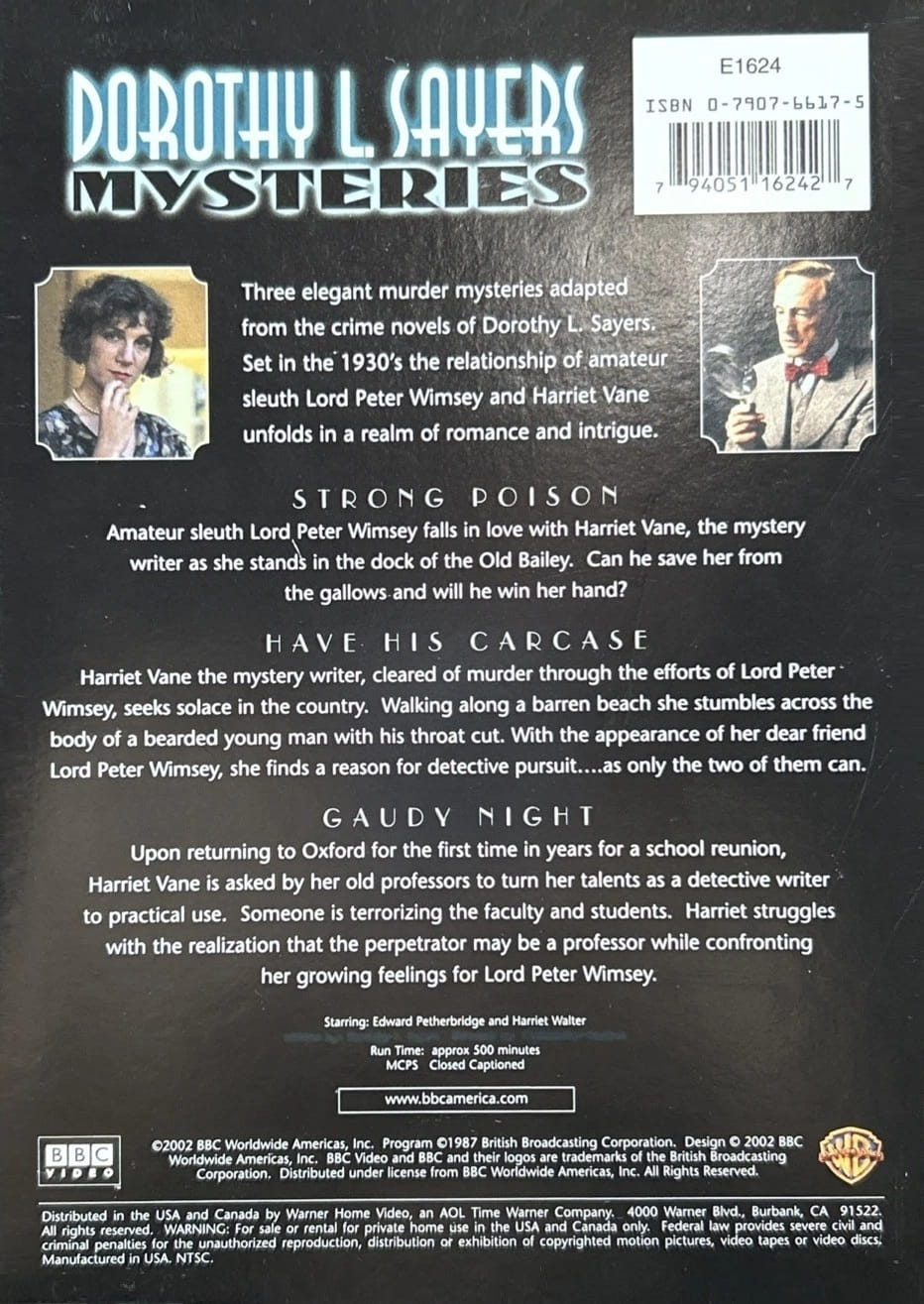
Dorothy L. Sayers Mysteries adaptations featuring Lord Peter Wimsey and Harriet Vane:
Strong Poison, Have His Carcase, and Gaudy Night (BBC Video, 2002)
Knowing why gives Wimsey confirmation of who. There are also connections with the Megatherium Trust (named for the giant ground sloth!), on which Wimsey gets helpful advice from his friend Freddy Arbuthnot — who has just become engaged to Rachel Levy, the daughter of the murder victim in Whose Body?, another matrimonial crossing of established social boundaries.
We also see Wimsey consulting with Marjorie Phelps, an artist who makes porcelain figures, for a better understanding of Vane’s cultural milieu. In particular, she introduces him to Vane’s friends Sylvia Marriott and Eiluned Price, who give him more background on Vane’s relationship with Boyes.
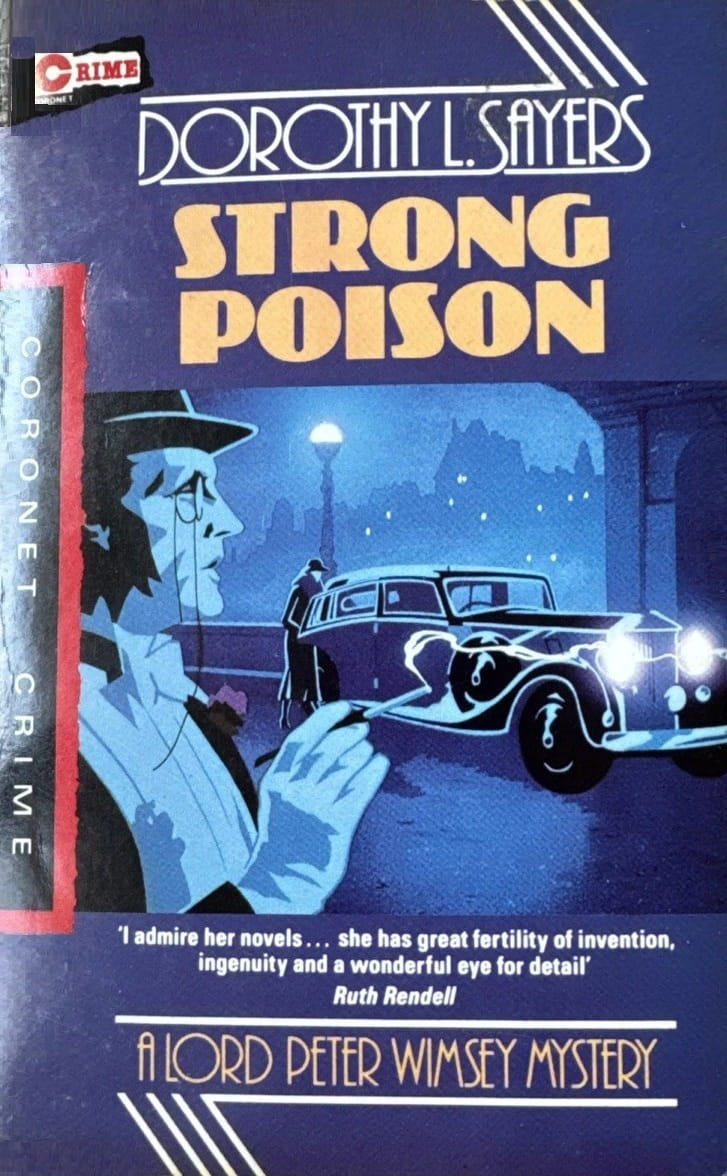
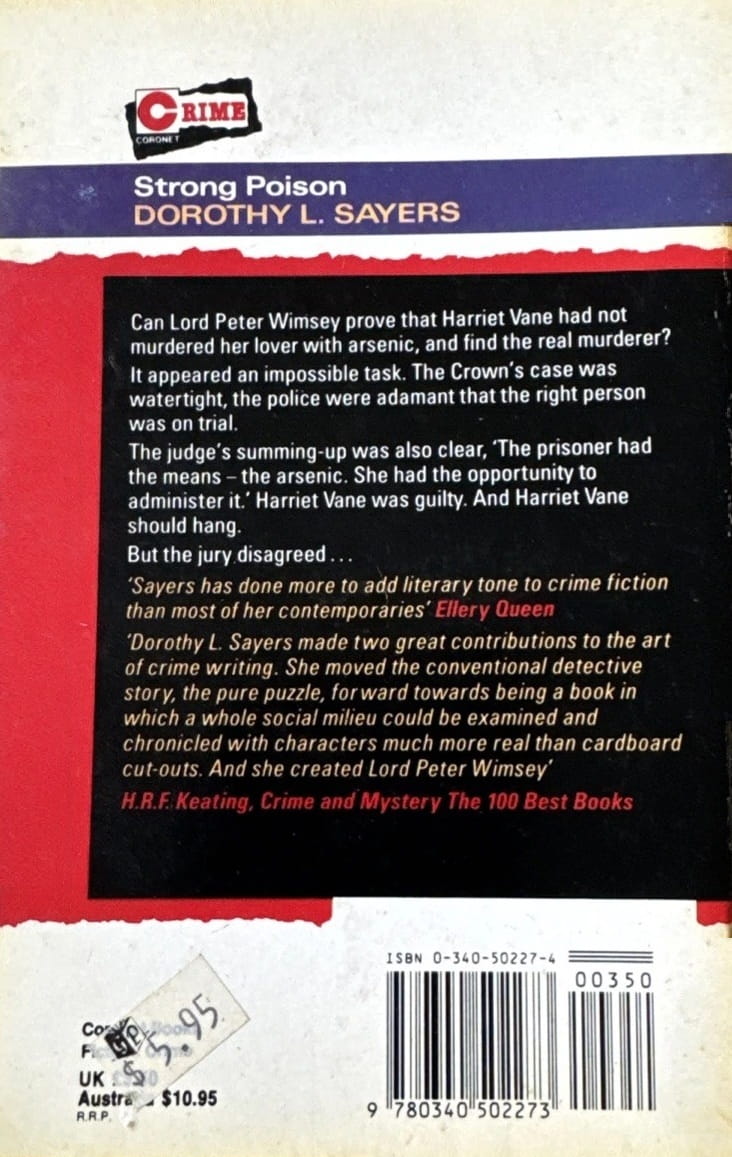
Strong Poison (Hodder & Stoughton/Coronet Crime trade paperback, 1993)
Price is characterized as generally disliking men, which might or might not be a hint about her sexuality, but at the end of the novel she tells Vane that Wimsey is too decent to be importunate in his courtship, so it seems he managed to make a good impression on her.
The chapter where Wimsey talks with the three women doesn’t seem to advance his investigation much; its function seems to be more one of characterization — notably Phelps’s silent unhappiness at the end, which hints at something unspoken between her and Wimsey.
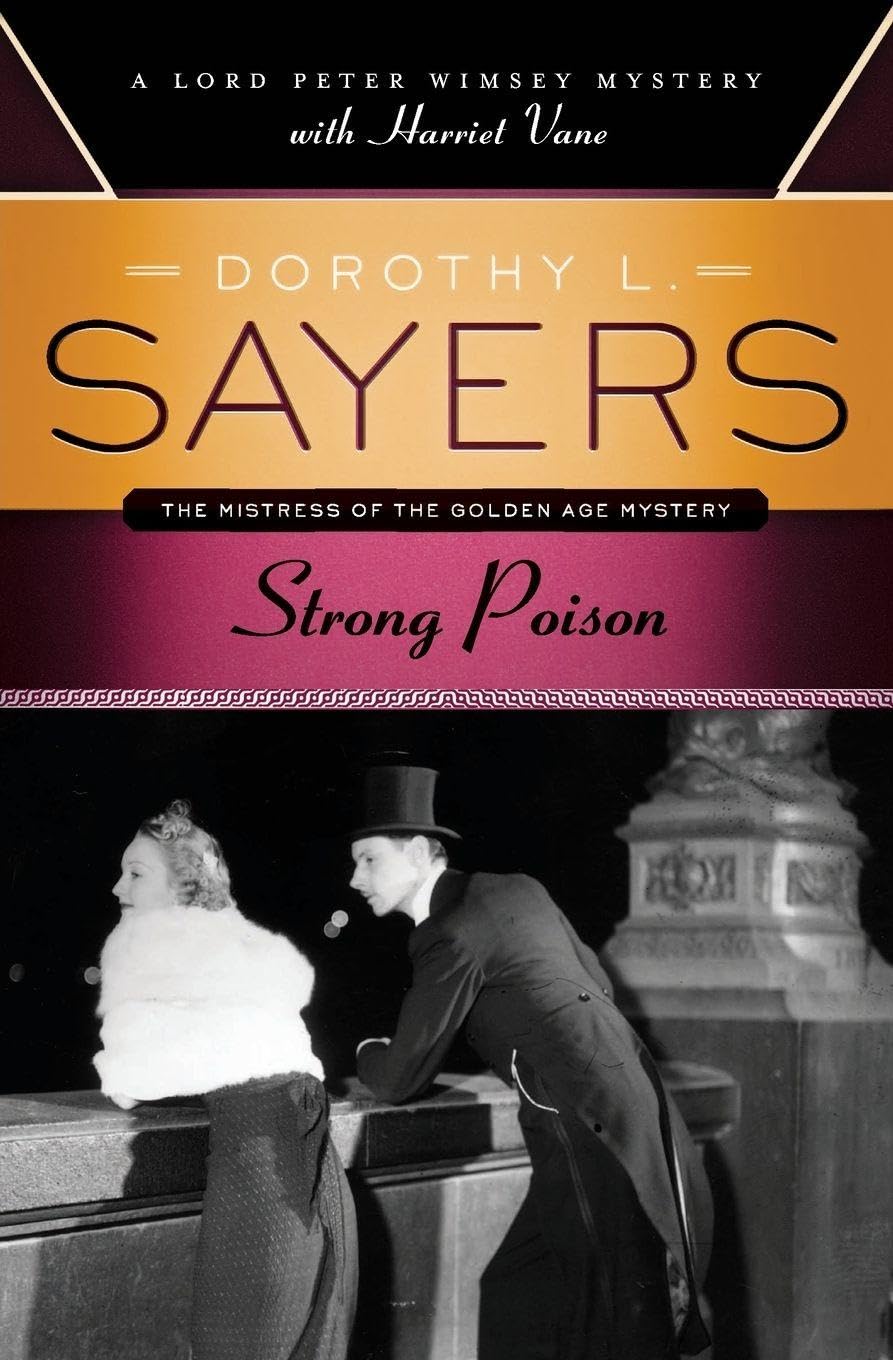
Strong Poison (Harper Paperbacks, 2012)
On one hand, I can’t regret the introduction of Harriet Vane into the series; she will play a significant role in some of the later novels, and even in this one her characterization is interesting.
On the other, while it’s in character for Wimsey to decide she’s innocent and take up investigating her case, it seems implausible for him to fall in love with her after having merely seen her in the witness box in a courtroom. I feel as if Sayers didn’t feel able to show the beginning of the attraction convincingly and fell back on making it a fait accompli.
And Wimsey’s declaration of his feelings during his first interview with Vane is awkward in a way that’s hard to believe of a man of such suavity. The events of Strong Poison are central to the series, but they make me wonder if the story Sayers was telling had gotten out of her control. So I can understand why some of her readers may have thought this particular storyline was ill-advised.
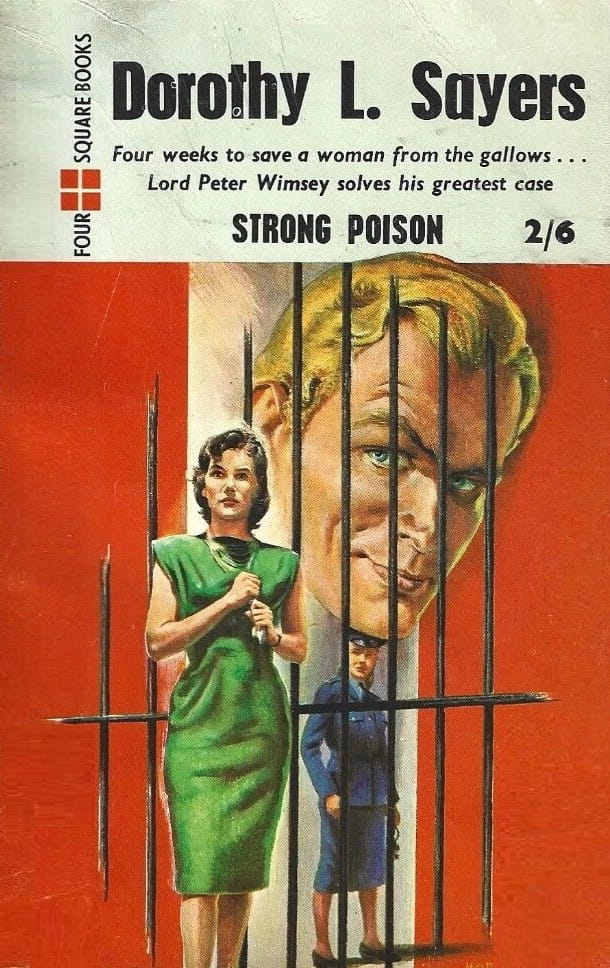 Strong Poison by Dorothy L Sayers (Four Square UK edition, 1960)
On the other hand, Sayers’s fusion of a murder mystery with a novel about courtship and social class certainly breaks the series out of any previously established formula, which is part of what makes it interesting.
“Forgive my asking, but — you were very fond of Philip Boyes?”
“I must have been, mustn’t I — under the circumstances?”
“Not necessarily,” said Wimsey, boldly, “you might have been sorry for him — or bewitched by him — or even badgered to death by him.”
“All those things.”
William H. Stoddard is a professional copy editor specializing in scholarly and scientific publications. As a secondary career, he has written more than two dozen books for Steve Jackson Games, starting in 2000 with GURPS Steampunk. He lives in Lawrence, Kansas with his wife, their cat (a ginger tabby), and a hundred shelf feet of books, including large amounts of science fiction, fantasy, and graphic novels.
Categories: Fantasy Books
Book Review: The Hive by Ronald Malfi
I received a review copy from the publisher. This does not affect the contents of my review and all opinions are my own.
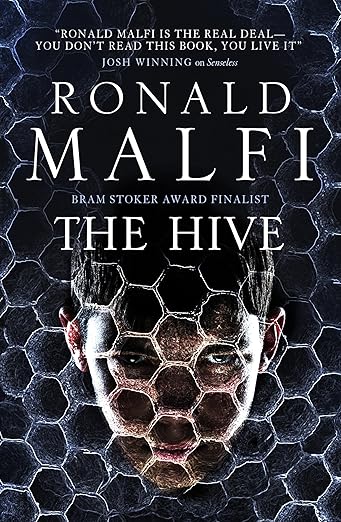
Mogsy’s Rating: 3 of 5 stars
Genre: Horror, Thriller
Series: Stand Alone
Publisher: Titan Books (April 14, 2026)
Length: 768 pages
Author Information: Website
I’ll be honest. Seeing the sheer size of The Hive when it first landed on my doorstep made me a little nervous. Ronald Malfi has been a must-read author for me for years and I’ve gotten used to his reliably mid-sized novels, the kind I can usually power through in just a couple of sittings thanks to how addictively readable they are. Hence, it’s why this sprawling doorstopper, which I’ve seen described elsewhere as his “tour de force,” felt like a bit of a curveball. Sure, knowing it’s been a long-term passion project for him definitely raises expectations, but from experience, I also know that doesn’t always work in the book’s favor.
Set in a small Chesapeake Bay town on Maryland’s Eastern Shore, the story opens in the aftermath of a violent storm that leaves behind the usual chaos of scattered debris. At first glance, there doesn’t seem to be anything unusual about it. Just a jumble of everyday knickknacks torn loose and flung across lawns and streets. But for some residents of Mariner’s Cove, there’s more to these objects than meets the eye. Each person finds themselves drawn to a particular item, whether it’s a door ripped from its frame or an old metal colander. As these things start to exert a powerful pull on their owners, sparking an obsession that grows more intense by the day, neighbors begin hiding their finds, guarding them ferociously, becoming irrationally angry when questioned, and generally behaving in increasingly erratic and disturbing ways.
While these changes are occurring on an individual level, something else is taking shape on a larger scale. A strange, hive-like consciousness is slowly emerging, manifesting as a low constant buzz consuming the minds of the affected townsfolk. Those who hear it can sense it building into something almost harmonious, connecting and binding them, guiding them towards something they cannot fully explain. And yet, not everyone has been touched by this madness. Several remain on the outside, watching as friends and neighbors transform into something they barely recognize. Among them is a young boy who discovers he possesses a strange ability, one that may be tied to whatever is happening. As the multiple perspectives begin to converge, a pattern is gradually revealed, and with it, the realization that whatever is taking root in Mariner’s Cove is building toward something far more dangerous.
If all of that sounds a little Stephen King-esque, it’s because yeah, it’s definitely is. The influence is unmistakable, from the small-town setting and the ensemble cast right down to the young boy coming into his supernatural powers. The Hive taps into a very familiar nostalgic and immersive vibe, and Malfi is good at creating an atmosphere of creeping horror. There’s also this persistent sense of dread, a lot of it brought about by the idea of ordinary everyday objects triggering a scary fixation in regular people in a quiet, insidious way.
But here’s also where things get a little shaky. I’m talking about places where Malfi seems to have picked up some of King’s less appealing habits. For one thing, The Hive is long. Reeeaally long. And the length isn’t always justified. In many sections of the book, the pacing is a slow burn in the most frustrating of ways, with stretches where the story feels like it’s inching forward, or worse, treading water and biding time instead of building momentum. We circle the same ideas and scenes a lot, with many interactions feeling repetitive or unnecessary. It takes a while for the many plot threads to come together and tighten up.
I also have mixed feelings on the multiple POV structure. On the one hand, the different voices help flesh out the town and give a broader view of how the strange phenomenon is spreading. On the other hand, not all characters are given equal weight or development or page time. Some start off feeling important, only to fade into the background later, while others carry more of the emotional load. That imbalance made it harder to keep track of an already bloated cast list, especially when the story detours into perspectives that don’t seem to pay off in any meaningful way.
That said, there are still plenty of moments that reminded me of why I love the author’s books and why I still think he’ll keep carrying on being a standout name in horror fiction. When The Hive plays up its strengths, like the moments of grotesque body horror or the psychological thrills, that’s when the novel really delivers. Malfi’s writing is also powerful, with an underlying weirdness and surreal quality to it that really sells the blurb’s tease of cosmic Lovecraftian horror.
In the end, The Hive is a solid read, but I so very much wish it had been a bit more balanced and succinct. I would recommend it to fans of Stephen King, but I would also note that, like many of King’s earlier books, this one probably could have used more rigorous editing to trim down the fat, improve the story’s pacing, and sharpen focus. Speaking as someone who will still always pick up anything Ronald Malfi writes, it’s definitely worth checking out, but it’ll help going in prepared with the knowledge that this is much slower and heavier than this usual work.


Categories: Fantasy Books
A Vintage Horror Collection: Young Blood, edited by Mike Baker
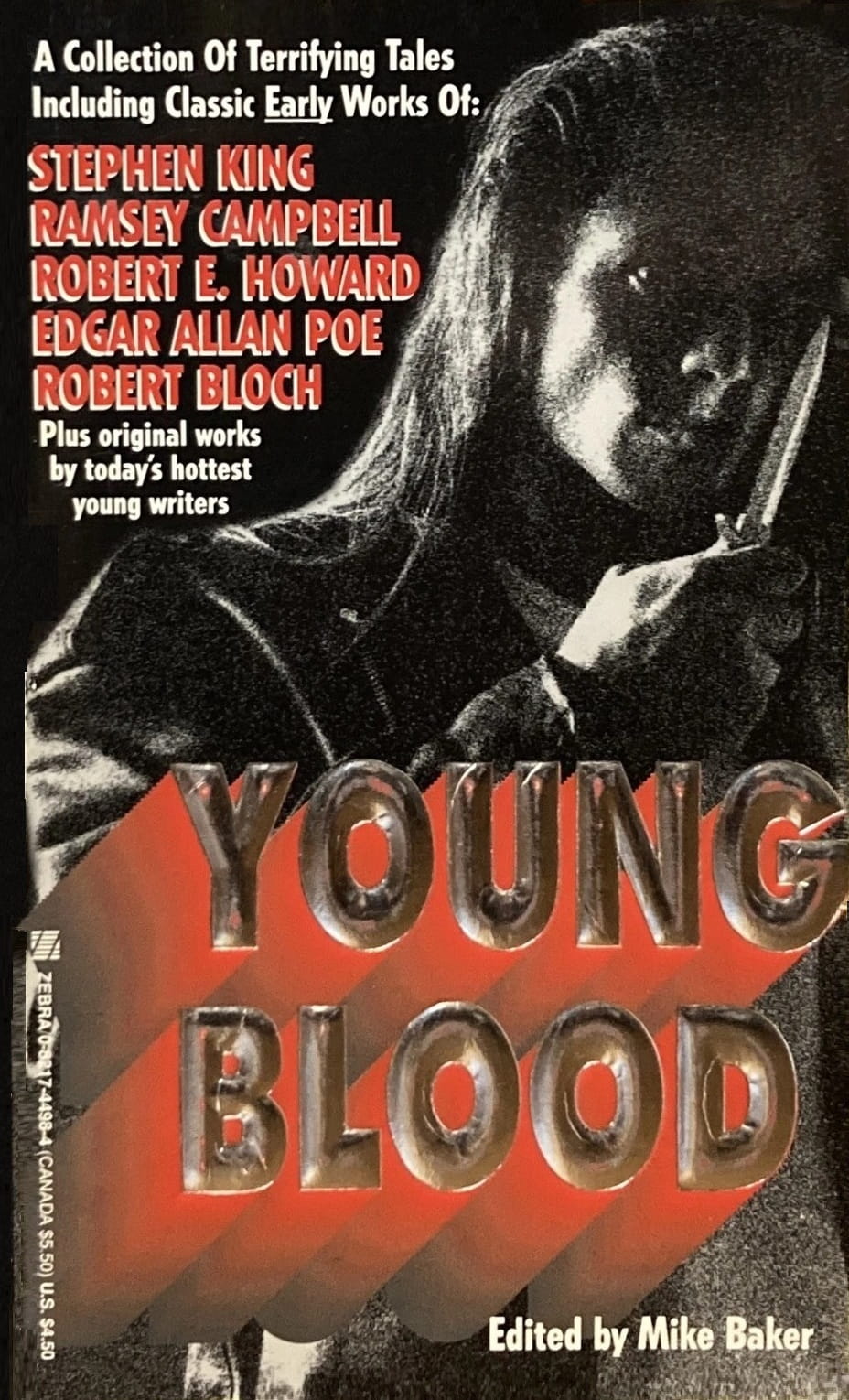

Young Blood (Zebra Books, March 1994). Cover uncredited
Young Blood, from Zebra 1994, Edited by Mike Baker. Cover looks like a photo: Artist unknown.
Here’s another book I picked up originally because it had a Robert E. Howard story in it. This one’s different, though. It isn’t a collection of Sword & Sorcery tales, but of horror stories. The Howard story is “Pigeons From Hell,” which is somewhat universally recognized as the best of his supernatural tales. In Danse Macabre, his nonfiction book on horror, Stephen King called it “one of the finest horror stories of our century.” I agree.
[Click the images for bloody versions.]
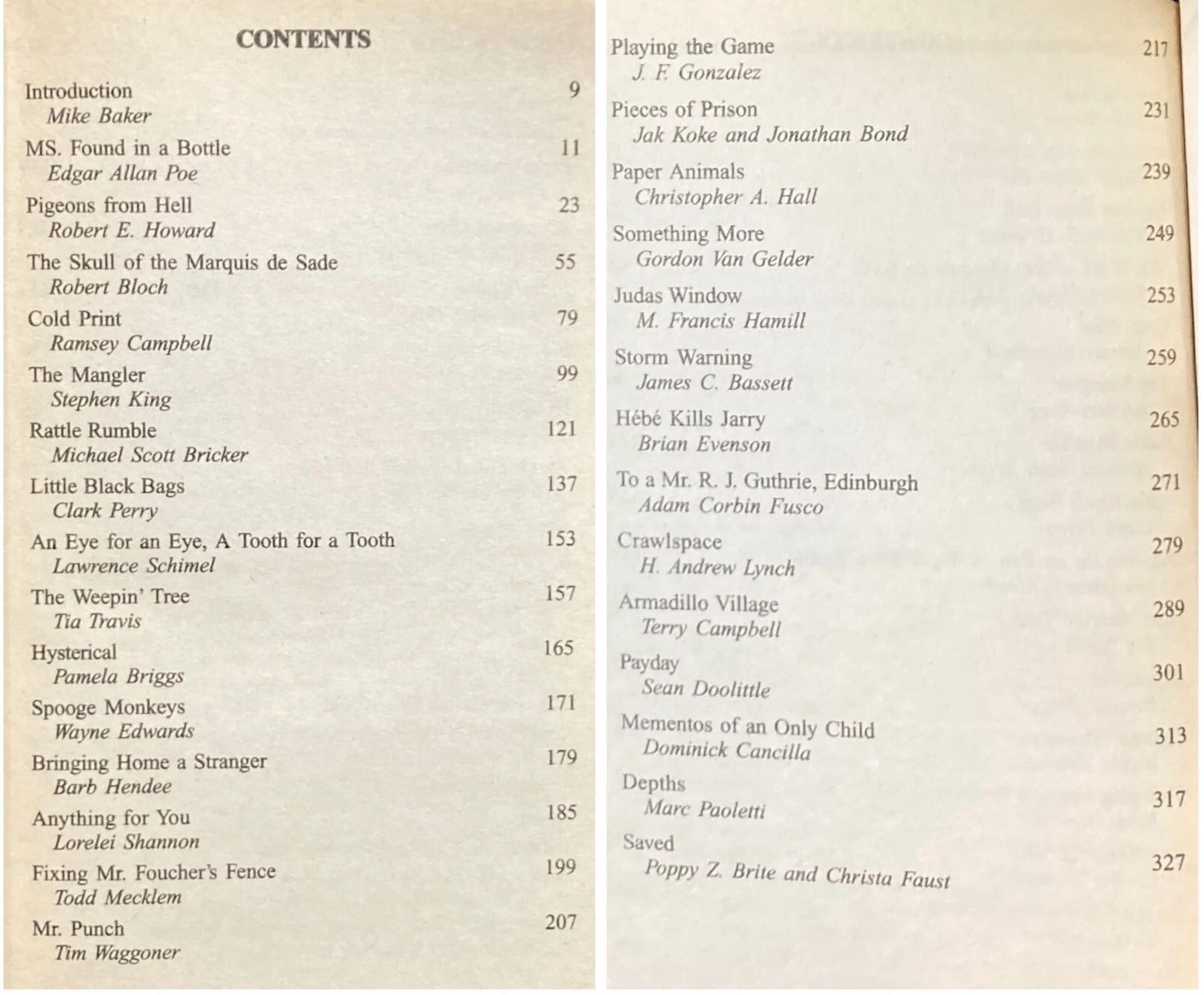 Young Blood contents
The collection also has stories by King, Ramsey Campbell, Robert Block, Poe, Michael Scott Bricker, Clark Perry, Lawrence Schimel, Tia Travis, Wayne Edwards, Pamela Briggs, Barb Hendee, Lorelei Shannon, Todd Mecklem, Marc Paoletti, Dominick Cancilla, Sean Doolittle, Terry Campbell, H. Andrew Lynch, Brian Evenson, James C. Basett, M. Francis Hamill, Gordon Gelder, Cristopher Hall, J. F. Gonzalez, Jak Koke & Jonathan Bond, Adam Fusco, Tim Waggoner, and Poppy Z. Brite & Christa Faust.
I knew a lot of these names, though not all, and I’ve had pleasant dealings with such folks as Hendee, Mecklem, Bond and Waggoner. I also knew Poppy Brite at this time, although he is now known as William Joseph Martin (1967 -).
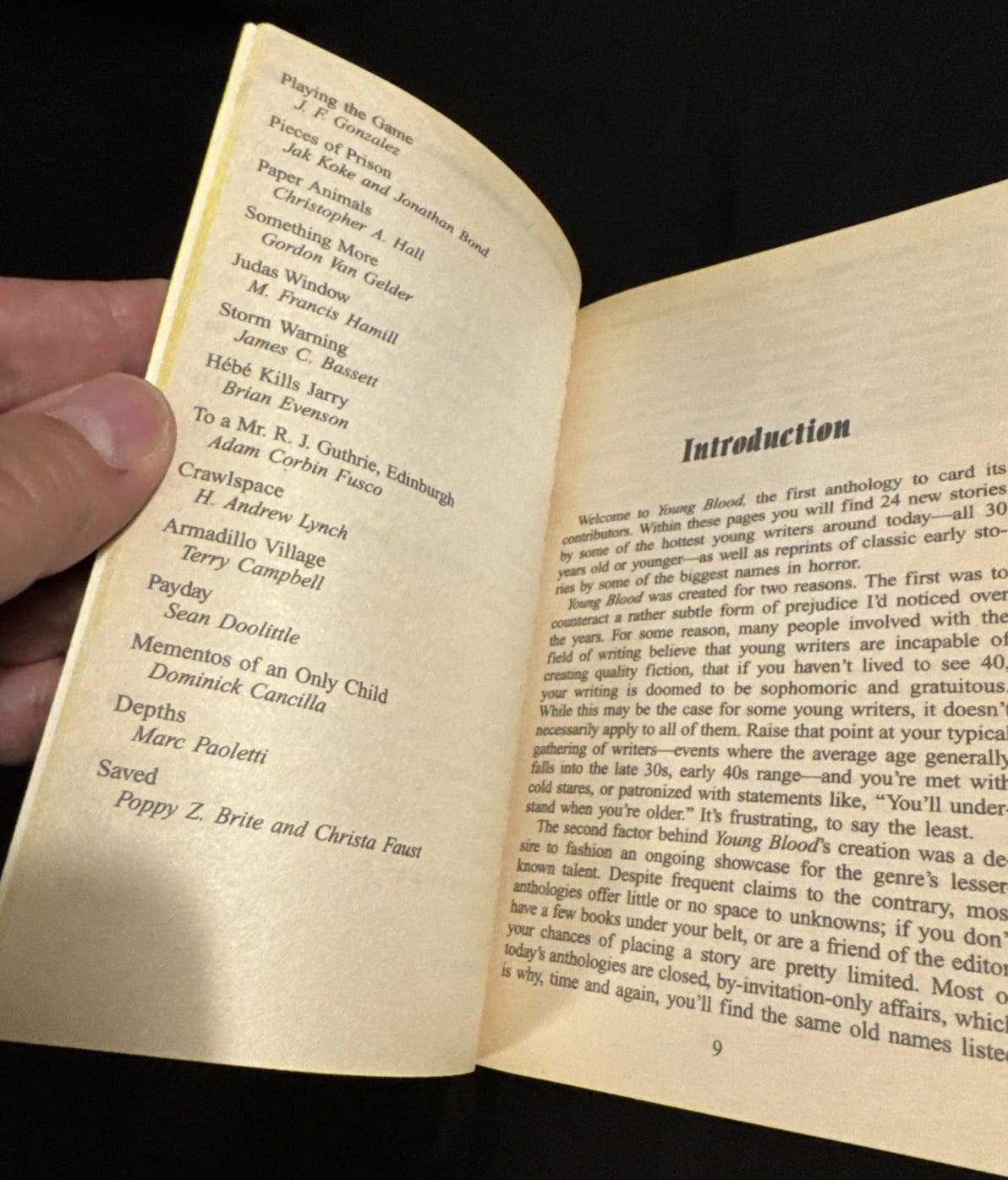 Young Blood introduction by Mike Baker
Brite’s collaboration, “Saved,” is by far the most graphic story in the book. I enjoyed it but was glad I hadn’t eaten recently.
My favorite story in the book, (other than Howard of course) was by Schimel. It was called “An Eye for an Eye, A Tooth for a Tooth.” It was absolutely hilarious. And one great idea.
Charles Gramlich administers The Swords & Planet League group on Facebook, where this post first appeared. His last article for us was a look at The Cornerstones of High Fantasy. See all of his recent posts for Black Gate here.
Categories: Fantasy Books
Women in SF&F Month 2026: Thank You and Links
Thank you so very much to all of this year’s guests for making April 2026 another incredible Women in SF&F Month! And thank you to everyone who shared guest posts and helped spread the word about this year’s series. It is always very much appreciated! Now that all of this year’s essays are up, I wanted to make sure there was a way to find all guest posts from 2026. This was (somehow) the fifteenth annual Women in SF&F Month, which […]
The post Women in SF&F Month 2026: Thank You and Links first appeared on Fantasy Cafe.
Categories: Fantasy Books
Comment on Edits At Last by Kevin
In reply to Benedict.
Don’t know if you saw my last response because I don’t think it was in the reply form, but regardless in my defense I am very computer illiterate hence my confusing responses apologies for the inconvenience.
Categories: Authors
7 Author Shoutouts | Authors We Love To Recommend

Here are 7 Author Shoutouts for this week. Find your favorite author or discover an…
The post 7 Author Shoutouts | Authors We Love To Recommend appeared first on LitStack.
Categories: Fantasy Books
Review – Under Fortunate Stars by Ren Hutchings (5/5 stars)

Reading Level: Adult
Genre: Science Fiction
Length: 476 pages
Publisher: Entangled: Rebellion Publishing Ltd
Release Date: May 10, 2022
ASIN: B09SVVVXKR
Stand Alone or Series: Stand Alone
Source: Borrowed ebook from library
Rating: 5/5 stars
“Fleeing the final days of the generations-long war with the alien Felen, smuggler Jereth Keeven’s freighter the Jonah breaks down in a strange rift in deep space, with little chance of rescue—until they encounter the research vessel Gallion, which claims to be from 152 years in the future.
The Gallion’s chief engineer Uma Ozakka has always been fascinated with the past, especially the tale of the Fortunate Five, who ended the war with the Felen. When the Gallion rescues a run-down junk freighter, Ozakka is shocked to recognize the Five’s legendary ship—and the Five’s famed leader, Eldric Leesongronski, among the crew.
But nothing else about Leesongronski and his crewmates seems to match up with the historical record. With their ships running out of power in the rift, more than the lives of both crews may be at stake…”
Series Info/Source: This is a stand alone book. I borrowed this on ebook through my library.
Thoughts: I ended up thoroughly enjoying this sci-fi story about time travel and its inevitability. The characters are very well done, and the story is cleverly woven together. The mystery really pulls the reader along, and there are fun twists throughout the story, even up until the very end. This is action packed and hard to put down.
Jereth Keevan’s freighter breaks down in a strange rift in deep space during the final days of a war with the Felen. The Gallion (a research ship) finds themselves trapped in the same strange rift. When the two ships discover each other in the rift, they find out that their timelines seem to be 152 years apart. Keevan’s crew should be from the past, and the Gallion crew should know that past well, however nothing is matching up. Both crews are forced to put aside this mystery to escape this rift alive.
This book jumps back and forth between current time (in the rift) and each of the characters’ pasts. This was very well done and really allows us to get to know the individual characters and the reasons behind their actions better. The jumps back in time relate to something happening in present time, so the switches in POV and time worked really well together and didn’t seem jarring or hard to follow.
I found this book incredibly engaging, fast-paced, and surprising. I enjoyed every second of reading this and looked forward to picking it up to read. Between this book, “God’s Junk Drawer”, and “Light from Uncommon Stars”, I have been on a bit of a sci-fi kick, I guess. I have read some excellent sci-fi reads this month.
My Summary (5/5): Overall I really loved this. I loved the unique way the story was put together, the characters, the fast-pace, and the constant surprises. This book kept me very engaged and was hard to put down. I loved the way everything came together in the end and enjoyed the twists and turns that were thrown at the reader. I definitely plan on checking out Hutchings’ other novels.

Categories: Fantasy Books
Late to the Game – My First Ever D&D Campaign
Good afterevenmorn, Readers!
So… I’m a nerd. I know, surprising, right? What might actually be surprising, though, is that I’ve never actually played a game of Dungeons & Dragons. I mean, I’ve had a couple of home-brewed one-shots many years ago, but I’m never actually played a proper campaign, with a regular crew. That changed this year. I started with a friend, who was part of another group, who then created a splinter group for a different game. I am part of that splinter group, starting a new campaign at ground zero.
Can I just say, I am loving it. It’s a very excellent way to explore character and motivation, as well as world-building and story-telling. If you struggle with any of these, consider starting a D&D campaign. Let’s explore what’s going on in my game, because I’m too enamoured with it currently not to share.
First, because I’m relatively new to the whole thing, I started out basic. The character I chose is closest to myself in both appearance and temperament, which is to say I am playing a human fighter. She’s wildly idealistic, believing her strength and talents should be used to protect those who cannot protect themselves. She is the embodiment of my favourite quote from The Lord of the Rings, as articulated by my favourite captain of Gondor, Faramir.
I do not love the bright sword for its sharpness, nor the arrow for its swiftness, nor the warrior for his glory. I love only that which they defend.
Which, incidentally, I intend to have tattooed to my person one of these days.
Unlike the devastating stories of early childhood trauma that seems to be the norm for player characters, Tabynthia’s childhood was happy. She grew up in a tiny village, who, like Sparta raises fighters. Unlike Sparta, however, this society is kind and open, and are directly responsible for instilling her belief that it is her duty in this life to defend the defenseless and protect the innocent.
Everyone, regardless of race or ability has a place in this village, provided they adhere to the tenants of life there (on of Taby’s best friends is a half-orc, whose father orcish father fell in love with one of the fighters when she was out in the world, and followed her, eventually joining the village, earning a living as a smith). Only those who are able are raised as warriors, and sent out into the world to make their mark and earn coin and when their adventuring is done, assuming they live, they return home to help raise and train the next generation of defenders.
The manner in which they make their coin matters, and upon their death, they must face the judgement of their ancestors, making a full accounting of their deeds in life. Only the worthy are permitted to join the ancestors in their eternal festivities. Everyone else is sent back to right their wrongs, or to try again and become worthy. Taby was loved by bother her parents, both of whom are still alive. Her mother trained her in the fighting arts, and her grandmother, a great hero of her time, coached her in ethics growing up. Her father simply proudly doted. She is out in the world now as a young adult, attempting to make the world better for her being there.
That’s my character. I mean in game.
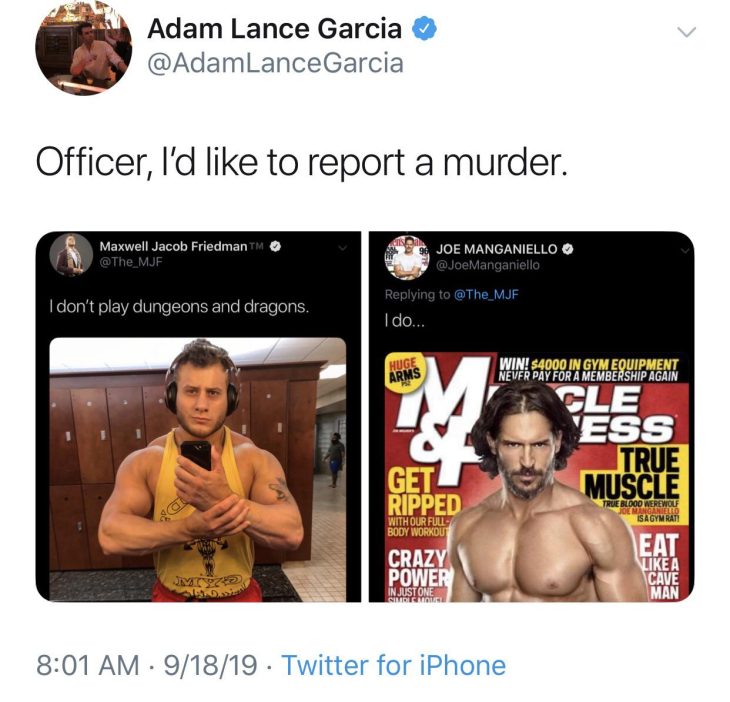 D&D, for everyone! Except the first guy. Not him.
This is a very fun dynamic in game to play. It makes for some really interesting choices for the character; a narrative choice. Does Taby permit the horrors of the world make of her a cold, hardened warrior, or does she make the very deliberate choice to lean even harder into the kindness and belief in goodness that stands at the core of her upbringing? Will she maintain the belief in herself instilled in her by a family that loved and supported her, or will she fall into the trap of having her self of self erode away, leaving her in despair regarding her own abilities? Save the fortune or misfortune of the roll of the dice, everything about a character is a deliberate choice on the part of the player.
It’s a great way to examine character choices in narrative, for those of us who are writers. It’s also an interesting way to examine our choice in the real world. I know for a fact that I’ve often turned to thoughts of my character when I’ve been personally struggling. What would Tabynthia do? She’s become a source of inspiration for me… which is weird, since I made her up. But it’s true.
This is also the first time I’ve played in a world that isn’t of my own creation. This is a very new experience for me. I have never written fan fiction, and I haven’t partnered with another author to create a story together. So this is something that I approached with considerable trepidation. It can be really tough creating in a world that has constraints you did not yourself create, and so might have trouble keeping your character or actions within the bounds of those constraints.
This is a good thing, I think; an excellent exercise for writer. I have read a few writers who break their own world rules without any valid justification (“because the narrative demands it” is not sufficient). I’ve also read a lot of characters that are able to magically do something that doesn’t make sense for their characters to be able to do. Practice not being able to do these things, as is offered by D&D, can help here I think.
Incidentally, though I’ve not dabbled in it, fan fiction can also help with this, as it is someone else’s world and, if done correctly, rules. It can also break the world, but let’s not talk about that too much.
I have to say, the DM running my particular game is quite forgiving when it comes to permitting me to create the whole damned culture which gave us Tabynthia. This small collection of villages in northern Faerûn doesn’t exist explicitly in the books I was given to help me get a handle on the game. But I was allowed to have Tabynthia come from there all the same. He’s also extremely patient in talking me through what my character can do, so I can make informed choices in any interaction. So, depending on your DM, you may have a lot more leeway to exercise your imagination while still being mostly true to the game. Though I still grimace at his evil little chuckles.
 How it feels any time the dice favour me. Image by Lixxe from Pixabay
This game also helps put you right in the shoes of your protagonist (and every player is the protagonist in their version of the story), so for anyone who struggles to see an alternate perspective, or having a character act differently from themselves in their fiction, this is a great way to exercise that particular muscle.
In order to do that, though, you must be willing to emphasize the role-playing aspect of this game. I have been letting my buried once-theatre kid have a ball with this character. It might take a bit for someone not used to inhabiting a role in this way to be able to do it, and perhaps a little longer to be comfortable doing it in a group setting, but it is well worth it; not just because it’s really fun, but also because it’s really good for seeing through another’s eyes. In writing and in life, this can only be a good thing.
Dungeons & Dragons is not just a great way to gather and play, but it can be a really serious exercise in good writing, in writing practice, and, like most fiction, dissecting the real world in which we live, and the actions of those in it in a more hands-on way than reading often permits (unless you’re like me, in which case you get so into a book you’re practically living it).
If you haven’t tried your hand at it yet, this is your sign to give it a go. Finding a good crew with a good DM can often be a challenge (hoy boy, have I heard some horror stories), but it’s well worth it if they can be found.
When S.M. Carrière isn’t brutally killing your favorite characters, she spends her time teaching martial arts, live streaming video games, and sometimes painting. In other words, she spends her time teaching others to kill, streaming her digital kills, and sometimes relaxing. Her most recent titles include Daughters of Britain, Skylark and Human. The Timbercreek Incident is free to read on Wattpad.
Categories: Fantasy Books
THE HIVE by Ronald Malfi
Epic Horror is one of the most ambitious kinds of horror stories to tell. Horror is a genre that relies a great deal on tension and can often be strengthened by intimacy of character or situation. In other words, relatively small stakes. Maintaining a level of tension and mounting dread over the course of a…
Categories: Fantasy Books
Comment on Edits At Last by Steve VC
Given how much ‘world building’ you’ve done and are continuing to do, would you ever consider allowing other authors to use these constructs to build their own stories? I can imagine it would be difficult but there are other series out there where the author has created a ‘world’ and other authors use that as a platform for their books.
By way of example – Eric Flint’s 1632 book started a huge spin off, so too has John Ringo’s Black Tide Rising zombie stories.
It could potentially allow you to help collaborate with other authors, expand the ‘universe’ and derive a potential additional revenue stream.
Categories: Authors
Free Fiction Monday: Worlds Enough…And Time
Whenever things get rough, Roxanne escapes to other worlds. She possesses a talent that no one else believes exists. Except her granddaughter Marissa, who exhibits the same talent.
Roxanne wants to train Marissa to live with her talent, but the rest of the family wants to stop her. They fear Marissa will end up like Roxanne: difficult, unreachable, distant. Worse, they fear Marissa will not survive Roxanne’s training—or her love.
“Worlds Enough…And Time” is free on this site for one week only. If you just want a copy of this story, download it on any e-book site or by clicking here. Enjoy!
Worlds Enough…And Time Kristine Kathryn Rusch“Watch,” Marissa says.
She brings her small hand to her temple, then extends her arm. She tilts her head sideways, black curls falling against her neck, and stares at something I can’t see. Finally she twists her fingers ever so slightly, and a window opens in the sky.
It’s a tiny window, the size of a hand mirror, and it looks like a photograph floating on the summer breeze. The window blots out part of a birch tree, but not the lake beyond.
A floating miracle, adrift in a sea of air.
I crouch to Marissa height, barely over three feet, and stare into the window. All I can see are waves, like heat waves that appear on a highway on a sunny day.
Marissa giggles, clenches her fist, and the window disappears. All that remains are the birch trees, the dandelion fluff decorating the air, and the chill breeze off the lake.
The emptiness startles me.
My heart is pounding and my own fingers clench. I want to grab her, shake her, demand that she do it again.
Instead, I close my eyes, trying to control my own trembling. Marissa laughs, the sound farther away. She’s probably running off, but I don’t care.
Her father will find her. Bastard. He said nothing of this. He should have known how interested I’d be.
A son owes his mother. He always owes his mother.
And he should never forget that.
***
I was Marissa’s age when I first had the feeling, the sensation of worlds dividing, multiplying, changing around me. I had snuck into the attic. The air smelled of dust and mildew, the floor simple pine boards, the boxes slowly rotting in the summer damp.
My mother’s wedding dress hung in a metal wardrobe, the latch rusted open. I pulled the door, saw the white dress yellowing with age and inattention, the black cocktail gown beside it, and a blue silk evening gown with a plunging neckline and room for a bustle.
Only I didn’t know what a bustle was or a cocktail dress or an evening gown. I brushed against the blue silk, part of it trailing to the dirty metal floor of the wardrobe, and saw the dress as it had once been: hanging off a voluptuous woman, accenting her narrow waist, her high breasts, and adding to her already ample behind. The diamonds around her neck winked in the gaslight, and she smiled, her skin unlined and pale against the blackness of her hair. In the background, music played—a waltz—and couples twirled on a polished dance floor, none of the women as beautiful as the one before me, the one in the dress, the one who made the dress live.
She turned, saw me, eyes widening, and shrieked that my filthy hand was ruining her dress. Her skin, warm and soft, brushed mine, and dislodged my fingers.
Then she faded as if she had never been.
The dress hung in the wardrobe, forgotten against the black and the rusting wall.
My hand had fallen to my side, the skin still tingling from her touch.
I told my mother and she had laughed. “Miracles in the attic,” she said with enough contempt that even I, child that I was, realized she thought I made the entire thing up.
***
Darren slams open my kitchen door. He drags Marissa by the hand, pulls her inside, and takes her upstairs. I sip my coffee, warming my hands against the mug, and lean against the kitchen counter.
Outside, the breeze has become a gale. The birch trees sway and bend as if they are dancing to a music only they can hear. The sky has grown dark with an oncoming storm.
“Jesus, Mom,” Darren says from behind me. “She fell into the lake. She could’ve drowned.”
“She can swim.” I don’t turn around. I know Marissa can swim because I’m the one who took her to swimming lessons before she could walk. She would giggle and paddle toward me, dipping her head in the water like a baby seal.
“And if she’d been knocked unconscious? What then?”
Then she would have drowned. But I don’t say that.
“You were supposed to be watching her.” He steps into my line of sight, his face mottled with anger just like his father’s used to do.
“I did watch her.” My voice is amazingly level, considering how odd I feel. “I watched her create a hole in the sky.”
***
At four, you’re too young for theories. You simply know that things are not exactly what they seem.
I could never get the lady with the dress to come back. I visited the attic day after day, touched dress after dress and saw nothing except dust motes and the occasional moth.
But the air was alive up there, and I had a sensation that if I touched the right thing at the right moment, I could see worlds I hadn’t even imagined. Not just visages of the past, but possibilities of the future, permutations of the present, times that exist outside of ours.
In some of those places, my mother believed me, nurtured my talent, told me of hers. In most of those places, I believed the world was a much better, much friendlier place.
***
Darren takes Marissa home. The supervised visit is over. I am told I should not see her again.
I am left in my small house eighty miles from nowhere, one of Minnesota’s ten thousand lakes only yards from my front door. Nowadays, motorboats and airplanes break the stillness with startling regularity, but when I moved here more than thirty years ago, silence was the norm.
I needed silence to concentrate, the glitter of the sun on the lake water to focus, the sparkle of deep winter snow to catch and hold my eye.
Sometimes I could slip—find an already existing window and start to step through it, like I first did in my mother’s attic—but I could never create my own.
I learned that in 1970 when Darren’s father left me.
***
By then, the theory I couldn’t form at four had become a full-blown dissertation, complete with footnotes and bibliography. I saw each conversation as my orals—a chance to convince the people around me that we were in one timeline out of millions, each linked by events, separated by choices in response to those events, and tied to each other by a single touchable moment.
My theory had pieces of Alice’s Adventures through the Looking Glass mixed with some C.S. Lewis and twisted by a touch of Ray Bradbury.
Years later, I would add more pages—chaos theory, string theory, the theory of everything—as well as musings on time by scientists from Dirac to Einstein.
But those scientific principles were in the future. In 1970, I was exploring inner space, trying to expand my mind, thinking the adventure came from within, not from without. My guru was Timothy Leary, my expansion of choice LSD, my trips cosmic, significant, and oh so wrong.
It was a sign of the time that Darrell—Darren’s father—who couldn’t take my constant drug use, my discussions of the limitlessness of the universe, my willingness to sit at the feet of anyone who believed in the existence of alternate worlds left me alone, pregnant, and broke—and no one blamed him for what happened next.
They blamed me.
***
The shrink has her own theory. She still tells me about it, even though I heard it in court when Darren got the judgment against me, forbidding me to see my own granddaughter for more than two hours, and never ever unsupervised.
The shrink thinks I make up alternate worlds because I do not like this one.
No matter how many books I bring her, no matter how much my aunt testifies to the Talents within our family, the shrink persists in her belief.
“Roxanne,” she says to me when I complain about Darren’s hasty departure, “you have to face what you do. You cannot constantly escape to other worlds.”
What the shrink does not understand is that I did not escape that afternoon by the lake. I wanted to, but I couldn’t reach the window. I couldn’t even see what was inside.
I was there the entire time.
I was there, just like I was supposed to be.
***
There will be a new hearing. Some legal assistant arrives at my house with court papers. My son has decided to exclude me from my granddaughter’s life forever.
I hesitate before I call my attorney. I cannot sound hysterical. I cannot let him know what I will lose.
I walk through my small house, touch the antiques that have once opened the past for me and do no longer. The desk I found at a flea market outside of Boston, which took me to a dark gray afternoon with a filthy harbor out the window, and a man writing a letter with a quill pen. The letter began Dearest, She has learned of us. I must end—
Then he saw me, started, and the pen scrawled awkwardly along the page. He shouted, pushed, and I fell backwards, out of wonderland, and back to the flea market where a dozen people stared at me as if I had lost my mind.
By then, I knew: Only two trips are allowed through a window into another time—a trip there and a trip back. After that, the window closes.
Still, I buy the objects that open worlds for me: the desk; a book of poems written in Latin (once held by a sobbing priest who screamed when he saw me); a glass serving bowl that in a not-too-distant past had held salad and matching glass tongs (lost to time). The woman who had been mixing the salad in the bowl had seen me and smiled, thinking I was one of her guests, until she saw my attire—blue jeans, a Cal Tech sweatshirt, bare feet. Then she frowned and spoke to me in a language I did not understand. Someone nearby grabbed my arm and shoved me backwards—and that window closed, like all the others before them.
I can find windows—existing windows—but I cannot create them.
Not like Marissa.
Marissa, who holds universes in one tiny little hand.
***
Perhaps doctors are right. Perhaps newborns should not ingest mind-altering chemicals in their mother’s milk.
Over the phone, my mother called Darren’s screams colic, but when those screams didn’t end, the neighbors called the police. They took him away from me, claiming he was malnourished, claiming he was addicted, claiming he would be brain-damaged forever.
He programs computers now, graduated from the top of his class at Harvard, lives a mundane life with a wife who refuses to meet me and the most beautiful child in the world.
The doctors were wrong: he is not damaged. At least not visibly. But he has a paranoia I recognize from my hippie days, a tendency to believe the worst of everyone around him, a rebellion against authority that must have come through the milk as well.
That the authority he rebels against is me is something I have trouble dealing with. I freely admit that, even though the shrink believes I do not—I cannot—understand.
***
I remember the first time we met. He was eighteen. He had used his powerful mind to track me down.
I believe he remembered me from those first few months—inside that complex mind of his were images of me—and I had a hunch that he too had peered into alternate worlds and saw how happy we would have been if only I had done things right.
We had eight years. I was clean and pretending to be unimaginative. My visits to antique stores were infrequent and I tried to stay away from estate sales, garage sales, and public auctions so that I couldn’t touch the past.
I tried very hard to be normal, to hide my secret life.
We would talk about everything from politics to aliens, from the things we could touch to the things we could only imagine, to the importance of belief and the willingness all humans have to understand something beyond themselves.
We would talk, then.
And he would listen.
***
Finally, I call the lawyer.
He is my age, expensive, and world-weary, with a high tolerance for alternate lifestyles, even though he hasn’t lived one himself in nearly thirty-five years.
He takes my call: he has gotten the papers. He expected to hear from me.
I am slightly annoyed that he did not call first.
I sit on my screened-in porch and stare at the lake as we speak. Sunlight glitters on the water, making diamonds, making tiny untouchable windows that might—if we’re lucky—open alternate worlds.
Sometimes I am distracted, but my lawyer is used to that.
Today it seems to irritate him.
“I asked, Roxanne, if you were supposed to be keeping an eye on her,” he snaps, his voice metallic through the phone.
“The visits are supervised. I’m never the only one watching her.” I rock back in my chair, looking at the lake from a different angle.
The prisms of light flicker, but do not move.
“Don’t you remember the fight we had to get Marissa out to the lake house in the first place?” he asks. “Don’t you remember the discussion with the judge, your promise—in writing, Roxanne—that you would never take your eyes off her?”
“I blinked,” I say. A blink of an eye: the lid closes, then opens. It takes only a moment, or perhaps an entire night. The amount of time passing depends on your definition of time. If a moment is a blink of an eye, and a blink is the closing of the lids, followed by the opening of the lids, then I looked away for only a moment.
“It says here you left her.” I can hear papers rattling through the earpiece. “It says you went inside and made coffee.”
“Darren was already going to her. I knew she’d be fine.” Then I whisper: “She swims, you know.”
“I know.” He sounds so exasperated.
The swim classes convinced the first judge that I cared. I was the one who drove Marissa there, the one who held her in the water, the one who listened to her coach, swam with her, helped her learn to use those tiny limbs.
I was the only one thinking ahead—knowing, fearing, if she fell through a window into another world there was no guarantee she would land on ground. She might find herself a pond or a pool or a too-full tub. She might need to know how to hold her breath before she moved backwards, into the world she had just left.
Of course, I never explained it quite that way. Lawyers, judges, logical minds—they never entirely understand. So I said simply, convincingly, apparently, that swimming is a survival skill as important as walking and it’s always better for children to learn early, particularly if they’re going to be around lakes.
Back then, that had been a point for me.
“But that’s not the point now,” my lawyer says. “The point is that you should have gone after her. You should have saved her, not Darren. He sees it as one more sign of your growing irresponsibility.”
“I’m not irresponsible,” I say.
“Your granddaughter nearly drowns and you make coffee?”
“She didn’t nearly drown.” I have to struggle to keep my voice level. “She can swim.”
“I’m going to be honest with you, Roxanne,” he says to me, and I hate the tone. It is the same tone Darren uses with me now — an I-will-speak-slowly-because-you-will-never-understand tone. “You’ve blown this. Even if we do go back to court, the best you can hope for is supervised visits in a neutral place—like Social Services. You’ll never get to see her at your house, and certainly not at Darren’s. Maybe it’s best if you let Marissa go. Your record with children is poor. Wait until she’s an adult, like you did with Darren. Wait until the two of you can talk.”
I did not wait until Darren was an adult. He was taken from me, and no one would tell me where he went. He found me.
And for a brief time, I was his alternate world.
“No,” I say. “I have to see her.”
“Why, Roxanne?” he asks. “And don’t give me the grandmother-granddaughter crap. I don’t buy it. Other people aren’t real to you.”
“There are things in life that only I can teach her, only I can show her.”
“Yeah,” my lawyer says. “Which is precisely what your son is afraid of.”
***
He was too old when he came to me, my son, my Darren. His mind had already formed around precepts someone else had taught him—that solid objects existed only in one space-time, that this world was the only one (except for Heaven and Hell—which Darren himself called mythical concepts—he had taken his disbelief one step further than even the world around him had taught him).
Although I tried to tell him about our family’s talents—my aunt’s ability to know what had happened in someone else’s past, my mother’s sudden inklings of what was to come, my own ability to reach into already existing windows—he did not believe me. He laughed, calling our talents superstitious nonsense which could be explained logically, he was sure.
Later, he called my beliefs fantasies, and even later, drug-induced hallucinations.
By then, he had married.
By then, his mind had been poisoned, by his wife.
***
After that day near the lake, I have thought a lot about Marissa and how she fits into this world. She is one of the window-creators. If she touches an object, she doesn’t find the window, as I do. She makes it.
Like the woman in the dress (a great-grandmother, I later learned), like the man at the desk, like the priest with his poetry, my granddaughter has the ability to open moments in time.
I suspect she also has the ability to close them.
I have searched for this my entire life—something I cannot explain to my lawyer, who sees my actions as negligence—and something my shrink willfully misunderstands. My granddaughter is special, but only people who understand her special ability will help her develop it.
She needs me, even more than I need her.
***
It takes planning, of course. And silence. I speak to no one, confide in no one, write to no one.
I act alone.
I let my lawyer pursue our defense in court, even though his heart is not in it. Neither is mine. Supervised visits in Social Services will do neither me nor Marissa any good.
I let my shrink enroll me in more rehabilitation programs, even though I am still clean, and have been for nearly twelve years now.
Of course, I do not tell her that I plan to be gone before the first program starts.
Darren’s house is in a modern neighborhood with large lots and houses that the media calls McMansions. His is a 6,000-square-foot monstrosity with an indoor and an outdoor pool, a four-car garage, a guesthouse, and a state-of-the-art security system.
The system funnels into the guesthouse and the garage as well as the house.
People forget that I was once a beloved member of the family—or at least a tolerated one. I have keys. I have codes.
I can—and have—slipped in and out unnoticed.
Marissa’s bedroom is in the south wing, on the second floor. She has a suite with a playroom, a bedroom, and a second bedroom for guests or the nanny that Darren keeps threatening to hire. The south wing has a door at its far end that leads into the apartment above the garage.
It is so simple to enter the garage by the side door, shut off the alarm before it even blares, climb the stairs to the apartment, and then cross into the house. So simple that I worry I will get caught whenever I do it.
This night it is even simpler. I wait until everyone is asleep. I have a flashlight that I only use in the non-windowed parts of the hallway, but I really don’t need it.
I know this place as well as I know my own—the worlds we travel between, the lives that get lived within these little boxes, in these quiet walls.
Marissa’s suite is filled with nightlights. I close and lock the main door, then slip into her bedroom. She is asleep on her side, her hands tucked under her head as if she were praying. Her curls float behind her.
My hand hovers near her temple, wishing I could pull the window from it with a touch of my fingers. But I dare not try.
Instead, I cradle her against me, coax her awake. She blinks sleepily at me and smiles—to his credit, Darren has never said anything negative about me to her—and settles into the crook of my arm.
“Remember?” I whisper. “Remember showing me how you can make pictures in the sky?”
She nods.
“Can you do it now?” I ask.
She nods again.
“Watch,” she whispers.
She brings her small hand to her temple, then extends her arm. She tilts her head sideways, black curls falling against her neck, and stares at something I can’t see. Finally she twists her fingers ever so slightly, and a window opens right in front of us, a window filled with light.
I look through it, but cannot see clearly, just like before.
I reach out my hand, but Marissa shakes her head. “Papa says not to touch.”
Damn him. Darren knows—and believes—his daughter, but denies the talent to me.
Damn him.
Still, I smile at her. “Grownups can touch,” I say.
I touch the edge and the window widens. I still cannot see through the light.
Marissa puts her thumb in her mouth, a little girl now, in a world she does not understand.
I would comfort her, but I do not. She needs to remember this. She needs to remember it like I remember the attic, as the defining moment, the beginning of her understanding of the nature of the universe.
She will explore, on her own, her abilities, if she only remembers how I behave.
I am nervous, but I can’t let her see that.
My heart pounds. I ease my body away from hers, then kiss her forehead. She looks at me with wide, frightened eyes.
I place both hands into the light. It is warm there, and I catch the scent of daffodils.
“Remember,” I say, and tumble through.
She reaches out a hand to stop me—and instead, closes the window.
Just as I expected.
***
A blink of an eye—
—and suddenly, I am sitting beside a row of daffodils, planted against a headstone. The cemetery is carefully mowed, the trees are large—birches—and beyond, you can catch a glimpse of one of Minnesota’s ten thousand lakes.
Sunlight glimmers off the water, creating prisms of light, little windows into yet even more worlds.
I am not willing to travel beyond this spot. I am comfortable here. It is quiet, and I always do best in the quiet.
The air is alive, filled with visages of the past, possibilities of the future, and permutations of the present.
I know this world is a much better, much friendlier place.
Worlds Enough…And Time
Copyright © Kristine Kathryn Rusch
Published by WMG Publishing
Cover and Layout copyright © WMG Publishing
Cover design by WMG Publishing
Cover art copyright © Svetap/Dreamstime, Naphotos/Dreamstime
This book is licensed for your personal enjoyment only. All rights reserved. This is a work of fiction. All characters and events portrayed in this book are fictional, and any resemblance to real people or incidents is purely coincidental. This book, or parts thereof, may not be reproduced in any form without permission.
Any use of this publication to train generative artificial intelligence (“AI”) technologies is expressly prohibited. The author and publisher reserve all rights to license uses of this work for generative AI training and development of machine learning language models.
Categories: Authors
Slice of Life Monday
Mod R is out today, so you are in my semi-capable hands. This is a slice of life post.

When I was a child, time seemed to move in a straight forward way, like floating down the stream of a slow, gentle river in a little boat. Then I became an adult, and the passage of time stopped being a steady ride. Sometimes it’s a rapid current, and I don’t know what’s going on, and the boat is falling apart. Sometimes the river turns into a swamp, and I’m going in circles, rowing as fast as I can and getting nowhere. Sometimes I just give up and drift. But then there are times when I open my eyes and notice that the sky is a beautiful blue, the water is clear, and the weeping willows are bending gracefully over the banks.
April had managed to pack all of those moments into 4 weeks. It’s always a very busy month for us. Gordon and both of our daughters were all born in April. This year, there was a book tour on top of it, followed by Gordon getting sick, and then a storm that ripped the decorative shutters off our house and damaged the stucco. Through all of it, we have been working on the book, which is a mammoth at 173,000 words and still isn’t done.
The river has been clogged with debris of Not Done for a while. Boxes of books haven’t been mailed, admin tasks haven’t been attended to, phone calls haven’t been returned, and important errands haven’t been run. I haven’t unpacked. I normally unpack within 24 hours of coming home.
::stares at the suitcases::
I swear I will unpack today.
We did accomplish some things. I have gone to my medical appointments. They had given me a heart monitor out of abundance of caution, and I am delighted to report that I am allergic to whatever kind of glue is on it. I broke out in hives, and the itching was ridiculous. The monitor fell off after 5 days and I actually did a little dance of happiness. I also dragged Gordon to have an eye exam, and his new glasses have arrived. I need to drag him out again to pick them up.
We went out for a dinner with friends and then again to celebrate the birthdays. We have left the house so many times in April, it has to be a record of some kind.
We signed and mailed off 2,600 bookplates for a special book box.
We heroically cut the grass in the backyard, because we finally got rain and in the true Texas fashion, the weeds had gotten thigh-high in a space of a week. Gordon ordered a dumpster for a spring cleaning, and I am ridiculously excited, because I can clean out the back yard. It accumulates old planters, random items like rusted thingie that was used at some point to turn the shutters, and other weird stuff, and I swear that refuse keeps reproducing somehow.
Someone emailed about the mammoth I made during the Q&A. Here she is.
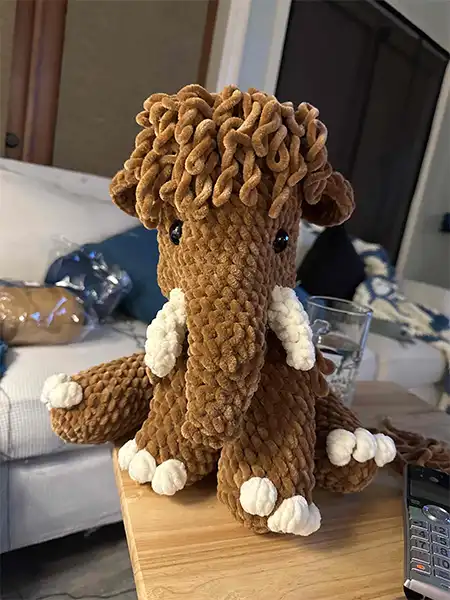
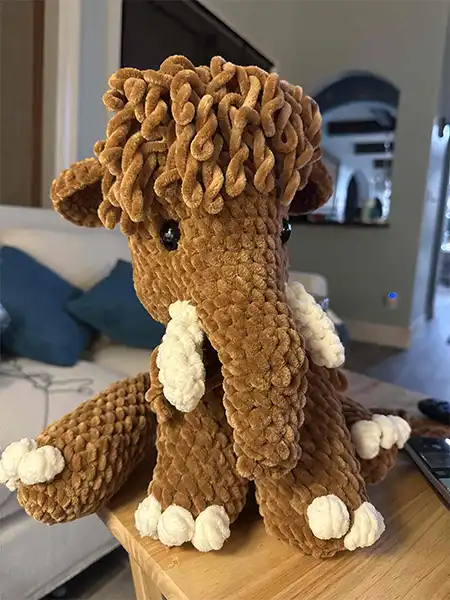
I made her with Premier Parfait Plush for Kid 2. The pattern is available on Etsy from KnotsandSnuggles. Their mammoth has a wider head and less curly hair, but I really liked the curls. There is no trick – they happen naturally if you pull up a longer yarn loop.
I haven’t finished the Book Tour Shawl. I am saving it for the summer trip to Columbus Book Fair.
The next project is this shawl, Frühlingserwachen. I’d love to know what that translates to.
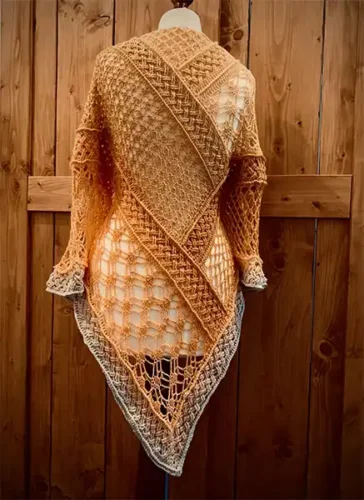 Pattern and Image by FraeuleinGerdaEU
This is a very interesting pattern that looks deceptively complex, but is actually pretty straight forward. My issue right now is that I don’t quite have the right yarn for it.
I can hear you laughing, but hear me out.
This shawl takes at least 1,200 yards. I wanted to do one of Wendy Wonders gradients with it, but realized that what I have tops out at 800 and matching to it will be difficult. I’m trying to figure out how to approach this. Should I do each section in a different color? Do I want cotton or something like Blue Heroin with lurex for this or do I want wool? Fingering or DK? Should I stick to the gradient but do the narrow cross sections in a different color or would that look ugly?
I am conflicted.
Well, I need to be at work in 8 minutes, so I have to end this lovely picnic and climb back into my metaphorical boat.
This is my reminder to myself and to anyone who needs it today: the book will get finished, the chores will get finished, the planet will keep spinning. In a rush to get everything done and to catch up, let’s not forget to enjoy the river.
The post Slice of Life Monday first appeared on ILONA ANDREWS.
Categories: Authors
Women in SF&F Month: Ai Jiang
Today’s Women in SF&F Month guest is Ai Jiang! Her poetry and short stories include “We Smoke Pollution,” winner of the 2023 Ignyte Award for Best in Speculative Poetry, and “Give Me English,” a Nebula and Locus Award finalist for Best Short Story. She is also the author of the Bram Stoker and Nebula Award–winning horror novella Linghun and the science fantasy novel An Empire in the Clouds (coming in September). Her next book, A River From the Sky, comes […]
The post Women in SF&F Month: Ai Jiang first appeared on Fantasy Cafe.
Categories: Fantasy Books
Spotlight on “Pretend You’re Dead and I Carry You” by Julian Delgado Lopera
Other LitStack Spots We’ve also added a few other titles to our TBR stack, including…
The post Spotlight on “Pretend You’re Dead and I Carry You” by Julian Delgado Lopera appeared first on LitStack.
Categories: Fantasy Books
When is a Sidewalk Fully Dressed? – The Hudsucker Proxy
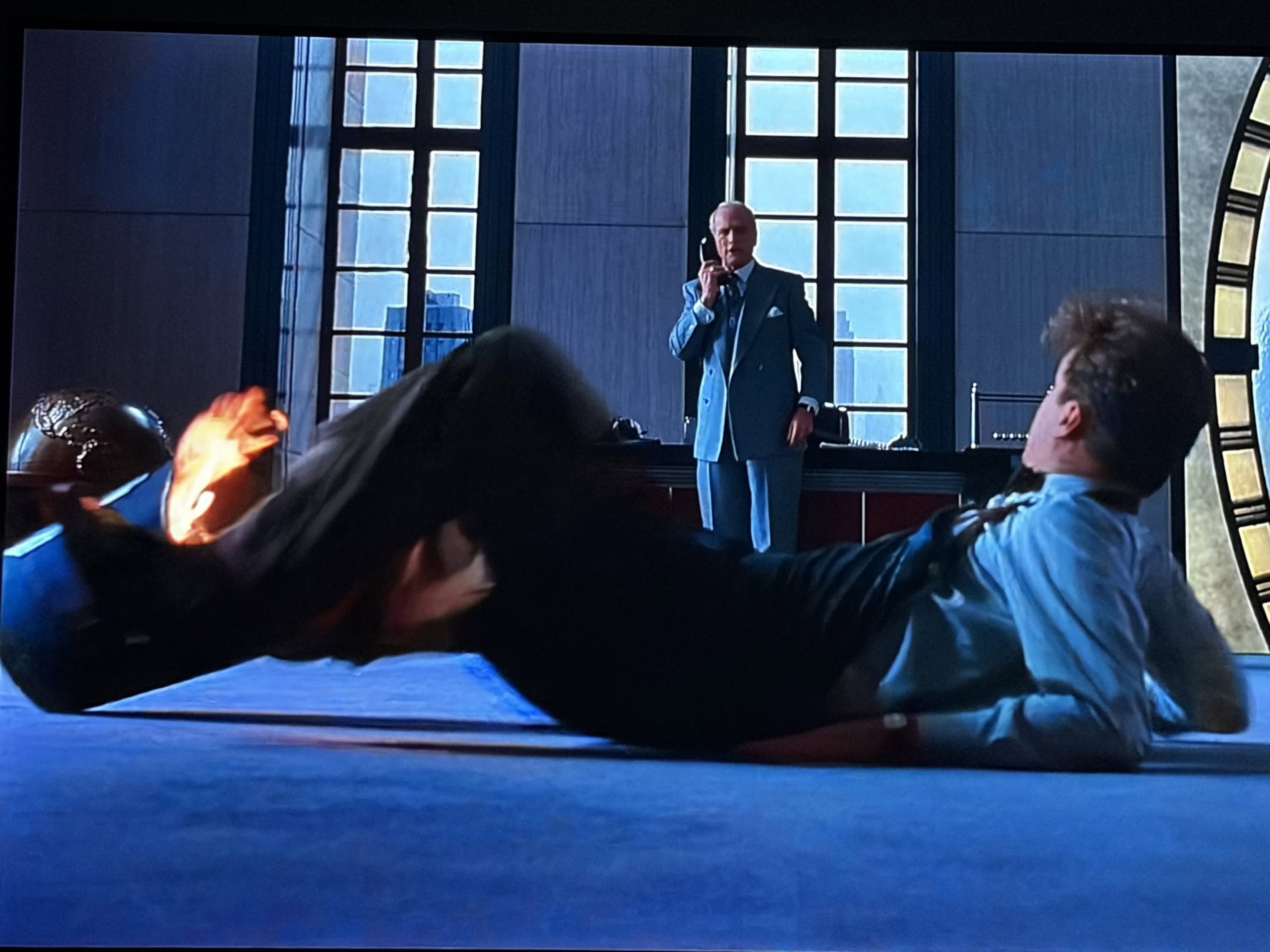 The Coen Brothers are among the finest filmmakers of my lifetime. Joel and younger brother Ethan started with Blood Simple in 1984, writing, directing, and producing together for the next few decades. And they produced some of the era’s best films. Dark comedies like Raising Arizona, Barton Fink, Fargo, and Intolerable Cruelty. The Big Lebowski is a prolific meme generator. And O Brother, Where Art Thou is a masterful ‘modern’ retelling of The Odyssey.
They raised the Noir stakes from Blood Simple, making The Man Who Wasn’t There (a black-and-white film in 2001? That’s bold). And the chilling No Country for Old Men.
Miller’s Crossing – heavily influenced by Dashiell Hammett’s The Glass Key – is one of my Top Five Hardboiled films of all time,
Joel worked as an assistant film editor (back in the days when they literally cut and spliced together reels of film) for 1981’s Evil Dead. That was the first movie which Sam Raimi and Bruce Campbell made (that’s a post subject some day). A friendship formed between Joel and Sam, and the ‘two camps’ would intertwine.
The Coens made a ‘fake trailer’ for Blood Simple, and Campbell – who is not in the movie – played the murder victim. The Coens’ next film was Crimewave (written with, and directed by, Raimi), and they wrote the lead for Campbell. He wasn’t remotely a star yet, and the studio wanted ‘a name’ and vetoed the choice. The brothers and Raimi created an entirely new part – Renaldo ‘The Heel’ – to get Bruce in the movie.
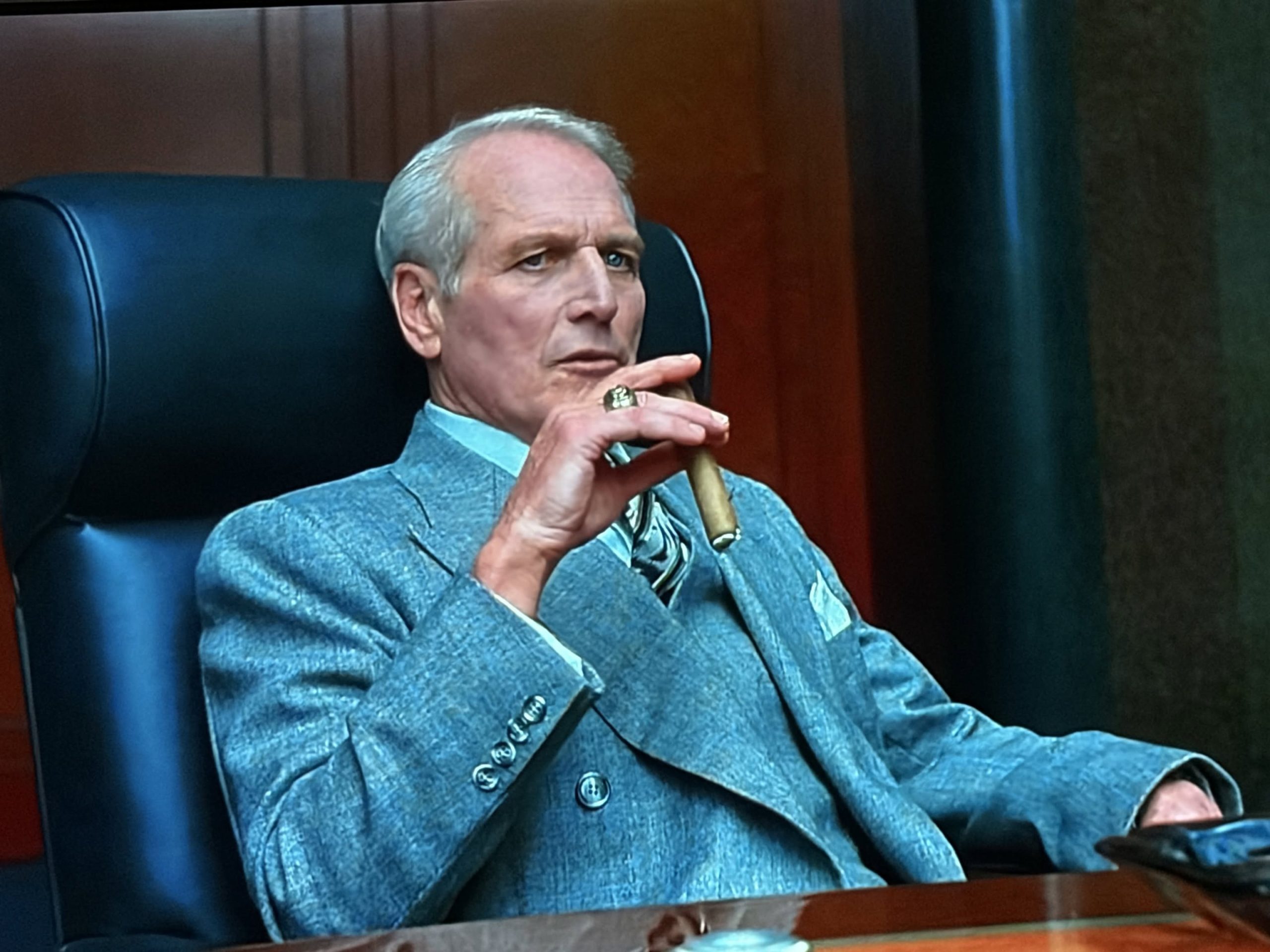 And to tie all this together, Bruce and Sam played parts in my vote for the most underrated Coen Brothers film, The Hudsucker Proxy. It’s simply brilliant. You could call it a screwball comedy, with satire, and oddly, some fantasy mixed in.
It BOMBED at the box office, finishing 174 (domestic) for the year. And #176 was Red Rock West, which is one of the best Noirs you’ve never seen. There’s no accounting for taste.
Beyond the story basics, this is gonna be a spoiler-free essay. You should explore the movie yourself.
Between Bull Durham, and The Hudsucker Proxy, Tim Robbins had become well-respected in 1992 for The Player (box office #67), and Bob Roberts (#129). These were insightful satires. The Player elevates by being a terrific movie in which it’s hard to find someone to root for. That is not easy to pull off. (I know, by default it’s gotta be Gretta Sacchi. But I found her tiresome).
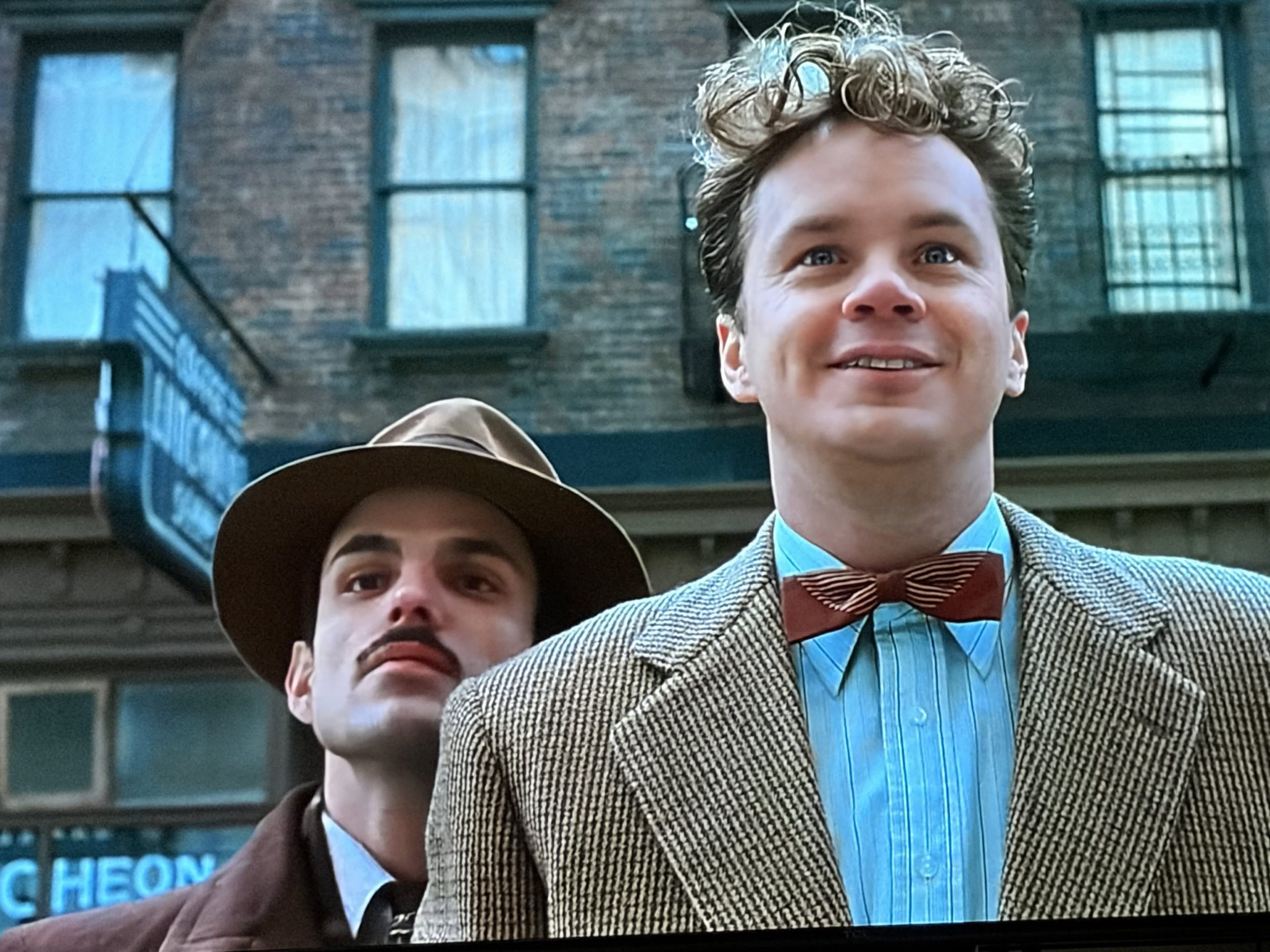
In 1994, Robbins played bumpkin Norvell Barnes, hitting the big city in 1958, fresh out of the Muncie School of Business. He gets a job in the mail room of Hudsucker Industries, just as a change is occurring on the top floor. And at ground level as well.
Paul Newman is the crusty, cigar-smoking, sleazy, right-hand man, and he’s an absolute delight. One of my favorite performances of his. He has a scheme that involves elevating Barnes to President of the company, and he supports his bizarre product idea.
With the working name Extruded Plastic Dingus, there’s a montage of the different design, development, promotion, and production phases of this new item ‘You know, for kids.’
There’s a lot of hoopla for a simple product. The satire is highlighted by the Advertising secretary reading War & Peace, and then Anna Kerinina, while the ad men toss out slogan after slogan.
It’s all done in a visual fifties corporate style, and it’s fun to watch. The Coens were clever and intentionally thoughtful. The burst of color they use for the Dingus after these bland scenes is more evidence of their skill and ability to make enduring films.
Then, it’s THE montage, with the dingus, and the kids. Sam Raimi directed this, and he has a cameo alongside John Cameron, another of The Evil Dead crew. I think that Raimi is one of the truly excellent filmmakers of this era (like the Coens), and this is a masterful montage.
Watch the facial expressions, the way the scene moves forward visually with the music (there’s no dialogue). The plot explodes in this montage, without using any words. Don’t scroll on your phone – really watch this. Even the price stickers going back up is clever. This movie is full of ‘smart funny’ elements; you pick up on more things, the more you watch it.
Such as, keep an eye on the changes in Robbin’s character as it goes along. It’s shown visually, bit by bit. It presages one of the episodes in The Ballad of Buster Scruggs. The Coen Brothers are really good at telling a story.
There’s a lot of movie left, and I’ll leave the rest of the story to your viewing. A fantastical element becomes a key part, and it’s always struck me as a bit jarring, but it sticks together.
Jennifer Jason Leigh is Amy Archer (who never fails to mention she’s won a Pulitzer Prize), a fast-talking newspaper reporter. John Mahoney (Frasier) is her editor, and Bruce Campbell is a fellow reporter. The Coens put together a terrific cast – folks even in single scenes. It’s got Charles Durning and Bill Cobbs, and look for Peter Gallagher, Steve Buscemi, Anna Nicole Smith, John Goodman (maybe listen for him), and Richard Schiff.
And if you are a fan of The Wire, you are gonna love EVERY scene Jim True-Frost is in. He’s delightful. Seriously.
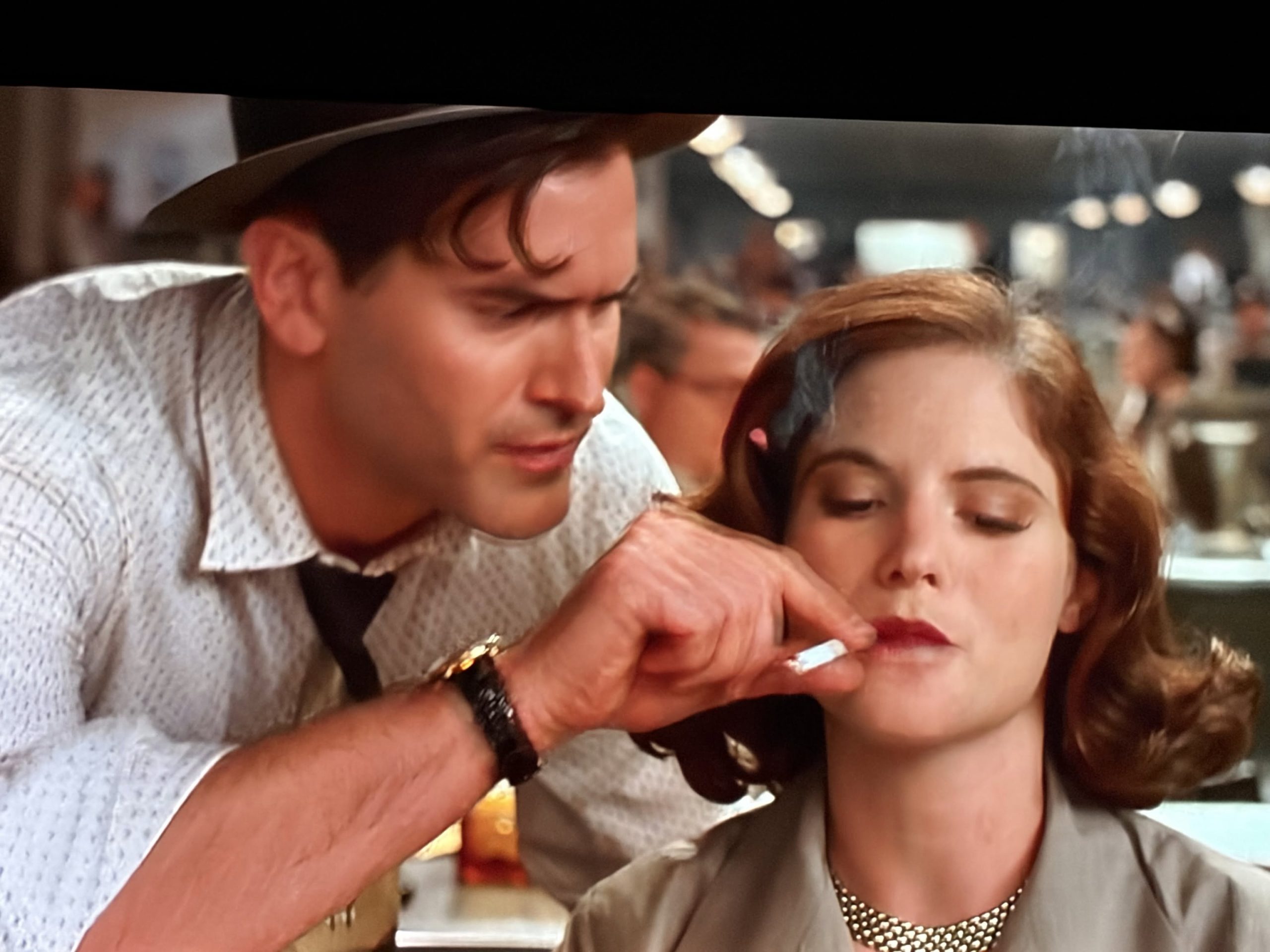 While box office revenues are certainly a valid way to assess a movie’s success or failure, it’s certainly not the sole determinant of a movie’s worth. On a $25 million budget, Hudsucker only brought in $2.8 million, and it had no international release. It barely made back one-tenth of its budget.
The Coens’ next two movies would be Fargo, and The Big Lebowski. The boys continued to be popular but not commercially successful (Fargo, #75, Lebowski #98). Even O Brother, Where Art Thou, which was a financial hit, still was only the #58 movie of 2001.
But movie fans can rattle off movie after movie, when asked what they like by the Coens. The box office isn’t the measure of the Coen Brothers’ quality. They made smart, or funny, or dark, or satirical, or thoughtful – usually a mix of at least two of those qualities – movies. I have a friend who thought Intolerable Cruelty was just okay. I think it’s hilarious. And we both think the Coens remade True Grit as well as anyone could have. You just need to watch a few of their movies to appreciate them.
I drifted away from their stuff starting with Burn After Reading, and The Ballad of Buster Scruggs is the last thing I saw (and Hail Caesar! fell flat for me). But a half dozen-ish of them are among the best movies I’ve seen. The Coens were THAT good. If you only saw The Hudsucker Proxy, and Miller’s Crossing, your life would have been blessed. Though O Brother, Where Art Thou is great in so many ways – especially for this Greek mythology geek.
The Hudsucker Proxy isn’t the same kind of cult classic which Firefly, or even The Big Lebowski, is. But people who know, love this one. And many of us rank it higher than the better-known Coens movies. Regardless, this is a treat to watch, and it doesn’t grow stale with additional viewings.
You can watch The Hudsucker Proxy for free, on Tubi. This world is a dumpster fire. We all have things we watch, or listen to, to help us deal with it. To step away from all the crap. If you wanna sit down and watch something funny and thoughtful, this is the movie for you.
Some previous entries on things to watch:Let’s Go to the Movies: 1996
Firefly – The Animated Reboot
What I’ve Been Watching – February 2026 (The Night Manager, SS-GB, Best Medicine)
What I’ve Been Watching – October 2026 (Return to Paradise, Lynley, Expend4bles, and more)
What I’ve Been Watching – August 2025 (Ballard, Resident Alien, Twisted Metal, and more)
What I’ve Been Watching – May 2025 (County Line, The Bondsman, Bosch: Legacy)
What I’ve Been Watching – October 2024 (What We Do in the Shadows, The Bay, Murder in a Small Town)
What I’m Watching – November 2023 (Brooklyn Nine-Nine, The Caine Mutiny Court Martial, A Haunting in Venice)
What I’m Watching – April 2023 (Florida Man, Picard – season three, The Mandalorian)
 The Pale Blue Eye, and The Glass Onion: Knives Out
Tony Hillerman’s Dark Winds
The Rings of Power (Series I wrote on this show – all links at this one post)
What I’m Watching – December 2022 (Frontier, Leverage: Redemption)
What I’m Watching – November 2022 (Tulsa King, Andor, Fire Country, and more)
What I’m Watching – September 2022 (Galavant, Firefly, She-Hulk, and more)
What I’m Watching- April 2022 (Outer Range, Halo, Why Didn’t They Ask Evans, and more)
When USA Network was Kicking Major Butt (Monk, Psych, Burn Notice)
You Should be Streaming These Shows (Corba Kai, The Expanse, Bosch, and more)
What I’m BritBoxing – December 2021 (Death in Paradise, Shakespeare & Hathaway, The Blake Mysteries, and more)
To Boldly Go – Star Treking – (Various Star Trek incarnations)
What I’ve Been Watching – August 2021 (Monk, The Tomorrow War, In Plain Sight, and more)
What I’m Watching – June 2021 (Get Shorty, Con Man, Thunder in Paradise, and more)
Tucker and Dale vs. Evil
What I’ve Been Watching – June 2021 (Relic Hunter, Burn Notice, Space Force, and more)
Appaloosa
Psych of the Dead
The Mandalorian
What I’m Watching: 2020 – Part Two (My Name is Bruce, Sword of Sherwood Forest, Isle of Fury, and more)
What I’m Watching 2020: Part One (The Adventures of Brisco County Jr, Poirot, Burn Notice, and more)
Philip Marlowe: Private Eye
Leverage
Nero Wolfe – The Lost Pilot
David Suchet’s ‘Poirot’
Sherlock Holmes (over two dozen TV shows and movies)
 Bob Byrne’s ‘A (Black) Gat in the Hand’ made its Black Gate debut in 2018 and has returned every summer since.
His ‘The Public Life of Sherlock Holmes’ column ran every Monday morning at Black Gate from March, 2014 through March, 2017. And he irregularly posts on Rex Stout’s gargantuan detective in ‘Nero Wolfe’s Brownstone.’ He is a member of the Praed Street Irregulars, and founded www.SolarPons.com (the only website dedicated to the ‘Sherlock Holmes of Praed Street’).
He organized Black Gate’s award-nominated ‘Discovering Robert E. Howard’ series, as well as the award-winning ‘Hither Came Conan’ series. Which is now part of THE Definitive guide to Conan. He also organized 2023’s ‘Talking Tolkien.’
He has contributed stories to The MX Book of New Sherlock Holmes Stories — Parts III, IV, V, VI, XXI, and XXXIII.
He has written introductions for Steeger Books, and appeared in several magazines, including Black Mask, Sherlock Holmes Mystery Magazine, The Strand Magazine, and Sherlock Magazine.
You can definitely ‘experience the Bobness’ at Jason Waltz’s ’24? in 42′ podcast.
Categories: Fantasy Books
Book review: The Lord of the Empty Mirror by Michael R. Fletcher

Book links: Amazon, Goodreads
ABOUT THE AUTHOR: Michael R. Fletcher lives in the endless suburban sprawl north of Toronto. He dreams of trees and seeing the stars at night and being a ninja. He is an unrepentant whiskey-swilling reprobate of the tallest order and thinks grilled cheese sandwiches are a food group.
Publisher: Michael R. Fletcher (April 13, 2026) Page count: 353 pages Formats: ebook, paperback
That line pretty much sums up what The Lord of the Empty Mirror is doing, and what Khraen is at this point. Not a man so much as a collection of pieces arguing with each other.
I loved the original Obsidian Path trilogy, so I went in with high expectations and this didn’t disappoint. Khraen is hunting the shards of his heart but also he's against one that represents the worst (or maybe most honest) version of himself. The part that understands power, control, conquest. Which means you get two Khraens. Sort of.
One is trying to fix things and unite the world, stop a god, and maybe do a bit less mass murder along the way. The other version is much more focused on conquering everything, trusts no one, and absolutely don’t let feelings get in the way.
Bringing in another POV, especially one tied so closely to Khraen himself, works surprisingly well. It allows to dive into one of the series’ core ideas of how memory shapes identity. Who you are, what you remember, and what you choose to become aren’t cleanly separated here. Fletcher really digs into that, and it pays off. If you take a man, break him into pieces, and then put him back together… which version is real? The one trying to be better, or the one who remembers how effective being worse used to be?
Plot-wise, there’s always something happening and it never drags. I liked the twists, but I won't spoil them for you.
Also, it’s properly grim. Every solution costs something awful. There’s a moment where Khraen casually weighs how many souls something is worth, and it doesn’t feel out of place. That’s the level we’re operating on.
Khraen himself is, well, still Khraen. Powerful, determined, and capable of making deeply questionable decisions with full confidence. There were a few “why would you do that” moments, but they always track. He’s not stupid, he’s just very committed to his own logic, which is sometimes worse.
The ending is going to split people. If you didn’t like how the original trilogy wrapped up, this won’t fix that. It follows the same idea and you get no neat closure or the sense that everything is finally “done.”
For me, it was perfect since it fits the series. But if you’re looking for clear answers and everything tied up nicely, you won’t get that here.
TL;DR: I loved it.
Categories: Fantasy Books
Pages

Recent comments