
Feed aggregator
Celebrate Asian American Pacific Islander Heritage Month with 7 Great Books

These novels, story collections, and works of nonfiction by Asian American and Pacific Islander authors…
The post Celebrate Asian American Pacific Islander Heritage Month with 7 Great Books appeared first on LitStack.
Categories: Fantasy Books
Comment on Editing by Inna
In reply to Bill.
Love the books, but I have to absolutely agree with you on the last point, especially.
Categories: Authors
Comment on A Beginner’s Guide to Drucraft #46: Sigl Fashion (Body/Torso) by Johannes
In reply to Bill.
I think he also has one that he wears around his neck as a necklace.
Categories: Authors
Comment on Editing by Benedict
In reply to Hubert.
It shouldn’t delay things. Book 4 is still on track to release this November, and Book 5 is currently on track to release a year after that.
Categories: Authors
MORTEDANT’S PERIL by R J Barker
R J Barker’s latest fantasy novel goes into the Grimdark – a murder mystery story of steampunkish machinery, death, political manoeuvrings and corruption in a grimy, unpleasant world. Irody Hasp is a Mortedant, a cleric tasked with reading the last thoughts of the dead—though no one thanks him for it. No Mortedant is popular –…
Categories: Fantasy Books
Comment on Editing by Hubert
Given the timing of the book 4 edits, curious what you think this will do to the release dates of the rest of the books (particularly for books 4 and 5), if that’s something you can share?
Categories: Authors
Comment on Editing by Bill
Thank you very much for the update on Book#4. I’m assuming that there will be further world-building, perhaps when the edits are complete, these expand our knowledge of Stephen’s world and add to our enjoyment of the whole IoM series. However, I can see why they wouldn’t fit within the Novels themselves but are an amazing bonus for fans to peruse while waiting for the next book in the series. They are also, so far, factual (I think?) so missing out on speculation on the ‘grey areas’ of the world such as the mysterious powerful groups in the background, influencing a lot of the world’s major events.
I can understand that you don’t want to include spoilers with the world-builders, but think (perhaps?) that your readers would be justified in knowing as much as Stephen does at this stage in the series? I’m thinking Primal and Dimensional Drucraft and how these can be used. We haven’t heard in the books that he has tried these but even if he hasn’t found wells and tried/failed to fashion Sigls he must has seen some indications on what range of sigls be structured from the what’s offered in the Exchange Catalogue?
Stephen has also met “the most beautiful girl he’s ever seen” and has been thrown into close proximity to her with his Personal Security work. While I am not expecting the series to morph into a Romance Novel, although I would guess that his post-teenage hormones mush be firing at each encounter? I was hoping that interactions between the two of them would figure in his narrative of events, rather than they suddenly emerge as a couple (as Alex and Ann did in the previous series).
Categories: Authors
This Kingdom Vellum Overlay Giveaway Winner
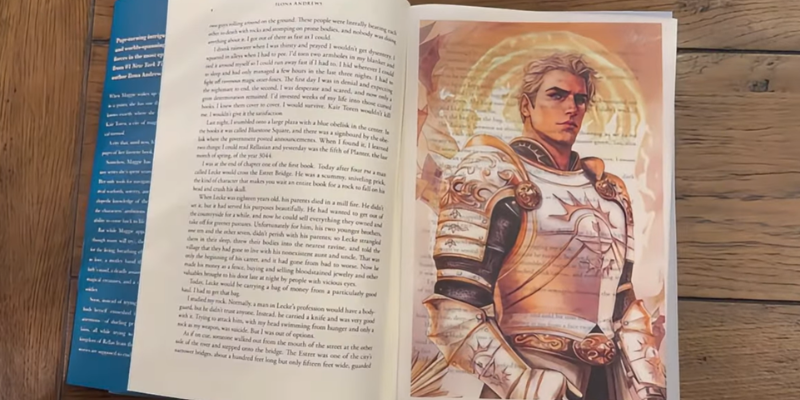
Happy Friday!
The Random Number Generator performed its duty and gave us the winner of the vellum overlay set for This Kingdom Will Not Kill Me:
Congratulations, Erin Phillippi!I will contact Erin from the modr@ilona-andrews.com email address. If we don’t hear back by Thursday, May 14, a new winner will be drawn next Friday.
What are these?
For anyone who missed it, Ilona made a video explaining and demonstrating the vellum inserts, which you can find here.
Briefly: vellum overlays are not art prints. They are semi-transparent character portraits printed on softly textured vellum, which is a frosted, slightly cloudy specialty paper that lets the art show through while giving it a muted, layered effect. They are designed to be tucked into the hardcover book or placed over a page, not framed as standalone wall art.
The vellum overlays will be available as a set of six in the Ilona Andrews merch store when it reopens. I don’t have an official date for the opening yet, and House Andrews are still working out whether international availability is possible. The best way to make sure you don’t miss the announcement is to subscribe to the Ilona Andrews newsletter.
At the moment, the set will include only the six character portraits by Helena Elias: Clover, Solentine Dagarra, Ramond vi Everard, the Sun Margrave, Doran Arvel and the Man from the Garden.
If you are looking for This Kingdom Will Not Kill Me art prints, reminder that many of the commissioned artists have prints available directly through their own stores, which is covered and linked in this post. Buying from them is a wonderful way to support the artists and their original, human-made work, taking a stand against AI content.
Speaking of AI and spam, a quick online safety reminder: please stay vigilant for scammers. House Andrews will never ask you to cover postage costs, pay fees, or make any kind of money transfer connected to these giveaways. Winners are announced here on the blog, and we will only contact you from an official Ilona Andrews account or email address, with the link to the public blog post as proof that you are indeed the winner.
May your weekend bring good times, good tidings, and yummy snacks!
Note from Ilona – we should have the first batch of vellum next week. We will be doing a trial run of 120 sheets, with 20 sets of 6. We have never acted as a fulfillment center before, so we want to make sure that we iron out any kinks before fully unleashing the Horde. If you miss the opportunity to order, don’t panic. We will be doing a larger print run, and this vellum is printed locally by a small business, so it’s not shipping in from overseas and it will be available much faster.
The post This Kingdom Vellum Overlay Giveaway Winner first appeared on ILONA ANDREWS.
Categories: Authors
Forgotten Authors: Miles J. Breuer
 MIles (Miloslav) J. Breuer
Miles J. Breuer was born in Chicago on January 3, 1889, but the family moved to Crete, Nebraska when he was four years old so his father could attend medical school. He attended the University of Texas and went on to medical school at Rush Medical Center. He worked as an internist, specializing in tuberculosis at Lincoln General Hospital in Nebraska. He often bylined his work with his credentials as an M.D.
In 1916, he married Julia Strejc and they had three children, Rosalie, Stanley (who died at 18 when he fell from St. Isabel Glacier), and Mildred. During World War I, he served in France and achieved the rank of first lieutenant in the Medical Corps. Upon his return to the U.S., he joined his father’s medical practice and began publishing medical articles in Czech language newspapers and a monthly medical column in a Czech-language agricultural magazine. He published the Index of Physiotherapeutic Technic in 1925, outlining physical therapy practices.
His first English language science fiction story, “The Man with the Strange Head” appeared in the January 1927 issue of Amazing Stories, however, it was previously published as “Muž se zvláštní hlavou” in a Czech language almanac published in Chicago. He also appears to have published “The Man without an Appetite” in the Czech magazine Bratrský věstník in 1916, although it didn’t see English publication until 1963. His Czech stories tended to be published under the name Miloslav J. Breuer, and he continued to publish in Czech throughout his early writing career.
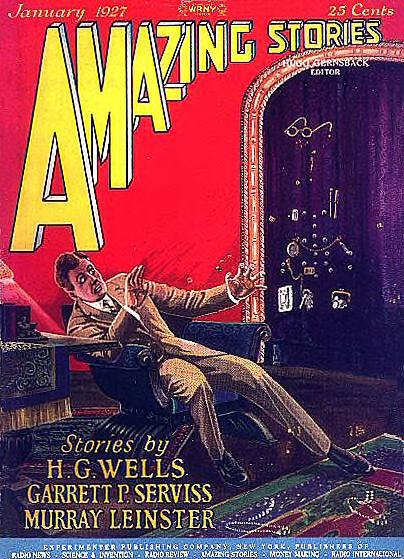 Amazing Stories, 1/27, Cover by Frank R. Paul
The majority of his work, more than two dozen stories, were published within a five year period, with only half that number appearing in the following decade. While his fiction included gadgets and other standard tropes of science fiction of the time, Breuer tended to look at how those things impacted humans rather than focus on the cool gizmos. His earlier works tended to be stronger stories and better written than works he published later in his career. One of his most famous stories was 1930’s “The Gostak and the Doshes,” whose seemingly nonsensical title became a catch phrase in early fandom.
Breuer collaborated with Jack Williamson on the story “The Girl from Mars” and novel The Birth of a New Republic. The idea for the novel was Breuer’s, with Williamson doing the majority of the writing. He also collaborated with Clare Winger Harris on the story “A Baby on Neptune.”
The majority of Breuer’s fiction was published in either Amazing Stories or Amazing Stories Quarterly, but he did publish “The Problem of Communication” in Astounding, “Mars Colonizes” in Marvel Tales, “The Disappearing Pages” in Future Fiction, and “The Oversight” in Comet.
In 1942, Breuer suffered a nervous breakdown and moved to Los Angeles as a means of giving himself a fresh start, setting up a medical practice there. Breuer died on October 14, 1945 in Los Angeles and is buried in the Los Angeles National Cemetery. His father died the following year.
In 2025, Jaroslav Olsa, Jr. published Dreaming of Autonomous Vehicles: Miroslav (Miles) J. Breuer: Czech-American Writer and the Birth of Science Fiction.
 Steven H Silver is a twenty-one-time Hugo Award nominee and was the publisher of the Hugo-nominated fanzine Argentus as well as the editor and publisher of ISFiC Press for eight years. He has also edited books for DAW, NESFA Press, and ZNB. His most recent anthology is Alternate Peace and his novel After Hastings was published in 2020. Steven has chaired the first Midwest Construction, Windycon three times, and the SFWA Nebula Conference numerous times. He was programming chair for Chicon 2000 and Vice Chair of Chicon 7.
Categories: Fantasy Books
Audiobook Review – Charms and Firearms (Mitzy Moon Mysteries, Book 5) by Trixie Silvertale, Narrated by Coleen Marlo (4/5 stars)

Reading Level: Adult
Genre: Paranormal Mystery
Length: 5 hours and 10 minutes
Publisher: Sittin’ on a Goldmine Productions LLC
Release Date: October 26, 2021
ASIN: B09KDGTDDS
Stand Alone or Series: 5th book in the Mitzy Moon Mysteries series
Source: Bought on Audiobook
Rating: 4/5 stars
“Mitzy Moon plans to take a break from snooping and learns to ski. And after receiving a mysterious gift from her travel companion, she feels light as a feather, but her heart goes stiff as a board when she faceplants into a corpse.
Racing back to the bookshop to consult her otherworldly helpers, Mitzy is horrified to discover her meddling Ghost-ma is missing. Her spoiled feline seems to ignore her pleas, and her alchemist attorney isn’t answering either. She can’t decide if she’s lost her powers or her mind….
Can Mitzy solve a murder without her extrasensory perceptions, or will one misstep put her in the killer’s crosshairs?”
Series Info/Source: This is the 5th book in the Mitzy Moon Mysteries series. I bought this for audiobook.
Thoughts: This was an entertaining and well-done installment in the Mitzy Moon series. While these books don’t really “wow” me, they are fun little diversions. I originally started this series because I wanted an audiobook to listen to during a regular 6 hr (round trip) car trip I need to do monthly. These are the perfect length to get done during that commute.
In this book Rory wins a vacation at a nearby ski resort and asks Mitzy to accompany him. Of course the first thing Mitzy does on her virgin ski run is to face plant into a corpse. Oddly Mitzy is struggling to use the very powers she thought she was finally gaining control of. Now Mitzy is on the case and is uncovering things both about this ski resort and about Rory she wish she never knew.
All of our favorite characters are in the story along with a few new ones. I enjoyed the mystery here and enjoyed watching Mitzy mature a bit more and open her eyes to some of the manipulations happening around her. I have complained in previous books that Mitzy seems a bit naive for her upbringing, and she makes progress in being a bit more savvy in this book. I hope at some point she will learn that when her cat, Piwackett, brings her clues she needs to listen!
I listened to this on audiobook and it is well done. The narrator does character voices well and consistently, and it’s fun to listen to.
My Summary (4/5): Overall I thought this was a very solid addition to the Mitzy Moon series. I enjoy the town of Pincherry Harbor and really enjoy the quirky characters here too. It was fun to see Mitzy grow more as a character and become a bit more savvy. I am excited to see what happens in book 6. If you are looking for a novella paranormal mystery series, this is a decent one. It takes a few books to get moving, but once it does, it is a lot of fun.

Categories: Fantasy Books
Dark Muse News: Sword & Sorcery Chain Story (#19-#23)
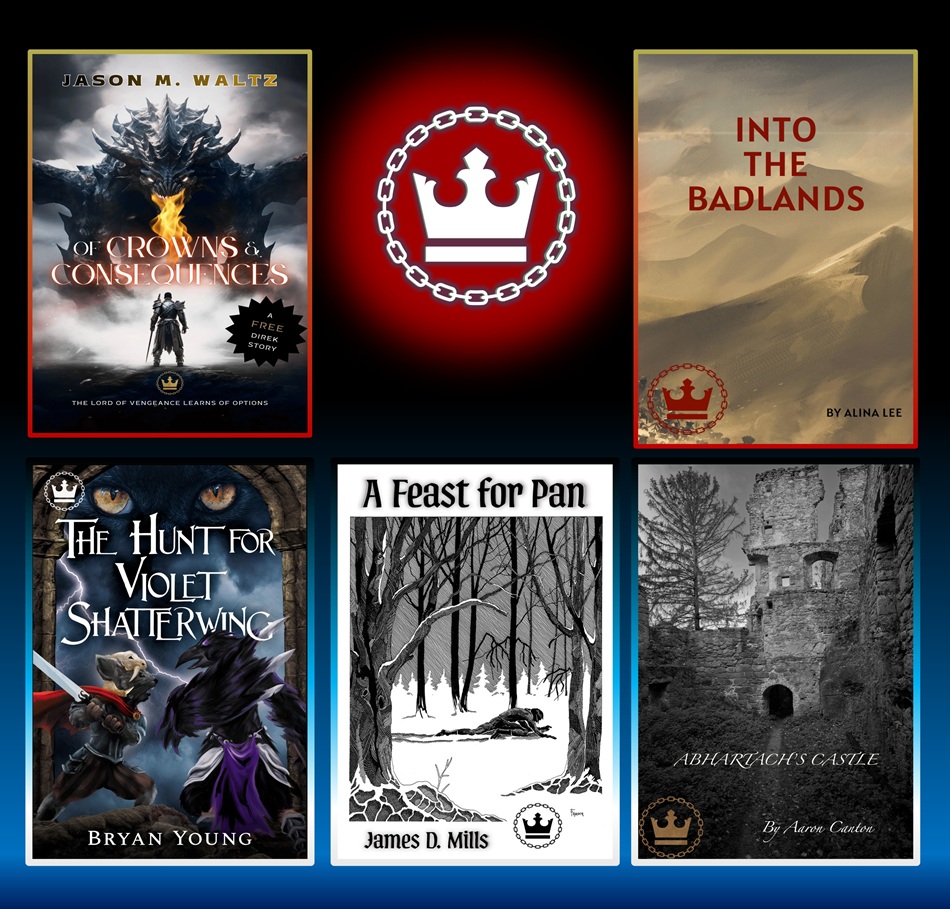
In August 2025, we hailed the emergence of a second Chain Story project championed by Michael A. Stackpole. This is a Sword & Sorcery-focused, contagious set of connected (“chained”) stories.
Each is:
- A standalone tale
- Readable in any order
- Free to read!
- Interconnected via a theme involving a Crown
We round up groups every several weeks, but check the Chain Story website. for the latest. Here we highlight the latest set of five, Episodes 19-23:
- 19 Of Crowns & Consequences by Jason M. Waltz
- 20 The Hunt For Violet Shatterwing by Bryan Young
- 21 Into The Badlands by Alina Lee
- 22 Abhartach’s Castle by Aaron Canton
- 23 A Feast For Pan by James D. Mills
Previous Black Gate posts have chronicled groups of the growing chain:
- The Chain Story 2 – Sword and Sorcery – Episodes 1 – 3 (Aug 2025)
- The Chain Story 2 – Sword and Sorcery – Episodes 4 – 8 (Oct 2025)
- The Chain Story 2 – Sword and Sorcery – Episodes 9 – 13 (Nov 2025)
- The Chain Story 2 — Sword & Sorcery – Episodes 14 – 18 (Feb 2026)
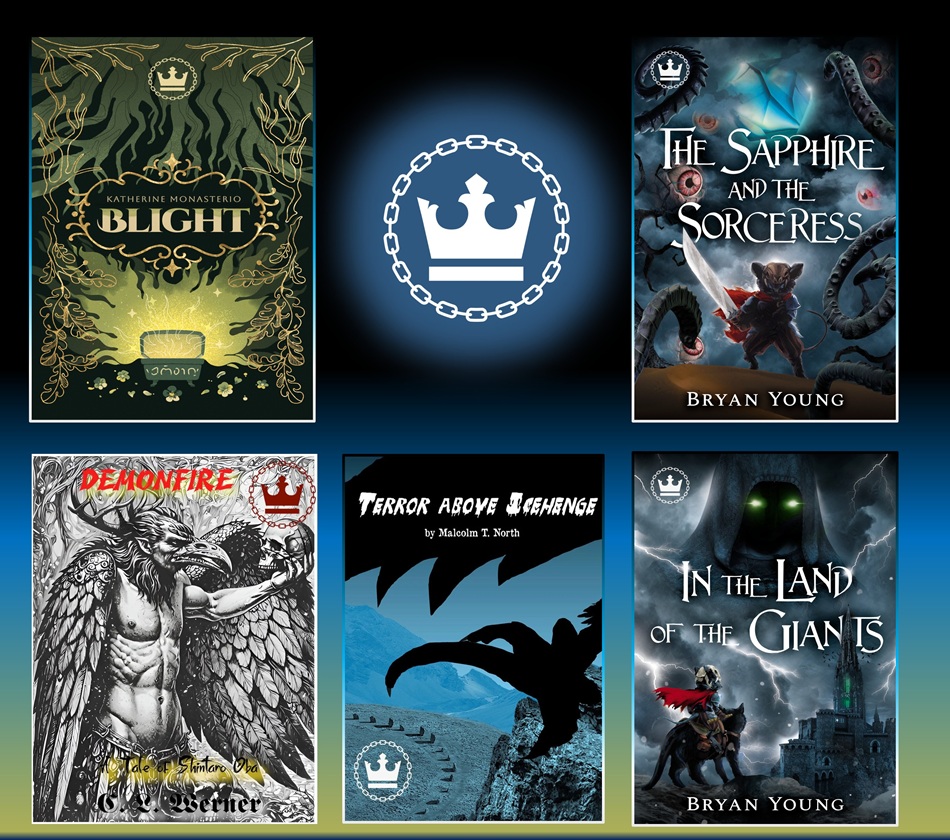
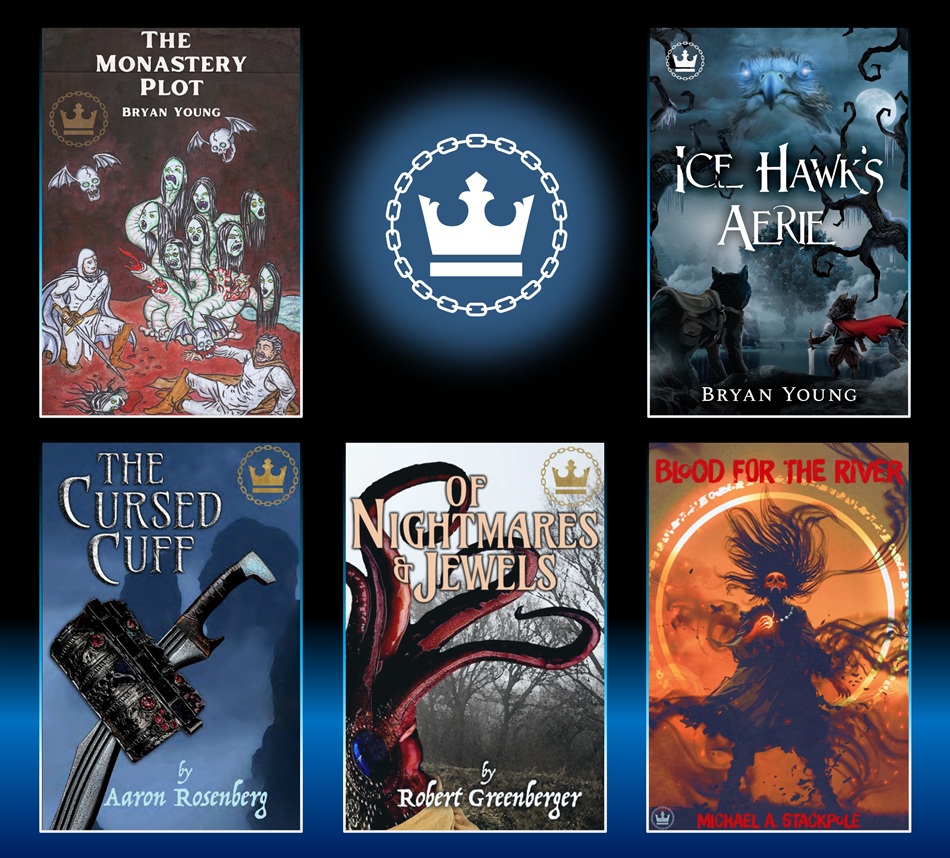
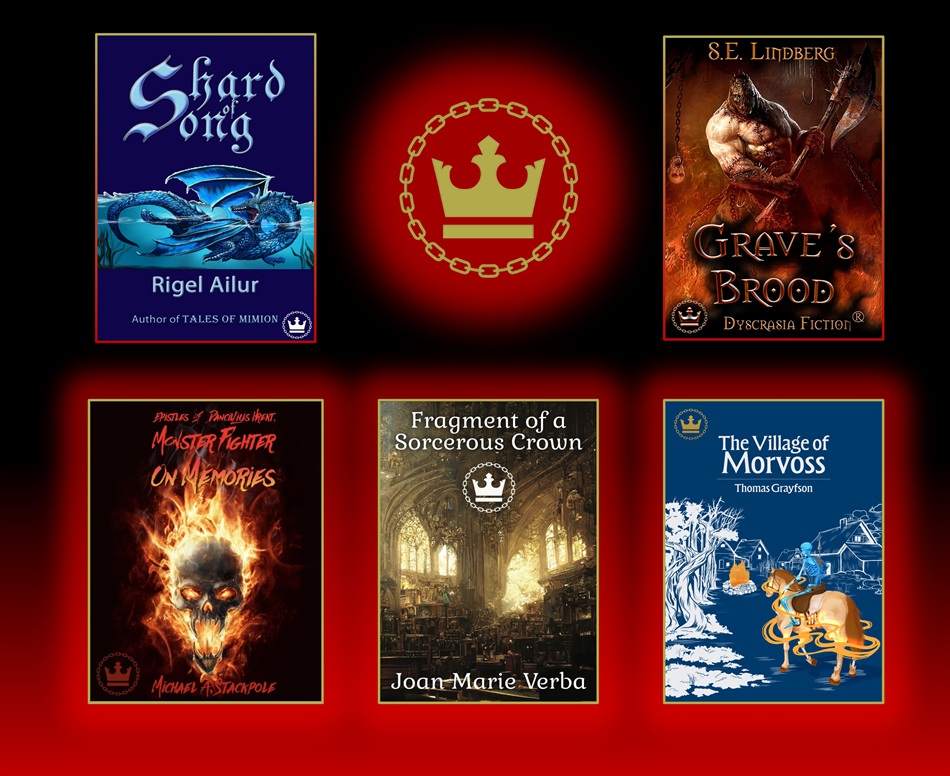
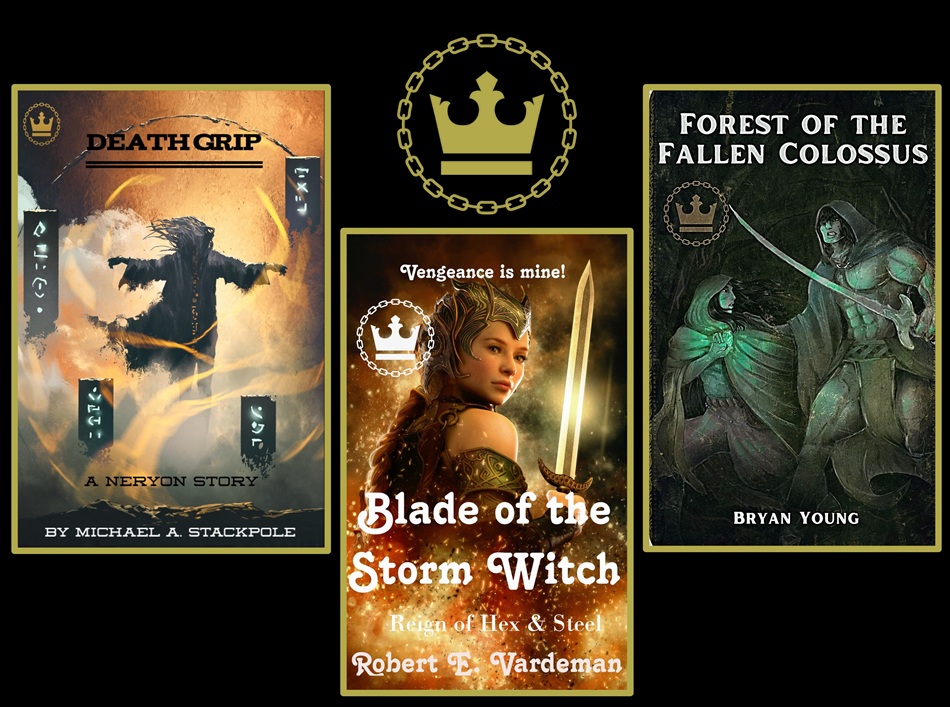
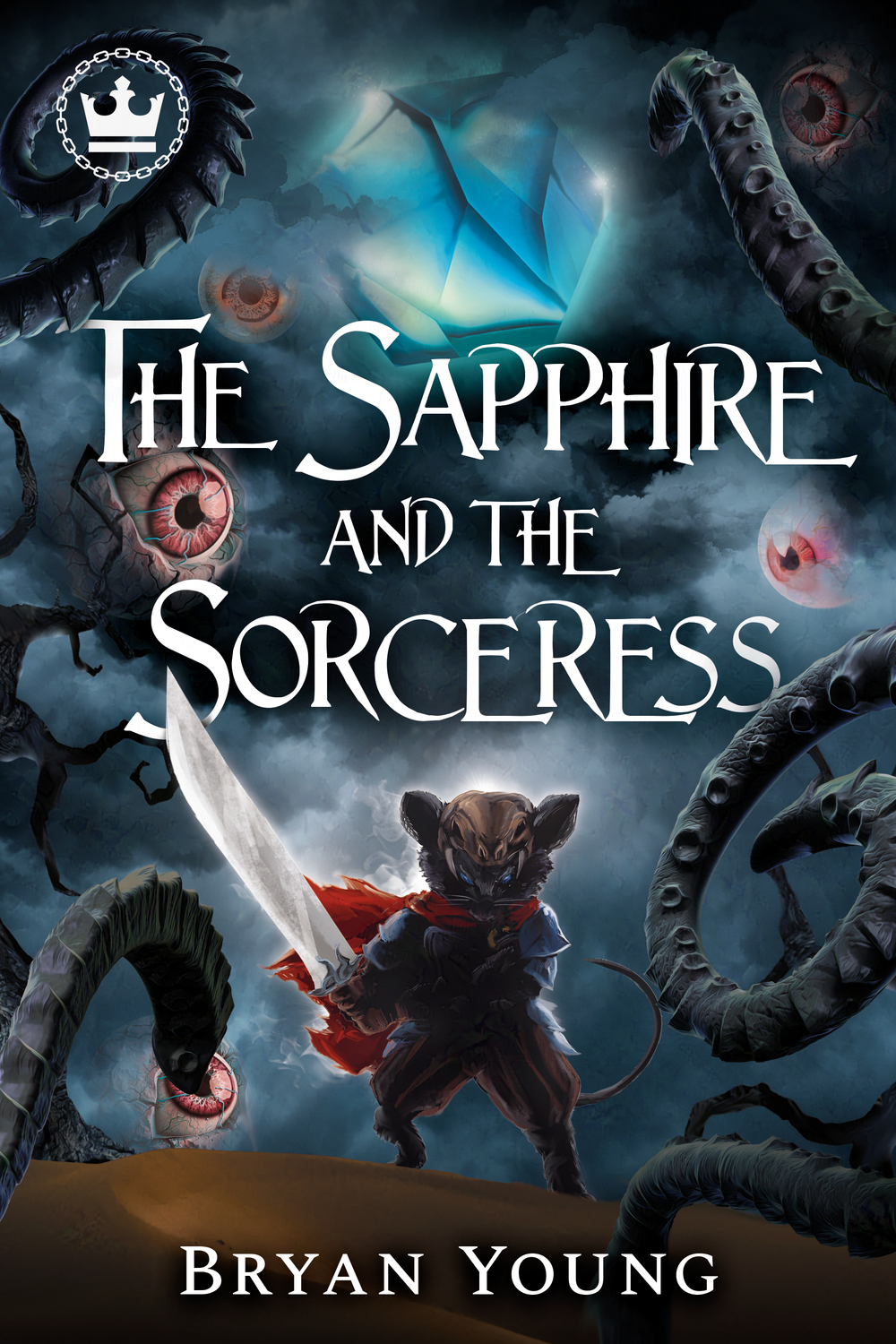
Entry Chain Post (Link on Chain site) Story (Link to Free version) Author Abstract 23 March 25, 2026 A Feast For Pan James D. Mills IN THE WASTES, ALL ARE FODDER FOR PAN. In a return to the world of SOIL and Ashen Rider, Hromgir and Arvid of Clan Sparrow are on the run after a raid gone wrong. Braving the frozen wastes of the northern coast, they must reach the mountain pass to escape the Wystran riders close on their heels. Hiding from the riders, they take shelter in the depths of a strange cave, unearthing otherworldly horrors better left buried…. 22 March 11, 2026 Abhartach’s Castle Aaron Canton A trio of student witches head off on a dangerous adventure to obtain a powerful artifact—aiming to retrieve it and keep it out of the hands of sinister forces.
Unexpectedly they meet opposition in the form of a classmate they’d once all considered a friend, but who has become a most dangerous foe. 21 February 25, 2026 Into The Badlands Alina Lee Rowan Grim’s world is one which is long on places you don’t want to travel to, and few people return from. But what is out there draws her, and she willingly embraces the challenges which have devoured so many others. 20 February 9, 2026 The Hunt For Violet Shatterwing Bryan Young Now returned to Nightfall Forest, and in the company of the fox bard Ashley, Pip finds the hamlet of Riveroak ablaze. The mouse knight, his war cat, and companion race to quench the fires and hunt the leader of the crow cult, intent on putting an end to her evil. 19 January 28, 2026 Of Crowns & Consequences Jason M. Waltz Direk, wielder of the magickal sword Retribution, has been dispatched to destroy an old enemy at the behest of his King. In his pursuit he encounters a newly awakened power which challenges his knowledge of the world, and threatens to up end all he knows to be true. 18 January 19, 2026 The Sapphire and the Sorceress Bryan Young As with all good heroes, Pip does not shrink from danger and adventure. Still, there are times when it would be good to relax at home. But Pip is far from home, and is searching for a powerful sorceress who can help him on his way. 17 January 14, 2026 Terror Above Icehenge Malcolm T. North To reach her, however, he’ll have to venture through the Chaos Realm and, as every true hero knows if you undertake that journey lightly, it will end quickly. But Pip has no choice, and therein our adventure begins. 16 December 31, 2025 Demonfire: A Tale of Shintaro Oba C. L. Werner A forbidden ritual conducted in secret, bathed in blood and death enables a demon to grasp unimaginable power—the power to destroy all enemies and raise himself above all others. 15 December 24, 2025 In The Land of the Giants, Bryan Young A Samurai, whose duty calls for him to hunt down such a creature. A destiny he must pursue even as the world burns around him. 14 December 10, 2025 Blight Katherine Monasterio Forest Ranger Hazel Boncliff is a Green Speaker, a person with the magical ability to commune with plants. When the king summons Hazel and her assistant to the capital to heal the strange blight affecting his hunting grounds, she’s reluctant to help—least of all because he’s insisting his inexperienced secretary go along for the journey. But with a reward she can’t refuse and the blight’s effects more harrowing by the moment, she’ll take all the help she can get. 13 November 26, 2025 Ice Hawk’s Aerie, Bryan Young A chance meeting in the dark forest. A tale of woe and injustice.
Pip Strongpaw, the last of the fabled Great Catriders, must once again wield the runed-sword Feathersbane, to end the chilling menace threatening to destroy the hamlet of Riveroak. A menace of sorcerous origins against which even the bravest of heroes may not prevail. 12 November 12, 2025 Blood for the River Michael Stackpole Chased into a swamp by homicidal cultists, Kellach and Serinna encounter a fire mage who saves their lives, and then leads them on an adventure that is sure to get them killed. 11 October 14, 2025 Of Nightmares & Jewels Robert Greenberger Something drew the mage onward, always toward the northwest, through restless evenings and dark dreams of ill portent. Yet when Jareth’s traveling companion, the swordswoman Talin, asks him why, he has no idea.
And then they reached a tiny town at the edge of nowhere, wherein lurked an evil with roots sunk deep in times beyond remembering; an evil that has chosen their visit as a time to awaken. 10 October 14, 2025 The Cursed Cuff Aaron Rosenberg She came to them spinning a tale of woe. An army of undead lay siege to the Manor she called home. She had barely escaped and sough adventurers brave enough to free her people.
But to do that Birr Blackjaw and his companions would have to wrest an ancient artifact from the hands of a cult leader who had his own army, and a hellish pet none could hope to defeat. 9 October 1, 2025 The Monastery Plot Bryan Young Shield Maiden and legendary sleuth Sister Agatha, accompanied by her faithful initiate, Brother Dominguez, sought to enjoy peace and quiet at the Monastery of St. Maryam.Despite their desires, they soon find themselves investigating twin murders. Murders which become all that much more bizarre when the name Tarru-Syn turns up, and their search leads them into the very bowels of the earth, to face a foe from beyond their reality. 8 September 24, 2025 On Memories Michael Stackpole Dancillius Hrekt is fairly new to the world of Monster Fighting. All he wants to do is to make a good impression with his peers. And all they want is for him and his best friend to die. 7 September 10, 2025 The Village of Morvoss Thomas Grayfson In this new Kavion adventure, our tormented knight clings to the last threads of family and sanity as he navigates the mysterious Village of Morvoss. Haunted by fractured memories, he must confront the darkness around him—and within. 6 August 27, 2025 Fragment of a Sorcerous Crown Joan Marie Verba In this tale from the Chronicles of the Library of Sorcery, the sorcerers investigate a dangerous magical artifact of mysterious origin. Can the sorcerers uncover the truth?Sorcerer Serena is called to investigate an enormous, carnivorous plant. She finds that a mysterious magical artifact is behind the phenomenon. To find out where the artifact came from and what its properties might be, she consults the Library of Sorcery, where she uncovers the answers, but not on the Library shelves. Can the artifact be banished from the sorcerous regions before it becomes a more deathly threat? 5 August 13, 2025 Grave’s Brood S.E. Lindberg Doktor Grave sends Brood to recover a crown from the Red Orchard, only for Brood to find it is the source of a bloody plague caused by Grave’s experiments. Facing vampiric plants and their loyal clan, Brood must confront his past and question whether he can trust Grave or escape the nightmare himself. 4 July 28, 2025 Shard of Song Rigel Ailur Two wizards search desperately for a way to stave off a vicious magical-musical attack before the dragons succumb. A powerful relic ancient beyond memory calls to them, but do they dare use it? 3 July 16, 2025 Forest of the Fallen Colossus Bryan Young A dying robber hands Laila and Zaki a mysterious artifact in the middle of a fae-haunted wood. “Danger,” the robber manages before dying. Suddenly sister and brother find themselves safeguarding an unwanted gift—on the run for their lives in the Forest of the Fallen Colossus. 2 July 3, 2025 Death Grip Michael Stackpole The man hadn’t died easily.A smoking hole sat where his heart should have been. Terror twisted his features, and he clutched an emerald reeking of magick as if would somehow save him. Neryon and Magistrate-Martial Logan find themselves in a race to find the killer before he has a chance to harvest more victims. But, with the amount of power used on his first target, there was a big gulf between finding and stopping; and no guarantee he wouldn’t kill them, too. 1 July 3, 2025 Blade of the Storm Witch Robert E. Vardeman Her vengeance became elemental! The Conqueror-King’s minion murdered her pirate husband. The Lady Rennata was condemned to follow him into a watery grave—until wind and wave swept her to a magical blade that commands all of Nature.
S.E. Lindberg is a Managing Editor at Black Gate, regularly reviewing books and interviewing authors on the topic of “Beauty & Art in Weird-Fantasy Fiction.” He has taken lead roles organizing the Gen Con Writers’ Symposium (chairing it in 2023), is the lead moderator of the Goodreads Sword & Sorcery Group, and was an intern for Tales from the Magician’s Skull magazine. As for crafting stories, he has contributed eight entries across Perseid Press’s Heroes in Hell and Heroika series, and has an entry in Weirdbook Annual #3: Zombies. He independently publishes novels under the banner Dyscrasia Fiction; short stories of Dyscrasia Fiction have appeared in Whetstone Amateur S&S Magazine, Swords & Sorcery online magazine, Rogues In the House Podcast’s A Book of Blades Vol I & II, DMR’s Terra Incognita, the 9th issue of Tales From the Magician’s Skull, Savage Realms Magazine, and Michael Stackpole’s S&S Chain Story 2 Project.
Categories: Fantasy Books
Comment on A Beginner’s Guide to Drucraft #46: Sigl Fashion (Body/Torso) by Bill
Wait.. Doesn’t Stephen wear most of his sigls as rings?
Categories: Authors
Spotlight on “Land” by Maggie O’Farrell

LitStack Spots by Maggie O’Farrell We’ve also spotted these titles by Maggie O’Farrell that we…
The post Spotlight on “Land” by Maggie O’Farrell appeared first on LitStack.
Categories: Fantasy Books
Review: The Last Contract of Isako by Fonda Lee

Buy The Last Contract of Isako
FORMAT/INFO: The Last Contract of Isako was published on May 5th, 2026. It is available in hardcover, ebook, and audiobook formats.
OVERVIEW/ANALYSIS: When Isako's boss unexpectedly retires, she knows she's at the end of her career. Afterall, what is a longkniveswoman without a contract? But an expected offer comes in from a rival executive for one last job - one that will allow her to retire on her own terms. The contract: successfully find dirt on one of the most powerful executives at the Company and stop him from joining the Board of Directors. But as soon as Isako starts poking around, she starts finding a bigger conspiracy than she anticipated - and all roads lead back to Martim, the last person Isako ever took on as an apprentice.
The Last Contract of Isako is an atmospheric mystery set in a bleak, harsh world that offers little comfort to the reader or those who live in it. By far the highlight of this story is the world-building. The author has created a pressure cooker of a city, where everyone's value is determined by whether or not they're deemed useful to society. Every element of this world boils down to the fact that it is a resource scarce colony. If you aren't contributing to the colony's survival, then you're a drain on resources. But of course, the people who determine what is useful are the elite who will almost never have to face the consequences of the society they've created. And like the frog in the slowly boiling water, the rest of society doesn't realize it's already cooked.
I've found myself calling this a cybernoir book. There's elements of cyberpunk, with one giant corporation controlling everyone's lives, technology integrated into bodies, and a big disparity between the haves and the have nots. That melds nicely with the noir aspects, where the world is hugely weighted against you unless you have stacked the deck yourself and solving a mystery doesn't necessarily mean justice is achieved.
Enter Isako, a woman in her fifties who has been working in corporate life for decades. Her job is something of a cross between a consigliere and a bodyguard; she helps plan her boss's corporate strategy and she also defends his life. Isako understands she's a cog in a system; she has a role to play and she does it well, even if it means sometimes doing terrible things. Her life is dedicated to serving her Principal, and that means following their orders. But now, faced with the end of her career, Isako is also facing that big existential question: in the grand scheme of things, what did her work and her life mean? What legacy will she leave behind?
I understand some of the misgivings of people looking for the next GREEN BONE SAGA. I've seen a few comments that people missed having a sprawling cast of complex characters. But bear in mind this isn't a grand sweeping trilogy with 1500 pages at its disposal. This is a standalone (if still a hefty one) that is getting through a complex story. There's only time to build out a few characters with true depth. You'll get to know a few people really well, and some you'll only see the surface of, but that doesn't detract from the overall story.
I will admit, there were times when I wasn't sure how I was going to ultimately feel about this book. It is broken into three parts, and after spending the first half of the book getting to know and root for Isako, it's jarring to switch to following a different character. But after Isako uncovers the what of the mystery, this new character perspective offers the WHY of the mystery, and that's the thread that ties everything together. It's what makes the finale really land when the last chunk of the book switches to resolving the conspiracy that's been exposed.
As a result, the ending is a quiet gut punch. Jade Legacy may have left me a bawling mess, but The Last Contract of Isako had me just staring into middle distance, unpacking everything that happened in the last 50 pages and what that meant for the characters. It's an ending that somehow manages to be both tragic and hopeful and not at all where I thought things would end when I started the journey.
The Last Contract of Isako is not here to fill you with sunshine and it's not quite here to stomp on your heart. Instead it leads you through a world that is completely unbalanced, slowly filling you with existential dread. Surely society can't be this uneven, surely there's a way out. Surely a life will have meaning when all is said and done. But if you're looking for those reassurances, The Last Contract of Isako is not here to offer them.
Categories: Fantasy Books
Book Review: This Inevitable Ruin by Matt Dinniman
I received a review copy from the publisher. This does not affect the contents of my review and all opinions are my own.
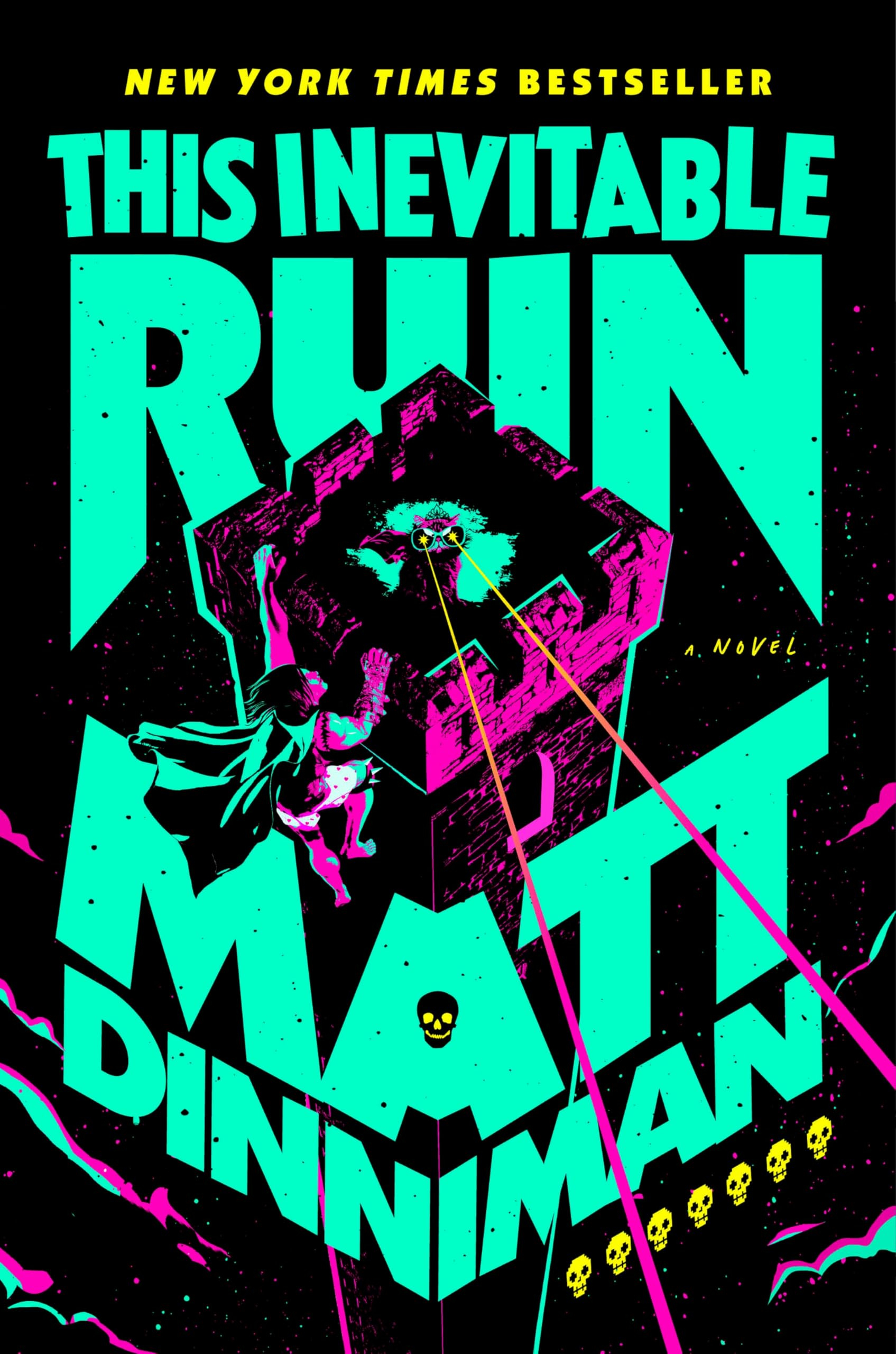 This Inevitable Ruin by Matt Dinniman
Mogsy’s Rating: 4 of 5 stars
Genre: Fantasy, Science Fiction
Series: Book 7 of Dungeon Crawler Carl
Publisher: Ace (September 23, 2025)
Length: 870 pages
Author Information: Website
I can’t believe I almost let this slip by, but I just realized I never actually wrote my review for This Inevitable Ruin by Matt Dinniman, and now the next book is basically upon us. Naturally, I had to do a quick refresh, which in this case is doing a reread but with the audiobook this time, and honestly, this is one of those rare occasions where I genuinely can’t decide which format is better. I mean, I almost never recommend audio over print, but Jeff Hays’ performance on this series is just that good. You really can’t go wrong with either pick, but if you’re still on the fence about starting your Dungeon Crawler Carl journey, the audio route is a fine choice.
This seventh installment finally brings us to the long-teased Faction Wars on the ninth floor, an event that has been looming over the series for a while now. It’s an epic showdown whose set up has been in the works since the first book, involving multiple factions, each backed by powerful off-world participants, all thrown into a massive battlefield with one primary objective: be the last one standing.
But of course, thanks to Carl, Donut, and their allies, things are more complicated this time around. As always, crawlers are active participants in this deadly game, but now the NPCs also have their own team, becoming a force to be reckoned with. The usual rules are shifting as well, with protections being stripped away, making permadeath a thing, essentially leveling the playing field. The stakes have never been higher as the different factions go to war and the death toll begins to rise. The closer Carl gets to leading his fellow crawlers to victory, however, the more dangerous the road there becomes. Every win comes with a cost, and despite it all, losing is not an option.
As much as I enjoyed finally seeing the Faction Wars play out, I have to say this was also the point where the sheer size and scope of the book started to work against it a little. While the last few volumes have also been on the longer side, in general they still felt on track and manageable. This Inevitable Ruin, on the other hand, had so much going on, the sheer scale of everything happening made it harder to stay consistently focused. To start, there are a lot of factions to deal with. By design, that means we end up working through clash after clash as we watch Carl and his crawler faction push forward. It’s exciting in bursts, but it also stretches things out, making them feel disjointed. There were definitely moments where it felt like the story was spinning its wheels between major developments, not to mention the fatigue.
That said, I still enjoyed the hell out of this book. Even though the narrative is sprawling in every direction, we’re jumping between battles and checking in on different characters, the overall story still being mindful of tying up lingering plotlines and loose threads. I loved catching up with everybody. The humor is as sharp and ridiculous as ever. The action hits hard, but there are also those powerful emotional moments that hit even harder. These are characters I’ve followed for a long time, and there’s a growing sense that, as intense as things have already gotten, we’re still building toward something even bigger. And you have to give this series credit. Even when it gets messy, it’s never boring.
In the end, This Inevitable Ruin comes in at a lower rating compared to the previous books, but just by a smidgen, and mostly due to the sense that the story is straining a bit under the weight of the massive beast it’s grown into. I still had a great time, and if anything, it’s only made me more excited for what’s coming next. At this point, I am fully locked in and have gone full Dungeon Crawler Carl fan mode, backing the tabletop RPG campaign, buying Mongo shirts, and feeling absolutely ready to jump back in with book 8, A Parade of Horribles.


More on The BiblioSanctum:
Review of Dungeon Crawler Carl (Book 1)
Review of Carl’s Doomsday Scenario (Book 2)
Review of The Dungeon Anarchist’s Cookbook (Book 3)
Review of The Gate of the Feral Gods (Book 4)
Review of The Butcher’s Masquerade (Book 5)
Review of The Eye of the Bedlam Bride (Book 6)
Categories: Fantasy Books
A Sword & Planet Graphic Novel: Bigfoot: Sword of the Earthman by Josh S. Henaman, Andy Taylor, and Tamra Bonvillain
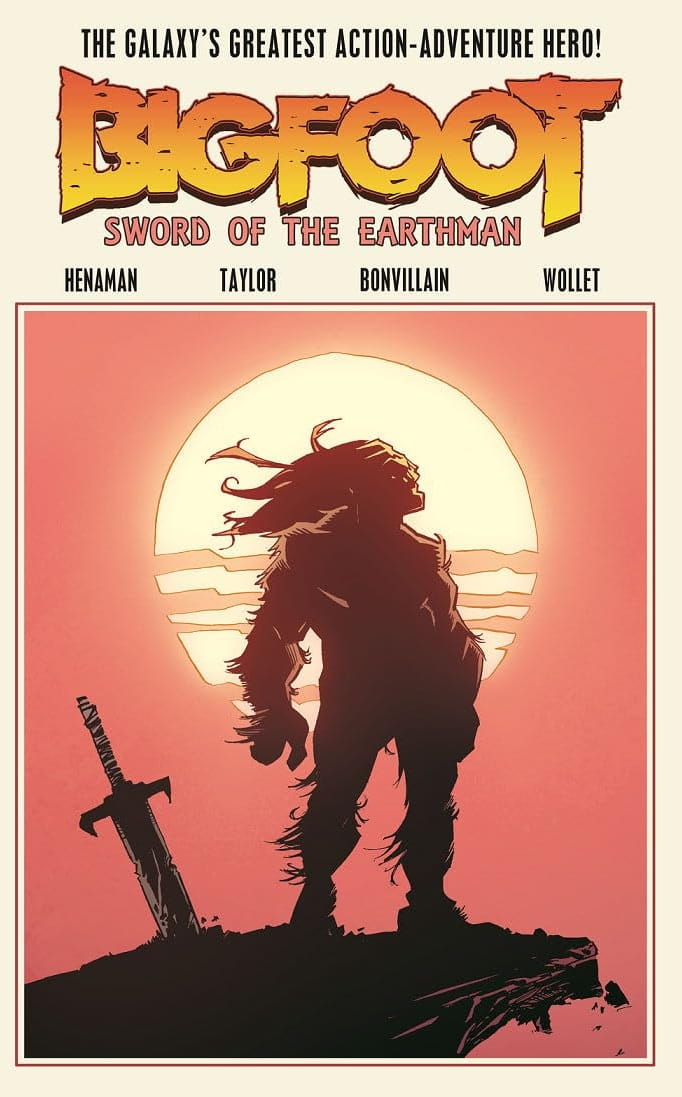 Bigfoot: Sword of the Earthman Volume 1, collecting issues 1 – 6 (Action Lab Entertainment, August 2, 2016)
Dipping back into the Sword & Planet genre for the day, here’s one of the odder items I have. Bigfoot: Sword of the Earthman, subtitled as “The Galaxy’s Greatest Action-Adventure Hero.” As far as I can tell, Josh Henaman is the writer, with Andy Taylor (Penciller), Tamra Bonvillain (Colorist), and Adam Wollet (Letterer).
This is a graphic novel collecting the first six issues of the story. I bought this because it was billed as sword & planet set on Mars, and featuring Bigfoot. It mostly was, although not quite what I was hoping it might be.
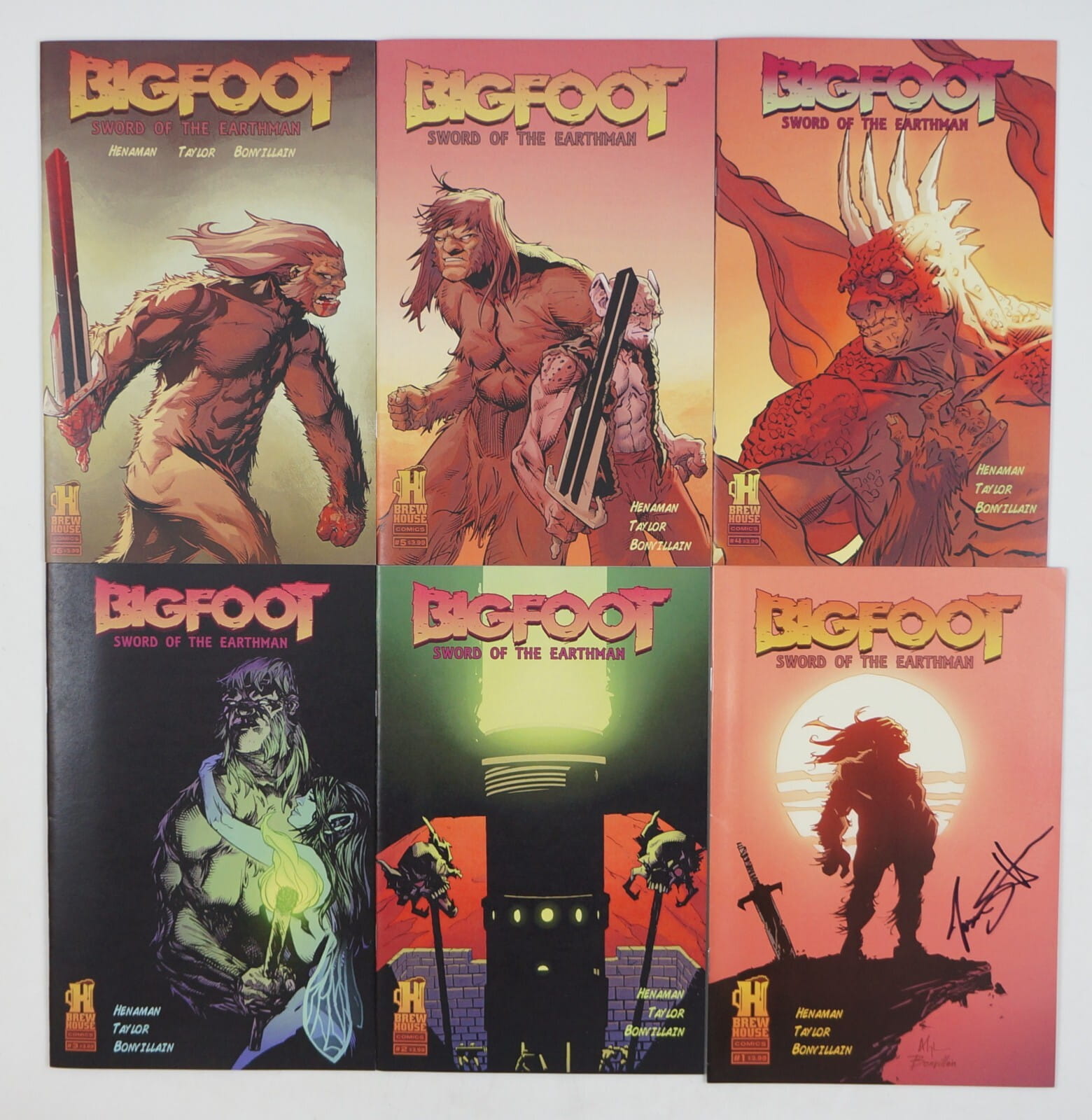 Issues 1-6 of Bigfoot: Sword of the Earthman (Brew House Comics editions, 2012-2014)
I gave it 3 1/2 stars, although at current I don’t have plans to buy the later material in the series.
The idea was quite good, if — of course — pretty far out there. Bigfoot somehow gets transported to an ancient Mars and becomes a hero. The art was good as well, although I’m not completely familiar with the comic reading process so I couldn’t always tell what was going on from the art. Maybe readers more familiar with the art form could.
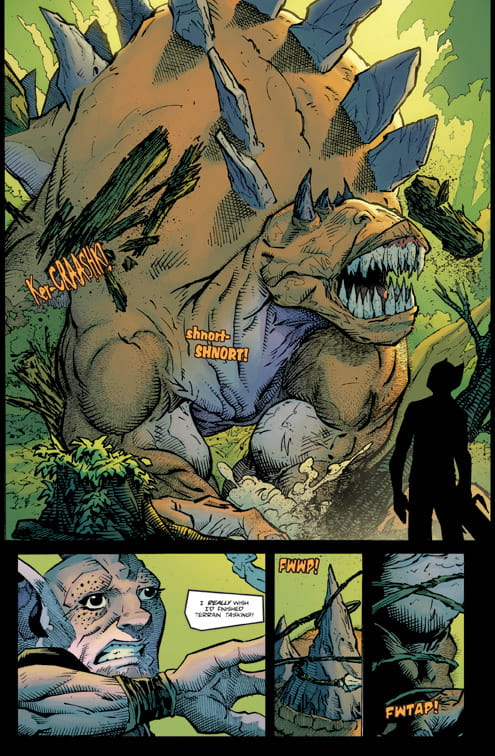 A page from Bigfoot: Sword of the Earthman, issue #4. Art by Andy Taylor and Tamra Bonvillain
The story has a tremendous amount of narration from the point of view of a Martian character who follows Bigfoot through the tale and relates the events, but he’s pretty clearly an unreliable narrator, which makes it difficult to know what is really happening. Bigfoot doesn’t talk at all, which was fine for a while but began to get a little old as the tale continued.
The book is called Sword of the Earthman, that being Bigfoot, but there’s very little sword slinging action through most of the book. Only in the last chapter do we really see Bigfoot cut lose and there is a lot of action. I was prepared to go with 3 stars until that ending chapter, which had much less narration and much more action, and some pretty good emotional moments as well as a surprise ending. If more of the book had been like that last chapter I’d have ranked it higher.
Charles Gramlich administers The Swords & Planet League group on Facebook, where this post first appeared. His last article for us was a a review of the 1994 horror anthology Young Blood. See all of his recent posts for Black Gate here.
Categories: Fantasy Books
Review of To Shape a Dragon’s Breath by Moniquill Blackgoose
As a Bookshop affiliate, I earn from qualifying purchases. To Shape a Dragon’s Breath by Moniquill Blackgoose, the first book in a trilogy set in an alternate historical version of our world with dragons, was one of my favorite books published in 2023. Since I wanted to refresh my memory before reading To Ride a Rising Storm, the second book in the Nampeshiweisit trilogy that was released earlier this year, I decided to reread it and write a lengthier review […]
The post Review of To Shape a Dragon’s Breath by Moniquill Blackgoose first appeared on Fantasy Cafe.
Categories: Fantasy Books
Cats and Bookmarks
I overslept, and my day started with an outraged cat.
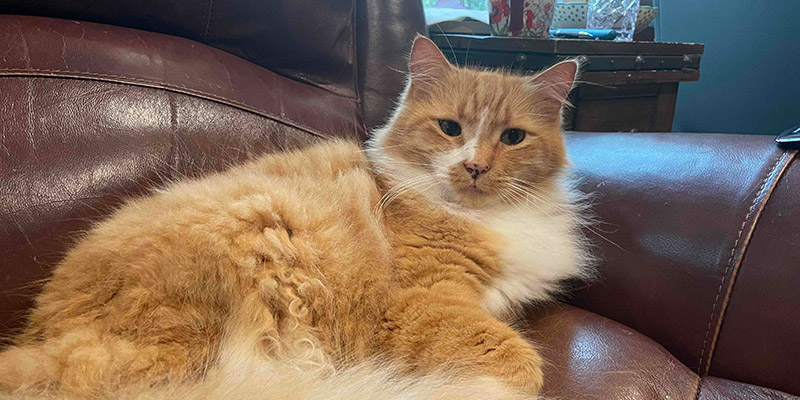
Over the past few days, a road crew has been working on the street next to our house. They are repaving it. The road is closed, and Gordon observed the workers having heated words with a driver of a delivery truck this morning. We might be trapped today.
Because of the road crew, we are keeping Tuna inside. Tuna started life as a stray who wandered randomly around an apartment complex, and breaking him of wanting to go outside is impossible. He has two acres here, and he is very much the lord of his domain. Today His Majesty was refused access to the outside. The inability to inspect his lands didn’t sit well, so he made himself into a nuisance.
Tuna: Pet me! Pet me! Pet me! Look, I meow by the door. Open door. OPEN DOOR.
Me, trying to clean up: No.
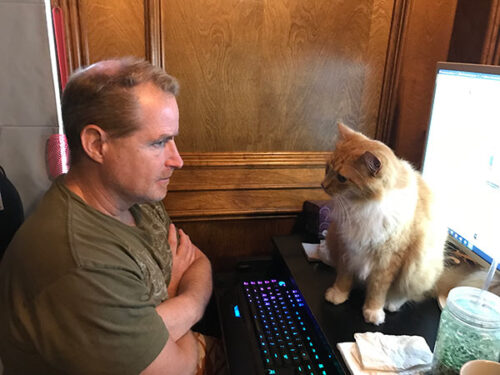
The allergies have been terrible, and neither of us is sleeping that well. I was shopping for some Halls cough drops and saw that instead of puny bags, they now come in full scale large jars. Of course, I bought a jar. It was delivered yesterday with saline spray and Flonase, and being too tired, I plopped all of that on my writing tray in the office. I need the tray to write.
Me, gathering items to take to the medicine cabinet.
Tuna: TREATS.
Me: No, you fool. These are not Temptation treats.
Tuna: TREATS.
Me: It’s cough drops!
Tuna: If not treats, why treat shaped? TREATS.
Tuna VisionI gave him treats. The vet will fuss at me again over his weight, but there are limits to human patience.
I come to you with a mission this morning. The book is now 185K. It is very clear that there is no room left for anything else in our lives. I still have not unpacked. Or sent things out. Mod R will have strong words with me here soon if I keep failing.
We need assistance, or we will never get the shop back off the ground, and our time is better spent writing. To that end, we hired a designer to help us turn the treasure trove of art into merch. Here is some of her work.
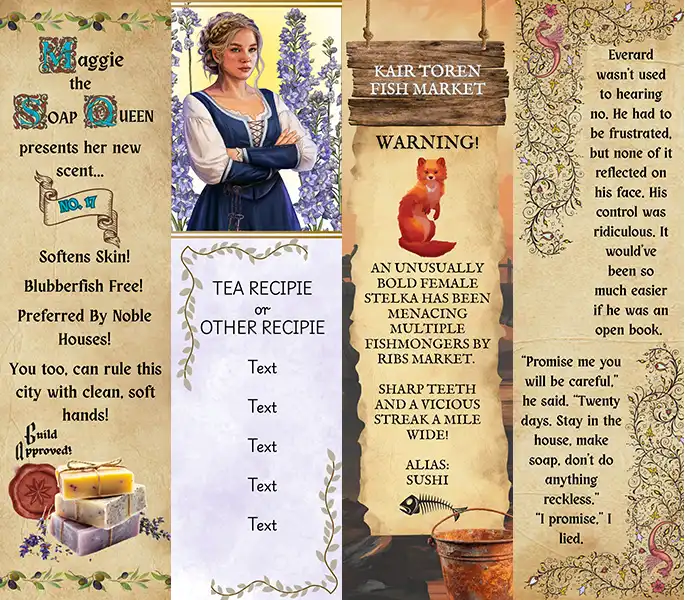
These bookmarks will be included in the media package. We have secured a printer for the vellum, so we will be bringing to you a media pack with vellum, stickers, and bookmarks.
Do you have any favorite quotes or moments you want reflected in This Kingdom merch? Please leave us a comment below. If you are dying for something from the other series, you can throw it in there too, but we are focusing on This Kingdom as it is the latest release.
The comment section to this post contains SPOILERS. Read at your own risk.
The post Cats and Bookmarks first appeared on ILONA ANDREWS.
Categories: Authors
The Write Attitude: Sounding Like Yourself
This post is a chapter from my book, The Write Attitude, which is now in a second edition. I’m posting it here to entice you to head over to Storybundle to pick up a copy, along with ebooks by Darcy Pattison, Douglas Smith, Ron Collins, Tracy Cooper-Posey and others.
Everything in this Storybundle is exclusive, including The Write Attitude. So if you want to read it now, pick it up from Storybundle. The bundle will end in 9 days, so hurry on over. If you don’t want a deal on the ebook or if you only read print, then you can always preorder the book on various retailer sites starting next month. The new edition will release in July.
The second edition of The Write Attitude is quite different from the first edition, which originally appeared in 2016. I kept some parts of the original book, but much of the material is newer. The new material comes from my Patreon page. Not every post from my Patreon page shows up here, although several do. If you want to see everything, though, head to Patreon and sign up.
This post appeared on my Patreon page in November of 2025, and is one of the early chapters in the book.
SOUNDING LIKE YOURSELFFrom 2025
In a Billboard article about Addison Rae, I came across a useful Miles Davis quote. (Billboard, August 13, 2025.) She cited the quote this way:
Sometimes it takes you a long time to sound like yourself.
Wow. That hit home. But before I used it to base a blog post on, I looked it up. I was worried that it really wasn’t a Miles Davis quote or that it was a misquote (although it didn’t sound like one). What I found was that there are two versions of this quote, which leads me to believe that the jazz great remarked on this a lot.
The other version of the quote says:
Sometimes you have to play a long time to be able to play like yourself.
And I think I like that one better, although both quotes are useful. For those of you who don’t know who Miles Davis was, he was one of the most influential musicians of the mid-twentieth century. He is definitely one of the most influential jazz musicians of all time.
If you are not familiar with him or his work, start at his website, milesdavis.com, and scan outward. You are probably familiar with a lot of his music, particularly if you’re a jazz fan.
The reason I like both quotes is that they have at least two different meanings, three if you think of them from the point of view of a prose writer.
The first quote: It takes a long time to sound like yourself.
That’s all about voice. Yes, Miles Davis, Addison Rae, and vocal coach Eric Vetro (who first showed Rae the quote) were talking about a musical voice—about sounding like no one else by channeling your own inner vision.
Which is what the best writers do. (That’s why the worst copy editors aren’t the ones who introduce mistakes; they’re the ones who put some writer’s manuscript into “perfect” grammar, ruining their voice.) If you listen to Stephen King reading his own work, his inflections and pauses are not surprising because he knows how to write them into the prose. (His accent or the tone of his voice might surprise you, but nothing more than that.)
Stephen King, former English teacher, found his own voice as a young boy and then learned how to transmit that voice, via the tool of a manuscript, into the brain of a reader. What he does is an extremely difficult skill, and one I aspire to. That’s why I typed Mick Herron’s work into my computer a while back (see the previous chapter), so that I could learn how someone else did things.
The more tools you have in the toolbox, the better writer you will be.
If you don’t read much fiction or you don’t read much fiction anymore, as so many writers say, then you’ve stopped accumulating tools. As long as I breathe, I will be reading. And the fascinating part to me is that I see writers do things that I thought were impossible or things I’ve never thought of. Or, Mick Herron’s case, he does things that someone, somewhere, decades ago, had warned me away from. (The opening to each Slough House book is an astonishing exercise in setting the stage as well as the characters and the themes of each book.)
Here’s the tough part. Once you sound like yourself, your writing will seem bland to you. Because you live with that voice in your head each and every day.
So that’s the voice part.
That’s the first part of sounding like yourself.
The second part is this: You must defend your voice, your “sound.” Sure, it might be “wrong” to use a dozen semi-colons in a single paragraph, but Herron does it to such great effect (sometimes in a single sentence) that the reader doesn’t notice them.
I didn’t realize the man uses a million semi-colons until I typed in his work. I’m semi-colon lite, dash heavy, which, I thought, made me a much more breathless writer than he is, but his work continually proves me wrong.
I’m sure some silly copy editor somewhere tried, once upon a time, to edit out all of his semi-colons and to make his honkin’ long single-sentence paragraphs into many sentences, and from what I can tell, the man slapped them down.
There’s another component to voice, though, and it has nothing to do with words and grammar and punctuation. It’s subject matter. It’s characterization. It’s something I discussed after the Herron piece. It’s the ability to “go there,” wherever there is. (See chapter 10.) To write the stuff that frightens us, that makes us original, that might get us in trouble with the readers or in some cases, the government.
It’s the stuff that doesn’t fall into genre lines.
I was having a discussion a few weeks back with someone I was considering working with on a future project. That person insisted we use trope charts, like so many writers have started to do in Kickstarters.
Tropes are well and good, if used sparingly. As a romance reader, I want to see—either from the sales copy or from a trope listing—that the book in my hand uses the enemies-to-lovers trope or is a small-town romance. I want to avoid a guardian-ward historical trope because…yucky!
So a one-line description or acknowledgement of the trope is a good thing, especially in books where the ending is prescribed, like a romance (happily ever after) or a cozy mystery (amateur solves a stakes-free murder).
But other than that—a tropes chart? You might as well put two gigantic signs on your work. The first sign says, Read something else because this book is on rails. The second sign says, This book is mediocre. There are no surprises here. There’s a third sign, but only if someone dares to crack open a book based on a tropes chart. And that sign says This writer has no idea what tropes are. The ones listed here are not in the book.
Whoops.
Writers who sound like themselves can’t write books that can be boiled down into a tropes chart. Sure, the overall trope might work because that might form the heart of the book. (I’m thinking of enemies to lovers here in a romance trope.) But going beyond that would harm the reading experience if the writer is writing from their heart.
That’s why writers who are really good at sounding like themselves often have trouble selling their fiction to set markets, particularly traditional markets. Those markets want something they can sell, and a book that’s on rails is easier to market to a consumer than a book that is, at its core, like nothing a reader has ever seen before.
That’s why this quote comes from Miles Davis. His website has this sentence on the home page:
Miles Davis made music that grew from an uncanny talent to hear the future and a headstrong desire to play it.
Note the phrases here. “Uncanny talent.” In other words, he did things no one else dared. “Hear the future.” I might disagree with that one on some level, because on that level, Davis invented the future that his website claimed he heard. And, the most important phrase, “a headstrong desire to play it.”
Later this little biographical snippet points out that Davis never stopped fighting for his art. That’s my memory of him. He wasn’t as respected in his lifetime as he became later, even though no one dared argue with the impact he was having. I worked in listener-sponsored radio in Wisconsin and was immersed in jazz. We could play all kinds of jazz for our listeners and they supported the programming with their dollars.
The other local jazz station was much more conservative. They played traditional melodic jazz, things we call standards now, and would go to modern jazz after 10 p.m. when most Midwesterners went to bed. Even then, you wouldn’t find a lot of Miles Davis on that station. The powers that be loathed his work.
I think that’s the other side of this. You have to become good enough to force people to have opinions about your work. “Having opinions” means they’ll love it or they’ll hate it. What is most important, though, is that they won’t forget it.
These mediocre, “properly written” works? The ones with the voice edited out of them, with the vision troped to death? Those will be forgotten the moment that the reader closes the book.
I don’t know about you, but I don’t ever want to be accused of being mediocre. Love or hate my work, that’s up to the reader. But finding it dull or predictable…well, then, I’ve done something wrong.
The second quote from Miles Davis is my favorite. I think it might more accurately reflect what he’s getting at, especially if you’re familiar with his music.
Sometimes you have to play a long time to be able to play like yourself.
Yeah, I know. He’s talking about playing music, often onstage. He was the master of improvisation, but even in the improvisation, the listener knew they were listening to Miles Davis. His perspective was that original.
But what I love here is the word “play.” I love watching jazz musicians in particular improvise. Somewhere in the middle of what they’re doing, they’ll grin at each other. They’re having fun. They’re creating something new, something unexpected, and it gives them joy.
This type of musicianship is why I don’t miss a Keith Urban residency when he’s in Las Vegas. He performs intensely and playfully, goofing around much more than other residency performers I’ve seen. I wasn’t a big fan (or much of a fan at all) when I first saw him perform, and now I go to watch the playful musicianship.
Writers need to play as well. We need to experiment. We need to risk failure. We need to jangle some chords, try a different instrument, and go far, far, far off the beaten path.
That means we’ll miss sometimes, but it also means that when we hit, the work will be powerful.
When I talk about play, I’m not saying that writers should only write something light and “fun.” Instead, I’m talking about experimentation, about risking everything, about free-floating ideas from our own subconscious even if those ideas make us feel uncomfortable.
We should also go for different formats and different genres, different lengths and different ideas than we’ve explored before. We might not be onstage riffing with our friends, but we should write in that same spirit of improvisational play.
We need to be uniquely ourselves as writers. And as Miles Davis said (and yes, he wrote his own stuff), it takes a long time to achieve that.
But finding yourself as a writer? That’s worth the time spent.
“Sounding Like Yourself” from The Write Attitude
Copyright © Kristine Kathryn Rusch
Published by WMG Publishing
This ebook is licensed for your personal enjoyment only. All rights reserved. This ebook, or parts thereof, may not be reproduced in any form without permission.
Any use of this publication to train generative artificial intelligence (“AI”) technologies is expressly prohibited. The author and publisher reserve all rights to license uses of this work for generative AI training and development of machine learning language models.
Categories: Authors
Pages

Recent comments