
Feed aggregator
Novella Review: Platform Decay by Martha Wells
received a review copy from the publisher. This does not affect the contents of my review and all opinions are my own.
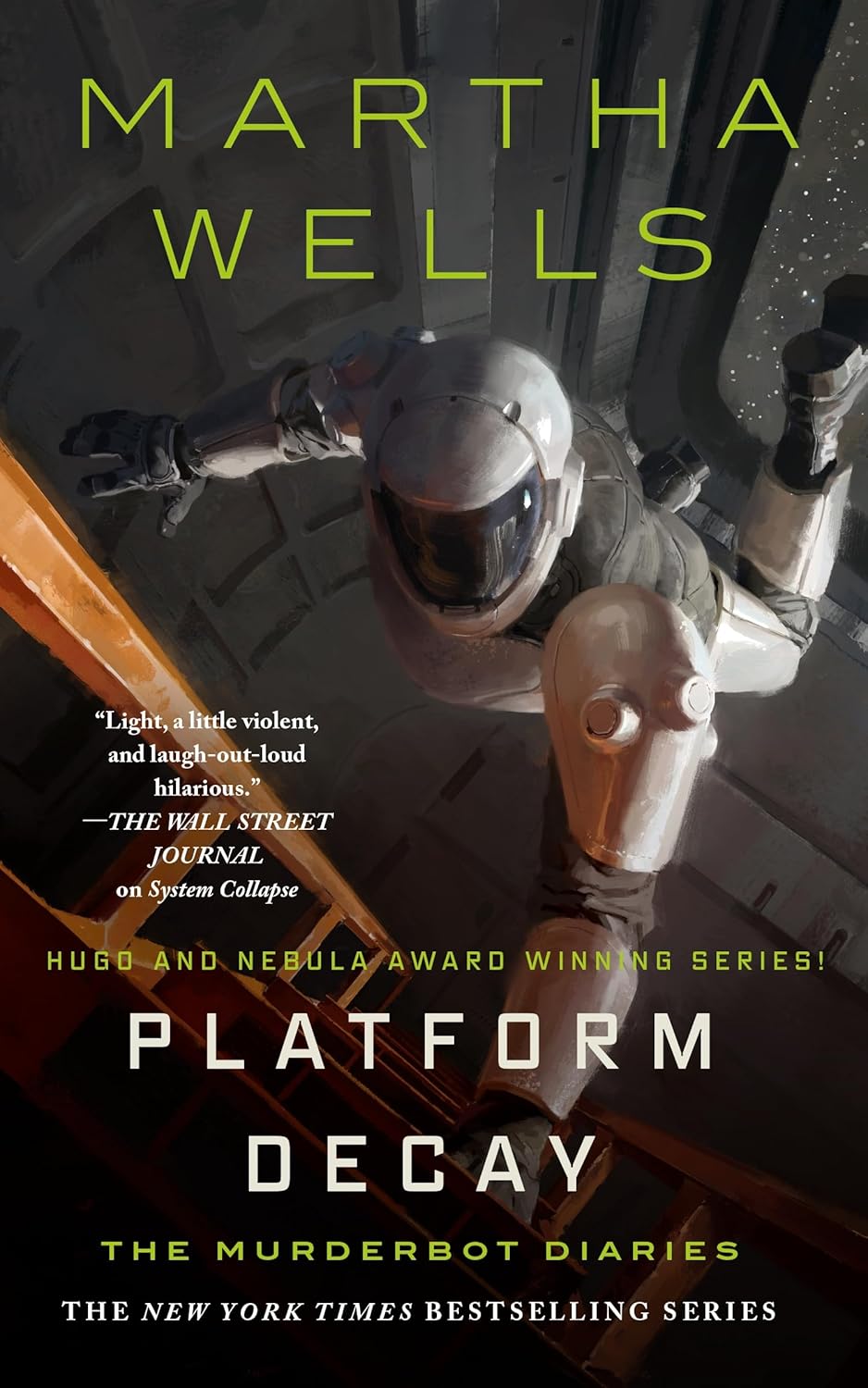 Platform Decay by Martha Wells
Mogsy’s Rating: 3 of 5 stars
Genre: Science Fiction
Series: Book 8 of The Murderbot Diaries
Publisher: Tordotcom (May 5, 2026)
Length: 244 pages
Author Information: Website
A new Murderbot book is always cause for joy, and since it’s been a couple of years since the last one, you can imagine my excitement going into Platform Decay. But as we are eight books into the series, after so many adventures and turning points, I feel like I have a pretty good sense of what works for me and what doesn’t. Ultimately, while the SecUnit remains one of my favorite protagonists in science fiction, this new installment simply landed closer to the middle of the pack. It’s still enjoyable, containing many of the things I love about The Murderbot Diaries, but comes across more like detour than a meaningful step forward.
The story picks up shortly after the events of the previous book, and once again Murderbot finds itself responsible for protecting a group of squishy, vulnerable humans from the usual combination of corporate greed, poor decision-making, and imminent danger, not always in that order. This time, the mission takes it to a massive orbital platform where a hostage situation has spiraled into a full-blown crisis. Among those trapped aboard are members of Dr. Mensah’s family, including children, immediately making the situation far more personal for Murderbot than it would probably like to admit.
What follows is essentially an extended rescue and escape operation. As conditions aboard the station continue to deteriorate, Murderbot must guide its charges through a series of increasingly dangerous situations while dealing with one of its least favorite complications: people. These are frightened civilians with conflicting agendas, messy emotions, and frequent bouts of mistrust. And in what might be the most terrifying aspect of this entire ordeal, the children won’t stop asking uncomfortable questions! Meanwhile, hostile forces are closing in, forcing Murderbot to stay constantly on the move and several steps ahead. Thankfully, our protagonist has had plenty of experience dealing with seemingly impossible situations, even if doing so now comes with a growing collection of inconvenient feelings it would much rather ignore.
Platform Decay was a lot of fun. That said, I couldn’t help but feel like we’ve been down this road before. The main challenge of any long-running series is finding fresh ways to engage both the protagonist and the reader, and this installment occasionally struggles with that. Essentially, Murderbot is tasked with saving innocent lives yet again, from yet another corporate disaster zone. Only the minor details are different, making this feel like a side quest between larger events rather than an impactful sequel with meaningful consequences. In fact, I was hoping for something with a bit more weight behind it, but outside of getting to finally meet some of Mensah’s family members, I didn’t see a whole lot of changes beyond continuing with the status quo.
But there are also plenty of positives. As ever, spending time in Murderbot’s head is an endless source of entertainment, and the narration has so much punch that you can’t forget it. I also like seeing how far the character has come since the beginning. And yet, while our protagonist has made great strides emotionally, that doesn’t mean it has suddenly become warm and cuddly. Murderbot’s deadpan cynicism is what makes this series, and Martha Wells remains incredibly good at making the SecUnit’s personality leap off the page even when the story itself feels smaller.
In the end, Platform Decay is a perfectly decent Murderbot novella, but it does pale in comparison to some of the series’ stronger entries. Nevertheless, it’s fast, entertaining, and easy to devour in a sitting. Bottom line, a middling Murderbot book is still a Murderbot book, and I’ll never not geek out over one even if it’s not a favorite. I’ll keep following The Murderbot Diaries, and here’s just hopnig the next volume will feel a little more substantial.


More on The BiblioSanctum:
Review of All Systems Red (Book 1)
Review of Artificial Condition (Book 2)
Review of Rogue Protocol (Book 3)
Review of Exit Strategy (Book 4)
Review of Network Effect (Book 5)
Review of Fugitive Telemetry (Book 6)
Review of System Collapse (Book 7)
Categories: Fantasy Books
Three by John Bellairs
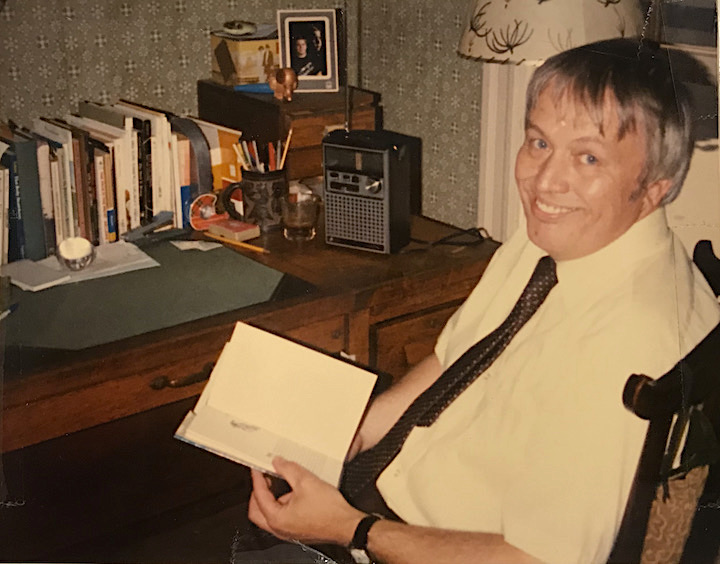 I write scary thrillers for kids because I have the imagination of a ten-year old. The center of my books is always the childhood of which I seem to have a nearly total recall.
John Bellairs
It’s perhaps fitting I follow up a years worth of writing about JRR Tolkien with something about John Bellairs‘ young adult stories. In response to reading Tolkien’s books, he wrote The Face in the Frost (1969). It’s a comic tale of two wizards, Prospero (not the one you’re thinking of) and Francis Bacon fighting to save the world from the machinations of the evil Melchius. When he wrote his next book, The House With a Clock in Its Walls (1973) as an adult supernatural thriller, he was encouraged to rewrite it for children. His publisher didn’t see enough of a market for the sort of adult fiction he had created.
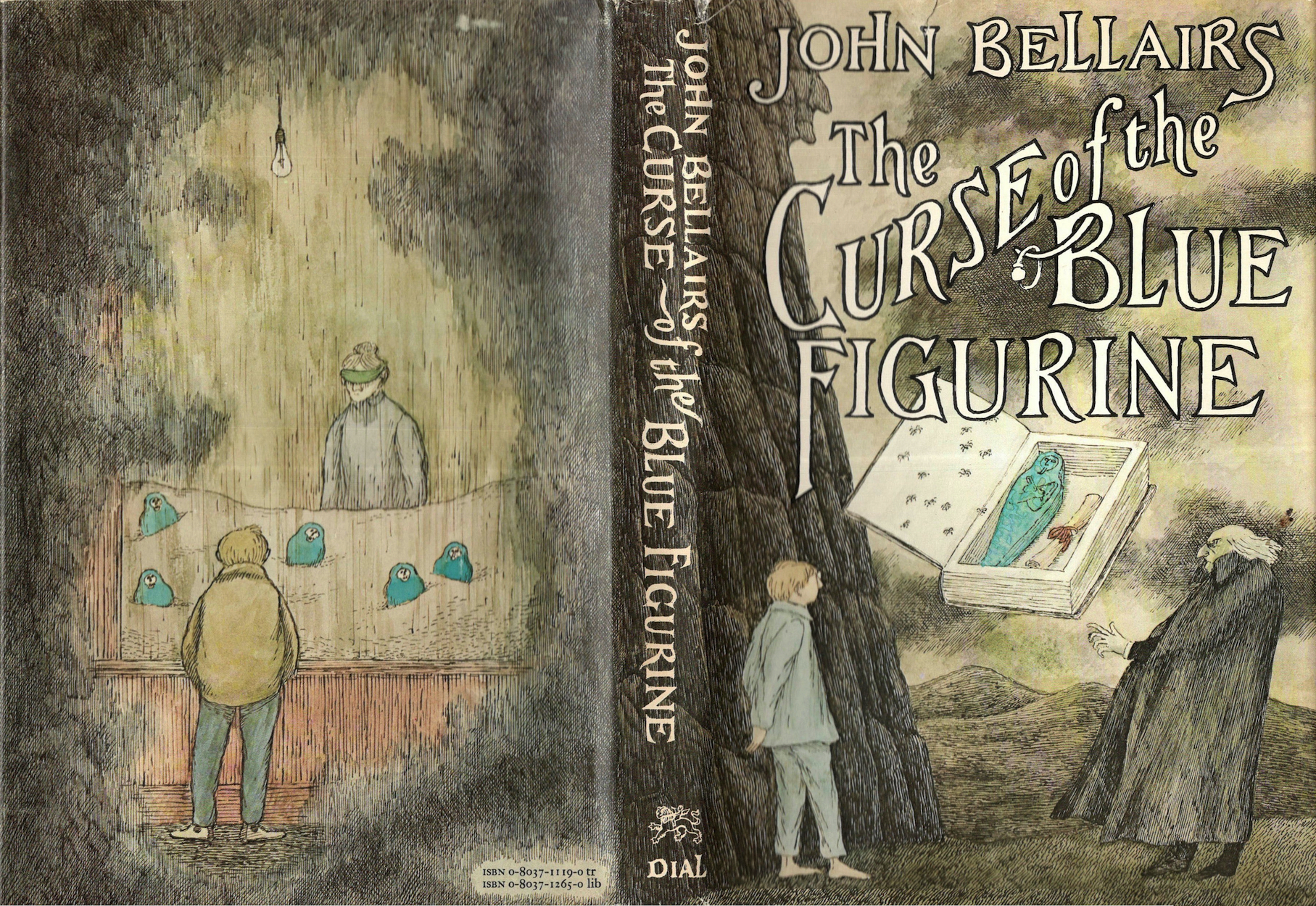
Over the remaining eighteen years of his life, Bellairs created three similar series of stories and completed fourteen additional novels. House was the first of three tales about Lewis Barnavelt, an orphan who comes to live with his uncle in the small Michigan town of New Zebedee. The town is modelled on Bellair’s own hometown, Marshall, Michigan. The second series is four books featuring Anthony Monday and his friend, the elderly librarian Myra Eells. The first book, The Treasure of Alpheus Winterborn is a straightforward mystery, but the later books introduce supernatural elements. I suspect both Bellairs and his publisher understood what his audience wanted. Finally, there is the eight book long Johnny Dixon and the Professor series, starting with The Curse of the Blue Figurine. Set in 1951, Johnny has been, following the death of his mother and his father being sent to Korea as a fighter pilot, to live with his grandparents in Massachusetts. As you can see, each series features a young boy, displaced from his home or isolated and befriended by a older adult who is willing to help him face whatever adventures come his way. Despite a similar framework, there’s a very different feel to each of the books.
I first encountered John Bellairs through a cheaply made adaptation of The House With a Clock in Its Walls presented by Vincent Price. It’s not very good, though Severn Dardern is a fun addition to any movie. It starts at 21:48. It was enough to make me go find the book.
Lewis Barnavelt is a young and bookish fat boy. When his parents are killed in car crash, he’s forced to go live with his uncle Jonathan. Quickly enough, he learns that his uncle and his neighbor, Florence Zimmerman, are good sorcerers. His uncle’s house was once owned by a terrible, evil magician, Isaac Izard and his wife Selena. Izard created a magical clock that will bring the world into alignment and destroy the world and hid it inside his house.
Fortunately, for the world, Izard died before he could trigger the clock. Now, every night, Jonathan stops the numerous clocks that fill his house so he can try to focus on the ticking of the doomsday device and discover its location. In an effort to maintain the friendship of a classmate, Lewis decides to show him a display of magic and raise the dead. Inadvertently, perhaps, he selects the mausoleum of Selena Izard, triggering her husband’s return and a race to find the evil clock.
Looking at Bellairs’ quote at the top of the page, he’s really good at recreating the feel of childhood, with all its anxieties, fears, and dreams. The rise and fall of his friendship the popular Tarby Corrigan feels perfect in its miserableness.
There are also several wonderful scenes. The standout is a magical presentation by Jonathan and Mrs. Zimmerman put on for Lewis and Tarby.
And now Uncle Jonathan’s back yard came to life. It was full of strange sights and sounds. The grass glowed a phosphorescent green, and red worms wriggled through the tall blades with a hushing sound. Strange insects dropped down out of the overhanging boughs of the willow tree and started to dance on the picnic table. They waltzed and wiggled in a shaking blue light, and the music they danced to, faint though it was, sounded to Lewis like “Rugbug,” the famous fox trot composed by Maxine Hollister. This was one of the tunes that Jonathan’s parlor organ played. Uncle Jonathan walked over to the tulip bed, put his ear to the ground, and listened. He motioned for the others to join him. Lewis put his ear to the damp earth, and he heard strange things. He heard the noise that earthworms make as they slowly inch along, breaking hard black clods with their blunt heads. He heard the secret inwound conversations of bulbs and roots, and the breathing of flowers. And Lewis knew strange things, without knowing how he came to know them. He knew that there was a cat named Texaco buried in the patch of ground he knelt on. Its delicate ivory skeleton was falling slowly to pieces down there, and its dank fur was shrivelled and matted and rotten. The boy who had buried the cat had buried a sand pail full of shells near it. Lewis did not know the name of the boy, or how long ago he had buried the cat and the pail, but he could see the red and blue pail clearly. Blotches of brown rust were eating up the bright designs, and the shells were covered with green mold.
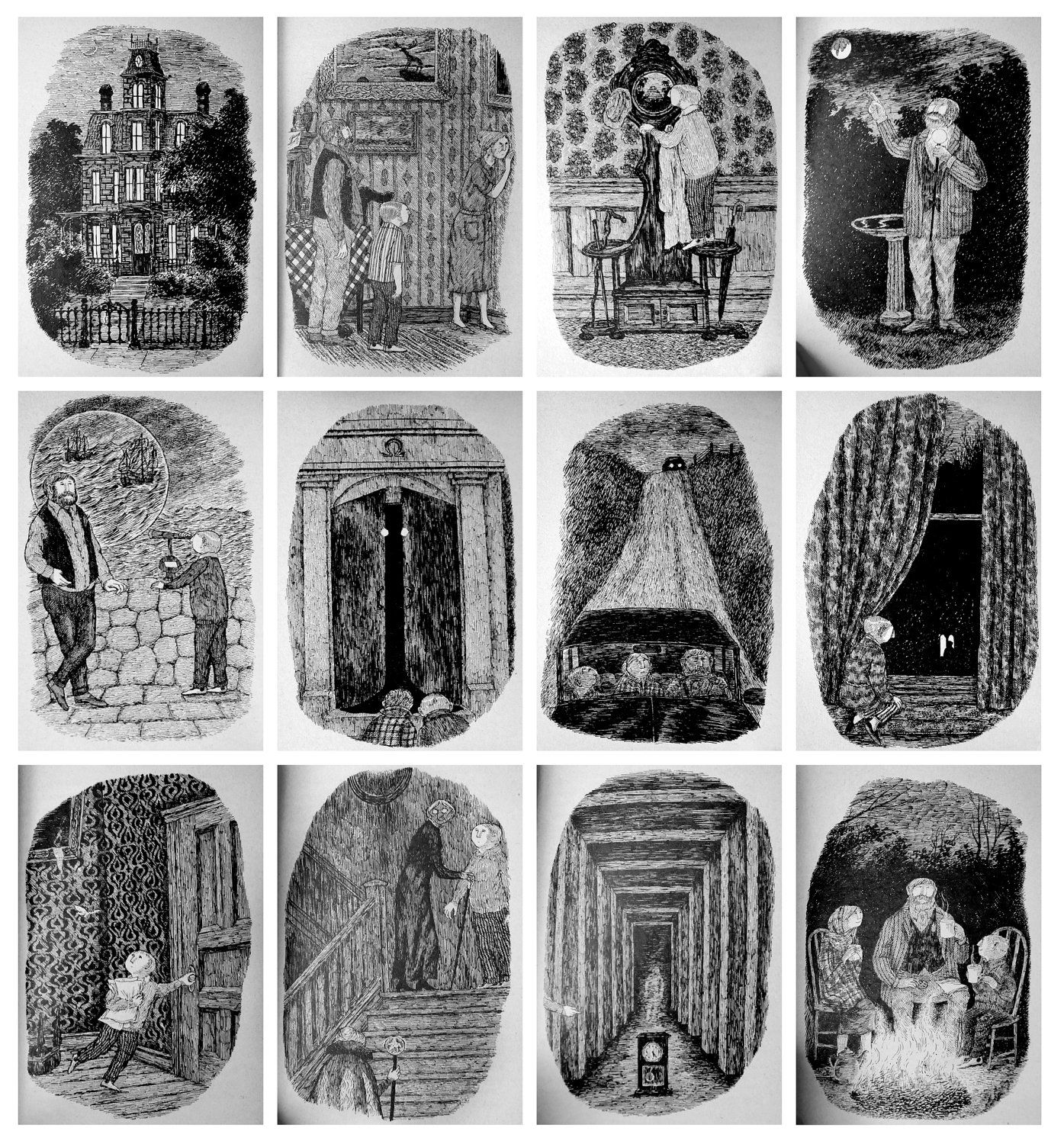
One of the most wonderful things about House are the illustrations by Edward Gorey, something I only recognized when I reread it in my thirties. I knew him first from his animated credits for PBS’s Mystery anthology series, his War of the Worlds illustrations, and I had heard about his sets for the Broadway production of Dracula starring Frank Langella. He would go on to do the covers and frontpieces for most of Bellairs’ other books.
Apparently, Gorey and Bellairs never communicated. Gorey took on the illustrating as work-for-hire, would read the book, and then send his art to the publishers and Bellairs would review for any technical discrepancies. According to one article, the art for House came in late enough, the publisher told Bellairs he’d have to change his text as they were running to close to deadline to get Gorey to redo anything. In an article by Matt Domino, he recounts how Gorey was more-or-less dismissive of his Bellairs illustrations and had them removed from his archives:In fact, according to Brown, later in his life, Gorey wanted to disown his cover illustrations for Bellairs. “He called me up one day and said, ‘Let’s get all of the Bellairs work out of the archives.’ He just didn’t think it represented him and what he was trying to do. He saw it as his grunt work.”
Be that as it may, the illustrations, like most of Gorey’s work are wonderful and perfectly weird and spooky. If you aren’t familiar with Gorey’s work, I recommend you find any one of his books or collections. His work is finely detailed and black & white, usually set in some sort of Edwardian or post-WWI setting, featuring strange characters and often delightfully disturbing rhymes. It’s also wickedly funny. Unfortunately, while House retains the interior illustrations, the covers and frontpieces are no longer used for the current editions.
Below are his illustrations for The House With a Clock in Its Walls. Not only are they wonderful, they’re also so specific. He clearly had a good reader’s instinct for the perfect moments in the story to illuminate.
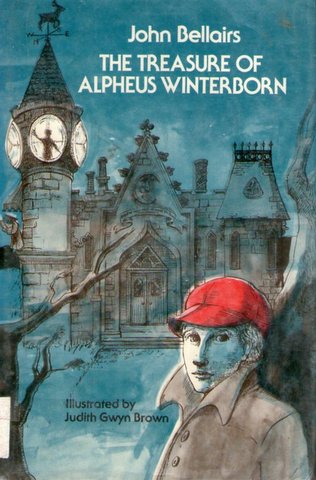 Anthony Monday is not a orphan or half-orphan, just the son of a sickly father and an overbearing mother. In The Treasure of Alpheus Winterborn (1978) as something of an escape, he spends much time in the Hoosac Public Library where he befriends the librarian, Myrna Eells. Working in the library, he discovers something that convinces him the long rumored secret treasure left behind by eccentric millionaire and self-taught Biblical archaeologist, Alpheus Winterborn is real. With doggedness driven by fear of his family falling into poverty, he convinces Ms. Eells to help him follow a trail of riddles and other clues.
Unfortunately, this brings him up against Hugo Philpotts, vice-president of the First National Bank of Hoosac and disinherited nephew of Alpheus. He knows the legend of the treasure too, and has been keeping his eyes open for it for nearly thirty years. Soon, Anthony is struggling to keep the banker at bay as disaster strikes the town and the treasure seems tantalizingly out of reach.
Treasure is not as colorful a book as House. In fact, it’s much darker. The two adults featured in House are kind and protective of Lewis. While Ms. Eells is helpful to Anthony, his father is disliked for running a saloon and is sickly, while his mother is often shrewish and dismissive of her son. The threat of losing what little money and security they have hangs over the Monday family and drives Anthony to take increasingly foolhardy risks. Anthony’s sense of desperation permeates the book. So much so, that when author Brad Strickland was engaged by the publishers to write books based on unfinished manuscripts and outlines by Bellairs as well as completely new stories, he asked about writing Anthony Monday books and was told no. Apparently, the publishers disliked the character, finding him too downbeat and depressing.
In The Curse of the Blue Figurine (1983), Johnny Dixon comes up against the malign ghost of Father Baart, a priest given over to black magic. Fortunately, he is aided and watched over by his grandfather’s friend, Prof. Roderick Childermass. The professor is steeped in all sorts of knowledge as well as a baker extraordinaire. As Johnny falls prey to the ghost’s manipulations, only the professor stands to save him. A growing atmosphere of evil fills the book, culminating in desperate fight during a storm on a New Hampshire mountaintop.
Curse is more expansive than either of the other two books. There are more characters, more settings, and much more background and atmosphere. It’s longer than them, so Bellairs had room to develop everything just a bit more. Of the three books, it’s the best written and the one I’m looking most forward to reading at least one or two more of its sequels. The next book is titled The Mummy, the Will, and the Crypt, so from the title alone, I’m hooked.
I don’t know how kids today would react to these books, but I hope they’d still find them fun and just spooky enough. They’re good, fast reads, and don’t talk down to their intended readers. I imagine there must be enough of an audience for them still, though, because in 2018 they made a big Hollywood version of The House With a Clock in Its Walls starring Jack Black and Cate Blanchett.
Sadly, I have to report that for all its flash and special effects, it isn’t very good, no matter how much I wanted it to be. Aside from Blanchett being far too young as Mrs. Zimmerman and Owen Vaccaro too svelte as Lewis, the movie suffers from the usual theatrical need to jazz things up too much and overwhelm some of the very things that make the book so charming. In lieu of Lewis’ elaborate adlibbed spell to find they clock there’s a cheesy magical battle that’s been done a thousand times since Harry Potter.
Fletcher Vredenburgh writes a column each first Sunday of the month at Black Gate, mostly about older books he hasn’t read before, though not always. He also posts at his own site, Stuff I Like when his muse hits him.
Categories: Fantasy Books
Life, Merch, and Other Trauma
It is the weekend so Mod R is off. You are in my moderating hands. – Ilona
Important merch news first: we will be opening for the vellum preorders on Monday.
Availability
Right now it is US only.
Canada: The cheapest shipping is $20, takes 4 weeks, and there is no guarantee it gets there or in what shape it will arrive. We are hoping to figure out some sort of cost effective option here because the vellum retails for $30 and you would be paying $20 on top of it. Ideally I would love to print vellum, ship it to a Canadian fulfillment center and have them distribute it.
UK/EU: We have the printer in UK, but we are having a difficulty finding the fulfillment center. Most of them want a steady flow of orders instead of a large drop. We are looking into it. Right now my plan is to check with various book box representatives to see if any one them would handle the fulfillment for a fee.
Why the preorder, cousin?
We don’t know what the demand will be. Our printer stocks vellum specifically for us and we need to tell them how much to order. We will not run out. If you want vellum, you will have the opportunity to order.
A funny aside: the preorder wasn’t activating, so I had to enable the site for one hour for the customer support to diagnose the issue. In that time, 6 BDH members managed to sneak in vellum orders. We will honor those orders, and they will go out next week. You guys are not getting the map, though, so if you want the map, email me or comment here, and I will hold your order until the map happens.
How long?
Officially, the preorder will run for 4 weeks and we will mail everything out at the end of that. Unofficially, if we get a lot of orders, we will start filling them as they come in.
What will be in the box?
Everything that was included in the previous trial run and Becka’s map. We have come to an agreement on the fee. The map will be printed on 80# cover gloss. Some of you might remember buying collector editions of computer games and getting a stiff glossy map inside. That’s exactly what we will be using. The advantage of 80# cover is its durability. It can be creased, folded, unfolded, folded again, and it will be fine.
Here is a video explaining the nature of the paper. It is basically soft cover grade.
View this post on InstagramA post shared by Printedge (@printedge)
We will have a sample for you as soon as the contracts are signed and the art file is finalized.
I don’t want the whole pack. I just want one.
Whether it is 1 or 6, the shipping is still $10. You would be better off with an art print from one of the artists. But once we get through this run, we will see about individual item envelopes.
Other merch?
Coming. We are working on stickers, mugs, and placemats.
Hold My Beer CoffeeA little while ago we ran this promo on Instagram
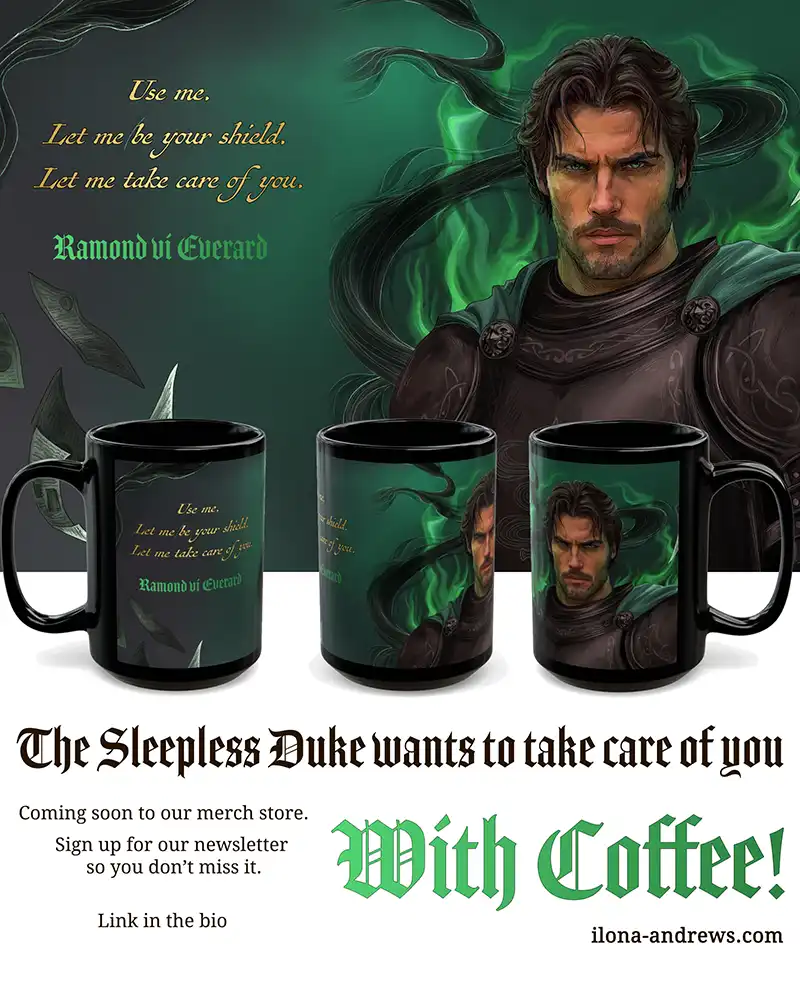
If you give BDH a hand, they will bite your arm off at the elbow. In that fine tradition, we immediately got this response on Facebook.

Behold the ridiculous video. Sound on, please.
::clears throat:: Call me Archmage.
This mug will be available in 11oz only. That is the only size they have,
Personal Things.Rough couple of weeks for various reasons. Getting older isn’t for the faint-hearted. And this morning, I woke up to a broken pot.

One of the resident catnip addicts must’ve really wanted the catnip growing in it. I don’t know why but that pot did me in. It was pricy. I informed the cats that they are the reason we can’t have anything nice. They are unrepentant.
You can tell the stress is getting to me, because this is my latest blanket.
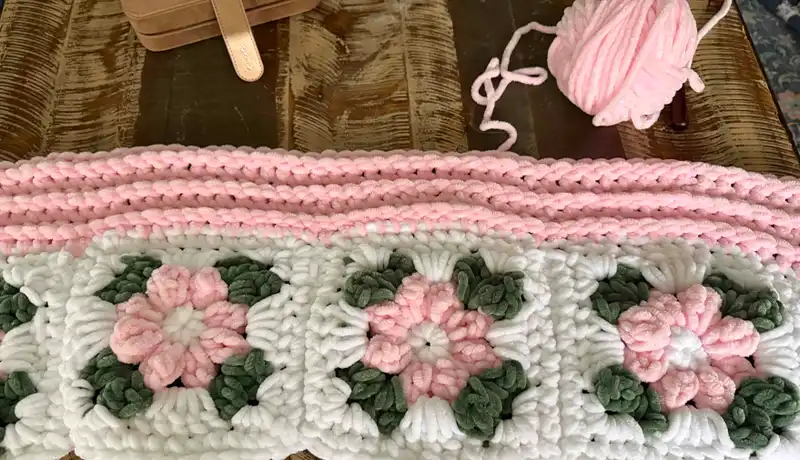
Like what is even happening here. It is hella pink.
The book is at 213K.
The post Life, Merch, and Other Trauma first appeared on ILONA ANDREWS.
Categories: Authors
Lately, It’s All Time Travel, All The Time (pun intended)
My latest novelette, “The Test of Time,” just appeared in Lightspeed Magazine. Editor John Joseph Adams describe the story by saying it contains “all the SFnal crunchiness of time travel paradoxes inside a delicious academia setting. It’s like the Reese’s peanut butter cup of SF novelettes!” And, y’know? It is! I think you’ll enjoy it. You can read it for free here or listen to the audio version, also for free.
And, if you want even more time travel, pick up my novel Snipers, which is part of the What If… book in the current Escape from 2026 Storybundle. Lots of alternate history fiction as well as time travel fiction here. The bundle will run for just a few weeks, so get your books now.
Categories: Authors
A Poem Opens Between Two Languages in “O” by Zeina Hashem Beck

In this week’s LitStack Rec we set our sights on the luscious and beautiful book…
The post A Poem Opens Between Two Languages in “O” by Zeina Hashem Beck appeared first on LitStack.
Categories: Fantasy Books
Uh-oh: The Bride!
Sue Granquist, Black Gate’s own incomparable Goth Chick, died not quite seven months ago, and the hole she left here is impossible to fill. I don’t know about you, but my Thursdays just haven’t been the same.
Sue’s beat was horror in all of its manifestations (well, maybe not all of them — I never remember her saying anything about politics), and she was especially keen on horror movies and television shows. Next to her husband Terry, the genre was the great love of her life.
Sue was always up to date; the avant-garde held no surprises for her, but she was really passionate about the good old stuff. Karloff and Lugosi, Jekyll and Hyde, the Mummy and the Wolfman, all those late-night or Saturday afternoon, black and white television terrors that begin with the little airplane circling the Universal globe — those classics put her in her happy place, if a fog-shrouded moor or cobwebbed crypt are places that foster happiness. For Sue, they were.
The Goth Chick was especially attentive to any new versions of those old stories and characters; any new Mummy or Dracula or Wolfman movie drew her instant attention, and her attitude was always a finely-balanced blend of hope and skepticism, at once generous and jaded. She was prepared to like anything if it was good, but she always had a torch and pitchfork at hand to storm the castle of the shoddy or slapdash.
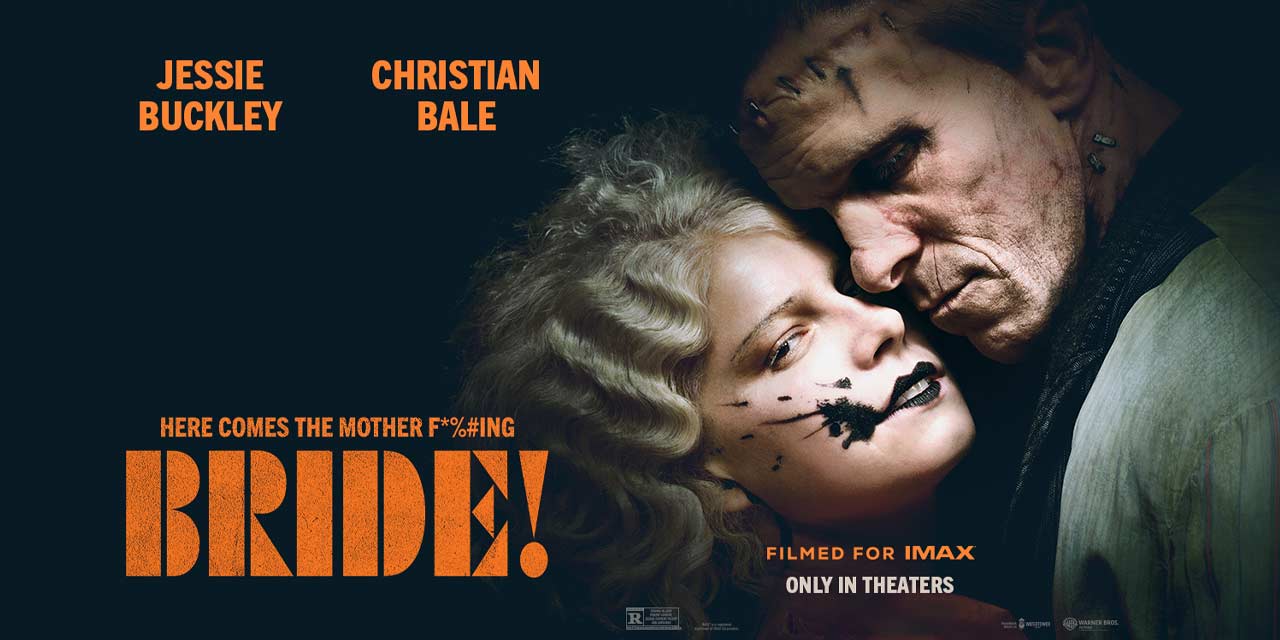
Which brings us to the most recent “updating” or “reimagining” of one of the Universal Studios classics, The Bride!, writer-director Maggie Gyllenhaall’s take on the 1935 Boris Karloff-Elsa Lanchester Bride of Frankenstein.
It premiered on March 6th of this year and started streaming a couple of months ago on HBO, where I finally caught it Thursday night. It’s a movie Sue never got to see, but I know she would have been on it like stink on a monkey. I don’t know what she would have thought of it, though I can make a fair guess. In any case, as soon as I saw the trailer (my reaction? “Uh-oh”), I knew that someone around here should write about the film out of respect for the Goth Chick. Needless to say, what follows is (entirely) my own reaction. As always, your mileage may vary.
Summary will only make the movie sound even nuttier than it actually is, which is nutty enough, so I’ll be brief. Doctor Frankenstein’s monster (Christian Bale) shows up in 1936 Chicago to seek out the famous Doctor Euphronious (Annette Benning). He’s lonely, you see, and having read Euphronious’s books he knows that she’s the only one who can help him — by making a mate for him. After some dickering, they settle on the lovely corpse of Ida (Jessie Buckley), a speakeasy girl who was killed while working in the establishment of the city’s top gangster, Boss Lupino.
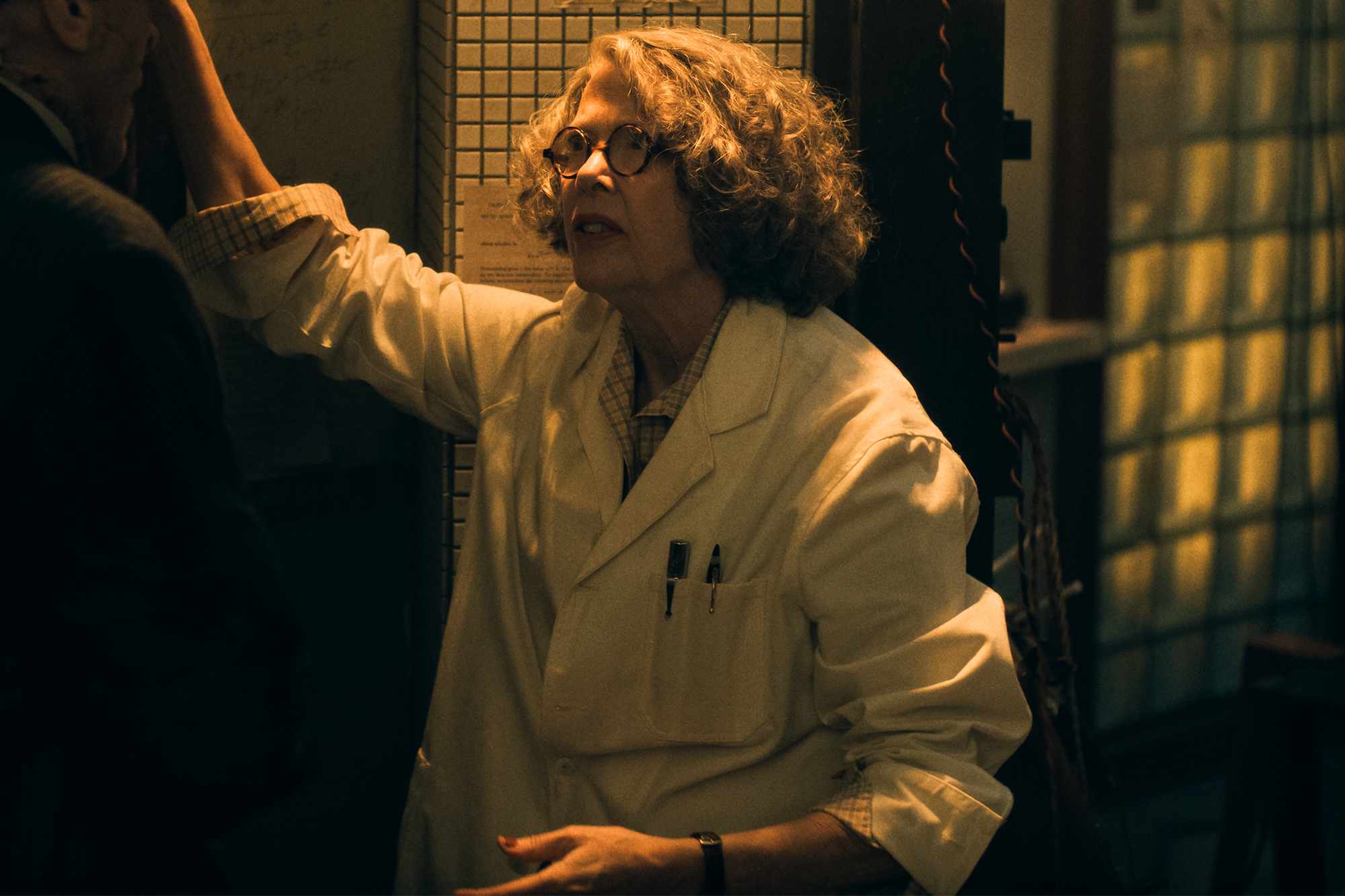 Dr. Euphronious
How did she get killed? She was possessed by the pissed-off spirit of Mary Shelley — also played by Buckley — who wants to use Ida to tell the story she really wanted to tell back in 1818. Why did she wait a hundred and eighteen years? Look, if you’re going to ask questions like that, we’re never going to get through this. Anyway, while thrashing around and spewing Shelley-prompted profanity (who knew that Mary had such a potty mouth?), Ida fell down some stairs and broke her neck.
Once reanimated, Ida and Frank (yep, that’s what they call him) go through a brief but bumpy courtship and become a couple, and after a few killings that of course are in no way their fault, they go on what used to be called a tri-state crime spree (though I’m really not sure how many states are actually involved; I do know they wind up in New York, where reanimated corpse sex is nothing that the Big Apple can’t handle). All the while, cops, gangsters, and reporters are all hot on their trail, and it ends as such things always do, with the misunderstood lovers riddled with bullets. Of course, Doctor Euphronious knows what kind of movie she’s stuck in and exactly what’s expected of her, and the last thing we see (the dead hands of Frank and the Bride twitching and reaching for each other) suggests that they’ll be baaaack!
They won’t be back. The last accounting indicated that The Bride! was well on its way to losing a hundred million dollars. That’s the kind of dead that there’s no coming back from.
The actors are all talented people who try hard; your heart especially goes out to Buckley and Bale as they strain to animate these puppets (Annette Benning just seems eager to cash her check and get the hell out of town, which is perfectly reasonable), but with the obstacles in their way, all their efforts go for nothing. You can’t blame them, though (or Peter Sarsgaard or Penelope Cruz, who also give it their best); the grindingly tendentious and yet disjointed story and flashy, meretricious direction would defeat anyone.
The main problem is that the movie’s writer-director neglected the first step in creation — you have to decide what it is that you want to create. (Victor Frankenstein could have told her that.) Is The Bride! a horror story? A gangster story? A satire? A comedy? A feminist polemic? A romance? An absurdist fable? An homage? I don’t know because Gyllenhaal doesn’t seem to know; any of them would have been fine with me, but it’s all of them at once, which means that finally it’s none of them. It’s just a shapeless, self-indulgent, pretentious, incoherent, contradictory mess, a film abounding in ideas but without any of the discipline that could give those ideas shape and force. The result is a movie that’s seemingly in the grip of Tourette’s Syndrome, as scene by scene (and minute by minute within each scene) the mood wildly lurches from comic to tragic to satiric and back, without ever resting on one long enough for you to discern the filmmaker’s intentions.
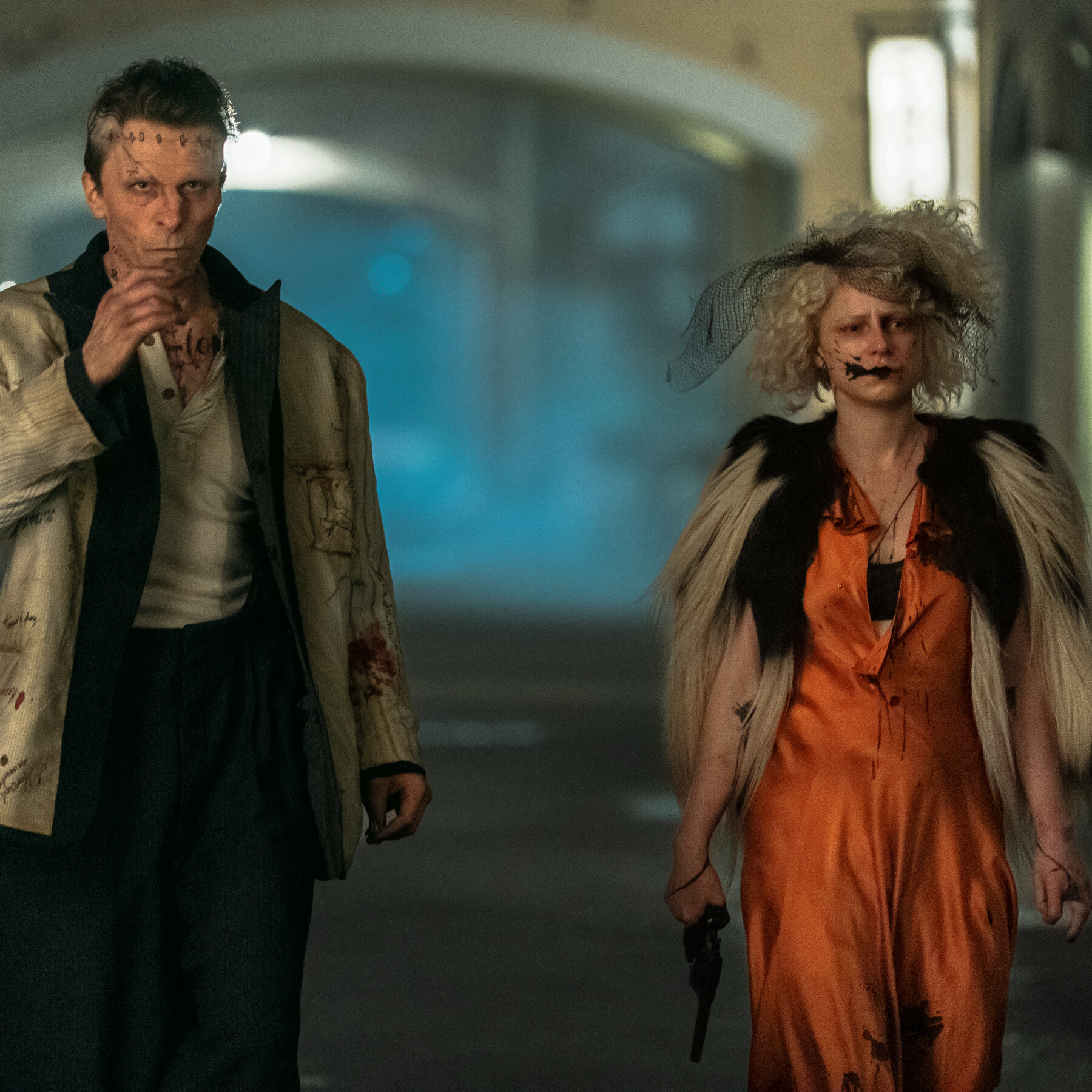 The Happy Couple
It’s a movie with no center that wants to be given credit for peripheral winks and nudges and “wit” that rarely rises above the sophomoric. In a film with supposedly serious ambitions, what are we expected to make of the “scientific” gobbeldygook spouted by Euphronious that literally sounds like the sort of thing you used to hear on Dexter’s Lab? And two thirds of the way through the movie I suddenly realized that Gyllenhaal wants us to recognize and applaud the conjunction between the names of the heroine and the main villain — Ida and Lupino. Ida Lupino. Get it? Yes, Ida Lupino is a feminist icon, a great actor who was also a pioneering director in an era when very few women got the opportunity to direct movies. Fine… but Ida Lupino’s films are invariably sharp and incisive, efficiently organized and without an ounce of fat. I’m not sure she would be all that pleased to see her name appropriated for use in an incompetent, scatter-shot disaster like The Bride!
I know I might justly be accused of piling on, but honestly, there are so many things wrong with this movie, one of the biggest being the risible dialogue, which is the worst I’ve heard since Harlan Ellison’s The Oscar. The setting is also a problem — is this really 1936 Chicago or not? Twenty minutes in, I was exhausted from dodging the nonstop anachronisms, and I could never determine whether their presence was part of some obscure design or just the result of ignorance or laziness.
And you should be very careful when filling your film with references to earlier works like Young Frankenstein (believe it or not, there’s a “Putting on the Ritz” sequence in The Bride!), Bonnie and Clyde, and the Fred Astaire-Ginger Rogers musicals. (Inexplicably, Frank loves the movies of song-and-dance man “Ronnie Reed,” played by Jake Gyllenhaal, and we get to see scenes from several of them, giving us a look at Maggie’s idea of what old Hollywood movies were like, if that’s your idea of a good time.) Too often the effect is just to remind viewers of how much better those movies are than this one is, to say nothing of prompting thoughts of what Louis B. Mayer would have done to the director of a turkey that lost this kind of money. (Would he have just run Gyllenhaal out of town, or would he have put out a contract on her? Hmmm…)
The most pertinent comparison is of course to James Whale’s immortal The Bride of Frankenstein, a ninety-one-year-old movie that’s riskier, funnier, scarier, more daring and subversive and moving than this product from the cutting edge of 2026, which is too restless to be involving, too frenetic to be exciting, too confused to be illuminating and too filled with unearned self-regard to be worthy of even the respect due to an ambitious failure.
Maybe Sue would have found more virtues in The Bride! than I have been able to; I don’t know. (I almost hope she would have; I don’t like to think of her wasting two hours of precious time the way I did.) But I do know that she would have seen something in the movie that I also saw, the one good thing about it: a hint of the hold these old stories have on us, a hold so strong that Frankenstein and Dracula and the rest are constantly being recreated anew, sometimes successfully and sometimes not — but the desire and the act are always a testament to the power of the originals, and a reminder that they’re strong enough to survive any manhandling… or womanhandling, in Ms. Gyllenhaal’s case. We can take some comfort from that, at least.
 Sue Granquist, saluting the best in classic horror
Honestly, at the end of the day, The Bride! is such an unqualified fiasco that it’s hardly worth talking about for its own sake; I really just wanted an excuse to see Sue’s name here one more time. I miss her.
Here’s looking at you, Goth Chick.
Thomas Parker is a native Southern Californian and a lifelong science fiction, fantasy, and mystery fan. When not corrupting the next generation as a fourth grade teacher, he collects Roger Corman movies, Silver Age comic books, Ace doubles, and despairing looks from his wife. His last article for us was A Boy Scout’s Handbook: The Mysterious Island
Categories: Fantasy Books
THE TRAVELER by Joseph Eckert
One of the great things about reading (and reviewing!) books is that every now and then you get a complete surprise – one of those books that you know little about before reading but then it goes above and beyond what you expect. This was one of those. To give context, although the book is…
Categories: Fantasy Books
BDH Crosswords
Friday is Horde enrichment activity day, because otherwise we start to think Steve ideas make sense.
Behold, the Ilona Andrews crossword for June 5th:
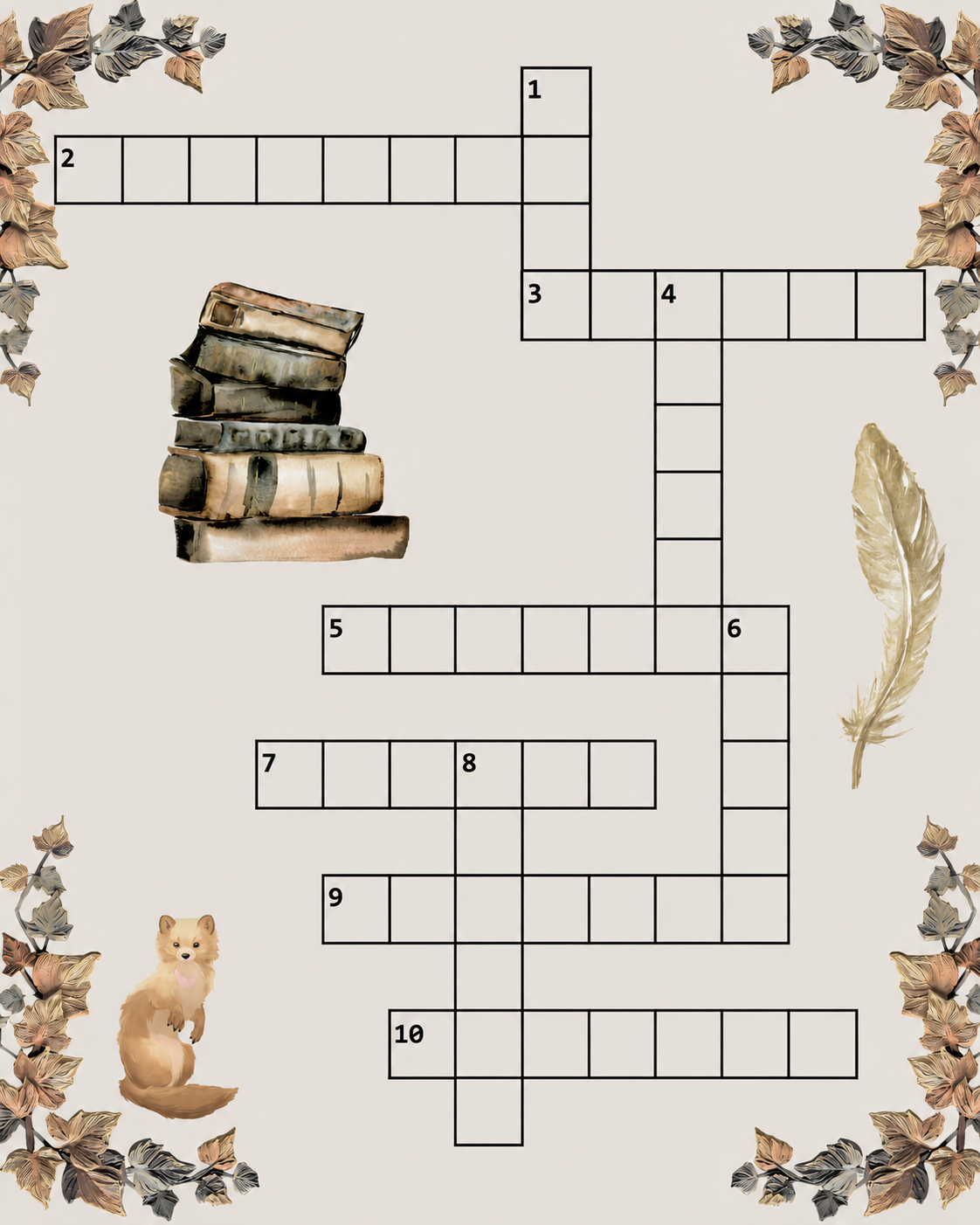 Across
- 2. Border-lord title with excellent fantasy credentials.
- 3. Kinsmen whose family drama comes with built-in force blades.
- 5. Ever merciful and kind to a fault. Title.
- 7. Its prophecy speaks for all the covens; tortoise throat spit on the house.
- 9. Old dragon whose Horde fans survive on two snippets and a prayer.
- 10. The cutest argument for pressure sensors in dryer vents.
- 1. Criminally fluffy galactic merchants.
- 4. Dye miracle worker with robbery-level bargaining skills.
- 6. The moon people, the swamp elders and mud crawlers, ancestors to one of the galaxy’s greatest showmen.
- 8. To admire the vampire full moon among the flowering apple trees, first serve this Earth beverage.
This is a static image, not an interactive puzzle, because the blog is many things, but not a puzzle app. You can copy it by hand, or save/print the image if you prefer paper and pencil.
This is completely optional and strictly for fun. If crosswords make your eye twitch, or the clues are too chernobogian, please feel free to ignore it with the most esteemed Mod R’s blessing.
The answer key will be posted tomorrow if it hasn’t already been figured out in the comments.
Happy puzzling! Mischief responsibly this weekend.
The post BDH Crosswords first appeared on ILONA ANDREWS.
Categories: Authors
Forgotten Authors: Philip Francis Nowlan
 Philip Francis Nowlan
Philip Francis Nowlan’s name may not be remembered by many, but he may be the most influential science author I’ll discuss in this series. Born on November 13, 1888 in Philadelphia, Pennsylvania, Nowlan earned a Bachelor of Arts from the University of Pennsylvania in 1910. At college, he was a member of The Mask and Wig Club, a college musical comedy troupe, and he wrote and performed in their shows. He married Teresa Marie Junker in 1918 and they had ten children, four daughters and six sons, one of whom, Michael Joseph Nowlan, died earlier this year at the age of 99. His son, Philip F. Nowlan, Jr., was enough of a science fiction fan that it was mentioned prominently in his obituary.
Although he worked for various newspapers, including the Public Ledger, the North American, and Retail Ledger, his most notable work was his debut science fiction story.
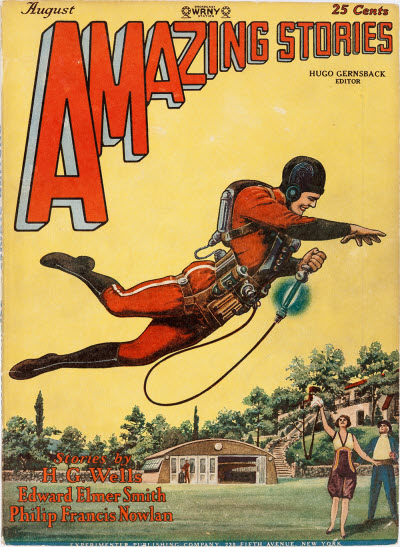 Amazing Stories, 8/28
Cover by Frank R. Paul
In the August 1928 issue of Amazing Stories, Nowlan published the story “Armageddon 2419 A.D.,” which introduced Anthony “Buck” Rogers to the world. The story appeared in the same issue that featured the first of E.E. “Doc” Smith’s Skylark of Space stories. The following year, Nowlan and Dick Calkins created a comic strip based on Buck Rogers, which would run until 1967, although Nowlan’s participation ended in 1939. The property was also a radio serial that ran from 1932 through 1947, a movie serial in 1939, a television serial in 1950, and another television series from 1979-1981.
While Nowlan’s focus was on the comic strip, and several stories were adapted for Big Little Books, he also wrote a handful of other stories, including “The Onslaught of Venus” under the name Frank Phillips, “The Time Jumpers,” and “The Prince of Mars.” One of the Big Little adaptations, Martians Invade Jupiter, was a finalist for the Retro Hugo Award for Best Graphic Stories in 2019, losing to Wonder Woman #5 “Battle for Womanhood.” Nowlan was inducted into the First Fandom Hall of Fame in 2003.
Nowlan suffered a fatal stroke on February 1, 1940 at his home in Bala Cynwyd, Pennsylvania. His stories “Space Guards” and the mystery novel The Girl from Nowhere were published posthumously.
 Steven H Silver is a twenty-two-time Hugo Award nominee and was the publisher of the Hugo-nominated fanzine Argentus as well as the editor and publisher of ISFiC Press for eight years. He has also edited books for DAW, NESFA Press, and ZNB. His most recent anthology is Alternate Peace and his novel After Hastings was published in 2020. Steven has chaired the first Midwest Construction, Windycon three times, and the SFWA Nebula Conference numerous times. He was programming chair for Chicon 2000 and Vice Chair of Chicon 7.
Categories: Fantasy Books
Book review: The Fist of Memory by Wole Talabi

Book links: Amazon, Goodreads
Genre: Sci-Fi First Contact Thriller
ABOUT THE AUTHOR: WOLE TALABI is an engineer, writer, and editor from Nigeria. He is the author of the speculative action thriller THE FIST OF MEMORY (2026) and the acclaimed fantasy novel SHIGIDI AND THE BRASS HEAD OF OBALUFON (2023) which was nominated for the Nebula, Locus, and World Fantasy awards. His short fiction has appeared in Asimov’s, F&SF, Lightspeed, and other major venues and is collected in CONVERGENCE PROBLEMS (2024) and INCOMPLETE SOLUTIONS (2019). His work has won multiple awards and been a finalist for the Hugo, and the prestigious Caine Prize. His stories have been translated into a dozen languages. He has edited five anthologies including AFRICANFUTURISM (2020) and MOTHERSOUND: THE SAUÚTIVERSE ANTHOLOGY (2023). He likes scuba diving, elegant equations, and oddly shaped things. He currently lives and works in Australia. Find him at @wtalabi on Twitter, Instagram, Bluesky and Tiktok.
Publisher: DAW (October 27, 2026) Page count: 416 Formats: audiobook, ebook, hc
I requested The Fist of Memory on NetGalley because the synopsis sounded exactly like my kind of sci-fi: first contact, assassins, strange technology, all set in Nigeria instead of the usual familiar locations. Glad I did, because this is a really interesting novel.
An alien spacecraft appears above Earth without communicating with anyone, which naturally sends the world into panic mode. The story focuses on an astrophysicist, a professional killer working for a mysterious witchdoctor, and another assassin completely consumed by revenge. None of them are especially likable or relatable, honestly, but that fits the tone of the novel. Everyone here feels damaged in one way or another.
What I liked most was the near-future setting. Talabi throws in loads of clever details that make the world feel slightly ahead of ours without drowning the reader in exposition. People have Neuranexuses embedded in their brains and casually perform tasks through neural commands while AI assistants quietly run their lives in the background. Money transfers, home management, communication - they all can be handled with a thought. Which sounds convenient right up until someone starts feeding people false memories and ideas directly into their heads.
At times, the book becomes heavily philosophical. The aliens themselves are interesting because they’re not really invaders in the traditional sense. They might actually be trying to help humanity, although "help" becomes a complicated word here. The novel spends a lot of time exploring connectedness, shared memory, identity, and what people could become if human consciousness stopped being so isolated. Some of those sections slowed the pacing a bit, but the ideas themselves were strong enough that I didn’t mind too much.
There’s still plenty of action too. Assassinations, betrayals, fights, political tension. The book started years ago as a revenge thriller before Talabi expanded it into something much larger, and you can still feel that DNA underneath all the sci-fi and metaphysics.
I did have some issues with the prose. Talabi’s writing is good, but some metaphors felt too noticeable for my taste. Lines about realizations crystallizing "like salt" or glass "screaming" when it shatters weren't my jam. I tend to prefer more neutral prose, so mileage will definitely vary depending on the reader. Some people will probably love that style. For me, it occasionally got in the way.
Still, once I settled into the rhythm of the novel, I ended up pretty impressed by it. Wole Talabi clearly had big ideas he wanted to explore, and for the most part he pulls it off. Thoughtful sci-fi with strong concepts, cool technology, and enough action to keep the philosophical parts from floating completely into space.
Categories: Fantasy Books
Audiobook Review – The Inheritance (Breach Wars, Book 1) by Ilona Andrews, Narrated by Hillary Huber, James Konicek (4/5 stars)

Reading Level: Adult
Genre: Science Fiction
Length: 8 hours and 14 minutes
Publisher: NYLA
Release Date: January 28, 2026
ASIN: B0GGTLCCWR
Stand Alone or Series: 1st book in the Breach Wars series
Source: Bought Audiobook from Audible.com
Rating: 4/5 stars
“We are at war. The interdimensional invasion brought us unimaginable suffering, but it also awoke talents slumbering deep within us, a means to repel and destroy our enemy. Every day new gates open, leading to breaches filled with monsters and valuable resources. If you are a Talent, your country needs you. The world needs you. Be the hero you were born to be.
Adaline is a Talent. Ten years ago, she had a happy marriage and a job she loved. The invasion shattered both. Now she works for the government, searching the breaches for magic metals and medicine to help Earth repel an interdimensional enemy. Two kids, one cat, bills, benefits, mortgage and school tuition…Risking her life became routine.
She had gone into the dimensional gates hundreds of times. She was always well protected. This time everything goes wrong. Now Ada is trapped in the labyrinth of alien caves unlike any other. Her only companion is a scared German Shepherd named Bear. Together they must uncover the breach’s secrets and escape, because Ada promised her children that she will come home.
The future of humanity depends on it.”
Series Info/Source: This is the 1st book in the Breach Wars seres. I bought a copy of this on audiobook from Audible.com.
Thoughts: While I love the Ilona Andrews writing team, I have been struggling with the fact that they start so many projects they don’t finish. Normally, I would have snapped this up right away, but I waited for a bit because I am worried that this is another side project where they are going to start something but not follow through on it. I am still waiting for the resolution to The Innkeeper Chronicles, the continuation of The Iron Covenant, the continuation of Aurelia Ryder, and possibly some more Wilmington Years…
This book is a near future sci-fi where inter dimensional portals called breaches started opening on Earth and flooding our planet with monsters/aliens. Oddly, at this same time humans started gaining special talents that help them to fight and repel these monsters. The story follows Adaline whose Talent is assessing material in breaches for their worth; she can identify valuable minerals, and dangerous objects. Things go very wrong in the current breach she is assigned to and Ada ends up trapped in the breach with a German Shepherd named Bear as her only companion. She needs to find a way to escape the breach or at least survive until a team comes in to rescue her.
This was very typical Ilona Andrews. There is a lot of action, some adventure, and a lot of overly dramatic angsting about kids. The story goes back and forth between two POVs. The first is Adaline, who we hear the majority of the story from. The second is the leader of the group that Adaline was working for, who needs to go into this Breach to find out what happened. While Ada is trying to survive, he’s trying to get a team put together to enter the breach to assess the situation.
While I enjoyed this, there was a lot in here that was very similar to other books this team has written. There are lots of very well done action scenes and some intriguing monsters. The world-building is a bit gimmicky and contrived feeling, but feels complete. The characters have sharp senses of humor but can be overly dramatic and a bit too in their own heads at points. I liked Adaline, but she is a very typical Ilona Andrews type protagonist; she is smart, tough, has a weak spot for children and pets, and gets way too powerful too quickly.
In the end, I felt like this was fine. If you are a big Ilona Andrews fan, then you are familiar with the style and types of characters here. This is more of the same from them. That isn’t necessarily bad; a lot of people want more of the same. There just doesn’t seem to be a lot of anything new here. I liked the characters, but they are very similar to many other characters that this writing duo has come up with. The world-building was intricately done but seemed very contrived and implausible. The story went exactly as I expected it would go. Will I continue with this series? I think the bigger question is will Andrews actually finish one of their “side” projects…so we will see another book in this series?
I listened to this on audiobook and the audiobook was very well done. There are two narrators, and they both do an excellent job with their parts of the story. If you enjoy audiobooks I would recommend listening to this on audiobook.
My Summary (4/5): Overall this was fine, I enjoyed the action and adventure here. The characters were decent but similar to characters in other series by this writing team. The world-building was well done but felt immplausible and contrived. The story was very predictable. I am on the fence about whether or not I will finish this series. I really wish the Andrews team was working on finishing up some of their other spin-off series first.

Categories: Fantasy Books
Dark Muse News: Battleborn Magazine Issues 2 and 3
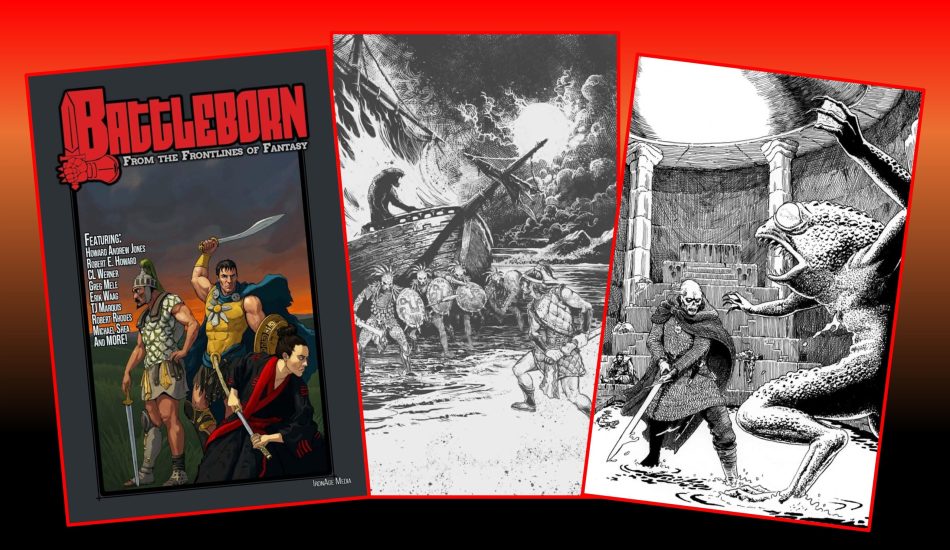 [LEFT] Battleborn issue #1 (cover art by Samuel Dillon); [CENTER] Interior Art for “Jaguar’s Children” by Greg Mele (artist Babeto Daroz); [RIGHT] art for Lee Patton’s “Temple of the River King.”Black Gate has covered the inception of Battleborn magazine as it spawned from an August 2025 crowdfunding on Indiegogo. Columnist and author Mark Rigney interviewed the champion and chief editor Sean CW Korsgaard over three segments: Part 1, Part 2, and Part 3.
Too much ground to recap here, but we can highlight that the goal of the magazine is to blend contemporary Sword & Sorcery with reprints of classics (beyond Robert E. Howard, there will be Michael Shea, David Drake, and even more….that we ‘kane’t’ wait to share the identities of!)
Sean CW Korsgaard is not to be confused with the Commander of Battleborn Magazine. This character is akin to the Skull from Tales from the Magician’s Skull, and he is as rough as the skeletal icon, but perhaps a bit easier on his interns. The Commander has provided his sacred guidance below.
This post covers the initial reception to the advanced review copies of issue #1 (reaching the open market now, as this is written! Check back for later edits that will include links to order), the schedule targets for Issues #2 and #3, and even a special note from the Battleborn Commander. Looking for review copies or feedback from fans? Check out Battleborn’s Facebook Page (Link), and contact the Commander (via his intern-like admins).
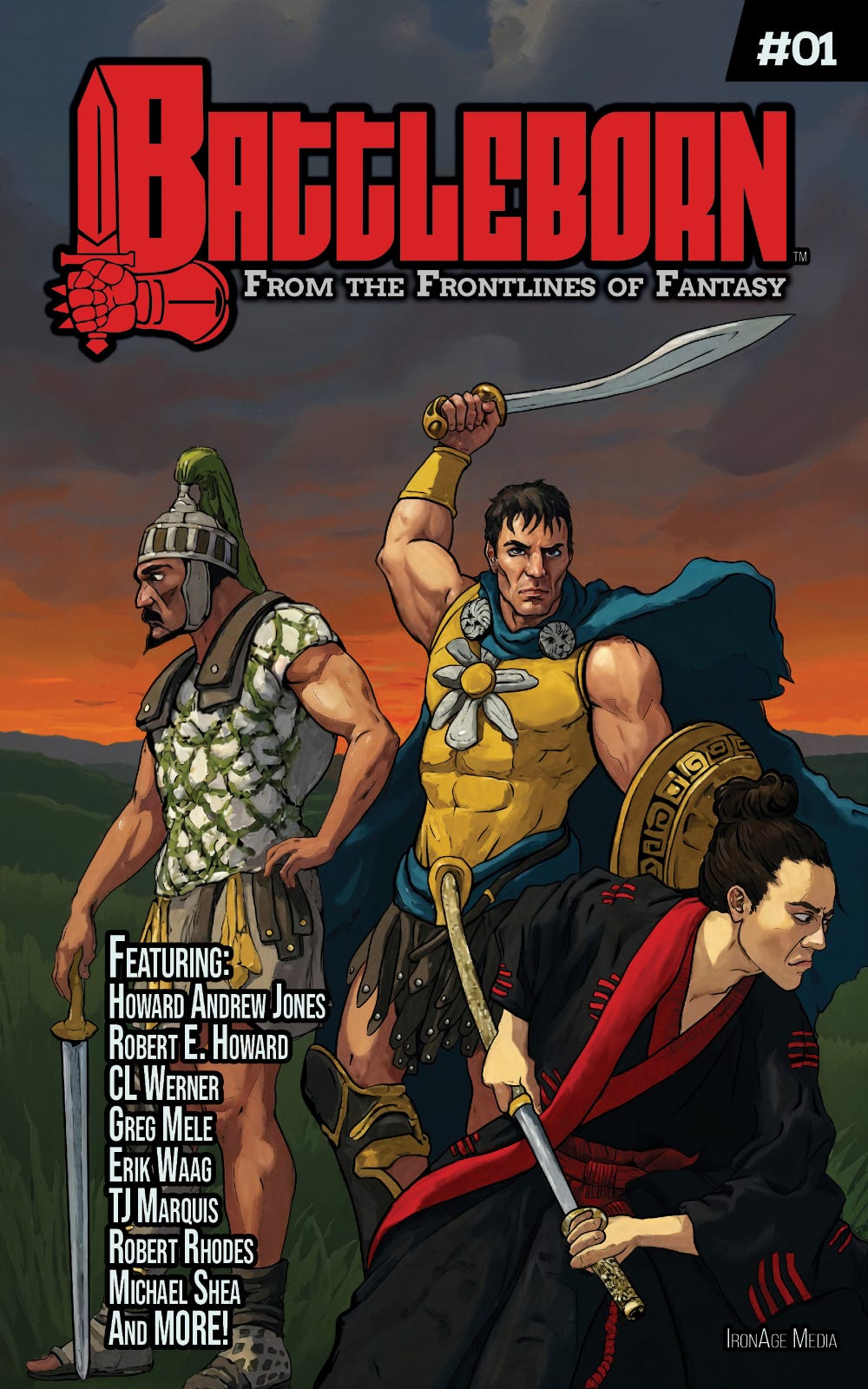 Battleborn, issue 1
Reviews of Issue #1
James D Mills from The Arcanist: Fantasy Publishing
Battleborn, issue 1
Reviews of Issue #1
James D Mills from The Arcanist: Fantasy Publishing
The next Savage Sword of Conan?… Battleborn magazine is a new Sword and Sorcery magazine that brings the charm of the classics to new readers. They’re also devoted to sharing newer writers with the world. Overall, I found this to be a fun read and a compelling beginning to a magazine that I hope runs for a long time. It has a clear identity and is built to provide a multi-medum format that is meant to celebrate the genre as a whole.
The Gung-Ho Book Club Podcast & WordPressBattleborn hit the ground running thanks to the experience of the editorial team and the solid newcomer stories backed by even more solid veteran fare. The columns are highly informative and thought provoking, the comic is a neat touch, and The Commander is the absolute boss.
Don McGregor ReviewBattleborn enters the Sword & Sorcery magazine anthology market not with a whimper, but with a booming battle cry. It is an ebullient rallying cry that celebrates authors both living and dead in a beloved genre. I STRONGLY RECOMMEND that you not only purchase this first issue but find a way to support it through a subscription to future issues.
David Riley (Horror/Fantasy/Sci-Fi writer and co-owner of Parallel Universe Publications) ReviewIt’s good to see that unlike too many periodicals Battleborn does not shy away from publishing reprints… At over 200 pages, Battleborn is a substantial read, with ne’er a poor story anywhere in sight. Definitely an important addition to the growing number of sword and sorcery publications appearing today in what is truly an exciting period in our genre.
Issue #1 ContentsBATTLEBORN BRINGS SWORD-AND-SORCERY’S BOLDEST STORIES – FROM THE FRONTLINES OF FANTASY TO YOUR FINGERTIPS!
Battleborn is a magazine that collects the very best of modern and classical sword-and-sorcery and heroic adventure stories, and delivers page after page of fist-pumping blood-and-thunder fantasy for your reading pleasure. It’s more than just a magazine – it’s a celebration of that grand fantasy tradition of two-fisted action and unforgettable heroes going back to the pulps, and the writers who have kept that spirit alive for generations.
Battleborn issue 1 contains the following stories and poems.
- “A STONE’S THROW” by Howard Andrew Jones
- “BLOOD OF THE ONI” by C.L. Werner
- “JAGUAR’S CHILDREN” by Gregory D. Mele
- “VENGEANCE VOW” by TJ Marquis
- “TO BOAST OF VICTORY” by Erik Waag
- “TEMPLE OF THE RIVER KING” by Lee Patton
- “THE FURY’S BLADE” by Robert Rhodes
- “THE ROAD OF KINGS” by Robert E. Howard
- “PEARLS OF THE VAMPIRE QUEEN” by Michael Shea
- “THE LAST SPELL” (Part 1 of 3) by Schuyler Hernstrom
Each story is paired with glorious black-and-white artwork, and they’re accompanied by columns penned by some of modern fantasy’s boldest thinkers, including Sean CW Korsgaard, Jason M. Waltz, Morgan Holmes, Jason Ray Carney, Gregory D. Mele, and The Commander!
All this and more in this volume of BATTLEBORN! So what are you waiting for? If love for heroics and glory beat in your chest like a battle drum, grab your copy today, and become a hero. Become a legend! Become… BATTLEBORN!
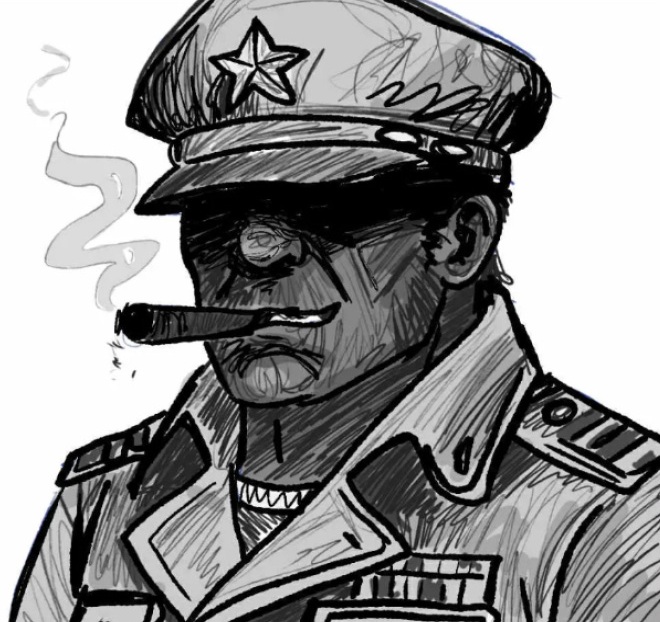 Battleborn Commander Address
Brothers-in-arms of Black Gate!
For countless years, you have gallantly carried the banner of sword-and-sorcery forward when blaggards and cowards left it for dead. You were among the first, and many a gallant ally joined you in fighting the good fight – Tales of the Magician’s Skull, Old Moon Quarterly, Savage Realms Monthly, Heroic Fantasy Quarterly, DMR Books and so many others.
At last, it is Battleborn’s turn to carry the banner of sword-and-sorcery forward to greater glory along the frontlines of fantasy.
Long have you waited. Long have we labored and trained. Now our hour at glory is at hand, and we’re ready to join the charge with not just one, but the first two issues of Battleborn.
Not only are they beauties – glorious black-and-white art paired with every story – and not only did we fulfill our promise to deliver one of the most brutal flavors of fantasy between our folds, with heroic fantasies’ finest firing on all cylinders on every page… Battleborn is also the biggest sword-and-sorcery magazine in print today, with over a 100k words an issue of glorious heroes committing bloody deeds, not including columns, reviews, comics, and words of wisdom shared by me, your patron of pulp and paragon of masculinity, The Commander.
But this is not only about celebrating face-melting, hard-hitting, fist-pumping sword-and-sorcery. This is about saluting the brave and bold men and women who’ve spent months fighting the good fight to make sure Battleborn arrives to your hands as the biggest and boldest magazine it could be.
To the staff who kept the magazine moving forward by tireless effort and sheer fucking will… to the blooded veterans and gentlemen rankers of sword-and-sorcery, whose names and stories we wear like a badge of honor… To the late lamented legends of the subgenre whose spirits and stories we seek to keep alive in our pages… And to the hungry greenhorns who drew first blood in our slush pile, and are about to earn their ranks within sword-and-sorcery…
We salute you. I salute you.
I couldn’t be prouder of all of them or of Battleborn. Why, I might even shed a tear, if I hadn’t lost my tear ducts in the war.
I can’t wait for all these fine warriors to set your hearts and this genre ablaze with their swords and their stories.
Brothers of Black Gate — join us in Battleborn‘s Great Crusade, to put boots to asses, bring books to the masses, and restore sword-and-sorcery to its rightful place in fantasy: reigning supreme atop the bloody throne.
Glory awaits. Triumph awaits. Battleborn awaits.
We’re ready – are you?
See you atop the walls.
Always Forward, The Commander
The Commander’s ForumThe Battleborn leaders and community do a great deal of their chatting on their Facebook page (follow along now).
The Battleborn Battle Plan- Issue #1 – available imminently (publication in process)
- Issue #2 – to be showcased ~ Howard Days, June 11th being the anniversary of the Father of Sword & Sorcery’s death, and the event in his honor being June 12th & 13th this year.
- Issue #3 – to be released ~ The Day of Might, Oct 23rd every year, in honor of Howard Andrew Jones‘s stranger-half (a.k.a. the “Skull”) who declared that day in celebration of the anniversary of the day on which the Skull first revealed himself to the modern world!
- “Alyrienne” by Michael A. Stackpole
- “Calicask’s Body” by John C. Hocking
- “A Step in Time” by Violette Malan
- “Ten Arrows” by Alyssa Hazel
- “All in a God’s Way” by Jason M. Waltz
- “Wizard’s Right Hand” by Steven L. Shrewsbury
- “Surface” by Chuck Clark
- “Mortu and Kyrus in the White City” by Schuyler Hernstrom
- “Twilight of the Horn Hunters” by Scott Forbes
- “Crawford Valiance Lost” by Michael Panter
- “The Mantichore” by David Drake
- “The Sacker of Cities” by Daniel J. Davis
- “The Crosses Grow on Anzio” by Audie Murphy
- “The Last Spell” (Part 2 of 3) by Schuyler Hernstrom
- “Against the Wall” by James Enge
- “The Fury’s Rune” by Robert Rhodes
- “Scion Ung” by S.E. Lindberg
- “The Blood of Wolves” by Adrian Cole
- “The Icehawk” by Mark Rigney
- “In the Temple of the Shadow Moon” by Bryan Young
- “The Taker of Voices” by Richard Lee Byers
- “More Than Man” by K.D. Julicher
- “Thrall” by Charles Belt
- “A Violent Way” by e. rathke
- “Where First She Had Sinned” by Keith Alerec
- “The Wizard of Remembrance” by Sarah Newton
- A story to be revealed publicly at Howard Days 2026
- “Danny Deever” by Rudyard Kipling
- “Live Your Life” by Tecumseh
- “The Last Spell” (Part 3 of 3) by Schuyler Hernstrom
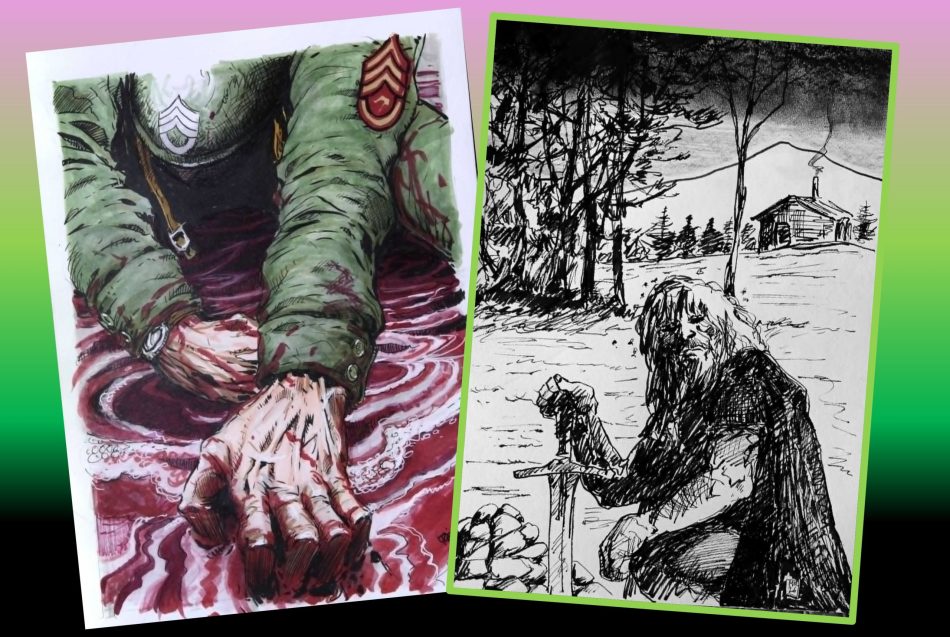 Sneak peek of interior illustrations for Issue #2, [LEFT] art for “The Crosses Grow on Anzio” by Audie Murphy (art by James O’Barr) and [RIGHT] art for “Valiance Lost” by Michael Panter (artist Mike Rollins)
S.E. Lindberg is Blackgate.com’s Managing Editor, regularly reviewing books, interviewing authors, and running Dark Muse News. He has led the Gen Con Writers’ Symposium and the Goodreads Sword & Sorcery Group; even interned for Tales from the Magician’s Skull, and is Assistant Editor for Battleborn. He contributed eight stories across Perseid Press’s Heroes in Hell & Heroika and an entry for Weirdbook’s Zombies. He independently publishes Dyscrasia Fiction®, stories of which have appeared in Whetstone and Swords & Sorcery magazines, A Book of Blades (Vol. I and Vol. II), DMR’s Terra Incognita, Tales From the Magician’s Skull, Savage Realms Magazine, and Michael Stackpole’s Chain Story 2 Project.
Categories: Fantasy Books
A Public Apology to Becka Moon
When we were first working on Kair Toren, we commissioned a map from Becka Moon of Becka Designs Cartography. Becka is a map artist who works with Inkarnate.
To clarify before some misunderstanding might occur: Inkarnate is not generative AI and has never been one. It is illustrative software that is tailored specifically to map making. It doesn’t generate maps, it requires a human artist, and it has been around for years.
Becka created a fantastic map which you can see below. She truly brought our vision to life, which is why we have been recommending her as the map artist.
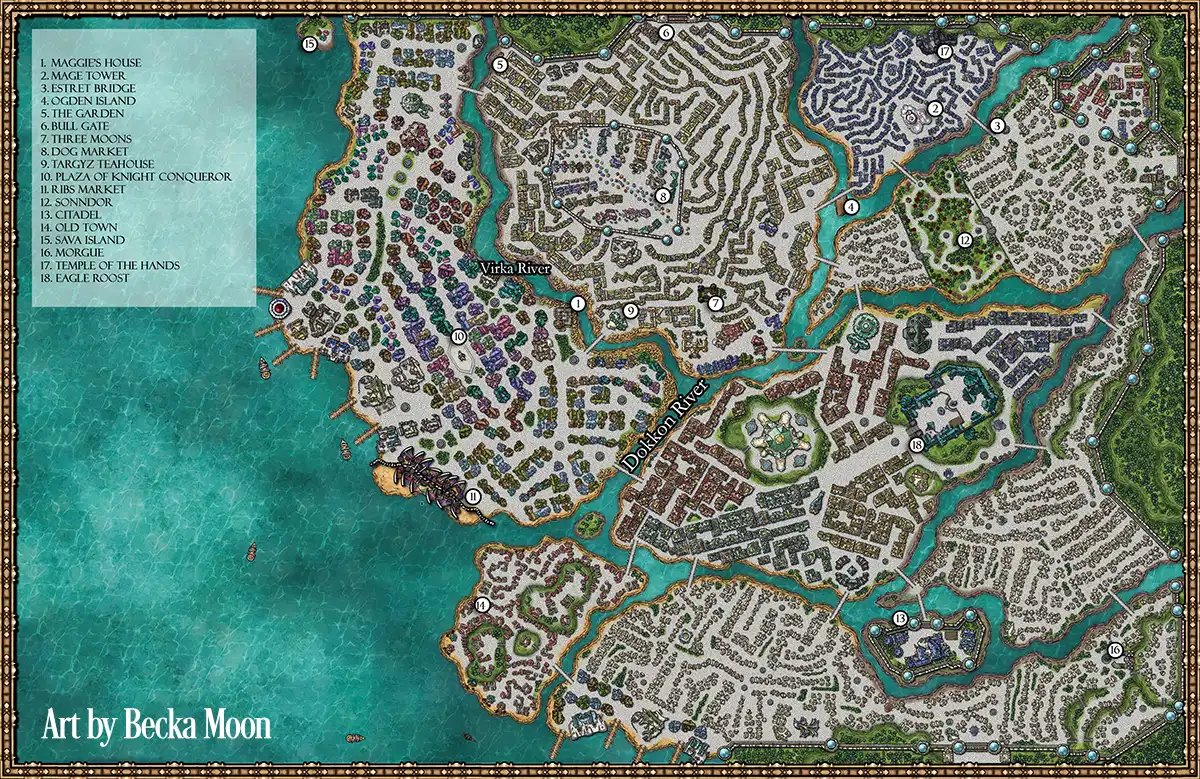 Art by Becka Designs Cartography
This map originally appeared on this site but was taken down prior to publication in accordance with Tor’s promotional schedule. Some of you might remember it.
We provided this map to Tor with the original contract. While I love this map with all my heart, a decision was made to replicate it and simplify it for print. Another artist, Jennifer Hanover, was commissioned by Tor to create a hand-drawn version that would work a little better in a black and white format and would reflect minor changes which occurred as the book was edited. Jennifer also created a piece of art, and you can see her version below.
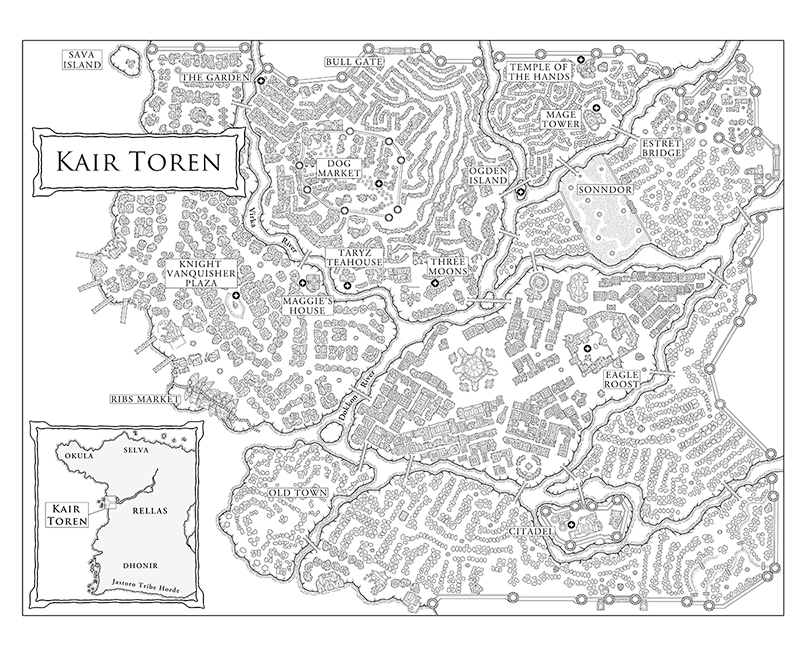 Art by Jennifer Hanover
As you can see, the two maps are very similar. Jennifer was credited as the map artist in the book, but Becka was not.
Why did this happen?
Becka and I executed our contract for her map in November of 2023 prior to the series being sold. That contract included a provision which asks for the copyright attribution. This is the image from the executed contract.
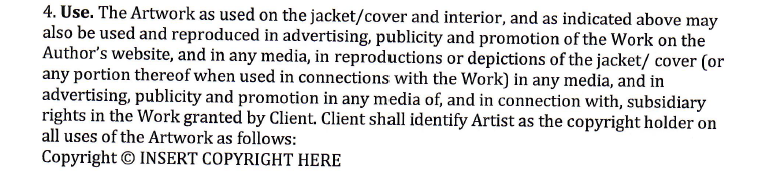
It reads:
4. Use. The Artwork as used on the jacket/cover and interior, and as indicated above may also be used and reproduced in advertising, publicity and promotion of the Work on the Author’s website, and in any media, in reproductions or depictions of the jacket/ cover (or any portion thereof when used in connections with the Work) in any media, and in advertising, publicity and promotion in any media of, and in connection with, subsidiary rights in the Work granted by Client. Client shall identify Artist as the copyright holder on all uses of the Artwork as follows:
Copyright © INSERT COPYRIGHT HERE
My guess is that this paragraph is the culprit. Bringing the book to publication requires coordinating many moving parts. This is exactly the kind of thing that seems minor but ends up causing issues, because everyone would pull the proper copyright attribution from this contract.
Whose fault is this?
This is my fault. My deepest apologies to Becka Moon. I am so sorry that I failed to ensure proper attribution.
The initial admin error is joint: Becka didn’t fill out the copyright line and I didn’t check the contract to make sure it was filled out. I verified the address, dates, and signatures and somehow overlooked the copyright line.
I bear more responsibility here, because I should have caught the lack of attribution in the finished book. Instead I was under impression that she was credited and only found out about the issue yesterday, when Becka emailed.
(It went somewhat like this: what do you mean you are not credited, you are credited, they have the contract, let me check…. !!!!! All the emails and phone calls.)
Tor bears no responsibility in this issue because I was the one who was supposed to provide the correct attribution. To their credit, they jumped on this issue immediately, and resolved it the same day, which is lightning speed in publishing. Amazing response here.
With that in mind, we have agreed to treat this contract issue as an oversight in good faith. This is not about technicalities but making things right and ensuring that the artist is credited. Therefore, we will proceed as if the line was properly filled out and treat it as a contract breach.
Here are the steps we are taking to remedy this.
- Tor will edit all future editions of the book to include Becka Moon as the original map artist. The attribution will be as follows: Map art by Jennifer Hanover, based on an original map by Becka Designs Cartography. The changes will appear in the ebook first. There is no way to un-print the existing books, but all future editions will have the proper attribution.
- All future foreign editions will also follow suit and include Map art by Jennifer Hanover, based on an original map by Becka Designs Cartography as attribution. Once again, the changes will appear in the ebook first, with print following.
- A public apology will be offered – which is what I am doing now. I am deeply sorry for failing to ensure the proper attribution.
- A restitution will be paid to the artist in the exact amount of the original contract fee. This has been paid yesterday, and receipt was confirmed.
- Finally, we will prominently display Becka’s map with attribution and all appropriate links once the Maggie’s part of the site goes up. This will happen once book 2 is finished.
I am happy to report that Becka will be returning to Kair Toren for the battle maps relevant to the second book in Maggie the Undying series. With the proper attribution this time.
Also, all future artist contracts will have this line highlighted. I will learn Adobe Acrobat and make sure that it is unskippable.
The post A Public Apology to Becka Moon first appeared on ILONA ANDREWS.
Categories: Authors
Spotlight on “Natural Disaster” by Lisa Owens
LitStack Spots We’ve spotted a few other titles that we are adding to our TBR…
The post Spotlight on “Natural Disaster” by Lisa Owens appeared first on LitStack.
Categories: Fantasy Books
Book Review: Mortedant’s Peril by RJ Barker
I received a review copy from the publisher. This does not affect the contents of my review and all opinions are my own.
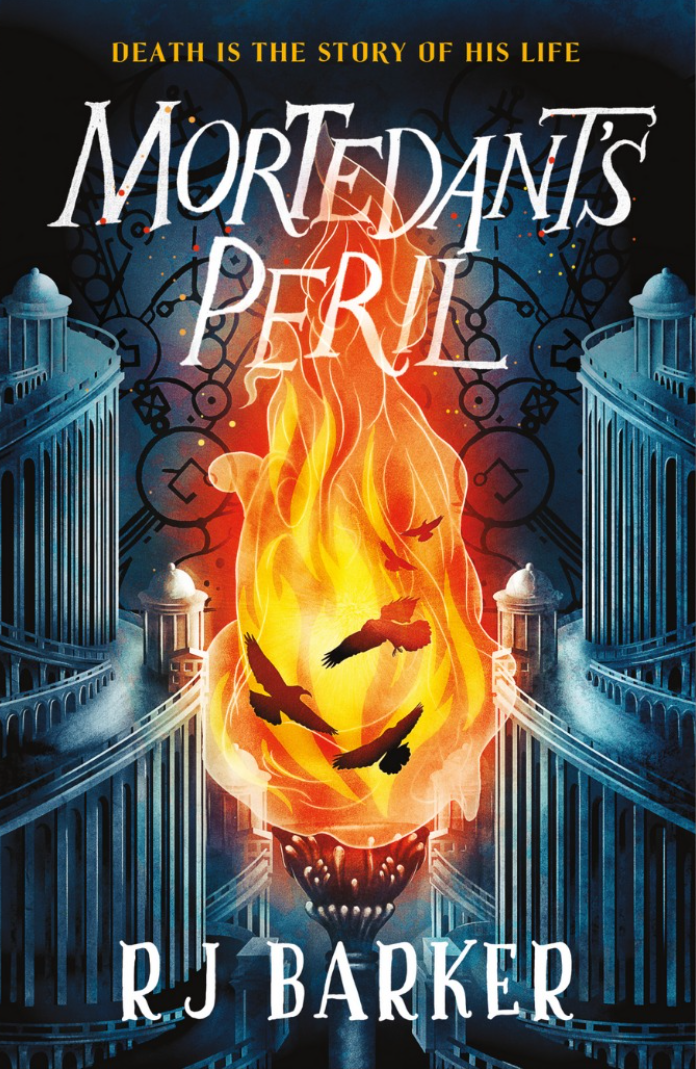 Mortedant’s Peril by RJ Barker
Mogsy’s Rating: 4 of 5 stars
Genre: Fantasy
Series: Book 1 of The Trials of Irody Hasp
Publisher: Orbit (May 19, 2026)
Length: 432 pages
Author Information: Website | Twitter
It’s actually been a little while since I’ve picked up one of RJ Barker’s books, despite the fact that his assassins-focused The Wounded Kingdom trilogy remains one of my all-time favorite fantasy series. So, when I heard that Mortedant’s Peril was not only kicking off a brand-new series but also leaned heavily into mystery, I was immediately on board. I will never say no to a fantasy mystery, and Barker’s name attached to this one made it an easy sell.
The story follows Irody Hasp, a Mortedant, one of a small and generally disliked order of clerics tasked with reading the final thoughts of the dead. It’s a respectable and useful profession, but not one that earns much gratitude due to the nature of the work. Most people view Mortedants with suspicion, and our protagonist’s reputation is even worse than most. Already hovering at the edges of society, he also finds himself tolerated by his co-workers and constantly given the assignments that no one wants.
But one day, after what seemed like just another routine job, Irody returns home to discover his young apprentice murdered. Devastated by the loss and determined to find the killer, he quickly finds himself caught in an investigation where he is also the prime suspect. Clearing his own name becomes just as important as seeking justice for his apprentice, but what begins as a straightforward murder investigation soon spirals into something far larger. Alongside a newly acquired apprentice and a strait-laced protector assigned to watch over him, Irody must navigate a tangled web of politics, corruption, and conspiracy that reaches the highest levels of the city.
Mortedant’s Peril combines two of my favorite genres, and even having few expectations going in, it still managed to surprise me. What begins as an engaging fantasy murder mystery gradually opens up into something much bigger, supported by excellent worldbuilding, an engaging cast of characters, and the kind of richly imagined setting that makes you want to learn more about it. The story takes place in Elbay, exactly the kind of fantasy city I love getting lost in, one that actually feels lived-in, layered with history and ancient traditions. It’s easy to imagine restless spirits lingering in the very stones that make up the walls of this place. Everywhere you look, there seems to be another secret waiting to be uncovered, making Elbay one of those settings that just leap off the page.
I also ended up really liking Irody Hasp as a protagonist, though it did not start off that way. In the beginning, he didn’t come off as the most endearing protagonist, and every time he went on one of his self-pitying rants, I had to fight not to roll my eyes. And yet, as time went on, as Irody threw himself into his quest of finding his apprentice’s killer, we start to see the person beneath all that bitterness and frustration. For all his complaining and whiny attitude, he’s ultimately driven by a genuine sense of decency. That, along with his pursuit of justice, gradually won me over.
In that regard, the supporting cast helps quite a bit. The dynamic between Irody, his new apprentice Mirial, and his assigned guardian Whisper brings a lot of life and energy to the story, and I especially enjoyed watching their partnership gradually take shape over the course of the investigation. Barker has always had a knack for creating memorable character relationships, particularly mentor-apprentice bonds and the complex interplay of loyalty, trust, and duty. Through these relationships, the novel also explores themes of class division, prejudice, and the way outsiders are often viewed with suspicion, adding another layer of depth beneath the mystery and adventure.
That said, if I have one critique, it would probably be the pacing. The story takes its time getting where it’s going, and there were stretches where the investigation felt more deliberate than urgent. However, that’s hardly uncommon for fantasy mysteries, especially series starters that are trying to establish a new world and introduce a large cast, so honestly, it’s not something I’m holding too strongly against this book. The moments where I found myself wishing the plot would hurry itself along were infrequent, so it’s a relatively minor complaint in what is otherwise a highly entertaining and solid opening volume.
In the end, Mortedant’s Peril is a promising start and another strong offering from RJ Barker, who continues to impress me with his creativity and willingness to try new things. I’m already looking forward to returning to Elbay and seeing where the story will take these characters next.

Categories: Fantasy Books
Saved by the Panther: Jonathan Maberry on storytelling, books, and how the Black Panther changed his life, Part Two
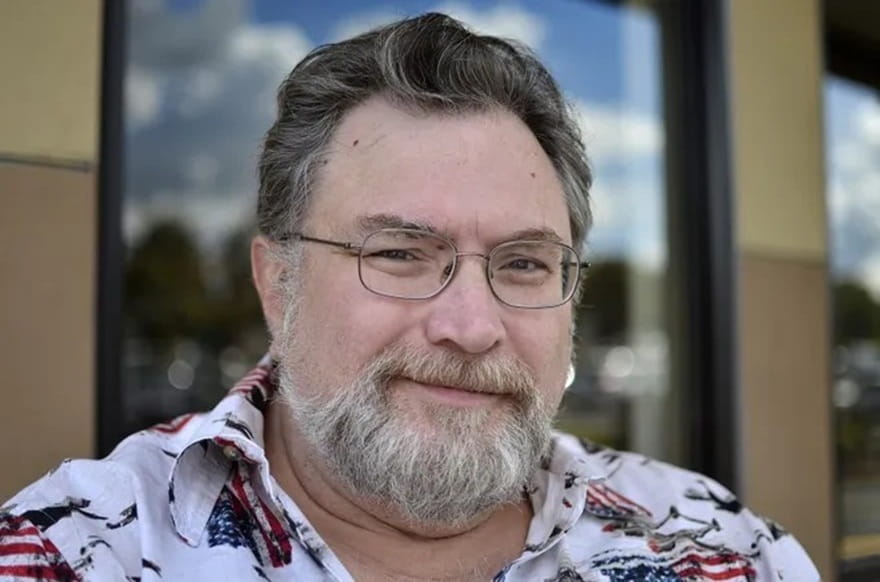 Jonathan Maberry
Read Part One of this interview here.
Our wide-ranging interview with the legend Jonathan Maberry continues as the award-winning author discusses how Black Panther not only changed his life, but led to one of the most rewarding opportunities any writer could ask for.
I was chosen to write Black Panther because of my childhood and what happened with that.
I grew up in a really terrible neighborhood in Philadelphia called Kensington. If you look up the worst neighborhoods in Philadelphia, it’s still the number one worst neighborhood of Philadelphia.
If a black family moved into Kensington they would be firebombed. That’s the kind of neighborhood it was. It was appalling. My father ran the local chapter of the KKK and that was the environment I was born into. It was an early issue of Fantastic Four when they introduced T’Challa the Black Panther that began splitting me away from my father’s viewpoints and made me question all the things that he said Black people were incapable of doing.
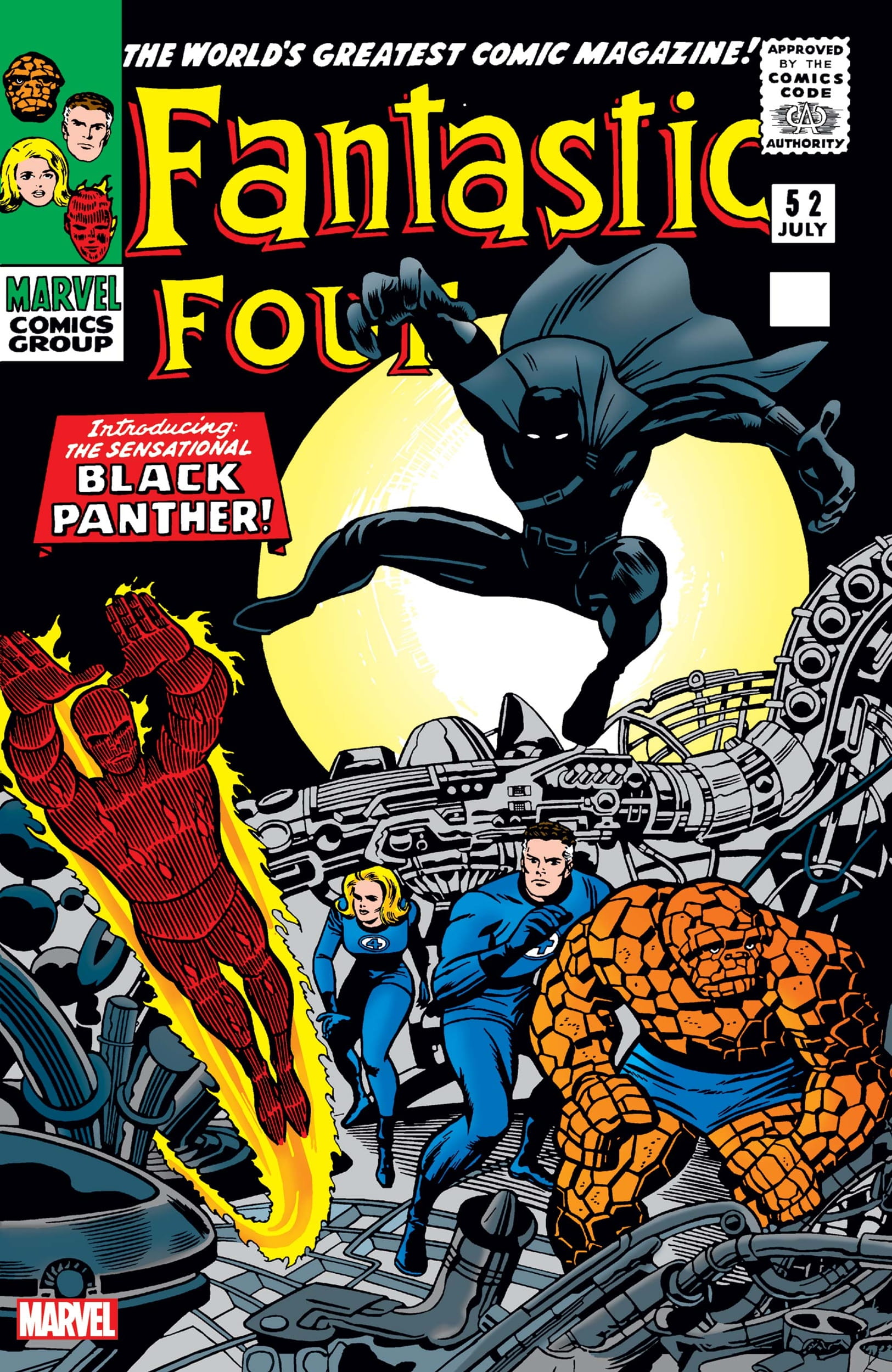 Fantastic Four #52, by Stan Lee and Jack Kirby (Marvel Comics, July 1966). Cover by Jack Kirby and Joe Sinnott
But here were my favorite Marvel people, Lee and Kirby, creating a character who is the exact opposite of that. He’s noble, he’s strong. In the comics he’s the scientist not Shuri, Shuri was added much later. He’s the hero, the king, he’s the scientist, he’s all these people.
When I got to 7th grade it was the first time I ever met someone of color. In Kensington it was all Whitey McWhite, there was no color anywhere. In Middle School, the librarian, she was white but it was in a mixed school.
I brought a copy of Fantastic Four to her and I said “You’ve met my dad. Why does he get mad whenever he sees Black Panther on the cover of the book?” She looks at the comic and says, “Well this particular issue is about apartheid.” I was like “What’s apartheid?”
She goes: “Do you know anything about the Jim Crow laws?” I was like whose “Jim Crow, is he another writer?” She says no. She said, “Do you know who Dr Martin Luther King was?”
Remember, this is only what I knew from growing up, I said: “He was some sort of a bad guy, my father threw a big party when he died.” She said “Sit down!” told me the story of racism, intolerance, and the beauty of inclusion. She really pitched it for me, and moments like that you can either close your eyes again and go back to that skewed worldview, or you can leave your eyes open which is risky, dangerous, and often leads to the breaking of relationships but that’s the real world view and I chose that path.
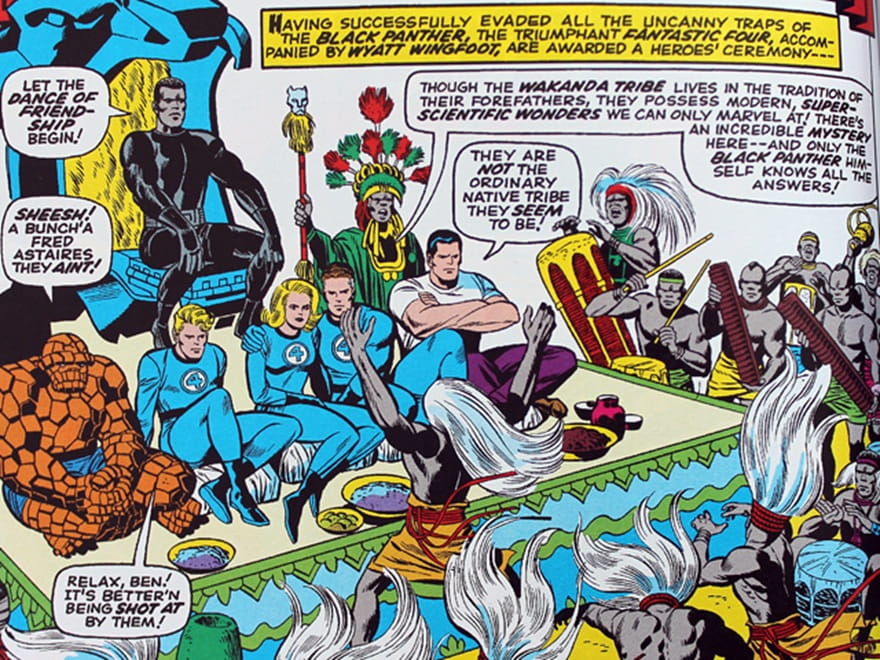 Black Panther in Fantastic Four #52, by Stan Lee and Jack Kirby
So I was talking about this on the radio in New York. I was already writing Punisher and Wolverine stuff for Marvel and I was talking about this and Reginald Hudlin who had been writing The Black Panther before me, you know an academy award winning Black film producer, he was looking to step down and he wanted someone to take over but he wanted it to go kind of in a fresh direction. He heard me talk about my childhood and then he went and read some of my comics then went to the President of Marvel and said, “I want Maberry to follow me on the book.”
They’re all like: “He’s white.” He said, “Yeah I know.” The assumption had been after Christopher Priest every writer (in Black Panther) would be Black. I’m not. But he told them my story and got the clip and let them listen to my backstory and they brought me in to do a test thing. I didn’t know they already agreed to hire me as the writer of Black Panther, they didn’t’ tell me that.
What I found out not only were they going to offer me a comic and I picked it up right after Reggie Hudlin’s last run, and even did some Shuri-centric dialogue on his last few issues. Then I was off and running as the actual full-time writer. It was mind-blowing. Oh, and one other thing, Reggie had heard that I’d also been teaching women’s self-defense for 35 years, so he cooked up the idea of having T’Challa getting ambushed by Doom and maybe being permanently injured, so Shuri had to step up.
Now at this point Shuri was basically the Wakanda party girl, the one who was always getting caught in the wrong hot-tub and they wanted to transform her into a fighter and a queen. They thought that since I’d been teaching self-defense I could handle that part of it and also the empowerment part of it. So really all of it was a test drive. Having Shuri step up because T’Challa had been injured, Reggie did it as a gift to me to (put) me on sure footing so when I took over the book it would have a natural flow.
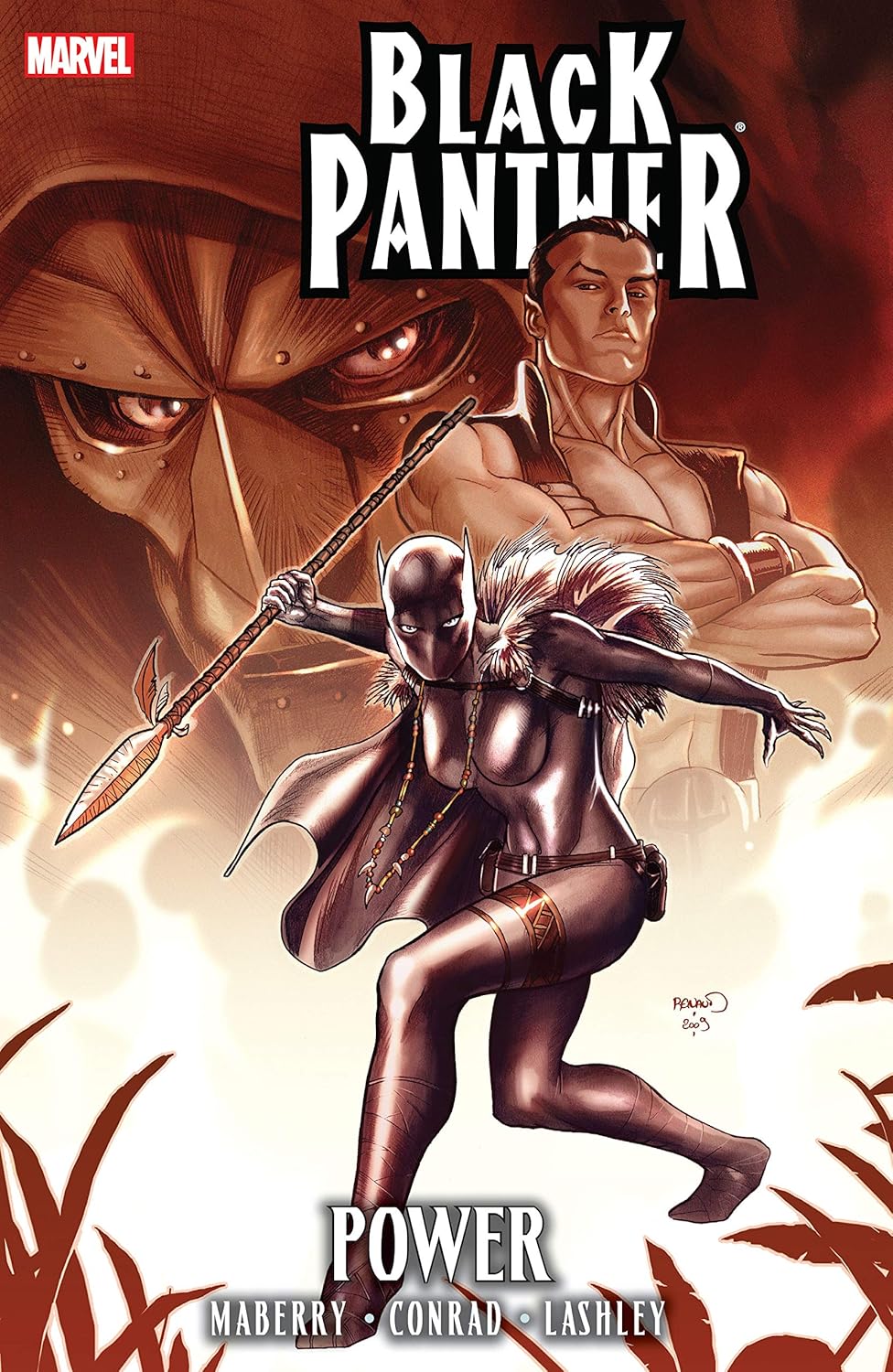 Shuri as the Black Panther: Black Panther: Power, by Jonathan Maberry, Will Conrad, and Ken Lashley (Marvel Comics, 2010)
Black Panther: Wakanda Forever is partly based on those comics. I was the first to put Shuri against Namor. The uniform she wore I co-designed with my artist Ken Lashley — a great artist by the way. I created the Midnight Angels, which in the comics was a special ops Dora Milaje team, but in the movie they made it a special armor that made the Dora Milaje stronger and faster.
There’s a character [I created] that Michaela Cole played called Aneka, she was the one with the two laser daggers. I even have the Funko-Pop of her. I didn’t know how much of this was in the movies until they invited my son and I up to the premiere. I got to meet the cast and we all had a laugh and it all started because I was talking about the terrible childhood I had and how the Black Panther saved my ass.
I was going to ask this question later but I might as well ask it now. Because you’ve written and done so much, is having that fun part of what keeps the flame alive?
If I’m not having fun I won’t do the job. I’m fortunate enough now, knock on wood, that I’m offered more work than I can do. So I get to pick and choose.
My favorite of these, however is, when I was ten I snuck into the movies to see the world premiere of Night of the Living Dead. October 2nd 1968, I was ten years old. The movie impacted me so much.
So, because I write horror I’d been on panels with George Romero a million times. I called him up one day and said, “George I would love to do an anthology of stories set around 72 hours in Night of the Living Dead, would you give me permission to do that?” He said, “On three conditions: I want to co-edit it with you, second I want to write a short story for it, and third I want you to write a story that takes one of your characters.” Apparently he’d been reading my books and I had no idea.
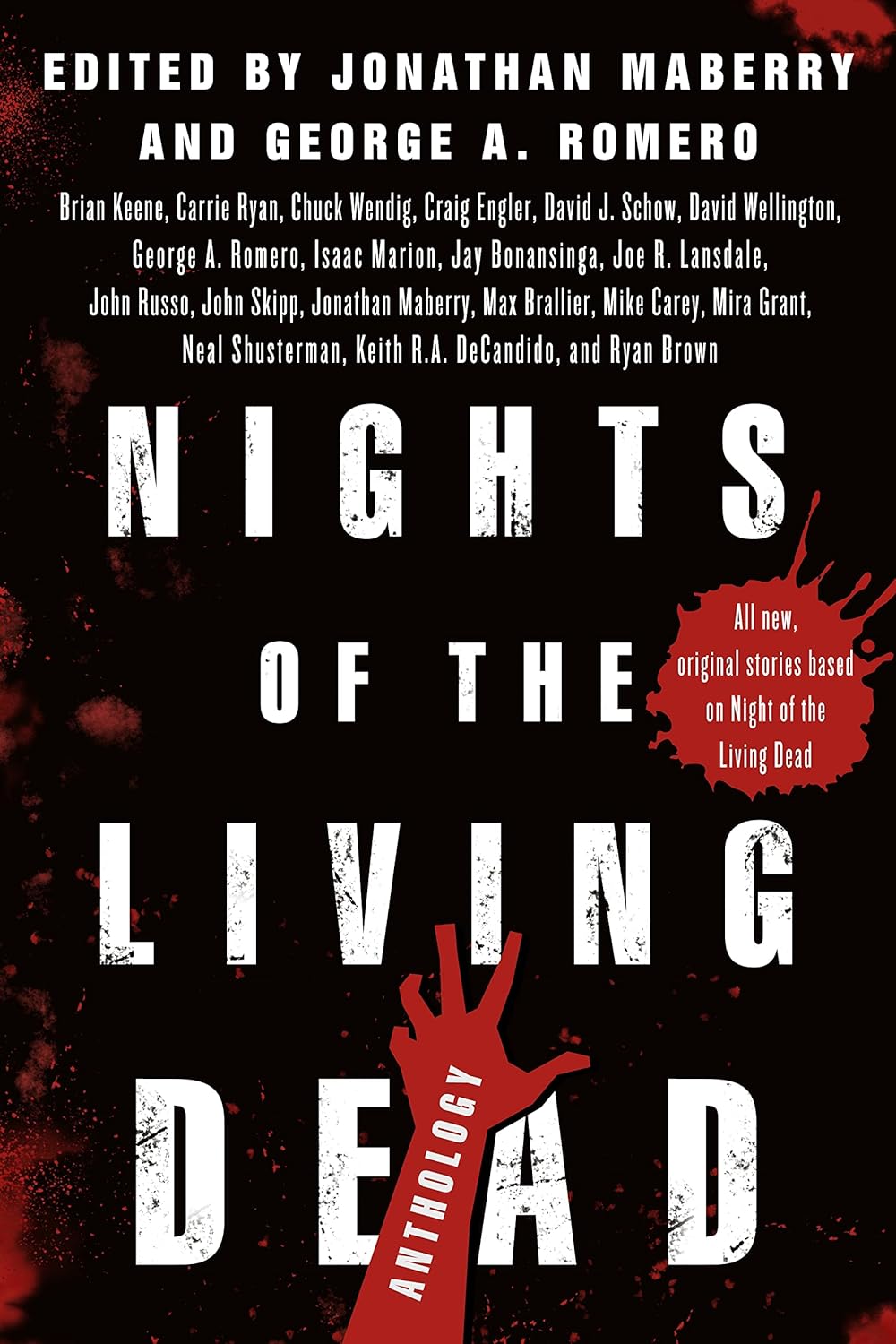 The Nights of the Living Dead anthology (St. Martin’s Griffin, July 11, 2017)
In my Dead of Night series, which is about the Zombie Apocalypse, there is a character named Sam Imura. George said, “I would love for that character to not be dead.” He’s presumed dead at the end of one of the books. “Have him not be dead and bring him all the way to the house in night of the living dead so we can officially connect your writing and my movie.”
We went out and did the anthology, and it was the last thing he completed before he died. As a matter of fact, I was at the very first signing for it, we had 200-300 people, and his wife called me and said he’d just passed. So, we turned the signing into a celebration of George’s life and it was great. I miss him. He was a good guy who became a very good friend.
Speaking of editing, you’re the current editor of Weird Tales. Its such a big name in speculative fiction. What’s it like stepping into that role? How much fun have you had doing that?
I’ve had a lot of fun.
At first when I stepped in, a friend of mine told me it was back and I pitched a story to them, wrote it and sold it. That was a big bucket list for me sell to Weird Tales. But a month later I get a call from the publisher saying, “Our editor is old and he’s ill, he can’t finish editing the magazine, which is our first issue back after several years.” He knew I’d edited a bunch of anthologies so he said, “Would you want to come in and finish editing the magazine?” I said, “Well how much of the magazine is done?” He said, “Well we have your story.” That was it.
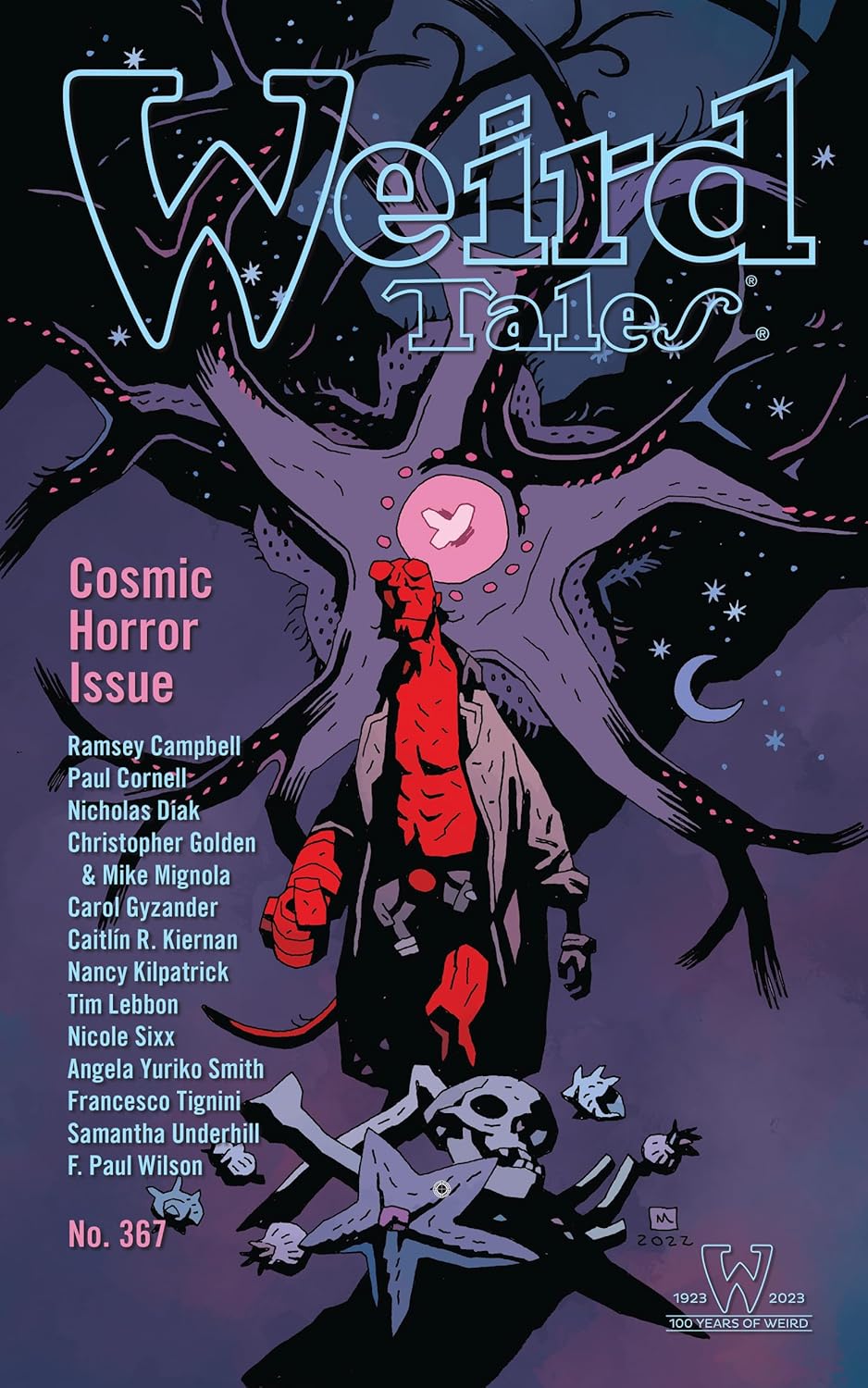 Weird Tales 367, the Cosmic Horror issue, edited by Jonathan Maberry (August 2023). Cover by Mike Mignola
So, I stepped in. First issue I was editorial director and from then on they just made me editor. The other editor did eventually pass, it was sad to see him go. But the magazine came to me and I was able to help keep it alive.
What they me to be the ongoing editor, much as I love Weird Tales. Conan the Wanderer was the first novel I ever bought, and it reprinted stories from Weird Tales. Me and Weird Tales go way back. In fact L. Sprague de Camp, who helped bring Conan back, became a friend and mentor. And weirdly, the agent who gave the Howard manuscripts to Sprague de Camp and that’s how Conan came out of obscurity, is my wife’s grandfather.
We had the challenge of while HP Lovecraft’s cosmic horror stuff is fantastic, he was a racist misogynistic, homophobic asshole and we can’t echo anything about his tone. I said, “I want to make sure we don’t just dip into a pool where all guys are this skin color or this gender.”
A friend of mine, who is a bookseller [once] said, [Here] is a novella you must read, it’s called The Ballad of Black Tom by Victor LaValle. This is going to leave you bruised and gasping. And it did, I read it in one long day. I really felt like I’d just been mugged in an alley, like Holy shit. That’s how Victor and I became friends, I wrote to him and told him I loved it.
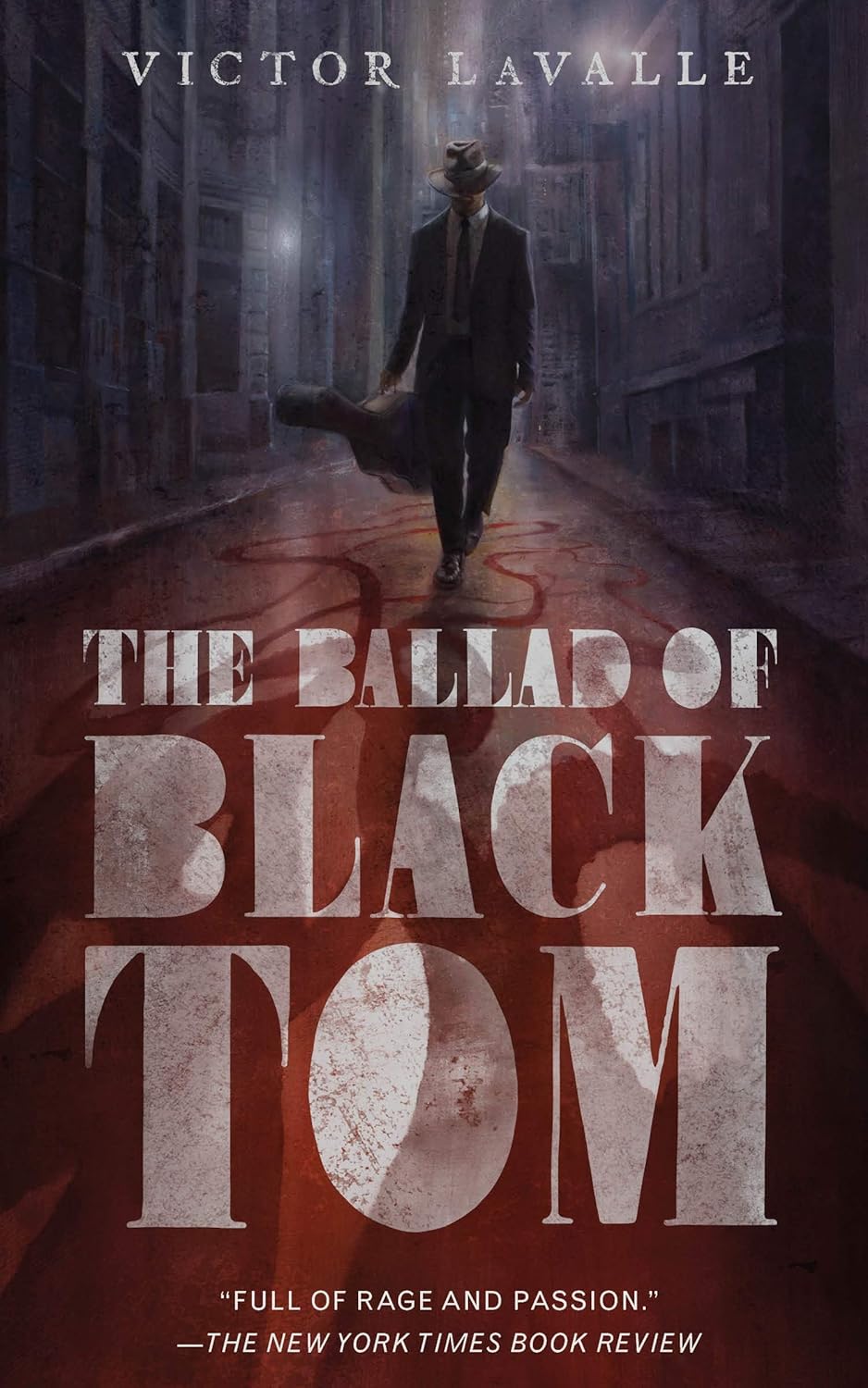
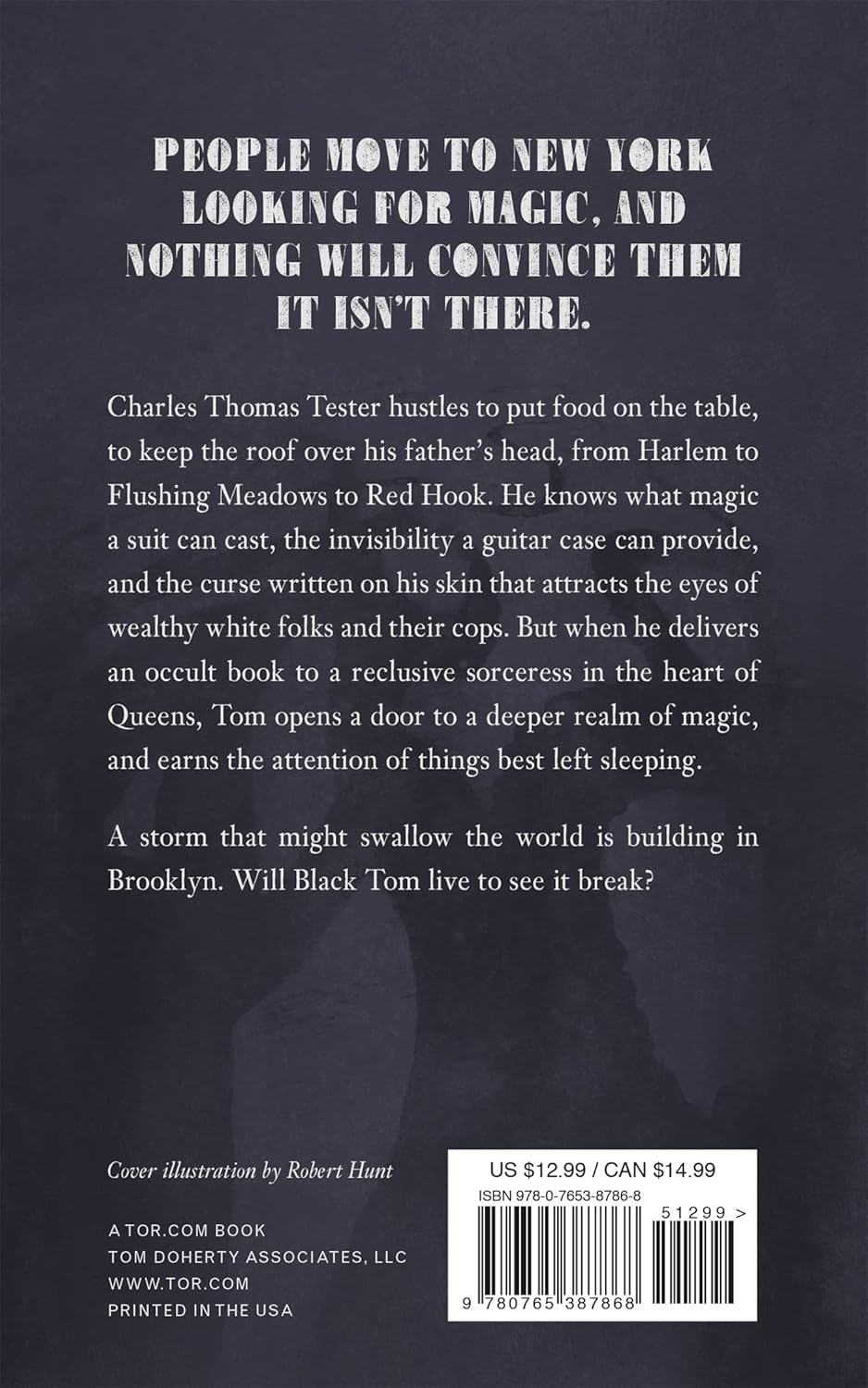
The Ballad of Black Tom by Victor LaValle (Tor.com, February 16, 2016). Cover by Robert Hunt
Then when Weird Tales came along he was the first person I contacted. I said, “You know Vic you bruised me pretty badly with The Ballad of Black Tom, how about you come and draw blood for me for Weird Tales?” And he wrote “Up From Slavery,” which was a great, great story, won a Stoker Award and I believe he’s in discussions with filmmakers about a possible film adaptation. And it deserves to be a film.
That’s kind of been my vibe. Inclusion does a lot of things. For one, it resonates with where I am in my life and in my heart. But also we’ve had generations and generations of storytelling mostly from one perspective. Horror has been dominated by white males mostly. It was harder for women to break in. The first woman of color to win a Stoker was Tananarive Due and that was two years ago, only two years ago!
I started reaching out to my friends, the people I know who had different backgrounds because every time you look at someone from a different culture, different gender, different orientation whatever — what makes them afraid, what they think is scary is going to be different. I want all of that, I want every voice talking about that in the magazine. That’s been my self-imposed mission as the editor of the magazine. I’m very happy with what we’re doing, we have a lot of representation in a lot of different ways.
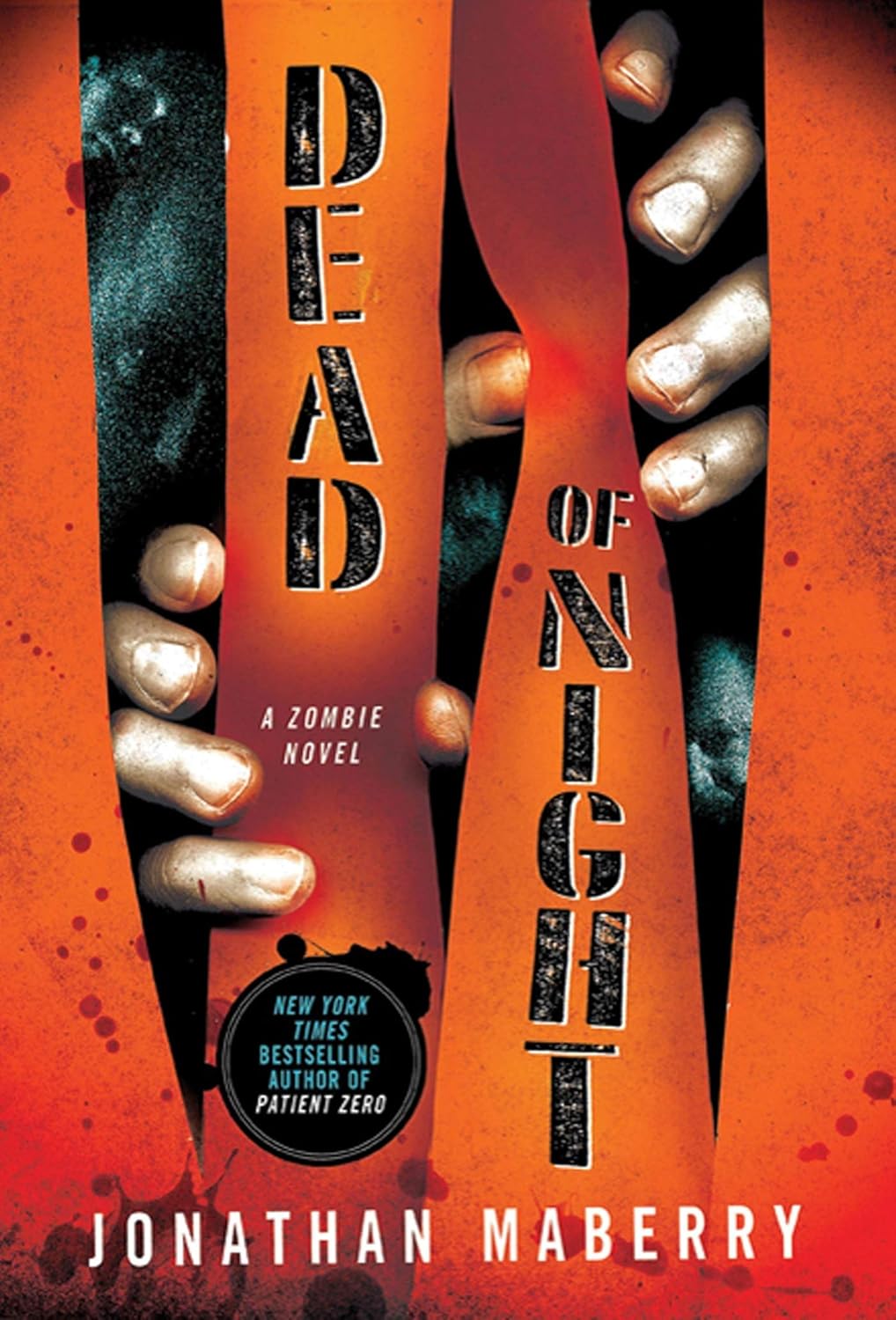
Dead of Night (St. Martin’s Griffin, October 25, 2011). Cover design by Rob Grom
What are some great writing tips that you can share with me and other writers out there who would love to learn from your decades-worth of experience?
There’s a couple things. Only take projects that are fun. Second, and this is important: a lot of writers kind of go on their natural storytelling gifts but the more you study the elements of craft, not just know what they are but actually understand how they can be applied in variation, it allows you to write everything in your head better. If you don’t know them, you can hit things that can stop you because you don’t know the thing that solves the problem.
It’s something Stephen King and I talked about the first time I met him. He is always learning new things. He doesn’t need to. But he wants to because he wants to be better all the time and that’s a great role model right there.
And the third thing is don’t believe in the concept of writer’s block, it’s not a thing. It’s an umbrella term used to describe a bunch of different problems but if you as a writer go and talk to two other writers, the other writers will have solutions.
Just because you don’t know the solution doesn’t mean the block is like a iron wall a thousand feet tall. It just needs ladder or door in that wall and here’s a way to do that. Everything is fixable.
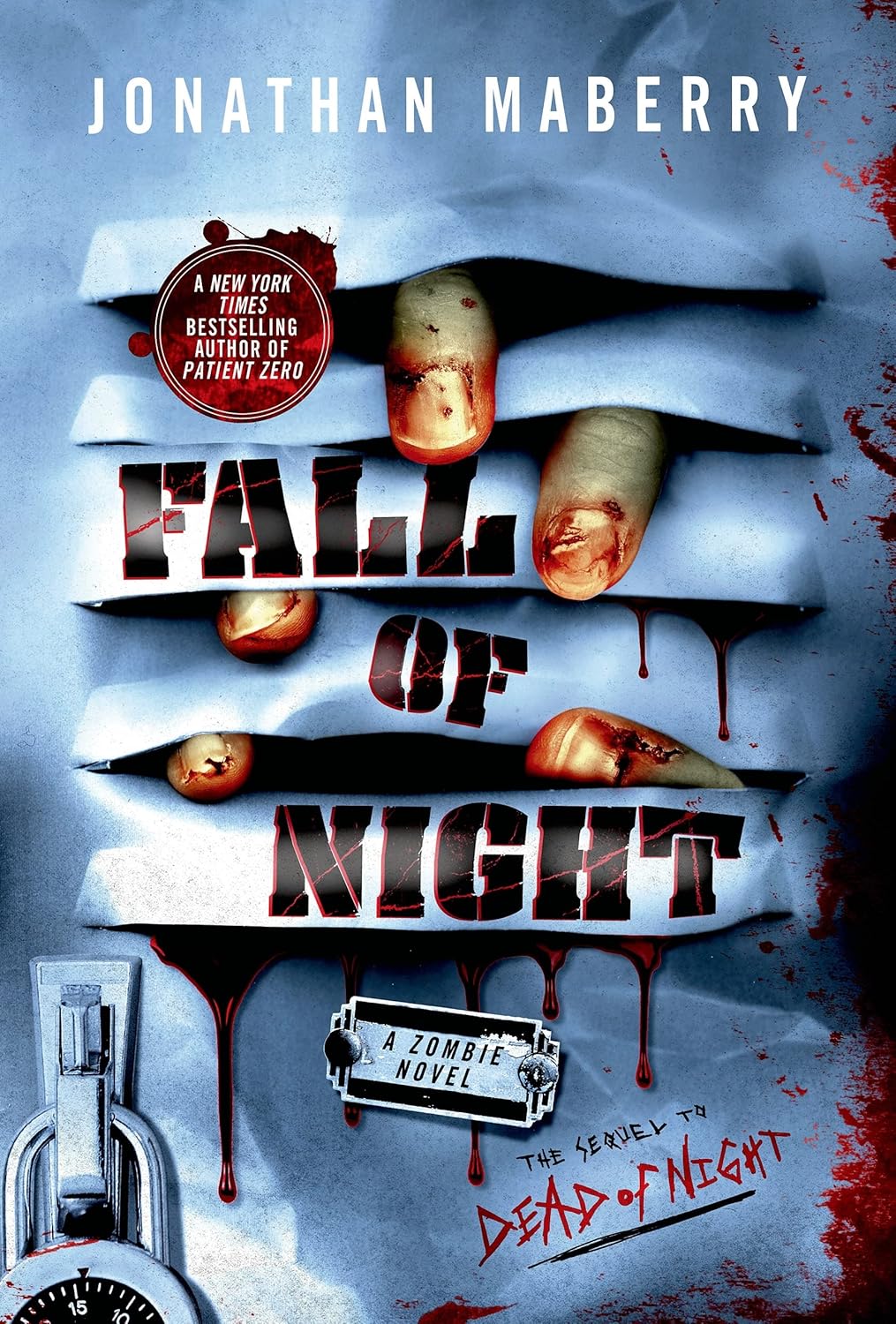 Fall of Night (St. Martin’s Griffin, August 2, 2014)
I wanted to ask about the future: what are some projects you have coming up in the future that you are excited about and what gives you hope for the future of writing?
I’ll start with the last part first because we’re going through a political time where books are getting banned left and right, where it’s hard to put diversity in books if you’re not that color or that gender or that religion or whatever when just five years ago that was the selling point of books, having a diverse cast of characters. Now it’s being pushed back on because those books get banned so quickly in a lot of states. We’re going through hard times and the future of writing depends on people writing the best book they can and promoting reading.
Writing is marching still. Audio books have one of the biggest market shares right now because of the oil price impacting print. We’re seeing E-books expand now.
In terms of what’s happening in the short-term future they want books to be shorter. I just turned in a book in a series like that and it’s about 25,000 words shorter. One it saves a bunch of trees and also a lot of money in paper, oil, print, and production.
Serve that need because it will keep the cover price low enough for people to buy it and you want people to read it. It’s not about trying to get rich, it’s about trying to make a living while also sharing your stories with as many people as possible. If that means telling a shorter story by replotting, I’ll just lean into those types of plots. I like a long complex thriller plot but I also like shorter books too. So change with the times and people who change with the times their future is as bright as can be, those doors are open.
There are times I want to write things that are outside my experience. My novel Ink is a good example of that. There are two elements of that its about a kind of vampire who if you have a tattoo tied to a very important memory and he touches, tattoo and your memory begin to disappear because he feeds on that. So one of the characters has a tattoo of her murdered daughter on her hand and every day she begins forgetting more and more that she ever had a daughter.
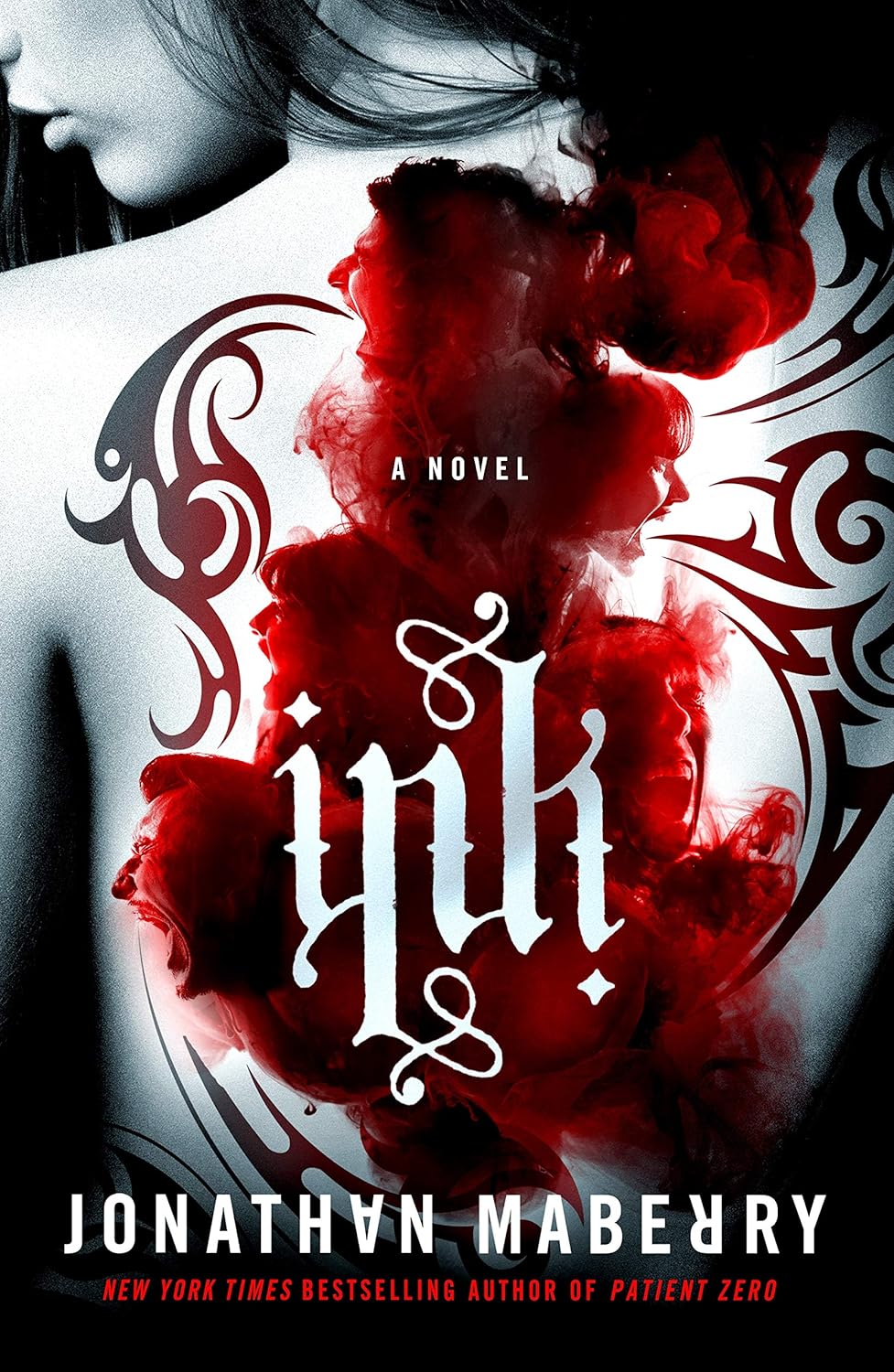
Ink (St. Martin’s Griffin, November 17, 2020). Cover design by Rob Grom
The thing is I don’t know anything about tattoos, I never had tattoos, my brother has tattoos but we’re somewhat estranged. But I know there are people for whom tattooing is more than decoration, it’s a statement, even if it’s a statement for them. So, I reached out through social media if I could ask questions of folks, do some interviews, so I could understand.
You know, why’d you get the tattoo, what did it mean at the time, has the meaning changed, what was the family reaction, do you talk about the meaning of it or do you keep it to yourself. I learned stuff I never would have learned about tattoo culture. I listened to their experiences and even folded some of them into the book.
The other part of that book: I had two romantic interests in the book. One was heterosexual which I can write because I‘m a straight guy. The other is a bicurious woman who is in a heterosexual marriage who wants to explore by going on a date with a lesbian. I’m not lesbian, I’m not bicurious I’m not any of the things that define those characters. So again, I reached out, I said I’d like to do some interviews. I thought maybe I’d get three or four. I got 500 people! I think part of it was because I was a straight guy trying to understand. Because in my message I wrote that I didn’t want to do even well-intentioned assumptions, I didn’t want to do cliché. And when you ask those questions and get the answers, listen to them, pay attention to them, because it not only expands your ability to write those characters, it expands your personal growth in understanding human people and human experiences.
The world is not defined by you and what looks like you. The world is defined by itself and it is a very diverse world. Learn more about that and you’ll find so many things to write about. The research has allowed me to read so far beyond my cultural zone in terms of race, religion, and sexual orientation because they are stories I don’t know, I can’t predict the end to them, I can’t predict the details and I want to know. That’s what I do as a writer because its what I do as a reader.
That’s something everyone can do and it’s a wave I’m starting to see happen more and more. The research turn into understanding, not just a collection of data.
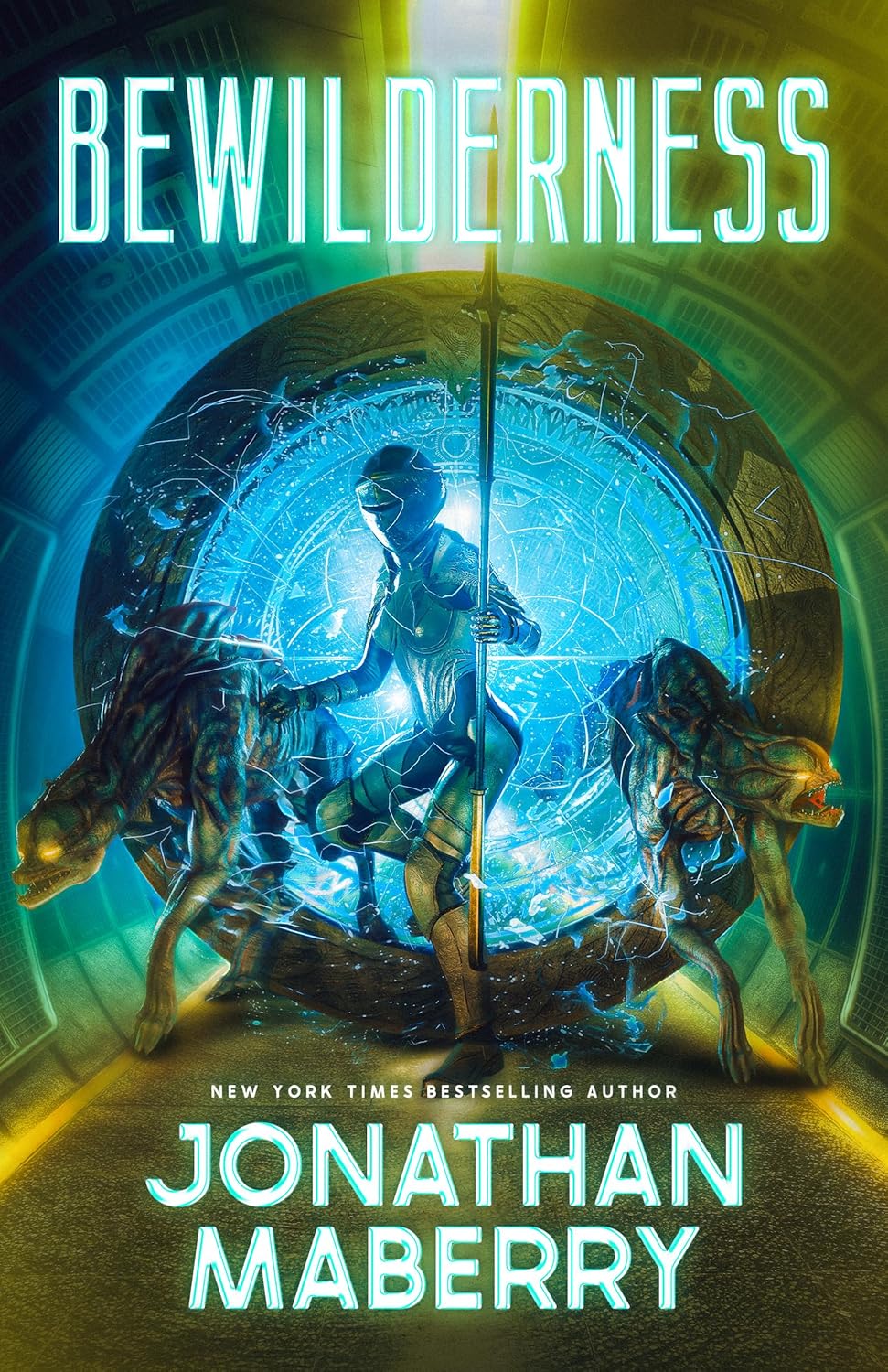 Bewilderness, forthcoming from WordFire Press, August 11, 2026
What books do you have coming out before the end of the year?
Well, I’ve had two novels out so far which is Red Empire and that series is being directed by the director of John Wick. I may be working on sort of a John Wick role but I can’t talk about that. The Sleepers War book just came out, in August I’ll have Bilderness and then in October I have Ghosts of the Void coming out which will wrap that Necrotek series.
At the moment I’m writing The Jersey Devil, which is about the cryptid. It’s my 57th novel in 20 years. I’m having a lot of fun with it, it will be 100,000 words or less because again that’s what editors feel comfortable with.
I’m writing three comics right now, one of which I can talk about because we’re thinking of pitching it to Keanu Reeves. It’s about an aging samurai who wants to die gloriously in battle but he keeps surviving every battle because he’s just that tough.
Categories: Fantasy Books
Escape from 2026!
Don’t you wish we could escape from 2026? Sometimes I do, especially when I look at the state of our world right now. I really want this period in history to end so that I can read the history books from the comfort of my own chair, smiling softly at the fact that we survived all of the crap these last 10 years or so have thrown at us.
Of course, whenever I feel like I need to escape from something, I make plans. Or I try to do something that’s helpful. In this case, I did both.
First, I want to help readers (and writers) figure out how to find some personal time in 2026…by imagining themselves elsewhere. Or elsewhen. I kinda like the elsewhen part. Let’s imagine our world, but different.
So I asked some of my favorite writers if they had time travel or alternate history tales to contribute to a Storybundle. You can now get 14 ebooks, twelve of which are exclusive and impossible to find anywhere else in this bundle. There’s also a writing workshop in case you want to write your own escape.
I’ve included two of my books. One, Snipers, is alternate history and time travel. The other, Consecrated Ground, is neither, but should be. I combined them for reasons that you’ll see when you read the bundle. Consecrated Ground is an author-preferred edition of one of my best reviewed books, but it won’t be available wide until this fall. So if you want to read it early, here’s your chance.
You can get all of these books at a discount, so not only are there a lot of escapes here, but they’re also available at a bargain price.
Which leads to…
Second, I give to charities a lot during times of crisis. We–the world–have been in a prolonged crisis for years now. So I made sure the charity that we chose for this Storybundle responds to crisis. World Central Kitchen provides food in crisis zones worldwide. Their mission has remained the same over the years, but the need has grown, so any money you can give to them would be greatly appreciated.
We made it easy by adding them to the Storybundle.
So…pick up your escape, and spend the summer reading about other places and other times. All the while your money will magically work to help those in need.
Here’s the link to Storybundle. Thanks!
Categories: Authors
The Golden Butterflies
Warning: this post contains mild non-essential spoilers for This Kingdom Will Not Kill Me and a discussion of insects.

A swarm of glowing golden butterflies flowed out of the entrance, as if the
building had exhaled light and beauty into the night. The butterflies bounced
on the draft, trailing tiny gold sparks, swirled toward me, and melted into the
night air. Like magic.
No, not like. It was magic, not distant like the Mage Tower zapping the lorsses, but right there in front of me. A wonder. It was impossible back home, but here it was real. It existed and it was beautiful.
I caught my breath, swallowed, and walked unsteadily into the Garden of Soft Blossoms.

A man strode to the stage and halted by the red moat. He wore a light gray doublet and dark gray trousers tucked into tall boots. A teal cloak hung off his left shoulder, more of a fashion statement than a protective garment. His back was to me, so I couldn’t see his face, only his curly dark hair, cut short, and the color of his skin, a russet brown.
He pondered the empty stage as if puzzled and waved his hand. A globe of red water shot up from the moat fifteen feet into the air and snapped into a monstrous fish.
Oh!
The creature swam above the stage, circling it. Its long eel-like body kept going and going, long and slightly translucent, the sharp ridged fin along its back bristling with red spikes. It was big enough to swallow a human in one gulp.
Goosebumps crawled up my arms.
The fish’s grotesque jaws snapped, catching its tail. It exploded into a dozen stelkas. They rained onto the center of the stage and dashed into the dining room, darting between the tables. To the side a waiter gripped his tray and jerked it up over his head as a beast shot by his legs. People chuckled.
The stelkas burst into geysers of crimson flower petals. They swirled, flashed with light, and turned into golden butterflies.
Oh wow.
The glowing swarms floated over the dining floor, bouncing on the draft, spreading in all directions. It was too much. Too bright, too colorful, too everything . . .
The nearest group of butterflies changed its course, drifting close to each other instead of fanning out. They were heading right for me.
No time to react. A second, and they swirled around my body, clinging to my cloak. One landed on my shoulder, one tried to wedge itself in my hood, and the third rammed my right cheek . . .
People were looking at me.
I didn’t belong here. I was wearing a cloak that smelled like a corpse. There was river muck in my hair. My bare feet had probably left muddy footprints in the hallway. I couldn’t have been more out of place if I had set myself on fire.
The butterflies exploded in a puff of soft sparks. Something zinged my skin, like a weak rubber band slapping against my face.
“What about gold butterflies?” I asked.
“Ah. You’ve met Ciste. Is he still hanging out at the Garden?”
I nodded.
“His mother sold her body,” she said. “He grew up in a place a lot like the Garden.”
“What happened to it?”
“Nothing good,” she said. “Damaes tolerates his moonlighting, because Ciste is a gifted summoner. Did you see a swarm of glowing butterflies?”
“Yes. He summoned a sea monster and stelkas, too.”
She smiled. “Was it beautiful?”
“Very.”
“Ciste doesn’t summon illusions, only weapons. Everything he conjures is
created for violence.”
Oh.
“Those beautiful golden butterflies feed on your blood. The more magic you have, the richer their feast. A larger swarm can turn a living being into a husk in moments.”
The golden butterflies of Ciste. So lovely, so deadly, and surprisingly rooted in reality.
 @Гуменюк Виталий
This is Calyptra thalictri, otherwise known as vampire moth. It is thought that they originated in Asia or Siberian region, and then spread through Russia and Southern Europe. Most of the time, these moths nibble on fruit. They drill into it with a barbed proboscis and drink the juice. They really like raspberries and grapes.
However, during the mating season, the males will use pierce the skin of animals and human and feed on blood instead. They are also known to drink tears.
This happens because of a very interesting adaptation called mud-puddling. Under certain circumstances, some insects use unusual sources to obtain salts and amino acids which they can’t get from their normal diet. Butterflies will often crawl on wet soil after the rain, looking for those nutrients, and some species highly prize human sweat. It contains a lot of salt and sugar.
Calyptra thalictri, however, take it a step further. Once the males acquire the blood, they then pass it to female moths during mating as a kind of wedding gift to provide a boost to future larvae. It is the butterfly equivalent of “Honey, I am craving a hamburger with extra pickles. Could you please pick up one for me? I’m going to eat it with a strawberry yogurt.”
So far the vampire moths are the only species of moths or butterflies known to actually pierce the skin to obtain the blood. Although you can find several scary videos online, these guys are only about 40-45mm in size, so about an inch and a half, and the volume of blood they take is pretty small. A swarm of them is unlikely to turn you into a desiccated husk.
However, they do feed for 10-50 minutes and their bite does hurt. Mosquitoes, which are the predominantly insect blood suckers, have anesthetics in their saliva and only feed for about a minute. On the plus side, moth bites do not transmit bloodborne diseases.
If you would like to know more, there is a video below.
If you are reading this in your inbox, here is a direct link.
And now you know the origin of the magic swarm.
The post The Golden Butterflies first appeared on ILONA ANDREWS.
Categories: Authors
7 Author Shoutouts | Authors We Love To Recommend

Here are seven Author Shoutouts for this week. Find your favorite author or discover an…
The post 7 Author Shoutouts | Authors We Love To Recommend appeared first on LitStack.
Categories: Fantasy Books
Early Review – Mudlark by Mary Helen Specht (3/5 stars)

Reading Level: Adult
Genre: Science Fiction/Dystopian
Length: 400 pages
Publisher: Ballantine Books
Release Date: July 21, 2026
ASIN: B0FX7WZZQ2
Stand Alone or Series: Stand Alone
Source: eGalley from NetGalley.com
Rating: 3/5 stars
“Jenny Sweet’s marriage is ending—and with it her band and maybe even her fragile relationship with her thirteen-year-old daughter, Neko. A reluctant wife and mother, Jenny plans a new journey of self-discovery after one more gig at Burning Man. But when Neko disappears amid the chaos of the festival, Jenny fears that everything that mattered to her has been lost. As she races against the dark, Jenny finds herself thrown into the past, and into the heart of a gathering storm.
Now twenty-five, Neko is a mudlark: a trained recruit who braves the rival factions and feral survivalists in the ruins of a crumbling, flooded Manhattan for resources that grow scarcer by the day. When she stumbles upon the master of her mother’s long-lost solo album and later hears that someone else is searching for it—someone who could be her mother, missing for over a decade—she embarks on a perilous adventure with a ragtag crew that will take her from treetop societies to decadent raves to the underground bunker where she will, finally, confront her mother’s fate—and her own.”
Series Info/Source: This is a stand alone book. I got a copy of this on ebook from NetGalley.com.
Thoughts: This was okay. The book jumps back and forth between Jenny Sweet (a musician from the near past) and her daughter (Neko). The timeline is fairly fluid here and can be a bit hard to follow. Sometimes we are hearing from Jenny in the far past or in the near past and sometimes we are hearing from Neko in the current timeline or the near past (when she is a teen) or during her childhood. The jumping around in time and between POVs made this a meandering story, that took a lot of patience to read.
In the near past, Jenny is a musician and a reluctant mother. She knows her husband, Max, has been cheating on her but has been struggling to deal with this because her daughter, Neko, adores Max and Jenny doesn’t want to break up the family. Jenny and Max perform a last set with their band at Burning Man; they will be announcing the break up of both their marriage and the band soon. During this performance, Neko goes missing, and what follows will define Max’s, Neko’s, and Jenny’s lives.
In present day Neko is ekeing out a living with her partner, Iggy, and their crew in The Sink (what is left of parts of New York City after it flooded during a historic hurricane) as a mudlark. Neko and crew dive below the watery depths of the Sink to retrieve what others have lost. Then one day Neko retrieves a solo album from her mother, an album she didn’t know existed. She wants to know who requested this album and if it will lead to her mother, who is assumed to have died in the flooding of NYC.
This book is more poetry than story. It is written in a very lyrical and wandering way. The characters spend a lot of time thinking about the world around them in complex imagery. The story is dreamlike and dives into the relationship between daughters and mothers in a world that is a bit broken (both in the past and the present). These characters spend a lot of time in their heads questioning their own motives and whether or not their actions are selfish or necessary.
The post-apocalyptic world presented here is a bit vague. We know New York City flooded, as did some other areas of the Eastern seaboard. However, we don’t have a good idea of how that affected the rest of the world. We get small glimpses, but no broader picture. The story doesn’t have much resolution either; so if you like your stories with a clear ending, I would steer clear of this one.
If you have the patience and like this sort of wandering imagery that is more of a story-as-poetry you might enjoy this. I think I would have enjoyed this more if it hadn’t wandered between timelines so much and had been a bit more concise.
My Summary (3/5): Overall I respect the imagery and idea behind this, however it wasn’t really for me. Things were just too ambiguous here, and the story took too long to get anywhere. The language and descriptions were a bit over the top for me, and we spent too much time in our characters’ heads. If you enjoy a sort of poetic post-apocalyptic book that focuses on mother/daughter relationships this might be for you.

Categories: Fantasy Books
Pages

Recent comments