
Feed aggregator
Cover Art
On my Patreon page, I’ve been putting up free posts about the new and improved cover art that we’re doing at WMG. You can find a number of posts, but I thought I’d share this one with you here. (I’ll be sharing the occasional Patreon post throughout 2026 and maybe beyond.) You can sign up there for free and get the free posts only. On the weekends, I also write a new business post, but you’ll have to go through a paywall for those. Here’s a long(ish) one on the history of the Alien Influences cover.
Alien InfluencesWe have a plethora of covers to choose from here, and I even missed one, because mine is in storage, and I can’t find a good example of it online.
So…Alien Influences. I wrote the novel as interconnected short stories originally because at that time I did not realize I wrote out of order. The stories were published in various places, got nominated for awards, and (I knew) needed to be threaded into a full novel.
 At the time, I was being published first in England, through Orion Books’ imprint Millennium. There’s a lot of backstory here, some of which I was never privy to. I do know that the company was co-founded by Anthony Cheethem, who had been in British publishing since the mid-1960s. This company, which was founded in 1991, was the third company he had founded. The first two were acquired by major publishers in the UK for sums of money that I can’t find on a quick search.
Everyone I worked with at Millennium was enthusiastic. They all had a chip on their shoulder and something to prove. That they could build bestsellers? I have no idea. That they could publish good books that sold well? Possibly.
I do know this: I was never treated as well in traditional publishing as Millennium treated me.
They published my early fantasy novels and then they took a flyer with Alien Influences. I love the cover on the British hardcover, and they did a different version (which I can’t find easily) for the mass market paperback. There was also a trade edition.
The book hit number one on the bestseller list for the Times of London, got extremely well-reviewed, and became a Topic of Conversation, at least in UK fandom.
 It had also sold to Bantam in the United States as part of a bigger deal. Then in the U.S., I lost my editor at least five times. (I have blocked the exact number.) Meaning I had five different editors before my first novel from Bantam came out. Someone—and god knows who—moved Alien Influences away from the Fey publications and then buried it.
It was the only non-romance book that I know of that has the 1990s hunk (blech) Fabio on the cover. This cover often gets featured in retrospectives on Fabio covers…and then ignored.
It is a truly, truly, truly awful cover.
I got the rights back to the book because it went out of print very quickly, despite the excellent overseas sales and the good reviews—including one in The New York Times.
When we started WMG, we published it as soon as we could. We had one ugly-ass cover on it for a nanosecond because at the time, there weren’t yet art sites. I’m not even showing you that one, which was designed in PowerPoint, using historical (pre-20th century) artwork.
I think it only showed up on Amazon for that nanosecond because there were no other markets at the time.
 Then we hired locally in Lincoln City, and brought in someone who eventually proved to be a mistake.
We hurried to rebrand Alien Influences. The first cover, co-designed by Dean, has pretty good art and adequate branding.
For some unknown reason, the cover got redesigned around the time Dean and I moved to Las Vegas. I remember seeing the redesign after it was uploaded to all the sites. I do not remember being consulted on any of the redesign.
The most charitable thing I can say about the artwork itself is that it looks like a Richard Powers imitation. I loathe most of Powers’ work, so this is not a compliment.
Still, the name is more-or-less properly branded and the pull quote is good. Maybe if I liked the art, we might have made it pass muster.
But why would we do that? It doesn’t look like modern science fiction at all. I see nothing here that would get a reader in 2026 to buy it and, in fact, I see two different things that would turn the reader off.
The first is that art. Blech, yuck, icky.
 The second is the award I was nominated for. Back in the 1990s, the U.K.’s Arthur C. Clarke award was prestigious as hell. Maybe it still is, because it exists. But, the man was credibly accused of pedophilia, and there is a lot that I know about him because I was close to people who ran sf conventions. After the year 2000 or so, he was never invited to a U.S. sf convention again. (That I know of.)
I don’t want the association. We took that off my book cover this time. We put the best quote on the book, the one from The New York Times, not one from PW that sounds literary. (Yes, I find it ironic that the Times was the least literary review.)
I was the one to suggest rebranding and redesigning Alien Influences right away in our quest to brand everything properly. Now we have a cover I like. I believe this cover will entice readers to take a look, much more than the previous cover.
This book has had an interesting and weird history. I’m pleased it’s getting the kind of design it hasn’t had since it was introduced in the U.K. decades ago.
And right now, remember, we’re doing a Kickstarter on this and two other books. Broken Windchimes, which is also rebranded (and which I blogged about last week), and a short story collection that I will blog about on my Patreon page on Monday or so.
Categories: Authors
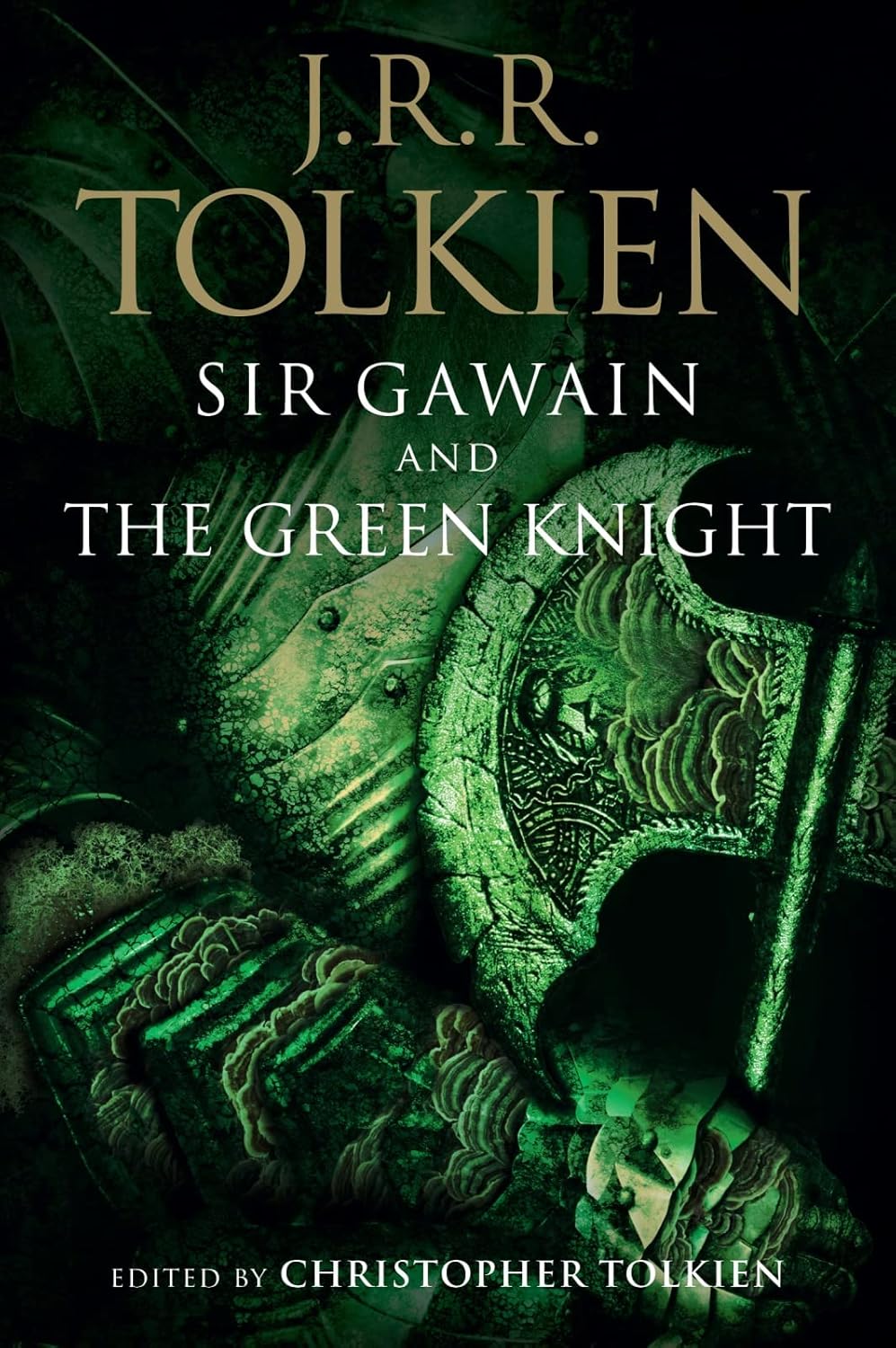
Half A Century of Reading Tolkien: Sir Gawain and the Green Knight, translated by JRR Tolkien
 From beside the queen Gawain
to the king did then incline:
‘I implore with prayer plain
that this match should now be mine.’
Somehow, I’ve never read Prof. Tolkien’s, let alone anyone’s, translation of Sir Gawain and the Green Knight (late 14th cent.), an English poem written by an unknown poet. Thinking on it, I know there’s a cheesy looking movie, Sword of the Valiant, from the eighties starring Miles O’Keeffe and Sean Connery, but it was only David Lowery’s 2021 The Green Knight and its critical acclaim that made me think it was maybe time to read the poem. Now I have. Additionally, and most valuable to me wrestling with my understanding of the poem, I’ve also read the professor’s 1953 WP Ker lecture on work.
The poem recounts the temptations of Sir Gawain, youngest member of King Arthur’s Round Table, as he attempts to meet the suicidal obligation he accepted when he entered a contest with a mysterious green knight. More precisely, as told, it’s about the conflict between chivalrous virtues of honor and courtesy and, specifically religious, morality.
Gawain was written in Middle English, the evolution of the language used between the Conquest in 1066 and the late 15th century. Gawain, son of Morgause, one of King Arthur’s half-sisters, is a major figure in many of the assorted Arthur tales. His roots descend back into older Welsh tales, where he was known as Gwalchmei. Pre-Christian elements, including the Beheading Game and the Wild Hunt, are integral parts of the story, despite the tale’s overt Christianity. The Beheading Game is a recurrent motif that tracks back to at least the Irish tale Fled Bricrenn featuring the hero Cú Chulainn and the Wild Hunt occurs across various Northern European myth cycles.
The poem begins with a recounting of Britain’s founding by Brutus of Troy. Noble as he was, young King Arthur of Camelot was nobler still. One Christmas season, as Arthur’s knights were celebrating with a games and contests, a strange figure entered the hall.
For hardly had the music but a moment ended,
and the first course in the court as was custom been served,
when there passed through the portals a perilous horseman,
the mightiest on middle-earth in measure of height,
from his gorge to his girdle so great and so square,
and his loins and his limbs so long and so huge,
that half a troll upon earth I trow that he was,
but the largest man alive at least I declare him;
and yet the seemliest for his size that could sit on a horse,
for though in back and in breast his body was grim,
both his paunch and his waist were properly slight,
and all his features followed his fashion so gay
in mode;
for at the hue men gaped aghast
in his face and form that showed;
as a fay-man fell he passed,
and green all over glowed.
Even his stallion is green. He has arrived at Camelot, he declares, to see how brave the knights of the Round Table really are. Not in combat, though, as they are “but beard less children.” No, what the Green Knight wants is to strike blow for blow with his great axe anyone brave enough to accept his challenge. For playing along, he will let that person keep the axe.
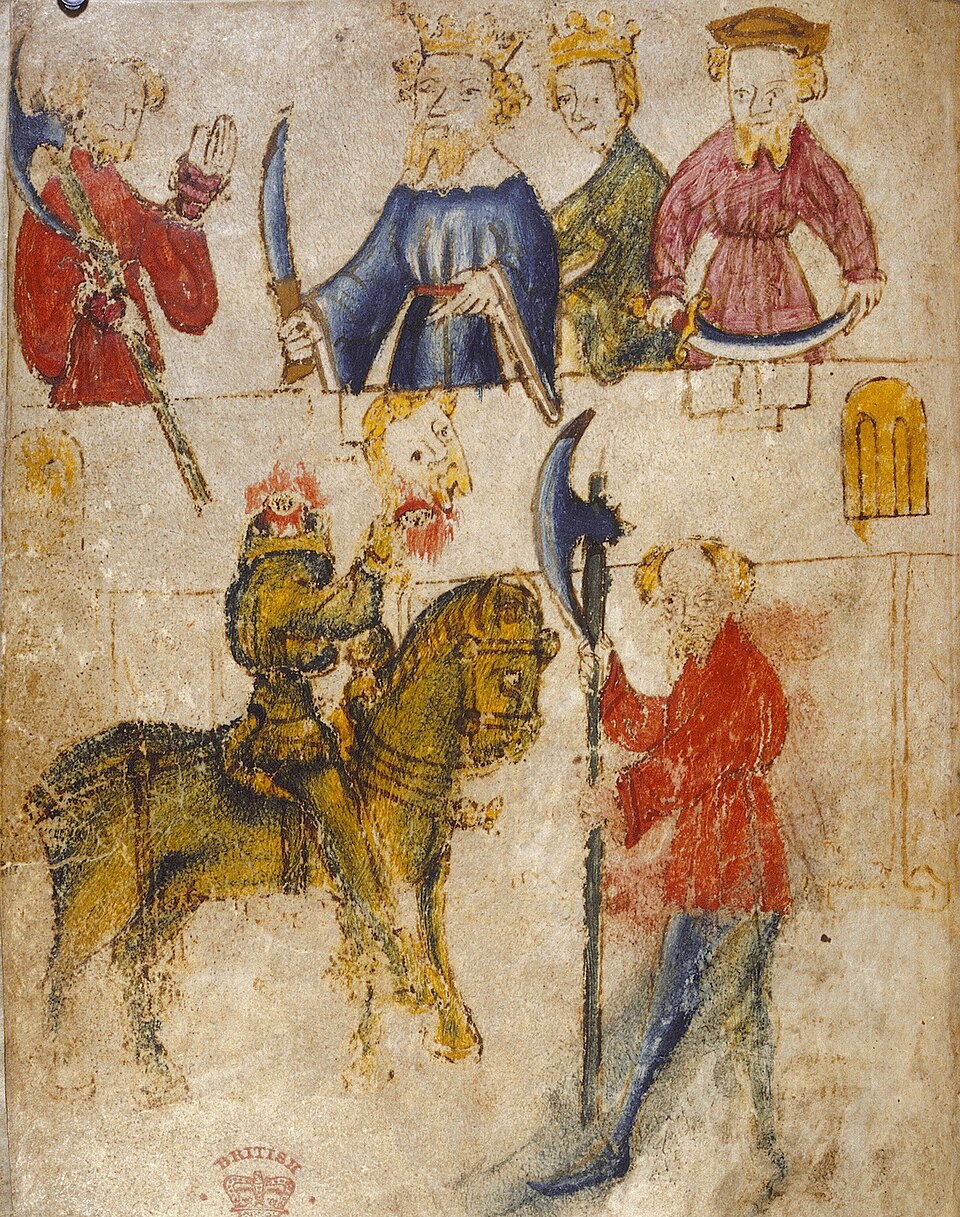 When no one steps forward, King Arthur, himself, raises his voice to take on the Green Knight, himself. At once, Gawain steps in to put himself between the king and any harm that might befall him. In a sharp bit of commentary, Gawain calls out his own weaknesses even while upbraiding his fellow knights for their apparent cowardice.
For I find it unfitting, as in fact it is held,
when a challenge in your chamber makes choices so exalted,
though you yourself be desirous to accept it in person,
while many bold men about you on bench are seated:
on earth there are, I hold, none more honest of purpose,
no figures fairer on field where fighting is waged.
I am the weakest, I am aware, and in wit feeblest,
and the least loss, if I live not, if one would learn the truth.
If his the knight’s green cast hadn’t hinted that strange things were at hand, it’s made abundantly clear once Gawain delivers his blow and lops the challenger’s head from his shoulders. Just because he’s headless, it doesn’t mean Arthur’s champion is off the hook. Never faltering, the Green Knight reaches for his head and holds it aloft to the king and his household.
For the head in his hand he held it up straight,
towards the fairest at the table he twisted his face,
and it lifted its eyelids and looked at them broadly,
and made such words with its mouth as may be recounted.
‘See thou get ready, Gawain, to go as thou vowedst,
and as faithfully seek till thou find me, good sir
as thou hast promised in this place in the presence of
these knights.
To the Green Chapel go thou, and get thee, I charge thee,
such a dint as thou has dealt — indeed thou has earned
a nimble knock in return on New Year’s morning!
One might think Gawain would set forth as soon as able, but he doesn’t, instead remaining with Arthur until All Hallows. As he prepares to leave, the poet provides a detailed description of the young knight’s livery. On both his baldric and his shield is a pentangle, a five pointed star.
First faultless was he found in his five sense,
and next in his five fingers he failed at no time,
and firmly on the Five Wounds all his faith was set
that Christ received on the cross, as the Creed tells us,
and wherever the brave man into battle come,
on this beyond all things was his earnest thought:
that ever from the Five Joys all his valour he gained
that to Heaven’s courteous Queen once came from her
Child.
 Tolkien describes this as instrumental to understanding the poem’s Christian context, as it represents the highest Christian ideals, the things Gawain aspires to embody and uphold:
For the significance that the pentangle is to bear in this poem is made plain — plain enough , that is, in general purport: it is to betoken ‘perfection’ indeed, but perfection in religion (the Christian faith), in piety and morality, and the ‘courtesy’ that flows therefrom into human relations; perfection in details of each, and a perfect and unbroken bond between the higher and lower planes.
For nearly two months, Gawain roams the land in search of the Green Chapel and its lord. Traveling across the wild countryside in search of the Green Chapel, his adventures, while extensive by any hero’s standard, are described in only a few sentences. They are merely something Gawain endures prior to the real struggle he must face in fulfilling his obligation to the Green Knight.
At every wading or water on the way that he passed
he found a foe before him, save at few for a wonder;
and so foul were they and fell that fight he must needs.
So many a marvel in the mountains he met in those lands
that ‘twould be tedious the tenth part to tell you thereof.
At whiles with worms he wars, and with wolves also,
at whiles with wood-trolls that wandered in the crags,
and with bulls and with bears and boars, too, at times;
and with ogres that hounded him from the heights of the fells.
Only a few days before New Year’s Day, Gawain comes across a castle, “the castle most comely that ever a king possessed,” deep in the wild forest. He is welcomed there by the lord and his wife. Aside from the lord and lady and their servants, there is a mysterious ugly old woman in the castle, whom everyone treats with great respect. They are honored and pleased to welcome such a notable as Arthur’s knight. On hearing of his quest, the lord tells him nearby is a path that lead to the chapel which is only two miles away. He also suggests that Gawain rest and recover until New Year’s Day, an offer the knight readily accepts. The lord also proposes a bargain; he will go hunting while the knight rests. At day’s end, the lord will give him whatever he catches in return for whatever gift the knight might receive during the day. Again, Gawain accepts the offer.
The poem continues the next morning with a detailed accounting of the lord’s hunt for deer in the forest. Tolkien points out that this is a realistic portrayal of a lord’s necessary activity during the winter as well as a providing a realistic reason for him to be away from the castle. That is important for the next part of the Gawain’s story.
It is on the very next morning that the real nature of Gawain’s struggle is revealed. What follows are three days of escalating temptation for Gawain. He is awoken by the castle’s lady with clearly lascivious intent. Her servants and maids are still asleep, and she’s “the door closed and caught with a clasp that is strong.”
To my body will you welcome be
of delight to take your fill;
for need constraineth me
to serve you, and I will.’
He is able to hold her off, though he finds doing so without being discourteous difficult. Nonetheless, he resists her persistent ardor and she retreats after giving him a single kiss. He dresses at once and proceeds to Mass.
She was an urgent wooer,
that lady fair of face;
the knight with speeches pure
replied in every case.
‘Madam,’ said he merrily, ‘Mary reward you
For I have enjoyed, i n good faith, your generous favour,
and much honour have had else from others’ kind deeds ;
but as for the courtesy they accord me, since my claim is not equal,
the honour is your own, who are ever well-meaning.’
The lord returns from his hunt with supply of venison which he gives to Gawain. When the knight gives him a kiss in return, he asks him “where you won this same wealth by the wits you posses.” Gawain responds ‘That was not the covenant,’ quoth he. ‘Do not question me more.”
This is the template for the remaining two days, but in each, the risk for Gawain increases. The lady becomes more forward and direct with each new morning. The young knight finds it increasingly difficult to hold off her advances, again, remaining courteous, faithful to the lord’s hospitality, and true to Christian values.
This, Tolkien explains, is the real heart of the poem and Gawain’s challenge: “The author is chiefly interested in the competition between ‘courtesy’ and virtue (purity and loyalty); he shows us their increasing divergence, and shows us Gawain at crisis of the temptation recognizing this and choosing virtue rather than courtesy, yet preserving a graciousness of manner and a gentleness of speech belonging to the true spirit of courtesy.” He fins this made clear in the following lines.
for she, queenly and peerless, pressed him so closely,
led him so near the line, that at last he must needs
either refuse her with offence or her favours there take.
He cared for his courtesy, lest a caitiff he proved,
yet more for his sad case, if he should sin commit
and to the owner of the house, to his host, be a traitor.
‘God help me l ‘ said he. ‘Happen that shall not !’
On the second day she is more forceful and he ends up receiving two kisses. On the third, it’s three kisses, but he doesn’t escape with quite intact. The lady presses on Gawain a green girdle she wove that will prevent any who wear it to be killed “by any cunning of hand.” Prompted as much by courtesy as fear, he accepts it. More important, he does not present it to the lord as one of the gifts he received that day, instead only giving him three kisses.
As I reach the poem’s climax, I’ve realized I haven’t said anything about my own reactions to it. I guess I’d have to say I’m swayed by Prof. Tolkien’s interpretation. In the poem’s final stanzas, it’s made clear that not only was the Green Knight’s challenge a game, but everything in the tale is a game. That is, the lady’s attempted seduction of Gawain is never real, only an effort to force him to fail to uphold his professes virtues, broken on the contradictions between his obligations to the lord, the lady, and Christian morality. It was all planned as an attack on Arthur, Guinevere, and the Round Tables and its knights. I didn’t have to be swayed very much, as the poet’s intent seems fairly clear, nonetheless, I appreciate his explication.
There’s real power in the poem, as I think is clear from lines I’ve included. The moments of weirdness serve as a connection to the deeper stories that run back to very roots of myths and legends. But there’s also a real, psychological depth to Gawain that’s often lacking in characters from fairytales and the like. There’s real anguish in his struggle to simultaneously maintain his honor and his virtue. It isn’t a simple morality play, but possessed of real human complexity. It’s not without value studying Gawain’s efforts in this parlous age.
 Confessing his sins the night before, on New Year’s Day, Gawain sets out. Instead of the expected chapel, the Green Knight’s abode is a cave set in an earthen mound, with more hint of Devil than Christ to it. What follows is the direst test of the young knight as he braves the “Danish axe newly dressed the dint to return, with cruel cutting-edge curved along the handlefiled on a whetstone, and four feet in width” of his challenger.
When the Green Knight swings his axe, Gawain flinches. Reproached for cowardice, a second strike is delivered, though this stops short of touching Gawain’s neck. When Gawain demands a third, true blow, he is rewarded with a slight wound to his neck. At this point, all is revealed.
The Green Knight is none other than the lord of the castle and the whole thing was planned by the old woman at the castle. She is, in fact, Morgan le Fay, Arthur’s half-sister and Gawain’s aunt. She hoped the sight of the Green Knight’s talking severed head would scare Guinevere to death and that one of Arthur’s knights would fail to maintain his virtue. He only wounded Gawain at all because he hid his receipt of the girdle.
This last breaks Gawain. He believes he has failed, giving into cowardice and not remaining true to his promise to the lord, condemning himself: ‘Cursed be ye, Coveting, and Cowardice also I In you is vileness, and vice that virtue destroyeth.’ No one else, though, agrees. The lord laughs and rejects this as Gawain, save for valuing his life a little too much, has met the other challenges perfectly and extends an invitation to his New Year’s celebrations. On returning to Arthur, the king and his knights also reject Gawain’s self-denouncement, instead, choosing the green girdle as a reminder of Gawain’s adventure and virtue.
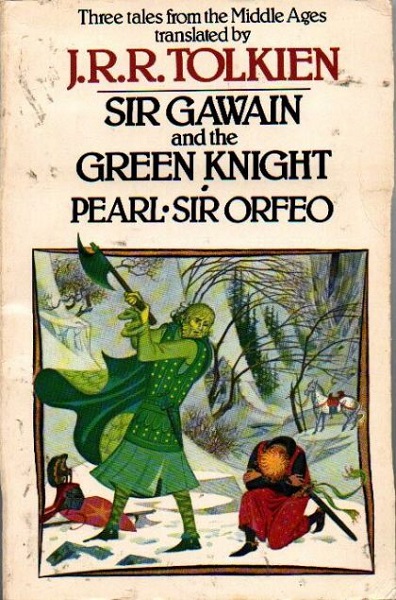
I need to think about Sir Gawain and the Green Knight some more and reread it a few more times before I come to anymore conclusions on in it. As with Tolkien’s translation of Beowulf, I enjoyed reading this and found it flowed and moves with a nice rhythm. There are two other poems in the collection I have, Pearl and Sir Orfeo, which I haven’t read yet, but will the next time around.
Half a Century of Reading Tolkien: Part One
Half a Century of Reading Tolkien: Part Two – The Fellowship of the Ring by JRR Tolkien
Half a Century of Reading Tolkien: Part Three — The Two Towers by JRR Tolkien
Half a Century of Reading Tolkien: Part Four — The Return of the King by JRR Tolkien
Half a Century of Reading Tolkien: Part Five — From the Beginning: The Hobbit by JRR Tolkien
Half a Century of Reading Tolkien: Part Seven — The Sword of Shannara by Terry Brooks
Half a Century of Reading Tolkien: Part Eight — The Silmarillion by JRR Tolkien
Grimmer Than Grim: The Children of Húrin by J.R.R. Tolkien
Fletcher Vredenburgh writes a column each first Sunday of the month at Black Gate, mostly about older books he hasn’t read before. He also posts at his own site, Stuff I Like when his muse hits him
Categories: Fantasy Books
Exploring the Dark Side of Life: Remains, edited by Andrew Cox
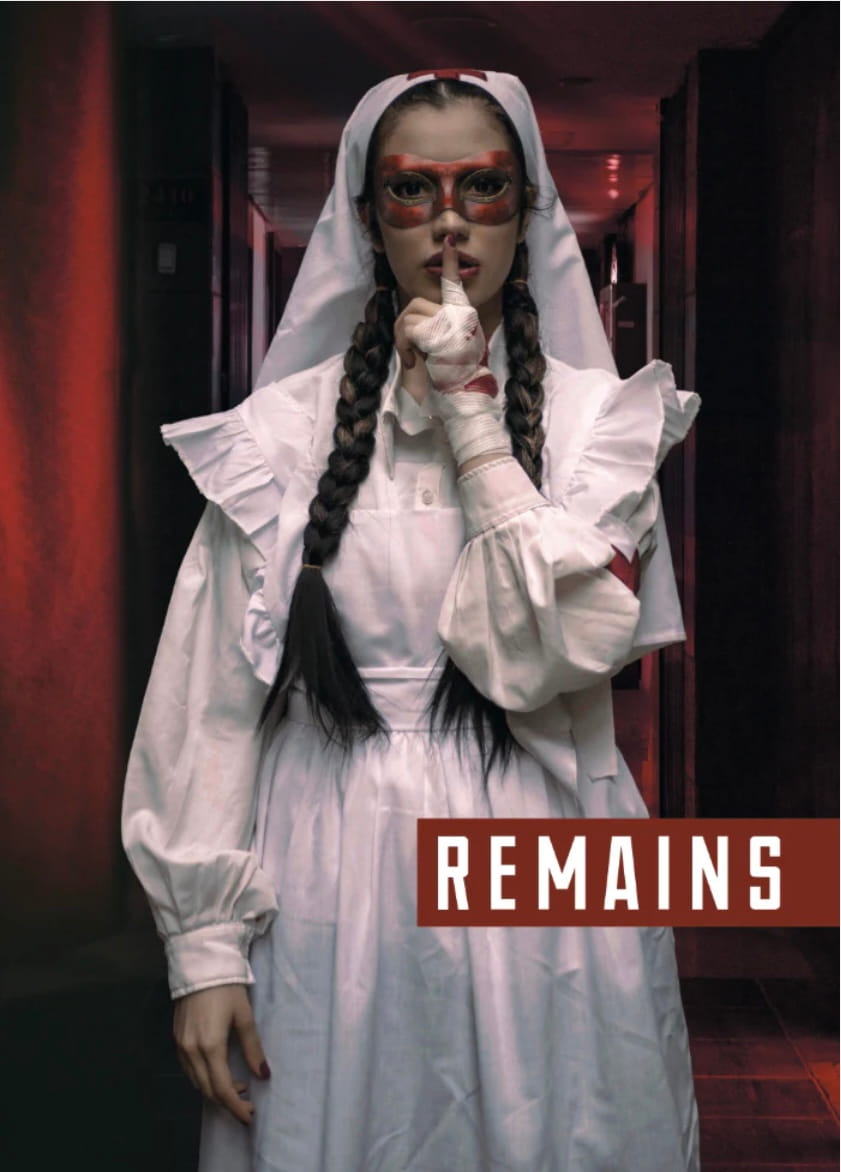

Remains, issues 4 and 4. Cover art by Richard Wagner
There are readers who, like me, prefer dark fiction in short form, because their suspension of disbelief is too brief to sustain — with a few exceptions — a full novel.
For people like us here’s a real treat: the new magazine/anthology Remains, edited by Andy Cox and illustrated by Richard Wagner, both well known for their previous work with the mythical Black Static magazine.
The first two issues are already sold out, but volume 3 ( published in late 2025) and the brand new volume 4 are available to entertain and disquiet.
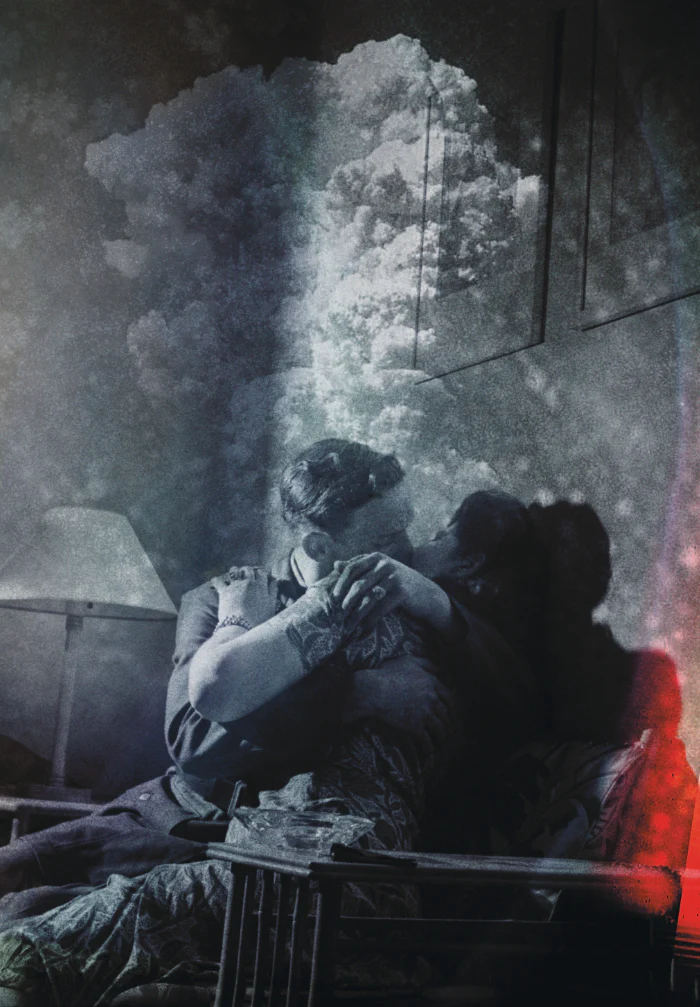 Art for “Hiroshima Was Another Word For Love Then” by Andrew Hoo, from Issue 3, by Richard Wagner
My favorite stories from vol 3 are the following:
“Atrophy Wife” by Gary McMahon, a superb, deeply unsettling tale where two boys discover the headless body of a murdered girl
“Hiroshima Was Another Word for Love Then” by Andrew Hook, an insightful, slightly sad piece depicting the fleeting encounter between a man and a woman whose lives will be separated forever
“Gehenna” by Steve Rasnic Tem, an engrossing, moving story featuring a cancer patient riding the bus to his chemo infusions
The list of contributors includes Allison Littlewood, Danny Rhodes, James Sallis and Stephen Hargadon.
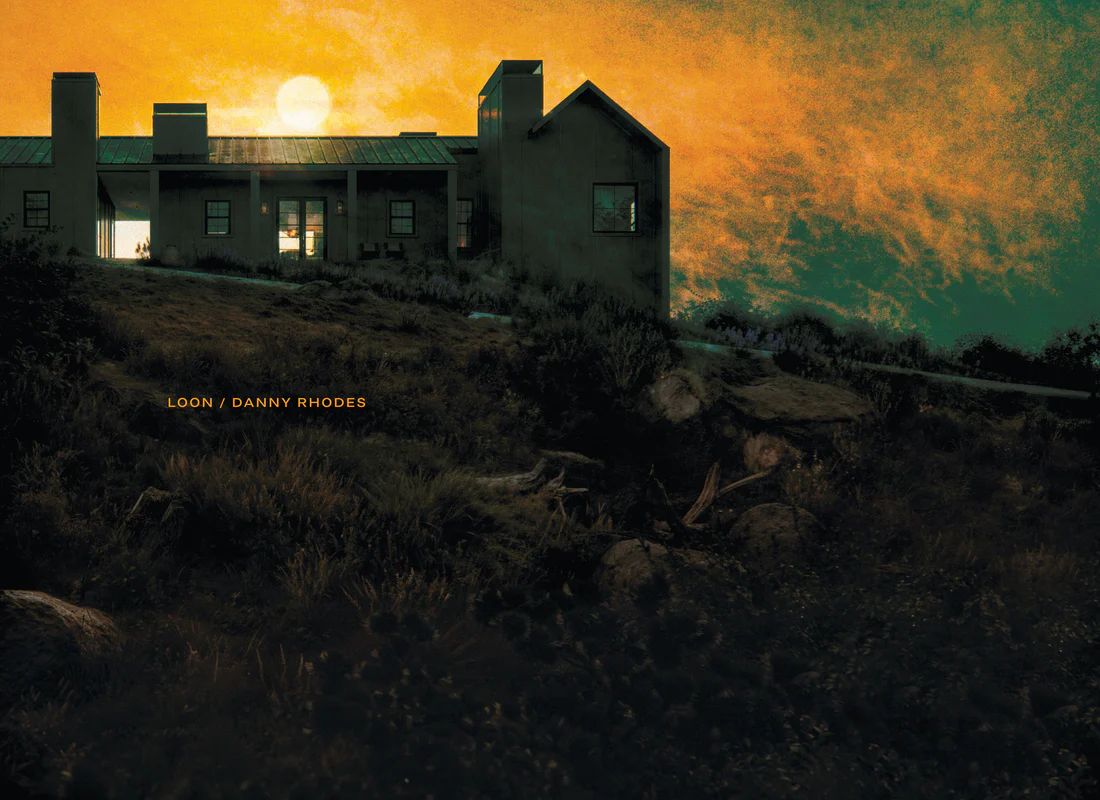 Art for “Loon” by Danny Rhodes, from Issue 3, by Robert Wagner
From volume 4 my personal choices are
“Station to Station” by Stephen Bacon, a fascinating, life-long trip in the network of London Underground in search of a friend lost forever
“Development Conversation” by Stephen Hargadon, a very unusual, fascinating piece of weird fiction set in an office where unexpected changes are going to take place
Other contributors are: Sean Padraic Byrne, Kay Vandail, James Sallis, Annie Neugebauer, Craig Bernardini, Steve Toase and John Possidente.
Copies are $10 each in the US, and a 4-issue subscription is $33. Order directly from the Remains website.
Mario Guslandi was born in Milan, Italy, where he currently lives. He became addicted to horror and supernatural fiction (too) many years ago, after accidentally reading a reprint anthology of stories by MR James, JS Le Fanu, Arthur Machen etc. Most likely the only Italian who regularly reads (and reviews) dark fiction in English, he has contributed over the years to various genre websites such as Horrorworld, Hellnotes, The British Fantasy Society, The Agony Column and many more. See all his recent reviews for us here.
Categories: Fantasy Books
Join Jim this month at Penguicon!

Visit Penguicon’s website for more information about the event and tickets.
A special leather-bound edition of Storm Front and a special hardcover edition of Brief Cases will be featured in their auction! Please come to support and be a part of this wonderful opportunity. Thank you Penguicon!
Categories: Authors
“Little Failure ~ A Memoir” & “The Company”
The post “Little Failure ~ A Memoir” & “The Company” appeared first on LitStack.
Categories: Fantasy Books
JITTERBUG by Gareth L Powell
“On Earth, they depicted justice as blindfolded and impartial, but out here on the frontier, she was red in tooth and claw.” It’s not every book that begins with the unanticipated dismantling of a planet. But that is what happens here, when people in South London watch through a telescope the disassembling of the planet…
Categories: Fantasy Books
SPFBO XI - The Third Update (Mihir's Batch)

Read FBC's SPFBO11 First Update (Lukasz's batch)
Read FBC's SPFBO11 Second Update (Jack's batch)

Aah SPFBO, we are back in a new time period for the start. I got my batch of six titles and I was off. With all six books, I read 20% of them before deciding whether to read each title in its entirety. For me, this time all six titles were very cool looking. Mine is the third batch to be read and you can read what Lukasz and Jack thought of their batches in the links above.
My thanks to all six authors for their submission and being brave to submit their babies for being reviewed by unknown people. It takes a special kind of mental fortitude to toil away in creating these stories and then setting them free into the world for being read and judged. I applaud you all.
So here are my thoughts on all of them:

Chalmach Chronicles by Torbjørn Øverland Amundsen – I started my SPFBO read with this book because I found the blurb to be very intriguing. In my previous years in SPFBO, I read a book like this, and I had enjoyed it immensely. The Chalmach Chronicles follows on in this manner, and I very much enjoyed it. Each story was a different one and highlighted the magic present within the world as well as the different aspects of the city. I really enjoyed how the author showcased the city’s geographical aspects within each story as it added to the story’s depth. The stories also reference characters from the other stories, and this adds to the plot depth.
Overall I would really recommend this book as I very much enjoyed it for its ingenuity, and I will be buying the sequel as well.

Night of The Illumination by Jacob Montanez – Night Of The Illumination is an epic fantasy that has dark edges and great prose. I enjoyed reading this book but had to DNF it around the 50% mark as the book’s pace had slowed down significantly. This book had a lot of epic feel to the main plot, it was also very dark. The world settings are constantly hinted at but never properly revealed
I think I wasn’t the right reader for this story. The writing style is very in-depth and while it isn’t the purple kind, it has beauty to it. Overall, this would be great for those who are looking for something different. Think along the lines of Mark Lawrence, Michael R. Fletcher and Brian Staveley, Jacob Montanez is a writer with a unique voice and style.

The Golden Scarab of Balihar by Michael Grayford – The Golden Scarab was a fun and fast read set in a world that’s reminiscent of South-West Asia. The writing was very succinct, and the pace of the story was smooth. Overall I enjoyed this story wherein the female MC uses her wits and the world has a very Arabian nights feel. This story flowed quickly and was a bit predictable but that’s not a knock on the book or the author. The humour quotient especially with the Jinn is a solid factor for the enjoyment of the story and alongside the brilliant and plucky protagonist is a plus for the story.
This is a good effort, and it's a fun twist on the Aladdin fable but it’s also geared for newer fantasy readers and older/experienced fantasy readers might not find anything new within bar the settings. I would easily see this story be in much demand for younger (tween and teenage) readers and would make a great animated show or movie. This

The Dragon of the Dread Deep by C.D. McKenna – This was a book which I was most excited for as it featured nautical fantasy and pirates. I finished this book as quickly as I could as it featured dragon riders, action and magic. For me however, this book had a very slow start but the characters, especially the main protagonist Cassian was enticing enough for me to continue. As I read on, I realized this book while a standalone is set in the world of the Vorelian Saga books. There might have been nods to the main events but because I haven’t read those works, I couldn’t tell.
The story kicks into proper gear by the middle and from there it’s all about battles, treachery, dragon magic and being decent in a cutthroat world. I wouldn’t call this world grimdark but it occupies the space nicely between dark and grimdark fantasy. There’s not a lot of good people, just folks with various plans and agendas and some who are trying to do the decent thing. The world introduced within is a complicated one and for fans of high fantasy, will be very pleased.
The Dragon of the Dread Deep is a dark fantasy that explores how doing the right thing can lead to more problems. Full of magic, action, betrayals, TDOTDD is a book for those looking to get lost in a complex world.

The Sins of Steel and Shadow by Steve Pannett – The Sins of Steel & Shadow was another title which beguiled me with its blurb. This is a world wherein humans and vampires co-exist with simmering tensions and navigating these landmines is out protagonist Bail Neren. He is deemed a Turned, not entirely Vampyr but far away from a human. Hated by one and deemed lowly by other, Bail often stays in the shadows for his safety.
TSOSAS is a dark, gritty story with strong focus on characters. For me, I enjoyed the slow reveal of the world, Bail’s cautious wanderings in the world and his alliances within the city. There’s a proper mystery afoot within the main plot and this book is very much for fans of Daniel Polansky and RJ Barker.I had read the previous book by this author and while that was a western fantasy, this book was another different one. The mystery plot was nicely unveiled and the ending was a complete shocker for me. For readers who enjoy character-driven stories, mixed in moral ambiguity, socio-political intrigue, and low fantasy settings, this book will be for you.

Throne of Darkness by Spencer Russell Smith – I’m going to say this right upfront this is one of the wildest fantasy books I’ve read since I started reading fantasy in 1999-2000. The prologue is like Wheel Of Time epic but juiced up with BSG SF richness.
There’s no way for me to describe it but to implore readers to just read and decide for themselves. This book is for lovers of Tolkien, Sanderson and Christopher Ruocchio, those worldbuilding gods whose skills leave us readers wowed. Spencer Russell Smith can easily labelled in their level as one can easily see in this book. Besides the worldbuilding, this book has a lot of characters and it is action-packed to its gills. The story while straightforward, does require a lot of attention as the author drops us into the world of Efruumani and handholds us while giving us all the details and intricacies of the system within (I very much was reminded of my first read of R. Scott Bakker’s The Darkness That Came Before)
For me, this was such a wild read, that I had no comparison for it. The writing does take a while to adjust to and the prose is kept steady because of the way the main story unfolds. I had to go with the flow a lot as I was trying to take in all the world info and story details. This wasn’t the most enjoyable way, but this story demanded as the main story occurs over the space of 4 days and some hours and it ends with an explosive resolution that’s buttressed with two epilogues.
All I will say about Throne Of Darkness is that this book is unlike any that you have read before, and while it does have its shortcomings (prose, information overload), the story pace, worldbuilding and magic system (gem, metal based, and light enhanced) simply overpowers those flaws. This is one of those titles which will have its fans and detractors in equal order but it is a hidden gem and Spencer Russell Smith can be proud of what a unique story he has envisioned. Throne Of Darkness is a unique science-apocalpytic epic fantasy in a league of its own. Read it and find out where you stand in its wake.
.
.
.
So after finishing my lot, I had a very heavy choice to make. There were four obvious titles which I read and while they challenged me, each of them was enjoyable in their own special way. So I would like to highlight these four titles and implore SPFBO readers to check them out as it’s only due to the nature of the competition that I must select one among these four:

1) Chalmach Chronicles
2) Throne of Darkness
3) The Dragon of the Dread Deep
4) The Sins of Steel and Shadow
For choosing my SPFBO semifinalist, it came down to my personal enjoyment as to which book provided a full story and had the least flaws. I must apologize to all the authors as I don’t mean to imply that there was anything wrong with their stories. In choosing one among these four, the remaining three aren’t unworthy. They would have been my top choice in any previous edition, and I hope readers do check them out irrespective of my choice below….
So, without any further waiting, my SPFBO semifinalist is
.
.
.
.
.
.
.
.
.
.
.

The Sins of Steel and Shadow by Steve Pannett was the one book which I enjoyed the most and will be putting forward for my FBC co-judges to read in our quest to select a finalist. Many congratulations to Steve Pannett and my commiserations to all the authors in my lot of six. I want to thank you for allowing me to read your books and giving me an opportunity to provide my thoughts on them.
Categories: Fantasy Books
Comment on One-Third by Bill
So pleased to hear that a regular annual release of IoM looks feasible again! Congratulations for keeping on with book#5 rather than waiting for the Book#4 edits before proceeding – it looks a winning strategy!
Thanks for keeping us informed and fingers crossed that “Early March” Edits are minor and don’t impact your new writing now that its going so well! (any idea why the edits were so long in coming this time?)
Categories: Authors
The Devouring Oscars
Since the Oscars are just around the corner, it seems only fair that the Book Devouring Horde hold their own awards ceremony.

Andrea donated some extra-long purple shag carpet and Steve said any machine is a smoke machine if he operates it, so the ceremony part is clearly handled.
We just need you to pick the most beloved winners. Polls will stay open until next Friday and I’ve tried (operative word) to enable multiple options. You should be able to choose two answers in these, the most impossible of choices. Mwahaha!
Note: There is a poll embedded within this post, please visit the site to participate in this post's poll.Everything happened so much this week, why not pour your favourite drink and relax by thinking about your favourite among these capable, fierce men:
Note: There is a poll embedded within this post, please visit the site to participate in this post's poll.But Mod R, there’s only one leading man from the Edge! So much squandered hunkiness! Yes, he’s my favourite, I love him the best, and this is my poll *phhhrrrrbttt*.
Now it’s your turn to nominate:
Suppose you wake up in an Ilona Andrews world* the way Maggie does in This Kingdom Will Not Kill Me: cold, confused, and very much alone. The protagonists are busy saving the day, so they’re not available to help you. Which supporting character do you go looking for first?
*Because the Innkeeper world is our world, we’ll mix it up and have you waking up in Baha-char, with nothing on you, not even a sneaker to trade the muckrats.
And if you can’t wait to find out how Maggie handled the world of her favourite series, reminder that the first chapters of This Kingdom Will Not Kill Me are currently running as a serial over at Reactor Magazine and are available as an extended preview for readers served by the US edition.
Take care out there, BDH!
The post The Devouring Oscars first appeared on ILONA ANDREWS.
Categories: Authors
Comment on One-Third by Sean
“I’ll be able to keep up my one-a-year target after all” You were CONCERNED about nothing.
Categories: Authors
Forgotten Authors: Theodora Du Bois
 Theodora Du Bois
Theodora McCormick was born on September 14, 1890 in Brooklyn, New York. Her father died when she was a year old and she was raised by her mother and stepfather. She attended the Barnard School for Girls in Manhattan and the Halsted School in Yonkers. Although she wanted to attend Vassar College and was accepted in 1909, her parents did not support her attending the school. Her plans to go anyway were dashed when she was diagnosed with tuberculosis and she found herself in a TB sanitarium instead. Eventually, in 1916, she enrolled in the Dartmouth Summer School for Drama.
While in the sanitarium, McCormick began writing poetry, although most of her poetry was written during this time and after she was healthy she focused on various forms of prose writing. In 1918, she married Delafield Du Bois and took the name Theodora Du Bois. Theodora gave birth to a daughter, also named Theodora, in 1919 and in 1922 had a son, Eliot.
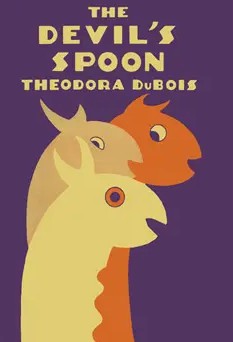 The Devil’s Spoon
Perhaps best known as a playwright and mystery author, she wrote historical romances using the name Theodora McCormick, and other works of fiction and plays as by Theodora Du Bois. Her first published play, The Sleeping Beauty: A Play With or Without Pageantry, was first published in 1919 and, as the name implies, is a fantasy. Her first book, Amateur and Educational Dramatics was written with coauthors Evelyne Hilliard and Kate Oglebay and was published in 1917.
She began publishing fiction in 1920 with the short story “Thursday and the King and Queen,” which appeared in Woman’s Home Companion. She branched out to novels in 1930 with The Devil’s Spoon about a devil who possesses a human in order to fight against Satan’s plans to dominate the world (originally published as a novel, it would be reprinted in the June 1948 issue of Famous Fantastic Mysteries). Du Bois would return to the theme of possession in 1948 with The Devil and Destiny.
Later works, such as Murder Strikes and Atomic Unit and High Tension fell into the science fiction/thriller genre and other works during the 1940s and 50s also tackled the cold war, with Du Bois being dropped by her publisher in 1954 after her novel Seeing Red took on the issue of McCarthyism.
In addition to her dramas, mystery novels, historical romances, and science fiction works, Du Bois also wrote numerous juvenile works, beginning with Rocks and Rills: A Cartoon in Three Dimensions in 1932 through The High King’s Daughter in 1966.
When Delafield Du Bois worked on the Manhattan Project during World War II, the couple formed a committee at Yale University to help academics from Oxford and Cambridge who found themselves in the United States during the war. Delafield died in 1965.
Titles published using the McCormick name included the medieval novel The Emerald Crown, the American Revolution novel Freedom’s Way, and the Irish novel The Love of Fingin O’Lea.
Du Bois died on February 1, 1986 in New York. She is buried in Moravian Cemetery in New Dorp, New York.
 Steven H Silver is a twenty-one-time Hugo Award nominee and was the publisher of the Hugo-nominated fanzine Argentus as well as the editor and publisher of ISFiC Press for eight years. He has also edited books for DAW, NESFA Press, and ZNB. His most recent anthology is Alternate Peace and his novel After Hastings was published in 2020. Steven has chaired the first Midwest Construction, Windycon three times, and the SFWA Nebula Conference numerous times. He was programming chair for Chicon 2000 and Vice Chair of Chicon 7.
Categories: Fantasy Books
Book Review: House of Splinters by Laura Purcell
I received a review copy from the publisher. This does not affect the contents of my review and all opinions are my own.
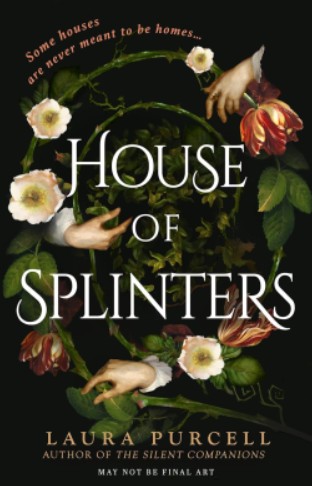 House of Splinters by Laura Purcell
Mogsy’s Rating: 4 of 5 stars
Genre: Horror, Historical Fiction
Series: Stand Alone
Publisher: Blackstone Publishing (February 10, 2026)
Length: 346 pages
Author Information: Website | Twitter
My queen of gothic horror is at it again! Laura Purcell returns to the haunting concept she first introduced in The Silent Companions, bringing back those creepy wooden figures in House of Splinters. As a long-time fan of the author, stepping back into that eeriness and uncanny atmosphere felt like coming home, though as it turns out, home might not be the best choice of word.
The story follows Belinda Bainbridge, who has spent most of her life under the thumb of her anxious, overbearing mother. So when her father-in-law dies, prompting her husband Wilfred to relocate his family to take over management of his ancestral estate, Belinda quietly hopes the change will give her the chance to build a life of her own. With her young son Freddie approaching his breeching and another child on the way, the move feels like a turning point. However, the one tie from her past that she insists on bringing with her is her lady’s maid, a steady source of familiarity and reassurance as she prepares to leave her old life behind.
But when they arrive at the estate, known as the Bridge, Belinda quickly realizes it is nothing like the future she imagined. The place had never seemed particularly cheerful during her earlier visits, but now it’s practically falling apart. The house is in disrepair, the gardens neglected and lifeless. The villagers, long under the Bainbridges’ care, are resentful and wary of the family, whispering that they are cursed. Indeed, the Bridge has had its share of dark history, including an ancestor rumored to have been executed as a witch, the mysterious death of Wilfred’s sister when they were children, and the accidental death of a servant. Then there are the wooden figures known as silent companions, flat wooden cutouts once popular as household decorations during the Dutch Golden Age. Those that once belonged to Wilfred’s mother are found locked away in a room Belinda hopes to turn into a nursery, but once they are uncovered, strange things begin to happen. Freddie becomes oddly fascinated with them, talking to them and treating them like real people. And with the birth of her second child drawing closer, Belinda begins to fear that something is deeply wrong with the house and that something is haunting her family.
Considering The Silent Companions was the novel that first made me fall in love with the author’s work, one of the most exciting aspects of House of Splinters is how it reconnects with the world of the earlier book. While this novel tells a completely new story with completely new characters, Purcell cleverly revisits some familiar ground by returning to the Bainbridge family and the Bridge. Fans will recognize certain elements echoed in this one, like a pregnant protagonist, the rundown estate, the unwelcoming villagers, and of course, the stars of this horror show which are the silent wooden figures themselves. At the same time, this isn’t a rehash of the original plot with just a few things tweaked. Rather, it feels more like another chapter in the wider legacy of the unfortunate Bainbridges, exploring how multiple generations continue to become haunted by the house and the companions.
One of the things Purcell always does so well is atmosphere, and House of Splinters certainly delivers on that front. The Bridge is practically a character in its own right, and it serves as the perfect gothic setting with its isolation and decaying front, full of secrets that quite literally refuse to stay buried. You never know what might emerge from its overgrown grounds or from the shadows within the house, because the entire place carries an air of unease and the sense that something isn’t right. I’ve also always felt the companions concept had far more potential to explore, and they are again put to excellent use.
Beyond the paranormal elements, the novel also heartily embraces all the classic gothic themes. We have Belinda, a particularly sympathetic protagonist who wants so badly for her new life in her new home to work out, but feels increasingly trapped by the family secrets, societal pressures, and the guilt brought on by unrealistic expectations. And whenever children are involved, the horror becomes even more disturbing. Let’s just say there’s a reason why the “creepy child” trope has become so embedded in the genre, and Purcell taps into it big time here through Freddie’s increasingly strange behavior. The idea that something evil could be influencing a child or threatening a baby makes the implications especially chilling and difficult to shake.
If there’s any downside, it’s that the story takes some time to get going. But then again, it’s a gothic novel. Slow-building tension is par for the course. But once those threads start coming together, particularly with the arrival of Wilfred’s estranged brother Nathan, and the opening of the floodgates with regard to the Bainbridge secrets, things start gaining serious momentum. Is there something supernatural at work at the Bridge? Or is superstition and paranoia getting the better of our characters’ perceptions?
In the end, this ws another strong addition to Laura Purcell’s growing catalogue of spectacular gothic horror. If you enjoy slow-burning tales filled with atmosphere and uneasy mysteries, do yourself a favor and pick one up now. Dark and unsettling, House of Splinters is full of the creeping sense of dread that she does so well, and fans of her work will find plenty to enjoy here, along with the return of the eerie silent companions.


Categories: Fantasy Books
Early Review – So Far Away by Kat Mellon (4/5 stars)

Reading Level: Adult
Genre: Contemporary Fantasy/Science Fiction
Length: 324 pages
Publisher: Tarsier Publishing
Release Date: March 27, 2026
ASIN: B0GFQ82RXW
Stand Alone or Series: Stand Alone
Source: eGalley from NetGalley
Rating: 4/5 stars
“After two months of intensive group therapy, six individuals embark on a Thera Quest Inc. session—a simulated fantasy adventure guaranteed to incite lasting behavioral change in the real world. For thirty-year-old Elizatine, this means overcoming her beastly shopping addiction alongside five strangers with their own problems: Tanner and Lana, two middle-aged alcoholics; Amara, a young ambulatory wheelchair user with POTS mourning her loss of agency; Rowan, a thirty-something wracked by guilt from the death of his younger brother, and Felix; a charming and depressed entertainer. Within the simulation, the six must work alongside each other to deliver a cursed book while encountering whimsical hybrid creatures, unsettling personal trials, and hulking manifestations of their inner demons.”
Series Info/Source: This is a stand alone book. I got this on ebook through NetGalley for review.
Thoughts: I picked this book on a bit of a whim from NetGalley for review and was surprised how quickly I was engaged in the story. This is a fast-paced easy read that has an interesting premise. I think the only downside to this was that the world, the characters, and the plot were a bit simpler than I expected.
Six individuals are embarking on a fantasy quest through Thera Quest Inc. Their personal quest is to confront their issues using a new type of immersive therapy. Their fantasy quest is to deliver a cursed book to a frog person. We hear from each person individually, but the story really focuses on Elizatine (who has a shopping addiction) and Tanner (who is a recovering alcoholic).
This was a super quick and easy read that was fast-paced and engaging. In general, I liked all of the characters. They all (obviously) have some pretty big issues from their pasts that they are trying to work through. The premise of doing that through an immersive fantasy game is a fun one. The characters are all fairly likable, if a bit simpler than expected. There is a bit of a romance in here as well.
My biggest complaint about this is that everything is just a bit too straight-forward and simple. The characters working through their issues seem to do so easily and without many complications. The characters themselves are also somewhat two dimensional; they have easily explained issues they are working through from well defined past traumatic events. People are rarely that straight-forward. The plot itself is also fairly simple and straight-forward.
I do think maybe the simplicity of this story might be part of its charm. It is a fun concept, a quick read, the characters are likable, and the ending leaves you feeling hopeful. I guess I was just left feeling like there should have been a bit more to these characters and their stories. While I read this quickly and vaguely enjoyed it, I don’t think it is one of those books that I will ever think back on. This was more of a quick read that you are like “huh that was fun” and then you move on.
My Summary (4/5): Overall I liked this. This was a fun and fast-pasted read that has an interesting premise and likable characters. I did struggle with how easily these characters’ issues were solved and with how simple both the characters and the plot were. However, that may have been part of the charm to this story. It is simple, straight-forward, fun, and easy. While I don’t think this story left a lasting impact on me (it’s not the type of story I will probably even think about again after writing this review), it was a fun diversion. I would recommend if you think the premise sounds interesting and if you don’t mind more simplistic and straight-forward stories.

Categories: Fantasy Books
Old Maids: Unnatural Death by Dorothy Sayers
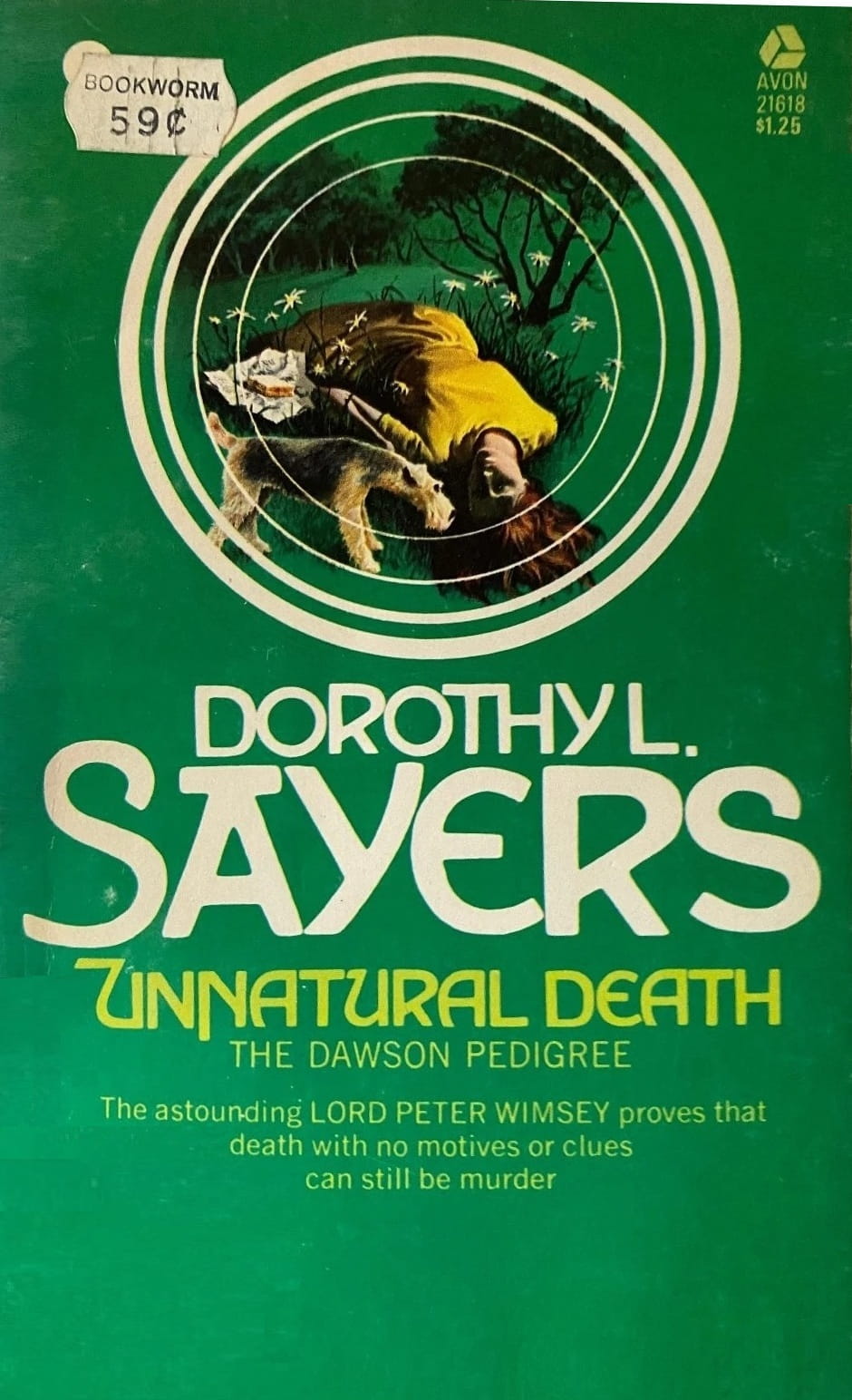
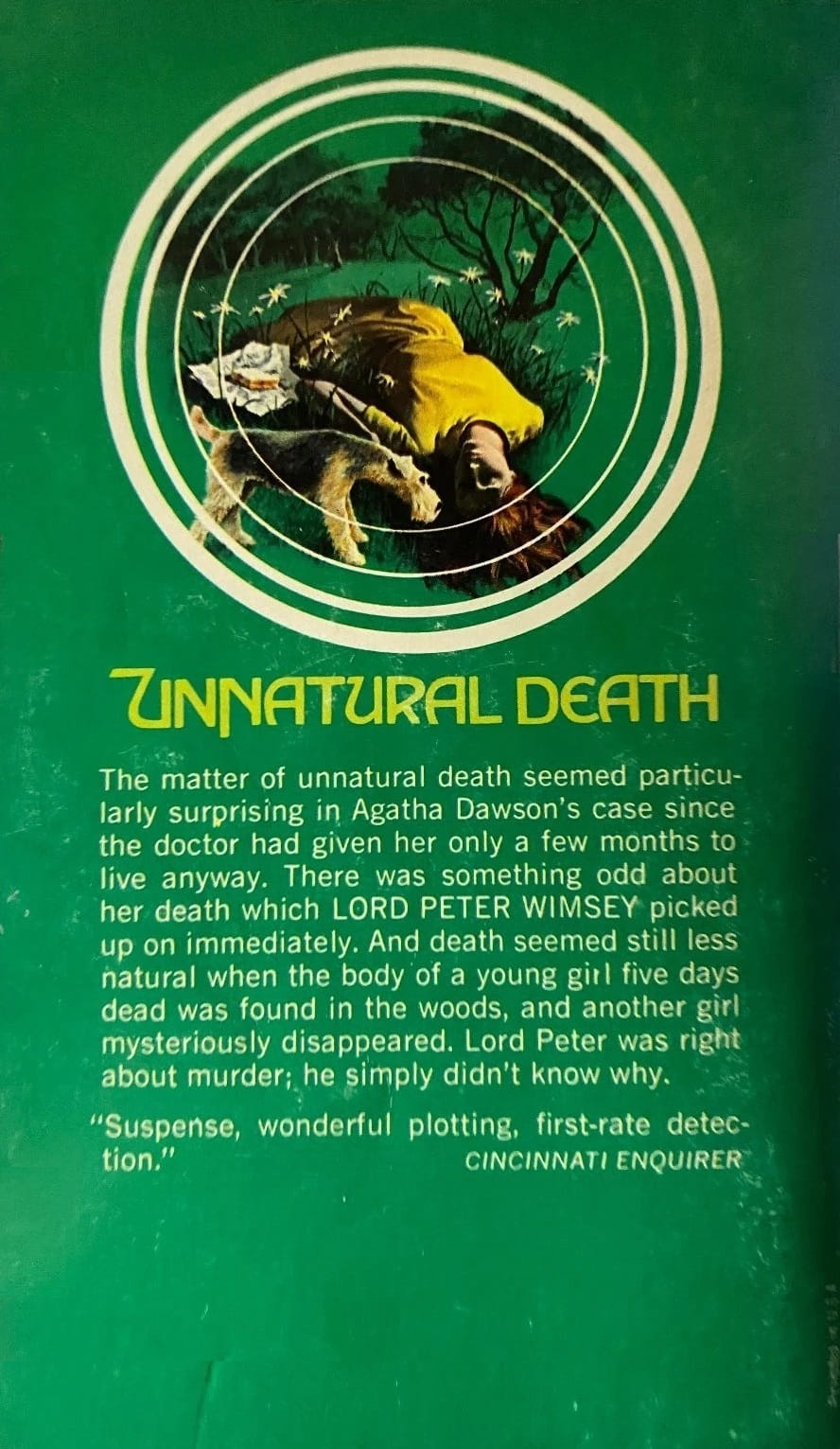
Unnatural Death by Dorothy Sayers (Avon Books, 1964)
“I know who you are now,” said Nurse Philliter, slowly. “You — you gave evidence against Sir Julian Freke. In fact, you traced the murder to him, didn’t you?”
In Unnatural Death, the third Wimsey novel, Sayers again makes medical issues vital to the plot and the mystery. In this case, Wimsey learns of his case entirely by accident: He and his close friend Charles Parker are talking about crime over dinner, and Wimsey tells Parker that, unlike police officers, who have a public duty to voice their suspicions, doctors have no such duty and can get in trouble by doing so.
This is overheard by a doctor seated at a nearby table, who tells them a story of his own experience with doing so: A rich old woman in his care died unexpectedly — she was suffering from a terminal cancer, but that was not the cause — and he found the death puzzling and asked to do a post-mortem, which found no cause of death, followed by a chemical analysis, which revealed nothing either.
[Click the images for unnatural-sized versions.]
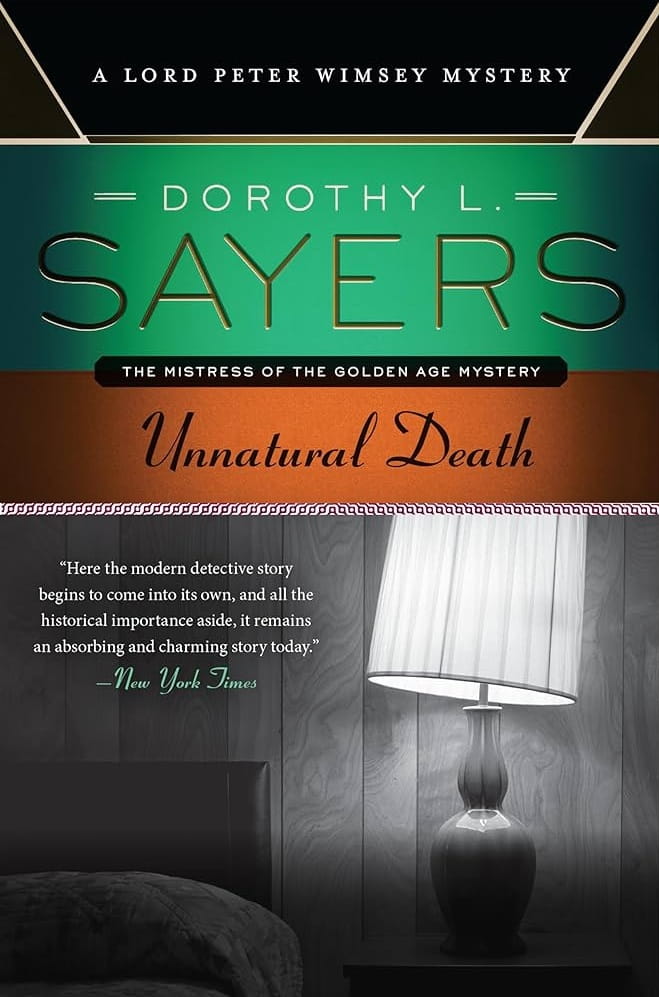 Unnatural Death (Bourbon Street, January 7, 2014)
This sets us up for a neat medical mystery, which in fact has a solution that’s fairly widely known now, but that apparently was obscure a century ago. The doctor tells the other two that the local gossip that followed from this ruined his practice, and he had to move away and start over elsewhere.
Intrigued, Wimsey offers to look into the case, but the doctor turns him down, remarking with satisfaction that Wimsey doesn’t know his name and won’t be able to pursue the matter. Wimsey decides to do so anyway, sends the doctor, Dr. Edward Carr, a short note, and says to Parker, “If you want to be immune from silly letters, Charles, don’t carry your monomark in your hat.”
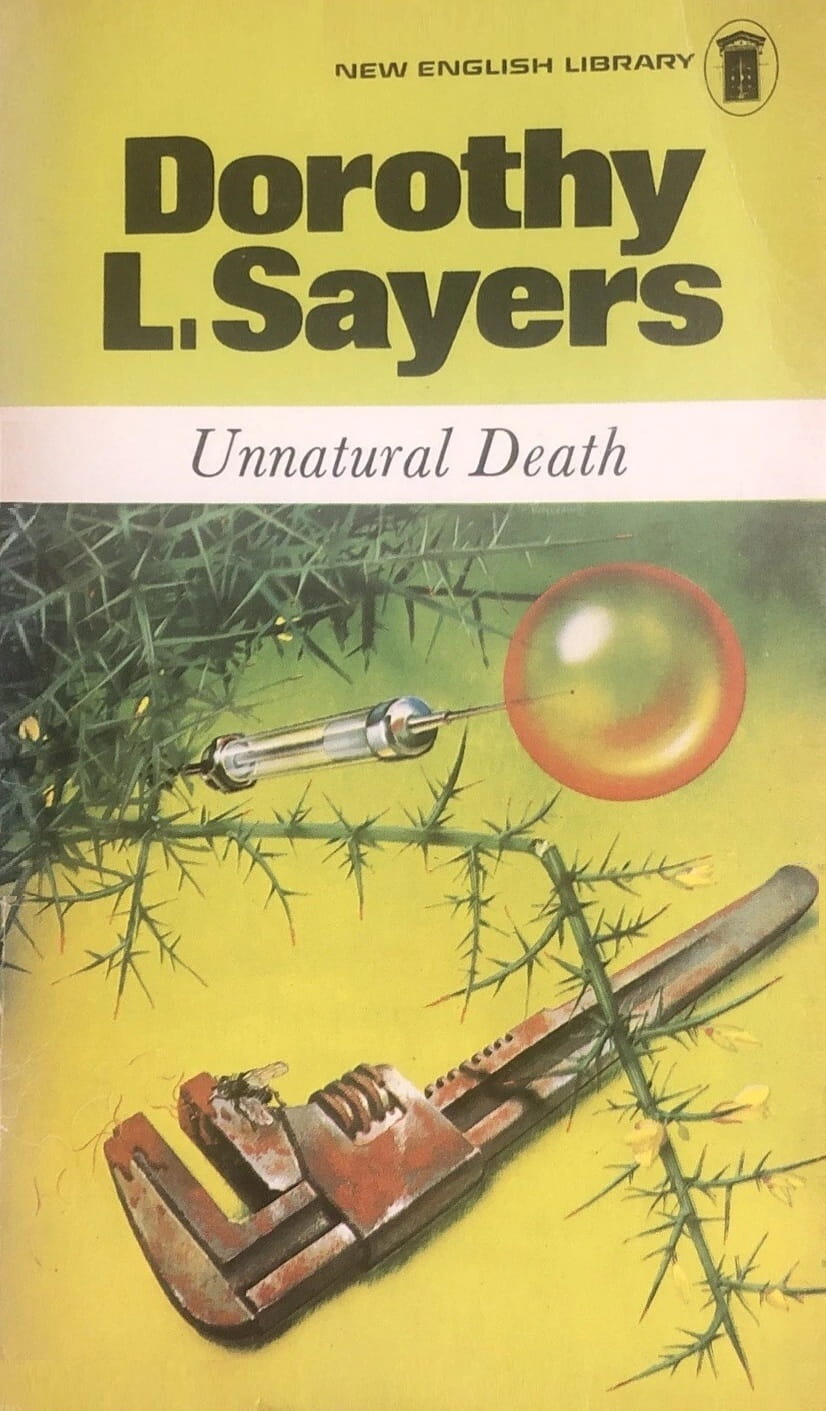
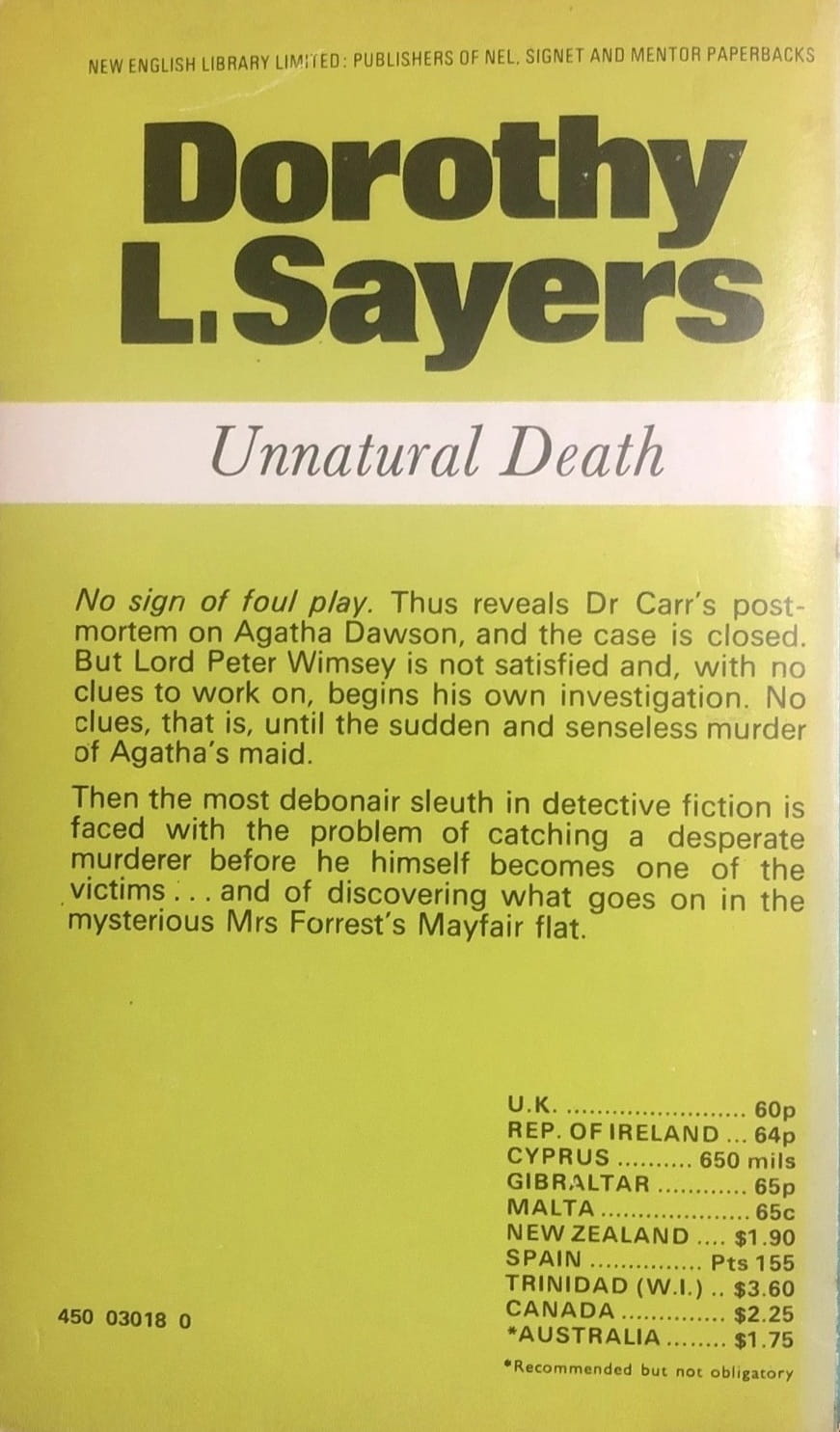
Unnatural Death by Dorothy Sayers (New English Library, 1976)
(According to Wiktionary, a monomark is a short alphanumeric sequence used as a postal address, brought into use by a British mail forwarding company two years before Unnatural Death was published. Naturally Lord Peter would have spotted and memorized the monomark!)
In an early chapter, Wimsey takes Parker to meet a woman whom he describes as a friend. Parker takes this to be a euphemism, and is embarrassed, privately ironic about how “they always seem to think it’s different,” and trying not to show the disapproval he feels. Then he and the readers meet “a thin, middle-aged woman, with a sharp, sallow face and very vivacious manner.”
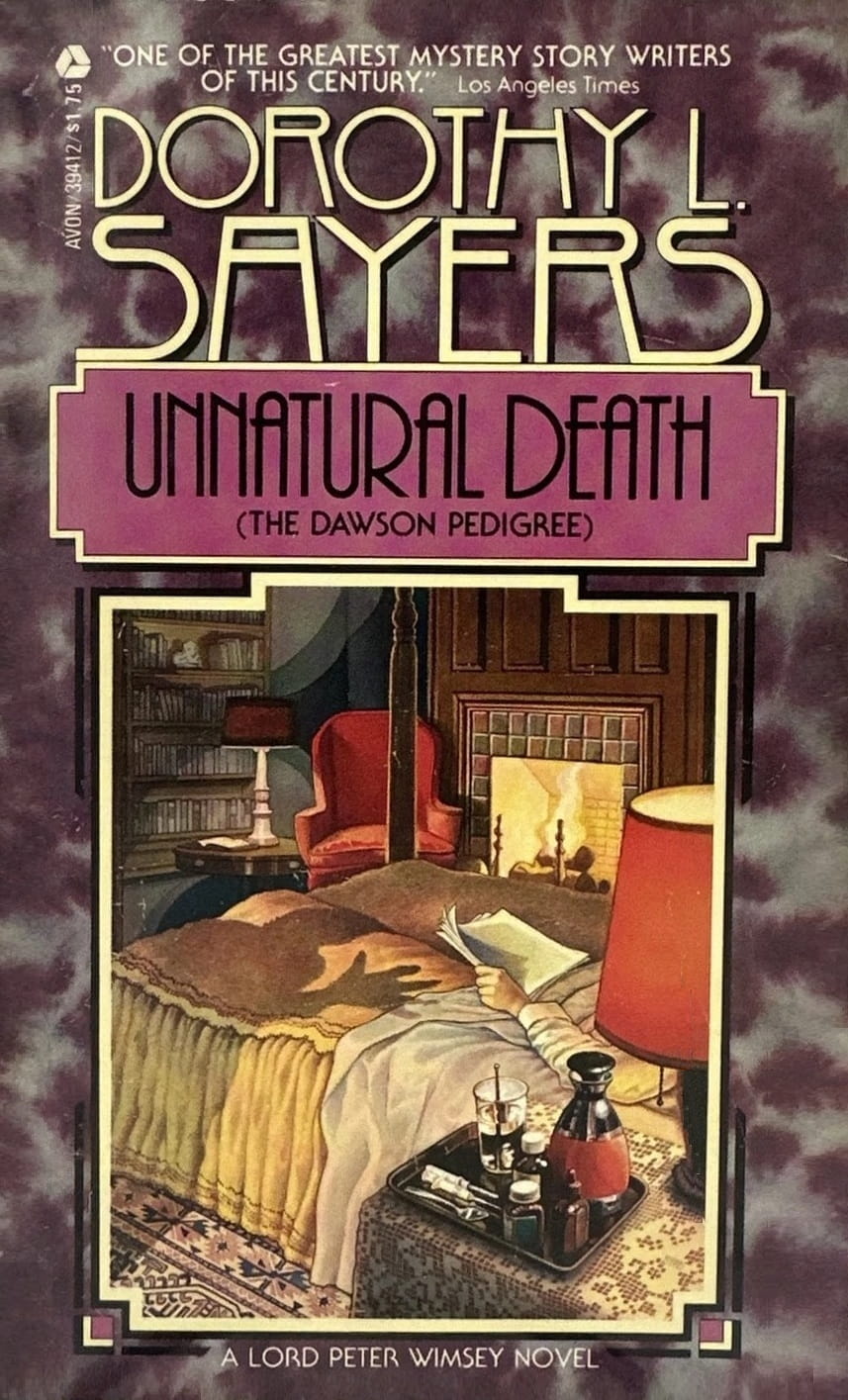
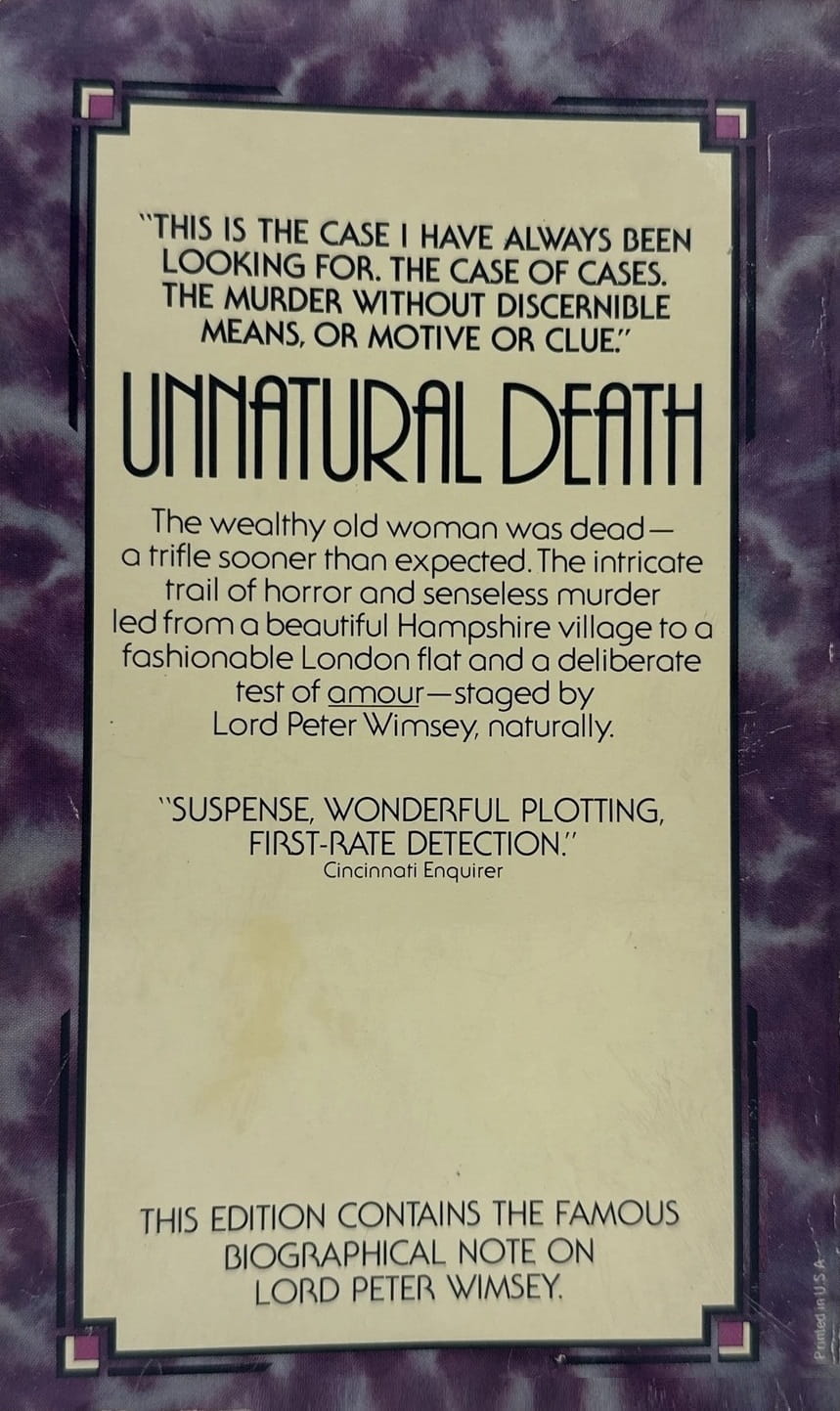
Unnatural Death (Avon Books, 1964)
Miss Climpson is, as Wimsey says, an old maid (an increasing problem in the years after the Great War) and, as Parker says, a sort of inquiry agent; in Wimsey’s words, “She asks questions which a young man could not put without a blush.”
In fact, she is part of an agency which Wimsey has created and is funding, which amounts to his version of the Baker Street Irregulars (with single women instead of street urchins!), and he sends her off to find which town Dr. Carr formerly practiced in and who was his deceased patient there — the first stage of her active role in the entire investigation.
At this point the story acquires a subtext that Sayers never makes explicit. The patient was Agatha Dawson — Miss Agatha Dawson, for she never married; she lived most of her life with her cousin, Miss Clara Whittaker, to whom she was deeply attached. Neither of them cared for marriage; Clara supported them as a successful horse breeder, and wanted nothing to do with men, except on matters of business.
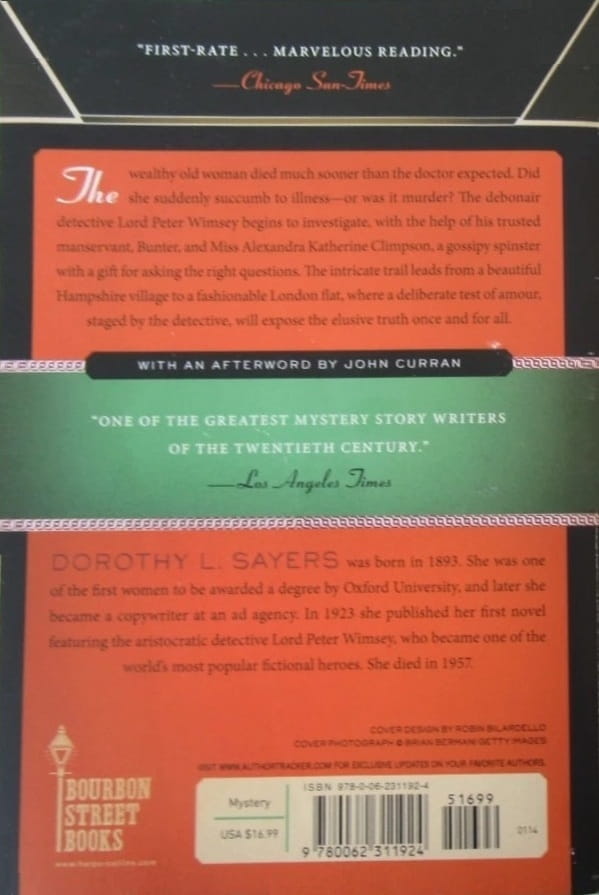 Unnatural Death, back cover (Bourbon Street, January 7, 2014)
After Clara’s death, her niece, Mary Whitaker, a trained nurse who steps in to manage Miss Dawson’s care, is also, to Miss Climpson’s eye, “not of the marrying sort,” and is much admired by a younger woman, Vera Findlater, of whom Miss Climpson thinks “It is natural for a schoolgirl… in a young woman of twenty-two it is thoroughly undesirable”; the two have plans to buy a chicken farm together.
Finally, Wimsey has two interviews with yet another woman, Miss Forrest, at the second of which she attempts to seduce him, but when he takes the lure and kisses her, she involuntarily shudders away in revulsion.
It’s a point in Sayers’s favor, I think, that she doesn’t have one stereotype of “the love that dare not speak its name” (however politely hinted at) but shows everything from lifelong devotion to naïveté to cynical manipulation. What’s unnatural, in this novel, is not one woman’s passion for another, but murder.
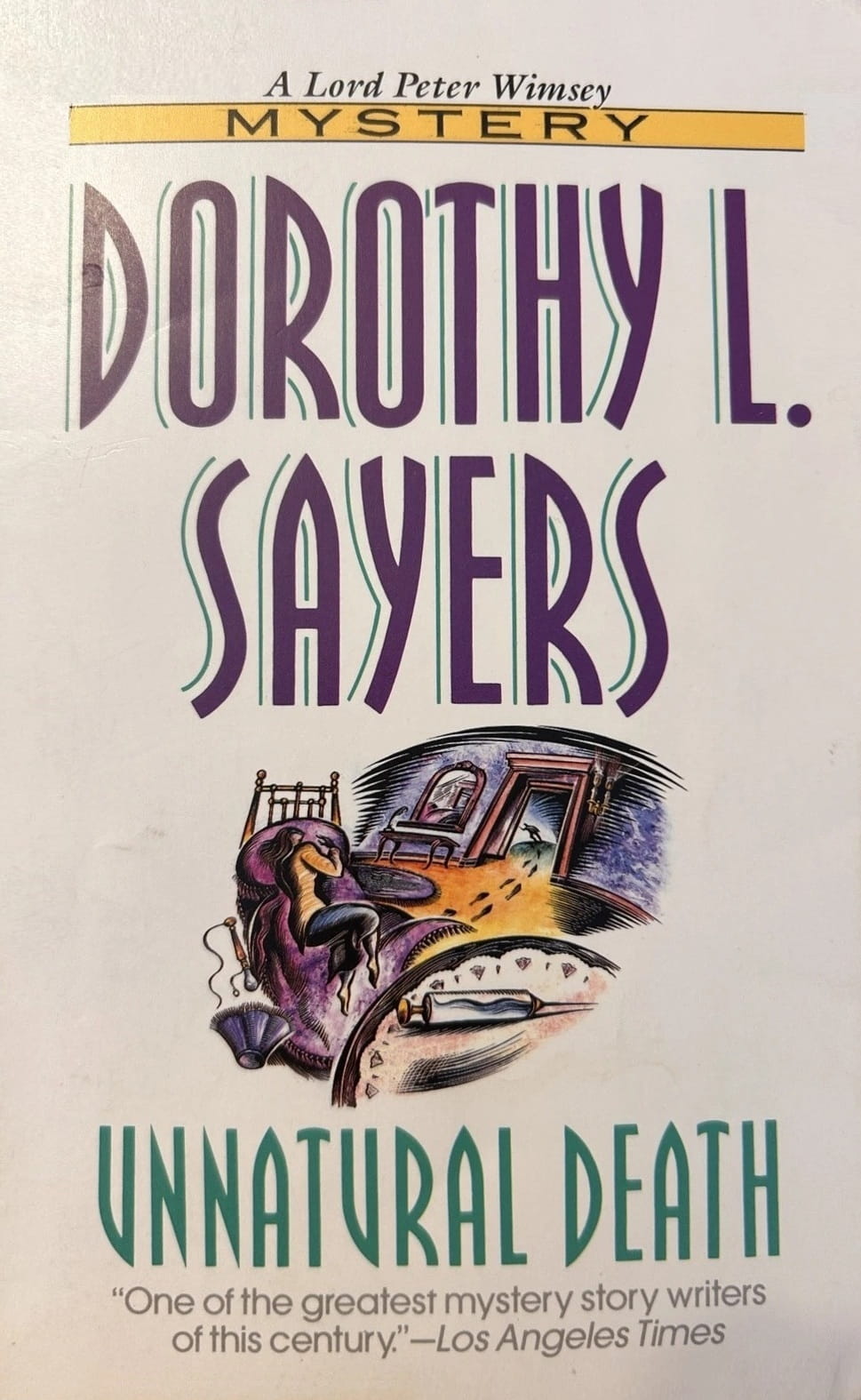
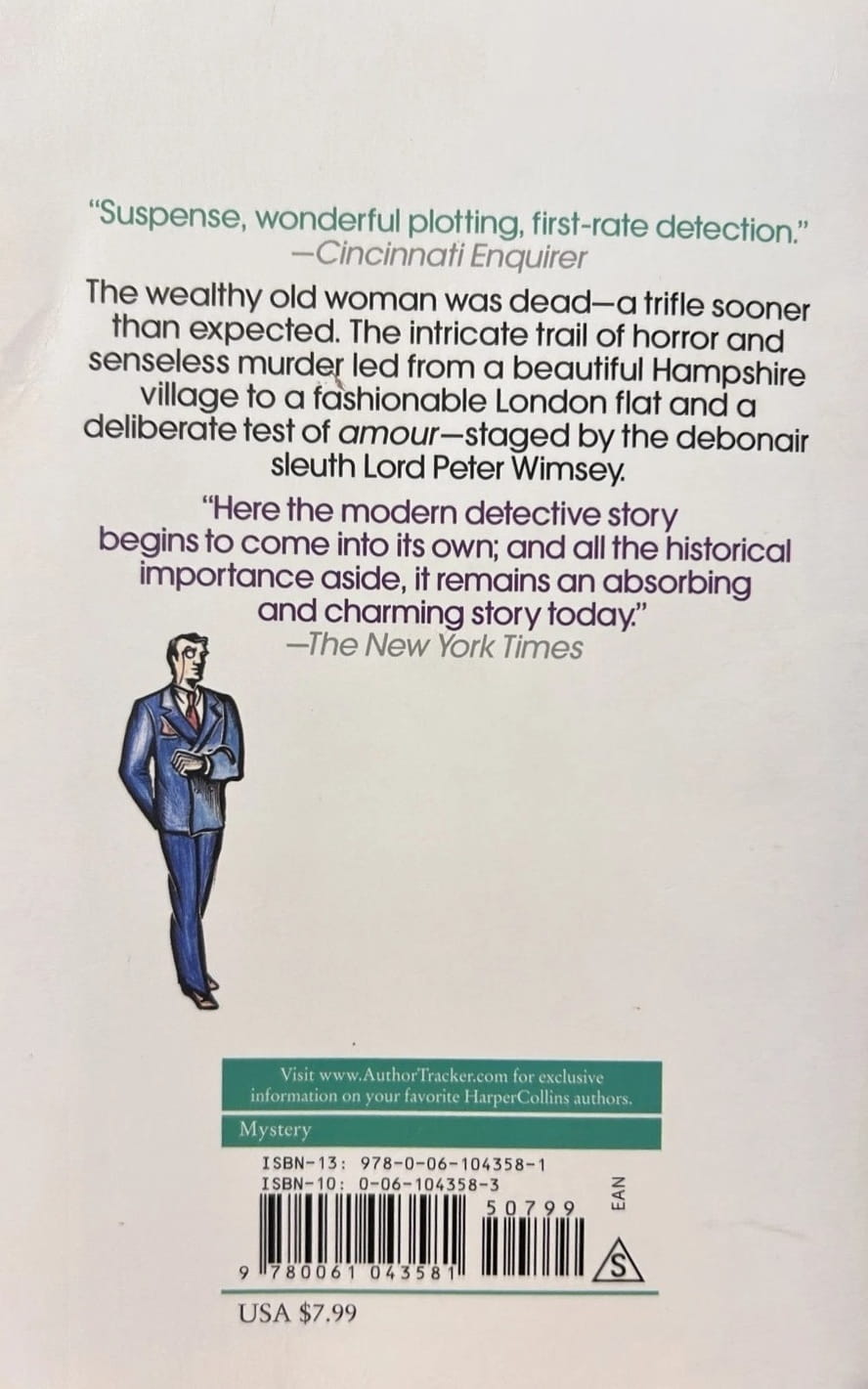
Unnatural Death (HarperCollins, 1995)
Finding out about the two cousins gives Wimsey and Parker a start on discovering the family relations (some American editions were titled The Dawson Pedigree), and also meeting the solicitor who took over from their retired former solicitor. This brings up some complex issues that follow from a recent change in the law (I imagine Sayers reading about the change and thinking that it could be a motive for murder) and that supply a motive.
The story supports one of Wimsey’s ideas: That one crime can lead to more crimes as the criminal tries to cover up the first. The investigation heats up with the death of Bertha Gotobed, formerly a servant of Miss Dawson, and with the death of Vera Findlater. All this builds up to a dramatic climactic scene and to the revelation of how the original death was brought about.
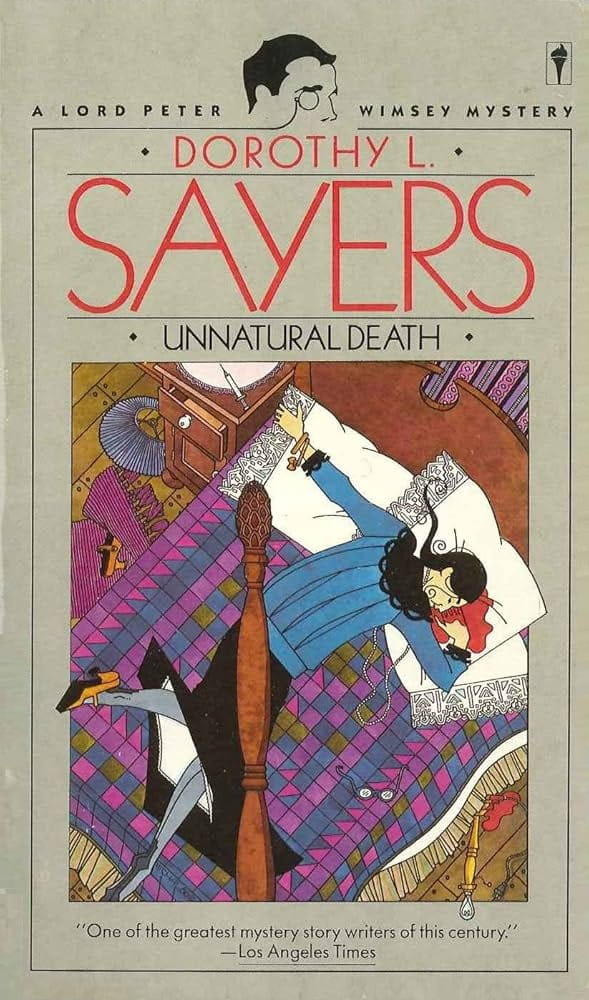
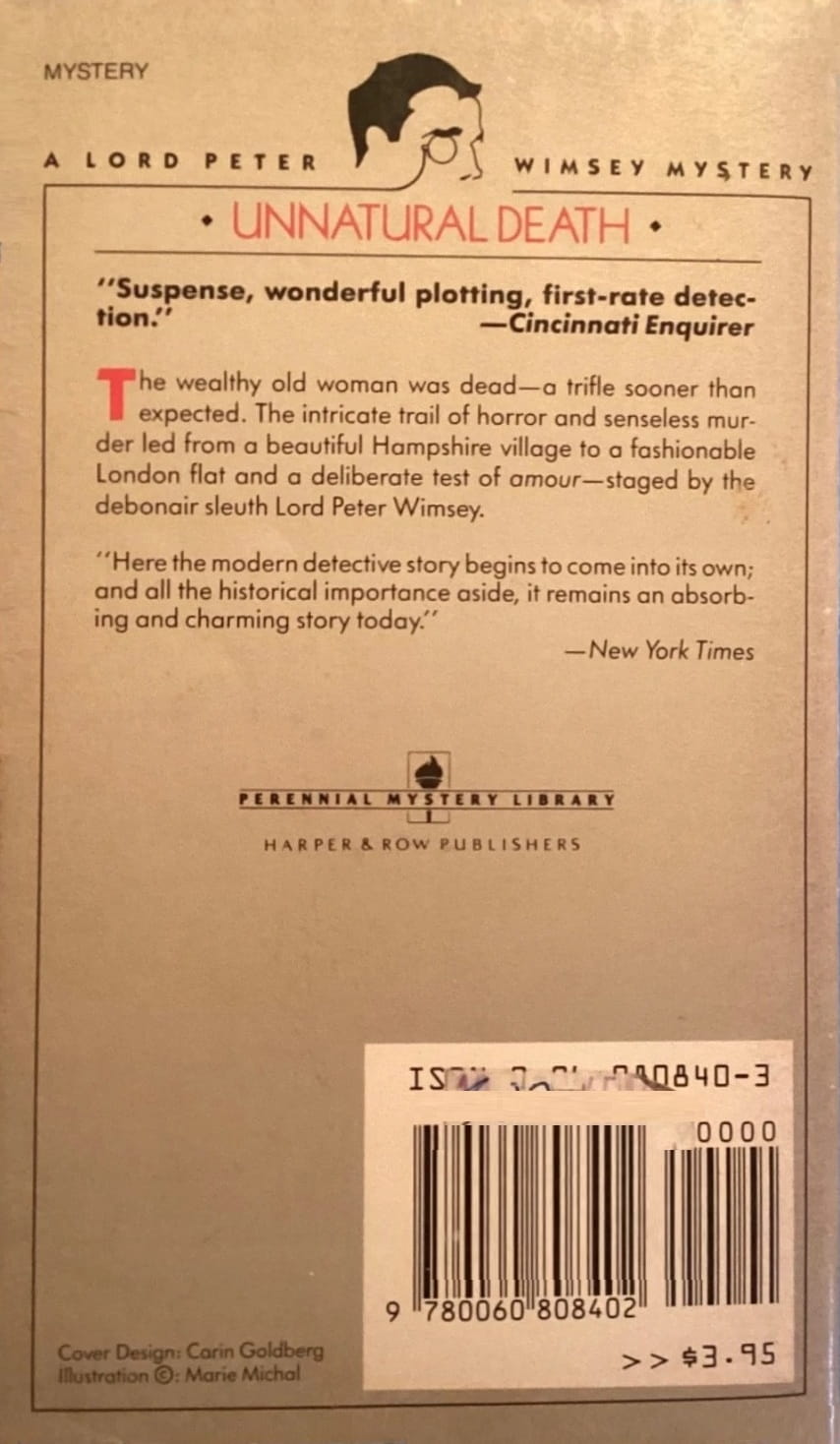
Unnatural Death (Perennial Mystery Library, 1987)
Sayers also shows Wimsey troubled by his own involvement in the case: asking the vicar of the town where Miss Dawson and Miss Whittaker lived for moral advice on a “hypothetical” case; thinking that his own investigations may have created the motive for two more murders; and in the end, “cold and sick” at the outcome. Inner conflict over his own vocation of criminal investigation makes him an increasingly complex character, and makes this a psychological novel as well as a murder mystery.
William H. Stoddard is a professional copy editor specializing in scholarly and scientific publications. As a secondary career, he has written more than two dozen books for Steve Jackson Games, starting in 2000 with GURPS Steampunk. He lives in Lawrence, Kansas with his wife, their cat (a ginger tabby), and a hundred shelf feet of books, including large amounts of science fiction, fantasy, and graphic novels.
Categories: Fantasy Books
Spotlight on “Aviary” by Maria Dong

Other LitStack Spots LitStack has also spotted other books that we want to add to…
The post Spotlight on “Aviary” by Maria Dong appeared first on LitStack.
Categories: Fantasy Books
Book review: Discovery by J.A.J. Minton

Book links: Amazon, Goodreads
ABOUT AUTHORS: J.A.J. Minton is the pen name for Jakob, Amy, and John Minton, a family living in North Carolina. Together, they produce and host the YouTube channel, "Talking Story: A Fantastical Fiction Channel." Between them, they have lived nine lives in theatre, comic book retail, indie filmmaking, academia, undercover shopping, dog kennel cleaning, advertising copywriting, old-school video store management, and hot dog delivery for Harlan Ellison. This is their first book.
Publisher: Keyhole Books (May 15, 2025) Page Count: 461 pages Formats: audiobook, ebook, paperback
Discovery is an ambitious book and you notice that immediately. It opens big with strange forces moving pieces on a board humanity barely understands, Then it quickly shifts into newsroom, and later missing expeditions, and government secrecy. It’s juggling cosmic horror, conspiracy thriller, historical mystery, and character drama all at once.
Surprisingly, a lot of it works.
The mystery surrounding the Rosie expedition hooked me, fast. Something clearly went very wrong in the South Pacific, and the slow reveal through letters, tapes, and investigations kept things exciting. I also enjoyed the newsroom scenes. Nessa Decker is a good lead because she reacts how a reasonable person would - she’s cautious, skeptical, and trying to separate fact from spectacle while everything grows increasingly hard to explain.
The atmosphere is great, too. The horror always hangs in the background. Even when characters are just talking in offices or arguing over evidence, there’s an unease that something larger is already in motion.
That said, ambition sometimes works against the book.
The prose gets dense and performative, especially early on. Long monologues and stylized narration slow the pacing when the story would benefit from getting to the point faster. The cast is large, and while many characters are memorable, it takes time to understand who matters most. The shifting perspectives add scope, sure, but also feel unfocused. Just as you start to vibe with it, the book moves elsewhere. Eventually the pieces come together, but the middle stretch demands patience.
Tone is another mixed success. At times the book balances dark humor, horror, and thriller elements well. At other moments, the theatrical style feels excessive. The story clearly enjoys its own weirdness, which is part of the appeal, but it tends to lean a bit too hard into it.
Still, the central mystery remains compelling, the cosmic ideas are unsettling in a good way, and the gradual realization of what humanity may have uncovered gives the later sections weight. You start with a missing expedition. You end up asking much larger questions about knowledge, power, and whether some discoveries are survivable at all.
It’s uneven, but interestingly so. Even though I struggled in places, I’m glad I’ve read it.
Categories: Fantasy Books
Humble Bundle: Dread & Darkness
There’s a new “Dread & Darkness” horror megabundle at Humble Bundle consisting of 52 ebooks. Included are the Matthew Corbett series (minus The Queen of Bedlam, since Open Road doesn’t publish that), Stinger, They Thirst, The Wolf’s Hour, Boy’s Life, and Swan Song, along with books by Richard Matheson, Stephen Graham Jones, Robert Bloch, and others. You can get all 52 ebooks for $18 (or more, if you want).
If you’re not familiar with Humble Bundle, you pay what you want, and part of the proceeds go to charity. This Bundle benefits the charity Save the Children. The included ebooks are DRM-free and can be read on any e-reader.
Dread & Darkness: A Horror Megabundle from Humble Bundle
 The Bundle is available through March 23, 2026.
Categories: Authors
New: COMING SOON: A Court of Thorns and Roses 6 (27 Oct 2026) & A Court of Thorns and Roses 7 (12 Jan 2027)
ACOTAR 6 and 7 release dates revealed on Call Her Daddy
The post New: COMING SOON: A Court of Thorns and Roses 6 (27 Oct 2026) & A Court of Thorns and Roses 7 (12 Jan 2027) appeared first on Sarah J. Maas.
Categories: Authors
25 Minutes

That’s how much time I have for the blog post today. I have a fancy and semi-intelligent post in drafts about Fantasy genres and it need more braining than I have at the moment. So this is a rambling salad of randomness instead.
On Monday we got a massive attack of Chinese IPs and the site has crashed. We have solved the problem but it ate most of the day, even with the capable assistance of WP-Engine Support.
I worked two weeks straight without breaks and crashed just like the website for the whole day yesterday. It was that place where you haven’t slept well and you have a low grade headache, and you almost feel slightly out of it because you are that tired. This release + deadline is kicking my ass.
It’s been hot and humid, so we haven’t gone walking this week. I can’t play computer games because we are signing things for Waterstones and I am making a blanket for Gordon, and the hand can only take so much. The blanket actually helps to loosen the fingers up, because I’m using a very bulky yard and a big hook, so the motion is wider. I will take a pic once it’s done. It is very pretty.
All my coping mechanisms are failing a bit.
In a flash of brilliance or desperation, I’ve off loaded the This Kingdom website to Anchored Designs, who created this one, so that is one less thing on my plate. I’ve also learned the InDesign in self-defense. OMG, editing graphics for print layout is so much easier.
In the good news, This Kingdom has taken the triple crown in audio: Audible, Apple and Spotify all selected it as their featured release for the month of March.
I leave you with this wonderful post by Éros Brousson. Everything you ever wanted to know about Texas HEB religion. If you are reading this in your email, here is a direct link.
View this post on InstagramA post shared by Éros Brousson (@erosbrousson)
That reminds me, I need to put a grocery order in and the flyer should’ve just come out.
The post 25 Minutes first appeared on ILONA ANDREWS.
Categories: Authors
Pages

Recent comments