
Authors
Comment on A Beginner’s Guide to Drucraft #46: Sigl Fashion (Body/Torso) by Bill
Wait.. Doesn’t Stephen wear most of his sigls as rings?
Categories: Authors
Cats and Bookmarks
I overslept, and my day started with an outraged cat.
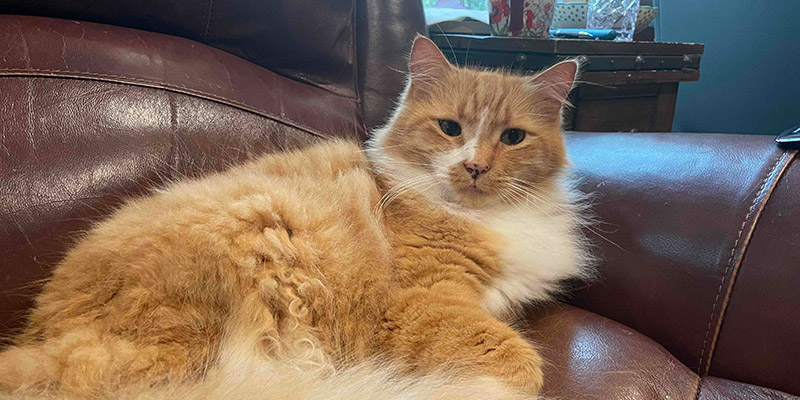
Over the past few days, a road crew has been working on the street next to our house. They are repaving it. The road is closed, and Gordon observed the workers having heated words with a driver of a delivery truck this morning. We might be trapped today.
Because of the road crew, we are keeping Tuna inside. Tuna started life as a stray who wandered randomly around an apartment complex, and breaking him of wanting to go outside is impossible. He has two acres here, and he is very much the lord of his domain. Today His Majesty was refused access to the outside. The inability to inspect his lands didn’t sit well, so he made himself into a nuisance.
Tuna: Pet me! Pet me! Pet me! Look, I meow by the door. Open door. OPEN DOOR.
Me, trying to clean up: No.
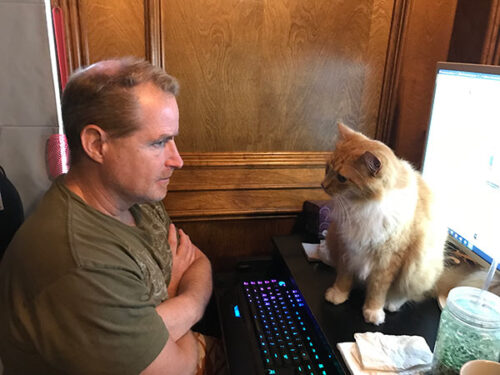
The allergies have been terrible, and neither of us is sleeping that well. I was shopping for some Halls cough drops and saw that instead of puny bags, they now come in full scale large jars. Of course, I bought a jar. It was delivered yesterday with saline spray and Flonase, and being too tired, I plopped all of that on my writing tray in the office. I need the tray to write.
Me, gathering items to take to the medicine cabinet.
Tuna: TREATS.
Me: No, you fool. These are not Temptation treats.
Tuna: TREATS.
Me: It’s cough drops!
Tuna: If not treats, why treat shaped? TREATS.
Tuna VisionI gave him treats. The vet will fuss at me again over his weight, but there are limits to human patience.
I come to you with a mission this morning. The book is now 185K. It is very clear that there is no room left for anything else in our lives. I still have not unpacked. Or sent things out. Mod R will have strong words with me here soon if I keep failing.
We need assistance, or we will never get the shop back off the ground, and our time is better spent writing. To that end, we hired a designer to help us turn the treasure trove of art into merch. Here is some of her work.

These bookmarks will be included in the media package. We have secured a printer for the vellum, so we will be bringing to you a media pack with vellum, stickers, and bookmarks.
Do you have any favorite quotes or moments you want reflected in This Kingdom merch? Please leave us a comment below. If you are dying for something from the other series, you can throw it in there too, but we are focusing on This Kingdom as it is the latest release.
The comment section to this post contains SPOILERS. Read at your own risk.
The post Cats and Bookmarks first appeared on ILONA ANDREWS.
Categories: Authors
The Write Attitude: Sounding Like Yourself
This post is a chapter from my book, The Write Attitude, which is now in a second edition. I’m posting it here to entice you to head over to Storybundle to pick up a copy, along with ebooks by Darcy Pattison, Douglas Smith, Ron Collins, Tracy Cooper-Posey and others.
Everything in this Storybundle is exclusive, including The Write Attitude. So if you want to read it now, pick it up from Storybundle. The bundle will end in 9 days, so hurry on over. If you don’t want a deal on the ebook or if you only read print, then you can always preorder the book on various retailer sites starting next month. The new edition will release in July.
The second edition of The Write Attitude is quite different from the first edition, which originally appeared in 2016. I kept some parts of the original book, but much of the material is newer. The new material comes from my Patreon page. Not every post from my Patreon page shows up here, although several do. If you want to see everything, though, head to Patreon and sign up.
This post appeared on my Patreon page in November of 2025, and is one of the early chapters in the book.
SOUNDING LIKE YOURSELFFrom 2025
In a Billboard article about Addison Rae, I came across a useful Miles Davis quote. (Billboard, August 13, 2025.) She cited the quote this way:
Sometimes it takes you a long time to sound like yourself.
Wow. That hit home. But before I used it to base a blog post on, I looked it up. I was worried that it really wasn’t a Miles Davis quote or that it was a misquote (although it didn’t sound like one). What I found was that there are two versions of this quote, which leads me to believe that the jazz great remarked on this a lot.
The other version of the quote says:
Sometimes you have to play a long time to be able to play like yourself.
And I think I like that one better, although both quotes are useful. For those of you who don’t know who Miles Davis was, he was one of the most influential musicians of the mid-twentieth century. He is definitely one of the most influential jazz musicians of all time.
If you are not familiar with him or his work, start at his website, milesdavis.com, and scan outward. You are probably familiar with a lot of his music, particularly if you’re a jazz fan.
The reason I like both quotes is that they have at least two different meanings, three if you think of them from the point of view of a prose writer.
The first quote: It takes a long time to sound like yourself.
That’s all about voice. Yes, Miles Davis, Addison Rae, and vocal coach Eric Vetro (who first showed Rae the quote) were talking about a musical voice—about sounding like no one else by channeling your own inner vision.
Which is what the best writers do. (That’s why the worst copy editors aren’t the ones who introduce mistakes; they’re the ones who put some writer’s manuscript into “perfect” grammar, ruining their voice.) If you listen to Stephen King reading his own work, his inflections and pauses are not surprising because he knows how to write them into the prose. (His accent or the tone of his voice might surprise you, but nothing more than that.)
Stephen King, former English teacher, found his own voice as a young boy and then learned how to transmit that voice, via the tool of a manuscript, into the brain of a reader. What he does is an extremely difficult skill, and one I aspire to. That’s why I typed Mick Herron’s work into my computer a while back (see the previous chapter), so that I could learn how someone else did things.
The more tools you have in the toolbox, the better writer you will be.
If you don’t read much fiction or you don’t read much fiction anymore, as so many writers say, then you’ve stopped accumulating tools. As long as I breathe, I will be reading. And the fascinating part to me is that I see writers do things that I thought were impossible or things I’ve never thought of. Or, Mick Herron’s case, he does things that someone, somewhere, decades ago, had warned me away from. (The opening to each Slough House book is an astonishing exercise in setting the stage as well as the characters and the themes of each book.)
Here’s the tough part. Once you sound like yourself, your writing will seem bland to you. Because you live with that voice in your head each and every day.
So that’s the voice part.
That’s the first part of sounding like yourself.
The second part is this: You must defend your voice, your “sound.” Sure, it might be “wrong” to use a dozen semi-colons in a single paragraph, but Herron does it to such great effect (sometimes in a single sentence) that the reader doesn’t notice them.
I didn’t realize the man uses a million semi-colons until I typed in his work. I’m semi-colon lite, dash heavy, which, I thought, made me a much more breathless writer than he is, but his work continually proves me wrong.
I’m sure some silly copy editor somewhere tried, once upon a time, to edit out all of his semi-colons and to make his honkin’ long single-sentence paragraphs into many sentences, and from what I can tell, the man slapped them down.
There’s another component to voice, though, and it has nothing to do with words and grammar and punctuation. It’s subject matter. It’s characterization. It’s something I discussed after the Herron piece. It’s the ability to “go there,” wherever there is. (See chapter 10.) To write the stuff that frightens us, that makes us original, that might get us in trouble with the readers or in some cases, the government.
It’s the stuff that doesn’t fall into genre lines.
I was having a discussion a few weeks back with someone I was considering working with on a future project. That person insisted we use trope charts, like so many writers have started to do in Kickstarters.
Tropes are well and good, if used sparingly. As a romance reader, I want to see—either from the sales copy or from a trope listing—that the book in my hand uses the enemies-to-lovers trope or is a small-town romance. I want to avoid a guardian-ward historical trope because…yucky!
So a one-line description or acknowledgement of the trope is a good thing, especially in books where the ending is prescribed, like a romance (happily ever after) or a cozy mystery (amateur solves a stakes-free murder).
But other than that—a tropes chart? You might as well put two gigantic signs on your work. The first sign says, Read something else because this book is on rails. The second sign says, This book is mediocre. There are no surprises here. There’s a third sign, but only if someone dares to crack open a book based on a tropes chart. And that sign says This writer has no idea what tropes are. The ones listed here are not in the book.
Whoops.
Writers who sound like themselves can’t write books that can be boiled down into a tropes chart. Sure, the overall trope might work because that might form the heart of the book. (I’m thinking of enemies to lovers here in a romance trope.) But going beyond that would harm the reading experience if the writer is writing from their heart.
That’s why writers who are really good at sounding like themselves often have trouble selling their fiction to set markets, particularly traditional markets. Those markets want something they can sell, and a book that’s on rails is easier to market to a consumer than a book that is, at its core, like nothing a reader has ever seen before.
That’s why this quote comes from Miles Davis. His website has this sentence on the home page:
Miles Davis made music that grew from an uncanny talent to hear the future and a headstrong desire to play it.
Note the phrases here. “Uncanny talent.” In other words, he did things no one else dared. “Hear the future.” I might disagree with that one on some level, because on that level, Davis invented the future that his website claimed he heard. And, the most important phrase, “a headstrong desire to play it.”
Later this little biographical snippet points out that Davis never stopped fighting for his art. That’s my memory of him. He wasn’t as respected in his lifetime as he became later, even though no one dared argue with the impact he was having. I worked in listener-sponsored radio in Wisconsin and was immersed in jazz. We could play all kinds of jazz for our listeners and they supported the programming with their dollars.
The other local jazz station was much more conservative. They played traditional melodic jazz, things we call standards now, and would go to modern jazz after 10 p.m. when most Midwesterners went to bed. Even then, you wouldn’t find a lot of Miles Davis on that station. The powers that be loathed his work.
I think that’s the other side of this. You have to become good enough to force people to have opinions about your work. “Having opinions” means they’ll love it or they’ll hate it. What is most important, though, is that they won’t forget it.
These mediocre, “properly written” works? The ones with the voice edited out of them, with the vision troped to death? Those will be forgotten the moment that the reader closes the book.
I don’t know about you, but I don’t ever want to be accused of being mediocre. Love or hate my work, that’s up to the reader. But finding it dull or predictable…well, then, I’ve done something wrong.
The second quote from Miles Davis is my favorite. I think it might more accurately reflect what he’s getting at, especially if you’re familiar with his music.
Sometimes you have to play a long time to be able to play like yourself.
Yeah, I know. He’s talking about playing music, often onstage. He was the master of improvisation, but even in the improvisation, the listener knew they were listening to Miles Davis. His perspective was that original.
But what I love here is the word “play.” I love watching jazz musicians in particular improvise. Somewhere in the middle of what they’re doing, they’ll grin at each other. They’re having fun. They’re creating something new, something unexpected, and it gives them joy.
This type of musicianship is why I don’t miss a Keith Urban residency when he’s in Las Vegas. He performs intensely and playfully, goofing around much more than other residency performers I’ve seen. I wasn’t a big fan (or much of a fan at all) when I first saw him perform, and now I go to watch the playful musicianship.
Writers need to play as well. We need to experiment. We need to risk failure. We need to jangle some chords, try a different instrument, and go far, far, far off the beaten path.
That means we’ll miss sometimes, but it also means that when we hit, the work will be powerful.
When I talk about play, I’m not saying that writers should only write something light and “fun.” Instead, I’m talking about experimentation, about risking everything, about free-floating ideas from our own subconscious even if those ideas make us feel uncomfortable.
We should also go for different formats and different genres, different lengths and different ideas than we’ve explored before. We might not be onstage riffing with our friends, but we should write in that same spirit of improvisational play.
We need to be uniquely ourselves as writers. And as Miles Davis said (and yes, he wrote his own stuff), it takes a long time to achieve that.
But finding yourself as a writer? That’s worth the time spent.
“Sounding Like Yourself” from The Write Attitude
Copyright © Kristine Kathryn Rusch
Published by WMG Publishing
This ebook is licensed for your personal enjoyment only. All rights reserved. This ebook, or parts thereof, may not be reproduced in any form without permission.
Any use of this publication to train generative artificial intelligence (“AI”) technologies is expressly prohibited. The author and publisher reserve all rights to license uses of this work for generative AI training and development of machine learning language models.
Categories: Authors
Video Experiments
I’ve been doing a lot of experimentation with short video. Sometimes I add audio, but every now and then I do something that’s imagery and text. I’ve done that here, with the video I did for Dean Wesley Smith’s current Kickstarter campaign. There was simply too much information to cram into a talky video, so I didn’t. I let images do the work.
If you like what you see here, head over to the campaign. You’ll find it here.
You know what? Even if you don’t like the video, head over to the campaign. There’s lots to love in it.
Enjoy!
https://kriswrites.com/wp-content/uploads/2026/05/Five-Science-Fiction-Collections-high-quality.mp4
Categories: Authors
Art Print Roundup
I did not get much sleep last night. I am relying on tea and sheer will, so let’s hope I make sense. We have an art print roundup for you this morning, with several options from the artists who worked on This Kingdom Will Not Kill Me.
A note about shipping: a lot of the artists we work with are outside the US. The shipping costs have risen sharply, in large part due to the tariffs. If you want a signed print and you are in the US, you might have to pay more.
Because of this, all of the artists on this list offer INPRNT art. These prints are not signed museum quality but are still beautiful. They are more reasonably priced and have US domestic shipping rates.
So: INPRNT = unsigned print, local shipping for US.
Luisa Preissler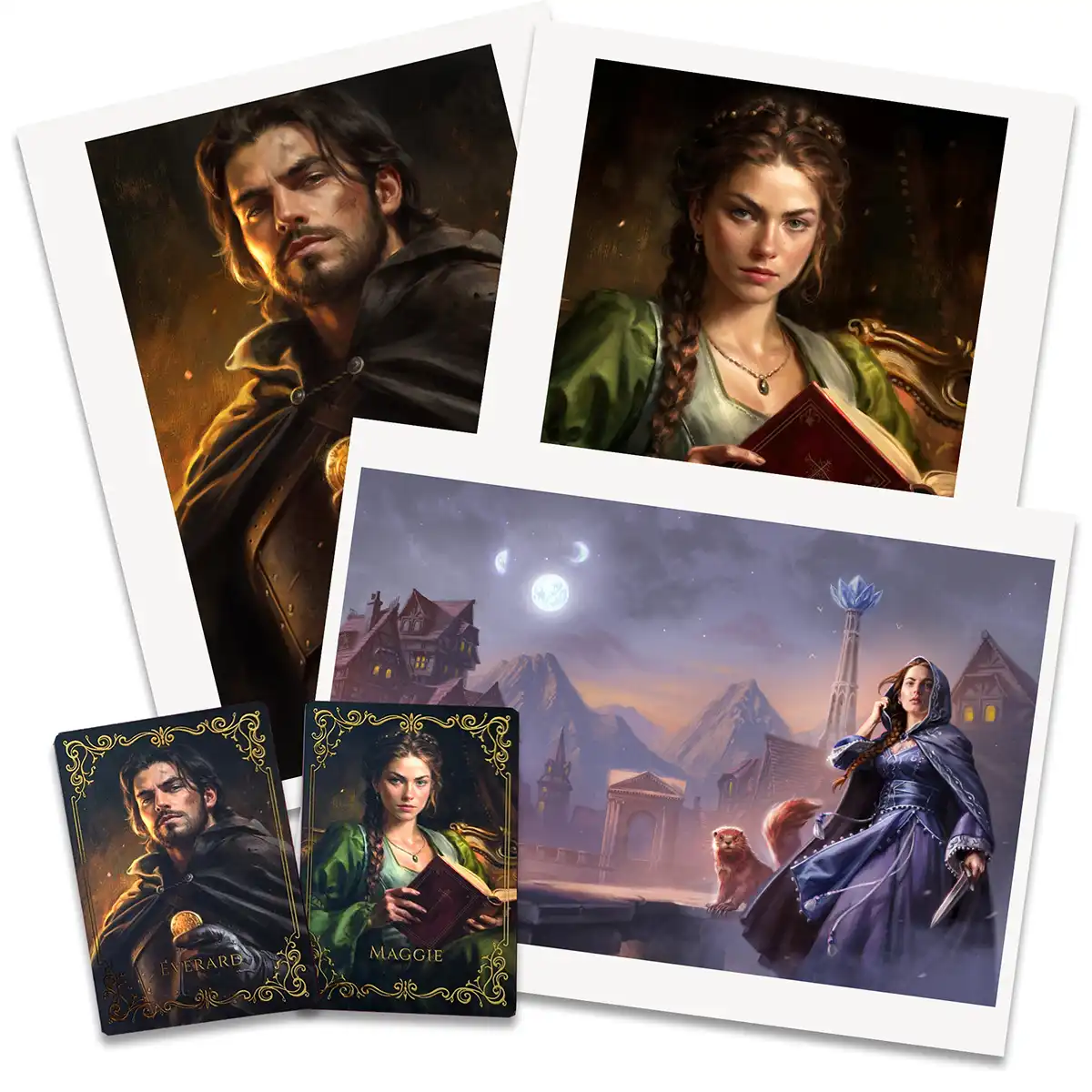
Fine art prints and collectible character cards featuring illustrations by Luisa Preissler, created for the world of This Kingdom Will Not Kill Me by Ilona Andrews.
The prints are museum-quality giclée prints. Each one is hand-signed by the artist and available exclusively during a limited pre-order window.
Also available is a set of collectible character cards featuring Maggie & Everard, finished with gold details. The cards include foil stamping on both sides and rounded corners — designed to be displayed rather than stored away.
Pre-order period: May 1st – May 15th, 2026 (closes 8 PM CEST / Berlin time). All items are produced after the pre-order closes and are expected to begin shipping May 29th.
You can shop the signed fine art prints and character cards here:
https://luisapreissler.de/collections/all
Please note for US customers: due to current customs regulations, shipping is only available via DHL Express, which is significantly more expensive, and import duties may apply on arrival.
For a more budget-friendly option, the unsigned prints are available via INPRNT:
https://www.inprnt.com/gallery/luisapreissler/. This option does not include the custom character cards, however.
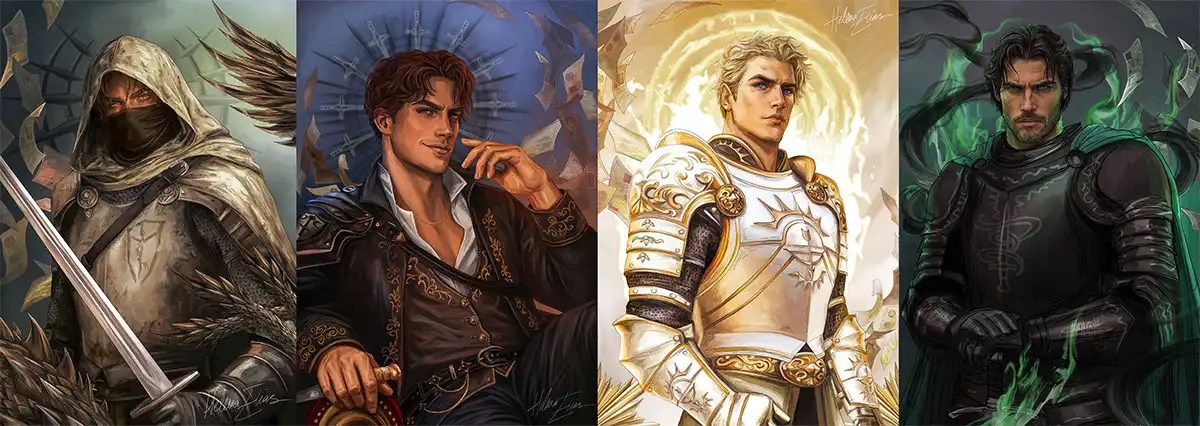
Helena’s shop offers high quality collector prints in two sizes. They are giclée printing quality on matte museum paper.
She is located in Australia, so all prices are in Australian dollars (AUD); however, the prints are fulfilled through an international distributor. So while you are paying in AUD, your shipping will be domestic if you are in US and you won’t have to wait for your prints to clear customs.
Candice Slater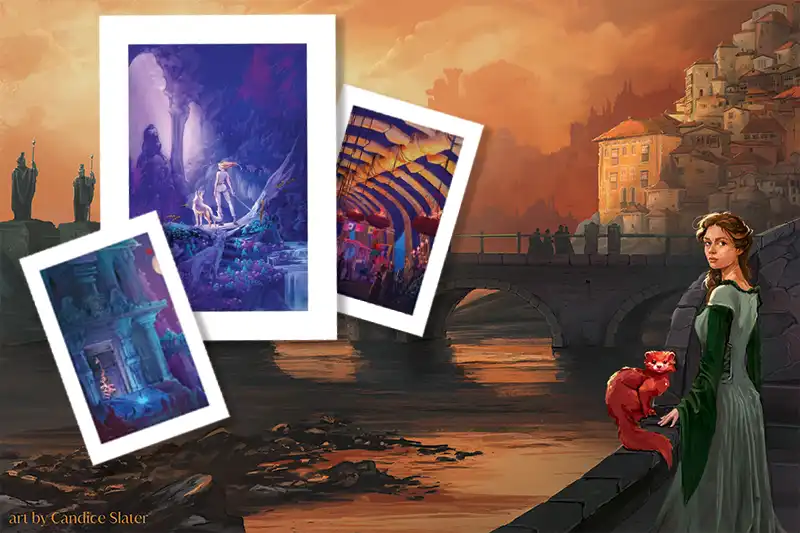
Candice Slater offers the landmarks of Kair Toren and Inheritance art through INPRNT.
The prints are unsigned, with domestic US shipping, and some are also available as posters, minis, framed prints, and stickers.
Leesha Hannigan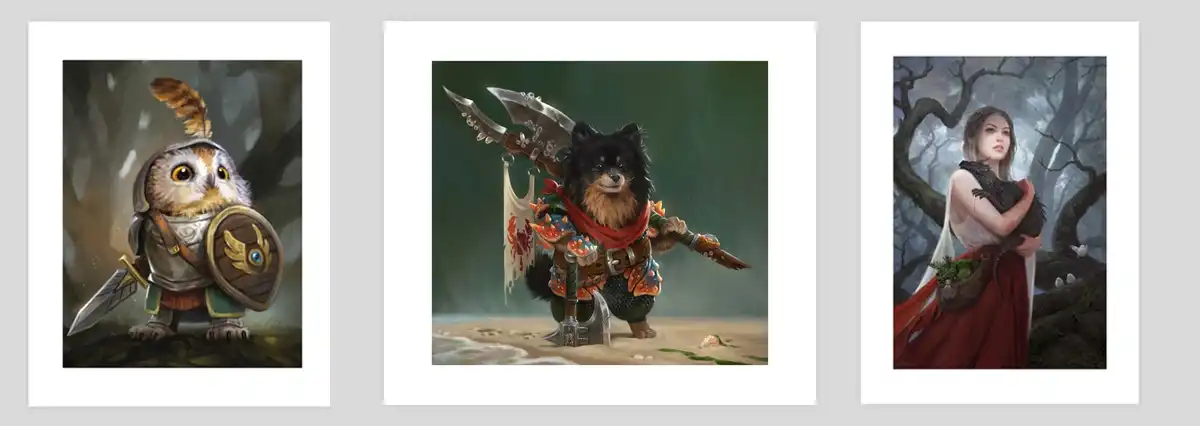
Leesha also offers art prints through INPRNT. While I do not see Sushi there right now, I am pretty sure she was going to add her. However, you can shop all of the other amazing art she has. The doggie. Look at the doggie!
Don’t forget to enter the vellum giveaway by signing up for our newsletter.
A reminder that our Merch Store will not offer art prints. We are doing vellum hardback inserts and the usual merch items like T-shirts, cups etc. If you want art prints, please order directly from the artists.
PS Mod R:
Ilona wrote this blog post for us, but she has a lot on her plate, so I’ve set myself as the author to ensure the comments come only to me and don’t flood her inbox. There is no deep conspiracy here, I’m certain we would all prefer House Andrews to focus on what they do best!
The post Art Print Roundup first appeared on ILONA ANDREWS.
Categories: Authors
Comment on A Beginner’s Guide to Drucraft #46: Sigl Fashion (Body/Torso) by Selwyn
Thanks for the article! It made the image of Stephen becoming a Sigl manufactor, similar to a jewelry designer, pop up in my head. It would be interesting to see Stephen develop more in that area, especially now that he hopefully will get more access to information, what with his position as a liaison.
Categories: Authors
Free Fiction Monday: Perennials
Santa Cruz right after the 1989 earthquake. Broken concrete, broken dreams. One woman uses time slips to escape that moment only to find herself in a tangle of family. She needs a solution that will survive…long after she does.
“Perennials” is free on this website for one week only. You can get your own copy in ebook on every e-retailer or go to WMGbooks.com.
Perennials Kristine Kathryn Rusch
1989
IN REAL TIME the destruction looks different. I stand at the edge of the Pacific Garden Mall and see flat concrete, large holes surrounded by wire fences, a few shored-up buildings, and innumerable parking lots.
Last summer, eucalyptus trees covered the mall. Buildings—a few that had survived the ’06 quake—lined the streets. Street musicians hung out on corners; bicyclists and pedestrians filled the sidewalks. The place had the kind of life that too few cities experience.
I had always loved that life. To me, it was the heart of Santa Cruz.
I don’t like real time. As I stand here, hands in the pockets of my windbreaker, staring at the remains of the destruction, I see the city as a newcomer would see it: a broken, deserted downtown, like so many other downtowns in so many other places. Newcomers would think that Santa Cruz has charm anyway. The Boardwalk, with its famous roller coaster and sea view, still stands. Shops dominate the pier. Funky older houses line tree-covered, winding streets. There are only a few of us who know, a few of us who remember, and we will never forget.
When I was a little girl, my grandmother’s house smelled of peppermint. I loved the kitchen. Light streamed in from two windows and the screen door. Grandma’s collection of saltshakers lined one window like a curtain. On the counter, chocolate cake with marshmallow frosting cooled. The cookie jar waited on top of the refrigerator for that special moment during the day when Grandma would reward us for being ourselves.
In her bedroom the portraits hung: Grandma’s mother in 1886, at twenty-six a foreboding woman with dark eyes; Grandma’s entire family around 1910, arranged from tallest to shortest, Great-aunt Ruth (always the gregarious one) with a bow the size of a Stetson hat tied in her hair; Grandma, Grandpa, my father, and Aunt Mary in her forties—Grandma looking the same, shoulders back, gaze straightforward and proud; Grandpa smiling, his hair nearly gone, hand holding his only daughter’s; Aunt Mary looking young and happy; and my father, wearing black-rimmed glasses, his body still young-man trim, and his hairline receding like his father’s, with an impish grin that I had seen only when he played cards. I used to lie on Grandma’s bed and stare at the pictures as I tried to conjure the family ghosts. No haunting ever came—no shaking chains, no eerie voices. But some of the pictures seemed alive. On those nights when I slept on the cot at the foot of Grandma’s bed, I would wake to whisperings that I attributed to my great-grandmother and my grandfather, both of whom died shortly before I was born. The whisperings were always too faint to hear, but I felt the love in them, just as I felt the love in my grandmother’s gaze.
***
I take my car from the mall to the Boardwalk. The drive is familiar, except for the cracked windows, the fallen signs. The road itself has lost its smoothness, and the car rocks in the ruts. I keep the radio off, listening instead to the whoosh of other cars as they pass, the honking horns, the occasional shouts of pedestrians as they walk down the twisting streets.
The morning looks no different than any other, even though it should. I know that if I turn down the right street, I’ll find my tiny one-room apartment, filled with books and newspapers, an overlarge stereo, and a sofa bed; a place that’s less of a haven than somewhere to sleep. I clerk at the local grocery store and put most of my money into a savings account that I never touch. My grandmother and I share a social life with each other—made up of each other—which she said is normal for a woman of ninety-five, but not for a woman of thirty. She would tell me I need to live in my present and work for my future, and I would always laugh and tell her life is easier in the past.
The Boardwalk looms, a barrier against the sea. The view is both dated and modern: the old wooden roller coaster dominates the skyline, making the newer flume ride and the Giant Dipper seem cheap and brassy. I park my car in the empty parking lot and walk to the gate. Someone has locked it and placed a CLOSED sign against the metal bars. Through the doors past the concession stands and shored-up rides, the ocean whispers against the beach. The air smells of sea salt and fresh wind instead of cotton candy and corn dogs. My hands sink deeper into my pockets, and the nylon strains against my knuckles.
On hot summer days, the parking lot was full, and cars circled the street like hungry cats. I walk back to my car, alone in a place that I never believed could be lonely. I pull the car door open and stand for a moment before crawling inside. Across the street a cyclone fence surrounds an empty field. Scraggles of winter grass cover the choppy earth. Something sat there, something I should remember. My mind yields up no images, no pictures of the spot, though I had once gone by it daily. I get into the car, close the door, and huddle against the steering wheel. One tiny fragment gone—dispersed by the sands of time.
***
On the day my Aunt Esther died, I arrived home from school to find my mother scrubbing the kitchen floor. Dirt streaked her face, except for the places where hours-dried tears had cleaned the skin. I touched her shoulder, and she shook me away.
“Get off my floor.” Her voice was harsh and raw. I had never heard its peculiar edge before.
I stood for a moment, wanting to ask details—the school counselor had told me only that my aunt, my mother’s favorite sister, was dead—wanting to hold my mother, to comfort her, to share the pain. Instead, I walked across the clean linoleum into the living room and sat on a transplanted kitchen chair in the growing twilight until my father came home.
He made us dinner on the well-scrubbed stove, and then he put my mother to bed. I huddled under one of my grandmother’s afghans on the couch and listened to my father’s voice drone as he made the arrangements by phone. When he finally came into the living room, looking smaller than I had ever seen him, his balding head shining in the lamplight, I asked, “What are we going to do?”
“We’re going to remember her,” he said. “That’s all we can do.”
***
The empty field mocks me. I can see nothing but the diamond wires of the cyclone fence, the clumps of dirt, the shades of ancient footprints. If I go back six months, I will see it. I will know.
I reach for a time slip, feel its power hum against my fingertips, but as I try to grasp the rim, the slip scuttles away, and I remain in real time, clutching the steering wheel of a twenty-year-old car, a car I’ve owned for only half a day.
Somewhere I will find a place that hasn’t changed, a place where the past, present, and future have fused, a place that is safe.
I turn the key in the ignition, and the car hums into life. As I pull out of the parking lot, a dozen other cars appear from nowhere. Perhaps we all are searching for the same thing.
***
Four days after my aunt’s funeral, I found my first time slip. I lay on my bed in the upstairs of the creaky old Victorian house my mother had just cleaned top to bottom. I was almost asleep, when a light-filled slit like that of a half-opened door appeared in the air before me. I had seen those slits before, several dozen times in my young life. When I was four, the night my sister (who was my mother surrogate) married, hundreds of light slits appeared in my room. I cowered against the wall and screamed for help. No help came. My parents, too drunk from the wedding, slept through all my cries. Finally the lights faded, and I thought the lights were dream visions that passed into my waking hours.
That night, though, I knew I wasn’t asleep. Another slit appeared, and another, until they surrounded me, and their light felt like a hug. No one had hugged me since my aunt died. No one had said more than three sentences to me in all that time—except my grandmother, who tried to comfort me by phone from her home six hundred miles away.
I reached out, perhaps to hug back, perhaps just to touch, when I felt something hum against my fingertips. I stuck my hand inside the nearest light, and felt a solid edge. I grabbed the edge, pulled a little—
And found myself in my Aunt Esther’s dining room. The room smelled of cigarettes, roast beef, and fresh bread. Bottles of alcohol covered the bureau, and half a dozen people sat around the table. The chandelier sent a crystal light across the room. It took a moment to recognize the man at the head of the table as my uncle. He was too slim, his hair too dark. My parents sat on one side, my mother’s hair long and black and coiled around her scalp, my father looking like the picture in Grandma’s bedroom. Aunt Esther came out of the kitchen, carrying one of her good serving bowls filled with broccoli in cheese sauce. She was beautiful: her face unlined, her eyes wide and dark. Her hair, cut in its usual marcel, didn’t seem dated, but looked appropriate somehow. She set the bowl down, and the woman across the table—not my mother, but someone else I vaguely recognized—stubbed out a cigarette. My uncle carved the roast beef, while my father picked up the bowl filled with mashed potatoes and plopped a spoonful on his plate. My mother took the bowl from him and looked at Aunt Esther.
I walked to the table and took a little piece of meat. It was good and hot. I hadn’t had Esther’s cooking since my uncle died.
“All this food,” Mother said. “We should say grace.”
“Father would have said grace.” Aunt Esther’s voice was smoother, less rough than I remembered it, as if the years of cigarettes and alcohol hadn’t touched it yet. “But I figure we earned it—why should we eat it after it gets cold?”
“Esther.” My uncle placed a slab of roast beef on his own plate. He didn’t look up, but I could hear the caution in his tone. I touched his shoulder, hoping he would pull his chair back, but he didn’t notice me.
Esther took a sip from the drink beside her ashtray. “I don’t have to do everything my father taught me. He’s been dead for twenty years. And if he were here, he wouldn’t be thankful for the food. He would yell at me for all the paint I wear, the booze I drink, and the things I say.”
“You shouldn’t speak ill of the dead,” my mother said softly.
“See what I mean?” Esther said. “She was only four when he died, and she can mimic his voice perfectly. Some people always haunt you.”
The scene faded. I reached for my uncle, but found myself grabbing my own bedspread, the smell of roast beef and cigarettes still lingering in my nostrils. I hugged my pillow and waited until dawn for the lights to return. They didn’t, and I fell into an uneasy sleep.
***
I have driven along the ocean for over an hour. Finally I pull into an empty turnout at the edge of a cliff and get out of my car. The wind is cold here, the ocean rough and gray. Waves break against the rocks below me. Off in the distance, heavy, dark clouds threaten a major winter storm.
The ocean is here, ever present, ever changing, never reassuring. I reach for a time slip, and can’t even find one, shivering as a chill runs up my back. Used to be I could slip anywhere, anytime. I would close my eyes and reach until I felt the hum. Then I would grab a corner and pull myself into another world.
My grandmother would say it was as if I had disappeared from my eyes. She never knew where I went, and I would never know where I was going, only that I would find somewhere better than I was. She hated it when I was gone. But the time slips never lasted long. I would get a brief glimpse and then come back to the present. I saw bits of my parents’ lives, bits of wars, bits of places I would never see again. When I went through high school, the lights faded, but the hums remained. I learned to control the slips, to go anywhere I wanted. And often I would end up in Santa Cruz, on the Boardwalk or in the mall, places where time had a special essence, an added dimension of warmth.
Sea droplets splash my face. I draw my windbreaker closer. This is a place I would have visited in a slip, but it feels wrong in real time. Less powerful, less potent. If I were able to slip now, I would return to my grandmother’s house, steal a fingerful of marshmallow frosting, and lie on her bed, staring at the photos. I would listen to the whispers, the haunting, and if I heard my grandmother’s step, slow and sure across her linoleum, I would run to the kitchen, hug her, and never let her go.
Some of the water drops running down my face are warm. I wipe my cheeks, irritated at the moisture, and turn my back on the sea. It is not home, it is not safe, and it has no warmth.
***
Last week the phone woke me out of a sound sleep. Grandma was in the emergency room, bleeding from countless ulcers in her ninety-five-year-old stomach. She was screaming for me, they said. Even if she hadn’t been, I still would have rushed to the hospital.
The hospital had a Sunday-morning quiet. The walls were painted forest green, and the plush carpet absorbed all sound. I hurried to the emergency wing, and they ushered me to a back room. My grandmother lay on a bed, held down by a doctor and three nurses. Her gray hair was matted around her face; her watery blue eyes were wide with fright. When she saw me, she murmured, “Thank God. Thank God.”
“You’re her granddaughter?” the doctor asked. He was my age, but his frustration made him seem younger. “We need to put some tubes down her to pump the blood from her stomach. But she won’t let us.”
The tubes went through the nostrils. I remembered my mother hooked up like that in the years before the alcohol finally killed her.
Grandma grabbed my hand. She squeezed so tight that I knew I would bruise. “They’re hurting me,” she said.
“They have to hurt you to help you,” I said.
“Will you stay while we try again?” the doctor asked. “Maybe she’ll be calmer around you.”
I nodded. They brought the tubes to her nose, and Grandma screamed and thrashed. I put my hands on her shoulders, held her head in place, and she stopped moving. All the while they worked, she watched me, staring into my eyes as if my presence gave her strength. Finally everything was in place, the suction began working, and the tubes turned black with her blood.
The doctor thanked me and took the nurses outside. Grandma closed her eyes and sighed once. I reached for a time slip, a short moment somewhere better, when her grip tightened on my hand.
“Stay.” Her voice was wispy, a little girl’s.
“I’m right here,” I said.
“No.” She shook her head once. I brushed the hair from her forehead. “Stay in your eyes. You aren’t living when you’re running away.”
I pulled over a chair and sat down, never letting go of her hand. For that entire week, I stayed. But she didn’t.
This morning she left.
***
I’m back on the mall, staring at the empty spots, the holes, the missing pieces. I can’t slip away anymore, can’t run to some better spot in someone else’s life. In my week’s stay, the ability to slip left me. I ramble through this broken place, where pieces of the past have shattered like concrete against the force of the earth, and I know that parts have already left my memory—perhaps to form other time slips that other children can run away to.
I guess, Grandma would say, it is time to start living in the present and planning for the future.
I guess I’m as ready as I’ll ever be.
Beside me on the cyclone fence, a work permit flutters in the breeze. Across the street, enterprising merchants have set up large tents filled with heat and light and merchandise. I walk over there, away from the demolished Cooper House, the shored-up western facades, the buildings of handmade brick that had survived the ’06 quake and had died in this one. A little bit of history passed on. A life spanning nearly a century, punctuated by two quakes and, in the end, some lingering pain.
A woman sells plants outside the nearest tent. She sits next to the tent wall, clutching a steaming paper cup, and watches me. I glance at the plants, little shoots in green plastic pots, and I know that she is here, hoping that people will plant for spring.
“I want some flowers.” My voice cracks as if I never use it. “Perennials.”
She shows me more shoots in more green plastic pots. I buy six that bloom in different light and temperature. Flowers for my grandmother’s grave, always and forever. Always changing, always there. One small way—my only way—to control a bit of time…
And to keep it warm.
Copyright Information
Perennials
Copyright © by Kristine Kathryn Rusch Published by WMG Publishing
Cover and Layout copyright © by WMG Publishing Cover design by WMG Publishing
Cover art copyright © blinkblink/Depositphotos
This book is licensed for your personal enjoyment only. All rights reserved. This is a work of fiction. All characters and events portrayed in this book are fictional, and any resemblance to real people or incidents is purely coincidental. This book, or parts thereof, may not be reproduced in any form without permission.
Any use of this publication to train generative artificial intelligence (“AI”) technologies is expressly prohibited. The author and publisher reserve all rights to license uses of this work for generative AI training and development of machine learning language models.
Categories: Authors
Monday Meows May the 4th Be With You
Special Bonus Edition
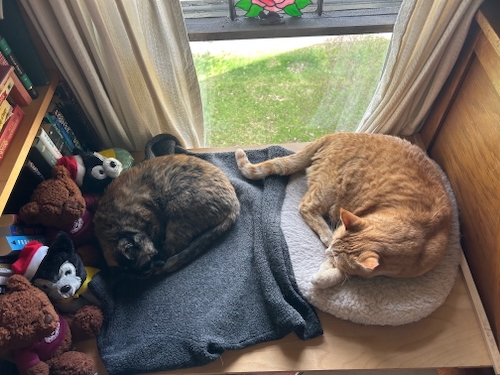
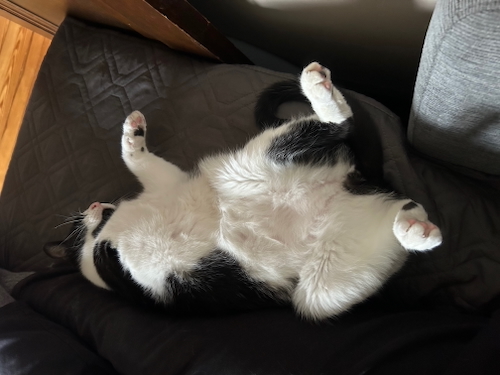
TuxeDO
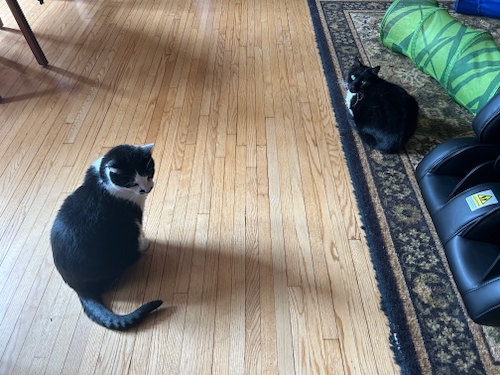
TuxeDO NOT
TuxeTRIpod
Categories: Authors
Veronica Roth with House Andrews in Dallas!
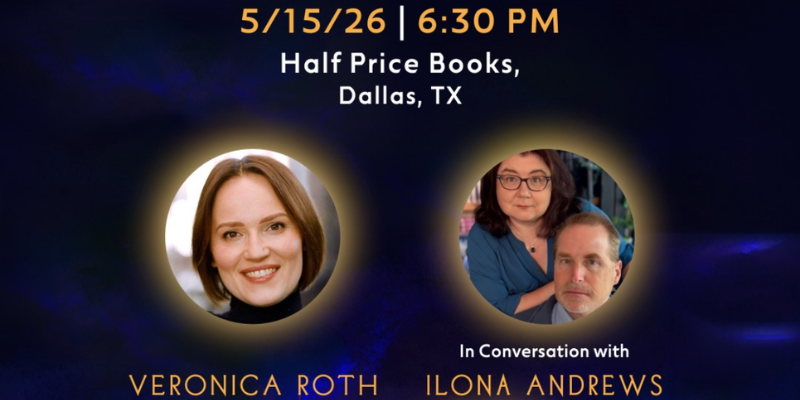
Attention, Dallas-area Horde, I have a special announcement.
On Friday, May 15th, at 6:30 pm, Ilona and Gordon are emerging from the writing cave (trademark pending) and heading to Half Price Books in Dallas to moderate one of Veronica Roth’s signing tour appearances for her new book, Seek the Traitor’s Son.
And what a book to talk about!
Seek The Traitor’s SonAn epic, romantic dystopian fantasy begins in Seek the Traitor’s Son, from #1 New York Times bestselling author of the Divergent series, Veronica Roth. Available on May 12th from Tor Books, in deluxe hardcover edition with sprayed edges.
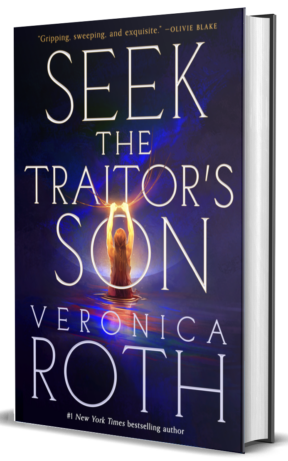
Elegy Ahn did not ask for destiny to find her.
She is happy with her life as a soldier, defending her small country from the Talusar, a powerful nation who worships a deadly Fever. A fever that blesses half of its victims with mysterious gifts.
But then she’s summoned to hear a prophecy–her, and the most ruthless of Talusar generals, Rava Vidar. Brought face to face, they learn that one of them will lead their people to victory over the other…but they don’t know which. And at the center of both of their fates: a man. A man that, Elegy is told, she will fall in love with. In just one day, Elegy’s old life–her job, her purpose, and her future–is over.
She and Rava are destined to collide, with the fate of their nations hanging in the balance. And when they do, only one will be left standing.
Elegy intends to make sure it’s her.
Destiny, prophecies, enemy generals, romance, warfare, mysterious gifts, and the fate of nations hanging in the balance? Yes, please! I know Ilona and Gordon are extremely excited to see Veronica and hear all about it.
House Andrews will be there in a supporting role as moderators, making sure the evening is a true celebration of Veronica and her incredible new book. Think of this as a “chatting shop” night, a chance to see them in conversation with another fantastic writer!
If you are in the Dallas area and would like to attend, tickets for the event are available for purchase here.

If you would like to attend a signing and you can’t make it to Dallas, Veronica’s tour will have multiple stops in both the US and the UK – for full details of all appearances, moderating authors and dates, check out her website here.
Happy preordering and May the 4th be with you!
The post Veronica Roth with House Andrews in Dallas! first appeared on ILONA ANDREWS.
Categories: Authors
Monday Meows
What’s a martini? I hear they’re good?
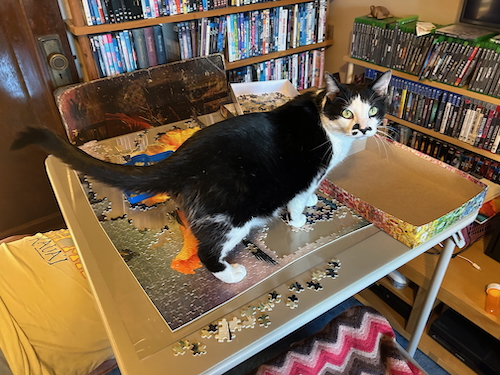
This.
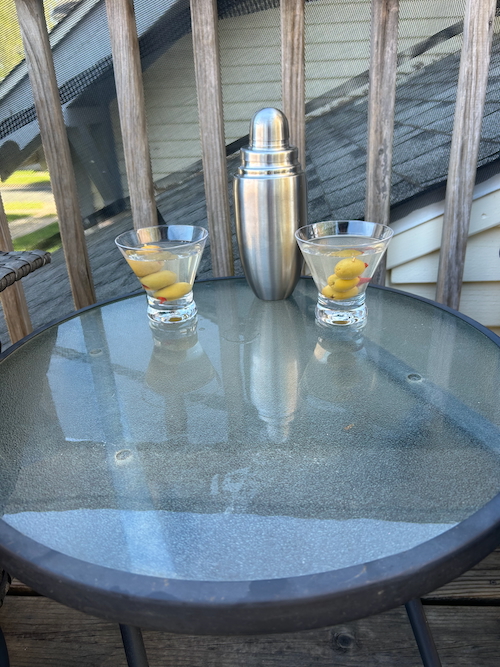
I like martinis.
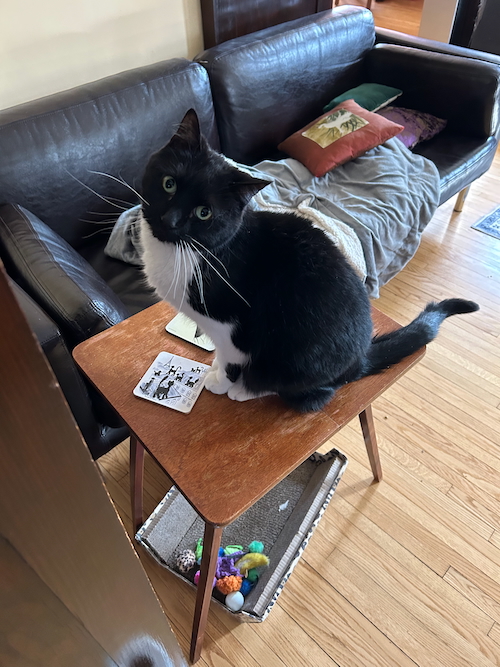
I demand martinis.
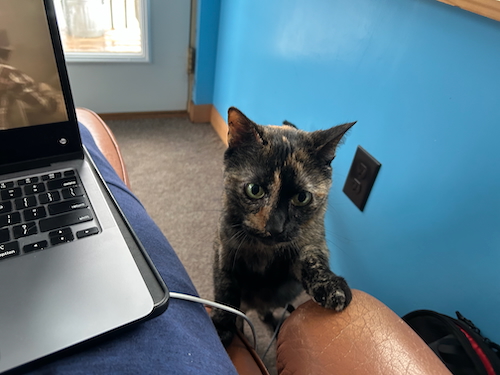
I demand martinis and all yer gold too, arrr!
You guys realize cats don’t drink, right? Right?
Categories: Authors
Recommended Reading List: April 2026
I had a good reading month. Lots of fun things, although a couple of the novels read slowly. (Meaning I had to savor every word. Oh, woe is me!) I did finish a crappy mystery anthology. It was the one I was reading at UNLV during lunch, although a number of students ended up co-opting my lunch as the semester progressed. Lots of good discussions, very little reading. Not that it mattered. When I did get a chance to read, I was disappointed, so I’m not recommending that here.
Got introduced to some marvelous playwrights and some fascinating theater history as well. Also had to wrestle with more bad writer behavior from some of them. I’m going to include two, one amazing woman and a man with a difficult history.
Fewer articles than usual. Maybe I just wasn’t in an article-recommending mood.
So here’s April’s reading. It’s quite a cornucopia.
April, 2026
Canfield, David, “Love The Sinner,” The Hollywood Reporter, February 11, 2026. This is an interview with Ryan Coogler, written before the Oscar ceremony. It’s worthwhile to see how one of the most creative artists in film approaches story, imposter syndrome, and business negotiations. He got an amazing deal from Warner Bros. last year. About it, The Hollywood Reporter says:
Driven by both the movie’s themes (Sinners) and the evolution of his own career, Coogler negotiated to have Warner Bros. return the rights to him 25 years after release — an uncommon, if hardly unprecedented, arrangement that nonetheless sparked endless debate about its merits both for him, despite his strong track record, and for an embattled Warner Bros.
And yet, he pulled it off. Ask and see what will happen. That’s the art of negotiation. Now, read the article.

Carter, Ally, Only The Good Spy Young, Little, Brown and Company, 2010. I continue to work my way through Ally Carter’s Gallagher Girls series, which takes place at a boarding house for spies. Things are getting real by this, Book 4. I found it a bit distressing, because no one trusted a character that had been set up as a good person earlier in the series. I truly did not know if the earlier impressions were correct. (Not giving spoilers here.) So the book is effective, and even though I read these late in the day, hoping not to stay up late, I ended up staying up late to finish. It’s a good series, but start with the first book.
 Carter, Stephen L., The Emperor of Ocean Park, Vintage Contemporaries, 2002. I’ve been planning to read this novel for nearly 25 years. But the cover put me off—or something did. I’ve read other books of Carter’s and liked them. Then I picked up a later work, and saw a mention that it was tied to this one, and thought, “Okay, time to read this book first.”
I’m glad I did. It was a deliberately slow read. (John Grisham’s blurb calls it a legal thriller. Um, no. It’s a legal meanderer.) Mostly it’s a family saga, beautifully written, with characters so vivid they leap off the page. My favorite is our protagonist, Talbot Garland’s son, Bentley, who is only three. I’m guessing that Carter’s son was three at the time the book got written, because this three-year-old sings off the page–all the good and bad things about three-year-olds are here, delightfully so. The love that Talbot has for his son is the best thing about the book, which also shows that no matter how much you love your children, the way you live your life can have an unforeseen impact on them. Bentley makes it to the end, but that charming three-year-old eventually turns four in a different circumstance.
Circling around all of this is the ghost of Talbot’s father, a judge who was nominated to serve on (it seems) Reagan’s Supreme Court, until a scandal that happened in the middle of his hearings brought him down. Rather like Robert Bork, only if Bork had been Black, adding an entire racial component. The judge dies under what some believe to be mysterious circumstances and there’s quite a bit of drama around fake FBI agents and detectives and a university that seems…well…familiar.
The only problem I had with this book is that it felt normal. At the time it was published, it must have been shocking. A corrupt judge that close to the court? Murder? People being uncivil in government, lying about who they are? The book almost seems prescient.
I really, really enjoyed the time I spent with the book and miss visiting it now that I finished.
 Grynbaum, Michael M., Empire of the Elite, Simon & Schuster, 2025. Well, I have two ugly covers on this list, and this is, by far, the ugliest. However, the book is fascinating. Empire of the Elite is the history of Condé Nast, from its start 100 years ago or so to now. If you’re a writer who has been at this for more than two decades, back when the New Yorker and Vanity Fair were actually important magazines, you might want to read this. Not just for the dishy (but sourced) gossip, but for the reason that you—a member of the Great Unwashed who did not hang out in rarified circles—could never succeed over the transom. Just the amount of money spent to maintain the illusion of taste and power is breathtaking, even in 2026 terms.
Dunno about the rest of you, but I’m thrilled that we do not live in this curated world any longer. Still, the book itself is quite the publishing education.
 Johnson, Georgia Douglas, A Sunday Morning in The South, University of Illinois Press, 2024. Play written in 1924/25. Sadly, while I had heard of a number of writers from the Harlem Renaissance, like Langston Hughes and Zora Neale Hurston, I had never heard of Georgia Douglas Johnson. She was exceedingly influential, holding salons and working with younger writers. This play, which is one of her anti-lynching plays, is a gut-punching read. I’d love to see it performed. The book, which is not where I read the play (we got an excerpt from a different book), contains two states—a Black church version and a white church version. I do hope you read this, and when you do, realize that it was a contemporary play, not a historical one. She was dealing with a very real issue 100 years ago, and doing so powerfully.
The play is set in a family kitchen near a church. The music filters in as the grandmother cooks breakfast and talks with her grandchildren. The action is startling and much-too-true. The play’s characters are rich and her writing is amazing, so that you can visualize the show easily while reading the script.
Odets, Clifford, Waiting for Lefty, 1935. I couldn’t find an ebook version, so I linked to a Grove/Atlantic version from 1994. Another political play. Like A Sunday Morning in the South, this feels too on point for where we are in 2026. (Sigh) This is a play of a union meeting—written before Waiting for Godot. Lefty is a union leader who might authorize a strike vote against a taxi-cab company. While everyone waits, they talk about the reasons they need to be paid more.
The structure of the play caught me. Little vignettes in the middle have just as much power as the play overall. I’m still thinking about the format.
Odets himself is a controversial figure. He, along with Elia Kazan, named names in the 1950s blacklist era. There were reasons they did so in the way that they did, but it didn’t play well with the blacklisted authors. (Or others, for that matter.) As we were studying this, I kept thinking, Why do I know his name? so I looked him up after class and realized why I did. It’s fascinating to have the hindsight on a lot of these writers. We also dealt with Bertold Brecht this month, and wowza, was he a piece of work. Still thinking on all of this…
Schmitt, Preston, “How To Win A Nobel Prize,” specifically “Mr. & Mrs. Lederberg,” On Wisconsin, Winter, 2025. When the idiots in the Trump administration started cutting funding for universities (and continue to cut funding for science. Bastards.), most universities have found ways to fight back.The University of Wisconsin is using its alumni magazine to point out how significant the research is, was, and can be. On the was side of the equation is this article, about all the Nobels the university has won. Normally, I wouldn’t point this out, but there is a very sad middle to the entire thing. The only woman on the list, Esther Lederberg, did not win a Nobel. Her husband did in 1958 for work they did together. In fact, she’s the one who made the breakthrough discovery, not him. Take a look at this, please, and do what you can to make sure that things like this never happen again.
 Score, Lucy, Mistakes Were Made, Bloom Books, 2026. I forgot that, when I preordered this, I ordered the Amazon special edition, planning to get the regular paperback later. I ended up with, bar none, one of the ugliest books I’ve ever seen. Click over and take a look. Whoever designed it apparently loved yellow. The book screams at you from across the room. I also forgot, until just now, that Lucy Score is an Amazon-exclusive ebook writer, and was picked up by Bloom Books for her paperbacks only. So I’m linking to Amazon so that you can get the ebook. Frustrating as hell.
The book arrived this month, just as I was thinking I needed something light. This is light and funny. Score can write situations that are completely unbelievable, but work. And her dialogue sparkles. There was one too many iterations of will-they-won’t-they, but I was committed. This, in theory, is about an agent who moves to a small town to deal with her one and only client. Yeah, that happens. So suspend your disbelief.
Some good stuff here about living with ADHD, about forgiveness, and about the way lives can be destroyed in a single moment. So behind the humor is some good, if tough, stuff.
Categories: Authors
Revised Schedule
Sitrep: Pops and I are recovering from Flu crud. It sucks the life out of you. I hate getting sick but at least I'm almost completely back to normal.
In other news, I took Paul's advice and split PRI 4 Building Intrigue in half.
So, the next book to come out is Building Intrigue by the end of the month...
 There is an animation for this too. I need to go over it again though. Book 98!
And then in July the next half which is the new PRI 5 Knowledge is Power will drop:
 Book 99!
And then Infection in September:

Book 100!!!! (can you believe it??)
And then the current finale of the PRI saga Pirate War: Book 6 in November:
 Book 101!
That is everything for the year... though I might insert a book and push Pirate War back to 2027, who knows?
Categories: Authors
McCammon’s Shoppe of Olde Curiosities
Coming July 7, 2026, from Open Road!
McCammon’s Shoppe of Olde Curiosities
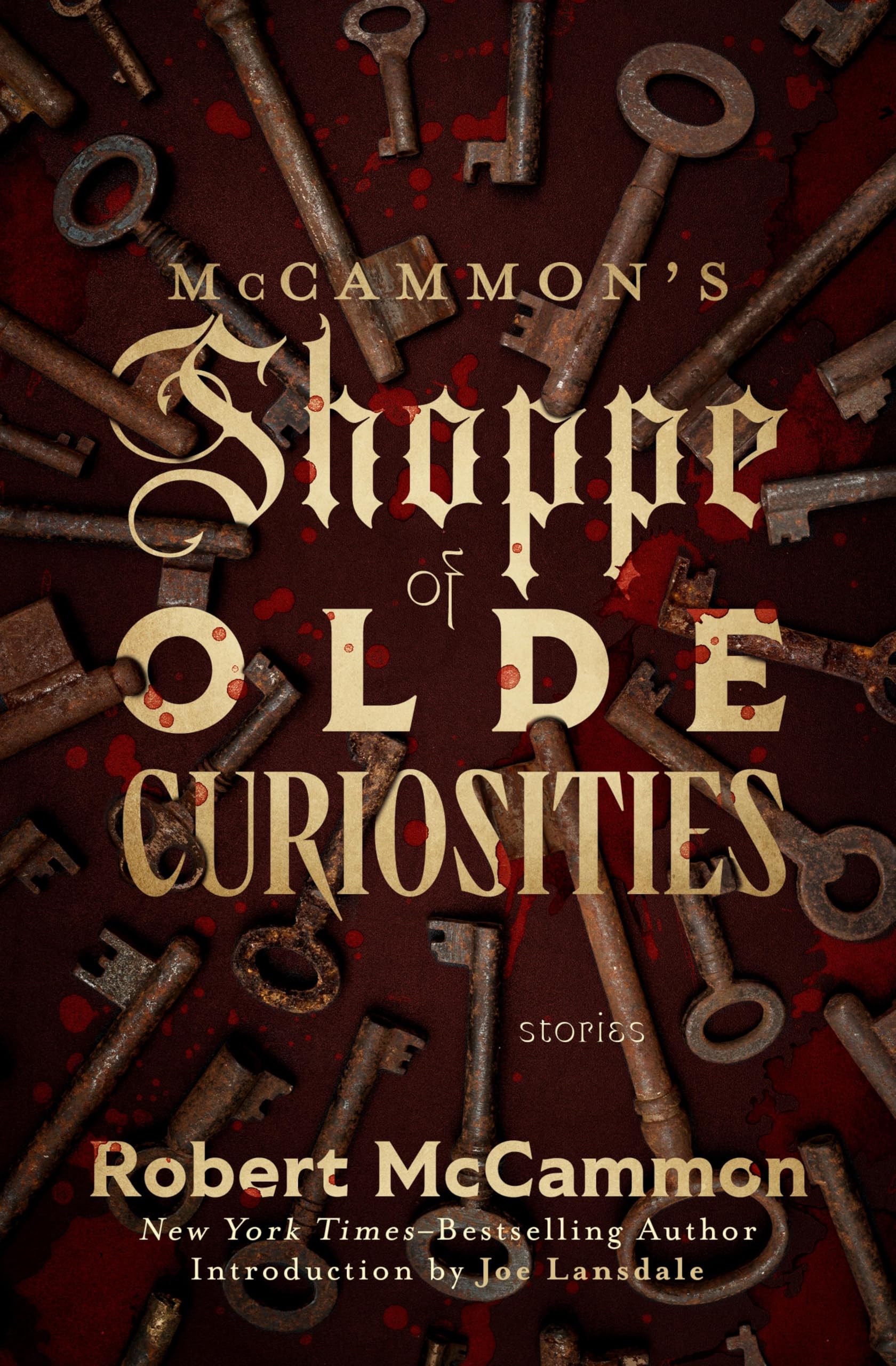
McCammon’s Shoppe of Olde Curiosities collects all of Robert McCammon’s previously-uncollected short stories written throughout his career.
Open Road will publish the collection in trade paperback and ebook formats on July 7, 2026.
Lividian will publish a limited edition in early 2027, and Audible will be releasing the audio edition later this year or early 2027.
You can pre-order the ebook now from Amazon, Barnes & Noble, Bookshop.org, and Kobo.
You can see the Table of Contents here.
From Open Road:
A collection of genre-bending horror and dark fantasy stories from the award-winning, New York Times-bestselling author of the Matthew Corbett novels.
This edition includes an introduction by international bestselling author Joe R. Lansdale.
Featuring two Bram Stoker Award–winning tales, McCammon’s Shoppe of Olde Curiosities is a career-spanning collection gathering nineteen short stories showcasing the author’s imaginative range of frightening terror, fantastical worldbuilding, and characters confronting the unknown around them and within themselves.
Pursuing a life of celebrity fame, Erik Van Helsing’s desire to cash in on his famous family’s name as vampire hunters unveils a legacy he cannot escape in “Blood is Thicker Than Hollywood”—a spinoff tale from the novel They Thirst.
A woman surviving in a post-apocalyptic landscape fights off loneliness when she reads aloud to the “Children of the Bedtime Machine”—a tribute to the wondrous storytelling style of Ray Bradbury.
As “Death Comes for the Rich Man” in 1703 Colonial America, Matthew Corbett is hired to delay the Grim Reaper to give a regretful old sinner time to make amends with his estranged daughter.
Experimenting as a mixologist, McCammon presents five drink recipes in A Little Amber Book of Wicked Shots, accompanying stories about a serial killer in a haunted hotel, an athlete’s destiny in the face of cosmic horror, a vindictive ad man learning the price of revenge, and an ex-slave on a suicidal and soul-sacrificing mission to serve justice.
Chilling and evocative, weird and humorous, these stories—and a dozen more—reveal why “no one can paint word pictures as vividly as Robert McCammon” (Sandra Brown).
Categories: Authors
Hi Cassie! Will Hyacinth make an appearance in TLKOF or in the other TWP books?
Okay, oddly, yes! She does make an appearance in TLKOF and does something fairly important. That was an excellent random guess. :)
Categories: Authors
This Kingdom Gives Away Vellum Overlays
We have beautiful overlays from Helena Elias, and today is you chance to win a set. We made you this video explaining what the overlays are, so you have a chance to listen to me in my Sell Products Online era.
If you are reading this in your inbox and can’t see the video, here is a direct link to the post.
If you are already a newsletter subscriber, no need to do anything. Your email address is already entered.
If you haven’t subscribed, you have two options: Publishing News, which comes out only a few times a year with important news like new releases and giveaways, and Blog Updates, which delivers all of our blog posts to your inbox. We will not sell or share your information; your email address stays with us and is used only for our newsletters.
As stated, these are prototypes, and the portraits of Sol and Ramond turned out to be a little too dark when printed, so they will be lightened for the final printing. Please note that I said 3 times in the video that these are semi-transparent. That’s because experience tells me that someone will order these and be terribly upset because they are not art prints.
If you would prefer to order Helena’s prints, they are available at her store.
Winner will be chosen next Friday, May 08, 2026. We will ship internationally; however, there is no guarantee that the prints will arrive to you. In the event the prints are lost in transit, we will not replace them and will bear no responsibility for compensating you.
The post This Kingdom Gives Away Vellum Overlays first appeared on ILONA ANDREWS.
Categories: Authors
One Year Until Overworld
As you've no doubt already heard, we have about a year left before the release of my new book, Overworld, in April 2027.
But, of course, you knew that. You saw my elementally appropriate Pokémon shirts.
Not only have I been writing this book for a while already, but we're in the middle of the editing process now. Since this is my first project with Tor, or any traditional publisher, I've gotten to learn a new editing process. A much cooler one.
Most people don't know this, but Tor edits by printing off the manuscript and having each author hike it up to the top of an active volcano. If you recite the chant correctly while tossing it into lava page by page, Tor alchemists can reconstitute the ash into a version of the book with no errors.
If you do mess up the chant, sometimes you'll end up with the wrong "their." Or an extra "ring like a bell."
My usual editing process involves sailing out into the deep sea and using a printed copy of my manuscript as bait to hook a fish, then grilling and eating that fish so I can taste the typos. But I'll try it their way this time.
So, does that mean you'll have to wait another year for my next book? No!
Not unless something goes horribly wrong, anyway. Like the volcano rejecting my gift.
The Commander is still slated for release this year. In fact, as many of you have already noted by looking slightly to the right, I finished a draft of it a few weeks ago.
But then it was back to editing Overworld! And now it will be back to writing another draft of The Commander. Then editing The Commander. Then writing The Sword. Then maybe editing The Commander one more time, depending on what the volcano says. Then releasing The Commander. Then editing The Sword.
And so on and so forth. They call that The Circle of (My) Life.
-Will
But, of course, you knew that. You saw my elementally appropriate Pokémon shirts.
Not only have I been writing this book for a while already, but we're in the middle of the editing process now. Since this is my first project with Tor, or any traditional publisher, I've gotten to learn a new editing process. A much cooler one.
Most people don't know this, but Tor edits by printing off the manuscript and having each author hike it up to the top of an active volcano. If you recite the chant correctly while tossing it into lava page by page, Tor alchemists can reconstitute the ash into a version of the book with no errors.
If you do mess up the chant, sometimes you'll end up with the wrong "their." Or an extra "ring like a bell."
My usual editing process involves sailing out into the deep sea and using a printed copy of my manuscript as bait to hook a fish, then grilling and eating that fish so I can taste the typos. But I'll try it their way this time.
So, does that mean you'll have to wait another year for my next book? No!
Not unless something goes horribly wrong, anyway. Like the volcano rejecting my gift.
The Commander is still slated for release this year. In fact, as many of you have already noted by looking slightly to the right, I finished a draft of it a few weeks ago.
But then it was back to editing Overworld! And now it will be back to writing another draft of The Commander. Then editing The Commander. Then writing The Sword. Then maybe editing The Commander one more time, depending on what the volcano says. Then releasing The Commander. Then editing The Sword.
And so on and so forth. They call that The Circle of (My) Life.
-Will
Categories: Authors
Cast in Blood is (already) live
Tuesday, the latest of the CAST novels was released into the wilds in print, audio and ebook. People who have preordered the book should have seen it pop up on their ebook reading platforms. This is the nineteenth CAST novel, the twenty-third Elantra novel. I’ve been writing these books since the early 2000s, and many of you have been reading them since then. Many of you may have already read the book that was released last Tuesday >.<. I can’t believe that my world has become so over-focused on family that I completely missed what would otherwise be the most important event on Tuesday just past–which would be pub day for Cast in Blood. It’s proof that life–bad and good–continues … Continue reading →
Categories: Authors
Comment on Edits At Last by Kevin
In reply to Benedict.
Don’t know if you saw my last response because I don’t think it was in the reply form, but regardless in my defense I am very computer illiterate hence my confusing responses apologies for the inconvenience.
Categories: Authors
Comment on Edits At Last by Steve VC
Given how much ‘world building’ you’ve done and are continuing to do, would you ever consider allowing other authors to use these constructs to build their own stories? I can imagine it would be difficult but there are other series out there where the author has created a ‘world’ and other authors use that as a platform for their books.
By way of example – Eric Flint’s 1632 book started a huge spin off, so too has John Ringo’s Black Tide Rising zombie stories.
It could potentially allow you to help collaborate with other authors, expand the ‘universe’ and derive a potential additional revenue stream.
Categories: Authors
Pages

Recent comments