
Authors
Comment on End of Editing by Sebas
All your books (both Alex and Inheritance) are a great joy to read. All thanks to your thorough rewriting. Also I very much like the way you talk and discuss about the Drucraft on this website. Its strengths but also its limitations. Fantastic!
Categories: Authors
Building Intrigue Snippet 3
Normal 0 false false false EN-US X-NONE X-NONE MicrosoftInternetExplorer4 /* Style Definitions */ table.MsoNormalTable {mso-style-name:"Table Normal"; mso-tstyle-rowband-size:0; mso-tstyle-colband-size:0; mso-style-noshow:yes; mso-style-priority:99; mso-style-qformat:yes; mso-style-parent:""; mso-padding-alt:0in 5.4pt 0in 5.4pt; mso-para-margin:0in; mso-para-margin-bottom:.0001pt; mso-pagination:widow-orphan; font-size:10.0pt; font-family:"Times New Roman","serif";}
Chapter 3
At Sea
Captain Chamas saw the trawler and noted it was flying the colors of the Nuevo Imperium. He had the surviving crew tack to get as close as they could while he readied his pistols.
It was late evening; the sloppy crew hadn't even manned a watch in the crow's nest or on deck. He slipped aboard and then took control of the ship.
"Who is the captain?" he demanded.
An anxious lad looked furitively to an old grizzled man with gray hair and beard.
Captain Chamas looked at his pistol and then put it in his waist band and pulled his dagger. He slit the throat of the old man. The old man's eyes were wide as he gargled and fell over. Blood sprayed across the room, getting on the pirate.
The other pirates laughed maliciously.
"Now, I'll ask again, who is the captain," he demanded.
"You," the lad stuttered, pointing to him.
"Better," the captain said. He nudged the body. "Strip that and then throw it over the side," he growled. "Save the boots; they may be my size," he growled.
They had been in the lifeboat a hafta. Their clothes were encrusted with salt. Having a spare set of clothes would be nice. He watched as the lad and one of his sailors stripped the body and then moved it to the stern.
"Tie off the lifeboat; we may need it again," he growled. "Search the ship. Find me some rum," he growled as he heard a splash in the stern. The lad and any other able-bodied prisoners were about to be sold into slavery once they got to the pirate island.
"Let's get this dung heap of a barge squared away and then head home," he growled. The other pirates growled in agreement.
---+--+-{0}-+--+---
Ziyougang City, Pirate Island
Dominus Dirk Wheeler had been initially proud of achievements and had taken great pride over the navy. Still worried about what Imperials will do.
He was pushing innovation and the machine shops and shipyards hard to turn out new machines. The research on the technology was tricky, but knowing that it had been done while also having a physical example and paperwork helped immensely in the copying and understanding of the things.
They needed to close the gap on innovation with the mainland if they were ever going to have a chance at survival long term.
As usual there was a need for more iron for steel and more coal of course and so on and so forth. He looked at the pile of notes and shook his head.
"So many calls for iron! From ships to machines to buildings—it seems that this is getting out of control!"
"It is just moving faster than we ever dreamed," Hala, his mate said with a smile.
"The Gaijin are devils!"
So many things had been learned from the festival spies as well as the captured PBY Catalina craft. Standardized tools, fittings, screws, bolts, so many, many things. Access panels, motors, turbine engines, the lists went on and on. He was sometimes dazed by it all.
His artisans were going crazy with the work. Of course Captain Pasha was smug since it had been his clan to bring the craft down. He was reeping a lot of what the artisan clan made from their research.
Dirk might have complained at an earlier date. Now he didn't care. They were all benefiting from the capture.
His mate ran her hands over his shoulders and then hugged him from behind. "They are just men. They have many annus of change that they brought with them. The plans for it all. We have seen some of it over the many annus, but never understood it all."
"Very little."
"Correct. Much of it lacked the basics on how it works," she said. She looked over him to a sketch and smiled.
There was an exploded diagram of an engine transmission on the paper. The sketch was ingenious; no doubt the concept had been taken from the festival spies but the drawing was new. "For the aircraft?" she asked as she picked the sketch up and examined it.
"And other things. Vehicles, cranes, all manner of machines," Dirk said as he turned to watch her. "It is all about gears and moving them about to find the right size gear to apply just the right amount of power and torque to do the job."
"Ah," she said in approval.
"They have to be made out of the right metals," he warned.
"I see," she said as she laid the paper back down again.
"We have some casting issues but I'm transitioning to diesel and gas. Primarily gas, the diesel engines are still more trouble than they are worth," Dirk said with a grimace. "They are costing a lot so I'm selling the steam engines to the market as they come online."
"Ah?" she asked in amusement. "Should you sell one or two to the duke?" she asked in malicious amusement. "He might pay richly for one."
Dirk cocked his head. "That is a thought," he admitted. He'd probably get two or three times what the market would bear locally if he sold a steam engine to the Grand Duke of Medicini. After a moment, he nodded. "Their tribute ship is due in a mens or two?"
"Something like that," his mate said. "Aren't you going on a trip again?"
He nodded. "Isaac and the others have parts to try in the plane. If they work, we will be slightly closer to replicating more of it," he said. "We leave in the morning."
"Ah. Well then, I have you all to myself then," she said huskily as she climbed into his lap and cradled his face. He smiled as she leaned in and kissed him.
---+--+-{0}-+--+---
Domina Ching Abbas had her hands tucked in the sleeves of her robe as she wandered through the alchemy building. Dominus Wheeler was pushing for more change, and she agreed with him. His work and that of the spies had improved their alchemy ten fold in only a few short annus.
She exited the building and went across the street to another which was making drugs. All sorts of pharmacuticals were being made, from medicines to those used for entertainment. She was amused that some of the other dominus like Wheeler were so trusting with her, and others didn't trust her at all. Of course it might be that they were suspicious of her because of her use of poisons. She had in fact removed an annoying dominus recently for his stupidity.
That had actually backfired when he had been replaced by Pasha. Pasha was a chuavanistic fool, a bit of a blowhard. He had youth and energy though, something that Omar had lacked. He was eager to prove himself, which was one reason that fool and the other dominus with him had raided the Nuevo Imperium.
She grimaced and nodded slightly as she made her way through the lab and then out another door and over to her office. She didn't bother checking the massage parlor, which doubled as a brothel, or the medicus building further down the street.
She had hopes that Wheeler would turn up something new for her soon. She also hoped that the Imperium would hold off a bit longer, though she doubted that they would hold out forever.
---+--+-{0}-+--+---
Categories: Authors
Horde vs The Grey
Happy Thursday, BDH. Mod R here, requesting Horde assistance.
 Not an image of my actual apartment but like…90% there.
I am moving house.
The new place is lovely, and I am very happy and grateful to have housing, but it has also been touched by the Fairy of Modern Rental Design (much less cooler than the Fish Fairy) and leeched of colour. Stark white walls, bright fluorescent lighting, black fittings, grey floors. Add windows that do not get direct sun and the usual English grey natural light, and you get the picture.
Very much a First World Mod problem, I am the first to admit. But the more I get to know myself and my ADHD, the more I realise how much my environment overstimulates me and makes me evil.
I haven’t decorated a home in more than a decade, and I ended up really hating what I did then, which was to work with the monochrome instead of against it. When I got rid of the bigger, greyer pieces, it was like my whole nervous system breathed a sigh of relief from tension I didn’t even know I was holding.
I do not want to get to that situation again.
Now I’m leaving all of that furniture behind and starting anew, with two limitations:
- I can only work with furniture, textiles, lighting, rugs, art, and renter-friendly tricks. The walls, floors, kitchen fittings, and permanent fixtures must remain as they are.
- More importantly, I have no measurable aesthetic sense. As in, I can appreciate it when I see it, but I have no idea how to get things that harmoniously “go” together.
My style is…pretty much everything they dig up at Pompeii? I’m not sure what to call that particular flavour of Mediterranean, but if I could live on an Ancient Rome set design, I would. Creams, terracotta, olive greens, pops of gold and sea blues.
My mission is to lighten and warm up the place by combining the two realities. “What if a spreadsheet became a home?” meets “You wake up on a sunny afternoon in Apulia. It’s 78 AD, and the olive harvest is plentiful.”
So I come to you, wise Horde.
Where do you look for inspiration and shop for home things? I’m in the UK, but please do not let geography stop you. The comment section has never respected borders before, and I see no reason for it to start now.
Is it Pinterest accounts? Design books by…? Instagram people? Specific blogs? YouTube channels? Secret witch covens that meet inside an ancient turtle and discuss where to buy good curtains?
Please advise, because I am currently losing a staring contest with a grey floor.
The post Horde vs The Grey first appeared on ILONA ANDREWS.
Categories: Authors
This Kingdom Sells Vellum
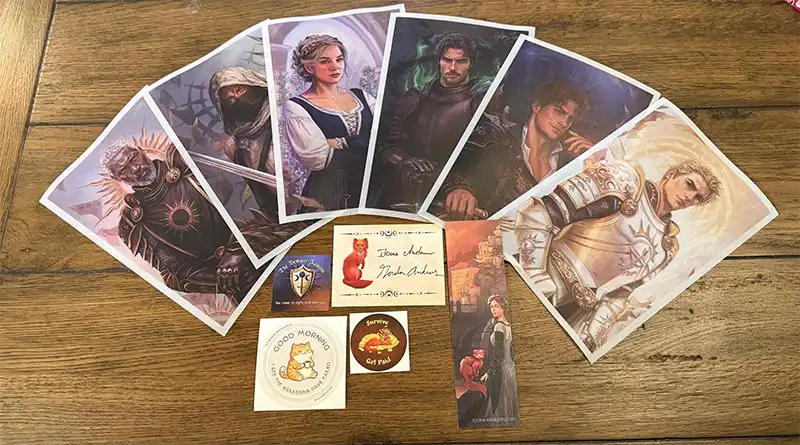
UPDATE from ModR: “They’ve sold out before I got the chance to format the pictures and write the caption for Instagram…” Level of BDH chalantness: 100. Okay, let us get this processed.
Here we go. ::deep breath::
We are doing the first trial run of This Kingdom Vellum Overlays. This is our chance to iron out shipping and logistical issues, so this first batch is limited to 10 sets. We felt that vellum needed a bit more with it, so we are offering a Vellum Media Envelope.
Vellum Media Envelope contains 6 gorgeous vellum prints of the character art by Helena Elias. These prints are 6 x 9 inches and are printed on 45 lbs vellum. Vellum is stiff and translucent, and tends to stay in the book.
The envelope retails for $24.99 with flat $9.99 shipping.
ORDER HEREA word about this: we are seeing vellum overlays retail for between $4-$10. We are going with $4 per print for this run. We may up the price in the future to be around $6.
These prints fit
- US Hardcover Edition
- OwlCrate
These prints do not fit
- UK regular hardcover
For some reason, the regular UK hardcover is 1/4 inch narrower. I don’t have the Waterstones to compare.
For this reason, this trial batch is US only.
PS: If your are in US and have one of the following editions of This Kingdom:
- The Waterstones edition with painted edges
- The French Edition
- The Polish Edition
- The German Edition
please comment here and we will send you a complimentary vellum print of your choice to test it. This is a first come, first serve.
Back to the envelope
Character List
- Solentine Dagarra
- Man from the Garden
- Clover
- Doran Arvel
- Colart Jennicor
- Ramond vi Everard
What’s in the box?
- 6 vellum prints
- 1 bookmark
- 1 signed bookplate
- 1 large sticker (3×3)
- 2 small stickers (2×2)
There are three sticker designs available: Demarr Crest, Assassins, and Survive, Get Paid.
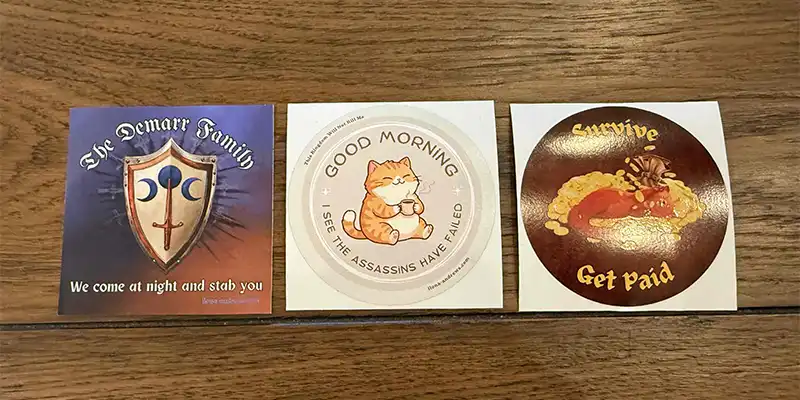
During the checkout, you can input order notes. Please indicate which sticker you would like to be 3×3. If you want your bookplate personalized with your name, please add that in the order notes as well. If you leave it blank, you will get the bookplate with just a signature.
And the cat. The cat is also for sale.
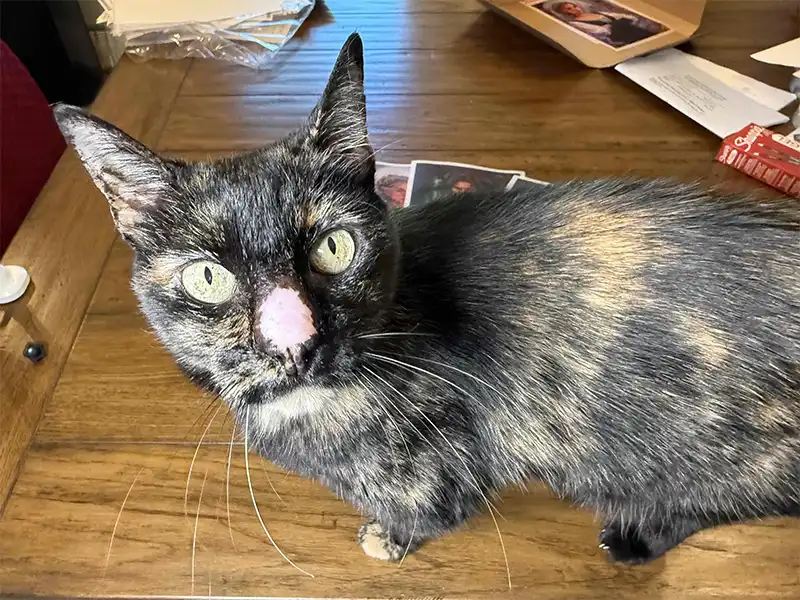
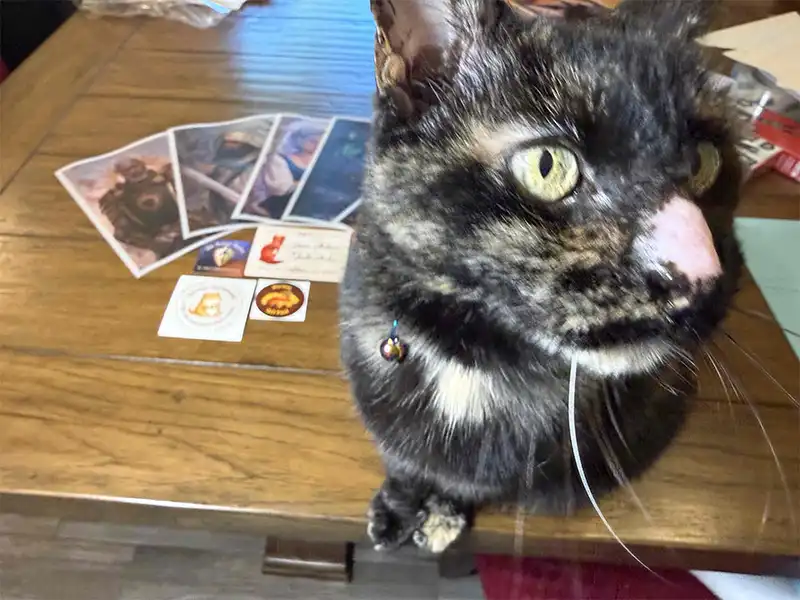
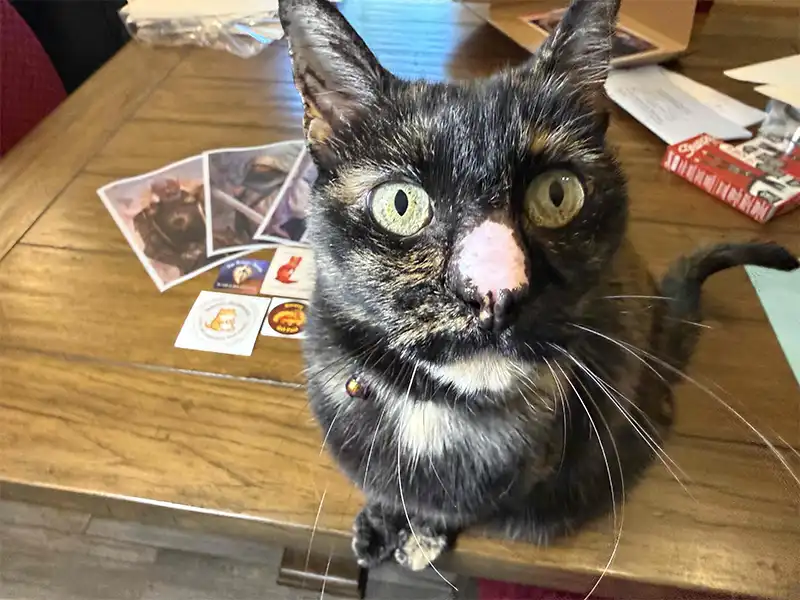
Please somebody take this feral cat off my hands. I cannot reach for anything without her being in my way.
The contents will come in a dark blue padded envelope with a cardboard insert. Once again, this item has a flat shipping rate of $9.99.
ORDER HEREWhen will this be mailed?
As soon as the orders are in.
I am Erin, the giveaway winner.
Erin, you are getting yours mailed tomorrow. I have the label.
I am Cad.
I saved you a set. That is going out with Erin’s tomorrow.
I want that cat on a mug!
Me too. This is being made.
I missed it!
This is the trial batch. Once it is mailed out and everything is good, we will start taking preorders. You will absolutely get your set.
I want just one print.
That can be arranged. The individual prints will retail for $6. The shipping will likely be the same or only slightly cheaper. It’s because of the envelope. We are mailing a bubble mailer with stiff cardboard in it.
That’s it. Your mission, should you choose to accept it, is to take this poll. If you cannot see the poll because you are getting this through your inbox, please click here.
Note: There is a poll embedded within this post, please visit the site to participate in this post's poll. Note: There is a poll embedded within this post, please visit the site to participate in this post's poll.The post This Kingdom Sells Vellum first appeared on ILONA ANDREWS.
Categories: Authors
Free Fiction Monday: Improvements
As a woman in the Middle Ages, Maude knows her place. But her husband’s early death means she must fulfill his duties until their son comes of age.
When a woman appears on her doorstep bloodied and broken, Maude must decide how far she will go to protect her son’s estate. Will she follow the cultural rules, or will she find a strength she didn’t know she possessed?
“Improvements” is free on this website for one week only. If you would like an ebook copy of the story, you can get it at WMG Books or on any other ebook retail site. Enjoy!
Improvements Kristine Kathryn Rusch
When the strange woman appeared, Maude was in the buttery, speaking with the clerk of the kitchen about his latest round of purchases. He went to market too often, she thought, and was too extravagant for the types of meals he produced. She would, if he did not modify his expenditures, have to fire him.
He would be the first servant she fired since her husband died.
The very idea filled her with dread. She had run the household since her marriage ten years before, but her husband had handled the money, the hiring and firing of servants, and the overall management of the large estate.
Now she managed it, in trust for their only child, a son who was still in swaddling. Still, some duties made her hands shake.
The clerk of the kitchen was a large florid man whom her husband had hired shortly before the baby was born. She had had misgivings about him then, but had been too tired to speak of them. Then her husband became ill, the baby had been born, and her husband had died, all within half a year’s time. She felt as if she woke up only recently to find herself in a life that only resembled the one she had once had.
The buttery was a small room off the kitchen. Beer and candles sat on the shelves. The stairs from the beer cellar descended down one side, and the main door of the buttery opened into the hall. She had sent the yeoman of the buttery—he was such a gossip—into the garden for a brief rest. Not that he needed one. His services were rarely used this early in the day.
The clerk of the kitchen was explaining, in his condescending voice, how some foods tasted poorly without the proper ingredients. She had her hands folded inside her sleeves, her wimple pinching her chin. She had been listening to him for too long, but she didn’t know how to make him stop.
And that was when they heard the screams, coming from the kitchen.
The clerk looked at her as if he had never heard such sounds before. She pushed past him into the Hall, through the Court, and into the kitchen.
It stank of grease and smoke and roasting meat. Even though no one was yet cooking the evening meal, the smell from last night’s lingered.
The kitchen staff was huddled near the outside door. One of the kitchen maids had her hands over her mouth. She was doubled over away from the door, as if she had seen something horrible.
Maude hurried past the worktable to the door itself. The servants parted as they saw her, all but the chief cook who blocked her way with his large body.
“Milady,” he said. “This is not for a lady to see.”
“Move aside,” she said.
He stared at her a moment, his blue eyes red-streaked from smoke, his lips thin and pursed as if he had tasted something bad. Then he stepped away from the door.
A woman lay on the flagstones leading into the garden. Her ragged clothes were blood-covered as was her face and hair. When she saw Maude, she raised a thin hand as if beseeching her.
“We shall take care of this, Milady,” the chief cook said. “It is nothing that should bother you.”
But they hadn’t taken care of it so far, had they? Besides, how could she leave a creature in such obvious distress?
“It is simply a beggar woman,” the chief cook said. “We see many of them at the kitchen. She was probably beset by thieves—“
“A beggar woman, beset by thieves? That does not seem likely.” Maude stepped outside. She knew why the staff was protecting her. The woman wore garments that Maude recognized from the town’s stew.
“She is a harlot, Milady,” the chief cook hissed. “Please. It is not right for you—“
“Enough!” Maude said. She crossed the flagstones and crouched beside the woman.
The woman smelled of sweat and fear. She was so thin that all the bones in her hand were visible. Her face was swollen and bruised, her teeth blackened and nearly gone. Yet Maude was certain the woman was younger than she.
Her surcoat had once been a rough wool, but time and use had worn it to nothing. There were several tears in it, recent tears, that rendered it nearly useless. She wore nothing underneath, and Maude could see scars beside the fresh bruises.
“Milady,” the woman murmured.
Maude put a hand on the woman’s forehead. No fever. She could not see where the blood came from. “Who did this to you?”
The woman touched her bloody garment. “Not mine.” She spoke so softly that Maude could barely hear her. “Anne’s.”
Maude felt a shiver run through her. “Where is Anne?”
The woman looked toward the forest beyond, and the road that led back into town. “I could not help her any longer…”
It was then that Maude looked at the woman’s feet. She wore no hose and no shoes. Her right leg, Maude suddenly realized, was twisted in an unnatural way.
“Help me get her inside,” Maude said to the chief cook.
“No, Mistress,” the woman said, but Maude ignored her.
The chief cook crossed his arms. “Milady, she is—“
“One of God’s children,” Maude said. “We shall take care of her.”
The chief cook sent out scullions and the indoor grooms. Apparently the cook was too good to help a woman in need.
The men slipped their arms beneath the woman and she moaned. Maude wondered how many other bones had been broken.
“Place her in the servants quarters and send for the wet nurse,” Maude said. Her wet nurse knew potions and herbs and healings. She had cursed the doctors when she saw what they had done to Maude’s husband, saying that if Maude had brought her in sooner, she could have saved him.
Considering that she saved the steward, who later fell to the same disease, Maude believed her.
The quarters where she had them take the woman were for the greater servants. They had rooms of their own, with cots stuffed with straw, instead of mattresses on the floor. This room had been empty since her husband died. She had lost a few servants and hadn’t had the energy to replace them.
The men laid the woman on the bed. She was paler than she had been before, and her eyes were glassy with pain.
“What are you called?” Maude asked.
“Mistress, your man, he is right about what I am.”
“Do not argue,” Maude said. “You are here now. What are you called?”
“Joan.”
“Joan,” Maude said. “Who did this?”
Joan closed her eyes. At that moment, the wet nurse appeared. She held a towel as if she had just left the young lord, and her surcoat was not properly fastened.
When she saw the woman on the bed, her gaze met Maude’s. “Milady, you know—“
“I know,” Maude said. “See what you can do. She’s been badly beaten and her arm is broken.”
The wet nurse nodded. She came inside, put a hand on Joan’s forehead, and then began to examine her. Maude stood.
The men were still crowded inside the room. It was as if they saw Joan as a curiosity and nothing more.
“Come,” Maude said. “We shall find this Anne.”
***
Halfway to town, they found what remained of Anne. She lay in a crumpled heap beside the road, her limbs bent at unnatural angles. Her face was bloodied, as if her nose had been broken, but that was not where all of the blood came from.
She had knife wounds on her hands and arms, and another through her belly. The dry road contained a black trail, as if she had lost blood the entire way.
Joan had carried her on a broken leg, until she could come no farther.
Maude turned to the head groom who had accompanied her. She took one of Anne’s cold, damaged hands, and held it out to him.
“What do you think of this?” she asked.
He shrugged. He could barely look at her. “This is not your concern, Milady.”
“Of course it is,” she snapped, startled at the tone that came out of her mouth. Had she ever spoken to anyone so harshly? “This is my land.”
He looked at her then, and it seemed as though there was pity in his eyes. It made her bristle.
“What becomes of these women,” he said, “is their choice.”
“I doubt anyone would choose to die like this,” Maude said. She ran her fingers over the deep wounds. The skin had parted so far that she could see muscle. “I believe she was trying to defend herself.”
“Be that as it may, Milady,” the groom said. “She knew what such a life would bring.”
Did she? Did anyone? Maude remembered the day after her marriage, as she rode in her husband’s carriage to her new home, the estate she now ran. Had she known that day how many miscarriages she would have? How the first babe born to them would die three days later in pain so bad that his little wails broke her heart? Had she known then that she would love her surviving son so much that it hurt?
Of course not. And the greatest surprise of all had been how badly she missed her husband, now that he was gone.
“You know something of these women then?” she asked her groom.
He flushed. “Only what I have overheard in taverns, Milady.”
She narrowed her eyes, not believing him. “They are from the stew, are they not?”
He nodded.
“Is such treatment common there?”
His flush grew deeper. “Milady, I am not—“
“I am a woman married and widowed,” she said. “I am not unfamiliar with such things.”
“There are perversions, Milady, that I cannot speak of to a gentleborn lady.”
She raised her eyebrows. “Perversions that would result in this?”
He looked away from her. His skin was the color of dark wine. “There are men who enjoy inflicting pain.”
She shuddered once, and decided that perhaps he was right; she was not ready to hear such things. Still, a woman had died on her land and another had come to her for help.
“What do you think they were doing here?” she asked. “Where do you think they were going?”
He shook his head. He knew, as well as she, that no one would have taken the women in.
The hand did not feel human. It was too cold, the flesh hard.
“We shall give her a Christian burial,” Maude said.
“Milady! She deserves no such treatment.”
“Did you know her then?” Maude asked.
He shook his head.
“Then you do not know who and what she was. Like me, you can only guess. And I choose to guess that she was a Godly woman. You shall send some men to bring her back to the house. We shall place her in the chapel, find her suitable clothes before the priest arrives, and have him say a few words over her.”
“He will not like this, Milady.”
“He will not know,” she said.
“How will he not learn of it?” the groom asked. “So many have seen her, so many already know.”
She raised her head, anger making her feel stronger than she had for almost a year. “If anyone speaks of this,” she said firmly, “he will be fired.”
The groom’s eyes widened. She had never been this cold before.
He nodded once. “As you wish,” he said.
***
Because of her duties to young Henry, the wet nurse enlisted the aid of two kitchen maids and a chambermaid, all of whom, the wet nurse said, also had knowledge of healing.
Maude was amazed that she knew so little of her staff. They bowed to her when she came into the room. It now smelled of wine and camphor. While Maude was gone, Joan’s sore feet had been cleaned and bound with cloth, her bruises rubbed with hot stones, and her broken leg set and splinted.
But she was awake, her eyes dark against her pale face.
“Leave us for a moment,” Maude said to the servants.
They bowed again, and slipped through the door. Maude took Joan’s hand. It was fragile as a bird’s wing, but at least it felt alive, warm and callused, the bones delicate against her palm.
“Anne is dead,” Maude said.
Joan closed her eyes for a moment, and nodded. It was as if Maude’s words made the death real.
“I am giving her a Christian funeral,” Maude said. “She is in the chapel. If you are well enough, you may attend.”
Joan bit her lower lip. “You do not want me there.”
“Of course I do,” she said.
“’Tis not a place for me.” Joan bowed her head.
“Our Lord did not think so,” Maude said. “Mary Magdalene was of your profession, yet she was at his side.”
Joan squeezed Maude’s hand. “You are a good woman. I did not mean to burden you.”
“It is no burden.” Maude put her other hand on top of Joan’s. “Who did this to you?”
“Milady, it is not for you to hear.”
“I am so tired of everyone telling me what I may and may not hear,” Maude said. “I have lived more than a score of years, and I know of the stew and the men who frequent it. Now, stop protecting my dainty ears and tell me who did this to you.”
“A man,” Joan whispered. “I do not know his name.”
“Is he the same one who killed Anne?”
A tear eased out of Joan’s right eye. “No.”
“Yet you left together.”
“She would not have been hurt if not for me.”
“Tell me,” Maude said, and so Joan did.
***
The story came out in fits and whispers, sometimes lost beneath the choking sound of Joan’s heavily drawn breath. A man—a customer—had ill used her, and Anne, seeing how badly Joan was hurt, went to William, the stewholder, asking him to send for a doctor. He refused, and demanded that Joan, who was popular, finish her night’s work.
Anne returned to Joan’s room, and bundled her up, taking bread from the kitchen, and rolled it and some clothing in two blankets. Anne had heard of nunneries that took in Daughters of Eve—the Order of Saint Mary Magdalene—and they would travel until they found such a place.
Anne was helping Joan out of the stew when William found them. He accused Anne of stealing and he drew a knife. He cut her and that brought him to a frenzy. He attacked her like a madman, and did not stop. Joan could not help her.
Blood spattered her face, and then his, and that seemed awaken him from his fit. He left them in the road outside the stew, left them, Joan believed, to die.
She managed to lift Anne over her shoulder, holding her in place with her good hand. Somehow she managed to make it to the middle of the forest before she fell, unable to go on. There she realized that Anne’s eyes were open and unseeing, that Anne was not drawing a breath.
She remembered no more.
“I do not even think I saw your manor,” she said. “I was just walking because I did not know what else to do.”
***
Maude did not know what to do either. She sat in her private chamber, head bowed. But she did not ask for God’s aid. Somehow she felt that God’s presence was in none of this.
The stewholder, she knew, had rights over his women. He could prevent them from leaving. He could punish them for an obvious theft. But Maude did not believe the theft of bread and blankets was sin enough for this. She did not believe that women, who sought to better themselves, deserved to die by the side of the road, to be left there like discarded clothes.
It took her an hour to come to her decision.
And then she sent for her steward.
***
He was a man of some years, thin after his illness, his hair gone except for graying tufts at the sides. Her husband had trusted him implicitly and Maude had trusted him as well. His advice had been sound, his care for the estate excellent.
He seemed uncomfortable to be in her private rooms. He waited, with the door open, for her instruction.
“Have the sheriff arrest the stewholder,” she said. “His name is William.”
“Milady,” the steward said. “Since your husband’s death, we have had no magistrate.”
She nodded. “I will sit in judgment,” she said.
He stared at her for a long moment, as if she were not someone he recognized.
“What would be the charge, then?” the steward asked.
“Murder,” she said.
***
She held the hearing the next day. She sat in her hall as the sheriff brought in William the Stewholder. He was a portly man whose scarlet tunic was made of an expensive serge and whose shoes were lined with fur.
He looked as if he could afford the loss of a blanket or two.
His hands were shackled, but his feet were not.
When he saw her, his face flushed the color of his tunic. “I’ll not sit before a woman!” he cried.
“You have no choice,” she said in her new voice, the voice that had been born of this experience. “I am the trustee of my husband’s lands, and until my son comes of age, I am the one who runs them.”
“That means she’s the magistrate,” the sheriff said, shaking William.
“Did you,” she asked, “stab a woman named Anne?”
“She stole from me.”
“Enough to warrant two dozen wounds?” Maude asked.
“The price of theft is death!” he shouted, spittle coming from his mouth. Apparently he felt that she would only understand him if he yelled.
“I determine the price of theft on these lands,” Maude said, amazed she could sound so calm. “Those women were injured. They wanted medical care.”
“Only one was injured,” he said.
“Yet you wanted her to work.”
He shrugged. “She done it before.”
Maude stared at him for a long moment. He stared back, unrepentant.
“I sentence you,” she said, “to a pilgrimage. You shall visit holy sites until you learn the meaning of humility.”
“How shall that be judged?” the sheriff asked.
“I believe it will take many years. Perhaps,” she said, “your pilgrimage shall be eternal. I shall think on it, and come to that decision by the morrow, when you shall be shipped out.”
“You cannot do this,” he said.
“We’ve already established that I can.”
“Those whores you’re so worried about will have no one to manage them.”
She felt cold. She hadn’t thought of that. She looked at the sheriff. “You shall bring them here. They shall learn useful work.”
“Milady, they may leave but that will not stop someone else from opening a stew,” the sheriff said.
“I am aware of that,” she said. “But at least it will not be William here.” She waved in dismissal. “Take him away.”
***
That evening, she sat alone in the chapel as the priest sent Anne’s soul on its way. Joan had been too ill to come. It would take many weeks for Joan to heal.
By then, Maude hoped the men she had sent to find the nearest Order of Saint Mary Magdalene would have returned with good news.
For it did not matter how a woman was born, as a daughter of Eve, or a daughter of Mary, she deserved to live a life free of brutality and pain.
Maude lived such a life, but she had not known it until now. And it had taken a sight that most would have shielded her from to teach her that she had strengths she had never expected.
She would hold these lands in trust for her son. And when he came of age, she would give them to him gladly, better than they had been when she came to them.
Better, because she had made them so.
Improvements
Copyright © Kristine Kathryn Rusch
Published by WMG Publishing
Cover and Layout copyright © WMG Publishing
Cover design by WMG Publishing
Cover art copyright © Alvaro Ennes/Dreamstime
This book is licensed for your personal enjoyment only. All rights reserved. This is a work of fiction. All characters and events portrayed in this book are fictional, and any resemblance to real people or incidents is purely coincidental. This book, or parts thereof, may not be reproduced in any form without permission.
Any use of this publication to train generative artificial intelligence (“AI”) technologies is expressly prohibited. The author and publisher reserve all rights to license uses of this work for generative AI training and development of machine learning language models.
Categories: Authors
Building Intrigue Snippet 2
Normal 0 false false false EN-US X-NONE X-NONE MicrosoftInternetExplorer4 /* Style Definitions */ table.MsoNormalTable {mso-style-name:"Table Normal"; mso-tstyle-rowband-size:0; mso-tstyle-colband-size:0; mso-style-noshow:yes; mso-style-priority:99; mso-style-qformat:yes; mso-style-parent:""; mso-padding-alt:0in 5.4pt 0in 5.4pt; mso-para-margin:0in; mso-para-margin-bottom:.0001pt; mso-pagination:widow-orphan; font-size:10.0pt; font-family:"Times New Roman","serif";}
Chapter 2
Imperium Capital
Dean Eratosthenes worked with the engineers to open a series of trade schools. Not everyone needed to go to the university to learn a trade, many of the hands-on jobs needed just that, hands-on training. What they set up was essentially a trade university—engineers, machinists, carpenters, plumbers, electricians, and so on. Many worked off of an apprentice system which the natives were intimately familiar with.
---+--+-{0}-+--+---
Doctor Sue Carter recieved detailed files from Doctor Cassie O'Connell and her 3D printed organ and limb project. She was keen to implement such a practice in the Imperium.
They had some long-term cases in wards and hospicies in the city. There was also an institution for people with disabilities. Many elders were retired in homes across the kingdom. They tended to families and the hearth but would go hungry if the farm lacked food. Fortunately, that practice was ending in all but a few of the most isolated farms.
The doctor would love to help those people and more. There were so many that needed help, and like any good doctor, she was frustrated by her lack of tools in some cases. They had some cases where they had to sadly watch someone die and just comfort them in their end time.
She had made great strides with her students to improve things in the kingdom, but she was always aware that there was so much more that could be accomplished. Hopefully, Doctor O'Connell could arranage the time for a visit.
She had recently become aware of an institute for dead, dumb, and blind people in the capital and in several of the duchies. They were hovels, living off of whatever charity was thrown their way. She had started to change that for the better, giving the folks there a new lease on life. Just instituting better care practices, teaching brail and sign language, and basic medicine had made a large impact.
She was not sure about curing all of the blind folks; however, an exam had weeded those with a degnerative disease out from those who had cataracts or just very poor vision. The optotrician had performed a series of cataract surgeries for nearly a mens, what the natives called a month. Just that had gone a long way to clean out some of the folks in the properties.
The truly blind folks had to wait until they could find a means to surgically correct their eyes. She was still leery about attempting replacing an entire eye. Hooking up the optical nerves was scary.
They had also gotten to work on deaf people. Sadly so many deaf people had not been taught how to communicate by sign language. They had learned some rote activities but were considered stupid. She lacked corrective measures beyond the very basic and rudementary. That was changing though.
The time with the institutes had made her reconsider mandatory eye, nutrition, and hearing exams for children. Many children had poor grades and dropped out of school because of one of those three things. Getting to them early helped to change their lives for the better.
---+--+-{0}-+--+---
Diedra was overseeing the preparations for the upcoming Harvest Festival when word came in about the attack. She called the cabinet in and they listened to the radio as Ginger described the strike.
"Hopefully, this will serve as a lesson to them?" Winston, the treasurer, asked.
"Only if there were any survivors," Ciara, the dominus of textiles stated.
"And if they can get home safely. This happened off the coast of the Nuevo Imperium," Eugene frowned as he studied a map. "Ginger, any ideas on if any survived?"
"One small lifeboat got away. I don't know how many people were on it," the pilot reported.
"Okay," Eugene said with a nod. "So, they'll either flag down another of their ships or a merchant or fishing vessel."
"If they flag down one of the latter two, all money is off on the safety of the crew," Sergeant Waters, their gaijin expert in military matters, growled. They turned to him. "Remember the crap that pirates pulled off the coast of Africa? Small boat raiding or capturing ships at sea?"
Eugene, Charlie, Sue, Mary, and Max winced. The natives looked confused.
"Warlords off the coast of Africa sent small boats to attack shipping that was coming out of the Persian Gulf region," Mary explained. "They had small fast boats with weapons. They would run up to a bigger ship, many of which didn't mount a watch, then get on board and take the crew hostage. Sometimes they tortured and killed the crew. They would then sell the cargo and ship back to the proper owners."
The natives grimaced.
"The navy got involved. Many navies actually," Ginger stated. "They did like we did or sent in commandos to rescue ships. The pirates are still a threat, but they are not pulling off many raids anymore, at least before we left that is."
Eugene nodded. "So, the crew of any ship that they encounter might be in danger and there is no way to warn them."
"Sorry," Ginger stated.
"Not your fault, Ginger, you did the right thing. We can't have it all our way," Eugene stated. He made a slight puttering sound. "Any other issues?"
"No. Well, yeah, I'm about out of munitions," Ginger reported. "I had four missiles, and it took all four to hit."
"Darn."
"The good news is that they don't have many of those ships," Ginger stated. "But I could use a replenishment."
Eugene looked to Max. He grunted and spread his fingers in a flicking motion. "We'll work on that," Eugene said slowly as he looked back to the radio. "How are you on fuel and parts?"
"Okay. When do we have another PBY coming?"
"Two more and two more DC-3s and then I'm done building them and the Douglas for the time being. I'm switching everything to the Hercules project," Max growled.
There was a long silence. "Hercules?"
"Yeah, we're going for that instead of a bomber. That platform has more flexibility, and the Bootstrap folks have the plans already," Max stated. Eugene nodded.
"Damn good idea!" Ginger stated. "Good range, lots of stuff we can do with that bird. Awesome. When do we get them?"
"We need the plans first. I just got a lot of stuff to sort out from them, and we're going to build the infrastructure too. Plus as many common parts with the other birds as we can."
"Good," Ginger said. "I can't wait to get my hands on the controls," she said. There was a slapping sound and then rubbing. Eugene snorted. Those that knew her knew that the pilot was eagerly rubbing her hands together in glee.
---+--+-{0}-+--+---
Categories: Authors
Monday Meows
Paint me like one of your French girls, Jack.
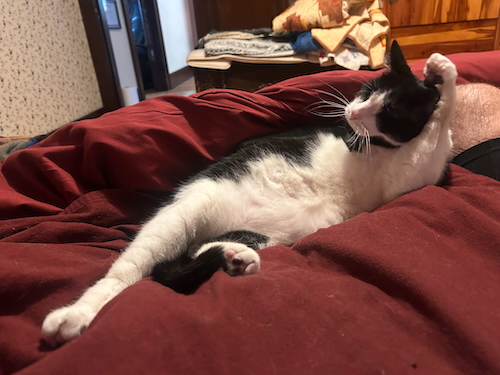
Not this again.
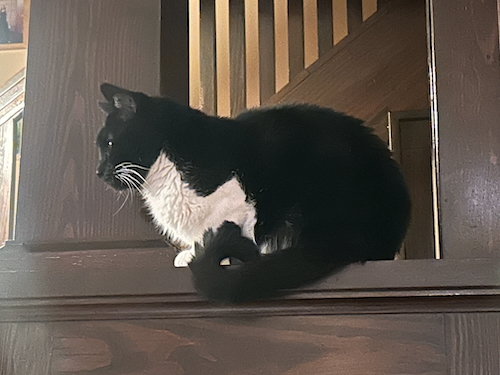
I’m more of a Rubens type…
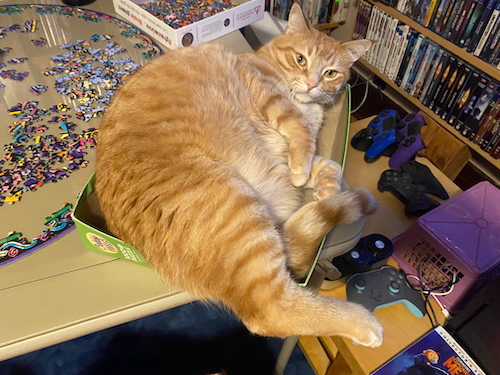
I am trying to delete this entire thread with my mind.
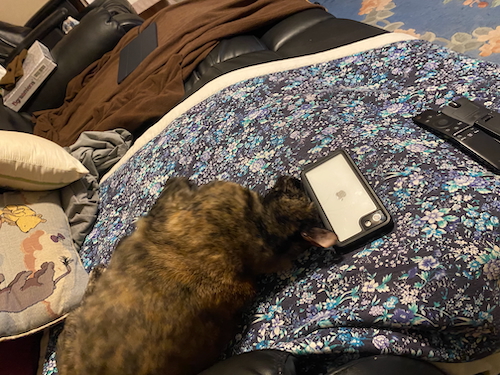
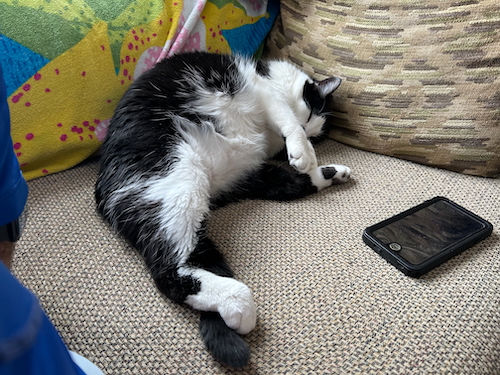
I was trying to touch my toes, but well, it’s a LOT of work.
Categories: Authors
Building Intrigue Snippet 1
Sitrep:
So, dad's out of the hospital and recovering nicely. I'm better from this flu crud, and I'm starting to get into Trial by Fire.
I sent PRI 4 off to Rea Wednesday and she got it back to me Friday. I got it sorted and off to Goodlifeguide and here we are.
Normal 0 false false false EN-US X-NONE X-NONE MicrosoftInternetExplorer4 /* Style Definitions */ table.MsoNormalTable {mso-style-name:"Table Normal"; mso-tstyle-rowband-size:0; mso-tstyle-colband-size:0; mso-style-noshow:yes; mso-style-priority:99; mso-style-qformat:yes; mso-style-parent:""; mso-padding-alt:0in 5.4pt 0in 5.4pt; mso-para-margin:0in; mso-para-margin-bottom:.0001pt; mso-pagination:widow-orphan; font-size:10.0pt; font-family:"Times New Roman","serif";}
Chapter 1Imperium Capital
Work around the capital screeched to a halt with the arrival of the Bootstrap Colony shuttle. They first got warning of the craft’s arrival as it was coming down. Several of the Memes came with it as escort.
The craft did a series of S turns to burn off its excess speed and then came into land at the main runway which had been cleared of all air traffic.
Eugene and Deidra had hastily cleared their schedules to meet the visitors.
They met Jacklynn Smith and her copilot as a truck with a staircase was wheeled up to the still steaming craft. Jacklynn shook hands with each of them. “Sorry, a lot has happened since we last visited.”
“Ah. So, where is Mister Chambers?” Deidra asked politely.
“Ah. Yes. About him, that’s why we had a delay …”
---+--+-{0}-+--+---
Deidra was still quiet as she settled in with Eugene late that evening. The newcomers had been given guest quarters and were the talk of the city. Everyone wanted to meet them. They had agreed to a radio interview in the morning and a tour of one of the aircraft factories with Max.
She was still struggling with the idea of Mitch Chambers and his … what did she even call it?
How would she react if something like that happened to Eugene? She cuddled to him, spooning into him until it was hard to tell where one began and the other ended.
“It’s okay,” he finally said when she squeezed him again.
He rolled over and then looked in her eyes, stroking her face in the dark.
“I …”
He smiled a wan smile. “He isn’t dead.”
“But … if that ever happened to you …,” she was near tears.
“Or you? We’d make the best of it one day at a time. And we’d still love each other irregardless,” he said.
She smiled and kissed him. That turned into something more, and they made love gently, as much a renewal of their love as solace in each other’s arms for another couple’s misery.
---+--+-{0}-+--+---
“You have done some impressive things here. I mean, really,” Jacklynn said with a shake of her head. “That production run is impressive.”
“It is,” Eugene said with a nod.
“We’ve got what, Cessnas, the shuttle, C-130s, and the tanker at the moment?” Jacklynn asked. “Oh, and the helicopters and a couple of other birds. But you started with just a couple of computers and a CNC machine? Damn impressive.”
Eugene nodded but he had something else cooking in his mind. The arrival of the shuttle had finally poked a thought to the surface of his mind. He’d grabbed it and was ready to act on it.
He had finally realized what he’d been thinking about earlier when Deidra had mentioned Mitch Chambers.
“Speaking of your C-130s,” Eugene said with a slight lilt of inquiry in his tone of voice.
“Yes?” Jacklynn asked. They were eating lunch in the great room. She was a guest next to him.
“Do you think we can trade for a couple?”
She snorted. “How would we get them here? They aren’t space worthy,” she reminded him.
“Oh. Damn,” he said with a grimace. “I forgot that.”
“The amount of energy to transport a bird is insane,” Jacklynn said with a shake of her head.
“Besides, we’d need parts …,” Eugene sighed in defeat. “Never mind."
“Manuals … Training … mechanics …” Jacklynn said thoughtfully and then stopped. She shrugged after a moment. “Besides, the Memes won’t allow warcraft to be transported.”
“Oh. So, I guess that is out,” Eugene stated.
“But, I bet we could trade you the plans,” the pilot said thoughtfully.
Eugene was about to say something. Instead he blinked and slowly closed his mouth.
Jacklynn smirked a little at his expression.
“You think we can work that sort of a deal out?”
“Sure. I love your PBY design. We could use it on our colony. And you’ve got a few things we could use too,” she said. “Like that medicine your pharmacology people identified that could lead to faster healing drugs and that other one that fights cancer and aging.”
Eugene nodded slowly. “Think you could throw in a run of ICs for a half a dozen birds?”
“For, oh, a full shipment of what I said, and most of the stuff on my shopping list, sure,” she said with a shrug.
He blinked. After a moment, he stuck his hand out. She took it and shook it and then laughed. “Sorry, I’m a bit sticky,” she admitted.
He chuckled and wiped his hands on a cloth napkin. “I don’t mind. I’ve got kids; I’m used to it actually.”
She smiled.
---+--+-{0}-+--+---
Categories: Authors
Comment on Editing by Bill
In reply to Cassandra.
Agree with you about the drip feed of background during the year! Keeps me going during the long wait for the next book.
I dont think of Stephen as bodyguard, more reluctant part of house Ashford and hero on waiting? Im rather hoping that he gets afew happy interludes as the story progresses…
His family dont seem to be that great (expect Brigette?) suportive rather than caring/loving
Categories: Authors
Comment on Editing by Bill
In reply to Bill.
Fair comment, just surpised that the thread from book#1 hasn’t developed…
Categories: Authors
Comment on A Beginner’s Guide to Drucraft #47: Sigl Fashion (Hands/Arms) by Jonathan
In reply to Tharaniya.
I wonder the same thing. Healing sigls seem like good candidates.
Categories: Authors
Comment on A Beginner’s Guide to Drucraft #47: Sigl Fashion (Hands/Arms) by Tharaniya
Stupid thought, but I wonder if it is possible to.. surgically implant a sigl inside of you and still be able to use it?
It sounds like a good ace to have up in your sleeve as a last resort, albeit risky in other aspects? I am not sure if I understand how sigls prescisly work either. You have to channel personal essentia through them while they are also in close enough proximity to you, right?
Categories: Authors
L’Heure du Loup Volume 1 audiobook
Audible now has a listing for the L’Heure du Loup, Volume 1, the unabridged audiobook of the French translation of The Wolf’s Hour, just recently published in two volumes by Monsieur Toussaint Louverture. The French audiobook is narrated by Hadrien Rouchard. It will be available on May 29, 2026, and can be pre-ordered from Audible now.
L’Heure du Loup Volume 1 audiobook from Audible
 Version 1.0.0
Categories: Authors
Signed Twelve Months Sweepstakes!

Enter now until 5/24/26 to win a signed copy of Twelve Months!
NO PURCHASE NECESSARY. Enter between 6:00 PM (ET) on May 4, 2026 and 11:59 PM (ET) on May 24, 2026. Open to US residents, 18 and older. Void where prohibited or restricted by law.
See Official Rules for full details.
Categories: Authors
Millennial PR vs Gen Z Socials
The official Tor account on Instagram did the Millennial vs Gen Z Marketing trend for This Kingdom Will Not Kill Me this week, and I was helpless before it.
View this post on InstagramA post shared by Tor Books (@torbooks)
For the happily offline among us, the meme format is simple: the Millennial Team gives you the earnest, back-cover-copy voice that tries hard. The Gen Z Social peeps release the group-chat vibe check pitch that hooks you in under 3 seconds.
It’s not a dig at either generation, just an acknowledgment that the same content can reach different audiences if captioned accordingly.
I guess I have more in common with Steve than previously assumed, because I immediately had to do it to the other books. It’s Friday, House Andrews are heading to their event, I have access to Canva, and no one stopped me in time.
As your resident Millennial, I have no illusions about my ability to be cool on command. When I try to write promo copy, it’s immediately Cheugystan, and I realise the moment that third sentence starts that I’m a lost cause. I offer my Gen Z voice with humility and the complete expectation that the youths of the Horde will roast me accordingly.
Text in captions for accessibility.
The Inheritance, Breach Wars volume 1:
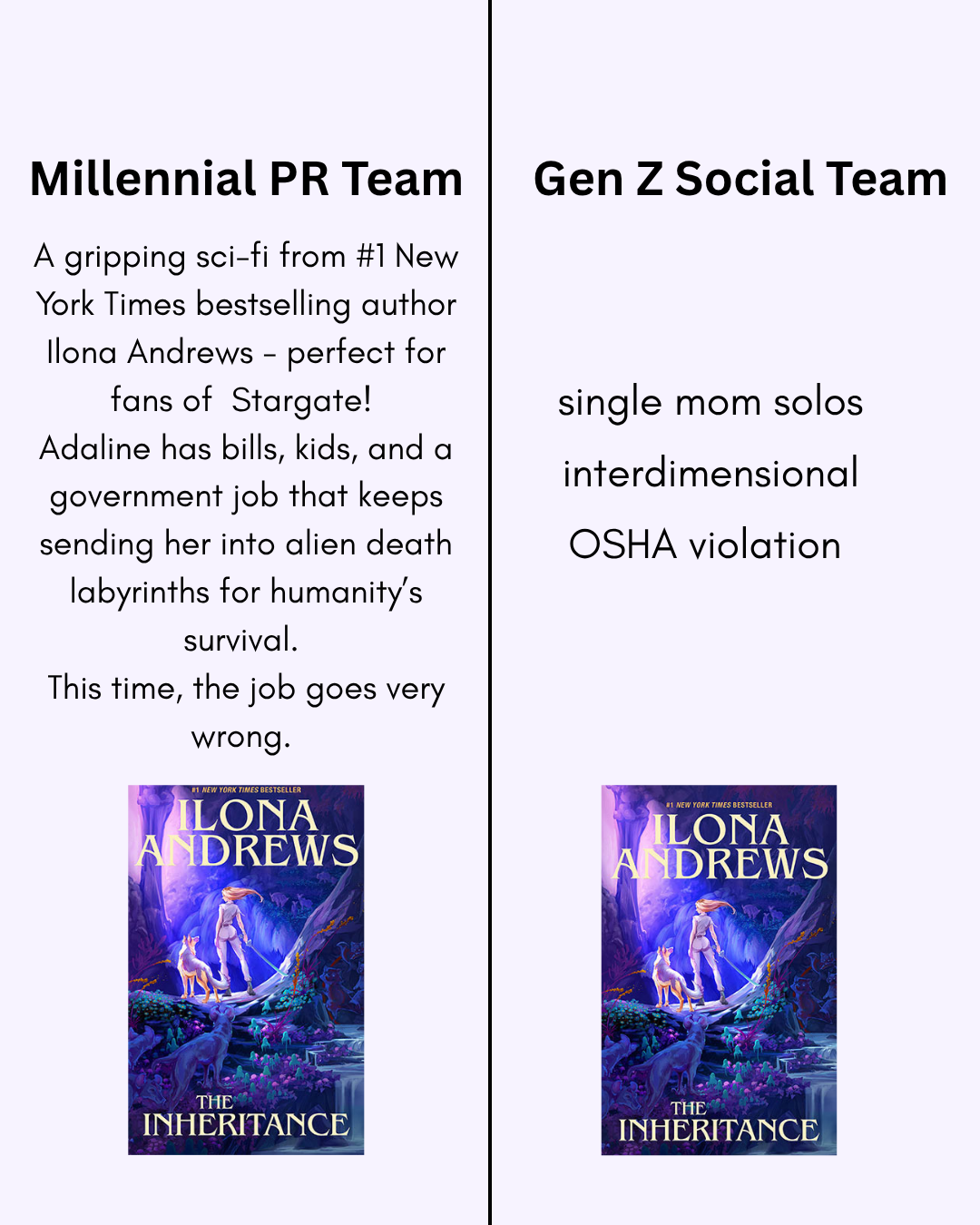 “single mom solos interdimensional OSHA violation” VS “A gripping sci-fi from #1 New York Times bestselling author Ilona Andrews – perfect for fans of Stargate! Adaline has bills, kids, and a government job that keeps sending her into alien death labyrinths for humanity’s survival. This time, the job goes very wrong.”
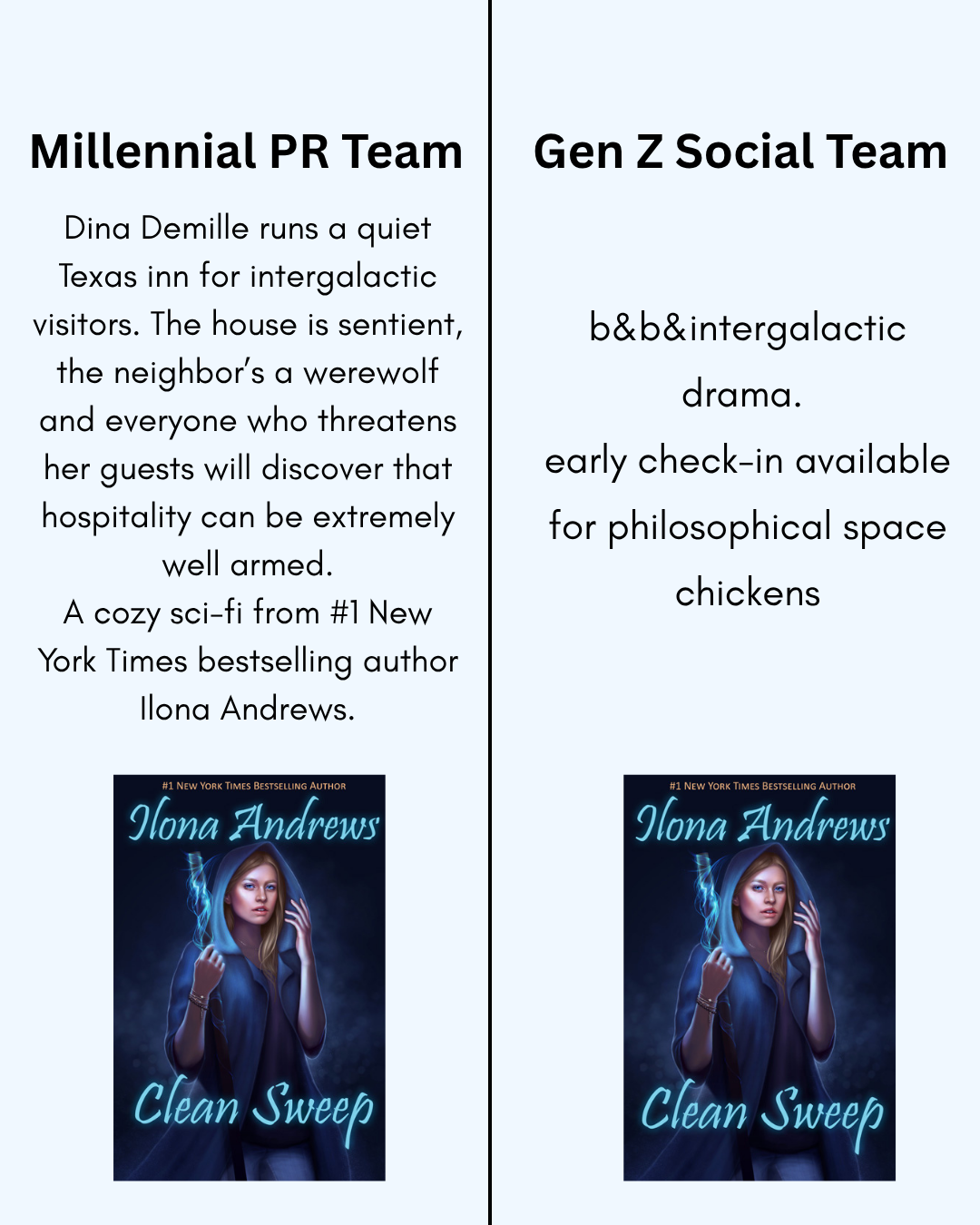 Millennial “Dina Demille runs a quiet Texas inn for intergalactic visitors. The house is sentient, the neighbor’s a werewolf and everyone who threatens her guests will discover that hospitality can be extremely well armed. A cozy sci-fi from #1 New York Times bestselling author Ilona Andrews.” VS Gen Z’s “b&b & intergalactic drama. early check-in available for philosophical space chickens”
Iron and Magic (Iron Covenant 1)
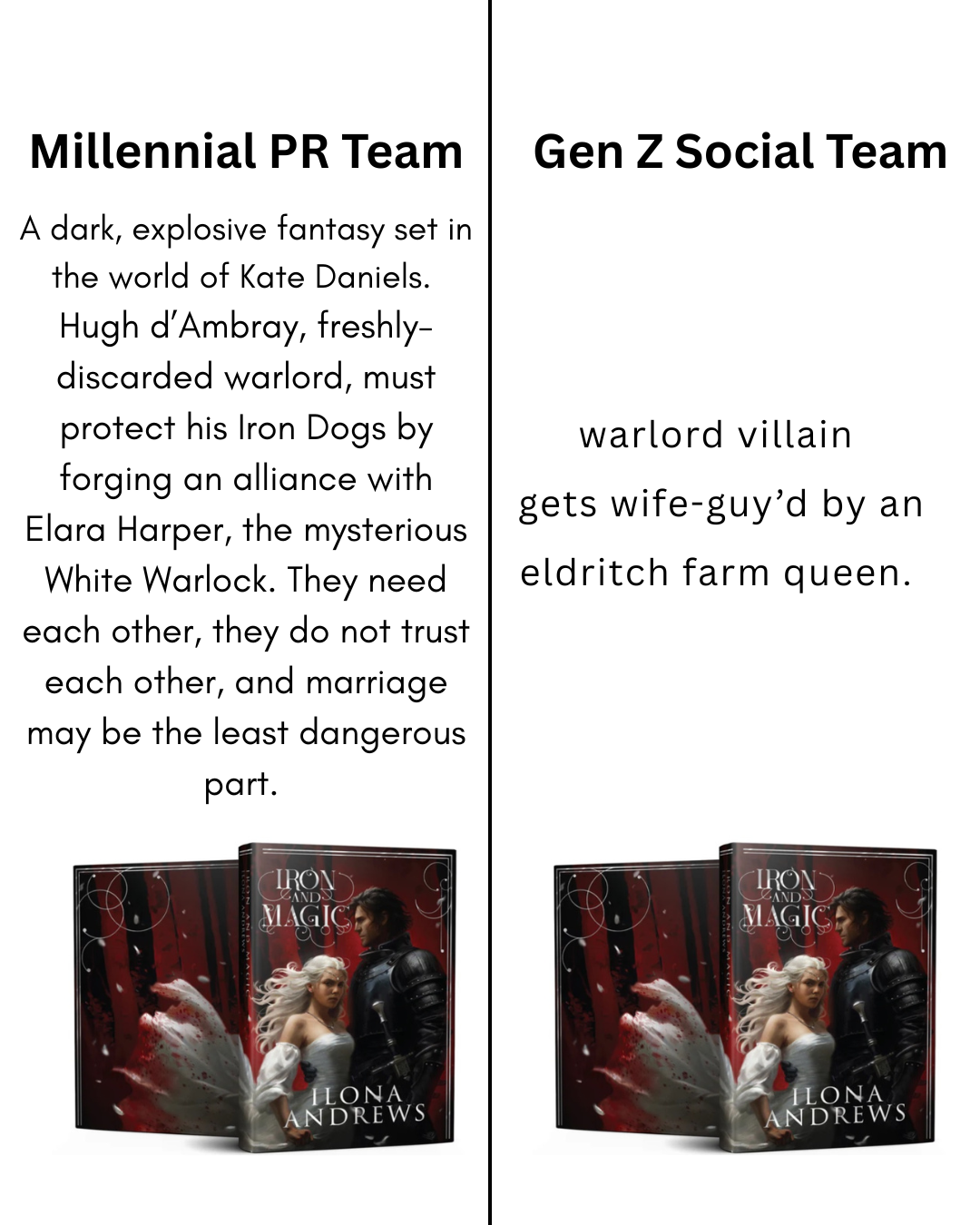 “warlord villain gets wife-guy’d by an eldritch farm queen” OR “A dark, explosive fantasy set in the world of Kate Daniels. Hugh d’Ambray, freshly-discarded warlord, must protect his Iron Dogs by forging an alliance with Elara Harper, the mysterious White Warlock. They need each other, they do not trust each other, and marriage may be the least dangerous part.”
Hidden Legacy:
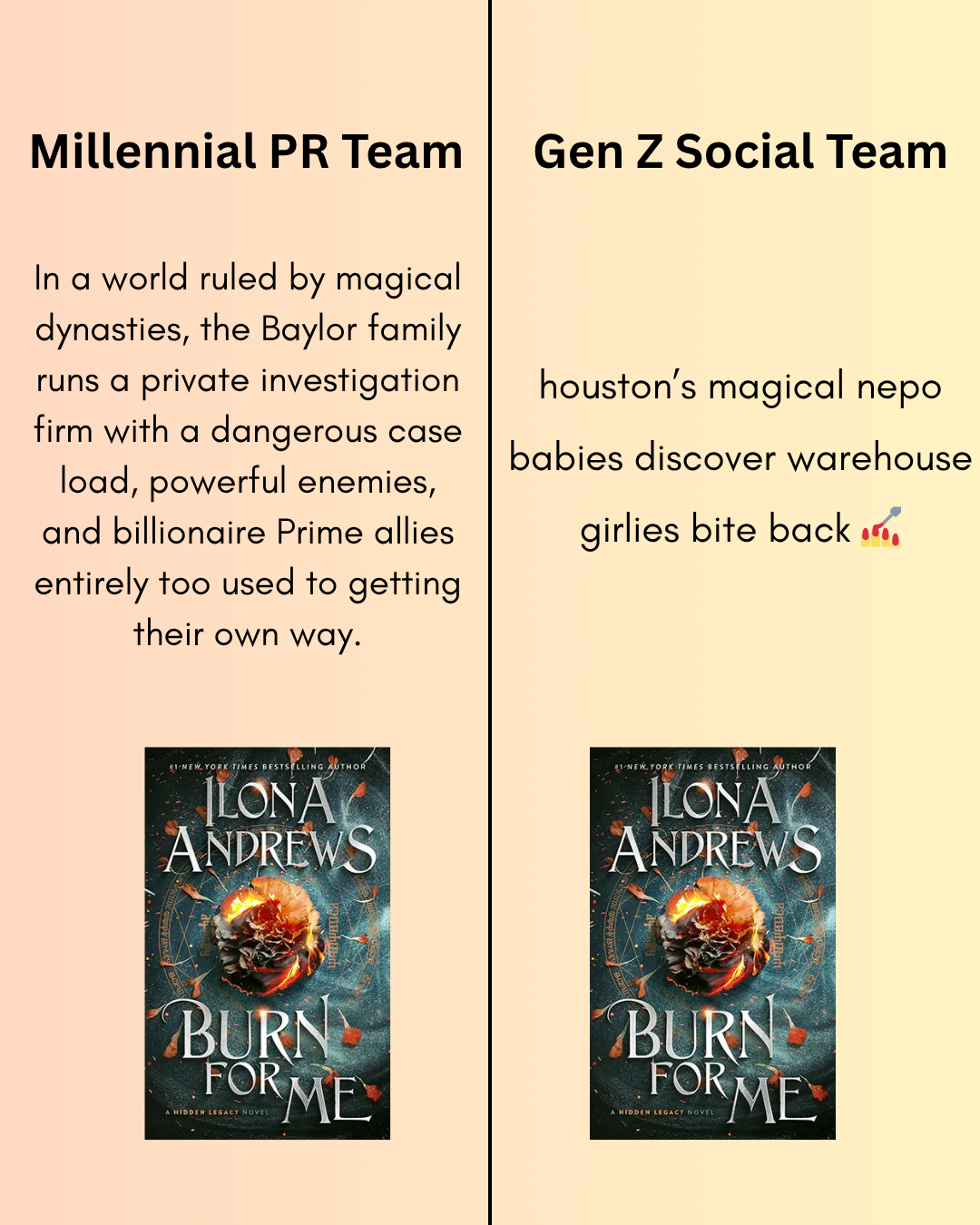 “In a world ruled by magical dynasties, the Baylor family runs a private investigator firm with a dangerous case load, powerful enemies, and billionaire Prime allies entirely too used to getting their own way.” OR “houston’s magical nepo babies discover warehouse girlies bite back”
Which version would have made you pick up the book?
The post Millennial PR vs Gen Z Socials first appeared on ILONA ANDREWS.
Categories: Authors
Comment on Editing by Bill
In reply to Jørgen.
Too much going on? He literally only has one paying job and that’s to watch over her…
Categories: Authors
Reminder: Ilona Andrews chats with Veronica Roth tomorrow

This is your reminder that tomorrow, Friday, May 15th, at 6:30 pm, Veronica Roth will be at Half Price Books in Dallas for the release of her new series debut, Seek the Traitor’s Son – and Ilona and Gordon will be the ones moderating the event!
Seek the Traitor’s Son is book 1 of the Burning Empire series, and is out now from Tor Books in a deluxe hardcover edition with sprayed edges. This new dystopian fantasy brings us destiny, prophecy, enemy generals, romance, warfare, mysterious gifts, and the fate of nations hanging in the balance.

There are a few tickets left for the event, available for purchase here.
If you would like to attend a signing and you can’t make it to Dallas, Veronica’s tour will have multiple stops in both the US and the UK – for full details of all appearances, moderating authors and dates, check out her website here.
To be extra clear, as there was a bit of confusion last time: this is Veronica Roth’s event. House Andrews are not doing a separate IA signing or presentation at this time. They will however appear as Featured Authors at the 2026 Columbus Book Festival in Ohio on July 11 and 12, 2026.
Keep an eye on the blog and newsletter for other House Andrews announced appearances!
The post Reminder: Ilona Andrews chats with Veronica Roth tomorrow first appeared on ILONA ANDREWS.
Categories: Authors
Comment on Editing by Jørgen
In reply to Inna.
This story is great in so many aspects, but as of now I struggle to see how romance can naturally fit in it. I get that Stephen’s young, but he has sooo much going on now!
Categories: Authors
BDH BINGO
Happy Wednesday, Horde!
I’m hosting a little Book Bingo morning to get us through the week hump.
The rules are simple. Tick off every square that applies to you. The central Curran square is free, because the Consort is ever merciful.
- Five in a row – across, down, or diagonal – and you have BINGO
- Fill the whole sheet and you have DEVOUR-ALL
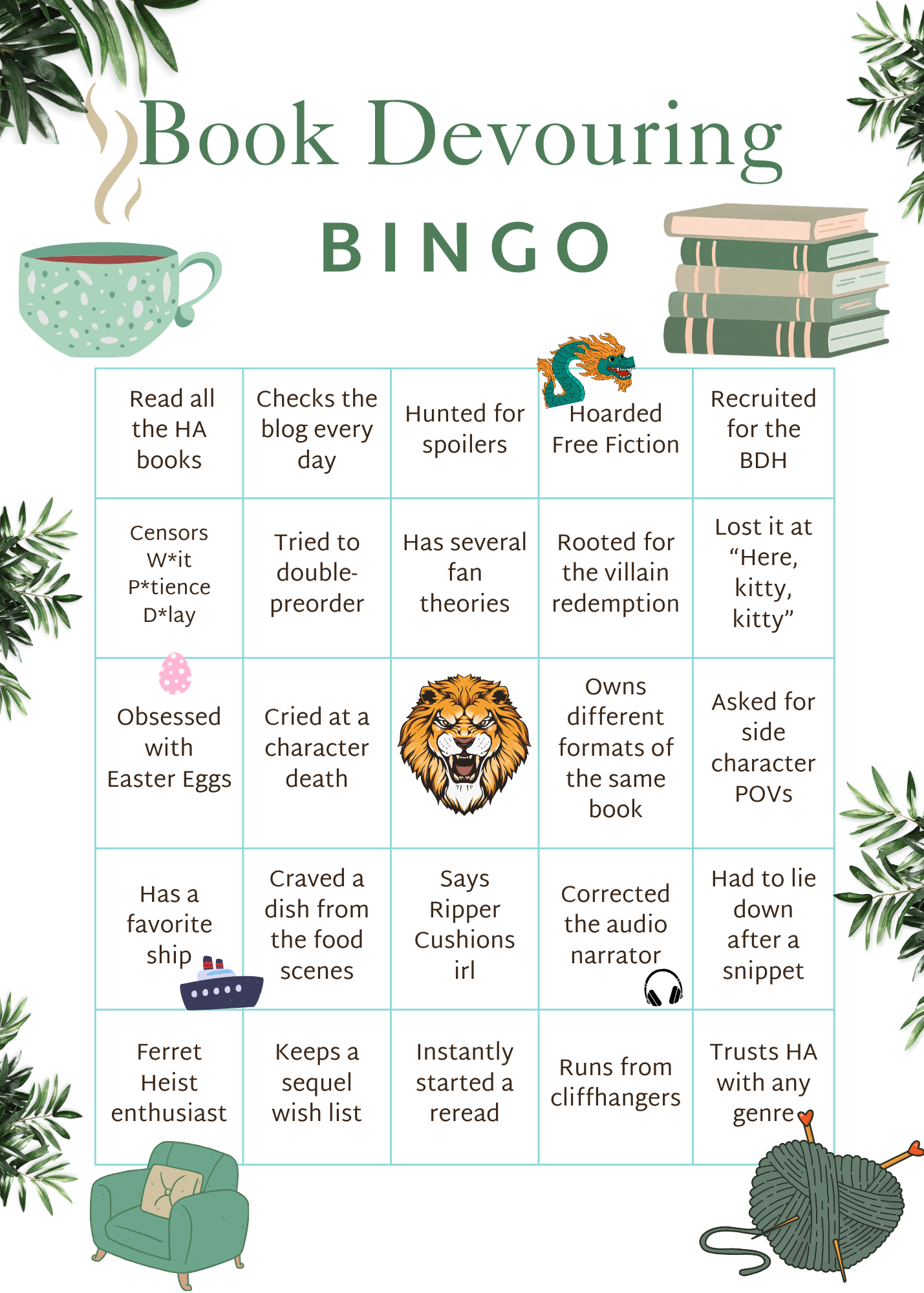
You get to brag with your total in the comments and the prize of knowing that you are part of the greatest Horde ever!
A few notes for anyone who needs them:
BDH stands for Book Devouring Horde, the affectionate collective name for Ilona Andrews readers.
HA means House Andrews, aka Ilona and Gordon.
Ship/shipping is a fandom term for a character romance you root for, whether confirmed on the page or not.
There is an accessibility button in the upper-left corner of the site. It can adjust contrast, switch to greyscale, and offer other display options that may help.
How did you do?
The post BDH BINGO first appeared on ILONA ANDREWS.
Categories: Authors
The Write Attitude: Doing The Work Amid The Noise
This post is a chapter from my book, The Write Attitude, which is now in a second edition. I’m posting it here to entice you to head over to Storybundle to pick up a copy, along with ebooks by Jamie Ferguson, T. Thorn Coyle, Dean Wesley Smith, Robert Jeschonek and others.
Everything in this bundle is exclusive to the Storybundle, including my book. So if you want to read it now, pick it up from Storybundle. The Storybundle ends in two days, so you might want to get yours now. If you don’t want a deal on the ebook or if you only read print, then you can always preorder the book on various retailer sites. The new edition will release on in July.
The second edition of The Write Attitude is quite different from the first edition, which originally appeared in 2016. I kept some parts of the original book, but much of the material is newer. The new material comes from my Patreon page. Not every post from my Patreon page shows up here, although several do. If you want to see everything, though, head to Patreon and sign up.
This post is from February of 2025, and is in the second section of the book.
DOING THE WORK AMID THE NOISEFrom 2025
There are times in life when being a writer is hard. I don’t mean real-world hard. Real-world hard is when your job is so important that one small error means someone else dies. There are a lot of real-world hard jobs in the world, and they keep the rest of us safe and alive.
As I said in Chapter 11, entertainment is important as well. We have an obligation to help those who are doing real-world hard jobs by giving them some kind of respite at the end of their long days.
But that means we have to do the work, and the work comes out of our brains. When we’re panicked and distracted—checking the news every fifteen minutes, looking at our social media, worrying aloud with our friends about what is going to happen next—it’s difficult, if not near impossible to concentrate on our made-up worlds.
They feel so small and unimportant.
We don’t see readers enjoying our work. We have no idea that a reader will close a book and hug it, like I did a week ago when I finished Robert Crais’s latest, The Big Empty. I know that Bob is a slow writer, and I wish he wasn’t, because I would love another of his books right now.
He lives in L.A. Not only are people there dealing with the chaos that is America right now, they’re dealing with the devastating losses of many parts of their community. I suspect he’s distracted.
I know that Connie Willis is distracted because I’m following her Facebook page in which she aggregates all the news of the day. I have no idea how she finds the time to write fiction or if she even is. I hope she is.
I’m a former journalist. I love information, the more the better. But, after the election, I shut off all media. I canceled all of my major newspaper subscriptions, stopped watching everything but the weather on any news channel, and got a lot done. I needed to because of an ongoing business crisis.
But I also needed the rest.
And I knew if I didn’t figure out how to control the information that came to me, I would not write another sentence—at least in fiction.
Writing fiction, as unglamorous as it sounds, is my job. It’s what I do for a living. But it’s also what I would do if the world ended tomorrow (which has gotten closer, according to the Doomsday Clock run by The Bulletin of the Atomic Scientists).
I make up stories. I always have. I write them down and have done that since I was in grade school.
Storytelling keeps me sane.
After the despair of the election (not shock, because I kept saying all summer [hell, all year] that this was possible, even if I wasn’t really listening to myself), I needed that quiet. I needed to accept that the world as I had known it for years would change dramatically.
How dramatically? I had—and have—no idea. This post is not about what’s going on out there in the real world. It’s changing too fast. I sat down at 1 p.m. on a Sunday, knowing that by the time I finish, more news will pour in.
It might be good; it might be bad; it might be hopeful; it might be devastating. It might be all those things at once.
It’s too much for the brain to cope with—and right now, it’s designed that way. Which is why I urge you to take care of yourself and your family first. Then take care of your community, whatever that might be, and then pick one or two or three issues to work on and be part of the solution for. If all of us do that, our differences will make sure that we will cover the entire spectrum of problems that are popping up like weeds.
Yes, I know. People are dying. I know. The situation is growing more dire by the day.
One step at a time. That’s all we can do. See above.
The problem is, then, how to corral the brain and give it enough space so that you can write.
That solution is different for each and every one of us. And it’s different each one of us as an individual at different points in our lives.
I can only give you examples from my own life.
Example #1: I got very sick when I was living on the Oregon Coast. I’m already allergic to half the world; there, we later discovered, I was living in mold and was allergic to that too. We moved to the dry desert here in Nevada just in time. I doubt I would have made it through the year otherwise.
But, I was and am a writer. I wrote through all of that, and even wrote a book about my methods for writing when I barely had enough strength to get out of bed. The book is called Writing With Chronic Illness, which will appear in a revised edition in mid-2026.
Some of the solutions in that book might work for some of you now. Doing the writing first, being happy with what you can accomplish, accepting your limits—all of those are important.
I did them as best I could there. Here, in Las Vegas, I’m healthier, although the chronic conditions do fell me more than I would like. I can get through them easier in this dry climate, so sometimes I forget what I had learned.
Example #2: Our close friend Bill Trojan died, and Dean had to handle Bill’s horribly messy estate. At the same time, my editor at one of the traditional publishing houses had a mental meltdown and spent a half an hour on the phone, screaming at me and telling me I was the worst writer on the planet.
No one treats me like that. No one. So I immediately divorced that publisher, offering to pay back the money they had invested in me and my work so that I could get the rights to my books back.
That was at least $250,000 that I would have had to pay—even though we were embroiled in the estate mess and Dean was not working on publishing and writing, due to that big problem.
My confidence was shaken, and we were in financial difficulties. I had to figure out how to write a funny novel that was still under contract.
I did, a page here and a page there. I remember sitting in my office and writing long paragraphs about how awful that editor was to get her out of my head so that I could actually finish a book that was under contract for someone else.
I did it, but shutting out the noise was almost impossible. It took concentration. It took will power. It took a daily reminder to myself that writing is supposed to be fun.
And you know what? Many days, it ended up being that way, just because of the determination.
Example #3: As many of you know, the last two or so years of my life have been filled with turmoil. Dean lost much of his eyesight, which meant we had to make some massive changes in our lives. Then, just as he was getting used to the changes, he fell on a 5K race and destroyed his right shoulder.
He couldn’t do much work. He was healing. I cared for him and, as I dug deeper into the business at our publishing company, I realized it was sick too.
We had to make drastic changes there, and I had to take over the company completely.
Which meant it got run the Kris way—lots of questions, lots of systems, lots of data, lots of procedures. The old staff buckled under the Kris method (which had not been in place since I got very ill in 2015), and within two months, they were gone…leaving problems so massive behind that those problems either had to be solved or the company had to be dissolved.
Dean and I chose solving those problems, and we had (and have) great help in doing so. These sorts of events teach you who your friends really are.
I knew, as we dug in, that I was not going to be focused on the writing. I needed to figure out how to harness that focus in a different way.
I had a novel to finish as well as short story deadlines from traditional short fiction editors. I was not going to miss those deadlines, and I needed to finish that novel.
The problem was that in this small condo, I did not have a second business office. I had to do the work on my laptop and my writing computer in my writing office.
I knew I needed help.
So I set up a challenge with other writers. I made it costly for me to lose (not just pride—which, pardon my French, fuck if I care about personal pride). I started the first challenge in December of 2023, and continued the challenges through most of 2024.
I lost a couple of times. But the challenge was the only thing that got me to the computer. Daily word count…that I had to report (and God, I hate reporting). I couldn’t fudge it for my own sake, and I didn’t.
I finished that novel, and a lot of short fiction, before September hit, and the business stuff combined with some legal matters that were all do-not-miss and I had to miss some writing days.
It irked me—and kept the writing as a focus.
Usually I don’t bring others into my writing process, but I knew I would need it in 2024. So I did it.
I continued the writing challenges into early 2025, because I knew that I needed to get back to massive novel production, and I didn’t want to lose my short story focus. I have to do both (which I have done throughout my career).
It’s not as draconian as the 2024 challenge, but my life is different now. The business has settled into a pattern. We’ve moved the main offices to Nevada, which means I have a business desk. (Yay!) And we’ve gotten through some of the mess left by the old staff, and what’s left we’re slowly wrapping our arms around.
One thing I noticed, though, in all of those crises, is that the world swirled around me, with its problems and its demands. In each of them, it felt like a massive storm pounding on the outside of my house—you know the kind: the rain is horizontal, the winds are devastating, and the view outside the windows is black and gray, with almost no visibility at all.
You just have to wait out those storms and know that when they’re over, everything will be different, but some things will still stand. There will be rebuilding. There will be heartbreak. But the sun will have come out to reveal what’s left.
In the middle of it, though, you just have to survive it and keep the important things safe.
Your writing is one of those important things. It will take effort to keep it safe. Effort on your part.
And you’ll have to figure out what it will take for you to do it. My methods might not work for you. Find what works. Realize that those things might not work in a different kind of crisis.
But you can find a way to be with yourself during these tough times.
Here are a few practical things you can do in most (not all) crises:
- Protect your safe space. For me, that’s my writing space. I couldn’t do it during this last crisis, but I managed somehow. It felt uncomfortable and reminded me yet again about the importance of having a dedicated writing computer.
- Shut off the internet. Dean uses a different computer for his internet research—one that’s just a foot or two away from his writing computer. I shut off my wi-fi, so that clicking over to the internet for research takes a conscious action, and often makes me realize that I was just heading over to distract myself. (Different strokes, y’know.)
- Set a daily writing time. Make sure your family knows what it is, and that you shouldn’t be disturbed. Try to pick a time when it’s not easy to disturb you (early mornings; late evenings)
There are so many other practical things you can do, but again, they become specific to you.
One other thing—a tough thing—is that sometimes the project you were working on when the crisis hit is not the project your creative voice needs right now. You might have to switch—something shorter, something longer, something that requires less research, something that requires a different kind of concentration.
It’s up to you.
But the key here is to remember that when you write, you’re inside and safe from the storm. It will rage around you unabated while you’re working. It’ll probably (sadly) still be there when you’re done with today’s writing session.
But you got that session done. It’s a victory.
Celebrate the tiny victories. Keep writing.
And remember, in almost every difficult time, the only way out is through.
“Doing The Work Amid The Noise” from The Write Attitude
Copyright © Kristine Kathryn Rusch
Published by WMG Publishing
This ebook is licensed for your personal enjoyment only. All rights reserved. This ebook, or parts thereof, may not be reproduced in any form without permission.
Any use of this publication to train generative artificial intelligence (“AI”) technologies is expressly prohibited. The author and publisher reserve all rights to license uses of this work for generative AI training and development of machine learning language models.
Categories: Authors
Pages

Recent comments