
Authors
Free Fiction Monday: Dunyon
In a rundown bar on a space station at the end of the universe, a customer asks for passage to Dunyon. But the bartender has never heard of Dunyon.
But more and more people arrive, all wanting to go to Dunyon—creating a huge crisis for that little bar, the space station, and maybe the universe.
“Dunyon” is free on this site for one week only. If you’d like your own copy, you can get it at your favorite retailer or pick up a copy from WMG Books by clicking here.
Dunyon Kristine Kathryn Rusch
It started in the far reaches of the sector—ships firing on each other, some destroyed. Keeping track became hard—communications turned sporadic, and who really followed which government was in charge of what anyway?
Rumors started, rumors impossible to confirm as communications throughout the system grew intermittent. Entire ships, destroyed. Cities, gone. A planet, blown up.
But most people saw no evidence of any of it. One would think, if a planet had been destroyed, there would be some kind of repercussion, but most people knew of none. Most people saw nothing.
Until one day the ships appeared overhead.
Most people barely had time to gather the family and the money, barely had time to get away, to find refugee ships.
But “refugee ships” make it sound organized, like an effort conducted by some charity organization or a benevolent and surviving government.
The ships weren’t organized or tied to each other or even very similar. Some were old-fashioned generation ships. Some were commandeered space yachts. Some were stolen trading vessels.
They made it only so far. Some refugees died in the blackness of space, the ships powerless, spinning slowly, the only thing surviving an emergency signal that would go forever unheeded.
Other refugees made it to the outer reaches of the sector. To supply stations and military outposts.
And the rest—well, the rest ended up here.
The new arrivals always ask me where here is, and I tell them one of three things, depending on my mood.
I say, I used to know but I don’t any more.
Or, It’s the end of the line.
Or, Here? This isn’t a place. It’s an emotion.
But too many asked me what that emotion was.
Desperation, I’d say. Desperation, pure and simple.
***
In truth, “here” was once an outpost, so far on the edge of the sector that we weren’t even sure which government claimed us. Mostly we claimed ourselves. Eventually, we became a destination space station, a haven for the rich. We built fantasy resorts spiraling off the main part of the station—all virtual reality and holographic technology like nothing else in the sector.
If you wanted to be pampered, you came here. If you wanted to redefine yourself, you came here. If you wanted to hide from the public, you came here.
It would cost you more money that most people ever saw, but you came here.
I came here without money twenty years ago. Most women, when they arrived, either dripped money or had unvarnished beauty. I had neither.
I was a former soldier looking for a respite, scarred inside and out. I started as a bartender, and built a reputation as the person who solved everyone else’s problems quickly, silently, and efficiently.
I did nothing but work and save and meddle (unemotionally) in other people’s lives. So as the station expanded, built its first exclusive wing, I had enough money to build my own bar with my own apartment attached.
I could run things the way that I wanted to, keep the hours that I wanted, let in the clients I wanted.
By being exclusive, I became popular.
And rich.
Nowadays, the bar is still exclusive. We are the only place that still charges a cover. We have entertainment in the back room—usually a band, sometimes a comedian, once in a while an acting troupe—all of them famous, all of them refugees. I pay well. People want to run their show in my place because they like my place.
I have human employees not because I can afford them (of course I can) but because I’m trying to create jobs so that fewer people remain stuck in the refugee areas, the places we called the pens. So far, I’ve created twenty-five jobs, and I’m thinking of expanding.
I’ve already expanded more than I initially planned. In addition to my entertainment room, I have a high stakes poker room. No one gets in without a fifty thousand minimum. I raised the stakes when I learned the truly desperate were taking the last of their savings and trying to double their money on my tables.
I didn’t want to get rich by making desperate people poor.
In the main room, we serve dinner at eight sharp. When the five courses are over, we clear the tables and serve drinks until four a.m.
At four, I shut down everything except the high stakes poker (some games can go on for days) and wander the halls, looking at the decay. The hotels that once catered to the dilettante are now filled to capacity with the rich and desperate. The restaurants serve food to the people who pay up front. But their doors are all closed when I wander. I see the signs for specials or warning the people from the pens to stay out. Sometimes I see evidence of a scuffle—broken chairs, smashed tables, a hastily made “closed for the week” sign.
The only places still open when I close the bar are the information kiosks. They have no employees, so people can use them at any time. Even at four in the morning, I will pass lines in front of the kiosks, lines that extend through dozens of corridors.
Information. That’s where the premium is. People want to know if their home is still there, if members of their family are still alive, when (if ever) they can return. Most never let go of the past, unable to accept they’re in a new future, one they don’t recognize.
I barely recognize it, and I have little to hang onto. But I see patterns. For example, you can always tell which part of the sector is closed or ruined or under attack because the information stops flowing from there. What replaces information is rumor.
Rumor. This place thrives on rumor. You can hear it as you walk through the corridors, going from the old resort section (now part of the pens) to the condo wing to my little neighborhood of exclusivity. You hear it in the lowered voices, see it in the furtive looks. You know that someone is lying to someone else, maybe not intentionally, but always harmfully.
For the rumors are almost always harmful. They give hope where there is none.
And I think that’s the most destructive of all.
***
Last month, I finally became a victim of rumors. The whispers, the looks, all came toward me, and I had no idea what was causing them.
My bartender brought me the first hint. He used the silent call built into the back bar to bring me down from my office on the second floor.
The bar in the main room is spectacular. I designed it for looks as well as ease for the bartender. I insist on a human bartender, not some robotic mixer or automated machine. There’s an art to mixing cocktails—the right amount of this touched with a splash of that—which machines can never get right.
The bar circles around a blue screen that shows flat images of anywhere in the sector. Usually I set the imagery, and I try to keep current: any place that’s considered safe shows up on the image screen, and any place that might have exploded out of existence gets removed from the rotation.
In front of the imagery stand bottles of real alcohol, most of them imported. The bulk of my real alcohol is stored in a safe room off-premise. Only I know where that safe room is because now, much of the real alcohol is more valuable than jewelry or credits or any other commodity except food. Some of those liquors aren’t ever going to be made any more, and the fifteen bottles in my storeroom are the fifteen last known bottles in the sector, maybe even the universe.
I price accordingly.
Between the bar and the back bar is a floor so springy that you can stand on it all day and your legs don’t ache. Customers sit on high stools that gradually tilt if the bartender decides the customer is sucking too much air. Obnoxious people leave quickly. Pleasant ones stay so long, they often fall asleep with their heads on my well-polished bar.
The bartender, Jack Kunitz, had moved to the very edge of the bar when he saw me. He was a burly man with a history as checkered as mine. He dreamed of opening his own bar one day—or he used to, before all of this.
He was polishing glasses with a special bar rag, even though we had a machine for that.
“See that woman?” he asked softly, nodding at the other side of the bar.
I could barely see her. The bar was shaped like a giant C, and she was in the middle of the opposite curve. Slender, older, rich. Rich was easy to tell because her clothes fit, she looked well nourished, and she still wore expensive rings on her long, thin fingers.
“Yeah?” I asked.
“She wants to know how much passage is,” he said.
“Passage?” I asked. “To where?”
“Dunyon,” he said.
“Dunyon?” I repeated. I had never heard of it. I thought I had heard of every damn place. “Where the hell is that?”
He shrugged. “I asked her. She said it was somewhere far from here. Somewhere safe.”
“Why is she asking us for passage?” I asked.
“Dunno,” he said. “I asked her. She said I should know. So I called you.”
Sometimes I had special information. Or a ticket someone lost at a high stakes game for an expensive berth on a ship leaving from here, usually somewhere far away. Maybe not somewhere safer, but somewhere different.
After you’ve been here for a while, after you’ve finally accepted that your home is gone, you have no family left, and nothing is ever going to be as it was, you go somewhere else, figuring you’ll start new, figuring you have at least a fighting chance of rebuilding some kind of life.
At least, that’s what these people tell me when they spend thousands—sometimes tens of thousands—for the chance to get the hell out of here.
“I don’t know a thing about Dunyon,” I said. “Apologize and tell her to check her source.”
He did, and she left, and I gave it no more thought until the next night when three more people—obviously wealthy people—offered a small fortune to buy their way to Dunyon. And the following night, six offered. By the next night, twenty-five.
The amount of money was staggering. The number of people willing to pay it was growing by the hour.
I needed to find out what Dunyon was, and I needed to find out fast.
***
Believe it or not, bartenders—bar owners—don’t always have the latest information. I don’t believe rumor and innuendo, and while I have a few trusted sources, I only trust them on matters pertaining to the station and my operator’s license. Anything else is suspect.
So at times like this, I have to use an information kiosk like everyone else. Before everything went to hell, I could access information from my apartment. But that avenue got shut off as the pens grew larger and larger. First people hacked into our personal systems, and then the information got corrupted. That made the kiosks the only safe place for news.
The kiosks were tapped into the station’s space monitoring system. Information from ships approaching and leaving, from other systems, and from various networks filtered through the monitoring system. If its information was wrong, the station would soon cease to exist.
The kiosks were designed so that no one could tap into that system, and anyone who tried to modify the kiosks’ security was arrested and often never heard from again.
I paid one of the cocktail waitresses to stand in line for me. Poor thing, she waited for eight hours before she contacted me. She was three people from the kiosk door. I still didn’t hurry down. Three people, at a minimum, would take twenty minutes to finish their business.
I made it to the kiosk in fifteen. Still two people away. The waitress looked exhausted.
“Next time,” she said. “Get someone else to stand for you. I’d rather be moving than standing still.”
I nodded, thanked her, and waited another fifteen minutes before getting into the kiosk myself.
The kiosks were ten feet tall and seven feet wide. They were oblong, with doors on two sides. The person accessing information went in one door while the person who had just finished with the kiosk went out the other.
As the doors slid, the kiosk wiped its memory, so that the newcomer would face a blank screen.
At least, that was the theory. More than once, I’d seen what the person before me had been searching for. Mostly, those searches didn’t concern me—a name I had never heard before, a place I was only vaguely conscious of—but the searches almost always ended with a red no-longer-viable notice.
My searches were few and far between. Mostly they pertained to specialized booze or a particular type of glassware. This was the first search I would ever make for a place.
The kiosk doors slid closed simultaneously and the side lighting came on, faint but illuminating. The flat screen in front of me had its own backlight. If I wanted a holographic avatar that would talk me through various programs, I had to turn around and deal with the other screen.
I interacted with people more than enough. I didn’t need a fake person to walk me through programming.
So I asked the screen in front of me about Dunyon and got this response back:
Which Dunyon?
Which Dunyon indeed? I had no idea. But I couldn’t tell an information kiosk that.
“Dunyon,” I repeated. “The one that’s far from here. And safe.”
You are the six hundredth person to enquire about that Dunyon on this station in the past week, the system informed me. I have no Dunyon that fits such parameters.
“How about a place called Dunyon within travel distance from this station?” I asked.
I have no Dunyon that fits those parameters either, the system informed me. You are asking questions in the same pattern as four-hundred-and-eighty other inquirers. Would you like the remaining questions and answers?
I didn’t like being told I was unoriginal, but I did appreciate the shortened workload. I told the system yes, and let it inform me that there was no place called Dunyon in the known universe, that there was no place with alternate spellings or pronunciations of Dunyon in the known universe, and no place called Dunyon on any shipping lanes.
“No place nicknamed Dunyon?” I asked.
No, the system told me, and then informed me that I was starting down a line of questioning that 365 people had followed. I got their results as well.
So far as we could tell—all of us who inquired on this system—Dunyon did not exist.
Then I remembered the system’s initial response to my very first question.
“When I inquired about Dunyon,” I said, “you asked me to clarify. You said, which Dunyon? Which implies that there are several Dunyons. What are they?”
Dunyon, the system responded. An ancient family of hereditary rulers on Uteelly. The family was assassinated several thousand years ago. Uteelly was destroyed in the latest wars, along with all cities and landmarks named after the family Dunyon.
I wondered if that was the source of my rumor and was about to ask when the system continued.
Dunyon, it said. A mythological city in the Koppae Sector. A place that may or may not have existed. Thought to be the perfect city. The hereditary family Dunyon of Uteelly claimed to be the only survivors of Dunyon, although this is unproven. There is no evidence that this Dunyon ever existed.
But it sounded like my Dunyon, the place far from here, the place that was safe. In these troubled times, “safe” was better than perfect or idyllically beautiful.
I frowned. There was a long silence, and I realized that the system had finished its recitation.
“When did you get your first query about Dunyon?” I asked.
Seven days ago.
“Did that query fit into any of the patterns of inquiry you mentioned before?”
No.
“What did that questioner want to know?” I asked.
Personal inquiries are protected information, the system said, rather primly it seemed to me.
“Did I ask any of the same questions as the original inquirer?” I asked.
No, the system said.
I felt frustrated. I couldn’t find out where this information had originated, but it had clearly originated here on this station one week before.
“Did I receive any of the same answers as the other questioner?” I asked.
No, the system said.
I thought for a moment. Then I tried one last question. “Has anyone thought they’ve found the lost city of Dunyon?”
Time parameters?
Time parameters? It took me a moment to understand that. “When did that Dunyon disappear?”
Sixteen centuries ago.
“Has anyone thought they’ve found the lost city of Dunyon in the past three hundred years?”
I chose the number 300 randomly. I could have chosen 500 or even the full sixteen hundred. But I wanted some inkling of what was happening recently.
Seventy-five explorers believed they found Dunyon. But they could not find it a second time.
I recognized this myth. It had existed throughout human history. The vanishing city. The perfect city that you could only visit once.
“Has anyone found the lost city of Dunyon in the past fifty years?”
Lucas Ennelly found the lost city of Dunyon fifteen years ago.
“Where is Lucas Ennelly now?” I asked.
I got the red screen. Lucas Ennelly was no longer viable. Even though I expected something like that, I still felt discouraged. I could understand why most people fled the kiosk upon getting such news.
“When did Lucas Ennelly die?” I asked.
Eight days ago, the system told me.
My stomach clenched. I was on to something.
“Where?” I asked, even though I had a hunch I knew.
In a bar on this station, the system told me.
“Which bar?” I asked. I knew what the system would tell me. I really didn’t have to wait for the words, although I did.
My bar. Lucas Ennelly died in my bar, eight days ago.
The day before the woman arrived, asking about Dunyon.
***
People die in my bar all the time. That’s part of the new reality. No one has the money to do simple things, like eat properly or see doctors when they get ill. The pens are breeding grounds for all kinds of viruses, and no one is allowed to leave if they’re sick.
But that doesn’t always stop people. Nor do they benefit from the constant stress and worry. Heart attacks, once thought to be eradicated, are common now, along with strokes. Experts are saying that it is the stress which kills, but I think it’s a broken heart.
Lucas Ennelly passed out at the bar, not far from where that woman sat. By the time we realized he wasn’t a passed-out drunk, it was too late. He had stopped breathing an hour before.
I’m not held liable for such things, just like I’m not held liable for the attacks and the attempted murders that go on just outside. People have become hostile. They drink too much and get too angry.
I’m always happy when they pass out. I prefer to let them rest there, since God knows, they probably don’t get rest anywhere else.
Jake contacted authorities when we realized Ennelly was dead. One of the station’s six coroners eventually removed the body, and—I’m sorry to say—that was the last thought we had given him, if we had given him one before that.
I was giving him a lot of thought now. I had the system tell me all it could about Lucas Ennelly. Turned out he was taking funds from people—the money the woman had quoted to us—for safe passage to Dunyon. He had already made a down payment on a retrofitted generation ship. He was going to take everyone to a place he had only seen once.
And they were willing to believe him. I left the kiosk, and reported his scheme to the authorities. If things went well, they might find some of Ennelly’s funds and return them to the poor unsuspecting souls who had invested so much for escape to a mythical realm.
If things went the way they normally did, some low-grade bureaucrat would find the money, pocket it, and claim that Ennelly had spent it all.
I couldn’t worry about it.
I had to figure out how to keep Ennelly’s clients from coming to my bar.
I walked back. I didn’t usually have time off during the day and it was an odd treat to see people in the corridors, to see the full restaurants, and the back-and-forth of commerce, even if it was conducted furtively and with great desperation.
By the time I got back to my exclusive neighborhood, I was relieved. I was tired of the crowds, the grasping, the clawing, the questioning looks from faces shoved against mine. I had gotten used to the late night silence as well as the order I kept inside my own bar.
I preferred it.
I wasn’t going to get it, however.
Because as I got close, I heard shouting. Then I saw dozens and dozens of people, pressing against the bar’s entrance. A mob, screaming, pulling, punching. The windows looking into the corridor were already broken and people were pouring inside.
I had never seen such chaos at my place—or even in this neighborhood. I grabbed one man and pulled him back.
“What’s going on?”
“Free tickets to Dunyon to the first five hundred people!” he yelled back, then pulled away from me.
I stood there, breathless, as more and more people hurried toward my bar. None were well dressed. They all smelled like sweat and unwashed clothes.
People from the pens, running toward free tickets.
I scrambled away, heading to the side of the bar. The employee entrance was hidden. Only an employee’s DNA made it visible, and no one else’s. I made sure I wasn’t followed before I touched the wall, which opened for me, and let me slide inside.
Inside wasn’t much better. People crowded the main room. The images behind the bar were shut off, and it took me a moment to realize why. Someone had broken the screen. Bright light shone from it onto the floor above.
Jake was standing behind the bar, protecting the expensive liquors with some kind of unauthorized weapon. The cocktail waitress who had helped me was keeping people back with the broken edge of a bottle.
I didn’t see any other employees, but I glanced up. The doors to the back rooms were closed and locked. Someone had the presence of mind to seal off the entertainment area and the high stakes poker room.
The noise was deafening. I pressed the emergency call button beside the employee entrance and got a green light, which meant help was on the way.
Although I wasn’t sure what the authorities could do, except stun the rioters and maybe hurt regular patrons inside my bar.
I pushed my way to the bar proper, then climbed on top of it. I waved my hands, but nothing happened.
So I shouted, “I’m the owner of this bar!”
The people in front of me stopped yelling and pushing.
I shouted the same thing again, and again, until the entire room was quiet.
Now I had to tell them something. I could have said the authorities were coming and they would all be arrested, but that probably wouldn’t counteract the concept of a free ticket.
I had to be creative.
I had to let them think they were getting what they wanted.
“Thank you all for coming,” I said, hoping I sounded sincere. “It’s been a great promotion. Lucas Ennelly gave us tickets to Dunyon and I’m proud to tell you that we have just given the last one away. Congratulations to all the winners!”
I clapped my hands, as if I were congratulating someone. Jack watched me for a minute as if I had lost my mind, then he started clapping too. The cocktail waitress slapped one hand against the neck of the broken bottle.
A few confused people up front peered at me, but people behind them started to clap. And so did everyone else.
They were so used to losing, so used to being the ones who did not get the special treatment, that they weren’t angry when they realized the tickets they had come for were gone. They accepted the loss as one more in a series of losses. They pretended joy for my so-called winners, and then they slowly, calmly, filed out.
No one remained except Jake, the cocktail waitress, and one of our regulars, who had clung to his seat at the bar through it all.
“What the hell was that?” Jake asked.
“I know how the rumor started,” I said, and told him about Lucas Ennelly. “He really was selling tickets to Dunyon from this bar for a lot of money.”
“A scam,” the waitress said.
“Most likely,” I said. Then I shrugged. “But people who claimed they found the lost city of Dunyon always tried to go back. I think he was using these poor people to fund his trip.”
“I don’t get it,” Jake said. He set his weapon in a drawer behind the bar that I had forgotten about. “Why come in greater numbers after he died?”
“Two reasons I think,” I said. “First, people had bought tickets here. And second, deaths don’t get publicized on the station. No one knew he was dead.”
“So they thought he was holding out on them,” the cocktail waitress said.
I nodded. “Which only made them more desperate.”
I didn’t have to explain the rest to them. Because they live here and they know: Desperation leads to rumors and rumors become wild stories, and wild stories ignite belief. People are taking action on the smallest things, the most unlikely things, because they need something—anything—to cling to.
I’ve seen it countless times.
I just hadn’t experienced it myself.
Until then.
The authorities arrived too late to do anything. We were already sweeping up the mess, replacing the broken tables with others from our back rooms, and scrambling to find more chairs.
I didn’t even file a complaint because who was there to complain against? God? The universe? The random unfairness of the conflicts we all found ourselves in?
So I had some damage and I lost some money. I consider myself one of the lucky ones.
I have a place. I am here on purpose, not because I have nowhere else to go.
Unlike most of the people outside my doors, I am not desperate.
Not yet.
Although I feel the press of humanity with the arrival of each new ship filled with refugees, as the pens grow bigger and the crowds more unruly.
At some point, there won’t be incidents any more, sparked by rumors, fed by hopelessness.
At some point, it really will be us against them.
And we will lose.
Because there are too many of them, desperate and terrified. And there are too few of us, pretending that civilization will go on.
Even when there is no real civilization left.
Dunyon
Copyright © Kristine Kathryn Rusch
Published by WMG Publishing
Cover and Layout copyright © WMG Publishing
Cover art copyright © Starblue/Dreamstime
This book is licensed for your personal enjoyment only. All rights reserved. This is a work of !ction. All characters and events portrayed in this book are !ctional, and any resemblance to real people or incidents is purely coincidental. This book, or parts thereof, may not be reproduced in any form without permission.
Any use of this publication to train generative arti!cial intelligence (“AI”) technologies is expressly prohibited. The author and publisher reserve all rights to license uses of this work for generative AI training and development of machine learning language models.
Categories: Authors
Some thoughts on renewables and the Iran war
The large scale uptake of solar generation and batteries in places like Saudi Arabia and the UAE speaks to the massive cost advantages of solar and other renewables and how that incentivizes switching from fossil fuel to electrical use cases where possible—ground transportation, heat pumps, induction for cooking, etc. It also speaks to their awareness of the forthcoming decline in demand for fossil fuels as fuel.
.
One of the main reasons the UAE is leaving OPEC is they have made the calculation that oil sold sooner even if at a lower rate is more valuable than proven reserves left in the ground. This makes very good sense if we are at or near peak demand and much less sense under any other scenario. The cost case for renewables and battery storage is already cheaper and more sustainable than basically any burnable but natural gas, and that’s coming. The whole world knows it, even if it is currently considered heresy by the Republican party.
.
The idea of peak fossil fuel demand should also inform our understanding of the Iran war. Iran knows that they have more leverage now than they are ever likely to have again. The combination of a unilateral attack by Donald Trump that has effectively separated us from our allies and his failure to make any kind of case for it in advance, which has prevented any kind of wag the dog patriotic effect is a unique blunder. This war started out highly unpopular at home and abroad and is only getting more so as the economic effects become harder and harder to hide. At some point even the stock market is going to figure it out.
.
Add that all together and Iran has maximum incentive to make this hurt as much as possible for as long as possible. Top it off with the demonstrated fact that current Republican government at the Federal level will cheerfully ignore or tear up any international deals it finds inconvenient, and you have a recipe for Iran prolonging the closure of the Strait of Hormuz at least until the fall if they can manage it.
.
Which brings me to: Can they really hold out that long? Well, we are starting to get reports that the Pentagon has revised its estimates of how long Iran can hold out without straining their capacity to absorb harm much more than they already are to at least two to three months more. Given how much political pressure defense analysts are under to pretend that Iran is on the brink of collapse, the safe way to bet is that two to three months number is very much on the optimistic end of things when rendered through the lens of the Trump defense department.
.
Finally, food for thought. The average length of a modern war is about 15 months.
Categories: Authors
Book Recommendations Thread: The TKWNKM Support Group
Welcome to Book Devourers Anonymous. Please pull up a chair. This is a safe space of no judgement.

I know we all tried our best to pace ourselves and make it last, and then This Kingdom Will Not Kill Me simply took the reins and happened to us. Intentions were noble, but a Horde can’t change its spots.
Your comments tell me we collectively have a serious case of book hangover. Whether you’ve tried rereads, continuous relistens, or have reached the point of “I tried two other books and neither of them took” confessions: you are not alone.
The cure prescribed is hair of the bookmark that bit you: another story, recommended by a fellow Devourer who understands exactly what we are missing.
Maybe it’s the intricate political games, the dangerous people making spectacular decisions, the found family, the competent heroes. Maybe it isn’t high fantasy or portal fantasy at all, and it doesn’t even have any dukes, but it has the same immersive feeling we’re yearning for as escapism.
Bring your suggestions and requests in the comments below, and let’s get each other through the w*it.
A few gentle guidelinesWe’ve run enough of these threads now to know they work better with a little structure.
Please remember that the CTRL+F shortcut is your friend for checking whether your recommended author or title has already been mentioned. Here’s how to use the search on your mobile.
- Keep it recent. We have a wonderfully well-read Horde, and previous threads have given our beloved classics a thorough airing. This time, please stick to books released in the last decade. Everyone already knows of the fabulous Tamora Pierce, Mercedes Lackey and Anne McCaffrey. Let’s make room for discovery.
- One recommendation per person. A focused comment is so much more useful to people than an intimidating wall of text. One book, a series, or an author. If someone’s already mentioned your pick, a +1 reply is more useful than a new thread.
I have already removed 10 comments that broke this rule and the post has barely been live for half an hour. 1 book, 1 author or 1 series, please.
- Stay on topic. If someone’s asking for something specific, such as a particular feel, a genre, triggers they want to avoid, please try to match that.
The comments are yours. Help a Hungover Horde: recommend your book cure!
The post Book Recommendations Thread: The TKWNKM Support Group first appeared on ILONA ANDREWS.
Categories: Authors
Monday Meows
GUYS GUYS GUYS COME HERE QUICK AND LOOK

That’s it, I’m out.

You scared away my lunch!

I think it was more likely to eat you, to be honest.

He has a point.

I could take it.

Categories: Authors
Hoping For A Productive Summer
My class ended on Wednesday with a surprise A+ on a quiz I hadn’t studied for. That was lovely. A bunch of other things happened these past few weeks, all good, which I really can’t share except to say that they were marvelous. And Dean Wesley Smith and I celebrated our 40th anniversary on Monday. I’m astonished at that. It seems like I just met him a year or so ago. Amazing how time flies…
Anyway, with school ending and a bunch of other things closing down, it feels like summer has started. The end of the school year has always felt like a beginning to me anyway, as the daughter of a professor. I love school (which is why I take the occasional class at UNLV) and I love having school end.
Oh! And basketball season has started just this weekend, even though my Aces allowed themselves to suffer a tragic defeat yesterday.
My summer includes a lot of book design, some learning on a video program, and several writing-adjacent projects. I looked at that, then looked at myself, and realized, Uh,oh. Distract-o Girl will not get much writing done unless she plans really well.
I have learned over the last few years that without firm deadlines from the outside, I need something to get me in the chair first thing. Challenges work, especially when I have a lot of other distractions. (In the past three years, they were mostly bad distractions; now they’re mostly good ones.)
So, I’m in need of a challenge. When I’m in need of an exterior challenge, I set one up. I talked to Dean about it, and it seems that he needs one too. Plus we need to focus on the writing first again, which means we need to do some motivational things. When we get like this, we want to share.
Rather than have me explain it all, I’m going to copy Dean’s blog from Thursday night. (Note that the “I” in the italicized section below is actually Dean.)
Kris and I have challenges available that anyone can sign into, and we have done some focused seminars over the last year or so. They were great fun and the challenges are open to anyone at any time, to start at any time.
The Super Great Challenges run for an entire year from the moment you start. And making it work not only gets you a bunch of stuff written and published, but a subscription award to Teachable.
So I got a couple questions on what people got at the end of this challenge (that Kris has proposed)? Answer… a lot of stuff written through the summer. But the seminar part of this is the key. Taking the seminars in the past, you got knowledge, no award. This is a challenge mixed with a seminar.
So for 14 weeks you get two motivation videos from me and Kris every week. 28 motivation videos over the summer and then also three webinars focusing on motivation. That is the award for joining into this challenge and focusing on your own writing.
This idea came about because Kris was looking for something to help her stay focused on her writing this summer. Really, really focused. And a couple years ago, some challenges she had offered had really helped her. But this summer she tells me she is working on a really difficult project and wants to stay ultra-focused for three months.
Okay? She is normally frighteningly focused, so this could get interesting…
So we got talking about offering a challenge through this time of great forgetting, but then decided that we could also add a couple of motivation videos every week. We would plan them together, I would record them. Videos to help anyone signed up keep writing and publishing through this time of great forgetting.
And then we will add in a monthly webinar, three of them during the time of the challenge, making it into a strange form of seminar.
Start May 18th and end August 16th.
This is not a challenge against Kris.
You are only challenging yourself, and getting weekly motivation videos and a monthly webinar. At the start you will tell us how many FICTION words you plan to write per week and then report in every Monday. We suggest you keep the amount low because if you miss a week, if you want to continue with the videos and webinars, you have to buy back in for half price. Or just let the time of great forgetting win.
Your report does not have to be about your week, just the number of fiction words you wrote and maybe how far above your challenge number you were.
And Kris will tell you her goal and every week Kris will talk about her progress and how she is doing to those in the seminar. (That alone will be a major learning experience.)
So you get to challenge yourself, get weekly motivation videos, monthly webinar, and watch how Kris is doing up close every week. Three months of progress for yourself and staying focused through the time of great forgetting. All wins and great fun!!
SUMMARY OF THE BASICS1… Three months long, starting May 18th, ending August 16th.
2… You must send us before we start the amount of fiction words you want to write EVERY week during those three months. (Keep the total low, but not under 250 words per day, 1,750 words per week is minimum.) Goal starts over every week, not cumulative.
3… Original Fiction Only… No nonfiction or rewrites. ANY GENRE IS FINE.
4… LIMITED to 25 writers.
5… $300 price but $250 early bird sign-up until May 10th late. (THAT IS THIS COMING SUNDAY!!)
6… If you miss on a week, you can jump back in for $150.00
7… No subscriptions or credits on this because for this to work you must have skin in the game (Write me if you want me to explain why that works.)
8… To sign up, send the $250 fee to PayPal to the email address dean@wmgpublishingstore.com
I will get you on the list. Again limited to the first 25 writers signing up. Webinars will be recorded in case you can’t make it on a month.
This is going to be great fun and even though I am focused on the publishing side totally, I might jump into this as well, start ramping back up my writing, and report my progress to everyone.
Questions, write me at Dean (dot) WMG workshops @ gmail
Now…Kris again. I hope you all join me on this—or at least a few of you will. We would like the videos and the webinar to keep us motivated as well.
Let’s have a productive summer…together.
Categories: Authors
Comment on Editing by Benedict
In reply to Tharaniya.
The cover will probably be a bit delayed this time due to the slowness of the edits. Title should be relatively soon.
Categories: Authors
Comment on Editing by Benedict
In reply to Selma.
First I’ve heard of that! According to my publishers they’re still aiming for November 2026.
Categories: Authors
Comment on Editing by Selma
In reply to Benedict.
That’s wonderful news! A retailer’s website listed march 27th as the publishing date for book 4 so that had me a little worried for a moment.
Categories: Authors
Comment on Editing by Bill
In reply to Benedict.
That is great news – looking forward to Book#4!
Categories: Authors
Comment on Editing by Inna
In reply to Bill.
Love the books, but I have to absolutely agree with you on the last point, especially.
Categories: Authors
Comment on A Beginner’s Guide to Drucraft #46: Sigl Fashion (Body/Torso) by Johannes
In reply to Bill.
I think he also has one that he wears around his neck as a necklace.
Categories: Authors
Comment on Editing by Benedict
In reply to Hubert.
It shouldn’t delay things. Book 4 is still on track to release this November, and Book 5 is currently on track to release a year after that.
Categories: Authors
Comment on Editing by Hubert
Given the timing of the book 4 edits, curious what you think this will do to the release dates of the rest of the books (particularly for books 4 and 5), if that’s something you can share?
Categories: Authors
Comment on Editing by Bill
Thank you very much for the update on Book#4. I’m assuming that there will be further world-building, perhaps when the edits are complete, these expand our knowledge of Stephen’s world and add to our enjoyment of the whole IoM series. However, I can see why they wouldn’t fit within the Novels themselves but are an amazing bonus for fans to peruse while waiting for the next book in the series. They are also, so far, factual (I think?) so missing out on speculation on the ‘grey areas’ of the world such as the mysterious powerful groups in the background, influencing a lot of the world’s major events.
I can understand that you don’t want to include spoilers with the world-builders, but think (perhaps?) that your readers would be justified in knowing as much as Stephen does at this stage in the series? I’m thinking Primal and Dimensional Drucraft and how these can be used. We haven’t heard in the books that he has tried these but even if he hasn’t found wells and tried/failed to fashion Sigls he must has seen some indications on what range of sigls be structured from the what’s offered in the Exchange Catalogue?
Stephen has also met “the most beautiful girl he’s ever seen” and has been thrown into close proximity to her with his Personal Security work. While I am not expecting the series to morph into a Romance Novel, although I would guess that his post-teenage hormones mush be firing at each encounter? I was hoping that interactions between the two of them would figure in his narrative of events, rather than they suddenly emerge as a couple (as Alex and Ann did in the previous series).
Categories: Authors
This Kingdom Vellum Overlay Giveaway Winner
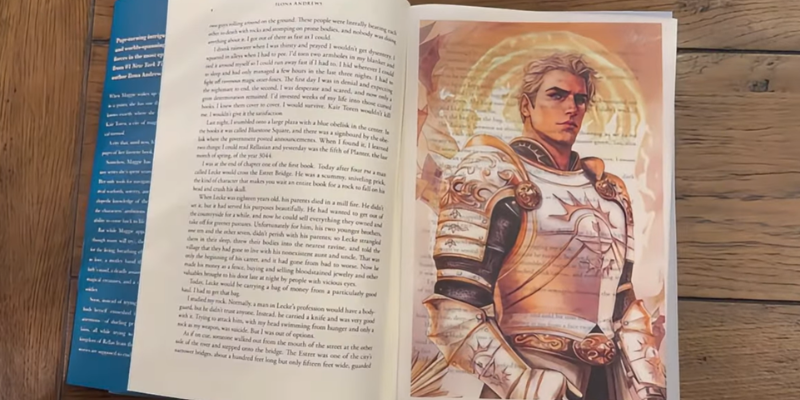
Happy Friday!
The Random Number Generator performed its duty and gave us the winner of the vellum overlay set for This Kingdom Will Not Kill Me:
Congratulations, Erin Phillippi!I will contact Erin from the modr@ilona-andrews.com email address. If we don’t hear back by Thursday, May 14, a new winner will be drawn next Friday.
What are these?
For anyone who missed it, Ilona made a video explaining and demonstrating the vellum inserts, which you can find here.
Briefly: vellum overlays are not art prints. They are semi-transparent character portraits printed on softly textured vellum, which is a frosted, slightly cloudy specialty paper that lets the art show through while giving it a muted, layered effect. They are designed to be tucked into the hardcover book or placed over a page, not framed as standalone wall art.
The vellum overlays will be available as a set of six in the Ilona Andrews merch store when it reopens. I don’t have an official date for the opening yet, and House Andrews are still working out whether international availability is possible. The best way to make sure you don’t miss the announcement is to subscribe to the Ilona Andrews newsletter.
At the moment, the set will include only the six character portraits by Helena Elias: Clover, Solentine Dagarra, Ramond vi Everard, the Sun Margrave, Doran Arvel and the Man from the Garden.
If you are looking for This Kingdom Will Not Kill Me art prints, reminder that many of the commissioned artists have prints available directly through their own stores, which is covered and linked in this post. Buying from them is a wonderful way to support the artists and their original, human-made work, taking a stand against AI content.
Speaking of AI and spam, a quick online safety reminder: please stay vigilant for scammers. House Andrews will never ask you to cover postage costs, pay fees, or make any kind of money transfer connected to these giveaways. Winners are announced here on the blog, and we will only contact you from an official Ilona Andrews account or email address, with the link to the public blog post as proof that you are indeed the winner.
May your weekend bring good times, good tidings, and yummy snacks!
Note from Ilona – we should have the first batch of vellum next week. We will be doing a trial run of 120 sheets, with 20 sets of 6. We have never acted as a fulfillment center before, so we want to make sure that we iron out any kinks before fully unleashing the Horde. If you miss the opportunity to order, don’t panic. We will be doing a larger print run, and this vellum is printed locally by a small business, so it’s not shipping in from overseas and it will be available much faster.
The post This Kingdom Vellum Overlay Giveaway Winner first appeared on ILONA ANDREWS.
Categories: Authors
Comment on A Beginner’s Guide to Drucraft #46: Sigl Fashion (Body/Torso) by Bill
Wait.. Doesn’t Stephen wear most of his sigls as rings?
Categories: Authors
Cats and Bookmarks
I overslept, and my day started with an outraged cat.
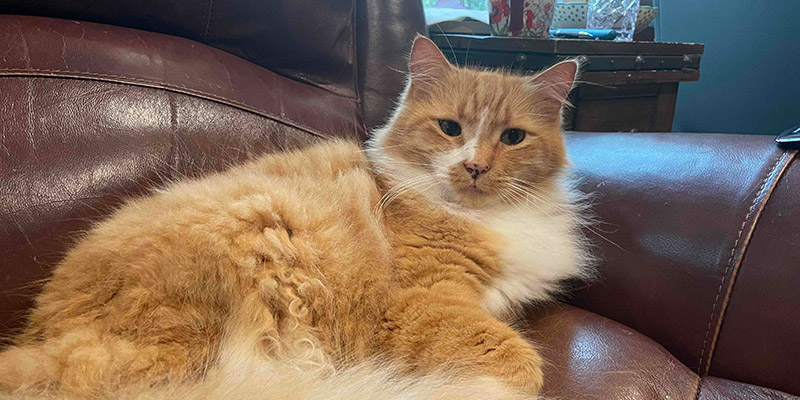
Over the past few days, a road crew has been working on the street next to our house. They are repaving it. The road is closed, and Gordon observed the workers having heated words with a driver of a delivery truck this morning. We might be trapped today.
Because of the road crew, we are keeping Tuna inside. Tuna started life as a stray who wandered randomly around an apartment complex, and breaking him of wanting to go outside is impossible. He has two acres here, and he is very much the lord of his domain. Today His Majesty was refused access to the outside. The inability to inspect his lands didn’t sit well, so he made himself into a nuisance.
Tuna: Pet me! Pet me! Pet me! Look, I meow by the door. Open door. OPEN DOOR.
Me, trying to clean up: No.
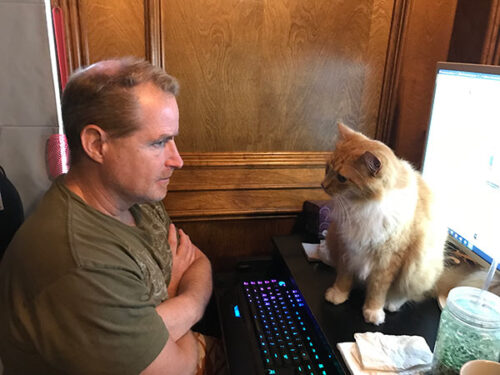
The allergies have been terrible, and neither of us is sleeping that well. I was shopping for some Halls cough drops and saw that instead of puny bags, they now come in full scale large jars. Of course, I bought a jar. It was delivered yesterday with saline spray and Flonase, and being too tired, I plopped all of that on my writing tray in the office. I need the tray to write.
Me, gathering items to take to the medicine cabinet.
Tuna: TREATS.
Me: No, you fool. These are not Temptation treats.
Tuna: TREATS.
Me: It’s cough drops!
Tuna: If not treats, why treat shaped? TREATS.
Tuna VisionI gave him treats. The vet will fuss at me again over his weight, but there are limits to human patience.
I come to you with a mission this morning. The book is now 185K. It is very clear that there is no room left for anything else in our lives. I still have not unpacked. Or sent things out. Mod R will have strong words with me here soon if I keep failing.
We need assistance, or we will never get the shop back off the ground, and our time is better spent writing. To that end, we hired a designer to help us turn the treasure trove of art into merch. Here is some of her work.
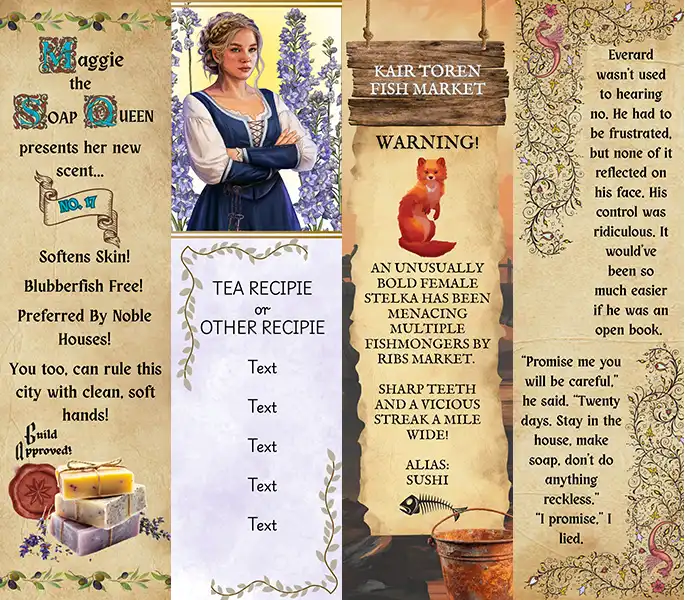
These bookmarks will be included in the media package. We have secured a printer for the vellum, so we will be bringing to you a media pack with vellum, stickers, and bookmarks.
Do you have any favorite quotes or moments you want reflected in This Kingdom merch? Please leave us a comment below. If you are dying for something from the other series, you can throw it in there too, but we are focusing on This Kingdom as it is the latest release.
The comment section to this post contains SPOILERS. Read at your own risk.
The post Cats and Bookmarks first appeared on ILONA ANDREWS.
Categories: Authors
The Write Attitude: Sounding Like Yourself
This post is a chapter from my book, The Write Attitude, which is now in a second edition. I’m posting it here to entice you to head over to Storybundle to pick up a copy, along with ebooks by Darcy Pattison, Douglas Smith, Ron Collins, Tracy Cooper-Posey and others.
Everything in this Storybundle is exclusive, including The Write Attitude. So if you want to read it now, pick it up from Storybundle. The bundle will end in 9 days, so hurry on over. If you don’t want a deal on the ebook or if you only read print, then you can always preorder the book on various retailer sites starting next month. The new edition will release in July.
The second edition of The Write Attitude is quite different from the first edition, which originally appeared in 2016. I kept some parts of the original book, but much of the material is newer. The new material comes from my Patreon page. Not every post from my Patreon page shows up here, although several do. If you want to see everything, though, head to Patreon and sign up.
This post appeared on my Patreon page in November of 2025, and is one of the early chapters in the book.
SOUNDING LIKE YOURSELFFrom 2025
In a Billboard article about Addison Rae, I came across a useful Miles Davis quote. (Billboard, August 13, 2025.) She cited the quote this way:
Sometimes it takes you a long time to sound like yourself.
Wow. That hit home. But before I used it to base a blog post on, I looked it up. I was worried that it really wasn’t a Miles Davis quote or that it was a misquote (although it didn’t sound like one). What I found was that there are two versions of this quote, which leads me to believe that the jazz great remarked on this a lot.
The other version of the quote says:
Sometimes you have to play a long time to be able to play like yourself.
And I think I like that one better, although both quotes are useful. For those of you who don’t know who Miles Davis was, he was one of the most influential musicians of the mid-twentieth century. He is definitely one of the most influential jazz musicians of all time.
If you are not familiar with him or his work, start at his website, milesdavis.com, and scan outward. You are probably familiar with a lot of his music, particularly if you’re a jazz fan.
The reason I like both quotes is that they have at least two different meanings, three if you think of them from the point of view of a prose writer.
The first quote: It takes a long time to sound like yourself.
That’s all about voice. Yes, Miles Davis, Addison Rae, and vocal coach Eric Vetro (who first showed Rae the quote) were talking about a musical voice—about sounding like no one else by channeling your own inner vision.
Which is what the best writers do. (That’s why the worst copy editors aren’t the ones who introduce mistakes; they’re the ones who put some writer’s manuscript into “perfect” grammar, ruining their voice.) If you listen to Stephen King reading his own work, his inflections and pauses are not surprising because he knows how to write them into the prose. (His accent or the tone of his voice might surprise you, but nothing more than that.)
Stephen King, former English teacher, found his own voice as a young boy and then learned how to transmit that voice, via the tool of a manuscript, into the brain of a reader. What he does is an extremely difficult skill, and one I aspire to. That’s why I typed Mick Herron’s work into my computer a while back (see the previous chapter), so that I could learn how someone else did things.
The more tools you have in the toolbox, the better writer you will be.
If you don’t read much fiction or you don’t read much fiction anymore, as so many writers say, then you’ve stopped accumulating tools. As long as I breathe, I will be reading. And the fascinating part to me is that I see writers do things that I thought were impossible or things I’ve never thought of. Or, Mick Herron’s case, he does things that someone, somewhere, decades ago, had warned me away from. (The opening to each Slough House book is an astonishing exercise in setting the stage as well as the characters and the themes of each book.)
Here’s the tough part. Once you sound like yourself, your writing will seem bland to you. Because you live with that voice in your head each and every day.
So that’s the voice part.
That’s the first part of sounding like yourself.
The second part is this: You must defend your voice, your “sound.” Sure, it might be “wrong” to use a dozen semi-colons in a single paragraph, but Herron does it to such great effect (sometimes in a single sentence) that the reader doesn’t notice them.
I didn’t realize the man uses a million semi-colons until I typed in his work. I’m semi-colon lite, dash heavy, which, I thought, made me a much more breathless writer than he is, but his work continually proves me wrong.
I’m sure some silly copy editor somewhere tried, once upon a time, to edit out all of his semi-colons and to make his honkin’ long single-sentence paragraphs into many sentences, and from what I can tell, the man slapped them down.
There’s another component to voice, though, and it has nothing to do with words and grammar and punctuation. It’s subject matter. It’s characterization. It’s something I discussed after the Herron piece. It’s the ability to “go there,” wherever there is. (See chapter 10.) To write the stuff that frightens us, that makes us original, that might get us in trouble with the readers or in some cases, the government.
It’s the stuff that doesn’t fall into genre lines.
I was having a discussion a few weeks back with someone I was considering working with on a future project. That person insisted we use trope charts, like so many writers have started to do in Kickstarters.
Tropes are well and good, if used sparingly. As a romance reader, I want to see—either from the sales copy or from a trope listing—that the book in my hand uses the enemies-to-lovers trope or is a small-town romance. I want to avoid a guardian-ward historical trope because…yucky!
So a one-line description or acknowledgement of the trope is a good thing, especially in books where the ending is prescribed, like a romance (happily ever after) or a cozy mystery (amateur solves a stakes-free murder).
But other than that—a tropes chart? You might as well put two gigantic signs on your work. The first sign says, Read something else because this book is on rails. The second sign says, This book is mediocre. There are no surprises here. There’s a third sign, but only if someone dares to crack open a book based on a tropes chart. And that sign says This writer has no idea what tropes are. The ones listed here are not in the book.
Whoops.
Writers who sound like themselves can’t write books that can be boiled down into a tropes chart. Sure, the overall trope might work because that might form the heart of the book. (I’m thinking of enemies to lovers here in a romance trope.) But going beyond that would harm the reading experience if the writer is writing from their heart.
That’s why writers who are really good at sounding like themselves often have trouble selling their fiction to set markets, particularly traditional markets. Those markets want something they can sell, and a book that’s on rails is easier to market to a consumer than a book that is, at its core, like nothing a reader has ever seen before.
That’s why this quote comes from Miles Davis. His website has this sentence on the home page:
Miles Davis made music that grew from an uncanny talent to hear the future and a headstrong desire to play it.
Note the phrases here. “Uncanny talent.” In other words, he did things no one else dared. “Hear the future.” I might disagree with that one on some level, because on that level, Davis invented the future that his website claimed he heard. And, the most important phrase, “a headstrong desire to play it.”
Later this little biographical snippet points out that Davis never stopped fighting for his art. That’s my memory of him. He wasn’t as respected in his lifetime as he became later, even though no one dared argue with the impact he was having. I worked in listener-sponsored radio in Wisconsin and was immersed in jazz. We could play all kinds of jazz for our listeners and they supported the programming with their dollars.
The other local jazz station was much more conservative. They played traditional melodic jazz, things we call standards now, and would go to modern jazz after 10 p.m. when most Midwesterners went to bed. Even then, you wouldn’t find a lot of Miles Davis on that station. The powers that be loathed his work.
I think that’s the other side of this. You have to become good enough to force people to have opinions about your work. “Having opinions” means they’ll love it or they’ll hate it. What is most important, though, is that they won’t forget it.
These mediocre, “properly written” works? The ones with the voice edited out of them, with the vision troped to death? Those will be forgotten the moment that the reader closes the book.
I don’t know about you, but I don’t ever want to be accused of being mediocre. Love or hate my work, that’s up to the reader. But finding it dull or predictable…well, then, I’ve done something wrong.
The second quote from Miles Davis is my favorite. I think it might more accurately reflect what he’s getting at, especially if you’re familiar with his music.
Sometimes you have to play a long time to be able to play like yourself.
Yeah, I know. He’s talking about playing music, often onstage. He was the master of improvisation, but even in the improvisation, the listener knew they were listening to Miles Davis. His perspective was that original.
But what I love here is the word “play.” I love watching jazz musicians in particular improvise. Somewhere in the middle of what they’re doing, they’ll grin at each other. They’re having fun. They’re creating something new, something unexpected, and it gives them joy.
This type of musicianship is why I don’t miss a Keith Urban residency when he’s in Las Vegas. He performs intensely and playfully, goofing around much more than other residency performers I’ve seen. I wasn’t a big fan (or much of a fan at all) when I first saw him perform, and now I go to watch the playful musicianship.
Writers need to play as well. We need to experiment. We need to risk failure. We need to jangle some chords, try a different instrument, and go far, far, far off the beaten path.
That means we’ll miss sometimes, but it also means that when we hit, the work will be powerful.
When I talk about play, I’m not saying that writers should only write something light and “fun.” Instead, I’m talking about experimentation, about risking everything, about free-floating ideas from our own subconscious even if those ideas make us feel uncomfortable.
We should also go for different formats and different genres, different lengths and different ideas than we’ve explored before. We might not be onstage riffing with our friends, but we should write in that same spirit of improvisational play.
We need to be uniquely ourselves as writers. And as Miles Davis said (and yes, he wrote his own stuff), it takes a long time to achieve that.
But finding yourself as a writer? That’s worth the time spent.
“Sounding Like Yourself” from The Write Attitude
Copyright © Kristine Kathryn Rusch
Published by WMG Publishing
This ebook is licensed for your personal enjoyment only. All rights reserved. This ebook, or parts thereof, may not be reproduced in any form without permission.
Any use of this publication to train generative artificial intelligence (“AI”) technologies is expressly prohibited. The author and publisher reserve all rights to license uses of this work for generative AI training and development of machine learning language models.
Categories: Authors
Pages

Recent comments