
Feed aggregator
Not So Juvenile: Star Man’s Son / Daybreak 2250 A.D. by Andre Norton
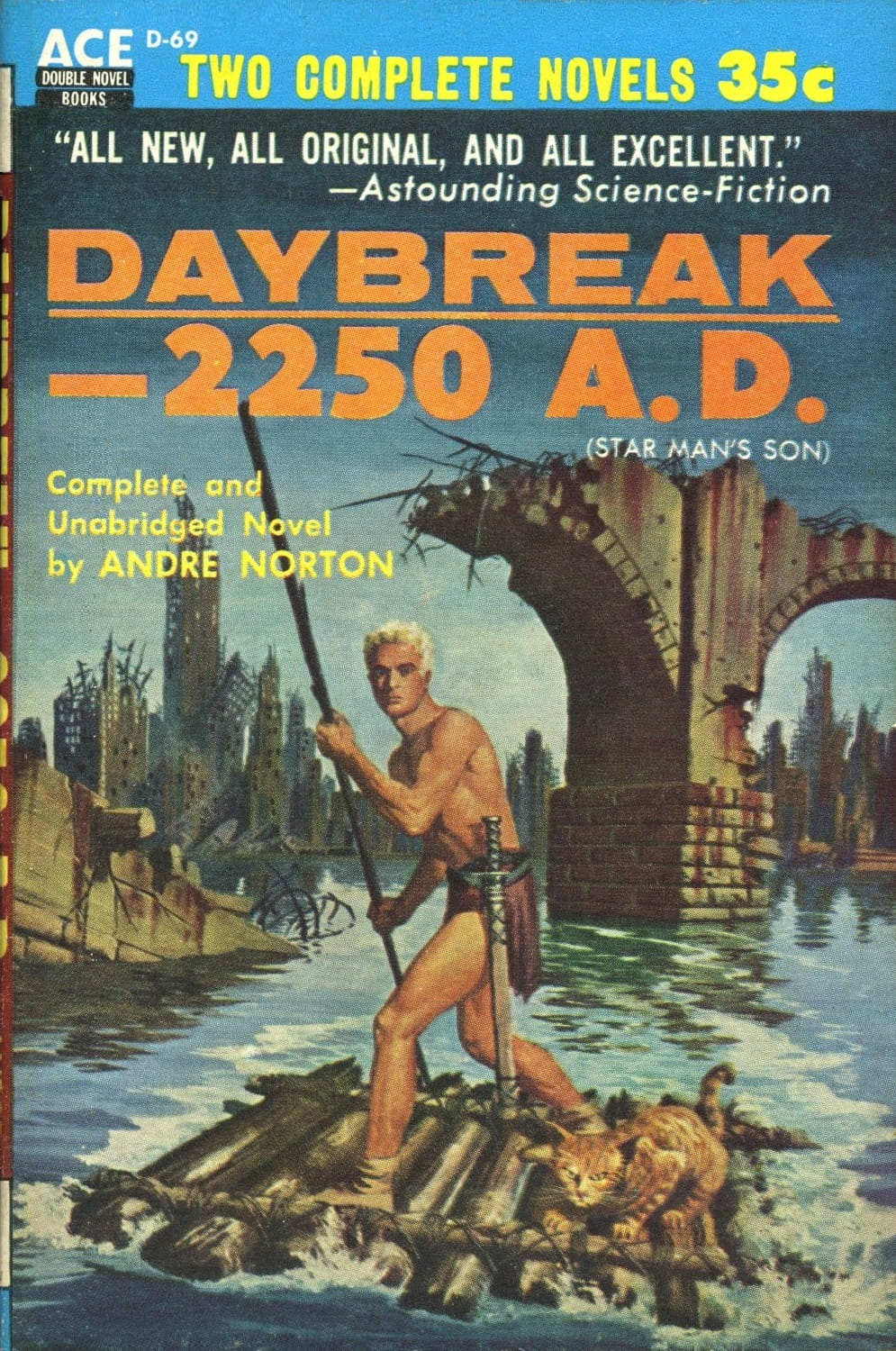 Daybreak 2250 AD, originally published as Star Man’s Son, one half of Ace Double D-69 (Ace Books, 1954). Cover artist unknown
I started intentionally looking for science fiction to read in elementary school. Our city library had one big room full of fiction for young readers, from preschool through high school, so I found books that were meant for readers older than I was — but I enjoyed reading them, even if I didn’t understand everything that happened to their protagonists. The top two science fiction writers, for me and I think for a lot of other people, were Robert Heinlein and Andre Norton.
Norton had written half a dozen novels, mostly historical, before she ventured into science fiction in 1952 with Star Man’s Son. But it seems to have been successful; she wrote a new fiction novels nearly every year for some time after that, and I went on reading the library copies at least up through Catseye in 1961.
[Click the images for giant cat versions.]
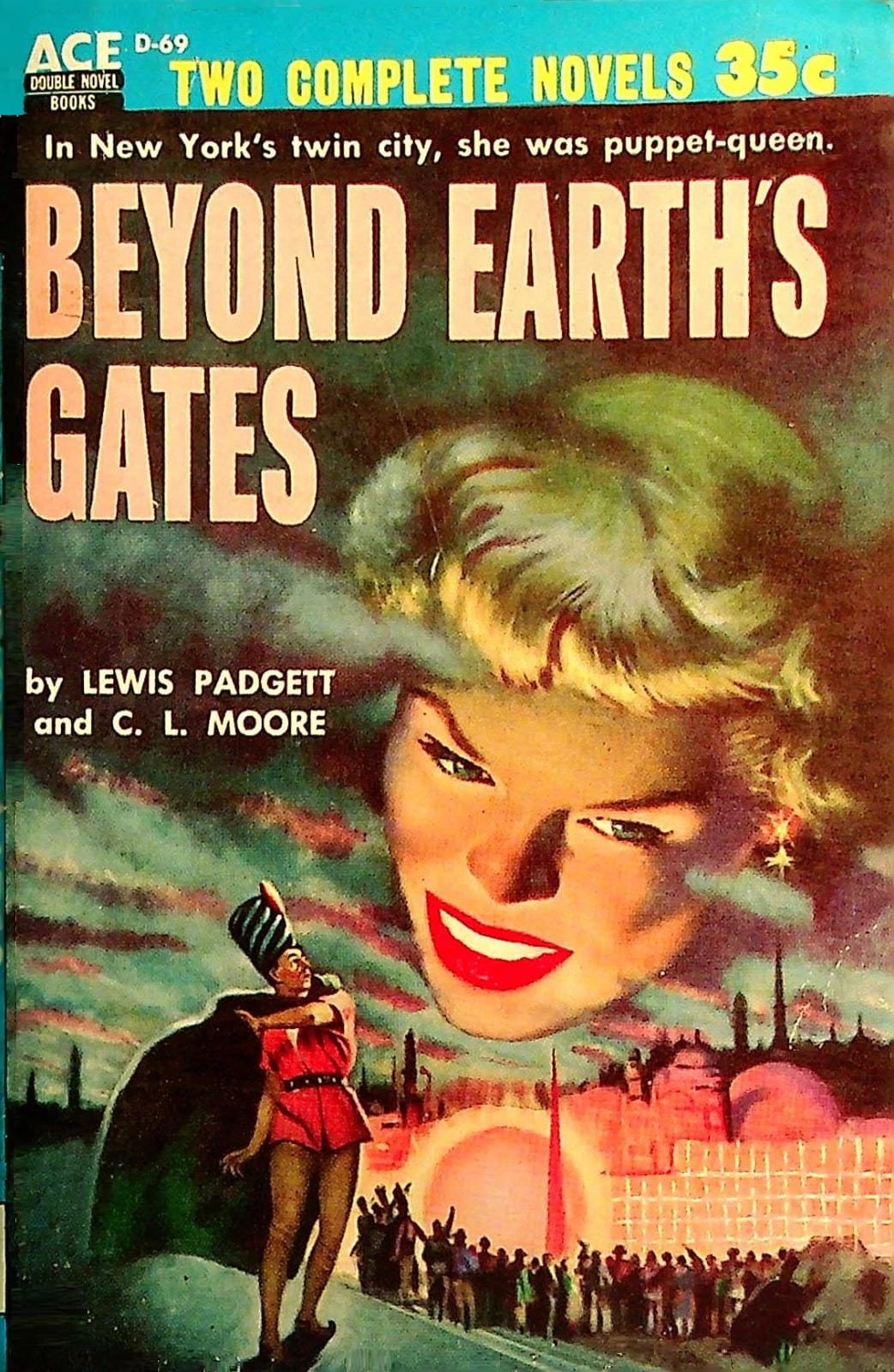
Ace Double D-69: Beyond Earth’s Gates by Lewis Padgett (Henry Kuttner) and C.L. Moore,
and Daybreak 2250 A.D. by Andre Norton (Ace, 1954). Covers by Harry Barton, unknown
Star Man’s Son was a cleverly chosen title. It clearly signaled that this was science fiction. But it wasn’t, as the words seem to promise, a story about travel between the stars. Its Star Men were the elite of a hidden community high in the mountains, called the Eyrie, whose mission was to go out into the largely depopulated lands around them and look for the ruins of cities, both to find treasures such as colored pencils and to try to recover the lost knowledge of their builders.
Star Man’s Son is one of the founding works of the post-nuclear-war genre, published only seven years after Hiroshima, but envisioning a world devastated by nuclear weapons: massively depopulated, with many areas left lethally radioactive, and with parts of the land geologically transformed.
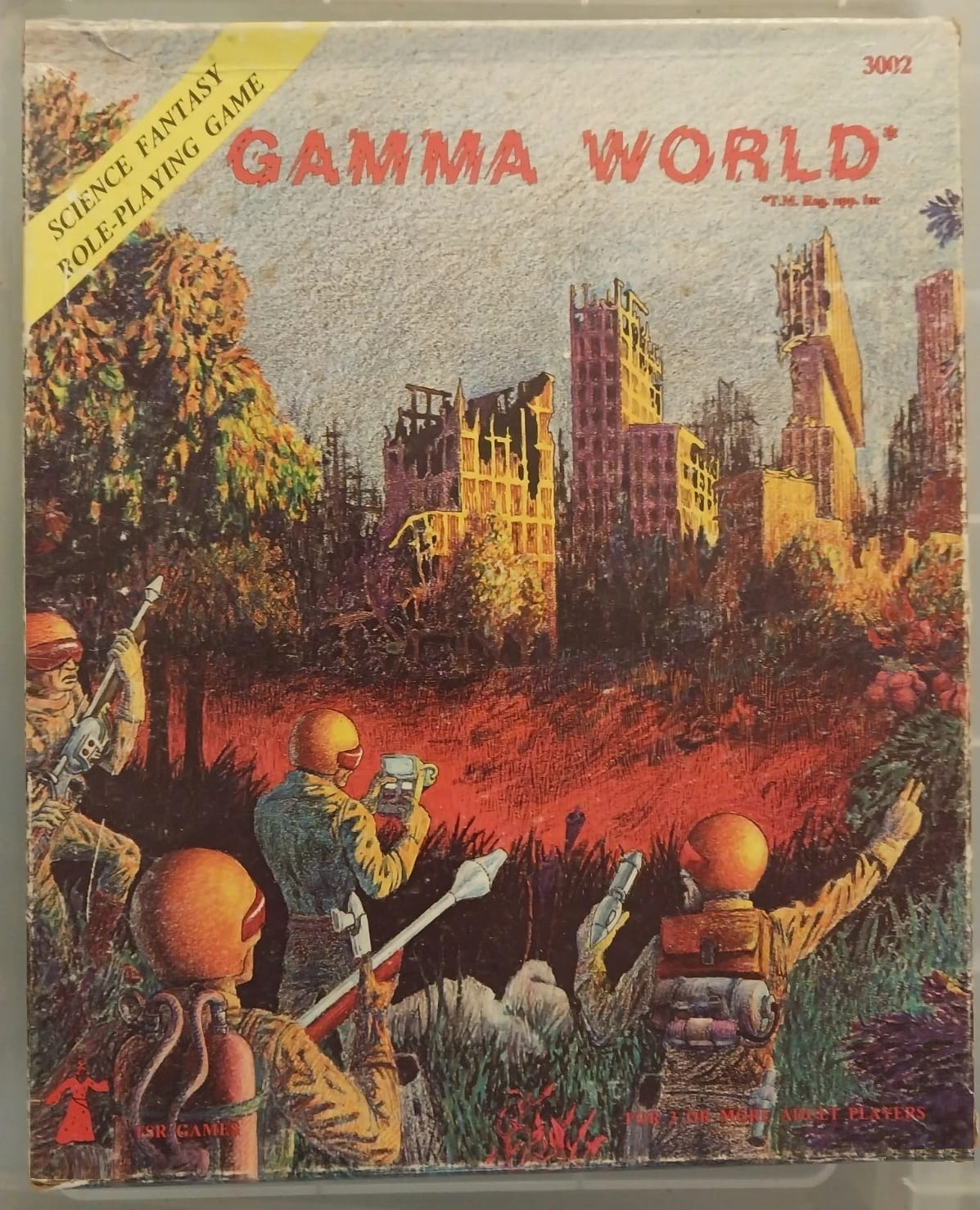 Gamma World by Gary “Jake” Jaquet and James M. Ward (TSR, 1978). Cover by David C. Sutherland III
As a by-product of the radioactivity, there are mutant forms of various species, including human beings. In fact this setting could be a prototype for the early roleplaying game Gamma World.
Norton’s hero, Fors, is one of these mutants, and that’s the starting point for her story’s conflict. Fors’s father was a Star Man, and a very successful one. But Fors’s mother came from a different culture, the Plains People, who lead a nomadic existence in the deserted lands outside the Eyrie; and Fors himself has mutant traits, both visible — white hair — and invisible — night vision and preternaturally keen ears.
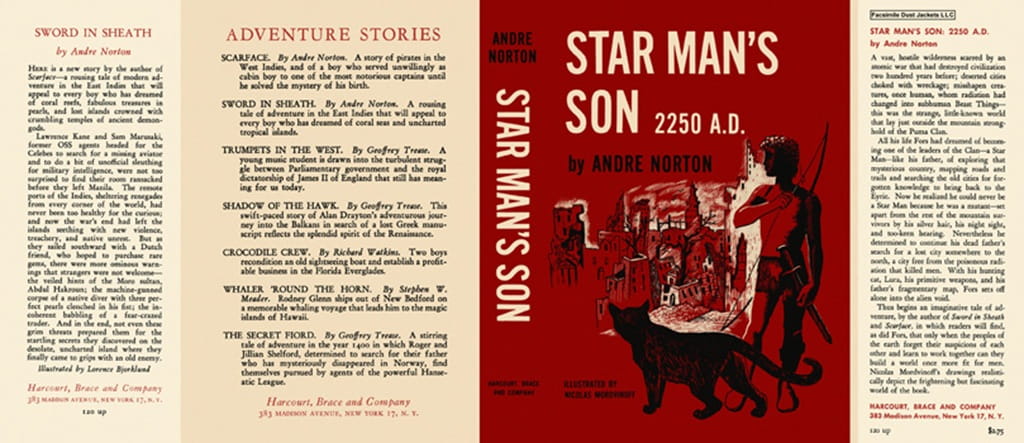 Dust jacket for Star Mans Son 2250 A.D. (Harcourt, Brace & Company, August 1952). Cover by Nicolas Mordvinoff
Orphaned by his father’s death on an expedition into the wilderness, Fors wants to succeed him as a Star Man, but is repeatedly rejected, out of a prejudice against mutants. At 17, after his sixth and final rejection, Fors rebels, stealing his father’s gear (but not his father’s star, which he hasn’t earned) and venturing out into the wild lands on his own, looking for a fabled lost city of the ancient world that would prove his worth.
Norton doesn’t link any locations to familiar geographic names, but her readers would naturally have assumed that her story took place in North America. From her descriptions, the Eyrie could be in the Rocky Mountains, perhaps in Colorado; the plains might be Kansas or Nebraska; and the city that Fors eventually finds might be any major Midwestern city, though I’ve long assumed that it was Chicago, and apparently other readers commonly do the same. (This isn’t like Pangborn’s postapocalyptic setting, with little kingdoms bearing easily parsed names such as Bershar, Penn, or Vairmant.)
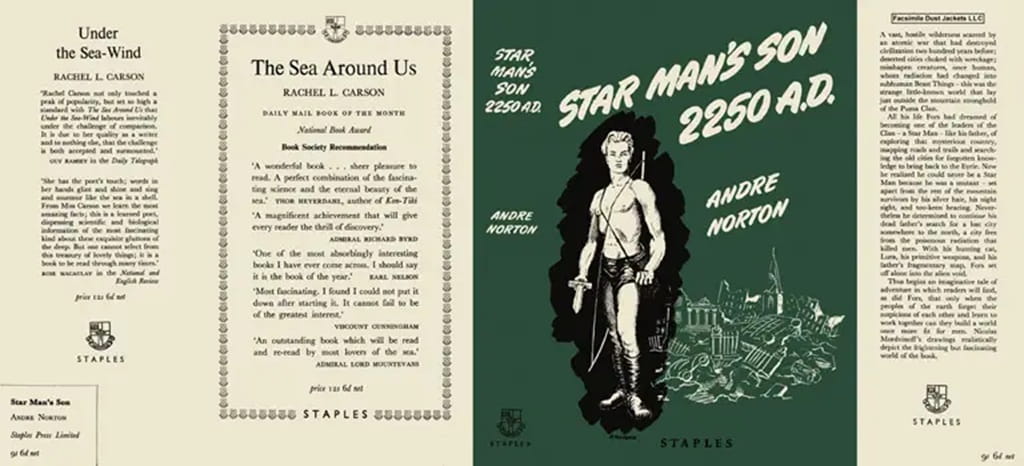 Dust jacket for Star Mans Son 2250 A.D. (Staples Press, 1953). Cover by R. Dulford
The combination of ruined structures and depopulation is curiously similar to Tolkien’s realm of Arnor, which would appear a few years later in The Fellowship of the Ring; Tolkien rejected any suggestion that the One Ring was an allegory for the atomic bomb, but both stories seem to reflect the idea of a fallen higher civilization, analogous to Rome, and perhaps the idea that the industrial West could also fall was made more credible by the destructiveness of the World Wars.
Another parallel to what Tolkien would publish is the existence of an inherently hostile race, the Beast Things. Like Tolkien’s orcs, they have a roughly human form, but one that’s hideous to human eyes; in this case, they have faces and clawed hands that make them resemble gigantic rats.
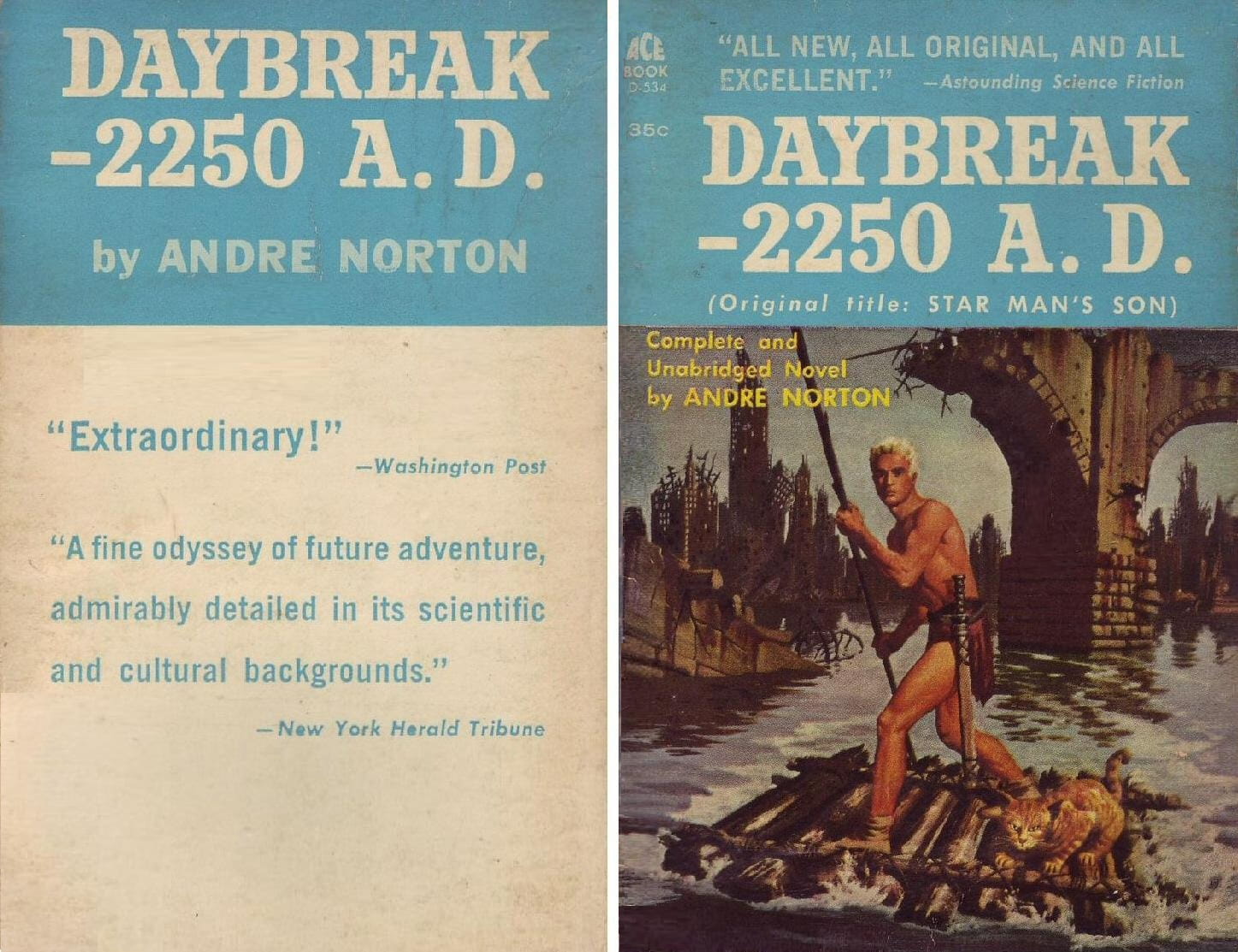 Daybreak 2250 A.D. (Ace Books, 1961). Artist unknown
The Beast Things seem to lead entirely collectivized tribal existences and to be naturally cruel and hostile to human beings.
And in Star Man’s Son, where they previously were a minor threat, dangerous mostly to solitary explorers, they have emerged to more organized hostility, attacking various human groups in vast hordes (where those hordes came from is no clearer than it was for the “goblins” in The Hobbit; such enemy races tend to have a nightmarish fecundity).
Their origins are obscure, but they’re clearly mutants, and help explain where the common hostility to mutants came from.
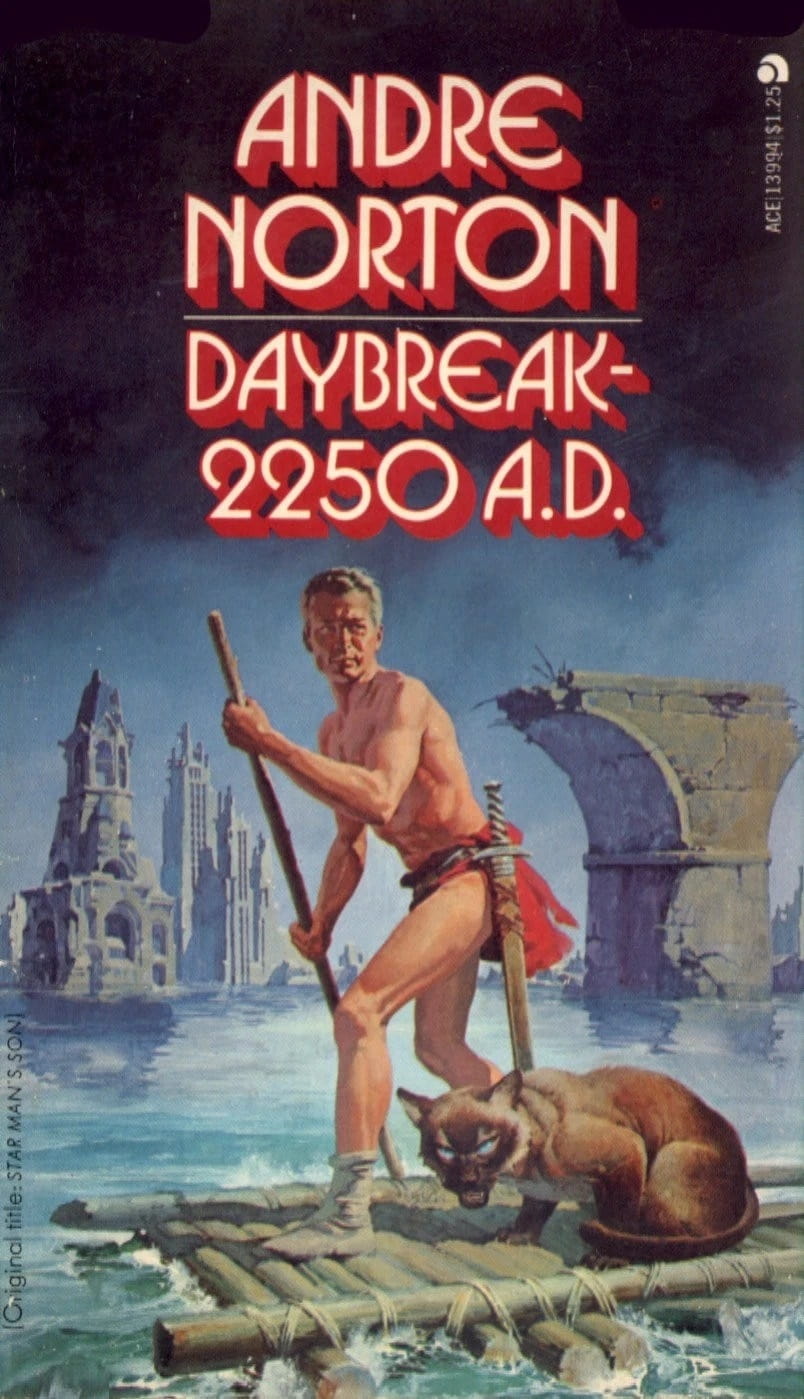
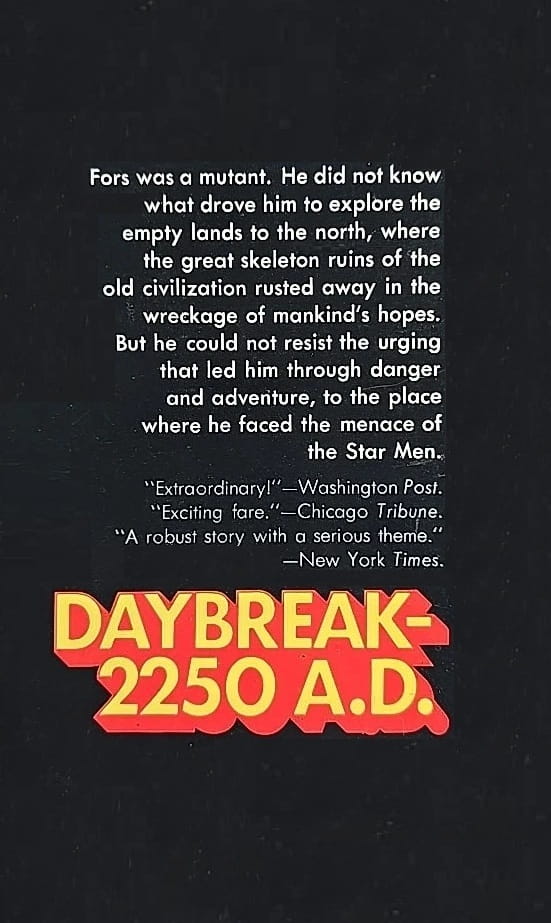
The 1977 cover refresh from Ace Books. Cover artist also unknown
Fors’s own venture acquires a companion from a different culture still, with its own traditional heritage from the more civilized past: Arskane, whom Fors pulls out of a pit trap and treats with an antibiotic salve (and in return, Arskane introduces him to coffee, which Fors doesn’t like at all!).
From Norton’s description, it’s clear that Arskane is Black, and it’s curious that where Heinlein found it necessary to hint cryptically at Rod Walker’s ethnicity in Tunnel in the Sky, published only a few years later in 1955 (his publisher was worried about sales in the South),
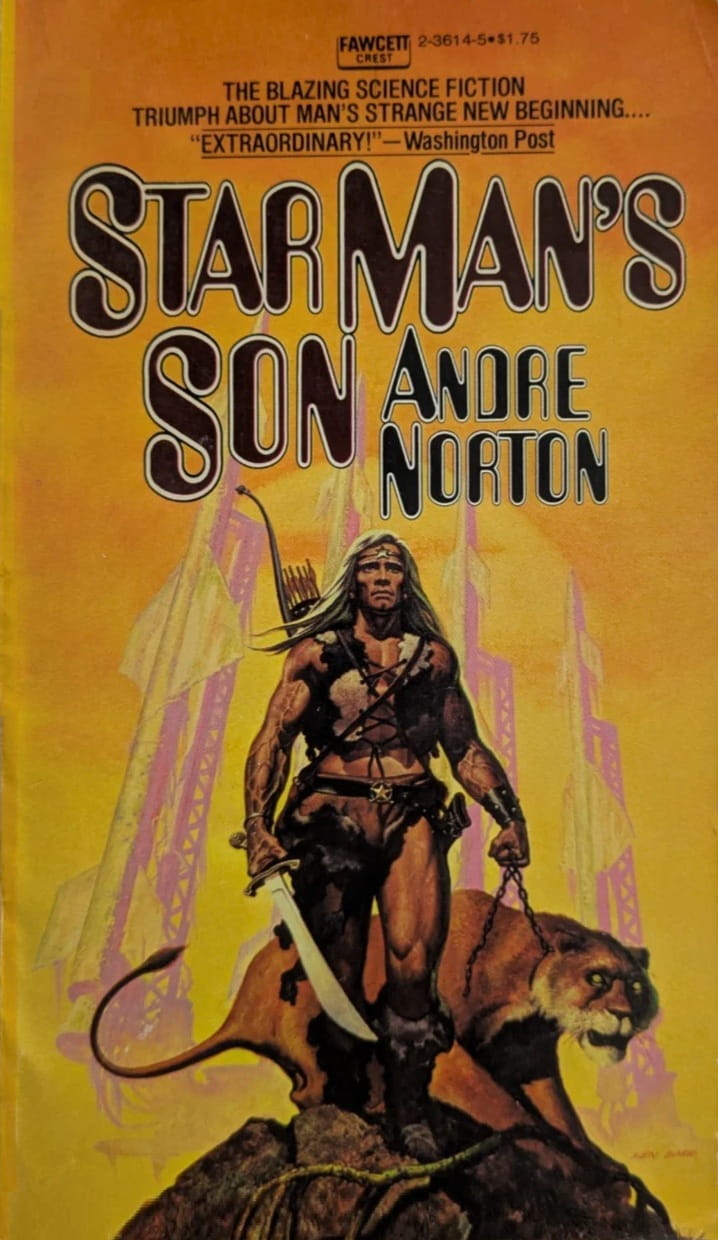
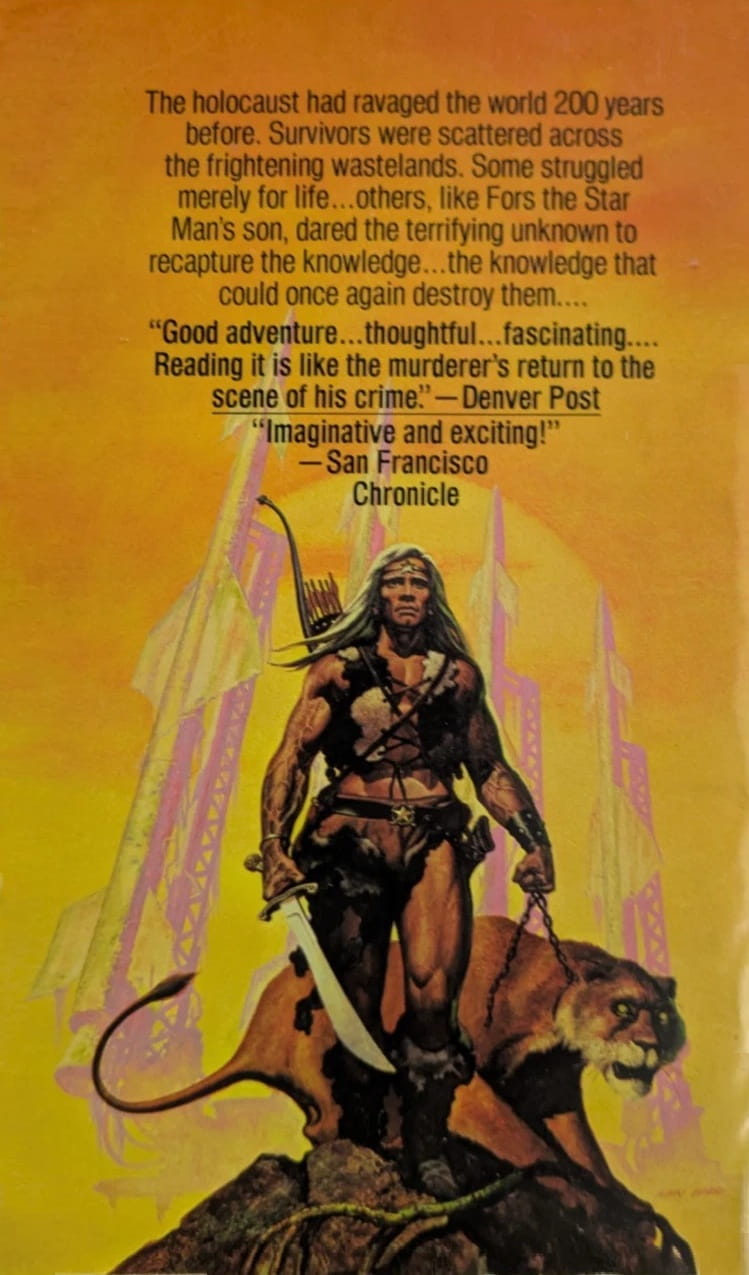
Fawcett Crest paperback edition, which returned to the
original title (Fawcett Crest, August 1978). Cover by Ken Barr
Norton didn’t have any trouble showing Fors and Arskane teaming up and even coming to regard each other as brothers. (Or might Heinlein have been unnecessarily worried?) Arskane’s account of his people’s origins to Fors makes them descendants of aviators, and perhaps Norton was thinking of the Tuskegee Airmen and expecting her readers to do likewise. And in parallel, Norton mentions a legend that the Eyrie was originally a base for an intended venture into space, which is why its elite explorers are called Star Men.
Fors is also accompanied by another mutant: Lura, descended from domestic cats, but grown larger and apparently empathic through the effects of radiation. (The image of the symbiotic goes back a long way before Honor Harrington.)
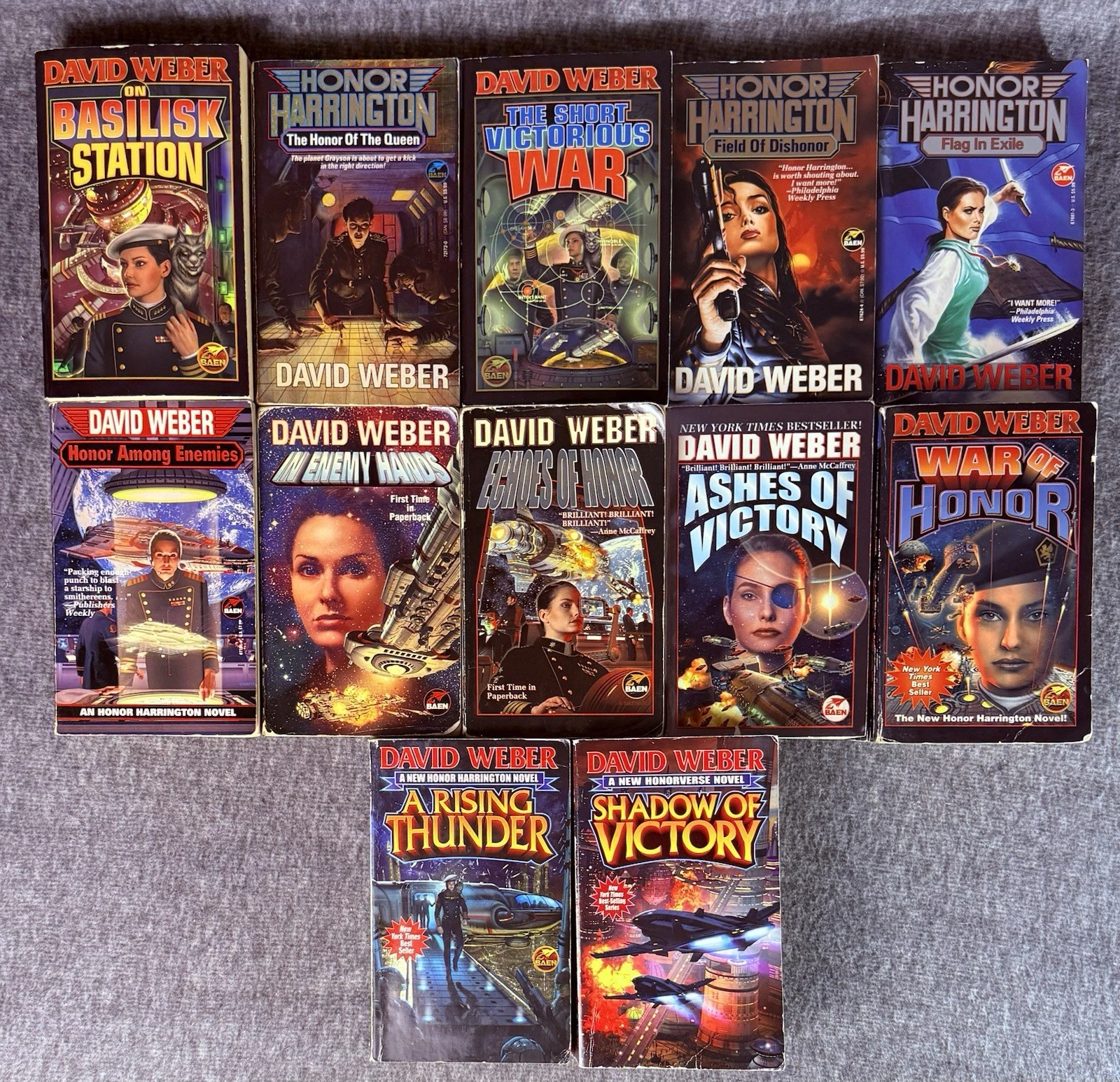 The first ten Honor Harrington novels by David Weber, plus two novels in the Honorverse series (Baen Books, 1993-2016). Covers by David Mattingly, Laurence Schwinger, and Gary Ruddell
Lura is described as having a coat coloration similar to Siamese cats. She accompanies Fors through most of his journeys and is only temporarily parted from him during one major crisis. Aelurophilia seems to be a common trait among science fiction writers and readers, and Norton does a persuasive job of appealing to it.
All of this shows that the novel’s recurring theme is mutation: The Beast Things, Lura, Fors himself, and a variety of exotic life forms such as a race of diminutive lizards that tend farms and wield poisonous weapons are all mutants. And the novel’s continued point is that “mutant” as such is not a moral category: Mutation can be either good or bad, depending on what the mutant does.
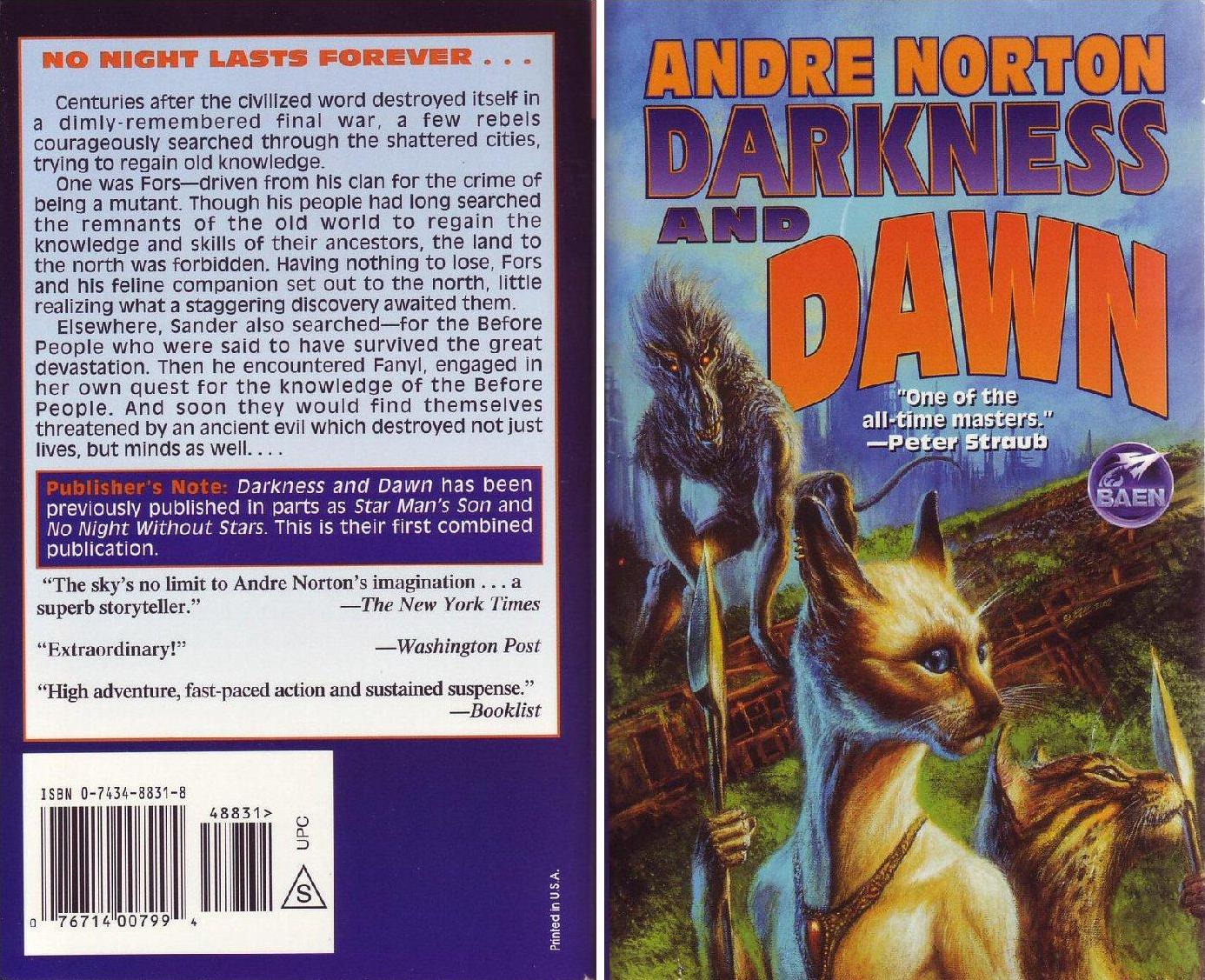 The Darkness and Dawn omnibus, containing the novels No Night Without Stars (1975) and Daybreak 2250 A.D. (Baen Books, March 2003). Cover by Bob Eggleton
At the novel’s climax, we have the mutant Fors playing a vital role in a stratagem aimed to have all the human forces unite against an army of the mutant Beast Things — and then confronting a threatened outbreak of war between the different formerly allied human forces. Norton seems to be making a point similar to St. Paul’s statement that “Here there is no Greek or Jew, circumcised or uncircumcised, barbarian, Scythian, slave, or free” — or, in this case, mutant or nonmutant.
Indeed, her characters raise the question of whether it’s good to preserve the unchanged likeness of the ancient humanity that destroyed its own civilization in a vast war.
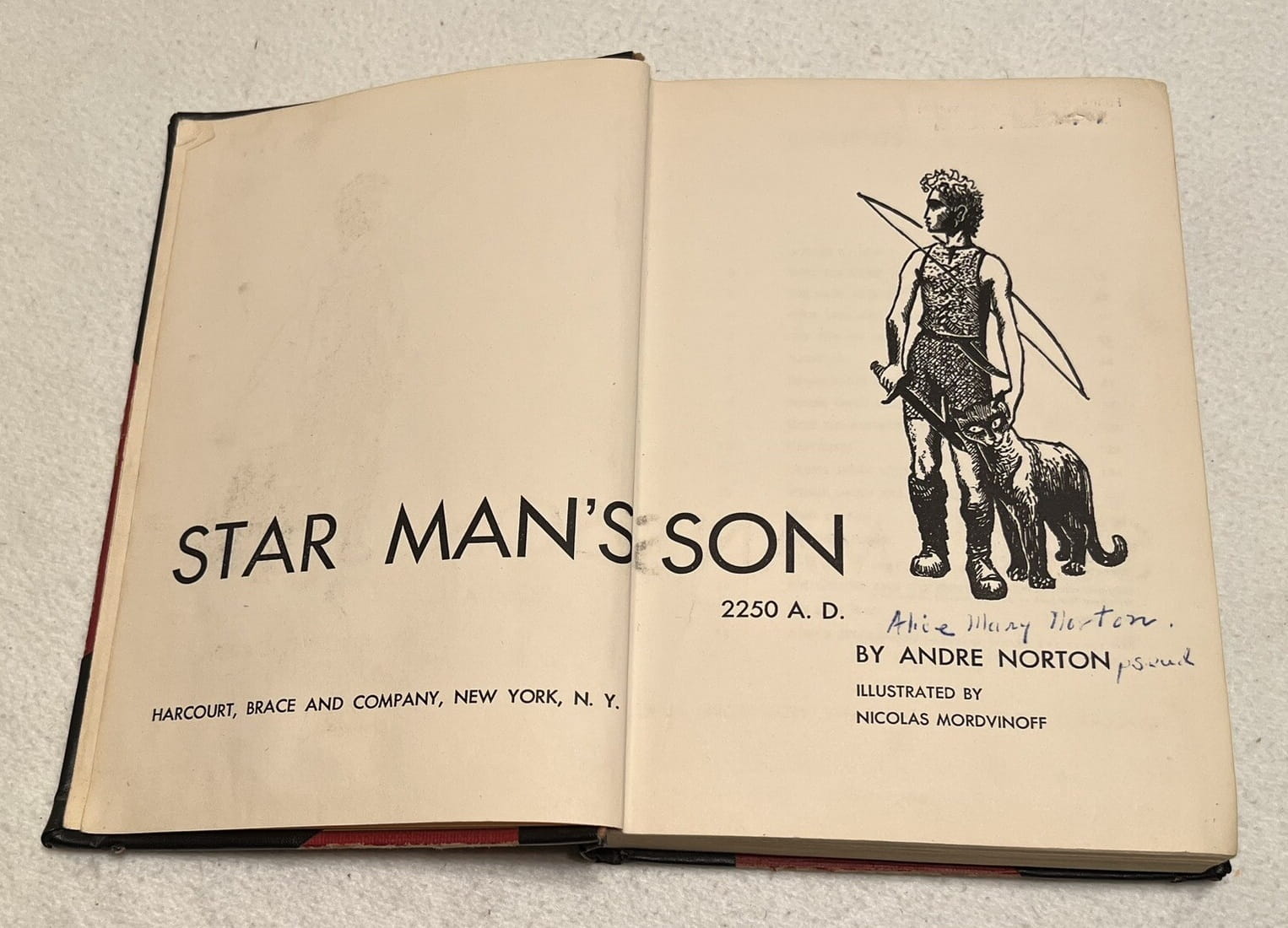 Star Man’s Son title page, with illustration by Nicolas Mordvinoff
In a review of this novel, quoted in the copy I read, the Denver Post called it “a good adventure story which is a thoughtful book as well,” and I think that’s a fair summary. Like Heinlein, Norton assumed that her readers would be interested in serious themes and able to make sense of them; and that was part of what made her a leading author of “juvenile” science fiction.
William H. Stoddard is a professional copy editor specializing in scholarly and scientific publications. As a secondary career, he has written more than two dozen books for Steve Jackson Games, starting in 2000 with GURPS Steampunk. He lives in Lawrence, Kansas with his wife, their cat (a ginger tabby), and a hundred shelf feet of books, including large amounts of science fiction, fantasy, and graphic novels.
Categories: Fantasy Books
May 2026 Virtual Fantasy Book Recommendations
One week from today, I’ll be doing the second quarterly virtual book recommendations event with the Ashland Public Library in Massachusetts of this year. If you followed last year’s recommendations, both fantasy and science fiction books were covered. This year, I’m focusing on fantasy books and author Elizabeth Bear is covering science fiction recommendations. (She just did her second recommendation event last night, which made me want to start a couple of books on my shelves I still need to […]
The post May 2026 Virtual Fantasy Book Recommendations first appeared on Fantasy Cafe.
Categories: Fantasy Books
Reminder: Ilona Andrews chats with Veronica Roth tomorrow
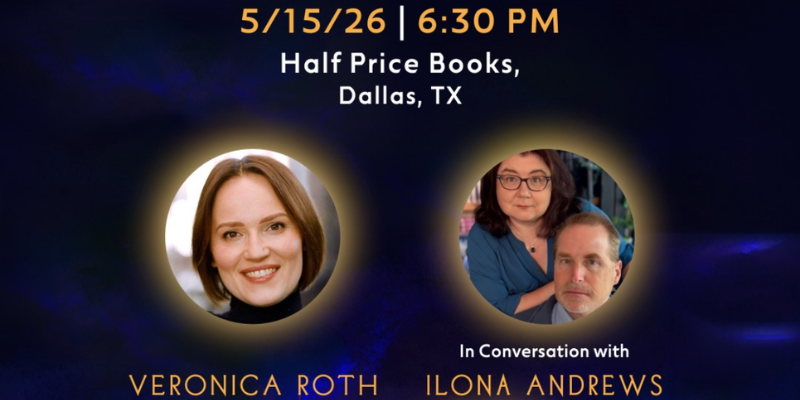
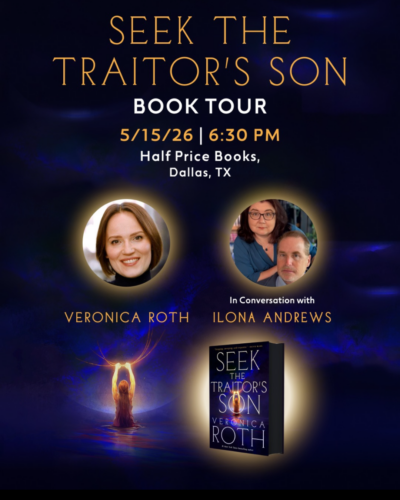
This is your reminder that tomorrow, Friday, May 15th, at 6:30 pm, Veronica Roth will be at Half Price Books in Dallas for the release of her new series debut, Seek the Traitor’s Son – and Ilona and Gordon will be the ones moderating the event!
Seek the Traitor’s Son is book 1 of the Burning Empire series, and is out now from Tor Books in a deluxe hardcover edition with sprayed edges. This new dystopian fantasy brings us destiny, prophecy, enemy generals, romance, warfare, mysterious gifts, and the fate of nations hanging in the balance.
There are a few tickets left for the event, available for purchase here.
If you would like to attend a signing and you can’t make it to Dallas, Veronica’s tour will have multiple stops in both the US and the UK – for full details of all appearances, moderating authors and dates, check out her website here.
To be extra clear, as there was a bit of confusion last time: this is Veronica Roth’s event. House Andrews are not doing a separate IA signing or presentation at this time. They will however appear as Featured Authors at the 2026 Columbus Book Festival in Ohio on July 11 and 12, 2026.
Keep an eye on the blog and newsletter for other House Andrews announced appearances!
The post Reminder: Ilona Andrews chats with Veronica Roth tomorrow first appeared on ILONA ANDREWS.
Categories: Authors
Spotlight on “Marching West” by Karin L. Stanford & Mark Speltz
Other LitStack Spots We’ve spotted a few other titles that we are definitely adding to…
The post Spotlight on “Marching West” by Karin L. Stanford & Mark Speltz appeared first on LitStack.
Categories: Fantasy Books
SEEK THE TRAITOR’S SON by Veronica Roth
Veronica Roth first came to my attention, as she did many others, I’m sure, with her Divergent series of novels (2011 – 2014), a dystopian science fiction series that seemed to be what readers of The Hunger Games (2008 – 10) wanted. More than a decade later, those Divergent readers have become adult, and so…
Categories: Fantasy Books
High Fantasy in the Tolkien tradition: The Iron Tower Trilogy by Dennis L. McKiernan
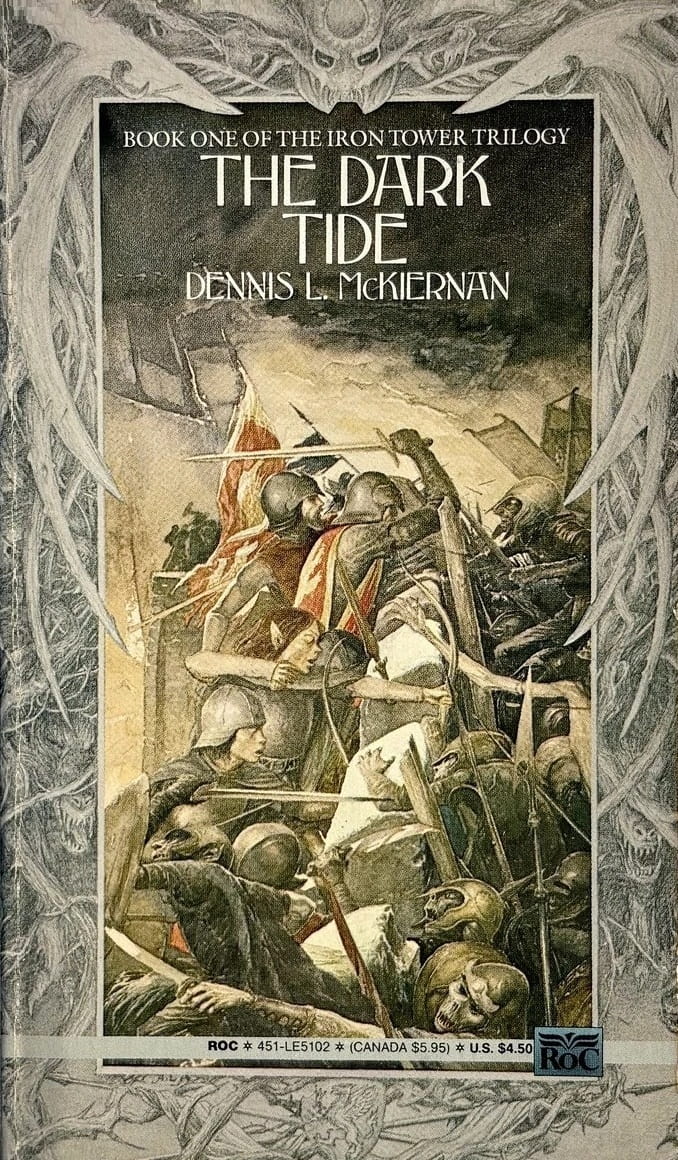
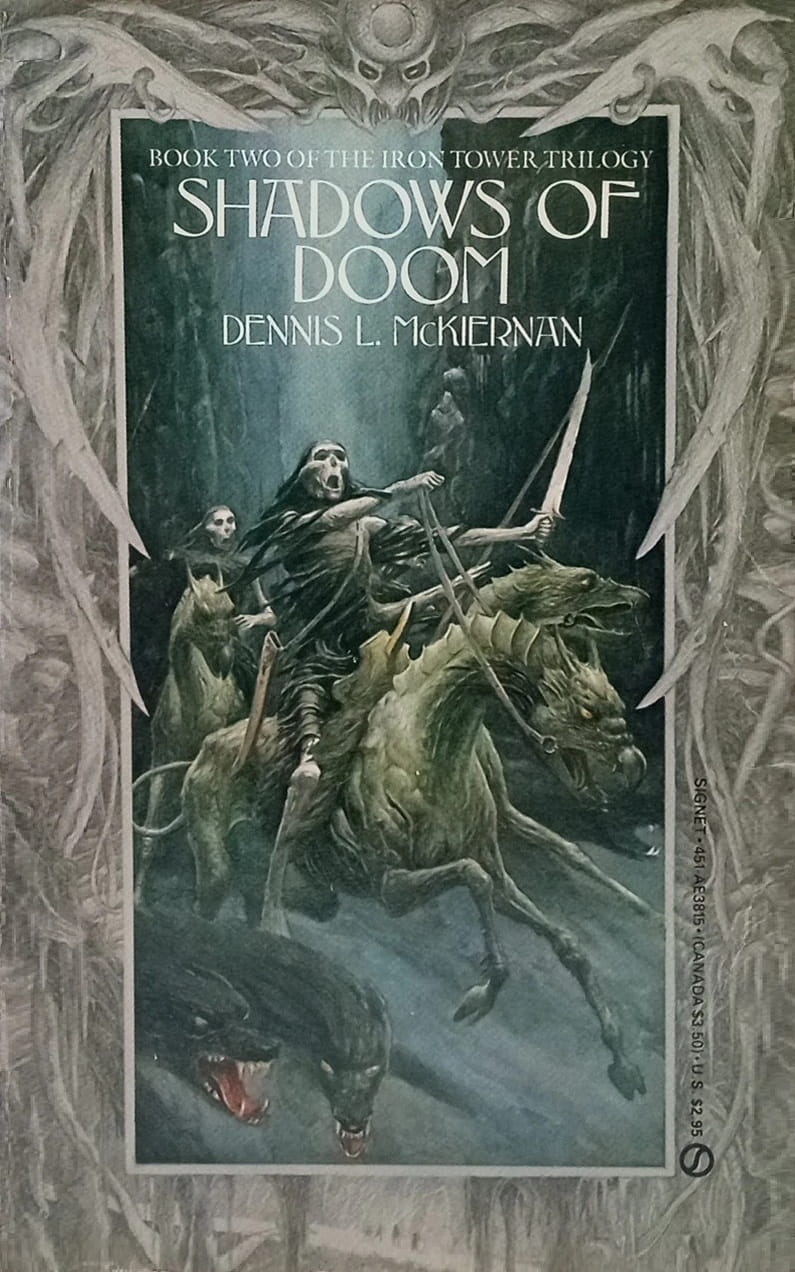
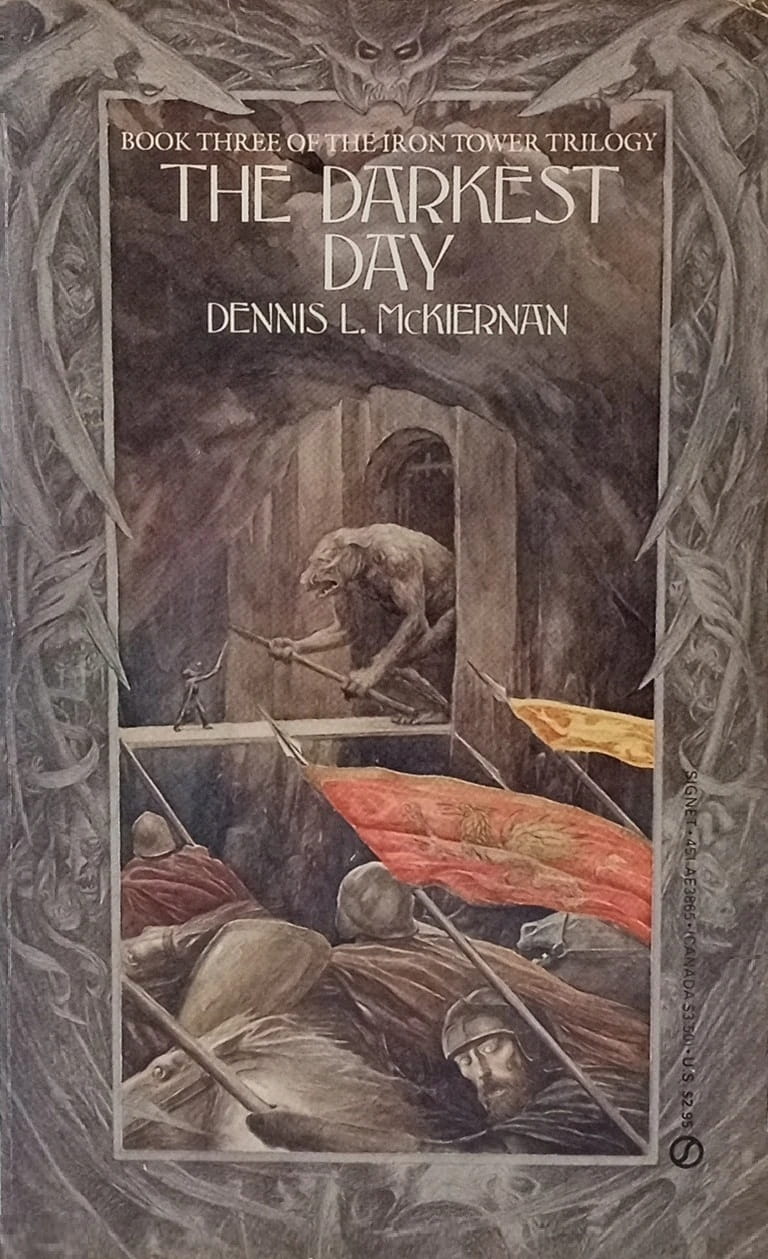
The Iron Tower Trilogy: The Dark Tide, Shadows of Doom, and The Darkest Day
(Signet, August 1985, September 1985, and October 1985). Covers by Alan Lee
I recently posted some of my thoughts about High Fantasy. I haven’t read a large amount from that field but I did read Dennis L. McKiernan’s first trilogy of books, the Iron Tower trilogy, which is definitely High Fantasy written very strongly in the Tolkien tradition.
Here’s my review of those three books, which I read in an omnibus edition.
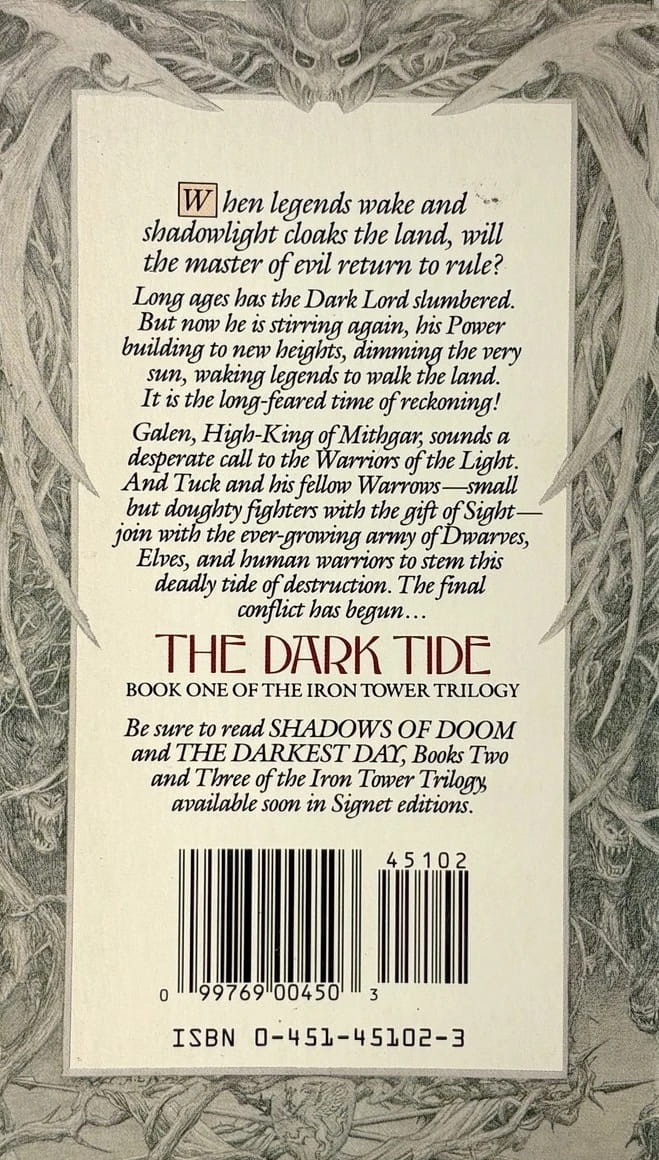
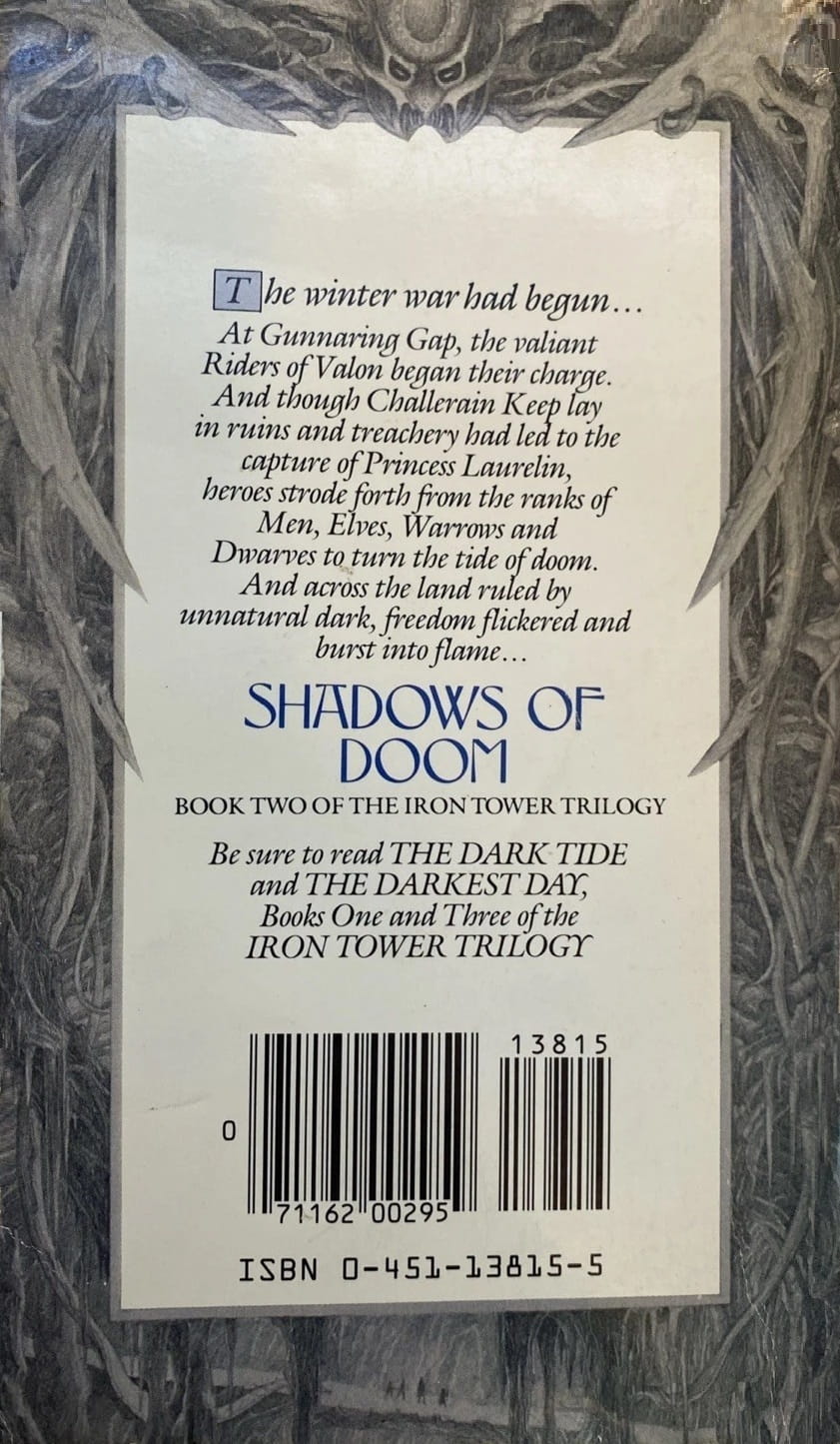
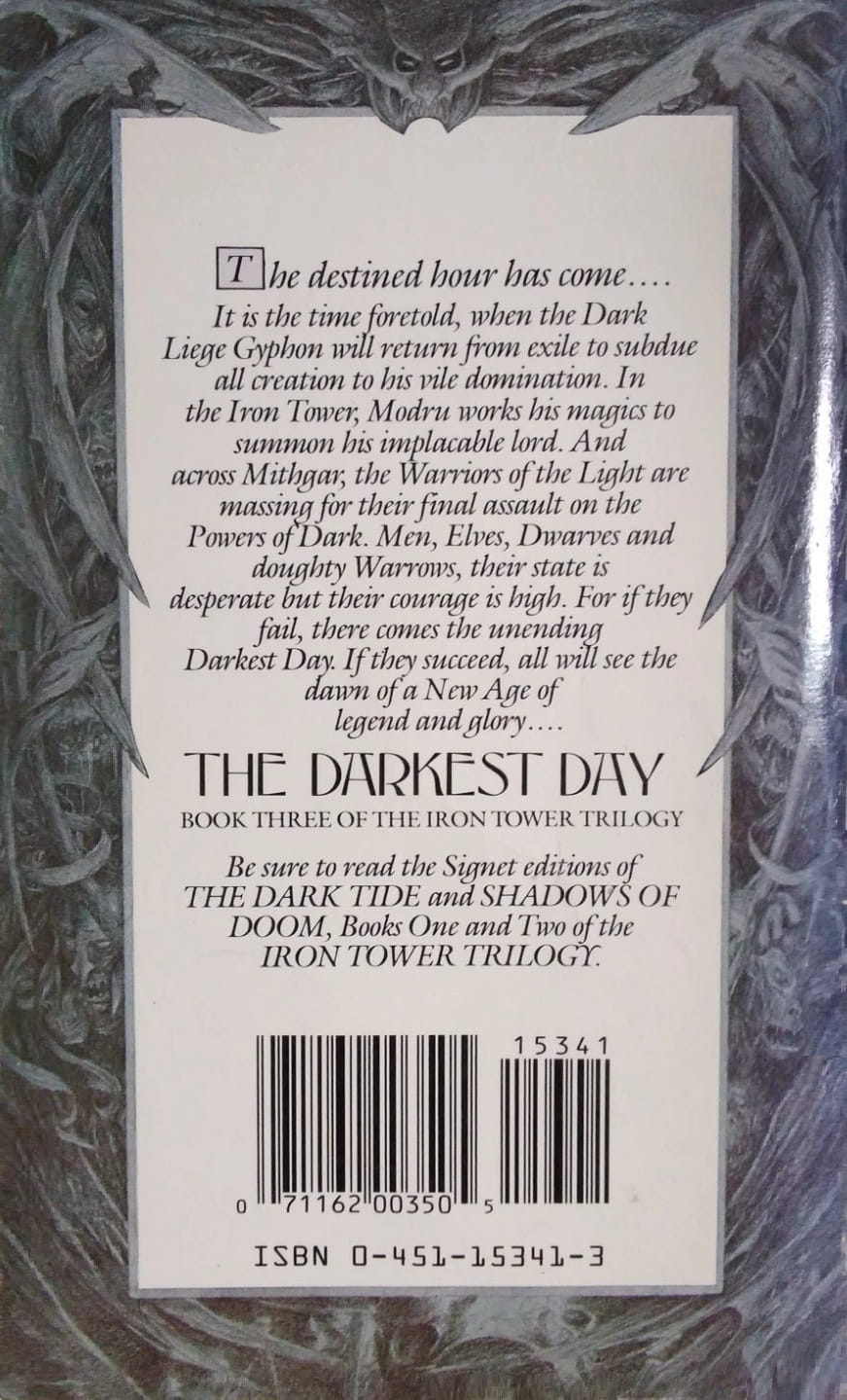
Back covers for The Dark Tide, Shadows of Doom, and The Darkest Day
While laid up after a motorcycle accident for several months, Dennis L. McKiernan (1932 – ) began writing what he first intended to be a sequel to The Lord of the Rings. When that plan fell through, he changed some of the setting and produced his Iron Tower trilogy, which was published by Doubleday in 1984, although he started the work in 1977 after his accident.
I read the three in the omnibus edition shown below, but the three books are:
The Dark Tide (Signet, August 1985)
Shadows of Doom (Signet, September 1985)
The Darkest Day (Signet, October 1985)
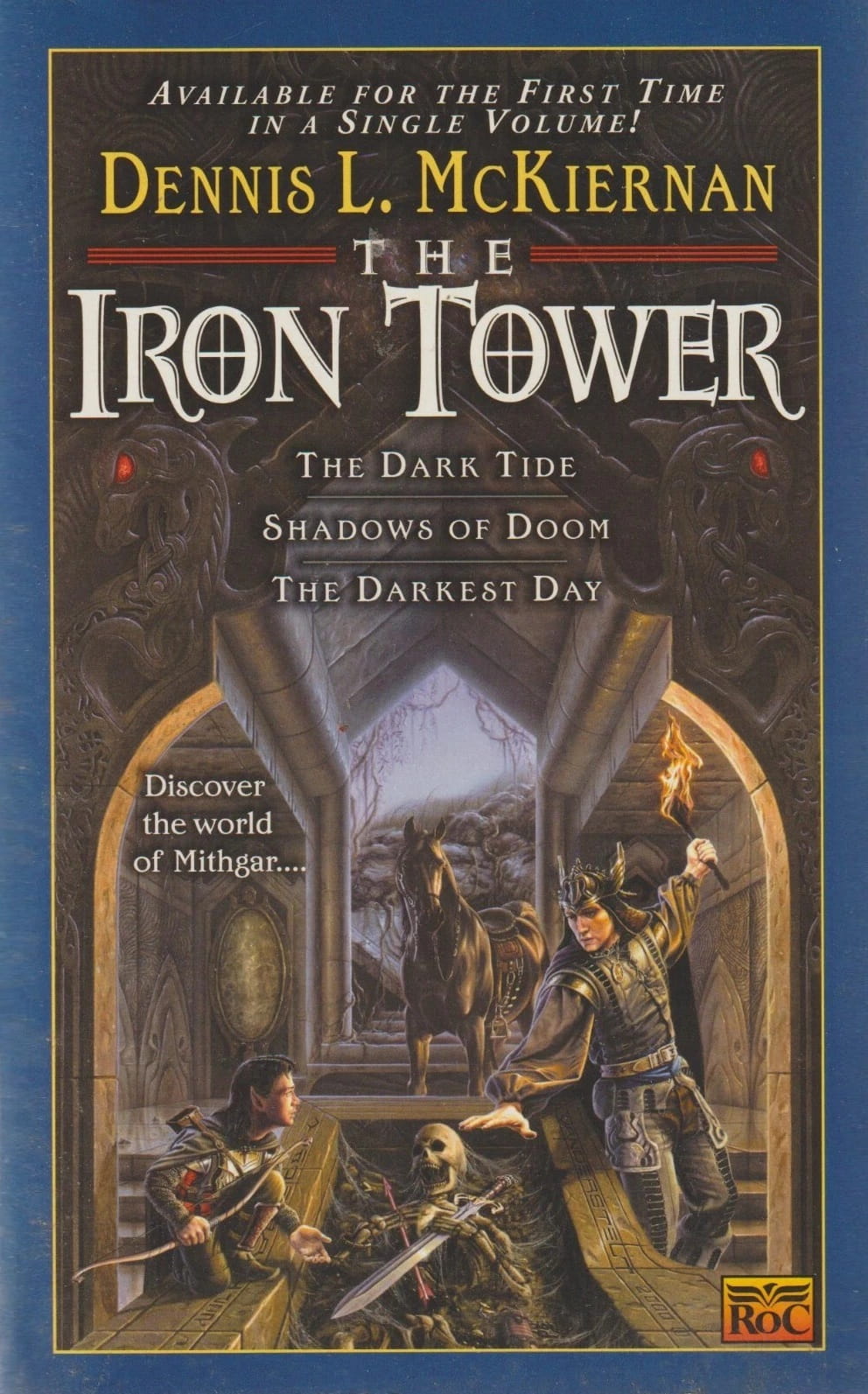
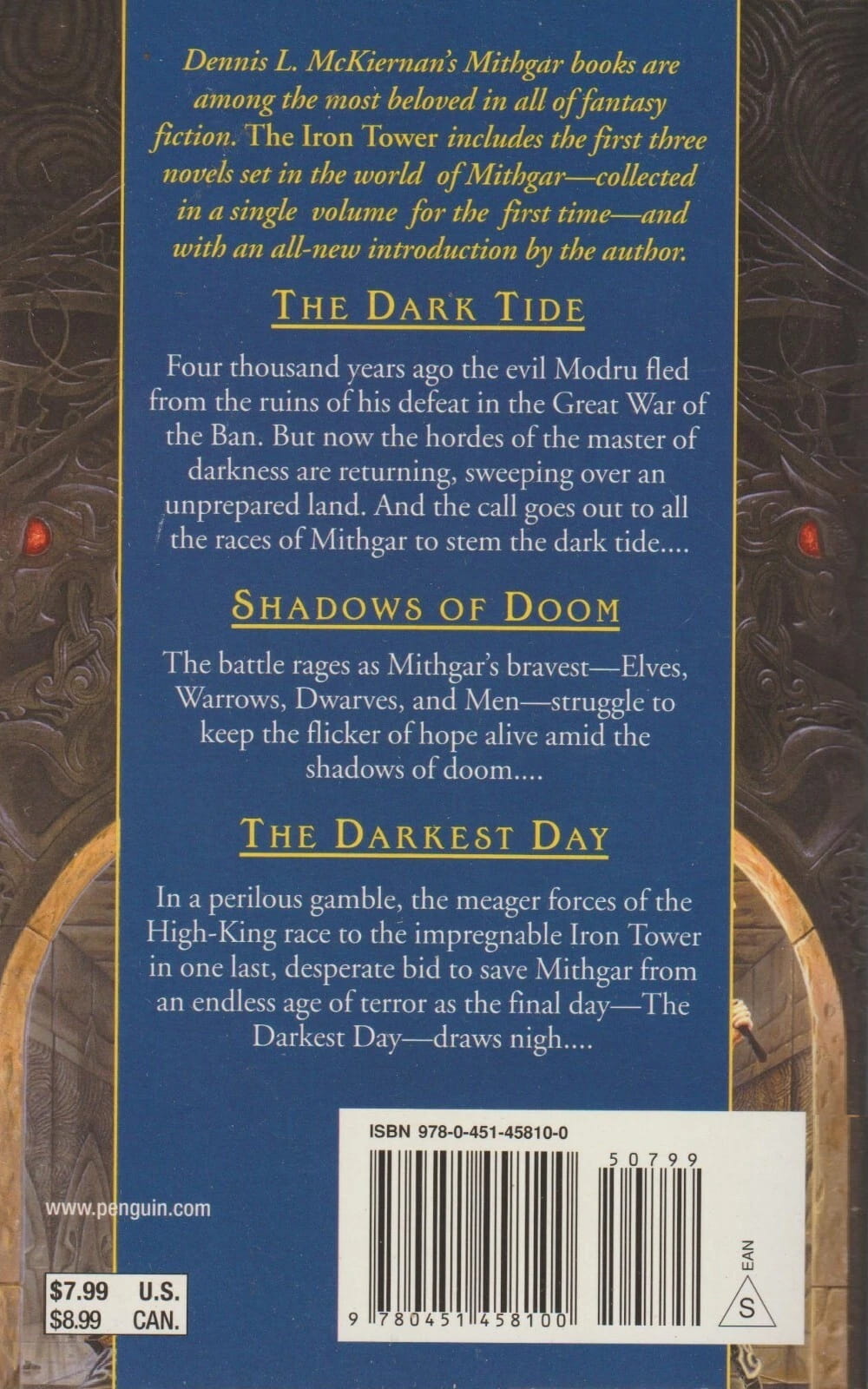
The omnibus edition of the Iron Tower trilogy (Roc, 2000). Cover by Jerry Vanderstelt
These are McKiernan’s first books and show his inexperience, but he did produce some memorable characters and I generally enjoyed the books.
Perhaps because of how the work was initially conceived, as a sequel to Tolkien’s work, they bear a very close resemblance to Tolkien’s setting, characters, and overall story arcs, so much so that one might be forgiven for considering them pastiche Tolkien. From what I’ve heard, McKiernan went on to write much more original material later.
However, though I have a couple of his later books I’ve not read any of them. Anyone have a recommendation for something good from him?
Charles Gramlich administers The Swords & Planet League group on Facebook, where this post first appeared. His last article for us was a a review of the Bigfoot: Sword of the Earthman graphic novel by Josh S. Henaman, Andy Taylor, and Tamra Bonvillain. See all of his recent posts for Black Gate here.
Categories: Fantasy Books
Comment on Editing by Jørgen
In reply to Inna.
This story is great in so many aspects, but as of now I struggle to see how romance can naturally fit in it. I get that Stephen’s young, but he has sooo much going on now!
Categories: Authors
BDH BINGO
Happy Wednesday, Horde!
I’m hosting a little Book Bingo morning to get us through the week hump.
The rules are simple. Tick off every square that applies to you. The central Curran square is free, because the Consort is ever merciful.
- Five in a row – across, down, or diagonal – and you have BINGO
- Fill the whole sheet and you have DEVOUR-ALL
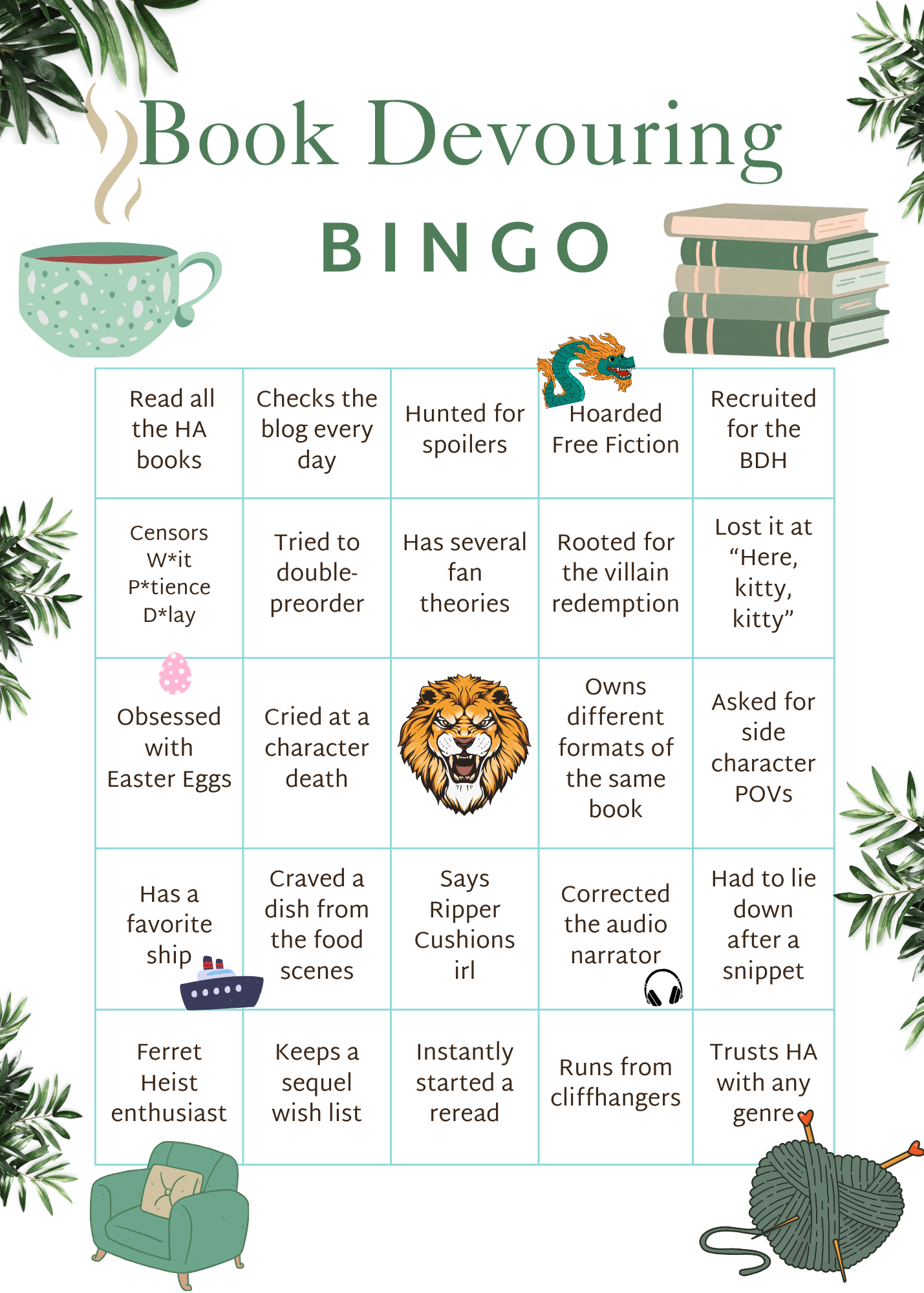
You get to brag with your total in the comments and the prize of knowing that you are part of the greatest Horde ever!
A few notes for anyone who needs them:
BDH stands for Book Devouring Horde, the affectionate collective name for Ilona Andrews readers.
HA means House Andrews, aka Ilona and Gordon.
Ship/shipping is a fandom term for a character romance you root for, whether confirmed on the page or not.
There is an accessibility button in the upper-left corner of the site. It can adjust contrast, switch to greyscale, and offer other display options that may help.
How did you do?
The post BDH BINGO first appeared on ILONA ANDREWS.
Categories: Authors
7 Author Shoutouts | Authors We Love To Recommend
Here are 7 Author Shoutouts for this week. Find your favorite author or discover an…
The post 7 Author Shoutouts | Authors We Love To Recommend appeared first on LitStack.
Categories: Fantasy Books
Book Review: Steel Gods by Richard Swan
I received a review copy from the publisher. This does not affect the contents of my review and all opinions are my own.
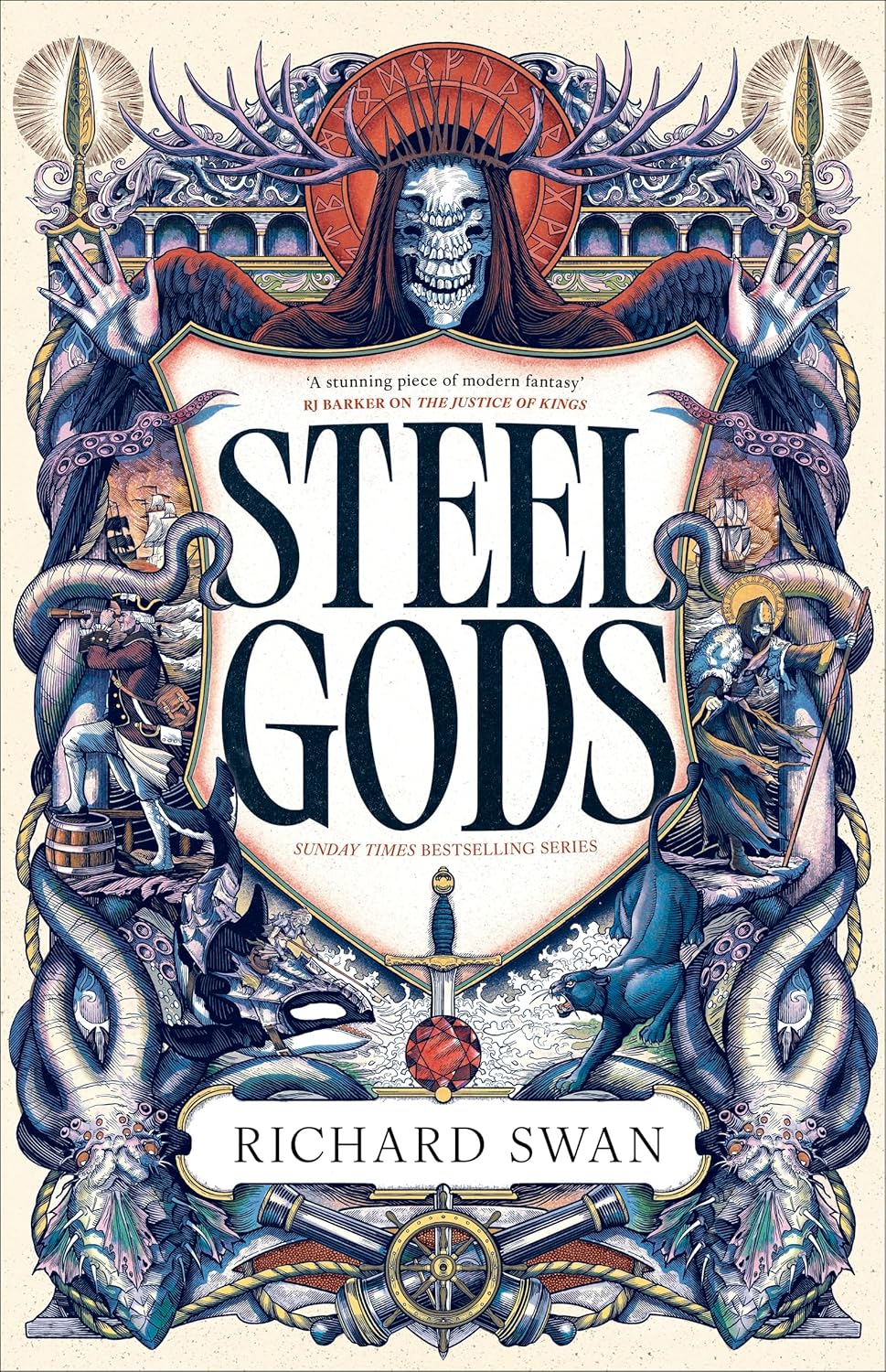
Mogsy’s Rating: 2 of 5 stars
Genre: Fantasy
Series: Book 2 of The Great Silence
Publisher: Orbit (March 31, 2026)
Length: 448 pages
Author Information: Website
This review is probably going to be full of unpopular opinions, but the thing is, I don’t get it either. In recent years, I have become a big fan of Richard Swan, I also absolutely loved the first book of this series, and yet, Steel Gods ended up being a huge disappointment. While I devoured Grave Empire effortlessly, I spent most of this second novel struggling to stay interested and wondering when it was finally going to click, forcing myself to keep going because I genuinely believed it would eventually get better. Just stick with it, I told myself, and when you’re done, you’ll be glad you can roll straight into book three. But heck, by the end, I honestly wasn’t even sure I wanted to continue the series at all.
Picking up after the events of the previous novel, the world of The Great Silence continues devolving into more chaos as the boundaries between the mortal realm and the afterlife begin to break down. The big baddies, the Vorr, which are horrifying interdimensional beings that fed on souls, have breached the land of the dead and invaded the world of the living. Their influence spreads through the empire like a plague, inflicting mind rot upon their victims, turning them into soulless, hollowed-out husks like zombies.
But instead of working together to try to stop the infection, those with power begin looking for ways to exploit it. Among them is Count Lamprecht von Oldenburg, who uses thaumaturgy to turn the mindless horde into his own personal army. He’s also batshit insane. Meanwhile, Ambassador Renata Rainer is continuing her diplomatic mission, traveling to the heart of enemy territory in the hopes of recruiting new allies. Lieutenant Peter Kleist, on the other hand, has managed to survive the treacherous wilds, despite his youth and lack of experience being constantly tested along the way. Now he finds himself back in the haunted wilderness, compelled by the need for answers, even as the weight of everything he has already endured begins to catch up with him. Across the wider series arc, the story continues to unfold through multiple POVs scattered around a rapidly destabilizing world, each trying to prevent it from slipping into total collapse.
This sequel should have been a slam dunk, but what surprised me most was how different this book felt compared to Grave Empire. Same world, same continuity, many of the same characters, and yet for me, the energy was completely off. For one, the focus of the first book was much tighter, whereas this one felt sprawling in a way that diluted a lot of what originally hooked me. The character perspectives are diverging once more, introducing more threads but also more distance. It gave the book a disconnected quality, like everyone was wandering through separate stories instead of participating in the same one.
The pacing also dragged for me. Oh boy, did it really drag. Looking back, quite a lot actually happens, but very little of it feels impactful in the moment. Any reveals arrive with surprisingly little weight behind them, or maybe it was just my bored state of mind making major developments seem like they fizzled rather than explode. Entire sections feel bogged down in exposition without much payoff. Chapters would go by where I realized I had been reading for quite some time without feeling any real momentum carrying me forward. Honestly, if the first book hadn’t been so good, making me feel invested in this series, I probably would have DNFed this before the halfway mark.
Part of the issue may simply be that this installment feels much more transitional. It spends a lot of time repositioning the characters, which might explain why they didn’t work nearly as well for me this time around. Here, a lot of them felt strangely flattened or pushed aside in favor of laying down groundwork for future events, leading to less balance and more confusion. I’d thought I had a strong grasp of the characters’ motivations, but after this book, I don’t feel as confident anymore. Not because they suddenly changed, but because much of the book feels emotionally flat and they don’t really develop in particularly exciting ways.
To be fair, Swan still writes well on a technical level. The prose is polished, and the world-building is detailed. Here and there are flashes of genius like the political complexity or the grim atmosphere that reminded me why I loved the first book. But ultimately this sequel just never came alive for me. Whatever momentum Grave Empire had going for it, I simply didn’t feel it here.
In the end, if I had to boil it all down to one thing, I’d say that Steel Gods has a pretty serious case of middle book syndrome. The series began with a much stronger sense of tension and direction, so I know what it’s capable of, but this installment never really comes close to reaching those same heights. I’m now on the fence about whether I’ll continue with the series, but I suppose time will tell.


More on The BiblioSanctum:
Review of Grave Empire (Book 1)
Categories: Fantasy Books
The Write Attitude: Doing The Work Amid The Noise
This post is a chapter from my book, The Write Attitude, which is now in a second edition. I’m posting it here to entice you to head over to Storybundle to pick up a copy, along with ebooks by Jamie Ferguson, T. Thorn Coyle, Dean Wesley Smith, Robert Jeschonek and others.
Everything in this bundle is exclusive to the Storybundle, including my book. So if you want to read it now, pick it up from Storybundle. The Storybundle ends in two days, so you might want to get yours now. If you don’t want a deal on the ebook or if you only read print, then you can always preorder the book on various retailer sites. The new edition will release on in July.
The second edition of The Write Attitude is quite different from the first edition, which originally appeared in 2016. I kept some parts of the original book, but much of the material is newer. The new material comes from my Patreon page. Not every post from my Patreon page shows up here, although several do. If you want to see everything, though, head to Patreon and sign up.
This post is from February of 2025, and is in the second section of the book.
DOING THE WORK AMID THE NOISEFrom 2025
There are times in life when being a writer is hard. I don’t mean real-world hard. Real-world hard is when your job is so important that one small error means someone else dies. There are a lot of real-world hard jobs in the world, and they keep the rest of us safe and alive.
As I said in Chapter 11, entertainment is important as well. We have an obligation to help those who are doing real-world hard jobs by giving them some kind of respite at the end of their long days.
But that means we have to do the work, and the work comes out of our brains. When we’re panicked and distracted—checking the news every fifteen minutes, looking at our social media, worrying aloud with our friends about what is going to happen next—it’s difficult, if not near impossible to concentrate on our made-up worlds.
They feel so small and unimportant.
We don’t see readers enjoying our work. We have no idea that a reader will close a book and hug it, like I did a week ago when I finished Robert Crais’s latest, The Big Empty. I know that Bob is a slow writer, and I wish he wasn’t, because I would love another of his books right now.
He lives in L.A. Not only are people there dealing with the chaos that is America right now, they’re dealing with the devastating losses of many parts of their community. I suspect he’s distracted.
I know that Connie Willis is distracted because I’m following her Facebook page in which she aggregates all the news of the day. I have no idea how she finds the time to write fiction or if she even is. I hope she is.
I’m a former journalist. I love information, the more the better. But, after the election, I shut off all media. I canceled all of my major newspaper subscriptions, stopped watching everything but the weather on any news channel, and got a lot done. I needed to because of an ongoing business crisis.
But I also needed the rest.
And I knew if I didn’t figure out how to control the information that came to me, I would not write another sentence—at least in fiction.
Writing fiction, as unglamorous as it sounds, is my job. It’s what I do for a living. But it’s also what I would do if the world ended tomorrow (which has gotten closer, according to the Doomsday Clock run by The Bulletin of the Atomic Scientists).
I make up stories. I always have. I write them down and have done that since I was in grade school.
Storytelling keeps me sane.
After the despair of the election (not shock, because I kept saying all summer [hell, all year] that this was possible, even if I wasn’t really listening to myself), I needed that quiet. I needed to accept that the world as I had known it for years would change dramatically.
How dramatically? I had—and have—no idea. This post is not about what’s going on out there in the real world. It’s changing too fast. I sat down at 1 p.m. on a Sunday, knowing that by the time I finish, more news will pour in.
It might be good; it might be bad; it might be hopeful; it might be devastating. It might be all those things at once.
It’s too much for the brain to cope with—and right now, it’s designed that way. Which is why I urge you to take care of yourself and your family first. Then take care of your community, whatever that might be, and then pick one or two or three issues to work on and be part of the solution for. If all of us do that, our differences will make sure that we will cover the entire spectrum of problems that are popping up like weeds.
Yes, I know. People are dying. I know. The situation is growing more dire by the day.
One step at a time. That’s all we can do. See above.
The problem is, then, how to corral the brain and give it enough space so that you can write.
That solution is different for each and every one of us. And it’s different each one of us as an individual at different points in our lives.
I can only give you examples from my own life.
Example #1: I got very sick when I was living on the Oregon Coast. I’m already allergic to half the world; there, we later discovered, I was living in mold and was allergic to that too. We moved to the dry desert here in Nevada just in time. I doubt I would have made it through the year otherwise.
But, I was and am a writer. I wrote through all of that, and even wrote a book about my methods for writing when I barely had enough strength to get out of bed. The book is called Writing With Chronic Illness, which will appear in a revised edition in mid-2026.
Some of the solutions in that book might work for some of you now. Doing the writing first, being happy with what you can accomplish, accepting your limits—all of those are important.
I did them as best I could there. Here, in Las Vegas, I’m healthier, although the chronic conditions do fell me more than I would like. I can get through them easier in this dry climate, so sometimes I forget what I had learned.
Example #2: Our close friend Bill Trojan died, and Dean had to handle Bill’s horribly messy estate. At the same time, my editor at one of the traditional publishing houses had a mental meltdown and spent a half an hour on the phone, screaming at me and telling me I was the worst writer on the planet.
No one treats me like that. No one. So I immediately divorced that publisher, offering to pay back the money they had invested in me and my work so that I could get the rights to my books back.
That was at least $250,000 that I would have had to pay—even though we were embroiled in the estate mess and Dean was not working on publishing and writing, due to that big problem.
My confidence was shaken, and we were in financial difficulties. I had to figure out how to write a funny novel that was still under contract.
I did, a page here and a page there. I remember sitting in my office and writing long paragraphs about how awful that editor was to get her out of my head so that I could actually finish a book that was under contract for someone else.
I did it, but shutting out the noise was almost impossible. It took concentration. It took will power. It took a daily reminder to myself that writing is supposed to be fun.
And you know what? Many days, it ended up being that way, just because of the determination.
Example #3: As many of you know, the last two or so years of my life have been filled with turmoil. Dean lost much of his eyesight, which meant we had to make some massive changes in our lives. Then, just as he was getting used to the changes, he fell on a 5K race and destroyed his right shoulder.
He couldn’t do much work. He was healing. I cared for him and, as I dug deeper into the business at our publishing company, I realized it was sick too.
We had to make drastic changes there, and I had to take over the company completely.
Which meant it got run the Kris way—lots of questions, lots of systems, lots of data, lots of procedures. The old staff buckled under the Kris method (which had not been in place since I got very ill in 2015), and within two months, they were gone…leaving problems so massive behind that those problems either had to be solved or the company had to be dissolved.
Dean and I chose solving those problems, and we had (and have) great help in doing so. These sorts of events teach you who your friends really are.
I knew, as we dug in, that I was not going to be focused on the writing. I needed to figure out how to harness that focus in a different way.
I had a novel to finish as well as short story deadlines from traditional short fiction editors. I was not going to miss those deadlines, and I needed to finish that novel.
The problem was that in this small condo, I did not have a second business office. I had to do the work on my laptop and my writing computer in my writing office.
I knew I needed help.
So I set up a challenge with other writers. I made it costly for me to lose (not just pride—which, pardon my French, fuck if I care about personal pride). I started the first challenge in December of 2023, and continued the challenges through most of 2024.
I lost a couple of times. But the challenge was the only thing that got me to the computer. Daily word count…that I had to report (and God, I hate reporting). I couldn’t fudge it for my own sake, and I didn’t.
I finished that novel, and a lot of short fiction, before September hit, and the business stuff combined with some legal matters that were all do-not-miss and I had to miss some writing days.
It irked me—and kept the writing as a focus.
Usually I don’t bring others into my writing process, but I knew I would need it in 2024. So I did it.
I continued the writing challenges into early 2025, because I knew that I needed to get back to massive novel production, and I didn’t want to lose my short story focus. I have to do both (which I have done throughout my career).
It’s not as draconian as the 2024 challenge, but my life is different now. The business has settled into a pattern. We’ve moved the main offices to Nevada, which means I have a business desk. (Yay!) And we’ve gotten through some of the mess left by the old staff, and what’s left we’re slowly wrapping our arms around.
One thing I noticed, though, in all of those crises, is that the world swirled around me, with its problems and its demands. In each of them, it felt like a massive storm pounding on the outside of my house—you know the kind: the rain is horizontal, the winds are devastating, and the view outside the windows is black and gray, with almost no visibility at all.
You just have to wait out those storms and know that when they’re over, everything will be different, but some things will still stand. There will be rebuilding. There will be heartbreak. But the sun will have come out to reveal what’s left.
In the middle of it, though, you just have to survive it and keep the important things safe.
Your writing is one of those important things. It will take effort to keep it safe. Effort on your part.
And you’ll have to figure out what it will take for you to do it. My methods might not work for you. Find what works. Realize that those things might not work in a different kind of crisis.
But you can find a way to be with yourself during these tough times.
Here are a few practical things you can do in most (not all) crises:
- Protect your safe space. For me, that’s my writing space. I couldn’t do it during this last crisis, but I managed somehow. It felt uncomfortable and reminded me yet again about the importance of having a dedicated writing computer.
- Shut off the internet. Dean uses a different computer for his internet research—one that’s just a foot or two away from his writing computer. I shut off my wi-fi, so that clicking over to the internet for research takes a conscious action, and often makes me realize that I was just heading over to distract myself. (Different strokes, y’know.)
- Set a daily writing time. Make sure your family knows what it is, and that you shouldn’t be disturbed. Try to pick a time when it’s not easy to disturb you (early mornings; late evenings)
There are so many other practical things you can do, but again, they become specific to you.
One other thing—a tough thing—is that sometimes the project you were working on when the crisis hit is not the project your creative voice needs right now. You might have to switch—something shorter, something longer, something that requires less research, something that requires a different kind of concentration.
It’s up to you.
But the key here is to remember that when you write, you’re inside and safe from the storm. It will rage around you unabated while you’re working. It’ll probably (sadly) still be there when you’re done with today’s writing session.
But you got that session done. It’s a victory.
Celebrate the tiny victories. Keep writing.
And remember, in almost every difficult time, the only way out is through.
“Doing The Work Amid The Noise” from The Write Attitude
Copyright © Kristine Kathryn Rusch
Published by WMG Publishing
This ebook is licensed for your personal enjoyment only. All rights reserved. This ebook, or parts thereof, may not be reproduced in any form without permission.
Any use of this publication to train generative artificial intelligence (“AI”) technologies is expressly prohibited. The author and publisher reserve all rights to license uses of this work for generative AI training and development of machine learning language models.
Categories: Authors
“Lammie Loves Cubby” | Fanning The Flames of Long Held Desire
Other Titles by Nora Gaskin Along with Lammie Loves Cubby, we’re definitely adding these other…
The post “Lammie Loves Cubby” | Fanning The Flames of Long Held Desire appeared first on LitStack.
Categories: Fantasy Books
Book review: Sarafina

Book links: Amazon, Goodreads
ABOUT THE AUTHOR:
Publisher" Page count: Formats:
War, as it turns out, is a terrible place to discover you don’t want to be in a war.
Three brothers (Ethan, Mason, and Archie) have this revelation during the Battle of Shiloh and do the only sensible thing available to them: they run in the opposite direction of cannon fire. Sadly, the desertion results in navigating through mud, starvation, regret and the creeping realization that survival and morality don't always gel.
When they think, all's lost, they find the house. Now, in stories, a house in the woods is rarely just a house. It is, at minimum, a decision. This one comes with a beautiful woman named Sarafina, her son (or not), huge and dangerous dogs and a general atmosphere of wrongness.
At first, it’s all very convenient, especially that the hist is welcoming, has food and is willing to share. On top of that, no one is actively trying to shoot them. WooHoo.
Ethan, who narrates like someone trying very hard to believe his own version of events, starts to notice small things. Then larger, more theological things. Meanwhile, his brothers adjust and let their inner selves (angry, violent, corrupt) act openly. Not the best choice.
I liked how Fracassi lures you in with something familiar (war is awful, men are flawed, there is a strange woman in a strange house) and then plays with it and rearranges pieces while you’re not looking. By the time you notice, you’re no longer in a war story. Or a haunted house story, for that matter. You’re somewhere worse.
The brothers aren’t likable, which is rather the point. They are what happens when you mix violence, fear, and a lifetime of bad influences and then give it all time to ferment. Ethan tries to be better, but the book suggests that trying and succeeding are not the same thing.
There’s a middle stretch where you might think you’ve figured it out. You haven’t.
In conclusion, if someone offers you food in a perfect little house in the middle of nowhere, you should at least consider the possibility that you are not the guest. Other than that, it's a great slow-burn horror story.
Categories: Fantasy Books
Mortal Kombat II – A Movie Review
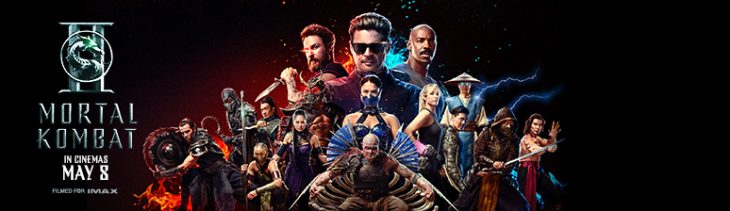
Good afterevenmorn, Readers!
This past Saturday, I headed out with a few of my martial arts students, past and present, to watch the second installment of the recent Mortal Kombat adaptations. I’m not going to lie, the draw for me was the involvement of Karl Urban as Johnny Cage. Cage was never a character I played, but the retired action movie star is a fun idea for this franchise, and I will generally support anything Karl Urban does. Even when it’s bad, he’s great in it. And sometimes when it’s bad, it’s good. Ask me about my love of the 2005 film Doom one day. I never said I had great taste.
The point is, I went and saw the movie, and the short review is, I loved it (see afore mentioned note about my tastes). Let’s dive in!
My entry into the Mortal Kombat universe was the original arcade game. I was, predictably, terrible at it. But it was a great time all the same. I credit Mortal Kombat, and shows like Xena: Warrior Princess, with pointing me to my long-term, much loved hobby of martial arts training (for those who don’t know, I train and teach Kickboxing and Northern Mantis Kung Fu).
It helped that the former had a character that shared my first name, albeit with a different spelling – Sonya. You bet I played her nearly exclusively. But the game also had a plethora of female characters who, importantly for little me, went toe-to-toe with male opponents. Their victory was not conditional to their gender (though a lot of the finishers were… I got very annoyed with Sonya’s finisher when they turned it into the ‘kiss of death.’ A kiss? Really? Anyway…), but on the skill of the person who had selected her as their avatar.
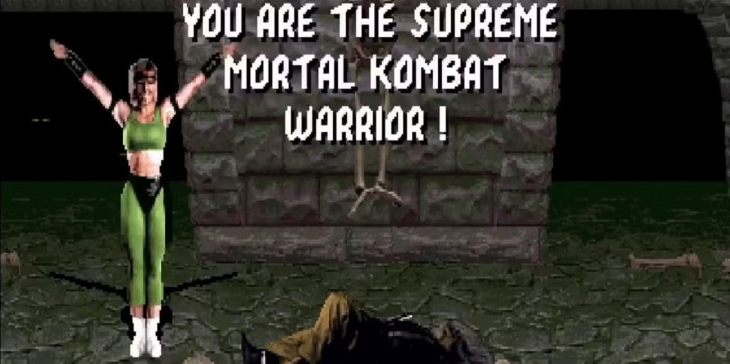 That’s my girl.
Oddly enough, I didn’t much like the first of the new Mortal Kombat films. There was something about them that just didn’t jive with me. I think, upon reflection, that the problem was that it took itself entirely too seriously for the ridiculousness of the premise. Perhaps? Not entirely sure. But I wasn’t a huge fan of the first of the most recent adaptations.
That was not the case for this one. Yes, this movie is so silly. It’s not a thinker. But what it is, is really, really fun (and gory). Don’t go if you’re looking for some deeper meaning into the human condition. You won’t find it. Do go if you’re looking for some excellent action, good laughs, and a lot of blood.
The story of Mortal Kombat II largely abandons Cole as the main character, relegating him to one of the crew. Enter Johnny Cage, a washed-up action hero from the age of really cheesy, badly choreographed action films of the kind we lost in the early 90s (making this film a little meta, as it is also a really cheesy (but much better choreographed) action flick, harkening back to the kind we lost in the early 90s). You know, when action movies were dumb and fun… or sometimes just dumb. Really dumb. I particularly enjoyed the really bad action scene from one of his movies we were subjected to as a character introduction. It was horrifically bad. And that was just awesome. A perfect way to set the tone for the character and the movie.
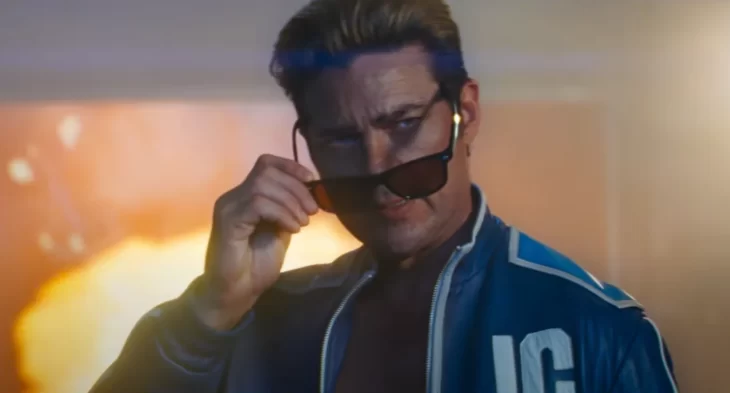 It was such a terrible sequence. And it showcased a particular character move from the games, too. So bad. So great.
I giggled my way through it.
For some reason, unseen by either his character or the audience, he has been selected as the replacement for Kung Lao as a defender of Earth Realm (Spoiler: Kung Lao was killed in the last movie); a call to adventure that he promptly rejects. Not that it does him much good. What I like about this is that Johnny Cage is not magically suddenly extremely good at martial arts when he is dragged into the Mortal Kombat arena. He was in his youth. But he is no longer young. And while he was a winning fighter as a young man, all of the hard work in his films were done by stunt doubles. And it shows. He doesn’t exactly perform well.
That’s all I’m going to say about it, because I don’t want to stray too far into spoiler territory.
I will say, however, that Karl Urban was very aware what kind of film this was, and very pleasingly hammed it up. So many of his scenes were flat out silly, and in it’s own self-aware way, hilarious.
To my surprise, however, that was not my greatest joy in this film. That honour once again belonged to Josh Lawson who reprised his role as Kano (he was in the trailer, so I don’t feel like this is too much of a spoiler). Kano was, to my mind, the best thing about the previous film. He also stood out here… but that might just be because of who I am and the fact that this time around he was so aggressively Australian that it very nearly killed me (I am much less aggressively Australian). I laughed hardest and loudest at his scenes. Even thinking about it now, I still giggle. It’s not often that Australia gets any kind of representation in films. In fact, the only other ensemble movie I can think of that had an explicitly Australian character was Pitch Black, and, well, he didn’t last long. To be fair, not too many characters did.
I am fairly sure that other folks of other backgrounds won’t take as much delight in Kano as I did, so I would not count on it to up the enjoyment of this film. But for me very specifically, it absolutely did.
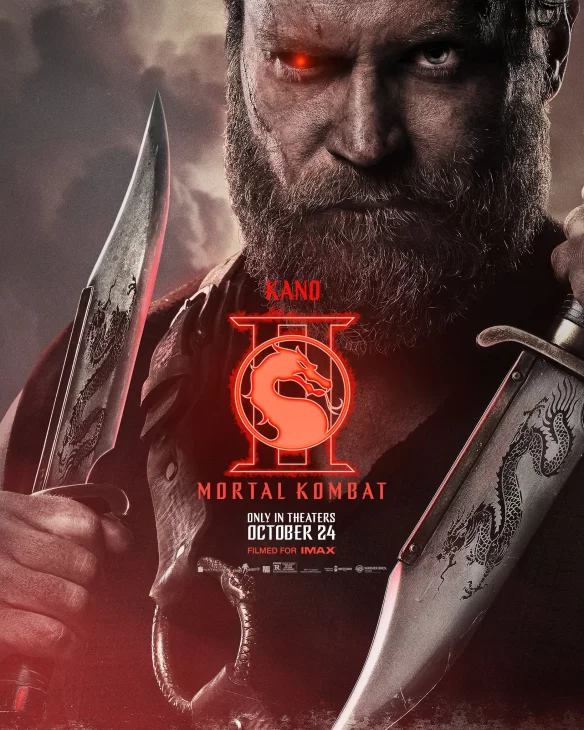 Don’t let the poster fool you. He is a deeply unserious character.
Kano steals the show. Yet again.
The story itself is about what you’d expect for this franchise. Broadly, Earth is under threat, and heroes, under the tutelage of the lightning god Raiden, must overcome their personal limitations to rise against the foe in order to save Earthrealm from annexation. But even in this, through the figure of Johnny Cage, the film kind of makes fun of itself. Of course, the folks on the other side are up to shenanigans, and so they must be countered — both inside and outside the arena.
There are a lot of great fight scenes, a tonne of gore (which is to be expected, given the nature of the games), some unexpected deaths (no one is safe. No one. Side note: in my viewing, when one of the characters was killed someone in the front row exclaimed, “Nooooo!” quite loudly. Go see it with an audience, is what I’m saying. It was great.), and so, so many laughs. It was not deep, or profound, or even serious.
It was fun.
It evoked the old-school feeling action movies used to have: fun was the goal. I don’t know about you, but, given the state of well… everything, I desperately needed something fun. Mortal Kombat II perfectly scratched that itch. Definitely worth the cost of admission, silliness and all.
My goodness was it silly. What a good time in the cinema.
When S.M. Carrière isn’t brutally killing your favorite characters, she spends her time teaching martial arts, live streaming video games, and sometimes painting. In other words, she spends her time teaching others to kill, streaming her digital kills, and sometimes relaxing. Her most recent titles include Daughters of Britain, Skylark and Human. The Timbercreek Incident is free to read on Wattpad.
Categories: Fantasy Books
ALL HAIL CHAOS by Sarah Rees Brennan (The Time of Iron #2)
All Hail Chaos is the second installment of Sarah Rees Brennan’s A Time of Iron, a portal fantasy which finds a young woman named Rae swept into the world of the fantasy novels she and her sister Alice hold dear to their hearts. The first installment, Long Live Evil, saw Rae embrace the identity of…
Categories: Fantasy Books
Free Fiction Monday: Dunyon
In a rundown bar on a space station at the end of the universe, a customer asks for passage to Dunyon. But the bartender has never heard of Dunyon.
But more and more people arrive, all wanting to go to Dunyon—creating a huge crisis for that little bar, the space station, and maybe the universe.
“Dunyon” is free on this site for one week only. If you’d like your own copy, you can get it at your favorite retailer or pick up a copy from WMG Books by clicking here.
Dunyon Kristine Kathryn Rusch
It started in the far reaches of the sector—ships firing on each other, some destroyed. Keeping track became hard—communications turned sporadic, and who really followed which government was in charge of what anyway?
Rumors started, rumors impossible to confirm as communications throughout the system grew intermittent. Entire ships, destroyed. Cities, gone. A planet, blown up.
But most people saw no evidence of any of it. One would think, if a planet had been destroyed, there would be some kind of repercussion, but most people knew of none. Most people saw nothing.
Until one day the ships appeared overhead.
Most people barely had time to gather the family and the money, barely had time to get away, to find refugee ships.
But “refugee ships” make it sound organized, like an effort conducted by some charity organization or a benevolent and surviving government.
The ships weren’t organized or tied to each other or even very similar. Some were old-fashioned generation ships. Some were commandeered space yachts. Some were stolen trading vessels.
They made it only so far. Some refugees died in the blackness of space, the ships powerless, spinning slowly, the only thing surviving an emergency signal that would go forever unheeded.
Other refugees made it to the outer reaches of the sector. To supply stations and military outposts.
And the rest—well, the rest ended up here.
The new arrivals always ask me where here is, and I tell them one of three things, depending on my mood.
I say, I used to know but I don’t any more.
Or, It’s the end of the line.
Or, Here? This isn’t a place. It’s an emotion.
But too many asked me what that emotion was.
Desperation, I’d say. Desperation, pure and simple.
***
In truth, “here” was once an outpost, so far on the edge of the sector that we weren’t even sure which government claimed us. Mostly we claimed ourselves. Eventually, we became a destination space station, a haven for the rich. We built fantasy resorts spiraling off the main part of the station—all virtual reality and holographic technology like nothing else in the sector.
If you wanted to be pampered, you came here. If you wanted to redefine yourself, you came here. If you wanted to hide from the public, you came here.
It would cost you more money that most people ever saw, but you came here.
I came here without money twenty years ago. Most women, when they arrived, either dripped money or had unvarnished beauty. I had neither.
I was a former soldier looking for a respite, scarred inside and out. I started as a bartender, and built a reputation as the person who solved everyone else’s problems quickly, silently, and efficiently.
I did nothing but work and save and meddle (unemotionally) in other people’s lives. So as the station expanded, built its first exclusive wing, I had enough money to build my own bar with my own apartment attached.
I could run things the way that I wanted to, keep the hours that I wanted, let in the clients I wanted.
By being exclusive, I became popular.
And rich.
Nowadays, the bar is still exclusive. We are the only place that still charges a cover. We have entertainment in the back room—usually a band, sometimes a comedian, once in a while an acting troupe—all of them famous, all of them refugees. I pay well. People want to run their show in my place because they like my place.
I have human employees not because I can afford them (of course I can) but because I’m trying to create jobs so that fewer people remain stuck in the refugee areas, the places we called the pens. So far, I’ve created twenty-five jobs, and I’m thinking of expanding.
I’ve already expanded more than I initially planned. In addition to my entertainment room, I have a high stakes poker room. No one gets in without a fifty thousand minimum. I raised the stakes when I learned the truly desperate were taking the last of their savings and trying to double their money on my tables.
I didn’t want to get rich by making desperate people poor.
In the main room, we serve dinner at eight sharp. When the five courses are over, we clear the tables and serve drinks until four a.m.
At four, I shut down everything except the high stakes poker (some games can go on for days) and wander the halls, looking at the decay. The hotels that once catered to the dilettante are now filled to capacity with the rich and desperate. The restaurants serve food to the people who pay up front. But their doors are all closed when I wander. I see the signs for specials or warning the people from the pens to stay out. Sometimes I see evidence of a scuffle—broken chairs, smashed tables, a hastily made “closed for the week” sign.
The only places still open when I close the bar are the information kiosks. They have no employees, so people can use them at any time. Even at four in the morning, I will pass lines in front of the kiosks, lines that extend through dozens of corridors.
Information. That’s where the premium is. People want to know if their home is still there, if members of their family are still alive, when (if ever) they can return. Most never let go of the past, unable to accept they’re in a new future, one they don’t recognize.
I barely recognize it, and I have little to hang onto. But I see patterns. For example, you can always tell which part of the sector is closed or ruined or under attack because the information stops flowing from there. What replaces information is rumor.
Rumor. This place thrives on rumor. You can hear it as you walk through the corridors, going from the old resort section (now part of the pens) to the condo wing to my little neighborhood of exclusivity. You hear it in the lowered voices, see it in the furtive looks. You know that someone is lying to someone else, maybe not intentionally, but always harmfully.
For the rumors are almost always harmful. They give hope where there is none.
And I think that’s the most destructive of all.
***
Last month, I finally became a victim of rumors. The whispers, the looks, all came toward me, and I had no idea what was causing them.
My bartender brought me the first hint. He used the silent call built into the back bar to bring me down from my office on the second floor.
The bar in the main room is spectacular. I designed it for looks as well as ease for the bartender. I insist on a human bartender, not some robotic mixer or automated machine. There’s an art to mixing cocktails—the right amount of this touched with a splash of that—which machines can never get right.
The bar circles around a blue screen that shows flat images of anywhere in the sector. Usually I set the imagery, and I try to keep current: any place that’s considered safe shows up on the image screen, and any place that might have exploded out of existence gets removed from the rotation.
In front of the imagery stand bottles of real alcohol, most of them imported. The bulk of my real alcohol is stored in a safe room off-premise. Only I know where that safe room is because now, much of the real alcohol is more valuable than jewelry or credits or any other commodity except food. Some of those liquors aren’t ever going to be made any more, and the fifteen bottles in my storeroom are the fifteen last known bottles in the sector, maybe even the universe.
I price accordingly.
Between the bar and the back bar is a floor so springy that you can stand on it all day and your legs don’t ache. Customers sit on high stools that gradually tilt if the bartender decides the customer is sucking too much air. Obnoxious people leave quickly. Pleasant ones stay so long, they often fall asleep with their heads on my well-polished bar.
The bartender, Jack Kunitz, had moved to the very edge of the bar when he saw me. He was a burly man with a history as checkered as mine. He dreamed of opening his own bar one day—or he used to, before all of this.
He was polishing glasses with a special bar rag, even though we had a machine for that.
“See that woman?” he asked softly, nodding at the other side of the bar.
I could barely see her. The bar was shaped like a giant C, and she was in the middle of the opposite curve. Slender, older, rich. Rich was easy to tell because her clothes fit, she looked well nourished, and she still wore expensive rings on her long, thin fingers.
“Yeah?” I asked.
“She wants to know how much passage is,” he said.
“Passage?” I asked. “To where?”
“Dunyon,” he said.
“Dunyon?” I repeated. I had never heard of it. I thought I had heard of every damn place. “Where the hell is that?”
He shrugged. “I asked her. She said it was somewhere far from here. Somewhere safe.”
“Why is she asking us for passage?” I asked.
“Dunno,” he said. “I asked her. She said I should know. So I called you.”
Sometimes I had special information. Or a ticket someone lost at a high stakes game for an expensive berth on a ship leaving from here, usually somewhere far away. Maybe not somewhere safer, but somewhere different.
After you’ve been here for a while, after you’ve finally accepted that your home is gone, you have no family left, and nothing is ever going to be as it was, you go somewhere else, figuring you’ll start new, figuring you have at least a fighting chance of rebuilding some kind of life.
At least, that’s what these people tell me when they spend thousands—sometimes tens of thousands—for the chance to get the hell out of here.
“I don’t know a thing about Dunyon,” I said. “Apologize and tell her to check her source.”
He did, and she left, and I gave it no more thought until the next night when three more people—obviously wealthy people—offered a small fortune to buy their way to Dunyon. And the following night, six offered. By the next night, twenty-five.
The amount of money was staggering. The number of people willing to pay it was growing by the hour.
I needed to find out what Dunyon was, and I needed to find out fast.
***
Believe it or not, bartenders—bar owners—don’t always have the latest information. I don’t believe rumor and innuendo, and while I have a few trusted sources, I only trust them on matters pertaining to the station and my operator’s license. Anything else is suspect.
So at times like this, I have to use an information kiosk like everyone else. Before everything went to hell, I could access information from my apartment. But that avenue got shut off as the pens grew larger and larger. First people hacked into our personal systems, and then the information got corrupted. That made the kiosks the only safe place for news.
The kiosks were tapped into the station’s space monitoring system. Information from ships approaching and leaving, from other systems, and from various networks filtered through the monitoring system. If its information was wrong, the station would soon cease to exist.
The kiosks were designed so that no one could tap into that system, and anyone who tried to modify the kiosks’ security was arrested and often never heard from again.
I paid one of the cocktail waitresses to stand in line for me. Poor thing, she waited for eight hours before she contacted me. She was three people from the kiosk door. I still didn’t hurry down. Three people, at a minimum, would take twenty minutes to finish their business.
I made it to the kiosk in fifteen. Still two people away. The waitress looked exhausted.
“Next time,” she said. “Get someone else to stand for you. I’d rather be moving than standing still.”
I nodded, thanked her, and waited another fifteen minutes before getting into the kiosk myself.
The kiosks were ten feet tall and seven feet wide. They were oblong, with doors on two sides. The person accessing information went in one door while the person who had just finished with the kiosk went out the other.
As the doors slid, the kiosk wiped its memory, so that the newcomer would face a blank screen.
At least, that was the theory. More than once, I’d seen what the person before me had been searching for. Mostly, those searches didn’t concern me—a name I had never heard before, a place I was only vaguely conscious of—but the searches almost always ended with a red no-longer-viable notice.
My searches were few and far between. Mostly they pertained to specialized booze or a particular type of glassware. This was the first search I would ever make for a place.
The kiosk doors slid closed simultaneously and the side lighting came on, faint but illuminating. The flat screen in front of me had its own backlight. If I wanted a holographic avatar that would talk me through various programs, I had to turn around and deal with the other screen.
I interacted with people more than enough. I didn’t need a fake person to walk me through programming.
So I asked the screen in front of me about Dunyon and got this response back:
Which Dunyon?
Which Dunyon indeed? I had no idea. But I couldn’t tell an information kiosk that.
“Dunyon,” I repeated. “The one that’s far from here. And safe.”
You are the six hundredth person to enquire about that Dunyon on this station in the past week, the system informed me. I have no Dunyon that fits such parameters.
“How about a place called Dunyon within travel distance from this station?” I asked.
I have no Dunyon that fits those parameters either, the system informed me. You are asking questions in the same pattern as four-hundred-and-eighty other inquirers. Would you like the remaining questions and answers?
I didn’t like being told I was unoriginal, but I did appreciate the shortened workload. I told the system yes, and let it inform me that there was no place called Dunyon in the known universe, that there was no place with alternate spellings or pronunciations of Dunyon in the known universe, and no place called Dunyon on any shipping lanes.
“No place nicknamed Dunyon?” I asked.
No, the system told me, and then informed me that I was starting down a line of questioning that 365 people had followed. I got their results as well.
So far as we could tell—all of us who inquired on this system—Dunyon did not exist.
Then I remembered the system’s initial response to my very first question.
“When I inquired about Dunyon,” I said, “you asked me to clarify. You said, which Dunyon? Which implies that there are several Dunyons. What are they?”
Dunyon, the system responded. An ancient family of hereditary rulers on Uteelly. The family was assassinated several thousand years ago. Uteelly was destroyed in the latest wars, along with all cities and landmarks named after the family Dunyon.
I wondered if that was the source of my rumor and was about to ask when the system continued.
Dunyon, it said. A mythological city in the Koppae Sector. A place that may or may not have existed. Thought to be the perfect city. The hereditary family Dunyon of Uteelly claimed to be the only survivors of Dunyon, although this is unproven. There is no evidence that this Dunyon ever existed.
But it sounded like my Dunyon, the place far from here, the place that was safe. In these troubled times, “safe” was better than perfect or idyllically beautiful.
I frowned. There was a long silence, and I realized that the system had finished its recitation.
“When did you get your first query about Dunyon?” I asked.
Seven days ago.
“Did that query fit into any of the patterns of inquiry you mentioned before?”
No.
“What did that questioner want to know?” I asked.
Personal inquiries are protected information, the system said, rather primly it seemed to me.
“Did I ask any of the same questions as the original inquirer?” I asked.
No, the system said.
I felt frustrated. I couldn’t find out where this information had originated, but it had clearly originated here on this station one week before.
“Did I receive any of the same answers as the other questioner?” I asked.
No, the system said.
I thought for a moment. Then I tried one last question. “Has anyone thought they’ve found the lost city of Dunyon?”
Time parameters?
Time parameters? It took me a moment to understand that. “When did that Dunyon disappear?”
Sixteen centuries ago.
“Has anyone thought they’ve found the lost city of Dunyon in the past three hundred years?”
I chose the number 300 randomly. I could have chosen 500 or even the full sixteen hundred. But I wanted some inkling of what was happening recently.
Seventy-five explorers believed they found Dunyon. But they could not find it a second time.
I recognized this myth. It had existed throughout human history. The vanishing city. The perfect city that you could only visit once.
“Has anyone found the lost city of Dunyon in the past fifty years?”
Lucas Ennelly found the lost city of Dunyon fifteen years ago.
“Where is Lucas Ennelly now?” I asked.
I got the red screen. Lucas Ennelly was no longer viable. Even though I expected something like that, I still felt discouraged. I could understand why most people fled the kiosk upon getting such news.
“When did Lucas Ennelly die?” I asked.
Eight days ago, the system told me.
My stomach clenched. I was on to something.
“Where?” I asked, even though I had a hunch I knew.
In a bar on this station, the system told me.
“Which bar?” I asked. I knew what the system would tell me. I really didn’t have to wait for the words, although I did.
My bar. Lucas Ennelly died in my bar, eight days ago.
The day before the woman arrived, asking about Dunyon.
***
People die in my bar all the time. That’s part of the new reality. No one has the money to do simple things, like eat properly or see doctors when they get ill. The pens are breeding grounds for all kinds of viruses, and no one is allowed to leave if they’re sick.
But that doesn’t always stop people. Nor do they benefit from the constant stress and worry. Heart attacks, once thought to be eradicated, are common now, along with strokes. Experts are saying that it is the stress which kills, but I think it’s a broken heart.
Lucas Ennelly passed out at the bar, not far from where that woman sat. By the time we realized he wasn’t a passed-out drunk, it was too late. He had stopped breathing an hour before.
I’m not held liable for such things, just like I’m not held liable for the attacks and the attempted murders that go on just outside. People have become hostile. They drink too much and get too angry.
I’m always happy when they pass out. I prefer to let them rest there, since God knows, they probably don’t get rest anywhere else.
Jake contacted authorities when we realized Ennelly was dead. One of the station’s six coroners eventually removed the body, and—I’m sorry to say—that was the last thought we had given him, if we had given him one before that.
I was giving him a lot of thought now. I had the system tell me all it could about Lucas Ennelly. Turned out he was taking funds from people—the money the woman had quoted to us—for safe passage to Dunyon. He had already made a down payment on a retrofitted generation ship. He was going to take everyone to a place he had only seen once.
And they were willing to believe him. I left the kiosk, and reported his scheme to the authorities. If things went well, they might find some of Ennelly’s funds and return them to the poor unsuspecting souls who had invested so much for escape to a mythical realm.
If things went the way they normally did, some low-grade bureaucrat would find the money, pocket it, and claim that Ennelly had spent it all.
I couldn’t worry about it.
I had to figure out how to keep Ennelly’s clients from coming to my bar.
I walked back. I didn’t usually have time off during the day and it was an odd treat to see people in the corridors, to see the full restaurants, and the back-and-forth of commerce, even if it was conducted furtively and with great desperation.
By the time I got back to my exclusive neighborhood, I was relieved. I was tired of the crowds, the grasping, the clawing, the questioning looks from faces shoved against mine. I had gotten used to the late night silence as well as the order I kept inside my own bar.
I preferred it.
I wasn’t going to get it, however.
Because as I got close, I heard shouting. Then I saw dozens and dozens of people, pressing against the bar’s entrance. A mob, screaming, pulling, punching. The windows looking into the corridor were already broken and people were pouring inside.
I had never seen such chaos at my place—or even in this neighborhood. I grabbed one man and pulled him back.
“What’s going on?”
“Free tickets to Dunyon to the first five hundred people!” he yelled back, then pulled away from me.
I stood there, breathless, as more and more people hurried toward my bar. None were well dressed. They all smelled like sweat and unwashed clothes.
People from the pens, running toward free tickets.
I scrambled away, heading to the side of the bar. The employee entrance was hidden. Only an employee’s DNA made it visible, and no one else’s. I made sure I wasn’t followed before I touched the wall, which opened for me, and let me slide inside.
Inside wasn’t much better. People crowded the main room. The images behind the bar were shut off, and it took me a moment to realize why. Someone had broken the screen. Bright light shone from it onto the floor above.
Jake was standing behind the bar, protecting the expensive liquors with some kind of unauthorized weapon. The cocktail waitress who had helped me was keeping people back with the broken edge of a bottle.
I didn’t see any other employees, but I glanced up. The doors to the back rooms were closed and locked. Someone had the presence of mind to seal off the entertainment area and the high stakes poker room.
The noise was deafening. I pressed the emergency call button beside the employee entrance and got a green light, which meant help was on the way.
Although I wasn’t sure what the authorities could do, except stun the rioters and maybe hurt regular patrons inside my bar.
I pushed my way to the bar proper, then climbed on top of it. I waved my hands, but nothing happened.
So I shouted, “I’m the owner of this bar!”
The people in front of me stopped yelling and pushing.
I shouted the same thing again, and again, until the entire room was quiet.
Now I had to tell them something. I could have said the authorities were coming and they would all be arrested, but that probably wouldn’t counteract the concept of a free ticket.
I had to be creative.
I had to let them think they were getting what they wanted.
“Thank you all for coming,” I said, hoping I sounded sincere. “It’s been a great promotion. Lucas Ennelly gave us tickets to Dunyon and I’m proud to tell you that we have just given the last one away. Congratulations to all the winners!”
I clapped my hands, as if I were congratulating someone. Jack watched me for a minute as if I had lost my mind, then he started clapping too. The cocktail waitress slapped one hand against the neck of the broken bottle.
A few confused people up front peered at me, but people behind them started to clap. And so did everyone else.
They were so used to losing, so used to being the ones who did not get the special treatment, that they weren’t angry when they realized the tickets they had come for were gone. They accepted the loss as one more in a series of losses. They pretended joy for my so-called winners, and then they slowly, calmly, filed out.
No one remained except Jake, the cocktail waitress, and one of our regulars, who had clung to his seat at the bar through it all.
“What the hell was that?” Jake asked.
“I know how the rumor started,” I said, and told him about Lucas Ennelly. “He really was selling tickets to Dunyon from this bar for a lot of money.”
“A scam,” the waitress said.
“Most likely,” I said. Then I shrugged. “But people who claimed they found the lost city of Dunyon always tried to go back. I think he was using these poor people to fund his trip.”
“I don’t get it,” Jake said. He set his weapon in a drawer behind the bar that I had forgotten about. “Why come in greater numbers after he died?”
“Two reasons I think,” I said. “First, people had bought tickets here. And second, deaths don’t get publicized on the station. No one knew he was dead.”
“So they thought he was holding out on them,” the cocktail waitress said.
I nodded. “Which only made them more desperate.”
I didn’t have to explain the rest to them. Because they live here and they know: Desperation leads to rumors and rumors become wild stories, and wild stories ignite belief. People are taking action on the smallest things, the most unlikely things, because they need something—anything—to cling to.
I’ve seen it countless times.
I just hadn’t experienced it myself.
Until then.
The authorities arrived too late to do anything. We were already sweeping up the mess, replacing the broken tables with others from our back rooms, and scrambling to find more chairs.
I didn’t even file a complaint because who was there to complain against? God? The universe? The random unfairness of the conflicts we all found ourselves in?
So I had some damage and I lost some money. I consider myself one of the lucky ones.
I have a place. I am here on purpose, not because I have nowhere else to go.
Unlike most of the people outside my doors, I am not desperate.
Not yet.
Although I feel the press of humanity with the arrival of each new ship filled with refugees, as the pens grow bigger and the crowds more unruly.
At some point, there won’t be incidents any more, sparked by rumors, fed by hopelessness.
At some point, it really will be us against them.
And we will lose.
Because there are too many of them, desperate and terrified. And there are too few of us, pretending that civilization will go on.
Even when there is no real civilization left.
Dunyon
Copyright © Kristine Kathryn Rusch
Published by WMG Publishing
Cover and Layout copyright © WMG Publishing
Cover art copyright © Starblue/Dreamstime
This book is licensed for your personal enjoyment only. All rights reserved. This is a work of !ction. All characters and events portrayed in this book are !ctional, and any resemblance to real people or incidents is purely coincidental. This book, or parts thereof, may not be reproduced in any form without permission.
Any use of this publication to train generative arti!cial intelligence (“AI”) technologies is expressly prohibited. The author and publisher reserve all rights to license uses of this work for generative AI training and development of machine learning language models.
Categories: Authors
Some thoughts on renewables and the Iran war
The large scale uptake of solar generation and batteries in places like Saudi Arabia and the UAE speaks to the massive cost advantages of solar and other renewables and how that incentivizes switching from fossil fuel to electrical use cases where possible—ground transportation, heat pumps, induction for cooking, etc. It also speaks to their awareness of the forthcoming decline in demand for fossil fuels as fuel.
.
One of the main reasons the UAE is leaving OPEC is they have made the calculation that oil sold sooner even if at a lower rate is more valuable than proven reserves left in the ground. This makes very good sense if we are at or near peak demand and much less sense under any other scenario. The cost case for renewables and battery storage is already cheaper and more sustainable than basically any burnable but natural gas, and that’s coming. The whole world knows it, even if it is currently considered heresy by the Republican party.
.
The idea of peak fossil fuel demand should also inform our understanding of the Iran war. Iran knows that they have more leverage now than they are ever likely to have again. The combination of a unilateral attack by Donald Trump that has effectively separated us from our allies and his failure to make any kind of case for it in advance, which has prevented any kind of wag the dog patriotic effect is a unique blunder. This war started out highly unpopular at home and abroad and is only getting more so as the economic effects become harder and harder to hide. At some point even the stock market is going to figure it out.
.
Add that all together and Iran has maximum incentive to make this hurt as much as possible for as long as possible. Top it off with the demonstrated fact that current Republican government at the Federal level will cheerfully ignore or tear up any international deals it finds inconvenient, and you have a recipe for Iran prolonging the closure of the Strait of Hormuz at least until the fall if they can manage it.
.
Which brings me to: Can they really hold out that long? Well, we are starting to get reports that the Pentagon has revised its estimates of how long Iran can hold out without straining their capacity to absorb harm much more than they already are to at least two to three months more. Given how much political pressure defense analysts are under to pretend that Iran is on the brink of collapse, the safe way to bet is that two to three months number is very much on the optimistic end of things when rendered through the lens of the Trump defense department.
.
Finally, food for thought. The average length of a modern war is about 15 months.
Categories: Authors
Book Recommendations Thread: The TKWNKM Support Group
Welcome to Book Devourers Anonymous. Please pull up a chair. This is a safe space of no judgement.

I know we all tried our best to pace ourselves and make it last, and then This Kingdom Will Not Kill Me simply took the reins and happened to us. Intentions were noble, but a Horde can’t change its spots.
Your comments tell me we collectively have a serious case of book hangover. Whether you’ve tried rereads, continuous relistens, or have reached the point of “I tried two other books and neither of them took” confessions: you are not alone.
The cure prescribed is hair of the bookmark that bit you: another story, recommended by a fellow Devourer who understands exactly what we are missing.
Maybe it’s the intricate political games, the dangerous people making spectacular decisions, the found family, the competent heroes. Maybe it isn’t high fantasy or portal fantasy at all, and it doesn’t even have any dukes, but it has the same immersive feeling we’re yearning for as escapism.
Bring your suggestions and requests in the comments below, and let’s get each other through the w*it.
A few gentle guidelinesWe’ve run enough of these threads now to know they work better with a little structure.
Please remember that the CTRL+F shortcut is your friend for checking whether your recommended author or title has already been mentioned. Here’s how to use the search on your mobile.
- Keep it recent. We have a wonderfully well-read Horde, and previous threads have given our beloved classics a thorough airing. This time, please stick to books released in the last decade. Everyone already knows of the fabulous Tamora Pierce, Mercedes Lackey and Anne McCaffrey. Let’s make room for discovery.
- One recommendation per person. A focused comment is so much more useful to people than an intimidating wall of text. One book, a series, or an author. If someone’s already mentioned your pick, a +1 reply is more useful than a new thread.
I have already removed 10 comments that broke this rule and the post has barely been live for half an hour. 1 book, 1 author or 1 series, please.
- Stay on topic. If someone’s asking for something specific, such as a particular feel, a genre, triggers they want to avoid, please try to match that.
The comments are yours. Help a Hungover Horde: recommend your book cure!
The post Book Recommendations Thread: The TKWNKM Support Group first appeared on ILONA ANDREWS.
Categories: Authors
Spotlight on “Sex in Public” by Angela Jones
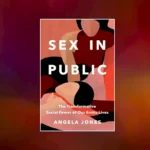
Other LitStack Spots We’ve spotted a few other titles we are adding to our TBR…
The post Spotlight on “Sex in Public” by Angela Jones appeared first on LitStack.
Categories: Fantasy Books
Monday Meows
GUYS GUYS GUYS COME HERE QUICK AND LOOK

That’s it, I’m out.

You scared away my lunch!

I think it was more likely to eat you, to be honest.

He has a point.

I could take it.

Categories: Authors
Pages

Recent comments