
Feed aggregator
Novella Review – Kirkyards & Kindness (A Rip Through Time, Book 4.5) by Kelley Armstrong (4/5 stars)

Reading Level: Adult
Genre: Time Travel/Historical Fiction/Mystery
Length: 158 pages
Publisher: K.L.A Fricke Inc
Release Date: December 2, 2025
ASIN: B0F8YP6JWM
Stand Alone or Series: 4.5th book in the A Rip Through Time series
Source: Borrowed ebook from Library
Rating: 4/5 stars
“A year ago, twenty-first-century detective Mallory found herself in 1869 Edinburgh, in the body of Catriona Mitchell, a housemade working for Dr. Duncan Gray, pioneer in forensic science. Shortly after she arrived, she made the unfortunate acquaintence of Catriona’s former criminal mentor, Davina, an entanglement that nearly got Mallory killed. Now she’s about to meet Davina again.
Greyfriars Bobby has disappeared. The little terrier is already a legend, and Davina has made a tidy living showing him off on graveyard tours…while picking the pockets of her guests. When the elderly dog vanishes, Davina calls in a favor from her old student. Mallory agrees to help find Bobby in return for the one thing she’s been unable to get from Davina—the mysterious Catriona’s life story.”
Series Info/Source: This is a novella in the A Rip Through Time series and takes place after book Book 4 of that series. I borrowed a copy of this on ebook from the library.
Thoughts: This was a decent novella. This is set after Book 4 in the series and focuses on the disappearance of a famous dog named Greyfriars Bobby. While nothing super exciting happens, this was a well-done mystery and I enjoyed it.
This story brings in some additional aspects of Catriona’s past as one of Catriona’s “friends” Davina who is upset about Greyfriars’ disappearance because she was making money off of using the dog as part of her graveyard tour. The story focuses around the disappearance of this dog and Mallory (in Catriona’s body) working to solve this mystery. We do get a bit more character development both around Mallory and Duncan’s relationship and by learning more about Catriona’s past. Some small progress is also made on Duncan’s sister’s relationship with policeman Creedy.
This was a well done and quick read. I enjoy the setting of Victorian Scotland and enjoy watching Mallory try to unravel Catriona’s past. The mystery was well done and cute and gave some incite into this time in history.
This would be an okay stand alone read, but I think you will enjoy it more if you have read previous books in this series.
My Summary (4/5): Overall I enjoyed this short jaunt, it is a cute and well done mystery. I continue to enjoy the setting and premise here and love the characters. We do get to learn more about Catriona’s past, which was fascinating. I think you will enjoy this more if you have read the previous books in the series. I would recommend this whole series to those who enjoy police procedurals that are set in a historic period (with some weird time travel stuff thrown in). This series does have a tad of romance, but it is more in the background.

Categories: Fantasy Books
Book Review: Sibylline by Melissa de la Cruz
I received a review copy from the publisher. This does not affect the contents of my review and all opinions are my own.
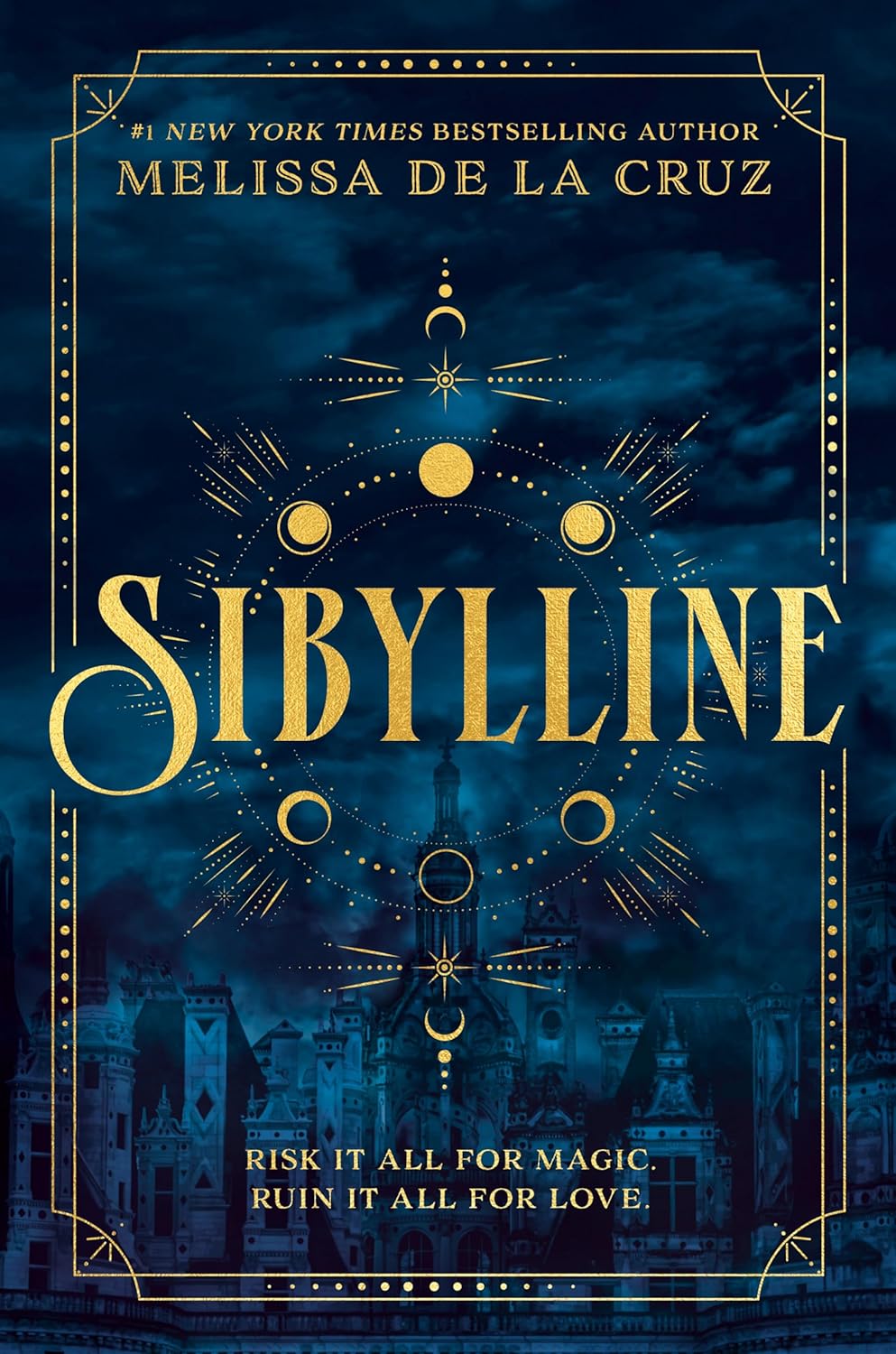 Sibylline by Melissa de la Cruz
Mogsy’s Rating: 2.5 of 5 stars
Genre: Fantasy, Romance
Series: Stand Alone
Publisher: G.P. Putnam’s Sons Books for Young Readers (February 3, 2026)
Length: 304 pages
Author Information: Website | Twitter
I find myself a little torn on my feelings for Sibylline by Melissa de la Cruz. I would say check it out if you’re a sucker for dark academia fantasy, but also be aware of the other major themes in the story. It doesn’t always seem to know what it wants to be, and in the end, that indecision is what dampens what could have been a much better read.
The story follows Atticus, Dorian, and Raven, three childhood friends with magical abilities who have always dreamed of attending the Sibylline school of magic together. However, when all three are sent rejection letters, they refuse to accept this as the end of the line and come up with a way to get inside the university anyway. After all, if they can’t enter as students, what’s stopping them from doing it as employees instead? After securing jobs as a professor assistant, a lab aide, and a library worker, the three begin sneaking into lectures, secretly auditing classes, and stealing access to restricted books. By slowly piecing together a magical education through unofficial means, they hope to better understand their own powers, which seem to grow stronger the longer they spend time on campus.
But their underground efforts soon uncover something rotten at the heart of Sibylline. Ancient magic stirring beneath its grand halls and rumors of a student’s mysterious death hint at a threat that may be tied to the very foundation of the school. As the trio are drawn deeper into their investigation, long-standing feelings and unspoken attractions between them also begin to surface, causing no small amount of friction within their relationship. Caught between keeping their heads down and confronting a danger they barely understand, Raven, Atticus, and Dorian must decide how far they’re willing to go for magic, even if it might tear their friendship apart.
While the premise holds a lot of potential with a setup that is undeniably fun, the execution doesn’t quite hold together. Just when the plot feels like it’s settling into a dark magic school mystery with just a sprinkling of romantic tension, it takes a sharp turn toward emotional angst to become a full-blown relationship drama—and one that is messy and distracting as hell at that. Of course, this was before I realized, at its core, Sibylline is actually a throuple romance. The sexual tensions burning between our three protagonists aren’t part of a supplementary side story running alongside the main narrative as I’d initially thought, but they are in fact THE main focus.
As you can imagine, the dark academia aspects and even the central mystery surrounding the school itself often take a backseat to entire chapters spent belaboring who is in love with whom. For those keeping track, Raven has been quietly pining for Atticus since they were children, but Atticus is in fact secretly love with Dorian, while for years Dorian has been carrying a torch for Raven. The tragedy is that all three are deeply invested in the wrong person, with none of their feelings fully returned. Cue the jealousies, hurt feelings, and overall an exhausting amount of mental turmoil born of unrequited love.
The result is that the mystery and horror elements get pushed out just as they’re starting to become interesting. This lack of balance is especially noticeable when the characters’ actual investigation is frequently interrupted by long stretches focused on their emotional spiraling, bringing the pace to a crawl. The shift feels even more jarring if you went into this novel expecting a very different kind of story, or even one aimed at a different age group. It’s interesting to note that Sibylline is published under a YA imprint, but it feels like it should be categorized as New Adult, given its mature themes and a sexually explicit threesome scene near the end that makes it less appropriate for younger teen readers.
In the end, Sibylline feels like a book full of good ideas that never quite come together. To be fair though, I wasn’t at all prepared for the primary focus of the story to be an overwrought and emotionally complicated three-way romance, but readers who are into that kind of dynamic will likely get way more out of this one than I did.


Categories: Fantasy Books
O&V Recap, hardcover sale, ARCs, and other news
As the time draws closer for the Wrath & Desire book release, I've prepared a refresher for readers so they can dive back into the Realm of Zadrya world more easily. In this post, you'll also find details on a hardcover sale for Oaths & Vengeance, updates on ARCs, and other news.
Categories: Authors
Early Review – Operation Bounce House by Matt Dinniman (3/5 stars)

Reading Level: Adult
Genre: Science Fiction
Length: 448 pages
Publisher: Ace
Release Date: February 10, 2026
ASIN: B0F88XYTZF
Stand Alone or Series: Stand Alone
Source: eGalley from Netgalley
Rating: 3/5 stars
“All colonist Oliver Lewis ever wanted to do was run the family ranch with his sister, maybe play a gig or two with his band, and keep his family’s aging fleet of intelligent agriculture bots ticking as long as possible. He figures it will be a good thing when the transfer gate finally opens all the way and restores instant travel and full communication between Earth and his planet, New Sonora. But there’s a complication.
Even though the settlers were promised they’d be left in peace, Earth’s government now has other plans. The colossal Apex Industries is hired to commence an “eviction action.” But maximizing profits will always be Apex’s number one priority. Why spend money printing and deploying AI soldiers when they can turn it into a game? Why not charge bored Earthers for the opportunity to design their own war machines and remotely pilot them from the comfort of their homes?
The game is called Operation Bounce House.
Oliver and his friends soon find themselves fighting for their lives against machines piloted by gamers who’ve paid a premium for the privilege. With the help of an old book from his grandfather and a bucket of rusty parts, Oliver is determined to defend the only home he’s ever known.”
Series Info/Source: This is a stand alone book. I got a copy of this on ebook from NetGalley from review.
Thoughts: I am a huge fan of the DCC series, so I was super excited to see Dinniman coming out with another book. I have also read Kaiju: Battlefield Surgeon, which I thought was okay but not great. This book is fairly different from either DCC or Kaiju; I thought it was okay but had some pretty big issues with it.
The premise here is that humans have colonized on different planets; on New Sonora they are mainly farmers. There is a lot of excitement when the gate is finally connected to Earth; this will allow easy travel between New Sonora and Earth. Unfortunately that is also when the strange battlemechs start showing up to decimate the population of New Sonora.
This is fast paced and reads fine. Dinniman can tend to spend a lot of time explaining mechanics and this book does suffer some from that. I struggled with the premise because it felt like is a mash up of a lot of sci-fi themes that have been overdone (Earth wiping out a settlement planet, gamers as soldiers, etc).
I had two main issues with this book. The first is that it just doesn’t have the humor of DCC, I mean it is a pretty serious situation but so is the situation Carl is in in DCC and this book doesn’t have much humor at all. Any humor it does have is a kind of teenage sexual humor that missed the mark for me.
The second issue is the characters. There are a lot of them introduced quickly, and all of them (except for maybe Oliver’s sister), feel very interchangeable. Oliver, the main character, doesn’t feel like a main character at all. For the majority of the story things just happen to him. Oliver’s super vanilla and seemed to be along for the ride. The only good character in here is Roger the AI; he is actually occasionally funny and has quite the agenda.
I also didn’t love the ending. It felt super rushed and unfinished. It had this very overdone theme of humanity making circular errors in judgment. I both felt like I didn’t get closure around what happened with the characters on New Sonora and that I wasn’t exactly sure what was happening on Earth.
My Summary (3/5): Overall this is okay and I finished it. However, I almost stopped reading it multiple times because I just didn’t like the premise or the characters. I kept hoping it would get better but it really didn’t. It was fine if you are looking for a sci-fi romp with a lot of mech battle type fights and don’t care if the story doesn’t have a lot of depth.

Categories: Fantasy Books
Book Review: Songbird of the Sorrows by Braidee Otto
I received a review copy from the publisher. This does not affect the contents of my review and all opinions are my own.
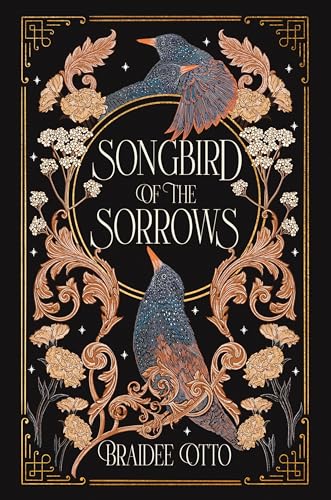 Songbird of the Sorrows by Braidee Otto
Mogsy’s Rating: 3.5 of 5 stars
Genre: Romance, Fantasy
Series: Book 1 of Myths of the Empyrieos
Publisher: The Dial Press (February 3, 2026)
Length: 400 pages
Author Information: Website
Even if you’re just a casual reader of YA or New Adult romantasy, I think Songbird of the Sorrows by Braidee Otto will instantly feel familiar. You have your secret princess, a shadowy network of spies, and a dangerous mission that places the protagonist in a “last one standing” style competition against others. It’s the kind of setup that immediately signals the types of tropes this story is interested in exploring.
The novel follows Aella, a king’s daughter cast out of the palace at a young age and raised instead in the Aviary, a school for orphans which is in fact a front for an organization that trains its students to become covert operatives for the Empyrieos. After completing years of training, successful graduates of the program are given new identities and code names inspired by birds. For example, when Aella finally earns her place among the full-fledged members, she takes the name of Starling and is given her first major assignment as part of the Aviary’s elite unit, Alpha Flight.
This mission sends her straight into enemy territory under the guise of competing in the bridal trials hosted by the Prince of Eretria to choose his future queen. Having been born a princess, Aella already possesses many of the skills expected of a highborn lady thanks to her early palace upbringing, making her return to the role of Princess of the Sorrows a natural fit. Combined with the spycraft and combat training she received at the Aviary, she becomes a serious contender in the trials. Beneath all the spectacle, however, Alpha Flight’s true objective is to gather intelligence and support a larger operation led by Raven, a senior agent with whom Aella shares a complicated past—one that only heightens the tension as she struggles to maintain her cover and survive the cruel prince’s dangerous games at court.
As the story unfolds, Aella is pulled in several directions at once. It doesn’t help that the bridal trials themselves function less as a The Bachelor style competition and more as a backdrop for political maneuvering and espionage. Unfortunately, the biggest hurdle for me was the journey it took to this point where hints are finally revealed about the larger power struggles beneath the surface. To put bluntly, the first half of the novel is a collection of clichés, from the emotional blackmail that drives Aella to perform her task to the absolute cringiness of a group of ladies competing for the hand of a prince. For one, Aella is threatened with her beloved friend’s death should she fail, and this is one device that has always bothered me. Our protagonist is clearly capable, but the story takes a while to let her feel like she’s acting for herself rather than being pushed from one obligation to the next.
The good news is, things improve drastically in the back half of the book. Once the groundwork is out of the way, the plot becomes more engaging and less predictable. Secondary characters start to stand out, the suspense surrounding the court intrigue sharpens, with the broader implications of Alpha Flight’s mission becoming clearer. The focus turns towards unpacking the secrets, while the big yikes situation between the bridal competitors begins to develop real momentum beyond banal pageantry. By the final page, the author has delivered an ending that hooks the readers and makes the larger series feel worth sticking with.
On a final note though, the writing tends to be on the purple side, and it didn’t surprise me to find out that Songbird of the Sorrows is a debut. On top of the plot being very ambitious and occasionally frazzled, at times the prose feels overwritten with “first novel” energy—as in just a tad too excessive with the flowery metaphors. Hopefully, that will soon turn into a cleaner style with Braidee Otto’s later books because I can see a lot of potential in this series. As a first installment, this is a solid if uneven start, but it’s also a beginning that hints at a stronger follow-up down the line!

Categories: Fantasy Books
Stinger in Arabic
 Arabic publisher Aser Al-Kotob has just acquired the Arabic translation rights for Robert McCammon’s Stinger. The deal just happened, so there is no additional information at this time. This will be the first Robert McCammon novel translated into Arabic.
Update 2026-02-10: Aser Al-Kotob has created a “Coming soon” page for their edition of Stinger:
Categories: Authors
Writers! Do We Have Advice For You!
Dean Wesley Smith, one of the most influential voices in indie publishing, has updated his most essential writing books for 2026. Through our Kickstarter, which just launched, get all four ebooks for $20, and, if we hit our stretch goals, receive hundreds in online writing workshops as well.
You can also opt for four of my books on writing as a reward.
Lots of learning here, and all at a discount. But the Kickstarter won’t last forever, so order your copies now.
Categories: Authors
Polish edition of The Providence Rider coming this month!
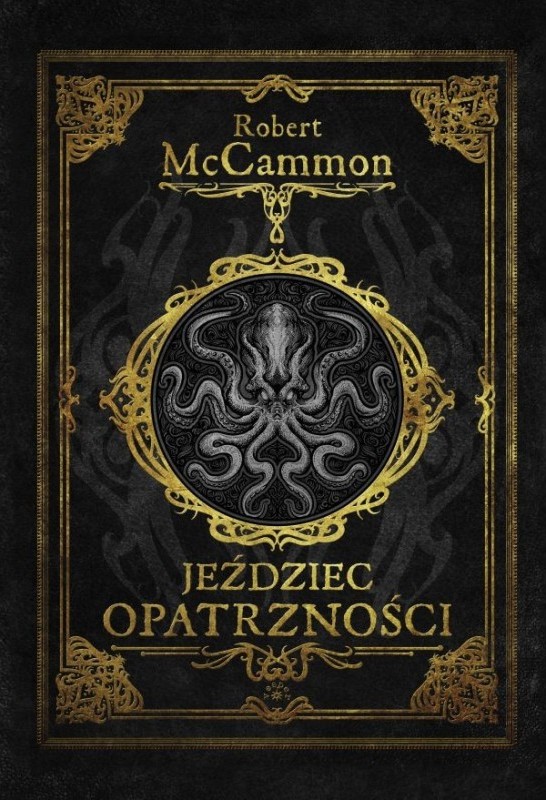
Polish publisher Vesper has revealed the cover for Jeździec opatrzności, their translation of Robert McCammon’s The Providence Rider, due for release on February 18, 2026! The cover art is by Krzysztof Wroński. The book can be pre-odered now from Polish booksellers.
Jeździec opatrzności at Vesper.pl
Categories: Authors
Monday Meows
Please sir, do not put my laundry in the machine. It’s done no harm.
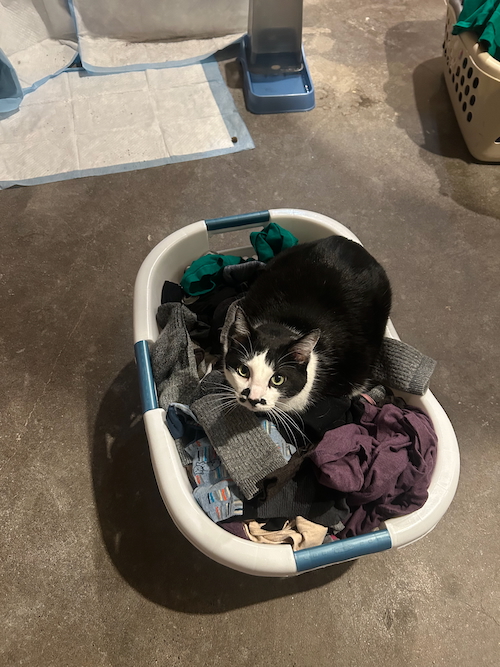
Why is he protecting the laundry?

You REALLY don’t want to know.
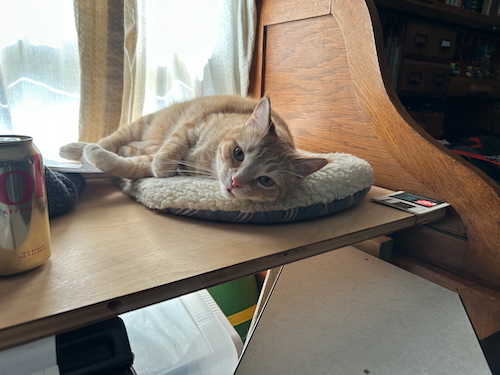
My favorite blanket is in there. I call her…Eileen.

That is so not okay.
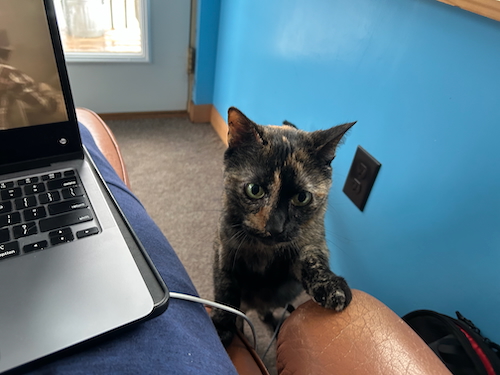
You hadda ask.

Hey now, don’t kink shame.

Categories: Authors
SPFBO XI - The First Update

The time has come to make choices. Not always comfortable, not always happy for all concerned, but such is the nature of this bloodbath competition.
FBC Judging Process
Our judging process is straightforward. Each of the five judges is assigned (randomly) six books and can select one of them as a semi-finalist. We then evaluate each other's semi-finalists and assign ratings. The book that receives the highest score is chosen as the finalist.
Each judge determines their own approach to reading their set of six books. This year, I made sure to read a minimum of 25% of the books assigned to me.
If you're interested, a few words about my preferences. I love genre-bending books and character-driven stories. I love good pulp fiction, too. My pet peeves include unnecessary wordiness, redundancy, and blocks of exposition (I don't care about the world or magic if you won't hook me with your voice or make me care for characters, first).
Before I wrap things up, I want to emphasize that SPFBO's main strength and addictive nature lies in the wonderful community and process of discovering and discussing books. Submitting your book to a contest takes courage, and I applaud all of you for doing so.
Getting involved in the community is one of the best things any self-published author can do. I encourage you all to follow the contest and engage with bloggers and other authors regardless of the outcome of this round of cuts. I hope my mini-reviews will allow potential readers to pick books that may appeal to them.
Here is our first batch of six books (in alphabetical order). Let's take a closer look at each of them.

Amoran by Debra KoelherPublished August 28, 2025; 424 pages (Kindle edition)Genre: Romantic Fantasy, Portal Fantasy
Amoran was a nice surprise. It’s very readable from the first chapter. Kerrin Scott is juggling work, marriage, kids, deadlines, and mild existential dissatisfaction when a strange pink letter appears in her house and refuses to be either read or ignored. Soon after, a grumpy dwarf-like guardian shows up, followed by elves, vortexes, and the revelation that Kerrin is far more important to the fate of two worlds than her calendar currently allows.
Kerrin lands on Amoran, a strange, colorful world tied to ours through an energy vortex that is slowly destabilizing. If the vortex collapses, both worlds are done. Not ideal. The complication is that Kerrin was supposed to remember who she really is, and due to an unfortunate toilet-related incident, she doesn’t. The rest of the story builds around that missing knowledge, Kerrin's training and light romantic tension. All with a touch of humor. Well, actually, more than a touch.
Humor is everywhere. Sometimes a bit too much. The jokes are good-natured, in character, and generally pleasant. They fit Kerrin’s voice and never feel out of place, but they tend to pile up. Moments often go like this: something happens, Kerrin reacts, explains why it matters, reassures herself, then cracks a joke. As a result, scenes last longer than they need to, emotions are explained, and internal monologue often repeats what the scene already showed.
Anyway, this is clearly meant to be a feel-good portal fantasy. Stakes exist, but they’re softened by humor and reassurance. Nothing feels truly threatening, and the tension comes more from logistics and timing than from genuine unpredictability. Readers looking for a fun, comforting story with an enjoyable heroine, a warm tone, and light romantic tension will likely have a great time here.
That’s ultimately where Amoran lands. It’s competent, comforting, and easy to sink into, but it doesn’t push hard against its genre boundaries. The tension comes more from logistics and timing than from genuine unpredictability.
Overall, Amoran is a smooth, accessible start to a fun portal fantasy series that cares more about readability than innovation. If you like gentle humor, likable heroines, and fantastical world, you'll enjoy this one.
.jpg)
A Sharper, More Lasting Pain by Alex Harvey-RivasPublished November 1, 2024; 282 pages (Kindle Edition)Genre: Dark Fantasy Horror
A Sharper, More Lasting Pain is dark, explicit, and emotionally heavy. It’s also clearly written by someone who knows what they’re doing.
The characters carry the book. Simone is controlled and distant, while Nadia is sharp-tongued, self-destructive, and spiraling, but never written as helpless. Their relationship is intense and unhealthy, and often uncomfortable. The supporting cast (Etienne, Chantal, Luc) feels functional, not just there to fill space.
I mostly liked the writing, which is confident and effective. With one caveat - it doesn’t know when to stop. Metaphors stack up, emotions get spelled out, and scenes sometimes end past the point where they’ve made their impact. For a book this short, it drags more than it should.
Structurally, the story overpromises. The prologue hints at something bigger ( monsters, dangerous research, deeper magic), but what follows is a very narrow, character-focused story set almost entirely in one place. A dark-academia mystery teases itself into existence and then mostly refuses to develop. Many of the more interesting ideas are introduced and left untouched.
Basically, this is a tragic sapphic romance about illness, addiction, and self-destruction, and that part works. Everything around it feels underdeveloped by comparison.
Worth reading if you’re here for characters and atmosphere. Less so if you want plot momentum, mystery payoffs, or world-building that actually goes somewhere.
.jpg)
Empire of Ash and Blood by Matthew ThompsonPublished January 13, 2025; 433 pages (Kindle Edition)Genre: dark science-fiction dystopia
This is an ambitious, angry book. It follows Matias, a long-lived bloodman who has suffered deeply and wants you to understand exactly how and why.
Matias is bitter, thoughtful, and shaped by loss. His relationships show how faith, violence, and love pull him in opposite directions. The plot sounds great on paper, since it contains escape, rebellion, forbidden relationships, and the looming threat of imperial power. Sometimes, it works well, sometimes it has a serious self-control problem.
The novel, you see, explains everything. Then explains it again. Then pauses to make sure you understood the moral implications. In other words, there are moments when backstory overwhelms forward motion. Whole sections feel like they exist because the author didn’t want to let them go, not because the story needed them right then. And so the book feels longer than it needs to be and heavier than it has to be.
Still, there’s no denying the commitment here. Empire of Ash and Blood makes a serious statement about power, freedom, and who gets to define monstrosity. Whether it succeeds will depend on how much patience you have for monologues, ideology, and backstories.
.jpg)
Life Remains by Niranjan K.Published September 16, 2021 ; 202 pages (Kindle Edition)Genre: Romantic Urban Fantasy
Life Remains does almost everything right, even though its portrayal of vampires is far away from what I prefer. I like vampires to be about death. These ones walk in daylight, eat normal food, run society, and spend a lot of time talking about coexistence.
The story follows several connected threads. Mabel, whose parents were killed by vampires, is forced to live under the protection of Frederick, one of their leaders. Ken, a human hunter (and Frederick’s lover), tries to help people without starting a war. Luke and Clint are two boys caught in the middle, owned by vampires who decide their fate without asking. Secrets, latent powers, old connections, and shifting loyalties slowly push everyone toward conflict even though most of them would really prefer to avoid one.
From a craft perspective, there’s little to complain about. The book is well paced, clearly structured, and easy to read. The chapters move quickly, action scenes are clean and understandable, and the story never gets bogged down in exposition. Characterization is solid across the board.
That said, the plot rarely surprises. The intrigue is competent but most twists are easy to see coming. If you’re waiting for a moment that genuinely changes the game, it never arrives.
Overall, Life Remains is a well-written, dark urban fantasy with vampires who are more interested in control, politics, and relationships than blood and death. To be fair, they don't experience emotions the way people do. A good pick if you want a smooth, fast read and don’t mind your vampires being civilized.
.jpg)
Pilgrim by Mitchell LüthiPublished October 31, 2023; 693 pages (Kindle Edition)Genre: Dark Fantasy / Horror / Medieval
As a fan of dark fantasy and cosmic horror, I was stoked to check this one out. And it delivered.
Pilgrim is set in 12th-century Jerusalem, at the tail end of the Crusades. Dietmar, a broke and grieving German knight, is hired to smuggle a holy relic back to Europe. That’s the plan, anyway. Instead, a sandstorm drops him and his companions into a nightmare road trip through lost cities, ancient gods, and places that feel fundamentally wrong.
I can't imagine the amount of research that went into it. Lüthi is clearly a scholar, and it shows. Pilgrim pulls from Christian, Islamic, Arabic, and pre-Christian traditions and smashes them together.
The vibe is bleak. Monsters show up often, but the real horror is existential and theological. It shows faith breaking down, reality bending, and the sense that God might not be what anyone thinks He is. Any moment of safety gets erased fast and hope is in short supply by design.
That said, it’s long. Like, 700 pages long. And you feel it. The structure starts to repeat: arrive somewhere strange, encounter a horrifying mythological entity, people die horribly, survivors move on, repeat. Not every encounter feels necessary, and some conversations circle the same questions about faith and evil without really moving things forward. I liked the ideas being explored, but there were stretches where it felt like a lot of words to cover familiar ground.
The characters are interesting, but not always fully developed. Dietmar’s grief and guilt drive the story, but his motivations feel a bit muddy. Razin, on the other hand, is fantastic. Lüthi’s knowledge of Islamic philosophy really shines through him. Still, it can be frustrating that Razin, who clearly understands more than anyone, constantly withholds insight. I get that uncertainty is a theme here, but sometimes I just wanted someone to try and put the pieces together on the page and for people to communicate.
Pilgrim has issues. It’s too long. It repeats itself and drags in the middle. It could’ve been tighter. But it’s also bold, deeply researched, and unique. I’m really glad I read it, and I’ll absolutely be checking out more from Lüthi.

Reflections of Lilje Damselfly by Natalie KeldaPublished June 23, 2025; 219 pages (Kindle Edition)Genre: Romantic Fantasy
Reflections of Lilje Damselfly has a solid idea. Lilje is a water nymph suffering from a chronic illness and constant pain. Her father sends her to an Edwardian spa retreat to live among humans and, hopefully, get better. This means learning human customs, clothing (important), and social norms. Some of this is played for gentle humor, and it mostly works.
Lilje is a likable protagonist. Her illness forces her to leave her family and familiar surroundings, and that sense of loss comes through. The book takes a warm, affirming approach to disability and chronic pain, and despite the subject matter, the overall tone stays light and comforting. There’s also a sapphic romance, which develops without much melodrama (well, there's just a bit of it). This is very much a feel-good story.
Unfortunately, the execution didn’t work for me. The stakes are close to non-existent, and there’s no real urgency to the plot. Things happen, but rarely feel like they matter much. The characters are pleasant but shallow, and most of them don’t develop beyond a single defining trait. Even at just over 200 pages, the book feels over-written*. There’s a lot of description, a lot of explanation, and very little momentum.
I understand the story is, above all, about coping with disability and it can be therapeutical. With that said, I wasn't impressed by writing about disability. Lilje tells us she’s in pain. Often. But we rarely feel it through the scenes themselves. Combined with the slow pacing, this made the reading experience feel flat.
If you’re looking for an easy, cozy read with a warm take on disability, self-acceptance, and finding love despite hardship and illness, this might work for you. If you’re hoping for tension, depth, or a tighter plotting, it probably won’t.
* After checking GR reviews, I'm definitely in the minority. Most readers loved lyrical writing.
*---------------*---------------*---------------*
Verdict
The books in my batch were solid, but, being perfectly honest, only one impressed me. So, without further ado, our first semi-finalist is:
.jpg)
Pilgrim by Mitchell Luthi. Congratulations to Mitchell Luthi and commiserations to the fallen.
Categories: Fantasy Books
Cape Fever
1920: Nineteen-year-old Soraya, an intelligent and sensitive Muslim girl, takes a job as maid and cook for Mrs. Hattingh in an unnamed colonial harbor city after the Great War. Mrs. Hattingh’s son still resides in England after his war service and, despite her busy life full of good works, Mrs. Hattingh lives alone in some isolation. As Soraya begins her service as a live-in maid, she also encounters a mysterious grey woman, a spirit in the house only she can sense. At length, Soraya’s employer—unaware that Soraya is literate—offers to write weekly letters to Soraya’s fiancé. The two women, alone in the old decaying mansion, develop an oddly intertwined relationship, while her employer demands more of Soraya’s time, limiting her days off and opportunities to visit her beloved family.
This novel totally engrossed me; I devoured this book in one sitting. The writing is masterful and the complex characters hypnotically compelling. As the two women’s convoluted relationship deepens, dark secrets rise to consciousness. The story easily transcends the Gothic genre and makes for a memorable read—a tender and scathing meditation on power dynamics and human experience, on colonizer and colonized, and, more intimately, on two women thrown together by need and circumstance. Easily among the best books I’ve read this year, this book is highly recommended… a fantastic story!
The post Cape Fever appeared first on Historical Novel Society.
Categories: Fantasy Books
The Boy with the Jade
In 18th-century China, Baoyu is a child of privilege, heir to an important family of Chinese nobles. He is said to have been born with a jade pendant in his mouth and surrounded by luxury. His grandmother swears to this legend and tells him that as long as he wears the jade around his neck, he will have good luck. He is adored and pampered by his grandmother, but his father hates him, and he has no idea why. He prefers to avoid his father and spend his time with his brilliant and beautiful cousin Daiyu, with whom he quickly falls in love. But then a cruel beating, death, betrayal, and the loss of his jade lead Baoyu to look inward.
The descriptions in this novel, which is inspired by the Chinese novel Hong Lou Meng, are absolutely vivid, and written words spring to life: the opulence in which Baoyu lives, the privilege he enjoys, and the servants who meet his every physical need, with no exceptions, paint a lush but questionable picture of his young world. The evil is apparent too. The hatred his father has for him absolutely thumps across the page. A jealous half-brother hates him. Young Baoyu’s unchecked self-indulgence also has the potential for evil.
The reader is quickly immersed in Baoyu’s world, good and bad. The author’s extensive research and knowledge of Chinese folklore and customs, as well as Taoist, Confucian, Zhuangzian, Buddhist, and other teachings is apparent. Baoyu’s response to devastating loss and agony defines this whole book. The impact on this reader, from the vivid imagery combined with the depth of feeling portrayed by the author, was immense. Eye-opening, artful, exquisite, and painful, this is a journey of self-discovery that is not to be missed. Highly, highly recommended.
The post The Boy with the Jade appeared first on Historical Novel Society.
Categories: Fantasy Books
They Have Lightning Strikes Now!
This month has been one of the most eventful months in the history of Hidden Gnome! But I’m not allowed to talk about any of that, so I’m going to talk about Terraria.
Instead of letting you know about how we [REDACTED] to [REDACTED] for [REDACTED] number of penguins, I’ll instead tell you what I’ve been enjoying this week: the new Terraria update.
Terraria is one of my all-time favorite games, so whenever they release a new content patch, I do another playthrough with my friends.
This time, I’m running summoner, because they added a bunch of whips to the game. And whips, as we all know, are the summoner’s secret weapon.
Currently I’m roller-blading around the world, dressed as a butler for [REDACTED] reasons, with six summoned spiders crawling around to defend me. My whip is made of fire and makes enemies explode when my minions attack, and I have a pet treasure chest mimic with teeth that I can keep items in.
Truly this is the world we’ve always dreamed of.
-Will
P. S. When you hear our big news in the next few months, you can think back to this moment and know what I was talking about.
P. P. S. Also I’ve continued stitching Elder Empire together! That’s been fun.
P. P. P. S. Back to work on The Commander soon…very soon…assuming my jury duty next week doesn’t get out of hand.
P. P. P. P. S. Oh no, the jury duty is for a series of dragon rider murders. I might have to stick this one out.
Instead of letting you know about how we [REDACTED] to [REDACTED] for [REDACTED] number of penguins, I’ll instead tell you what I’ve been enjoying this week: the new Terraria update.
Terraria is one of my all-time favorite games, so whenever they release a new content patch, I do another playthrough with my friends.
This time, I’m running summoner, because they added a bunch of whips to the game. And whips, as we all know, are the summoner’s secret weapon.
Currently I’m roller-blading around the world, dressed as a butler for [REDACTED] reasons, with six summoned spiders crawling around to defend me. My whip is made of fire and makes enemies explode when my minions attack, and I have a pet treasure chest mimic with teeth that I can keep items in.
Truly this is the world we’ve always dreamed of.
-Will
P. S. When you hear our big news in the next few months, you can think back to this moment and know what I was talking about.
P. P. S. Also I’ve continued stitching Elder Empire together! That’s been fun.
P. P. P. S. Back to work on The Commander soon…very soon…assuming my jury duty next week doesn’t get out of hand.
P. P. P. P. S. Oh no, the jury duty is for a series of dragon rider murders. I might have to stick this one out.
Categories: Authors
My Top Thirty Films, Part 3
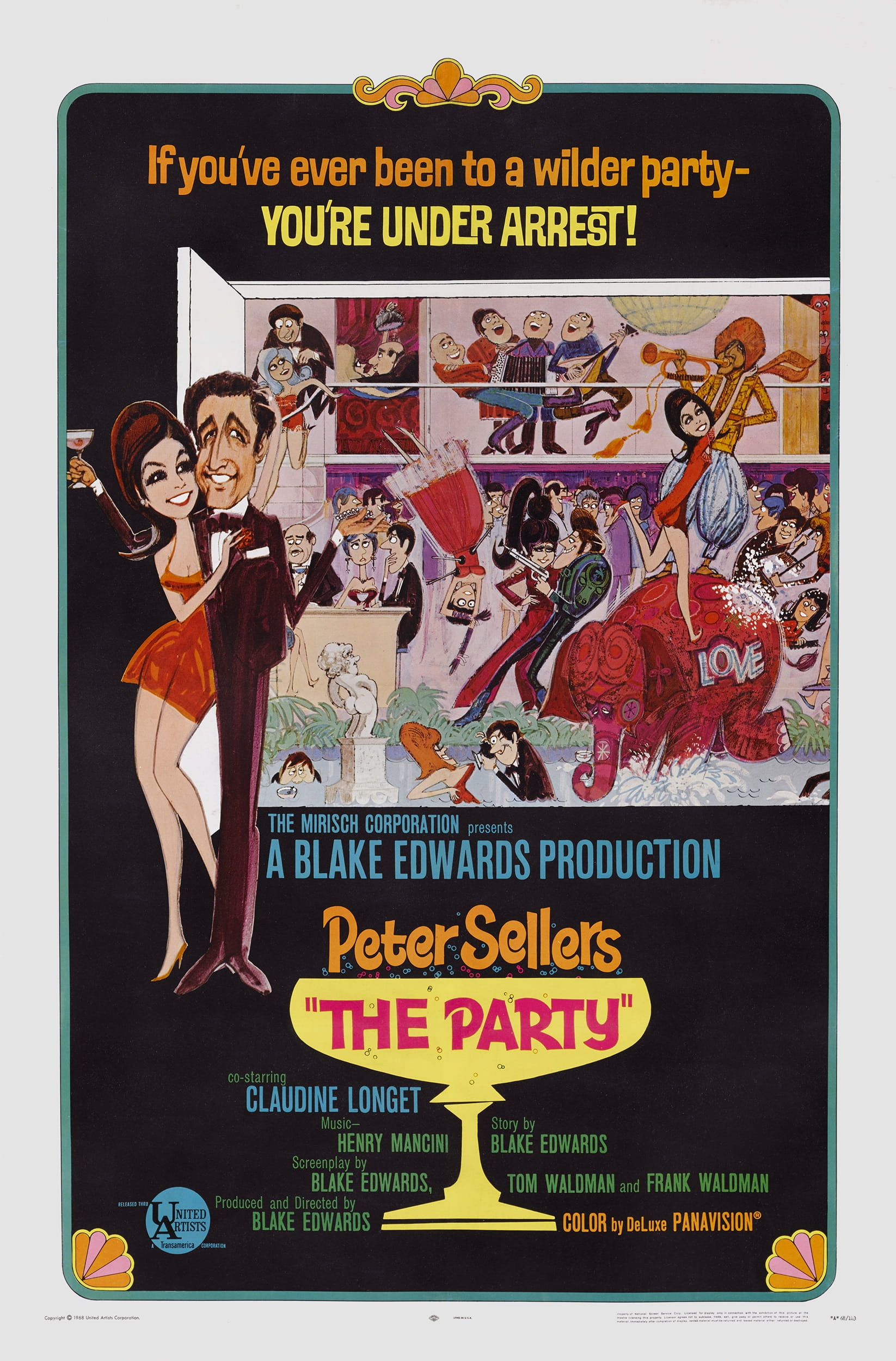 The Party (United Artists, April 4, 1968)
Following the excellent Starship Troopers feedback last week, here’s a selection that might be a little less controversial.
Kidding.
The Party (1968) Who’s in it?Peter Sellers, Claudine Longet, Steve Franken, Denny Miller
What’s it about?Hrundi V. Bakshi (Sellers) is an up and coming Indian actor who dreams of the big time. Unfortunately, being prone to mishaps leads to him blowing up a very expensive film set, and he is fired on the spot. Due to a clerical error though, he ends up on the guest list to a party being thrown by the film’s producer, and he attends in the hope that he can apologize in person. Through no fault of his own, Bakshi stumbles through one surreal incident after another, ultimately leading to the partial destruction of a Hollywood mansion, and a blossoming romance with a young French starlet.
Why do I love it?A perennial family favorite and endlessly quotable; “Birdie num num,” and “I would have been most disappointed if you had not crushed my hand,” are a couple that we use in any given situation.
Of course we should address the painted elephant in the room — Sellers is playing an Indian actor, complete with brown-face and head gestures, so incredibly taboo in this day and age, and there’s nothing I can say to defend it. I will venture one small snippet though with the fact that this film was a huge hit in India, and a favourite of the then PM, Indira Gandhi, who was prone to quote it herself. So there’s that.
Moving on, Sellers’ performance aside (he is, of course, Jacques Tati-inspired perfection), for me the star of this daft slice of celluloid is Steve Franken, who plays Levinson, the increasingly inebriated server. While Levinson is keeping the party guests lubricated, he is also secretly draining any leftovers he happens upon, and is soon three sheets to the wind. Franken’s physical comedy chops are on full display here as he staggers and weaves around the house, baffling guests and infuriating his boss who finally snaps and tries to throttle him in the kitchen, a tableau only revealed to us in a living triptych as the kitchen door swings open and shut during the struggle.
I can’t forget the beautiful score by Henry Mancini either, especially the dreamy song ‘Nothing to Lose’ wistfully sung by Longet at the midway point. A sheer delight.
 Sleeper (United Artists, December 17, 1973)
Sleeper (1973)
Who’s in it?
Sleeper (United Artists, December 17, 1973)
Sleeper (1973)
Who’s in it?
Woody Allen, Diane Keaton, Jon Beck, Don Keefer
What’s it about?Miles Monroe (Allen), a mild-mannered owner of a health food store, goes into hospital for a routine operation, which goes wrong. He is placed in a cryogenic chamber and forgotten about, only revived 200 years later when rebel scientists need an unidentifiable citizen to infiltrate the tyrannical government in an effort to bring down their ‘Leader.’ Monroe is forced to go on the run after the rebels are captured by the police state, and ends up entwined with socialite slacker, Luna Schlosser (Keaton). Through a series of misadventures they both end up back with the rebels, where Luna falls for the rebel leader, Erno (Beck). After accidentally foiling the government’s efforts to clone the Leader from his only remaining body part, his nose, Monroe and Luna go back on the run again, knowing that staying with the rebellion would only lead to more political power grabbing.
Why do I love it?Speaking of questionable films and filmmakers, if I found it hard to separate the artists from their art then I wouldn’t have read half the books I have, so I have no problem shoving a Woody Allen comedy onto this list.
Sleeper is one of a trio of his early films that I adore (the others being Bananas (1971) and Love and Death (1975)), and it’s the Allen film I return to time and time again. I’ve seen other reviews of Sleeper describe it as Allen’s most Chaplin or Keaton-like, and it’s hard to disagree. The physical comedy, running around, balancing on a ladder, certainly channels Buster Keaton at his best, and he reserves the Charlie Chaplin influence for close-ups to great effect, but it’s not all fighting off sentient puddings or slipping on genetically mutated banana peels. Allen peppers the script with his usual wry observations and self-deprecation and, as was his wont in the early films, usually ties it all back to sex (or lack of it).
It’s the physical comedy for me though; the hapless police and their useless weapons, the flying machine (which made me laugh like a drain when I contemplated him being stuck, rotating in a tree’s branches until the battery ran out), and the ‘Orgasmatron’ plus bonus ‘sex orb’. Diane Keaton showed what a brilliant comedian she was, holding her own in improvised scenes and perfecting the vacant stare, and Allen’s jazz soundtrack is to die for.
Also, did you ever realize that ‘God’ spelled backwards is ‘dog’?
 The Rocky Horror Picture Show (20th Century Fox, August 14, 1975)
The Rocky Horror Picture Show (1975)
Who’s in it?
The Rocky Horror Picture Show (20th Century Fox, August 14, 1975)
The Rocky Horror Picture Show (1975)
Who’s in it?
Richard O’Brien, Tim Curry, Susan Sarandon, Barry Bostwick
What’s it about?An innocent young couple, Janet Weiss (Sartandon) and Brad Majors (Bostwick) are on their way to their university professor’s home to celebrate their new engagement when their car suddenly breaks down in a terrible thunderstorm. They run to the closest house in the hopes of finding a phone, but this house is inhabited by an assortment of glorious weirdos who appear to be dedicated to partying and free sex. This throng is led by the fabulous Dr. Frank N. Furter (Curry), a transvestite scientist in the process of building the perfect man. As Brad and Janet try to survive the night, their innocence is shattered by the highly charged energy of the place, and they both undergo sexual awakenings thrust upon them by the aliens who run the place. Hijinks ensue.
Why do I love it?I’m not a fan of musicals, although I make an exception for this one (and Little Shop of Horrors (1986)), purely because everyone seems to be having a lovely time, and the lyrics are hilarious. I saw Rocky Horror in 1983 at a good age, 16, when teens are legally obliged to be discovering who they really are, and it turned out that I was a kid in love with Susan Sarandon who rather enjoyed wearing fancy clothes to the subsequent stage productions I took myself off to. Confusing times!
Still, the main reason I adore this film is, of course, Tim Curry. I had seen him as the Pirate King in The Pirates of Penzance one year earlier and his stage presence, let alone his astonishing voice, was still fresh in my mind. What a whiplash when I saw him not as an overtly rogueish ne’er-do-well, but as a maniacal, fragile, highly sexual ‘sweet transvestite.’ Cue more confusion for teenage me.
Curry is hypnotic, and as much as I enjoy all the preamble and set-up at the start of the film, when I watch his stomping high heel descending in the elevator I know I can finally settle in and let myself go with the flow. I watched it again recently after quite a break, and it truly felt like slipping on a comfortable old pair of fishnets. Ha! Take that, slippers. The songs were as fresh as ever (my personal favourite is the beautifully haunting ‘Over at the Frankenstein Place’), the frantic direction was energetic and subversive, and it still made me feel like I shouldn’t be watching it. Time to show my kids.
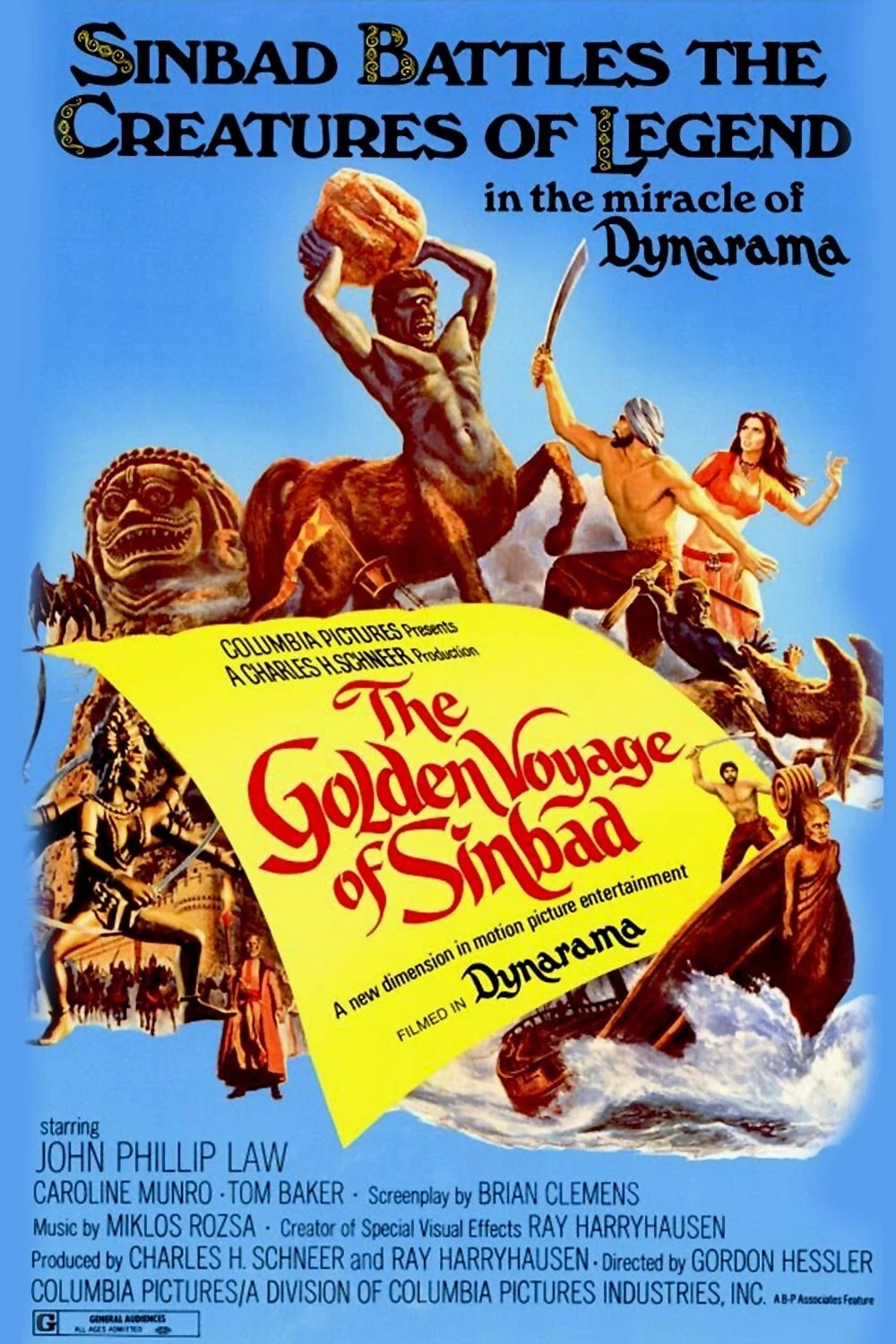 The Golden Voyage of Sinbad (Columbia Pictures, January 25, 1974)
The Golden Voyage of Sinbad (1973)
Who’s in it?
The Golden Voyage of Sinbad (Columbia Pictures, January 25, 1974)
The Golden Voyage of Sinbad (1973)
Who’s in it?
John Phillip Law, Caroline Munro, Tom Baker, Martin Shaw.
What’s it about?When Sinbad (Law) intercepts a homunculus messenger from the evil sorcerer Koura (Baker) it leads him to the Grand Vizir of Marabia, who requests Sinbad’s help in stopping Koura from acquiring the three pieces of a golden artifact that will lead the owner to the Fountain of Destiny and provide them with immortality, invisibility, and riches. A servant girl, Margiana (Munro), joins them on this quest, as she was born with the mark of an eye on her palm, which seems connected to the artifact. So off they sail, encountering several Harryhausen beasties along the way, in an effort to defeat Koura, protect the kingdom of Marabia, and uncover the secret of the eye.
Why do I love it?Two of the films on this list of thirty are true comfort films for me (you’ll meet the other in the final spot) — films that feel like old friends, always there to cheer me up when I’m down, or distract me when I’m sick. Like any sensible child, I adored all of the films that featured Harryhausen’s wizardry, but this one is my absolute favorite, due to arguably his best bit of stop-motion, Kali (yes, I’m putting her over Jason’s skeletons), and then there’s the little rubbery homunculus, the wooden ship figurehead (the sound design here is fantastic, all squeaks and splinters), and a battle royal between a cyclopean centaur and a (sadly underused) griffin.
Golden Voyage has the best cast of any of the films. Law is a fantastic Sinbad, masculine, respectful, wily, and he is ably supported by a crew that is not just there as fodder for monsters. Shaw’s Rachid feels like a true shipmate, you get the sense they have seen a lot together, and he acts as the voice of reason to Sinbad’s whims. Then there’s Tom Baker’s tortured turn as Koura, all wild eyes and gnashing teeth. Baker sells it in his usual extravagant manner, but never takes it too far, and then we have Caroline Munro. Good lord. I recently made a list of all of my comfort films from every genre, and Munro appears in seven out of twenty of them! I’m sure it’s just a coincidence.
Fun fact: that weird, goat-faced oracle that Sinbad and his chums confront in the temple well? That’s an uncredited Robert Shaw.
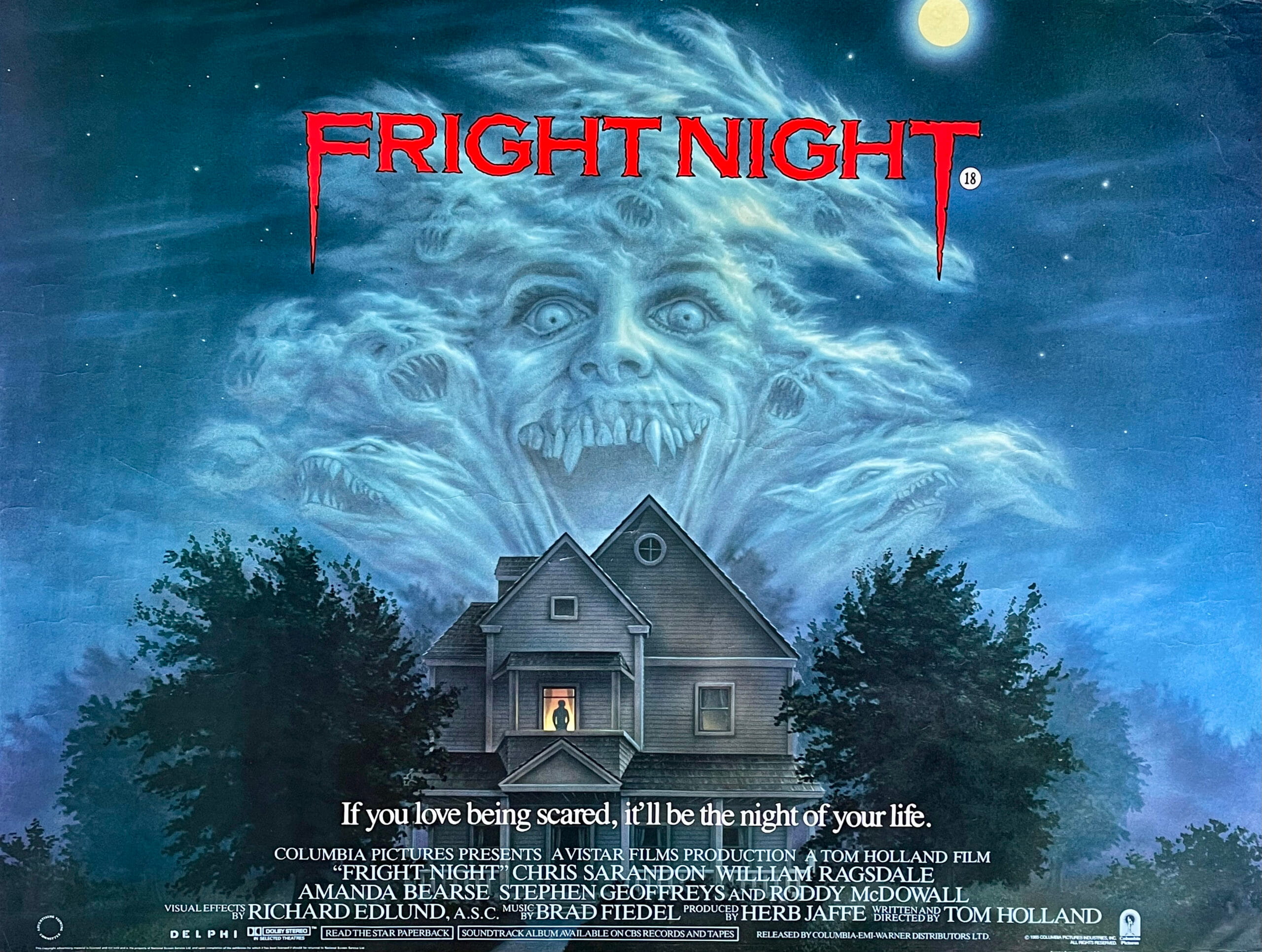 Fright Night (Columbia Pictures, August 2, 1985)
Fright Night (1985)
Who’s in it?
Fright Night (Columbia Pictures, August 2, 1985)
Fright Night (1985)
Who’s in it?
Chris Sarandon, Roddy McDowell, William Ragsdale, Amanda Bearse
What’s it about?Charlie Brewster (Ragsdale) is a horror nut, obsessed with a cheesy TV show that features old horror flicks, introduced by second-rate actor Peter Vincent (McDowell). When he suspects that a vampire (Sarandon) has moved in next door, Charlie eventually recruits Vincent to help him eradicate the monster before it can put the moves on Charlie’s girlfriend, Amy (Bearse). Armed with an encyclopedic knowledge of vampire lore, and some hokey slayer tools, Charlie and Vincent enter the vampire’s lair, ill-prepared and unready to face the monsters within.
Why do I love it?I was at art college when this was released, and had a best friend who was as heavily into horror films as I. We had a mutual love for Hammer and Amicus, hosted regular video parties, and used college resources to practice make up effects. Our first love however was vampire flicks, and every teased image from Fright Night just whetted our appetites even more. Plus, it featured Roddy McDowell, and as huge Planet of the Apes fans, we would watch anything he was in.
The film was playing for one week in the cinema closest to the college, The State Cinema, a 1930’s picture house complete with a wurlitzer organ and scary ticket booth lady. We went to see the film every night that week, steeping ourselves in its gently humorous lore and seductive undertones, to the point that we scared ourselves stupid one night when some leaves rustled in the cemetery we had to walk through to get to the train station. Ah, happy times.
Everything about this film hits the spot; Brad Fiedel’s aggressively boppy score, McDowell’s cowardly custard actor and his redemption arc, Charlie Brewster being a horror freak ‘just like us,’ and the gnarly, blood soaked effects. However, the film belongs to Chris Sarandon. I would argue that there has never been a sexier vampire than his portrayal of Jerry Dandrige. Every word, every move, is precise and effortless (until he gets thoroughly miffed at the end), and he oozes sexual confidence, whether cozying up to his live-in familiar, Billy Cole, or ensnaring Charlie’s girlfriend, Amy, in his nightclub sweater.
The make up and creature effects, headed by Steve Johnson, also make me extremely happy, and this was at a time when we were spoiled for vampire prosthetics (see The Lost Boys (1986), Vamp (1987), Lifeforce (1985) et al). At once hilarious and horrifying, the plethora of creatures on show, vampires, giant bats, an almost cute werewolf, look great and are filmed with appropriate energy by horror legend Tom Holland.
Another one to finally show my kids.
Previous Murky Movie surveys from Neil Baker include:
My Top Thirty Films, Part 1
My Top Thirty Films, Part 2
The Star Warses
Just When You Thought It Was Safe
Tech Tok
The Weyland-Yutaniverse
Foreign Bodies
Mummy Issues
Ch-Ch-Ch-Ch-Changes
Monster Mayhem
It’s All Rather Hit-or-Mythos
You Can’t Handle the Tooth
Tubi Dive
What Possessed You?
See all of Neil Baker’s Black Gate film reviews here. Neil spends his days watching dodgy movies, most of them terrible, in the hope that you might be inspired to watch them too. He is often asked why he doesn’t watch ‘proper’ films, and he honestly doesn’t have a good answer. He is an author, illustrator, teacher, and sculptor of turtle exhibits.
Categories: Fantasy Books
You’ll Love “The Magicians Trilogy” | School Of Hard Knocks (And Spells)
The post You’ll Love “The Magicians Trilogy” | School Of Hard Knocks (And Spells) appeared first on LitStack.
Categories: Fantasy Books
Wrath & Desire pre-order incentive giveaway
Check out this post for the Wrath & Desire pre-order incentive giveaway.
Categories: Authors
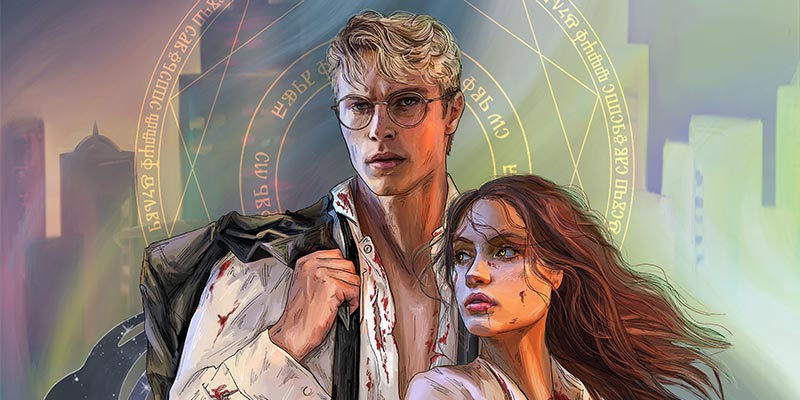
Happy Book Birthday to BEAST BUSINESS
 STANDARD VISITOR NOTICE
You are leaving the comfort of a magic-free existence and entering a world shaped by powerful Houses. These dynasties control corporations, command private armies, and enforce their own rules. Their rivalries are long-standing, their resources vast, and their disputes often deadly.
Some magic talents destroy. Some deceive. None should be underestimated.
House Andrews is responsible for maintaining order and providing this advisory. By continuing, you acknowledge that House Andrews cannot be held liable for any squeeing, urgent sequel sensations or sudden appreciation for Illusion Primes that may occur. If this is your first visit, proceed at your own risk and do not accept experimental serums from anyone.
Welcome to Hidden Legacy!
BUY DIRECTLY FROM USThe Ilona Andrews store supports purchases from US, UK, AUS, and the EU – for now.
Or from your favorite retailers:




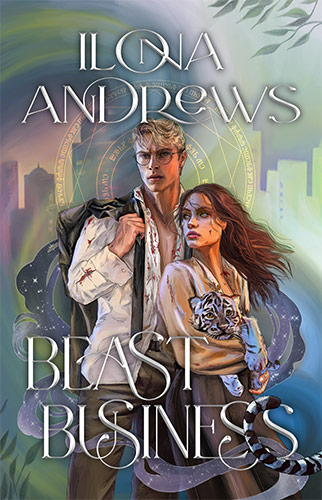
Augustine Montgomery is an Illusion Prime who owns a premier PI corporation and alters his appearance with magic. The people who have seen Augustine’s real face can be counted on the fingers of one hand. The people who witnessed the full extent of his power are dead. The illusion isn’t just the brand of his magic. It’s become his lifestyle.
Show as little as possible. Make them think that illusion is all you have. Your life depends on it.
Augustine lives by this creed. He’s cold, rational, and calculating. He doesn’t get emotionally involved. Then one day Diana Harrison walks into his office and asks for his help. Diana is a Prime, an animal mage who bonds with animals through her magic and prefers their company to humans. Something precious has been stolen from House Harrison. Something Diana must recover at all costs.
The two Houses are allied through a friendship pact. Assisting Diana is simply good business. And yet, there is something about her that disturbs the careful balance of Augustine’s inner world.
Neither of them is who they appear to be. Both would die to keep their secrets. But the enemy they face is more powerful than either had imagined, and saving the life that hangs in the balance will demand the ultimate price neither Augustine nor Diana ever anticipated to pay – complete honesty.
Le Admin:What all is in Beast Business?
- Augustine Montgomery and Diana Harrison (Cornelius’ older sister and Head of House Harrison) adventure novella
- Arabella Baylor new POV short story
I’m duty-bound to say: don’t read this first. Arabella is my favourite, I know we all want her books, but it lands much better after Augustine and Dian…oh, you’re already midway through it. Sigh. At least I tried.
- Beloved Hidden Legacy blog extras, for the first time in a published book. Free from dangerous archiving! A Misunderstanding, The Cool Aunt, Marty, and the FrInnterviews of Augustine and Arabella.
Formats, woman, which formats?
Epub – see above. It will be available everywhere you usually get self-published Ilona Andrews books from – please search the retailer catalogue if it’s not included above.
Print – paperback PODs are starting to populate. For now just on Amazon but soon to appear on other retailers, as soon as the internal systems finish checks. If you wish to buy from your local indie booksellers, they can place order through Ingram with the book’s print ISBN 9781641973724.
Audiobook – a few months down the line, we will of course keep you updated.
It doesn’t have a cover on Amazon.
It does now. You may have to sync your device or redownload your file in order to see it on your Kindle.
Thank you so much for your patience while we dealt with the bug that ate @helena.illustrated‘s beautiful cover art.
I’m leaving up the links to Amazon Canada and Amazon India, in case people still have issue finding them.
Zoom? Release Q&A?
Not this weekend, but maybe the next one if you’re interested. Let us know!
When does Beast Business happen, chronologically?
About 2 months after the Baylors buy their new compound, so in the gap between the prologue and main body of Ruby Fever.
Is. There. KISSY FAAAAACE??? Are we officially sailing the good ship Panthercakes?
There’s a spoiler comment section below, why don’t you check?
*walks off whistling sea chanties*
From Ilona: A quick note to those who are participating in the No-Buy day: go for it and please don’t worry about us. The book will be there for later purchase, and it’s not going anywhere. We had to put it out now, because delaying it would be cutting into Tor release window, so this was a no-choice type of deal – it was now or summer. We’ve gotten a couple of concerned emails, and I want to assure you that absolutely no stress, the lists are not important for this release and even if they were, standing up for causes you believe in is more important.
The post Happy Book Birthday to BEAST BUSINESS first appeared on ILONA ANDREWS.
Categories: Authors
What Stalks the Deep - Book Review
 What Stalks the Deep (Sworn Soldier #3)by T. Kingfisher
What is it about:Alex Easton does not want to visit America.
They particularly do not want to visit an abandoned coal mine in West Virginia with a reputation for being haunted.
But when their old friend Dr. Denton summons them to help find his lost cousin—who went missing in that very mine—well, sometimes a sworn soldier has to do what a sworn soldier has to do...
What did I think of it:I am so in love with this series!
This book was yet another great read. It's funny, witty, suspenseful, and full of creepiness.
I absolutely adore Alex, they're sensible, but at the same time end up in trouble because they're also more courageous then they give themselves credit for.
I had a great time with this book and I wll most probably reread all three books in this series soon, while hoping Kingfisher writes tons more.
Why should you read it:It's a fun and suspenseful Horror read.
Categories: Fantasy Books
Forgotten Authors: Robert Moore Williams
 Robert Moore Williams
Robert Moore Williams was born in Farmington, Missouri on June 19, 1907 and attended the Missouri School of Journalism, from which he graduated in 1931 with a Bachelor of Arts in journalism. He married Margaret Jelley in 1938 and they had one daughter. The couple divorced in 1952.
Williams published his first short story, “Zero as a Limit” in the July 1937 issue of Astounding Science Fiction, at the time still edited by F. Orlin Tremaine. Later in 1937, he published a story in Thrilling Wonder Stories, edited by Mort Weissinger, and his third story, “Flight of the Dawn Star” appeared in the March 1938 issue of Astounding, now edited by John W. Campbell, Jr. By the end of 1938, he added Amazing Stories, edited by Raymond A. Palmer to the list of magazines and editors he sold to.
In addition to science fiction, Williams published in a variety of other genres, occasionally using pseudonyms, including John S. Browning, H.H. Harmon, and Russell Storm. He also used the house name E.K. Jarvis on some stories written for the Ziff-Davis magazines, such as “Hickson’s Strange Adventure.” Although Williams was the most prolific (and possibly only) author to use the Jarvis name in the 40s, Robert Bloch used it most often in the 50s, with seven stories appearing under that byline. Other authors to use it included Paul W. Fairman, Harlan Ellison, Robert Silverberg, and Henry Slesar.
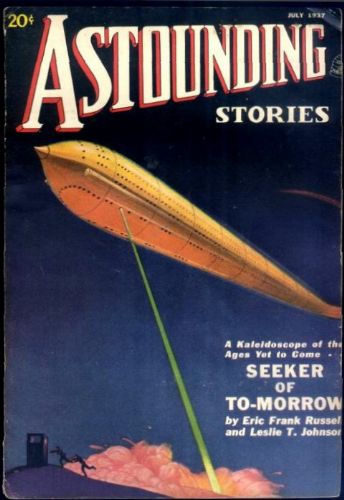 By the end of the 1950s, Williams had sold more than 120 stories to the magazines, and would consider selling short stories throughout most of the decade. He published his first novel, The Chaos Fighters, in 1955, after which he focused primarily on novels, although he had several short stories continue to appear through the end of the decade. Ten of his stories appeared as part of the Ace Doubles series between 1955 and 1964, backed with authors included Leigh Brackett, Eric Frank Russell, John Brunner, Keith Laumer, Terry Carr, and Samuel R. Delany.
While most of the novels Williams published were standalone novels, he did publish novels in two series. The three Jongor novels, which started as novellas published in Fantastic Adventures between 1940 and 1951, were published in book form in 1970 and are a Tarzanesque series focusing on Jongor (born John Gordon) in an Africanized Australia.
His other series, four books about Zanthar, was published as original novels between 1967 and 1969. Just as the Jangor novels were a pastiche of Tarzan, Zanthar is more in line with Burrough’s Barsoom novels, setting human physicist John Zanthar to a foreign and primitive planet courtesy of a cyclotron.
His 1970 novel, Love Is Forever—We are For Tonight has been described by multiple sources as autobiographical and shows a man who has subscribed to Dianetics and Scientology. Other, more science fictional works of the last years of Williams life also have a tendency towards fringe theories. When describing Love Is Forever—We are For Tonight in a Curiosities piece publishe din the January 2007 issue of F&SF, Graham Andrews wrote it “captures his surely unique blend of madness and/or vision in its simon-pure form.”
Gerald W. Page noted that Williams “doesn’t seem to have very often probed deeply into any of his ideas or themes, and this makes some of his work, while perfectly readable on the surface, seem disturbingly incomplete.”
Williams died in Dateland, Arizona on May 12, 1977.
Don D’Ammassa reviewed Williams’ novels on his website, concluding that “Despite his many faults as a writer, Williams is above average for the pulp SF adventure of the 1940s and 1950s. His reputation began to slip during the 1960s as standards for publication rose…”
 Steven H Silver is a twenty-one-time Hugo Award nominee and was the publisher of the Hugo-nominated fanzine Argentus as well as the editor and publisher of ISFiC Press for eight years. He has also edited books for DAW, NESFA Press, and ZNB. His most recent anthology is Alternate Peace and his novel After Hastings was published in 2020. Steven has chaired the first Midwest Construction, Windycon three times, and the SFWA Nebula Conference numerous times. He was programming chair for Chicon 2000 and Vice Chair of Chicon 7.
Categories: Fantasy Books
Comment on Moving Along by Bill
Sorry that there isn’t any news from the edits, I wonder what can be delaying them? (or perhaps there is absolutely nothing they can find wrong with Book#4?).
Anyway it is good news that Book#5 is still going well, but not much to tempt you outside in this dismal weather!
Categories: Authors
Pages

Recent comments