
Feed aggregator
Trade paperback pre-orders for the new collection
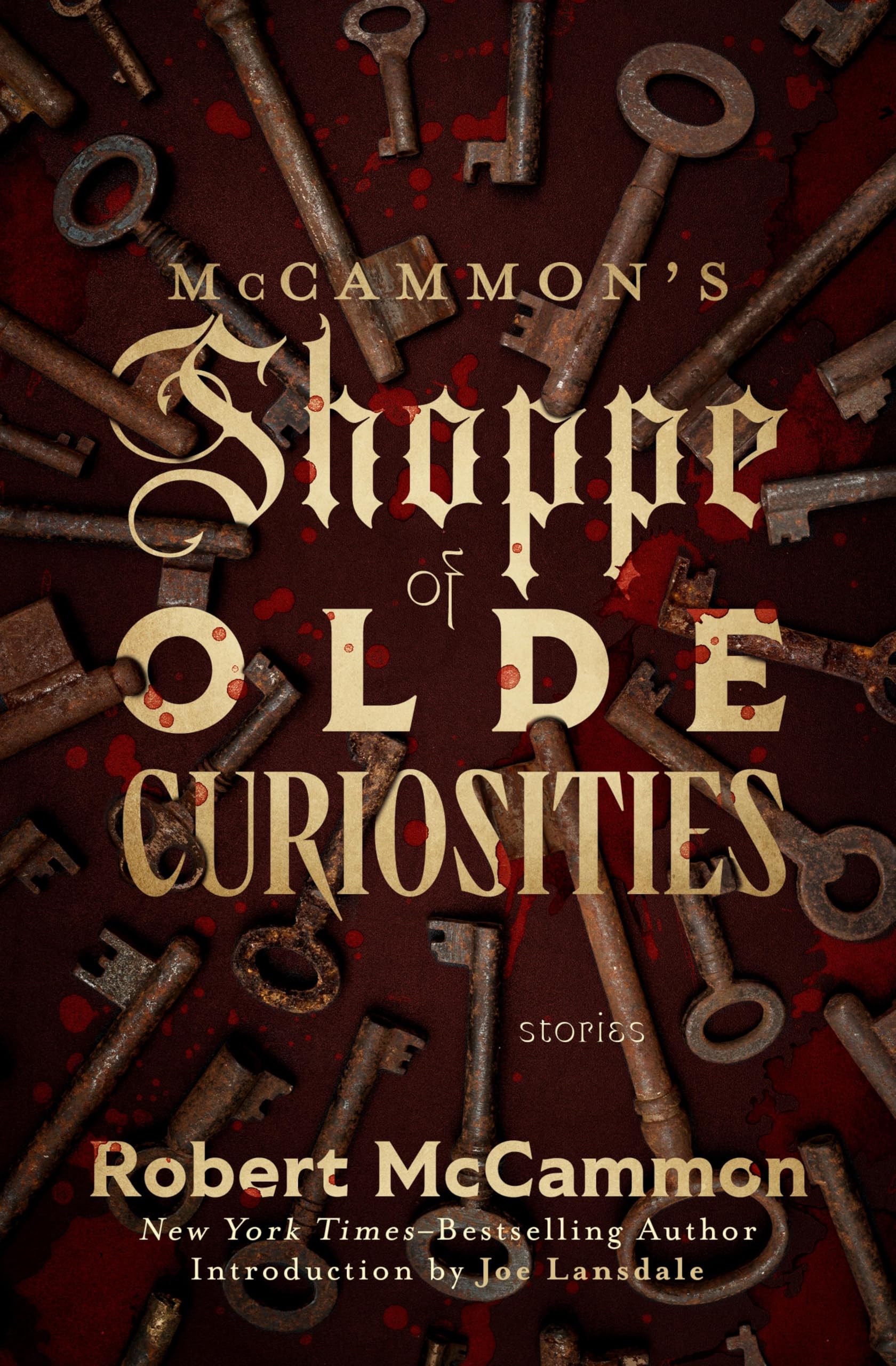
Pre-orders can now be placed for the trade paperback edition of the upcoming McCammon’s Shoppe of Olde Curiosities. The book will be published July 7, 2026, by Open Road Media in both trade paperback and ebook formats.
Pre-order McCammon’s Shoppe of Olde Curiosities from Amazon, B&N, Target, Bookshop.org, Walmart
Ebook pre-orders: Amazon, Amazon UK, Barnes & Noble, Bookshop.org, and Kobo
Lividian Publications will produce a hardcover limited edition next year, and Audible is producing an audiobook edition. No other news is available about those at this time.
Categories: Authors
Free Fiction Monday: G-Men
February, 1964: Two men die in a squalid alley in a bad neighborhood. New York Homicide Detective Seamus O’Reilly receives the shock of his life when he looks at the men’s identification: J. Edgar Hoover, the famous, tyrannical director of the FBI, and his number one assistant, Clyde Tolson.
O’Reilly teams up with FBI agent Frank Bryce to solve the high-level assassination before the murders unleash even greater consequences.
Two different best of the year collections, including the prestigious Best American Mystery Stories, chose “G-Men” as one of the best stories of the year. Nominated for the Sidewise Award for Best Alternate History.
“G-Men” is free on this website for one week only. You can get your own copy here or at any online retailer. If you like this story, you might enjoy the novel version, The Enemy Within. And if you’re a fan of alternate history, then pick up the current Storybundle called “Escape From 2026.” It includes two of my novels as well as a number of other tremendous alternate history and time travel tales.
G-Men Kristine Kathryn Rusch“There’s something addicting about a secret.” —J. Edgar Hoover
The squalid little alley smelled of piss. Detective Seamus O’Reilly tugged his overcoat closed and wished he’d worn boots. He could feel the chill of his metal flashlight through the worn glove on his right hand.
Two beat cops stood in front of the bodies, and the coroner crouched over them. His assistant was already setting up the gurneys, body bags draped over his arm. The coroner’s van had blocked the alley’s entrance, only a few yards away.
O’Reilly’s partner, Joseph McKinnon, followed him. McKinnon had trained his own flashlight on the fire escapes above, unintentionally alerting any residents to the police presence.
But they probably already knew. Shootings in this part of the city were common. The neighborhood teetered between swank and corrupt. Far enough from Central Park for degenerates and muggers to use the alleys as corridors, and, conversely, close enough for new money to want to live with a peak of the city’s most famous expanse of green.
The coroner, Thomas Brunner, had set up two expensive, battery-operated lights on garbage can lids placed on top of the dirty ice, one at the top of the bodies, the other near the feet. O’Reilly crouched so he wouldn’t create any more shadows.
“What’ve we got?” he asked.
“Dunno yet.” Brunner was using his gloved hands to part the hair on the back of the nearest corpse’s skull. “It could be one of those nights.”
O’Reilly had worked with Brunner for eighteen years now, since they both got back from the war, and he hated it when Brunner said it could be one of those nights. That meant the corpses would stack up, which was usually a summer thing, but almost never happened in the middle of winter.
“Why?” O’Reilly asked. “What else we got?”
“Some colored limo driver shot two blocks from here.” Brunner was still parting the hair. It took O’Reilly a minute to realize it was matted with blood. “And two white guys pulled out of their cars and shot about four blocks from that.”
O’Reilly felt a shiver run through him that had nothing to do with the cold. “You think the shootings are related?”
“Dunno,” Brunner said. “But I think it’s odd, don’t you? Five dead in the space of an hour, all in a six-block radius.”
O’Reilly closed his eyes for a moment. Two white guys pulled out of their cars, one Negro driver of a limo, and now two white guys in an alley. Maybe they were related, maybe they weren’t.
He opened his eyes, then wished he hadn’t. Brunner had his finger inside a bullet hole, a quick way to judge caliber.
“Same type of bullet,” Brunner said.
“You handled the other shootings?”
“I was on scene with the driver when some fag called this one in.”
O’Reilly looked at Brunner. Eighteen years, and he still wasn’t used to the man’s casual bigotry.
“How did you know the guy was queer?” O’Reilly asked. “You talk to him?”
“Didn’t have to.” Brunner nodded toward the building in front of them. “Weekly party for degenerates in the penthouse apartment every Thursday night. Thought you knew.”
O’Reilly looked up. Now he understood why McKinnon had been shining his flashlight at the upper story windows. McKinnon had worked vice before he got promoted to homicide.
“Why would I know?” O’Reilly said.
McKinnon was the one who answered. “Because of the standing orders.”
“I’m not playing twenty questions,” O’Reilly said. “I don’t know about a party in this building and I don’t know about standing orders.”
“The standing orders are,” McKinnon said as if he were an elementary school teacher, “not to bust it, no matter what kind of lead you got. You see someone go in, you forget about it. You see someone come out, you avert your eyes. You complain, you get moved to a different shift, maybe a different precinct.”
“Jesus.” O’Reilly was too far below to see if there was any movement against the glass in the penthouse suite. But whoever lived there—whoever partied there—had learned to shut off the lights before the cops arrived.
“Shot in the back of the head,” Brunner said before O’Reilly could process all of the information. “That’s just damn strange.”
O’Reilly looked at the corpses—really looked at them—for the first time. Two men, both rather heavy set. Their faces were gone, probably splattered all over the walls. Gloved hands, nice shoes, one of them wearing a white scarf that caught the light.
Brunner had to search for the wound in the back of the head, which made that the entry point. The exit wounds had destroyed the faces.
O’Reilly looked behind him. No door on that building, but there was one on the building where the party was held. If they’d been exiting the building and were surprised by a queer basher or a mugger, they’d’ve been shot in the front, not the back.
“How many times were they shot?” O’Reilly asked.
“Looks like just the once. Large caliber, close range. I’d say it was a purposeful headshot, designed to do maximum damage.” Brunner felt the back of the closest corpse. “There doesn’t seem to be anything on the torso.”
“They still got their wallets?” McKinnon asked.
“Haven’t checked yet.” Brunner reached into the back pants pocket of the corpse he’d been searching and clearly found nothing. So he grabbed the front of the overcoat and reached inside.
He removed a long thin wallet—old fashioned, the kind made for the larger bills of forty years before. Hand-tailored, beautifully made.
These men weren’t hurting for money.
Brunner handed the wallet to O’Reilly, who opened it. And stopped when he saw the badge inside. His mouth went dry.
“We got a feebee,” he said, his voice sounding strangled.
“What?” McKinnon asked.
“FBI,” Brunner said dryly. McKinnon had only moved to homicide the year before. Vice rarely had to deal with FBI. Homicide did only on sensational cases. O’Reilly could count on one hand the number of times he’d spoken to agents in the New York bureau.
“Not just any feebee either,” O’Reilly said. “The Associate Director. Clyde A. Tolson.”
McKinnon whistled. “Who’s the other guy?”
This time, O’Reilly did the search. The other corpse, the heavier of the two, also smelled faintly of perfume. This man had kept his wallet in the inner pocket of his suit coat, just like his companion had.
O’Reilly opened the wallet. Another badge, just like he expected. But he didn’t expect the bulldog face glaring at him from the wallet’s interior.
Nor had he expected the name.
“Jesus, Mary and Joseph,” he said.
“What’ve we got?” McKinnon asked.
O’Reilly handed him the wallet, opened to the slim paper identification.
“The Director of the FBI,” he said, his voice shaking. “Public Hero Number One. J. Edgar Hoover.”
***
Francis Xavier Bryce—Frank to his friends, what few of them he still had left—had just dropped off to sleep when the phone rang. He cursed, caught himself, apologized to Mary, and then remembered she wasn’t there.
The phone rang again and he fumbled for the light, knocking over the highball glass he’d used to mix his mom’s recipe for sleepless nights, hot milk, butter and honey. It turned out that, at the tender age of 36, hot milk and butter laced with honey wasn’t a recipe for sleep; it was a recipe for heartburn.
And for a smelly carpet if he didn’t clean the mess up.
He found the phone before he found the light.
“What?” he snapped.
“You live near Central Park, right?” A voice he didn’t recognize, but one that was clearly official, asked the question without a hello or an introduction.
“More or less.” Bryce rarely talked about his apartment. His parents had left it to him and, as his wife was fond of sniping, it was too fancy for a junior G-Man.
The voice rattled off an address. “How far is that from you?”
“About five minutes.” If he didn’t clean up the mess on the floor. If he spent thirty seconds pulling on the clothes he’d piled onto the chair beside the bed.
“Get there. Now. We got a situation.”
“What about my partner?” Bryce’s partner lived in Queens.
“You’ll have back-up. You just have to get to the scene. The moment you get there, you shut it down.”
“Um.” Bryce hated sounding uncertain, but he had no choice. “First, sir, I need to know who I’m talking to. Then I need to know what I’ll find.”
“You’ll find a double homicide. And you’re talking to Eugene Hart, the Special Agent in Charge. I shouldn’t have to identify myself to you.”
Now that he had, Bryce recognized Hart’s voice. “Sorry, sir. It’s just procedure.”
“Fuck procedure. Take over that scene. Now.”
“Yes, sir,” Bryce said, but he was talking into an empty phone line. He hung up, hands shaking, wishing he had some BromoSeltzer.
He’d just come off a long, messy investigation of another agent. Walter Cain had been about to get married when he remembered he had to inform the Bureau of that fact and, as per regulation, get his bride vetted before walking down the aisle.
Bryce had been the one to investigate the future Mrs. Cain, and had been the one to find out about her rather seamy past—two Vice convictions under a different name, and one hospitalization after a rather messy backstreet abortion. Turned out Cain knew about his future wife’s past, but the Bureau hadn’t liked it.
And two nights ago, Bryce had to be the one to tell Cain that he couldn’t marry his now-reformed, somewhat religious, beloved. The soon-to-be Mrs. Cain had taken the news hard. She had gone to Bellevue this afternoon after slashing her wrists.
And Bryce had been the one to tell Cain what his former fiancé had done. Just a few hours ago.
Sometimes Bryce hated this job.
Despite his orders, he went into the bathroom, soaked one of Mary’s precious company towels in water, and dropped the thing on the spilled milk. Then he pulled on his clothes, and finger-combed his hair.
He was a mess—certainly not the perfect representative of the Bureau. His white shirt was stained with marina from that night’s take-out, and his tie wouldn’t keep a crisp knot. The crease had long since left his trousers and his shoes hadn’t been shined in weeks. Still, he grabbed his black overcoat, hoping it would hide everything.
He let himself out of the apartment before he remembered the required and much hated hat, went back inside, grabbed the hat as well as his gun and his identification. Jesus, he was tired. He hadn’t slept since Mary walked out. Mary, who had been vetted by the FBI and who had passed with flying colors. Mary, who had turned out to be more of a liability than any former hooker ever could have been.
And now, because of her, he was heading toward something big, and he was one-tenth as sharp as usual.
All he could hope for was that the SAC had overreacted. And he had a hunch—a two in the morning, get-your-ass-over-there-now hunch—that the SAC hadn’t overreacted at all.
***
Attorney General Robert F. Kennedy sat in his favorite chair near the fire in his library. The house was quiet even though his wife and eight children were asleep upstairs. Outside, the rolling landscape was covered in a light dusting of snow—rare for McLean, Virginia even at this time of year.
He held a book in his left hand, his finger marking the spot. The Greeks had comforted him in the few months since Jack died, but lately Kennedy had discovered Camus.
He had been about to copy a passage into his notebook when the phone rang. At first he sighed, feeling all of the exhaustion that had weighed on him since the assassination. He didn’t want to answer the phone. He didn’t want to be bothered—not now, not ever again.
But this was the direct line from the White House and if he didn’t answer it, someone else in the house would.
He set the Camus book face down on his chair and crossed to the desk before the third ring. He answered with a curt, “Yes?”
“Attorney General Kennedy, sir?” The voice on the other end sounded urgent. The voice sounded familiar to him even though he couldn’t place it.
“Yes?”
“This is Special Agent John Haskell. You asked me to contact you, sir, if I heard anything important about Director Hoover, no matter what the time.”
Kennedy leaned against the desk. He had made that request back when his brother had been president, back when Kennedy had been the first attorney general since the 1920s who actually demanded accountability from Hoover.
Since Lyndon Johnson had taken over the presidency, accountability had gone by the wayside. These days Hoover rarely returned Kennedy’s phone calls.
“Yes, I did tell you that,” Kennedy said, resisting the urge to add, but I don’t care about that old man any longer.
“Sir, there are rumors—credible ones—that Director Hoover has died in New York.”
Kennedy froze. For a moment, he flashed back to that unseasonably warm afternoon when he’d sat just outside with the federal attorney for New York City, Robert Morganthau and the chief of Morganthau’s criminal division, Silvio Mollo, talking about prosecuting various organized crime figures.
Kennedy could still remember the glint of the sunlight on the swimming pool, the taste of the tuna fish sandwich Ethel had brought him, the way the men—despite their topic—had seemed lighthearted.
Then the phone rang, and J. Edgar Hoover was on the line. Kennedy almost didn’t take the call, but he did and Hoover’s cold voice said, I have news for you. The President’s been shot.
Kennedy had always disliked Hoover, but since that day, that awful day in the bright sunshine, he hated that fat bastard. Not once—not in that call, not in the subsequent calls—did Hoover express condolences or show a shred of human concern.
“Credible rumors?” Kennedy repeated, knowing he probably sounded as cold as Hoover had three months ago, and not caring. He’d chosen Haskell as his liaison precisely because the man didn’t like Hoover either. Kennedy had needed someone inside Hoover’s hierarchy, unbeknownst to Hoover, which was difficult since Hoover kept his hand in everything. Haskell was one of the few who fit the bill.
“Yes, sir, quite credible.”
“Then why haven’t I received official contact?”
“I’m not even sure the President knows, sir.”
Kennedy leaned against the desk. “Why not, if the rumors are credible?”
“Um, because, sir, um, it seems Associate Director Tolson was also shot, and um, they were, um, in a rather suspect area.”
Kennedy closed his eyes. All of Washington knew that Tolson was the closest thing Hoover had to a wife. The two old men had been life-long companions. Even though they didn’t live together, they had every meal together. Tolson had been Hoover’s hatchet man until the last year or so, when Tolson’s health hadn’t permitted it.
Then a word Haskell used sank in. “You said shot.”
“Yes, sir.”
“Is Tolson dead too then?”
“And three other people in the neighborhood,” Haskell said.
“My God.” Kennedy ran a hand over his face. “But they think this is personal?”
“Yes, sir.”
“Because of the location of the shooting?”
“Yes, sir. It seems there was an exclusive gathering in a nearby building. You know the type, sir.”
Kennedy didn’t know the type—at least not through personal experience. But he’d heard of places like that, where the rich, famous and deviant could spend time with each other, and do whatever it was they liked to do in something approaching privacy.
“So,” he said, “the bureau’s trying to figure out how to cover this up.”
“Or at least contain it, sir.”
Without Hoover or Tolson. No one in the bureau was gong to know what to do.
Kennedy’s hand started to shake. “What about the files?”
“Files, sir?”
“Hoover’s confidential files. Has anyone secured them?”
“Not yet, sir. But I’m sure someone has called Miss Gandy.”
Helen Gandy was Hoover’s long-time secretary. She had been his right hand as long as Tolson had operated that hatchet.
“So procedure’s being followed,” Kennedy said, then frowned. If procedure were being followed, shouldn’t the acting head of the bureau be calling him?
“No, sir. But the Director put some private instructions in place should he be killed or incapacitated. Private emergency instructions. And those involve letting Miss Gandy know before anyone else.”
Even me, Kennedy thought. Hoover’s nominal boss. “She’s not there yet, right?”
“No, sir.”
“Do you know where those files are?” Kennedy asked, trying not to let desperation into his voice.
“I’ve made it my business to know, sir.” There was a pause and then Haskell lowered his voice. “They’re in Miss Gandy’s office, sir.”
Not Hoover’s like everyone thought. For the first time in months, Kennedy felt a glimmer of hope. “Secure those files.”
“Sir?”
“Do whatever it takes. I want them out of there, and I want someone to secure Hoover’s house too. I’m acting on the orders of the President. If anyone tells you that they are doing the same, they’re mistaken. The President made his wishes clear on this point. He often said if anything happens to that old queer—” And here Kennedy deliberately used LBJ’s favorite phrase for Hoover “—then we need those files before they can get into the wrong hands.”
“I’m on it, sir.”
“I can’t stress to you the importance of this,” Kennedy said. In fact, he couldn’t talk about the importance at all. Those files could ruin his brother’s legacy. The secrets in there could bring down Kennedy too, and his entire family.
“And if the rumors about the Director’s death are wrong, sir?”
Kennedy felt a shiver of fear. “Are they?”
“I seriously doubt it.”
“Then let me worry about that.”
And about what LBJ would do when he found out. Because the president upon whose orders Kennedy acted wasn’t the current one. Kennedy was following the orders of the only man he believed should be president at the moment.
His brother, Jack.
***
The scene wasn’t hard to find; a coroner’s van blocked the entrance to the alley. Bryce walked quickly, already cold, his heartburn worse than it had been when he had gone to bed.
The neighborhood was in transition. An urban renewal project had knocked down some wonderful turn of the century buildings that had become eyesores. But so far, the buildings that had replaced them were the worst kind of modern—all planes and angles and white with few windows.
In the buildings closest to the park, the lights worked and the streets looked safe. But here, on a side street not far from the construction, the city’s shady side showed. The dirty snow was piled against the curb, the streets were dark, and nothing seemed inhabited except that alley with the coroner’s van blocking the entrance.
The coroner’s van and at least one unmarked car. No press, which surprised him. He shoved his gloved hands in the pockets of his overcoat even though it was against FBI dress code, and slipped between the van and the wall of a grimy brick building.
The alley smelled of old urine and fresh blood. Two beat cops blocked his way until he showed identification. Then, like people usually did, they parted as if he could burn them.
The bodies had fallen side by side in the center of the alley. They looked posed, with their arms up, their legs in classic P position—one leg bent, the other straight. They looked like they could fit perfectly on the dead body diagrams the FBI used to put out in the 1930s. He wondered if they had fallen like this or if this had been the result of the coroner’s tampering.
The coroner had messed with other parts of the crime scene—if, indeed, he had been the one who put the garbage can lids on the ice and set battery-powered lamps on them. The warmth of the lamps was melting the ice and sending runnels of water into a nearby grate.
“I hope to hell someone thought to photograph the scene before you melted it,” he said.
The coroner and the two cops who had been crouching beside the bodies stood up guiltily. The coroner looked at the garbage can lids and closed his eyes. Then he took a deep breath, opened them, and snapped his fingers at the assistant who was waiting beside a gurney.
“Camera,” he said.
“That’s Crime Scene’s—.” the assistant began, then saw everyone looking at him. He glanced at the van. “Never mind.”
He walked behind the bodies, further disturbing the scene. Bryce’s mouth thinned in irritation. The cops who stood were in plain clothes.
“Detectives,” Bryce said, holding his identification, “Special Agent Frank Bryce of the FBI. I’ve been told to secure this scene. More of my people will be here shortly.”
He hoped that last was true. He had no idea who was coming or when they would arrive.
“Good,” said the younger detective, a tall man with broad shoulders and an all-American jaw. “The sooner we get out of here the better.”
Bryce had never gotten that reaction from a detective before. Usually the detectives were territorial, always reminding him that this was New York City and that the scene belonged to them.
The other detective, older, face grizzled by time and work, held out his gloved hand. “Forgive my partner’s rudeness. I’m Seamus O’Reilly. He’s Joseph McAllister and we’ll help you in any way we can.”
“I appreciate it,” Bryce said, taking O’Reilly’s hand and shaking it. “I guess the first thing you can do is tell me what we’ve got.”
“A hell of a mess, that’s for sure,” said McAllister. “You’ll understand when….”
His voice trailed off as his partner took out two long, old-fashioned wallets and handed them to Bryce.
Bryce took them, feeling confused. Then he opened the first, saw the familiar badge, and felt his breath catch. Two FBI agents, in this alley? Shot side-by-side? He looked up, saw the darkened windows.
There used to be rumors about this neighborhood. Some exclusive private sex parties used to be held here, and his old partner had always wanted to visit one just to see if it was a hotbed of Communists like some of the agents had claimed. Bryce had begged off. He was an investigator, not a voyeur.
The two detectives were staring at him, as if they expected more from him. He still had the wallet open in his hand. If the dead men were New York agents, he would know them. He hated solving the deaths of people he knew.
But he steeled himself, looked at the identification, and felt the blood leave his face. His skin grew cold and for a moment he felt lightheaded.
“No,” he said.
The detectives still stared at him.
He swallowed. “Have you done a visual i.d.?”
Hoover was recognizable. His picture was on everything. Sometimes Bryce thought Hoover was more famous than the president—any president. He’d certainly been in power longer.
“Faces are gone,” O’Reilly said.
“Exit wounds,” the coroner added from beside the bodies. His assistant had returned and was taking pictures, the flash showing just how much melt had happened since the coroner arrived.
“Shot in the back of the head?” Bryce blinked. He was tired and his brain was working slowly, but something about the shots didn’t match with the body positions.
“If they came out that door,” O’Reilly said as he indicated a dark metal door almost hidden in the side of the brick building, “then the shooters had to be waiting beside it.”
“Your crime scene people haven’t arrived yet, I take it?” Bryce asked.
“No,” the coroner said. “They think it’s a fag kill. They’ll get here when they get here.”
Bryce clenched his left fist and had to remind himself to let the fingers loose.
O’Reilly saw the reaction. “Sorry about that,” he said, shooting a glare at the coroner. “I’m sure the director was here on business.”
Funny business. But Bryce didn’t say that. The rumors about Hoover had been around since Bryce joined the FBI just after the war. Hoover quashed them, like he quashed any criticism, but it seemed like the criticism got made, no matter what.
Bryce opened the other wallet, but he already had a guess as to who was beside Hoover, and his guess turned out to be right.
“You want to tell me why your crime scene people believe this is a homosexual killing?” Bryce asked, trying not to let what Mary called his FBI tone into his voice. If Hoover was still alive and this was some kind of plant, Hoover would want to crush the source of this assumption. Bryce would make sure that the source was worth pursuing before going any farther.
“Neighborhood, mostly,” McAllister said. “There’re a couple of bars, mostly high-end. You have to know someone to get in. Then there’s the party, held every week upstairs. Some of the most important men in the city show up at it, or so they used to say in Vice when they told us to stay away.”
Bryce nodded, letting it go at that.
“We need your crime scene people here ASAP, and a lot more cops so that we can protect what’s left of this scene, in case this men turn out to be who their identification says they are. You search the bodies to see if this was the only identification on them?”
O’Reilly started. He clearly hadn’t thought of that. Probably had been too shocked by the first wallets that he found.
The younger detective had already gone back to the bodies. The coroner put out a hand, and did the searching himself.
“You think this was a plant?” O’Reilly asked.
“I don’t know what to think,” Bryce said. “I’m not here to think. I’m here to make sure everything goes smoothly.”
And to make sure the case goes to the FBI. Those words hung unspoken between the two of them. Not that O’Reilly objected, and now Bryce could understand why. This case would be a political nightmare, and no good detective wanted to be in the middle of it.
“How come there’s no press?” Bryce asked O’Reilly. “You manage to get rid of them somehow?”
“Fag kill,” the coroner said.
Bryce was getting tired of those words. His fist had clenched again, and he had to work at unclenching it.
“Ignore him,” O’Reilly said softly. “He’s an asshole and the best coroner in the city.”
“I heard that,” the coroner said affably. “There’s no other identification on either of them.”
O’Reilly’s shoulders slumped, as if he’d been hoping for a different outcome. Bryce should have been hoping as well, but he hadn’t been. He had known that Hoover was in town. The entire New York bureau knew, since Hoover always took it over when he arrived—breezing in, giving instructions, making sure everything was just the way he wanted it.
“Before this gets too complicated,” O’Reilly said, “you want to see the other bodies?”
“Other bodies?” Bryce felt numb. He could use some caffeine now, but Hoover had ordered agents not to drink coffee on the job. Getting coffee now felt almost disrespectful.
“We got three more.” O’Reilly took a deep breath. “And just before you arrived, I got word that they’re agents too.”
***
Special Agent John Haskell had just installed six of his best agents outside the Director’s suite of offices when a small woman showed up, key clutched in her gloved right hand. Helen Gandy, the Director’s secretary, looked up at Haskell with the coldest stare he’d ever seen outside of the Director’s.
“May I go into my office, Agent Haskell?” Her voice was just as cold. She didn’t look upset, and if he hadn’t known that she never stayed past five unless directed by Hoover himself, Haskell would have thought she was coming back from a prolonged work break.
“I’m sorry, Ma’am,” he said. “No one is allowed inside. President’s orders.”
“Really?” God, that voice was chilling. He remembered the first time he’d heard it, when he’d been brought to this suite of offices as a brand-new agent, after getting his “Meet the Boss” training before his introduction to the Director. She’d frightened him more than Hoover had.
“Yes, Ma’am. The President says no one can enter.”
“Surely he didn’t mean me.”
Surely he did. But Haskell bit the comment back. “I’m sorry, Ma’am.”
“I have a few personal items that I’d like to get, if you don’t mind. And the Director instructed me that in the case of…” and for the first time she paused. Her voice didn’t break nor did she clear her throat. But she seemed to need a moment to gather herself. “In case of emergency, I was to remove some of his personal items as well.”
“If you could tell me what they are, Ma’am, I’ll get them.”
Her eyes narrowed. “The Director doesn’t like others to touch his possessions.”
“I’m sorry, Ma’am,” he said gently. “But I don’t think that matters any longer.”
Any other woman would have broken down. After all, she had worked for the old man for forty-five years, side-by-side, every day. Never marrying, not because they had a relationship—Helen Gandy, more than anyone, probably knew the truth behind the Director’s relationship with the Associate Director—but because for Helen Gandy, just like for the Director himself, the FBI was her entire life.
“It matters,” she said. “Now if you’ll excuse me…”
She tried to wriggle past him. She was wiry and stronger than he expected. He had to put out an arm to block her.
“Ma’am,” he said in the gentlest tone he could summon, “the President’s orders supercede the Director’s.”
How often had he wanted to say that over the years? How often had he wanted to remind everyone in the Bureau that the President led the Free World, not J. Edgar Hoover.
“In this instance,” she snapped, “they do not.”
“Ma’am, I’d hate to have some agents restrain you.” Although he wasn’t sure about that. She had never been nice to him or to anyone he knew. She’d always been sharp or rude. “You’re distraught.”
“I am not.” She clipped each word.
“You are because I say you are, Ma’am.”
She raised her chin. For a moment, he thought she hadn’t understood. But she finally did.
The balance of power had shifted. At the moment, it was on his side.
“Do I have to call the president then to get my personal effects?” she asked.
But they both knew she wasn’t talking about her personal things. And the President was smart enough to know that as well. As hungry to get those files as the Attorney General had seemed despite his Eastern reserve, the President would be utterly ravenous. He wouldn’t let some old skirt, as he’d been known to call Miss Gandy, get in his way.
“Go ahead,” Haskell said. “Feel free to use the phone in the office across the hall.”
She glared at him, then turned on one foot and marched down the corridor. But she didn’t head toward a phone—at least not one he could see.
He wondered who she would call. The President wouldn’t listen. The Attorney General had issued the order in the president’s name. Maybe she would contact one of Hoover’s Assistant Directors, the four or five men that Hoover had in his pocket.
Haskell had been waiting for them. But word still hadn’t spread through the Bureau. The only reason he knew was because he’d received a call from the SAC of the New York office. New York hated the Director, mostly because the old man went there so often and harassed them.
Someone had probably figured out that there was a crisis from the moment that Haskell had brought his people in to secure the Director’s suite. But no one would know that the Director was dead until Miss Gandy made the calls or until someone in the Bureau started along the chain of command—the one designated in the book Hoover had written all those years ago.
Haskell crossed his arms. Sometimes he wished he hadn’t let the A.G. know how he felt about the Director. Sometimes he wished he were still a humble assistant, the man who had joined the FBI because he wanted to be a top cop like his hero J. Edgar Hoover.
A man who, it turned out, never made a real arrest or fired a gun or even understood investigation.
There was a lot to admire about the Director—no matter what you said, he’d built a hell of an agency almost from scratch—but he wasn’t the man his press made him out to be.
And that was the source of Haskell’s disillusionment. He’d wanted to be a top cop. Instead, he snooped into homes and businesses and sometimes even investigated fairly blameless people, looking for a mistake in their past.
Since he’d been transferred to FBIHQ, he hadn’t done any real investigating at all. His arrests had slowed, his cases dwindled.
And he’d found himself investigating his boss, trying to find out where the legend ended and the man began. Once he realized that the old man was just a bureaucrat who had learned where all the bodies were buried and used that to make everyone bow to his bidding, Haskell was ripe for the undercover work the A.G. had asked him to do.
Only now he wasn’t undercover any more. Now he was standing in the open before the Director’s cache of secrets, on the President’s orders, hoping that no one would call his bluff.
***
As O’Reilly led him to the limousine, Bryce surreptitiously checked his watch. He’d already been on scene for half an hour, and no back-up had arrived. If he was supposed to secure everything and chase off the NYPD, he’d need some manpower.
But for now, he wanted to see the extent of the problem. The night had gotten colder, and this street was even darker than the street he’d walked down. All of the streetlights were out. The only light came from some porch bulbs above a few entrances. He could barely make out the limousine at the end of the block, and then only because he could see the shadowy forms of the two beat cops standing at the scene, their squad cars parking the limo in.
As he got closer, he recognized the shape of the limo. It was thicker than most limos and rode lower to the ground because it was encased in an extra frame, making it bulletproof. Supposedly, the glass would all be bulletproof as well.
“You said the driver was shot inside the limo?” Bryce asked.
“That’s what they told me,” O’Reilly said. “I wasn’t called to this scene. We were brought in because of the two men in the alley. Even then we were called late.”
Bryce nodded. He remembered the coroner’s bigotry. “Is that standard procedure for cases involving minorities?”
O’Reilly gave him a sideways glance. Bryce couldn’t read O’Reilly’s expression in the dark.
“We’re overtaxed,” O’Reilly said after a moment. “Some cases don’t get the kind of treatment they deserve.”
“Limo drivers,” Bryce said.
“If he’d been killed in the parking garage under the Plaza maybe,” O’Reilly said. “But not because of who he was. But because of where he was.”
Bryce nodded. He knew how the world worked. He didn’t like it. He spoke up against it too many times, which was why he was on shaky ground at the Bureau.
Then his already upset stomach clenched. Maybe he wasn’t going to get back-up. Maybe they’d put him on his own here to claim he’d botched the investigation, so that they would be able to cover it up.
He couldn’t concentrate on that now. What he had to do was take good notes, make the best case he could, and keep a copy of every damn thing—maybe in more than one place.
“You were called in because of the possibility that the men in the alley could be important,” Bryce said.
“That’s my guess,” O’Reilly said.
“What about the others down the block? Has anyone taken those cases?”
“Probably not,” O’Reilly said. “Those bars, you know. It’s department policy. The coroner checks bodies in the suspect area, and decides, based on…um…evidence of…um…
activity…whether or not to bring in detectives.”
Bryce frowned. He almost asked what the coroner was checking for when he figured out that it was evidence on the body itself, evidence not of the crime, but of certain kinds of sex acts. If that evidence was present, apparently no one thought it worthwhile to investigate the crime.
“You’d think the city would revise that,” Bryce said. “A lot of people live dual lives—productive and interesting people.”
“Yeah,” O’Reilly said. “You’d think. Especially after tonight.”
Bryce grinned. He was liking this grizzled cop more and more.
O’Reilly spoke to the beat cops, then motioned Bryce to the limo. As Bryce approached, O’Reilly trained his flashlight on the driver’s side.
The window wasn’t broken like Bryce had expected. It had been rolled down.
“You got here one James Crawford,” said one of the beat cops. “He got identification says he’s a feebee, but I ain’t never heard of no colored feebee.”
“There’s only four,” Bryce said dryly. And they all worked for Hoover as his personal housekeepers or drivers. “Can I see that identification?”
The beat cop handed him a wallet that matched the ones on Tolson and Hoover. Inside was a badge and identification for James Crawford as well as family photographs. Neither Tolson nor Hoover had had any photographs in their wallets.
Bryce motioned O’Reilly to move a little closer to the body. The head was tilted toward the window. The right side of the skull was gone, the hair glistening with drying blood. With one gloved finger, Bryce pushed the head upright. A single entrance wound above the left ear had caused the damage.
“Brunner says the shots are the same caliber,” O’Reilly said.
It took Bryce a moment to realize that Brunner was the coroner.
Bryce carefully searched Crawford but didn’t find the man’s weapon. Nor could he found a holster or any way to carry a weapon.
“It looks like he wasn’t carrying a weapon,” Bryce said.
“Neither were the two in the alley,” O’Reilly said, and Bryce appreciated his caution in not identifying the other two corpses. “You’d think they would have been.”
Bryce shook his head. “They were known for not carrying weapons. But you’d think their driver would have one.”
“Maybe they had protection,” O’Reilly said.
And Bryce’s mouth went dry. Of course they did. The office always joked about who would get HooverWatch on each trip. He’d had to do it a few times.
Agents on HooverWatch followed strict rules, like everything else with Hoover. Remain close enough to see the men entering and exiting an area, stop any suspicious characters, and yet somehow remain inconspicuous.
“You said there were two others shot?”
“Yeah. A block or so from here.” O’Reilly waved a hand vaguely down the street.
“Pulled out of one car or two?”
“Not my case,” O’Reilly said.
“Two,” said the beat cop. “Black sedans. Could barely see them on this cruddy street.”
HooverWatch. Bryce swallowed hard, that bile back. Of course. He probably knew the men who were shot.
“Let’s look,” he said. “You two, make sure the coroner’s man photographs this scene before he leaves.”
“Yessir,” said the second beat cop. He hadn’t spoken before.
“And don’t let anyone near this scene unless I give the o.k.,” Bryce said.
“How come this guy’s in charge?” the talkative beat cop asked O’Reilly.
O’Reilly grinned. “Because he’s a feebee.”
“I’m sorry,” the beat cop said automatically turning to Bryce. “I didn’t know, sir.”
Feebee was an insult—or at least some in the Bureau thought so. Bryce didn’t mind it. Any more than he minded when some rookie said “Sack” when he meant “Ess-Ay-Cee.” Shorthand worked, sometimes better than people wanted it to.
“Point me in the right direction,” he said to the talkative cop.
The cop nodded south. “One block down, sir. You can’t miss it. We got guys on those scenes too, but we weren’t so sure it was important. You know. We coulda missed stuff.”
In other words, they hadn’t buttoned up the scene immediately. They’d waited for the coroner to make his verdict, and he probably hadn’t, not with the three new corpses nearby.
Bryce took one last look at James Crawford. The man had rolled down his window, despite the cold, and in a bad section of town.
He leaned forward. Underneath the faint scent of cordite and mingled with the thicker smell of blood was the smell of a cigar.
He took the flashlight from O’Reilly and trained it on the dirty snow against the curb. It had been trampled by everyone coming to this crime scene.
He crouched, and poked just a little, finding three fairly fresh cigarette butts.
As he stood, he said to the beat cops, “When the scene of the crime guys get here, make sure they take everything from the curb.”
O’Reilly was watching him. The beat cops were frowning, but they nodded.
Bryce handed O’Reilly back his flashlight and headed down the street.
“You think he was smoking and tossing the butts out the window?” O’Reilly asked.
“Either that,” Bryce said, “or he rolled his window down to talk to someone. And if someone was pointing a gun at him, he wouldn’t have done it. This vehicle was armored. He had a better chance starting it up and driving away than he did cooperating.”
“If he wasn’t smoking,” O’Reilly said, “he knew his killer.”
“Yeah,” Bryce said. And he was pretty sure that was going to make his job a whole hell of a lot harder.
***
Kennedy took the elevator up to the fifth floor of the Justice Department. He probably should have stayed home, but he simply couldn’t. He needed to get into those files and he needed to do so before anyone else.
As he strode into the corridor he shared with the Director of the FBI, he saw Helen Gandy hurry in the other direction. She looked like she had just come from the beauty salon. He had never seen her look anything less than completely put together but he was surprised by her perfect appearance on this night, after the news that her long-time boss was dead.
Kennedy tugged at the overcoat he’d put on over his favorite sweater. He hadn’t taken the time to change or even comb his hair. He probably looked as tousled as he had in the days after Jack died.
Although, for the first time in three months, he felt like he had a purpose. He didn’t know how long this feeling would last, or how long he wanted it to. But this death had given him an odd kind of hope that control was coming back into his world.
Haskell stood in front of the Director’s office suite, arms crossed. The Director’s suite was just down the corridor from the Attorney General’s offices. It felt odd to go toward Hoover’s domain instead of his own.
Haskell looked relieved when he saw Kennedy.
“Was that the dragon lady I just saw?” Kennedy asked.
“She wanted to get some personal effects from her office,” Haskell said.
“Did you let her?”
“You said the orders were to secure it, so I have.”
“Excellent.” Kennedy glanced in both directions and saw no one. “Make sure your staff continues to protect the doors. I’m going inside.”
“Sir?” Haskell raised his eyebrows.
“This may not be the right place,” Kennedy said. “I’m worried that he moved everything to his house.”
The lie came easily. Kennedy would have heard if Hoover had moved files to his own home. But Haskell didn’t know that.
Haskell moved away from the door. It was unlocked. Two more agents stood inside, guarding the interior doors.
“Give me a minute, please, gentlemen,” Kennedy said.
The men nodded and went outside.
Kennedy stopped and took a deep breath. He had been in Miss Gandy’s office countless times, but he had never really looked at it. He’d always been staring at the door to Hoover’s inner sanctum, waiting for it to open and the old man to come out.
That office was interesting. In the antechamber, Hoover had memorabilia and photographs from his major cases. He even had the plaster-of-paris death mask of John Dellinger on display. It was a ghastly thing, which made Kennedy think of the way that English kings used to keep severed heads on the entrance to London Bridge to warn traitors of their potential fate.
But this office had always looked like a waiting room to him. Nothing very special. The woman behind the desk was the focal point. Jack had been the one who nicknamed her the dragon lady and had even called her that to her face once, only with his trademark grin, so infectious that she hadn’t made a sound or a grimace in protest.
Of course, she hadn’t smiled back either.
Her desk was clear except for a blotter, a telephone, and a jar of pens. A typewriter sat on a credenza with paper stacked beside it.
But it wasn’t the desk that interested him the most. It was the floor-to-ceiling filing cabinets and storage bins. He walked to them. Instead of the typical system—marked by letters of the alphabet—this one had numbers that were clearly part of a code.
He pulled open the nearest drawer, and found row after row of accordion files, each with its own number, and manila folders with the first number set followed by another. He cursed softly under his breath.
Of course the old dog wouldn’t file his confidentials by name. He’d use a secret code. The old man liked nothing more than his secrets.
Still, Kennedy opened half a dozen drawers just to see if the system continued throughout. And it wasn’t until he got to a bin near the corner of the desk that he found a file labeled “Obscene.”
His hand shook as he pulled it out. Jack, for all his brilliance, had been sexually insatiable. Back when their brother Joe was still alive and no one ever thought Jack would be running for president, Jack had had an affair with a Danish émigré named Inga Arvad. Inga Binga, as Jack used to call her, was married to a man with ties to Hitler. She’d even met and liked Der Fuhrer, and had said so in print.
She’d been the target of FBI surveillance as a possible spy, and during that surveillance who should turn up in her bed but a young naval lieutentant whose father had once been Ambassador to England. The Ambassador, as he preferred to be called even by his sons, found out about the affair, told Jack in no uncertain terms to end it, and then to make sure he did by getting him assigned to a PT boat in the Pacific, as far from Inga Binga as possible.
Kennedy had always suspected that Hoover had leaked the information to the Ambassador, but he hadn’t known for certain until Jack became President when Hoover told them. Hoover had been surveilling all of the Kennedy children at the Ambassador’s request. He’d given Kennedy a list of scandalous items as a sample, and hoped that would control the president and his brother.
It might have controlled Jack, but Hoover hadn’t known Kennedy very well. Kennedy had told Hoover that if any of this information made it into the press, then other things would appear in print as well, things like the strange FBI budget items for payments covering Hoover’s visits to the track or the fact that Hoover made some interesting friends, mobster friends, when he was vacationing in Palm Beach.
It wasn’t quite a Mexican stand-off—Jack was really afraid of the old man—but it gave Kennedy more power than any Attorney General had had over Hoover since the beginnings of the Roosevelt administration.
But now Kennedy needed those files, and he had a hunch Hoover would label them obscene.
Kennedy opened the file, and was shocked to see Richard Nixon’s name on the sheets inside. Kennedy thumbed through quickly, not caring what dirt they’d found on that loser. Nixon couldn’t win an election after his defeat in 1960. He’d even told the press after he lost a California race that they wouldn’t have him to kick around any more.
Yet Hoover had kept the files, just to be safe.
That old bastard really and truly had known where all the bodies were buried. And it wouldn’t be easy to find them.
Kennedy took a deep breath. He stood, shoved his hands in his pockets, and surveyed the walls of files. It would take days to search each folder. He didn’t have days. He probably didn’t have hours.
But he was Hoover’s immediate supervisor, whether the old man had recognized it or not. Hoover answered to him. Which meant that the files belonged to the Justice Department, of which the FBI was only one small part.
He glanced at his watch. No one pounded on the door. He probably had until dawn before someone tried to stop him. If he was really lucky, no one would think of the files until mid-morning.
He went to the door and beckoned Haskell inside.
“We’re taking the files to my office,” he said.
“All of them, sir?”
“All of them. These first, then whatever is in Hoover’s office, and then any other confidential files you can find.”
Haskell looked up the wall as if he couldn’t believe the command. “That’ll take some time, sir.”
“Not if you get a lot of people to help.”
“Sir, I thought you wanted to keep this secret.”
He did. But it wouldn’t remain secret for long. So he had to control when the information got out—just like he had to control the information itself.
“Get this done as quickly as possible,” he said.
Haskell nodded and turned the doorknob, but Kennedy stopped him before he went out.
“These are filed by code,” he said. “Do you know where the key is?”
“I was told that Miss Gandy had the keys to everything from codes to offices,” Haskell said.
Kennedy felt a shiver run through him. Knowing Hoover, he would have made sure he had the key to the Attorney General’s office as well.
“Do you have any idea where she might have kept the code keys?” Kennedy asked.
“No,” Haskell said. “I wasn’t part of the need-to-know group. I already knew too much.”
Kennedy nodded. He appreciated how much Haskell knew. It had gotten him this far.
“On your way out,” Kennedy said, “call building maintenance and have them change all the locks in my office.”
“Yes, sir.” Haskell kept his hand on the doorknob. “Are you sure you want to do this, sir? Couldn’t you just change the locks here? Wouldn’t that secure everything for the President?”
“Everyone in Washington wants these files,” Kennedy said. “They’re going to come to this office suite. They won’t think of mine.”
“Until they heard that you moved everything.”
Kennedy nodded. “And then they’ll know how futile their quest really is.”
***
The final crime scene was a mess. The bodies were already gone—probably inside the coroner’s van that blocked the alley a few blocks back. It had taken Bryce nearly a half an hour to find someone who knew what the scene had looked like when the police had first arrived.
That someone was Officer Ralph Voight. He was tall and trim, with a pristine uniform despite the fact that he’d been on duty all night.
O’Reilly was the one who convinced him to talk with Bryce. Voight was the first to show the traditional animosity between the NYPD and the FBI, but that was because Voight didn’t know who had died only a few blocks away.
Bryce had Voight walk him through the crime scene. The buildings on this street were boarded up, and the lights burned out. Broken glass littered the sidewalk—and it hadn’t come from this particular crime. Rusted beer cans, half buried in the ice piles, cluttered each stoop like passed-out drunks.
“Okay,” Voight said, using his flashlight as a pointer, “we come up on these two cars first.”
The two sedans were parked against the curb, one behind the other. The sedans were too nice for the neighborhood—new, black, without a dent. Bryce recognized them as FBI issue—he had access to a sedan like that himself when he needed it.
He patted his pocket, was disgusted to realize he’d left his notebook at the apartment, and turned to O’Reilly. “You got paper? I need those plates.”
O’Reilly nodded. He pulled out a notebook and wrote down the plate numbers.
“They just looked wrong,” Voight was saying. “So we stopped, figuring maybe someone needed assistance.”
He pointed the flashlight across the street. The squad had stopped directly across from the two cars.
“That’s when we seen the first body.”
He walked them to the middle of the street. This part of the city hadn’t been plowed regularly and a layer of ice had built over the pavement. A large pool of blood had melted through that ice, leaving its edges reddish black and revealing the pavement below.
“The guy was face down, hands out like he’d tried to catch himself.”
“Face gone?” Bryce asked, thinking maybe it was a head shot like the others.
“No. Turns out he was shot in the back.”
Bryce glanced at O’Reilly, whose lips had thinned. This one was different. Because it was the first? Or because it was unrelated?
“We pull our weapons, scan to see if we see anyone else, which we don’t. The door’s open on the first sedan, but we didn’t see anyone in the dome light. And we didn’t see anyone obvious on the street, but it’s really dark here and the flashlights don’t reach far.” Voight turned his light toward the block with the parked limousine, but neither the car nor the sidewalk was visible from this distance.
“So we go to the cars, careful now, and find the other body right there.”
He flashed his light on the curb beside the door to the first sedan.
“This one’s on his back and the door is open. We figure he was getting out when he got plugged. Then the other guy—maybe he was outside his car trying to help this guy with I don’t know what, some car trouble or something, then his buddy gets hit, so he runs for cover across the street and gets nailed. End of story.”
“Did you check to see if the cars start?” O’Reilly asked. Bryce nodded that was going to be his next question as well.
“I’m not supposed to touch the scene, sir,” Voight said with some resentment. “We secured the area, figured everything was okay, then called it in.”
“Did you hear the other shots?”
“No,” Voight said. “I know we got three more up there, and you’d think I’d’ve heard the shooting if something happened, but I didn’t. And as you can tell, it’s damn quiet around here at night.”
Bryce could tell. He didn’t like the silence in the middle of the city. Neighborhoods that got quiet like this so close to dawn were usually among the worst. The early morning maintenance workers, and the delivery drivers stayed away whenever they could.
He peered in the sedan, then pulled the door open. The interior light went on, and there was blood all over the front seat and steering wheel. There were styrofoam coffee cups on both sides of the little rise between the seats. And the keys were in the ignition. Like all Bureau issue, the car was an automatic.
Carefully, so that he wouldn’t disturb anything important in the scene, he turned the key. The sedan purred to life, sounding well-tuned just like it was supposed to.
“Check to see if there are other problems,” Bryce said to O’Reilly. “A flat maybe.”
Although Bryce knew there wouldn’t be one. He shut off the ignition.
“You didn’t see the interior light when you pulled up?” he asked Voight.
“Yeah, but it was dim,” Voight said. “That’s why I figured there was car problems. I figured they left the lights on so they could see.”
Bryce nodded. He understood the assumption. He backed out of the sedan, then walked around it, shining his own flashlight at the hole in the ice, and then back at the first sedan.
Directly across.
He walked to the second sedan. Its interior was clean—no styrofoam cups, no wadded up food containers, no notebooks. Not even some tools hastily pulled to help the other drivers in need.
He let out a small sigh. He finally figured out what was bothering him.
“You find weapons on the two men?” he asked Voight.
“Yes, sir.”
“Holstered?”
“The guy by the car. The other one had his in his right hand. We figured we just happened on the scene or someone would have taken the weapon.”
Or not. People tended to hide for a while after shots were fired, particularly if they had nothing to do with the shootings but might get blamed anyway.
Bryce tried to open the passenger door on the second sedan, but it was locked. He walked around to the driver’s door. Locked as well.
“No one looked inside this car?”
“No, sir. We figured crime scene would do it.”
“But they haven’t been here yet?” Bryce asked.
“It’s the neighborhood, sir. Right there—” Voight aimed his flashlight at stairs heading down to a lower level “—is one of those men-only clubs, you know? The kind that you go to when you’re…you know…looking for other men.”
Bryce felt a flash of irritation. He’d been running into this all night. “Okay. What I’m hearing in a sideways way from every representative of the NYPD on this scene is that crimes in this neighborhood don’t get investigated.”
Voight sputtered. “They get investigated—”
“They get investigated,” O’Reilly said, “enough to tell the families they probably want to back off. You heard Brunner. That’s what most in the department call it. The rest of us, we call them lifestyle kills. And we get in trouble if we waste too many resources on them.”
“Lovely,” Bryce said dryly. His philosophy, which had gotten him in trouble with the Bureau more than once, was that all crimes deserved investigation, no matter how distasteful you found the victims. Which was why he kept getting moved, from communists to reviewing wire-taps to digging dirt on other agents.
And that was probably why he was here. He was expendable.
“Did you find car keys on either of the victims?” Bryce asked.
“No, sir,” Voight said. “And I helped the coroner when he first arrived.”
“Then start looking. See if they got dropped in the struggle.”
Although Bryce doubted they had.
“I got something to jimmy the lock in my car,” O’Reilly said.
Bryce nodded. Then he stood back, surveying the whole thing. He didn’t like how he was thinking. It was making his heartburn grow worse.
But it was the only thing that made sense.
Agents worked HooverWatch in pairs. There were two dead agents and two cars. If the second sedan was back-up, there should have been four agents and two cars.
But it didn’t look that way. It looked like someone had pulled up behind the HooverWatch vehicle, and got out, carefully locking the door.
Then he went to the door of the HooverWatch car. The driver had got out to talk to him, and the new guy shot him.
At that point, the second HooverWatch agent was an easy target. He scrambled out of the car, grabbed his own weapon, and headed across the street—maybe shooting as he went. The shooter got him, and then casually walked up the street to the limo, which he had to know was there even though he couldn’t see it.
As he approached the limo, the limo driver lowered his window. He would have recognized the approaching man, and thought he was going to report on the danger.
Instead, the man shot him, then went to lie in wait for Hoover and Tolson.
Bryce shivered. It would have happened very fast, and long before the beat cops showed up.
The guy in the street had time to bleed out. The limo driver couldn’t warn his boss. And the beat cops hadn’t heard the shots in the alley, which they would have on such a quiet night.
O’Reilly brought the jimmy, shoved it into the space between the window and the lock, and flipped the lock up with a single movement. Then he opened the door.
No keys in the ignition.
Bryce flipped open the glovebox. Nothing inside but the vehicle registration. Which, as he expected, identified it as an FBI vehicle.
The shooter had planned to come back. He’d planned to drive away in this car. But he got delayed. And by the time he got here, the two beat cops were on scene. He couldn’t get his car.
He had to improvise. So he probably walked away or took the subway, hoping the cops would think the extra car belonged to one of the victims.
And that was his mistake.
“How come you guys were here in the middle of the night?” Bryce asked Voight.
Voight swallowed. It was the first sign of nervousness he’d shown. “This is part of our beat.”
“But?” Bryce asked.
Voight looked away. “We’re supposed to go up Central Park West.”
“And you don’t.”
“Yeah, we do. Just not every time.”
“Because?”
“Because I figure, you know, when the bars let out, we could, you know, let our presence be known.”
“Prevent a lifestyle kill.”
“Yes, sir.”
“And you care about this because…?”
“Everyone should,” Voight snapped. “Serve and protect, right, sir?”
Voight was touchy. He thought Bryce was accusing him of protecting the lifestyle because he lived it.
“Does your partner like this drive?” Bryce asked.
“He complains, sir, but he lets me do it.”
“Have you stopped any crimes?”
“Broken up a few fights,” Voight said.
“But not something like this.”
“No, sir.”
“You don’t patrol every night, do you, Voight?”
“No, sir. We get different regions different nights.”
“Do you think our killer would have thought that this street was unprotected?”
“It usually is, sir.”
O’Reilly was frowning, but not at Voight. At Bryce. “You think this was planned?” O’Reilly asked.
Bryce didn’t answer. This was a Bureau matter, and he wasn’t sure how the Bureau would handle it.
But he did think the killing was planned. And he had a hunch it would be easy to solve because of the abandoned sedan.
And that abandoned sedan bothered him more than he wanted to admit. Because the presence of that sedan meant only one thing: that the person who had shot all five FBI agents was—almost without a doubt—an FBI agent himself.
***
Kennedy looked at the bins and the filing cabinets stacked around his office and allowed himself one moment to feel overwhelmed. People ribbed him about the office; he had taken the reception area and made it his, rather than use the standard size office in the back.
As a result, his office was as long as a football field, with stunning windows along the walls. The watercolors painted by his children had been covered by the cabinets. His furniture was pushed aside to make room for the bins, and for the first time, this space felt small.
He put his hands on his hips and wondered how to begin.
Since six agents began moving the filing cabinets across the corridor more than an hour ago, Kennedy had received five phone calls from LBJ’s chief of staff. Kennedy hadn’t taken one of them. The last had been a direct order to come to the Oval Office.
Kennedy ignored it.
He also ignored the ringing telephone—the White House line—and the messages his own assistant (called in after a short night’s sleep) had been bringing to him.
Helen Gandy stood in the corridor, arms crossed, her purse hanging off her wrist, and watching with deep disapproval. Haskell was trying to find out if there were remaining files and where they were. But Kennedy had found the one thing he was looking for: the key.
It was in a large, innocuous index file box inside the lowest drawer of Helen Gandy’s desk. Kennedy had brought it into his office and was thumbing through it, hoping to understand it before he got interrupted again.
A man from building maintenance had changed the lock on the door leading into the interior offices, and was working on the main doors now that the files were all inside. Kennedy figured he’d have his own office secure by seven a.m.
Then he heard a rustling in the hallway, a lot of startled, “Mr. President, sir!” followed by official, “Make way for the President,” and instinctively he turned toward the door. The maintenance man was leaning out of it, the door knob loose in his hand.
“Where the fuck is that bastard?” Lyndon Baines Johnson’s voice echoed from the corridor. “Doesn’t anyone in this building have balls enough to tell him that he works for me?”
Even though the question was rhetorical, someone tried to answer. Kennedy heard something about “your orders, sir.”
“Horseshit!” Then LBJ stood in the doorway. Two secret service agents flanked him. He motioned with one hand at the maintenance man. “I suggest you get out.”
The man didn’t have to be told twice. He scurried away, still carrying the doorknob. LBJ came inside alone, pushed the door closed, then grimaced as it popped back open. He grabbed a chair and set it in front of the door, then glared at Kennedy.
The glare was effective in that hang-dog face, despite LBJ’s attire. He wore a plaid silk pajama top stuffed into a pair of suitpants, finished with dress shoes and no socks. His hair—what remained of it—hadn’t been Brilcremed down like usual, and stood up on the sides and the back.
“I get a phone call from some weasel underling of that Old Cocksucker, informing me that he’s dead, and you’re stealing from his tomb. I try to contact you, find out that you are indeed removing files from the Director’s office, and that you won’t take my calls. Now, I should’ve sent one of my boys over here, but I figured they’re still walking on tip-toe around you because you’re in fucking mourning, and this don’t require tip-toe. Especially since you got to be wondering about now what the hell you did to deserve all of this.”
“Deserve what?” Kennedy had expected LBJ’s anger, but he hadn’t expected it so soon. He also hadn’t expected it here, in his office, instead of in the Oval Office a day or so later.
“Well, there’s only two things that tie J. Edgar and your brother. The first is that someone was gunning for them and succeeded. The second is that they went after the mob on your bidding. There’s a lot of shit running around here that says your brother’s shooting was a mob hit, and I know personally that J. Edgar was doing his best to make it seem like that Oswald character acted alone. But now Edgar is dead and Jack is dead and the only tie they have is the way they kow-towed to your stupid prosecution of the men that got your brother elected.”
Kennedy felt lightheaded. He hadn’t even thought that the deaths of his brother and J. Edgar were connected. But LBJ had a point. Maybe there was a conspiracy to kill government officials. Maybe the mob was showing its power. He’d had warning.
Hell, he’d had suspicions. He hadn’t let himself look at any of the evidence in his brother’s assassination, not after he secured the body and prevented a disastrous autopsy in Texas. If those doctors at Parkland had done their job, they would’ve seen just how advanced Jack’s Addison’s disease was. The best kept secret of the Kennedy Administration—an administration full of secrets—was how close Jack was to incapacitation and death.
Kennedy clutched the file box. But LBJ knew that. He knew a lot of the secrets—had even promised to keep a few of them. And he wanted the files as badly as Kennedy did.
There had to be a lot in here on LBJ too. Not just the women, which was something he had in common with Jack, but other things, from his days in Congress.
“From what I heard,” Kennedy said, making certain his voice was calm even though he wasn’t, “all they know is someone shot Hoover. Did you get more details than that? Something that mentions organized crime in particular?”
“I’m sure it’ll come out,” LBJ said.
“You’re sure that saying such things would upset me,” Kennedy said. “You’re after the files.”
“Damn straight,” LBJ said. “I’m the head of this government. Those files are mine.”
“You’re the head of this government for another year. Next January, someone’ll take the oath of office and it might not be you. Do you really want to claim these in the name of the presidency? Because you might be handing them over to Goldwater come January.”
LBJ blanched.
Someone knocked on the door, and startled both men. Kennedy frowned. He couldn’t think of anyone who would have enough nerve to interrupt him when he was getting shouted at by LBJ. But someone had.
LBJ pulled the door open. Helen Gandy stood there.
“You boys can be heard in the hallway,” she said, sweeping in as if the leader of the free world wasn’t holding the door for her. “And it’s embarrassing. It was precisely this kind of thing the Director hoped to avoid.”
Then she nodded at LBJ. Kennedy watched her. The dragon lady. Jack, as usual, had been right with his jibes. Only the dragon lady would walk in here as if she were the most important person in the room.
“Mr. President,” she said, “these files are the Director’s personal business. He wanted me to take care of them, and get them out of the office, where they do not belong.”
“Personal files, Miss Gandy?” LBJ asked. “These are his secret files.”
“If they were secret, Mr. President, then you wouldn’t be here. Mr. Hoover kept his secrets.”
Mr. Hoover used his secrets, Kennedy thought, but didn’t say.
“These are just his confidential files,” Miss Gandy was saying. “Let me take care of them and they won’t be here to tempt anyone. That’s what the Director wanted.”
“These are government property,” LBJ said with a sly look at Kennedy. For the first time, Kennedy realized his Goldwater argument had gotten through. “They belong here. I do thank you for your time and concern, though, ma’am.”
Then he gave her a courtly little bow, put his hand on the small of her back, and propelled her out of the room.
Despite himself Kennedy was impressed. He’d never seen anyone handle the dragon lady that efficiently before.
LBJ grabbed one of the cabinets and slid it in front of the door he had just closed. Kennedy had forgotten how strong the man was. He had invited Kennedy down to his Texas ranch before the election, trying to find out what Kennedy was made of, and instead, Kennedy had realized just what LBJ was made of—strength, not bluster, brains and brawn.
He’d do well to remember that.
“All right,” LBJ said as he turned around. “Here’s what I’m gonna offer. You can have your family’s files. You can watch while we search for them and you can have everything. Just give me the rest.”
Kennedy raised his eyebrows. He hadn’t felt this alive since November. “No.”
“I can fire your ass in five minutes, put someone else in this fancy office, and then you can’t do a goddamn thing,” LBJ said. “I’m being kind.”
“There’s historical precedent for a cabinet member barricading himself in his office after he got fired,” Kennedy said. “Seems to me it happened to a previous president named Johnson. While I’m barricaded in, I’ll just go through the files and find out everything I need to know.”
LBJ crossed his arms.
It was a stand-off and neither of them had a good play. They only had a guess as to what was in those files—not just theirs but all of the others as well. They did know that whatever was in those files had given Hoover enough power to last in the office for more than forty years.
The files had brought down presidents. They could bring down congressmen, supreme court justices, and maybe even the current president. In that way, Helen Gandy was right.
The best solution was to destroy everything.
Only Kennedy wouldn’t. Just like he knew LBJ wouldn’t. There was too much history here, too much knowledge.
And too much power.
“These are our files,” Kennedy said after a moment, although the word “our” galled him, “yours and mine. Right now we’re control them.”
LBJ nodded, almost imperceptivity. “What do you want?”
What did he want? To be left alone? To have his family left alone? At midnight, he might have said that. But now, his old self was reasserting itself. He felt like the man who had gone after the corrupt leaders of the Teamsters, not the man who had accidentally gotten his brother murdered.
Besides, there might be things in that file that could head off other problems in the future. Other murders. Other manipulations.
He needed a bullet-proof position. LBJ was right: the Attorney General could be fired. But there was one position, constitutionally, that the president couldn’t touch.
“I want to be your Vice President,” Kennedy said. “And in 1972, when you can’t run again, I want your endorsement. I want you to back me for the nomination.”
LBJ swallowed hard. Color suffused his face and for a moment, Kennedy thought he was going to shout again.
But he didn’t.
Instead he said, “And what happens if we don’t win?”
“We move these to a location of our choosing. And we do it with trusted associates. We get this stuff out of here.”
LBJ glanced at the door. He was clearly thinking of what Helen Gandy had said, how it was better to be rid of all of this than it was to have it corrupting the office, endangering everyone.
But if LBJ and Kennedy controlled the entire cache, they also controlled their own files. LBJ could destroy his and Kennedy could preserve his family’s legacy.
If it weren’t for the fact that LBJ hated him almost as much as Kennedy hated LBJ, the decision would be easy.
“You’d trust me to a gentleman’s agreement?” LBJ asked, not disguising the sarcasm in his tone. He knew Kennedy thought he was too uncouth to ever be considered a gentlemen.
“You know where your interests lie. Just like I do,” Kennedy said. “If we don’t let Miss Gandy have the files, then this is the only choice.”
LBJ sighed. “I hoped to be rid of the Kennedys by inauguration day.”
“And what if I planned to run against you?” Kennedy asked, even though he knew he wouldn’t. Already the party stalwarts had been approaching him about a 1964 presidential bid, and he had put them off. He had been too shaky, too emotionally fragile.
He didn’t feel fragile now.
LBJ didn’t answer that question. Instead, he said, “You can be an incautious asshole. Why should I trust you?”
“Because I saved Jack’s ass more times than you can count,” Kennedy said. “I’m saving yours too.”
“How do you figure?” LBJ asked.
“Your fear of those files brought you to me, Mr. President.” Kennedy put an emphasis on the title, which he usually avoided using around LBJ. “If I barricade myself in here, I’ll have the keys to the kingdom and no qualms about letting the information free when I go free. If you work with me, your secrets remain just secrets.”
“You’re a son of bitch, you know that?” LBJ asked.
Kennedy nodded. “The hell of it is you are too or you wouldn’t’ve brought up Jack’s death before we knew what really happened to Hoover. So let’s control the presidency for the next sixteen years. By then the information in these files will probably be worthless.”
LBJ stared at him. It took Kennedy a minute to realize that although he’d won the argument, he wouldn’t get an agreement from LBJ, not if Kennedy didn’t make the first move.
Kennedy held out his hand. “Deal?”
LBJ stared at Kennedy’s extended hand for a long moment before taking it in his own big clammy one.
“You goddamn son of a bitch,” LBJ said. “You’ve got a deal.”
***
It took Bryce only one phone call. The guy who ran the motorpool told him who checked out the sedan without asking why Bryce want to know. And Bryce, as he leaned in the cold telephone booth half a block from the first crime scene, instantly understood what had happened and why.
The agent who checked out the sedan was Walter Cain. He should’ve been on extended leave. Bryce had recommended it after he had told Cain that his ex-fiancé had tried to commit suicide. On getting the news, Cain had just had that look, that blank, my-life-is-over look.
And it had scared Bryce. Scared him enough that he asked Cain be put on indefinite leave. How long ago had that been? Less than twelve hours.
More than enough time to get rid of the morals police—the one man who made all the rules at the FBI. The man who had no morals himself.
- Edgar Hoover.
Bryce had spent the past week studying Cain’s file. Cain had had HooverWatch off and on throughout the past year. Cain knew the procedure, and he knew how to thwart it.
He’d killed five agents.
Because no one would listen to Bryce about that vacant look in Cain’s eye.
Bryce let himself out of the phone booth. He walked back to the coroner’s van. If he didn’t have back up by now, he’d call for some all over again. They couldn’t leave him hanging on this. They had to let him know, if nothing else, what to do with the Director’s body.
But he needn’t’ve worried. When he got back to the alley, he saw five more sedans, all FBI issue. And as he stepped into the alley proper, the first person he saw was his boss, crouching over Hoover’s corpse.
“I thought I told you to secure the scene,” said the SAC for the District of New York, Eugene Hart. “In fact, I ordered you to do it.”
“The scene extends over six blocks. I’m just one guy,” Bryce said.
Hart walked over to him. He looked tired.
“I need to speak to you,” Bryce said. He walked Hart back to the two sedans, explained what he’d learned, and watched Hart’s face.
The man flinched, then, to Bryce’s surprise, put his hand on Bryce’s shoulder. “It’s good work.”
Bryce didn’t thank him. He was worried that Hart hadn’t asked any questions. “I’d heard Cain bitch more than once about Hoover setting the moral values for the office. And with what happened this week—”
“I know.” Hart squeezed his shoulder. “We’ll take care of it.”
Bryce turned so quickly that he made Hart lose his grip. “You’re going to cover it up.”
Hart closed his eyes.
“You weren’t hanging me out to dry. You were trying to figure out how to handle this. Son of bitch. And you’re going to let Cain walk.”
“He won’t walk,” Hart said. “He’ll just…be guilty of something else.”
“You can’t cover this up. It’s too important. So soon after President Kennedy—”
“That’s precisely why we’re going to handle it,” Hart said. “We don’t want a panic.”
“And you don’t want anyone to know where Hoover and Tolson were found. What’re you going to say? That they died of natural causes in their beds? Their separate beds?”
“It’s not your concern,” Hart said. “You’ve done well for us. You’ll be rewarded.”
“If I keep my mouth shut.”
Hart sighed. He didn’t seem to have the energy to glare. “I don’t honestly care. I’m glad to have the old man gone. But I’m not in charge of this. We’ve got orders now, and everything’ll get taken care of at a much higher level than either you or me.
You should be grateful for that.”
Bryce supposed he should be. It took the political pressure off him. It also took the personal pressure off.
But he couldn’t help feeling if someone had listened to him before, if someone had paid attention, then none of this would have happened.
No one cared that an FBI agent was going to marry a former prostitute. If the Bureau knew—and it did, then not even the KGB could use that as blackmail.
It was all about appearances. It would always be about appearances. Hoover had designed a damn booklet about appearances, and it hadn’t stopped him from getting shot in a back alley after a party he would never admit attending.
Hoover had been so worried about people using secrets against each other, he hadn’t even realized how his own secrets could be used against him.
Bryce looked at Hart. They were both tired. It had been a long night. And it would be an even longer few weeks for Hart. Bryce would get some don’t-tell promotion and he’d stay there for as long as he had to. He had to make sure that Cain got prosecuted for something, that he paid for five deaths.
Then Bryce would resign.
He didn’t need the Bureau, any more than he had needed Mary, his own pre-approved wife. Maybe he’d talk to O’Reilly, see if he could put in a good word with the NYPD. At least the NYPD occasionally investigated cases.
If they happened in the right neighborhood.
To the right people.
Bryce shoved his hands in his pockets and walked back to his apartment. Hart didn’t try to stop him. They both knew Bryce’s work on this case was done. He wouldn’t even have to write a report.
In fact, he didn’t dare write a report, didn’t dare put any of this on paper where someone else might discover it. The wrong someone. Someone who didn’t care about handling and the proper information.
Someone who would use that information to his own benefit.
Like the Director had.
For more than forty-five years.
Bryce shook the thought off. It wasn’t his concern. He no longer had concerns. Except getting a good night’s sleep.
And somehow he knew that he wouldn’t get one of those for a long, long time.
Copyright © Kristine Kathryn Rusch
Cover and Layout copyright © WMG Publishing Cover design by WMG Publishing
Cover art copyright © grand failure | Depositphotos
This book is licensed for your personal enjoyment only. All rights reserved. This is a work of !ction. All characters and events portrayed in this book are !ctional, and any resemblance to real people or incidents is purely coincidental. No AI was used in the creation of this book. This book, or parts thereof, may not be reproduced in any form without permission.
Any use of this publication to train generative arti!cial intelligence (“AI”) technologies is expressly prohibited. The author and publisher reserve all rights to license uses of this work for generative AI training and development of machine learning language models.
Categories: Authors
Film adaptation of “Yellowjacket Summer” announced
From Deadline today, June 1, 2026.
EXCLUSIVE: Gary Dauberman‘s Coin Operated has secured the rights to Robert R. McCammon’s horror short story Yellowjacket Summer as part of its discretionary fund, enlisting Pulitzer Prize-winner and New York Times bestselling author Daniel Kraus to adapt the screenplay for a feature adaptation.
Read the full article on Deadline.
Categories: Authors
Out of Office: Please Advise

From: bookdevouringhorde@ilonaverse.galaxy
To: ALL
Subject: Completely Hypothetical Assistance Inquiry
Hello,
This is Steve.
I don’t think this is an emergency, everyone is still breathing. Unfortunately, so is that weird artifact we brought back on the last Horde raid.
Before accusations start flying, I only touched it a little bit, and honestly, I think it was already doing that before I got close.
Ilona is at the Austin event, Mod R is moving house, and “someone responsible” was supposed to watch the inbox. Since I barely managed to regain access, I’m just being proactive. I have no idea who keeps changing the passwords.
Again, not an emergency, but if you are able to assist with breathing artifacts and consequences that are technically nobody’s fault, please advise.
Regards,
Steve
Acting Temporary Emergency Liaison
Book Devouring Horde
Not an emergency (probably)
The following are auto-replies translated from the Ilonaverse audio stream. Accuracy not guaranteed. Alien dialects, growling and chanting have been rendered into English for your convenience:
From: House Baylor casefiles@baylorinvestigationsagency.bia
Subject: Re: Completely Hypothetical Assistance Inquiry
Thank you for contacting Baylor Investigative Agency.
Due to a high caseload, we are currently prioritizing active investigations, client emergencies, Prime-related incidents, and magical misconduct.
Please forward all relevant details, including names, dates, known magical abilities, House affiliations, and a brief summary of the incident.
Leon will be in touch.
From: Solentine Dagarra wecome&stabu@shears.kairtoren
Subject: Re: Completely Hypothetical Assistance Inquiry
You should not have this address.
You should not know this route exists.
You should not use the code “BDH” in open correspondence.
I will discover who gave you this access. I will discover what you know, who you shared it with, and why your small glowing rectangle keeps asking me to accept pastries.
One of my people will come to you. You will not see them arrive. You will not know they are there.
From: frontdesk@gertrudehunt.earthinns
Subject: Re: Completely Hypothetical Assistance Inquiry
Thank you for contacting Gertrude Hunt.
The innkeepers are currently away on urgent Baha-char business. All messages will be rerouted through First Scholar Thek, Sage of the Great Tree, and will be accompanied by an existential essay, which you may freely ignore, although you would learn a lot from it.
Gertrude Hunt will be happy to welcome you next week, when our in-house chef will be debuting the new summer menu.
From: K9-47 Bear woof@sadrinmoore.ops
Subject: Re: Completely Hypothetical Assistance Inquiry
Automated reply generated by paw.
Ada and I are out on breach business.
If this is sadrin business, state your message after the woof and we will get back to you as soon as we’re back.
Stay away from the purple flowers.
From: Chernobog, the Dark Serpent, Ruler of the Freezing Cold gruelingfields@darkness.nav
Subject: Re: Completely Hypothetical Assistance Inquiry
YOU HAVE REACHED THE SHADOW BENEATH THE ROOT.
THE GATES OF NAV ARE OPEN ONLY TO THE INVITED, THE DOOMED, AND THE VERY FOOLISH.
Audio stream translation error. Transcription code not prepared for the Old Magic. Please restart all devices.
Error. Old Slavonic chanting not supported.
Phizzzzzzz.
Steve would like to remind everyone that this is still not an emergency.
If an emergency does occur, I am still around in the comments and contact form, just slightly slowed down by moving boxes.
The post Out of Office: Please Advise first appeared on ILONA ANDREWS.
Categories: Authors
Spotlight on “Man Overboard!” by Kathleen Rooney

LitStack Spots Other Titles by Kathleen Rooney Here are a few other titles by Kathleen…
The post Spotlight on “Man Overboard!” by Kathleen Rooney appeared first on LitStack.
Categories: Fantasy Books
Monday Meows—Xmas in June Edition
I hate my life.
Shouldn’t that be “hat” your life?
Festive hats and puns. Kill me now.
I am feeling hat anxiety.
I got this!
DIE HAT, DIE!
Categories: Authors
A (Black) Gat in the Hand: Marvel Goes Noir. And NAILS It!!!
“You’re the second guy I’ve met within hours who seems to think a gat in the hand means a world by the tail.”
– Raymond Chandler
 Spider-Noir is the best thing to happen to Marvel streaming since…well, Daredevil: Born Again. So yeah, not that long ago. I’ve only watched the first three – of eight – episodes so far. Because this is too good to binge. It should be savored. It may not be everybody’s cup of tea, but I LOVE that it’s an homage to hardboiled Pulp and Noir. Which you might know I blog about once in awhile…
No spoilers here (if I can help it). I just wanna talk about the Noir vibe a bit. I’ll do a full blown post after I watch it all (and when some spoilers will be okay). These folks absolutely know their source material. And I’m talking about Pulp, not Marvel.
A little Spider-Man Noir history first. The character appeared in a short comic book run in 2009, which I had certainly never heard of. But I’m not a comic book guy.
Then, back in 2018, the first of the animated Spider-Verse movies came out, with Miles Morales as the main Spider-Man. In the same scene with Spider-Ham (he still cracks me up), Peter and Miles meet a Nicholas Cage-voiced Spider-Man Noir. He has a few scenes after that.
I knew nothing about that mysterious character, but I was immediately intrigued by the obviously hardboiled private eye iteration. Flash forward to 2026, and Spider-Noir is the coolest new thing from the Marvel-verse in years. Cage is back in a live-action version, and his Spider-Man Noir is played differently than in the animated movie. But that’s fine. You should look at the ‘Verse version as just a starting point to introduce the character.
Spider-Noir is an eight episode series streaming on Prime (Screw MGM+ and yet another money-grab by Amazon). Cage is Ben Reilly a nineteen-thirties private eye in a Spider-Verse New York City. He was the only superhero in the city, and a tragedy in his past has led him to forsake his powers (though his Spidey-sense still goes off). This Spider-Man hero is known as The Spider, which was an in-house name for the character. The Spider was a Pulp hero, whom Stan Lee cited as an inspiration for creating Spider-Man. I’m not ready to delve into that influence, yett.
Okay. Go watch the first episode if you want more.
COLOR OR B&W?
 You can choose whether to watch in color or black and white. You can even switch during an episode. Because of the Noir nature of the show, this is a really cool feature. And both ways look great.
I am watching an episode in black and white. And after each one, I go back and re-watch it in color.
There’s something to the vibe in b&w that isn’t present in color. Noir is meant to be – but it is NOT completely mandatory – to be in black and white. And I think it suits Spider-Noir. Especially in enhancing the other homage elements.
I like it in color. It’s akin to The Untouchables, to me. It’s a black and white era, but it looks GOOD in color. And it totally works. I honestly feel you get two different experiences from the two methods. And both are worthwhile. As a noted Pulp guy, I let the b&w sink in. I get immersed in that Black Mask-style hardboiled PI vibe.
I would not dis someone for only watching it in color. It’s a terrific series that way. But for anybody who likes that old-style PI genre, Marvel really accomplished something in 2026. I appreciate it.
CARMEDYReid is a typical under-employed shamus, barely keeping the business going and buried in bills. Which his secretary reminds him of. A man named Carmedy comes in and hires Reilly to get proof his wife is cheating on him. My Pulpy Sense was tingling.
The b&w vibe obviously screams Pulp movies of the thirties and forties. As a committed Bogie guy, I was getting Philip Marlowe’s Raymond Chandler (Cage isn’t playing Reilly with a Sam Spade toughness).
Carmady was an early version of Marlowe, in Chandler’s short stories for Black Mask (following his Mallory character). He more-or-less became John Dalmas when Chandler moved to Dime Detective. And Dalmas was pretty much what we got with Marlowe, for the novels. There were a LOT of names they could have used, and a one-letter difference from one of Chandler’s early gumshoes, seems more than just coincidence. And we get it right out of the gate.
HOW ABOUT CAT HARDY?
 We are used to damsels in distress in Spider-Man. They figure prominently in Noir, though they are frequently up to something, and they aren’t exactly just looking to be rescued. Often they’re manipulating the PI.
Cat Hardy is that Noir staple, the femme fatale. Being a torch singer adds to her allure. Her character has a couple different roles, and Reilly has to figure out ‘who she is,’ as it were. (No spoilers, remember?)
I quickly got an impression of Anna May Wong. Wong was the first Chinese-American movie star. She rose to prominence in a time when Caucasians were used for Asian parts. And she was a woman to boot. Wong was a trailblazer, decades ahead of her time.
I know her from Reginald Owens’ A Study in Scarlet. Which has nothing to do with Arthur Conan Doyle’s novel of the same name. It’s actually Agatha Christie’s Ten Little Indians (and a few other names).
This is my first time seeing Li Jun Li (I quit the opening scene of Babylon). She soars as Cat. And watching Reilly be ensorcelled by her singing at the club, is a testament to both actors. It’s a great scene. She’s not clearly copying Wong in look or manner, but I do get a sense of the influence. And she’s absolutely shining in her scenes.
BOGIECage is playing a world-weary private eye, just getting by. This is Philip Marlowe, not Sam Spade or the Continental Op: and DEFINITELY not Mike Hammer, or Race Williams. And while Bogart defined Sam Spade in John Huston’s The Maltese Falcon (the third attempt to get it right, and one never to be bettered), Cage isn’t doing Spade. He’s channeling his inner Bogie, from Chandler’s The Big Sleep.
 It’s there in the first two episodes. And I about jumped out of my seat near the end of episode two, when Reilly pretends to be a maintenance man to get inside his old apartment.
There’s the popular ‘You do sell books, hmm?’ scene in The Big Sleep. Bogie turns up his hat, puts on glasses, and acts like a total book collector nerd, to get info inside AG Geiger’s bookstore. He finishes with the ‘Hmm’ bit again and hurries off. It’s a terrific scene with Sonia Darrin (Agnes).
And they TOTALLY used this scene for Cage at his old apartment. He turns up the brim of his hat and emulates Bogie, swapping out book banter for building maintenance shop talk (Bogie researched his info. Cage is making his up). And Cage even finishes on “Mmm” and walks out of the room. It’s frigging brilliant homage! You don’t have to know The Big Sleep to appreciate Cage’s scene. It’s fun, and it leads to a key plot point. But knowing they chose a Bogart scene to move the story along, is simply wonderful to me.
In episode 3, Cage’s baggy cheeks (a Bogart trademark) looked more evident, and his voice even sounds more like Bogie in that one. The series is wearing Ben Reilly down, and I think that’s part of how his character is changing. And it’s leading to more of a Bogart vibe.
It’s not a straight ‘copy Bogie.’ Bogart always played it tougher than Cage does. But of all the hardboiled dicks they could have modeled on (and there are a LOT), I can see the Bogart Marlowe here.
SILVERMANEBrendan Cleeson is a mix of Al Capone and Kingpin. Which is not a bad combo for a Marvel Noir series. He’s a big guy, though not physically imposing like Kingpin. But he’s a ruthless gangster determined to crush his enemies. Reilly is going to have to beat him with smarts. He’s not a shootout with the bad guy type-of-PI. There are no layers to Silvermane. He’s a terrible guy and we hope he gets what he deserves.
MUTANTSContinuing to minimize giving away info, the Marvel element is present in that there are mutants. The Spider was the only hero in town, and when he quit, Silvermane ran amuck pretty much unchecked. So, superheroes are rare. And it’s not an X-Men world with schools of mutants. I’ll let you explore the rest of the mutant line, yourself. But it fits in with me. This is Marvel Noir. It works.
MISC The tagline is ‘With no power, comes no responsibility.’ That’s a pretty cool twist on the famous Spider-Man line. It’s clear early on that there’s a redemption/restoration theme coming, with Reilly/The Spider. I’m only three episodes in, so I’m not giving anything away here. But as Reilly both grows increasingly worn down, and re-engages with his superhero past, something is happening. He’s not just gonna drink himself away into oblivion (kinda like Dashiell Hammett did).
I come to Spider-Noir from a different place than most people do. And while I have repeatedly said I hated WandaVision (even though I’m a fan of those old TV shows it incorporated), I don’t necessarily dislike something for being different from the ‘formula.’
This is definitely not most people’s Spider-Man. And it’s not the normal Marvel. But I’m more excited about this than I’ve been about any other Marvel thing for a while; and I really liked season one of Loki.
We’ll see how the Spider-Man arc plays out. But Marvel gave this to people who know Noir, and the Pulps. And I think they’re doing a terrific job utilizing the genre. I’m picking up on this stuff as I watch. I’m not actively looking for it. But it’s there. And I’m sure there’s more to come.
I’ll surely have watched a couple more episodes by the time you read this. (Well, I did manage to watch ep 4, anyways).
Spider-Noir is 5/5 for me so far.
And back in 2024, I shared a lot of Marvel thoughts in this Ten Things. Includes a link to the follow-up.
Prior Posts in A (Black) Gat in the Hand – 2026 (2)
Elliott Gould Reads Chandler
All My Steeger Books Intros
Prior Posts in A (Black) Gat in the Hand – 2025 (12)
 Will Murray on Dash(iell Hammet) and (Lester) Dent
Shelfie – Dashiell Hammett
Windy City Pulp & Paper Fest – 2025
Will Murray on Who was N.V. Romero?
Conan – The Phoenix in the Sword in Weird Tales
More of Robert E. Howard’s Kirby O’Donnell
More Weird Menace from Robert E. Howard – Conrad and Kirowan
Hardboiled Gaming- LA Noire
Western Noir: Hell on Wheels
T.T. Flynn’s Mr Maddox
Dashiell Hammettt’s The Scorched Face (my intro)
Will Murray on Raymond Chandler’s Other Lost Stories?
Prior Posts in A (Black) Gat in the Hand – 2024 Series (11)
Will Murray on Other Lost Raymond Chandler Stories?
Will Murray on Dashiell Hammett’s Elusive Glass Key
Ya Gotta Ask – Reprise
Rex Stout’s “The Mother of Invention”
Dime Detective, August, 1941
John D. MacDonald’s “Ring Around the Readhead”
Harboiled Manila – Raoul Whitfield’s Jo Gar
7 Upcoming A (Black) Gat in the Hand Attractions
Paul Cain’s Fast One (my intro)
Dashiell Hammett – The Girl with the Silver Eyes (my intro)
Richard Demming’s Manville Moon
More Thrilling Adventures from REH
Prior Posts in A (Black) Gat in the Hand – 2023 Series (15)
Back Down those Mean Streets in 2023
Will Murray on Hammett Didn’t Write “The Diamond Wager”
Dashiell Hammett – ZigZags of Treachery (my intro)
Ten Pulp Things I Think I Think
Evan Lewis on Cleve Adams
T,T, Flynn’s Mike & Trixie (The ‘Lost Intro’)
John Bullard on REH’s Rough and Ready Clowns of the West – Part I (Breckenridge Elkins)
John Bullard on REH’s Rough and Ready Clowns of the West – Part II
William Patrick Murray on Supernatural Westerns, and Crossing Genres
Erle Stanley Gardner’s ‘Getting Away With Murder (And ‘A Black (Gat)’ turns 100!)
James Reasoner on Robert E. Howard’s Trail Towns of the old West
Frank Schildiner on Solomon Kane
Paul Bishop on The Fists of Robert E. Howard
John Lawrence’s Cass Blue
Dave Hardy on REH’s El Borak
Prior posts in A (Black) Gat in the Hand – 2022 Series (16)
Asimov – Sci Fi Meets the Police Procedural
The Adventures of Christopher London
Weird Menace from Robert E. Howard
Spicy Adventures from Robert E. Howard
Thrilling Adventures from Robert E. Howard
 Norbert Davis’ “The Gin Monkey”
Tracer Bullet
Shovel’s Painful Predicament
Back Porch Pulp #1
Wally Conger on ‘The Hollywood Troubleshooter Saga’
Arsenic and Old Lace
David Dodge
Glen Cook’s Garrett, PI
John Leslie’s Key West Private Eye
Back Porch Pulp #2
Norbert Davis’ Max Latin
Prior posts in A (Black) Gat in the Hand – 2021 Series (7 )
The Forgotten Black Masker – Norbert Davis
Appaloosa
A (Black) Gat in the Hand is Back!
Black Mask – March, 1932
Three Gun Terry Mack & Carroll John Daly
Bounty Hunters & Bail Bondsmen
Norbert Davis in Black Mask – Volume 1
Prior posts in A (Black) Gat in the Hand – 2020 Series (21)
Hardboiled May on TCM
Some Hardboiled streaming options
Johnny O’Clock (Dick Powell)
Hardboiled June on TCM
Bullets or Ballots (Humphrey Bogart)
Phililp Marlowe – Private Eye (Powers Boothe)
Cool and Lam
All Through the Night (Bogart)
Dick Powell as Yours Truly, Johnny Dollar
Hardboiled July on TCM
YTJD – The Emily Braddock Matter (John Lund)
Richard Diamond – The Betty Moran Case (Dick Powell)
Bold Venture (Bogart & Bacall)
Hardboiled August on TCM
Norbert Davis – ‘Have one on the House’
with Steven H Silver: C.M. Kornbluth’s Pulp
Norbert Davis – ‘Don’t You Cry for Me’
Talking About Philip Marlowe
Steven H Silver Asks you to Name This Movie
Cajun Hardboiled – Dave Robicheaux
More Cool & Lam from Hard Case Crime
A (Black) Gat in the Hand – 2019 Series (15)
 Back Deck Pulp Returns
A (Black) Gat in the Hand Returns
Will Murray on Doc Savage
Hugh B. Cave’s Peter Kane
Paul Bishop on Lance Spearman
A Man Called Spade
Hard Boiled Holmes
Duane Spurlock on T.T. Flynn
Andrew Salmon on Montreal Noir
Frank Schildiner on The Bad Guys of Pulp
Steve Scott on John D. MacDonald’s ‘Park Falkner’
William Patrick Murray on The Spider
John D. MacDonald & Mickey Spillane
Norbert Davis goes West(ern)
Bill Crider on The Brass Cupcake
A (Black) Gat in the Hand – 2018 Series (32)
George Harmon Coxe
Raoul Whitfield
Some Hard Boiled Anthologies
Frederick Nebel’s Donahue
Thomas Walsh
Black Mask – January, 1935
Norbert Davis’ Ben Shaley
D.L. Champion’s Rex Sackler
Dime Detective – August, 1939
Back Deck Pulp #1
W.T. Ballard’s Bill Lennox
Erle Stanley Gardner’s The Phantom Crook (Ed Jenkins)
Day Keene
Black Mask – October, 1933
Back Deck Pulp #2
Black Mask – Spring, 2017
Erle Stanley Gardner’s ‘The Shrieking Skeleton’
Frank Schildiner’s ‘Max Allen Collins & The Hard Boiled Hero’
A (Black) Gat in the Hand: William Campbell Gault
A (Black) Gat in the Hand: More Cool & Lam From Hard Case Crime
MORE Cool & Lam!!!!
Thomas Parker’s ‘They Shoot Horses, Don’t They?’
Joe Bonadonna’s ‘Hardboiled Film Noir’ (Part One)
Joe Bonadonna’s ‘Hardboiled Film Noir’ (Part Two)
William Patrick Maynard’s ‘The Yellow Peril’
Andrew P Salmon’s ‘Frederick C. Davis’
Rory Gallagher’s ‘Continental Op’
Back Deck Pulp #3
Back Deck Pulp #4
Back Deck Pulp #5
Joe ‘Cap’ Shaw on Writing
Back Deck Pulp #6
The Black Mask Dinner
 Bob Byrne’s ‘A (Black) Gat in the Hand’ made its Black Gate debut in 2018 and has returned every Summer since.
His ‘The Public Life of Sherlock Holmes’ column ran every Monday morning at Black Gate from March, 2014 through March, 2017. And he irregularly posts on Rex Stout’s gargantuan detective in ‘Nero Wolfe’s Brownstone.’ He is a member of the Praed Street Irregulars, and founded www.SolarPons.com (the only website dedicated to the ‘Sherlock Holmes of Praed Street’).
He organized Black Gate’s award-nominated ‘Discovering Robert E. Howard’ series, as well as the award-winning ‘Hither Came Conan’ series. Which is now part of THE Definitive guide to Conan. He also organized 2023’s ‘Talking Tolkien.’
He has contributed stories to The MX Book of New Sherlock Holmes Stories — Parts III, IV, V, VI, XXI, and XXXIII.
He has written introductions for Steeger Books, and appeared in several magazines, including Black Mask, Sherlock Holmes Mystery Magazine, The Strand Magazine, and Sherlock Magazine.
You can definitely ‘experience the Bobness’ at Jason Waltz’s ’24? in 42′ podcast.
Categories: Fantasy Books
Early Review – The Unicorn Hunters by Katherine Arden (5/5 stars)

Reading Level: Adult
Genre: Fantasy/Adventure
Length: 368 pages
Publisher: Del Rey
Release Date: June 2, 2026
ASIN: B0FPL1PXN6
Stand Alone or Series: Stand Alone
Source: eGalley from NetGalley.com
Rating: 5/5 stars
“Anne of Brittany was a child when France invaded and drove her royal father to his death. Now she is a young woman, sovereign duchess of an occupied realm, and France means to crown their conquest by marrying her to their king. Such an alliance would put her title, her lands, and her body forever in the hands of her enemies.
But Anne refuses to be the last duchess of Brittany.
Her only hope of resisting conquest is another alliance sealed with marriage, so Anne arranges a daring last gambit: a secret betrothal to Charles of France’s greatest rival. But secrets are hard to keep in a world where rival courts spy on each other with diviners.
The forest of Brocéliande was once the haunt of Merlin the Enchanter and the long-lost faerie queen. But magic is long gone from Broceliande, except for the occasional sight of a unicorn and one critical quirk: This ancient forest is completely hostile to divination.
While pretending compliance with France, Anne plans a unicorn hunt in Brocéliande. A bit of pointless pageantry. A diversion so she can wed in secret.
Or so she thinks.
In this rich and epic novel, the author of the acclaimed Winternight trilogy turns the real history of a remarkable woman into an unforgettable tale of mystery, enchantment, and the price of power.”
Series Info/Source: This is a stand alone book. I got a copy of this on ebook from NetGalley.com.
Thoughts: This was an amazing fantasy read. It reminds me of a more classic fantasy read with kings and duchesses, wars and adventures, faerie and sorcerers. This was impossible to put down, and I absolutely loved the characters and world here. Prior to reading this I had read Arden’s Winternight Trilogy (loved it), Small Spaces series (liked it) and “The Warm Hands of Ghosts” (loved it). So I was thrilled to read this book as well.
Anne of Brittany was a child when France invaded, and then her father passed away. Now Anne is doing all she can to come up with a strategy to keep Brittany independent from France. She has a plan to delay the machinations of the French, who want to force her to marry their king. She has arranged a secret betrothal to France’s greatest enemy and convinced France’s general to go hunting for unicorns while she sets things in motion. Unfortunately, she never could have planned for some of the magical elements she accidentally set in motion; the unicorn is real and a man who was lost for hundreds of years has returned from the haunted forests of Broceliande.
This was a wonderful read. I love the world here; this is very much historical fiction with a touch of faerie magic. I also really love the characters. Anne is saddled with a big task, and she performs her duties with intelligence, grace, kindness, and a toughness that most don’t expect. I loved how supportive everyone is of each other and enjoy that Anne does find people to help support her. This really tackles the issue a strong woman faces when having to stand on her own and support a whole kingdom while being limited to the bounds of her era.
This is beautifully written; the plot keeps you guessing, the characters are intricate, and the writing flows seamlessly. I enjoyed every second of reading this book. I have really enjoyed all of Arden’s books, and this one was another fantastic story by her.
My Summary (5/5): Overall I absolutely loved everything about this book. The beautiful writing, the complex characters, the world, and the story were all masterfully done. I would highly recommend this read, especially if you enjoy a more classic historical fantasy featuring a strong female lead. I can’t wait to see what Arden comes up with next.

Categories: Fantasy Books
Monthly Review – May 2025

I started the following series:
- The Art of Piracy (Inspector Davidson Steampunk Mystery, Book 1) by Cecilia Dominic, Narrated by Alicia Foreman (3/5 stars)
- The Strange Case of the Alchemist’s Daughter (The Extraordinary Adventures of the Athena Club, Book 1) by Theodora Goss (2/5 stars)
- Letters from the Last Apothecary (Tressport Magic, Book 1) by Bita Behzadi (4/5 stars)
- The Ornithologist’s Field Guide to Love by India Holton (4.5/5 stars)
I finished the following series:
- None
My Favorite Books of the Month Were:
- A Long and Speaking Silence (The Singing Hills Cycle, Book 7) by Nghi Vo (5/5 stars)
- A Parade of Horribles (Dungeon Crawler Carl, Book 8) by Matt Dinniman (4.5/5 stars)
- First Sign of Danger (Haven’s Rock, Book 4) by Kelley Armstrong (5/5 stars)
- The Ornithologist’s Field Guide to Love by India Holton (4.5/5 stars)
The full list of books that I read this month are shown below:
1. The Art of Piracy (Inspector Davidson Steampunk Mystery, Book 1) by Cecilia Dominic, Narrated by Alicia Foreman (3/5 stars)
2. The Strange Case of the Alchemist’s Daughter (The Extraordinary Adventures of the Athena Club, Book 1) by Theodora Goss (2/5 stars)
3. A Long and Speaking Silence (The Singing Hills Cycle, Book 7) by Nghi Vo (5/5 stars)
4. Charms and Firearms (Mitzy Moon Mysteries, Book 5) by Trixie Silvertale, Narrated by Coleen Marlo (4/5 stars)
5. Letters from the Last Apothecary (Tressport Magic, Book 1) by Bita Behzadi (4/5 stars)
6. A Parade of Horribles (Dungeon Crawler Carl, Book 8) by Matt Dinniman (4.5/5 stars)
7. Bars and Boxcars (Mitzy Moon Mysteries, Book 6) by Trixie Silvertale, Narrated by Coleen Marlo (4/5 stars)
8. Witch Hat Atelier Vol 14 by Kamome Shirahama (4/5 stars)
9. First Sign of Danger (Haven’s Rock, Book 4) by Kelley Armstrong (5/5 stars)
10. The Ornithologist’s Field Guide to Love by India Holton (4.5/5 stars)
Categories: Fantasy Books
Book Review: The Temptation of Charlotte North by Camilla Bruce
I received a review copy from the publisher. This does not affect the contents of my review and all opinions are my own.
 The Temptation of Charlotte North by Camilla Bruce
Mogsy’s Rating: 4.5 of 5 stars
Genre: Horror
Series: Stand Alone
Publisher: Del Rey (May 19, 2026)
Length: 448 pages
Author Information: Website | Twitter
I confess, I was a little surprised at the mixed reviews for The Temptation of Charlotte North. As a fan of Camilla Bruce who has half a dozen of her books under my belt, this one ended up being one of my favorites! It had the same deliciously unsettling vibes that made You Let Me In such a standout for me, while also capturing the oppressive atmosphere and creepy dread that I loved in In the Garden of Spite. This one seemed to have it all. ‘
The story is set in the early twentieth century on Margaret’s Keep, a small and isolated fishing island. Charlotte North is the restless, strong-willed second daughter of the wealthiest family in the village, feeling trapped by the narrow future laid out before her now that she is of age to be married and plans are already being made to send her to the mainland. The problem, however, is that Charlotte is already pining over someone else: the island’s handsome new reverend, despite the inconvenient fact that he is already married. Her infatuation does not go unnoticed, least of all by the minister’s wife, who makes her displeasure abundantly clear to Charlotte’s parents. Mortified by the potential scandal, Mrs. North becomes determined to rein in her troublesome daughter. Already frustrated by Charlotte’s rebellious streak, she escalates her punishments by locking her away in a shed for hours at a time as if she were a prisoner.
But during one such confinement, a powerful earthquake strikes the island, toppling its namesake, an ancient tower that had stood on the edge of the cliffs overlooking the sea for centuries. For many islanders, its destruction actually comes as a relief. The tower has long been tied to local legends and whispered superstitions, and plenty are happy to see the cursed structure gone. Yet not long afterward, strange disturbances begin occurring in the North household. First, Charlotte notices odd noises within the walls. Next comes the needles appearing in impossible places, putting her on alert at all hours of the day. It’s as though someone, or something, is playing tricks on her. And then, there are the knocks. Something appears to have made this place its home, and Charlotte names it the Knocker because that’s how it communicates. Before long, she finds herself fascinated by the entity, intrigued by its supernatural powers and the secrets it knows. But is Knocker friend or foe? Regardless, it seems specifically drawn to Charlotte, making her wonder if it might be her key to escaping the life she never asked for while obtaining everything she has ever wanted.
One of the things I loved most about this novel was its structure. The Temptation of Charlotte North is told through three distinct points of view. Charlotte is the central figure, occupying that difficult space between victim and instigator. She’s strong and determined, but her youth also makes her impulsive, selfish, and motivated by desires she doesn’t fully understand. Another POV belongs to Ruth, a schoolteacher who had grown up on the mainland. As an outsider, she provides a fresh perspective on the island’s strange customs, as well as a grounded counterbalance to the increasingly chaotic events plaguing the North family. Finally, there’s Jasper Hill, the village’s idealistic minister and the object of Charlotte’s desires. Through him, the author explores guilt and temptation and the ways human beings rationalize our mistakes and bad decisions. Together, these three viewpoints create a fuller picture of both the mystery and the community of Margaret’s Keep itself.
Speaking of which, the setting is absolutely stunning. Margaret’s Keep isn’t merely a backdrop but serves as the very foundation upon which the story is built. Bruce does an excellent job capturing the feeling of a tiny, isolated community cut off from the wider world, where traditions, beliefs, and old ways of thinking have endured for generations. The islanders live deeply religious lives, yet many also cling to centuries-old folklore and old wives’ tales, taking them far more seriously than outsiders ever could, and are quick to show disapproval when customs are disrespected. All of this creates an atmosphere thick with unease from the very beginning, and the isolation is palpable.
Even though the pacing is slow, it’s very much by design. The story follows classic gothic fiction conventions, prioritizing mood and character psychology over action. The prose takes its time building tension, unfurling layers upon layers of mystery and unease, and in that regard, the novel reminded me quite a bit of the work of Laura Purcell, whom I consider the queen of modern gothic horror. In fact, if there’s one thing I wish had been different, it would be the ending. For my tastes, it was a little too open-ended, the kind of conclusion you’d expect from a book setting up the next installment in a series, but as far as I know, that’s not the case here. It didn’t ruin my experience by any means, but I did come away wanting a bit more closure.
Ultimately, The Temptation of Charlotte North won’t be for everyone. If you’re looking for fast-paced thrills, this probably isn’t it. But if you enjoy books that slowly wrap themselves around you and tighten their grip, there’s a lot to love here. Fans of Camilla Bruce’s darker, moodier novels should be especially pleased, and for me, this was exactly the kind of gothic horror I love to immerse myself in.


Categories: Fantasy Books
Building Intrigue is publishing NOW!
Ayeyup!
Got it back this morning, it just went live.

Normal 0 false false false EN-US X-NONE X-NONE /* Style Definitions */ table.MsoNormalTable {mso-style-name:"Table Normal"; mso-tstyle-rowband-size:0; mso-tstyle-colband-size:0; mso-style-noshow:yes; mso-style-priority:99; mso-style-qformat:yes; mso-style-parent:""; mso-padding-alt:0in 5.4pt 0in 5.4pt; mso-para-margin-top:0in; mso-para-margin-right:0in; mso-para-margin-bottom:10.0pt; mso-para-margin-left:0in; line-height:115%; mso-pagination:widow-orphan; font-size:11.0pt; font-family:"Calibri","sans-serif"; mso-ascii-font-family:Calibri; mso-ascii-theme-font:minor-latin; mso-fareast-font-family:"Times New Roman"; mso-fareast-theme-font:minor-fareast; mso-hansi-font-family:Calibri; mso-hansi-theme-font:minor-latin;}
Eugene Ryans and his beautiful native wife Queen Deidra have had a lot of adventures and rescues since they have met. Their latest crisis involves a crew of a PBY Catalina that pirates had shot down off their island home. The crew had been captured and was being used as slaves to upgrade the pirate technology.
The pirates are allied with the Grand Duke of Medicini and both kingdoms are in a race to catch up to the technological levels of the Imperium. The grand duke, ever the spymaster has been stealing what tech secrets he could for years.
For the Imperium's part they have to contend with finding a way to rescue their people while stopping the pirates from raiding their coastline. This leads to a lot of… Building Intrigue…
There is an AI generated video of the cover but it is hilariously out of wack. I'll see if I can get around to remaking it later.
Amazon: Building Intrigue
B&N: Building Intrigue
Categories: Authors
Kane and the Dark Fantasy of Karl Edward Wagner
 Karl Edward Wagner’s Kane paperback editions
Karl Edward Wagner (1945 – 1994) is one writer I make a concerted effort to collect. I think I have almost his entire output, which is — unfortunately—not extensive. The man was a genius and I wish it was more. I met him briefly at a conference and corresponded with him some. He was only 48 when he died and that’s way too young.
The first work I found by Wagner (KEW) were his Sword & Sorcery stories of Kane, sometimes called “The Mystic Swordsman.” In my opinion, Kane is the most outstanding character creation in heroic fantasy, for he is Cain of the Bible, of Cain and Abel fame, although in later years Wagner seemed to be reinventing the character.
[Click for larger images.]
Melmoth the Wanderer by Charles Maturin (Penguin English Library, 1985). Cover by Henry Fuseli
When I first read the Kane stories, I assumed the character was influenced by Howard’s Conan and said so in public.
I actually received a letter from KEW where he indicated that he’d started writing about Kane in high school, before he’d ever heard of Howard, and that the character was much more influenced by Melmoth the Wanderer by Charles Maturin, published in 1820, which was part of the development of “Gothic” literature. KEW was certainly strongly influenced by the gothic and even referred to the Kane stores as “Acid gothic.”
The Kane paperbacks I’ve shown above are as follows.
NovelsBloodstone (Warner Paperback Library, March 1975). Cover by Frank Frazetta
Dark Crusade (Baen Books, May 1991). Cover by Frank Frazetta
Darkness Weaves with Many Shades… (Powell, 1978). Cover by Bill Hughes
Death Angel’s Shadow (Warner Paperback Library, June 1973). Cover by Frank Frazetta
Night Winds (Warner Books, August 1978). Cover by Frank Frazetta
All these have Frazetta covers and all but Dark Crusade were published by Warner Books. My copy of Dark Crusade is from Baen. My image of Kane will always be from the cover of Night Winds.
 Darkness Weaves With Many Shades, by Karl Edward Wagner (Powell, 1978). Cover by Bill Hughes
The one non-Frazetta cover volume from the picture is a pretty rare collectible. This is the first publication of Death Weaves With Many Shades, from Powell Books, 1970.
Whoever edited the book at Powell made internal changes apparently to try and match the cover and Karl did not like it. He much preferred the later publication from Warner. The Powell cover, by Bill Hughes, isn’t horrible but it certainly does not represent the Kane that KEW described.
 Back cover, with map, for Darkness Weaves by Bill Hughes
The Powell version did have a map on the back, above, and has a couple of interior pencil illustrations, seen below. The first illustration is definitely more how I’d envision Kane and is signed “Mayer.” I didn’t see a signature on the second one.
Red Harvest is a specialty item I picked up from the Sidecar Preservation Society of Chapel Hill, North Carolina, where Karl lived much of his life and where he died. It’s a side stapled pamphlet containing 14 poems about his most famous character, Kane. Some of these are fragments. The collection is illustrated by Stephen Jones, who also wrote an introduction. Scott F. Wyatt is listed as editor.
Interior art from Darkness Weaves by Bill Hughes
Red Harvest is a revised and expanded version of a KEW poetry collection published in 1981 called Songs of the Damned, which had been edited by Vern Clark and Bob Barger, two fellows I’m acquainted with.
There’s a lot of power in Karl’s poetry but he was not generally the most lyrical of poets. I’ve written a long essay in the past comparing Karl’s poetry to Robert E. Howard’s, and REH’s is quite a bit better to my mind, although Howard also just wrote a lot more poetry.
 Red Harvest by Karl Edward Wagner (Sidecar Preservation Society, October 2002). Cover by Stephen Jones
One KEW piece with a pretty good rhyming scheme is “Death Angel’s Shadow.” The first stanza is,
I wander through a desolate land,
On a cold and barren day;
I wander beneath a shadow,
Under light so chill, so grey;
My thoughts beneath a shadow,
That will not pass away.
Death Angel’s Shadow.
I like this, but the repetition of “shadow” three times in seven lines seems weak to me. Indeed, “shadow” appears ten times in this twenty-eight line poem.
There is one piece from Wagner that I really like, and it’s included in Red Harvest. It’s probably his best known piece of poetry. The rhyme scheme is simple, yet effective, and nary a word is repeated except for “In their.” Best of all, it trips like sweet water off the tongue.
In their castle beyond the night,
In their dungeon’s evil light,
Gather Gods while even fades,
And Darkness weaves with many shades
Much more on KEW to come.
Charles Gramlich administers The Swords & Planet League group on Facebook, where this post first appeared. His last article for us was a review of The Eternal City, edited by David Drake, Martin Greenberg, and Charles Waugh. See all of his recent posts for Black Gate here.
Categories: Fantasy Books
Thirteen Years Of Writing
Monday is the thirteenth anniversary of House of Blades (which now has a hardcover edition in bookstores, by the way), and therefore I have now been a professional writer for thirteen years!
With that milestone, I will achieve untold power. As part of my ascension ritual, we have arranged the following ARCANE and DISTURBING rites (number twelve will shock you!):
1.) Hardcover edition of House of Blades! I mentioned this before, but it's out now! A precursor of things to come. The Crimson Vault and City of Light will be available later this year, once the mystical energies are attuned to their frequency.
2.) A new, special, Tenth Anniversary Edition of Cradle is coming to bookstores! It's got a new, fancy cover and everything. And in this case, by "bookstores" I mean "just Barnes & Noble." Get it from Barnes & Noble.
Unless you're in Canada, and then it's available from Indigo Books!
I didn't have any idea how big of a deal Indigo was, since I live in the Southlands and not Canada, but they're awesome. They will be honored when I complete my ritual and emerge from my runic cocoon.
3.) Two signings this week, both in Orlando! My neck of the woods!
The first will be at Barnes & Noble on June 5th, and I'll be signing alongside someone who definitely shops at Indigo Books: Michael Chatfield, author of the Ten Realms series.
However, the second will be at indie bookstore Writer's Block on June 8th, and this time I will instead be joining the author of Restarting the Apocalypse, Sir Michael Chatfield.
3a.) Did you notice I didn't include specifics about when or where these things will occur? That's because it's a riddle for you to solve on your own. This trial will test you intellectually and spiritually. Maybe even physically, but let's not get crazy.
Wow, you passed those tests so great. Here's a Linktree. It has all the information you could possibly want to know about my upcoming activities. All of them. Every upcoming activity. Everything I will ever do is contained in this one link.
12.) Eating pineapple on pizza.* Are you shocked?
Thanks for thirteen years, everybody! Honestly, as much as this blog is an attempt to spread the word of all the stuff we've got coming up (and really I only got to half of it; we've got a lot of stuff coming up), I am grateful for the opportunity to continue writing and have people actually read it.
It's been a great thirteen years, and I couldn't do it without you! Gratitude!
-Will
*For legal purposes, I am required to disclose that I do not actually like pineapple on pizza. I do not have a hot take in this regard. Pineapple on pizza sucks. Anchovies are great, though.
With that milestone, I will achieve untold power. As part of my ascension ritual, we have arranged the following ARCANE and DISTURBING rites (number twelve will shock you!):
1.) Hardcover edition of House of Blades! I mentioned this before, but it's out now! A precursor of things to come. The Crimson Vault and City of Light will be available later this year, once the mystical energies are attuned to their frequency.
2.) A new, special, Tenth Anniversary Edition of Cradle is coming to bookstores! It's got a new, fancy cover and everything. And in this case, by "bookstores" I mean "just Barnes & Noble." Get it from Barnes & Noble.
Unless you're in Canada, and then it's available from Indigo Books!
I didn't have any idea how big of a deal Indigo was, since I live in the Southlands and not Canada, but they're awesome. They will be honored when I complete my ritual and emerge from my runic cocoon.
3.) Two signings this week, both in Orlando! My neck of the woods!
The first will be at Barnes & Noble on June 5th, and I'll be signing alongside someone who definitely shops at Indigo Books: Michael Chatfield, author of the Ten Realms series.
However, the second will be at indie bookstore Writer's Block on June 8th, and this time I will instead be joining the author of Restarting the Apocalypse, Sir Michael Chatfield.
3a.) Did you notice I didn't include specifics about when or where these things will occur? That's because it's a riddle for you to solve on your own. This trial will test you intellectually and spiritually. Maybe even physically, but let's not get crazy.
Wow, you passed those tests so great. Here's a Linktree. It has all the information you could possibly want to know about my upcoming activities. All of them. Every upcoming activity. Everything I will ever do is contained in this one link.
12.) Eating pineapple on pizza.* Are you shocked?
Thanks for thirteen years, everybody! Honestly, as much as this blog is an attempt to spread the word of all the stuff we've got coming up (and really I only got to half of it; we've got a lot of stuff coming up), I am grateful for the opportunity to continue writing and have people actually read it.
It's been a great thirteen years, and I couldn't do it without you! Gratitude!
-Will
*For legal purposes, I am required to disclose that I do not actually like pineapple on pizza. I do not have a hot take in this regard. Pineapple on pizza sucks. Anchovies are great, though.
Categories: Authors
Remembering Gerry Conway
 A few of the many comics Gerry Conway wrote for Marvel over his long career: Amazing Spider-Man #129, first appearance of the Punisher, illustrated by Ross Andru, October 30, 1973; Tomb of Dracula #1, illustrated by Gene Colan, November 16, 1971; and Peter Parker, The Spectacular Spider-Man #1, illustrated by Sal Buscema and Mike Esposito, September 28, 1976. Cover art: Gil Kane & John Romita, Neal Adams & Sam Rosen; Sal Buscema
Having ‘come into’ comics as a child in the very early 80s, the Bronze Age of Marvel was probably the genre-defining era for me.
And given my dual penchant for Spider-Man and The X-Men, that meant that the two most defining voices of the Bronze Age were Gerry Conway and Chris Claremont.
I grew up reading a lot of Gerry’s writing some 8-10 years after he originally wrote it and I always found it more centered and engaging than most of what was on the newsstands in the mid-late 80s. He had an amazing sense of earnestness when it came to depicting the inner workings of his characters and his voice was seminal in the fragile humanization of many superheroes that went hand in hand with the decade of the Bronze Age.
 Ms. Marvel #1 by Gerry Conway and John Buscema (October 5, 1976). Cover by John Romita
It would be fair to say that Gerry Conway probably informed my interpretation of and love for comics more than almost any other writer.
I just recently finished re-reading his very early Daredevil run (far from his best work) as well as his runs on Amazing Spider-Man and Peter Parker, The Spectacular Spider-Man (which were top shelf) and had been musing over whether I might be able to catch him at a convention sometime in the next year. Alas, it seems not to be. 73 feels so damned young.
Anyway, that’s that. We lost a real one on April 26, 2026. Pour one out for kid who had the huevos to kill Gwen Stacy stone-ass dead, no matter how many goddam times they brought her back. He was barely 21 when he rang that bell and he still gave another 50 years to the industry in the decades since.
Marvel’s official tribute, Remembering Gerry Conway, 1952-2026, is worth the read.
Joshua Dinges’s last article for Black Gate was a review of Clair Obscur: Expedition 33.
Categories: Fantasy Books
“The Lions of Al-Rassan” A Masterclass in Weaving the Slow Burn

Other Titles by Guy Gavriel Kay We’re also recommending these other titles by Guy Gavriel…
The post “The Lions of Al-Rassan” A Masterclass in Weaving the Slow Burn appeared first on LitStack.
Categories: Fantasy Books
NONESUCH by Francis Spufford
One of the trends I have noticed in recent years is the mainstreaming of science-fictional or fantasy tropes in mainstream fiction, crime novels, police procedurals, urban fantasy and the like. David Mitchell’s Cloud Atlas, Michael Chabon’s The Amazing Adventures of Kavalier & Clay, and yes, Margaret Atwood’s The Handmaid’s Tale, amongst others. At the same…
Categories: Fantasy Books
Building Intrigue 5
Normal 0 false false false EN-US X-NONE X-NONE MicrosoftInternetExplorer4 /* Style Definitions */ table.MsoNormalTable {mso-style-name:"Table Normal"; mso-tstyle-rowband-size:0; mso-tstyle-colband-size:0; mso-style-noshow:yes; mso-style-priority:99; mso-style-qformat:yes; mso-style-parent:""; mso-padding-alt:0in 5.4pt 0in 5.4pt; mso-para-margin:0in; mso-para-margin-bottom:.0001pt; mso-pagination:widow-orphan; font-size:10.0pt; font-family:"Times New Roman","serif";}
Chapter 5
Corvis cranked the handle the required thirty times and then clicked the microphone three times. After a moment, he tried again. After a moment, the speaker clicked back. He felt relief when it repeated so he hadn't imagined it.
The AM radio worked best at night; he wasn't certain as to why. Each time he cranked the handle, it gave the generator a few seconds of power as the flywheel spun. He began to crank at a steady pace with one hand as he tapped out the message with his transmitter.
Recently his handler had complained that his last four messages had been badly garbled. He was to report in at night at the required hour. His message frequency had stepped up to twice a hafta even though he didn't have much to report.
They wanted information that the Imperium spy wasn't able to gather. He wasn't about to stick his neck out further to get it too. Stuff like the status of the royal family, movement patterns, information about their armies, technology, and so on.
He had confirmed that the spy that had been flushed out and captured had died in an accident. They had passed orders for him to cooperate and not resist if he was ever caught. He hoped it never came to that sort of a scenario though.
He confirmed the previous report he'd made that more spies had headed south some time ago. He also confirmed that other spies were reporting in with things that were making their way across the border. Where he wasn't certain.
It took a few patient minutes to tap the order out. Once he was done, he stopped.
Once his message was complete, he waited for the acknowledgement. It came in with a series of beeps. He hastily used the side of his hand to wipe the slate clean and jot out the response.
He grunted and then tapped out a quick okay and then shut down for the night.
The radio was disguised. He broke it down and hid the pieces under the floorboard and behind a hidden cubbard. The one thing he couldn't hide was the very long antenna. That was tacked to the underside of the eaves and up to the point on the roof. He'd painted the copper wire though so it matched the honey color stone and the wood on the building. He had covered parts of it with trim to hide it further.
Just as an extra precaution, he had tied the end he plugged into to a stake in the ground. If anyone asked about it, he had a ready cover story; it was a lightning rod. It was to ward off lightning strikes.
He hoped he never had to use that cover story however.
He sat back and checked the slate. There were two more spies coming in. Both would need temporary lodging. He was fine with that, though it was hoped that they never came to him and instead went to an inn. There was a lot of safety in not knowing each other and not congregating.
He had a cover story in case they did come to his door; they were cousins looking for work after their farm had burned down. They were going to need a place though … he frowned.
They would hopefully bring that to him, he thought. He grimaced and then went to make dinner.
One of the things that sucked about being a bachelor was being on his own to cook and clean. He didn't like it. He could go to the tavern, but that got expensive quickly. If he was there too often, people started to wonder about his finances. He had to limit his visits to when he had just finished a job or once a mens.
Since he was alone, he took out a block of cheese, carefully unwrapped it, cut off a slice, rewrapped it tightly, and then did the same for some dried sausage. A bit of butter and a couple slices of bread toasted and he had a nice sandwich to eat by the fire as he planned his next day activities.
Of course it all hinged on the weather, he thought with a weather eye to the small window nearby. He couldn't tell. The sky wasn't red so he would only be able to tell in the morning.
---+--+-{0}-+--+---
Khalia finished reading the pamphlet from the Imperium University again and sighed. It was a copy and already a bit dog-eared from its wear. She got up, stretched and then went to find her father.
He was watching the grandchildren at play and she smiled. Her possible wedding was on hold; Torinus had fallen ill. She was avoiding his home because she didn't want to catch whatever he had. There had been requests by the medicus for some of the gaijin medicines and knowledge. The duke had not provided any.
She had to wonder sometimes if the alliance was off. Possibly.
Her first marriage had been something of a farce. Her father or someone else, no one had voluntarily come forward to say that they were the guilty party, had arranged her first mate's death. Her lips twitched. His holdings had been looted, and the lands and rusticus returned to the duke's personal holdings since she hadn't born any heirs to the family.
Pity about that, she thought in amusement.
"We need to find a proper tutor soon. One who knows the ins and outs of the new gaijin knowledge," her father rumbled thoughtfully. He nodded once.
She realized that his comment was what she needed. It was the opening to a topic that needed to be broached. She decided to take the plunge.
"Father, we need to do that with the whole kingdom," Khalia said as she sat down next to him.
He blinked in surprise and then one eyebrow lifted in inquiry.
"You know that the Imperium has their universities."
He nodded.
"We need to find ways to catch up. We cannot hoard knowledge; it must be spread about," she said. "Like seeds, we need to cultivate the knowledge or it will be lost. And we need to get it into the right hands so we can make some of the machina that the Imperium is making."
He frowned.
Khalia saw his intransigence begin to build. "We have to match them. We can't do that with some things being in secret."
Her father's frown deeped.
"We have started to make up ground with the medicus and hygiene, but you and I both know it isn't enough," she warned.
He nodded. She had been the one to do a lot there. She had also gotten him to pass laws to ban the pests that were known to cause diseases. Cats and sprays were being used to keep the pests down to a minimum. It was making people healtheir.
"They will find out we have some of this eventually, right? If they have not already? Why not put it out there? Learn from it, figure out what we can, and then sell it to the rusticus?"
"Them?" he asked in distaste.
"Yes! And we can sell it to merchants who will sell it too. Right now they are buying it from traders who cross the border into the Imperium or into Duluth. Why not learn to make it here?" She implored.
He frowned again. He had heard of some things being bought and brought over or traded for the products of his kingdom. The guilds wouldn't like it though.
His duchy's wool exports were not worth as much as it had been. Their textiles too. Metal was highly prized but heavy, and the carters therefore didn't like to haul it long distances. That economic downturn bothered many of his merchants. They wanted improvements.
"Why shouldn't we employ our own people to do the work and profit from it?" she asked as she sened another opening.
Her father grunted. She had a point. After a moment, he nodded.
She saw the opening and smiled.
"You yourself were looking for things to trade with the pirates, right? Things to offset the costs of paying them tribute? Things to get them to give up the secrets of the guns?"
He nodded again.
"They don't need engines or steam engines; they have those from the reports Dominic has passed on," she reminded him. "They have aircraft. They have better ships …"
"You aren't telling me things I don't know."
"I'm listing what they have while trying to look for something that they don't have. Such as the metals we have in the mines around here," she said patiently.
He cocked his head and then made a slight go-on gesture.
"Well, what if our people develop something that they crave? Something important enough to get them to trade the secrets of the weapons for?" she said slyly.
He sat back and stared at the ceiling as he gamed that out. It was a long shot but she had a point. He had been trying to trade them sabotaged copies of material from the Imperium. But what if his people developed the ideas further and applied them here and sold copies of working machina to the pirates? Would they trade the secrets of gunpowder to him? He finally looked at her and nodded once.
"Besides, introducing change isn't a bad thing. If it makes our industry better, that is good. We have better mines, more timber. We have artisans who are the best."
"Were," Harbard stated gloomily from the nearby door.
She glanced at her brother and then back to their father. "Then as a bid for our pride, I say we push to make them the best again. What say you, father?"
He nodded.
Harbard cocked his head slightly.
"The Imperium and Duluth both have these universities, these higher places of learning. Caliope had something similiar. We need to match them," he said slowly. He studied his granddaughter with interest. She gave a bright sunny smile and then went back to playing with the puzzle in front of her.
"Passing on the information to the next generation is imperative if we want to adapt and survive, father," Khalia said quietly.
"She is right," Harbard stated as he turned to see Avery, their steward, arrive with the treasurer, Clive Deluise, in tow. Both men took in the conversation and took on artful thoughtful expressions.
The duke nodded after a moment.
"It will be expensive," Clive warned after a long moment of thought. He knew that it was time to get on board with the plan.
"All endeavors worthy of change are. But they pay off many times the initial start-up costs later," Khalia stated firmly.
"Start small. We will find those who can learn and adapt and others to train them. A … think tank I believe they call it?" Harbard asked. He looked to his sister who nodded.
The grand duke grunted but then nodded. "See to it," he ordered with a look to Avery. The steward placed his bad arm over his abdomen and bowed slightly.
"There are spies coming back with more things from the festival, correct?" Clive asked. "Should we wait until they return?"
"That is a long time away." Harbard stated with a dismissive wave of a hand. "We need to lay the groundwork now for the university. We can start with what we have and identify what needs to be a focus."
"Such as the gaijin weapons," Avery stated with a look to the grand duke. "And ways to stop them. The old armor versus offense battle," he said.
The grand duke grunted.
That had ever been the way with warfare; offense would look for a new weapon to kill and get through or around armor. Then the armorers would see the weakness and find a way to cover it over. Then the whole system would start anew like an ever-rotating wheel.
There had to be ways to defend against the gaijin weapons. They just needed to find them.
"Put an emphasis in looking through the old archives. There are some gaijin who came and settled here in the past. They spoke of such things; there are a few examples. Find them."
"We have looked," Avery stated.
The grand duke frowned thoughtfully and then noted the clock. It was ticking away on the mantle. He indicated it. It was made out of slate and was beautiful. "Perhaps them?"
Heads turned to the clock.
"Find the clockmaker. Ask them what they know. Perhaps the ancestor kept records? Or passed down stories?" Khalia suggested with a nod to her father.
"Exactly," the grand duke said with an answering nod.
"The artisans can be recruited to the university as well," she said.
"Yes, that too," the duke murmured.
"Younger minds are the best. Fresh ideas demand fertile ground and fresh energy," Khalia stated. Her father and Avery both nodded.
---+--+-{0}-+--+---
Categories: Authors
Austin event with Caitlin Rozakis

On Monday, June 1st, at 7 pm, Ilona will be joining Caitlin Rozakis at Barnes & Noble Arboretum in Austin to chat shop, ask questions, and help celebrate Caitlin’s new release, STARTUP HELL.
Tickets are free and available at TicketLeap.
Purchasing the book from B&N Arboretum on event day will grant you access to the signing line. If you have any other questions or arrangements you need to make in advance, you can contact the venue at this link. More details about Caitlin’s signing tour dates in both the US and UK can be found on her website.
About STARTUP HELLSTARTUP HELL by Caitlin Rozakis is a contemporary fantasy office comedy about a junior sales witch stuck in (corporate) hell, who has to juggle devilish pacts, her kickass demon-slaying mother, and one inconveniently hot demon, all while trying to hit her quarterly target.
It was released on May 19th from Titan Books, in ebook, audio and paperback format.
Morgan Blackwater-McKey is a junior salesperson for a tech startup that can’t even decide what its product is. Sure, her mom might be a kickass, world-saving, demon-slaying Shadow Council wizard. But with magic dyslexia and a disinclination to kick ass, Morgan’s life is more about sales leads than case leads.
That is, until her boss summons a demon to try to trade his soul to make his quarterly target. And dies without sending the demon home.
Now Morgan is stuck with an inconveniently attractive junior salesdemon sleeping on her couch. Other than that whole souls thing, turns out the infernal realm is not so different from startup culture. If all corporations are hell and their bosses are ruthless monsters anyway, why not team up?
Morgan just has to stay ahead of her demon-hunting mother, her amoral tech bro CEO, and her growing attraction to a certain demon. And a quarterly target that threatens to damn them both...
Corporate life: somehow barely worse when you add actual demons, amirite?
I have only managed to read the sample so far, because moving house stress and back pain (always lift with your legs, Horde!), but Morgan’s reaction to the classic Faust-style “deal with a summoned demon” situation gave me a chuckle. We stan a woman with boundaries, professional burnout, and absolutely no time for infernal nonsense. Goethe could have saved himself a lot of time with that one.
If that sounds like your kind of chaos, this is your chance to hear Caitlin and Ilona talk all things fantasy, writing, demons, and corporate despair.
Come for the author chat, stay for the infernal office comedy, and bring your best fluffy Horde energy!
The post Austin event with Caitlin Rozakis first appeared on ILONA ANDREWS.
Categories: Authors
Forgotten Authors: Rog Phillips
 Rog Phillips
Roger Phillip Graham was born in Spokane, Washington on February 20, 1909 to John Alfred Graham and Abbie Susan (née McCalmont). His family moved often, spending time in Oklahoma, among other places. He returned to Spokane to attend Gonzaga College, from which he graduated in 1931 and did some graduate work at the University of Washington. Most of his sf work appeared under the name Rog Phillips.
During the pre-war years, Phillips held a variety of jobs, including working as a farm worker, plumber, construction worker, and carpenter. During World War II, he worked as a power plant engineer and a shipyard welder.
Graham married Eleanor Cora Smith on October 8, 1938 in Spokane, although they were divorced by 1950, when he married sf fan and author Mari Wolf. They divorced in 1955 and the following year, he married another fan, Honey Wood, to whom he remained married until his death. Wood and Phillip were members of the Outlanders, a subset of LASFS fans who lived just outside Los Angeles.
 Mystery Stories #20
Phillips published his first short stories in Mystery Stories in 1939 under the name Roger Graham. His next story, “Let Freedom Ring,” appeared after the war in the December 1945 issue of Amazing Stories, a magazine which would be his main place of publication, along with its sister magazine Fantastic Adventures.
His first novel, Time Trap, was published in 1949. His other novels appeared in 1950 and 1951. Later novels appeared in magazines, with one of them, These Are My Children, which first appeared as a serialization in Other Worlds Science Stories in 1952 seeing its first stand-alone publication in 2018. Other small presses have published collections of his work in the twenty-first century, most recently Rog Phillips, Ace of Science Fiction Digests in 2023.
During the 1950s, he lived in Chicago and wrote “The Club House” a column covering science fiction fan gatherings and short reviews of fanzines, first for Amazing Stories from 1948-1953 and later in Universe Science Fiction from 1954-1955, and finally in Other Worlds Science Stories from 1955-1956. “The Club House” introduced fannish culture to people, including a young Robert Silverberg.
Phillips wrote under a variety of house names, including Craig Browning, Franklin Bahl, Peter Worth and Melva Rogers, in addition to his own name. He also used the pseudonym John Wiley for mystery and detective stories. He used other pseudonyms as well.
In 1956, Phillips was a Hugo finalist in the “Best Feature Writer” category in the only year it was awarded. He lost to Willy Ley. Other nominees included L. Sprague de Camp, Robert A. Madle, and R.S. Richardson. Three years later, his story “Rat in the Skull” was nominated for Best Novelette, losing to Clifford D. Simak’s “The Big Front Yard.”
Phillips served as best man at SF author Chad Oliver’s wedding. He also served as godfather to Earl Terry Kemp, the son of Earl Kemp, who chaired the 1962 Chicon. The younger Kemp has revived “The Club House” and has also edited collections of Phillips’ work.
He died on March 2, 1966 in San Francisco.
 Steven H Silver is a twenty-two-time Hugo Award nominee and was the publisher of the Hugo-nominated fanzine Argentus as well as the editor and publisher of ISFiC Press for eight years. He has also edited books for DAW, NESFA Press, and ZNB. His most recent anthology is Alternate Peace and his novel After Hastings was published in 2020. Steven has chaired the first Midwest Construction, Windycon three times, and the SFWA Nebula Conference numerous times. He was programming chair for Chicon 2000 and Vice Chair of Chicon 7.
Categories: Fantasy Books
Book review: The Tapestry of Fate by Shannon Chakraborty

Book links: Amazon, Goodreads
GENRE: Adventure Epic Fantasy
ABOUT THE AUTHOR: S. A. Chakraborty is the author of the critically acclaimed and internationally best-selling The Daevabad Trilogy. Her work has been nominated for the Locus, World Fantasy, Crawford, and Astounding awards. When not buried in books about thirteen-century con artists and Abbasid political intrigue, she enjoys hiking, knitting, and re-creating unnecessarily complicated medieval meals. You can find her online at www.sachakraborty.com or on Twitter and Instagram at @SAChakrabooks, where she likes to talk about history, politics, and Islamic art. She lives in New Jersey with her husband, daughter, and an ever-increasing number of cats.
Publisher: Harper Voyager (May 12, 2026) Page count: 494 pages Formats: audiobook, ebook, paperback
The Tapestry of Fate was easily one of my most anticipated books of 2026. I loved The Adventures of Amina al-Sirafi, but sequels are difficult. Especially sequels to books built almost entirely on charm, chemistry, and an awesome adventure featuring people addicted to making terrible decisions. Sometimes the magic disappears the second everyone comes back for round two.
Not here.
This is, imo, a masterclass in writing a sequel. The stakes are higher, the story gets darker, the world expands naturally, and yet it still feels like its own complete adventure. Also, the ending caught me off guard. Shannon Chakraborty clearly looked at readers peacefully enjoying closure and decided that was unacceptable.
The story sends Amina after another magical artifact, this time a spindle capable of rewriting fate itself. You know, the sort of thing nobody should touch under any circumstances, but, naturally, everyone immediately sails toward it. The island at the center of the story is eerie, dangerous, full of strange magic and shifting loyalties. The deeper Amina gets into the mission, the clearer it becomes that the peris are hiding far more than they admitted.
This book is noticeably darker than the first one too. There are some genuinely brutal scenes here, more violence, more heartbreak, and more tension between the characters. Amina’s relationship with her daughter gets more complicated - Marjana is older now, smarter, and increasingly tired of being lied to about her mother’s life and her own heritage. Fair enough. If your mother keeps disappearing on magical pirate missions while refusing to explain anything, eventually you start asking questions.
Amina and Dalila's friendship is the main focus of the story. It's crazy how deeply these two women care about each other while also being stubborn enough to make everything infinitely harder than necessary. So, we get lots of emotional scenes between them, but also demons, sorceresses, sea monsters, and people getting stabbed at alarming speed.
It's worth noting that even when things get darker, it never becomes emotionally miserable. There’s heartbreak, yes, but this is still fundamentally a story about adventure, friendship, found family, and larger-than-life characters doing wildly reckless things for reasons that usually make emotional sense at the time.
And the characters really are the magic here. Amina remains one of the most entertaining protagonists in fantasy right now. Brave, stubborn, overprotective, occasionally very wrong, but always compelling. Raksh continues to cause chaos like an immortal being who genuinely wakes up every morning asking himself how to make today everyone else’s problem.
Shannon Chakraborty somehow managed to make the world feel bigger while keeping the story personal, which isn’t easy in epic fantasy sequels. The Tapestry of Fate feels richer, darker, and more confident than the first novel without losing the warmth and sense of adventure that made me love the series in the first place.
Now I just need book three immediately. Which, judging by that ending, is probably exactly what Chakraborty wanted.
Categories: Fantasy Books
Pages

Recent comments