
Feed aggregator
Free Fiction Monday: The Trendy Bar Side of Life
Strangers don’t walk into D’s bar very often. But one night, a stranger shows up. Something about him seems familiar. Reminds her of her past. And just might threaten her future.
“The Trendy Bar Side of Life” is available on this website for one week only. If you want your own copy, head to WMG Books, or pick it up from any of your favorite retailers.
The Trendy Bar Side of Life Kristine Kathryn Rusch
I tend bar, not in one of those upscale things that serve weird drinks with funny names, where everyone comes after work for a nanosecond while the bar’s the hot spot and then move on when someplace else becomes trendy.
Nope. I tend bar in one of the old dives that still exist in neighborhoods, the kind that no sane person would enter without an invitation, and that invitation only comes from the universe. You know, you lose your job, your wife walks out, your friends tell you to stop whining, so you pass the dive bar you’d never think of entering when you’re on the trendy bar side of life.
You walk in, see the decrepit unshaven guy sitting at the edge of the bar, a woman nursing a piss-colored beer at a table that hasn’t balanced since 1970, and one of those lighted bubbling beer signs for a brand that got discontinued when you were a kid. You doubt the bar’s been cleaned since then, either, although none of the surfaces you touch are sticky or dirty or dust-covered. The place is just so old that the dirt and the now-banned cigarette smoke are embedded into the walls.
I’ve worked in that kind of bar since the night Ronald Reagan got re-elected, the night I decided to chuck it all and walk into one of those bars myself. Only I walked in, wearing a suit with a lace collar, bow-tie untied, and heels so high they looked like fuck-me-shoes instead of what they really were, which was the required business attire of the day.
Yeah, I’m a woman. Yeah, you’re excused if you have no idea. Most people don’t know until I open my mouth, and some aren’t sure even then. They see the shaved head, the muscular fat, the T-shirt with ripped sleeves, and the bicep tattoos and think “man.” They ignore the studs outlining the rim of my ears, the delicate chain around my neck that ends in a tear-drop diamond, and the breasts which, granted, are a bit underwhelming, even with the extra fifty pounds I’ve gained since that horrid night.
This isn’t my bar, even though folks think it’s my bar. They never see Bancroft, the owner, who, let’s be honest, hasn’t crossed the threshold since his first AA meeting in 1991. He calls me on the landline when he’s coming by (he doesn’t have a cell), stops his Hog in the alley near the garbage cans so he can’t smell the piss and stale beer from the back door, and makes me hand him the books (on paper), the cash, and the hard drive backup which, in theory, he takes to the accountant, because Lord knows, a man who doesn’t like cell phones doesn’t like computers either.
Bancroft tells me I can do what I want with the place. I can redecorate. I can expand to the empty storefront next door (which he also owns). I can start making trendy drinks.
He doesn’t care, so long as the bar makes money.
I’m afraid if I alter a damn thing, the money will vanish, and if the money vanishes, then I actually have to confront a few things, like why I work in a dive bar in a redneck neighborhood, why I have the same conversations that I’ve had weekly for thirty years with the same people, and why even I’ve started to look at strangers with suspicion because, y’know, they don’t belong in this bar.
Which is how I look at the new guy when he staggers in. Maybe twenty-five, pretty in a sexually ambiguous kinda way, collar open, shirt askew, tie completely gone. He’s walking like something hurts, like a woman does when the high heels she’s worn all day hurt not just her feet, but her back as well. Only he’s not wearing high heels. His dress shoes are stained on top, but the sides shine.
He gingerly climbs onto a bar stool in the very center of the horseshoe bar and if I weren’t paying attention to him, I’d assume he was being prissy—worrying that the seat wasn’t clean enough for the black silk pants that matched the shiny black silk suit coat.
I slap a bar napkin in front of him, and he jumps. Then he looks at my hand, resting on that bar napkin, as if he’s never seen a hand before.
I frown. And, for once, I modulate my tone so I don’t sound actively hostile.
“You want something?”
He raises his head, but his eyes don’t meet mine. “I don’t know. Jesus. A drink.”
Normally, I’d say, You are in a bar, buddy, but I don’t. Instead, I look closer at him. His hair’s spikey, and I don’t think that’s style. Either a bruise is forming along his chin or something has smudged there.
“Ah…beer,” he says, then shakes his head. “Um, no. Whiskey. Brandy. Something that burns.”
“Beer, whiskey or brandy,” I say. “Which do you want?”
“Jack,” he says. “Just give me some Jack.”
I pour him a Jack Daniels, and set the glass in front of him. He’s already torn up the bar napkin. There’s dirt under his fingernails.
His manicured fingernails.
He leans over the drink like he doesn’t recognize it. I get another glass, and fill it with ice water, and set that in front of him, on a coaster this time, with a bar napkin beside it.
He doesn’t even look up. I’m not sure he notices.
My own mouth is dry. I look around the bar, to see who’s here. The same crowd is here day to day, so sometimes I don’t really notice who’s in the bar and who’s not. And I haven’t noticed until now.
Ma Kettle sits in her favorite booth, her gray wig askew, and her sweatshirt food-stained. Her real name is Cora Kattleman, but I think I’m the only one who knows that, and only because she opened her tab with a credit card fifteen years ago. Everyone calls her Ma Kettle at her insistence, and most folks don’t even know the reference, a clichéd but popular hillbilly movie character from the 1940s and 50s.
But then, no one thinks about the nicknames. Most of us in this place have one, and we use it instead of our real names. It’s easier that way.
Ma Kettle comes in at noon, every day, and sits in her booth. I set the first vodka tonic in front of her, and maybe by the fifth, she’ll say hello. She doesn’t talk much, mostly watches the TV, which I have on mute, and stares at nothing.
She hasn’t seen the guy.
And no one else is here, although Rick Winters should come in at any moment. His shift ends at 3:30, and he usually rolls in here by 3:35.
Just me, Ma Kettle, and the new guy, who hovers over his drink like he’s about to puke.
The sleeve of his suit is split at the shoulder, and the silk in the back looks smudged, like silk does when it has encountered liquid it doesn’t like.
I’m shaking, just a little. I’ve been there. I’ve literally been there, right here, at this bar, in ripped clothes, aching all over, staring at a drink I don’t want, but not sure what else I can do.
Turning point: Last night of my professional life. Last night of my all-important career. Last night of ain’t-she-cute.
That’s how I know he wasn’t in a fight. Oh, he might’ve fought. But one of those knock-em-down, drag-em-out fights? Naw. Right now, everything’s scraped and raw and coming in images. He’s not thinking clear, and I don’t blame him.
I also don’t lean toward him to talk.
Bancroft leaned in that night, thirty-two years ago, and probably scared a decade off of me. I still have nightmares about that moment, and jump whenever Bancroft leans toward me. Not his fault, but he got roped into those images, those memories.
So this afternoon, I slide the ice water toward the new guy and say, “Did you know him?”
The new guy’s hand shakes as he grabs the whiskey glass. His knuckles are scraped and his thumb is swollen and it hangs funny. It might be broken.
“Whatever you think you know,” he starts in a tone that puts me, a bartender, back into my lower-class place, “it’s wrong.”
His voice wobbles on the word “wrong,” and he swallows hard.
Naw. I’m not wrong. He wants me to be wrong. He doesn’t want me to see him at all, and I see too clearly.
Like Bancroft had with me. I’d said to Bancroft, Piss off, asshole. Let me drink in peace.
And he’d said, I don’t think you’re going to find peace tonight.
I don’t know what to say now. I know what not to say. So I go for short and succinct, flat tone, as if I don’t care. And I do care, even though I don’t want to.
“You want that thumb to keep working, you’ll need to see a doctor,” I say. I don’t say anything about his private parts, which’ve got to be just as bruised. Maybe more bruised. Maybe more than bruised.
I don’t want to scare him away.
Now his eyes meet mine. They’re brown, two shades darker than his skin. They’re also watery, and his lower lip is trembling.
“No,” he says in a tone that adds, Back off.
I shrug, grab the bar rag and toss it over my shoulder. It smells of the vinegar solution we use to wipe down the back area. I walk away, keeping my eye on the guy in the gigantic mirror behind the expensive alcohol.
He starts to pick up the whiskey, grimaces, and keeps the glass on the bar. That thumb is the size of a dying balloon. With his other hand, he grabs the ice water. The glass shakes as he raises it to his lips. Some of the water drips onto his expensive suit.
The door bangs open. The new guy jumps and spills more water. Rick Winters stomps in and slams the door behind himself. That takes some doing, because I got the door on one of those slow swings, just so no one can slam it.
Rick looks older than he should—balding, a growing beer belly, and a whole lotta attitude. He’s staving off burnout by spending the afternoons here, but he doesn’t have much longer. Every day for the last six months, he’s come in mad.
I open a Heineken and set it at his usual spot on the bar, on the left side of the horseshoe, back to the door. He looks at the new guy.
“What’s the story?” Rick asks, with an edge.
I shrug. I don’t ask for stories. Rick should know that. It’s one reason he comes here. The relief bartender, who usually works weekend days, came in for me one afternoon, asked Rick what had him so pissed off, and got to hear the entire story about a five-car pile-up on the Expressway, which started with the sentence, Fucking drunk drivers, and ended with, and of course, the asshole drunk walked away.
Rick might be a drunk himself, but the minute his fingertips touch a green longneck, he doesn’t go near a vehicle. He says 90 percent of the shit he deals with as an EMT occurs because someone who had too much to drink gets behind a wheel or punches the wife or plays with a gun. Rick says he needs to haul his ass to AA, but he’s not ready.
He’ll be ready when he quits the job. He’s not suited. It’s not the drunks he objects to. It’s all the blood.
Rick’s fingers haven’t touched the bottle. He’s still looking at the new guy. “Pretty messed up.”
“Yeah,” I say, not willing to add that I’d mentioned a doctor already.
“It’s probably none of our damn business,” Rick says.
“It usually isn’t,” I say, and wipe off an imaginary spot on the bar near that Heineken. Ma Kettle pounds her glass on the table—a sign that I haven’t been doing my job: I usually anticipate her drinking needs—and then there’s a large clatter and bang behind me.
I whirl in time to see the new guy’s head slide off the bar. He’d knocked over his water and his whiskey when he passed out. He would’ve fallen all the way to the floor, but somehow Rick levitates from his place at the end of the bar and runs to the new guy’s side, catching him before he bangs his head again on the nearby stool.
“Shit,” Rick mutters. “Shit.”
At first, I think he’s commenting on working after hours, at dealing with some drunk. We’d done it a hundred times, dragging some idiot to a chair where we throw water in his face, pick his pocket for his wallet and address, and call him a ride home.
Then I realize that Rick isn’t looking at the guy or where he’s dragging the guy to. He’s looking at the bar stool.
He picks up the guy as if he weighs nothing, and swings him toward the door. Liquid drips—I’m thinking whiskey, when my brain registers the viscosity.
Blood.
The guy surfaces, looks up, sees Rick holding him, and screams. I’ve never heard a sound like that, raw and pain-filled, and completely anguished.
“Call Mercy General,” Rick says. “Tell them I’m bringing in a guy. I’ll radio.”
The guy claws at him, moaning now, kicking, trying to get free.
“You got your rig?” I ask. I’ve only seen it once, that ambulance he drives like it’s a tank.
“No, not that it matters. I got a radio in my truck.” Then Rick backs him out the door, and the guy screams again.
The sound fades as the door bangs closed.
“Jesus,” Ma Kettle says. “High drama.”
Then she holds up her glass.
I pour her another vodka tonic, just because it’s easier than fighting with her. I carry the vodka tonic around the bar, and head toward her, careful to step over the blood trail.
In one move, I take the old glass and set the new one down on the wet bar napkin. It’s a sign of how distraught I am that I haven’t brought a new napkin. Automatic movements and all that.
I turn, look at my bar from the customer’s point of view. A thin line of blood drips off the new guy’s stool. How had I missed that?
I look at the door, see only a blood trail leading out. Either he hadn’t been bleeding that bad when he came in, or the blood disappears in the general ambience of the place.
Here’s what I can do: I can call the cops, let them treat this place like part of a crime scene, not that it is a crime scene. It’s a crime scene aftermath. Technicalities and all that. I can leave it or I can clean up.
The cops’ll come here anyway. Mercy General will have to run a rape kit. Rick’ll insist on it, and because he’s there, he’ll file, as an EMT on the scene. Whether or not the new guy presses charges, well, that’s up to him.
Considering how he was sitting for so long in so much pain, considering how he didn’t want a doctor in the first place, considering that suit, that condescending tone, he’s not going to want cops involved. Hell, women don’t want cops involved, and it’s quote-unquote normal for a woman to get raped.
Guys, well, they’ve got even more stigma to overcome. Not just with the cops, but in their own head.
I go to the back, grab the fluids bucket, the oldest mop, and some bleach. At least three times a month, I clean blood off my floor. I’m damn good at it, after thirty years.
I can make anything disappear.
Except the memory of what came before.
That memory never leaves.
***
“He won!”
Confetti, balloons, hotel grand ballroom doing double-duty—half a party for the Reagan-Bush Re-election Campaign, the other half for Senator Dwight Corbin. Red, white, blue, the posters with their exclamation points and patriotic lettering lining the walls, including the stupid one, the one that always stopped me short—Ronald Wilson Reagan painted to look decades younger despite the wrinkles on his face, almost Norman Rockwell, an American flag behind him, an unrecognizable George H.W. Bush looking off to the side, and the slogan “Bringing American Back!” which always, always made me ask, “Bringing America back to what?”
If I’d been working national campaign instead of state campaign, I’d’ve advised against the slogan. I mean, after all, hadn’t Ronald Reagan been president for four years already? Bringing America back from the brink? Because we felt like we were on the brink: I just didn’t trust Mondale to do anything except flap his gums.
I was a great operator back then, a better operator for Reagan than Senator Corbin, although Corbin’s campaign shared me once everyone figured out just how well I could handle the press. Didn’t need a lot of press for the re-election campaign—they’d send their flunkies in when the President came to town, which ended up being all of three times. Needed lots of press for Corbin because he was young, because he was new, and because he was dumb as rocks.
I wasn’t really grooming him for a national senate seat or even governor once he finished with his state term. I was grooming me for the day when women in politics became more than a curiosity or a curious screw-up, like Mondale’s Veep Ferraro, whose husband cocked everything up, the way husbands always do.
So, celebrating, drinking, confetti in my hair—hell, confetti everywhere, including my hoo-ha when it was all said and done. I still don’t see confetti as anything but evil, even now.
The rest of the memory gets lost in campaign Sousa marches and cheers of “he won!” and laughter, lots of laughter. The laughter bleeds into everything, like clown laughter in a bad horror film, and then the lights get dim, and there’s a bed involved, one of those pasty hotel beds in one of those gold upscale rooms, and I’m holding champagne, and then I’m not, and I stand in the bathroom, aching everywhere, pulling confetti out of my hair and wondering if my lips look bruised.
I paste myself back together, adjust the suit coat, leave the stupid bow-tie undone (who thought of bow-ties for women, anyway?), finger comb my blond curls, wash off my face and ignore my shaking hands.
Then I walk out the door, go back before it closes, grab my purse, leave again, and look at the elevator, think: maybe he’s in the elevator. Think: maybe people’ll wonder why I’m in the elevator. Think: they’ll want me back in the ballroom. Think: screw the ballroom, and walk to the stairs, conscious that I’m limping a little.
I blame the shoes. Even in my memory, I blame the shoes—too high, too pointed, too tottery. But really, that year, I lived in extra-high-heels, showing off my calves, my thighs, my ass, because you could go miles with the male operatives if you distracted them with some cleavage and a hint of sex.
That’s what I was thinking as I walked down the steps. My fault. Cleavage, hint of sex, only a matter of time. Reached the lobby, didn’t go out that way, went down one more flight to the parking garage, only it wasn’t a parking garage, it was the basement, a nearly empty function space that I hadn’t seen, and a door marked exit that I walked through to an alley that meandered like I was, until I found our street, this bar, one drink, and Bancroft saying I don’t think you’re going to find peace tonight.
But I did. Peace and oblivion, not in bottles, like Bancroft those first six years. But in the work. The mindless work. I cleaned up after him, tended bar when he couldn’t, slept in the back room because, hand-to-God, I didn’t want to walk outside again, and I didn’t, not that I noticed anyway, until someone (Bancroft?) told me the hotel’d gone bankrupt and the building was empty, and it was the last bastion of the Great Downtown, and it was finally, finally going away.
Thought of torching it myself. Instead, meandered up that alley, stared at the broken windows, the steel door, the now-faded glory, thought: Serves you right, you bitch, and wasn’t sure if I was talking to the hotel, or to me, or to the world in general.
Then turned around and headed back to the bar, but first, stopped in the barbershop half a block away, and when they wouldn’t shave my head, grabbed the electric razor and started it myself. Lots of screaming, lots of Don’t do it, honey, and I was wondering where the hell they were years before, when someone should’ve screamed (me, maybe?) and someone should’ve said Don’t do it, honey (me again?) and someone should’ve yanked his hand away, like they yanked the razor out of mine. But Gus, the barber, finished the shave, told me to go buy a wig, said, At least you got one of them perfect skulls, and I looked in the mirror, liked what I saw, none of that you’re-too-cute-to-work-in-politics-sweetheart, not any more. Looked more like a Star Trek alien than the girl next door.
Took another year to get the tattoos. By then, the extra fifty I carried took away the cute as effectively as the hair. Stopped watching the news, stopped voting, stopped thinking about politics at all. Mostly listened to my drunks repeat the same stories over and over, finding comfort in their miserable little lives, happy that those lives weren’t mine, happy that I had a place and some usefulness and that sense I belonged, even if daylight had become foreign and the stench of stale beer normal.
I’da kept going too, if the blood didn’t remind me, if the blood didn’t—
***
Ah hell, it wasn’t the blood. It was the look on the new guy’s face, that shell-shocked, not-me-look I’d seen in the mirror too many times, the dirt (blood) under the fingernails, the way he jumped when my hand got too close.
His wallet sits on the bar, drenched in whiskey, and I pick it up, wrap it in a towel, and put it in the safe. And I think about it, through the long normal night, like the wallet’s a talisman, thinking, thinking as Ma Kettle expounds drunkenly on her latest theory about toll ways and city streets, as Screwy Marcus and The Donster argue about next year’s playoffs, and as five guys, fresh from their weekly basketball game, stop in on their way home.
Rick never comes back though, and I wonder if tonight’s the night he finally gets clean. Then I wonder if the new guy died, and Rick couldn’t deal. And then I wonder why I should care about either of them.
But the wallet…it calls me and calls me and calls me, and I know I can’t keep it forever. I wait until closing, when The Donster does his chivalric thing and offers (like he does every night) to walk Ma Kettle home, and she refuses, and he does it anyway, and they pretend like it’s something new.
I lock the door, open the safe, and pull out the wallet.
It’s calf leather, black, and stained now, not just from the whiskey, but probably from blood. That doesn’t gross me out. After tending bar for thirty-some years, nothing grosses me out, although behaviors often disgust me.
I take the wallet to the office, which has better lighting, and turn on the overhead, along with the gooseneck lamp that probably curved over the desk since the bar’s founding. I set the wallet on a wad of paper towels, even though I know I’m going to clean up the desk anyway. Bleach is a marvelous thing.
I flip the wallet open, see gold cards, platinum cards, and at least five hundred dollars cash. Tucked in both sides of the cash flap are business cards, two wads of them, one white and one a light blue. I pull out the business cards first, expecting to see that he had organized a pile of them.
Instead, I see two different cards for the same man: A.D. “Andy” Santiago. One card, the blue one, with somewhat archaic type, lists his job as “consultant,” along with an email address and a phone number.
The white card has a red-white-and-blue logo on the front. The logo’s for the Jeff Davis For Senate campaign, and I damn near drop the card. I don’t like coincidence. Politics and rape and this bar. Thirty years apart, but still.
I glance at the driver’s license. Yep. A.D. Santiago is the owner of the wallet, the guy who stumbled into my bar, the man who looked like I had all those years ago.
Only we got him to the hospital. Bancroft never took me.
I make myself cling tighter to the white card, bending it slightly, and I focus on it. I focus on the now. In the lower left, the card reads Andy Santiago, Media Relations, along with a different phone number and a different email address from the other card.
This one’s newer, but I would have known that just from the campaign itself. Jeff Davis is in a dead heat with some other candidate whose name I can’t recall. The only reason I know Davis’s name is because of the billboards plastered on the Expressway, accusing him of living up to his namesake Jefferson Davis, former president of the Confederacy.
Want to go back to 1861? the billboards ask. They have a Confederate flag as a backdrop. Vote Jeff Davis For Senate.
Every once in a while, my old calling catches me, and I have thoughts I can’t bury. Like who the hell thought that was a good campaign slogan? It doesn’t even name the candidate running opposite Jeff Davis, although, in fairness, who would want her name on a billboard like that?
I shake myself from the reverie, know I mentally walked that way because of the shock of seeing that poor A.D. “Andy” Santiago is a political operative just like I was.
And then he ended up here.
I slip both cards into my back pocket, clench my fist to stop my hand from shaking, and dig through the wallet a little more. The address on Santiago’s driver’s license is eight blocks from here, on a street that was gentrified ten years ago.
The money’s coming back to the neighborhood, as I mentioned to Bancroft a while ago. At some point, we’re going to have to upscale the bar or sell it. He doesn’t want to sell it: Bancroft doesn’t like change. But that was when he gave me permission to remodel the place.
Bancroft isn’t the only one who doesn’t like change.
And I force my mind back to the wallet. I recognize the way my thoughts wander when there’s something in front of me that brings up my past. Only now, I want to face it, and I’m finding that as hard as running away from it.
I write the address down, then fold the wallet back up and carry it, wrapped in paper towels back to the bar. I pull out a plastic sandwich bag from the stack I use for leftover garnish, and slip the wallet inside.
Then I sigh. Crunch time.
I can keep it here until someone comes for it. I can take it to the police. Or I can take it to the hospital.
I glance at the ancient clock emblazoned with the Christmas Budweiser Clydesdales in the snow. It’s quarter past eleven. We don’t stay open past midnight on weeknights: there’s no point.
It’s past visiting hours at the hospital, not that I want to look in on this guy. But it’s still early enough that someone on the staff with half a brain would be there, who would be able to trace the John Doe that Rick Winters brought in.
If Santiago registered as a John Doe. He seemed pretty out of it when Rick carried him out of here, but Santiago had been conscious. He might’ve used his name.
I slip the wallet in its baggy in the canvas tote I call a purse, grab my leather jacket, toss them both over a chair, and go through my lockup routine. I have to follow the same routine, day in and day out, or I forget something.
When you do the same thing for decades, you zone out as you do it, and I’m no exception. Books balanced. Pour count entered. Cash in the safe in my office, receipts printed and tallied. Computers shut down. Lights dimmed. Bar gleaming.
Purse and jacket over my arm, check to see if the front door’s locked. Yep. Make sure the window bars are secure. Yep. Head to the back, set the alarm, let myself out, and lock up.
Alley smells of vomit again, with a bit of piss mixed in. Supposed to rain tonight, so the smell should be gone by morning. I step gingerly past any puddles, note that the garbage is particularly rancid as well, happy that the pickup arrives before I do tomorrow.
I slip my purse over my shoulder, my jacket over the entire thing, keys in hand, heart pounding like it always does—as if I expect some sex-crazed asshole to jump me in the 20 feet between the bar’s back door and the parking lot. Me, round and muscled. Me, who took so many self-defense courses that I can lay out a 250-pound drunk with a well-placed shove to the chest. Me, who hasn’t had anyone look at her sideways in maybe fifteen years.
But every night, sure as I lock up, I also talk myself down from the panic, remind myself just how safe I am, remind myself that the asshole who changed the course of my life wasn’t some random sex-crazed idiot with a hard-on, he was one of the best known politicians in the state, and goddamn if I shouldn’t’ve enjoyed his attentions because, after all, he spent some of his precious time with me.
That’s why I’m shaking. He’s still well known. Hell, he’s better known. And he’s not just in the legislature. He’s running it.
And he’s hoping to fill it with men like Jeff Davis, hoping to bring the world back to 1861. Just because I think the slogan’s bad politics for the opposition doesn’t mean I think the slogan’s wrong.
My vehicle’s the last one in the parking lot, just as it always is. Usually, I look at my black F-150 and smile, thinking Built Ford Tough because damned if I don’t need a vehicle that’s tough and protective, since I’m still on my own.
But this night, I scan the perimeter, like I always do, then I unlock the truck and get inside, locking back up immediately. I don’t feel safe. I don’t feel unsafe. I feel jangly, a little outside my own body, as if I’m not in complete control.
Maybe the fact that I’m not in complete control is how I ended up at Jeff Davis’s campaign headquarters. I realized I was driving there halfway down a side street I don’t normally drive on.
Campaign headquarters are never on the beaten path. They’re not places voters go to. Campaign headquarters are places to keep voters out of.
I expected this one to have one light burning and a few die-hard true believers, all under the age of twenty-five, to be shuffling papers and manning the phones. Shows how 1980s my campaign memories are, because when I pull up, the entire place is lit up. Yellow light, not pasty fluorescents, illuminates everything behind the glass windows, initially designed for a long-dead retail establishment.
Inside, people talk, exchange papers, lots of papers, and stare at computer screens, which adds even more ambient light. And yes, everyone seems to be under twenty-five—and well-dressed. No hoodies and ripped jeans, no T-shirts and old jeans, no jeans at all. Open-collar dress shirts, suit coats on the backs of chairs, matching pants which fit well—and everyone thin, or at least, thinner than the average American.
Enthusiastic, well-dressed, thin—jeez, it looks more like a movie set than an actual campaign headquarters.
I can’t help myself. I pull the truck over, park behind a Prius and feel tempted to go all Monster Truck on its ass. I ignore the thought and what it means (okay, yeah, I’m pissed, but I’m generally pissed, so what’s it matter?), grab my giant purse and let myself out.
I can’t do innocent anymore, although I’m tempted. I almost revert to Girl Operator, the one who died, along with her blond curls and her innocence.
Instead, I square my shoulders and take a deep breath. No Girl Operator. Instead, Bad-Ass Bartender. Or, maybe, Concerned Friend.
As I walk down the sidewalk, I try on Concerned Friend for good measure. Won’t work. Everyone in the headquarters knows Andy Santiago, and I don’t. Can’t do Bad-Ass Bartender either. Don’t have my bar, blocking me from the fighting customers. Don’t have my baseball bat for minor scuffles. Don’t have my gun for major ones.
Just me, short, squat, bald and tattooed. Big, and muscled, and unexpectedly female.
That should surprise the little shits working to take us back to 1861.
I pull open the campaign office door and, of all things, a bell jingles above me. Conversation ceases. Everyone looks up, a sea of white surprised faces. I remember this now from my years in campaign headquarters:
Alert! Stranger in our midst! Reporter? Spy? Civilian? Volunteer?
Only it’s nearly midnight. Who the hell comes into a campaign headquarters at midnight?
I let the door bang behind me. No one approaches me, although someone should. There should be some flunky in charge, even this late at night.
Computers hum in the silence. No one moves, as if I’ve caught them selling drugs or laundering money. I’m not real fond of standing here, either.
So I meet their gazes, slowly, one at a time, acknowledging them. An I-see-you action that I learned in self-defense class. It works with drunks who’re acting up all the way across the room.
Once I’ve met everyone’s gaze, I say, “I was told I could find Andy Santiago here.”
In the back of the room, two women glance at each other. Another woman stands up. As she draws closer, I see that she’s a little older than the others.
“What do you want with Andy?” she asks.
“It’s personal,” I say.
“Uh-huh,” she says in a tone that says I-don’t-believe-you.
“He’s not at his place,” I say, “and he’s not answering his cell. So, a friend said to try here.”
Those women glance at each other again. Someone titters in the back.
“You think this is funny?” I ask in my driest voice. “I’m looking for someone. I was told you people could help. Can you?”
The woman glares in the direction of the titter. Then she looks back at me. Her makeup has faded on the right side of her face, as if she’s been resting her hand there, and the makeup came off.
“Can’t help,” she says. “He’s not part of this campaign any longer.”
“Really?” I ask. “Since when? Because he was still handing out your business cards a few days ago.”
Her too-red lips thin. “We parted ways this afternoon.”
He showed up in my bar this afternoon.
“Over what?” I ask.
“That’s personal,” she says.
“Huh,” I say. “Because he worked for you. So that should be business.”
One of the young men in front of me leans back in his chair. His mouth twists sideways. I think maybe he’s trying to smile derisively. It’s not working.
“We don’t have any room for Log Cabin Republicans,” he says.
“Jordy,” the woman cautions.
He glares at her. “It’s true. That’s what Jeff—”
“We parted ways,” the woman says. “It turns out that Andy’s agenda was different from ours.”
I smile, and I know my smile works. “Log Cabin Republicans,” I say. “Is he a card-carrying member of that particular organization, or are you rocket scientists labeling him that because you just figured out that he’s gay?”
“He’s not gay,” one of the women from the back says.
“Stop,” the woman in charge says. “This is no one’s business but ours.”
The woman in the back stands up. “Andy’s not gay—”
“Yeah, right,” says the guy in front of me.
“But he believes in equality for everyone. He’s been pushing—”
“An agenda that’s not consistent with the Davis campaign,” the woman in charge says over her. “So we told him to take his services elsewhere.”
The woman in the back is looking at me. She’s maybe 21, with long blond hair, and the kind of cute that’ll get her dismissed in politics.
I should know.
“Two weeks before the election?” I ask. “That’s bit odd, isn’t it?”
“You’re a reporter, aren’t you?” the woman in charge asks.
“Actually, no,” I say. “I used to do your job, though, a long time ago in a land faraway.”
She looks me up and down, making it clear without saying a word that a woman like me could never have run a position of authority in a campaign. Funny, I used to get dismissed because I was little and cute. And now that I’m neither, I get dismissed for being the kind of person who’s too militant to ever be taken seriously.
“Well,” she says, “be that as it may, Andy’s not here, he’s not going to be here, he’s not ever coming back, and we have no idea how to reach him. So you have no reason to stay here.”
“And no reason to vote for Jeff Davis either, apparently, considering how nice and cooperative his staff is.”
“It’s midnight,” she says. “What did you expect?”
“It’s midnight,” I say, “and someone’s concerned about Andy. I would have expected some compassion, and maybe a little help.”
No one responds. I look at each of their faces again, as if I’m memorizing them. A number of the staff won’t look at me this time. The young woman in the back, the only one who spoke to me, glances at the woman in charge.
She doesn’t say anything. She’s still glaring at me.
I want to say Thanks for nothing, but that sounds childish, even in my head. So I just turn around and leave. I hear someone lock the door behind me.
I know if I turn around, I’ll see a few faces pressed against the glass, watching me go.
Strangely, that sense I had, that jittery not-quite-in-control sense is gone. And so is the underlying panic that I usually feel in a strange neighborhood. You’d think it would be worse here, but it’s not.
I get in the truck and sigh. I glance at the clock on the dash. Maybe I can get the wallet to someone who knows Andy Santiago at the hospital desk, but I think that’s a true maybe. The other maybe is whether or not I should go home—
A knock on the driver’s side window startles me. I swallow a scream, then curse myself. I still haven’t learned how to scream for help. Eight self-defense classes, and screaming still doesn’t come naturally to me.
I turn, and see the face of that young woman, the one who spoke out of turn, looking up at me. She had to reach up to hit the window with the knuckles of her right hand.
She’s not wearing a coat. Her arms are wrapped around her torso and she’s shifting from foot to foot as if she’s cold.
I lower the window, and don’t say anything.
“Why do you need to find Andy?” she asks.
“He left his wallet at my place,” I say, which is trueish, “and he’s not answering his phone,” which is probably true as well.
“Oh,” she says. “I thought maybe….”
I wait.
Her face scrunches up and she takes a deep breath. “He’s okay then?”
“I can’t reach him,” I say, as if that’s an answer. “That’s unusual for a man like him.”
She sighs a little. Bites her upper lip, glances over her shoulder.
“They walked him out,” she says. “Jordy and three other guys. And it didn’t look friendly.”
I don’t interrupt.
“I’m worried about him,” she says and her voice breaks. She seems to be telling the truth. She looks over her shoulder again. Then she adds, “I left my stuff in there. I—they’ll—would you walk me back?”
Is she kidding me? After she just told me that four men marched Santiago out of the building, and he ended up raped and beaten? Do they think I’m that dumb? Or do they think she’s so appealing that she’s going to be bait I would fall for?
I have no idea where that thought came from, but as soon as it crossed my mind, it made me angry.
“No,” I say.
Her lower lip trembles. She frowns prettily, and I resist the urge to roll my eyes. Bad-Ass Bartender doesn’t really exist outside of the bar, apparently.
“Tell you what,” I say. “I’ll back up, park in front of your headquarters, and watch as you go in. If anything goes wrong—”
“Forget it,” she says, voice plumy with tears. “I can handle it myself.”
She stomps away, then pauses just for a moment as if marshaling courage. It’s that little movement that catches me. I wheel the truck around and park across the street.
She sees me, then turns her head away.
She goes inside the headquarters. Everyone watches her, like they watched me. No one says anything.
They watch her walk to the back, grab her purse, a laptop bag, and a coat, and then the woman stops her near the door.
The girl isn’t bait. She’s genuinely scared. And I treated her badly.
I look around the neighborhood, then get out of the truck. I shove the keys in my pocket, and walk to the door, keeping my eye on the girl and the woman. They’re arguing.
I pull the door open—apparently she left it unlocked—and say, “You fired her for talking to me?”
They all look at me now.
The girl’s face is pale. “I quit, actually.”
She can’t lie to save herself. That’s so different from me at that age. I was the queen of liars. That’s how I got and kept my job.
“And I’m leaving,” the girl says, pulling the laptop bag away from the other woman.
“The laptop is ours,” the woman says.
“The laptop is mine,” the girl says. “My personal laptop. I never ever used yours. I don’t like linked networks.”
“It has our work product on it,” the woman says.
I know where this conversation is going, and I don’t like it.
“So hire a lawyer,” I say to the woman. Then I extend my arm to the girl. “C’mon. Let’s get out of here.”
Her look is both startled and grateful.
The Jordy kid stands up. He’s taller than me, younger than me, dumber than me. Even though he’s not drunk, I probably have fifty IQ points and a whole lotta living on him. And I can put him down with a shove to the chest.
Only he doesn’t know that.
“She’s not leaving,” he says.
“What’re you going to do?” I ask. “Hold her hostage?”
I waggle my fingers at the girl, and she runs toward me. I hold the door open, watching everyone, Jordy, the woman, the other workers still at their seats.
The other girl in the back, the one who had exchanged glances with the one heading to my truck, she’s gone too. I hope she went out a back exit, and isn’t just in the ladies room.
But she’s not my problem. I’m neither cop nor superhero.
“You people are something else,” I say, then follow the girl outside.
She’s standing on the sidewalk, shivering.
“Do you have a car?” I ask, thinking maybe the Prius is hers.
She shakes her head. “I took the bus.”
Worse than a Prius, then. A True Believer, who can’t afford a vehicle. True Believers go all Ninja Avenger when they lose their cherry and discover their candidate is an ass and a cad. (They’re all asses and cads, at minimum. Often they’re crooks and egomaniacs too.)
If she has writing skills, she’s going to blog.
If she doesn’t, she’s going to cause other troubles, and the problem is that the woman inside that campaign headquarters knows it.
“I’ll drop you,” I say to the girl.
She glances at me, then at the people inside. I can almost read her thoughts. She’s having two of them. The first: They’re going to think that I’m connected to this woman. And the other comes from a much younger, much more vulnerable place: I’m not supposed to get in a car with strangers.
The girl takes a deep breath, then nods. We cross the street to my truck, and using the remote access, I unlock the door. I’m getting into a car with a stranger, too, something I haven’t done in more than thirty years.
Not that my problems have ever come from strangers.
“I’m D,” I say after we’re both inside the truck. I don’t explain that “D” is short for “Blondie,” which was what the patrons used to call me before I got rid of the hair. Then they called me “Baldie,” and all I could hear over the noise of the jukebox was the hard “d,” so I took on the name.
“Laney,” she says, her voice still shaking. She’s glancing out the window as if she expects Jordy and his friends to follow us.
I start the truck and put it in gear in one swift movement. “I take it you like Andy.”
“He’s a lot of fun,” she says, “and he’s really smart, and he was right.”
A girl with a crush, it sounds like.
I check the mirrors, and the door to the campaign headquarters. The remaining staff is arguing. I don’t see the other girl.
I pull out and start down the road. “How do you know Andy’s not gay?”
“I just do,” she says. “I mean, he doesn’t seem like it, and he wouldn’t be, and he’s really nice.”
I suppress a sigh, wondering how anyone can be as naïve as she is and still function. I remind myself, as I often do at the bar, that it’s not my job to educate people. At the bar, it’s my job to help them forget their idiocies for a while.
Right now, I don’t really have a job, except maybe to get this girl home.
“Where do you live?” I ask.
“They’re not going to come for me, are they?” she asks.
I don’t ask “who.” I know who she means. “You got a roommate?”
She shakes her head.
“Deadbolts?”
She nods.
“Just don’t answer your door tonight,” I say, knowing it’s not a lot of comfort. But I’m not going to be responsible for this kid. “Call the cops if someone’s persistent.”
She makes a little involuntary sound of panic. I ignore it.
“Address?” I ask again.
She tells me. She lives all the way across town, near the university. Of course.
I wheel the truck in that direction, and wonder what I’m going to do with the information that the girl has given me. Call the cops? Tell Rick? Tell the hospital?
It’s really none of my business.
And I’m not the type who makes it my business. I tend bar, for godssake. Nothing is my business.
“Where were you when he left his wallet?” she asks.
I glance at her. I had said he left it at my place. Either she forgot that, or she’s trying to figure out why Santiago would be with a woman like me.
We’re nowhere near the headquarters now, and something about being alone in the cab of this truck with this girl makes me decide on honesty.
“He came into my bar,” I say, my voice flat.
“Bar?” She frowns at me. “I thought—he says—he doesn’t drink.”
Maybe like Bancroft doesn’t drink. Because no non-drinker would order Jack. Although I had pushed him into it. And he hadn’t known what would hurt him.
Maybe someone he knew ordered Jack, and he parroted the order.
“He did,” I say. “And then he passed out—”
“He drank that much?” she asks.
I wheel onto the Expressway. Not a lot of traffic this late at night, but the billboard is lit up from below. Want to go back to 1861?
“No,” I say, answering both questions. “He passed out from blood loss.”
“He got beat up in your bar?”
“He got beaten up and raped before he got to my bar.”
I let the words hang.
She’s shaking her head. “No. You can’t rape a…” and then she pauses and her breath catches. “No,” she says again, only this time, the tone is different. This no is a disbelieving no. She saw something, realized something, knew something.
“Where is he?” she asks.
“Mercy General,” I say. “We took him there.”
“If you know where he is, why did you come to campaign headquarters?” There’s anger in her voice now, as if it’s all my fault.
Why did I go to the headquarters? It was the sixty-four-thousand-dollar question. I hadn’t meant to, but I’m not sure I should say that to this girl.
“I thought maybe I’d find some of his friends there,” I lie. “I thought maybe I’d find someone who cared.”
She nods, and goes silent. The Expressway seems alien at this time of night, with the halogen streetlights leaving uneven pools of light across the smooth pavement. We’d gone several miles. We were due for another Want to go back to 1861? billboard real soon now.
“I care.” She says it so softly that I almost didn’t hear her over the hum of the tires. “Can we go see him?”
“It’s the middle of the night,” I say. “Do you know his family?”
She shakes her head. “Who do you think did this?”
“Who do you think did it?” I ask with more charge than I expect.
She turns away, thinking I can’t see her. But I can see her reflection in the passenger side window. Her mouth has thinned, her eyes are narrow, and at first, I think she’s angry. Then I realize she’s holding back tears.
“If I go to the police,” she whispers, “I’m done.”
“You already quit,” I say, recognizing the irony as the words come out of my mouth. I’m pushing her to take action in a situation where I never would.
“No,” she says. “I’m done working in politics.”
“Maybe,” I say. But politics are different now than they were in my day. No one would believe a girl with a complaint thirty years ago, even if she had been bruised and battered and bleeding for days.
Now, people would believe a girl, a sincere girl of the proper background, who saw something, knew something, accused something. And if she stood up, then maybe—
I smile at myself, mentally pat myself on the back and think, Hello, Girl Operator. I thought I’d trained her out of me, but she reappears like the undead, filled with naiveté, optimism and hope.
“You want to keep working in politics more than you want to help a friend?” I ask.
“He’s not a friend,” she says too fast. “He’s….”
He was the hope of a friend. A boyfriend. Someone kind to her.
We’ve reached her neighborhood. I take the first exit off the Expressway. Students sit outside well-lit bars, one hour before last call. My bar hasn’t been open to last call since Barak Obama got re-elected, when the rednecks and the bigots were too scared and angry to go home.
I wonder what made Laney want to return to 1861. She fits into my bar—Bancroft’s bar—better than I do, and she doesn’t even know it.
I wind through a couple of side streets and find the rundown apartment complex where she lives.
She looks at me for a moment, as if she wants to say something. Then she opens the passenger side door.
“Thanks for the lift,” she says, as if we’re old friends.
She gets out, slams the door, and half-runs, half-walks to the building. She doesn’t look both ways to see if anyone is lurking in the shadows. She doesn’t look back either.
I watch her fumble with her keys, open the main door, and head inside.
I don’t know why I expect her to do the right thing, when the only person in this entire situation who has done the right thing wasn’t me. It was Rick. And he did it without hesitation.
I sigh, pull away from the curb, and drive away.
Eventually, I head home, because I can’t think of anywhere else to go.
***
Home isn’t much. It’s a condo only because I bought the entire building a few years ago, when I realized it was better to control who I had as neighbors than it was to suffer through another loud drunken party two floors below me.
I have the entire top floor, which sounds more impressive than it is. Living room with a view of the street, good-size kitchen with a view of nothing, a dining room that serves as a storehouse for mail that I forget to sort, and a large bedroom complete with TV and reading chair, and two windows, both locked and shaded. I installed air conditioning and a good heating system, and if you came inside with me (which you never would) you’d think that the windows hadn’t been opened since the last century, and you’d be right.
Fresh air is for suckers, baby. And people who trust other people.
My kitchen table is always spotless. I hang my purse over one of the chairs, open the fridge, and take out the sub I bought that morning. I usually have something ready when I get home so I don’t have to think about food.
I unwrap the sub. The bread’s soggy from the oil and vinegar dressing I splurged on, but I don’t care. I eat a few bites, listen to the green pepper crunch, let the pepperoni bite my tongue, and start shaking again.
It’s hard to eat. My throat has closed up like it did in those first weeks after I met Bancroft. I trained myself to eat after that—too well, some would say—and I force myself to take a few more bites now.
No regression, no regrets. Just move forward.
Only that’s not really working for me right now. I know something. Laney knows something. And neither of us have taken any steps forward.
I cut the rest of the sub in half, and put the good half in the fridge for tomorrow—if I can eat tomorrow. I make myself finish the other half, chase it with some cold water, and head to the bedroom.
The queen-sized bed doesn’t even look inviting. The entire room seems like a foreign place. I go to my living room, don’t turn on any lights, and sit on the couch, surveying the neighborhood.
Or so I tell myself. Part of me knows I’m reverting to the scared woman I’d been thirty years ago.
And part of me doesn’t care.
***
I wake up with my head jammed against the arm and back of the sofa, a crick in my neck so profound that I moan as I move. The light falling into the room is unfamiliar, and I have awakened much earlier than usual.
I get up, and as I make some much-needed coffee, I look at the clock on the microwave. It’s 7:30 a.m.
Even though I don’t have to be at the bar until eleven, I know I can’t go back to sleep. My dreams were filled with confetti and laughter and cries of He won! I’m not going back there just to get a few more hours rest.
I shower, dress, manage to shove some Raisin Bran into my mouth, and chase the meal with coffee. Then, without really thinking about it, I let myself out of the condo.
Mercy General is fifteen minutes away on back roads in rush hour traffic. I get there just as visiting hours open.
I’m not sure if I want to see Andy Santiago. My stomach is as twisted as my neck was this morning, the coffee mixing badly with the cereal. I ask for Santiago’s room, and receive the number with no fuss.
Apparently, he was able to tell them who he was.
Hospitals have the same smell—the sour scent of sickness overlaid by disinfectant and cafeteria gravy, with a hint of very bad coffee. I take the elevator to the fourteenth floor, wondering what, exactly, I’m about.
But I don’t turn around.
His room is halfway down the hall from the elevator. I pass rooms with moaning patients, beeping equipment, and loud televisions. The room number is displayed prominently on the blond wood.
Santiago’s door stands open. I slip inside, surprised to see that the room is private. It has a bathroom near the door, and a bed in the center. Windows cover the outside wall, letting in sunlight.
Andy Santiago looks nothing like the man who came into my bar. His face is gray with pain and that bruise on his chin is five times the size it was yesterday afternoon. He’s smaller than I thought, and he wears a hospital gown instead of an expensive suit.
“Mr. Santiago?” I sit on the edge of the chair next to his bed. I don’t want to tower over him. In my experience, looming is as threatening as leaning in.
He opens one eye and slowly moves his head in my direction.
“You,” he says, his voice raspy with disuse.
I nod. I reach into my purse and remove the plastic bag with his wallet.
“I found your wallet.” I set it on the nightstand, near the TV remote. That’s when I realize the television is off.
“Thank you,” he mouths and closes his eyes again.
I wait a minute, just to see if he’ll talk to me. I start to get up, feeling very awkward.
You’d think I would know how to talk to someone in a situation like this. You’d think I would know what’s right and what’s wrong, how to pressure, how to comfort.
But I don’t. I don’t know any of it.
I don’t even say, I’m sorry for what happened to you, because even though the words aren’t empty, they sound empty.
I walk out of the room, feeling like I should have done more, but not sure what more actually is. I can’t tell him to go to the police; I never did. And I can’t offer him the comfort of some support group, because I never found them comforting.
I’m most of the way to my truck when I realize that all the things I would offer a friend, all the common-sense things people do for each other in times of crisis, all the ways our society says we should take care of crime and each other, I have done none of them for myself. Ever.
Coffee-flavored acid rises in my gorge and I swallow, hard. I lean on the truck for a moment.
Then I climb inside, and drive to work, two hours early and thirty years too late.
***
I clean the front top to bottom in those two hours, and I keep cleaning through the slow arrival of the lunch drinkers. Ma Kettle finds her booth around one, and I give her the usual vodka tonic. A twenty-something couple walks in about one-thirty, looks around, and then gives me a sheepish look before leaving again.
I’m amazed they got inside at all.
I’m clock-watching, waiting for Rick. I’m not sure what I want to talk to him about; I just want to talk.
Then, at three-thirty-five, he arrives, like he always has. Only he doesn’t bang the door closed and he doesn’t seem quite as angry.
He also doesn’t sit at his usual spot at the bar.
He glances at everything, as if memorizing it. I’ve seen this from regulars before. They’re saying goodbye.
I head over, but I don’t grab the Heineken. I won’t, unless he asks.
“Hey,” I say. “I took that guy his wallet.”
Rick nods. “He’s pretty messed up.”
“Yeah,” I say.
“They used something—bottle, bat, I don’t know,” he says. “I didn’t ask. But he was hemorrhaging. If we hadn’t brought him in, he would’ve died.”
Jesus. In my bar. Right in front of me.
“If you hadn’t brought him in,” I say.
“What?” Rick asks.
“You did it, not me,” I say. “If I had been here by myself—”
“You’d’ve called 911,” Rick says. He looks longingly at the bar stool. I can feel him wavering. “Those bastards. He wouldn’t tell me who did it.”
“Guys he worked with,” I say.
“He told you?” Rick asks.
I shake my head. I don’t want to tell him about the campaign office—it’s too close, too personal, but…
Rick’s staring at me. “What, D?”
“Debra,” I say, surprising myself. “I’m Debra.”
And then I burst into tears.
***
Oh, I’d love to tell you everything’s hunky dory now, and my life is perfect, and that big-name politician isn’t sitting like a slug at the statehouse. He is, and my life is still my life, and nothing’s hunky dory.
But Rick knew the detective handling Santiago’s case, and Rick made me tell the detective about the campaign headquarters and the Log Cabin Republican comments and the sheer hostility.
They found Laney, and it turns out she was scared not just because she figured out what happened. Right after I had said Santiago was raped, just as she was going to tell me with all her naïve passion that raping a man wasn’t possible, a memory hit her, and made the sentence die in her throat.
She had seen the bloody dowel Jordy and his friends used, part of a broken towel-rack someone placed near the back to take out with the recycling. She’d seen it, and better yet, she helped the police find it.
Those four guys who used it to teach Andy Santiago a lesson are going to learn some lessons themselves.
If this were one of those happy feel-good alls-well-that-ends-well kinda stories, I’d tell you that Santiago and I have become friends or that we bonded at our support group. I’d tell you this incident derailed the Jeff Davis campaign.
But none of that happened.
I’m still here, still tending bar, still wondering what to do with my afternoons.
Something’s different, though. I’m trying to figure out how to update the bar, so that we’re not the neighborhood eyesore as the gentrification continues. I’ve decided that I like what we are—that wayside, that haven, for the folks whose lives are in the crapper.
There’re plenty of trendy bars. I don’t like them much.
I prefer places where strangers wander in rarely, and when they do, they tend to stick around until they cross back over to the trendy bar side of life.
I imagine that’s where Rick is. Or he’s in that same place Bancroft is, the one that knows about the reality of dive bars and the camaraderie of people hanging at the end of their ropes.
About a week ago, Santiago came back, he says, because he owes me. But I keep saying he owes Rick. Santiago doesn’t owe me anything.
But Santiago does know that I used to do his job, back in the day, the job he doesn’t do any more either, and he knows I once sat on the same bar stool with the same disillusionment.
I don’t know if that means anything to him. I’m not sure it means much to me.
I do know that, for the time being, he’s finding comfort here.
And who can argue with that?
The Trendy Bar Side of Life
Copyright © Kristine Kathryn Rusch
Published by WMG Publishing
Cover and layout copyright © 2020 by WMG Publishing
Cover design by WMG Publishing
Cover art copyright © aragami12345/Depositphotos
This book is licensed for your personal enjoyment only. All rights reserved. This is a work of fiction. All characters and events portrayed in this book are fictional, and any resemblance to real people or incidents is purely coincidental. This book, or parts thereof, may not be reproduced in any form without permission.
Any use of this publication to train generative artificial intelligence (“AI”) technologies is expressly prohibited. The author and publisher reserve all rights to license uses of this work for generative AI training and development of machine learning language models.
Categories: Authors
Spotlight on “Tillinghast” by Clare Cavenagh

LitStack Spots Here are a few other bloodcurdling titles that we are definitely adding to…
The post Spotlight on “Tillinghast” by Clare Cavenagh appeared first on LitStack.
Categories: Fantasy Books
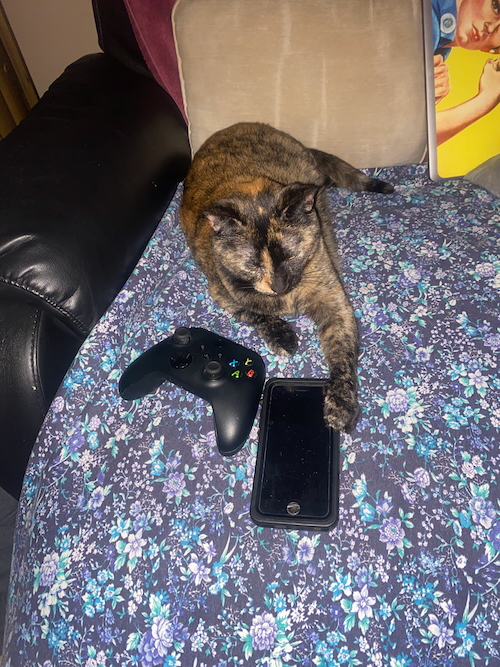
Monday Meows
Hey, we’re running short on pickles!
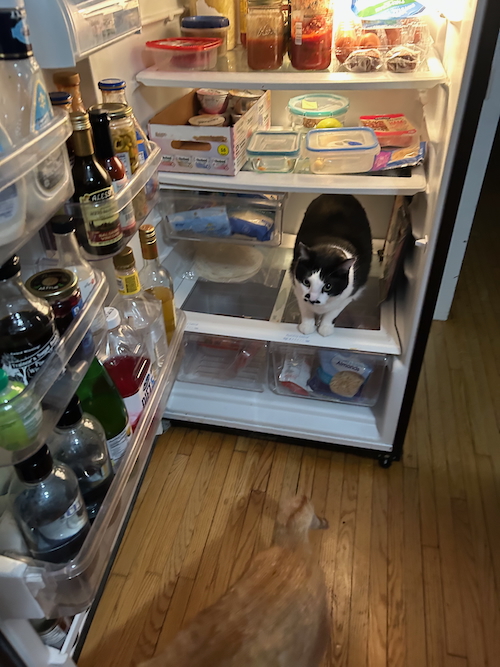
What I want to know is why he’s in the fridge.
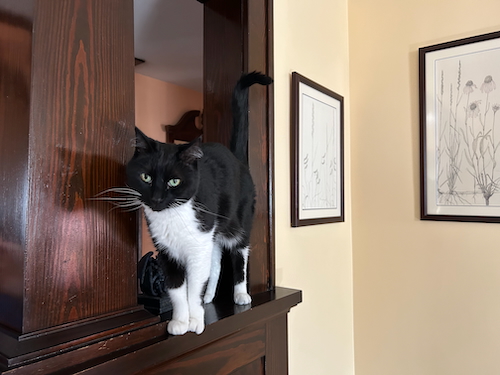
What I want to know is why he’s in MY fridge.
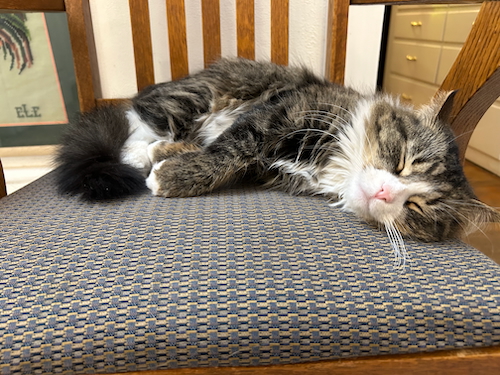
I want to know why I didn’t get to go in the fridge.
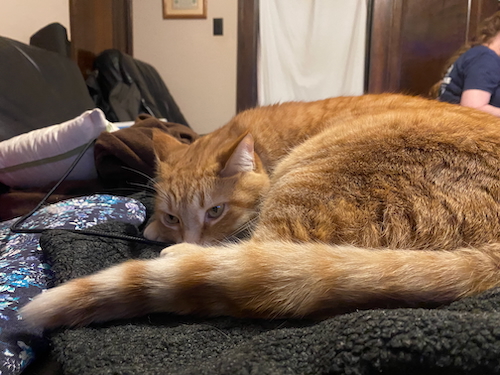
I want to know what secrets lurk in the hearts of men.
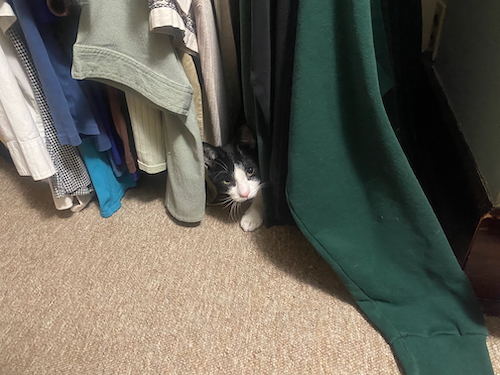
I want to know how to write my own damn cat blogs, starring…moi.
Categories: Authors
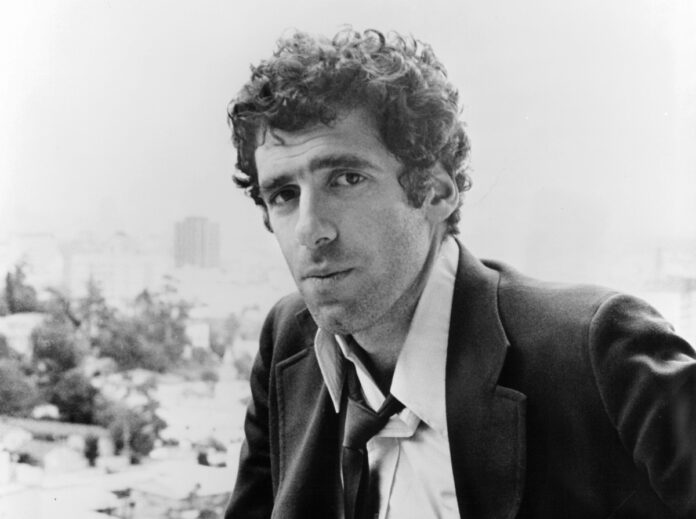
A (Black) Gat in the Hand: Elliot Gould’s Better Philip Marlowe
 “You’re the second guy I’ve met within hours who seems to think a gat in the hand means a world by the tail.”
– Phillip Marlowe in Raymond Chandler’s The Big Sleep
Back in the Summer of 2020, A (Black) Gat in the Hand looked at some screen and radio productions for Raymond Chandler’s private eye, Philip Marlowe. Two months before, I had done a separate post on Powers Boothe’s terrific series for HBO. That series was really the impetus to move me from not liking Raymond Chandler, to being a fan.
There was a second thing which brought me all the way in to being a Chandler guy. Now, I cannot abide Elliott Gould’s The Long Goodbye. My attempts to ‘try again’ inevitably lead to me quitting the re-watch. I don’t like my Marlowe in 1973, and it’s my least favorite Marlowe on screen.
However, as with Powers Boothe, I wouldn’t be a fan of Raymond Chandler if not for Gould. He recorded all the Marlowe novels, as well as several of Chandler’s non-Marlowe short stories, as audiobooks. This was way back in cassette days, and I was smart enough to pick up several of the CDs, even though I wasn’t into Chandler then.
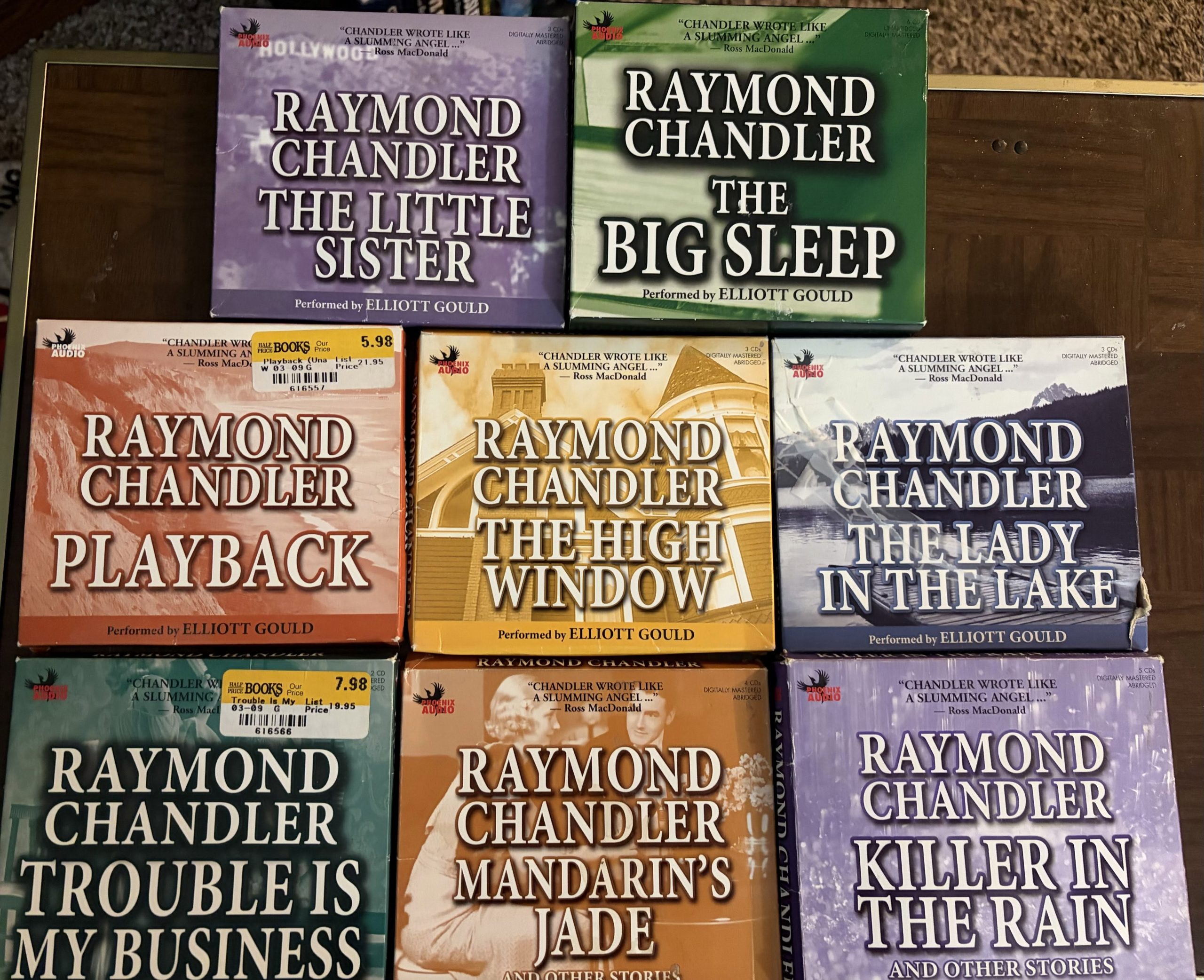
I have five of the seven novels (he also narrated Poodle Springs, an unfinished Chandler novel, which Robert B. Parker completed), and three short story CDs:
The Big Sleep
The High Window
The Lady in the Lake
The Little Sister
Playback
Killer in the Rain and Other Stories
Mandarin’s Jade and Other Stories
Trouble is My Business
 Gould is spot on. I have no complaints whatsoever about these audiobooks, other than that almost all of them are abridgements (at least The Big Sleep is unabridged).
Early on, Chandler wrote about a very Marlowe-like PI named Carmady, for Black Mask. Gould’s Killer in the Rain is all Carmady stories, as are two of the stories in Mandarin’s Jade.
After Cap Shaw was fired by Black Mask, Chandler left the magazine for Dime Detective and essentially turned Carmady into John Dalmas. And Dalmas was basically Marlowe before he was called Marlowe. There’s not much difference between the latter two.
John Dalmas is in “Mandarin’s Jade,” and the short novella, Trouble is My Business.
Dalmas was also in “Red Wind” (which I wish I’d bought), and the short story version of “The Lady in the Lake,” which Chandler turned into the Marlowe novel of the same name.
Chandler was pretty much done with short stories by 1942, and he would cannibalize some of these for his novels, starting with The Big Sleep. I like Chandler’s short stories, and fans of Marlowe should enjoy Dalmas. The Carmady stories are a little less polished, but he was just starting out as a writer. They’re still very Chandler.
I would have liked to see Gould in a period-appropriate Marlowe movie or two. Based on his readings, they would have been good.
Gould conveys the cynicism and world-weariness which is characteristic of Chandler’s detectives This is vital to a believable Marlowe. Chandler’s PI is different from Dashiell Hammett’s Sam Spade, or The Continental Op. Gould sounds like Chandler reads.
I can absolutely picture the scene as Gould narrates. The hard dames, the corrupt cops, the tough guys, the arrogant clients: Gould is excellent at ‘showing’ all the emotions and attitudes which Marlowe has to deal with. Prospective clients like to ‘put him in his place, and he rolls with it, often ignoring, rather than arguing back. Part of it is Chandler’s tremendous facility with words. But Gould isn’t just a good narrator. He’s a good Marlowe.
My feelings about Gould on screen vs in audio, reminds me of Alfred Molina. His modern-day Murder on the Orient Express was an unpopular movie. But a few years ago he did a radio play of “The Murder on the Links.” He is very good as Poirot.
Gould pronounces coupe ‘coop-ay.’ which feels kind of classy. And I like the way he says porte-cochere (Chandler really liked that French word). His voice is smooth. I like listening to him read. And he totally vibes the Marlowe of the written page.
Some of Gould’s audiobooks are on Youtube, and a few can be found via the Libby library app, and also on Audible. I’m fortunate that I bought most on CD. I listen to them at least every year or two when I get in a Marlowe mood. Though I really like the BBC radio plays with Toby Stephens (Vexed) as Marlowe. They’re tough to beat, and readily available to buy for phone listening.
But I often recommend Gould’s audiobooks. I think that the fact I can’t stand the movie,
It’s mid-May, and I’ve been in something of a hardboiled mood lately. So with Summer looming, here’s a Black (Gat) in the Hand. More Pulp is coming, like a gumshoe with a gasper and a rod.
Prior Posts in A (Black) Gat in the Hand – 2026 (1)
Prior Posts in A (Black) Gat in the Hand – 2025 (12)
Will Murray on Dash(iell Hammet) and (Lester) Dent
Shelfie – Dashiell Hammett
Windy City Pulp & Paper Fest – 2025
Will Murray on Who was N.V. Romero?
Conan – The Phoenix in the Sword in Weird Tales
More of Robert E. Howard’s Kirby O’Donnell
More Weird Menace from Robert E. Howard – Conrad and Kirowan
Hardboiled Gaming- LA Noire
Western Noir: Hell on Wheels
T.T. Flynn’s Mr Maddox
Dashiell Hammettt’s The Scorched Face (my intro)
Will Murray on Raymond Chandler’s Other Lost Stories?
Prior Posts in A (Black) Gat in the Hand – 2024 Series (11)
Will Murray on Other Lost Raymond Chandler Stories?
Will Murray on Dashiell Hammett’s Elusive Glass Key
Ya Gotta Ask – Reprise
Rex Stout’s “The Mother of Invention”
Dime Detective, August, 1941
John D. MacDonald’s “Ring Around the Readhead”
Harboiled Manila – Raoul Whitfield’s Jo Gar
7 Upcoming A (Black) Gat in the Hand Attractions
Paul Cain’s Fast One (my intro)
Dashiell Hammett – The Girl with the Silver Eyes (my intro)
Richard Demming’s Manville Moon
More Thrilling Adventures from REH
Prior Posts in A (Black) Gat in the Hand – 2023 Series (15)
Back Down those Mean Streets in 2023
Will Murray on Hammett Didn’t Write “The Diamond Wager”
Dashiell Hammett – ZigZags of Treachery (my intro)
Ten Pulp Things I Think I Think
Evan Lewis on Cleve Adams
T,T, Flynn’s Mike & Trixie (The ‘Lost Intro’)
John Bullard on REH’s Rough and Ready Clowns of the West – Part I (Breckenridge Elkins)
John Bullard on REH’s Rough and Ready Clowns of the West – Part II
William Patrick Murray on Supernatural Westerns, and Crossing Genres
Erle Stanley Gardner’s ‘Getting Away With Murder (And ‘A Black (Gat)’ turns 100!)
James Reasoner on Robert E. Howard’s Trail Towns of the old West
Frank Schildiner on Solomon Kane
 Paul Bishop on The Fists of Robert E. Howard
John Lawrence’s Cass Blue
Dave Hardy on REH’s El Borak
Prior posts in A (Black) Gat in the Hand – 2022 Series (16)
Asimov – Sci Fi Meets the Police Procedural
The Adventures of Christopher London
Weird Menace from Robert E. Howard
Spicy Adventures from Robert E. Howard
Thrilling Adventures from Robert E. Howard
Norbert Davis’ “The Gin Monkey”
Tracer Bullet
Shovel’s Painful Predicament
Back Porch Pulp #1
Wally Conger on ‘The Hollywood Troubleshooter Saga’
Arsenic and Old Lace
David Dodge
Glen Cook’s Garrett, PI
John Leslie’s Key West Private Eye
Back Porch Pulp #2
Norbert Davis’ Max Latin
Prior posts in A (Black) Gat in the Hand – 2021 Series (7 )
The Forgotten Black Masker – Norbert Davis
Appaloosa
A (Black) Gat in the Hand is Back!
Black Mask – March, 1932
Three Gun Terry Mack & Carroll John Daly
Bounty Hunters & Bail Bondsmen
Norbert Davis in Black Mask – Volume 1
Prior posts in A (Black) Gat in the Hand – 2020 Series (21)
Hardboiled May on TCM
Some Hardboiled streaming options
Johnny O’Clock (Dick Powell)
Hardboiled June on TCM
Bullets or Ballots (Humphrey Bogart)
Phililp Marlowe – Private Eye (Powers Boothe)
Cool and Lam
All Through the Night (Bogart)
Dick Powell as Yours Truly, Johnny Dollar
Hardboiled July on TCM
YTJD – The Emily Braddock Matter (John Lund)
Richard Diamond – The Betty Moran Case (Dick Powell)
Bold Venture (Bogart & Bacall)
Hardboiled August on TCM
Norbert Davis – ‘Have one on the House’
with Steven H Silver: C.M. Kornbluth’s Pulp
Norbert Davis – ‘Don’t You Cry for Me’
 Talking About Philip Marlowe
Steven H Silver Asks you to Name This Movie
Cajun Hardboiled – Dave Robicheaux
More Cool & Lam from Hard Case Crime
A (Black) Gat in the Hand – 2019 Series (15)
Back Deck Pulp Returns
A (Black) Gat in the Hand Returns
Will Murray on Doc Savage
Hugh B. Cave’s Peter Kane
Paul Bishop on Lance Spearman
A Man Called Spade
Hard Boiled Holmes
Duane Spurlock on T.T. Flynn
Andrew Salmon on Montreal Noir
Frank Schildiner on The Bad Guys of Pulp
Steve Scott on John D. MacDonald’s ‘Park Falkner’
William Patrick Murray on The Spider
John D. MacDonald & Mickey Spillane
Norbert Davis goes West(ern)
Bill Crider on The Brass Cupcake
A (Black) Gat in the Hand – 2018 Series (32)
George Harmon Coxe
Raoul Whitfield
Some Hard Boiled Anthologies
Frederick Nebel’s Donahue
Thomas Walsh
Black Mask – January, 1935
Norbert Davis’ Ben Shaley
D.L. Champion’s Rex Sackler
Dime Detective – August, 1939
Back Deck Pulp #1
W.T. Ballard’s Bill Lennox
Erle Stanley Gardner’s The Phantom Crook (Ed Jenkins)
Day Keene
Black Mask – October, 1933
Back Deck Pulp #2
Black Mask – Spring, 2017
Erle Stanley Gardner’s ‘The Shrieking Skeleton’
Frank Schildiner’s ‘Max Allen Collins & The Hard Boiled Hero’
A (Black) Gat in the Hand: William Campbell Gault
A (Black) Gat in the Hand: More Cool & Lam From Hard Case Crime
MORE Cool & Lam!!!!
Thomas Parker’s ‘They Shoot Horses, Don’t They?’
Joe Bonadonna’s ‘Hardboiled Film Noir’ (Part One)
Joe Bonadonna’s ‘Hardboiled Film Noir’ (Part Two)
William Patrick Maynard’s ‘The Yellow Peril’
Andrew P Salmon’s ‘Frederick C. Davis’
Rory Gallagher’s ‘Continental Op’
Back Deck Pulp #3
Back Deck Pulp #4
Back Deck Pulp #5
Joe ‘Cap’ Shaw on Writing
Back Deck Pulp #6
The Black Mask Dinner
 Bob Byrne’s ‘A (Black) Gat in the Hand’ made its Black Gate debut in 2018 and has returned every Summer since.
His ‘The Public Life of Sherlock Holmes’ column ran every Monday morning at Black Gate from March, 2014 through March, 2017. And he irregularly posts on Rex Stout’s gargantuan detective in ‘Nero Wolfe’s Brownstone.’ He is a member of the Praed Street Irregulars, and founded www.SolarPons.com (the only website dedicated to the ‘Sherlock Holmes of Praed Street’).
He organized Black Gate’s award-nominated ‘Discovering Robert E. Howard’ series, as well as the award-winning ‘Hither Came Conan’ series. Which is now part of THE Definitive guide to Conan. He also organized 2023’s ‘Talking Tolkien.’
He has contributed stories to The MX Book of New Sherlock Holmes Stories — Parts III, IV, V, VI, XXI, and XXXIII.
He has written introductions for Steeger Books, and appeared in several magazines, including Black Mask, Sherlock Holmes Mystery Magazine, The Strand Magazine, and Sherlock Magazine.
You can definitely ‘experience the Bobness’ at Jason Waltz’s ’24? in 42′ podcast.
Categories: Fantasy Books
Book review: Catch and Kill (Neon Meridian #1) by Craig Schaefer

ABOUT THE AUTHOR: Craig Schaefer writes about witches, outlaws, and outsiders. Whether they’re weaving tales of an occult-shrouded New York in Ghosts of Gotham, the dimension-hopping adventures of Castaways, or the gritty streets of a noir future in the Neon Meridian series, their protagonists are damaged survivors searching for answers, redemption, or maybe just that one big score.
Publisher: Aethon Books (May 19, 2026) Page count: 358 pages Formats: audiobook, ebook, paperback Genre: Urban Science Fantasy
At this point Craig Schaefer has basically become an instabuy author for me. Whenever a new book appears, I buy it, move it straight to the top of my TBR pile, and assume I’m about to have a good time. So far this strategy has worked quite well. I don’t think Schaefer has actually disappointed me once.
Catch and Kill definitely continues the streak.
This book feels like Schaefer operating in peak form again: fast, tight, funny in the right places, surprisingly charming, and full of twists that keep the story moving without turning it into nonsense. It’s also definitely adult. People get shot, cursed, murdered, manipulated, and occasionally reduced to a warning. But if you’re picking up cyberpunkish urban fantasy involving magical corporate espionage, that's probably what you're looking for.
Magic became public knowledge decades ago and people decided to monetize it. So now Hell has embassies, corporations employ witches and undead accountants probably exist somewhere off-page filing cursed paperwork forever.
Emily Yeats is a blue-collar Brooklyn witch running security audits with her team by staging elaborate magical break-ins for clients. She may not be the strongest person in the room physically, but she compensates with skill, stubbornness, and enough magical talent to make very dangerous people regret underestimating her. Her team is fantastic, and it includes a sentient android who moonlights as a dominatrix, a hacker/catgirl genius, and a hardened military operative who balances out the team’s collective tendency toward chaos.
Also, Emily shares her apartment with venomous spiders. Weirdly enough, they are excellent roommates. Quiet. Helpful. Probably better at cleaning than most humans.
The whole thing is insanely readable. Schaefer throws cyberpunk elements, urban fantasy, corporate conspiracies, magical contracts, supernatural assassins, and heist elements into the same blender and somehow the story never feels overloaded. It just moves. Every chapter pushes forward cleanly, and before long you realize you read half the book in one sitting.
And while this is clearly the start of a series, the actual story feels complete. There's no massive cliffhanger or "to be continued" ambush right as things get interesting. The central plot wraps up properly while still leaving plenty of room for future books.
Which is good, because I absolutely want future books. Book two. Book three. Book seven if sales permit. I’d happily keep following Emily and her dysfunctional little team through magical cyberpunk disasters for quite a while.
Categories: Fantasy Books
Manga Review – Witch Hat Atelier Vol 14 by Kamome Shirahama (4/5 stars)

Reading Level: Young Adult
Genre: Fantasy/Manga
Length: 176 pages
Publisher: Kodansha Comics
Release Date: March 17, 2026
ASIN: B0FDJHS1ZP
Stand Alone or Series: 14th volume in the Witch Hat Atelier series
Source: Bought paperback
Rating: 4/5 stars
“At long last, Dagda and Custas are back together, reunited in the medical tower. All they should have to do now is wait for the doctors to treat them. But at that moment, Qifrey has a terrible premonition. Meanwhile, Coco has a plan to defend the town from the rampaging valance leeches. But it’s a long shot that’ll need all the town’s witches to work together…”
Series Info/Source: This is the 14th volume in the Witch Hat Atelier series. I bought this in paperback to read.
Thoughts: This volume continues the storyline of the valance leeches and follows our witches as they try to fight it. When Coco comes up with an amazing idea to defend the town her idea is challenged by the knights. While both the knights and the witches want to save people, they have very different beliefs on how that should be done. Unfortunately, for them, the valance leeches latch onto a new location to unleash their deadly chaos.
I love the illustration in this manga series, it is absolutely beautiful and a joy to look at. I continue to enjoy the theme of family and teamwork throughout. This volume really drives home that idea that you need amazing ideas from a team of people to solve a complex situation. I also loved that a lot of our apprentice witches are gaining confidence and really stepping up to help solve complicated problems.
While I was happy to see this storyline make more progress, I was a bit disappointed that the valance leech storyline is still going strong at the end of this volume. I feel like it’s time to wrap that up. Although at this point, I am not even sure what would come next for our characters.
My Summary (4/5 ):Overall I really love the artwork throughout this volume and love that our characters are growing and becoming more confident. I am happy the storyline made some progress, but felt like it didn’t make enough progress. I definitely plan to continue with this series because I want to know if Coco’s plan will work! I would recommend this manga series to those who enjoy cozy magic fantasy stories.

Categories: Fantasy Books
The Leaning Pile of Books
The Leaning Pile of Books is a feature in which I highlight books I got over the last week that sound interesting—old or new, bought or received in the mail for review consideration. Since I hope you will find new books you’re interested in reading in these posts, I try to be as informative as possible. If I can find them, links to excerpts, author’s websites, and places where you can find more information on the book are included, along […]
The post The Leaning Pile of Books first appeared on Fantasy Cafe.
Categories: Fantasy Books
Saved by the Panther: Jonathan Maberry on storytelling, books, and how the Black Panther changed his life, Part 1
 Jonathan Maberry
Since the publication of his first novel Ghost Road Blues, Jonathan Maberry has been a mainstay in genre fiction circles. Whether its for one of his multiple series, comic book writing, or the numerous anthologies he’s edited over the years, audiences have come to know and love his work.
With the completion of his 57th novel right around the corner, Maberry is still going strong. The five-time Stoker Award winner joined me for a chat about the past, present, and future. From his childhood in the rough Kensington neighborhood of Philadelphia to being editor of Weird Tales, here’s what Maberry had to share with Black Gate magazine in an interview so big we had to split it in two.
You’ve been writing and editing for decades, how has the industry changed since you made your fiction debut?
My first novel came out in 2006 which is just around the time that digital was rising, so a couple years from then on we saw the end of CDs and cassettes for audio books and the rise of digital downloads.
Also, we saw the rise of independent publishing going from what looked like cheap work to much more sophisticated work. Because, it’s kind of a sad event but had a good benefit, during the economic downturn a lot of people in publishing a lot of editors agents and so on lost their jobs. And those folks, a lot of them went freelance. So the indie crowd is now able to hire professional freelancers that worked in traditional publishing to be able to edit their books, design their books and so on which raised the quality of indie to be somewhat comparable to traditional publishing.
I’m 100% traditional published but you’ve seen so many books come out that are definitely top quality from the indie world and that’s happened during that phase.
We’ve also had the rise of CGI and AI which can be good or can be really bad. I’m not a fan of generative AI at all-I’m part of that big Anthropic lawsuit in fact. We’ve also seen the rise of E-book, though for a while a lot of industry folks thought that was going to explode and be the dominant form for books, but it turned out to be in third place. First is still print, audio is next, and for guys like me audio is actually more, and then e-books are a smaller group. I think that will change especially during the economic crisis we’re going through now. Because print relies on oil and everything from the chainsaws that cut down trees to the paper mills and trucks that drive them to the book store that’s all oil.
 The 10-volume Joe Ledger series, written by Jonathan Maberry and published by St. Martin’s Griffin, began with Patient Zero in 2009
My personal favorite part of this is building a community because I’ve always been a community builder in the writing world anyway. For the last 26 years I’ve been actively building communities in various places so that writers of all kinds can share knowledge and mutually benefit. I started the Writers Coffeehouse back then and it’s since spread out to other parts of the country. I run the San Diego chapter and it’s thriving. It’s a free 3-hour networking group for writers of all kinds.
And that’s something that’s really wonderful. I can use these utilities like Zoom, Facebook Live, and others to talk to people, I can do classes, I do a writing masterclass as a charity fundraiser every month online. I do virtual panels, book events. All of that has happened in the 20 years since I started fiction.
The friends of mine who don’t like it, who are very much analog in their approach to writing, got left behind. And I’m sorry for them as a person but not sorry for them professionally because business has always changed and you have to change with it. That’s a fact of life. Business will not ask you whether it’s comfortable for you to change its going to change based on its needs and we’ve got to change with it.
Before you wrote your first novel in 2006, you’d written other books. What was it that made you want to become a writer and storyteller?
Honestly, I think I was born that way. I can remember even before I could write I was telling stories with toys. Storytelling was always baked into my DNA in some way. What changed over the years is the kind of writing. As a kid, I wanted to write comics and stories because that’s what I was reading and that’s what I understood. And my mentors, the people I met along the way at the time, were very encouraging of that.
But in high school I was very political. It was right after Watergate, right after the Vietnam war. Journalists had risen to become like rock stars. Woodward Bernstein, even Walter Cronkite, people like that were the voice of truth that we were hearing and I wanted to be that. So I shifted from fiction, probably in 10th grade, and then for the next 30 years that was my focus, nonfiction.
I went to school on a journalism scholarship through Temple University with every intention that I would expose the corrupt whatever, tear that down and expose the truth and all of that. Investigative journalists were like rock stars. But…I never actually did that. Halfway through college I took a course on magazine features and decided that was more fun, and I did that as part time work for decades.
 Judo & You: A Handbook for the Serious Student, by John Earl Maberry, 5th dan, and Dr. Chuck Rinear, 1st dan (Kendall Hunt Pub Co, 1991)
My day job was always teaching martial arts in various ways including teaching martial arts history at Temple University for 14 years along with teaching jujutsu classes and women’s self-defense and other things. So I was writing about that sort of stuff, my first book was a judo textbook I wrote for a friend of mine who was a judo instructor at Temple University. That book came out in 1991.
My breaking away from that kind of writing happened in stages. I started out with the ‘write what you know’ and since I’d been doing martial arts since I was five, I wrote about that. I then started writing about what I liked: skydiving, music, I wrote about travel, theater, bartending, holidays, parenting, all sorts of stuff. I did about 1200 feature articles and maybe 3000 reviews and filler pieces.
Then around 2000 I wrote a nonfiction book about supernatural folklore – The Vampire Slayers Field Guide to the Undead — about what people actually believed about monsters throughout history. It was the only thing I ever published under a pen name – Shane MacDougall — because my martial arts book publisher was afraid that such a dramatic genre shift would negatively impact sales of those other books. It did not, as it turned out.
The Vampire Slayers’ Field Guide to the Undead by Shane MacDougall,
AKA Jonathan Maberry (Strider Nolan, October 1, 2003)
While researching folklore it made me want to find novels that use the folkloric versions of monsters but they were very hard to find, at least back then. Now they are more common. But back then my wife said, “Why don’t you just write it.” And you know I actually never considered that, so I spent five years learning to write a novel and trying to understand the carpentry used to build a novel. You know, the elements of craft: pacing and tone, voice, point of view, figurative and descriptive language, the three act structure, all that.
And then I wrote a novel just to get it out of my system more than anything else. I got an agent really quickly, and it sold to the second publisher who looked at it. The book Ghost Road Blues is still in print. In fact June 6th will be the 20th anniversary of its release. June 6th is also when I’m getting the lifetime achievement award from the Horror Writers Association.
Ghost Road Blues by Jonathan Maberry (Kensington Books reprint edition, May 2016)
Just as publishing changes I’ve changed with publishing. I’ve had to learn about the business of publishing, about marketing and promotion, about business etiquette, and about the ways these things had changed and would continue to change.
I eventually wound up getting into comics, too. I’d grown up reading comics. Mostly Marvel, but other stuff as well, but I’d never seen what a comic script looked like. That was something else to learn, and I was there for it. ‘It’ was my novel Patient Zero that got Marvel interested enough to reach out and ask me if I would like to write for Marvel which is, by the way, a silly, silly question. Of course I want to write for Marvel. I’ve met very few writers that would say ‘oh I wouldn’t bother with that.’ No, we all want to write for Marvel.
I’m glad you mentioned all your other interests because that ties very nicely into my next question. How do you balance being a martial artist, a teacher, having all those different interests with being a writer. And how do you leverage those interests to help your writing?
These days I actually don’t teach martial arts anymore. I’d been doing it for 60 something years and it takes a toll on the old bones, you know? I do workshops on how to write fight scenes and I do some consulting on Spec-Ops and SWAT but that’s a smaller part of what I do. Everything else is writing now. It’s my day job, it’s what I do.
As far as balancing things, I look at my process all the time. I want to understand what makes me happy as a writer, because happiness has to be a big part of that; what makes me most efficient and what gets in the way of that and you tweak the process. It took me three and a half years to write the first draft of my (first) novel and then a year and a half to revise it. Now I write a long novel every three months.
 Marvel Comics by Jonathan Maberry: Captain America: Hail Hydra, Marvel Universe vs. The Avengers, and Marvel Universe vs. The Punisher
I think a lot of that pace has to do with being trained as a journalist. When you’re trained to be a newspaper reporter you’re not trained to write slow. Editor says go out and give me 2,000 words on that 5-alarm fire and phone it in. That isn’t waiting for the muse to whisper to you, or going out and waiting for the fire to speak to you. A reporter goes there, gets the information, finds a hook that makes that article different from every other article on the subject, writes it quick and dirty, fixes it in the rewrite and moves on. I applied that mindset and process to my fiction. So it allows me to be very productive but also, it allows me to be efficient enough so that I have family time. Without that balance what the hell are you working for?
As far as other jobs, I teach writing masterclasses online, I teach at writers conferences all over the country, and I do in-person things like the Writers Coffeehouse. These are kind of built into my schedule. Everything goes on my calendar. I run my writing career like a business because it is a business. I have an assistant who is a contract worker. I hire her by the hour when I need her and everything else is a one man show. And she is a working writer herself – Dana Fredsti. She’s a novelist and freelance editor.
If you’re running a business you’d better be efficient at it and you’d better be able to let it evolve with the times. Being willing to change as the publishing world changes has allowed me to have a rich writing career and a rich family life.
 The Pine Deep Trilogy: Ghost Road Blues, Dead Man’s Song, and Bad Moon Rising (Kensington Books, 2006 – 2008)
You’ve written in a wide range of different genres: supernatural thrillers, science fiction, horror, etc. Do you find it easy to hop from genre to genre? Is there a certain frame of mind that you have to get into to write a zombie horror story as opposed to a dark science-fiction one?
I actually find jumping from genre to genre is like a palate cleanser. It freshens up your mind; it allows you to let the other things sit and think for a little bit while you go in and do something else, and then when you come back it’s ready for you to work on it.
My schedule works like this: I write one novel every three months as I said. During that three month period I’ll have maybe five or six short stories I have to write, I have a couple comics I’ll have to come back and do another issue of every couple of weeks, I have a packet I have to write for my online workshops, and I have appearances I need to do.
I just came back from the Las Vegas Writers Conference where I kept pretty busy with programs but soon as each program was over I went back up to my hotel room and I would write. I need t get at least 3,000 or more words done every day, even while teaching multiple classes at a writer’s conference. Its efficiency. It’s not that I’m the fastest writer in the world, I’m fast but I’m not the fastest. I’m just very focused on my process, my time management, and growing my career. I want to make sure that when I’m on the job I’m the best version of my own employee and my own boss that I can be. And that also makes it fun because then the business thrives.

The Wolfman, Jonathan Maberry’s first bestseller (Tor, February 2010)
Through tie-in works and comics you’ve had the opportunity to write some classic characters including Doctor Doom, Deadpool, the Xenomorph. Is it difficult to add your own spin and style to these classic settings? How do you approach that when compared to writing your own characters?
I have people write in my literary worlds as well. There’s an organization called the International Association of Media Tie-in Writers. It’s for people who write in other people’s licensed worlds – like Star Wars, Star Trek, CSI, as well as movies and even video games. I’m currently the president of that organization. I’ve been able to write short stories, comics, and novels about other people’s amazing characters. I’ve done work with Hellboy, Planet of the Apes, True Blood, John Carter of Mars, Aliens vs Predator, X-files — some of that stuff was written because I went after it. Some of it was written because my very first best-seller was a tie-in to The Wolfman.
I enjoy exploring those worlds. Marvel really got me started with that because when they contacted me and asked me if I wanted to write, the first thing they offered me was a short (8-page) Wolverine script. I’ve read a lot of Wolverine comics, and those comics were not all written by the same person; they were written by dozens of writers. So it’s a matter of learning what is kept as bedrock by all writers working on that license and then to find an entry to tell something new without reinventing someone else’s character.
Like, you’re never going to turn Wolverine into someone who is just passive, that’s not him. Punisher is never going to start regretting killing a bad guy. So what you’re looking for is another element of their life that you would like to add another note to. With Wolverine, I ended up having him have to kill the Japanese woman he was in love with. That scenario was created by another writer years back, but like all stories there are untold “moments” that invite new ideas. My focus was on what the psychological effect on him was, and the inner turmoil that resulted from so tragic an act.
With The Punisher they don’t want you to change The Punisher’s personality so I gave him side characters who served the role of bringing personality, humor and other points of view somewhat into it.
Read Part Two of our interview with Jonathan Maberry next week!
Categories: Fantasy Books
Book Review: The Dorians by Nick Cutter
I received a review copy from the publisher. This does not affect the contents of my review and all opinions are my own.
Mogsy’s Rating: 3.5 of 5 stars
Genre: Horror
Series: Stand Alone
Publisher: Gallery Books (May 19, 2026)
Length: 400 pages
Author Information: Website
A few years ago, I read about Canada’s expansion of its MAiD program, which stands for Medical Assistance in Dying, allowing eligible patients with grievous medical conditions to legally seek physician-assisted death. What struck me most though, is that its framework is considered one of the most permissive in the world. While many countries strictly limit this option for terminally ill adults, Canada does not. And ever since learning about it, I had a feeling authors would eventually begin writing stories related to the emotional and ethical implications, and I was right. The Dorians is probably the second or third book I’ve read recently that explores themes surrounding right to die, bodily autonomy, fear of decline, and how far people are willing to go in order to end their personal suffering. Nick Cutter, the pseudonym for critically acclaimed Canadian author Craig Davidson, takes those themes and pushes them into full-blown horror science fiction territory.
The story follows a group of elderly characters nearing the end of their lives for different reasons, who have all independently sought out MAiD. Each of them is approached by a mysterious doctor named Astrid Marsh, who offers them the chance to participate in a highly experimental but life-altering treatment at her secluded research facility on a remote island. Some of these individuals are terminally ill and out of medical options, while others are simply exhausted by old age and feeling like they have become a burden to society. What they all share, however, is regret. That lingering hope of a chance at a do-over is what drives a lot of them to at least hear Dr. Marsh out, even for those who have already made peace with the idea of assisted death.
And indeed, it turns out what the brilliant doctor has planned is nothing short of revolutionary. In her research, she has discovered a way to not only stop aging, but to reverse the biological clock completely, restoring youth to those willing to participate in her study. Of course, the treatment comes with enormous risks, and it is definitely not for the squeamish. The experiment centers on the hydra, a primitive multicellular organism known for its apparent biological immortality as they do not age due to their stem cells existing in a constant state of renewal. And now, Dr. Marsh and her team have found a way to harness those regenerative properties and integrate them into human hosts. Despite the uncertainty and hideousness behind the process, it’s not hard to see why many of the participants would take her up on the offer.
After his last few novels, Nick Cutter feels fully back in his element with The Dorians. As much as I admire some of his weirder, more ambitious work, I truly think he’s at his strongest when he’s tackling straightforward body horror with a tightly managed cast of characters and a more focused premise. After all, what’s more anxiety-inducing than the idea of aging? Losing control of your body is terrifying enough, but losing your mind right alongside might be even worse. That fear sits at the center of this novel, and the author digs into it with all the grotesque detail he’s become known for.
And yes, the body horror absolutely delivers. I simply love it when horror novels incorporate a biological component, and if you’ve read Nick Cutter before, you already know he has a talent for making certain biological processes feel disturbing in the most skin-crawling ways possible. But what really makes the novel effective, and also what I think is its greatest strength, is that the horror here isn’t necessarily of the “jump scare” variety, nor would I say it is scary in the traditional sense. Instead, it’s unsettling on an idea level, paired with vivid and sometimes nauseating imagery that becomes harder and harder to look away from.
But while Cutter clearly had a lot of fun exploring the nightmarish possibilities of Dr. Marsh’s hydra experiment, we still have a strong emotional thread running beneath all the biological ick and gore. For one, the elderly participants all came to the island thinking they were staring down the final stretch of their lives. Many of them carry deep loneliness, resentment, or fear about what’s coming next. In some ways, I wish the story had spent more time unpacking these ideas related to the characters’ anxieties and regret about aging, which might have helped flesh them out more as individuals. Instead, the plot spends a lot of time delving into the backstory and psychology of the main antagonist. While important and interesting in its own right, it also pulled the focus away from the others, and by the end, the villain was honestly the only character who really stuck with me.
Ultimately, The Dorians was for me a really entertaining return to form for Nick Cutter. It’s gross and packed with the kind of body horror that gets under your skin, but it’s also thoughtful and emotionally messy. The novel does have some issues, but I still feel like it’s one of his stronger works and well worth checking out if the premise speaks to you.


Categories: Fantasy Books
Fauxnan the Barbarian, Part Three
 A Nymphoid Barbarian in Dinosaur Hell (Troma Entertainment, 1990)
A veritable cornucopia of dodgy barbarian and barbarian-adjacent movies that I have never watched before, and will probably never watch again. Enjoy Parts One and Two here and here.
A Nymphoid Barbarian in Dinosaur Hell (1990) – USAI can’t help thinking that this one must have disappointed many a randy teenager when they smuggled it out of the video store, only to learn that ‘nymphoid’ doesn’t mean the same as ‘nymphomaniac,’ and were instead subjected to a good hour of aimless wandering before even a glimpse of prehistoric knockers was on the cards.
This is another quick buck-maker from the Troma crew, who surely saw a return on their meagre investment thanks to the aforementioned teen suckers, but it really doesn’t feel like a Troma flick. There’s no sign of the inventive weirdness or inappropriate humour to be found in the usual Kaufman joint; it’s all replaced by a dull story in which the last woman on Earth after the apocalypse, (Linda Corwin) has to contend with wandering gangs of bestial chads, while trying to avoid larger critters in the form of daft-looking dinosaurs.
No real goal, just a bit of rambling. It doesn’t help that Corwin has a permanent expression on her face like every single living creature she encounters is farting in her direction. Having said all that, apart from a hilarious toothed sausage type thing (called a Tromasaurus), there are some very fun stop-motion monster moments, flung together by director Brett Piper in a matter of days, that hold up very well and almost redeem the rest of the snoozefest.
I said ‘almost.’
4/10
 Wizards of the Lost Kingdom (Concorde Pictures, April 1985)
Wizards of the Lost Kingdom (1985) – USA/Argentina
Wizards of the Lost Kingdom (Concorde Pictures, April 1985)
Wizards of the Lost Kingdom (1985) – USA/Argentina
Here’s one that always caught my eye, but I never got around to watching, and I had mistakenly thought it was a fantasy film of the same caliber of semi-respectable S&S flicks such as Krull (1983), or Dragonslayer (1981). Oh, gentle reader, it is not.
It’s actually part of the multi-picture deal that Roger Corman struck with the Argentinian studios (that kicked off with the afore-critiqued Deathstalker), albeit given a few dollars more for production design and laser effects. The tale concerns a sorcerer’s apprentice, Simon (Vidal Peterson) who must locate his magic macguffin and save the teenage princess he plans to marry. The obstacle in his way is the evil wizard Shurka (Thom Matthews, the budgie-headed guy from Buck Rogers) who wants the frankly underage princess to himself, plus to commit other assorted naughtiness.
Simon is aided on his quest by a rogue warrior, Kor the Conqueror (Bo Svenson, having fun) and a ridiculous Chewbacca stand-in, Galfax, who looks like a tightly-permed yeti with the head of a bichon frise, and who does bugger all. Much derring-do ensues.
The humour is pushed to the forefront during the jam-packed adventure, and I doff my cap to the filmmakers who chose to throw everything into this one, no matter if it makes sense. It’s ultimately as daft as a kettle of chipmunks, but I didn’t hate it.
6/10
 Ilya Muromets (Mosfilm, September 16, 1956)
Ilya Muromets (1956) – Russia
Ilya Muromets (Mosfilm, September 16, 1956)
Ilya Muromets (1956) – Russia
From the stable of epic fantasy director Alexandr Ptushko comes this retelling of a classic bit of Russian folklore. Ilya Muromets (Boris Andreyev) is a gentle giant of man, seemingly unable to walk until an ancient sword is presented to him by a band of wandering pilgrims, and he takes up arms against the invading Tugars who are rampaging through the lands of Mother Russia, led by the fearsome Tsar Kalin (Shukur Burkhanov). These Tugars are a little like the Tartars, but different, thus thwarting my plans to make a Tartar source joke.
It is up to Ilya to unite the lands, work with Prince Vladimir of Kiev (Andrey Abrikosov), and defeat various magical creatures along the way. It all culminates in a showdown including his own son (who had been adopted by Kalin) and the three-headed grandpappy of King Ghidora.
 The three-headed dragon in Ilya Muromets
As with many Russian films of this period, Ilya Muromets has a dreamy ‘magical realism’ feel to it, as if we are watching a stage play on a monumental scale. Actual landscapes are enhanced with beautiful paintings and fantastic model work (Ptushko started out as an animator and model maker), and glorious puppetry is employed throughout in the depictions of animals, birds, and even Ilya’s own mighty steed.
This version (on Tubi) is the original, not the hacked up version that Corman presented as The Sword and the Dragon, that ended up as the butt of a plethora of Finnish jokes by the MST3K crowd.
Recommended.
8/10
 The Seven Magnificent Gladiators (Cannon Italia, August 31, 1984)
The Seven Magnificent Gladiators (1983) – USA/Italy
The Seven Magnificent Gladiators (Cannon Italia, August 31, 1984)
The Seven Magnificent Gladiators (1983) – USA/Italy
A community is terrorized by a nefarious leader of soldiers and cutthroats, and must recruit a small band of defenders to save their crops and their lives. Yes, this is a blatant rip-off of Battle Beyond the Stars (1980). Someone should do a samurai version.
Anyhoo, a wise old elder (as opposed to a wise young elder), reveals a hidden sword that will ‘choose’ a hero to wield it, and a gaggle of ladies takes off for the big city to find such a hunk. It eventually ends up in the hands of good-natured lunk Han (Lou Ferrigno, dubbed), a gladiatorial barbarian who is no fan of injustice. Han then recruits a bunch of other warriors, and the film then proceeds to follow the original(s) beat for beat. Half the fun is figuring out which warrior is meant to be James Coburn. I did realize that Julia (Sybil Danning), was the Brad Dexter one.
Anyhoo, swords are swung, villagers are trained, and some of the magnificent gladiators kick the bucket — all par for the course. It’s a bit laborious, but ultimately good for a laugh, and there’s no way any film with Sybil in it is getting less than 5 out of 10 from me.
5/10
 Hawk the Slayer (ITC Entertainment, December 18, 1980)
Hawk the Slayer (1980) – UK
Hawk the Slayer (ITC Entertainment, December 18, 1980)
Hawk the Slayer (1980) – UK
I concluded this watch-a-thon with an old British classic that I somehow managed to never get around to seeing, much to my shame. Hawk (John Terry — as stiff as a dead ferret) is the younger brother of Voltan (Jack Palance — having a blast), and the two of them have had a severe falling out over their rivalry for Eliane (Catriana McColl) — their squabble ending in the fair lady’s death and Voltan getting a crispy makeover.
Since then, Voltan has gone on to terrorize the land with dark magic and a bad attitude, while Hawk has lent himself out as a goodly fighter for hire. When Voltan kidnaps a nun (Annette Crosby!) Hawk decides it is time to put an end to his brother’s wicked ways once and for all, and recruits a group of tropes in order to rescue her.
This group includes Crow (Ray Charleson) an elf with the power to shoot arrows remarkably quickly through the power of editing, Baldin (Peter O’Farrell), a cheeky dwarf, and Gort (Bernard Bresslaw) a giant. Yes, in the space of three years, Bernard Bresslaw played a giant in a fantasy film (Krull), albeit this time with twice as many eyes. They are also joined by Ranulph (W. Morgan Sheppard), a crossbowman who has just lost one of his hands to Voltan.
Plenty of sorcery and shenanigans take place on the way to the inevitable showdown, some heroes die, others ride off into the sunset, and Jack Palance hangs up his Vader-inspired helmet vowing never to make another fantasy film (until the producers of Gor coax him back with a sack of gold).
Lots of fun, stuffed to the gills with beloved British character actors, and a bonkers synth score from Harry Robertson means I finish on a high note. Huzzah!
8/10
Previous Murky Movie surveys from Neil Baker include:
Fauxnan the Barbarian, Part One
Fauxnan the Barbarian, Part Two
Probing Questions
My Top Thirty Films
The Star Warses
Just When You Thought It Was Safe
Tech Tok
The Weyland-Yutaniverse
Foreign Bodies
Mummy Issues
Ch-Ch-Ch-Ch-Changes
Monster Mayhem
See all of Neil Baker’s Black Gate film reviews here. Neil spends his days watching dodgy movies, most of them terrible, in the hope that you might be inspired to watch them too. He is often asked why he doesn’t watch ‘proper’ films, and he honestly doesn’t have a good answer. He is an author, illustrator, teacher, and sculptor of turtle exhibits.
Categories: Fantasy Books
Comment on A Beginner’s Guide to Drucraft #47: Sigl Fashion (Hands/Arms) by Remy
In reply to Jonathan.
Great idea! I worry a lot about Stephen getting into a situation where he is backed into a corner and has his sigls confiscated.. Imagine if he is injured additionally!
Categories: Authors
5 Stunning Novels On Film That Won Best Picture Academy Awards!
Experience Literary Magic: 5 Novels on Film that Won The Top Prize at the Academy…
The post 5 Stunning Novels On Film That Won Best Picture Academy Awards! appeared first on LitStack.
Categories: Fantasy Books
Stacking the Shelves – Audiobook, Bought, and Borrowed Books for Last 5 Months – 5/23/25
Welcome to Stacking the Shelves, hosted by Reading Reality.


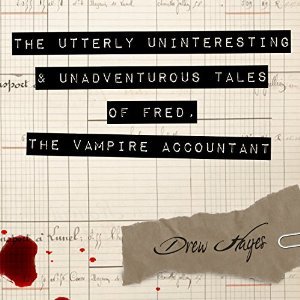



Categories: Fantasy Books
Comment on End of Editing by Bill
Very pleased to hear that the edits are almost done, and glad that (I’m assuming now) that they didn’t impact any of the prose that exists in the current Book#5 draft.
I trust that Book#5 is still “on schedule” for completion in the autumn?
Categories: Authors
DAVID STARR SPACE RANGER by Isaac Asimov
I consider myself lucky to have been reading science fiction for a long while (And since you didn’t ask, it’s over 50 years!) One of the things that keeps me reading is that I appreciate how much the genre has changed. Like many of my age, my first introduction to science fiction novels was through…
Categories: Fantasy Books
May 2026 Virtual Fantasy Book Recommendations
If you missed the second of my 2026 book recommendations events with the Ashland Public Library last night, you can watch the video on Youtube here. While last year’s program focused on both fantasy and science fiction, I’m primarily focusing on fantasy book recommendations this year. (But if you’re looking for more science fiction books this year, Elizabeth Bear has you covered!) This time, I highlighted the following: A Song of Legends Lost by M. H. Ayinde, an epic science […]
The post May 2026 Virtual Fantasy Book Recommendations first appeared on Fantasy Cafe.
Categories: Fantasy Books
Pack an Order with Us
I have a couple of posts I would like to write, but they must wait till tomorrow. A difficult scene is coming up, and it must be done right. The only way to do it to live through the emotions it requires.
We will walk this path with Maggie, because that is the price we pay for authenticity.
With that in mind, I bring you something light and calm. Help Kid 2 and I pack an order for Wynne. If you receiving this in your inbox and can’t see the video, you can find it on Youtube here.
If you ordered vellum with us, it will be arriving next week and most of the envelopes should get there by Wednesday. Please let me know if everything arrived safely. If you would like to order you own set, the preorder should go up next Friday.
I will see you on Saturday for a personal post.
The post Pack an Order with Us first appeared on ILONA ANDREWS.
Categories: Authors
Comment on End of Editing by Benedict
In reply to Nick Thijssen.
Unfortunately, when I’m writing the first draft, I don’t know WHICH bits are the ones I’ll have to change afterwards.
Categories: Authors
Comment on End of Editing by Nick Thijssen
This is kind of like Coding, where you have to change ALL the references to a certain bit of code. Do you write certain phrases in certain ways so they’re easier to find later when editing?
Categories: Authors
Pages

Recent comments