
Feed aggregator
Teaser Tuesdays - Six Scorched Roses
 The first time I met death, it was in my first breaths - or rather, the first breaths I didn't take. I was born too small, too sickly, too quiet.(page 3, Six Scorched Roses by Carissa Broadbent)
---------
Teaser Tuesdays is a weekly bookish meme, previously hosted by MizB of Should Be Reading. Anyone can play along! Just do the following: - Grab your current read - Open to a random page - Share two (2) “teaser” sentences from somewhere on that page BE CAREFUL NOT TO INCLUDE SPOILERS! (make sure that what you share doesn’t give too much away! You don’t want to ruin the book for others!) - Share the title & author, too, so that other TT participants can add the book to their TBR Lists if they like your teasers!
Categories: Fantasy Books
Book review: Goth the Wanderer by Raymond St. Elmo

ABOUT THE AUTHOR: Raymond St. Elmo is a programmer of artificial intelligences and virtual realities, who has no time for literary fabrications of fictitious characters and world-building. And yes, that was meant to be ironic.
A degree in Spanish Literature gave him a love of Magic Realism. Programming gave him a job. The job introduced him to artifical intelligence and virtual realities; as close to magic as reality is likely to get outside the covers of a book. And yes, that was meant to be cynical.
The author of several first-person comic-accounts of strange quests for mysterious manuscripts, mysterious girls in cloaks whose face appears SUDDENLY IN THE FLASH OF LIGHTNING. And yes, that was meant to be dramatic.
Publisher: Raymond St. Elmo (January 18, 2026) Page count: 181 pages Formats: ebook, paperback
I'm always looking to see what Raymond St. Elmo creates next. I dig his imagination and playful turn of phrase. Goth the Wanderer is, I think, his shortest book, and it’s pretty unique.
It has a strong Alice in Wonderland vibe. Except, Goth has a long knife, a battle pack, is hard-headed, bossy, brave, and likable. She sets off on a quest to recover her stolen shoe and quickly gathers companions, forming what becomes the Questers of the Shoe. Along the way she’s joined by a conversational wolf, a ghost girl, a candle that talks (mostly in exclamations), and a Very Large Mouse, who is absolutely not a rat. At some point even the shoe thief herself joins the party, which complicates things nicely.
Because it’s short and light on stakes, Goth the Wanderer reads quickly. As expected from the author, the ideas and imagery are vivid and odd, and the tone sits comfortably in cozy-adjacent territory. Don’t expect epic consequences or world-shaking revelations. Do expect wild imagination, whimsical writing, and the pleasure of watching a bossy eleven-year-old charge boldly into the unknown. The story maintains dreamlike wonder with just a hint of menace.
While it works as a standalone, expect nods to the previous Wanderer stories. Night Creep, for example, plays an important role here. The author’s own drawings appear throughout. They're simple, slightly rough, but they suit the book perfectly.
In short, Goth the Wanderer is imaginative, odd, and fun. A bold little quest with strange companions and unlikely places led by a girl who refuses to wait for permission.
Categories: Fantasy Books
ON SUNDAYS SHE PICKED FLOWERS by Yah Yah Scholfield
Yah Yah Scholfield’s On Sundays She Picked Flowers marks her impressive debut. It is a novel about perseverance, generational abuse, race, and shapeshifting creatures. It is part horror, part southern gothic and has the surreal, magical feel of a fairy tale. It is an arresting, powerful debut, in other words. In this sinister and…
Categories: Fantasy Books
Free Fiction Monday: Hunches
The Fleet designed the new SC-Class ships with an impenetrable bridge. The most protected spot on the ship. Right in the center.
So, when Lieutenant Balázs Jicha realizes the bridge of the Izlovchi now opens to space, he fights to remember what happened. And what to do next.
Jicha always follows his hunches. Now, he must rely on those hunches to help him save his ship.
“Hunches,” part of my Diving Universe, is free on this website for one week only. The story is also available as an ebook on all the various sites. (Yes, someday, I’ll put it in a collection.) If you want to get updates on my Diving Universe, sign up for the newsletter here: http://eepurl.com/gqxk-D
Enjoy!
Hunches Kristine Kathryn Rusch
Balázs Jicha stood in the wreckage of the bridge of the Izlovchi. The environmental suit he’d donned—too early, Lieutenant, Captain Treseter said when she saw him—was looser than he liked, making it feel as if his skin was sloughing off. His eyes ached from the smoke still swirling around the bridge—even though he hadn’t been in the smoke at all.
He’d been the only bridge crew member in an environmental suit who had been close enough to a console so that he could hang on when something small and fiery burst into the bridge itself.
That something small and fiery had carved a large opening through the hull and three levels between that hull and the bridge, opening the bridge to space. The whoosh of atmosphere leaving the bridge had been sudden and startling, partly because it wasn’t supposed to happen, not with the new SC-Class design.
No part of the bridge was even near an exterior wall of the ship. The bridge was in the exact heart of the Izlovchi, and as such should’ve been untouchable.
The ship didn’t even have a proper response to the attack on the bridge. The nanobits were supposed to repair critical systems first, so they prioritized the hull breach, which was huge, and one of the corridors that led to the medical wing. The nanobits didn’t even seem to be aware (if such things could be aware) that the bridge had been attacked.
No, the bridge had been destroyed.
He watched it happen in real time, gloved hands gripping the console, the small fiery thing still glowing, as if it was waiting for the oxygen to return. The small fiery thing seemed to be gloating, its redness pulsing, taunting him.
He had watched it zoom inside, then burrow into the floor, not too far from his boots. The boots that had their gravity turned on, so that he wouldn’t get pulled out of the bridge with the atmosphere, like so many others had.
But he had risked getting hit by that small fiery thing, and somehow, it had missed him.
When it settled, and the destruction was over, and it seemed like no more small fiery things were going to follow this one, he found himself on the other side of his console, as far as he could get from the demolished section of the floor.
The bridge looked nothing like it had an hour before. Consoles and equipment gone, edges of that gigantic opening crisped, a few crew members wrapped around console bases, but not wearing environmental suits.
And without the suits, they hadn’t had a chance.
He thought others had put on the suits, but there were holes in his memory, and right now, he was the only one moving.
The oxygen hadn’t returned yet, but the gravity had, which meant the full environmental system would kick in soon, and he would have to do something about that weapon, but he didn’t know what.
He had a hunch—and he wasn’t sure why he had that hunch (maybe he was just being paranoid)—that the small fiery weapon thing wanted him to use fire prevention equipment on it. His hunch told him any conventional fire prevention solution would make the problem worse.
And he had no idea why he had that hunch, what he had seen or heard or deduced from all the materials he’d been studying for his first contact with the culture that refused to identify itself on Luluenema, the planet they’d been planning to orbit when—this—hit them.
He wasn’t thinking clearly. Or rather, as clearly as he should have been. Somehow—somewhen—he had let go of the console. He didn’t remember doing it. Just remembered clinging as the escaping atmosphere tried to pull him with it into space.
The captain was gone, along with the first officer and—god, half the bridge crew. Three other bridge crew had been obliterated when the small fiery thing had busted its way inside. They’d been standing in its path, and they hadn’t burst into flame as much as burst into a reddish glow, and then evaporated.
He had seen it all, almost in slow motion.
Grabbing the environmental suit—that was his last real memory.
The captain had said—
***
“Hull breach, Cargo Bay One.” Captain Treseter sounded surprised. She was looking at a floating holoscreen as she stood in the exact center of the bridge, what she called the “well” of the bridge, because it was lower than any other point on the bridge.
This bridge was a bowl, and she used it, often setting up screens in a circle around her, making her seem like she was shielded from her bridge crew.
“I thought the shields were up,” First Officer Aydin said as her fingers moved on her screen. She was clearly checking the shields.
“They are,” Jicha said. He’d checked when he arrived on the bridge. Maintaining basic shields was one of his duties as the lowest ranking officer on the bridge.
“Toggle them to full strength,” the captain said, most likely to him. And because it was most likely, he opened the shield information on his console, only to see that someone else had already maximized the shields, probably First Officer Aydin.
That didn’t make him feel safer. The shields had been strong enough that no conventional weapon would have gotten through them.
“Who is firing on us?” The current navigator on duty, Gunna Ota, was leaning forward. She was only a yard or so from Captain Treseter and could probably see the floating screens. “We hadn’t picked up any ships nearby.”
“I’m getting flashes of things,” said Lieutenant Srigly. “I would say that I’m seeing fireflies, but that’s not possible. We’re not planetbound.”
Jicha knew what fireflies were, although he doubted that the others did. Jicha’s father had been a land-based engineer with Sector Base J-2, and Jicha spent a lot of time outside. They’d lived near a swamp, which had all kinds of insects, including something the locals called fireflies, because their tiny bellies would glow at twilight.
That comment sent a shiver through him. No one else on the bridge seemed nervous.
“Captain,” he said, “if these weapons can penetrate the hull even with the shields—”
“The hole in Cargo Bay One is already repaired, Lieutenant,” Treseter said. Her tone was condescending. His cheeks heated. She had been babying him since he had been posted on the Izlovchi.
His previous assignment had been on a much smaller ship, and he’d been a lowly ensign then. His work with other cultures, and his skills with languages, had gotten him promoted to Lieutenant Junior Grade, and with that promotion had come this assignment—an SC-Class vessel that needed someone unafraid of first-contact situations, particularly when the SC-Class vessel was clearing the way for a DV-Class convoy exploring planets for possible sector bases.
He was good at first contact because he read body language. He understood subtleties. He knew how humans reacted to other humans, even if they weren’t from the same culture.
But he was bad at interactions with others on the ships he’d served on because he had no idea how to translate those hunches into something Fleet officers saw as actionable.
Fleet officers wanted logic and rules and A-to-B-to-C reasoning that would make everyone else see the same possibilities. He still hadn’t learned how to do that.
His previous captain had tried to explain that aspect of Jicha to Treseter, and she had claimed she understood, but in the three months Jicha had been on board, he had learned that she hadn’t.
We don’t need that vague stuff, Lieutenant, she would say to him, and that tone, the one she most often used to shut him down, was the one she had just used about Cargo Bay One.
“I’m sorry, Captain,” he said, “but something is off.”
First Officer Aydin shot him a warning look. She professed to understand his hunches, and even promised to train him how to communicate them better, but so far, she had lacked the time.
“I agree,” Lieutenant Srigly said. “Those flashes of light have me worried. The sensors aren’t picking up anything, but the way the lights appear make it seem to me like we’re surrounded.”
“I don’t like that word ‘seem,’” Captain Treseter said. “I’d prefer something more concrete.”
Jicha blinked, frowned. His own memories felt like flashes of light sometimes, particularly when he was putting pieces together.
“I found something in my research about the space around Luluenema,” he said. “Something about ships getting swarmed by light.”
“Are we being swarmed, Lieutenant Srigly?” Captain Treseter asked, with just a touch of mockery in her tone.
“If those lights were actual bugs, then I’d say yes, Captain,” Lieutenant Srigly said.
The captain nodded, clearly surprised by that response. “The swarms, Lieutenant Jicha. Were they harmful?”
“The ships reporting them got destroyed, Captain,” Jicha said. That much he did remember. He wasn’t going to tell her, though, that the information he’d been working off of was centuries old.
“All right,” Captain Treseter said. “Then we need to take all the precautions we can. See what you can find in the records, Lieutenant Jicha. Anything that will give us a clue as to what we’re facing.”
“Yes, sir,” he said, and then turned. The supplies closet was just behind his station. He pulled the nearest environmental suit out, one that looked like it would fit him.
She had said all precautions. Or had he misunderstood? No one else was grabbing environmental suits.
“Too early, Lieutenant,” Captain Treseter said. “But put it on anyway. We all will need to suit up, since we’ve already had a hull breach. Aydin, send an announcement through the ship. Suiting up—”
***
—and then his memory skipped and broke. Somehow he was in the environmental suit, and two others who had been coming for their suits had turned into red glowing bits of themselves, and he imagined he could smell burning flesh and smoke, even though there was no oxygen, not anymore, not even when the small fiery thing hit, and he was clinging to the console, the hole punched through three layers of the ship and the hull letting space gleam beyond.
He saw fireflies, he was sure of it, out there in the bluish-blackness of space. Little twinkling lights, almost like they were mocking him, mocking all of them, and in his head, one of those lights had become the small fiery thing that burned its way through the ship.
The small fiery thing was still glowing, and one of the other members of the bridge crew—he couldn’t tell who, one of five who had grabbed environmental suits after he had (he remembered that now; how come he couldn’t remember more?), was reaching for fire suppression equipment.
Jicha shook his head, then waved a hand, holding them off. Instead, he leaned against the nearest console, surprisingly dizzy, even though his suit registered perfect oxygen levels and the gravity on his boots kept him stabilized, long before the actual gravity had returned.
He tried to ignore the weird sensations—the smoke, the burning flesh, the aching eyes, his sore knees from too much gravity (God, he felt like he weighed three times his usual weight)—and concentrate. He called up a control panel, saw the environmental system blinking as it slowly rebooted, one piece at a time, and slid his gloved forefinger across the screen, finding a containment unit.
He nearly pulled his finger away. It took all of his strength to keep his finger there, but he managed. And then he guided the containment unit to the small fiery thing, which was just a small glowing thing, and it looked harmless until he contained it, and then he saw all kinds of bits—mechanical bits—he hadn’t seen before.
It was giving off energy that the containment unit had under control, at least for the moment.
His headache eased—and he hadn’t even realized that he had a headache until it went away. The smell of burning flesh was gone, not even leaving an after-smell in his nose—but his eyes still ached, and his cheeks were wet, and he was shaking, but the dizziness was gone.
Two other members of the bridge crew pushed themselves upwards, their environmental suits gray with some kind of dust or damaged nanobits or something. Both crew members looked at him, but he couldn’t see their faces. He imagined they were surprised.
Or maybe their headaches had eased too. Maybe without the energy coming off the small fiery thing, the crew members could move around.
He needed to get the small fiery thing off the bridge, and off the ship. He wasn’t sure how to do that. He wasn’t sure how to do anything.
He looked over at the hole in the bridge again, and finally, what he saw registered. He could see all the way through the ship to bluish-blackness of space beyond. Little floating lights, those firefly lights, still winked.
He blinked, trying to make the image go away—and it wouldn’t. Those lights—he could see the lights.
He could see outside the ship.
He looked at the control panel, forcing himself to concentrate. Concentrating was easier than it had been.
The shields were still up around most of the ship, but not on this side, where the hole was. They were gone near Cargo Bay One too.
But worse, the nanobits weren’t repairing the second hole in the hull. They also left the hole in Cargo Bay One only half repaired.
The nanobits had stopped doing their job.
He’d never heard of that.
But even without them, the environmental systems were restoring themselves, which meant that something had contained the area around the bridge.
He called up information about the bridge itself, saw that a containment field had dropped around the bridge about the point the gravity reasserted itself. The containment field was a secondary system, one designed to activate when the shields no longer worked.
So, the shields weren’t working on this side of the ship, and neither were the nanobits.
He leaned on the console, his chest aching, almost as if he wasn’t getting air. He made himself concentrate on breathing. The air inside his suit tasted of metal and sweat—probably his own sweat. Flop sweat, from being terrified.
First things first, he had to get the small fiery thing off the bridge, but he wasn’t sure how to do it.
Then he blinked, thought, realized his priorities were wrong.
The Izlovchi was badly damaged. She was a lead ship, and three other ships would arrive soon, helping prepare the way for the convoy which was going to arrive a day or two from now.
He couldn’t remember the details. The details hadn’t been about him. The first contact had, and he had gotten lost in that. The meeting, it was scheduled for ten hours from now, and on Luluenema’s moon, not even on the planet itself.
Which was important. He needed to focus, not sure why that was important. Someone had said—he had said they clearly didn’t want the strangers anywhere near Luluenema, and he wasn’t sure why that was, he had planned on figuring that out, he wasn’t sure how he could figure that out, and—
He yanked his busy mind back to the moment at hand.
The incoming Fleet vessels. He needed to send them a message first.
Beware the firefly lights? Something like that, only expressed in a better way.
He looked at the console again. No distress signal had gone out. All Fleet vessels were built with automated distress signals. When a hull breached, and the bridge hadn’t responded within five minutes, a distress signal went to the nearest ships, and that hadn’t happened here.
He couldn’t investigate that part, not yet. He needed to send a message first.
He sent the distress signal, and opened the automated controls. They had been shut down at the moment of the original hull breach, the one in Cargo Bay One.
Which meant that something had invaded the Izlovchi’s systems. He felt awkward suddenly, wishing he hadn’t even activated the distress signal. Then he reminded himself: the other ships would see the signal, not bring it into their systems.
But sending them a message—that was more complicated. He didn’t want to open any straight line of communication to the other ships, because he was afraid that whatever had invaded the Izlovchi’s systems might travel through some communications links.
He clutched the console and made himself breathe. He couldn’t get whatever it was out of the system—he didn’t have that kind of skill. His engineering abilities were miniscule, barely good enough to put him on the officer track.
But…engineering. He opened a different section of the console, got different readings, saw that the engineering department was untouched. As was the medical bay, and so many other sections of the ship.
Untouched meant that they would be able to solve problems.
He wasn’t on his own.
He opened a communications link to Engineering. He identified himself, and then—the link cut out.
He re-established it, saw that they were trying to respond, but seemingly unable to.
Which meant they knew the problems existed; they just didn’t know what the problems were.
Communicating with them, though, wasn’t going to be dangerous. Not to them, not to him.
He just had to figure out how.
He glanced at that hole again, space glinting out there—or maybe the fireflies, the light. Surely Engineering would notice that the nanobits weren’t functioning right.
But no one had come to the bridge yet. No one had come to see if anyone was alive here, or injured or in need of rescue.
Did they think everyone was dead?
He opened yet another screen on his console, saw the environmental system still trying to reboot, and nothing else. He couldn’t see any locations of crew personnel. That system was never supposed to fail, and it had.
Or maybe the Izlovchi was going through cascading failures.
He let out a breath, rubbed a hand over his face, then winced. It felt weird to rub a gloved hand over his hooded helmet, and it made him realize how deeply embedded that nervous gesture was.
A few of the other crew members, all in environmental suits, had wobbled to their feet.
“Can you hear me?” he asked.
One of them nodded. The other two didn’t move. The one who nodded reached up and touched the side of their hood, indicating that the others should turn on their comm systems.
Hands went up, moved, then down again, and he repeated, “Can you hear me?”
“Yes.”
He didn’t recognize the voice, but that didn’t mean anything. He hadn’t yet worked with everyone on the bridge crew—or at least enough to feel comfortable guessing who was who.
“I don’t think shipwide comms are working,” he said. “We need a medical team, and someone has to go to engineering.”
He explained his belief that something was in the system, something that was overriding the systems, preventing the nanobits from recreating the hull, preventing communications internally, and maybe infecting other systems.
He told the three crew members his fear of communicating with other ships, worry that they would get infected too.
“I have a personal communication device,” said the only other person who had been speaking to him. He wished he knew who they were. He couldn’t tell from their voice. It could be anyone with a mid-range voice, and no local accent at all. “I can send a message to the Yoi.”
The Yoi was a family ship. It traveled with the Fleet.
Jicha almost told them not to contact the Yoi. It didn’t dare get infected. But if it did, it was with the bulk of the Fleet, and someone—somewhere—would be able to stop whatever destruction got started.
Besides, the systems being attacked were shipwide, not human systems.
And then he remembered the headache, that ghostly smell of smoke and burned wires, and he wondered.
It was either contact the Yoi through a personal device, one that, in theory, had been encased in an environmental suit just like the four of them had, or endanger other ships.
“Do it,” Jicha said.
Then he pointed at the person standing to the right. “You, go down to Engineering. Let them know we’re alive up here. Tell them what’s going on, and don’t let them contact anyone using the Izlovchi’s systems. And you—” He pointed at the third person. “Get to the medical bay. Have them send someone here.”
“What will you do?” the third person asked. His voice was deeper, almost rumbly.
Jicha knew his name, but couldn’t access it. Maybe he was wrong; maybe something had infected the humans too.
“I’m getting this thing off our ship,” he said, sweeping his hand down toward the container. “If it’s the last thing I do.”
***
They didn’t argue with him. No one did.
Instead, they followed his orders, as if he outranked them, which he probably did not. Two of the three left the bridge right away, and the third stood stock still for the longest time, most likely communicating on that personal communications device.
Jicha didn’t have time for communications or anything else. He had waited too long. That was a hunch, a feeling of impending doom. If he didn’t take care of that container, that something small and fiery, then the entire ship was going to be destroyed.
The headache was back, behind his eyes, and into his nose. His sinuses? He wasn’t sure. He ran a diagnostic on the environmental suit, and the suit cleared itself.
He didn’t trust the clearing. He didn’t trust anything, except maybe himself. And he barely trusted himself.
He felt fuzzy.
He peered at the container, the small fiery thing no longer glowing inside. The container’s walls didn’t look as clear as they had before. Were they occluded? Scratched? Scarring up? Was there moisture inside making the walls cloudy?
He couldn’t tell.
But he had to get the thing out of the ship.
He hadn’t turned off the gravity in his boots. He wasn’t going to. He was going to take the thing off the bridge, away from that small protective barrier, and into the hole that the thing had made.
He was going to carry the small fiery thing. He couldn’t think of any other way to transport it—especially if it infected systems.
He had to figure that his system was already infected, so he would assume the least amount of risk carrying it out.
And if the environmental suit failed, oh, well. He’d had a good life. He hadn’t become the captain of any ship, let alone a DV-Class vessel, which had been his dream, but he had done his best. He had known good people, and had had solid relationships.
He was proud of himself for getting as far as he had. He hadn’t found a mate yet, wasn’t sure he ever would, and didn’t have children, also wasn’t sure he wanted those either. He’d missed a lot of chances. He would miss even more, if he didn’t come through this.
He didn’t expect to survive it.
But he had to hope to survive. He understood how very important attitude was.
He pivoted, which was hard with the double-gravity, and opened the closet behind him. The environmental suits hung in a straight line, taunting him. They should have been on the captain, on the first officer, on the rest of the bridge crew, not stored in some closet. If that had happened, the others would have survived, even though they’d been sucked out of the ship.
But they hadn’t.
He blinked, his eyes still burning. He reached into the closet and removed one of the protective jackets that the anacapa specialists sometimes wore. He had never worn one. When he’d had his anacapa drive training, he’d had to go without—all trainees did, to see if they could handle the massive amount of energy spewing from the drives.
And then his brain cleared for just a moment. He hadn’t checked the anacapa drive. He hadn’t opened the container to see if the drive was safe.
Which—some small voice in his brain reminded him—was not procedure. He didn’t dare do that. The anacapa drive was the most protected part of any Fleet ship, and he didn’t dare expose that drive to whatever was going on.
He could handle anacapa drives—he wouldn’t be on the officer track if he couldn’t—but he didn’t know much about them. Engineering would be here soon; they could deal with the drives.
He had to get the container off the ship.
Dizziness swept over him, and that moment of clarity fled. He was definitely feeling the effects of something. He couldn’t remember what he had been doing.
He looked at the closet, saw the suits, remembered, grabbed the protective jacket and put it on. It was snug over the loose environmental suit, making the environmental suit’s sleeves bunch just a bit. It almost felt like he had installed two bands across his arms.
He adjusted the environmental suit as best he could, sealed the jacket, and pressed the release on the wrists so that his hands were encased in matching protective gloves. Maybe he should have raised the jacket’s hood, but that meant he would be wearing two environmental hoods, which would definitely have an impact on his vision, on him.
He couldn’t do that.
He pivoted again, thought for a moment about shutting off the gravity in his boots, decided against it, then thought about shutting off the gravity in the environmental system. He almost did that, and then remembered: there were a couple of people down who were wearing environmental suits. He didn’t want to lose them when he struck down that container field protecting that hole into the bridge.
He swallowed. His mouth tasted faintly of metal, and he wasn’t sure why that was. Maybe the oxygen in his suit was compromised. Maybe he was. He wasn’t sure.
He just needed to get the damn thing off the ship.
He took two heavy steps toward the container. And he was right: the walls of the container looked brittle and white and scratched, as if something was trying to get out.
Maybe he had less time than he thought. Maybe he should envelop it in another container. Maybe—
Maybe he should make a decision.
And before he even finished with that irritated thought, he bent at the waist and wrapped his arms around the container.
He expected to feel a vibration through his entire body, so hard and powerful that it would make his teeth ache. That was what had happened when he had picked up his first anacapa drive.
Instead, his headache got a bit worse. His eyes ached even more, and that smell of scorched and burnt wires grew stronger. The container felt warm against his body—and that was through the protective jacket and his environmental suit, which was built to withstand space itself.
The hole the thing had made in the floor was deeper than he expected, and it looked hot on the edges, glowing red just like the thing had before he had contained it.
He staggered toward the big gaping hole, toward the openness of space, one part of his brain telling him to shut off the gravity in his boots, another part warning about the environmental system, and still a third part reminding him that he could go through the barrier with his suit and jacket on—that they were designed to work with the frequency of the barrier so that he could slip through if need be.
He concentrated on that thought. It seemed like the logical thought, or maybe it was a hunch breaking through, or maybe he knew something that he didn’t consciously know (which was a hunch anyway, wasn’t it?). He saw movement out of the corner of his eye—someone on the ground, waving a hand, and he felt a stab of fear.
If he broke the barrier and it stayed broken, they would get sucked into space.
If he let this small fiery thing remain on the bridge where it had been slowly breaking its way out of the container, then that person might die anyway.
Probably would die anyway.
And didn’t he remember that the way the suit/jacket worked was that he would slip through the barrier—the barrier wouldn’t dissipate at all?
He hoped his memory was right, because if it wasn’t, he was dooming everyone.
He finally reached the first hole. Beyond it, he saw hole after hole, each one getting bigger, until the biggest wasn’t really a hole at all, but an opening into space. That entire section of the hull was just gone, and what had once been ordered and neat corridors and rooms and decks were masses of broken walls and floors and furniture mixed with personal possessions floating and spindly cords and stems of consoles and bits of chairs hanging off barely intact parts of the ship.
His body was getting warm, and sweat poured down his arms. His legs ached from trying to walk with extra gravity on in his boots.
The first hole led to a scattered bit of corridor—he recognized that—and thick walls that were now open to space, through the second hole.
It would be a relief to go through that first hole, to have only the gravity in his boots hold him in place. Or so he was telling himself, because he needed something to make himself go through it.
Otherwise his brain would stop him, make him hope that the engineers would get here and find whatever it was that was causing the small fiery thing to make him so very hot. The inside of his arms were too warm now. The sweat had pooled under his chin. He was hot and tired, and he just wanted to stop.
God. He couldn’t even trust his own brain.
He stepped through that barrier, one foot and then the other. His boots clamped down on what remained of a room—a room he couldn’t quite identify—and there he stood, on the other side of that barrier, feeling lighter.
Much lighter.
If he shut off the gravity in his boots, he would float away, with this thing cradled in his arm.
The chill of space should have had some kind of effect on the exterior of his suit—that burning he felt, it should have eased, right? But it didn’t.
He swallowed, the sweat making him feel soggy, and peered at the destruction before him.
It looked worse now that he was actually in it. Ripped bits of walls hung loosely beside his face, cords belonging to something floated upwards. A pair of pants hung beside him, buoyed by the lack of gravity, but unable to move unless he shoved the pants away.
The floor he stood on wasn’t that sturdy. It had gaping holes as well, but there was always something he could use to cross those holes—a bit of wall or a column that looked solid enough.
He climbed across the debris, his legs feeling ever so much better, but the burning across his torso growing worse.
Clearly whatever was causing that fiery feeling hadn’t broken through his environmental suit, or he would know it—he would be getting cold, not hot—or maybe the container he had put around the small and fiery thing was actually protecting him too.
He didn’t give that too much thought, because if he thought about the how of what he was doing, he wouldn’t keep doing it. It all seemed too impossible, terrifying, and hopeless.
Maybe he should just shut off the gravity in his boots, grab something solid, and push himself forward so that he reached the edge of the ship quicker.
But if he did that, and couldn’t control what direction he was going in, then he wouldn’t be able to clamp onto anything. The hole was bigger at the opening—the size, he could see now, of a small ship.
That hole in the hull looked bigger than it had earlier. It should have gotten smaller as the nanobits repaired the opening, but it actually looked like the opposite was happening—that the nanobits, or something like them, was slowly eating away at the edge of the ship.
He wondered if that was happening at Cargo Bay One, if the engineers and the others still in the environmentally sound parts of the ship had figured out how to fight this thing, or what it all was.
He couldn’t. He just knew he had to get rid of the cause.
He thought he saw more flickers in the bluish-blackness of the space ahead. Fireflies. Watching? Gloating? Getting ready to attack again?
He didn’t know. And he wasn’t certain if what he saw was what Lieutenant Srigly had seen. Srigly. Had he come for a suit? Was he still alive?
Jicha couldn’t remember seeing him coming for a suit, but Jicha couldn’t remember much. His brain was busy with this, with stepping around the broken pieces of floor.
Maybe he should just drop the container now. His hands were beginning to burn through the gloves. It would be so easy to let go.
But he didn’t, and if he dropped the container now, it would go through layers of ship material.
He shook his head. That wasn’t so. The container wasn’t heavy, not here. He was no longer in any kind of gravity.
And yet…he couldn’t let go. What if he shoved the container away from himself, and the push made it veer slightly off course? What if it caught in the broken bits of the ship, and did something like heat its way through or infect more of the ship or kill more people?
He couldn’t do that.
He had to get this damn thing off the ship. Far from the ship. If only he had actual gravity. If only he could fling the stupid thing and guarantee that it would fall away from the ship.
He would need another container, and he didn’t have that. He had no way to get that.
He could use his own body, and his boots, launch himself off the edge of the ship, still clutching the container, but that seemed wrong somehow, and not just because he would most likely die in that scenario, but also because it wouldn’t work.
He didn’t know why he believed it wouldn’t work, but he did.
He picked his way to the edge of an opening, saw paths and conduits from several decks below, all open to space. The opening was too wide for him to step across, but he was close enough to one of the walls (or what looked like a wall; maybe it had been a pocket door) to touch.
He lifted his right boot and placed it on the wall, then lifted his left and did the same. He walked across the side, focusing on the gigantic opening into space that he was heading toward, knowing he would make it.
He could follow this wall to get most of the way there. It wasn’t direct—he had initially been picking his way through the very center of the damage, and now he was at the side of it—but it would do.
As he walked, his perspective shifted, and it seemed like the wall was a floor. He loved that about being in space. He loved the lack of gravity, the lack of up and down. He loved so much about being here.
Space was what his life was about. Exploring it. Studying it. Seeing the outer reaches of it.
He had done that, and if he died—
He forced the thought away. He was not going to die today. He wasn’t going to let himself die, no matter what happened.
He reached the edge of the wall-floor. It broke away evenly, not raggedly like so much of the rest of this damage. He was right; something was chewing away at the ship—or had gotten the nanobits to chew away at the ship.
But he didn’t know enough about nanobits to know if they did that, chewed away, worked in reverse, or whatever, and he didn’t want to think about it.
His chest seemed to have attached itself to his spine now, and he felt like he was melting. The insides of his boots were wet, his feet damp, his skin everywhere a big puddle of sweat.
He was tired—almost too tired to keep going—but that couldn’t be true. Adrenalin should have kept him moving.
Unless he was in shock.
He didn’t feel like he was in shock. But wasn’t that part of being in shock—you felt just fine. Only he didn’t. He wasn’t. He was burning up, in the coldest part of the universe, and his brain wasn’t working the way he wanted it to.
Ahead, the flickers of lights—the fireflies—seemed farther away. Maybe he was just seeing the reflection of the shields through his hood.
Then he remembered: the shield wasn’t working here.
Nothing was, except him.
He picked his way up toward what would have been the ceiling had he been on the bridge. Right now, it looked like another wall, and it was solid. It didn’t have a ragged or an even edge. It looked like it was intact.
He got to the edge and stood there for a moment, rooted by his boots, and not feeling as vulnerable as he usually did when he was outside the ship by himself. Maybe because those holes leading back into the ship gave him a sense of safety, even when he wasn’t safe at all.
The fireflies almost looked like distant stars. Except they were winking, as if he was seeing them through atmosphere, and they were evenly spaced around the ship. Beyond them, he could see a white-and-blue planet, and farther, an actual star—a diamond-sized pinpoint of light. A bit of white spread below him, almost like a wisp of a cloud, even though it wasn’t a cloud, but probably an asteroid belt, and just beyond that, more planets—browner, redder, bluer—depending on how he looked at them.
Not a bad view for a man to have before he died.
He smiled then. This was what made him lucky—that he had gotten to see things like this and he had gotten to live landbound and he had gotten to make a choice.
He was making a choice now, to stand here—
And crap, he had forgotten what he was trying to do. Either something had hurt him earlier or this thing was having an impact on his mind. Or something else, something more.
Concentrating was hard. Remembering why he was here was hard. Because he did feel an odd euphoria…that was probably a reaction to all the pain in his torso, arms and hands.
If he stood here much longer, he wouldn’t be able to shove the container away from himself. He would probably remain rooted to this spot, dead, until the wall dissipated or someone found him.
He made himself take a deep breath, straightened his back and looked beyond the fireflies.
That movement didn’t feel like his own, though. His breath sucked in—a hunch, maybe his last one.
The damn fireflies.
He slid his hands along the sides of the container and pressed his palms against it. Then he mustered all the strength that he had, and visualized what he was about to do—something his father had taught him long ago.
His muscles bunched (burning), his jaw clenched (aching), and he raised the container to chest level.
Then he shoved it away from himself as hard as he could, sending it tumbling toward the fireflies.
He had expected them to continue in their circular pattern, but they didn’t. The container tumbled into them, and they scattered as if the container had hurt them.
Then they reassembled away from it. They formed a long flat rectangular plane, and then zoomed away, curling upwards from his position as they did so, as if fleeing the container.
It continued to tumble, getting smaller and less visible with each passing second.
It was only at the very last minute that he realized it had become completely white, and maybe even brittle. When it hit something—if it ever did—it might shatter with a single soft touch.
He shuddered.
He hurt, everywhere.
He looked down at his environmental suit, saw the outlines of the container against his chest and arms, and was uncertain if that was because he had held it so close or if it had done any damage.
Part of him didn’t care. Part of him wanted to push off the edge of the ship and follow the container, tumbling through space, seeing the universe until he couldn’t see anymore.
But that was crazy. So much of what he had been thinking had been crazy.
He needed to get back, somehow.
He turned, saw the damage, wondered if he was damaged too, if parts of him were receding the way that the edges of the ship were receding, if he was turning white the way the container had.
He couldn’t think about that right now.
He followed his own trail back, as best he could remember it.
The interior of the ship didn’t look welcoming anymore. It looked dark and damaged and abandoned—or it would have, if there weren’t lights from the decks above and below him.
Only the center, the path to the bridge, was destroyed, like some gigantic creature had taken a bite out of it all.
He picked and stepped, and finally, somehow, reached the barrier to the bridge, and saw people inside, moving, in environmental suits with gurneys and medical handhelds and standing near consoles, looking like they had a purpose, all of them.
He crouched, not sure if he should go back in, not sure if he would hurt them.
Someone looked up, saw him, beckoned.
He shook his head. “I might contaminate you,” he said, but he wasn’t sure they could hear him. No one responded. They beckoned again, and he shook his head again, and then two taller people in environmental suits got close.
“I’ll contaminate you,” he repeated, and they didn’t seem to care, because they reached through the barrier, and grabbed him, pulling, dislodging his boots or maybe shutting them off.
He tumbled inward, into real gravity, and actual light, and faces he thought he recognized through the clear part of their environmental hoods, and more and more people crowded around him, mouths moving, and he couldn’t hear them and hands pulled him deeper onto the ruined bridge, near some console or a chair, maybe.
He was shaking his head, wanting them to send him back, because he would probably hurt all of them, and then something broke through.
“…aware of the danger,” a woman’s voice said. “We’ll decontaminate and get you medical attention. We’ll figure this out.”
Figure it out. Okay then. He wasn’t sure if he spoke or if he just thought that, but what he realized was the problems were no longer just his.
“You saved us, you know?” she was saying. “You figured out what it was doing just in time, and by getting rid of it, you bought us time to solve this. We’re going to limp to a nearby base, and get you medical attention—quarantined…”
She kept talking but he couldn’t focus on it any longer. He closed his eyes, his body aching—no, maybe burning—and his senses a little off. He didn’t feel like himself. He wasn’t a man who did heroic things, and they were using words like “saved,” as if he had done something heroic.
He was tired now and safe—or as safe as he could be in a damaged ship, limping to a base somewhere. Someone else would worry about what happened.
“…seem to work as a unit. We’re tracking those lights that you found,” she was saying. Did she ever stop talking? Maybe if she stopped, he would correct her, and say that Srigly found the lights not him, fireflies, that seemed to work as a unit, but if they did, why hadn’t they all attacked? Or was that thing—that small fiery thing—the first volley, and no other ship had ever figured out that you had to get rid of the damn thing to get rid of them.
He would have to think about it. Or let someone else think about it. They all seemed clearer than he was. They would figure out what happened, who attacked, and why. Maybe the ship had gotten too close or—maybe he should have trusted what he learned. Maybe the people on Luluenema didn’t want any contact with anyone.
That was likely, given what happened. They got the Izlovchi close, and then attacked it with these strange weapons. It would be a great way to protect the planet, seeming to cooperate and then not cooperating at all.
He would tell someone that. Later. When speculation and investigation met into some semblance of the truth.
Until then, he would rest. He would close his eyes and think about other things.
He had a hunch he would be fine.
He had a hunch they would all be fine.
No matter what happened next.
Hunches
Copyright © Kristine Kathryn Rusch
Published by WMG Publishing
Cover and layout copyright © WMG Publishing
Cover design by WMG Publishing
Cover art copyright © Philcold
This book is licensed for your personal enjoyment only. All rights reserved. This is a work of fiction. All characters and events portrayed in this book are fictional, and any resemblance to real people or incidents is purely coincidental. This book, or parts thereof, may not be reproduced in any form without permission.
Any use of this publication to train generative artificial intelligence (“AI”) technologies is expressly prohibited. The author and publisher reserve all rights to license uses of this work for generative AI training and development of machine learning language models.
Categories: Authors
Comment on Under Way by Hape
The reason ist probably that they made a Christmas break too
Categories: Authors
Strange Horizons Roundtable on Influence
This week is the 2026 Strange Horizons Criticism Special, which includes a new essay and review every day, a podcast, an editorial, and a roundtable: “Giving Permission: A Roundtable on the Obscurity of Influence” with Yvette Lisa Ndlovu, Charles Payseur, Daniel A. Rabuzzi, and me. You can read the entire discussion here. Here’s a bit about the overall premise from the preamble: “We were seeking to identify a score or so authors who defy easy classification, whose unique style and/or […]
The post Strange Horizons Roundtable on Influence first appeared on Fantasy Cafe.
Categories: Fantasy Books
Spotlight on “The Ghost Women” by Jennifer Murphy

Other LitStack Spots Along with the book in this LitStack Spotlight, we’ve also spotted a…
The post Spotlight on “The Ghost Women” by Jennifer Murphy appeared first on LitStack.
Categories: Fantasy Books
Echoes of Insurrection – T. A. White
 Echoes of Insurrection Series: The Firebird Chronicles #6
 Published by T.A. White on January 14, 2026
With the alien scourge responsible for the greatest war in humanity’s history in full retreat, Kira Forrest anticipates a few months of rest and relaxation while she and her found family recover from their ordeal.
Her hard earned peace is cut short when an attack on the Great Houses reveals cracks in the very foundation of the empire. When blame is laid at the feet of Kira’s birth house, she will have to find the true perpetrators quick if she wants to protect her new home and everyone within it.
Her hunt will lead her to strange planets and ultimately a place anchored in her past. With the balance of power in a tension fraught universe at stake, Kira will have to decide what is most important to her. The love that sustains her or the safety of all she holds dear.
War isn’t just coming. It’s already here.

Pages: 679 Genres: Action & Adventure, Fiction / Romance / Science Fiction, Fiction / Science Fiction / Space Opera
Format: eBook ISBN: 1230009628021
By: T.A. White
Also in this series: Rules of Redemption, Age of Deception, Threshold of Annihilation, Facets of Revolution, Trials of Conviction
Also by this author: Age of Deception, Threshold of Annihilation, Facets of Revolution
{ "@context":"https://schema.org", "@type":"Review", "datePublished": "2026-01-26T13:47:04+00:00", "description": "Another outstanding entry from T. A. White and a standout in one of my favorite series. This installment is an action-packed page-turner that is difficult to put down. I strongly recommend readin", "publisher": { "@type": "Organization", "name": "Books In Brogan" }, "url": "https:\/\/booksinbrogan.com\/blog\/2026\/01\/26\/echoes-of-insurrection-t-a-white\/", "itemReviewed": { "@type": "Book", "name": "Echoes of Insurrection", "author": { "@type": "Person", "name": "T.A. White", "sameAs": "" }, "isbn": "1230009628021" }, "author": { "@type": "Person", "name": "Books In Brogan", "sameAs": "https:\/\/booksinbrogan.com\/" }, "reviewRating": { "@type": "Rating", "ratingValue": false, "bestRating": "5" } }
Another outstanding entry from T. A. White and a standout in one of my favorite series. This installment is an action-packed page-turner that is difficult to put down. I strongly recommend reading the series in order, as the story relies heavily on established characters and world-building; without that background, readers may feel lost. The book concludes with a light cliffhanger—just enough to leave you eagerly anticipating the next installment.
Categories: Fantasy Books
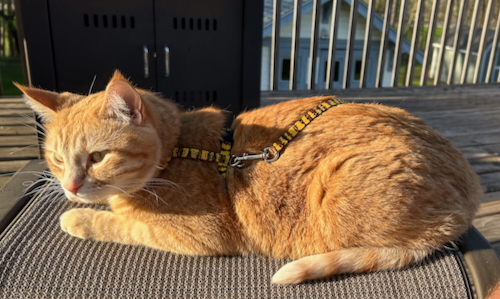
Monday Meows
Witness my meta commentary on the usual success of author insertion.
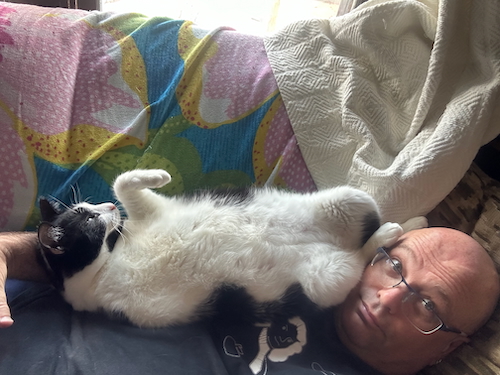
Meta-shmeta, that’s just pandering.
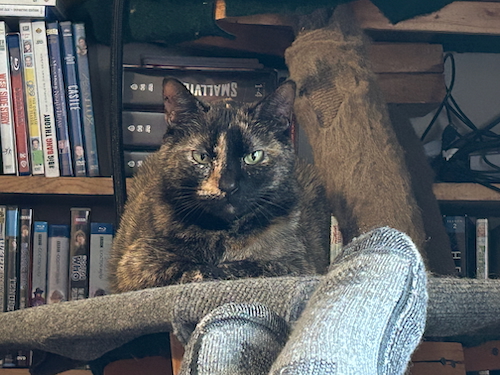
Also, kinda gross. Do you know where that cat butt has been?
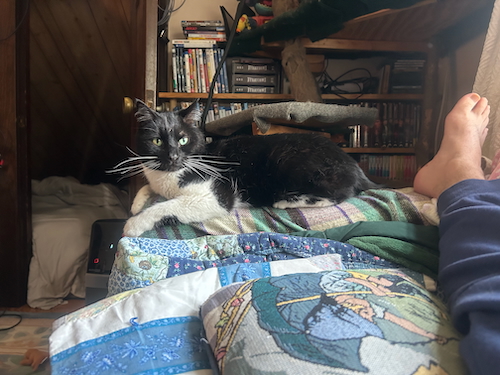
Ewwwww!
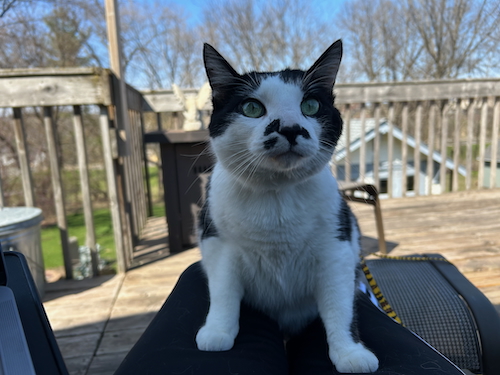
Not engaging. Happy place, happy place, happy place.
Categories: Authors
Wolf Worm - Early Book Review
 Wolf Wormby T. Kingfisher
What is it about:The year is 1899 and Sonia Wilson is a scientific illustrator without work, prospects, or hope. When the reclusive Dr. Halder offers her a position illustrating his vast collection of insects, Sonia jumps at the chance to move to his North Carolina manor house and put her talents to use. But soon enough she finds that there are darker things at work than the Carolina woods. What happened to her predecessor, Halder’s wife? Why are animals acting so strangely, and what is behind the peculiar local whispers about “blood thiefs?”
With the aid of the housekeeper and a local healer, Sonia discovers that Halder’s entomological studies have taken him down a dark road full of parasitic maggots that burrow into human flesh, and that his monstrous experiments may grow to encompass his newest illustrator as well.
What did I think of it:New Nightmare Unlocked!
I'm not a fan of bugs and other creepy crawlies at the best of times, so knowing this book had parasitic maggots I went in with the expectation of being squicked out.
Turns out I was both squicked and freaked out by this book!
I loved the buildup, the setting, and the characters. Sonia (as all of Kingfisher's main characters) was easy to root for, and I could not put the book down, even (or especially) during the more icky scenes.
Kingfisher brilliantly weaves entomology with myth creating a horrifically awesome story that I most certainly will reread, even though it has given me new nightmares about insects.
Why should you read it:if you are as squicked out by insects as I am, this is the perfect Horror for you!
Expected publication March 24, 2026
Categories: Fantasy Books
Five Things I Think I Think (January, 2026)
 It’s been quite a while since I’ve shared some Things I Think. Since I just jumped back down the Castle rabbit hole, and finished off the associated Nikki Heat books, I had the basis for this column. And away we go!
Nathan Fillion was a big name on the nerd convention circuit (you know I was a nerd way back when it got you laughed at in school) due to the cult favorite, Firefly. He’d had some attention in more mainstream things such as Two Guys, a Girl, and a Pizza Place, but in 2009 a buddy cop show launched him to stardom. He was Richard Castle, a James Patterson-like writer who works with NYC detective Kate Beckett (Stana Katic). It’s an odd couple pairing, with the immature Castle constantly annoying the professional driven Beckett.
I like a drama buddy cop show with humor, and Castle is one of the best. There are some over-arching story-lines, and even a big cast change. Humor, original crimes, good cast: this show worked. I’m on season two of my first-ever re-watch, and this is still a favorite show. It holds up, and Fillion really shines. It’s got more humor than his current hit show, The Rookie, which I also watch.
The show ran eight seasons, with viewership trending downward, as is often the case in long-running ones. But it got to where Fillion and Stanic were not even speaking off camera. It was abruptly announced that the show would continue without Katic – only Fillion. Not long after that, it was canceled outright. Several Castle co-stars have appeared on The Rookie. Katic has not been one of them. But you can’t go wrong watching Castle.
 2 – HOW ABOUT NIKKI HEAT?
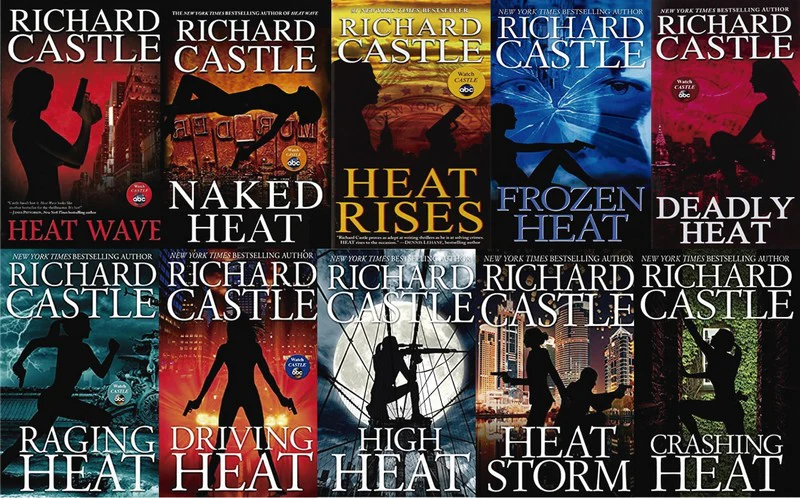
So, on the show, Richard Castle is a thriller writer. He achieved fame with novels about Derrick Storm, a spy-type stud. He kills off Storm in season one, and begins writing about a hot, tough, NYC detective named Nikki Heat. And she’s openly based on Beckett.
Tom Straw, writing as Richard Castle, turned out three Derrick Storm novels, and ten Nikki Heat books. There were also short stories, and graphic novels in the mix.
The Heat novels are essentially like bonus episodes of the show. It’s easy to envision Stana Katic as Heat, and Nathan Fillion as Jameson Rook. The book characters aren’t exact duplicates of the TV show, but pretty similar. The books hit a ‘jump the shark’ period in books eight and nine, but recovered. There were crossovers with Storm, and it was a bit much. But I think any Castle fan will enjoy Nikki Heat.
3 – GRIM DAWN IS PRETTY COOL
I played a TON of Diablo 1, and 2, back in the day. I replaced Diablo with Titan Quest, a really cool ARPG I got many hours on. I finally got around to D3, last year. I liked it well enough. I set aside the Reaper of Souls expansion, however. I then bought Titan Quest II in early access. TQII set aside it’s proprietary engine to use the Unreal Engine. It looks pretty, but it doesn’t have the charm of TQ1.
Which makes it somewhat ironic that I abandoned Titan Quest II, for Grim Dark. The 2016 ARPG was built using the Titan Quest 1 engine, by some former developers of TQ1. And I am enjoying this game far more than I was TQ2.
It’s a mix of pre-Victorian, horror, alien, cowboy, fantasy settings. Which all combine pretty neat. I have a large axe for melee, and a two handed musket for ranged. You can make some decisions with limited impacts on the storyline. Which is pretty railroad. But I like rr. There are side quests, as well as bounties from different factions, so you an mix things up.
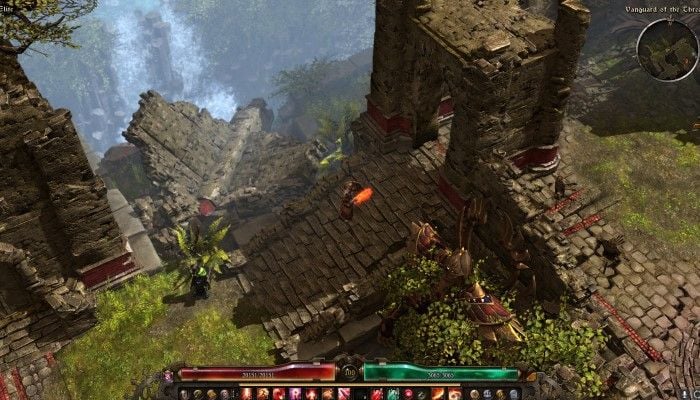 You multi-class at level 10, so you can tailor your character to play a couple different ways if you want. Point-and-click games don’t capture me the way they did in D1 and D2 days. But I’m pretty into Grim Dawn. I was looking for something after LA Noire, and this is working for me. Leaving Reaper of Souls, and Titan Quest 2, on the shelf.
4 – AUDIOBOOKS COUNT AS READING
This is a distinction mostly made by obnoxious twits, who want to argue semantics. I am not going to use the term ‘consume books’ so that doofuses who wanna expound on the difference between seeing/reading, and listening.
Yes, reading is a specific experience. But for purposes of enjoying a book, ‘reading’ is a generic term, unless you want to specify a difference. People who get into ‘the listening experience is different’ are exhausting. Like so many on social media.
In January, I finished 9 audiobooks, 4 physical books, and 2 e-books. I would not have been able to get to those nine books, ‘reading.’ 7 of the 9 were first reads. I’d have completely missed out on those.
I just block people who start on about this. It’s not even worth arguing.
5 – DOUGLAS ADAMS WAS A TREASURE
I re-read the first two books of The Hitchchiker’s Guide, listened to audiobooks of them, listeneed to the entire radio series, and continue to listen to the BBC radio plays of the two Dirk Gently novels. And Douglas Adams never grows old for me. The latter Hitchchiker’s books are uneven, for well-documented reasons.
But Adams’ works age well. He had an insatiable curiosity about many things, along with keen insights. I will never outgrow Adams, or Terry Pratchett. I’m going to do a regular column on Aams quotes. Mostly his real life – not his book characters. Douglas Adams wass a rare treasure for our lifetimes. The Black Gate Landing Page, for Adams.
Prior Ten Things I Think I Think
Four Things I Think I Think (May 2025)
Six Things I Think I Think (March 2025)
Ten Things I Think I Think (January 2025)
Ten Things I Think I Think (December 2024)
Nine Things I Think I Think (October 2024)
Five More Things I Think: Marvel Edition (September 2024)
Ten Things I Think I Think: Marvel Edition ( September 2024)
Five Things I Think I Think (January 2024)
Seven Things I Think I Think (December 2023)
Talking Tolkien: TenThings I Think I Think (August 2023)
A (Black) Gat in the Hand: Ten Things I Think I think (August 2023)
5 More Things I Think (March 2023)
10 Things I Think I Think (March 2023)
 Bob Byrne’s ‘A (Black) Gat in the Hand’ made its Black Gate debut in 2018 and has returned every summer since.
His ‘The Public Life of Sherlock Holmes’ column ran every Monday morning at Black Gate from March, 2014 through March, 2017. And he irregularly posts on Rex Stout’s gargantuan detective in ‘Nero Wolfe’s Brownstone.’ He is a member of the Praed Street Irregulars, and founded www.SolarPons.com (the only website dedicated to the ‘Sherlock Holmes of Praed Street’).
He organized Black Gate’s award-nominated ‘Discovering Robert E. Howard’ series, as well as the award-winning ‘Hither Came Conan’ series. Which is now part of THE Definitive guide to Conan. He also organized 2023’s ‘Talking Tolkien.’
He has contributed stories to The MX Book of New Sherlock Holmes Stories — Parts III, IV, V, VI, XXI, and XXXIII.
He has written introductions for Steeger Books, and appeared in several magazines, including Black Mask, Sherlock Holmes Mystery Magazine, The Strand Magazine, and Sherlock Magazine.
You can definitely ‘experience the Bobness’ at Jason Waltz’s ’24? in 42′ podcast.
Categories: Fantasy Books
Silver & Blood, Zooms and Innkeeper: The Reprintening
I hope everyone made it through the worst of the cold. We’ll have lots of good news and releases this coming week to help lift spirits!
First bit of happy: against all odds, Subterranean Press has softened its policy before the might of the Horde and is republishing the Innkeeper Chronicles, Volume One.
UPDATE: This has SOLD OUT now, in less than 24 hours!
This is not something that usually happens, once the stock is exhausted the books are never reissued. But it is something that happens to us. Because Horde power, that’s why!
This is the preorder link and it will go live tomorrow, January 26, at 12:00 PM EST.
To clarify: the link is not broken. It doesn’t lead to anything yet, because it’s not yet 12 pm on January 26. I know your ways hehe!
Subterranean’s reissue is the omnibus of the first 3 novels in the Innkeeper Chronicles series (so Clean Sweep, Sweep in Peace and One Fell Sweep) and it’s a BIG boy.
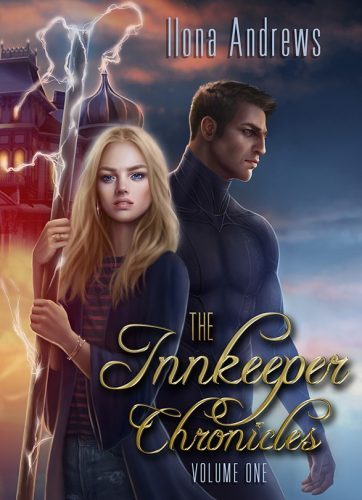
Over 760 pages of hardback goodness, signed by Ilona and Gordon, with a full colour wrap-around dust jacket, plus the familiar and beloved illustrations by Doris Mantair in both full-colour and black& white inside. The books are already with the printers and should ship out in a couple of months if all goes well.
Secondly, Ilona and Gordon hosted Jessie Mihalik yesterday to celebrate the release of her new romantasy, Silver & Blood, which will drop on Tuesday and is available from all major retailers, in epub, paperback and audio format (and gorgina hardback in the UK. Honestly, we’ve been rocking it lately over here with the pretty editions, yay us.)
We spited the cold and talked about the price of magic, the author–reader contract, what’s new in the Hidden Legacy world and most of all about Jessie’s new Avon-published duology, which is a Beauty and the Beast retelling with a smitten male protagonist, immersive world, and all the hot and dark twists for us to discover!
As promised, you can watch the Zoom recording below or catch it on YouTube via the Mod account.
PS: Edgar de Bruijn, if you’re reading this, the B.A. Bookish Boutique are trying to contact you about your Ilona Andrews merch order, please check your emails.
The post Silver & Blood, Zooms and Innkeeper: The Reprintening first appeared on ILONA ANDREWS.
Categories: Authors
My Top Thirty Films, Part 2
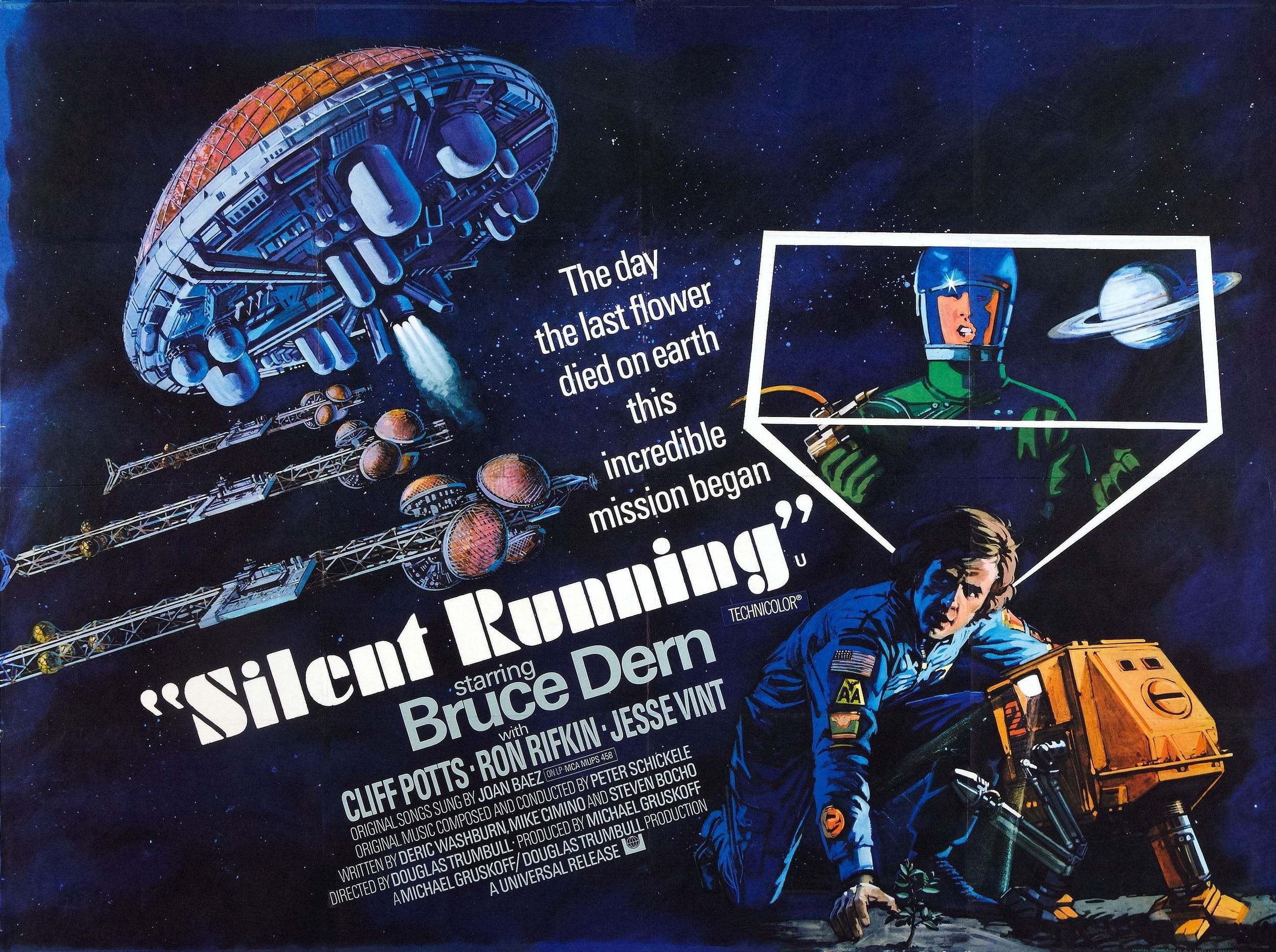 Silent Running (Universal Pictures, March 10, 1972)
I’ve had a little think about my favorite films, and what makes them my favorites. As you will see, my choices are on the whole rather fluffy, but these are the films that I return to time and time again for comfort, or as a way to reset my brain. I’d be very interested to find out if any of my favorites align with any of your own – please let me know in the comments below!
Read Part 1 here. Without further ado, in no particular order, and no ratings (because they are all 10s), let’s get cracking!
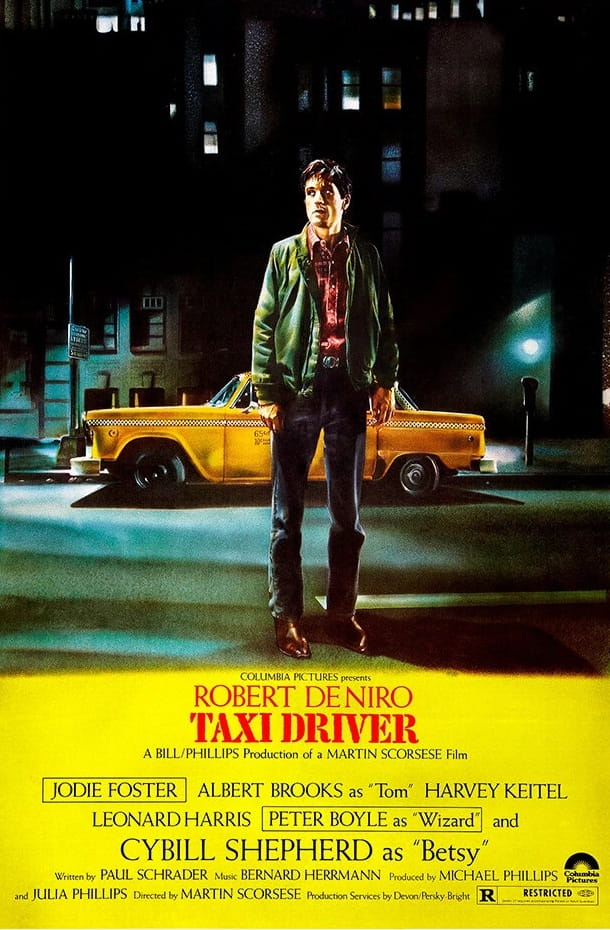 Taxi Driver (Columbia Pictures, February 8, 1976)
Taxi Driver (1976)
Who’s in it?
Taxi Driver (Columbia Pictures, February 8, 1976)
Taxi Driver (1976)
Who’s in it?
Robert De Niro, Jodie Foster, Harvey Keitel, Cybill Shepherd
What’s it about?Travis Bickle (De Niro) is a Vietnam Vet, suffering from PTSD, driving a cab for a living, and growing increasingly detached from reality day by day. He lives alone, on a diet of cornflakes and scotch, and writes in his diary the thoughts that trouble him nightly; the state of the New York City streets, the perceived inhumanity of its residents, and brief phrases and idioms to live his life by.
When he meets Betsy (Shepherd), a campaign assistant for a presidential candidate, he is fascinated by her, and attempts to take her on a date. The failure of their unformed relationship is due to his social awkwardness and choice of venue (an adult film theatre). Rejected by Betsy, he falls further into delirium as he becomes obsessed with ‘saving’ a child prostitute (Foster) from her pimp (Keitel). His mental breakdown concludes in the botched assassination of the candidate, and the successful liberation of the young girl in a bloody shootout.
Why do I love it?Everyone remembers their first Scorsese, and this was mine. It is still my favourite Scorsese film, and the fella has made quite a few good ones (sarcasm)!
Taxi Driver is an utterly dreamy film for me, not in the gossamer nightgown and watercolour pastures sense, nor in the David Lynch stream of consciousness sense, but more of an intangible mosaic of sound and light and shadow. Just thinking about it now, having not actually watched in over a decade, I can see the neon-drenched streets and hear the melancholy wail of Herrmann’s brass (my favourite score of his, completed mere weeks before his death).
I fell in love instantly with Cybill Shepherd and wanted to take her out for a coffee and apple pie with a slice of cheese (which still seems utterly alien to me), although I had a hard time separating Jodie Foster from Bugsy Malone. De Niro’s raw performance, years before he became a facsimile of himself, is hypnotic, and although I couldn’t possibly identify with him, I could certainly empathise.
There are so many quirky elements in this film that add to the dreamstate; the afore-mentioned cheese slice, corn flakes and scotch, custom wrist holsters, and Bickle’s own reaction to pornography, and these have all lingered with me like half-forgotten personal memories.
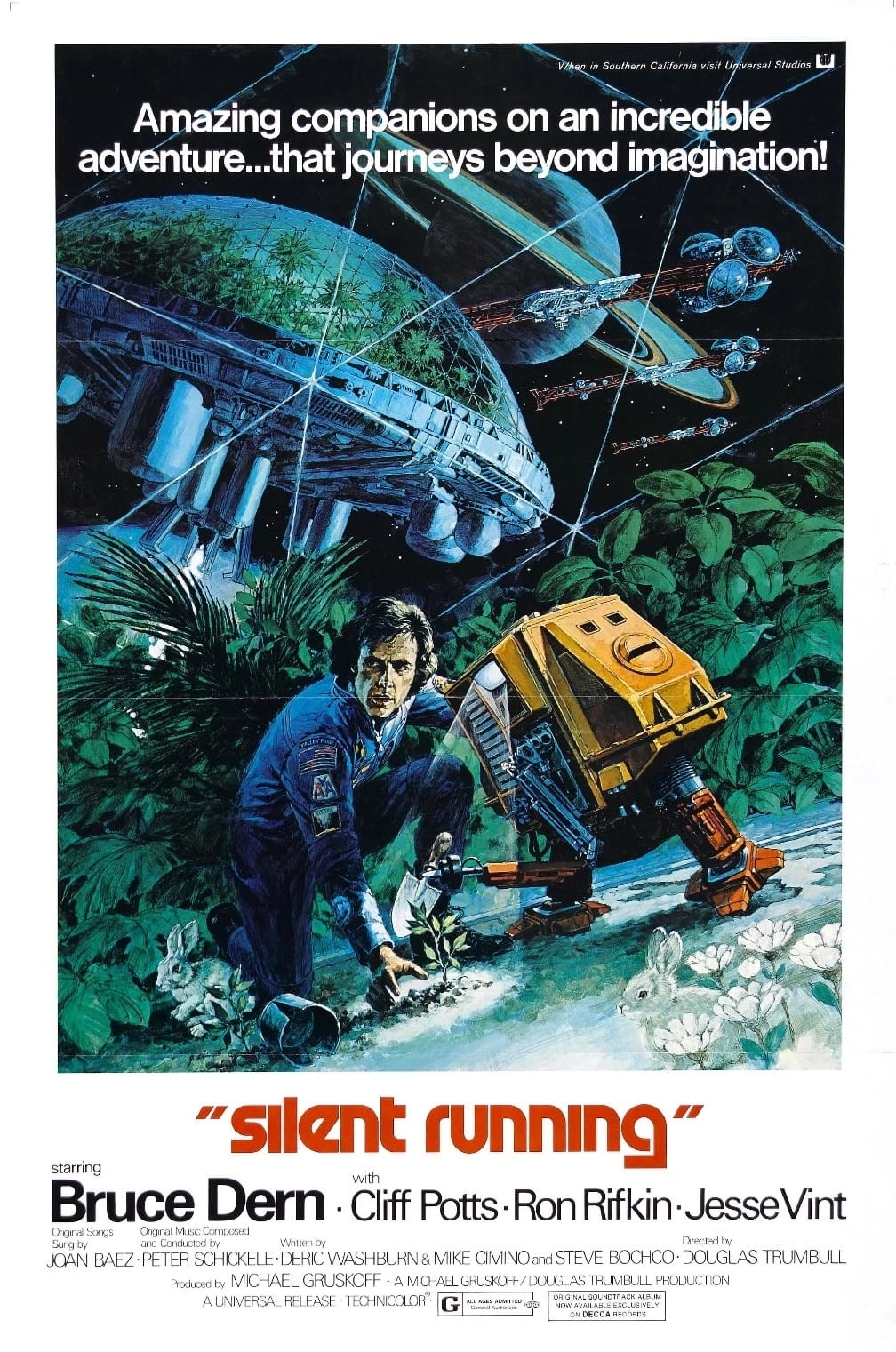 Silent Running (Universal Pictures, March 10, 1972)
Silent Running (1972)
Who’s in it?
Silent Running (Universal Pictures, March 10, 1972)
Silent Running (1972)
Who’s in it?
Bruce Dern, Cliff Potts, Ron Rifkin, Jesse Vint
What’s it about?In the future, all of nature on Earth has been eradicated by the advancement of humanity, and the last remaining forests, along with a clutch of animals, have been sent into space in vast geodesic domes attached to giant star freighters. The custodians of these last biomes are a motley bunch of blue-collar workers, including an obsessive biologist who seemingly prefers nature over humans, Freeman Lowell (Dern), and a trio of robotic gardener drones, Huey, Dewey, and Louis. When the order comes through to destroy the habitats (for ‘business’ reasons), Lowell flips and turns on his crewmates, determined to keep the forests alive.
Why do I love it?There have not been many films that made me blub uncontrollably at the end (Merry Christmas Mr. Lawrence (1983) is one of them), but when Joan Baez’s ‘Rejoice in the Sun’ kicks in as we watch Dewey, the last surviving drone, caring for a little garden with Lowell’s old watering can, the waterworks inevitably begin. It’s an ending both depressing and profoundly optimistic, and caps off a truly groundbreaking hard sci-fi flick that paved the way for many cultural touchstones, not least R2-D2, the stoned bomb operators of Dark Star (1974), and the crew of the Nostromo.
Following Star Wars, little me devoured any and all science-fiction I could find, and Silent Running felt like one of the few ‘realistic’ settings; less catsuits and rayguns, more industrial grime and hardware. It certainly helped that director Douglas Trumball shot many of the interiors in a real-life decommissioned aircraft carrier, the USS Valley Forge, blending the claustrophobic corridors and cabins with stunning, large-scale, greeblie-heavy spaceship models, and the talented performers, all bilateral amputees, imbued the little drones with so much character that they became more than machines, they were the characters that we empathized with the most. A stunning film.
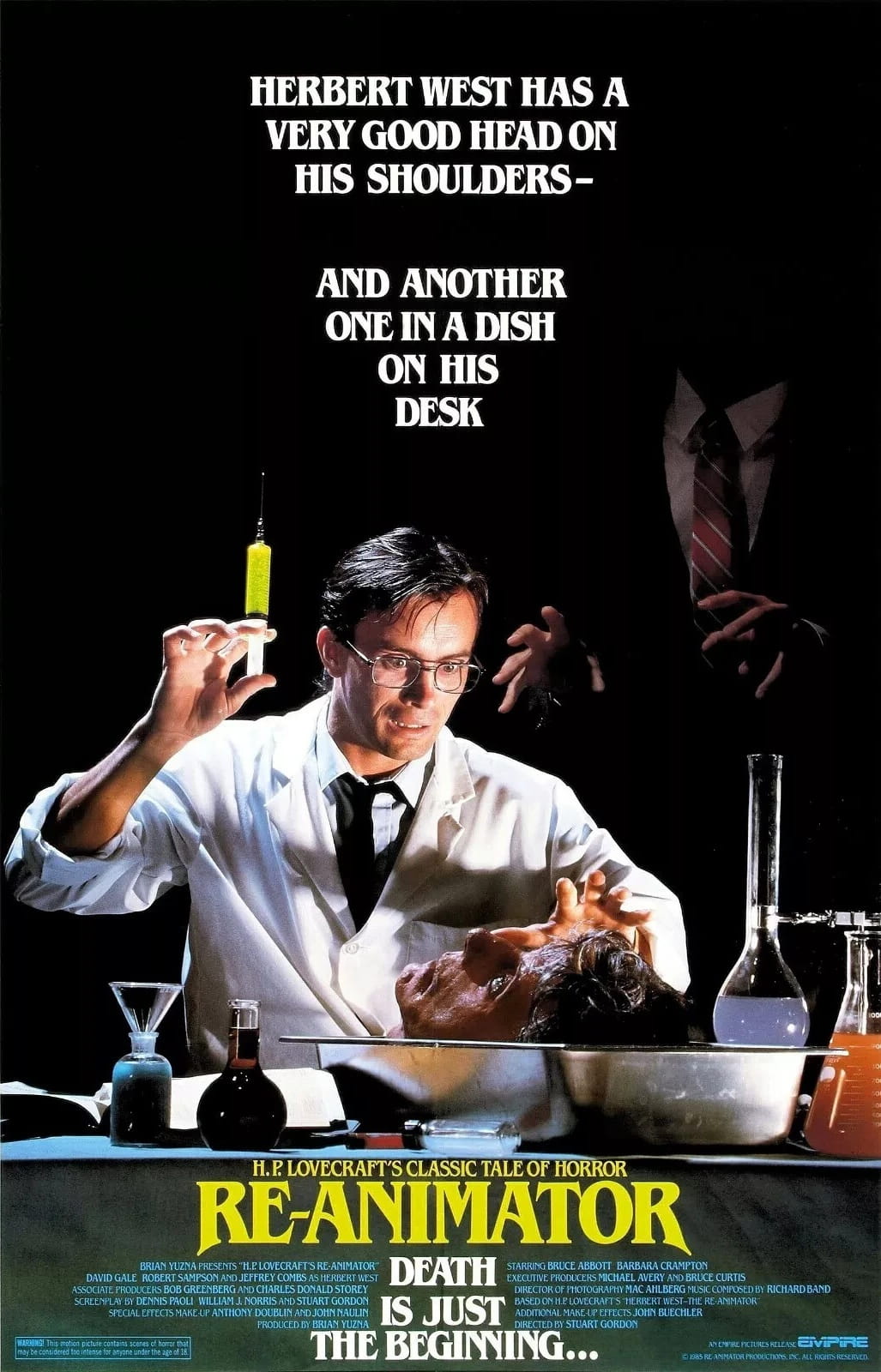 Re-Animator (Empire International Pictures, October 18, 1985)
Re-Animator (1985)
Who’s in it?
Re-Animator (Empire International Pictures, October 18, 1985)
Re-Animator (1985)
Who’s in it?
Jeffrey Combs, Barbara Crampton, Bruce Abbott, David Gale
What’s it about?VERY loosely based on H.P. Lovecraft’s 1922 novelette “Herbert West – Reanimator,” this version features West (Combs) as a brilliant, obsessive, young scientist who has developed a glowing green serum that can reanimate dead things.
Having secured a spot as a medical student at the famed Miskatonic University, West ropes his fellow student, Dan Cain (Abbott) into a series of experiments that soon grow wildly out of control. When one of the professors, Dr. Hill (Gale) learns of West’s discovery, he covets it for himself, but soon falls foul of West’s vengeance. However, death doesn’t stop him from continuing his quest to steal not only the formula, but Dan’s girlfriend, Megan (Crampton), and he literally unleashes bloody hell upon the university in his efforts.
Why do I love it?The first of Brian Gordon’s utterly bonkers reinventions of Lovecraft classics (see also From Beyond (1986), Castle Freak (1995), and Dagon (2001)), Re-Animator popped onto the scene when I had just hit 18, and was one of the first legitimate ‘adult’ certificate films I went to see. I was already frothing at the mouth having had the film’s insane effects teased by Fangoria magazine, but I really wasn’t prepared for the sheer sticky madness of the whole affair. Not only was it gory as all heck, but the gore itself was used in such an imaginative and hilarious way, that it altered my brain chemistry forever. Remember, this is a kid who grew up with the horny grue of Hammer films, so I was used to a little more restraint in the bloodletting (barring the occasional The Thing (1982) highlight).
Re-Animator however decided to not just disembowel someone, but then had their reanimated entrails loop out and grab someone, it had a headless corpse steady its own head by slamming it onto a desk paper spike, the undead are dispatched with bone saws. Of course, much of this visceral lunacy would be turned up to 11 in the better of the two sequels, Bride of Re-Animator (1990), but this film was the O.G. — the one that kicked off my passion for over-the-top gore, and my enduring infatuation with Barbara Crampton.
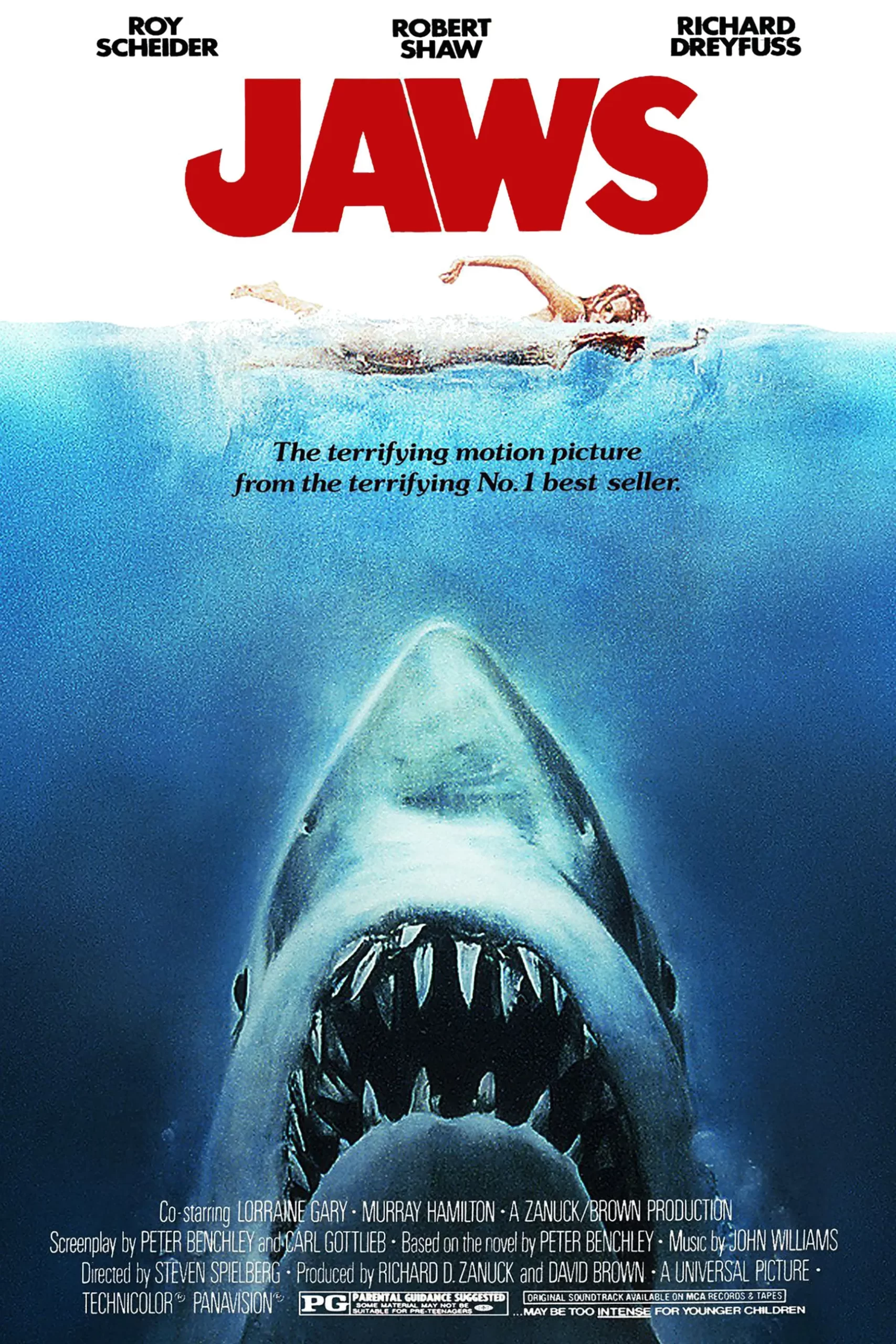 Jaws (Universal Pictures, June 20, 1975)
Jaws (1975)
Who’s in it?
Jaws (Universal Pictures, June 20, 1975)
Jaws (1975)
Who’s in it?
Roy Scheider, Robert Shaw, Richard Dreyfuss, Lorraine Gary
What’s it about?When the sleepy seaside town of Amity Island in New England is rocked by a shark attack, the local sheriff, Martin Brody (Scheider), must contend with the town mayor who wants to keep the beaches open for the 4th of July, while trying to convince the townsfolk of the very real danger of stepping into the ocean. A failed shark hunt leads him to recruit a student oceanographer, Matt Hooper (Dreyfuss), and a grizzled seadog, Quint (Shaw), in a last desperate attempt to destroy the toothsome terror before it can do more snacking.
Why do I love it?In this complete list of favourite movies, I would argue that all of them are fantastic, but only a handful of them are perfect. Jaws is undoubtedly one of the perfect ones.
My dad (in one of his rare moments of doing something cool with me) took me when I was 9 to see Jaws in the cinema. This was in the first week of release, when the hysteria hadn’t quite kicked in yet, and it had an ‘A’ certificate (the UK equivalent of a PG film), shortly before it was recertified to ‘AA’ (no one under 14 allowed). Naturally it scared seven colours out of me, especially old Ben Gardner’s noggin popping out of the boat hull.
Later that year we holidayed in Cornwall, and I recall the sheer panic when someone yelled “Shark!” at the beach and the sunburned throng erupted from the surf, mimicking a scene from Spielberg’s masterpiece. We did indeed see a dorsal fin, but it was probably a basking shark, harmless. We don’t get great whites off the English coast. Still, it was a lovely snapshot of the ongoing shark obsession that had gripped the world, and a perversely happy memory for me.
Jaws is a regular watch for me, it’s one of those comfort films that I can put on and just wallow in the mastery of all concerned; the stellar cast, the music, the cinematography, and Spielberg’s supernatural blocking skills. The film means so much to me, and has been present in key moments in my life — my early introduction to horror, as a learning tool in film school, as a teaching tool for my own son. I think I’d like it to be one the last things I watch before finally shuffling off. Guess I should be making plans.
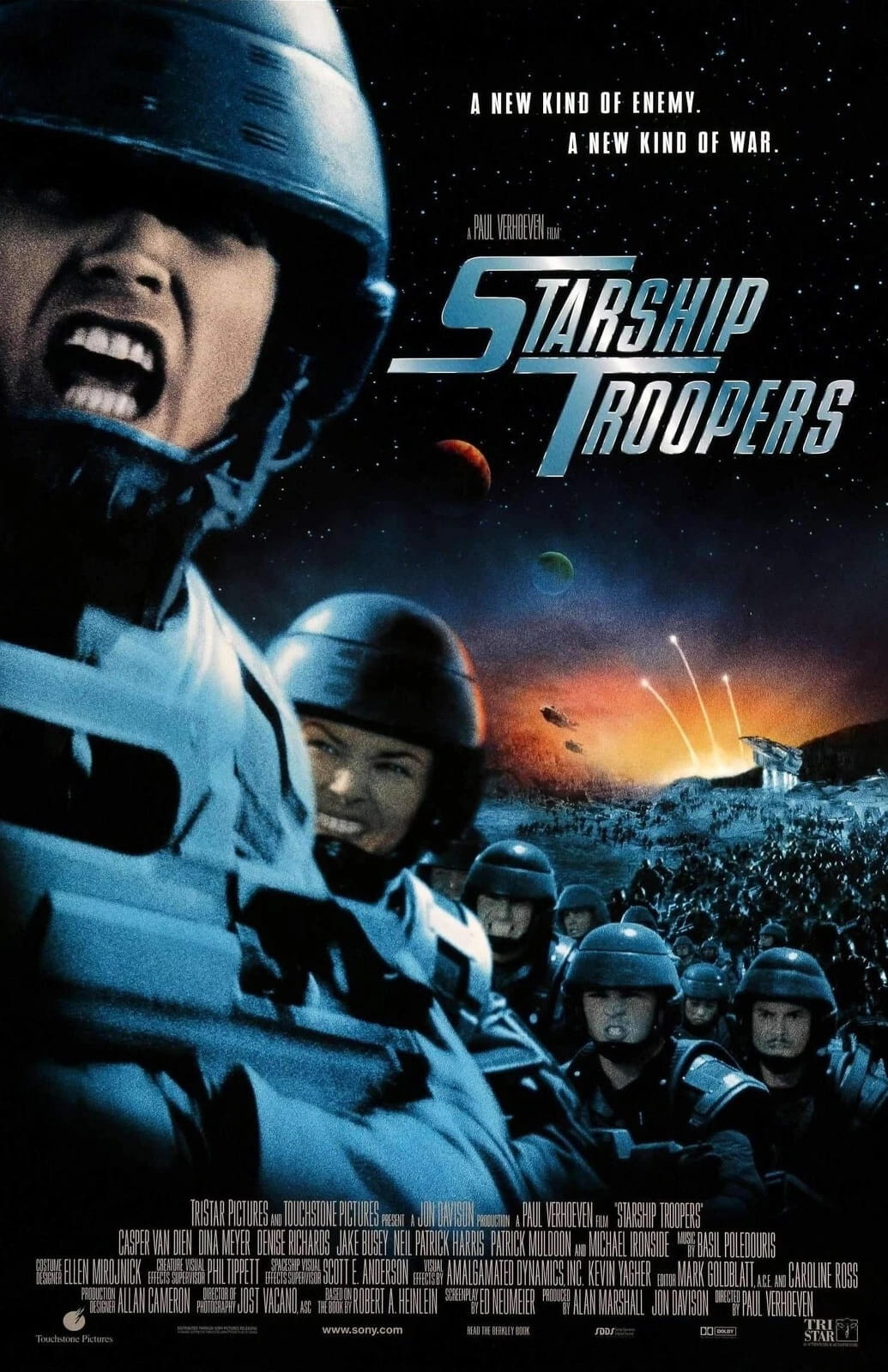 Starship Troopers (TriStar Pictures, November 7, 1997)
Starship Troopers (1997)
Who’s in it?
Starship Troopers (TriStar Pictures, November 7, 1997)
Starship Troopers (1997)
Who’s in it?
Casper Van Dien, Denise Richards, Neil Patrick Harris, Dina Meyer
What’s it about?The future expansion of the human race has brought us into contact with a highly-evolved alien insect species, which is now hellbent on destroying our planet. The war with the ‘Arachnids’ is ongoing, and the world government, run by a fascist corporation born from the ashes of a failed democracy, puts military service above all else. Only through fighting for your planet can you truly be perceived to be a citizen, and thus embrace the benefits that come with that status.
Into the fray is thrown Johnny Rico (Van Dien), a blond-haired, blue-eyed jock who doesn’t quite have the smarts for officer material, but is a good fit for the fodder known as the General Infantry. Rico enlists partly to impress his crush, Carmen (Richards), but is fully onboard after his parents and home town are destroyed in a bug attack. Once thrust into the brutality of close combat with the Arachnids, all that remains is for Rico to try to survive each encounter, save his friends, and eradicate the bug menace once and for all (spoiler alert — two out of three ain’t bad).
Why do I love it?The third in the holy Verhoeven trilogy, following Robocop (1987) and Total Recall (1990), and although I love the others equally, Starship Troopers is the one I’ve returned to the most times (and that’s saying something).
For all of my inherent anti-war feelings, I am always completely swept away on a jingoist wave of blood lust when this film gets going — much like rooting for the Colonial Marines when a swarm of xenomorphs is advancing. Nothing beats this film for sheer, bombastic military mayhem, and yet at its core are some sneaky anti-fascist themes, sandwiched between the violent layers like warm syrup in a stroopwaffle. Verhoeven’s great at this, he did something similar with Robocop, and here he manipulates (let’s face it) a Beverly Hills soap cast in a savage deconstruction of the military machine and Robert A. Heinlein’s alleged right-wing fantasies in his original 1957 novel on which this film is based.
But enough of my pseudo-analysis of themes, what really probes my brain bug are the effects, stunning for the time and further proof that for the best CG effects you need to place them in the hands of a traditional artist. Phil Tippett’s bugs still hold up today — it’s hard not to marvel at the swarms of Arachnids thundering across the rocky plateaus on their way to slice and dice the hopelessly outnumbered soldiers. Add to this spectacle some of the best military vehicles ever put on screen, gnarly animatronic gore, and Michael Ironside shoving his metal fingers into a hollowed out bonce and growling, “they sucked out his brains,” and you have the recipe for a damned good time. POPCORN, STAT!
Previous Murky Movie surveys from Neil Baker include:
My Top Thirty Films, Part 1
The Star Warses
Just When You Thought It Was Safe
Tech Tok
The Weyland-Yutaniverse
Foreign Bodies
Mummy Issues
Ch-Ch-Ch-Ch-Changes
Monster Mayhem
It’s All Rather Hit-or-Mythos
You Can’t Handle the Tooth
Tubi Dive
What Possessed You?
See all of Neil Baker’s Black Gate film reviews here. Neil spends his days watching dodgy movies, most of them terrible, in the hope that you might be inspired to watch them too. He is often asked why he doesn’t watch ‘proper’ films, and he honestly doesn’t have a good answer. He is an author, illustrator, teacher, and sculptor of turtle exhibits.
Categories: Fantasy Books
The Problem of the Invincible Warrior: Frank Frazetta’s Death Dealer by James Silke
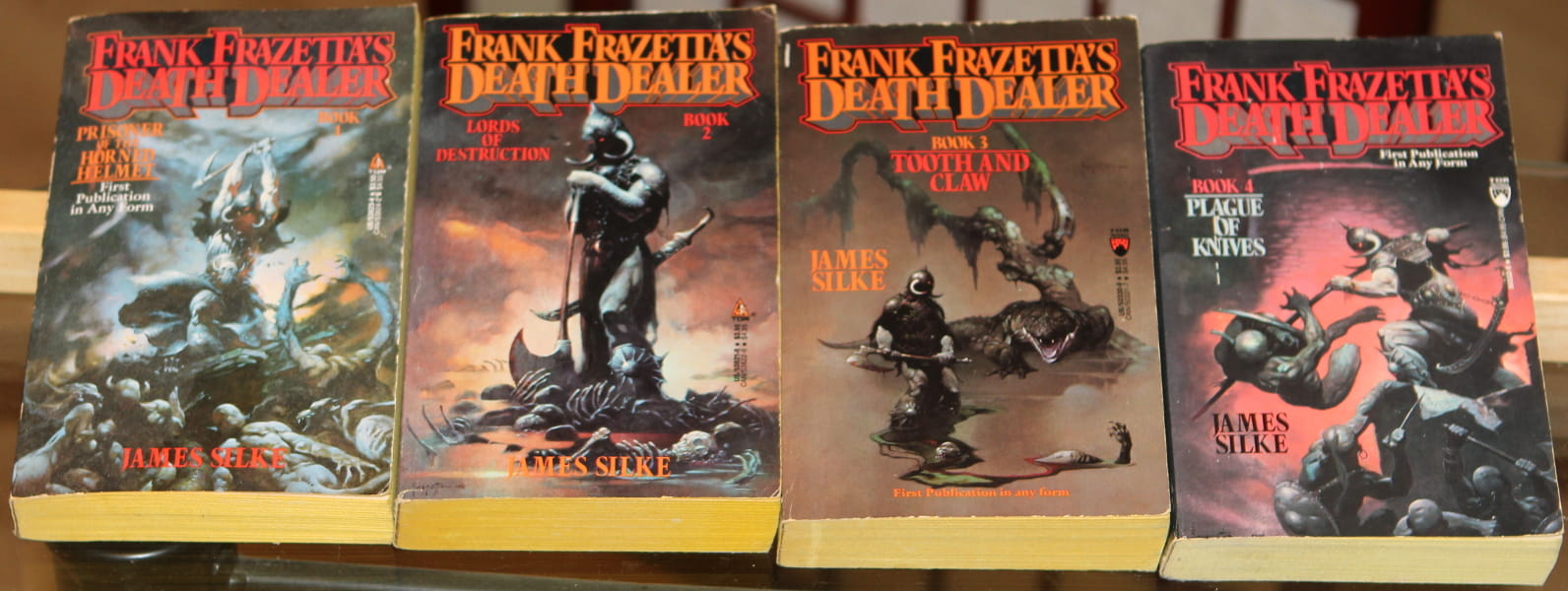 Frank Frazetta’s Death Dealer, Volumes 1-4, by James Silke (Tor Books, 1988-1990). Covers by Frank Frazetta
James Silke (1931 – ) is something of a renaissance man in the arts. He’s a visual artist and prose writer, a set and costume designer, photographer, and comic book guy. Most people who I meet recognize him as a comic artist/writer, although I’ve never read any of his graphic stuff.
I’ve seen a few of the movies he’s worked on, including King Solomon’s Mines and The Barbarians. My only experience with Silke’s writing is the four Sword & Sorcery books in the Frank Frazetta Death Dealer series.
These are:
1 Prisoner of the Horned Helmet (February 1988)
2 Lords of Destruction (January 1989)
3 Tooth and Claw (November 1989)
4 Plague of Knives (June 1990)
There’s also a book called Rise of the Death Dealer, with a Frazetta Cover (shown below), but I’ve never seen a physical copy, and from what I understand it’s not a 5th book in the series. According to Fantastic Fiction, it’s an omnibus volume that collects the first two books. Fantastic Fiction has been pretty accurate in my experience.
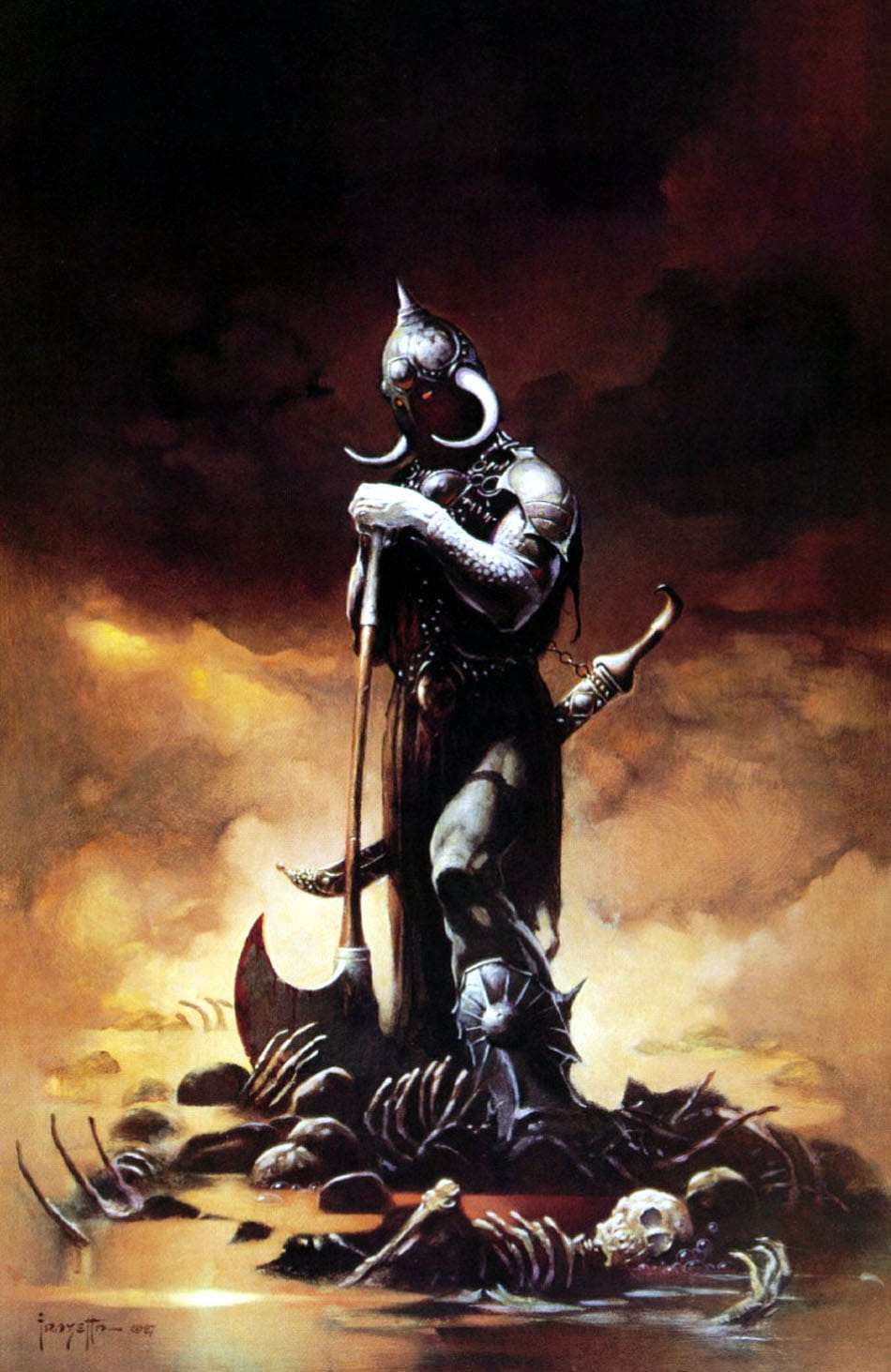 Frank Frazetta’s Rise of the Death Dealer, omnibus edition (Tor Books, March 2005). Cover by Frank Frazetta
As far as I understand, Frazetta provided the Death Dealer character and the covers and Silke wrote stories about the warrior, including an origin story in Prisoner of the Horned Helmet. I don’t know whether Frazetta offered any story ideas but the prose is Silke.
The series features a character named Gath of Baal, a young but powerful warrior at the beginning of the series, who acquires a horned helmet imbued with great sorcery. He doesn’t realize that once he puts it on he’ll become its prisoner and will become the Death Dealer.
I enjoyed the series quite a lot. There are some strong visuals and some bloody, gory fights. The prose is serviceable but not outstanding. There are some very modern phrasings that occasionally threw me out of the story. I was hoping for more Robert E. Howard style poetic prose but didn’t get it.
The pacing is not as fast as it could have been either, mainly because the books are too long. Cutting fifty pages out of each of these volumes would have really helped. At some point I’ll also talk about the “problem” of the invincible warrior and how it diminishes tension in a tale.
Charles Gramlich administers The Swords & Planet League group on Facebook, where this post first appeared. His last article for us was Erich von Däniken’s Chariots of the Gods? and the Pseudoscience Bestsellers of the 1970s. See all of his recent posts for Black Gate here.
Categories: Fantasy Books
Exhilerating Escape! 6 Mind-Bending Science Fiction & Fantasy Novels

Alright, let’s talk about science fiction novels and fantasy novels, and escape reality for a…
The post Exhilerating Escape! 6 Mind-Bending Science Fiction & Fantasy Novels appeared first on LitStack.
Categories: Fantasy Books
Book Review: Twelve Months by Jim Butcher
I received a review copy from the publisher. This does not affect the contents of my review and all opinions are my own.
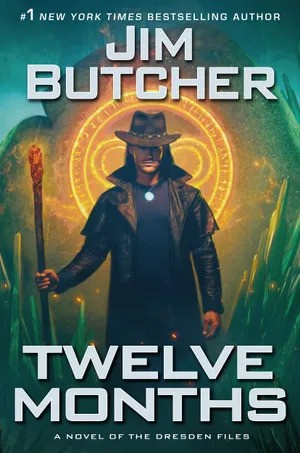
Mogsy’s Rating: 4 of 5 stars
Genre: Urban Fantasy
Series: Book 18 of Dresden Files
Publisher: Ace Books (January 20, 2026)
Length: 448 pages
Author Information: Website | Twitter
It’s kind of wild to think it’s been almost six years since Battle Ground came out, because Twelve Months very much feels like a sequel that has been cooking quietly in the background all that time. But instead of throwing readers straight back into the action, Jim Butcher hits the brakes to bring us a Dresden Files novel that’s much more subdued and reflective. In other words, this one is very much an “aftermath story” that explores what happens after the dust settles.
The last time we saw Harry, who is now openly operating as the Winter Knight, Chicago burned as the city became the site of a full-scale magical assault which resulted in the deaths of thousands. Though the attack was eventually thwarted and the enemy defeated, this came at an enormous cost. The supernatural world has been exposed for all to see, and Harry also lost someone very near and dear to him, only barely containing his anger and grief before he did something he’d regret. Still, given his history and his increasingly erratic and risky behavior, the White Council ultimately decided to cut ties with him, leaving our protagonist more isolated than ever.
And so, Twelve Months basically follows Harry across a year of his life as he tries to regain some sense of control and normalcy while trying to manage the crushing stress caused by grief, guilt, and an endless list of responsibilities. That said, there’s no more saving the world for Harry Dresden, at least not at this time. Right now, he’s in recovery mode, putting all his efforts into healing after loss and rebuilding the support systems around him, both emotionally and physically.
Stylistically, Twelve Months is one of the more unusual entries in the series. It’s certainly different from many of the previous sequels which saw Harry facing down supernatural foes and dealing with ever escalating threats. In this, the pacing slows down, but if you think that means the stakes disappear or the story loses its momentum, think again. The conflicts are alive and well, they’re just more intimate, and the focus turns towards character development and relationship dynamics.
Because of this, I can see this book receiving mixed reviews, but personally I enjoyed the change of pace. Having some room to breathe is a good thing, not to mention it’s also more realistic. Places don’t just bounce back from the brink of utter destruction, and neither do people. A lot happened in Battle Ground leading to significant repercussions that are going to take more than a few pages to digest, and Twelve Months gives us the chance to do a deep dive into the fallout, looking at how Chicago has changed. People are scared, resources are strained, and Butcher’s storytelling here truly drives home the point that the world of the Dresden Files is, and always has been, bigger than just Harry’s personal sphere.
There’s also a noticeable shift in the way Harry interacts with the greater world around him. He’s no longer the young, brash wizard who storms into every situation with his guns blazing. It’s been more than twenty-five years since the first book burst onto the scene, and in that time, the books have seen Harry mature and become a hardened man shaped by real-world experiences and fatherhood. Of course, he’s always been a reluctant hero, but there’s a lot more people now who look up to him and depend on him, and he’s becoming increasingly aware that his actions have consequences well beyond the here and now.
In the end, I do think there’s value in having a book like this every so often, especially in a long-running series. If nothing else, it helps break up the usual pattern and to prevent monotony. In this case, Dresden Files fans got a much calmer ride than we’re used to, but to be honest, I probably wouldn’t want too many more installments in this similar vein, and I certainly wouldn’t be too heartbroken if the next one swung back towards a more action-oriented approach. I’ll even admit I was cheering inside when the end of this book finally ramped up and delivered a genuinely exciting climax and conclusion.
In the end, Twelve Months feels very much like a transitional novel, nudging the overarching plot of the series forward, but not by too much and not in any way that’s too dramatic. By this point, Jim Butcher clearly knows his audience and trusts both their patience and their investment in Harry’s journey. In a way, this also feels like a book the author himself needed to write, since I’ve heard that so much of the emotional beats in the series are often a reflection of what he’s going through and feeling in his own life. As a sequel, this one feels necessary, giving the story a chance to decompress, while also efficiently laying the groundwork for what comes next.


Categories: Fantasy Books
Shelby Logan 10 Occupation is publishing NOW!
Hey so, got it back earlier than expected and here we go!

About:
Admiral Shelby Logan has had a lot of challenges in her life since growing up on Anvil Station. Her initial naval career as chief engineer and then XO on Firefly, her time on Prometheus, leading the expedition to the Tau sector, trying to make contact and rebuild the Federation, fighting pirates, fighting the pirate plagues, and then the xenophobic Tauren Confederation. Now she is in for another challenge like she had never experienced before.
The Tauren Confederation has fractured and a civil war has been put down. But thousands of Federation personnel were taken hostage by xenophobic fanatics hell bent on making a last stand. Shelby is light years away; forced to watch and send what forces she can in the vain hope of saving them and the man she has started a relationship with…
And on the northern frontier of the sector, an ancient nightmare alliance has spread like a cancer to the neighboring sector and threatens all of civilization…
Amazon: Occupation
B&N: Occupation
Categories: Authors
NINE GOBLINS by T. Kingfisher
In the scale of things fantasy, goblins since the age of Tolkien (and before actually) have tended to have a bit of a bad reputation. Seen as smelly, violent, greedy, selfish, grumpy, lazy and well, a bit dim, they’re not the first choice for literary inspiration. To this we then have T. Kingfisher’s latest novella…
Categories: Fantasy Books
This Kingdom Comes to Imagine Books and Other Fun Stuff
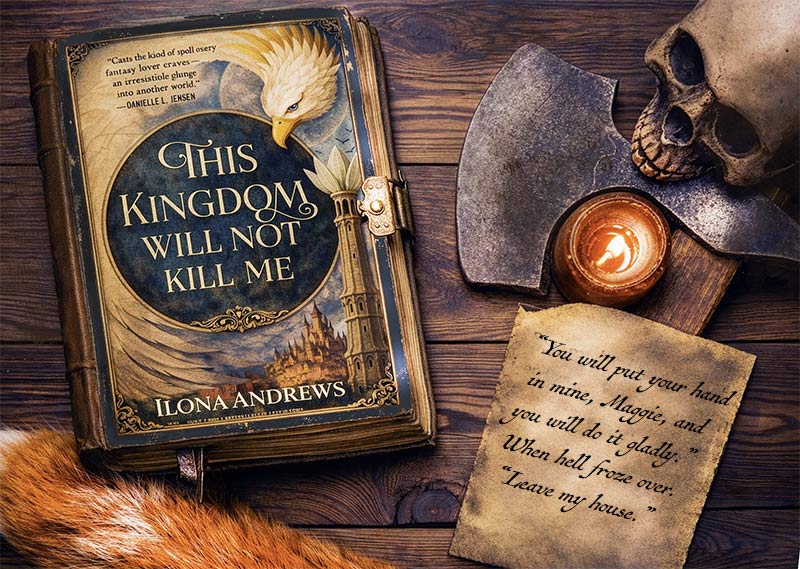
So much stuff. Okay, let’s see if I can get some of this in here without collapsing.
Winter StormWe are expecting a massive winter storm. As I am writing this, the outside world is soaked. Standing water lingers on the street and in the driveway. It is the first major rainfall we had this winter season. We need it desperately, because we are in full drought.
Tonight, and especially tomorrow afternoon, all of this will freeze. Ice will coat the ground and build up and down the electric cables, the temperature will drop, and Texas grid, which is made of tissue paper, will likely collapse again. We are already having multiple pole fires and outages.
We expect to lose power. If this happens, we may have to reschedule the Price of Magic Zoom and the release of Beast Business. We have a bit of an emergency with the copy editor, but we found someone else, so we are back on track. If the grid holds, we should release on the 27th. If the grid fails, it maybe more like Friday instead of Tuesday.
The novella is finished and has been through the first round of edits, so it’s not the matter of “it’s not done,” it’s the matter of “it’s not clean.” We need to do a copy edit and a proofread. Mod R has my number, and if we are powerless, she will update you.
Beast Business Release Party with This Kingdom Preview Q&AWe will be doing a second zoom to celebrate the release of Beast Business, probably next weekend – the registration link will be posted on the blog next week. We have been given permission to answer your questions regarding the content of the free preview of This Kingdom during the Q&A, but we will not be revealing any spoilers.
Gordon has promised to stick to that policy. (We are wise to your ways.)
Imagine Books: This KingdomThis Kingdom is attractive and charming, and it now has several special editions. One of these is by Imagine Books, and I’m here to tell you more about it.
DISCLAIMER: We cannot answer any specific questions, because we did not commission this edition and have nothing to do with the order fulfillment. This was done through Tor, and we are breaking this down to avoid any confusion.
What is it?It is a box containing the Tor Hardcover with teal edges and some extras.
The book:
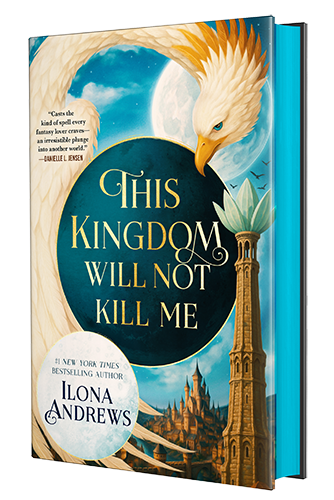
The extras:
- Signed bookplate sticker – we sign it and they attach to the book.
- Redesigned front dust jacket with foiling: @jescole.art
- Reverse dust jacket: @davidev.art
- Page overlays: @avoccatt_art
- Bookmark with character art
Add-on option:
Additional page overlay — $11.99
Okay, I didn’t know what page overlay was, so I had to look it up. It is a semi-transparent full page illustration that is almost like a very large bookmark. It fits over the page, so if you wanted to mark your favorite place or a scene in the book, you would slide it in. So imagine a removable illustration. Google came up with this awesome Instagram post about it, so if you want to see the pictures of what it might look like, go here.
(Also, page overlays, super cool, and we will be doing this in the future.)
To reiterate: this is a Tor hardcover with extra stuffs.
The price: This book will be priced at $42.99 plus tax plus shipping (this price does not include the add-on overlay).
The preorder date: the preorder will drop on Imagine Books Shop website on February 28th at 11:00 AM PST. Yes, we will remind you on the blog when it goes live.
The shipping date: This special edition is estimated to ship in JUNE. So, the regular release date for the Tor Hardcover is March 31, but this edition will NOT ship on that date. It will ship later. Here is what Imagine Book Shop says about it:
Why does a preorder take longer to ship, and how does this relate to special editions?
Great question! Our special editions feature custom artwork that is exclusive to Imagine Books Shop—that’s what makes them special. The artwork is designed, illustrated, and then sent to be manufactured. The longer wait time is
because the art (in this case, dust jackets and overlays) must be produced and shipped to us before we can ship the customized books to you.
We are currently estimating that this book will ship in June. Ship dates are estimates. We always do our best to get your order to you on time, but unforeseen circumstances or delays may occur. If there is a delay, we will always keep you updated.
We asked some additional questions. All answers are provided by Imagine Books.
Tell us about you?
“Hey everyone! I work for Imagine Books Shop, and we are thrilled to announce that we are collaborating with Macmillan and Ilona Andrews to bring you special editions of This Kingdom Will Not Kill Me!
As huge fans of Ilona Andrews, we couldn’t be more excited and honored to share these
editions with you. I got early access to this book and absolutely loved it. This is truly an amazing story that is near and dear to my heart. Reading this one was a special experience.”
Do I need a subscription to buy this book?
“No! This order is open to the public. No subscription is required to purchase these editions.”
Where can I buy this Imagine Books Shop edition of This Kingdom Will Not Kill Me?
“Our website is the only place this particular edition of this book will be available.
Here is the link to our website: Imagine Books Shop.”
Do you ship internationally, and what are your rates?
“Yes, we ship internationally. Shipping rates vary by location.”
What is a preorder, and how does this affect shipping?
“A preorder means you place an order for a book that will not ship right away. Our estimated shipping timeframe is June. Our preorder goes live on February 28th.
“Members of our Facebook group get early access to reveals and early access to sales by half an hour. We can’t wait to show you what’s coming! Here is the link to join:
Imagine Books Shop Facebook Group Link.”
Why does a preorder take longer to ship, and how does this relate to special editions?
“Great question! Our special editions feature custom artwork that is exclusive to Imagine Books Shop—that’s what makes them special. The artwork is designed, illustrated, and then sent to be manufactured. The longer wait time is because the art (in this case, dust jackets and overlays) must be produced and shipped to us before we can ship the customized books to you.
“We are currently estimating that this book will ship in June. Ship dates are estimates. We always do our best to get your order to you on time, but unforeseen circumstances or delays may occur. If there is a delay, we will always keep you updated.”
Are these editions limited?
“Yes. Once the initial stock sells out, the preorder will close, and there is no guarantee that we will restock these editions. We typically do not offer reprints.”
What is a page overlay?
“A page overlay is a vellum sheet that depicts a scene from the book. In simple terms, it is an art print (on thinner paper) designed to be inserted into a book to bring your favorite scenes to life.”
There you have it. For all additional inquiries, please contact Imagine Book Shop. If you ask us, Mod R will just paste the link back to you.
The post This Kingdom Comes to Imagine Books and Other Fun Stuff first appeared on ILONA ANDREWS.
Categories: Authors
Pages

Recent comments