
Feed aggregator
Tally Hawk
Well, the Tally Hawk is up:

I did a couple videos but they came out shaky. I was kinda fatigued from putting it up. I'll try again later.
Categories: Authors
Book Support
There’s been a lot of focus lately on the new readers joining us, and I wanted to take a moment to talk to the people who have been here all along.
Thank you.
Many of you have cared for these books for years, even longer than I have. My inbox is always full of questions, recommendations, fun stuff that reminded you of IA, and only the occasional emotional spiral about a detail I’ve never even considered from the stories we love. As House Andrews have said many times before, that makes it all worth it. You are seen and you are beloved.
At release time, one particular question shows up enough that I know the Horde speaks with one voice: “What’s the best way to support the book?”

It’s true that readers who understand the publishing ecosystem tend to behave in certain ways. And people call the BDH many things on the mean streets, but never ‘uninformed’ – so let’s get into it.
The cold reality is that what happens in the first few weeks after a release matters far more than it probably should. Visibility drives everything. Willingly or not, we all live somewhere in the algorithm.
ReviewsThey don’t need to be long, and they don’t need to be polished critique. Most of us have been on the other end, quickly checking for best fit before our decision battery runs out. Clear, in spaces where new readers will see them, and soon after release is what usually matters here.
Reviews also don’t have to be positive. Whatever yucks your yum could easily be the next person’s favorite thing! If you go straight to the one-star reviews to see what the haters say, I see you. I’ve bought books so fast my credit card was left spinning because of DNF reasons that sounded amazing to me. Female protagonist is too bossy, my left foot!
I know purists will pipe up and say they never look at a book that has less than 4.5 stars etc, but bestseller data don’t lie. This is what a good audience reach looks like for a book – all sorts of people read this and felt things about it:
 Word of mouth
Recommending the book, talking about it, posting about it.
There’s another thriving misconception here that it needs to go viral, or it only counts if it’s done by “big account” influencers. Most of us trust recommendations from people we know far more than the new BookTok engagement driver who mentions the same book as everyone else for the 127th time in a row.
From bestie to bestie and book club to book club, that’s how good books travel.
Library requests and bookstore interactionWe all know that librarians are the superheroes of Book World. There’s no way to overstate how influential they can be in making good books available to the right audience. So request the book you want, check it out, bring it on the librarian’s radar. They’ll take it from there.
Equally, bookstores don’t take wild guesses when it comes to what they stock. Demand drives decision. If you’ve ever found a favorite book by browsing the shelves of the local retailer, there’s a good chance it got there because enough people asked for it, preordered, bought, and showed interest in it and others of the same genre/type.
Why is any of this important to us? We already know what we like, what we’re buying and in how many formats.
Because this is how we get antsVisibility doesn’t stay contained to one book.
New readers discover one series, and then go looking for everything else. That’s how older series find new life, stay relevant and *ahem* continue.
The questions about sequels come up a lot and I don’t mind answering them every day, that’s part of why I’m here. Woot, Mod R gets the big bucks! But those answers don’t change from post to post and derailing the attention from the new releases isn’t getting us the wins we think. If a series isn’t marked as Finished or Finished for Now on the Release Schedule page, it will continue when the time and creativity allow for it. They’re not forgotten, and we’ll be the first to know as soon as a release date is official.
Speaking of behaviours that work against the very thing we’re hoping for: there’s the instinct to hold off until a series is complete before buying it or starting on it. It’s understandable, but it is also a self-fulfilling prophecy. A series that doesn’t sell and doesn’t get early momentum is a series that isn’t viable and won’t continue. I could sugarcoat it, but you know I’m your girl that keeps it real.
This all applies to book releases in general and none of it is prescriptive. Read only what you want, because life is short and the news cycle even shorter. Support however is convenient. Ignore all of this entirely if you prefer, or as always, take what is useful and leave the rest.
As for This Kingdom Will Not Kill Me in particular – it’s an idea House Andrews has wanted to explore for a long time, and worked hard to bring into the world.
We know better than anyone else what kind of ride we’re in for when that happens. For the Horde!
The post Book Support first appeared on ILONA ANDREWS.
Categories: Authors
7 Author Shoutouts | Authors We Love To Recommend

Here are 7 Author Shoutouts for this week. Find your favorite author or discover and…
The post 7 Author Shoutouts | Authors We Love To Recommend appeared first on LitStack.
Categories: Fantasy Books
Nine Goblins - Book Review (reread/repost)
.jpg) Nine Goblinsby T. Kingfisher
Nine Goblinsby T. KingfisherWhat is it about:When a party of goblin warriors find themselves trapped behind enemy lines, it'll take more than whining (and a bemused Elven veterinarian) to get them home again.
Nine Goblins is a novella of low...very low...fantasy.
What did I think of it:This such a fun read!It's silly, funny, and touching all in one.
The story switches viewpoints between the goblins and Sings-to-Trees, an Elven veterinarian. I loved the goblins and their view of the world, but I will confess I loved Sings-to-Trees even more. He's on the receiving end of a lot of trouble, still he keeps going and stays helpful.The goblins get themselves in hot water as well, but they're tough and resourceful in a unique goblin way.
All in all this was a delight to read, and as promised when I read it last year: I got my trotters on the hardcover for this first of many rereads!
Why should you read it:It's a super fun Fantasy read!
Categories: Fantasy Books
Review – Keeper & Kindred (Meow: Magical Emporium of Wares, Book 2) by Toni Binns (4/5 stars)

Reading Level: Adult
Genre: Cozy Fantasy
Length: 422 pages
Publisher: Self-Published
Release Date: February 3, 2026
ASIN: B0G3JRZX3B
Stand Alone or Series: 2nd book in the MEOW series
Source: Borrowed ebook from Kindle Unlimited
Rating: 4/5 stars
“The winter solstice is coming, and with it, a reckoning.
Sable thought being the Shopkeeper meant serving coffee, shelving books, and managing a talking cat’s attitude. She’s made peace with the magic, even embraced her role as guardian to Indigo, the world’s most curious baby bookdragon. But as the solstice draws near, a magical teacher arrives at the shop’s door—someone from the Cat’s past who might hold the key to his freedom.
The Fates begin whispering to Sable through golden auras. Old bargains, made long before her time, surface with dangerous demands. And somewhere in the chaos of rearranging shelves, interrogating a cryptic teacher, and managing interdimensional customers, Sable has to figure out how to tell her mother she won’t be home for the holidays.
The secrets she’s uncovered can’t be ignored. And the Cat—mysterious, maddening, and more vulnerable than he’d ever admit—might be the key to everything, if only Sable can get him to trust her.
Coffee can only solve so many problems. But friendship, courage, and one very determined Shopkeeper might just be enough.”
Series Info/Source: This is the 2nd book in the MEOW series. I borrowed this on ebook from Kindle Unlimited.
Thoughts: I really enjoyed this second book in the MEOW series. The story moves a bit slow for me, but I am enjoying the characters and the concept of the MEOW. I like that the background story makes more progress here and I love learning more about Cat’s history.
Sable is continuing her contract as Shopkeeper for the Magical Emporium of Wares (MEOW). Every day is a new adventure as she helps Cat to serve different interdimensional visitors. As Solstice approaches, Sable is determined to make the holiday special for everyone at MEOW. Little does she know she might have magic of her own she needs to manage and learn.
I am not a huge fan of “day in life” type of reads, and this has a lot of that in it, those type of stories just move a bit too slowly for me. However, that being said, there are enough elements in here that I really enjoy that I am liking this series quite a bit. I love Sable and her constant positivity and willingness to confront each day like a new and amazing adventure. I love Cat with his tentative hopefulness and the baby Bookdragon full of insatiable curiosity. I am also really enjoying the unfolding of Cat’s past and the hints that Sable’s birth family is not exactly what she thinks they are.
I enjoy that we get little odd stories from day to day as well. The beings that show up at MEOW are varied and intriguing. I also enjoy the expansion and discovery of Sable’s own magic. This is a cozy, creative, and intriguing read.
The only thing I don’t enjoy is that the days can feel a bit repetitive despite the changing customers, and the story moves a bit too slow for my liking. However, that is a personal preference and I have always preferred my stories fairly fast-paced.
My Summary (4/5): Overall I am really enjoying this series. I love the characters, the unique premise, and how some of the mysteries behind Cat’s past and Sable’s magic are unfolding. I am still struggling some with the slower pace to this and the very “day in the life” feel. If you are looking for a cozy, creative, magical, and deliberately paced read, I would definitely recommend. I look forward to reading each book in this series, even though there are points during reading the book where I wish things would progress a bit quicker.

Categories: Fantasy Books
Warlocks and Warriors: Two Sword & Sorcery Anthologies edited by L. Sprague De Camp and Douglas Hill
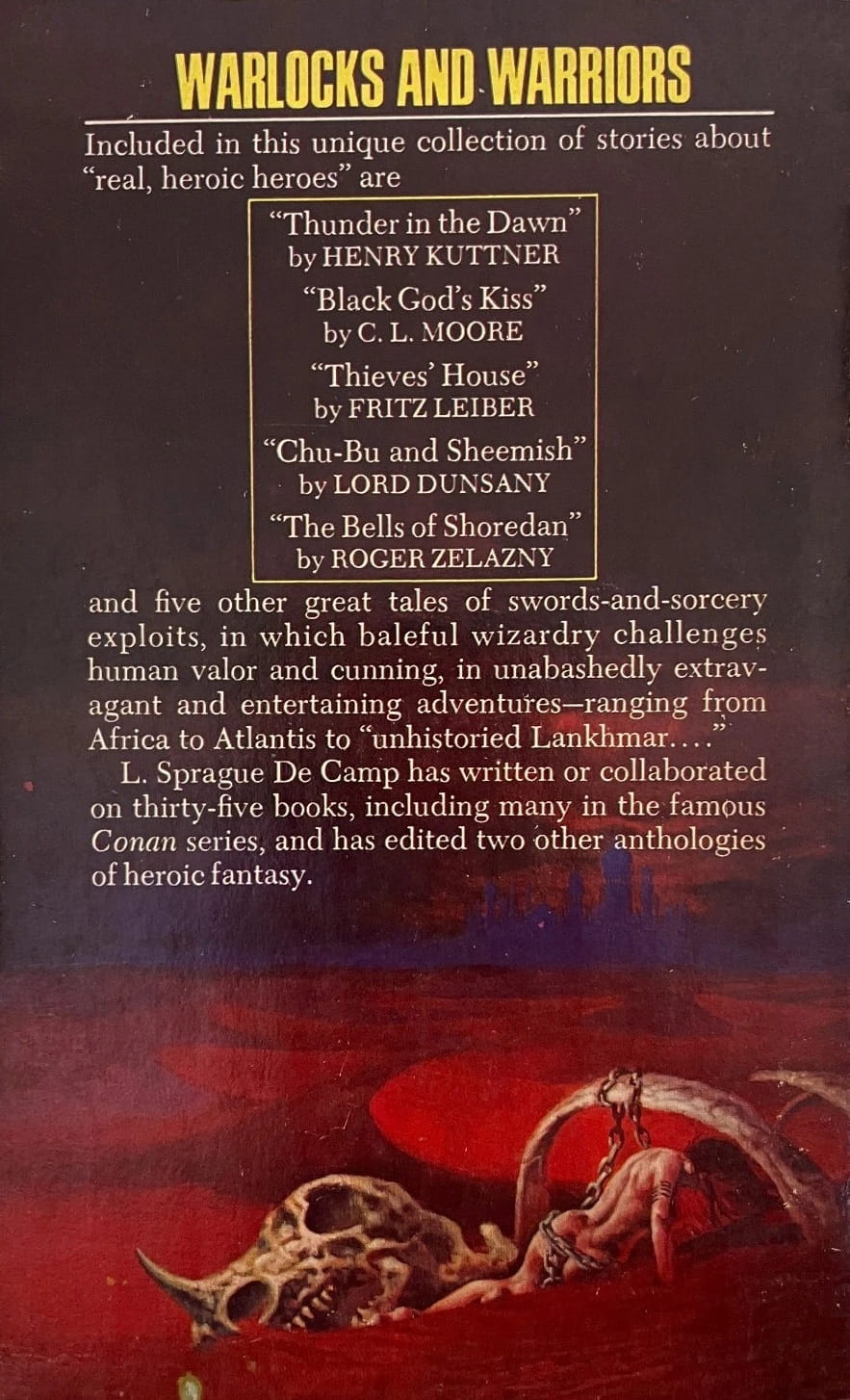
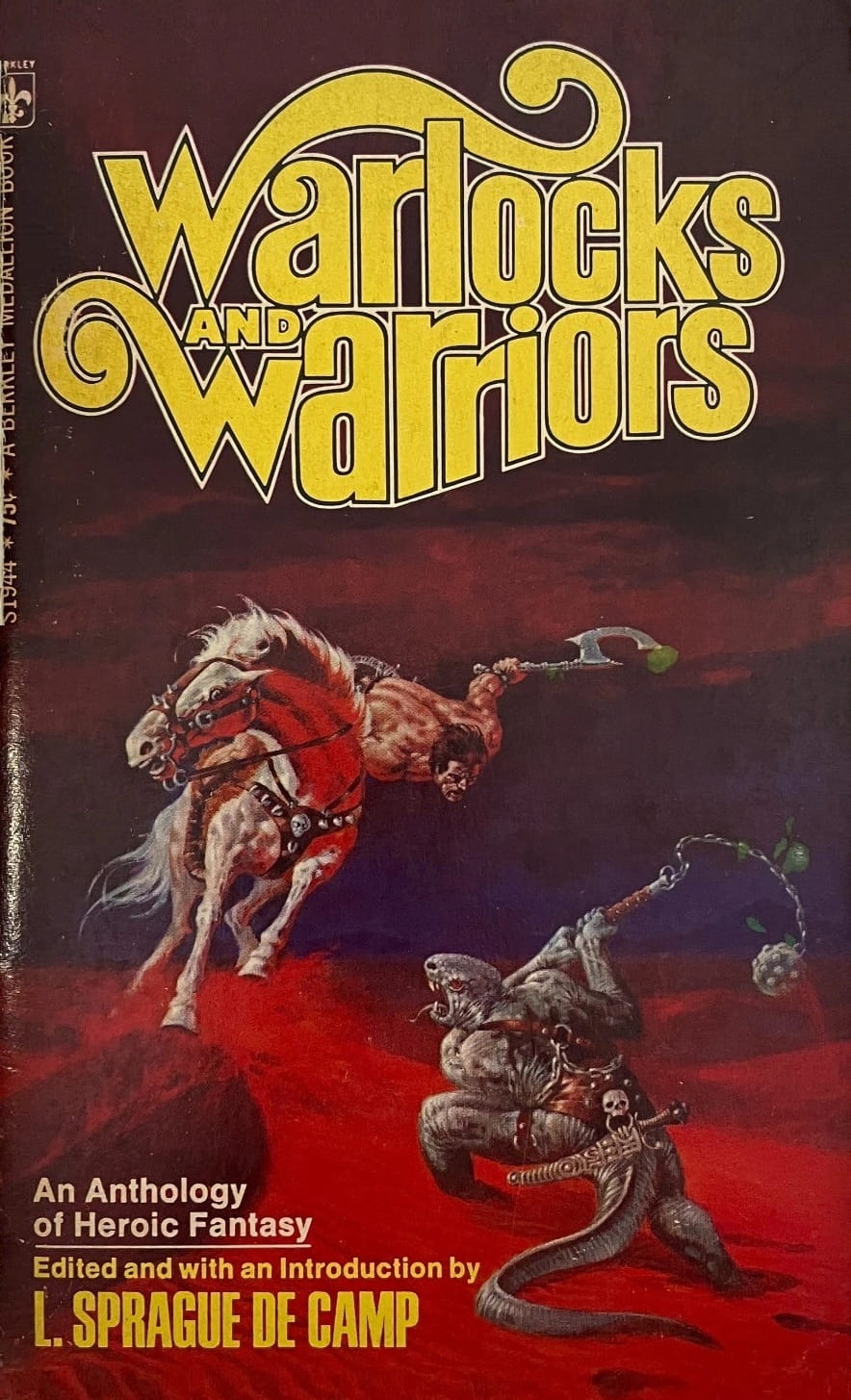
Warlocks and Warriors, edited by L. Sprague De Camp
(Berkley Medallion, January 1971). Cover by Jim Steranko
Warlocks and Warriors (1970) was edited by L. Sprague De Camp, who did quite a few anthologies around this time while also busy editing and rewriting Robert E. Howard’s Conan tales. It’s certainly a good collection, and quite varied, though not all these fit the heroic fantasy label associated with the collection. Certainly, not all are Sword & Sorcery (S&S). The cover is by the great Jim Steranko.
The anthology contains:
An intro by de Camp
“Turutal” by Ray Capella
“The Gods of Niom Parma” by Lin Carter
“The Hills of the Dead” by Robert E. Howard (a Solomon Kane tale)
“Thunder in the Dawn” by Henry Kuttner (Elak of Atlantis)
“Thieves’ House” by Fritz Leiber (Fafhrd & the Gray Mouser)
“Black God’s Kiss” by C. L. Moore (Jirel of Joiry)
“Chu-Bu and Sheemish” by Lord Dunsany
“The Master of the Crabs” by Clark Ashton Smith (Zothique)
“The Valley of the Spiders” by H. G. Wells
“The Bells of Shoredan” by Roger Zelazny (Dilvish)
The Ray Capella story, “Tutural,” is set in Robert Howard’s Hyborian Age but is not about Conan or a “Clonan.” One might consider it fan work but it’s quite well written. Capella’s full name was Raul Garcia-Capella (1933 – 2010), and you’ll sometimes see his work under just Raul Capella.
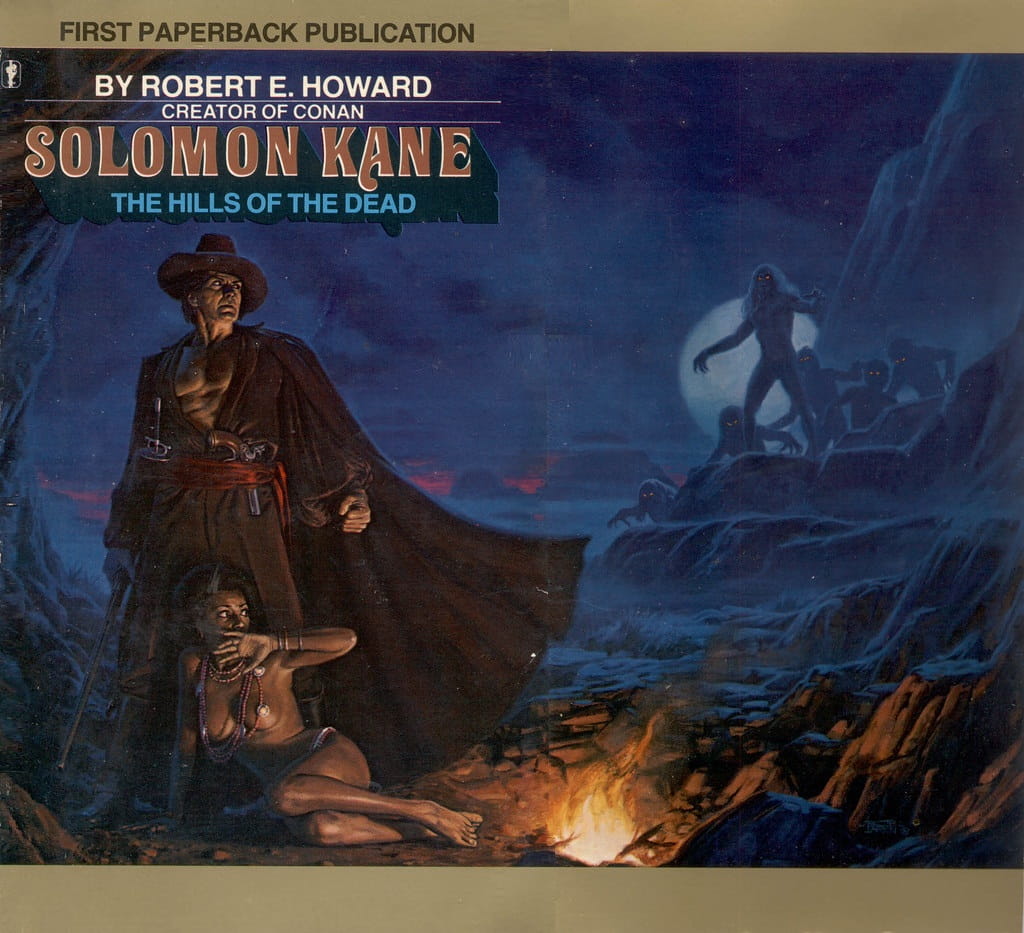 Solomon Kane: The Hills of the Dead by Robert E. Howard (Bantam Books, March 1979). Cover by Bob Larkin
The Howard contribution, “The Hills of the Dead,” is one of his Solomon Kane stories. The Solomon Kane tales were written before REH started working on Conan and they feature a very different kind of hero. I like them a lot.
Moore’s “Black God’s Kiss” is a Jirel of Joiry tale and my favorite piece here. Henry Kuttner was married to C. L. Moore. His tale here is his longest piece about Elak, which is well worth reading. Fritz Leiber seemed to be in just about every anthology that appeared around this time with his Fafhrd and Gray Mouser tales. This is another one. Wells’ story here is fantasy rather than SF and quite fun.

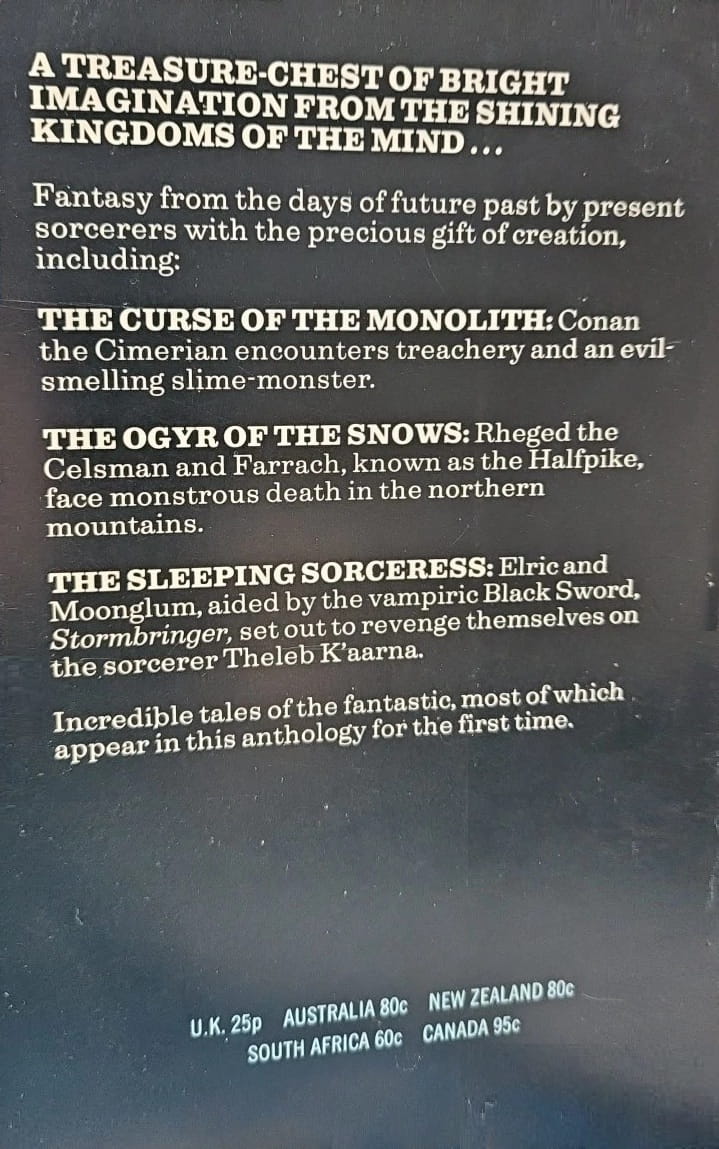
Warlocks and Warriors, edited by Douglas Hill (Mayflower, 1971). Cover by Josh Kirby
A second, very different book with the title Warlocks and Warriors appeared in 1971. It was edited by Douglas Hill (1935 – 2007) and published by Mayflower books in London. It has a very simplistic cover, artist unknown, although the reflection in the knife is kind of cool. Hill apparently wrote a number of books of his own, though I haven’t read any.
After Hill’s short introduction we have the following stories:
“The Sleeping Sorceress” by Michael Moorcock (an Elric tale)
“The Curse of the Monolith” by Lin Carter and L. Sprague De Camp (Conan)
The Ogyr of the Snows” by Martin Hillman
“The Wages Lost by Winning” by John Brunner (The Traveler in Black)
“The Wreck of the Kissing Bitch” by Keith Roberts (The Ice Schooner)
“The Unholy Grail” by Fritz Leiber (The Gray Mouser)
I’d read “The Sleeping Sorceress” before. This is an early Elric and Moonglum story by Moorcock and is quite good. I’d also read “The Curse of the Monolith,” which is a Conan pastiche by Carter and De Camp. Not quite Howard’s Conan but it was an OK tale.
I also had previously read “The Unholy Grail” by Leiber. This tale recounts the earliest adventure of the Gray Mouser, of Fafhrd and the Gray Mouser fame. Not my favorite of the series, probably because I like the Fafhrd character better than the Mouser character.

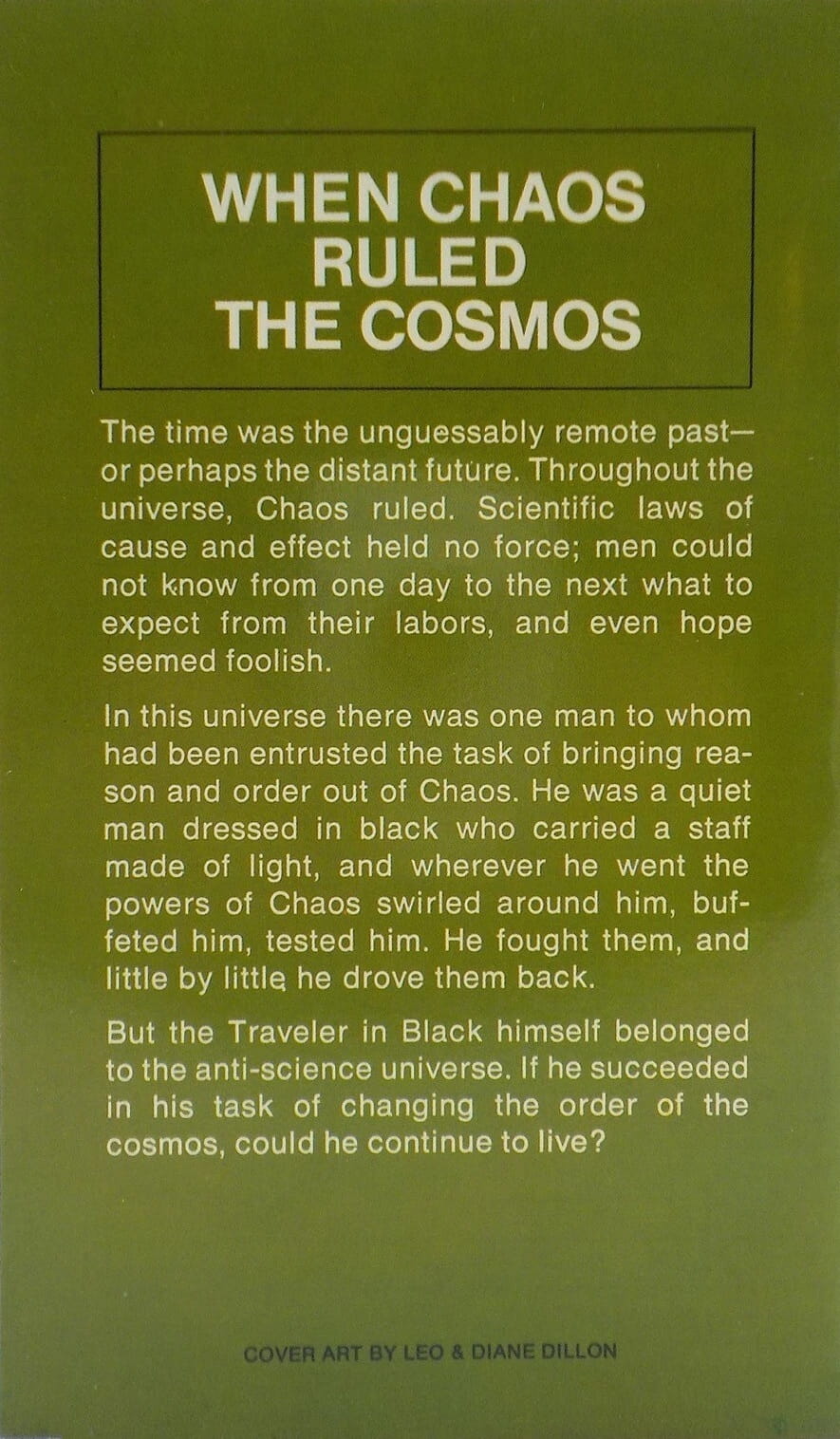
The Traveler in Black by John Brunner (Ace Books, January 1971). Cover by Diane and Leo Dillon
What were new to me were the tales by Hillman, Brunner, and Roberts, and all three were quite good. Brunner, I know, of course. I’ve read a lot of his SF. This is a story of the “Traveler in Black,” definitely fantasy though not Sword & Sorcery. The Traveler is a kind of mixed angel/devil character with the power to grant people’s desires. I’d not previously read these tales. It was beautifully written but meandered until it got to the main plot.
Martin Hillman’s “The Ogyr of the Snows” is definitely S&S, and a well written piece. The hero is Conanesque but wins the day mostly by wit. According to the introduction, this tale was extracted from a “novel in progress” by Hillman, but it turns out Hillman was Douglas Hill’s pseudonym. I looked through a list of Hill’s books but am not sure which one this piece may have come from.
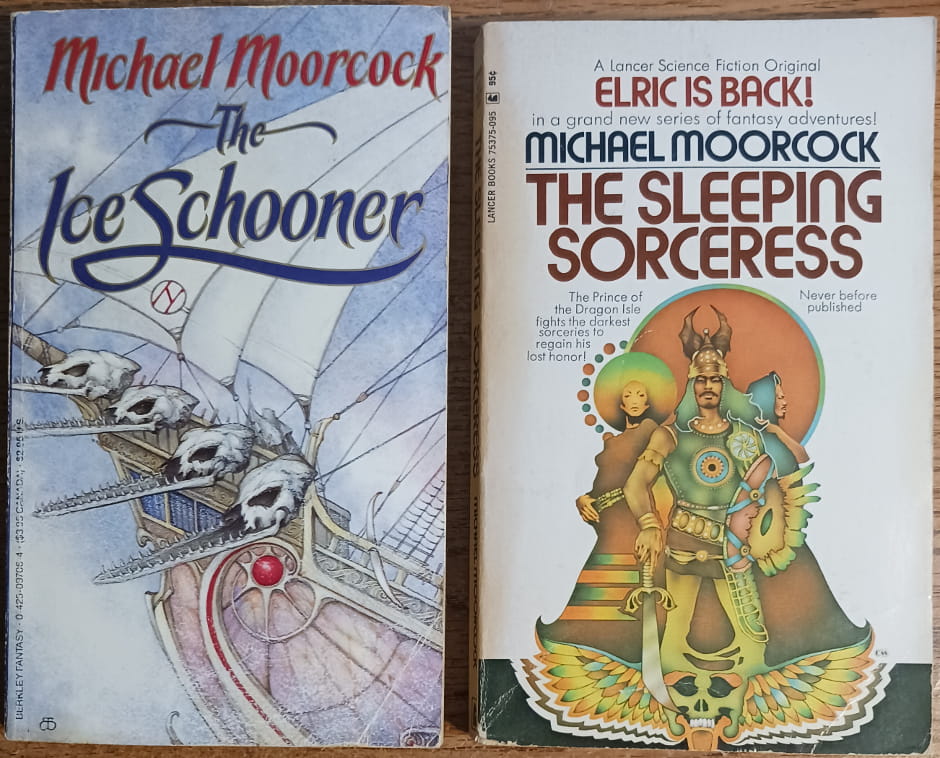 The Ice Schooner (Berkley Books, May 1987) and The Sleeping Sorceress (Lancer Books, September 1972), both by Michael Moorcock. Cover art: unknown, and Charles Moll
The greatest treasure in this collection is “The Wreck of the Kissing Bitch” by Keith Roberts. This tale is set in the world created by Moorcock for The Ice Schooner. The world was already beautifully conceived and Roberts does a fine job playing in the same universe. My favorite tale in the collection, concluding with a tense and exciting chase scene of sailing ships across the great ice seas.
I’ll be talking a lot about Moorcock down the line but above is a little tease in a picture of two of his books mentioned in this post (The Ice Schooner – cover artist unknown: The Sleeping Sorceress – cover by Charles Moll).
Charles Gramlich administers The Swords & Planet League group on Facebook, where this post first appeared. His last article for us was a review of Swordsmen and Supermen, edited by Donald M. Grant. See all of his recent posts for Black Gate here.
Categories: Fantasy Books
The Caretaker by Marcus Kliewer (Reviewed by Shazzie)
Book Review: The Caretaker by Marcus Kliewer

Nothing less than the survival of humanity is at stake.
From Marcus Kliewer, a new “titan of the macabre and unsettling” (Erin A. Craig, #1 New York Times bestselling author), comes a supernatural horror about a young woman who accepts a caretaking job from Craigslist, only to discover the position has consequences far greater—and more dangerous—than she ever could have imagined.
EXCITING OPPORTUNITY:
Caretaker urgently needed. Three days of work. Competitive pay. Serious applicants ONLY.
Macy Mullins can’t say why the job posting grabbed her attention—it had the pull of a fisherman’s lure, barbed hook and all—vaguely ominous. But after an endless string of failed job interviews, she's not exactly in the position to be picky. She has rent to pay, groceries to buy, and a younger sister to provide for.
Besides, it’s only three days’ work…
Three days, cooped up in a stranger’s house, surrounded by Oregon Coast wilderness.
What starts as a peculiar side gig soon becomes a waking nightmare. An incomprehensible evil may dwell on this property—and Macy Mullins might just be the only thing standing between it, and the rest of humanity.
Follow the Rites...
Follow the Rites...
Follow the Rites...
AUTHOR: Marcus Kliewer is a writer and stop-motion animator. His debut novel We Used to Live Here began life as a serialized short story on Reddit, where it won the Scariest Story of 2021 award on the NoSleep forum. Film rights were snapped up by Netflix, and it was acquired by Simon & Schuster for publication even before it had been extended into a full-length novel. He lives in Vancouver, Canada.
Follow him on Instagram @marcus_kliewer for exclusive book updates / writing things / stop motion animation & a lot of pet videos.
Publisher: Atria Books (April 21, 2026), Bantam (April 23, 2026)Page Count: 320 pagesFormats: hardcover, ebook, audio
REVIEW: I thought this was really clever.
It's one of those that does the jump scares well, and provides a compulsive story that gets more and more intense and heads to a bang of a finale. Before anything else though, be warned, it contains a protagonist who suffers from depression and has tendencies of suicidal ideation.
Macy has had a bad life so far, and there seems to be nothing bright lined up. She is unemployed, responsible for her younger sister after the unexpected death of their father, and everything she does only takes a turn for the worse. Until she finds a three day gig to take care of a huge mansion and follow strange rites to the T. The pay and bonus are unbelievable, so despite her sister's insistence to stay away, she accepts it.
The more I think about it, the more I think I like it. I want to say so much about this, but that will spoil it. It delivers well on the combination of horror with mental health. The main character can be annoying and seems to get more and more incompetent as the book progresses, which kind of is the point. It's a horrifyingly good metaphor for how downward spirals can be, when every action seems pointless and the only consistent feeling is that of being a failure.
After all, what is the more terrifying than your own mind working against you?

Book links: Goodreads
BLURB: Follow the Rites...Nothing less than the survival of humanity is at stake.
From Marcus Kliewer, a new “titan of the macabre and unsettling” (Erin A. Craig, #1 New York Times bestselling author), comes a supernatural horror about a young woman who accepts a caretaking job from Craigslist, only to discover the position has consequences far greater—and more dangerous—than she ever could have imagined.
EXCITING OPPORTUNITY:
Caretaker urgently needed. Three days of work. Competitive pay. Serious applicants ONLY.
Macy Mullins can’t say why the job posting grabbed her attention—it had the pull of a fisherman’s lure, barbed hook and all—vaguely ominous. But after an endless string of failed job interviews, she's not exactly in the position to be picky. She has rent to pay, groceries to buy, and a younger sister to provide for.
Besides, it’s only three days’ work…
Three days, cooped up in a stranger’s house, surrounded by Oregon Coast wilderness.
What starts as a peculiar side gig soon becomes a waking nightmare. An incomprehensible evil may dwell on this property—and Macy Mullins might just be the only thing standing between it, and the rest of humanity.
Follow the Rites...
Follow the Rites...
Follow the Rites...
AUTHOR: Marcus Kliewer is a writer and stop-motion animator. His debut novel We Used to Live Here began life as a serialized short story on Reddit, where it won the Scariest Story of 2021 award on the NoSleep forum. Film rights were snapped up by Netflix, and it was acquired by Simon & Schuster for publication even before it had been extended into a full-length novel. He lives in Vancouver, Canada.
Follow him on Instagram @marcus_kliewer for exclusive book updates / writing things / stop motion animation & a lot of pet videos.
Publisher: Atria Books (April 21, 2026), Bantam (April 23, 2026)Page Count: 320 pagesFormats: hardcover, ebook, audio
REVIEW: I thought this was really clever.
It's one of those that does the jump scares well, and provides a compulsive story that gets more and more intense and heads to a bang of a finale. Before anything else though, be warned, it contains a protagonist who suffers from depression and has tendencies of suicidal ideation.
Macy has had a bad life so far, and there seems to be nothing bright lined up. She is unemployed, responsible for her younger sister after the unexpected death of their father, and everything she does only takes a turn for the worse. Until she finds a three day gig to take care of a huge mansion and follow strange rites to the T. The pay and bonus are unbelievable, so despite her sister's insistence to stay away, she accepts it.
The more I think about it, the more I think I like it. I want to say so much about this, but that will spoil it. It delivers well on the combination of horror with mental health. The main character can be annoying and seems to get more and more incompetent as the book progresses, which kind of is the point. It's a horrifyingly good metaphor for how downward spirals can be, when every action seems pointless and the only consistent feeling is that of being a failure.
After all, what is the more terrifying than your own mind working against you?
Categories: Fantasy Books
I don’t know if this would be considered a spoiler but I’m curious. Are there going to be flashbacks in TLKoF like there was in Lady Midnight/ Chain of Gold or is just set in the present timeline?
There aren’t structural flashbacks, but between each chapter there are interstitials. These can be anything from pages from a book of Faerie history to the viewpoints of characters we haven’t seen much in the main narrative stories or an alternate perspective on a scene we’ve already experienced. There is one big flashback I can think of but it’s more like a vision of something that was forgotten than a journey into the past. At the moment there are more flashbacks in LPOH.
Categories: Authors
Molding Rebellion: Alien Clay by Adrian Tchaikovsky

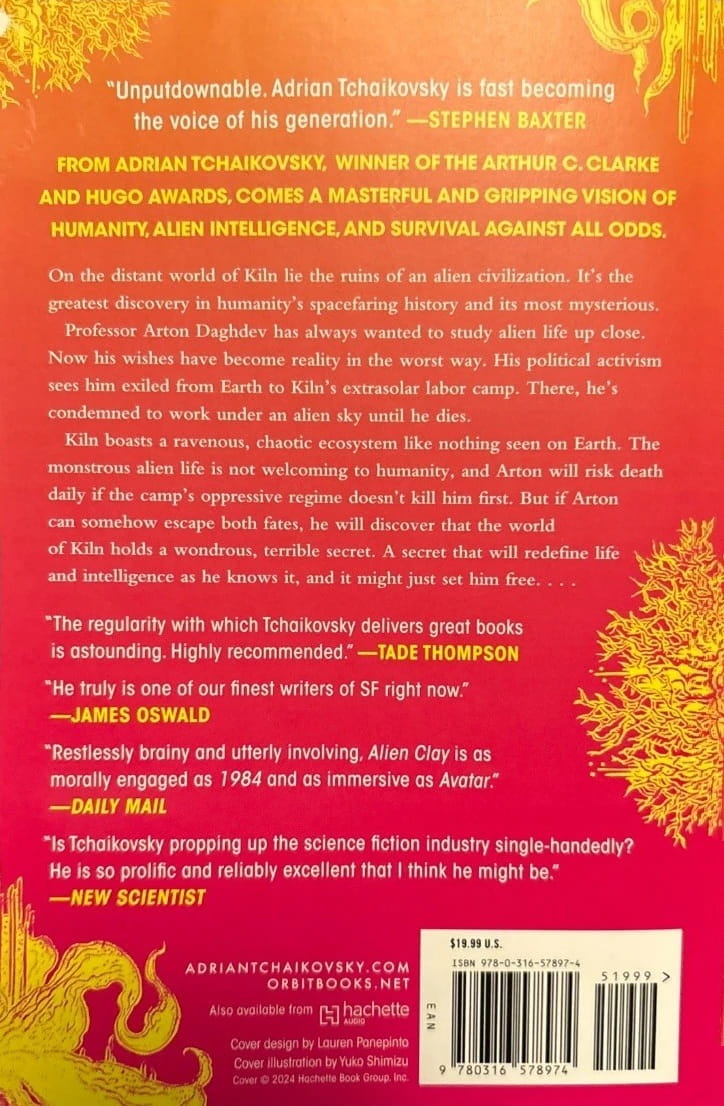
Alien Clay (Orbit, September 17, 2024). Cover design by Yuko Shimizu
Mushrooms in the cellar. Brood parasites. Puppet masters. Body snatchers. The Borg.
Resistance is futile.
But what, exactly, are we resisting?
Possession by alien entities into some kind of hive mind may have been inspired by studies of the social behaviors of ants; indeed, aliens are often depicted as bugs that threaten to unseat humankind’s self-awarded seat at the top of the evolutionary pyramid.
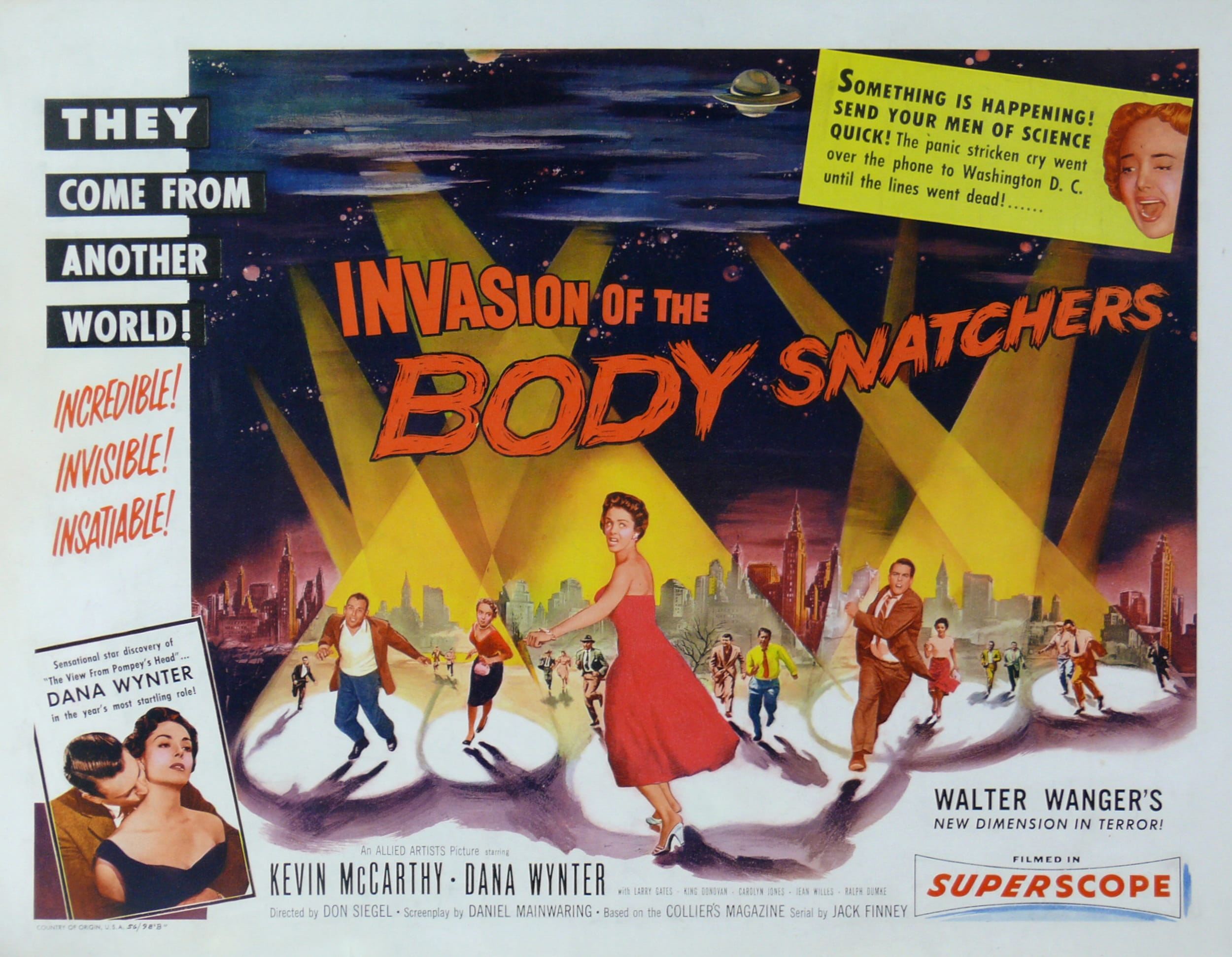 Invasion of the Body Snatchers (Allied Artists Pictures, February 5, 1956)
The invasion of body snatchers held particular appeal during the Red Scare of the 1950s and the supposed threat of sleeping Communist cells dedicated to destroying the American Way of Life (which was its own variety of hive mind) and instituting mindless collectivism (a fear to this day stoked by right wingers). The 1956 film about the pod people, based on the Jack Finney novel, is a classic depiction of insidious conformity and the inability of the individual to withstand it.
A trope that Adrian Tchaikovsky subverts in Alien Clay.
The first person narrator is Professor Arton Daghdev (whose last name is frequently mispronounced, something I expect the author as a fellow descendant of Polish ancestry also experiences). Daghdev is a dissident biologist challenging an academic orthodoxy demanded by the fascist Earth government termed the Mandate. For the “crime” of questioning whether humanity is the evolutionary pinnacle, Daghdev is sentenced to the exoplanet Kiln, a penal colony charged with investigating what appears to be the archeological remnants of an alien civilization.
For a scientist, such a punishment might seem to have an upside. There are two problem, though. The first is that any findings must adhere, any evidence to the contrary, to Mandate authorized dogma. More significantly, harsh environmental conditions on Kiln render any on site excursions extremely hazardous. Which is why they are using prison labor. Of which there is always a plentiful supply from a home planet bent on crushing those who don’t toe the autocratic line.
There was a time where I might have had trouble with this premise. Why would an authoritarian regime commit resources, even expendable resources, on a scientific mission for which conclusions are preordained with unclear benefits? But these days, with health policies determined by unsupported dictates and political correctness, it seems perfectly appropriate.

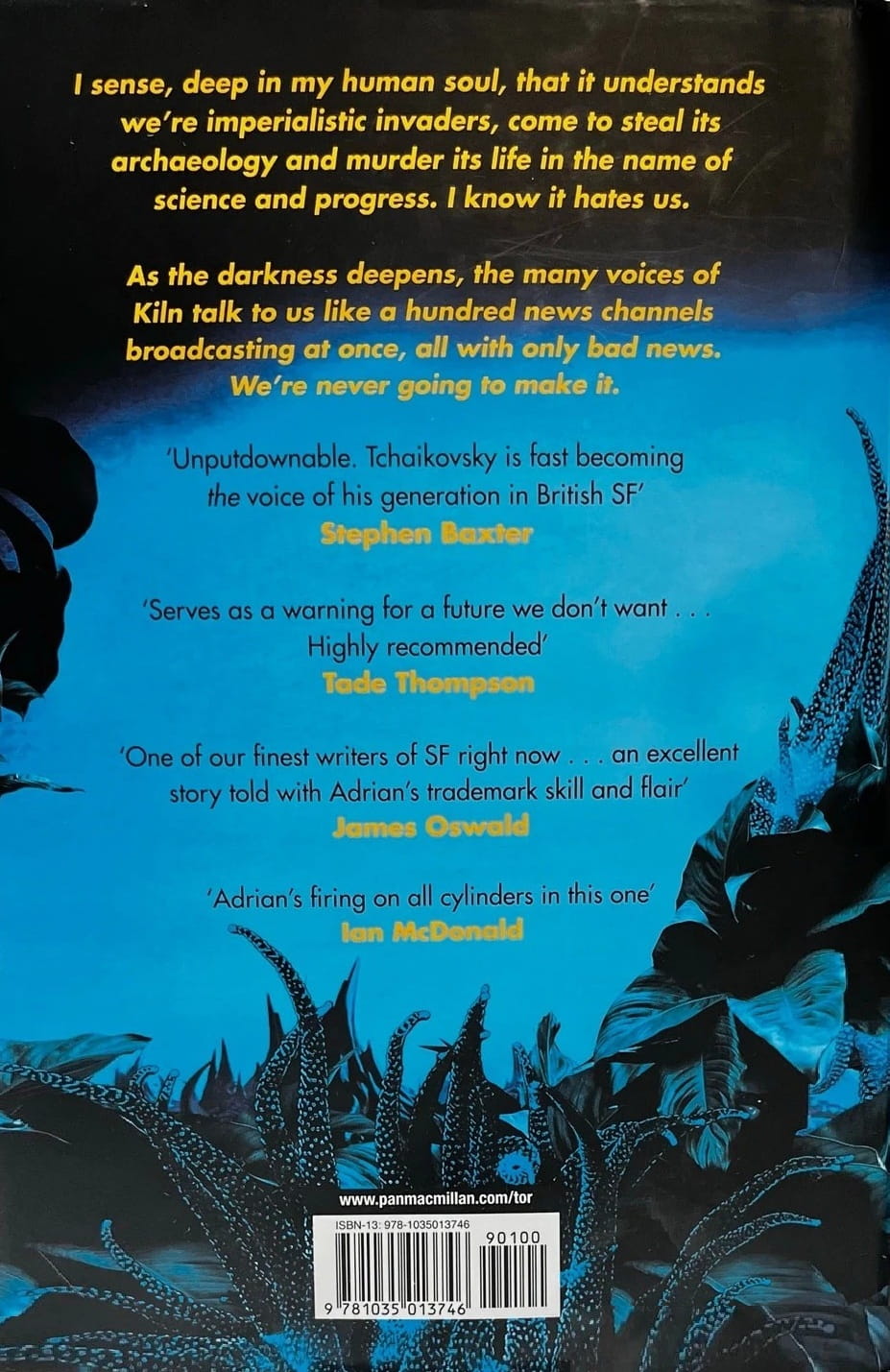
Alien Clay (Tor UK, March 28, 2024). Cover uncredited
Of course, once a revolutionary, always a revolutionary, except maybe when you question not only your own commitment and sufferance to the cause, but also who among you is likely to sell you and your comrades out. Or that your comrades might think you are the one doing the selling out.
So there is an attempted insurrection, one that is quickly smashed thanks to a betrayal. For his participation, Daghdev is removed from relatively safe bureaucratic chores conducted within the safety of the camp compound and assigned to Excursions, teams sent out to explore the alien ruins exposed to the highly infectious Kiln atmosphere. While they are issued some protective gear, they are prisoners, so expense is spared. Infection is expected. A saving grace is periodic three-day decontamination to forestall contagion. A process that sometimes is withheld as punishment.
Should an Excursion team not return to camp within minimal “safety levels” and suffer long-term exposure to Kiln’s strangely recombinant biologics, as happens to Daghdev’s team, no rescue mission sent out. Excursions are also Expendables.
In another type of story, the infected rise to absorb the rest of humanity. Here is where Tchaikovsky flips the script. Infection leads not to madness, but evolutionary jumpstart. Where the hive mind isn’t the embodiment of totalitarianism, but its enemy.
The alien clay here is actually human, on a planet named after an oven that transmutes clay into hardened finished material. A transmutation that has a ways to go before it can be considered finished.
David Soyka is one of the founding bloggers at Black Gate. He’s written over 200 articles for us since 2008. See them all here.
Categories: Fantasy Books
“The Marriage Bed” | The Joys and Difficulties of Loving One Another

Other LitStack Spots Here are some other titles LitStack has spotted to add to your…
The post “The Marriage Bed” | The Joys and Difficulties of Loving One Another appeared first on LitStack.
Categories: Fantasy Books
Teaser Tuesdays: "Look at My Pretty Book" Edition
No teaser from my current read today, but pictures of my newest arrival, just because it's pretty.
Slaying the Vampire Conquerorby Carissa Broadbent


Have you read it?What did you think of it?
Categories: Fantasy Books
Book review: Carrion Saints by Hiyodori

Book links:
ABOUT THE AUTHOR:
Publisher: Length: Formats:
Carrion Saints opens after the end of the world. The great cities are gone, only small towns, quiet hills, and monsters remain.
Crow is an immortal saint who looks like a monster and sometimes acts like one. She has wings, red eyes, and the weary patience of someone who has watched empires rise, fall, and rebrand. She arrives in a small village with a local monster problem. The monster, known as the Woman in the Hills, lives under a large magnolia tree and eats hunters. This arrangement has been going on for some time. The villagers are not thrilled, exactly, but they’ve adjusted. Crow has already fought so called Great Adversaries and so she accepts to slay the monster. The confrontation doesn’t go as planned.
Magnolia is a chatty severed head attached to a tree. She finds the one crack in Crow and pries it open. The dynamic between them works incredibly well. Magnolia chatters, taunts, philosophizes while Crow mostly endures. Sometimes she pushes back, but sometimes she can’t. She also wants to do the least harm possible, but the story keeps forcing her into situations where harm is unavoidable.
I like Hiyodori’s writing, but sometimes I wish she condensed things more. There are long stretches of conversation between Crow and Magnolia that are conceptually interesting but start to circle the same ideas of power, choice, mortality, and what it means to be a saint. The philosophical back-and-forth feels overextended.
The worldbuilding is intriguing but not fully explored. We hear about the other Great Adversaries, the long decline of the world, the strange ecology of monsters and saints. It’s compelling in outline, but much of it stays offstage. This keeps the story focused, which is good. It also makes the setting feel a touch abstract.
That said, the book makes two near-omnipotent beings arguing on a hill feel tense. Their conflict is about who understands the other’s weaknesses first. I’ll add that Magnolia is a great antagonist because she’s not frothing with rage. She’s amused. Curious. Almost affectionate in a warped way. Crow’s quiet fury and Magnolia’s gleeful prodding create a steady, uncomfortable tension.
Emotionally, the book feels heavy. It’s about grief that never quite fades. About living so long that loss becomes sediment. If the book has a weakness, it’s that its pace can feel flat in the middle. The stakes are clear, but the story sometimes pauses to explain things rather than letting events reveal them.
Overall, Carrion Saints is a strong Dark Fantasy that keeps things personal and intriguing throughout. It’s also my second book by Hiyodori and I’m becoming a fan.
Categories: Fantasy Books
WRETCH by Eric LaRocca
Eric LaRocca is one of the cutting-edge voices of horror today (mid 2020s), known for uncompromising stories that defy boundaries of any kind. When I was provided the opportunity to review his novel Wretch after his publicist reached out to me, it was an easy yes, please. This was my first opportunity to read his…
Categories: Fantasy Books
Robert McCammon: Where I Am
 Hello, all.
I thought I would check in and let you know where I am and what’s been going on.
I hope everyone enjoyed the Matthew Corbett series. I certainly enjoyed writing it and I hated to leave the characters but Matthew’s story was done and it was time to move on.
I took the opportunity to reflect on where I’ve been and where I’m going. Then I decided to write a musical play, which I finished today, March 23rd. It concerns the last days of a famous (or infamous) fictional figure. There are sixteen songs and two reprises, and I’m hoping it will see the stage around Halloween of 2027. This is for sure not iron-clad, as there of course remains much to do, but I’m hopeful. I’ll let you know more as the project progresses.
Next up, I’m going to finish the Trevor Lawson tetralogy. It’s high time to get the vampire/bounty hunter up and running again in his search for LaRouge and his battle with the Dark Society.
In the meantime, I would urge you to check out the video trailer that a very talented fan has created for the Corbett series, bringing in a lot of scenes from the books. This has been made with AI, and no matter your feelings on this hot-button subject, for a major studio to have made this trailer would have cost multiple millions of dollars.
I will risk being burned at the stake by saying we may be looking at the future of film-making, and that five years from now we may be astounded by what results from this new creative tool. Every new creative tool has met with controversy and become a hot-button issue, but just take a look at this video and consider what will be available in five years’ time. Of course we can’t know the future and probably shouldn’t, but time marches onward and though we may resist what comes out of the looming mists one has to be in awe of the possibilities. So…as they say…it is what it is. The real question is: what can it be?
On to Trevor now, and awakening him from the long sleep he’s been having. I can tell you he’s eager to strap on that gunbelt! Again, I’ll let you know more about the play as the details are hammered down. (Hammer…my favorite movie studio!)
As always, I thank you for your support and readership and for wanting to take this journey together. I can promise you, we still have a long way to go!
Best to you and enjoy your Spring and Summer,

Categories: Authors
Hey Cassie, it’s been a while, I’m 33 next week. It been a fun 15 years reading your books. Recently I read Castellane, also beautifully written. Shadowhunter world remains my favorite though, and I’m a Blackstairs girl. I’m still gathering up the...
Bred in the Bone is sad, but not because anything terrible happens to Julian or Emma. It is more sad in the philosophical sense of reminding us that nothing is permanent, that as Stephen King once titled a story, "All that you love will be carried away." Mortality, human nature, love, you know. The little stuff.
So it's not so much sad as haunting, I would say. And Emma and Julian are fine; we see them in book one. Still happy, still together. :-)
Categories: Authors
Free Fiction Monday: Crunchers, Inc.
Edith works for Number Crunchers Incorporated. Her job? Determine the monetary worth of each human being. But her corporation faces a nemesis—the EISHies. The ridiculously sentimental organization sabotages Crunchers, Inc. and other places just like it.
Edith must discover how the EISHies infiltrated her business—and then figure out what to do about it, without succumbing to the EISHies’ subversive message: Everyone Is Someone’s Hero.
“Crunchers, Inc.” is available on this site for one week only. You can get the story as a standalone ebook on all retail sites. Enjoy!
Crunchers, Inc. Kristine Kathryn Rusch
The scream from the middle office was loud and long.
“Damn,” said Edith. “We’ve just lost another one.”
Sure enough, Reginald Waterston burst out of the office, slamming the door against the wall—the windowed one, with the expensive glass that formed its own shutters.
He stopped at Edith’s desk—they all stopped at her desk, for reasons she never quite fathomed—and said, “My grandfather gave me a horse!”
Edith resisted the urge to roll her eyes. She folded her hands on top of the file that she hadn’t been studying, and leaned forward. The computer built into her desktop beeped, letting her know that on its screen, it already had Reginald’s personnel file, his suggested severance pay, and his recommendation letter.
“A real horse?” she said, pretending interest in Reginald Waterson’s revelation.
“A plastic horse. From 1942. It had no chips in the paint at all.” Reginald Waterston was forty-two himself, balding, with a tummy that needed a bit of tuck. His suit fit loosely—something Edith would have told him to change if she had been his company advisor—and he needed to trim his fingernails.
Employees five cubicles over slid their chairs toward the aisle. People were leaning around the ancient gray formations, so that all she could see were eyes.
Rows and rows of eyes.
It was different every time, with every single Actuarial Engineer. And everyone except Edith thought these outbursts were interesting.
Edith resisted the urge to sigh. She needed Reginald to get the point, and if she followed his inane line of reasoning, she would be listening to the poor man all day.
“This horse is important because—?”
“It’s the only thing I ever got from him.” Reginald had to mean the grandfather, not the horse.
Edith nodded.
“I was five, maybe littler. He told me to take care of it.”
“Which I’m sure you did.” The computer beeped again. Edith wished she could take that insistent tone with people. Maybe that was why they all came to her in the end. Because she was unfailingly polite.
“I did!” Reginald said with something like surprise. “And because of that horse, I went to a Wild West vacation in Arizona when I was twenty-five. I met my wife, we had my daughter, and I wouldn’t be standing here.”
“Resigning,” Edith said.
That stopped him. “Quitting,” he said after a moment. As if he were actually reflecting.
None of them had ever reflected before.
“How will you pay for your home? Your wife’s – .” she paused, looked down, saw nothing on the wife except that she had some outstanding student loans, and took a wild stab at it. “—continuing education? Your daughter’s first four-year college? Hmmm?”
“We have savings,” he said, sounding less and less certain of himself.
“And what happens when those savings run out?” she asked.
He stared at her for a long moment. Then those blood-shot eyes of his went slightly wild and he yelled, “I can’t stay here! My grandfather gave me a horse!”
“I know,” Edith said, hitting the image of the check on her desk-screen, then hitting print so that Reginald could have a hardcopy recommendation letter in addition to the e-mail version. “Believe me, I know.”
***
Reginald left fifteen minutes later, stopping to tell anyone who made eye contact with him about his grandfather, the plastic horse, and the small gestures that could turn into major events.
Damn EISH, anyway. They’d found a way to get to him.
They always found a way in.
Edith summoned Conrad Meisner, telling him to meet her in five minutes in what had been Reginald’s office. She felt unfairly burdened.
Any senior management official who got confronted with a terminating employee had to handle all problems caused by that employee.
Which meant that Edith had more than her share of terminal offenses. She’d actually dug through the hiring records to see if anyone had instructed quitters to come to Edith, but so far she had found nothing.
She would have to look again.
Then she heaved a sigh and got up, heading toward Reginald’s office. She had put on weight again, so moving wasn’t as easy as it had been. She had eight months before she was eligible for her third reduction surgery, so she’d either have to lay off the Cheetos before bed or take a six-week cure.
The last time she took the six-week cure, she went down to her official, government-recommended weight for two extra months, then gained every pound back plus the friend that pound had probably been shacking up with. She could do the old-fashioned starvation/exercise thing, but she wasn’t an exercise kinda girl even though she knew in fifteen years, she’d have to be at regulation weight or it would count against her. She already had two black marks—mid-level management position and no children—and she really couldn’t afford another.
She pressed her palm against the doorknob to get in. The office had reset itself when Reginald took his walking papers. The door unlocked then eased open, as if it were afraid to reveal the office’s interior.
The interior window had stayed shuttered, and so had the exterior window. The office itself was dark. As she crossed the threshold, light rose slowly—the brochures had said it calmed, but mostly it replicated the moment of irritation when she learned that she couldn’t make the lights come up any faster.
She had no idea how many times she had walked into this room, felt that same irritation, wished she could alter the moment when she ordered the lights. Originally, this had been her office. She hadn’t been demoted, just moved, because the Brass thought that perhaps a private office (with tons of extra security) would help Actuarial Engineers stay at the job longer.
So far, it hadn’t worked. Reginald had been the fifth AE to leave in the past sixteen months.
She stood with her hands on her too-ample hips. He hadn’t even personalized the space. The wall across from him had two dozen screens, all of them scrolling information in real time. His work desk had five more, slowed down to show the problem accounts, and the vid unit—digitized at optimal level for Reginald’s personal myopia—wasn’t even turned on.
The chair remained at the height the last AE had left it at, the spaces on the desk for photographs had dust, and the air-perfume was still set on Chanel, which was the preference of at least two AEs ago. Reginald didn’t strike her as a Chanel-type guy. Maybe, with all this talk of horses, he’d been a Bud and illegal smokes sort, but he hadn’t even set the air to imitate that.
Almost as if he’d known he wouldn’t last.
She shook off the paranoia and looked at the accounts while she waited for Conrad. Conrad always ran ten minutes late, except when he was fifteen minutes early. It was almost as if he couldn’t decide who he was.
She knew who he was. He was a relatively young man with too much responsibility. Conrad was in charge of all of the security on the seventeenth floor—a daunting task, considering the amount of information that flowed through this place.
Public records, bank records, arrest records, personal complaints, grades, salaries, family size, and any other information that someone—anyone, not just the subject—chose to share. People could (and often did) send false information on someone they hated; if the sender got caught, the information went into the sender’s file—one of those horrible black marks that Edith feared.
She constantly checked her records and saw only the two legitimate marks—the middle-management position (and no sign of ambition for a higher place in society) and the childlessness, which could be a plus if her ambition grew. Only she didn’t know how to grow ambition. She’d already come a long way. Her mother had been a homemaker in the days when homemakers were shunned as retro-women, and her father, an Iraqi war veteran, never really got over his period of service—moving from job to job to job, each with less pay and less responsibility.
That she managed to rise this high—and stay here—was a bloody miracle if she said so herself, and she did, although not as often as she could have (fearing that someone would report her for repetitious behavior or vainglory or some other minor sin that could besmirch her record if too many people reported disliking her).
“Edie?”
She jumped, even though she recognized the voice as belonging to Conrad. He was one of the few people in the world who called her Edie.
She turned, hand against her beating heart, glad for the cover of her fear. He always made her heart beat faster. He was six feet tall, broad shouldered, and strong featured. He had a classic 20th century handsomeness—the kind you saw on war recruitment posters in World War II (her area of expertise in college, all those years ago)—and his voice, a rumbling baritone, seemed to match it.
A few of the women said he was too perfect, suspecting him of abusing enhancements to improve his physical appearance (even in this day and age, women were supposed to do anything they could to improve their physical appearance, but men should abstain for fear of focusing too much on good looks over character). Edith believed he was one of the few humans on the planet born with his incredible good looks. No matter how much she stared at him (and she stared at him too much), she couldn’t see evidence of any surgical procedure, nano- or otherwise.
“You seem jumpy.” He came all the way into the office, and closed the door. Something in his movement jarred the wall system and both glass-shutters opened, as if preventing some kind of physical (albeit unplanned) rendezvous.
“I hate this,” she said. “EISH got to him.”
EISH was short for the Everyone Is Someone’s Hero Society, with the last “s” dropped because EISHS was too hard to say. If Edith had been running the Society, she would have given it another acronym altogether because EISH sounded too much like “ish” for her tastes.
“I don’t know how EISH got in,” Conrad said. “I’ve added more secure equipment to this room than any other place in the building. We even have guards posted outside—real, living, breathing guards—just so that no strangers get inside the elevators coming up to the seventeenth floor.”
Edith shrugged. “He screamed, then came out at top speed to tell me about his grandfather and a plastic pony, and how that made him the man he is today.”
Conrad sighed. “Sounds like EISH.”
He leaned against the desk and crossed his arms. He stared at the information still scrolling on the wall across from him, but he clearly wasn’t seeing it.
Edith sank into the chair. It felt comfortable, familiar, as if she had come home. Here she didn’t feel quite as heavy; here she didn’t feel quite as useless or out of date.
She sprang up.
“Check the chair,” she said.
“They did chairs two years ago. They’re not going to—”
“Check the chair.”
He sighed a second time—what other response could they all have to EISH but sigh?—and crouched. While he worked, Edith paced.
Technically, EISH wasn’t her responsibility. The Brass was supposed to monitor EISH and all other like-minded groups. There were divisions that handled anti-EISH spin; divisions that persecuted EISH members to the full extent of the law; and, it was rumored, divisions that sent EISH members into the database earlier than they deserved to go.
But technically, Actuarial Engineers were supposed to prevent database tampering. Even though it was against the company’s best interest, Actuarial Engineers were supposed to double-check suspicious information—especially information provided about a hated person or a person who belonged to a hated organization (like EISH). This protected the corporation from class action lawsuits, too much government oversight, and the occasional overzealous politician/prosecutor/investigative reporter.
After all, EISH had a point that most people sympathized with: Every life had value. Sometimes the value was as small as giving a plastic horse to a child you’d never see again. Sometimes the value was being the person everyone ran to in a crisis (Edith would have to see if that somehow made it into her file—a white mark to counteract the black). Sometimes the value was in living the perfect American life—2.5 children, a dog, a house and too much credit, and perfect attendance at the marginally useful job.
This sentimental view, which even she had some sympathy with, appealed to everyone whose life hadn’t exactly gone the way he’d planned. The person who woke up at forty, realizing that he wasn’t going to get the chance to buy enhancements that would make him a star quarterback (those were age-limited to the under thirty crowd, no matter what your innate talent level) or that he wasn’t going to be a wunderkind in any subject because wunderkinds all died before they turned forty, usually of some self-inflicted something or other.
EISHies, as she called them, gave succor to the hopeless, hope to the fearful, and pap to everyone else. They simply didn’t understand the way the world had to work.
“Yup,” Conrad said. “They got the chair. I’m going to have to boost the scans again. They put a low energy chip into this thing. It must’ve been working on him for weeks before he finally blew.”
Blew. That was a term. Actuarial Engineers went through a battery of personal tests, showing that they lacked the kind of sentimental bent that made EISH appeal to most people. AEs were as close as people got to being robots themselves, or so personnel had told Edith after the fifth AE blew his cool and left.
People who got hired by Crunchers, Inc., which was a branch of Number Crunchers, Inc., a branch of Statistical and Numerical Services, Inc., a branch of—well, she couldn’t remember, not that she had to. She’d only gone to the third level when she’d been applying here.
Suffice to say that the job of Crunchers, Inc. and companies like this was to assist decision-makers in those hardest of hard decisions.
The ones that involved life and death.
Rather than applying a standard of morality that varied from person to person or township to township, Crunchers and companies like it made certain that decisions occurred on a level playing field.
Each American life (someday, the bigwigs hoped, each life) would be reduced to a series of positives and negatives. The intrinsic value of the human being—not just his political clout and financial worth (although those factored in; no one could ignore the way that money talked, even now), but his value to society, how much has he contributed in a variety of measures—as a teacher, as a valued member of his own community, as a giver of advice. Is he a good parent? Have his children grown to become equally valued members of the society or are they in prison/unemployed/living on some sort of benefits? Has he had a positive influence on the people around him?
Each action could cause a reaction—good and bad. The programs worked out a level of disgruntledness proportionate to fame or good fortune or (in cases like Conrad’s) simple good looks (figuring that jealousy created bad human behavior). There were also the health factors—was this person keeping good enough care of himself so that he wouldn’t become a burden on society—too much alcohol, too much food, too little exercise (unless these things were matched by weight loss surgeries and overnight nano-exercises, things that only a fortunate few [like Edith] could afford).
In other words, the programs kept a functional and relatively simple database—most people fell into easily predictable categories.
It was the folks who led non-traditional lives who were the problems, and they fell under the auspices of the relatively robotic AE, who gave the information a somewhat human glance and decided what category the person belonged in.
Somehow, organizations like EISH had discovered the AEs and even worse, found their names. Now AEs were targets, and all of them seemed to be breaking under the pressure.
“Got it.” Conrad held up a chip the size of a fruit fly. “I’ll analyze it, but I’m sure it’s an EISH component.”
“Scan the room for more of them. And find out how it got on the chair.”
He gave her a lazy grin that warmed her more than it should have. “Yes, ma’am. And what’ll you do?”
“Besides fill out report after report on poor, broken Reginald?” She sighed, making this one gusty and long, so that Conrad knew he wasn’t alone in his disgust. “Find a replacement, of course.
***
The replacement, Edith decided, had to be someone with no trace of sentimentality. No hidden plastic horses, no loving spouse, nothing that could pry through the shield of that person’s loyalty to numbers, statistics and the purity of formula.
She no longer allowed personnel to make the final decision. She added a few interviews of her own.
It took a week before the seventeenth floor got its new AE. That put seventeen behind all the other floors in the building, a serious problem. Life and death decisions were being made all over the country, and the files that had been routed to seventeen couldn’t be accessed.
That meant doctors, who needed to know which patients deserved life-saving treatments couldn’t find out; insurance companies couldn’t figure out who deserved the high-end coverage; extended living facilities and comfortable retirement centers couldn’t evaluate applications—at least, not for the thirty thousand or so files normally processed each week on floor seventeen.
If this went on too long, seventeen would get docked (and black-marked). More than a month, and everyone on seventeen would be fired for lack of productivity—and then try to find a new job.
Edith shuddered. Job loss wasn’t a black mark on the permanent files, but job loss resulting in demotion was, and if she got fired along with everyone else on seventeen because they couldn’t find an AE, then she would never find a mid-level management position again. She’d be an “average” worker, and more than black marks, one thing you didn’t want in your permanent record was the word “average.”
So she went above and beyond. She stayed late, reviewing applicants’ life histories, breaking an unwritten rule and investigating their permanent files in search of sentimentality. (Technically personnel was supposed to look through permanent files for mundane things, like genetic predisposition to various diseases, criminal records, criminal charges, and personal complaints. To look for something more specific, like family history or a tendency toward weeping at sad movies, was against some Federal law that personnel could cite chapter and verse [and did whenever Edith asked them to do it] but Edith didn’t care. She wanted the best AE possible, and that meant taking extraordinary measures.)
She also had Conrad beef up security to the room—again. She looked in the budget to see if there was money to secure the AE’s place of residence as well. EISH had become quite sophisticated; its anti-formula programs slowly bombarded the AE’s subconscious with sentimental stories of the ways that the smallest of encounters could trigger life-changing events.
Even EISH didn’t argue that everyone should be saved. The serial killer, the repeat child molester—their bad deeds outweighed any potential for good. Despite the word “everyone” in EISH’s title, they were really arguing for the ordinary person, the average person, the person who, when they died, wouldn’t have enough accompaniments to fill a fifteen-second obituary spot on the Mourning Network.
Edith always thought (privately) that the founders of EISH were trying to protect themselves and their family. She always argued (publicly) that if EISH wanted the entire well-behaved world to get extended life treatments or the best medical care, then EISH shouldn’t concentrate on changing the formulas that companies like Crunchers used.
EISH should get more and more people to live on the high end of the Crunchers’ scale. EISH should encourage them to give more to charity or donate genetic material or house foster children. If more people wanted the benefits of an exemplary life, they should live one.
Even though it was hard. Edith was falling short, but at least she tried. She didn’t go through day-to-day sleepwalking. She actually thought about each action, and its equal or opposite reaction.
She knew she was taking risks interviewing the AE candidates herself, but she figured the benefits outweighed any chance she took.
And finally, within seven days, she found the perfect candidate.
***
He was tall and thin and homely. He wore black wool suits, white shirts, and work boots, all of which looked like they’d come from a second-hand store. He lived alone. His parents had died when he was young, and he’d been shuttled from foster home to foster home, never staying long enough to make attachments. He had been an excellent student who graduated with degrees in economics, applied mathematics, and computer analysis, but he didn’t read for pleasure nor did he see movies, play games, or socialize.
He never had a pet. He never, so far as Edith could tell, had a friend. He never supported a cause or took a stand. He ate every meal placed in front of him without complaint. He wasn’t even a vegetarian, as so many of these systems guys were.
Edith could find nothing—in his résumé, in his history with the company (in a lesser department; straight accounting), in his own personal life files—that showed a trace of sentimentality. There wasn’t even a place where sentimentality could breed—nothing, so far as she could see, that would give those relentless little chips that EISH was so fond of placing (somehow!) in this company a way to make him see the facts and figures he was crunching as human beings.
His name was Bartleby Plante, and he could start immediately. In fact, accounting was happy to transfer him to the seventeenth floor.
Edith ran through the training and Plante had no questions at all, rare for someone in this job, most of whom would ask for certain kinds of clarification, like “What does living alone really mean? Is she alone if she has a dog?” or “Does it matter how long ago his last act of kindness really was?”
Plante simply nodded, took notes, and then set to work.
By the end of the business day, he’d gone through five hundred files, more than any other AE had done on a single day. Edith had to stay late to check his work, and she found no fault with it.
If anything, he was a bit too strict—if someone huddled on the cusp of “deserves Excellent Treatment” and “has earned Good Treatment,” Plante always gave them the Good Treatment recommendation.
Of course, Edith recommended that to new AEs, with the caveat that good treatment costs all businesses that contract with Crunchers, Inc. less than excellent treatment, and one should save money where one could.
Still, all other AEs, faced with a subject one-quarter of a percentage away from Excellent Treatment, upgraded that subject. It seemed like the most humane thing to do.
But, she reminded herself that first night, she hadn’t hired Plante to be humane. She’d hired him to make judgments that fell outside the normal parameters, and if he was slightly harsher than most, it simply meant she wouldn’t lose him to EISH infiltration quite as quickly as some.
After a few days of checking, she felt satisfied that Plante could do the job. Sure, she had to tweak his process a little. If a subject was one-sixteenth of a percentage into Excellent Treatment country, Plante would downgrade them, and Edith had to remind him that once they earned Excellent Treatment, no matter how narrowly, they deserved to stay there.
Until, of course, their behavior moved them down a category—but she didn’t say that to Plante. He would not get a chance to review a file twice. Reviews moved up the floors—next year, new information would move everyone processed on seventeen to eighteen, and so on, as a sort of double-check. Of course, once a file had an eyeball review which was, at heart, Plante’s job, then the file tended to remain in whatever category it had been assigned—usually all the way to the bitter end.
Edith liked the system. She believed in the system. It was so much better than having individual doctors, for example, deciding which patients got the most expensive treatments based on personal likes and dislikes or on desire to perform that particular new experimental procedure or on ability to pay.
Edith believed in all that, she truly did. She felt sorry for the people who didn’t qualify for everything they wanted—few did!—but in the end, it was their own damn fault.
She found comfort in that.
She was certain she did.
***
Plante irritated her.
She couldn’t confess that to anyone. She had stressed that she needed the perfect EISH-proof employee, and she had found that in Plante.
But…
He ate tuna fish sandwiches for lunch, and the smell stayed in the office until closing. He picked his teeth while he waited for the on-floor barista to make his coffee. He didn’t seem to dry clean his suits regularly, and his boots had a faint barnyard odor.
Finally, Edith had to go to his office after he left and set the air-perfume on Scrub followed by Lilac, not caring that it was a gender-associated scent. She needed the strongest smell she could find to cover his odors, not to mention the strongest smell she could stand.
She sent a memo to personnel so that someone would discuss his hygiene with him, and hoped it would do some good. She didn’t want to disturb him more than she already did.
He scuttled away from her when he saw her; wouldn’t make eye-contact; and spilled his mocha-cream double-tall the first time she said hello to him during the mid-afternoon mandatory coffee break.
She tried to shrug it off—after all, a lot of people had trouble with her: she was the highest-ranking manager on seventeen—but she couldn’t entirely shake the feeling she’d made a mistake.
So she watched him. Watched him interact with the other employees (he didn’t); watched him arrive first thing in the morning (his breakfast came with him: McDonald’s biscuit with cheese); watched him lock up at night (always the same movement—a press of the palm to the doorknob, then a double-check with the other hand, just to make sure the door was locked).
He said hello to no one—not even the barista on the two mandatory coffee breaks—acknowledged no one, and shied away from any personal contact at all. If someone brushed against him in the elevator, he moved as if he’d been hit. If someone grinned at him, he ducked his head and looked away.
None of this was in his file, of course. He wasn’t listed as anti-social, just shy. So nothing pathological had come from this—and, she supposed, it was all expected, given his upbringing. He’d never learned any of the major social skills.
But he should know them, shouldn’t he? So that he could make evaluations? So that he could decide that a woman who smiled at babies sometimes saved them in a crisis—but said crisis hadn’t happened yet, so it couldn’t be counted on her record. But the smiling should be.
Or a man who gave money to the legion of homeless (those who hadn’t behaved well enough to let the system help them or who opted out of the system entirely) wasn’t that bad after all. He was just trying to provide what he could for people who couldn’t help themselves. There was no guarantee that those deadbeats would use the money to buy alcohol or drugs—and wasn’t it on the plus side for the man that he didn’t quiz the recipients on how they’d use his money? He trusted them to make the best decision for themselves.
Edith’s head was swirling with this and all the other factors that Plante had to consider for his job. She wanted to ask him if he realized he initially got a high rating because of his difficult childhood. For the first ten years of an adult’s life, a difficult childhood gave him a pass—an excuse to miss on certain things like marriage in your twenties or learning personal hygiene.
After ten years, though,—and Plante was right on that cusp—difficult childhoods faded in importance. The cultural assumption (again a correct one as far as Edith was concerned) was that adults should learn and grow, and yes, a difficult childhood handicapped people but they should learn the things they missed in childhood in their twenties, making them much better citizens in their thirties.
She found herself idly searching his file, looking for his exact birth date, the day he would turn thirty and become, in society’s eyes, accountable for his own weirdness.
And that was when she realized she was stepping over a line. She wasn’t quite sure what the line was, except that she knew it had to do with obsession, and eventually, she would get caught.
Another black mark on a file that couldn’t afford any more.
So, she contacted Conrad, met him in a coffee bar off-premise after hours, and waited the requisite fifteen minutes because he was, as usual, late.
He arrived, wearing the same twill pants he’d worn that day in the office with a different shirt (a brown that accented his coloring) and his hair slicked back.
He looked nice.
She wondered if that was for her, then decided it wasn’t. Men like Conrad were never interested in women like Edith. They had nothing in common except their jobs, and she wasn’t pretty enough, smart enough or interesting enough to keep him satisfied for very long.
The other women in the bar watched him walk across the room. The bar was small, with ferns against dark wood paneling—some kind of faux 20th century look—and the entire place smelled of coffee mixed with vanilla, a smell that always made Edith hungry.
“Out of the office,” he said as he sat down. He was smiling, which he didn’t do at work either. “Clandestine meetings, secret talks. Are we suddenly spies?”
She smiled, but waited to answer him until the waitress took his order—a plain black go-for-the-throat charger with extra caffeine, a man’s drink. A macho man’s drink.
“I may have made a mistake with Plante,” she said.
Conrad looked sympathetic.
“May I tell you my worries?” she asked.
“Is this on- or off-the-record?” he asked.
She shrugged. “Which is safer?” she asked, knowing that either could backfire.
“Just tell me,” he said, and he, the head of the seventeenth floor’s security, would make the decision for her.
Somehow she found that comforting. She found him comforting.
So she told him her observations and her fears about Plante. Conrad listened (they ended up having dinner), and then asked, “Isn’t that what you wanted?”
She blinked at him, not quite sure what he meant.
“A person who couldn’t be persuaded by anything EISH threw at him, a person without sentiment, a person who saw the world in numbers and codes and absolutes. Isn’t that why you got involved, so that you’d get the exact right man?” Conrad pushed his plate aside—he’d had a sandwich made from some kind of thinly sliced beef so rare it didn’t look like it’d been cooked—and folded his hands on the table.
“I didn’t expect him to be so cold,” she said, and realized how lame that sounded. She had picked at her salad, which she had ordered to impress Conrad with her restraint, not because she really wanted it.
“How could he be anything but?” Conrad asked. “You wanted no sentiment.”
“Sentiment’s a bad thing in this job,” she said.
“Is it?” his voice was soft. “Maybe compassion’s a better word then.”
She frowned.
“I mean, there’s compassion built into the system, right? Isn’t that why people with difficult childhoods get a pass early on?”
“The pass doesn’t cost much,” she said. “Younger people don’t have as many illnesses. They often don’t have insurance, and they’re not usually involved in life-and-death decisions. If they’re in an emergency room, it’s usually because of their own stupidity, which by every form, counts against them.”
Conrad’s lips turned up, but he wasn’t smiling. “So there’s compassion when it doesn’t cost anything.”
She nodded.
“And isn’t that what you’re complaining about?”
She frowned again.
“The eighteenths of a percentage point—he’s waiting for a perfect score to move people up and down the scale, but really, how much difference is there for people who are on the cusp, people who deserve more privileges in this society or nearly do?”
She shrugged. “Some.”
“Then I don’t see what the problem is,” Conrad said.
The smell of vinegar was beginning to turn her stomach. She pushed her salad away. She was beginning to regret this. She had thought Conrad was sympathetic, but he was like all the others.
He didn’t understand the fineness of her position, the way it sometimes became personal. If Plante were reviewing her file, he wouldn’t look at her previous weight losses. He wouldn’t look at the fact she was the first manager in her entire family, the first non-blue collar worker, the first person to make something of herself by her familial standards.
She was too old for him to look at familial standards. Her previous weight losses were too far in the past. She’d relied on surgery and tricks recently, and that wouldn’t wash.
She hadn’t had children, didn’t give enough money to charities, worked in the Crunching industry which—because crunchers didn’t want to be accused of bias—actually counted against her (but because crunchers did the work, was often bypassed as a “non-consideration.”) Plante wouldn’t make that a non-consideration. He’d examine each of the past five years for black marks and recommendations, for her good work and her bad. He’d see that no one would really miss her if she disappeared, and he’d mark that into her file, and no one would review it, not for quite a while, and if she suddenly found herself with some kind of strange cancer or something, she wouldn’t get the preferential treatment she would have received in her thirties, when she was still up and coming, when she was a potential wife, a potential parent, a potential CEO, someone who would eventually become a major contributing member of society, who, even if she didn’t have family, would sit on boards of various charities, and give a healthy percentage of her eight-figure income to various needy folk, and would serve as a role model to children of blue collar workers everywhere.
She’d stalled, grown content, felt no urge to move on, and her files would reflect that. The statistics said she wasn’t going to improve any longer, and Plante would know that, instead of looking at her and realize that just by getting involved in his hiring, she was showing ambition again.
She was striving. She just wasn’t doing a very good job at it.
“Edie?” Conrad asked. “You okay?”
She made herself take a deep breath. She nodded, regretting this conversation, regretting speaking to anyone on or off the record.
“I’m fine,” she said. “Thanks for coming, Conrad. I appreciate your time.”
Then she patted him on the hand, grabbed the bill and swiped it through the pay register on the side of the table, then pressed her right index finger on the marker, so that she paid out of the correct account.
He was trying to say something as she walked away, but she didn’t stop. She couldn’t stop.
She felt like a fool—and she wasn’t exactly sure why.
***
She became sure when she arrived at work two days later to find her boss, Conrad, and three members of upper management huddled around her desk.
Conrad looked at her guiltily, but the others had a coldness in their eyes. She recognized that coldness; she’d felt it too whenever she’d had to confront a misbehaving employee.
“What’s wrong?” she asked.
Conrad held up a chip. It was barely the size of a grain of sand. She had to squint to see it.
“EISH,” he said. “They couldn’t reach Plante—in any way—so they got you.”
She felt a flare of anger that she immediately suppressed. Anger would guarantee that she would lose this fight—and fight it was, sudden and terrifying.
“I told you I wasn’t being sentimental,” she said, sounding a bit clipped. She made herself breathe.
The others looked at her as if she were a subspecies of bug. Conrad bit his lower lip, an attractive look for him.
“I’ll walk you through the termination procedure,” he said gently. “It’s the least I can do, since I had to report that conversation.”
She had known he would. No matter what she’d said, on the record or off, she had known he would report her. She would have reported anyone who said those things—if she didn’t believe in the person. If she hadn’t trusted them.
Apparently, Conrad hadn’t trusted her.
“You had to know I’d do that,” he said into her silence. “You gave me the choice.”
She glared at the other three, who looked away from her, as if she were tainted somehow, as if, even by being close to her, they would ruin their own careers.
They had decided. Anything she did now would simply make matters worse. A black mark—being fired!—would become a stain if she fought too hard. She might never find another job if she protested. Someone would write her up as “irrational,” “emotional,” or “uncooperative.”
“All right,” she said to Conrad. “Walk me through.”
***
She knew the procedure better than he did. She had to help him when he got stuck, remind him that she needed her final check or the contents of her personal drawer.
He didn’t say much as he did the work, although he did have trouble meeting her gaze.
Finally, it was done. She grabbed her pitiful box of personal belongings and headed for the door—away from the prying eyes, the people who peered from the sides of their cubicles, the private glee that some of them would feel at losing a manager no matter what the cause.
Plante didn’t even look to see what the disturbance was. He didn’t seem to care—and why would he? That was the problem, after all.
Conrad caught up to her, took the box from her, and pushed the door open with his foot.
“You don’t have to do that,” she said.
“Yes, I do,” he said.
According to company regulations, he had to make sure she left, had to certify that she had walked out the front door, taking nothing from the company except her check and doing no vandalism as she went.
She resented that. She rarely accompanied any employee out—only the ones who were certifiable or who seemed unduly angry. The rest, she monitored through the company’s surveillance system, letting it verify when they had left.
Conrad stood silently beside her as the elevator took them down all seventeen floors—a trip that seemed to take most of her life. Then he followed her as she marched to the front door, feeling the gaze of two dozen people in reception following her as she left for the very last time.
Outside, it was sunny and warm, the air smelling faintly of hamburgers being grilled at the diner next door, the diner she had never gone into for fear it (and the preferences it implied) would show up on her record.
Maybe she’d go in there. Maybe she’d eat every greasy salty sugary thing on the menu. Then she’d go home and lay on her couch and order the worst movies ever made, play the most violent interactive internet games she could find, and maybe even indulge in some illegal porn downloads.
Who cared, after all? She had more black marks than she could fight. Her record had gone from not bad to worrisome in the space of an afternoon.
“I’m sorry,” Conrad started.
“Save it,” she said, reaching for her box.
“I mean it,” he said. “I had to keep my job. You know that, right?”
And he said it with some kind of weird emphasis, as if she should have an in-depth understanding of what he was talking about.
“Yeah,” she said. “We all feel that way in the real world.”
He winced. He moved the box away from her, and stepped toward the curb.
“They’re going to fire Plante,” he said.
She hadn’t known that. She wasn’t sure she cared.
“He’s compromised. You hired him by going outside procedure.”
She blinked. “He’s the perfect man for the job.”
“Yes,” Conrad said. “But this way…”
His voice trailed off. He leaned toward her, giving her the box, but as she slid her fingers through the cardboard handholds, he clung.
“EISH couldn’t get to him,” Conrad was whispering now. “We knew this was the only way.”
“We?” Edith asked.
He nodded. “I had to stay. Do you know how hard it is to keep a guy like me on the seventeenth floor?”
He let go of the box. Her head was spinning. What was he saying?
“Conrad, are you—?”
He put a finger on her lips. “You’ll be all right,” he said. “I’ll make sure of it.”
And then he walked away from her, disappearing back into the Crunchers’ building, the place she had spent most of her adult life. A place she had believed in.
Or maybe it had just been a place she feared. And maybe, by working there, she had tried to control those fears.
She had taken it to an extreme with Plante. Whom Conrad had gotten fired. The only man doing a superb job, and Conrad had found a way to get rid of him.
By getting rid of Edith too.
She hefted the box, glanced at the diner, and thought about it. Eating her way through her problems wasn’t the answer. She’d have to do what she recommended to so many others—career counseling, a personal reassessment, a quiet contemplation of what she really wanted from life.
Maybe she hadn’t contributed much because she’d been stuck in her fear instead of living her life.
Maybe.
Or maybe she had just been going through the motions, like everybody else. Marking time until someone made a decision for her.
Like EISH had.
Like Conrad had.
At her request. She had been trapped with Plante, a creature of her own making; Conrad had freed her.
If she understood him right, he was getting rid of all the Plantes, making sure that certain things didn’t go any farther.
She stared at that diner door, silver on the outside and spotless because of city regulations, but a faint grease line coated the interior. The man at the counter was as round as she was. The woman behind it had gray hair and wrinkles all over her face.
Imagine living a life like that—without worrying about each movement, each decision. Without thinking about black marks and ratings. Taking the consequences when the time came—but not before.
Just going through life, the way people did before computers and information-gathering and streamlined decision-making regulations.
Imagine having a piece of pie because she wanted a piece of pie—not because she was allowed one on her current program or because she could afford one given the amount of exercise she’d done.
She glanced at the Crunchers’ building, and then at the diner. She’d never before seen the irony in them being side by side. She studied them, thought about them, shifted her box from one hip to the other.
And then she walked away, heading—
She didn’t know where. She didn’t care. Somewhere new.
Somewhere undefined.
Somewhere very different from here.
Crunchers, Inc.
Copyright © by Kristine Kathryn Rusch
Published by WMG Publishing
Cover and layout copyright © by WMG Publishing
Cover design by WMG Publishing
Cover art copyright © Karol Brandys/Dreamstime
This book is licensed for your personal enjoyment only. All rights reserved. This is a work of fiction. All characters and events portrayed in this book are fictional, and any resemblance to real people or incidents is purely coincidental. This book, or parts thereof, may not be reproduced in any form without permission.
Any use of this publication to train generative artificial intelligence (“AI”) technologies is expressly prohibited. The author and publisher reserve all rights to license uses of this work for generative AI training and development of machine learning language models.
Categories: Authors
You mentioned a while ago that we have clues about Kit’s powers, but today I can’t connect anything to them. Like, making the fairies disappear and increasing Magnus’s power – is that related? Any clues? Spoilers?
Yes, those things are related, but they may not be as they seem. Helpful? Possibly? :-)
My inbox is open briefly at the moment and I'll open it back up Friday around noon EST.
Categories: Authors
Admin Stuff

We are getting closer to the release of This Kingdom and we are still very snowed in with the deadlines.
Quick news and admin things:
We are in the internet blackout for the next 2 weeks, while we work on the book and tour. Mod R will be taking the wheel.
Our store is closing tonight and will reopen in mid-April with new Maggie merch.
If you want art prints of the work from Candice, Helena, Leesha, and Luisa, we will post those for you as they become available.
We will be doing a Zoom event for those of you who cannot come to see us in person, but it will likely be mid-to-late April, as we are finishing Book 2, and we will be fried after the tour. Please save your questions. Mod R will put up a spoiler and question thread and we will do a long Zoom event and try to answer most of them.
We will have a website dedicated to Maggie and it will go live shortly after the release. Mod R will give you the details.
Quick answers:
Is This Kingdom a romantasy?
Why does this keep coming up?
Genres evolve organically. They exist to help readers to find a book that matches their reading preferences. It’s a shorthand for saying, if you like books with X, here are some titles that might be fun. For some reason, people get very heated about it. I had a whole post on it, but there is no time to devote to it.
There is no hard and fast definition of Romantasy. Again, people will argue to death over it, but at the core it is a subgenre of fantasy romance typically featuring a coming of age protagonist, set in a world of high fantasy, and focused heavily on romance. It’s a very fun genre, aimed at a mostly female audience, and it offers great escapism.
Now I have to define all this, argh.
Fantasy – genre that has magic, a fantastic element or force, which is impossible to explain by current science.
Romance – genre that focuses on a love story with a happy ending. The relationship is the plot and the book cannot exist without it.
Fantasy Romance – romance with fantasy elements. Romance is the story.
Romantic fantasy – fantasy with romance elements. Romance is there but is not the story.
High Fantasy – fantasy that takes place in a different world, some place other than Earth.
Low Fantasy – fantasy that takes place on Earth changed by magic.
So, to sum up: romantasy = young protagonist, a different world with magic, relationship is the story. There are other criteria people mention: first person, lighter worldbuilding, fae love interest, etc, but those are mostly details. You have to have the first three elements for the romantasy definition.
What about an older protagonist?
Romantasy, as it exists right now, tends to do the same thing as NA genre tried to do: it sets its narrative in the time of firsts. For contemporary romance, it is the first time living on your own, first job, first serious relationship. Romantasy deals in first love and finding your place in the world. Older protagonists already have some life experience, and their stories tend to fall under a more general genre of Fantasy Romance.
This Kingdom is not a romantasy. It is a portal fantasy, a high fantasy (we never see Earth,) an epic fantasy, and a fantasy with strong romantic elements. It focuses heavily on politics, intrigue, action, and yes, it has a strong romantic element. There are several love interests. They are very hot, as the art demonstrates, and they are compelling.
This Kingdom will absolutely appeal to the romantasy audience, as the early reviews show. People kicked their feet and described the slow burn as “delicious.” By the definition of the subgenre, this series is not a romance. It is closest to Game of Thrones, except not as dark, and without incest.
How dark is it?
The first three chapters of the book are probably the darkest, so if you made it through the preview, you are good to go. We don’t write super dark or bleak or hopeless. Our bread and butter is action mixed with humor, high stakes, and sparks of romance.
That doesn’t mean there won’t be dark moments. You can’t have high stakes without them. We will be killing people. We will be killing one particular person repeatedly. You must have darkness for light to exist. In storytelling that means that there must be low points for the high points to shine brighter.
If you want the technical know-how of the entire commercial fiction, here is the super secret of how it works – we scare and upset you, and then fix things, and you feel happy.
How much worldbuilding is there?
A lot. The worldbuilding is extensive, it is worth it to learn it, and it does pay off. If you are coming from a lighter worldbuilding, there is quite a bit, but it will make rereads more enjoyable. A lot of people read the early copies multiple times. We will have the website, with cast of characters, etc.
HEA?
Oy, Steve, oy. Yes, the series will have an HEA.
When is the second one?
Aaaaaaa! Ahem. The second one is being written right now. We are coming up on the final part and anticipate the final length of 175,000-180,000 words. We are at 155k right now. 150k. We have to edit this scene and it’s in cuts right now, so I am going to resurrect and rework it, and then we will be back to 155k.
Dear BDH, stay fluffy and chalant! We love all of you, we will see you on tour, and we will treat you to fun extras after the book comes out.
Okay, now I have a question for you: places to eat along our tour stops. The ideal restaurant will be close to the hotel and will be open late. We have three places:
- Near Washington Avenue, Minneapolis
- Near Joseph-Beth Bookstore in Lexington
- Near Dulaney Valley Road, Towson, MD
Any suggestions are very appreciated.
The post Admin Stuff first appeared on ILONA ANDREWS.
Categories: Authors
Spotlight on “The Witch” by Marie NDiaye

Titles by Marie NDiaye Here are other titles by Marie NDiaye spotted by LitStack, including…
The post Spotlight on “The Witch” by Marie NDiaye appeared first on LitStack.
Categories: Fantasy Books
Pages

Recent comments