
Feed aggregator
Sumptuous visuals and brilliant writing in an Indie RPG? Clair Obscur: Expedition 33 Has it All
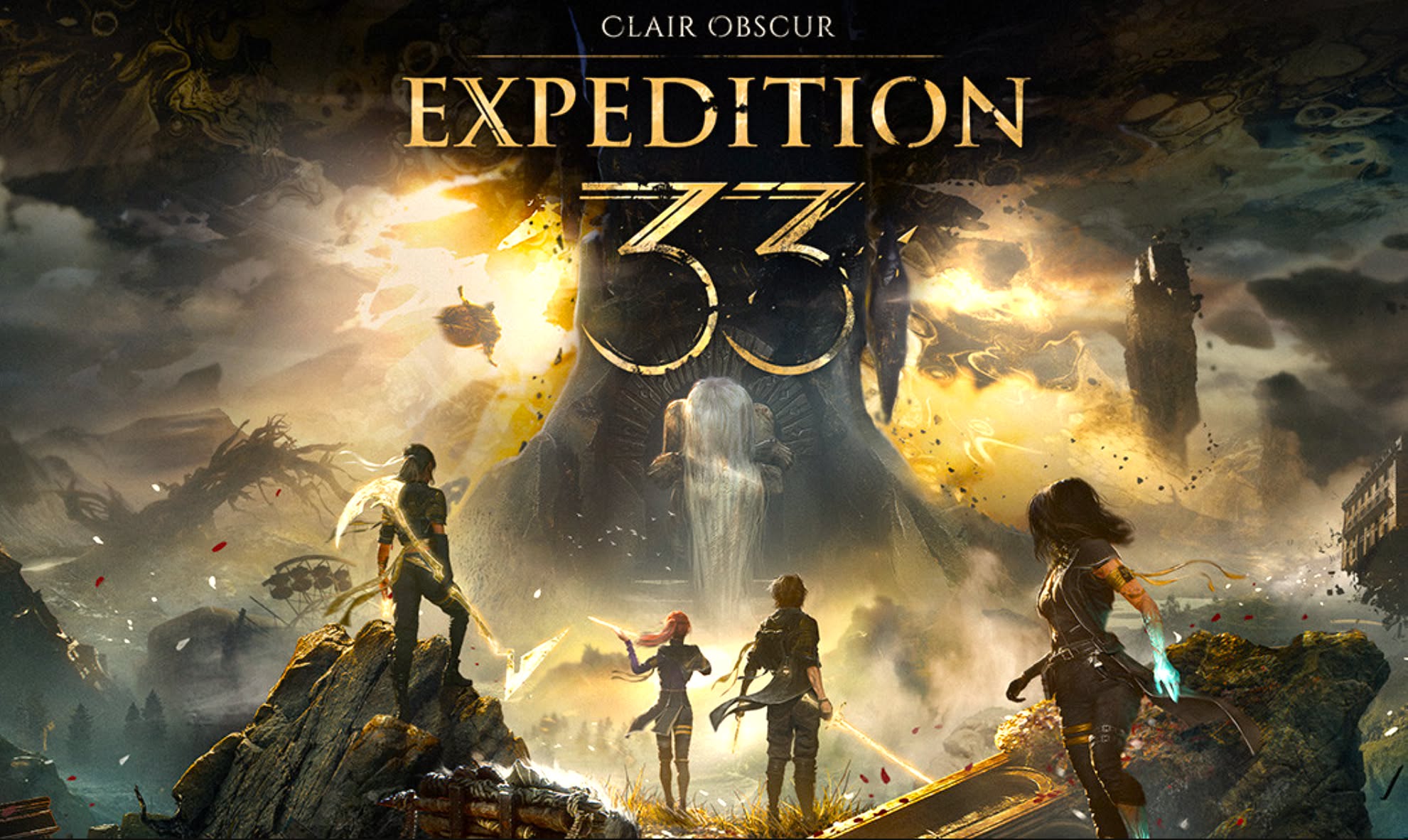 Clair Obscur Expedition 33, developed Sandfall Interactive and published by Kepler Interactive April 24, 2025
So… if you are an enthusiast of single player RPGs and have not spent any time thoroughly engrossed in this modern masterpiece, you’re either buried under a pile of rubble or not allowing yourself enough time for brilliant escapism.
In either case, you’re missing out on what was unequivocally the 2025 GOTY.
I’ll work up a proper review at some point but am simply too busy playing this stunning piece of interactive art with all of my spare time to do so now.
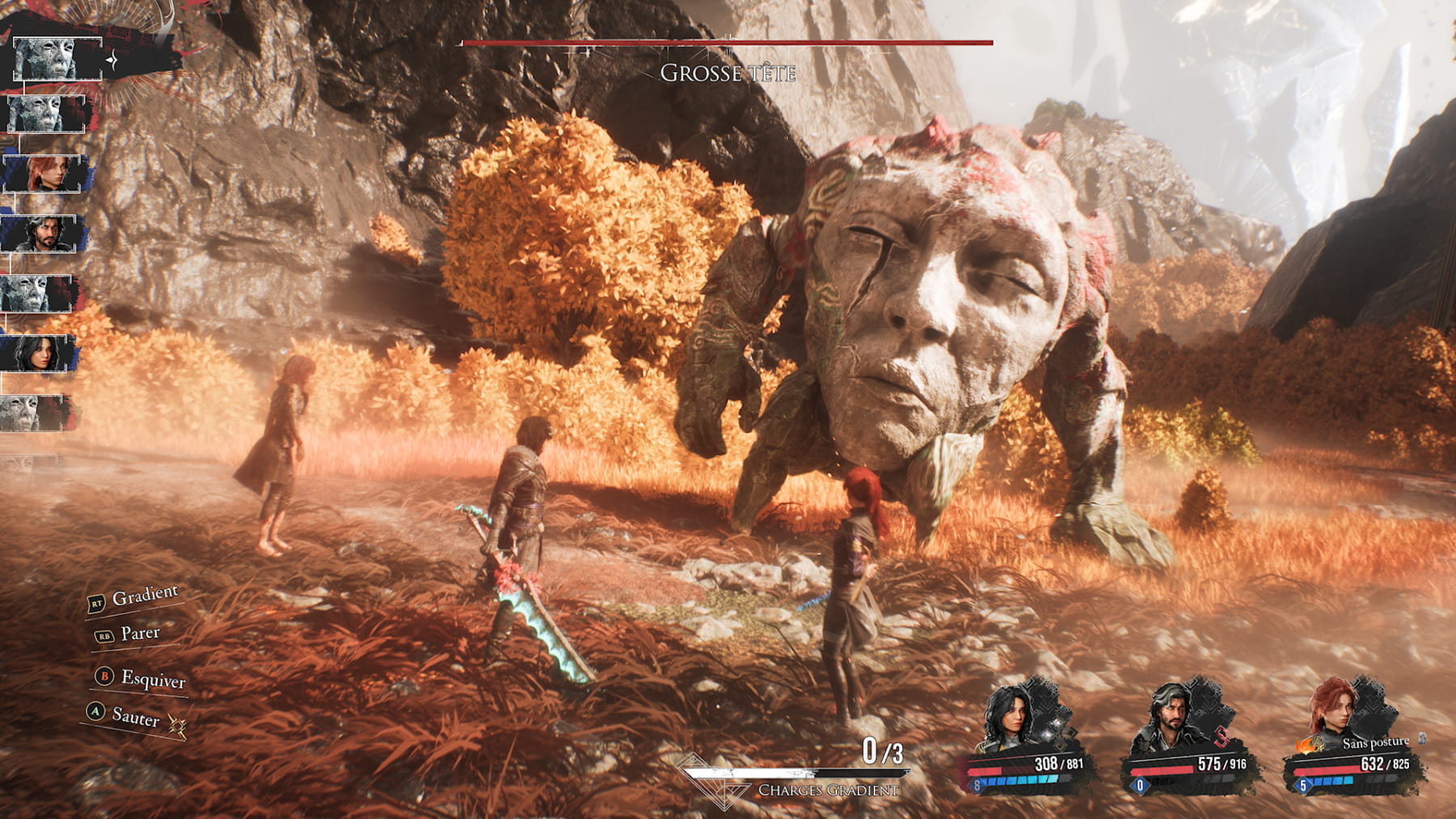 Fighting the giant head in Clair Obscur: Expedition 33
My very short take, aside from the above, is that this is essentially the game that Square Enix has been wishing they could have produced over the last two decades. I truly do not remember the last time I played a game that checked every box I have on my list of desired qualities after a lifetime of video games.
Fresh, engaging mechanics, sumptuous visuals, deeply developed world-building, top shelf voice acting, brilliant writing with staggering emotional depth, and the most phenomenal score since Final Fantasy VII.
All from a tiny French studio with barely more than 30 team members, most of whom are Ubisoft refugees.
Buy it, play it, support Sandfall Interactive. But even if they never produce another game again, their debut masterwork will prove to be an enduring legacy in the field for decades to come.
Joshua Dinges’s last game review for Black Gate was Return of the Obra Dinn.
Categories: Fantasy Books
6 Nautical Novels Drowning In Suspense
Nautical Novels – All Aboard for Danger on the High Seas! Search on Bookshop.org One-Way,…
The post 6 Nautical Novels Drowning In Suspense appeared first on LitStack.
Categories: Fantasy Books
Comment on Still Waiting by Benedict
In reply to Sean.
My current guess is about 10.
Categories: Authors
Comment on Still Waiting by Sean
How many books are anticipated for this series?
Categories: Authors
STARTER VILLAIN by John Scalzi
I’ve often said that writing humour (sorry, American readers: ‘humor’) is HARD. The difficulty is, as I understand it, that writing humour means that it doesn’t come across in the same way as a spoken one-liner. Perhaps more problematical is that a person’s sense of humour is not the same as another’s. What can seem…
Categories: Fantasy Books
Maybe this is an odd question but is Kit able to safely consume faerie fruit?
He doesn't know . . . yet.
Categories: Authors
Women in SF&F Month: Elaine Ho
Today’s Women in SF&F Month guest is artist and author Elaine Ho! Her illustrations, which can be found on her website and Instagram, include “Bones to the Wind” from the eponymous book cover jacket, “Harmony” from the Gen Con 2024 program cover, “Wall of Roses” from Uncanny Magazine Issue 46, and scenes from her debut novel. Her dark political fantasy book released late last year, Cry, Voidbringer, explores “how identity is reshaped under empire” and the question “Why do post-colonial […]
The post Women in SF&F Month: Elaine Ho first appeared on Fantasy Cafe.
Categories: Fantasy Books
An Accurate Stelka Guide to the Humans of Kair Toren (Character Art Roundup)
You asked for an art roundup guide to the main players of Kair Toren.
We’ve put our best agent on the case. Please don’t tell her any spoilers in the comments.
Unless otherwise specified, all art will be available as bookmarks, vellum inserts, and other goodies in the merch store when it reopens in mid-April.
Happy Friday, and happy (re)reading This Kingdom Will Not Kill Me! If you haven’t grabbed your copy yet, you can find retail links here.
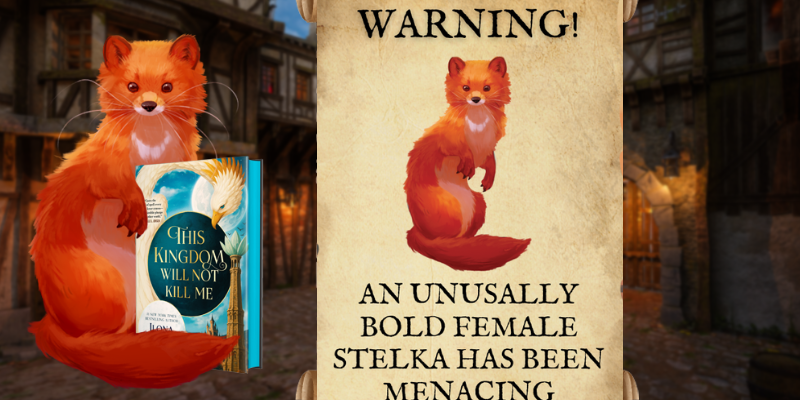
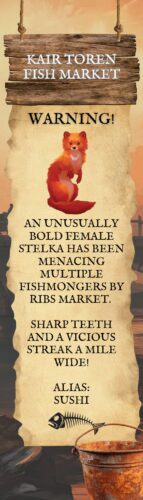 Sushi art by Jenn Munson
I am stelka.
Maggie calls me Soo’sshi.
I know secrets.
Also fish.
The fish men complain. They make signs about me.
This means I am thriving.
You want all the humans in one place. So you can understand them.
I already do.
But I will show you. Watch closely.
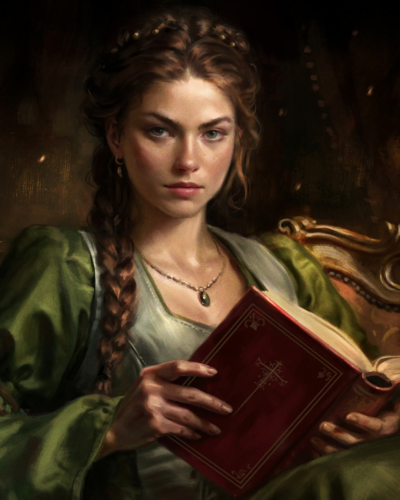 Maggie art by @luisapreissler for OwlCrate special edition
This is Maggie.
She did not wake.
I fixed it.
This one is bright.
I stay. I watch the dark places.
Now she is mine.
She has den. I added fish.
Den is better now.
We keep each other.
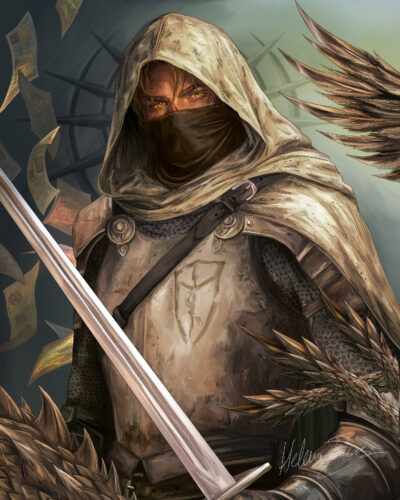
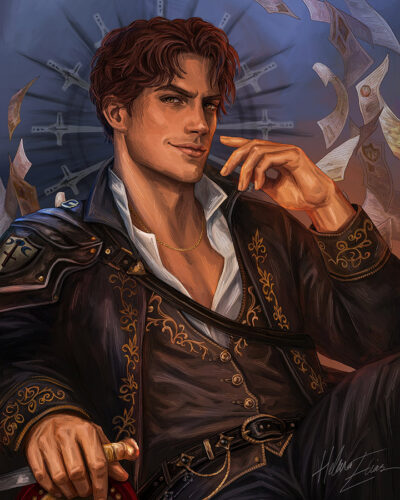 Solentine Dagarra art by @helena.illustrated
Would steal fish.
Sharp teeth inside smile.
This one kills clean.
No mess.
No noise.
Like biting the back of the neck.
Hands smell like metal and endings.
I would sit close.
But not that close.
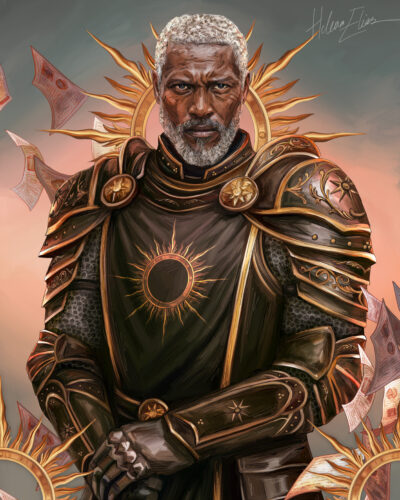 Sun Margrave art by @helena.illustrated
This one stands.
Like stone that remembers.
Keeps pack from tearing one another apart.
Does not bend.
Does not break.
Teeth stop here.
If gone –
too much blood.
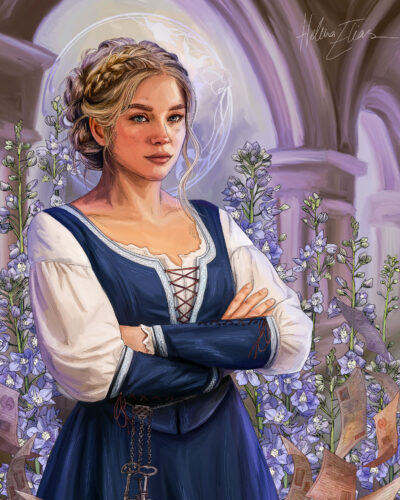 Clover art by @helena.illustrated
This one runs the den.
Counts. Fixes. Decides.
No teeth.
But all things move when she moves.
Even the tall dangerous ones.
She lives where food is.
Calls me vermin. I hiss.
Keeps everything in place.
 Man from the Garden art by @helena.illustrated
Human from garden.
This one is quiet danger.
Like a hunter who already chose.
I do not like being chosen.
Pretty. Not safe.
Watching.
Would not nap near.
Would not share fish.
Would not bite first. Maybe second.
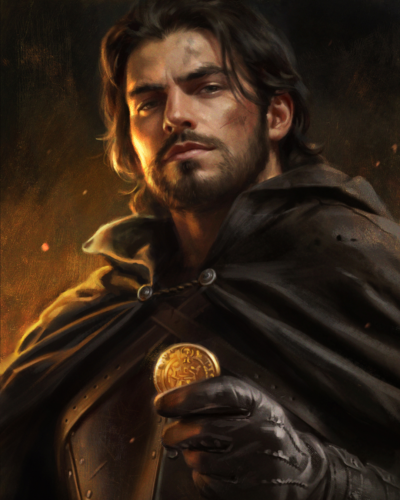 Sleepless Duke art by @luisapreissler for OwlCrate special edition
Humans should be simple.
This one is not.
He feels like story.
Stories bite.
This one is above hunters.
Above teeth.
This one is storm.
He burns bright.
Many fish. Many hiding places.
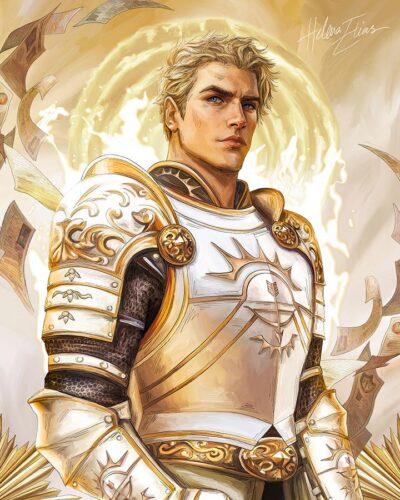 Doran Arvel art by @helena.illustrated
This one shines.
Like fresh meat in the sun.
Wants to be watched.
Always watches too.
Mostly Maggie.
Teeth still sharp.
Like trap.
I stole his fish. I go where I want.
Tasted like flowers.
For a better Stelka-to-human translation and a tour of Kair Toren locations (including the full map of the Kingdom of Rellas) you can revisit Ilona’s kingdom art reveal post here.
The post An Accurate Stelka Guide to the Humans of Kair Toren (Character Art Roundup) first appeared on ILONA ANDREWS.
Categories: Authors
Forgotten Authors: P. Schuyler Miller
 P. Schuyler Miller
Peter Schuyler Miller was born on February 21, 1912 in Troy, New York. He earned a Master of Science from Union College and worked as a technical writer for General Electric and the Fisher Scientific Company.
Miller had a lifelong interest in archaeology and was a member of the New York State Archaeological Association.
His first published short story “The Red Plague,” appeared in the July 1930 issue of Wonder Stories. Based on the cover of the magazine’s January issue, it was the first winner of a contest Wonder Stories ran, earning Miller publication and $150. Sam Moskowitz described the story as “more of a well-written plot synopsis for a novel than a short story.”
Miller participated in multiple collaborations. In the early 1930s, he wrote two stories with Walter Dennis and Paul McDemott: “The Red Spot of Jupiter” and “The Duel on the Asteroid.” These two stories were the only fiction Dennis and Dermott published, but Dennis was the co-editor, with Raymond A. Palmer, of The Comet, often cited as the first fanzine.
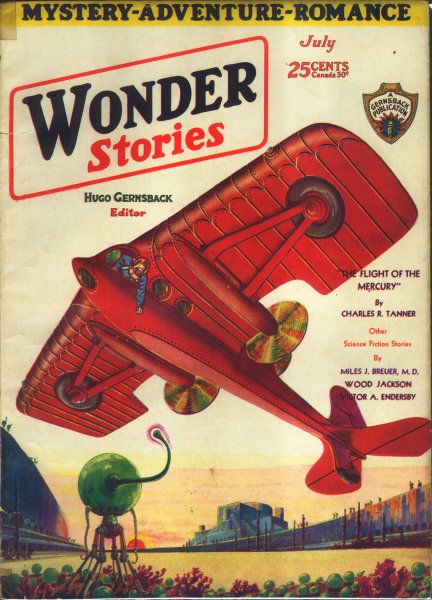 Wonder Stories, July 1930, Cover by Frank R. Paul
In 1934, he took part in the collaborative novel Cosmos, for which he wrote “Chapter 14: The Fate of the Neptunians.” In 1950, he collaborated with L. Sprague de Camp on the 1950 novel Genus Homo, which took advantage of Miller’s interest in archaeology. In late 1933, he began publishing the 11 part serial “Alice in Blunderland” under the pseudonym “Nihil.”
Willy Ley attacked Miller’s 1931 story “Tetrahedra in Space” for its scientific inaccuracies and Miller responded that the physical chemistry described in the story was accurate. Everett F. Bleiler had a low opinion of Miller’s stories in general, suggesting that his 1936 story “The Chrysalis,” published in Astounding was his only story worth reading.
After 1951, Miller became best known for writing reviews for Astounding’s “The Reference Library” until his death om 1974. He had very little fiction output once he began reviewing books. His reviews tended to look for the good in the stories and novels he was reviewing, often including mini essays of this historical and literary context of the works under review. In 1963, he won a Special Hugo Award for his book reviews.
Miller died in Parkersburg, West Virginia on October 13, 1974 while on an archaological tour of the Fort Ancient culture and was buried in the Elmwood Cemetery in Schaghticoke, New York.
His papers formed the bases of the P. Schuyler Miller Memorial Library at the Carnegie Museum in Pittsburgh, Pennsylvania.
 Steven H Silver is a twenty-one-time Hugo Award nominee and was the publisher of the Hugo-nominated fanzine Argentus as well as the editor and publisher of ISFiC Press for eight years. He has also edited books for DAW, NESFA Press, and ZNB. His most recent anthology is Alternate Peace and his novel After Hastings was published in 2020. Steven has chaired the first Midwest Construction, Windycon three times, and the SFWA Nebula Conference numerous times. He was programming chair for Chicon 2000 and Vice Chair of Chicon 7.
Categories: Fantasy Books
Early Review – Platform Decay (The Murderbot Diaries, Book 8) by Martha Wells (4/5 stars)

Reading Level: Adult
Genre: Science Fiction
Length: 256 pages
Publisher: Tor Books
Release Date: May 5, 2026
ASIN: B0FMSC5S4W
Stand Alone or Series: 8th book in The Murderbot Diaries
Source: eGalley from NetGalley for Review
Rating: 4/5 stars
“Having someone else support your bad decision feels kind of good.
After volunteering to run a rescue mission, Murderbot realizes that it will have to spend significant time with a bunch of humans it doesn’t know.
Including human children. Ugh.
This may well call for… eye contact!
(Emotion check: Oh, for f—)”
Series Info/Source: This is 8th book The Murderbot Diaries. I got an eGalley of this from NetGalley to review.
Thoughts: The last book in the Murderbot Diaries was published in Nov of 2023, so it’s been quite awhile since we’ve seen a new Murderbot book. As a result the beginning of this book, which jumps straight into action, is incredibly confusing. As the story continues, we do get clarification about what is going on, but I was nearly 30% of the way in before I figured out why Murderbot was doing what it was doing and why it was where it was.
The beginning of this book has Murderbot and Three infiltrating a massive rotating space station shaped like a torus, things go sideways when Barish-Estranza troops show up. I was quite sure why Murderbot and Three were infiltrating this space station until much further into the story. You are plopped straight into the action, which was a bit confusing.
Once I got about 40% of the way in, I was fully engaged in the story, understood what Murderbot was doing, and didn’t want to put the story down. However, that first third was pretty clunky and confusing. If you are going to take years between publishing books in a series, you have to give at least a few sentences of recap at the beginning. Not all readers go back and re-read the whole series before the next book or even have access to the previous books in the series.
I enjoyed Murderbot’s normal sardonic comments and also enjoyed the new “emotion check” functions. I didn’t feel like Murderbot grew much as a character in this book. This story felt very much like filler to me and was a bit disappointing. I didn’t feel like it progressed Preservation’s story much or really progressed any larger storyline at all. It was a very compact and separate story from the rest of the series. Additionally, the way the book wrapped up was incredibly abrupt. I was left feeling like, uh, okay I guess the book’s done then.
I would love to feel like that is a broader story arc here that is making progress, but at this point, I think we are just reading about instances in Murderbot’s existence. Which is fine, I guess. I just really loved where some of the previous books were going, and this feels so much like filler to me.
My Summary (4/5): Overall I enjoyed revisiting Murderbot and this world. I was disappointed at how confusing the first part of the book was and at how abruptly the story ended. The second half was action-packed, and the book was very hard to put down for that portion. All of this left me a bit confused about how to rate this book. The first part 3 stars, the middle to end portion 5 stars, then the end 3 stars…so I settled on 4 stars. I will definitely continue to read this series but feel like this book wasn’t as good as come of the previous books.

Categories: Fantasy Books
OUT NOW – Hour of the Wolf (Schooled in Magic 29)
Emily has failed.
The world she knows is gone. The multiverse itself is becoming a playground of a mad god, a once-human monster so powerful that reality itself is breaking under his gaze and all timelines are collapsing into one. Existence as we know it is over. If the mad god is not stopped, the multiverse will simply cease to be. But how can one kill a god?
Spilt in two, trapped in her worst nightmare and frozen in a single moment of time, Emily is reality’s only hope. But as she hops from timeline to timeline, meeting strangers wearing familiar faces and travelling across worlds very different to the one she knows in a desperate bid to gather the knowledge and resources she needs to stop a god, she is pursued by a creature out of myth …
And a nightmare that has walked beside her from her very first day of magic.
Download a FREE SAMPLE, then purchase from Amazon US, UK, CAN, AUS or Draft2Digital

Categories: Authors
A Curious Amalgam: Joan and Peter by H.G. Wells
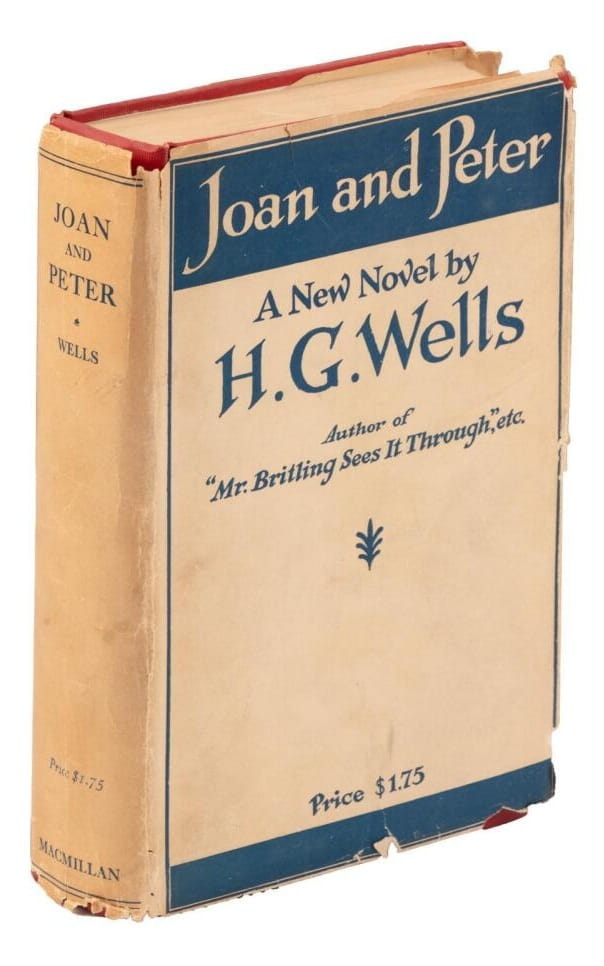 Joan and Peter by H.G. Wells (Macmillian, first American edition, 1918)
Science fiction fans naturally know H.G. Wells best for his scientific romances. But after 1905, he wrote relatively little in that genre. Instead, he turned his efforts variously to the Fabian Society, Britain’s indigenous socialist movement; to surveys of human knowledge for general audiences, in the style later followed by Isaac Asimov (I read my grandmother’s copy of The Outline of History, and I still have the four volumes of The Science of Life); and to realistic novels, starting with Love and Mr. Lewisham in 1900.
Joan and Peter is a curious amalgam of these interests — a realistic novel about changing class relations and cultural attitudes in England, much of whose storyline focuses on the problems of the English educational system as experienced by its title characters. This gives Wells a chance to explain things to his readers, though he’s often fairly good at enlivening the presentation beyond big lumps of exposition.
[Click the images to embiggen.]
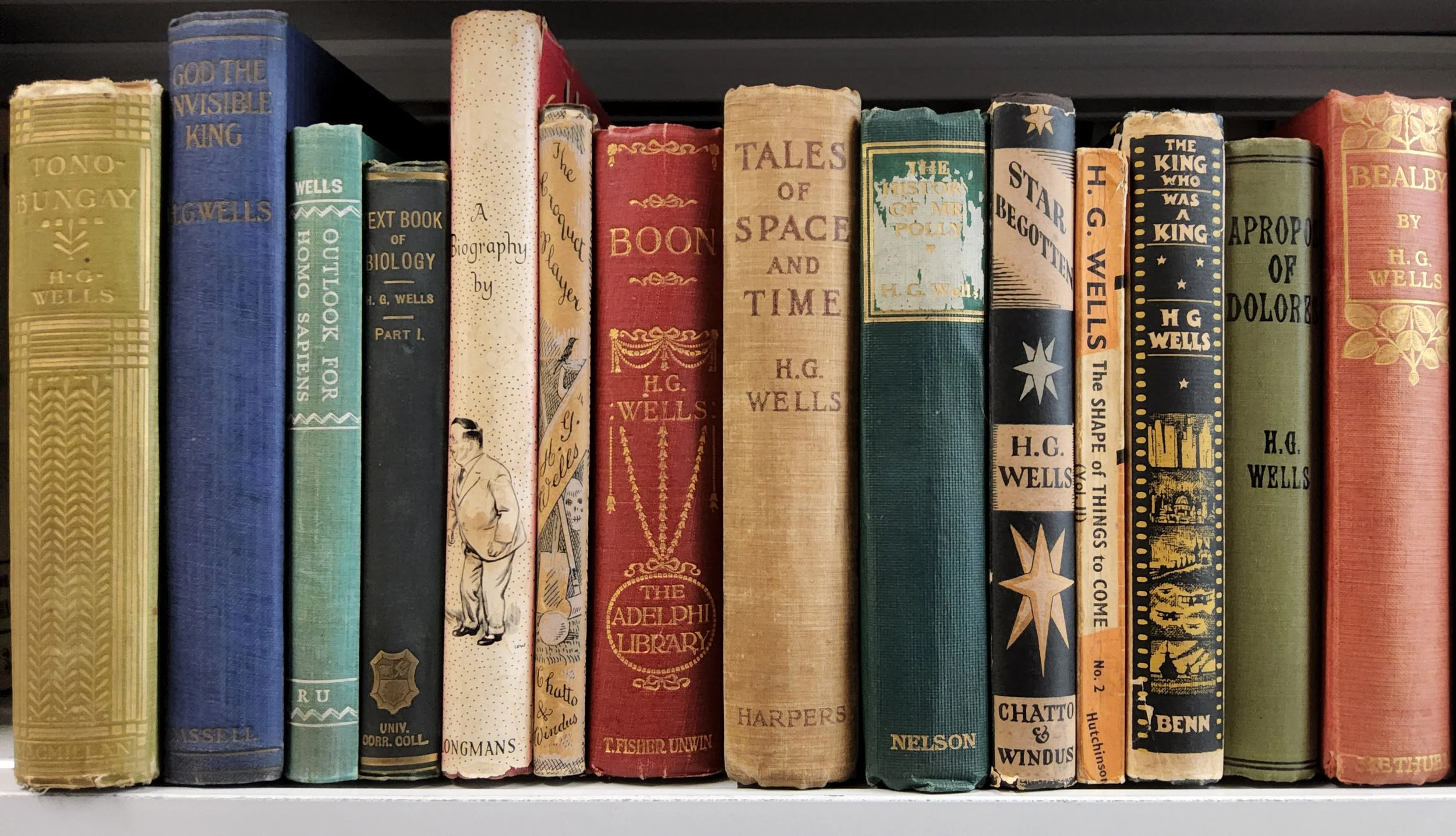 The books of HG Wells
When I say “realistic” here, I mean it in a mostly literary sense: fiction that avoids scientific speculation, marvelous inventions, supernatural powers, and other exotica. Joan and Peter’s characters are human beings living in a human world. However, some of its narrative turns seem to show the influence of older romantic themes.
The foundation for this story is a pair of English families with different origins and qualities. On one hand, the Stublands: Solidly middle class, in the older sense that meant “six hundred a year” and no need to work, thanks to ancestors who made a success in textiles. Ancestrally Quaker, they drifted over time among various non-established churches, and by the start of the novel, they’re spiritual without being religious, and many of them are artistic. On the other hand, the Sydenhams: County people, generally conservative, and prolific enough to have little money for their younger generation.
Dolly Sydenham, a vicar’s daughter, has a deep attachment to her cousin Oswald — but loses track of it temporarily in the excitement of meeting Arthur Stubland (“whom everyone called Stubbo,” Wells says, but in fact the nickname is used only half a dozen times, all in the first chapter). Arthur and Dolly marry and have a son, Peter. A couple of years later Dolly’s brother, an alcoholic reactionary journalist, dies and leaves her to care for his bastard daughter Joan.
And that gives us our core cast. This kind of family tableau seems exactly the sort of thing English novelists favored as a setup, though Wells may have been a little hasty with his: I tried to draw family trees and couldn’t make either the Stublands or the Sydenhams entirely consistent on the basis of Wells’s statements.
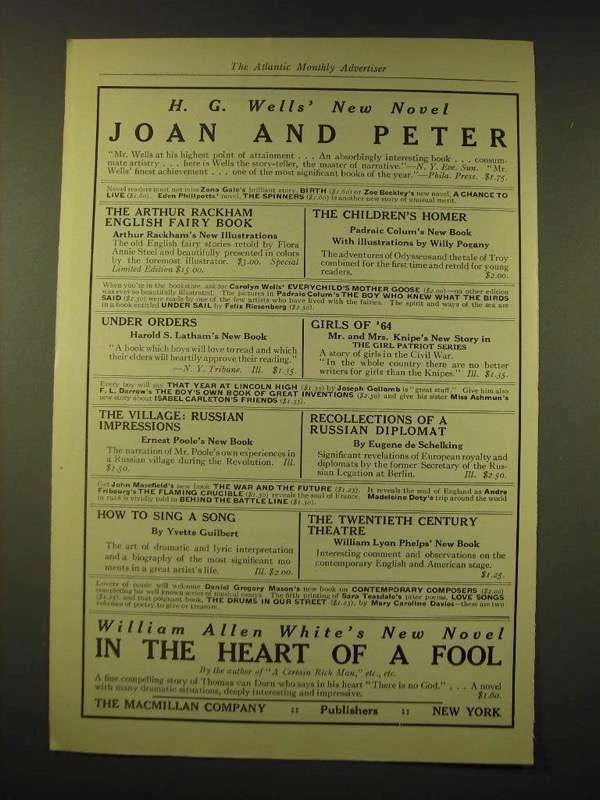 1918 Macmillan Company advertisment for Joan and Peter by HG Wells
From this foundation, Joan and Peter develops in three main parts.
In the first part, Peter is born, in a house designed by Arthur (one of only two), and Oswald comes from Africa to visit and, learning that Peter is not to be christened unless he asks to be, offers to be his godfather “pour rire,” and pledge that he shall be taught French, German, mathematics, chemistry, and biology and that he shall renounce the Devil and all his works. After he departs, Arthur and Dolly have a bicycling accident and consider who would become Peter’s guardian if they were both killed; after a little while Arthur thinks of Oswald.
A few years later, Oswald comes for another visit, after Joan has become part of the household. By this time, Arthur has been unfaithful to Dolly, “on principle,” Wells says, and goes on to hint at the affair to Dolly (a century later he would have said “polyamory”), who reacts very unhappily and indeed is tempted to return Oswald’s previously unconfessed love for her, perhaps even to go to Africa with him. Finally Dolly and Arthur are dramatically reconciled, and go on a trip to Italy, while Arthur’s sisters Phoebe and Phyllis move in to look after the children. During the trip they both drown in the waters off Capri.
By this point, it’s clear that Oswald is Wells’s real hero, and he has the right attributes for one: Enlisted young in the Navy, he receives the Victoria Cross at twenty for courage in battle — a battle that blinds one eye and scars half his face. No longer able to serve in the Navy, he eventually ends up in Nyasaland as a British agent, with the idea of serving humanity and the British Empire, suppressing slavery and despotic local rulers, but also with the idea that civilization is essentially an educational enterprise.
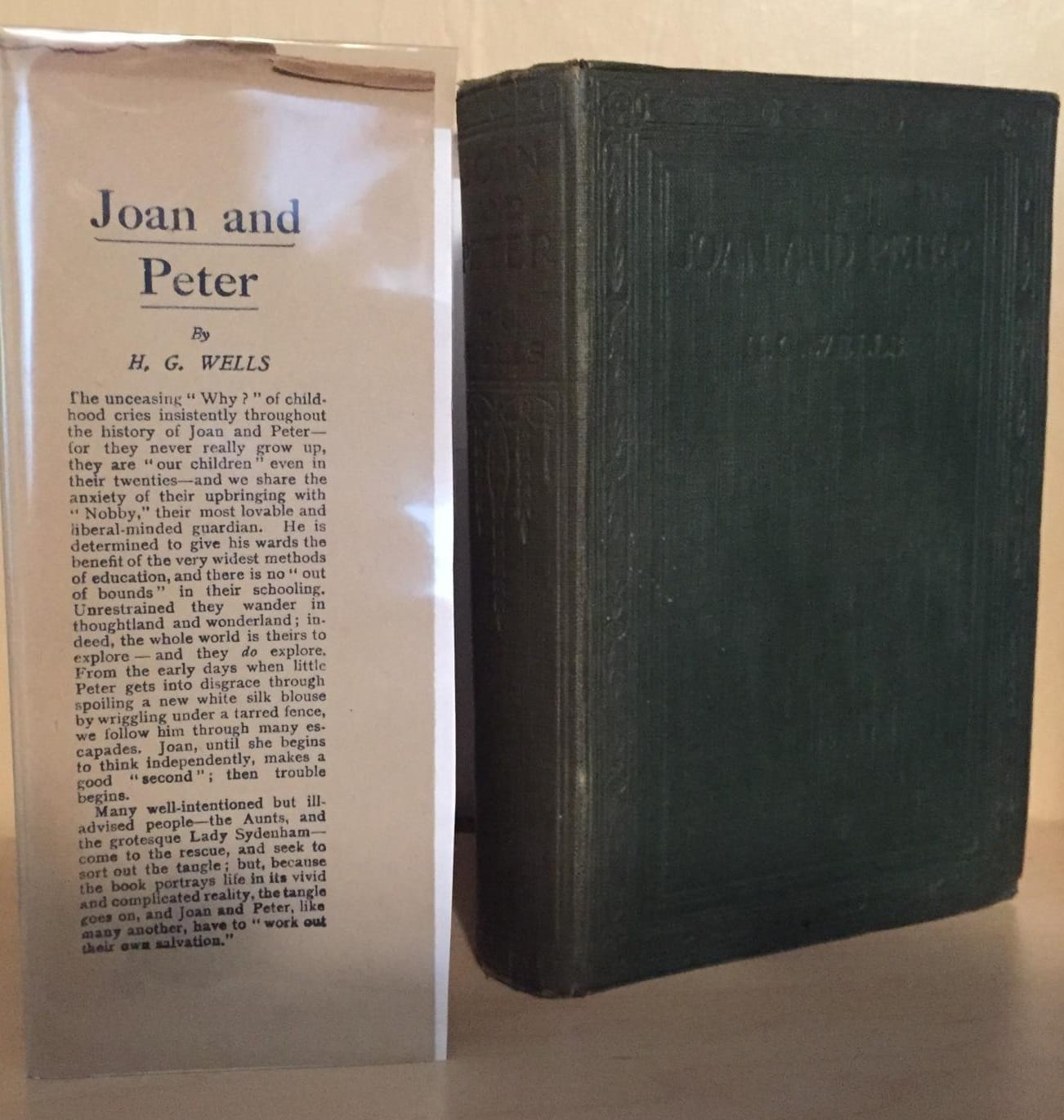 Joan and Peter inside flap (Cassell, 1918)
All of this actually makes Wells sounds more Kiplingesque than he’s often thought of as being. On his second visit to England, Peter gives him the nickname “Nobby,” after his favorite toy, a Dutch doll half of whose face was smashed off while Peter was playing with him and then painted black; the two of them fuse into a central figure in Peter’s private mythology. It’s as that myth that he appears in the second part.
All of that part’s complications derive from Arthur’s will, as he revised it before the trip to Italy — without telling Dolly! He appoints his two sisters as joint guardians with Oswald, and then, not wanting Oswald outvoted all the time, he adds Oswald’s aunt by marriage, Lady Charlotte, a wealthy and conservative widow, “one of those large, ignorant, ruthless, low-church, wealthy, and well-born ladies who did so much to make England what it was in the days before the Great War.”
This leads to a long series of conflicts over Joan and Peter’s upbringing, their schooling, and their religious instruction, carried out partly through solicitors, and eventually by Lady Charlotte’s agents taking Joan and Peter from their school to dispose of them more suitably (as Lady Charlotte sees it), when Peter has reached the age of ten.
At this point, Oswald comes back to England, for two reasons: first, he’s been warned that if he stays in Africa, blackwater fever will kill him; second, witnesses have been found to Arthur and Dolly’s deaths, and while the courts normally assume that the woman will drown first, being “the weaker vessel,” their testimony shows that Dolly went on swimming long after Arthur sank — so her will prevails, and Oswald is the only guardian after all.
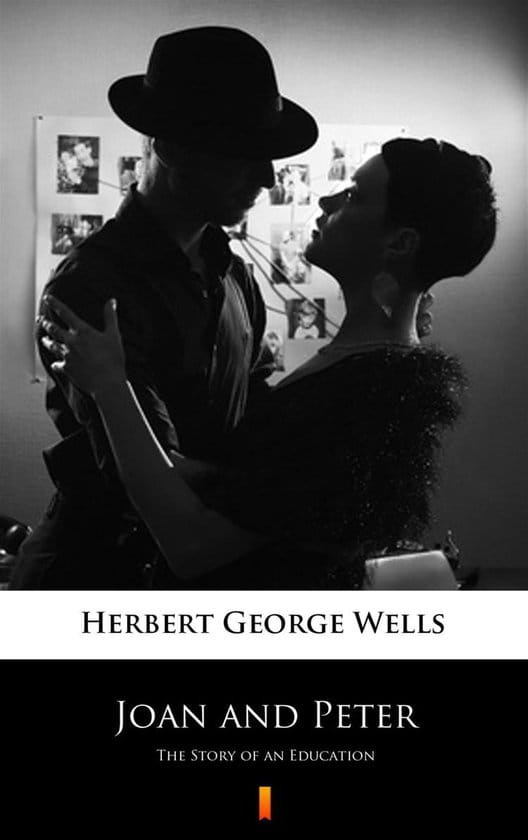 Joan and Peter paperback edition
The third part then jumps forward a decade, to when Peter and Joan are nearing majority, though with flashbacks to Oswald’s arrangements for their schooling. They get caught up in the Great War, and also in sexual passions — and Joan learns that Peter isn’t her brother, or even her half brother, but her first cousin, whom she can think of marrying, while Oswald puzzles over what a mess his wards are making of the whole matter.
On one hand, for American readers, these attachments of cousins may seem peculiar and even creepy: Oswald and Dolly are first cousins, and so are Peter and Joan, and there’s even a scene of unspoken romantic attraction between Oswald and Joan, who’s his first cousin once removed and thirty-two years younger. Wells treats it as a matter of course, though, and American writers once did so: Louisa May Alcott’s Rose Campbell (in Eight Cousins and Rose in Bloom) never even considers a suitor who’s not one of her male first cousins.
On another, having been raised together, and even thought each other to be half-siblings since infancy, Joan and Peter may not be a plausible romantic couple, and making them so may owe more to romantic poets like Shelley than to actual observation. The Westermarck effect had been recognized about when Wells began writing fiction. I also noticed several scenes of same-sex attraction; it’s visible that Wells makes male–male attraction much more disturbing than female–female.
But all of this is something of a side issue to Wells’s real plot, which is didactic. Key scenes involve his characters encountering the peculiarities of a sample of schools of various English types.
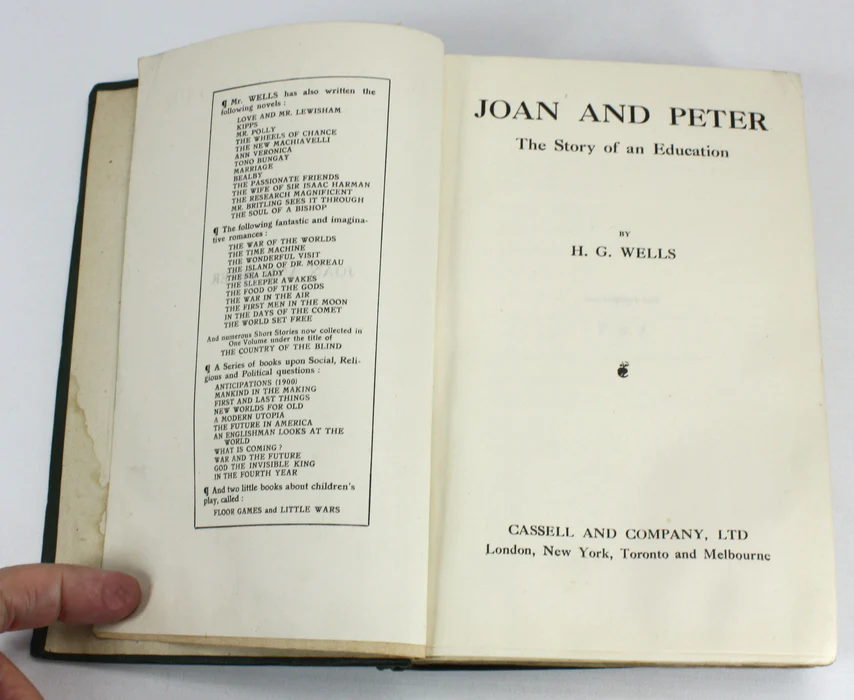 Joan and Peter: The Story of an Education (Cassell, 1918)
The School of St. George and the Venerable Bede, which Joan and Peter both attend from early childhood, has what we might now call a New Age flavor: children wear robes called djibbahs, and the curriculum is rather freeform and experimental, with artistic activities such as performing A Midsummer Night’s Dream. Wells makes a point of reading being taught by the “look–say” method and arithmetic by a process that emphasizes understanding rather than memorization, much like New Math or current approaches to mathematics — unfortunately the young woman who teaches arithmetic is a little confused about some of it. (These were things I thought came in after World War II, and maybe they did — in the United States.)
High Cross School is a much more traditional school, with a headmaster who was good at sports and never really mastered the classical languages he mainly teaches. After being harassed by other boys and caned by the headmaster (for not answering to the headmaster’s newly invented nickname for him) Peter runs away and finds his way home (and one of the boys sent out to search for him expresses extravagant, sentimental grief when it appears that he drowned). Peter calls on the name of “Nobby” during the caning and fantasizes about him while running away. Joan, in the meantime, isn’t sent to school at all; as a bastard she’s thought best suited to domestic service — and then she catches measles.
After this, Oswald undertakes a long search for better schools, of which we hear most about the ones for boys. Peter ends up at Caxton, a fairly progressive school for boys, and Joan at Highmorton, a school for girls run by suffragettes. And during this phase Wells gives us a passage where the headmaster of a preparatory school that readies Peter for Caxton bemoans the limits placed on him by parents’ demands for the standard sort of education.
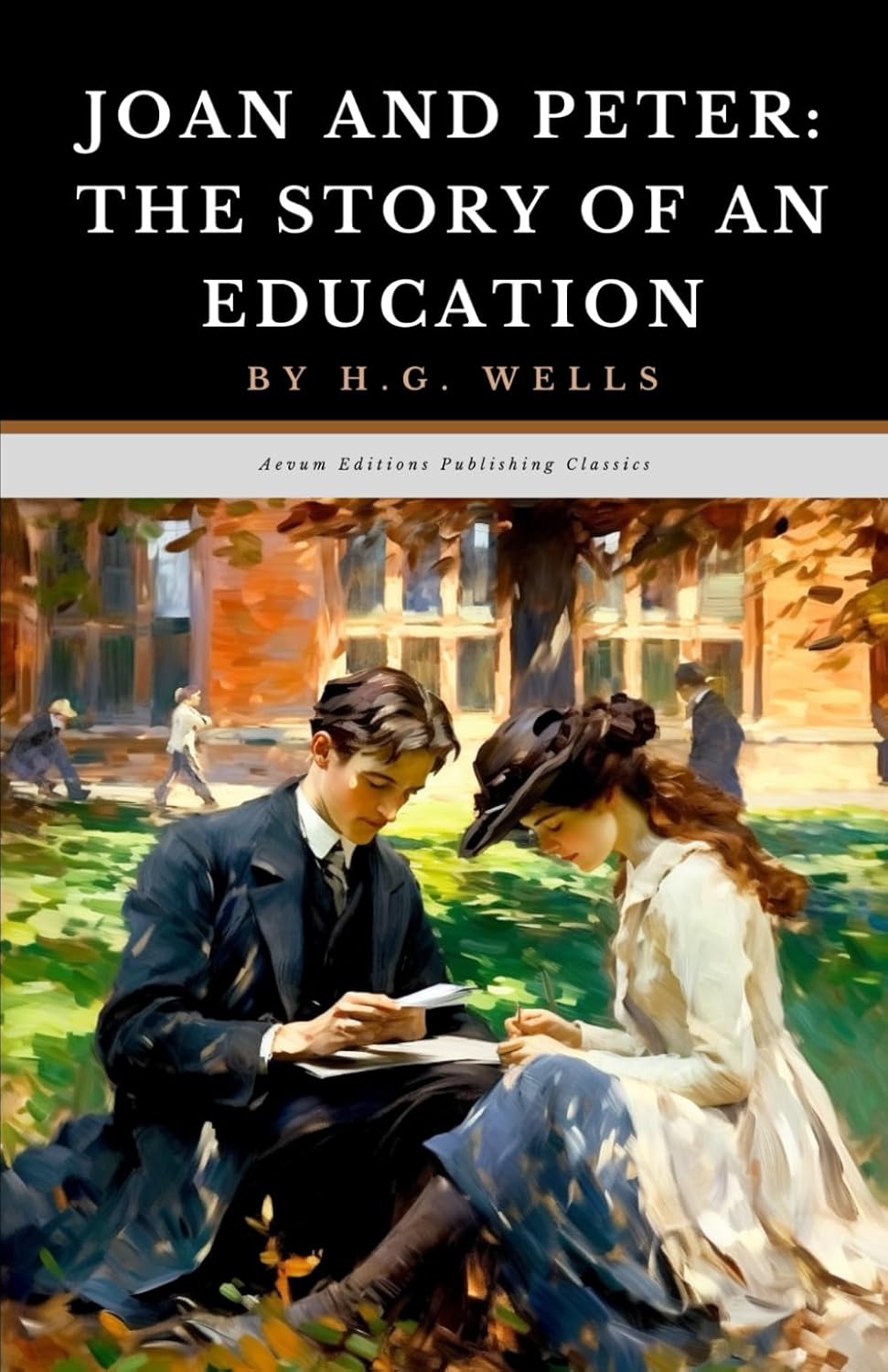
Joan and Peter The Story of an Education (Aevum Editions Publishing, December 30, 2023)
Behind all this is a clash of philosophies of education, presented in a conversation during Peter’s infancy: Arthur and Dr. Fremisson, the family doctor, are all for a natural childhood, in the spirit of Rousseau or William Morris, but Oswald thinks that human planning can improve nature considerably. This leads to a debate over whether plowed fields are artificial or natural:
“I’d like to know just what does belong to the natural life of man and what is artificial,” said Oswald. “If a ploughed field belongs then a plough belongs. And if a plough belongs a foundry belongs — and a coal mine. And you wouldn’t plough in bare feet — not in those Weald Clays down there? You want good stout boots for those. And you’d let your ploughman read at least a calendar? Boots and books come in, you see.”
“You’re a perfect lawyer, Mr. Sydenham,” said the doctor, and pretended the discussion had become fanciful…
The whole thing was remarkably like a Heinlein character’s rant about technophobes! Wells really was an ancestor to classic science fiction.
In a charmingly comedic scene, Arthur tries to get the children to build cooperatively with toy bricks, following Kropotkin’s theories, only to be frustrated by each one wanting to do the whole job: “Dadda not put any more bricks. No. Peter finish it.” The housemaid, Mary — a socially enlightened household has to have at least one servant, who actually spends more time with the children than either parent — finds it simpler to draw a line across the floor and give each child half the bricks, letting them play side by side. (Mary quietly vanishes from the story sometime after Oswald’s return.)
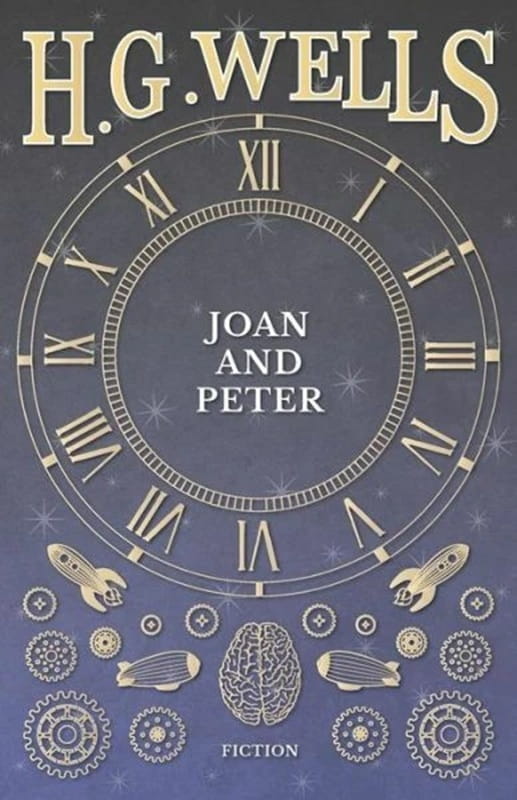 Joan and Peter trade paperback edition (Read Books, 2008)
A final chapter has Oswald setting out to give Joan and Peter a valediction, an apology for his own life and what he’s made of it, and a philosophy of education. But he doesn’t get to deliver much of what he’s lain awake rehearsing; no sooner does he ask his rhetorical introductory question, “What is education up to?” than Peter jumps in and offers his own answers. In the end Oswald, sitting in the dark in his study, reflects on his own life, and his feelings for Dolly and Joan, and then gets up to light his reading lamp and go to work.
I suppose literarily this is more plausible, and livelier, than Socrates giving a long speech while his young admirers say, “Yes, Socrates!” but I ended up feeling that it was a little too inconclusive. (And Plato would have explicitly linked erotic attraction to education in a way that Wells hints at but doesn’t quite make clear.) The whole project is a kind of amphibious entity, half a novel and half a tract, and both halves are interesting, but they don’t quite mix.
It had not thitherto occurred to Oswald that his ward had the most beautiful neck and shoulders in the world, or that Joan was as like what Dolly once had been as a wild beast is like a cherished tame one.
William H. Stoddard is a professional copy editor specializing in scholarly and scientific publications. As a secondary career, he has written more than two dozen books for Steve Jackson Games, starting in 2000 with GURPS Steampunk. He lives in Lawrence, Kansas with his wife, their cat (a ginger tabby), and a hundred shelf feet of books, including large amounts of science fiction, fantasy, and graphic novels.
Categories: Fantasy Books
if you could describe ash’s feelings for dru at the start of tlkof in one word – what would it be? <3
Conflicted.
Categories: Authors
Hi Cassie! Just wanted to ask, we know from sobh that Kit and Dru text, but how much do they text each other? Do they text casually every few days, do they obsessively text each other every time something that they think the other would appreciate...
Yes, Kit is not a very reliable texter and does avoid conversations about Ty especially with Ty's sister (unfortunate for him that Livvy can hassle him literally eternally if she feels like it) and when they meet again in TWP they haven't been texting for a while. They are fond of each other, though, in a familyish way.
Categories: Authors
Keep Calm and Maggie On
Happy release day to everyone receiving the Tor UK edition of This Kingdom Will Not Kill Me today!
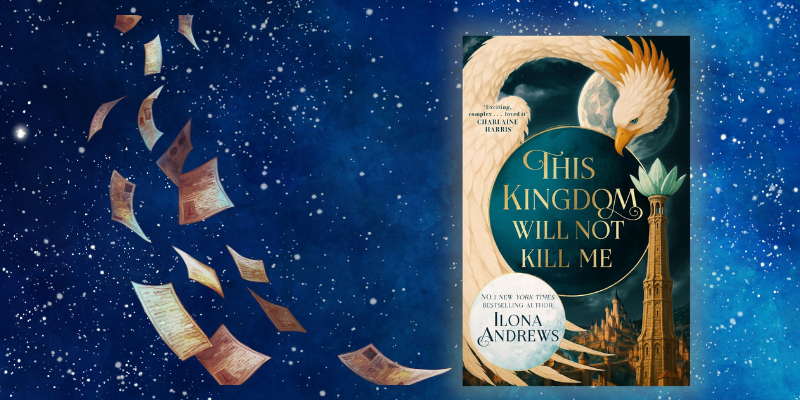
If you want your own copy, here are some of the retailer links:
 WATERSTONES
 Blackwell’s

I know it meant more w*iting for us, and the two extra days were torturous enough to make the stiffest upper lip wobble. But in fairness, we are getting some of the prettiest hardcover edges around:
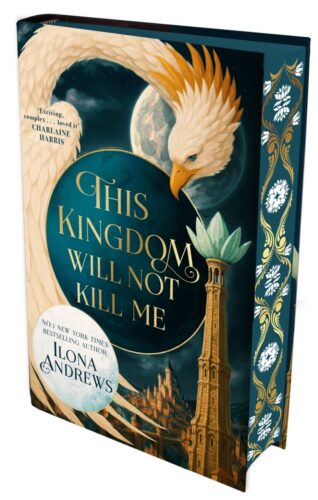 Tor UK hardcover
And there’s even more good news to celebrate: This Kingdom Will Not Kill Me has been named one of Amazon’s Best Science Fiction & Fantasy Books of April, while also holding a strong lead in major categories like Epic Fantasy and Romantic Fantasy.
Huge congratulations to House Andrews on such an outstanding launch and to the Book Devouring Horde for coming out in force to welcome it!
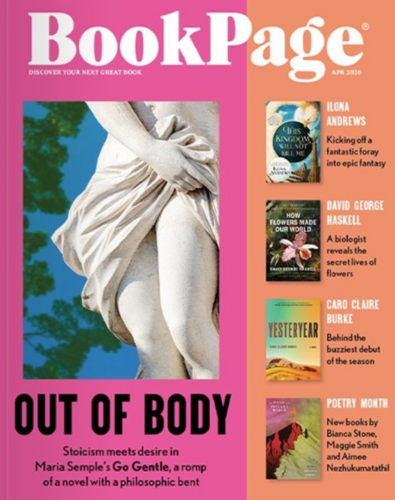
I have lists of all the great questions you shared on the spoiler discussion post and I love how everyone is interacting with the story. While we wait for House Andrews to come back from the signing tour and join the discussion, you can read this interview they did for the April issue of BookPage.
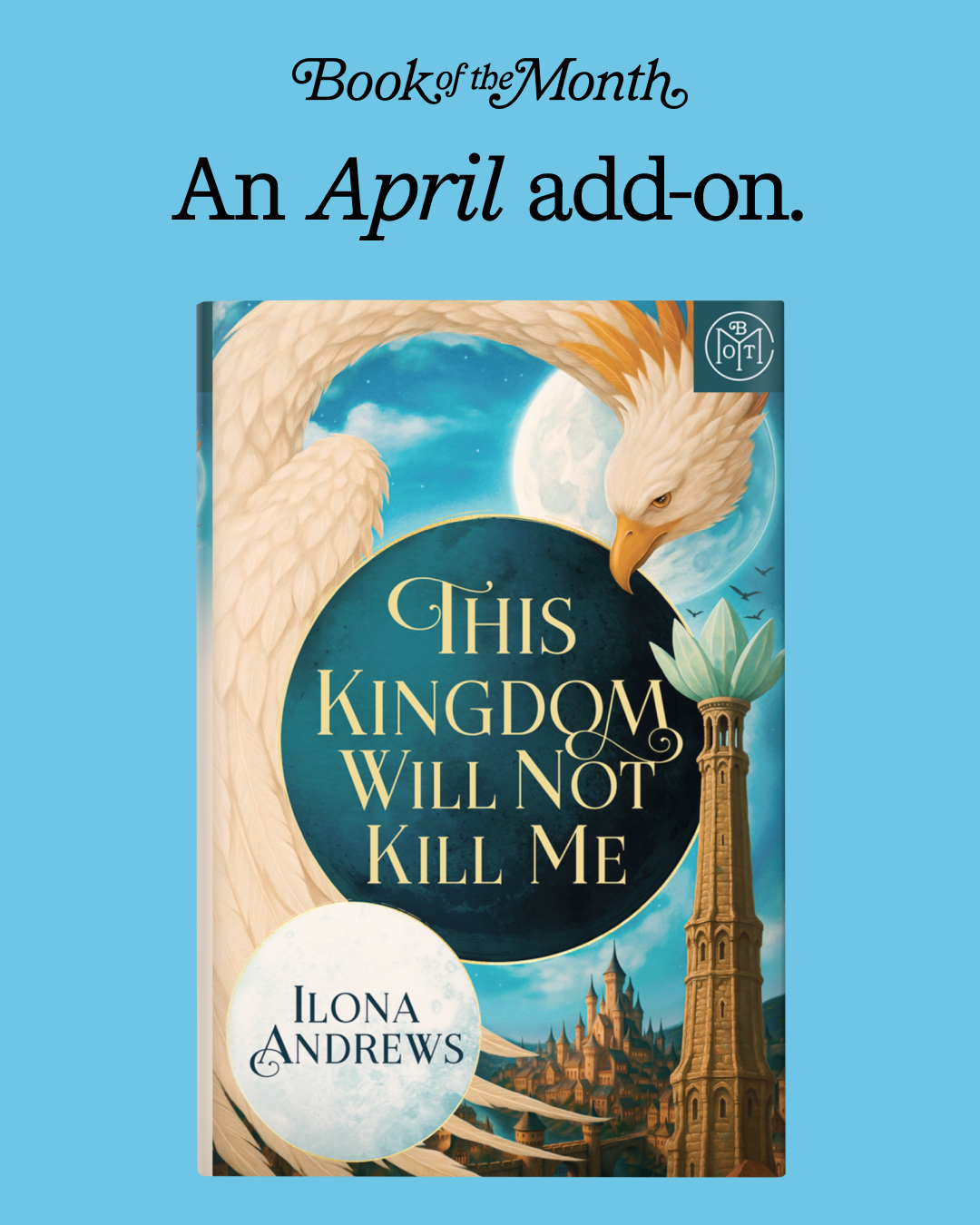
One more hype and I’m done: This Kingdom Will Not Kill Me has also been selected as part of Book of the Month’s April lineup! It’s so exciting to see it included, and we’re grateful to @bookofthemonth for the support.
And now, if you’ll excuse me, I will be heading to my local Waterstones to ever so subtly nudge their copies of This Kingdom to their best, most visible lives on the shelves. Public mod service.
UPDATE FROM THE SIGNING TOUR:House Andrews are signing everywhere they go! In case you didn’t manage to make it to the events, but are in the vicinity, you can still grab your own signed copies:
The Barnes& Noble Arboretum in Austin, Tropes and Trifles in Minnesota, and Joseph Beth in Lexington have numerous signed copies of This Kingdom Will Not Kill Me.
In addition, B&N Austin has signed Hidden Legacy copies.
Tropes and Trifles has signed copies of Beast Business, Inheritance, Sanctuary, and Innkeeper and Hidden Legacy (including the little paperbacks which are being phased out).
The post Keep Calm and Maggie On first appeared on ILONA ANDREWS.
Categories: Authors
Spotlight on “Small Boat” by Vincent Delecroix

LitStack Spots Here are other books we’ve spotted and we’re adding to our TBR list,…
The post Spotlight on “Small Boat” by Vincent Delecroix appeared first on LitStack.
Categories: Fantasy Books
Comment on One-Third by Mike
A wise man once asked a rhetorical question like this: who by worrying can add a single hour to their life?
Excited to read #4 and #5
Categories: Authors
The Imaro Saga by Charles Saunders
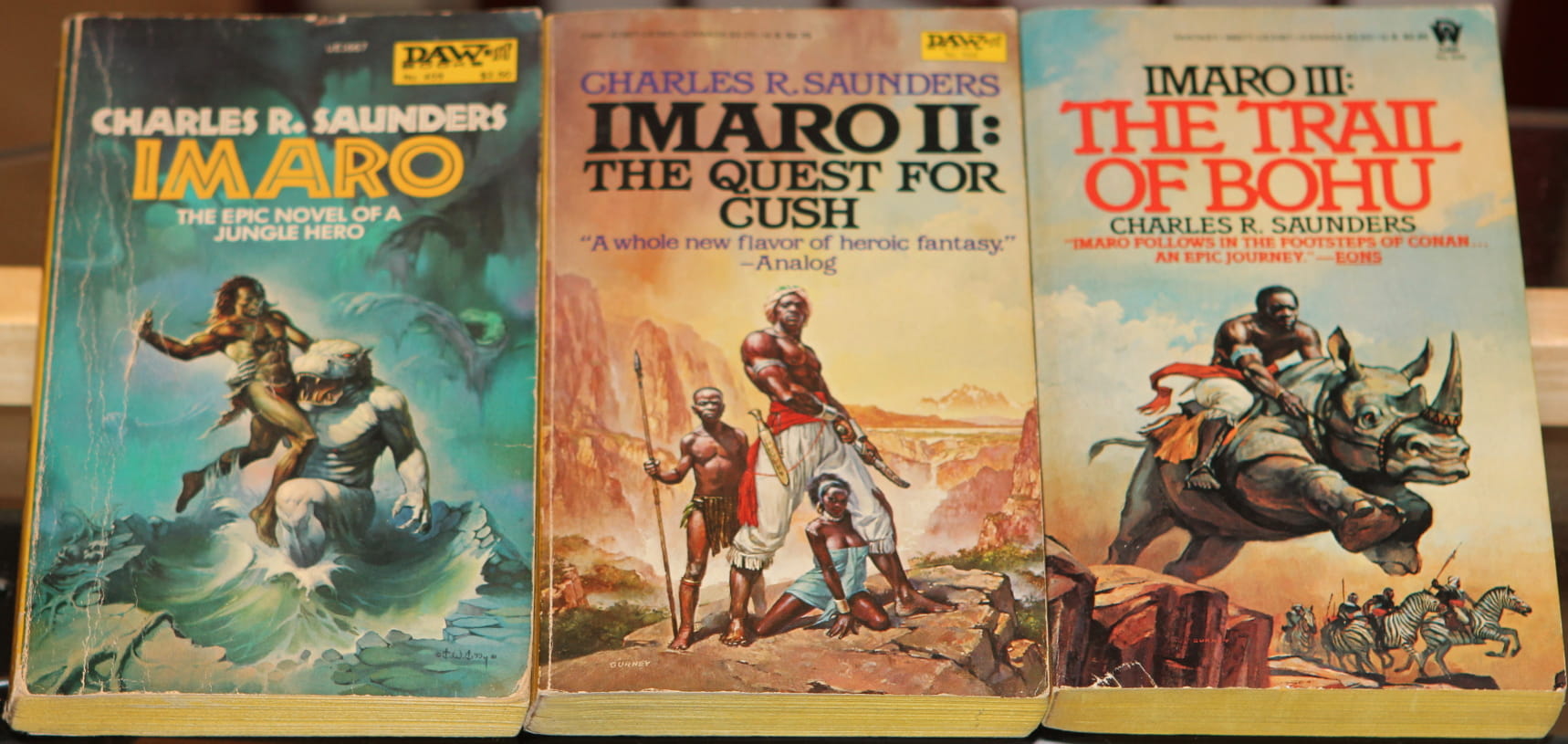 The Imaro trilogy by Charles Saunders, all from DAW Books: Imaro (November 1981), The Quest for Cush (February 1984) and The Trail of Bohu (October 1985). Covers: Ken Kelly and James Gurney
Charles Saunders (1946 – 2020) was one of two men who established a sub-genre of Sword & Sorcery that has come to be called Sword & Soul. The other was Samuel Delany (1942 – ). Saunders was born in the USA but moved to Canada as a conscientious objector after being drafted for Vietnam. He became a journalist and wrote a lot of nonfiction, much of it dealing with the lives of Blacks in Canada.
Around 1974, Saunders created a fictionalized Africa called Nyumbani and began writing S&S stories set there about a hero named Imaro. These were published in a small magazine but the first one was reprinted by Lin Carter in his 1975 edition of Year’s Best Fantasy. By 1981, some of these stories had been connected into novel form and were published as Imaro, by DAW books (Ken Kelly cover). Two more books followed, The Quest for Cush (1984) and The Trail of Bohu (1985), both with excellent and more appropriate-to-the-character covers by James Gurney.
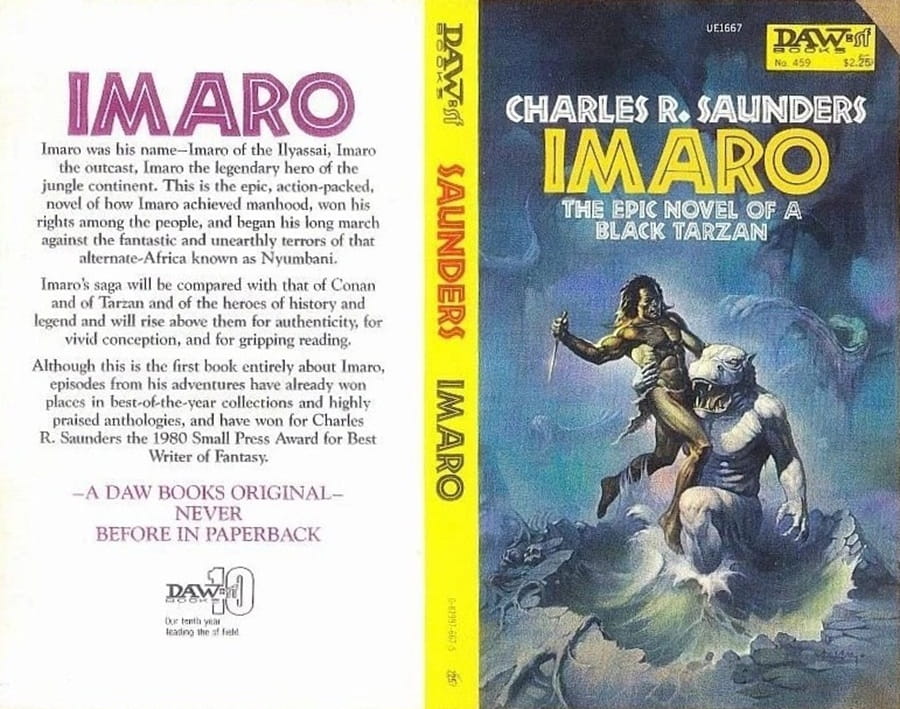 DAW’s original cover for Imaro, with tag line The Epic Novel of a Black Tarzan, withdrawn and reprinted after a complaint from the estate of Edgar Rice Burroughs
DAW didn’t know how to market a black S&S hero like Imaro and initially the character was compared to Tarzan, probably because of the African connection. Imaro, however, is much more Conan than Tarzan, although he is a unique character and no “clonan.” DAW realized their error and made the better connection, quoting on the back of Imaro:
Imaro’s saga will be compared with that of Conan and other heroes of history and legend…
(An aside about this quote: Conan is implied to be a hero of ‘history and legend.’ That’s a little odd.)
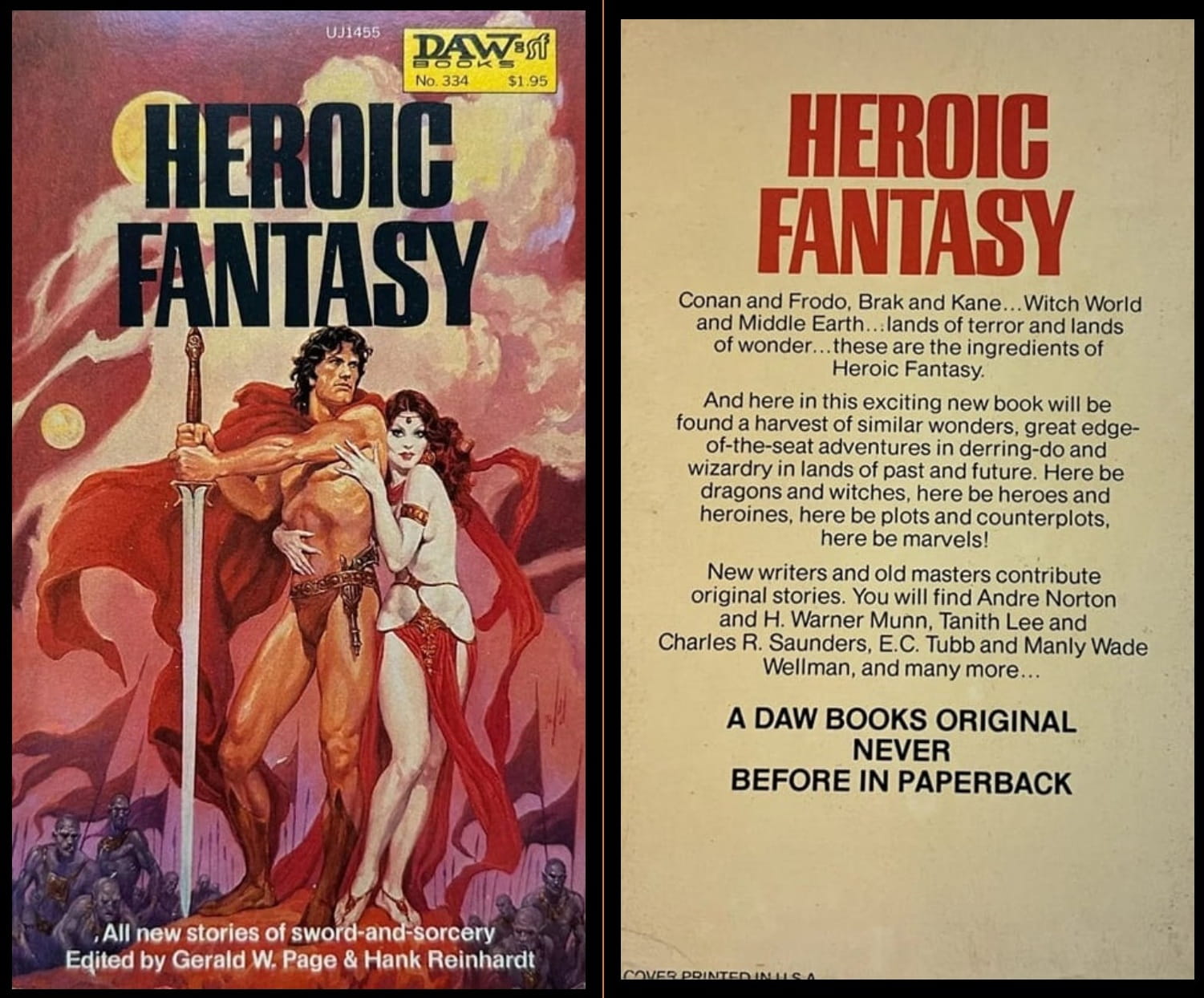 Heroic Fantasy edited by Gerald W. Page & Hank Reinhardt (DAW Books, April 1979). Cover by Jad
Imaro III: The Trail of Bohu has a cover quote:
Imaro follows in the footsteps of Conan
I first discovered Imaro in an anthology I’ve mentioned before called Heroic Fantasy. This led me to the first Imaro novel, although it took a while to find #2 and #3. They make a nice, solid body of work.
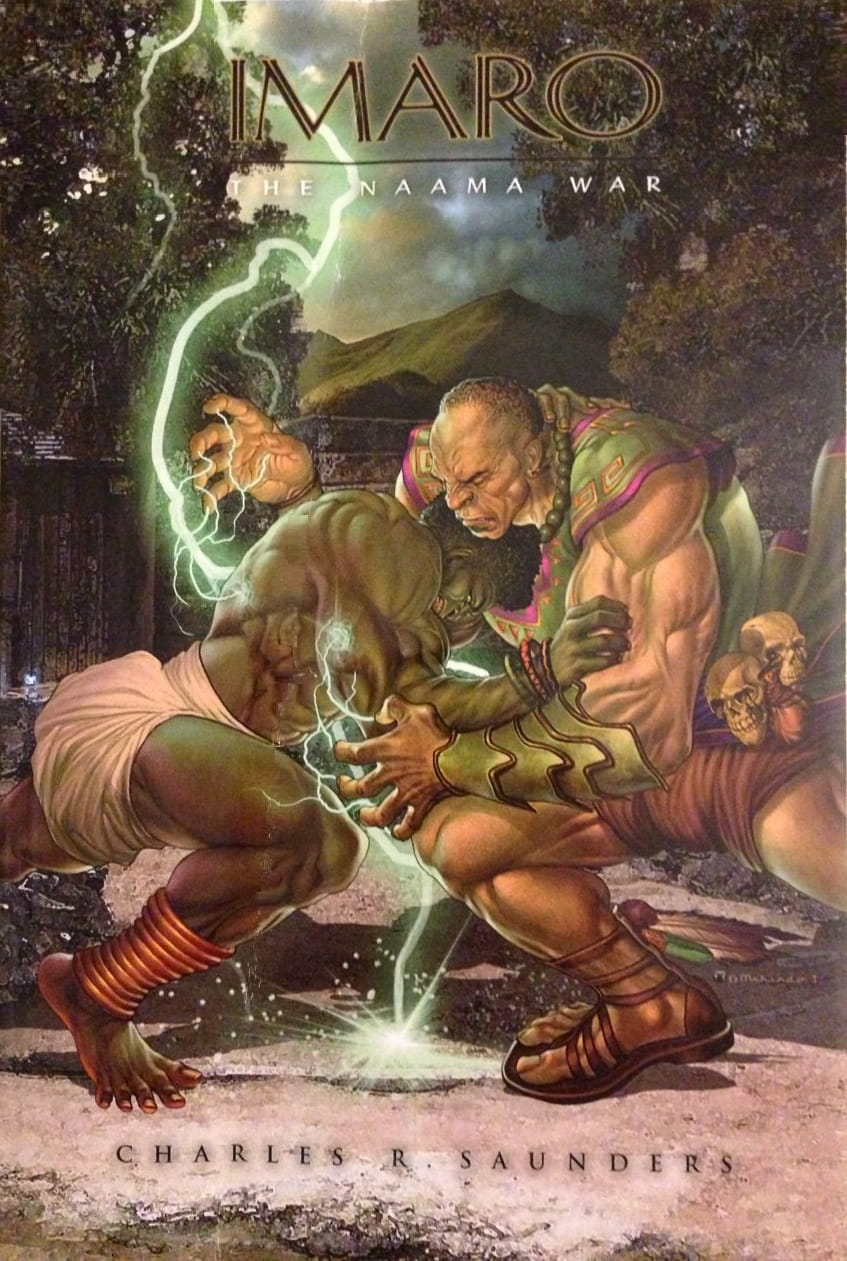 Imaro: The Naama War (Sword and Soul Media, December 29, 2009). Cover by Mshindo Kuumba
In 2009, Saunders self-published a fourth Imaro novel called The Naama War, through Lulu. Unfortunately, I didn’t immediately pull the trigger to buy it and now it’s unavailable. I’ve shown the cover pic by Mshindo Kuumba above.
There’s also a short story collection called Nyumbani Tales set in Imaro’s world (below), but the copies I’ve seen are used ones for nearly 150 bucks.
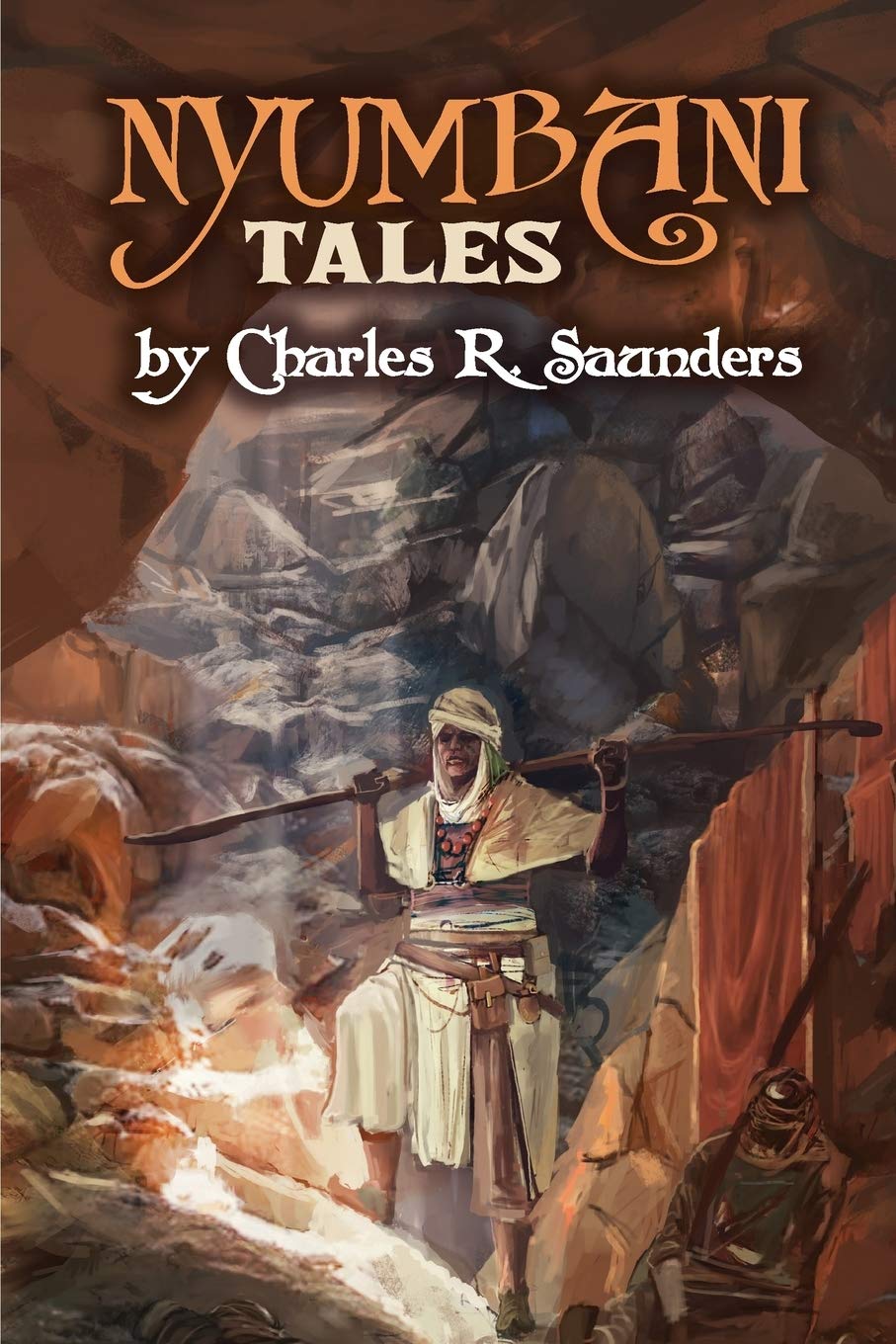
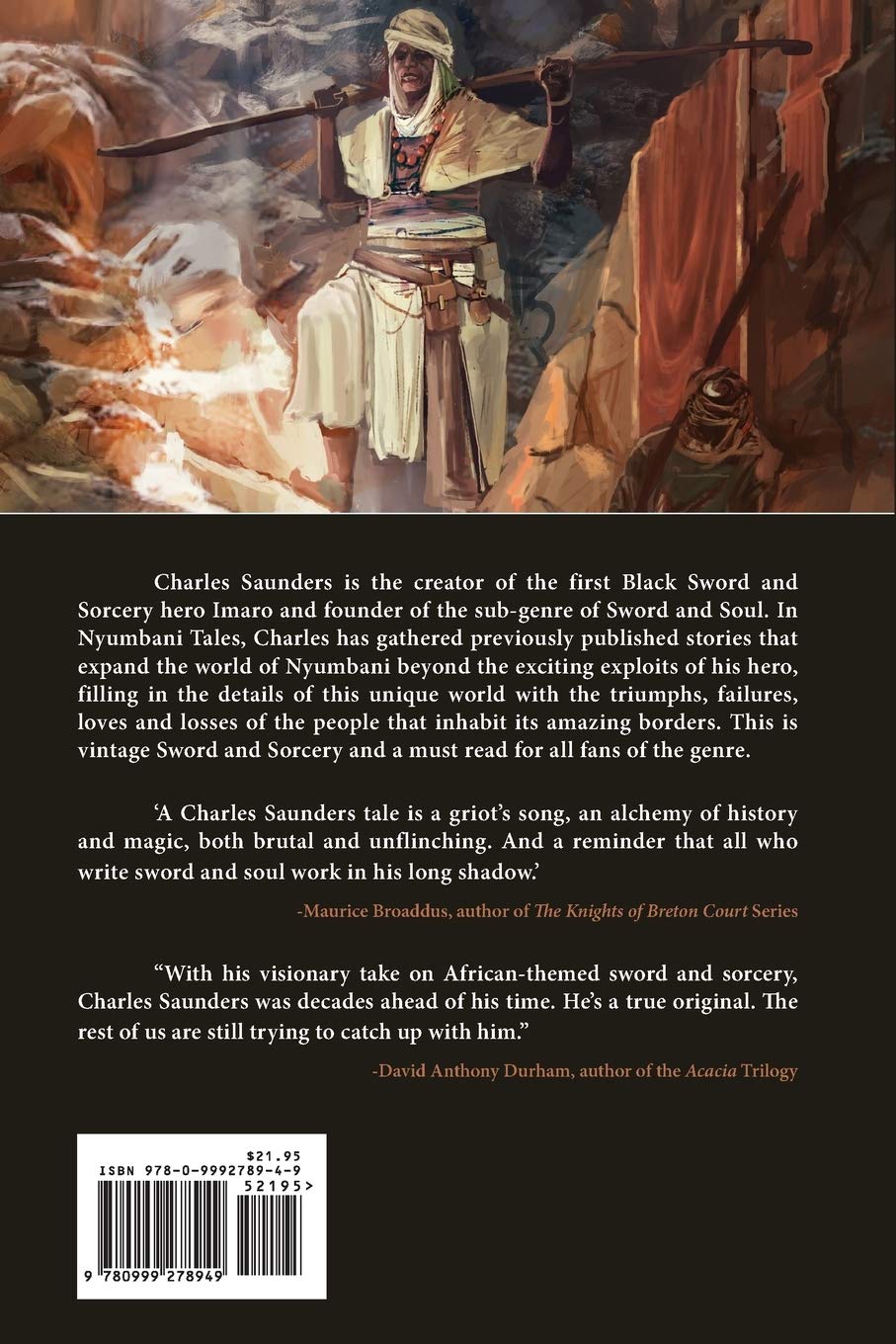
Nyumbani Tales (MVmedia, May 19, 2017). Cover by Edison Moody
Updated versions of the first two Imaro novels (re-edited by Saunders) were published in the early 2000s, although I don’t have them (see below). Saunders also wrote stories about a woman warrior named Dossouye. I read one of these, which was quite good, but the collection is currently unavailable.
I remember hearing of Saunder’s death several months after it occurred and being shocked. His writing, fine as it was, had not brought him any comfortable financial situation.
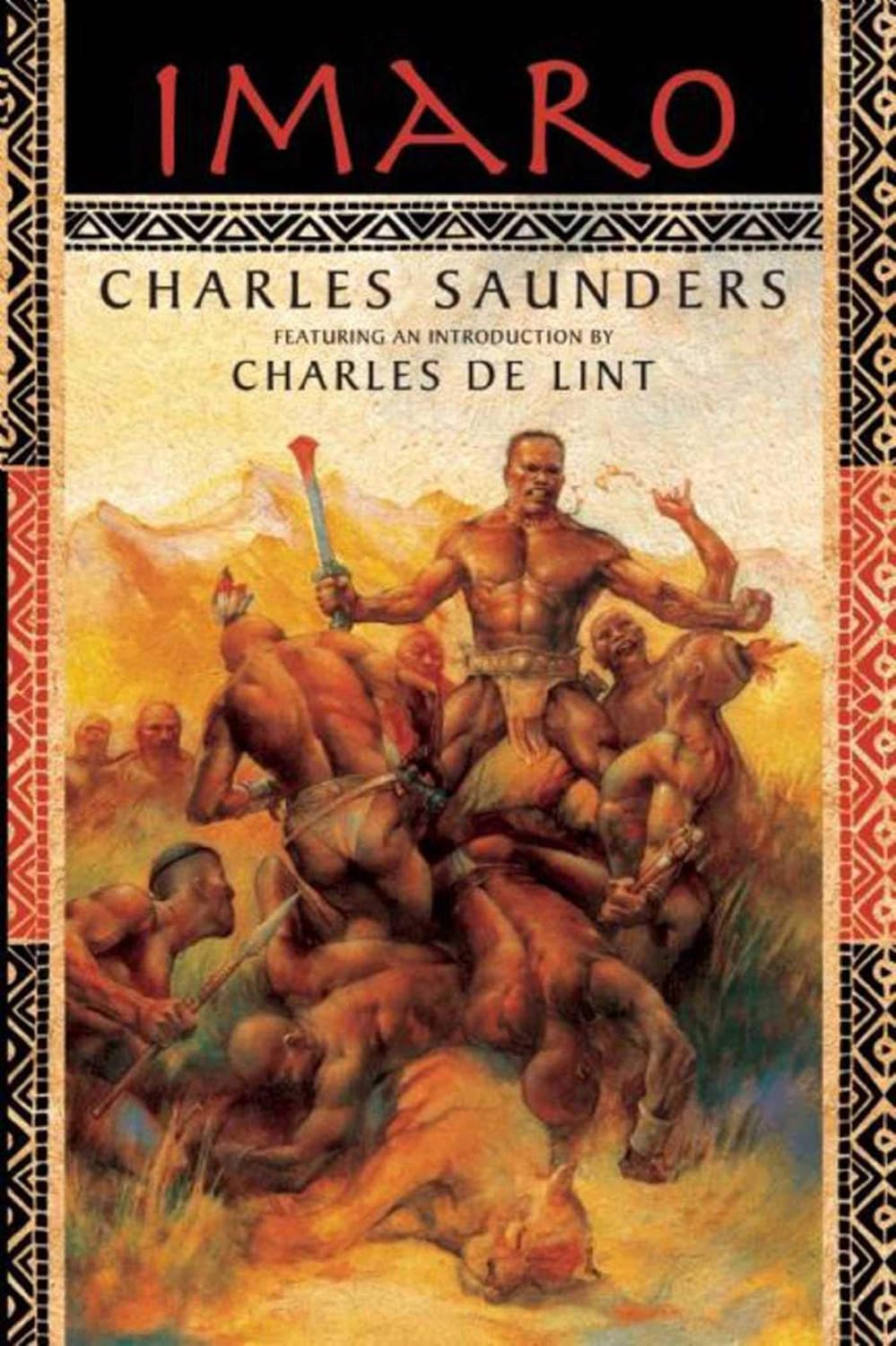
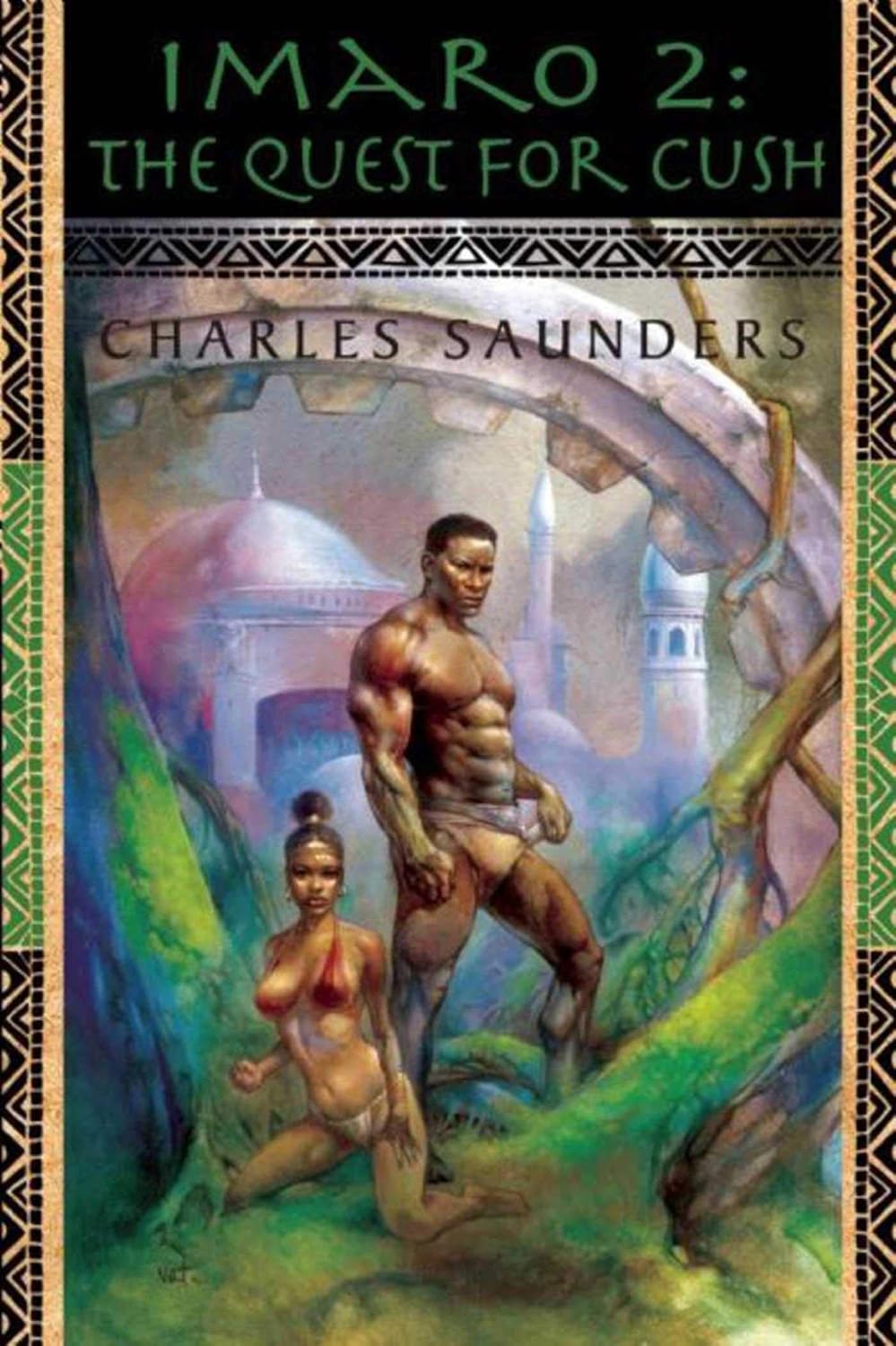
Reprint editions of Imaro and Imaro 2: The Quest for Cush from
Night Shade Books (February 15, 2006, and January 2007). Covers by Vince Evans
He died in a small apartment with no phone or internet connection, and apparently with no one close enough to him to check on his whereabouts. We can at least hope he’ll be better remembered after his death than he seemingly was before.
Charles Gramlich administers The Swords & Planet League group on Facebook, where this post first appeared. His last article for us was a review of two S&S anthologies, both titled Warlocks and Warriors, edited by Donald M. Grant. See all of his recent posts for Black Gate here.
Categories: Fantasy Books
Hey, Cassie! How old is Dru in TLKOF? Thanks!
She's seventeen. She and Ash are probably a few months apart in age though his age is slightly harder to pin down.
Categories: Authors
Pages

Recent comments