
Feed aggregator
Lividian: Book 1 from the Robert McCammon Library: Baal
Baal by Robert McCammon
Book #1 in the Robert McCammon Library
Includes an introduction by the author, artwork by
François Vaillancourt, a double-sided reversible dust
jacket, and much more!

Book #1 in the Robert McCammon Library
Includes an introduction by the author, artwork by
François Vaillancourt, a double-sided reversible dust
jacket, and much more!
From Lividian Publications‘s Robert McCammon Library:
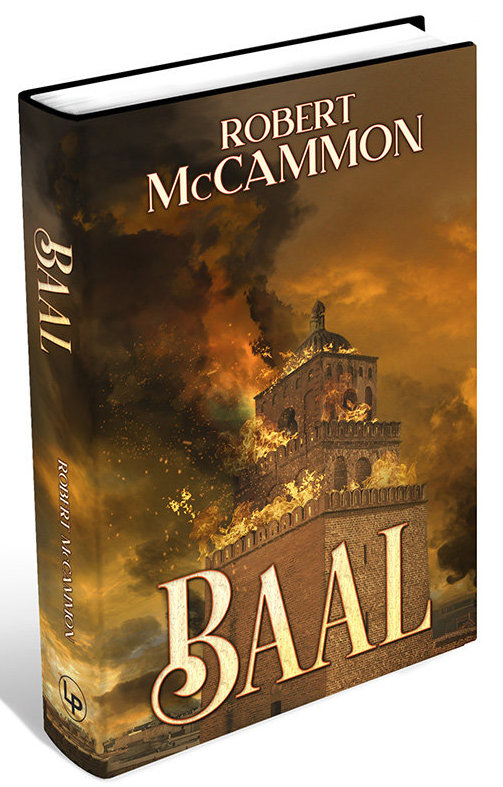 Lividian Publications is incredibly proud to announce our most ambitious undertaking ever: the Robert McCammon Library, a new hardcover series created to publish every Robert McCammon book in a unified set meant for both readers and collectors alike. These will be beautiful but affordable hardcovers that are Smyth-sewn like our Limited Editions, bound in cloth with hot foil stamping on the cover and spine, and printed on acid-free paper with a very reader-friendly page design.
The debut volume is Baal, his first novel, which was originally published in 1978. This new special edition includes the complete novel, an introduction by Robert McCammon, full-color wrap-around dust jacket artwork and ten black-and-white interior illustrations by François Vaillancourt, and “When the World Goes to Hell: Apocalyptic Horror and Human Evil in Robert McCammon’s Baal” by Mathias Clasen, the acclaimed Danish scholar of horror fiction.
As a special bonus, this edition features a double-sided reversible dust jacket that represents its unique place between a trade edition and a Limited Edition. One side will be printed with cover text in the style of a bookstore trade hardcover, while the other side will leave the artwork unobscured, like most of our Limited Editions. You can choose which version to display in your personal Robert McCammon Library.
Pre-order Baal from Lividian Publications
Pre-order Baal from Alabama Booksmith (signed)
Retail Price: $65 USD (book without slipcase)
Edition: Limited Trade Hardcover (unsigned)
Publication Date: Fall 2026
Page Count: 350
Special Features:
• Full-color dust jacket artwork by François Vaillancourt
• Ten black and white interior illustrations by François Vaillancourt
• Double-sided “reversible” dust jacket
• “When the World Goes to Hell: Apocalyptic Horror and Human Evil in Robert McCammon’s Baal” by Mathias Clasen
Deluxe Production Features:
• Offset printed on an acid-free archival quality paper stock
• A fine cloth binding
• Hot foil stamping on the front cover and spine
• Smyth-sewn to create a more durable binding
• Twine head and tail bands
• High-quality endpapers
Optional Special Features:
• Custom-made slipcase stamped with hot foil and featuring a unique die-cut window can be added to your order ($35 USD)
About the Book:
A woman is ravished…
and to her a child is born…
unleashing an unimaginable evil upon the world!
And they call him BAAL in the orphanage, where he leads the children on a rampage of violence…in California, where he appears as the head of a deadly Manson-like cult…in Kuwait, where crazed millions heed his call to murder and orgy.
They call him BAAL in the Arctic’s hellish wasteland, where he is tracked by the only three men with a will to stop him: Zark, the shaman; Virga, the aging professor of theology; and Michael, the powerful, mysterious stranger.
About the Author:
Robert McCammon is the New York Times bestselling author of more than thirty books. He’s the winner of five Bram Stoker Awards and a World Fantasy Award, and he is best known for Swan Song, The Wolf’s Hour, and Boy’s Life. More recently, he has published The Five, which Stephen King called his best novel ever, and the Matthew Corbett series, a ten-book series of historical thrillers that USA Network has called “the Early American James Bond.” McCammon lives in Birmingham, Alabama.
Categories: Authors
Fake Store
Our store has been cloned by a scam artist. Meaning it has been copied in its entirety and reproduced elsewhere. It is down now thanks to the quick action by the registrar and vigilance of the BDH.
Unfortunately, in the age of AI it is very easy to copy sites. This will happen again.
PURCHASE ONLY FROM THE REAL STORE
At the top of this site you will see a banner that says OUR STORE.
Use ONLY that link, directly from our site.
The real store has been unlocked pending the investigation. We are super not ready to open, so the merch sales are locked for now but books are available. I will try to work on it this weekend, so we at least have something.
That thing about cloning myself – I really need to look into it.
PS: Mod R takeover!
While Ilona cracks on with somatic cell nuclear transfer, I am taking over to remind everyone there will be a:
to celebrate the release of This Kingdom Will Not Kill Me!
For everyone who did not manage to get a space: as always the recording will be uploaded to the IA moderator account on YouTube early next week with captions enabled.
YouTube’s own transcript function is now good enough that I won’t be posting a separate transcript this time. Spoiler discussion will be limited by House Andrews’ desire to protect us from ourselves and by the covenant of the traditional publisher contract.
See you tomorrow!
The post Fake Store first appeared on ILONA ANDREWS.
Categories: Authors
Comment on Halfway by Alicia
I’m very happy for you!
I’m glad that things are going well with book #5 and (hopefully!) the edits for book #4 won’t be too much trouble.
Categories: Authors
Forgotten Authors: Austin Hall
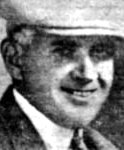 Austin Hall
Austin Hall was born on July 27, 1880.
While working as a cowboy, Hall was asked to write a story. This led to his career as an author, writing westerns, science fiction and fantasy stories, with westerns forming the majority of his published work. A one time, Hall may have worked as a sports editor for a newspaper in San Francisco.
Following the death of Hall’s father, his mother remarried and the family appears to have moved to Ohio, in an interview published by Forrest J Ackerman in 1933, Hall claims to have attended college in Ohio and California, but no details of his academic life can be confirmed. By the time he was thirty, Hall (as well as his mother and step-father) were living back in California and Hall had married Clara Mae Stowe and they had two children, Javen and Bessie.
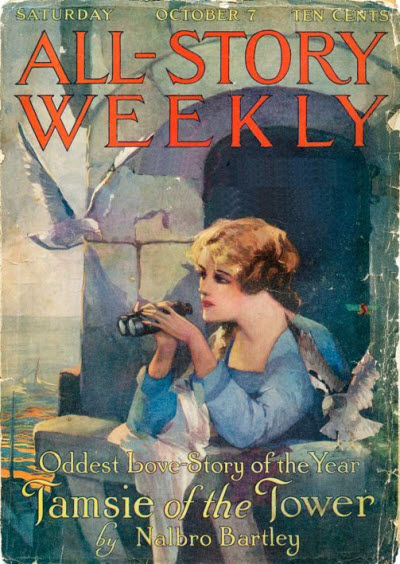 All-Story Weekly, 10/7/1916
His first science fiction story was “Almost Immortal,” which appeared in the October 7, 1916 issue of All-Story Weekly.
His 1919 story “The Man Who Saved the Earth” was reprinted in the first issue of Amazing Stories. Everett Bleiler describes this story as Hall’s second worst, which given Damon Knight’s opinion of Bleiler’s writing says quite a bit.
He collaborated with Homer Eon Flint on the novel The Blind Spot, which Damon Knight described in In Search of Wonder as “an acknowledged classic of fantasy…much praised…several times reprinted, venerated by connoisseurs—all despite the fact that the book has no recognizable vestige of merit. Knight enumerates his problems, not just with the novel, but with Hall’s writing, stating that hall is bereft of, among other things, style, grammar, vocabulary, observation, scientific knowledge, or ability to plot. Knight’s criticism of Hall is almost enough to make someone want to pick up one of his works to see how it could be as bad as Knight describes it.
Bleiler does not believe the story was an actual collaboration. Although Ackerman claims Hall pitched the idea to Flint and the two planned out how to work on it, Bleiler believes that Hall couldn’t come up with the middle of the novel and had Flint take over to get him over the hump.
Eventually, in 1932, eight years after Flint’s death, Hall would published a sequel to The Blind Spot, the serial The Spot of Life, in Argosy. Hall’s other science fiction, “The Rebel Soul” and “Into the Infinite” focus on the life and adventures of George Witherspoon. His The People of the Comet has Alvar, the king of the Sansars, describe his journey to a comet, which had a hollow interior in which they could live.
Although the majority of Hall’s writing appears to have been westerns, they appear to be harder to identify, although he wrote Where the West Begins and stories that appeared in Western Story Magazine.
He died on July 29, 1933 and is buried in Madronia Cemetery in Saratoga, California.
 Steven H Silver is a twenty-one-time Hugo Award nominee and was the publisher of the Hugo-nominated fanzine Argentus as well as the editor and publisher of ISFiC Press for eight years. He has also edited books for DAW, NESFA Press, and ZNB. His most recent anthology is Alternate Peace and his novel After Hastings was published in 2020. Steven has chaired the first Midwest Construction, Windycon three times, and the SFWA Nebula Conference numerous times. He was programming chair for Chicon 2000 and Vice Chair of Chicon 7.
Categories: Fantasy Books
Comment on Halfway by Bill
Thanks for the update and good to hear that Book #5 is going so well, a little anxious that Book #4 Edits are finally going to be with you and just hope that the reason for delay wasn’t anything about the book itself!
I’m very much enjoying the series and looking forward with eager anticipation for Book #4 in November (Chapter #1 in September too?) and perhaps a bit more information on Hobbs and Joanna’s contribution in Stephen’s life?
Categories: Authors
La Belle Dame sans Merci: Tam Lin by Pamela Dean
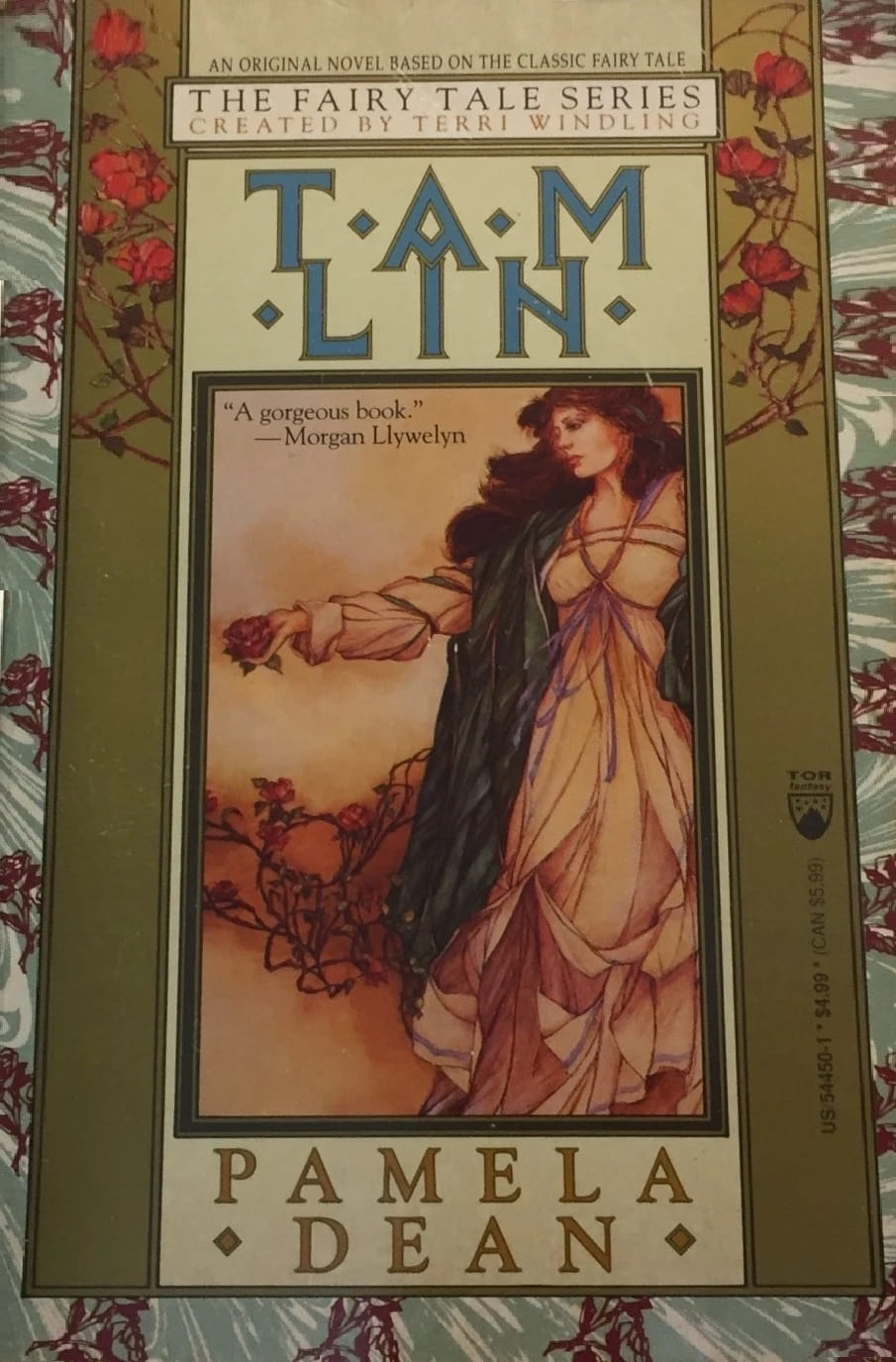
Tam Lin (Tor Books paperback reprint edition, April 1992). Cover by Thomas Canty
There’s been a lot of genre fiction set at schools. Hogwarts is an obvious example, but such settings were around long before Harry Potter; Heinlein’s Space Cadet, The Uncanny X-Men, and Le Guin’s A Wizard of Earthsea were all there first. Tam Lin is another early example, published six years before Harry Potter and the Philosopher’s Stone made scholastic fantasy a best-selling subgenre.
But it has an important difference: Its setting, the fictional Blackstock College, doesn’t teach magic, or superheroic combat, or spaceflight, or anything else fantastic. It’s a fairly typical small liberal arts college (based on the real college where Pamela Dean did her undergraduate work) where the supernatural elements are hidden beneath the surface.
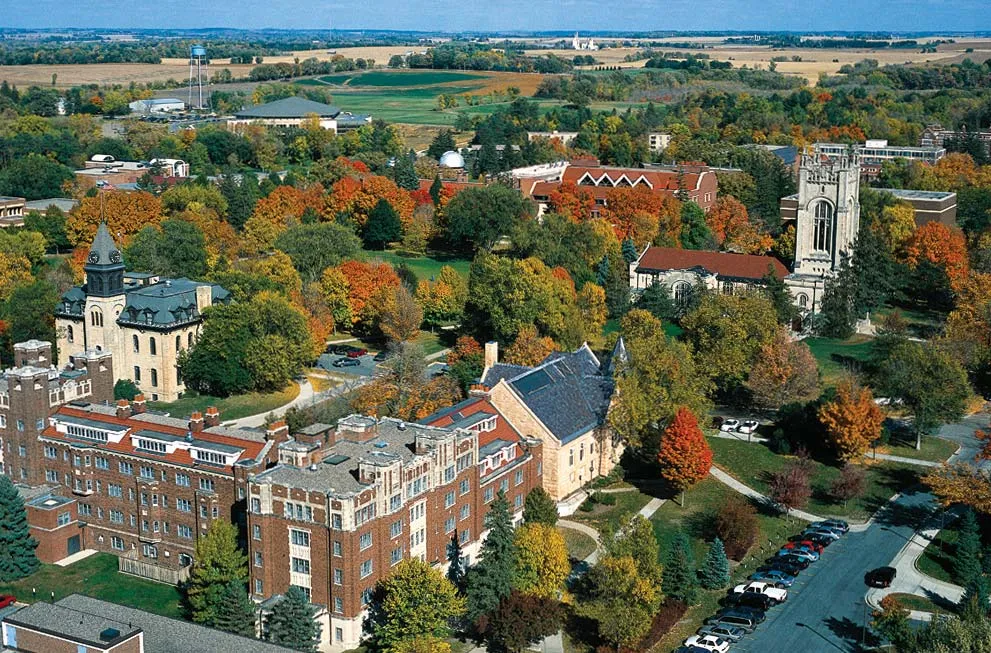 Carleton College, the real world model for Blackstock College
At the time when it was written, Tor Books was publishing novels that retold fairy tales at greater length, and with a style aimed at adult readers. Dean’s source wasn’t a fairy tale, strictly speaking, but a ballad, “Tam Lin,” though one where the fair folk are a visible presence — like “True Thomas” or Keats’s “La Belle Dame sans Merci.” Its theme is the mortal man who meets a fairy woman and is the worse for it, and that’s the undercurrent of Dean’s novel, and the problem her protagonist, Janet Carter, has to solve.
Much of the story is the non-fantasy details of Janet’s life. Dean lists every course she takes until the first quarter of her senior year — including a dozen in English, seven in Greek, and a variety of general education, from fencing to “physics for poets.”
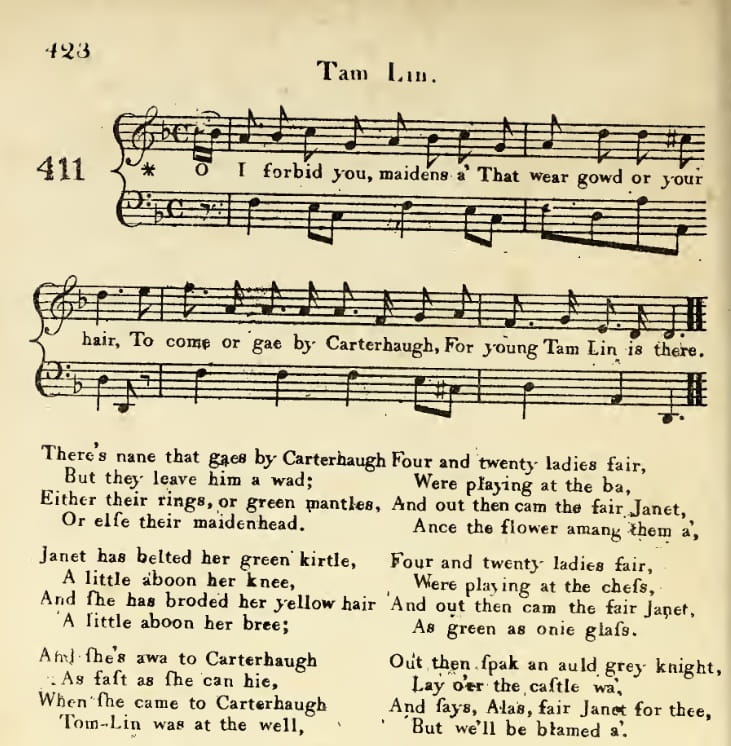 The opening verses of the ballad Tam Lin
We meet Janet’s roommates, Molly and Tina, whom she has difficulty with at first (especially with Tina) but stays with for all four years. We meet the young men they get involved with and learn of their experiences with sex and contraception — and of their breakups. We also meet Janet’s family, including her father, a member of the English faculty at Blackstock.
“I said I liked folk music, and Molly said she went to rock concerts, and Christina said she liked Bach, so they said, oh, look, three people who listen to music, and stuck us in the same room.”
So far as this part of the story goes, Tam Lin is a classic Bildungsroman (coming-of-age novel). But the social and psychological story is interwoven with an increasing awareness of magical aspects. On one hand, the campus has a ghost, a young woman who took an overdose of opiates in 1897 because she was pregnant, and who now throws specific books out of windows, including a Greek textbook. On the other, the classics department is a nexus of strangeness. All three of the women’s lovers are caught up in this, and Janet’s advisor, a classics professor, makes a serious effort to persuade her to major in classics as well.
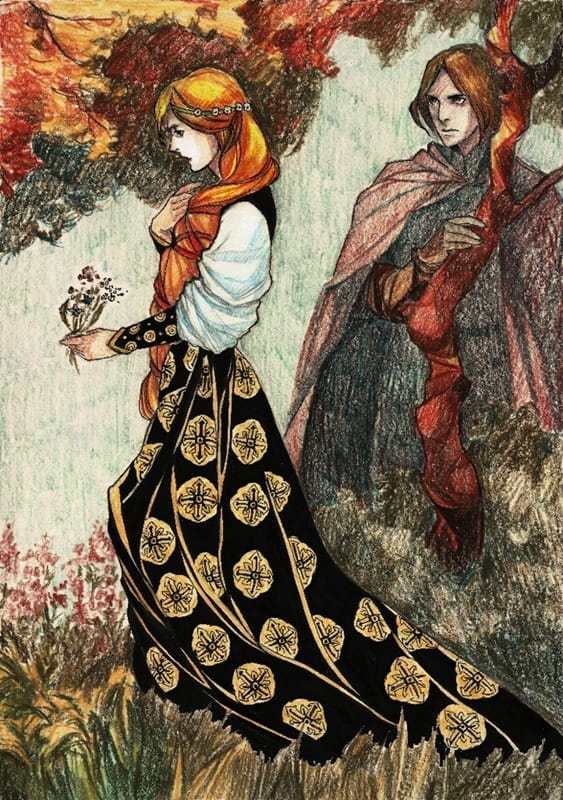
The other nuance of this is that the supernatural threads are interwoven with Janet’s literary tastes and interests, which we learn about in detail. One of the book’s major revelations, for example, comes from Janet reading a complete Shakespeare. An earlier scene has Janet reciting “La Belle Dame sans Merci”:
I saw pale kings and princes too,
Pale warriors, death-pale were they all;
They cried, “La belle dame sans merci
Thee hath in thrall!”
Earlier on, we see a discussion of which translation of Homer is best inspiring one of the young men to quote Keats’s sonnet “On First Looking into Chapman’s Homer.”
Quotations from the English classics are all through the dialogue — which seems plausible, as the fair folk are reputed to have a special affinity for poets and poetry. Janet herself writes a sonnet at one point, though one whose last line has all too plausibly flawed scansion.
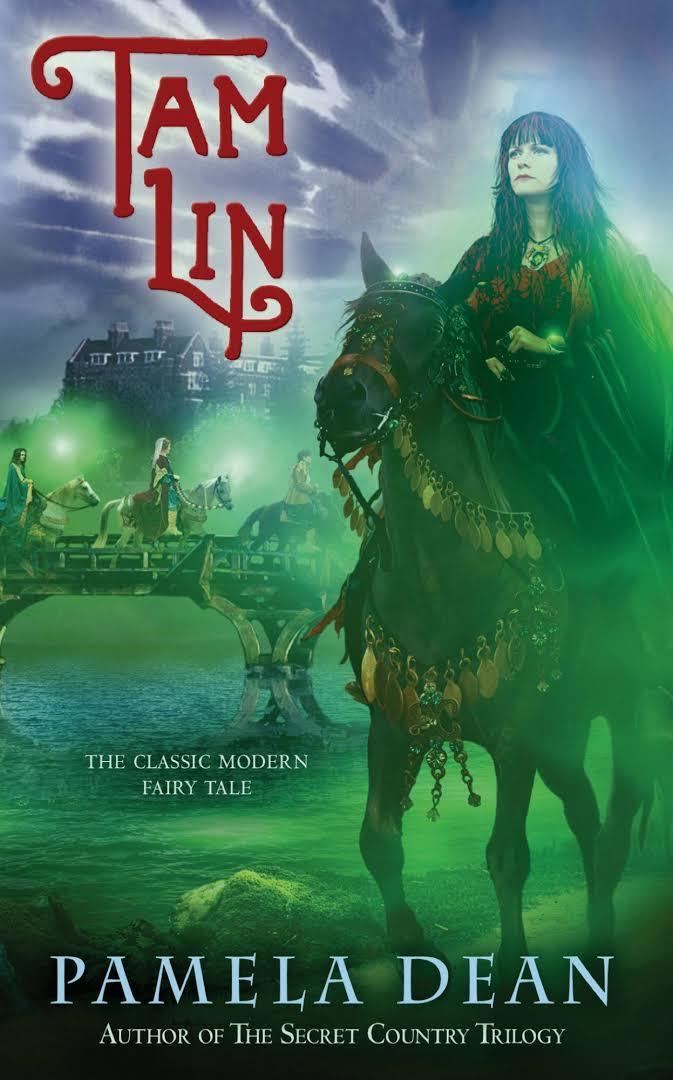 Tam Lin (Firebird, August 2006). Cover by Steve Stone
Women’s sexuality, pregnancy, and contraception are recurring issues, as of course they were in the real world in the 1970s. This fits its source material, where pregnancy is also an issue; but it seems that choosing to modernize that particular story gave Dean a way to comment on those issues, and to make them the crisis that leads to the novel’s climactic conflict.
Tam Lin seems oddly paced. Roughly the first half of the book portrays Janet’s, Molly’s, and Tina’s first term at Blackstock, almost day by day. The second half rushes through three full years, ending on Hallowe’en (naturally). This isn’t quite like some novels I’ve read that seemed to progress evenly until the penultimate chapter, and then rush ahead to tie off the plot; Dean does work things out step by step. But I’m not sure that first term needed to be shown in quite so much detail.
On the other hand, most of the details are, to my possibly peculiar tastes, fascinating. If you like English poetry, and the academic milieu, this novel may entertain you as much as it did me.
William H. Stoddard is a professional copy editor specializing in scholarly and scientific publications. As a secondary career, he has written more than two dozen books for Steve Jackson Games, starting in 2000 with GURPS Steampunk. He lives in Lawrence, Kansas with his wife, their cat (a ginger tabby), and a hundred shelf feet of books, including large amounts of science fiction, fantasy, and graphic novels.
Categories: Fantasy Books
Housekeeping, Plushies, Games, Etc

Mod R has faithfully gathered your questions for the upcoming zoom, and I am going to ask you to rethink some of them. You’re asking things like who is the author, who Maggie ends up, and so on. Those are the questions that will be answered in the future books.
We cannot spoiler the story for you. Most of you probably made it past Chapter 23. How much less of a moment would it have been if you knew about it in advance? We want to give you as much excitement as we can.
Let us mess with your emotions. That’s what we do for a living.
We are also contractually precluded from telling you too much about Book 2. Tor is very specific that everything is confidential.
PlushiesWe are very excited to announce a partnership with Andrielle of Phylogeny Unlimited. Andrielle is a biologist by training, and she has developed a line of prehistoric creatures for the Paleontological Research Institution. It’s called Paleozoic Pals, and they are hilariously anatomically correct, as in the number of segments on the trilobites and tentacles on the nautiloids is scientifically accurate.
Andrielle has a kickstarter right now, and I jumped on it so fast.

There are 6 days left, so if you are in the market for your own prehistoric sloth, I would get it now.
Right now Andrielle is working on a prototype of Sushi. We will likely aim for two sizes – a huggable friend and a desktop friend. This process takes time. We want to make sure that the toys are washable and are stuffed with fire-retardant stuffing, so they don’t catch fire if you throw them into the dryer.
That is a nightmare I didn’t know I needed, but from my research into plushies, apparently this can happen.
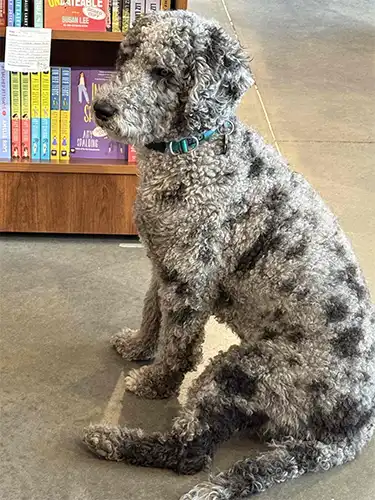
We know a lot of you have kids and pets, and stuffies might be stolen and may need to be washed. Actually, a funny story, while we were signing at Tropes and Trifles, the very good boy I posted before stole a toy from a customer. The toy was immediately recovered, and huge apologies were offered. The customer laughed it off, but just in the event something like this happens, we want the toy to survive the cleaning.
This process takes time, because we need to make sure the toy is cute, safe, and worth purchasing. We are aiming for Spring 2027 for availability. We know it’s a long way off, but we want to make sure that we do it right.
The AppWe have an app in the works. It will allow you to keep track of the our books, it will offer feed from the blog, and have achievements, discounts, and some exclusive content. Nothing too ground-breaking, so please don’t go into full FOMO (fear of missing out.) It is being beta tested now. I have some screenshots for you.
This app is not a replacement for the newsletter. It will still be emailed.
This app is for people who want to make sure they don’t miss things and want to keep track of their reading. It will let you access blog posts and fiction. So if you are stuck in a doctor’s office and don’t want to go through the trouble of opening the browser and looking for the site, you should be able to just tap the app open and read the latest things.





We anticipate it going live sometime around the beginning of summer. We are launching for iPhone only, because coding for Android is different and more involved, and we don’t know what the response to this will be, so we need to see if people are interested.
The GameSo this very premature, but Kid 2 is working on a game. It is a sole-developer project right now, and it will be set in the Innkeeper Universe. Right now it’s a farming sim, where you crash land on a planet and have to survive. This project is a long way off. But she was very touched by how much everyone loved This Kingdom, and she made this little video for you.
So this is technically a Chi moment, because this little alien is a muckrat, but this was just a quick wave to say hello to BDH.
We will probably not update you on this until there is a demo. Right now it’s all core mechanics and technical challenges like making sure that when you chop a tree down, logs appear, and then you can put them into your inventory.
Merch StoreWe are pushing the opening to May. There is just too much going on right now, and I really want to have vellum in my hands before we open. So the vellum has been ordered, and once I can actually see what it looks like in the book, we will be taking preorders.
We are still doing publicity. We still have interviews, and we are still signing things, and now we will be signing more things, because one special edition tripled their print run and another special edition has been just sold. This is…. #5? #6? I don’t even know. We managed to write twice this week, and it’s Thursday. Argh. I just want to get through this battle.
My philosophy is that if we don’t write, there will be nothing to promote, so we have to concentrate on the manuscript.
But if you are looking for prints, Helena’s store is open and Luisa’s store will be opening soon.
Someone asked before if it’s better to buy prints from us or the artists. If you want prints, please buy them from the artists.
We do not offer prints. We probably will not offer calendars.
We will be offering book-tie in items, like vellum, which is meant to be inserted into the hardcover. We would prefer that the artists benefited from their art through print sales. We specifically left those items to the artists’ discretion.
We will have a print round up for you when everyone sets up their stores.
The post Housekeeping, Plushies, Games, Etc first appeared on ILONA ANDREWS.
Categories: Authors
Spotlight on “Seek Immediate Shelter” by Vincent Yu

Other LitStack Spots We’ve spotted more titles we are adding to our TBR stack, including…
The post Spotlight on “Seek Immediate Shelter” by Vincent Yu appeared first on LitStack.
Categories: Fantasy Books
Review: The Republic of Memory by Mahmud El Sayed

Buy The Republic of Memory
FORMAT/INFO: The Republic of Memory will be published by Saga Press on May 5th, 2026. It is 480 pages long and available in paperback, ebook, and audiobook formats.
OVERVIEW/ANALYSIS: Two hundred years ago, the Sarafina set out on a journey to a new planet. While thousands of people sleep in cryogenic pods, generations of living crew members work to keep the ship running smoothly and ensure the safe delivery of the sleepers to their new home. But when a crisis faces the ship, a growing number of people begin to ask a critical question: Do they still want to dedicate every aspect of their lives to serving and protecting people they've never met?
The Republic of Memory is an engrossing tale of a ship in crisis that also digs into some juicy existential questions. What do you do when your ship's values and identity no longer align with the civilization that gave the ship its mission in the first place? Why are the lives of those in cryostasis more honored than the lives of the people who keep the ship running today?
I really enjoyed how the disaster that hits the ship really forces its everyday inhabitants to question things that they've taken for granted and to see the contradictions in their lives. They revere those in cryo as "ancestors," and consider the journey to their new planet as a sacred mission, but the culture of the ship has fundamentally changed since it began its voyage. If the crew were to wake the ancestors today, would they even get along with those who woke up?
To explore all these facets of a culture in upheaval, the story skips around to several different viewpoints over the course of the book, from a mid-level administrator to a teen street artist to the head of a rebel faction. While a few POVs get more of the lion's share of the tale, it's almost hard to point to the "main" characters of this book as there are so many POVs. And yet it is done in a way that is never confusing, as many characters show up in other POV chapters; you are now simply getting a different angle of the same story. It gives a pretty broad look at the different ways people are handling the crisis and grappling with the choices put before them and really enjoyed seeing the different cultures and parts of the ship.
Where I'm a little more mixed is in how well the author engaged with one of the unique aspects of the ship. On this generation ship residential areas are divided not by nation or by job description, but by the language a person speaks. Dividing on those lines is supposed to allow residents more flexibility in migration, as anyone can learn a language but they can't change their religion or heritage. And I did enjoy some of the ways the author plays with language. For instance, when listening to the voice of an ancestor, the current ship inhabitants hear it as "ye olden days" style language, but in flashbacks, the dialogue is perfectly normal.
But language is also supposed to be a huge barrier between the different berths. In fact, there's a whole occupation dedicated to translation, as only Admin people speak English as a primary language, and common folk need a Translator to process paperwork. Aside from some initial encounters with Translators, however, language didn't seem to cause too much friction. I myself grapple if this was the intent, that language evolves to its needs and people will find a common language. But as this is being sold as a linguistic sci-fi, it didn't feel like the author did enough with it.
The Republic of Memory is exactly what I was hoping for: a deep dive into a fully realized culture that has uniquely evolved in support of its mission. I really enjoyed the many different POVs it used, and how well fleshed out this microcosm of civilization felt. I am eagerly awaiting the next installment in this journey and can't wait to see how the crew evolves in the aftermath of this first crisis.
Categories: Fantasy Books
Signings, Yarn, and Other Gifts

Thank you so much to everyone who had come to see us at the signing. You guys are absolute best. If you read my tour summary, you probably know by now that book tours tend to be grueling. Meeting you is the only reason we actually go on tour. It’s not the sales – sorry, bookstores, and it’s not the publisher’s requests – it’s you. We absolutely love hanging out with you.
Now, to own up to some logistical issues: we have reached the point where the signings draw 200+ people. The Horde is mighty. We will probably have to limit signing of the stock from home in the future. We have some reports from people who came to the signing but could not stay long enough to get their book signed.
Our policy is always to defer to the store; however, we do specify that if you have mobility or health issues, small children, or pressing time commitments, we will accommodate you and you should be moved to the front of the line. That has been our touring policy since the very first tour. In the future, if you are attending, please let the store staff know.
We are very sorry if you missed us. We will try to get a couple of informal meet and greets in Austin area, probably one in the north, in Round Rock and one in the south. You can come, chat with us, and get you stuff signed.
This is not special-trip worthy unless you guys actually want to have a longer event, in which case I can rope a couple of local authors into it, and we can have an extended meet and greet. I can rent a hotel conference room very cheaply, we can park ourselves in there for the day, and I am sure I can get a local bookstore help us out with purchases. So let me know in the comments if that’s something you want to do.
Bookplates:
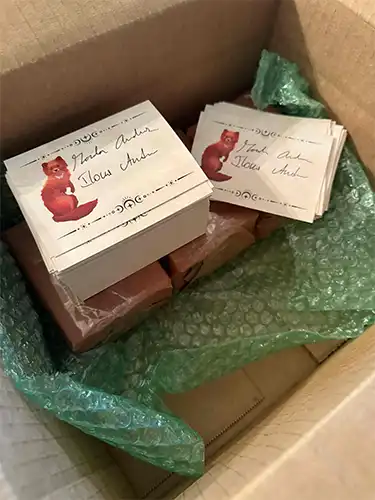
Sushi bookplates look like this. They are crack and peel, meaning you bend them and peel off the backing. We’ve received a lot of requests for these, so here is the deal: we are finishing signing 2,600 for a special edition, and then we are moving onto the store requests. Once we are done there, we will try to open the bookplates for general readership through the store. Unfortunately, we will have to charge you a small fee for the shipping and processing. So it might be like, I don’t know, $3-5 for ten or something. But we must honor our retail and special edition commitments first.
Despite us actively discouraging gift giving, you still brought us loot. We got books, treats, wine, and yarn. I am not going to shoot myself in the foot and tell you all about them, because we are very grateful. Please do not take this as encouragement for more gift giving. First, as grateful as we are, you already have given us a gift but purchasing and reading our work. Second, we have limited room in our suitcases. Meeting is is honestly enough. It makes us so happy.
First, I must tell you about this tea. Someone gave it to us at the signing, and I almost did a little dance.
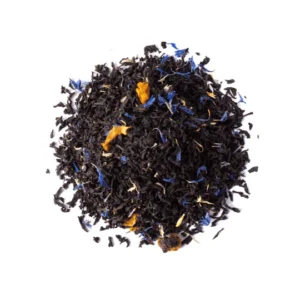
This is Sencha Earl Grey Starlight. So I am not actually a fan of Earl Grey. I had gone overboard on drinking it at one point and kind of burned out on it.
This is unbelievably delicious. It tastes of creamy vanilla, and the traditional Earl Grey citrus is not the main star, but more of a supporting player. I am hoarding it. In fact, I am going to get up and brew myself a cup of this right now as a special treat for having done the taxes.
You can purchase this yumminess at Sencha.
Many thanks for my new drug of choice.
Second, BDH gifted us a couple of books. Full disclosure, I haven’t read either of them, because we are back at work on Maggie 2, so these are not recommendations. Just a thank you for the gifts.
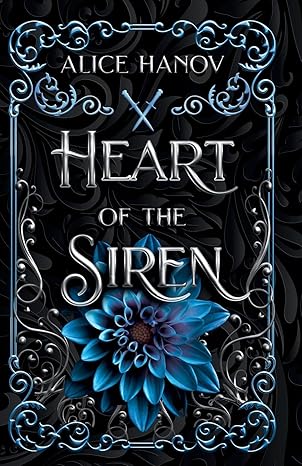
Heart of the Siren by Alice Hanov
Alice’s website describes this as “dark romantasy” with spice.

The Doodle Knit Directory by Jamie Lomax
This tour demonstrated that all of you have zero intention to help me kick my knitting addiction

Kentucky Horse Country by James Archambeault
A very beautiful picture book that will be living on our coffee table. I looked through it and there are gorgeous horse pictures inside
This trip also reaffirmed that we both love Kentucky. There is just something about Lexington. We really love the city and the green pastures that roll just outside of it. Our biggest regret is not spending more time there. Also we were hoping to see Gwenda Bond, with whom we’ve been friendly online for years. Unfortunately, we missed that opportunity.
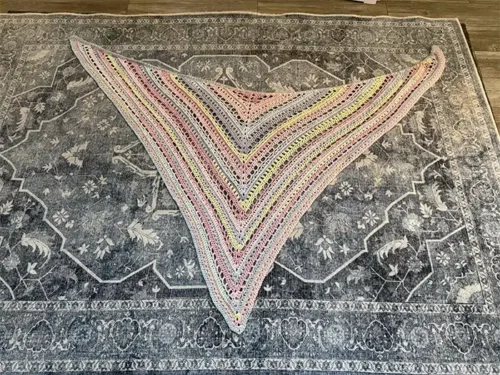
The person who crocheted this beautiful shawl is going through her second battle with cancer. Thank you so much for this gift. We are thinking of you. You’ve beaten it once, you can do it again. Please don’t lose hope.
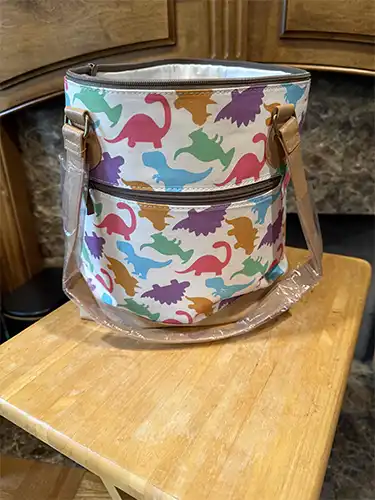
Next we have this amazing bag. It was a most fortunate gift, because I stuffed all of the yarn and small gifts into it.
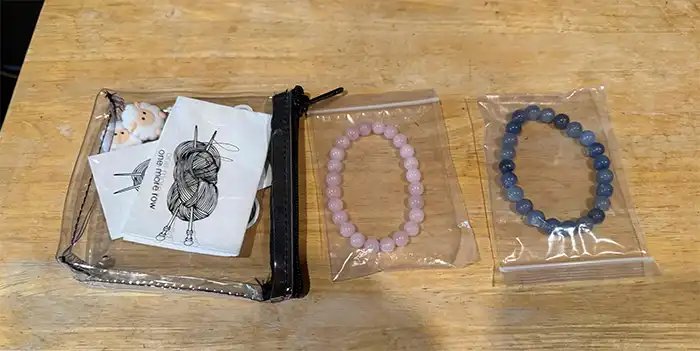
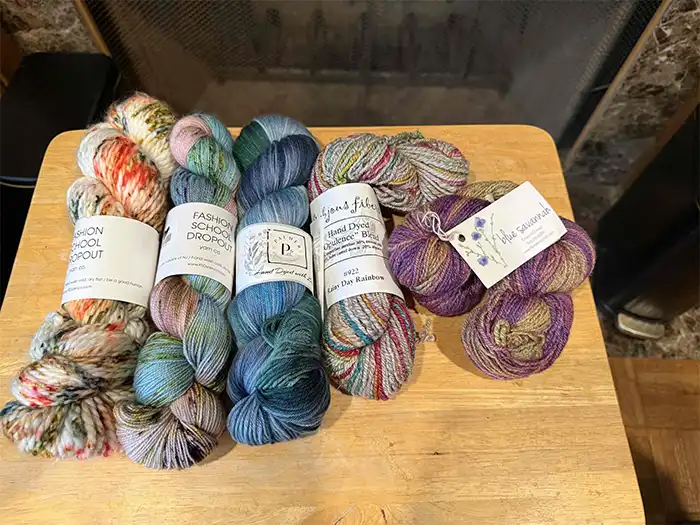
Mmmm, yarn. So excited about this.
I also bought some yarn in Baltimore.
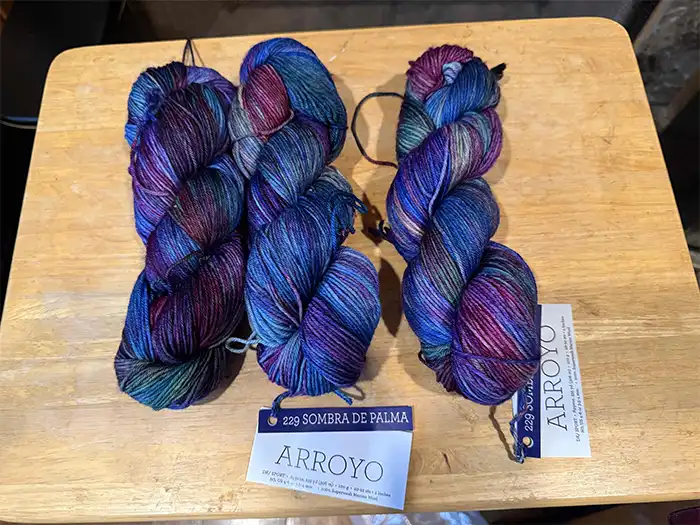
It was pretty and I got tempted.
We were also give delicious things, and I have no pictures of those for obvious reasons.
Thank you again for the fantastic tour. ::hug::
The post Signings, Yarn, and Other Gifts first appeared on ILONA ANDREWS.
Categories: Authors
Women in SF&F Month: E. J. Swift
Today’s Women in SF&F Month guest post is by E. J. Swift! Her short fiction includes the BSFA Award finalist “Saga’s Children,” first published in the anthology The Lowest Heaven and later in The Best British Fantasy 2014, and “The Complex,” first published in Interzone and later in The Best British Fantasy 2013. Her two latest novels are The Coral Bones, an Arthur C. Clarke Award and BSFA Award finalist, and When There Are Wolves Again, the 2025 BSFA Award […]
The post Women in SF&F Month: E. J. Swift first appeared on Fantasy Cafe.
Categories: Fantasy Books
7 Author Shoutouts | Authors We Love To Recommend

Here are seven Author Shoutouts for this week. Find your favorite author or discover an…
The post 7 Author Shoutouts | Authors We Love To Recommend appeared first on LitStack.
Categories: Fantasy Books
The Mighty Sword & Sorcery Anthologies of Hans Stefan Santesson
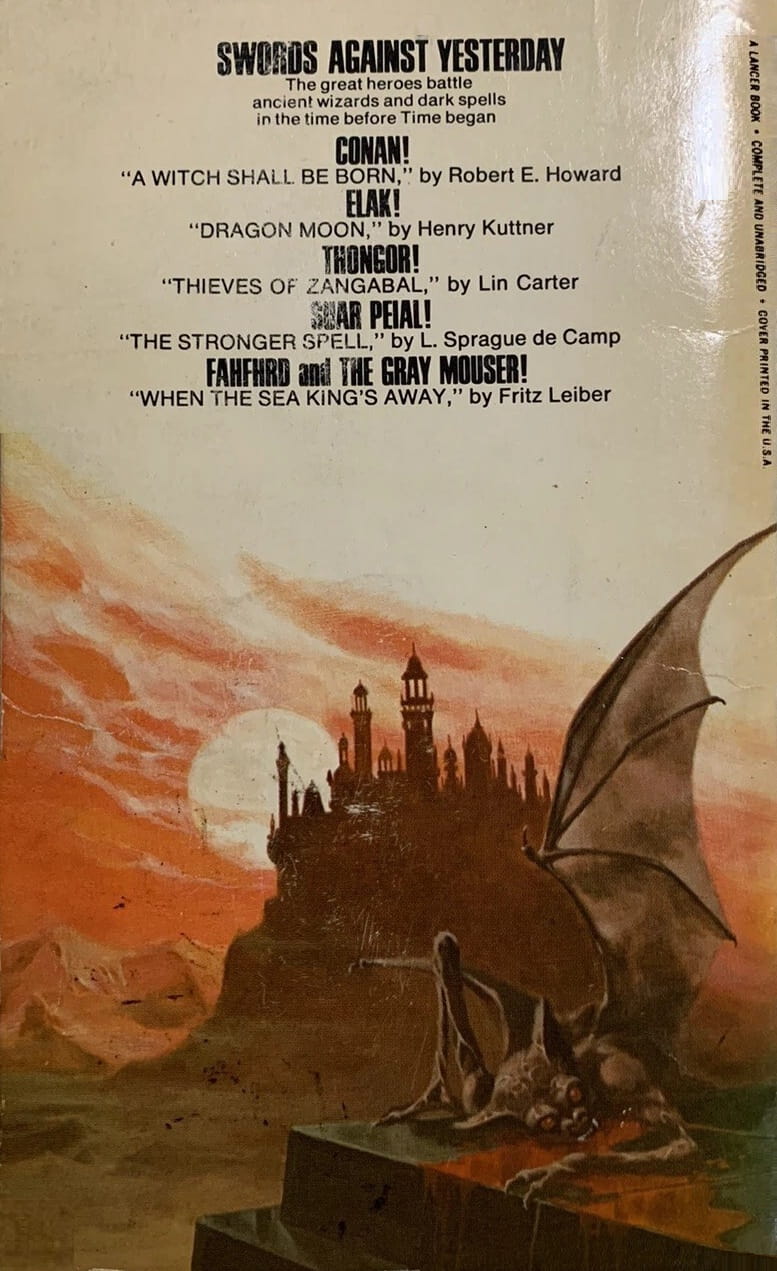
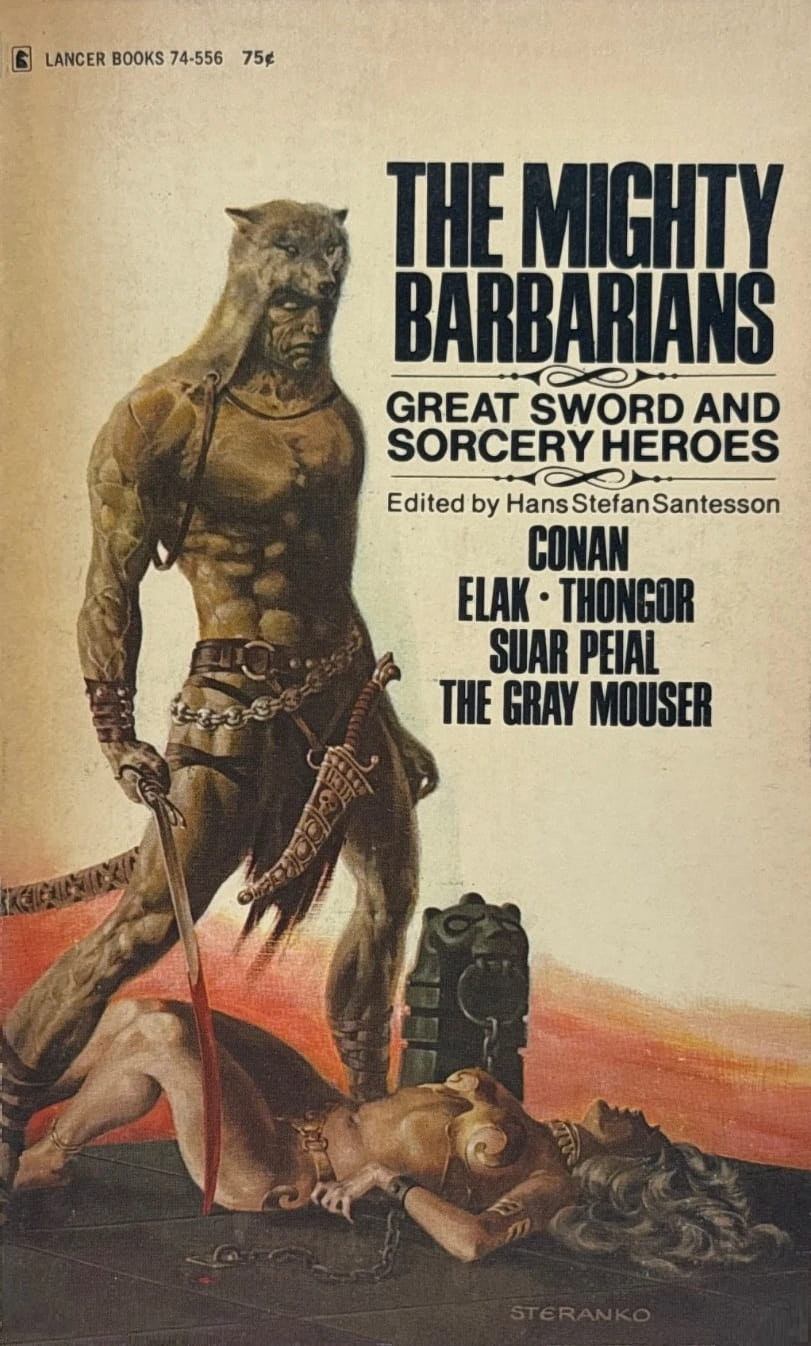
The Mighty Barbarians: Great Sword and Sorcery Heroes, edited by
Hans Stefan Santesson (Lancer Books, 1969). Cover by Jim Steranko
Hans Stefan Santesson (1914 – 1975) was born in France and lived in Sweden with his parents until 1923 when his mother immigrated to the US. She was a commercial artist and he soon became an editor for various mystery publications.
I likely would never have heard of him if not for two books of Sword & Sorcery he edited for Lancer Books. These were The Mighty Barbarians (1969) and The Mighty Swordsmen (1970), both with evocative covers by Jim Steranko.
[Click the images for mighty versions.]
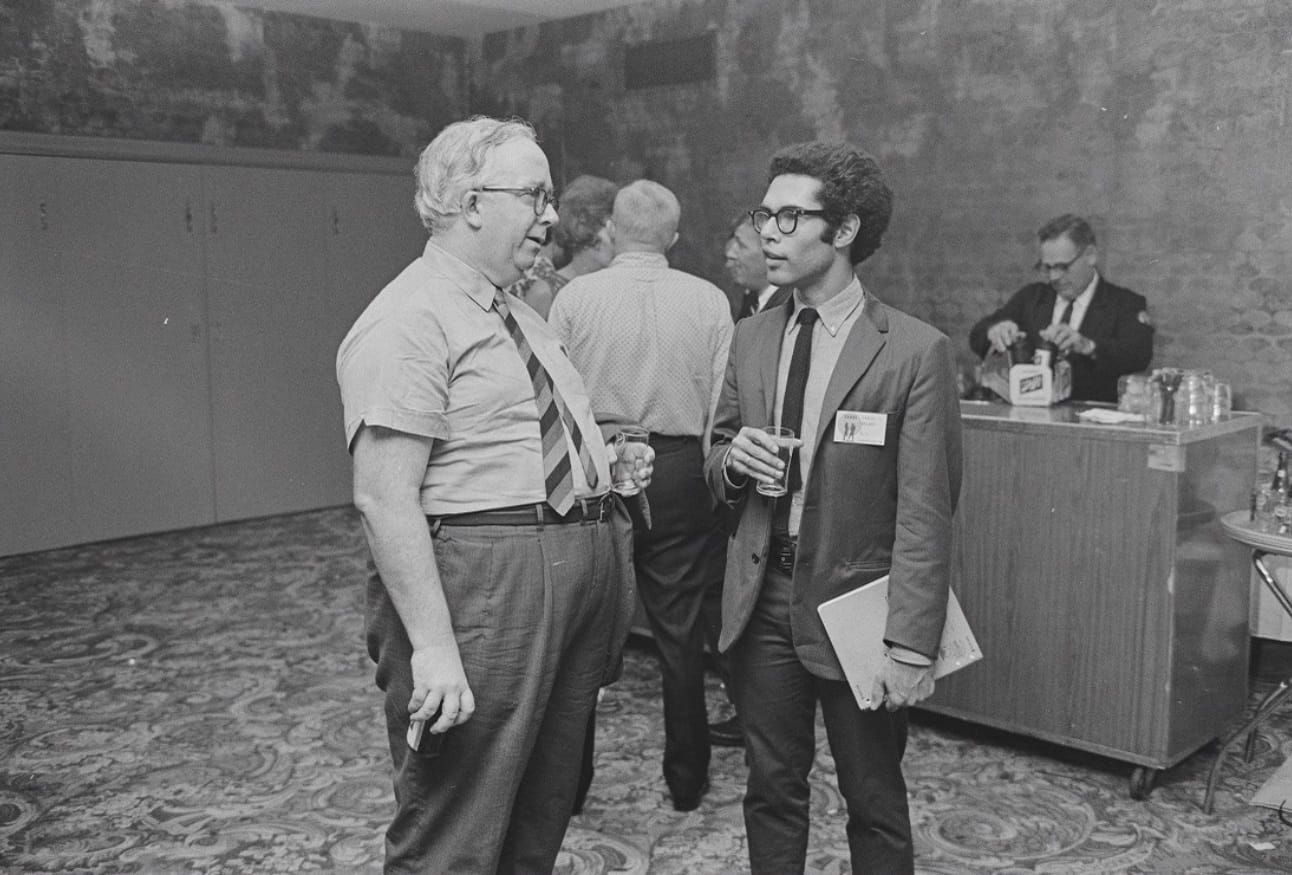 Hans Stefan Santesson and Samuel Delany in Cleveland, 1966. Photo by Jay Kay Klein
1. The Mighty Barbarians contains an Introduction by Santesson, and then the following stories.
“When the Sea-King’s Away by Fritz Leiber (Fafhrd/Gray Mouser)
“The Stronger Spell” by L. Sprague de Camp
“Dragon Moon by Henry Kuttner (Elak of Atlantis)
“Thieves of Zangabal” by Lin Carter (Thongor)
“A Witch Shall be Born” by Robert E. Howard (Conan)
The intro shows that Santesson was familiar with the history of heroic fantasy. He cites some of Carter’s nonfiction so he may have gotten it from there. All the stories are good and generally full of action.
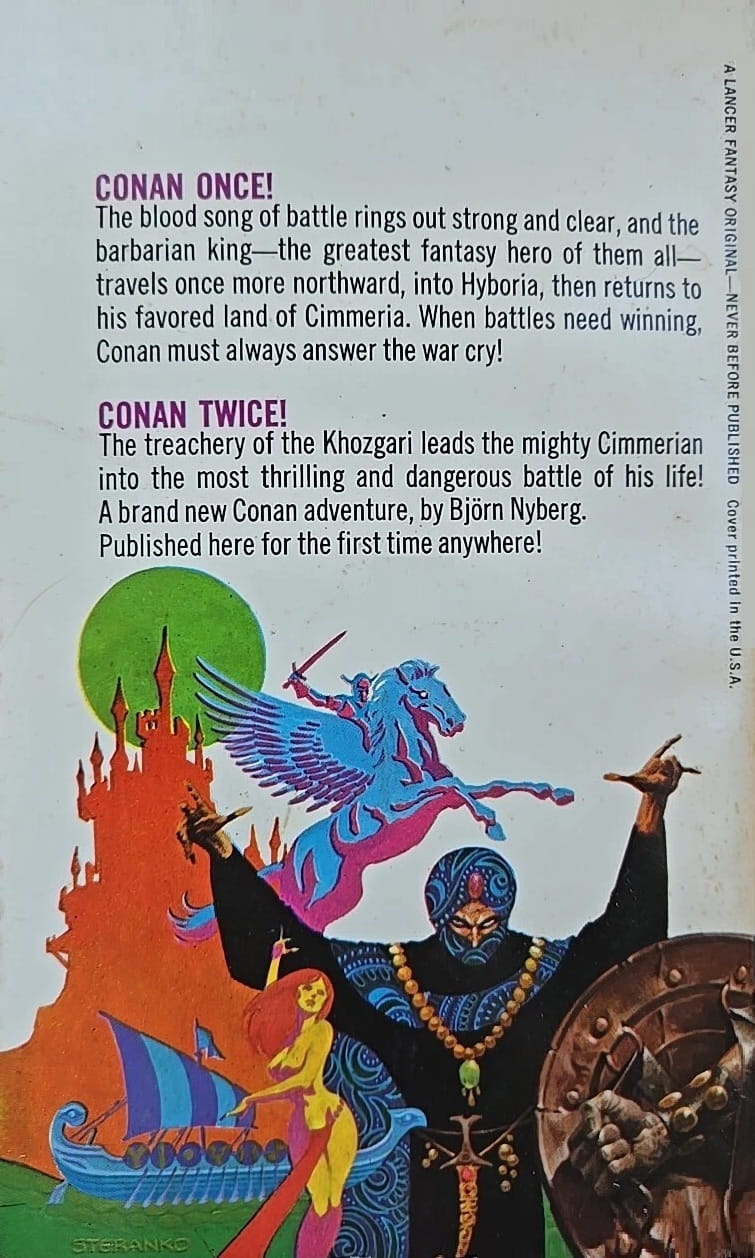
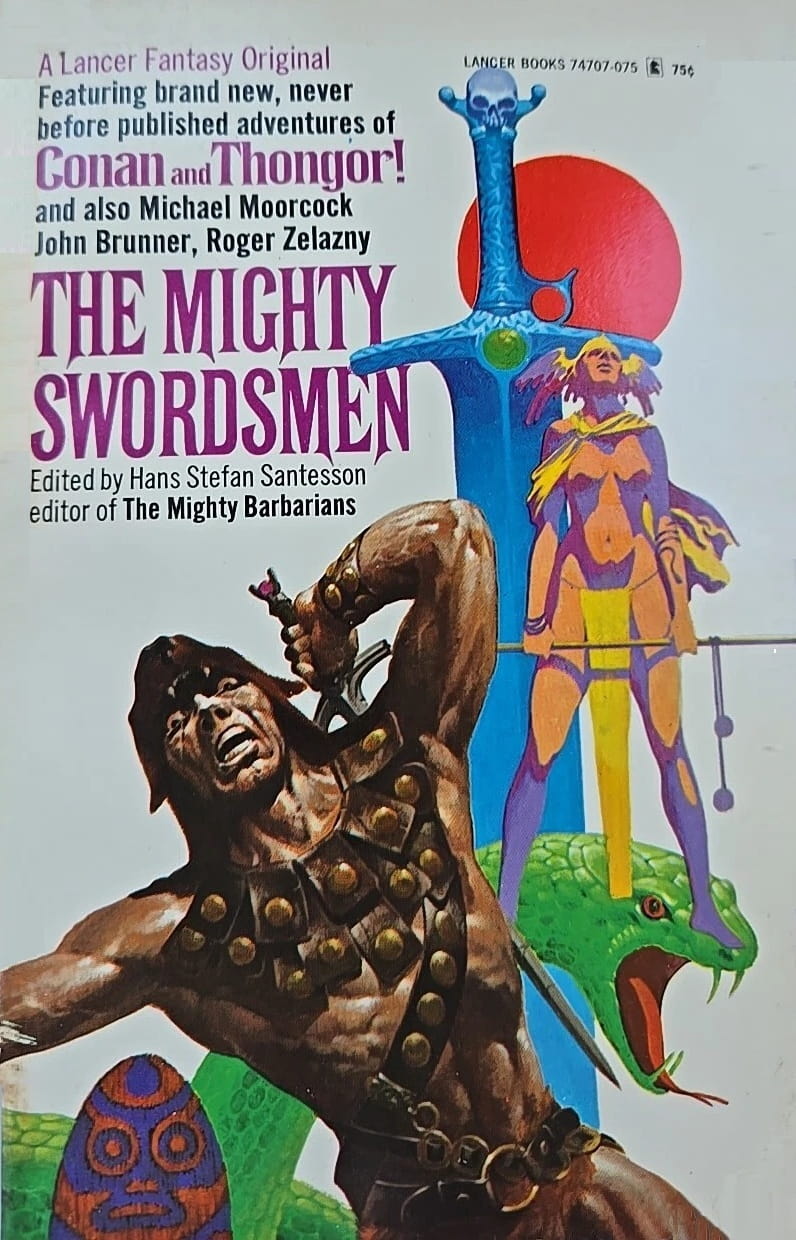
The Mighty Swordsmen, edited by Hans Stefan Santesson (Lancer Books, December 1970). Cover by Jim Steranko
2. The Mighty Swordsmen contains a shorter intro by Santesson and ends with “Beyond the Black River” by REH, one of the best Conan stories. It also contains tales by Moorcock, Brunner, Zelazny and a Conan pastiche by Bjorn Nyberg called “The People of the Summit,” which suffers by comparison with “Beyond the Black River.”
The Moorcock tale is “The Flame Bringers” (Elric). It’s quite good. Zelazny’s story is one of his Dilvish the Damned pieces, “The Bells of Shoredan.” Lin Carter’s “The Keeper of the Emerald Flame” is one of the best of his Thongor stories. Brunner’s story has the best title, “Break the Doors of Hell,” but doesn’t quite seem to fit with the others. It’s one of his Traveler in Black pieces.

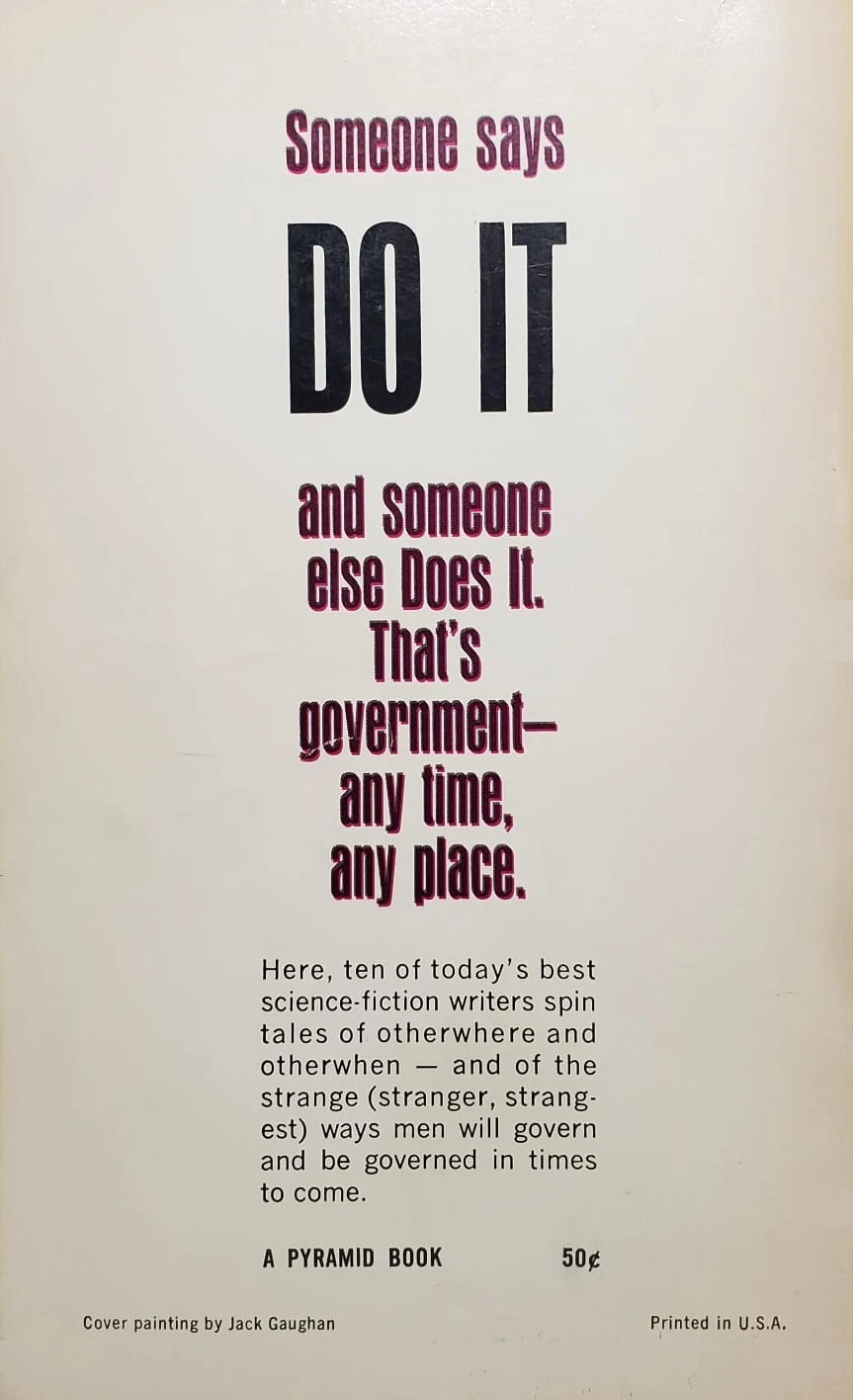
Rulers of Men, edited by Hans Stefan Santesson (Pyramid Books, 1965). Cover by Jack Gaughan
Santesson edited plenty of other works and even wrote a few stories himself under pseudonyms, none of which I’ve heard of. I did discover another edited collection by him that I’m going to try to get. You can see the cover above, by Jack Gaughan. Some star names there.
Charles Gramlich administers The Swords & Planet League group on Facebook, where this post first appeared. His last article for us was a review of the 1970 anthology Dark of the Soul, edited by Don Ward. See all of his recent posts for Black Gate here.
Categories: Fantasy Books
Book review: Flow My Tears, The Policeman Said by Philip K. Dick

ABOUT THE AUTHOR: Over a writing career that spanned three decades, Philip K. Dick (1928-1982) published 36 science fiction novels and 121 short stories in which he explored the essence of what makes man human and the dangers of centralized power. Toward the end of his life, his work turned toward deeply personal, metaphysical questions concerning the nature of God. Eleven novels and short stories have been adapted to film; notably: Blade Runner (based on Do Androids Dream of Electric Sheep?), Total Recall, Minority Report, and A Scanner Darkly. The recipient of critical acclaim and numerous awards throughout his career, Dick was inducted into the Science Fiction Hall of Fame in 2005, and in 2007 the Library of America published a selection of his novels in three volumes. His work has been translated into more than twenty-five languages.
First published February 1, 1974 Page count: 204 pages Formats: all Literary awards: Hugo Award Nominee (1975), Nebula Award Nominee (1974), Locus Award Nominee for Best Novel (1975), John W. Campbell Memorial Award for Best Science Fiction Novel (1975)
There are, broadly speaking, two kinds of bad mornings.
The first is when you wake up late, miss your alarm, and step on something on the way to the bathroom.
The second is when you wake up and discover that you do not legally, socially, or bureaucratically exist, which is considerably worse.
Jason Taverner experiences the second kind. And it’s a strong start. In fact, it’s such a strong start that the rest of the book spends a fair amount of time trying to catch up with it.
In the world Jason wakes up to, authority is everywhere, and it makes a routine of invigilating people. Taverner himself was a celebrity, and he spends most of the book trying to get his life back. Understandable, but it makes him less interested in big questions about identity and reality than in the more practical issue of not being arrested.
Anyway, he’s not awful to read about, but he’s also not that interesting. The book hints that losing everything might change him, but it mostly doesn’t. He stays focused on getting his life, status, comfort, and place at the top back. There are a few chances for him to actually connect with people, but he tends to fumble them or just move past them. That might be the point, but it doesn’t make him more engaging. That said, scenes describing his confusion and panic impressed me. And his attempts at explaining what love is are quite good.
Still, people around him are much more interesting. Buckman, in particular, is a fascinating character who knows a lot about life and certain life altering substances.
The structure is loose. Taverner moves through a series of encounters, each of which feels like it is going somewhere, but often isn’t. Characters appear, say something interesting, and then vanish. The explanation of the mystery didn't shock me since I read most books by Philip K. Dick and also his biography. But I won't spoil it.
So, did I like it? Mostly. There is something here, a sense that people are stuck being themselves, even when the world shifts under their feet. In the end, it’s an interesting book that never quite becomes a great one. It's full of good parts, just loosely assembled. You can see why people remember it. You can also see why they argue about it.
It makes it worth a read, I guess.
Categories: Fantasy Books
Is This Still a Thought?

Goodafterevenmorn, Readers!
I had an interaction online that took me aback a little bit, and I really need to talk about it. I realise that I’m largely preaching to the choir here, but I am feeling a little like I need a sympathetic ear, so apologies. But I must give some context, so here we go:
As part of my effort to make of my writing a viable source of income, I have joined a number of new social media sites that are, by and large, similar to but a much better experience than Facebook. I’m not going to tell you which one of these this happened in, largely because I’m not sure that some greater drama might result. I doubt anyone here is foolish enough to start a dogpile, but I’d much rather err on the side of caution.
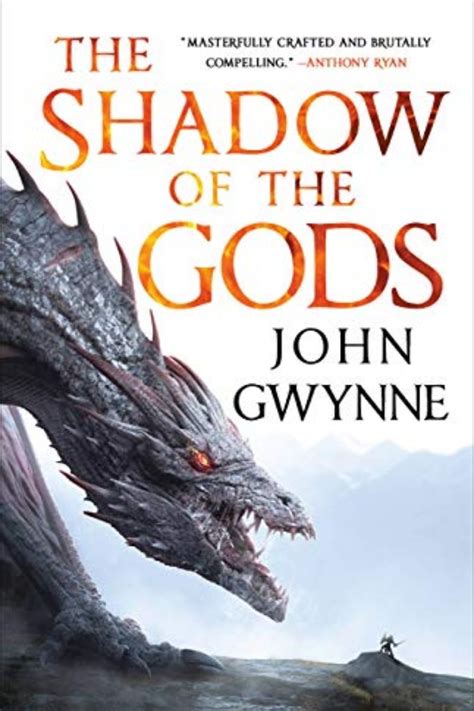
On one of these sites, I posted a brief review of a book I had recently read — The Shadow of the Gods by John Gwynne. For those who have not yet read this, it is the first book in a trilogy, and it is heavily based on dark age Scandinavian life and myth (what we’d consider ‘Viking’ in its most populist understanding). It is dark, and gritty, and really interesting. It really enjoyed this read (it didn’t make me cry, though, so I knocked off a few points in the review). Here is what I wrote about the book:
Meant to note that I’d finished reading this last weekend. A gripping read that’s very clearly been well-researched. I really enjoyed it.
And then, rather oddly (to me), I received this reply:
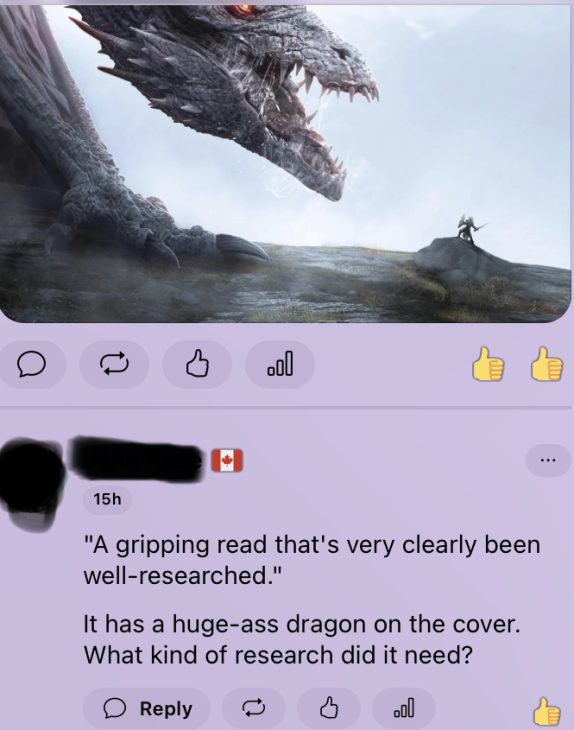
Now, I’ll be the first to admit, it got my hackles up right away. I write genre; mostly fantasy. And I’m usually in amongst people who also write the same, or adjacent, so I forget what opinions are outside of these circles. This slammed it in my face, and I wasn’t prepared. So my reply might have been equally as blunt, and perhaps a little tart as well. Perhaps I struck a nerve, as I received a reply to it, but it had been deleted before I could read what it actually said.
Probably for the best. I have a short fuse sometimes, and find myself in fights more often than I’d like, no matter how futile my brain knows it is. Besides the point. The point is, I had forgotten how some people outside of the genre view fantasy as a genre; primarily that because it is couched in distant allegory and magical worlds, and is a product of wild (also see: brilliant) imaginations, it clearly must not have much actual thought or “real work” (read here: research) behind it.
That is wildly offensive to me.
There are some things that even fantasy worlds and fantastical stories require in order for the reader to engage their suspension of disbelief, things must make sense. Things that are familiar must work more or less the same in the real world (unless its important to the world or plot that they don’t). If someone is fighting near a lava pool, there must be heat. If they are fighting with a spear, a strike with the shaft of the weapon will bludgeon, not cut. These kinds of things.
Are many things made up? Absolutely! Magic? That doesn’t exist in the real world, not at least like it does in fantasy stories (technology is a magic of a sort). Shape changers? Giant flying reptiles (this one did once exist, though. Have you seen arambourgiania, hatzegoteryx or quetzalcoatlus? Holy giant pterosaurs, Batman!)? Talking weapons? Talking animals? Talking plants? These things don’t exist in real life. Fun and completely made-up. But in order for them to work, the rest of the world must be believable. And often times, that requires a whole lot of research.
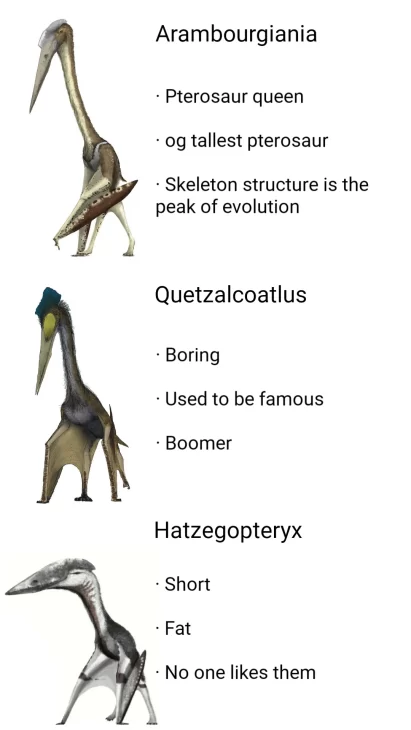 Found this image on reddit.com. It gave me a good giggle.
I will take The Shadow of the Gods as an example here. Set in a world that is analogous to Scandinavia of the (wrongly called) Dark Ages, but one in which myth and magic is real and exists, and the gods are not all that familiar in name or manner as the “Viking” pantheon we’re familiar with. It’s much more primal, with gods taking on bestial forms that are perhaps more familiar to folks who have studied various shamanic traditions.
That in an of itself requires a fair amount of research. As someone who has done that research, the execution of the world mythos was really well done. The tales have enough of a familiar ring to them that they do feel like a real life tradition made “real,” as it were. The hallmarks of many ancient myths are there – the all-being/first being was killed by his own progeny, and from his parts the world was made. We see it or its aspects in many traditions; particular those of Europe. In Viking myth, we see this in Odin and his siblings slaying Ymir, and making the world from the corpse.
It happened very similarly in this iteration, though the names Odin, Ymir and other names we might recognise are not used. This is a little out of my area of expertise (having studied much earlier up until the rise of the Roman Empire), but even those of us with a little passing knowledge would recognise the story, and those of us without would at least recognise the bones of it… pun unintended.
But there’s more to it than just the mythology of the world feeling familiar and plausible as an origin story in the world (that turns out to be probably very true). There’s so much in this book that benefitted from the author doing his research. A short list:
- Life in a world of snow and volcanoes, where night can last several weeks in mid-winter and day several weeks in high summer.
- Life on a raiding vessel; including division of labour, storage of armour and weapons, and beaching, disembarking and the actual act of raiding.
- Art and architecture in a world of frost and fire.
- Life in a settlement.
- Navigation
- Social structures and hierarchies in Late Iron Age/Early Middle Ages northern Europe.
- Fighting styles required of round shields and spears as primary weapons.
- Strategy in which shield and spear are the primary weapons in engagements.
- Anatomy (a femoral artery was cut in one scene that I recall, which anyone who knows anything about anatomy knows that’s as much a death sentence as if it was a carotid (particular in the time period represented)).
All of this and more was obvious in John Gwynne’s writing. It was very clear to me that a great deal of background research and knowledge was poured into this book.
 Image by Gordon Johnson from Pixabay. Also how I imagine the author looked while researching.
And the most oblique suggestion that it wasn’t still really grated on my nerves.
Again, I know I’m preaching to the choir, so this rant is going to change nothing, but still. I am getting quite fed up with people pretending that simply because a piece for writing is fantastical means that there was no research or work done behind the scenes to make it come to life. A good story well told will always have a lot behind it, whether or not magic is part of the tale. And I, for one, really appreciate it when you can tell it’s there. I’m just being a grump, I supposed, but I received that comment nearly two weeks ago, and it’s still bothering me.
So… thanks for listening to my rant. I needed to get that off my chest without starting a genre war. I feel better now.
Anyway, if you haven’t yet, do read The Shadow of the Gods, do. It’s a really great read.
And very well researched.
Ciao for now!
When S.M. Carrière isn’t brutally killing your favorite characters, she spends her time teaching martial arts, live streaming video games, and sometimes painting. In other words, she spends her time teaching others to kill, streaming her digital kills, and sometimes relaxing. Her most recent titles include Daughters of Britain, Skylark and Human. The Timbercreek Incident is free to read on Wattpad.
Categories: Fantasy Books
THIS KINGDOM WILL NOT KILL ME by Ilona Andrews (Maggie the Undying #1)
Portal Fantasies are some of the earliest subset of fantasy novels, going all the way back to the great Lord Dunsany. In those early stories, characters were often transported to a “Fairyland” but over the years, there are other worlds characters can visit. Take Ilona Andrews’s This Kingdom Will Not Kill Me, the first novel…
Categories: Fantasy Books
Audiobook Review: First Sign of Danger by Kelley Armstrong
I received a review copy from the publisher. This does not affect the contents of my review and all opinions are my own.
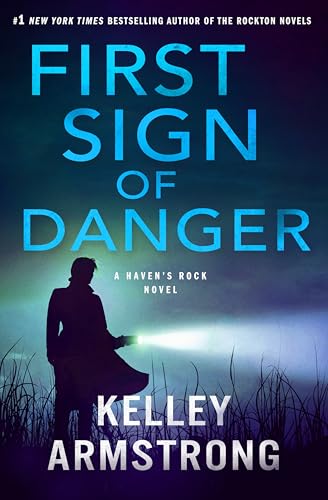 First Sign of Danger by Kelley Armstrong
Mogsy’s Rating (Overall): 4 of 5 stars
Genre: Mystery, Thriller
Series: Book 4 of Haven’s Rock
Publisher: Macmillan Audio (February 17, 2026)
Length: 9 hrs and 38 mins
Author Information: Website | Twitter
Narrator: Therese Plummer
I make it no secret how much I love the Haven’s Rock series, and I’ve been with this crew since they were first introduced in Rockton. As the fourth installment in this spinoff series, First Sign of Danger delivers the same tense, wilderness-set mystery I’ve come to expect, nothing more, nothing less. But while that may sound like business as usual rather than anything standout, it’s still a satisfying read.
The story picks up six months after the previous volume, Cold as Hell. Casey Duncan and Eric Dalton are new parents! Their home, the off-the-grid settlement of Haven’s Rock hidden in the wilds of the Yukon, continues to serve as a sanctuary for people looking to disappear, and this is where they are content to raise their family. Even the nearby mining operation has, for the moment, fallen into a workable truce. Boundaries are being respected, and both sides are keeping to themselves, at least for now. Everything feels relatively calm and balanced, just the way the town’s residents would prefer as they head into winter hoping for as little drama as possible.
But that fragile peace is abruptly shattered when Casey and Eric encounter two hikers who have wandered far too close to Haven’s Rock’s borders, raising immediate concerns about exposure. Thinking quickly, they point the interlopers away from town, towards a safer direction. But when they return the next day to make sure the hikers have moved on, they instead find one of them dead and the other missing without a trace. With no clear idea who these people were or why they were in the area, Haven’s Rock goes on high alert as Casey and Eric begin digging into the mystery. At best, the hikers’ presence is an unfortunate coincidence, but at worst, it could mean a new threat has found its way to their doorstep. Given everything this town has already endured, there’s too much at stake to take any chances.
One of the things this series does well is atmosphere, and that still holds true. The setting once more plays a starring role, the Yukon providing an active source of tension. Between the isolation, the harsh conditions, and the ever-present danger of nature and wildlife (speaking of which, there is a truly harrowing scene involving a bear in First Sign of Danger), there’s just this constant awareness in the back of your mind that things could go wrong at any moment. It gives the story a survivalist edge that perfectly complements the police procedural elements.
In terms of character development, Casey and Eric are now navigating a completely new phase of their lives with their six-month-old daughter, Rory. There’s a clear adjustment period as they figure out how to balance parenthood with their law enforcement responsibilities, but the book takes a refreshing approach here. Instead of playing up the usual themes of stress, exhaustion, and guilt in stories about new parents, it highlights how a strong support system can make all the difference, even in a remote place like Haven’s Rock. Here, the side characters step up. While overall they are in more background roles this time, their presence is still felt in meaningful ways, reinforcing the town’s sense of community. Sure, Casey is tired, but she’s never forced to choose between her job and her child. Rory, meanwhile, is growing up loved and cared for by a network of honorary aunties and uncles pitching in when needed, giving mom and dad the space to do what they need to do.
The mystery itself is engaging, though inevitably it feels familiar at times. Some of the plot points are recycled, easy to anticipate because we’ve seen them before. That said, I come at this as someone who genuinely loves this series, and there’s an undeniable comfort of returning to something I know. At the same time, I’m realistic. Between this series and the original Rockton run, we’re pushing close to a dozen novels in this world, and it’s starting to feel like we’re nearing the natural end of the road. And maybe that’s why I’m not all that upset about the author’s news that the next book will be the last. As much fun as I’ve had, quitting while you’re ahead is never a bad thing, and in this case, I’d much rather see the series wrap up on a strong note than stretch things out unnecessarily.
At the end of the day, First Sign of Danger is another dependable and easy-to-enjoy installment of the Haven’s Rock sequence. I also had the pleasure of listening to this in audio, and narrator Therese Plummer as ever does a fantastic job as Casey, bringing a natural and down-to-earth tone to her voice that fits the character completely. While this book doesn’t quite reach standout status for me, it still delivers a satisfying mix of mystery, character development, and wilderness tension, which are the exact ingredients that have always made this series so enjoyable.


Categories: Fantasy Books
Free Fiction Monday: Death on D Street
D Street—the closest thing Hope’s Pass has to a red light district. Three whorehouses and a few independents to service the miners who survived the mines outside of town.
When someone murders a prostitute, Will, the mayor, must fill in for the drunken sheriff and investigate. Only the crime has deep roots—roots that will touch Will’s entire family and make him question everything he has ever known.
“Death on D Street” is free on this site for one week only. If you like this crime story, you might like my other crime stories. A Kickstarter for my latest crime novel, Candid Shots of the 1970s, will run until Thursday, April 16. There you can get the new novel as well as Consecrated Ground, a novel that hasn’t seen print in 15 years, and a brand-new collection of short crime stories (although this one is not included). Click here to look at the Kickstarter.
If you just want a copy of this story, download it on any e-book site or by clicking here. Enjoy!
Death on D Street Kristine Kathryn Rusch
Ginny had just blown out the lamp and snuggled against me, her slender arm across my chest. The house still held too much of the day’s warmth for us to be cuddled so close together, but I didn’t move her. I liked the touch of her skin against mine, even when we were both too tired to do anything about it.
The baby was quiet for the first time in two days. She was teething and not happy about it. Ginny’d been rubbing my brandy against the baby’s gums and it didn’t seem to be doing anything except wasting good liquor. Still, Ginny swore that was a teething trick and I figured she’d know. She had gotten Sam through it, and on her own. By comparison, this couldn’t be as bad.
We should have expected the knock on the door—or something to break the quiet, but the knock surprised both of us. The baby wailed. Ginny must have already been asleep because she rolled over fast and reached for the gun she kept in the top dresser drawer.
I caught her arm and soothed her awake. I’d seen this reaction before and knew its source. A woman traveling alone across country had to be adept at protecting herself and her child. Nothing I could do convinced her she was safe. I’d stopped trying a year before.
I jerked on my pants as the knock came again. The baby’s wail grew into a scream. I grabbed a shirt and said, “See to the kids.” Then I headed down the stairs.
The knocking started a third time. I yanked the door open. Travis stood outside. He’d set his lantern on the porch. The yellow light illuminated his mud-stained pants and scuffed boots. The stench of cigars and cheap booze wafted inside.
“Sorry to wake ya,” he said, “but Doc sent me. We got a holy hell of a mess on D Street.”
D Street was the closest thing we had to a red light district. Three whorehouses and a few independents all lined up in a row. When I was sheriff, I restricted the hookers to that area. I’d learned that getting rid of them was impossible, not to mention unpopular. When men got time away from the mines, they wanted some affection, even if they had to pay for it.
“Where’s Sheriff Muller?” I asked.
“Couldn’t roust him.”
“Drunk again?” I glanced up the stairs. The baby was still crying. The floorboards creaked as Ginny walked with her, trying to quiet her.
“Smelled like it,” Travis said.
“What kind of mess?”
“Somebody killed Jeanne.”
I stepped onto the porch and pulled the door closed. “While she was servicing him?”
“Jesus, Will, how’m I supposed to know?”
I shook my head and strode down the street. The dust was caked thanks to the summer heat, the wagon ruts treacherous in the darkness. The air was cool now, almost cold—one of the benefits of being in the mountains—but by dawn the heat would be creeping back, oppressive and overwhelming.
D Street was three blocks over and two down. I walked along Main Street. Most of the saloons were still open. Music filtered out of O’Hallerans—someone was banging on the town’s only piano. A few drunks were collapsed on the wooden sidewalk, leaning against the building, and I knew who they were.
I’d lived in Hope’s Pass since it was founded, eight years before. I’d stumbled through here, looking to make my own fortune mining for silver. I lasted a month underground in the dark, candle burning away the oxygen, cave-ins a constant threat. Even though the pay was pretty good, I realized there were other ways to make money.
The town needed a sheriff and I volunteered, setting my own pay so high that no one in their right mind would meet it. But in those early days of what would become known as the Comstock Lode, no one was in their right mind.
They paid me more than I was worth for six years. Then Ginny came to town with little Sam and enough money to set up a dressmaking business. Four months later, we were married and I had resigned as sheriff. I felt it wasn’t right to be dragged out of bed at all hours to calm down drunken miners or settle disputes over one of the town’s whores. I ran for mayor and won; then I appointed Johann Muller as the new sheriff, which was, I think, the worst decision I’d ever made.
D Street was down two blocks from Main, at the very edge of the mountainside. The ground was treacherous here—subject to floods in heavy rains. The buildings here had washed away more than once. There were other problems as well. Mine shafts had been dug underneath this entire area of Hope’s Pass, and more than one man had fallen through the street to the emptiness below. One of my campaign pledges had been to shore up the South Town area, but no one was really pushing me to fulfill that promise.
Lights were on in all the houses, and laughter filtered down from one of the porches. The men here weren’t drunk—or at least weren’t obviously so. A lot of them stood outside, smoking and talking as they waited in line. It must have been payday for one of the mines. I’d gotten so caught up in my daughter’s teething drama I hadn’t been paying attention.
I walked to the very last house. The street trailed off into nothing here, just scraggly grass and dust. Light poured out of this house as well, but the door was shut tight. As I approached, I saw a man knock and get sent away.
I didn’t bother to knock. I tried the knob but it didn’t turn. I glanced over my shoulder. Travis hadn’t followed me. Apparently his only task had been to fetch me. That completed, he was able to go back to one of the saloons and see if he could finish the task of getting drunk.
So I rapped on the big picture window, closed despite the coolness of the evening, and shouted, “It’s the mayor!”
The door opened just a crack.
“Doc sent for me,” I said.
The door opened the rest of the way. I didn’t recognize the girl behind it. She was blonde and buxom, wearing a cheap satin wrap that tied at her waist and left nothing to the imagination. I didn’t recognize her, but that wasn’t a surprise. Girls came and went at these places so fast that sometimes I was surprised anyone knew who they were.
Her face was ashen and she didn’t even bother to greet me. She just stepped aside, waited until I crossed the threshold, then pulled the door closed.
Six girls were in the parlor. A few were wearing dresses. The rest had on stained wraps just like the girl who had opened the door. Lucinda Beale, who’d opened this house six years before, sat on the edge of a chaise lounge.
She waved a hand toward a door. “In there.”
The room smelled of sweat and perfume. One of the girls sat on the ornate staircase leading to the second floor. She held her face in her hands, her legs slightly spread, revealing everything.
I walked through the women. They all moved away from me, something I’d never experienced in a whorehouse before.
The door led to the back parlor. It was usually reserved for the girls and “family,” anyone involved with the house. I’d been there half a dozen times before, mostly for a drink after getting rid of unruly customers. I hadn’t been inside since I married Ginny.
I swung the door open and stepped inside the room. It was hot and had the copper odor of blood.
“Watch where you step.” Doc Clifton leaned against the wall, arms crossed. His open medical bag sat on the ornate red sofa. His face was puffy from lack of sleep. He’d been up the night before helping one of Rena’s girls down the way through a particularly difficult birth.
I gave him a sideways look. Doc nodded toward the floor.
Jeanne lay there, legs splayed, wrapper open. Her torso was undamaged. The only visible wound was around her neck. It had been cut so deeply that her head had nearly been severed. Her hands, flung back beside her face, were cut as well.
I crouched beside her body. Her eyes were open. Her expression was one of great fear. I’d seen that expression on her face before. Her ebony skin brought a certain kind of clientele to Lucinda’s—one with exotic tastes. But some of the customers objected to Jeanne’s presence. Most of the fights I’d stopped in his last year as sheriff had started over Jeanne.
“Someone got her this time, huh?” I asked.
“It’s not that simple.” Doc pushed himself off the wall. He pointed to her hands. A single matching slit ran across both palms.
“So he surprised her, cut her throat, and she grabbed at the knife at the last minute.”
Doc nodded. “But he killed her in here.”
I rocked on his toes and looked around. Blood spattered the rug and a nearby table. It had clearly spurted. “He spun her.”
“Yep.”
I sighed. Murder in a small town was always difficult. I hated the cases when they involved someone important. Investigating one with a prostitute—and one who wasn’t even white—would be even harder.
“We knew it was only a matter of time, Doc,” I said. “If someone didn’t get her here, they would have got her when Lucinda sent her to service the boys in Shantytown.” I’d escorted her back a number of times and that was when I’d seen the fear on her face. The men usually ignored her, but the town’s women—even my usually tolerant wife—gave her looks filled with hate.
Doc’s eyes narrowed. “You gonna let this slide, then, Will?”
Of course I was. Solving murders wasn’t my responsibility any more. “That’s for Sheriff Muller to decide.”
“Sheriff Muller’s a drunk and you know it. You gave him the job so someone would take the midnight calls and you could continue overseeing everything else.”
I stiffened. “The girls get hurt. Sometimes they die. It’s not a safe or particularly joyful profession. If anyone knows that, it’s you, Doc. How many times do you get sent to D Street to tend to someone who’d had it too rough or was dying in childbirth and didn’t know who the father was?”
“So we let this go.”
I looked at Jeanne. She’d been pretty in a quiet sort of way. And she had been soft-spoken, almost shy. The prettiness was gone now, leached out of her with the blood. “It might be better to forget about it.”
“Will you say that when this same maniac slits some other girl’s throat? Or what if he attacks a real citizen, someone you care about? What then?”
There was an edge to Doc’s words that I had never heard before. “You got a personal stake in this, Doc?”
His gaze slipped away from mine. “I don’t ever want to see a mess like this again.”
“Chances are it was a drifter.”
“Who got invited into the back parlor?”
“All right. Maybe it was someone who knew her. Maybe even a relative. Lord knows Lucinda wouldn’t want a colored man in her waiting room.”
Doc looked at me. His gaze was clear and direct. “Is this about Jeanne’s profession, Will? Or her color?”
My cheeks heated up. “I’m just trying to take care of this with a minimum of fuss.”
“Fuss? We got a dead woman lying at our feet. Someone damn near sliced her head off and you’re worried about fuss?”
“Yes,” I said. “It’s my job to keep things calm in Hope’s Pass.”
Doc’s cheeks were an ugly red. “You ignore this, Will, and I’ll kick up a fuss like you never seen before.”
I turned to him, careful to keep my feet away from the blood smeared on the floor. “What was Jeanne to you, Doc?”
“A person,” he snapped, and walked out of the room.
***
I’d never been shamed into an investigation before, and truth be told, it didn’t make me enthusiastic about it. Still, I’d prove to Doc that I could solve this—or at least make sure whoever’d done this was long gone.
First, I gave the scene one more once-over. A silver tray lay near the kitchen door. Two glasses lay on the rug. One still had a bit of whisky inside. The smell of blood overpowered the smell of alcohol, which was why I hadn’t noticed it when I’d first come in.
The couch’s cushions were untouched, except for Doc’s bag, which he had left behind. I peered in it and saw nothing out of the ordinary. In fact, except for the body and the blood, the room was neat. Lucinda always had a penchant for clean.
There were no footprints in the blood on the floor, no handprints on the wall. Whoever had done this had been careful. There was also no break in the spatter, so he hadn’t gone at her from the front.
Already I could hazard a guess on how the attack happened. He’d been sent to the back parlor and waited there, standing near the empty fireplace as Jeanne came out of the kitchen, carrying a silver tray. She’d clearly expected to entertain him, but whether that entertainment would lead to a trip upstairs, I couldn’t yet tell. She’d planned on drinking with him, though, and she hadn’t even gotten to the place where she could set the drinks down.
He grabbed her from behind, slit her throat quickly and viciously. She’d realized what was going on—she probably had a hell of a self-preservation instinct—and grabbed at the knife as he pulled it along her throat. But she hadn’t had a chance to scream—he’d been too fast for her—and the method he chose wouldn’t have allowed it.
Her life sprayed out of her fast, but she’d still struggled, forcing him to spin around because he was having trouble holding her. But she’d stopped pretty quick, going limp in his arms. Then he dropped her and ran out the kitchen—arms and hands bloody, but otherwise unscathed.
Knife wasn’t there. Nothing else was there, except a downed silver tray and the body of a woman Doc felt important enough to take time from my family.
I pushed open the kitchen door, and went inside. The kitchen was clean and everything was in its place. No dirt on the sideboards, tin canisters lined up against the walls. No fire burned in the stove, even though this room was hotter than the parlor. The only thing out of order was the whiskey decanter on the long kitchen table—and the bloody handprint on the back door.
***
I decided to talk to the girls individually. Most of them couldn’t tell me anything—they’d been upstairs with a client. Only Lucinda and Elly had seen anything at all.
Elly’d been between customers when the front door opened. A blond man, his hair falling ragged over his collar, came inside. Despite the day’s heat, he’d had on a gray coat. It was worn, almost a part of him. His hands were tucked in the pockets, pulling it down, messing up its shape.
At first she thought him old because he was so thin and he walked with a limp. Then she looked at his face and realized he couldn’t be thirty yet. He spoke with a Southern accent and his eyes were haunted. She figured him to be a Reb who’d been wandering since the war ended. She didn’t remember seeing him before.
She’d sidled up to him, put a hand on his chest, and thrust herself against him. “I’m just what you need,” she’d said.
“Maybe so, darlin’,” he’d said gently, “but you ain’t what I want.”
She’d backed away from him then, and Lucinda’d come forward. Elly went to the kitchen where Jeanne was cleaning the sideboards. She hadn’t had a customer all night and she was restless, feeling trapped in the house, unable to go outside.
They talked for a while, about nothing, Elly said, and then Elly rolled herself a cigarette and took it out back so Lucinda wouldn’t catch her.
Not that Lucinda was trying. She was talking to the stranger, finding out exactly what it was he wanted.
He’d heard, he said, she had a colored girl in the house. Then he’d lowered his voice so soft she had to strain to hear. “Growin’ up the way I did, I got me a special hankerin for colored girls.”
“We do have a girl,” Lucinda said. “Her name’s Jeanne. I’m sure she’d be happy to see you.”
He glanced at the front door then, and she could sense how nervous he was. “I’d like to talk first, but if my friends find me with her…”
He didn’t finish the sentence. He didn’t have to. Lucinda had heard that request dozens of times.
“Why don’t you go to the back parlor?” Lucinda said, pointing the way. “I’ll have her join you in just a few minutes.”
He’d smiled then. She’d thought it a particularly gentle smile, grateful really, and she’d smiled back. She hadn’t thought anything of it, not even when she’d heard the tray and the thud. Jeanne knew the rules—clients should be taken upstairs once the transaction was to begin—but sometimes men were too eager. That was a rule Lucinda was always willing to bend, as long as the man paid in full.
It was when the hour was up and then some that Lucinda got impatient. She’d expected her southern drifter to leave long before that. So she’d pushed open the door to the back parlor, and she’d seen Jeanne and she’d hoped that somehow the girl had lived through it, which was why she’d sent for Doc at the same time she’d sent for the sheriff.
Which was why she was willing to talk to me.
“This sort of thing got me closed down in St Louis,” she said. “I been real careful about it in Hope’s Pass. I run a safe house and my girls get treated good. You catch this man, Will, and you make everyone know that what he did had nothing to do with me.”
“You should check your clientele for weapons, Cinda,” I said.
“I do. They have to leave their guns at the door.” Then her eyes brightened and she held up one chubby finger. “Just a moment.”
She walked toward the door, moved a picture and opened a wall safe. From inside, she pulled out a small pistol.
“I suppose all your clients know that’s there,” I said.
Lucinda nodded. “That’s where we keep the guns. The real safe is somewhere else.”
She studied the pistol for a moment, then came toward me. “I got this off him before he went into the back parlor. Obviously, he didn’t come back for it, although he should have.”
“Should have?” I stood.
“I’ve never handled a gun quite like this one before.” She extended the gun to me, and I froze.
It was a Remington-Elliot single shot Derringer, .41 rimfire caliber, with walnut grips and blue plating.
“You sure that was his?” I asked.
“Oh, yes.” She frowned at it. “Pretty little thing, isn’t it?”
It was. It was so small that it fit in the palm of her hand. I took the gun from her and examined the barrel. Etched into the plating were the initials V.L., exactly as I expected.
“What’s there?” Lucinda asked.
“Hmm?” I looked at her. She was frowning at me. “Oh, nothing. Mind if I keep this?”
“I surely don’t want it.” She put her hands on her wide hips. “But it is a special gun. He might come back for it.”
“He might at that. Where’s Travis?” Travis worked as her security on busy nights.
“Probably drinking. He hasn’t come back since he fetched you.”
I checked the gun’s chamber. It wasn’t loaded. I slipped the gun in my pocket. “You get your own gun out, stay awake a while. I’ll make sure Sheriff Muller comes to keep an eye on this place, and I’ll find Travis for you.”
Lucinda smiled at me. “You always take good care of us, Will.”
In the past, I would have leaned over and kissed her cheek. But I didn’t dare get more perfume on me than had already leached into my clothes from this place. “You can tell Doc that it’s all right to come downstairs again.”
Lucinda’s smile turned sly. “I’m sure he’ll come down when he’s ready.”
“When he does,” I said, “make sure he does something with Jeanne. Remind him that’s his responsibility, not mine.”
Her smile faded. “Of all my girls to end up like that, I’d’ve never imagined Jeanne.”
“Why not?” I asked.
Lucinda’s gaze met mine. “She never was one who liked it rough.”
***
I found Travis and sent him back to Lucinda’s, not that he would do much good considering the condition he was in. Then I slapped Muller awake and sent him as well. He, at least, was a little more sober than Travis, only because he’d had time to sleep it off.
All the while, I fingered the gun in my pocket, the cold metal sending shivers through me. It took all my strength to find the men, to get them back to Lucinda’s, before heading home.
The sun was rising as I walked up Main. My house was dark, curtains closed, and the door locked. I opened the front door as quietly as I could and stepped inside. The early morning brightness hadn’t reached the interior of the house. Everything was in shadow. But the baby wasn’t crying.
I made my way up the stairs. When I reached the bedroom door, I stared at my wife, asleep in our bed. She lay on her left side, one hand tucked beneath her cheek, her chest rising and falling with her even breathing. Even asleep she looked tired.
I walked toward her, never taking my gaze off her. She didn’t stir. I crouched beside her and opened the top drawer of the dresser, and suddenly she was awake, reaching for the gun, the one I was covering with my right hand.
“Will?” she asked, as she blinked herself fully awake. “Everything all right?”
“I don’t know.” My voice sounded odd to my own ears, flat and emotionless. I pulled her gun out of the drawer and rested it on my left palm. The blue plating was nicked, the walnut grip scratched. But even from my angle, I could see the engraved initials.
V.L.
“Will?”
From my pocket, I pulled out the other gun and let it rest on my right palm. “Look what I found tonight.”
All the color left her face. Her brown eyes were wide, and I could see her tamping down panic. “Where?”
“In a whorehouse safe.”
“That what they called you out for? A gun?”
I had heard that kind of question before, and it made me sad. It was a stalling-for-time question, one that let the asker think about her story rather than try to obtain an answer.
“No,” I said, not willing to tell her what had happened. “Tell me about your gun, Ginny.”
“It’s just a gun, Will.” Another stall.
“Then there’s nothing to stop you from telling me about it.”
Her gaze hadn’t left my face, but I could see that took some effort. She was at a disadvantage. I was good at reading people, but I was best at reading her.
“I got it in a pawn shop in Kansas City, before I took the wagon train out here. I figured Sam and I needed protection.”
“From a single shot revolver?”
She shrugged. “It was all I could afford.”
She was lying. God help me, I could tell she was lying. The slight twitch of her upper lip, the sweat forming at the hairline. Something about this was scaring her and she didn’t want to tell me what.
“I thought the V.L. stood for Virginia Lysander,” I said. “In fact, you told me that once.”
“It’s my gun,” she said. “It can stand for anything I want. I don’t know what it stood for before.”
“It was just a bit of luck that you found a gun with your initials on it?”
“That’s why I picked it out,” she said.
“I thought you said it was all you could afford.”
A spot of color formed in each cheek. She knew I’d caught her. “That too.”
“Ginny,” I said, almost pleading with her. “This is serious.”
She pushed her lips together. She wasn’t going to say any more.
“The man who owned this gun murdered Jeanne.”
She blinked at me. “Jeanne?”
“She was a whore on D Street.”
Ginny frowned as if she were trying to place the name. It was a small town and she had lived here nearly as long as Jeanne. I knew they had to know of each other. “You mean that coal-black girl who worked Shantytown?”
“Yeah.”
“I thought you said you got the gun from a safe.”
“It’s a long story, Ginny. I just want to know how you fit in.”
She flung back the covers and got out of bed. She was moving with great purpose. “Where’s the man now?”
“I don’t know. That’s what I have to find out. I thought maybe you could help me.”
“How can I help you?” She grabbed her dress off the chair that she had lain it on the night before.
“Tell me what the connection is between the guns.”
She pulled the dress over her head, then keeping it bunched around her shoulders, stepped out of her nightdress. I couldn’t see her face when she said, “How should I know?”
“The matching gun, Ginny.”
“I told you. I bought it at a pawn shop.” She slipped her head through the dress. Her hair was mussed. “You believe me, don’t you?”
I stared at her, this woman I thought I knew well. I didn’t believe her, and I didn’t like the way I had started thinking. The way she woke up on edge, the fact that she always kept the gun near her, the difficulty she’d had initially trusting me or any man.
“Where’d you get the gun, Ginny?”
She blinked, looked away, then shook her head. “Don’t ask me any more. You’re not going to like what I have to say.”
“What I like and don’t like doesn’t matter, Ginny. Where’d you get the gun.”
She leaned against the wall, her head narrowly missing the crucifix she had put up there when we got married. “From a dead man.”
Somehow that didn’t surprise me. “Who?”
She swallowed, closed her eyes, and bowed her head. “Sam’s father.”
***
He’d been a decorated officer in the Confederate Army. He’d returned to Atlanta on a short leave around Christmas, 1862. That was when he’d forcibly raped Ginny and left her pregnant with Sam. Sam was born in August 1863 and she found she didn’t care how he was conceived. He was her boy. She made up a husband, a father for Sam—Russ Lysander, tragically killed at Gettysburg, the man she’d always told me about—and prepared to leave Atlanta as soon as she was healthy enough.
It took her some time to regain her strength after the birth. By November of 1863, she was ready to leave. But as she was figuring out how best to travel with an infant, she ran into Sam’s father again.
He had returned to Atlanta on Jefferson Davis’s business. Somehow—Ginny wasn’t real clear about this—Sam’s father managed to overpower her and take her to his home where he tried to rape her again. Only this time, she managed to get his gun.
She shot him, point-blank range, through the heart. He was dead before he hit the floor.
Then, she said, her voice oddly emotionless, she robbed him—took his gold wedding band, the diamond earrings he’d given his wife, some pieces of silver—spoons, a small box, and napkin rings. She also took the Confederate bank notes from his pocket, and the gold coins he’d stashed in his safe, and she used all of that to make her way west.
As she told me all of this, she met my gaze. It was as if she didn’t care what I thought—she would always be proud of what she had done.
“Who’s the man with the second gun?” I asked.
“His son.”
I waited for her to tell me his name.
Her lips thinned. “Beau Lewis.”
We stared at each other for a long moment. I could see the fear and hesitation behind her bravado. She wanted me to reassure her that I still loved her, even though she had killed someone, even though she’d been defiled. Neither of those things mattered to me.
What mattered was that she hadn’t trusted me enough to tell me either of them until now.
“May I have my gun?” she asked.
“You don’t need it,” I said.
“And if he somehow finds out I’m in town?”
“You’re not using the same name, are you?” That question was as much for me as it was for her.
She shook her head once.
“Then you’ll be all right.”
“I don’t like to be without it, Will.” A plaintive note to her voice, just the hint of begging.
I handed her the gun. “Stay inside. I’ll be back soon.”
“How’re you going to find him?” she asked.
“If what you say is true, then this gun means something to him. He’ll come back for it.” I slipped the extra gun in my pocket. “And I’ll be waiting for him.”
***
Whorehouses were quiet places in the daytime. The girls usually slept long past noon, and no clients appeared before dark. Things began to become active in the afternoons at a well-run place like Lucinda’s—people ate, cleaned, shopped, did all they needed to do.
I figured Lewis knew this, and would be back. I had only a few hours in which to catch him.
By the time I arrived back at Lucinda’s, Travis had fallen asleep in the chair by the door. Muller for once was awake and alert, but hadn’t seen anything out of the ordinary.
I relieved him, locked and jammed the back door, ordered Lucinda to keep the girls upstairs, and then I unlocked the front door. I positioned myself between the front door and the safe, my Colt resting on my leg with my hand covering it.
Sure enough, long about 9 a.m., I heard rustling outside. My grip tightened on the Colt, and I fished in my pocket for the Derringer. The door opened, and a man sidled inside.
He was gaunt and blond, his hair ragged, his face careworn. He wore a threadbare gray coat, his hands in its pockets, ruining its shape.
“Come back for this?” I asked, holding up the Derringer.
He froze, one hand on the jamb of the open door. Sunlight framed him, making him look as if he were outlined in light. “I left in a hurry last night.”
He had a soft Southern accent, not as coarse as I had imagined from Elly’s description. He sounded educated.
“I bet you did. A man usually doesn’t stick around when he murders someone in cold blood.”
To my surprise, he didn’t even try to bolt. “You the sheriff?”
“I’m the mayor.”
“Then you should know why I did what I did. That nigra girl, she murdered my daddy.”
“Did she now?”
“Yes, sir. After the Devil Lincoln issued his illegal declaration freeing all the slaves in a country he no longer ruled, she let herself into the house, took one of my daddy’s guns from his matched set, and shot him with it. Then she told all her people to run away. Thank the good Lord some of them stayed to tell me about it when I came home more’n a year ago.”
I felt cold. “You’re sure this was Jeanne?”
“Her name wasn’t Jeanne. It was Jubilee. She took my dead momma’s name when she pawned my family’s silver in St. Louis and signed onto the wagon train. That’s how I tracked her here.”
“Your momma’s name?” I had to brace my arm so that the hand holding the Colt didn’t shake.
“Virginia Lysander.”
I felt as if I were encased in a shell.
“I take it,” I said flatly, “you never met the woman who murdered your father.”
“Oh, I seen her,” he said. “She was ours, after all.”
“But you don’t remember her,” I said, “and you didn’t ask for her by name when you came here.”
“What is this?” He stepped further inside. “Why should I ask for her by name? She’d already changed it twice. I just asked where the town’s nigra women were. I was told there was only one.”
“And?” My throat was dry.
“She recognized me same time as I recognized her.” He held out his hands. “I was telling you this because I thought you was a reasonable man. I wasn’t willing to take her back to Georgia for trial. Laws’ve changed, and I didn’t want to travel with a darkie, not in today’s world. Surely, you can see that.”
“I can.”
“So you can give me my daddy’s gun, I’ll leave your fair city, and we’ll pretend this conversation never happened.”
I stood. “I’m afraid I can’t do that.”
“Whyever not?”
“You just reminded me,” I said as I approached him. “Laws have changed.”
“It’s Biblical. An eye for an eye. Justice has been done.”
“No, it hasn’t,” I said, fishing for my handcuffs. “Murder’s a hanging offense in Hope’s Pass.”
“She was a nigra, a murderess, and a whore. Ain’t no one gonna miss her.”
“I can think of at least two people who will,” I said as I cuffed his hands behind his back.
I led him into the sunshine. As we stepped onto D Street, I wasn’t surprised to see Ginny, standing alone in the dust, her Derringer out and pointed at Lewis.
“Go home, honey,” I said, feeling more weary than I’d ever felt in my life, hoping that Lewis wouldn’t realize the mistake he’d made.
But his face flushed an angry red. “Ruby,” he said in soft recognition. “Son of a bitch. You and Jubilee done this together.”
“Step aside, Will,” she said to me. “I don’t want my shot to go wild and hit you.”
“Ginny, honey, this isn’t right.”
Lewis gave me an odd sideways look.
“It’s right that he killed Jube?” she asked.
“He’s going to hang for that.”
“He’s gonna ruin our lives, Will.”
“What the hell’s she talking about?” Lewis asked me. “You got something with this woman?”
“She’s my wife,” I said softly.
“Tarnation, man, don’t you know what she’s done? She’s been passin’. She was one of our house niggers from the time she was old enough to carry.”
“Shut up!” Ginny waved the gun at him.
“She’s been lying to you,” he said in that sly voice. “All these years, making you think she’s something she’s not.”
“Move aside, Will,” she said again.
“She used you to make her greater than she was. And now you know what she is. A killer, an animal, no better than a snake.”
That frozen feeling was still with me. All of this felt like it was happening to someone else.
“Will.” Ginny sounded panicked. “I don’t care what you think of me. But what about Sam? The baby?”
Sam, with his gray, trusting eyes, and my daughter, whose black hair had more curl than I’d ever seen in a baby. Curly black hair and skin so white it made mine seem dark.
I reached into my pocket for the handcuff key. My hand was shaking. I wasn’t thinking. I was just acting.
I unlocked his cuffs and walked away, leaving her with her single-shot pistol alone with him and his knife.
***
She had left the children by themselves. The baby was crying in her crib, drool coming from her sore gums. Her diaper was wet. I changed it by rote, then cradled her against me and looked into her black, black eyes.
I could see it now, of course, now that I was looking. The curl of her hair, the darkness of her eyes, the twist of her features in a way that I had once thought particularly Ginny. Amazing that I’d missed it before.
Sam was tugging on me, his face splotchy. He’d been crying too, although, at three, he was too big a man to admit it. I crouched down and hugged him to me, and willed the numb feeling to go away.
I was afraid of what I’d find underneath it. Loathing for Ginny, for me. I’d always despised men who used their slave women, like my father had used his. I’d walked away from that life ten years before, wanting no part of it, content to sit out the war in the West and watch the casualties roll by.
I didn’t figure I’d have some of its victims in my own house.
Sam was a bright little boy, full of pluck and energy. He didn’t deserve half a life. And neither did the baby, her whole future ahead of her.
Maybe, on some level, I could understand what Ginny had done. And why she had to lie to me.
I could understand it, but I wasn’t sure I could ever forgive her.
***
She came home about a half hour later, her eyes haunted. The blood that spattered the bottom of her skirt told me she’d had to use Lewis’s knife to finish the job—her shot had only wounded him.
The baby was quiet. Sam was watching us from the doorway.
I led her into our bedroom, careful not to touch her, and closed the door.
“Where is he?” I asked.
“I left him on the street.” Her voice was low. “Someone’ll find him.”
“And come get me.”
She nodded. “But if you don’t make something of it, no one else will.”
She was right. No one would care, and everyone would have their own version of what happened. Some might even credit me.
In an odd way, they would be right. Because I wasn’t going to speak up. As Lewis had said, justice had been done.
“You want to tell me the truth now?” I asked. “I deserve to know.”
Ginny looked away, her expression sad. Then she closed her eyes, and took us both back to the past.
***
When she was sixteen, Lewis’s father visited her for the first time. When she was seventeen, she had his child. She had another child the next year, and the next, and when it became clear that she preferred motherhood to her duties, the children were sold as part of a package to a nearby plantation and she never saw them again.
She was pregnant with Sam when word of the Emancipation Proclamation hit. She stole the derringer, and waited, shooting Lewis’s father as he pressed down on her in the dark.
Jeanne heard the shot, and was the one who thought of taking the money, the silver, the rings. Together the women left, making their way north, helping each other survive.
Sam was born in New York, the first free child in Ginny’s family. It was there she realized that unless she was seen with Jeanne, everyone thought she and Sam were white.
She sold one of the spoons and left in the middle of the night for St. Louis, not telling Jeanne where she was going. She invented Russ Lysander and his untimely death, and received treatment beyond her dreams.
Everything went well, until Jeanne turned up in Hope’s Pass. She’d followed Ginny across country. Jeanne earned part of her living at Lucinda’s and supplemented it by blackmailing my wife.
Which was why every time I saw them near each other, they looked at each other with such hate.
***
Ginny’s voice had trailed to nearly nothing. Her gaze met mine, and I saw the pleading. But Lewis’s voice echoed in my mind.
She’d murdered two men. And she’d lied to me.
There was a knock on the door. I jumped, even though I’d expected it. In the next room, the baby started to wail.
“What do we do now?” Ginny asked.
“Will!” Travis yelled from the street. “Doc says we got another situation.”
The baby’s cries had grown piercing. Sam tapped on our door. “Mommy?” he said.
Ginny’s gaze met mine and held it. I always prided myself on doing the right and honorable thing.
Only this time, I had no idea what the right and honorable thing was.
“Will!” Travis yelled.
I could see fear in her face, fear greater than any I’d seen before. I sighed.
“Change your clothes,” I said, “and feed the children. I have no idea when I’ll be back.”
I pulled open the bedroom door. Sam launched himself at my leg, and held it so tight that he nearly cut off circulation. He would grow up slender like his uncle. He’d have the same gray eyes, the same deep voice.
I slipped my hand on his head, feeling his thin straight hair.
Ginny was watching us, her hands clasped together.
“And make sure you’re here when I get home,” I said. “I want to have dinner with my family tonight.”
Her breath caught. I could see her fighting to stay calm. “What happens next, Will?” she asked, her voice soft. “To us?”
I stroked Sam’s hair. We had only one choice. “We put the past behind us, Ginny, like all people who come West.”
Her smile was thin, but there was hope in her eyes. Maybe there was hope in mine as well.
“Will!” Travis yelled from below.
I nodded at her, kissed our son as I extracted him from my leg, and went downstairs to clean up Ginny’s mess.
Death on D Street
Copyright © by Kristine Kathryn Rusch
Published by WMG Publishing
Cover and layout copyright © WMG Publishing
Cover design by WMG Publishing
Cover art copyright © Philcold/Dreamstime
This book is licensed for your personal enjoyment only. All rights reserved. This is a work of fiction. All characters and events portrayed in this book are fictional, and any resemblance to real people or incidents is purely coincidental. This book, or parts thereof, may not be reproduced in any form without permission.
Any use of this publication to train generative artificial intelligence (“AI”) technologies is expressly prohibited. The author and publisher reserve all rights to license uses of this work for generative AI training and development of machine learning language models.
Categories: Authors
This Kingdom’s Cast of Characters
By popular demand – I wonder if other authors get so many demands, heh – here is the Cast of Characters. This is a basic version. You will have to wait until Maggie’s site, the app, or the Companion to Kair Toren, for the images version.
This thing is hyperlinked and should be spoiler free. Not every character is included. Some are meant to be discovered and others are too minor to mention.
Blanket permission to print and share on socials.
This Kingdom Cast of CharactersDownloadThe post This Kingdom’s Cast of Characters first appeared on ILONA ANDREWS.
Categories: Authors
Women in SF&F Month: Cheryl S. Ntumy
A new week of Women in SF&F Month starts today with a guest post by Cheryl S. Ntumy! Her short fiction includes “The Ghost of Dzablui Estate” in The Bright Mirror: Women of Global Solarpunk, “Godmother” in Apex Magazine and later The Best of World SF: Volume 3, and those in her BSFA Award–nominated collection Black Friday: Short Stories from Africa. She’s also written stories set in the shared Afrocentric speculative fiction universe named the Sauútiverse, including the novella Songs […]
The post Women in SF&F Month: Cheryl S. Ntumy first appeared on Fantasy Cafe.
Categories: Fantasy Books
Pages

Recent comments